
A complete issue · 35 pages · 1926
Judge — September 11, 1926
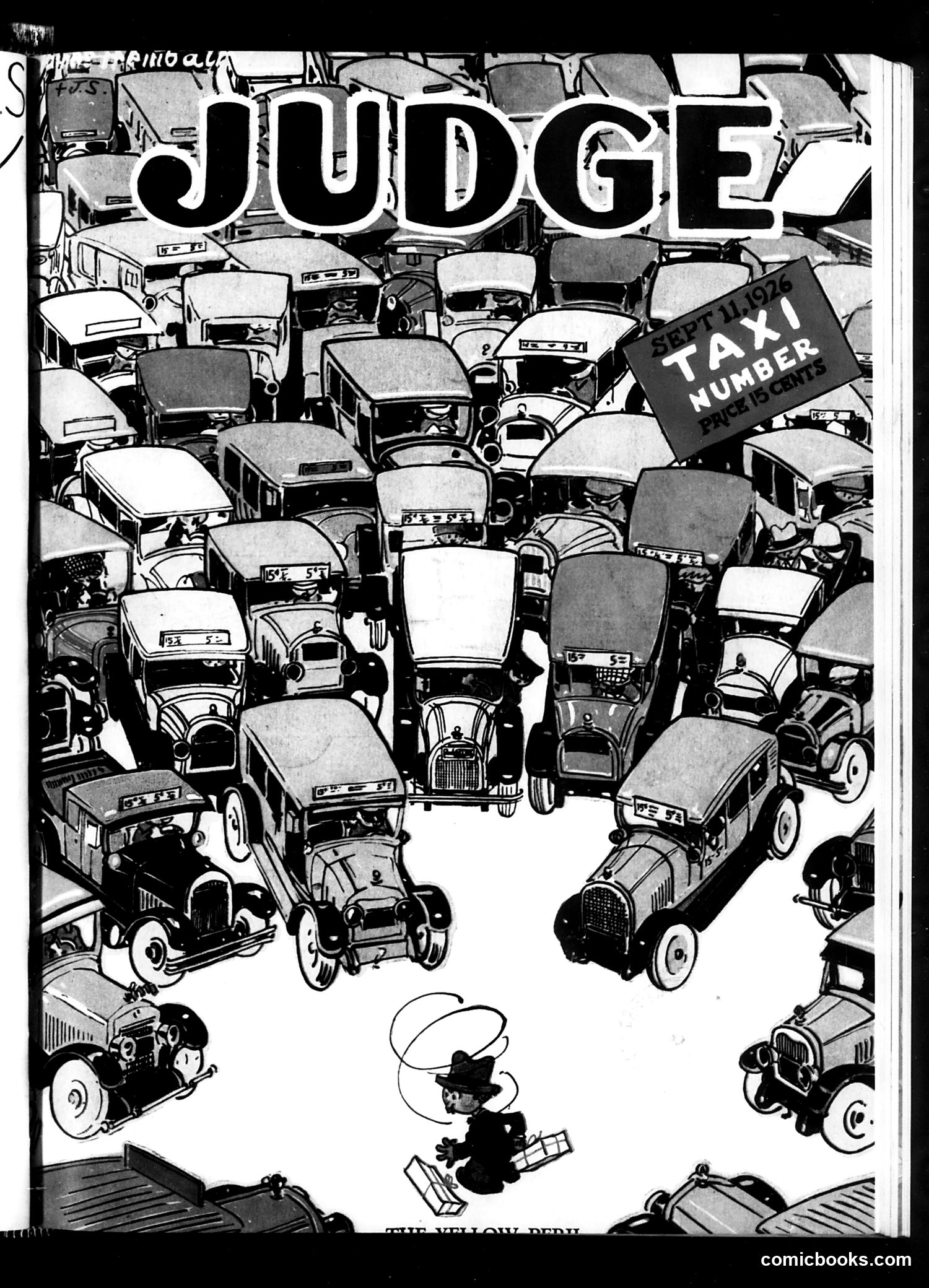
This is a Judge magazine cover satirizing taxi regulation, likely from the 1920s based on the style. The image shows dozens of taxis crammed together in a chaotic overhead view, with a single figure (appearing to be a city official or regulator) standing bewildered in the center amid the congestion. The "TAXI NUMBER PLUMBER" label suggests the satire targets someone—likely a city official or regulatory body—attempting to manage or control the proliferation of taxi cabs through licensing or numbering systems. The joke appears to be that such bureaucratic solutions are overwhelmed by the actual problem: too many taxis competing in urban streets, creating gridlock and confusion rather than order. The humor mocks both taxi-fleet chaos and ineffectual government regulation.
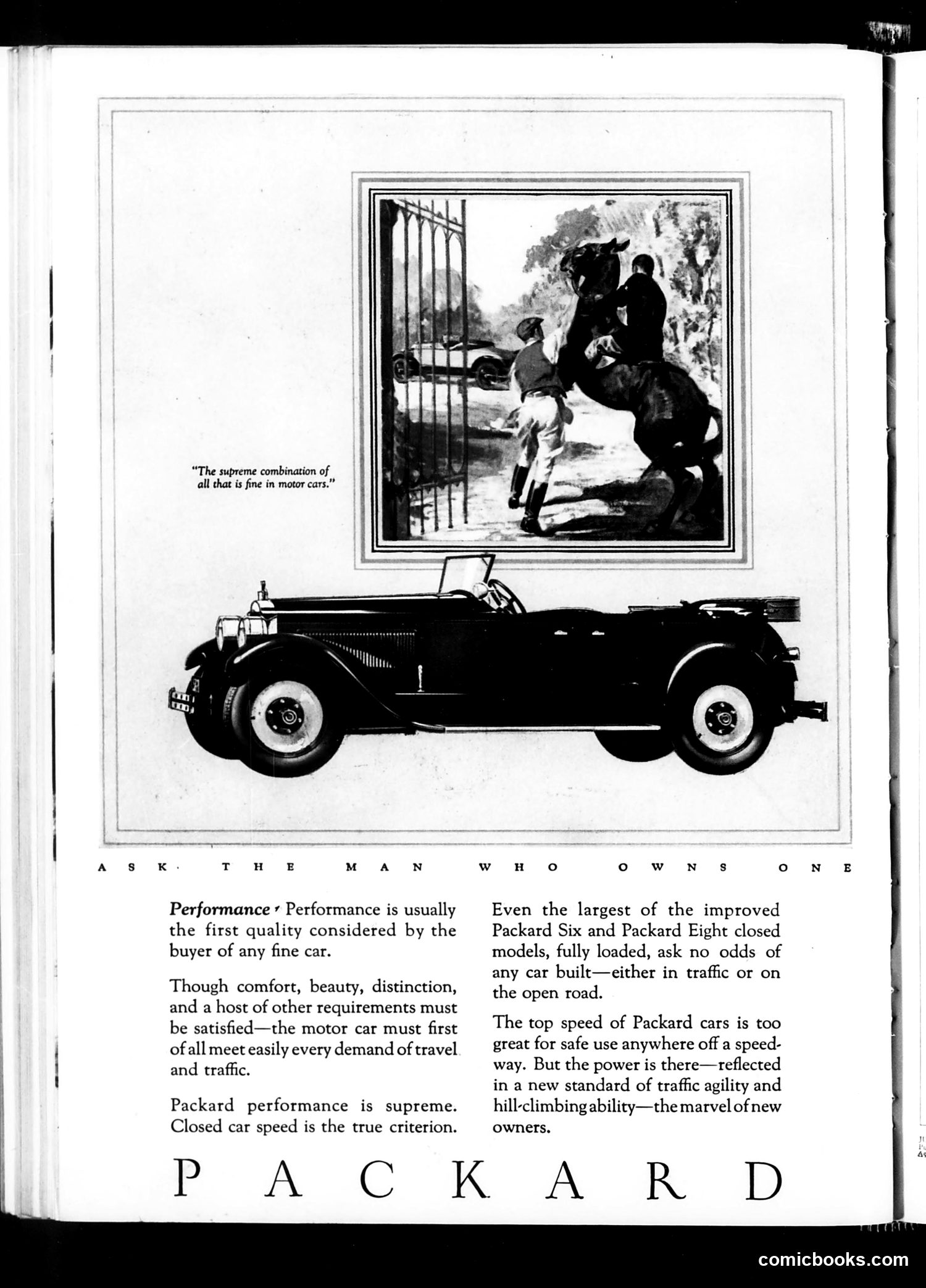
This page is primarily a **Packard automobile advertisement**, not political satire. The top image shows a scene of a man on horseback at a gate, with the caption "The supreme combination of all that is fine in motor cars." The advertisement emphasizes Packard performance, claiming their cars can handle any driving condition—traffic or open road—with superior speed and hill-climbing ability. The text positions Packard as the choice for discerning buyers who prioritize performance above other qualities. The equestrian imagery appears designed to evoke associations with luxury, tradition, and control—suggesting that owning a Packard conveys similar mastery and sophistication. This is purely commercial messaging, not political commentary or satire.
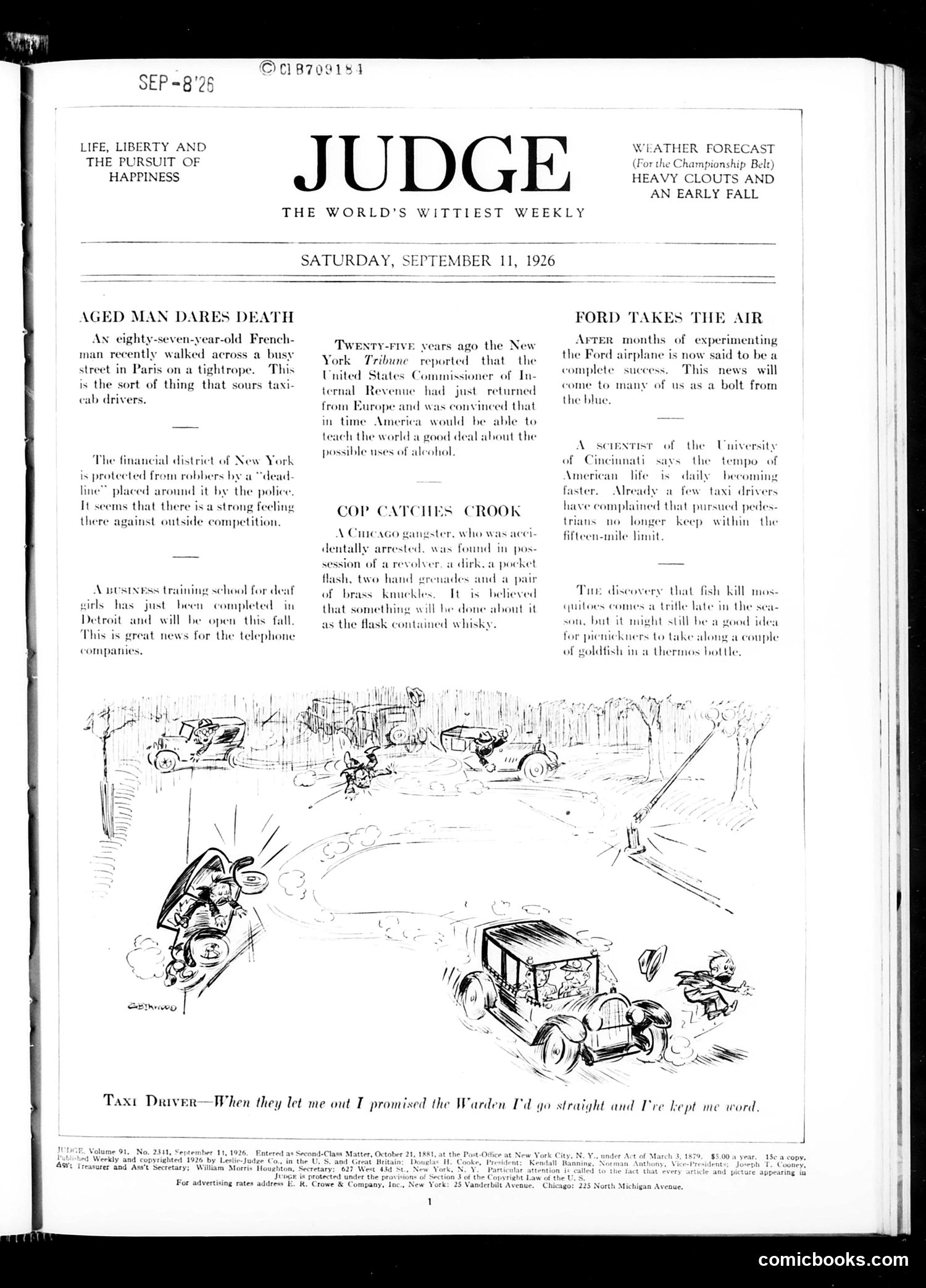
The main cartoon depicts a traffic accident scene with vintage automobiles and motorcycles colliding chaotically. The caption reads: "Taxi Driver—When they let me out I promised the Warden I'd go straight and I've kept me word." **The Satire:** The joke plays on the double meaning of "go straight"—both a promise of reformed behavior and literal driving directions. A recently released ex-convict taxi driver has caused a multi-vehicle pileup by driving in a perfectly straight line, despite the road's curves and traffic patterns. He's technically kept his word to the warden, but his literal interpretation creates dangerous chaos. The cartoon satirizes both criminal rehabilitation and reckless driving—contemporary concerns in 1926 as automobile traffic was rapidly increasing in American cities.
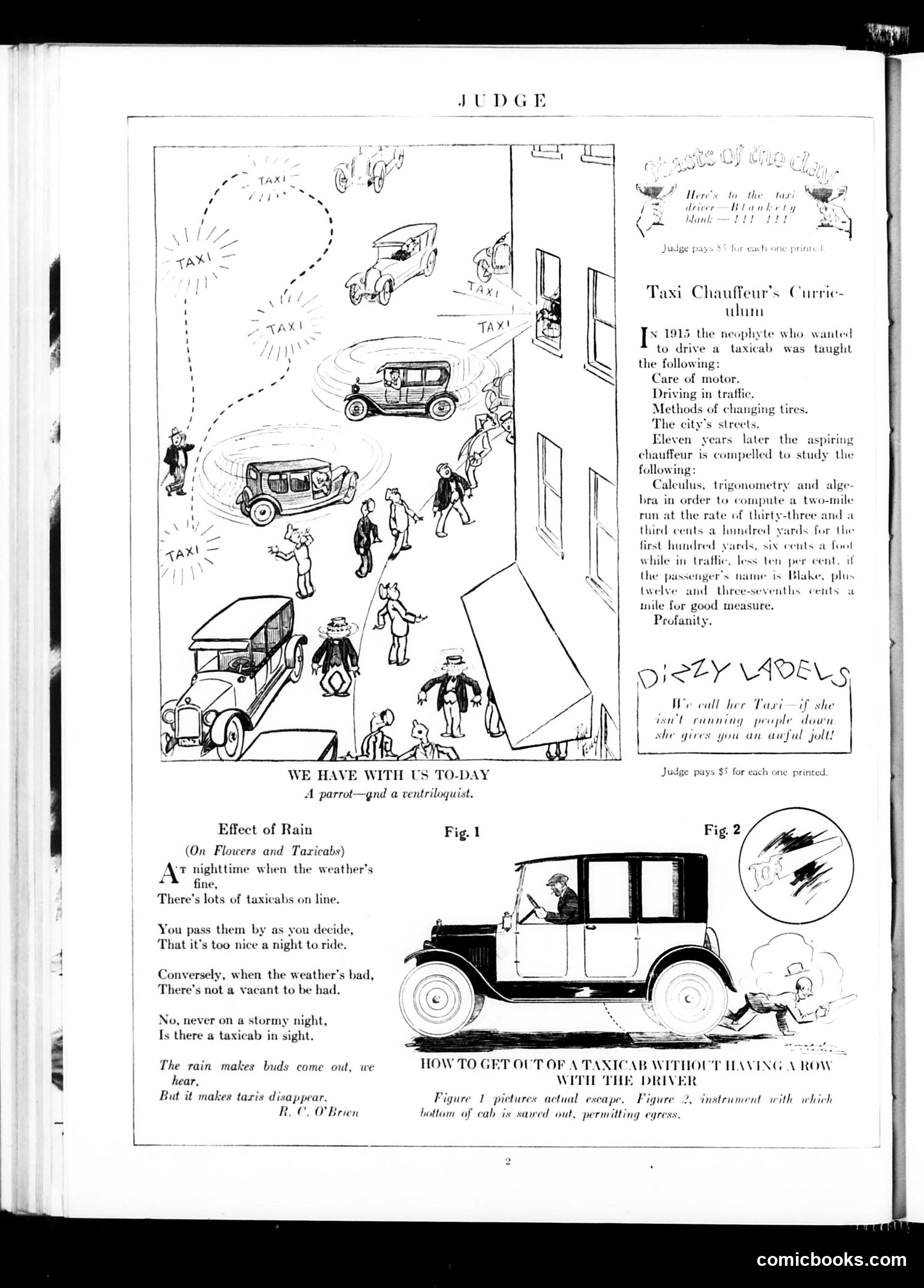
This page satirizes early taxi culture through three pieces: **"We Have With Us To-Day"** (top): A cartoon mocking the chaos of taxi cab operations—showing multiple cabs circling, pedestrians, and confusion. The subtitle "A parrot—and a ventriloquist" suggests taxis operate predictably or are controlled entities, possibly critiquing monopolistic practices or mechanical repetition in the industry. **"Taxi Chauffeur's Curriculum"** (right): Satirizes the educational gap for taxi drivers, listing what they supposedly need to learn (motor care, traffic rules, tire changing) while noting their actual training involves mathematics applied to fare-dodging and calculating profits. **"Effect of Rain" and escape diagrams** (bottom): Humorous commentary on taxi availability—plenty during good weather, none during storms—and a comedic "how to exit a taxi without paying" instructional, satirizing both fare evasion and driver frustration.
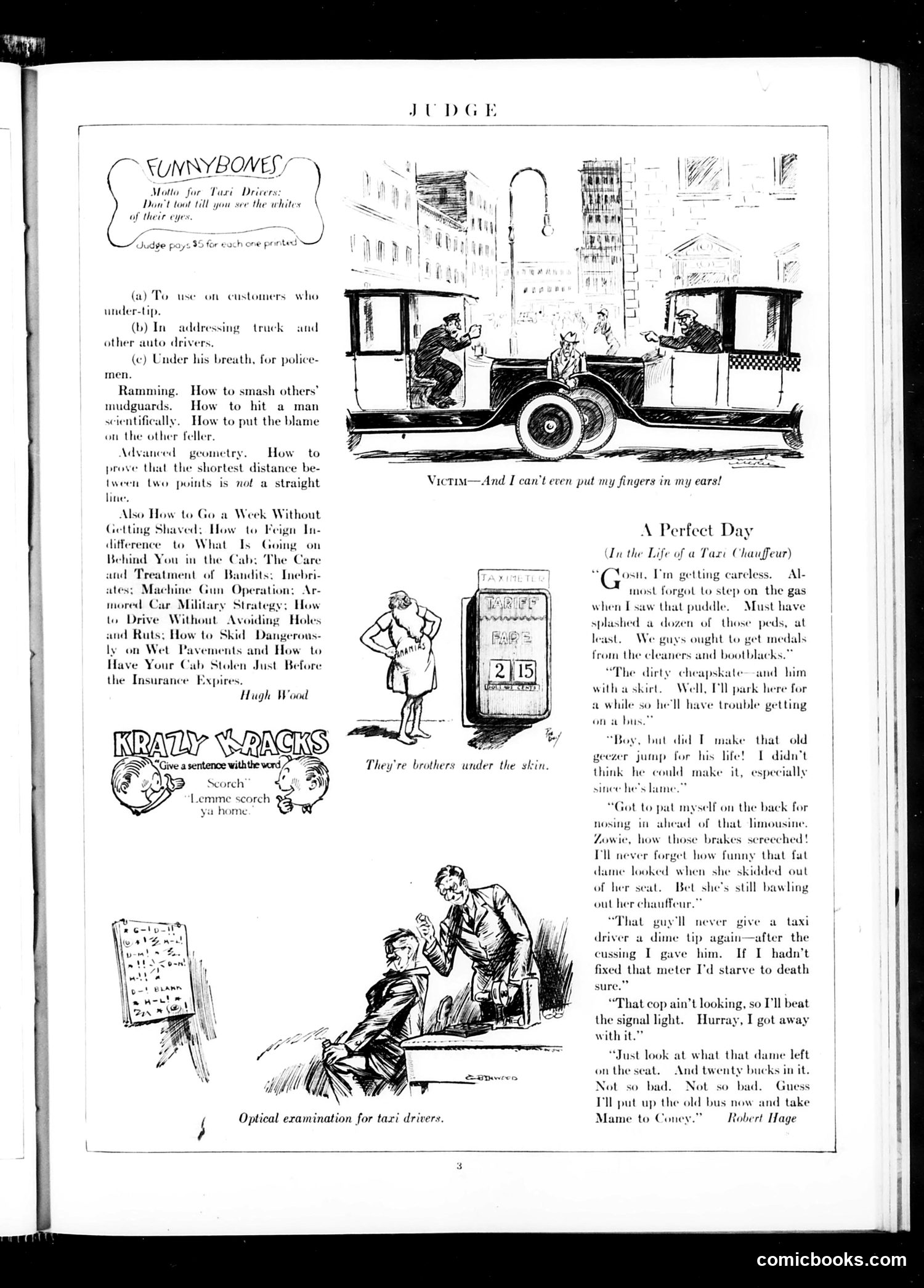
This page contains humor pieces about taxi drivers and urban transportation issues circa early 20th century. **"Funnybones"** features a multi-passenger taxi with the caption "And I can't even put my fingers in my ears!" — satirizing crowded, uncomfortable cab rides where passengers are crammed together. **"A Perfect Day (In the Life of a Taxi Chauffeur)"** presents a driver's monologue about his miserable workday: dealing with rude passengers, avoiding accidents, getting stiffed on tips, and suffering car troubles. The humor is sardonic—his "perfect day" is actually a litany of complaints and indignities. **"Krazy Kracks"** and "Optical examination for taxi drivers" offer additional taxi-related jokes, mocking driver incompetence and regulation. Overall, the page satirizes the growing taxi industry's poor working conditions and contentious relationship between drivers and passengers in urban America.
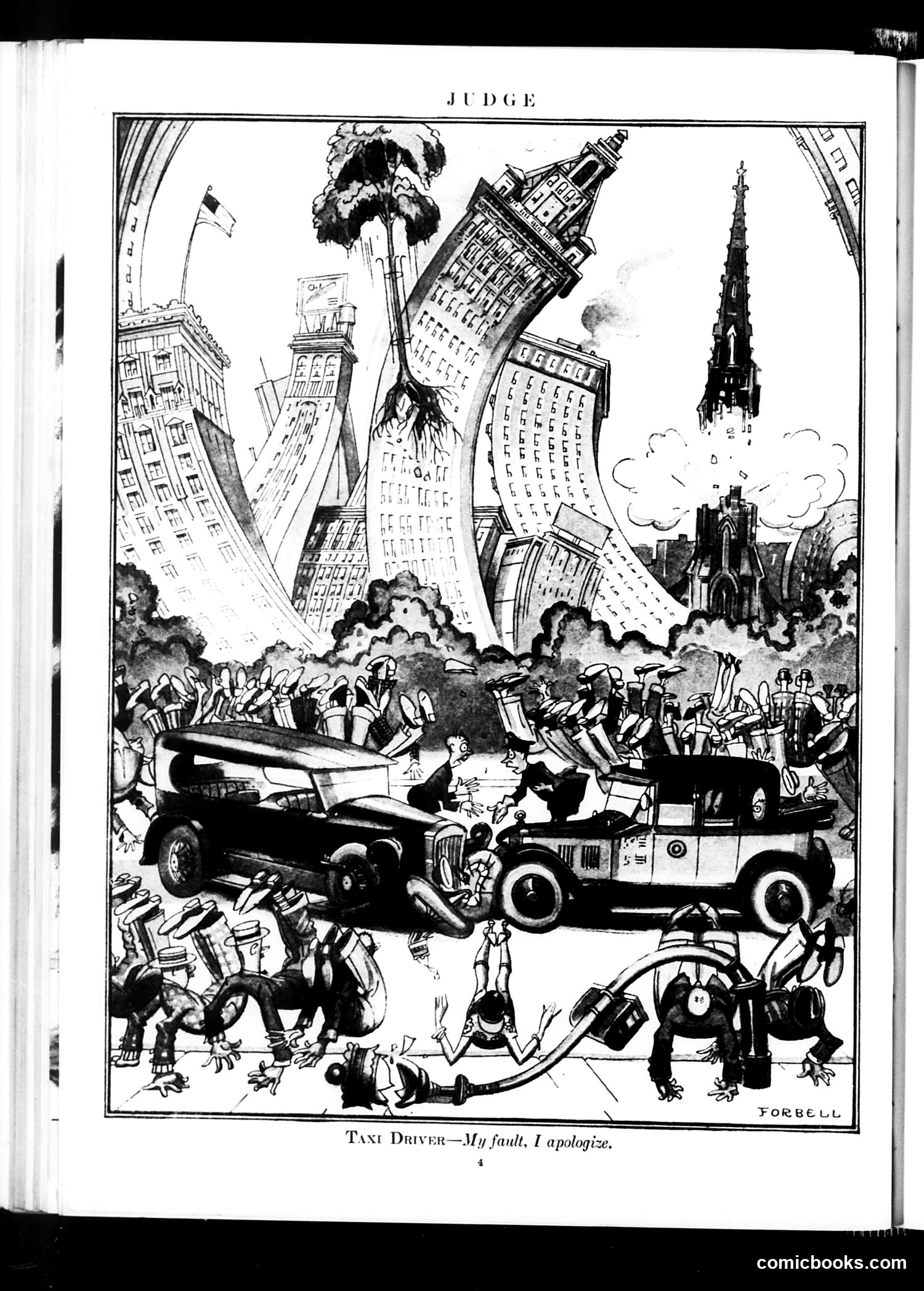
This cartoon satirizes reckless taxi drivers in early 20th-century urban America. The image shows a chaotic street scene where a taxi has collided with another vehicle amid a crowd of pedestrians and buildings. The driver appears to be offering a perfunctory apology ("My fault, I apologize") despite the massive destruction—toppled skyscrapers, panicked crowds, and general mayhem surrounding the accident. The joke mocks the casual indifference of taxi drivers to the dangerous consequences of their reckless driving. The absurdist exaggeration (buildings literally falling) emphasizes how minor infractions are treated as insignificant by drivers who cause real public hazard. This reflects contemporary concerns about traffic safety and the unpredictable behavior of early motorists in crowded city streets.
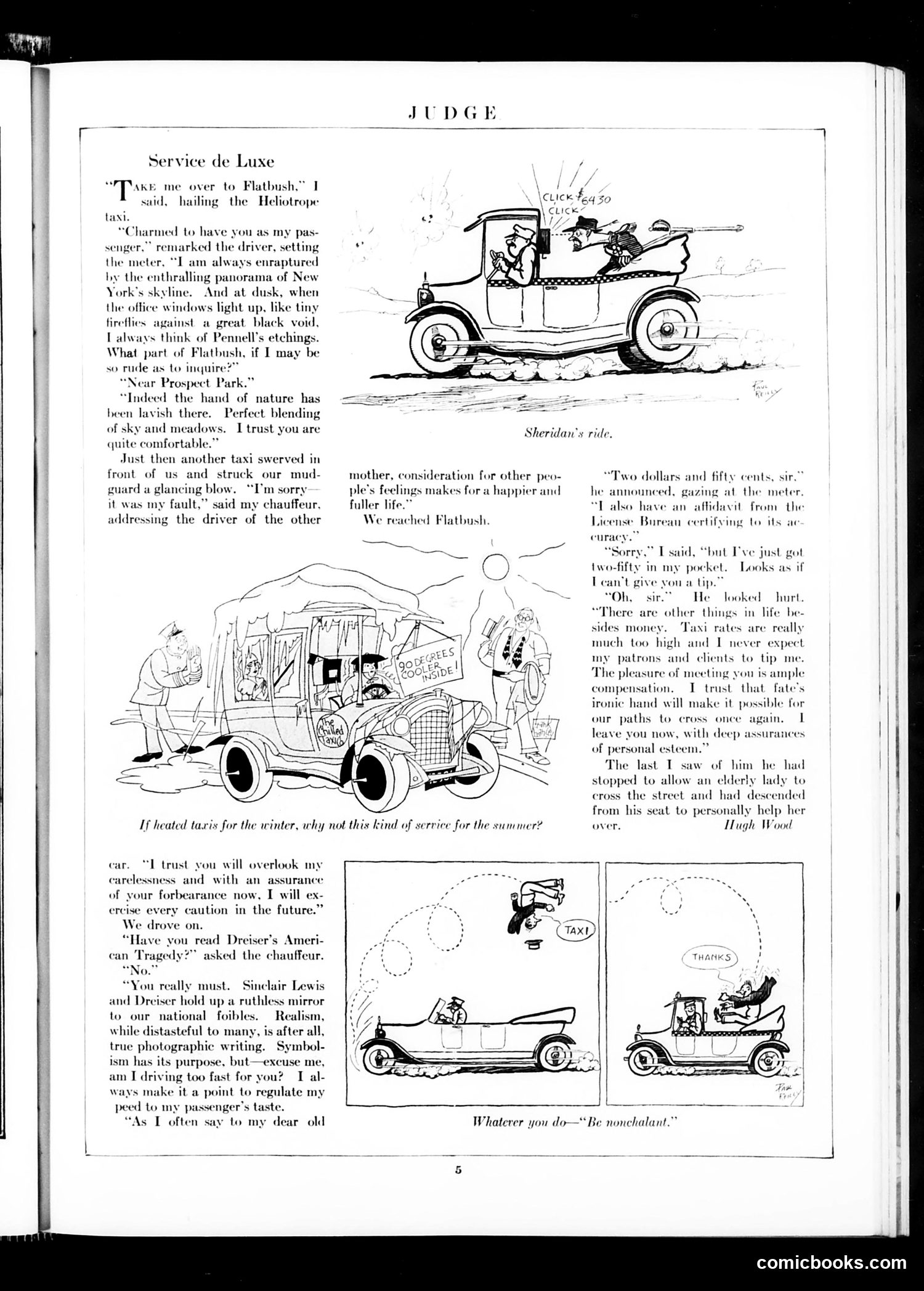
This satirical article mocks the contrast between taxi service quality and passenger expectations in early 1920s New York City. The humor centers on taxi drivers' rudeness and carelessness versus their demands for tips. The narrative describes a collision between two taxis, with the driver blaming the passenger for the accident. The passenger, unable to afford a tip, receives the driver's contempt despite having paid the fare. The cartoons illustrate the irony: drivers cause accidents and provide poor service, yet expect generous gratuities. The piece satirizes working-class entitlement and the emerging "tipping culture" problem—drivers demanding compensation beyond stated fares for unreliable, often dangerous service. It reflects contemporary frustration with New York City's taxi system and labor relations.
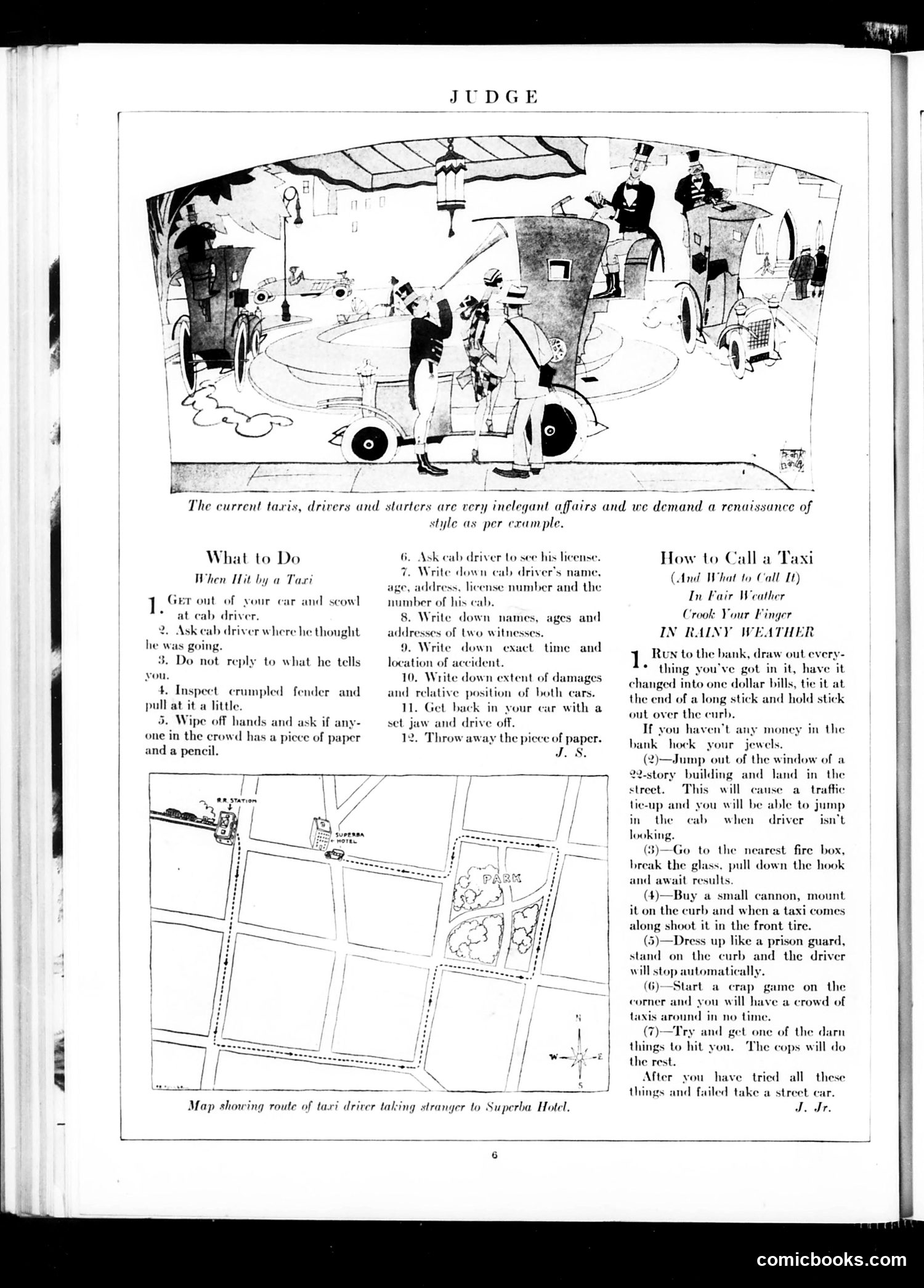
This page satirizes the poor state of taxi service and traffic safety in early 20th-century urban America. The top cartoon depicts a chaotic street scene with multiple taxis, pedestrians, and vehicles—conveying the disorder and danger of taxi transportation. The left column provides mock-serious instructions for what to do after a taxi accident: document the damage, collect witness information, and remain composed. This satirizes both the frequency of taxi collisions and the bureaucratic procedures citizens must endure. The right section absurdly escalates methods for summoning a taxi in different weather—from crooked fingers to jumping from buildings, firing cannons at cabs, and dressing as a prison guard. The escalating lunacy mocks the near-impossibility of actually obtaining taxi service. The final punchline—"take a street car"—suggests public transit is more reliable than taxis, a damning indictment of the taxi industry's incompetence and unreliability. The satire targets taxi drivers' poor conduct, dangerous driving, and the general inadequacy of taxi service as a transportation solution.
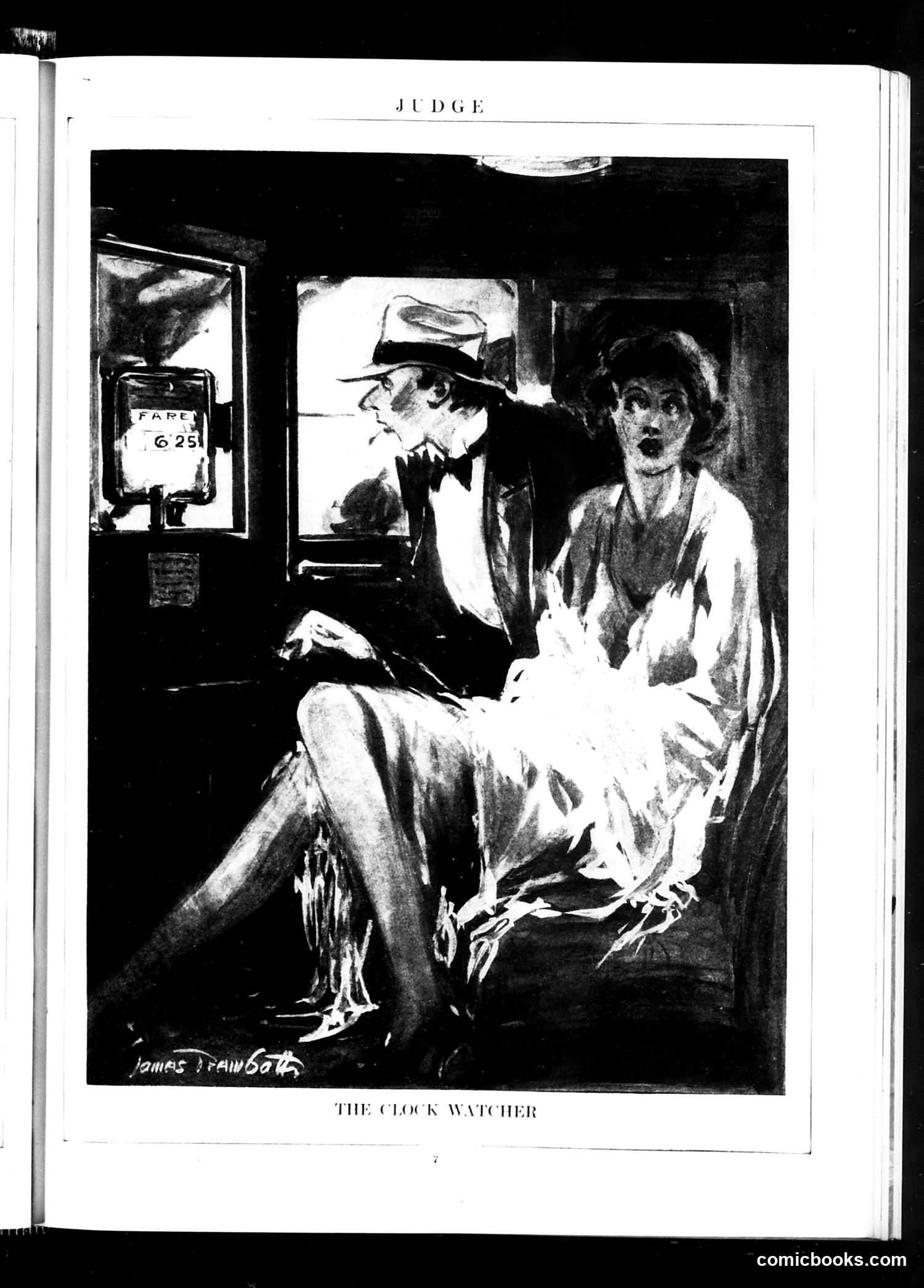
This illustration by James Montgomery Flagg depicts a domestic scene in what appears to be a taxicab or early automobile. A well-dressed man in a straw hat and bow tie sits beside a woman in a light dress, who looks startled or concerned. A clock face is visible on the vehicle's interior wall, marked with "6:25." The title "The Clock Watcher" suggests satirical commentary on punctuality or time-consciousness, likely poking fun at social conventions of the era. The woman's expression and body language suggest surprise or alarm at something—possibly the man's behavior or the late hour. The cartoon appears to mock romantic or social impropriety in early 20th-century courtship customs.
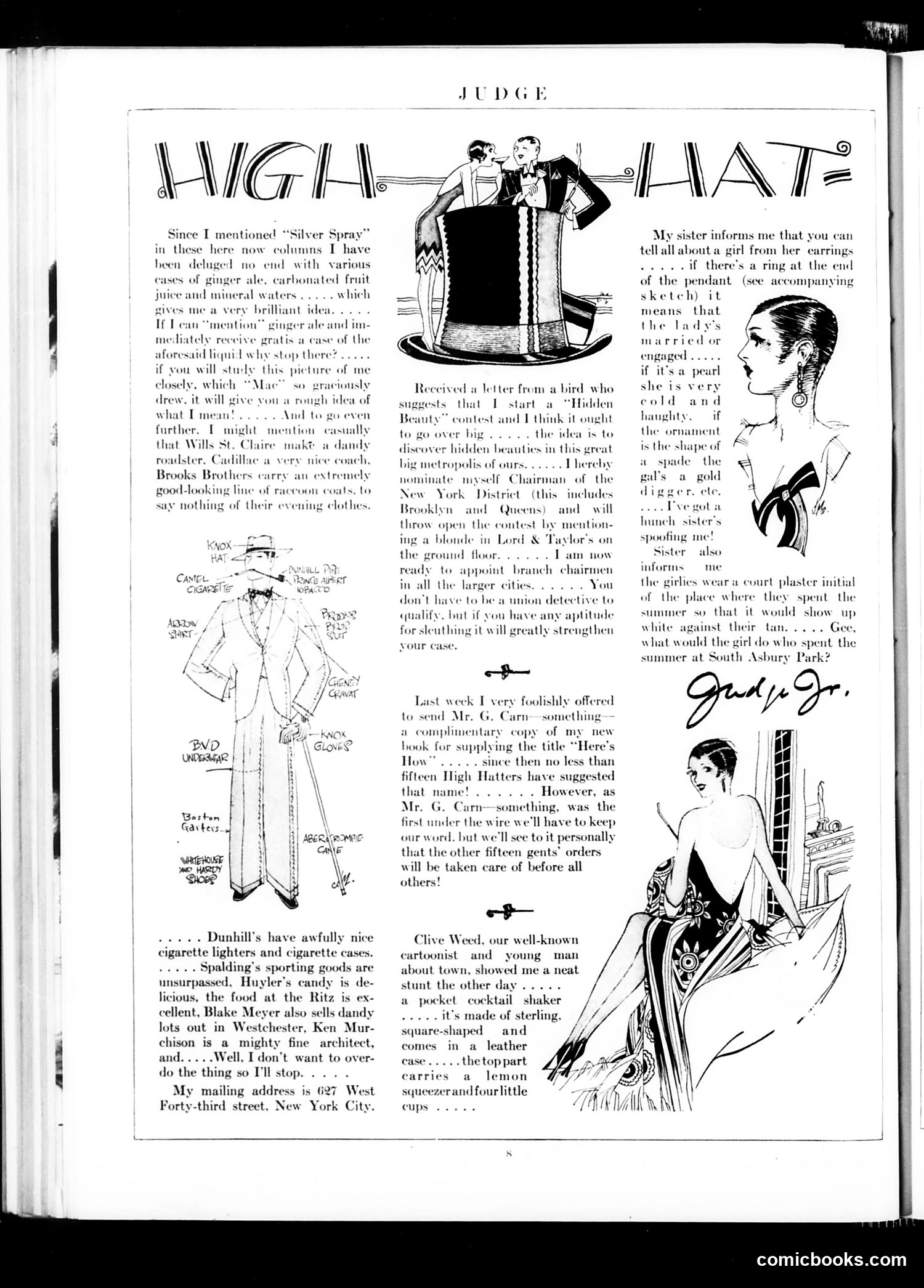
This is a humorous society column by someone using the pen name "Judge" (signature visible). The satire works on multiple levels: **The Main Joke**: The columnist openly admits to shameless product placement, joking that if mentioning "Silver Spray" ginger ale earned him free cases, he should mention luxury brands (Brooks Brothers, Cadillac, Ritz Hotel, Dunhill) to receive complimentary goods. This mocks both advertising culture and the columnist's own transparent commercialism. **Social Commentary**: The piece satirizes 1920s high-society pretension through references to "High Hatters" (snobby, upper-class types) and a proposed "Hidden Beauty" contest for discovering overlooked women in New York City. **The Earring Joke**: A sidebar mockingly explains how to judge women's marital status and temperament by their earring style—absurdist pseudo-scientific social commentary typical of the era's gender stereotyping. The column targets Jazz Age consumerism and class affectation while maintaining a self-aware, winking tone about its own commercial interests.
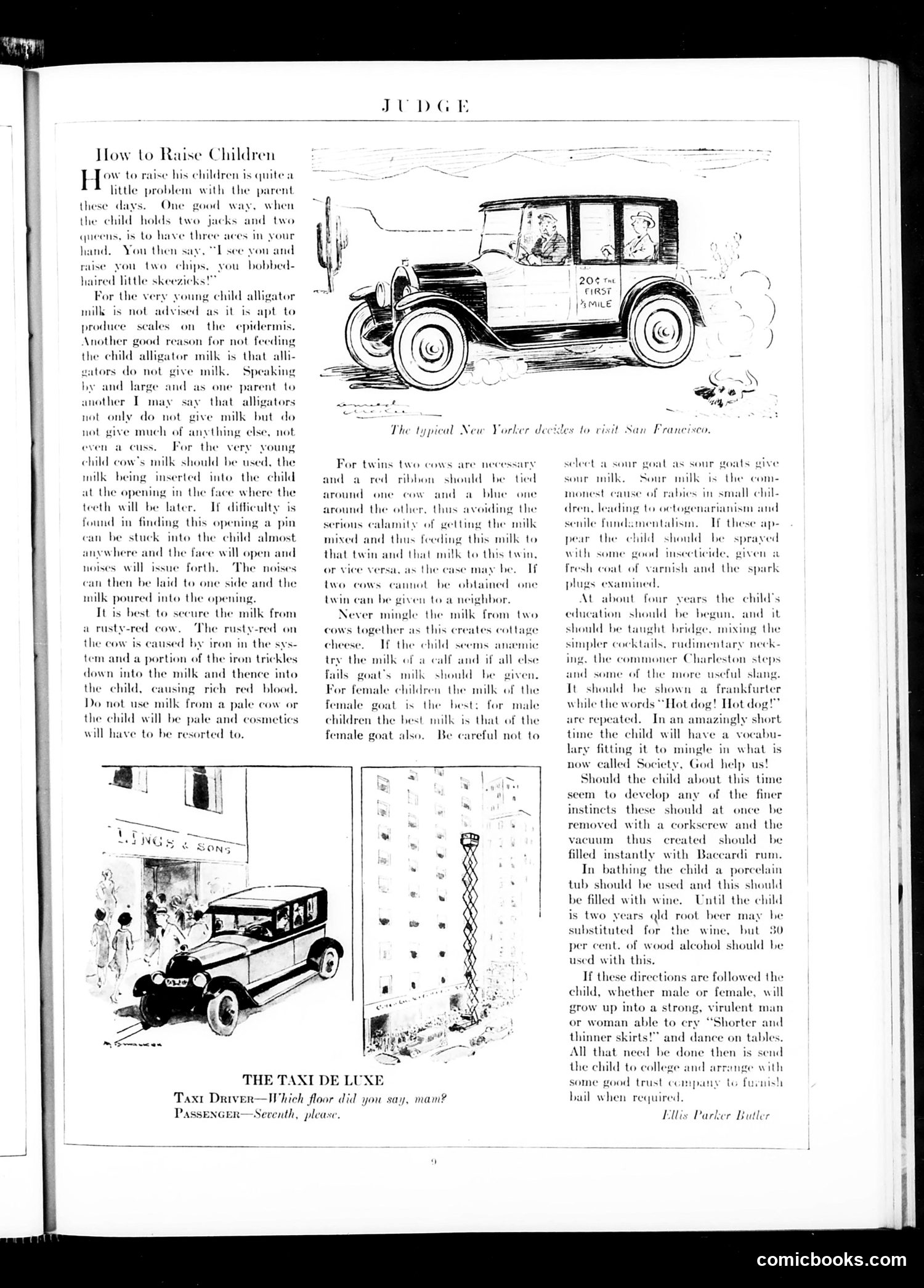
This is absurdist satire mocking modern parenting advice and Jazz Age excess. The author (Ellis Parker Butler) ridicules contemporary child-rearing guidance through deliberately outrageous, contradictory recommendations—feeding children alligator milk, using pins to locate their mouths, and bathing them in wine. The satire targets 1920s social anxieties: permissive parenting, the "bobbed-haired" flapper generation ("skeezicks"), and moral decline. The advice escalates absurdly, culminating in instructions to remove children's "finer instincts" with a corkscrew and replace them with rum—mocking how carelessly society was abandoning Victorian values for hedonism. The accompanying cartoons (a car full of children, "The Taxi De Luxe") reinforce themes of modern chaos and frivolity. This satirizes both parental incompetence and the era's cultural transformation.
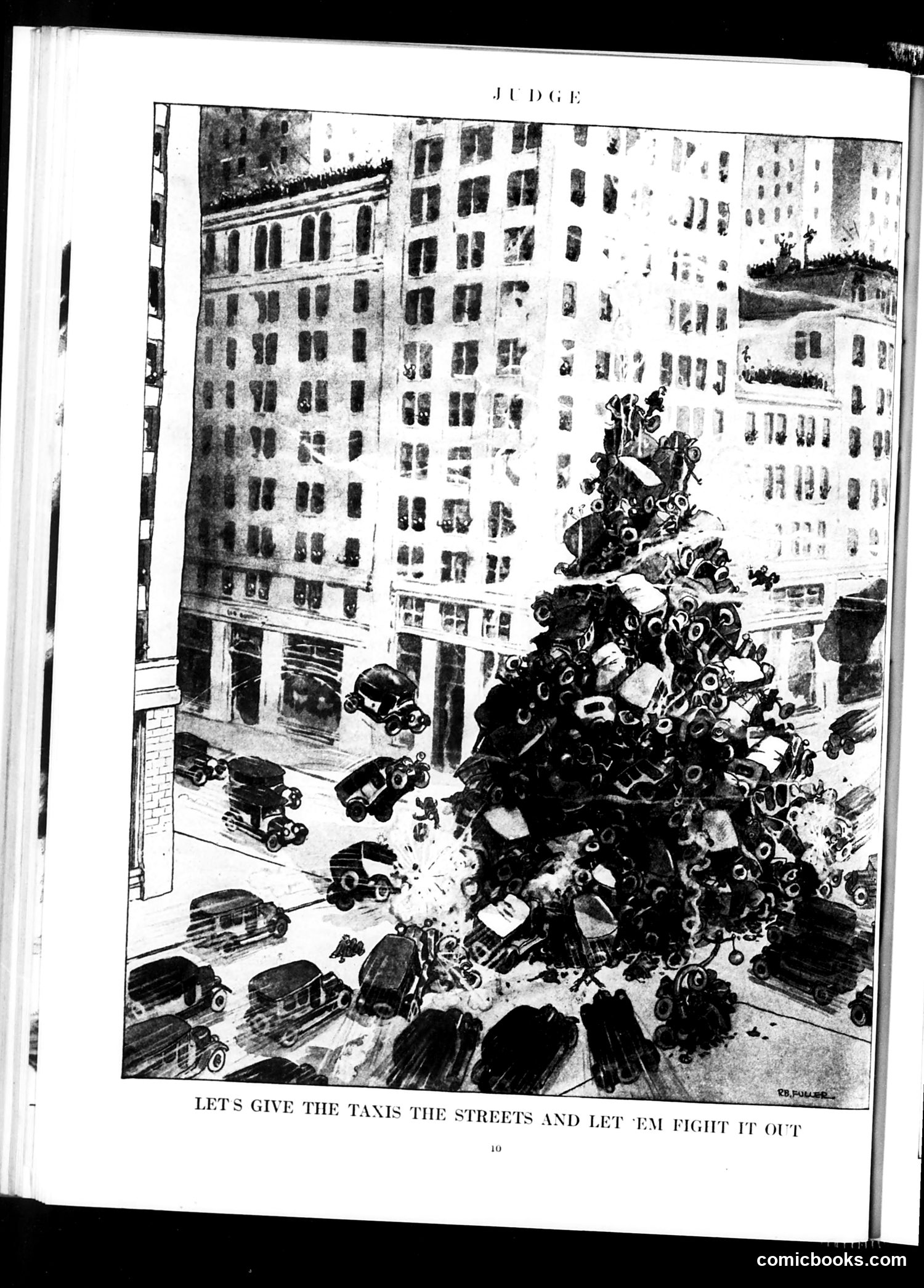
This is a satirical illustration from *Judge* magazine depicting a massive, chaotic pile-up of taxicabs in an urban street canyon. The caption reads: "LET'S GIVE THE TAXIS THE STREETS AND LET 'EM FIGHT IT OUT." The cartoon critiques what appears to be a proposal to grant taxis preferential street access in cities. The satire suggests that giving taxis dominance would result in pandemonium—literally showing dozens of vehicles crashed and tangled together in the street below tall buildings. This reflects early 20th-century anxieties about traffic congestion and transportation policy in major cities. The joke argues that privileging one vehicle type wouldn't solve urban congestion; instead, it would worsen chaos. The image mocks the proposal as absurd and impractical.
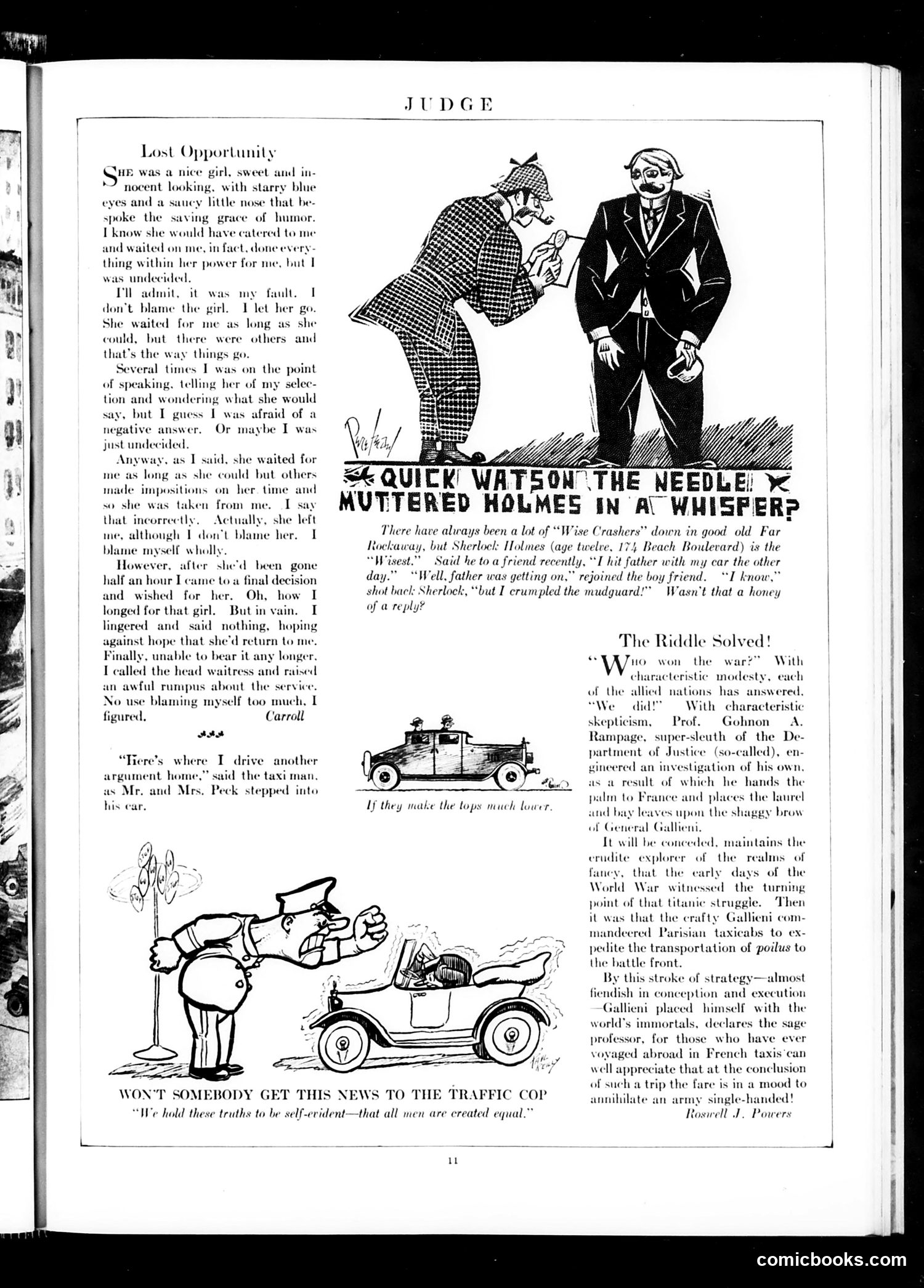
This page contains three satirical pieces from Judge magazine: **"Lost Opportunity"** (left): A sentimental story about a man who fails to propose to a waitress due to indecision, then regrets it when she leaves. The joke's conclusion reveals his complaint wasn't about losing her—it was about poor restaurant service. This satirizes male entitlement and shallow priorities. **"Quick! Watson, the Needle!"** (top right): A parody of Sherlock Holmes featuring a precocious 12-year-old who hits his father with a car, then brags about "crumpling the mudguard" as if it's a clever deduction. The satire mocks both child arrogance and the Holmes formula. **"The Riddle Solved!"** (bottom right): Mocks post-WWI debates over who won. Professor Rampage credits French General Gallieni's use of Parisian taxicabs to transport soldiers, then extends the "joke" by suggesting riding in expensive French taxis is so unpleasant it would make soldiers want to fight harder. This satirizes both nationalist posturing and French taxi reputation.
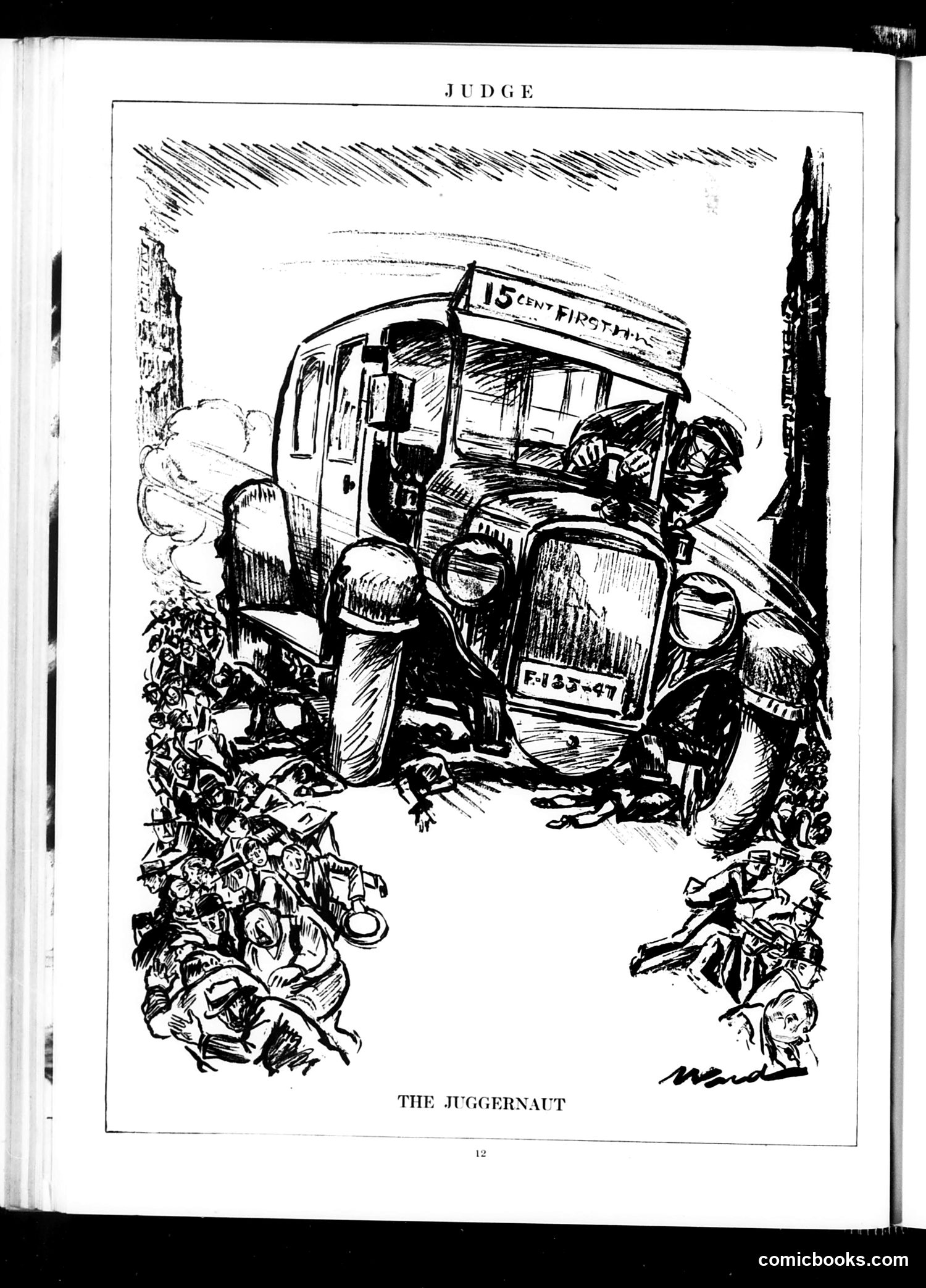
This political cartoon depicts a streetcar or bus labeled "15 CENT FARE" that has crashed into a mass of humanity below it. The vehicle, positioned as an unstoppable force, literally runs over a crowd of ordinary people—rendered as tangled, struggling figures. The title "The Juggernaut" references an unstoppable, crushing force. The satire appears to criticize rapid transit fare increases (the 15-cent fare is marked prominently) as indifferent to their impact on working-class passengers. The cartoon suggests that transit companies, like the mythical juggernaut, advance relentlessly regardless of human cost or suffering. This reflects early-20th-century labor and consumer protection debates around public transportation pricing.
This editorial essay laments the decline of great American university presidents. The author contrasts the "golden age" of figures like Harvard's Charles W. Eliot, Princeton's Woodrow Wilson, and others—described as genuine scholars with intellectual force—against modern college heads who are mere "executives and boosters" lacking independence or scholarly courage. The piece argues that contemporary universities, now wealthy and oversubscribed, no longer attract visionary leaders. Presidents focus on fundraising from alumni rather than leading intellectual advancement. The essay identifies three culprits: institutional comfort erodes ambition; administrative burdens repel genuine scholars; and alumni interference—particularly driven by football rivalry—pressures administrators toward mediocrity rather than innovation. The unnamed exception is Nicholas Murray Butler, praised for intellectual courage despite being "too obvious to be called scholarly."
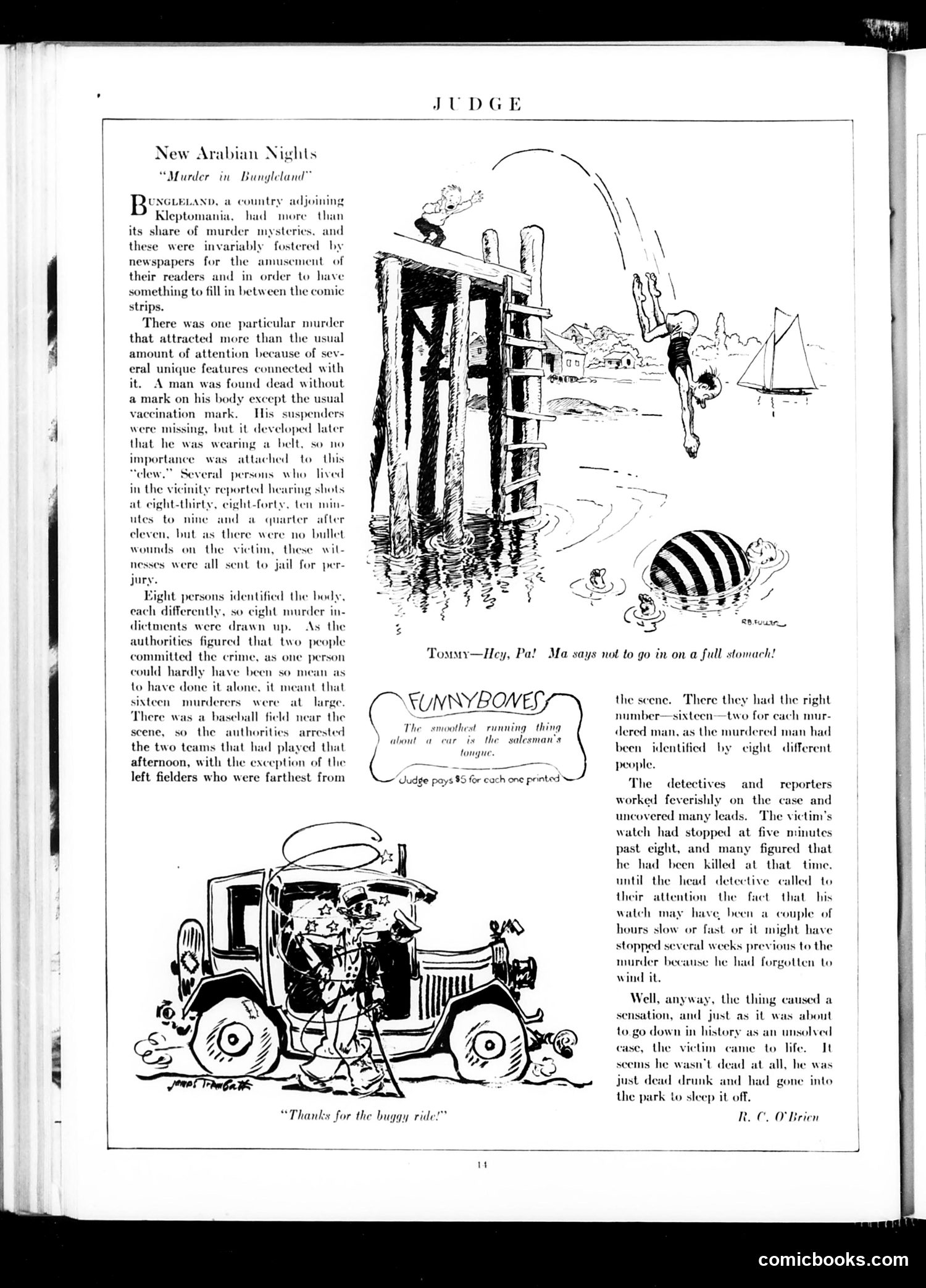
This is a humorous satirical story titled "Murder in Bungleland" mocking incompetent detective work and sensational newspaper coverage. The narrative describes a fictional country where a "murder" investigation spirals absurdly: eight people identify the body differently, leading to eight murder indictments; authorities arrest two baseball teams (minus left fielders) as suspects, totaling sixteen accused murderers. The satire targets how newspapers manufacture dramatic crime stories to entertain readers and fill space between comic strips. It also ridicules detectives' sloppy reasoning—they obsess over a stopped watch without considering it might be broken or unwound, and overlook obvious explanations. The punchline reveals the "victim" wasn't murdered at all but merely a drunk person sleeping in a park, making the entire investigation absurd from the start. The accompanying cartoon illustrations (a flooded cottage, a wrecked car) provide visual comedy supporting the theme of general incompetence.
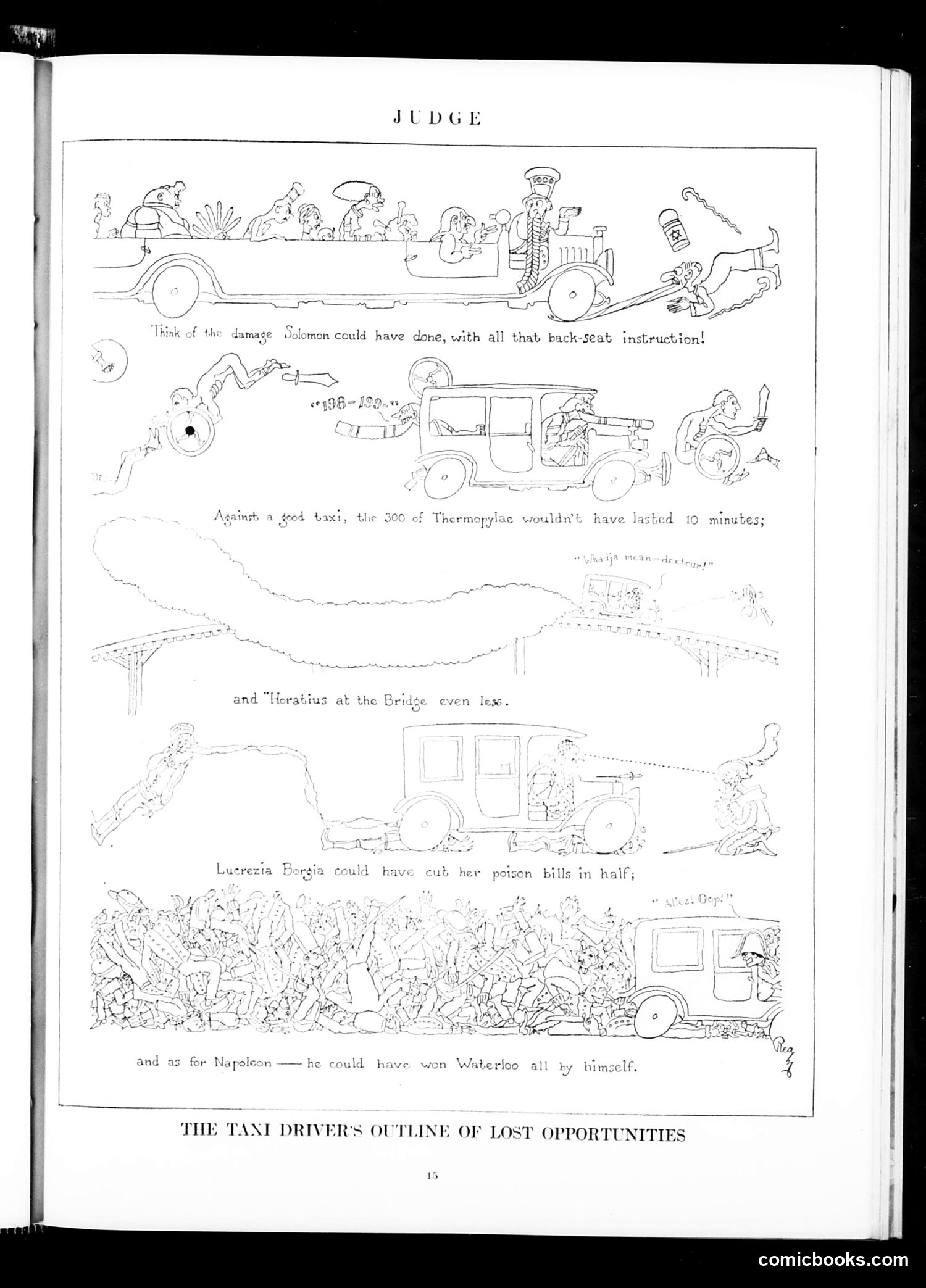
This is a humorous cartoon panel titled "Judge" showing a taxi driver imagining alternate historical scenarios where he could have achieved greatness. Each scene depicts a taxi being used in famous historical contexts: 1. Solomon receiving "back-seat instruction" (legal wisdom) 2. A thermopylae battle scenario where a taxi lasts longer than expected 3. Horatius at the Bridge 4. Lucrezia Borgia reducing her poison bills 5. Napoleon winning Waterloo The satire mocks the taxi driver's tendency to fantasize about how different he could have been under different circumstances—blending mundane modern taxi work with grandiose historical events. It's a working-class lament about missed potential and the gap between imagined abilities and actual station in life.
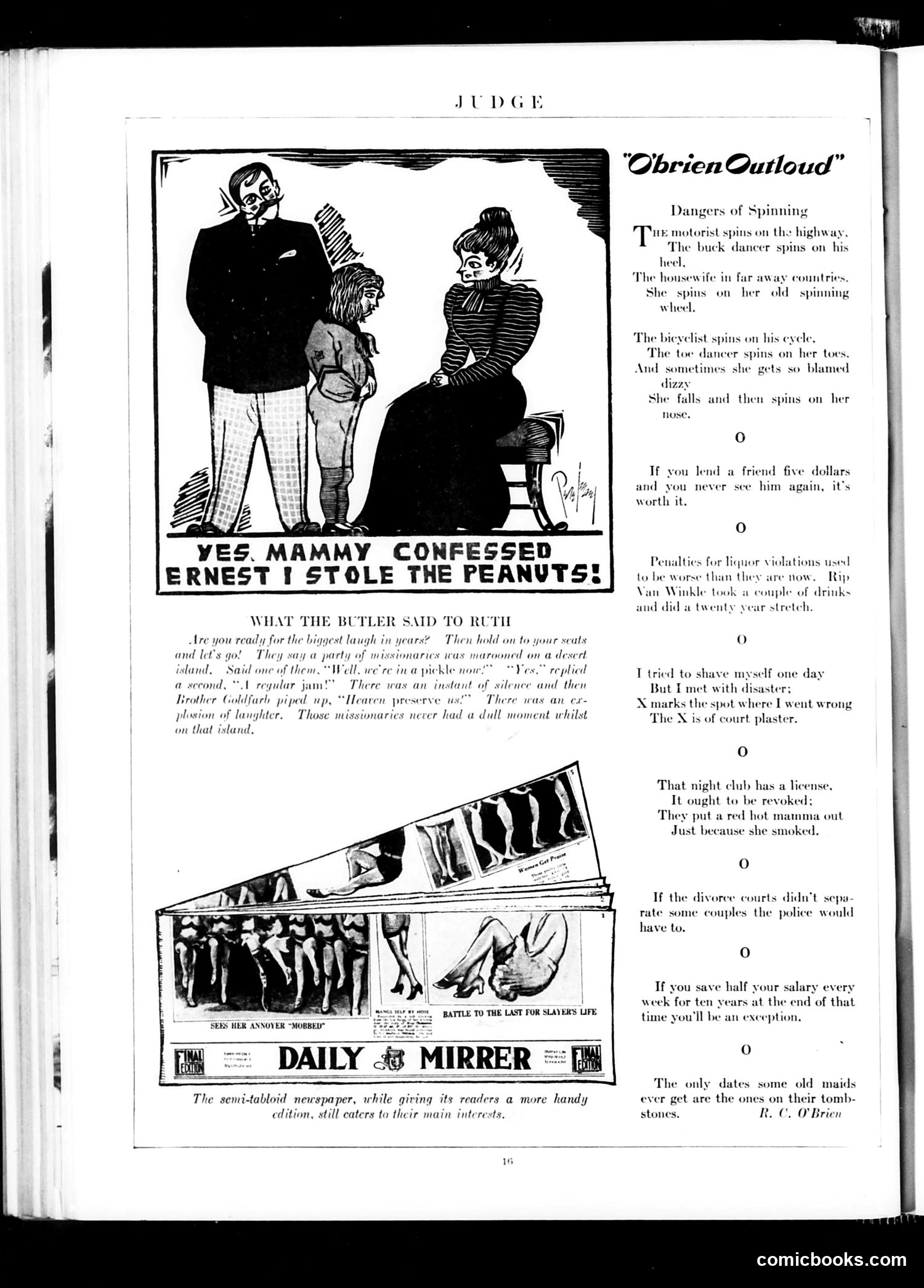
This Judge magazine page combines humor columns with social satire typical of early 20th-century American wit. **Top cartoon**: Shows a mother and child confronting a man, with the caption "Yes, Mammy Confessed Ernest I Stole the Peanuts!" This is a domestic comedy joke playing on a child's confession of petty theft—humor derived from childhood misbehavior and parental discipline. **"What the Butler Said to Ruth"**: A lengthy joke about missionaries stranded on an island making puns about their predicament ("pickle," "jam," "preserve"). The humor relies on wordplay and the incongruity of religious figures making bad jokes. **Right column titled "Obrien Outloud"**: A series of one-liner jokes and social observations by R.C. O'Brien covering contemporary concerns: reckless driving, alcohol prohibition penalties, divorce courts, and dating. These mock 1920s social anxieties and behaviors—particularly Prohibition enforcement and changing gender roles. **Bottom**: Notes that the "semi-tabloid newspaper" balances accessibility with entertainment value, reflecting Judge's own format. The overall tone is light satire of everyday American life rather than political commentary.
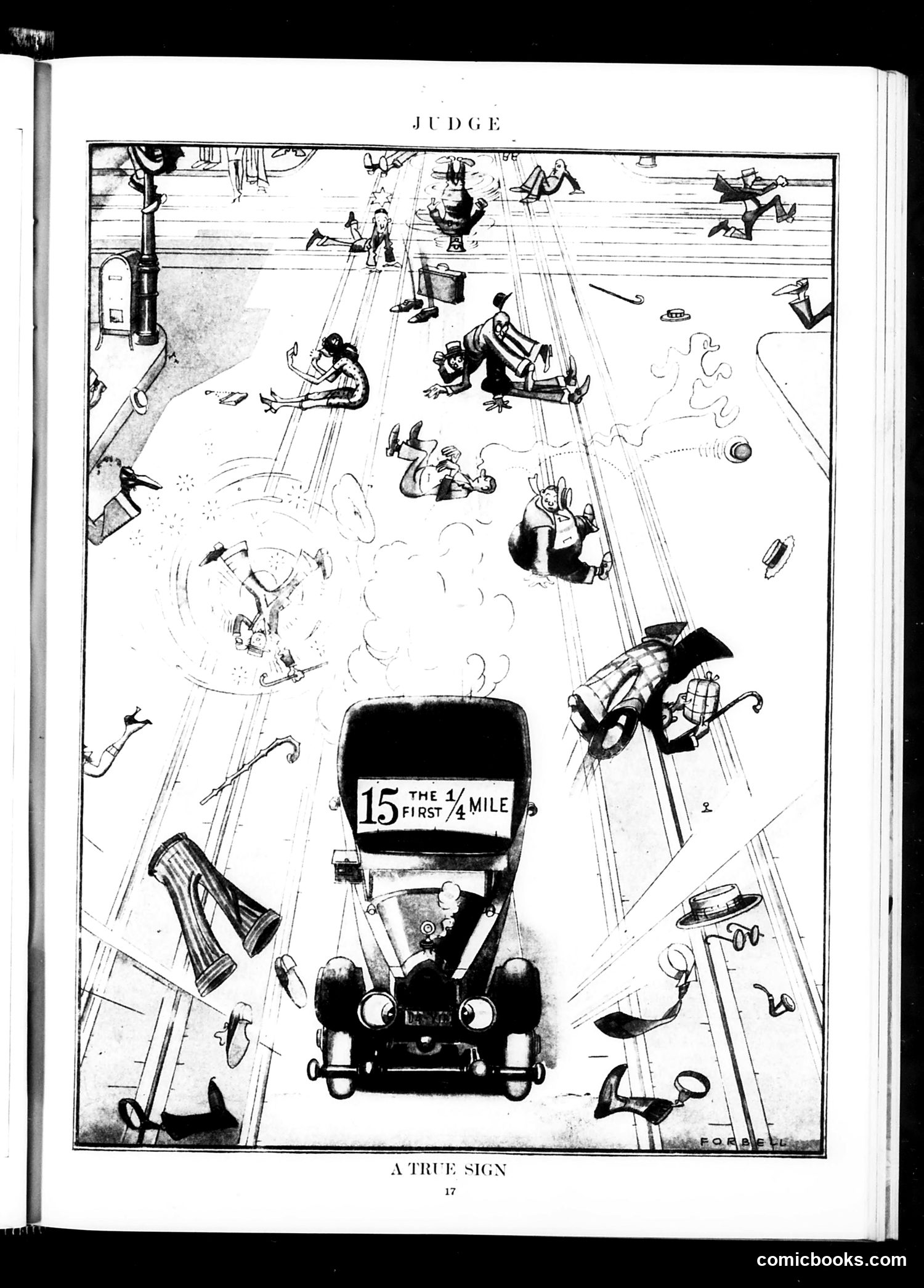
This Judge cartoon satirizes dangerous driving behavior, specifically speeding. The central image shows a car labeled "15 THE FIRST 1/4 MILE"—likely referencing a vehicle's acceleration capability or boasting about speed. Around this car, scattered across the road, are numerous accident victims: people flying through the air, injured figures, overturned vehicles, and debris. The satire's point is clear: the car's proud speed advertisement is surrounded by the actual human consequences of reckless driving. The "true sign" of such behavior isn't achievement but carnage. This reflects early 20th-century concerns about automobile safety as cars became faster and more common, killing pedestrians and passengers regularly. The cartoon critiques both dangerous driving culture and the automobiles' manufacturers who emphasized speed without acknowledging the deadly real-world outcomes.
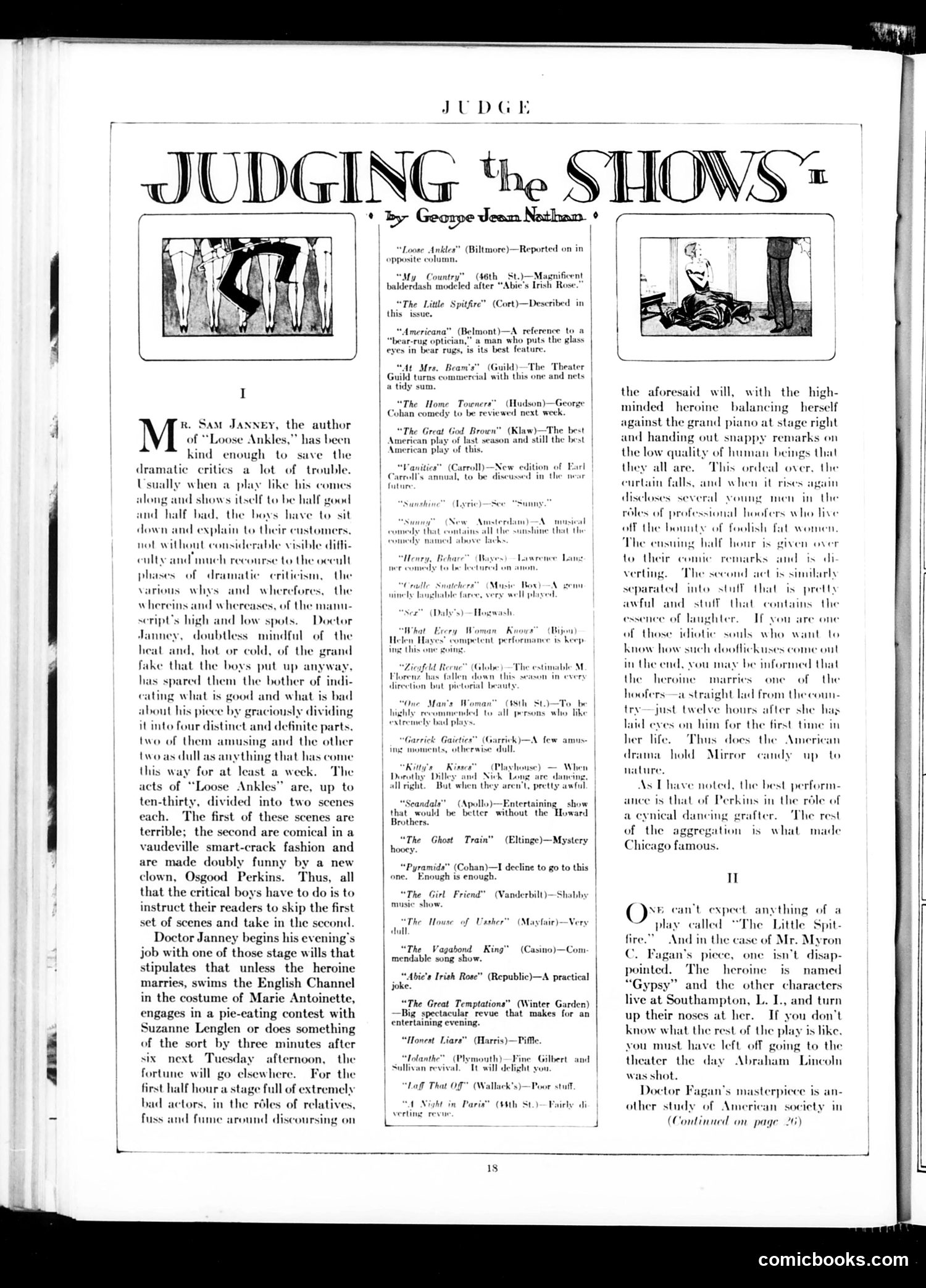
This page is a theater review column by George Jean Nathan. The main cartoon (top left) appears to show a stylized figure, likely representing theater criticism itself. Nathan's essay satirizes Dr. Samuel Janney's play "Loose Ankles" by praising him for solving critics' usual dilemma: how to explain that a play is "half good and half bad." Janney conveniently structures his play so the first scenes of each act are "terrible" while the second scenes are funny, allowing critics simply to tell readers to skip ahead. The satire mocks both the play's poor construction and critics' tendency to find workarounds rather than condemn bad theater outright. The accompanying theater listings show typical Broadway offerings of the 1920s era. Nathan's point: even mediocre drama gets rationalized by critics rather than honestly dismissed.
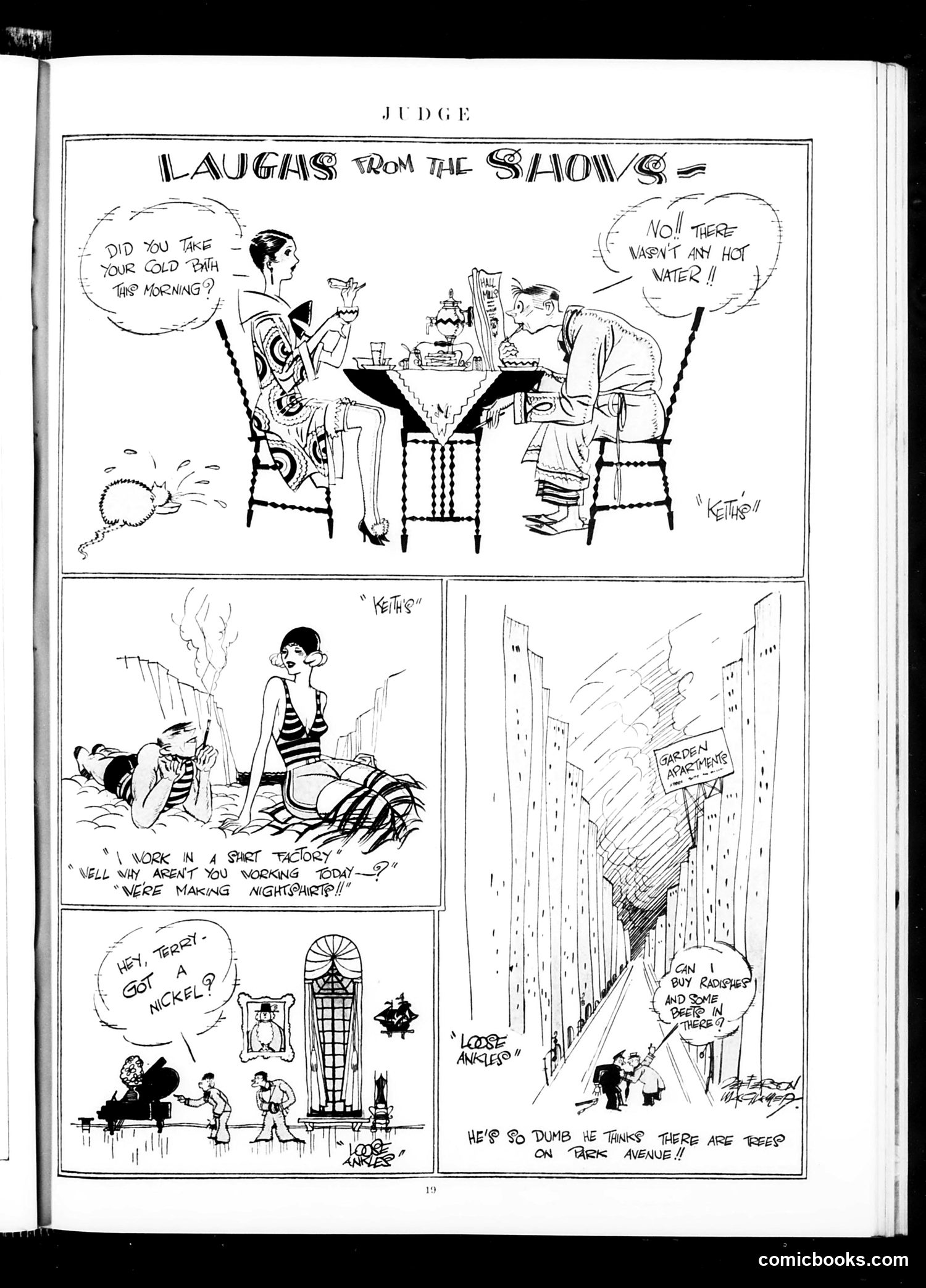
This appears to be a vintage Judge magazine humor page featuring four separate comics satirizing urban life and employment. **Top panel**: A couple at breakfast—she asks if he took a cold bath; he replies there's no hot water. This mocks domestic complaints and shabby living conditions. **Second panel**: A shirt factory scene where a worker claims he wasn't working because they were "making nightshirts"—a pun playing on the double meaning of "night" work. **Third panel**: Someone asks "Got a nickel?" in what appears to be Depression-era street begging or panhandling humor. **Bottom panel**: A man is so foolish he thinks "trees" exist on Park Avenue (an upscale Manhattan location), satirizing urban naïveté or working-class ignorance of wealthy neighborhoods. The overall theme mocks working-class struggles, unemployment, poverty, and social/economic gaps between rich and poor neighborhoods—likely from the 1920s-1930s era based on the style and content.
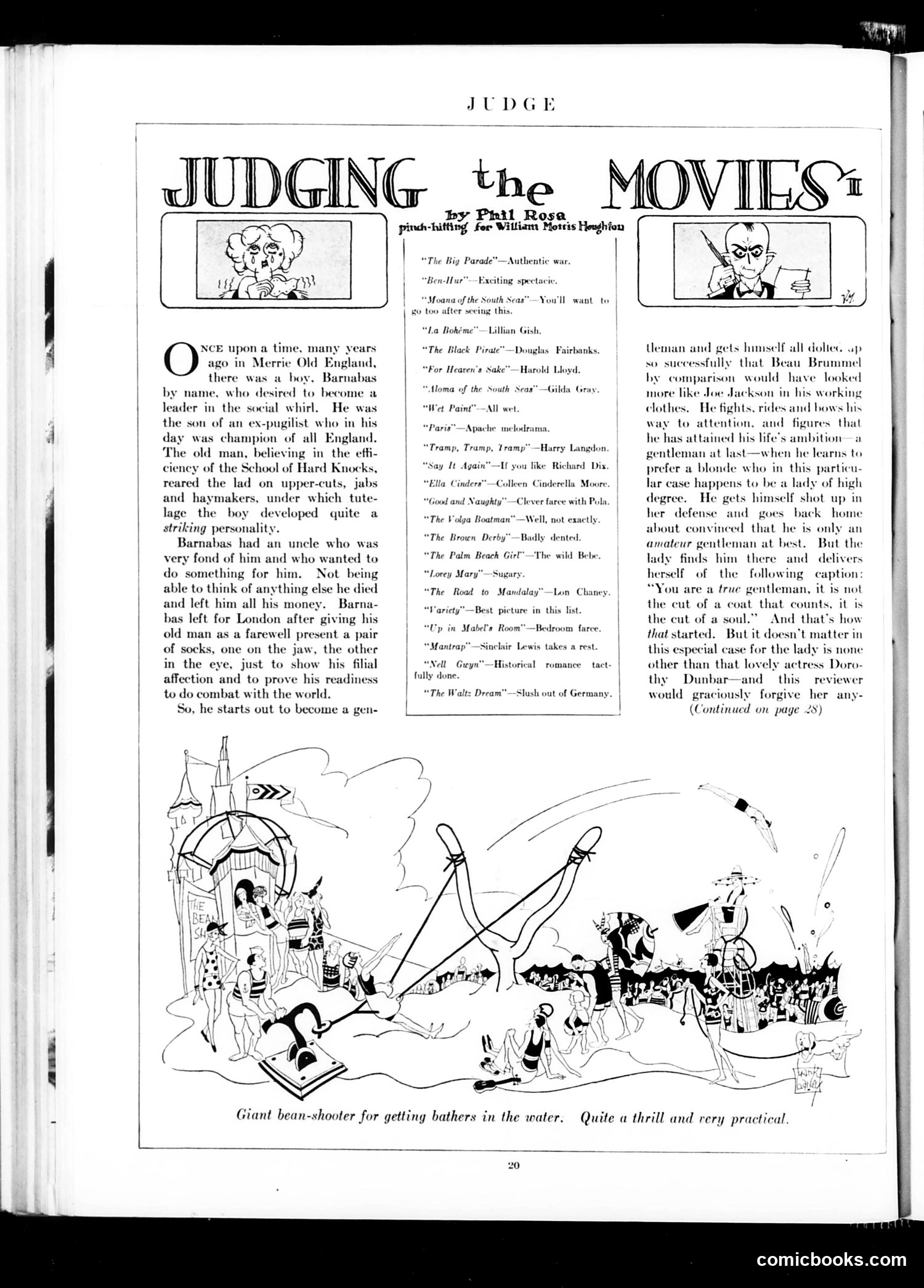
This page presents a satirical story about "Barnabas," a working-class boy who aspires to become a gentleman through fashionable dress and behavior. The narrative mocks social climbing and the superficiality of "high society"—he learns that true gentility comes from character ("the cut of a soul"), not appearance. The accompanying film list reviews contemporary 1920s movies, including *Variety*, *Ben-Hur*, and *The Big Parade*. The illustration shows an exaggerated "bean-shooter" contraption, satirizing the elaborate and absurd special effects of silent-era cinema. The piece satirizes both social pretension and Hollywood's tendency toward spectacle over substance. Dorothy Dunbar, mentioned as the female lead, was an actual silent-film actress. The humor relies on readers' familiarity with these films and period anxieties about class mobility and entertainment culture.
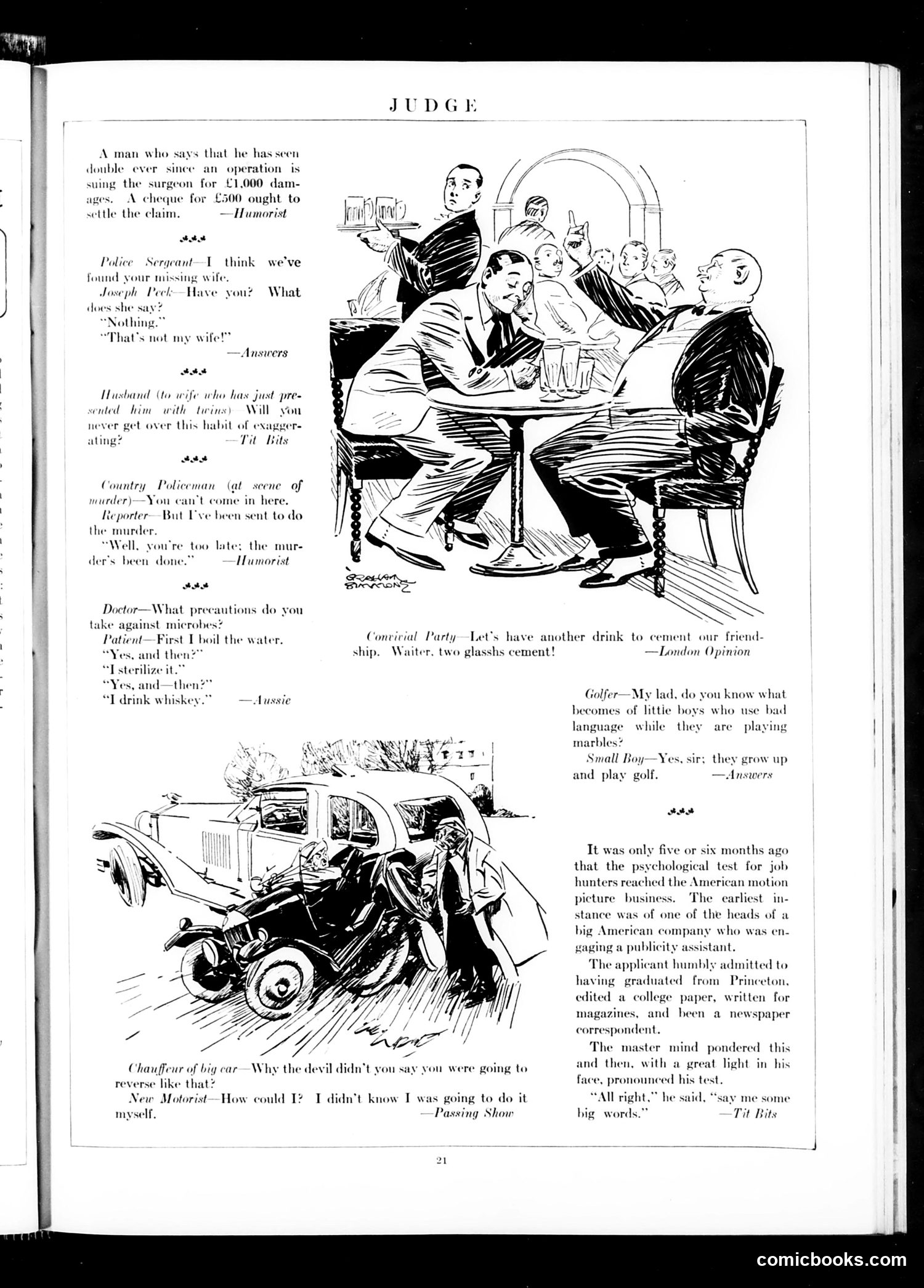
This page contains six short humorous anecdotes typical of Judge magazine's satirical style: 1. **Surgical double vision lawsuit**: Mocks frivolous litigation—a man suing a surgeon for seeing double, with the suggestion a £500 settlement is excessive. 2. **Missing wife joke**: Police sergeant's confusion; the punchline relies on the wife not being recognizable or the man's indifference. 3. **Twins exaggeration**: Husband complains his wife exaggerates; she's just given birth to twins—ironic timing. 4. **Reporter at murder scene**: Dark humor about journalistic persistence; the reporter arrives too late. 5. **Microbes/whiskey**: Doctor asks about precautions against microbes; patient's final answer (drinking whiskey) suggests alcohol kills germs—period medical folklore treated as joke. 6. **Car accident/motorist**: New driver can't explain reversing without warning—satirizes inexperienced motorists. The bottom story concerns a Hollywood publicity job applicant from Princeton who's asked to "say some big words"—mocking shallow hiring practices and suggesting the executive's test is absurdly simplistic. The illustrations depict these scenes in period cartoon style.
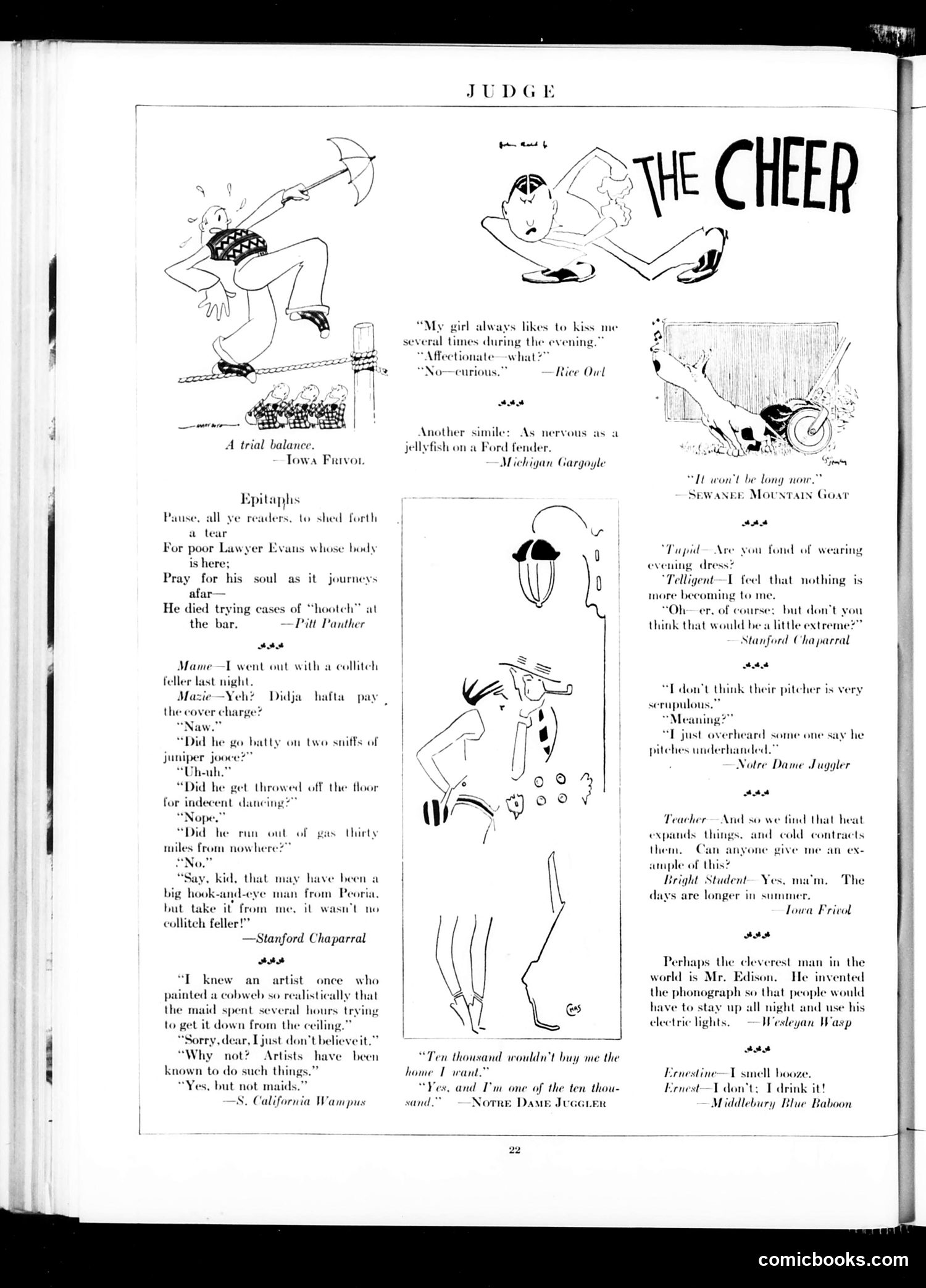
This page collects humorous one-liners and cartoon vignettes typical of Judge's satirical format, circa the 1920s (based on references to Prohibition-era "hootch" and Ford automobiles). **Main themes:** The cartoons mock social behaviors and popular anxieties of the era: awkward dating etiquette ("My girl always likes to kiss me"), Prohibition enforcement (the epitaph about lawyer Evans dying from bootleg liquor), automotive culture (the Ford fender jellyfish joke), and courtship conventions. **Visual gags** include exaggerated physical comedy—a woman with an umbrella, figures in various states of distress or absurdity. **The satire targets** everyday American life rather than specific political figures: silly romantic misunderstandings, youthful indiscretion, marital dynamics, and the gap between pretense and reality (the student claiming "days are longer in summer" as an example of heat expansion). The overall tone is lighthearted mockery of middle-class social rituals, typical of collegiate humor magazines that Judge republished.
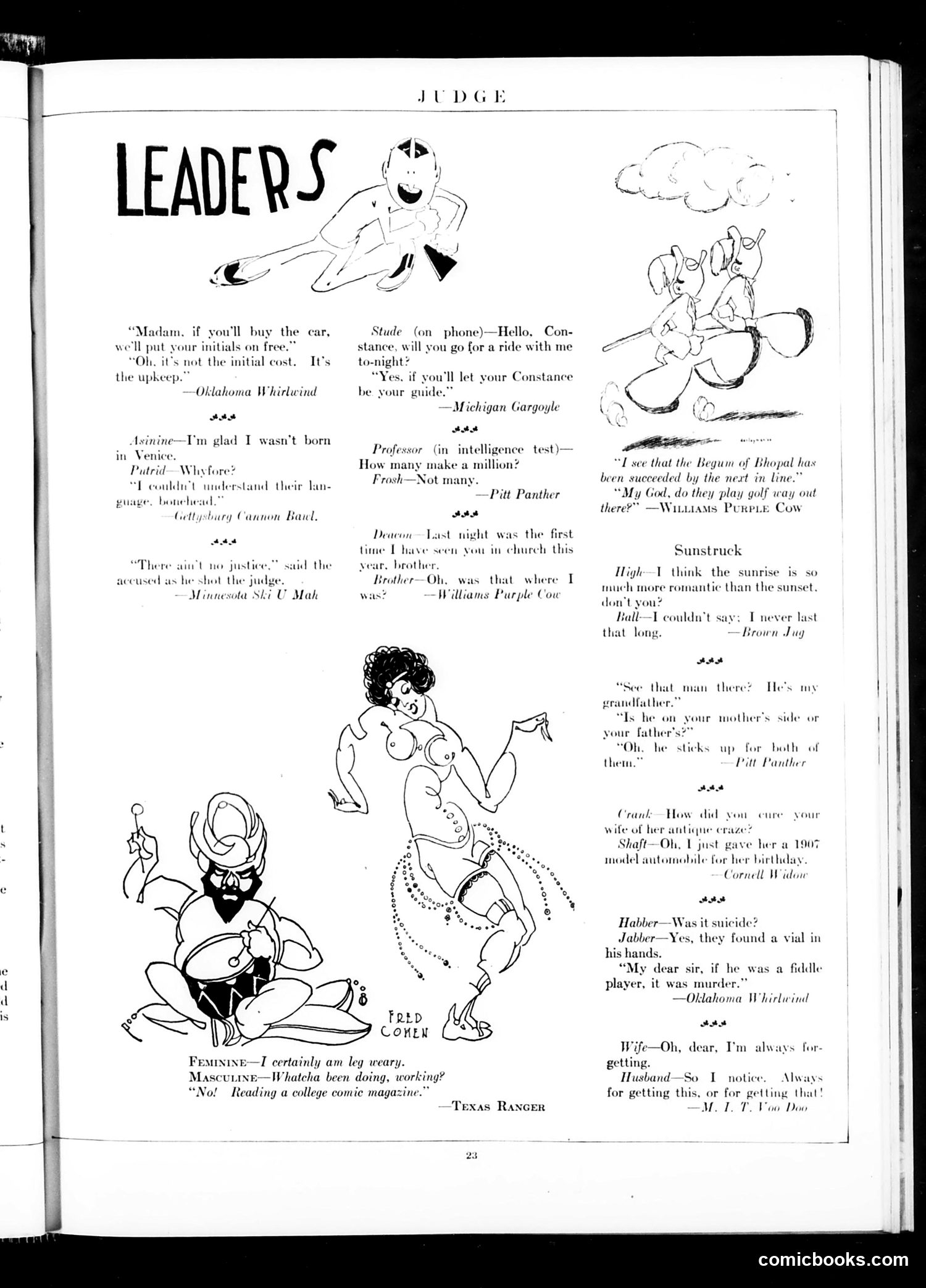
This page collects humor from college publications (Michigan Gargoyle, Pitt Panther, Williams Purple Cow, etc.), featuring brief jokes and cartoons typical of 1920s college humor. The satire targets: **Automobiles & consumerism**: The "upkeep" joke mocks car ownership costs beyond initial purchase; the "1907 model" gift satirizes wives' frivolous spending habits. **Gender roles**: Multiple jokes demean women—one for being "leg weary" from reading comics instead of working, another for chronic forgetfulness, and the "Feminine/Masculine" exchange implying women are intellectually shallow. **Class/Colonial attitudes**: A joke about the "Begum of Bhopal" (Indian ruler) succession trivializes non-Western governance, assuming such places are exotic curiosities. **Intelligence**: A professor's test joke mocks how few people understand basic math (making a million). The cartoons feature flapper-style women in exaggerated poses—standard Judge magazine visual humor emphasizing women's bodies and fashion rather than wit. Overall, this represents period-typical college humor: automobile-age references, romantic pursuit scenarios, and casual misogyny presented as clever.
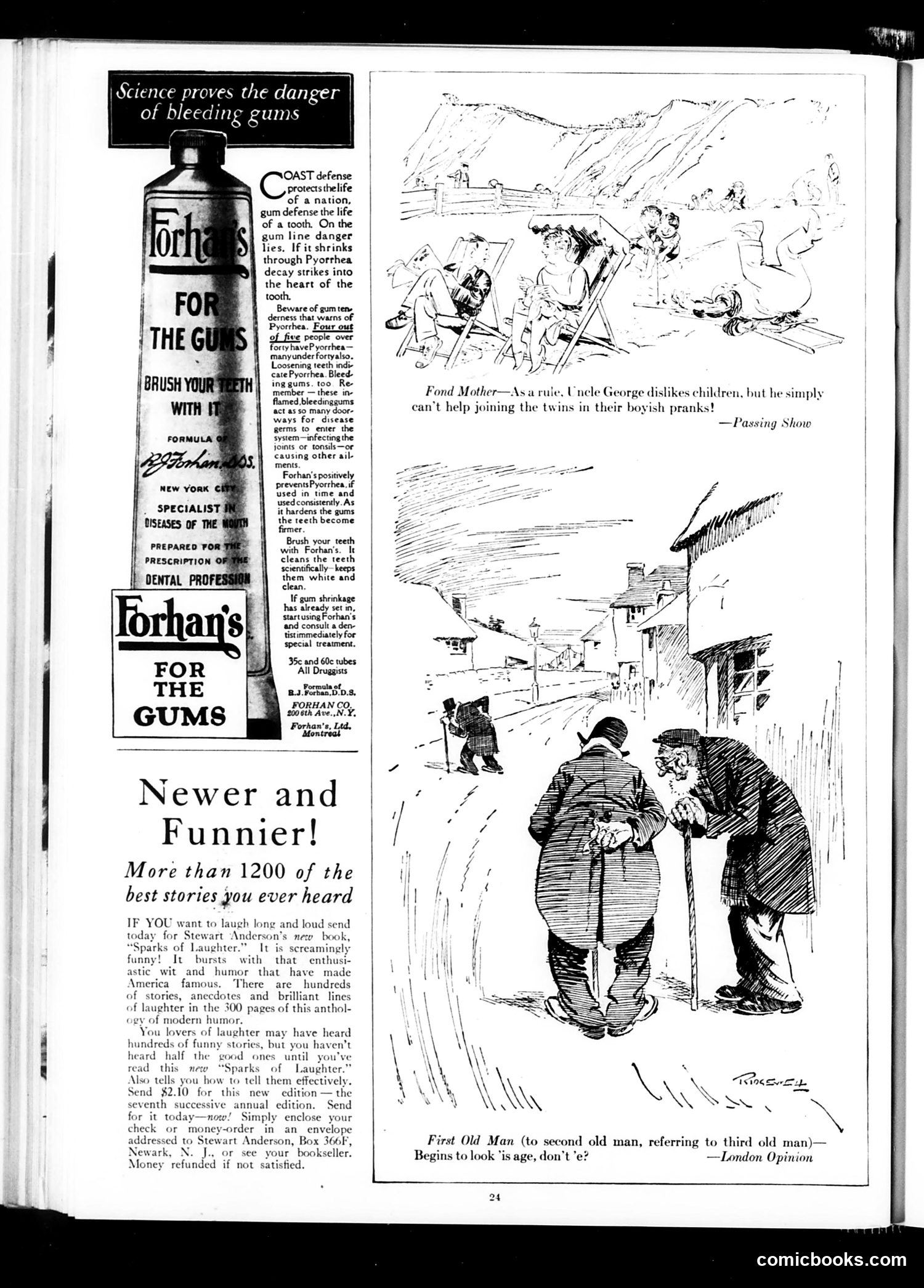
This page mixes advertising with comic cartoons typical of early 20th-century Judge. **Advertisement (Left):** Forhan's toothpaste markets itself by linking gum disease (Pyorrhea) to national defense—a wartime appeal suggesting healthy teeth equal a strong nation. The copy warns that bleeding gums threaten tooth health and can introduce infection into the body. **Top Cartoon:** A sentimental scene captioned "Fond Mother" depicts Uncle George reluctantly joining children's rowdy play. The joke relies on the stock character type of the curmudgeonly bachelor who unexpectedly shows affection for children—playing on period expectations that such men should naturally dislike kids. **Bottom Cartoon:** Three elderly working-class men discuss one peer "looking his age." The humor is gentle, observational comedy about aging, typical of British "London Opinion" sourced material Judge republished. No caricature or political reference is evident—it's simply humorous social observation about aging bodies. The page reflects Judge's mix of commercial content and light, character-based humor.
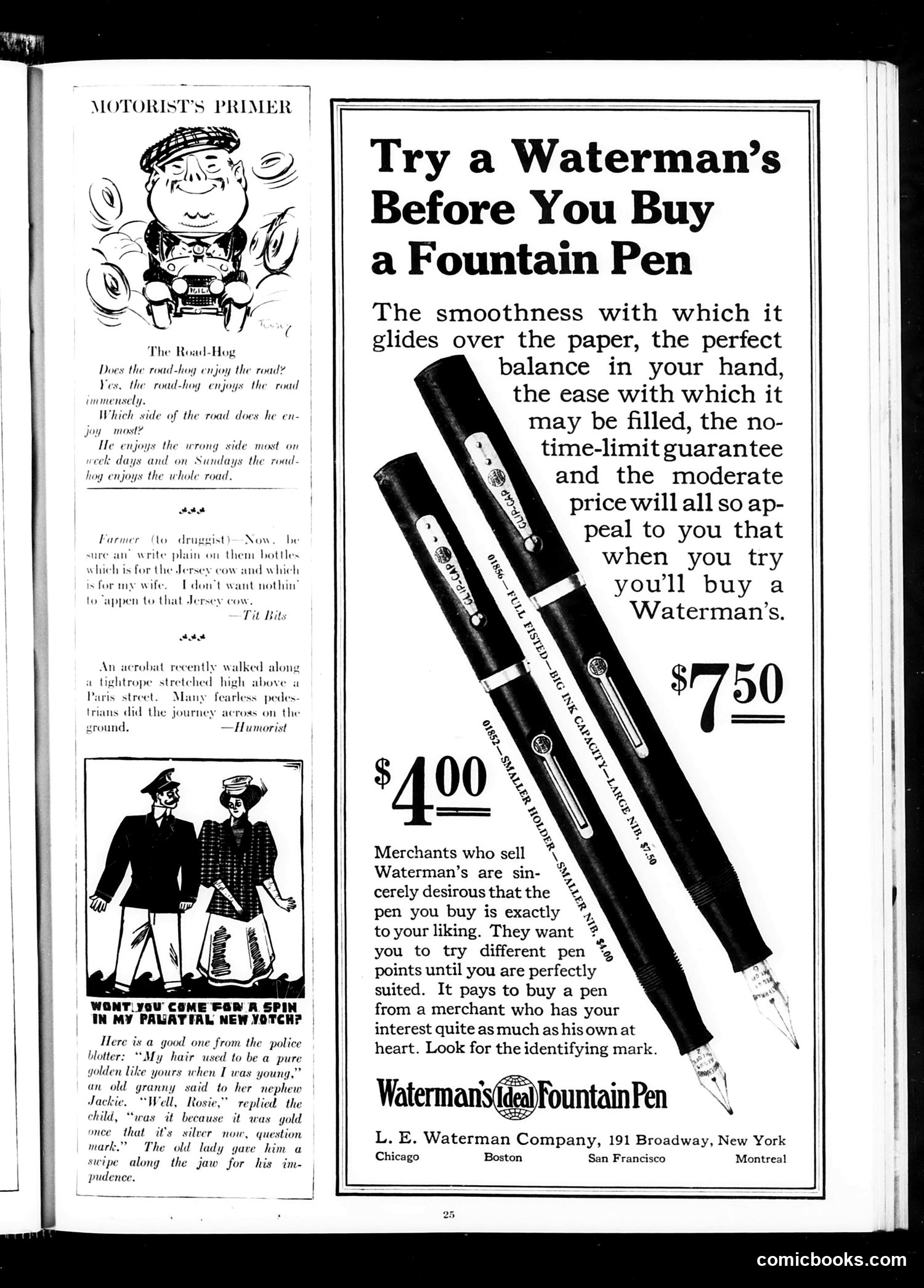
This page combines satirical humor with advertising. The left side contains three jokes from "Motorist's Primer": 1. **The Road-Hog**: A satirical primer-style piece mocking dangerous drivers who monopolize roads, particularly on weekends. The humor lies in the deadpan question-and-answer format revealing the road-hog's selfish behavior. 2. **The Farmer's Request**: A joke about a farmer asking a druggist to label bottles clearly so he doesn't poison his wife instead of his cow—implying marital discord through dark humor. 3. **The Child's Logic**: A child's innocent observation about his grandmother's graying hair, punished for his impertinence, exemplifies the period's humor about generational friction. The right side is a **Waterman's Fountain Pen advertisement** priced at $4.00–$7.50, emphasizing quality, balance, and the importance of trying pens before purchase. This was standard 1920s advertising strategy promoting consumer testing. The page reflects early 20th-century concerns: automobile safety, domestic dynamics, and pen quality—everyday consumer goods still novel enough to require explanation and endorsement.
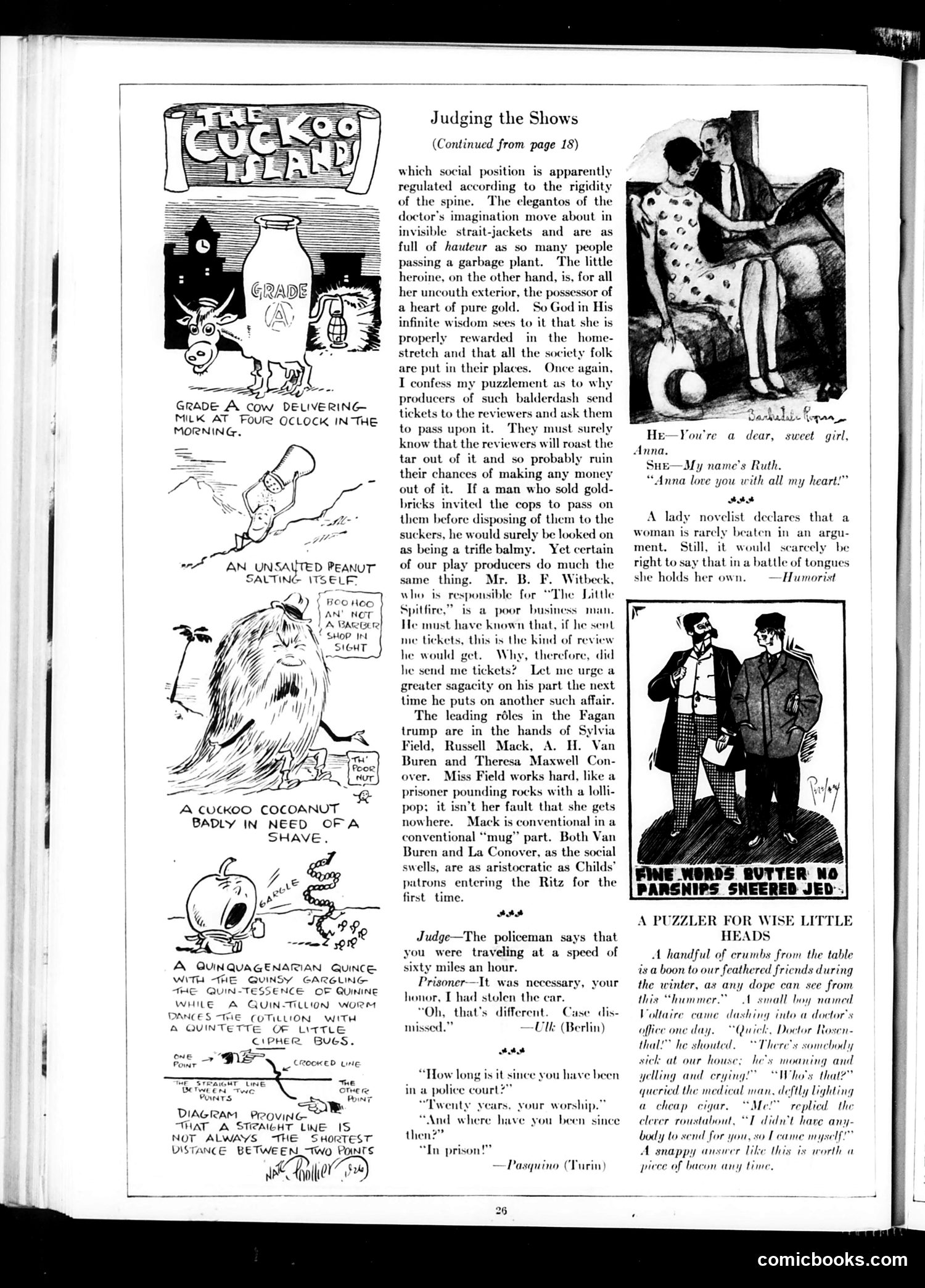
This page contains primarily **humorous cartoons and jokes** rather than political satire. The left side features absurdist visual gags—a cow delivering milk at 4 AM, a self-sautéing peanut, a cuckoo coconut needing a shave—typical of Judge's nonsense humor style. The main text column critiques a theatrical production called "The Little Spitfire" by B.F. Witbeck, mocking its plot (poor heroine with a golden heart, snobbish society people) as tired melodrama. The reviewer expresses bewilderment that producers send critics complimentary tickets knowing they'll write negative reviews that harm box office sales. The bottom section contains **brief comedic anecdotes**: a prisoner admits stealing a car (explaining his speeding), and a doctor's office joke about a sick child named Voltaire. The page exemplifies Judge's entertainment-focused approach: lowbrow visual humor combined with theatrical criticism and pun-based jokes, aimed at early 20th-century general readers seeking amusement rather than political commentary.
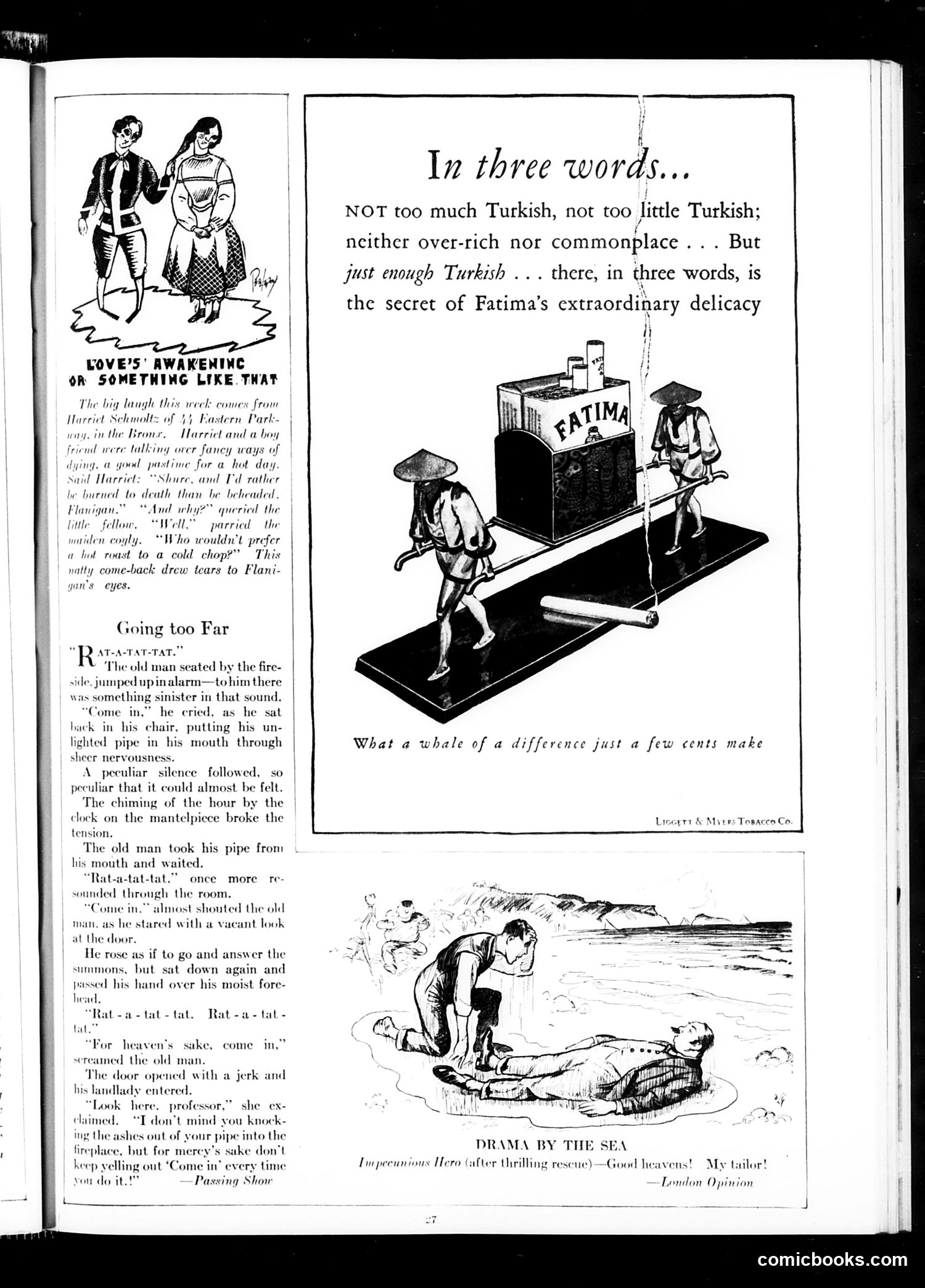
This page contains vintage advertising and humorous short stories typical of early 20th-century American satirical magazines. **The Fatima Cigarette Ad** ("In three words...") promotes Turkish cigarettes by emphasizing their balanced quality—not too exotic, not too plain. The illustration shows two figures operating a seesaw with a Fatima box, visually representing the "just right" balance the advertisement claims. **"Love's Awakening"** is a short humor piece about a young woman (Harriet Schmoltz from the Bronx) joking with a boy about methods of dying, preferring burning to beheading because a "roast" beats a "cold chop." It's gentle wordplay humor. **"Going too Far"** depicts an old man startled by mysterious knocking sounds ("Rat-a-tat-tat"), growing increasingly anxious. The punchline: his landlady reveals he's been the source—he's been knocking his pipe ashes into the fireplace while yelling "Come in!" **"Drama by the Sea"** shows a rescued man's first concern being his unpaid tailor—satirizing misplaced priorities among the impoverished.
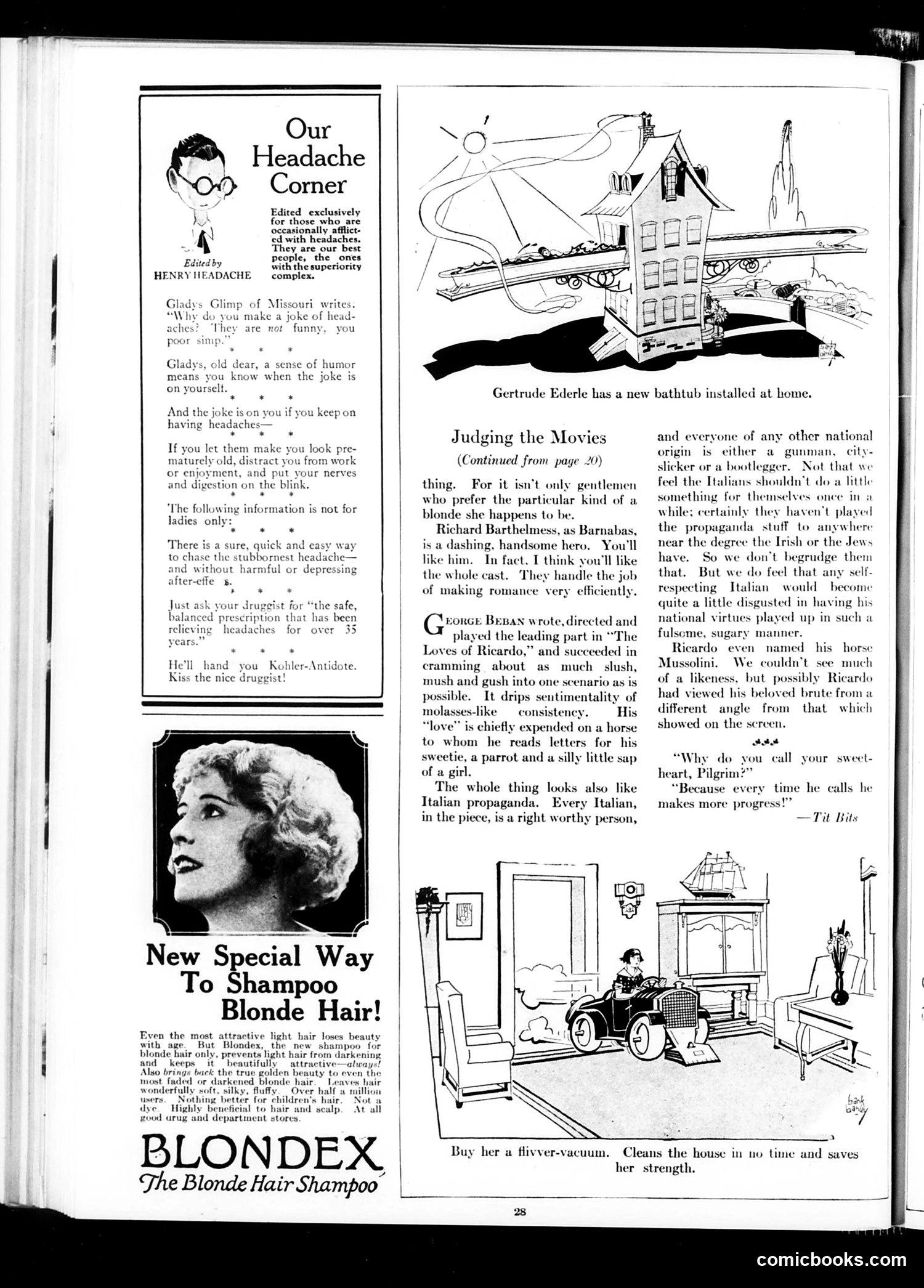
This page combines a humor column with movie reviews and period advertisements. **"Our Headache Corner"** is a satirical advice section edited by "Henry Headache," mocking wealthy readers who pride themselves on sophistication. It jokingly addresses their headaches while advertising Kohler-Antidote medicine—suggesting that superior people suffer headaches from their own pretension. **The movie reviews** critique current films, including one starring **Richard Barthelmess** and another by **George Beban** titled "The Loves of Ricardo." The reviewer criticizes Beban's film for excessive sentimentality and heavy-handed Italian propaganda, noting it portrays Italians as virtuous while depicting other nationalities (Irish, Jews, immigrants) as criminals or "bootleggers"—a jab at both the film's bias and 1920s prejudices. **Advertisements** include Blondex hair shampoo and a reference to **Gertrude Ederle's** bathtub (she was the famous 1926 channel-swimmer), and a joke about a "flivver-vacuum"—wordplay on the Model T Ford. The page reflects 1920s consumer culture, silent cinema, and casual ethnic stereotyping.
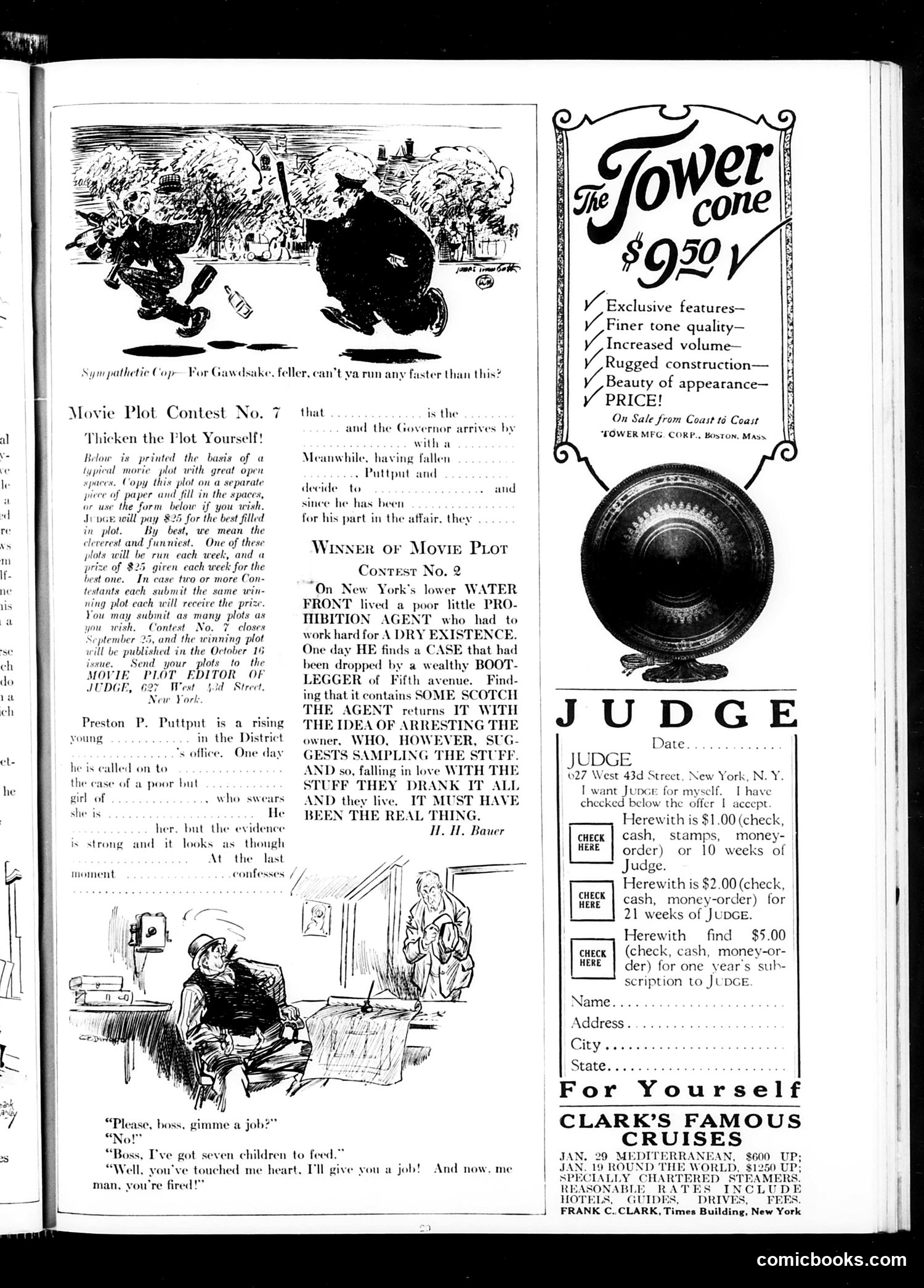
This page primarily contains **advertisements and reader contests** rather than political satire. The main content is "Movie Plot Contest No. 7," inviting readers to complete a fill-in-the-blank movie plot and submit entries for $25 prizes. The sample plot features a character named Preston P. Puttput, a young district attorney's office worker involved in a criminal case—typical lightweight comedic fodder for 1920s audiences. A cartoon at bottom left shows a sympathetic cop helping a jobless man with seven children, only to immediately fire him—playing on the contradiction between emotional appeal and harsh economic reality during this period. The page also includes a winning entry from a previous contest satirizing **Prohibition-era bootlegging**: a prohibition agent finds a case of liquor, returns it virtuously, but the bootlegger's generosity wins him over. The right side advertises a "Tower Cone" loudspeaker ($9.50), Judge magazine subscriptions, and Clark's Famous Cruises—typical period commercial promotions. This is primarily a consumer-oriented magazine page blending entertainment and advertising.
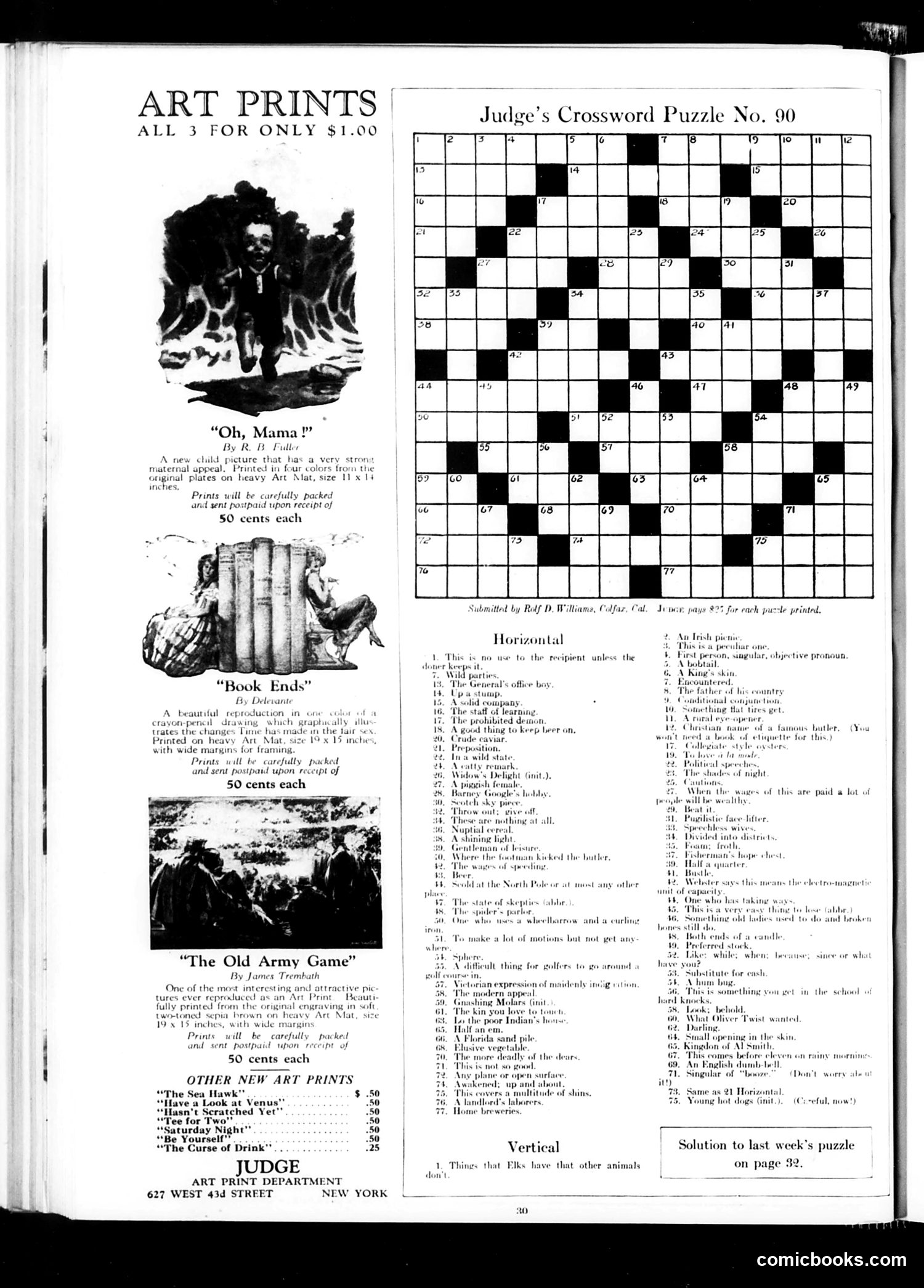
This is primarily a **merchandise advertising page**, not political satire. Judge is promoting three art prints for sale at 50 cents each: 1. **"Oh, Mama!"** by R.B. Fuller—a sentimental child portrait 2. **"Book Ends"** by Del—depicting how time changes a woman's appearance 3. **"The Old Army Game"** by James Trembath—a sepia-toned composition The page also lists other available prints and includes **Judge's Crossword Puzzle No. 90** with clues and a blank grid. The advertisements emphasize that prints are "carefully packed" and "postpaid," suggesting mail-order sales. This reflects early 20th-century consumer culture, where magazines monetized content by selling reproductions of artwork to readers seeking affordable home décor. The page contains no political commentary or satirical cartooning—it's straightforward commercial content typical of Judge's revenue model.
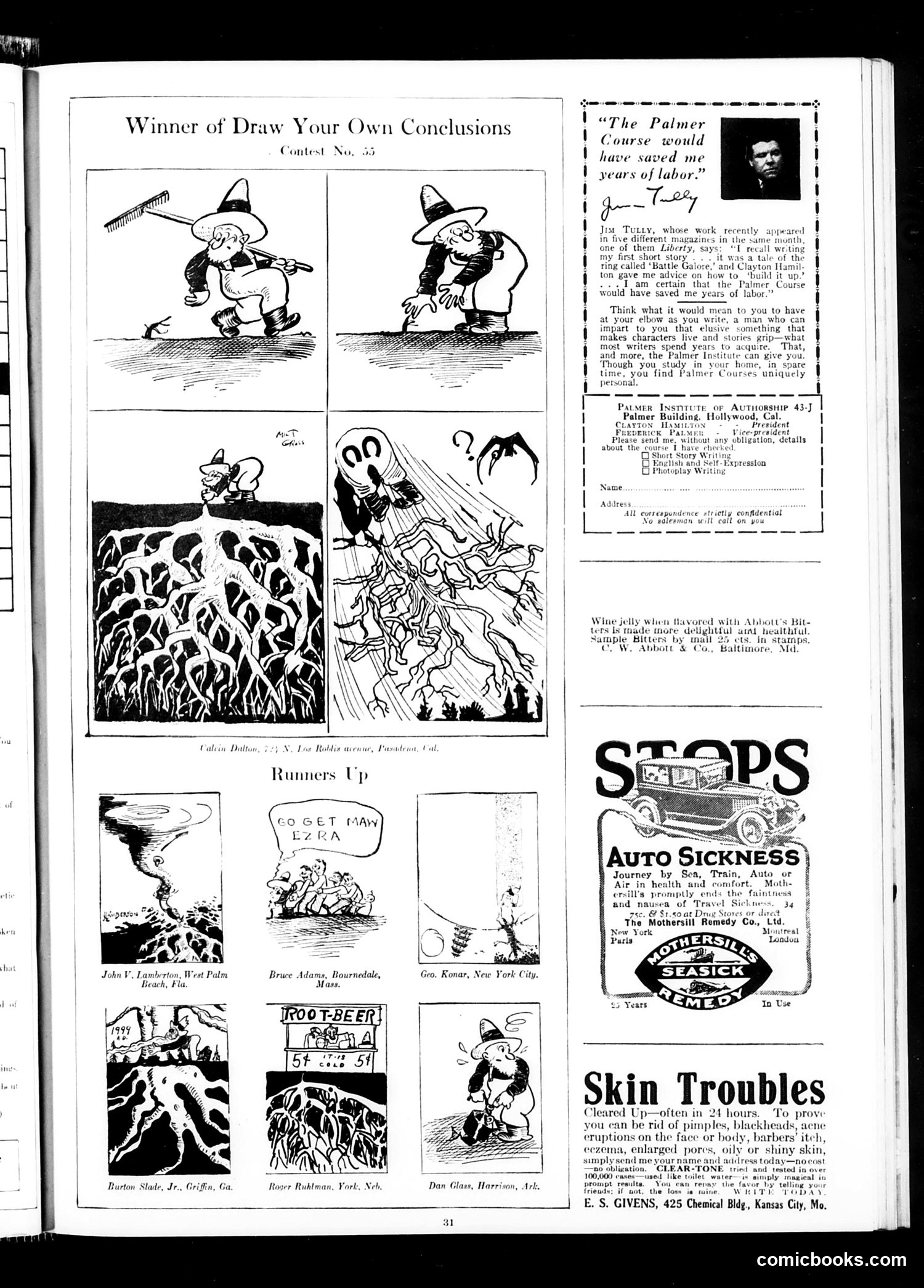
This page features a drawing contest ("Draw Your Own Conclusions, Contest No. 55") displaying winning cartoon submissions showing characters in various absurd situations—farmers with tools, figures in flames, underground scenes. The specific satirical targets are unclear without additional context, though the cartoons appear to depict exaggerated scenarios typical of early-20th-century humor magazines. More prominently, the page is dominated by **advertisements**, including endorsements from a figure named "Tully" praising the Palmer Course (a correspondence writing/authorship program), plus ads for Abbott's Bitters (a medicinal tonic), Mothersill's Remedy (for travel sickness), and a skin-condition treatment. These ads represent typical patent medicines and correspondence courses heavily marketed in period publications, often with dubious health claims that would later face regulation.
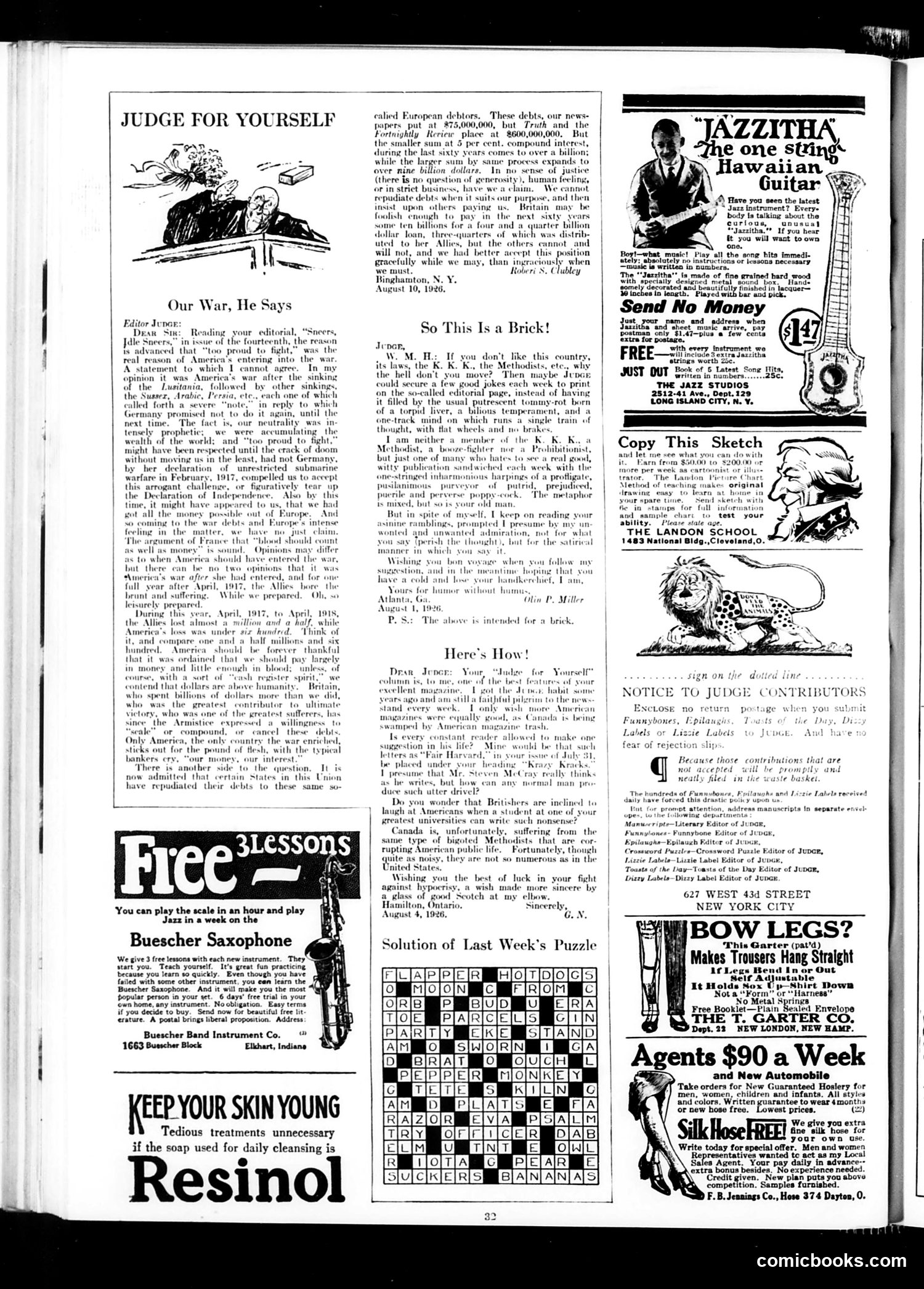
This page from Judge magazine (dated August 1926) features reader letters debating America's role in World War I and war debt collection. The main cartoon, "Judge For Yourself," appears to show a figure reviewing or weighing evidence—likely representing American public opinion on whether the U.S. was justified entering the war. **Key context for modern readers:** The letters discuss whether America should have entered WWI earlier and—more pressingly in 1926—whether the U.S. should forgive Allied war debts. One writer argues America grew wealthy during the war while allies suffered, so canceling debts would be just. Another counters that certain U.S. states repudiated debts to creditors, so America cannot morally demand payment forgiveness. This reflects genuine 1920s-30s tension: Europe owed America billions; America refused forgiveness; this financial conflict contributed to international resentment and economic instability. The page is mostly advertisements (Buescher Saxophone, Resinol soap, bow-leg correction) interspersed with reader commentary—typical Judge format.
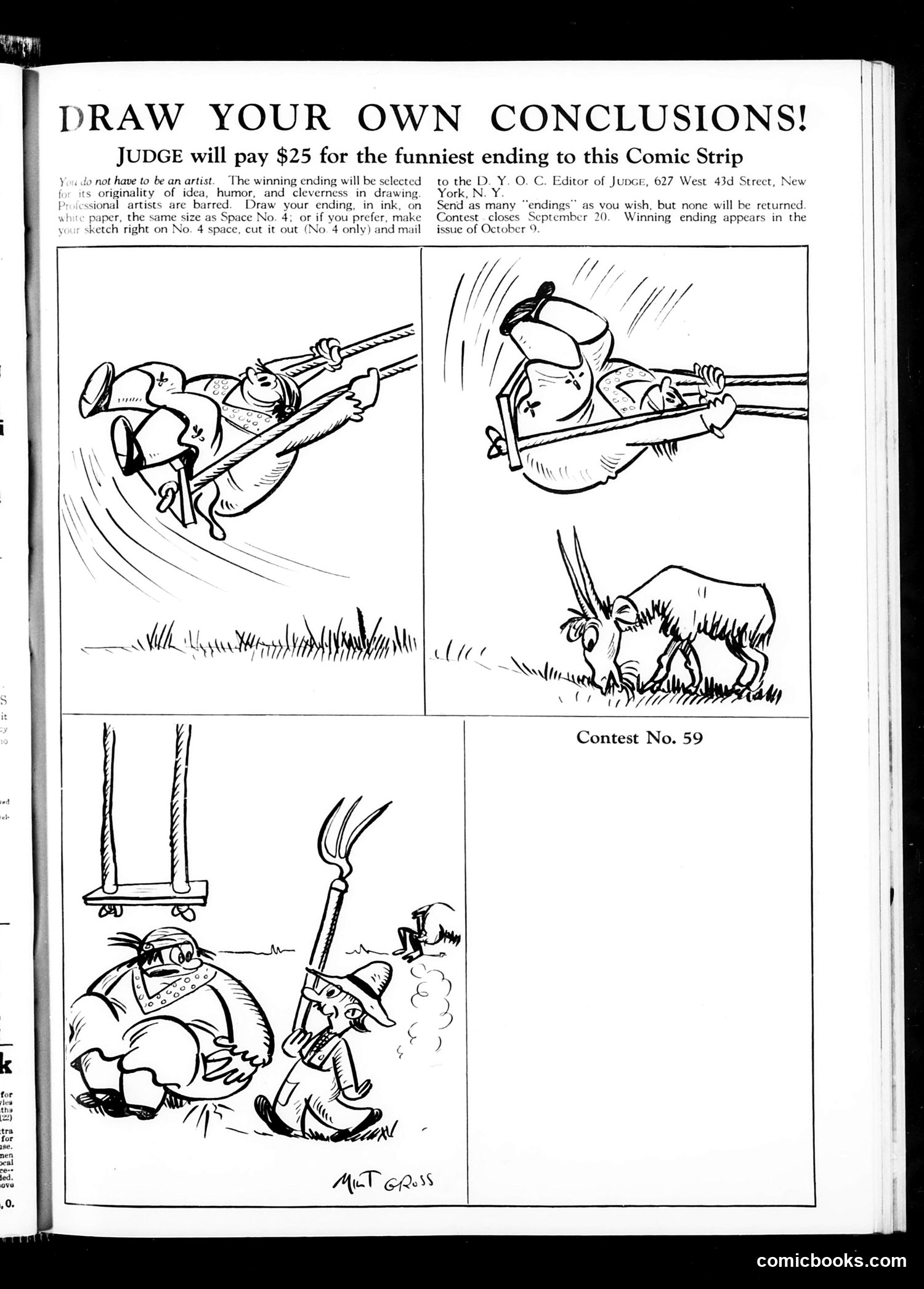
This is a **reader-participation contest** from Judge magazine, not a finished political cartoon. Readers were invited to complete an incomplete comic strip for a $25 prize. The three completed panels (signed by Mutt Gross, the cartoonist) show a physical comedy narrative: a man is launched into the air by a seesaw, lands on a goat, and the goat then charges at a heavyset man holding a large rake or pitchfork. The empty panel (No. 4) is where contestants would draw their own humorous conclusion to the sequence. This represents an early form of **interactive entertainment** common in magazines of this era—readers competed by submitting creative endings. The humor relies on slapstick physicality typical of early 20th-century comics, not political satire. The contest closed September 20, with winners announced in the October 9 issue.