
Judge, 1926-09-11 · page 7 of 35
Judge — September 11, 1926 — page 7: what you’re looking at
What you’re looking at
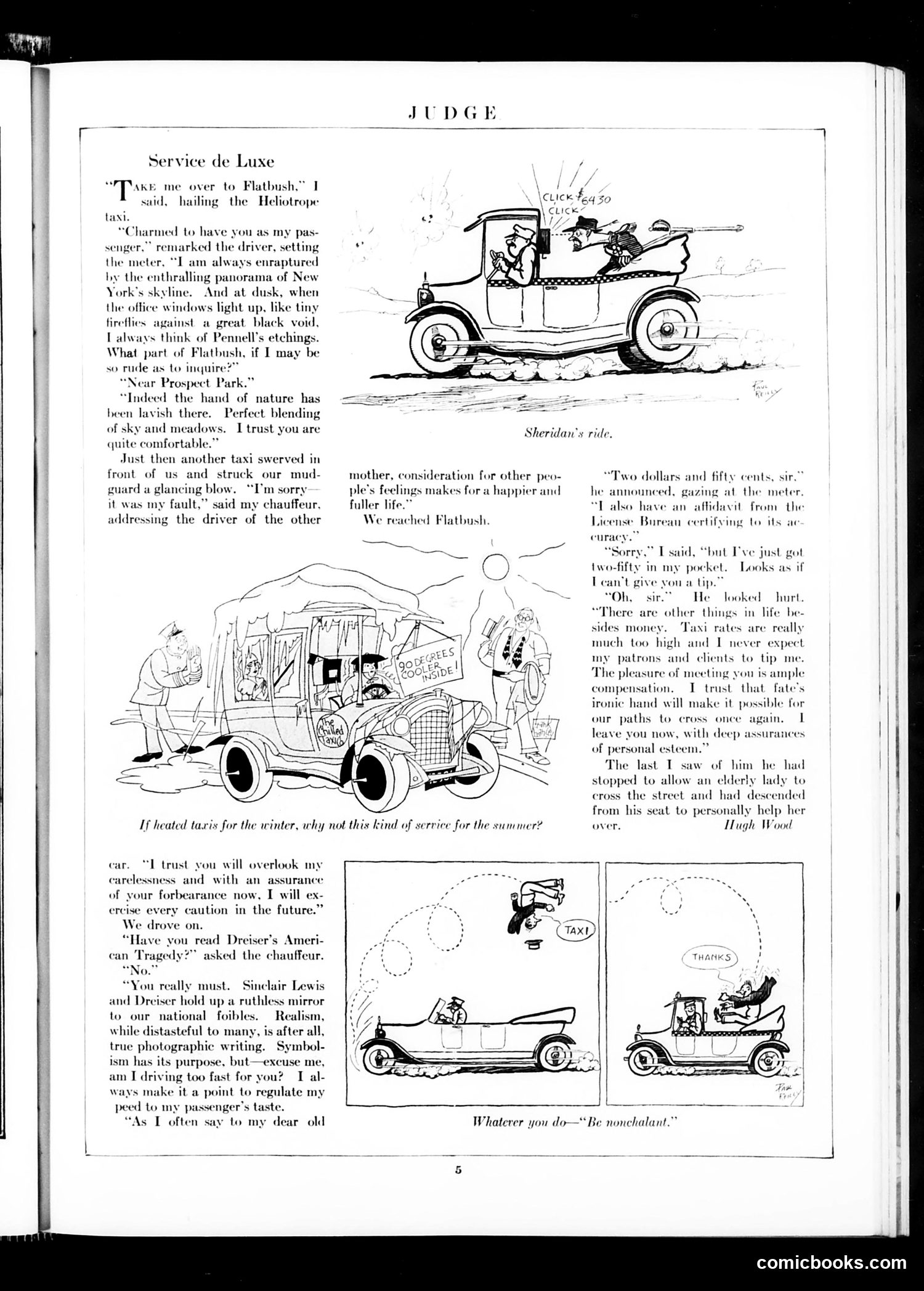
This satirical article mocks the contrast between taxi service quality and passenger expectations in early 1920s New York City. The humor centers on taxi drivers' rudeness and carelessness versus their demands for tips. The narrative describes a collision between two taxis, with the driver blaming the passenger for the accident. The passenger, unable to afford a tip, receives the driver's contempt despite having paid the fare. The cartoons illustrate the irony: drivers cause accidents and provide poor service, yet expect generous gratuities. The piece satirizes working-class entitlement and the emerging "tipping culture" problem—drivers demanding compensation beyond stated fares for unreliable, often dangerous service. It reflects contemporary frustration with New York City's taxi system and labor relations.
📄 Transcribed text from this page (OCR, searchable)
Machine-transcribed from the original scan — historical spelling and the odd misread are preserved.
Service de Luxe “Tage me over to Flatbush,” I said, hailing the Heliotrope taxi. “Charmed to have you as my pas- senger,” remarked the driver, setting the meter, “Iam always enraptured by the enthralling panorama of New York’s skyline. And at dusk, when the office windows light up, like tiny fireflies against a great black void, I always think of Pennell’s etchings. What part of Flatbush, if I may be so rude as to inquire?” “Near Prospect Park.” “Indeed the hand of nature has been lavish there. Perfect: blending of sky and meadows. I trust you are quite comfortable.” Just then another ta: front of us and stru swerved in our mud- guard a glancing blow. “I'm sorry it was my fault,” said my chauffeur. addressing the driver of the other car. “1 trust you will overlook my carelessness and with an assurance of your forbearance now, I will ex- ercise every caution in the future.” We drove on. “Have you read Dreiser's Ameri- * asked the chauffeur. “You really must. Sinclair Lewis and Dreiser hold up a ruthless mirror to our national foil Realism, while distasteful to many, is after all, true photographic writing. Symbol- ism has its purpose, but use me, am I driving too fast for you? I al- ways make it a point to regulate my peed to my passenger's taste. I often say to my dear old mother, consideration for other peo- ple’s feelings makes fora happier and fuller life.” We reached Flatbush. io S| (A ‘ : bess! q \ \cuter eq $0 Sheridan's ride. If heated taxis for the winter, why not this tind of service for the summer? “Two dollars and fifty cents, sir” he announced, gazing at the meter is | License Burean cer Iso have an affidavit’ from) the fying, to its ac curacy. T said, “but F've just got two-fifty T can’t give you a tip.” “Oh. sir” He looked hurt. “There are other things in life be- nomy pocket. Looks as if sides money. ‘Taxi rates are really much too high and I never expect my patrons and clients to tip me. The pleasure of meeting you is ample compensation. I> trust’ that "s dle for ironic hand will make it possi our paths to cross once again. 1 leave you now, with deep assurances of personal esteem.” The last T saw of him he had stopped to allow an elderly lady to cross the street and had descended from his seat to personally help her over. Hugh Wood comicbooks.com