
Judge, 1926-09-11 · page 15 of 35
Judge — September 11, 1926 — page 15: what you’re looking at
What you’re looking at
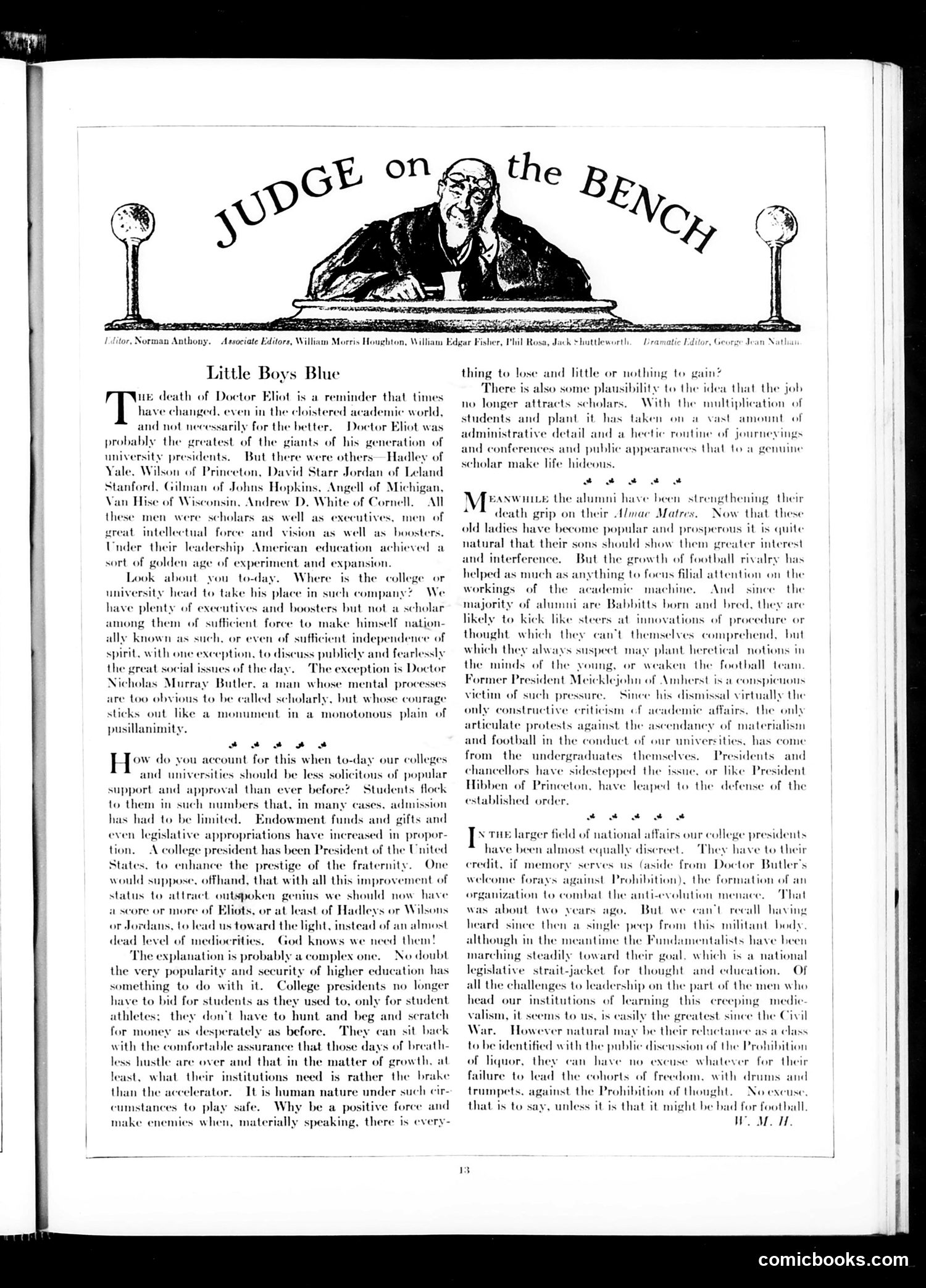
This editorial essay laments the decline of great American university presidents. The author contrasts the "golden age" of figures like Harvard's Charles W. Eliot, Princeton's Woodrow Wilson, and others—described as genuine scholars with intellectual force—against modern college heads who are mere "executives and boosters" lacking independence or scholarly courage. The piece argues that contemporary universities, now wealthy and oversubscribed, no longer attract visionary leaders. Presidents focus on fundraising from alumni rather than leading intellectual advancement. The essay identifies three culprits: institutional comfort erodes ambition; administrative burdens repel genuine scholars; and alumni interference—particularly driven by football rivalry—pressures administrators toward mediocrity rather than innovation. The unnamed exception is Nicholas Murray Butler, praised for intellectual courage despite being "too obvious to be called scholarly."
📄 Transcribed text from this page (OCR, searchable)
Machine-transcribed from the original scan — historical spelling and the odd misread are preserved.
Little Boys Blue ue death of Doctor Eliot is a reminder that times have changed, even in the cloistered academic world, and not necessarily for the better. Doctor Eliot was probably the greatest of the giants of his gene university presidents. But there were others: \ Yale, Wilson of Princeton, David Starr Jordan of Leland Stanford, Gilman of Johns Hopkins, Angell of Michigan, Van Hise of Wisconsin, Andrew D. White of Cornell. All these men were scholars as well as executives, men of great intellectual force and vision as well as boosters. Under their leadership American education achieved a sort of golden age of experiment and expansion. Look about you to-day. Where is the college or university head to take his place in such company? We have plenty of executives and boosters but not a scholar among them of suffic nt force to make himself nation- ally known as such, or even of sufficient independence of iscuss publicly and fearlessly the great social issues of the day. ‘The exception is Doctor Nicholas Murray Butler. a man whose mental processes spirit, with one exception, to are too obvious to be called scholarly, but whose courage sticks out like a monument ina monotonous plain of pusillanimity. He do you account for this when to-« and universities should be less solicitous of popular support and approval than ever before? Students flock to them in such numbers that, in many cases. has had to be limited. Endowment funds even legislative appropriations have increas tion, ey +s a admission ad gifts and 1 in propor- \ college president has been President of the United States. to enhance the prestige of the fraternity. One would suppose, offhand, that with all this improvement of status to attract outspoken genius we should now have a score or more of Eliots, or at least of Hadleys or Wilsons or Je ns, to lead us toward the light, instead of an almost dead level of mediocrities. God knows we need them! The explanation is probably a complex one. No doubt the very popularity and security of higher education has something to do with it. College presidents no longer have to bid for students as they used to, only for student athletes: they don’t have to hunt and beg for money as desperatel nd scratch yas before. They can sit back with the comfortable assurance that those days of breath- less hustle are over and that in the matter of growth, at least, what their institutions need is rather the brake than the accelerator. It is human nature under such cir- Why be a positive foree and make enemies when, materially speaking, there is every- cumstances to play sar Fisher, Phil Re uch Shuttleworth. Pra thing to lose and little or nothing to gain? There is also some plausibility to the idea that the job With the multiplication of students and plant it: has taken on avast amount of administrative detail and a hectic routine of journeyings no longer attracts scholars. and conferences and public appearances that to a genuine scholar make life hideous. * a ar) ) J #ANwinte: the alumni have been strengthening their . death grip on their Almae Matres. ow that these old ladies have become popular and prosperous it is quite natural that their sons should show them greater interest and interference. But the growth of football rivalry 1 helped as much as anything to focus filial attention on the workings of the machine. And since — the majority of alumni are Babbitts born and bred, they are likely to kick like steers at innovations of procedure or thought: which they can’t themselves comprehend, but which they always suspect may plant heretical notions in the minds of the young, or weaken the football team: Former President Meicklejohn of Amherst is a conspicuous victim of such pressure. academic Since his dismissal virtually the only constructive criticism of academic affairs, the only articulate protests against the ascendancy of materialism and football in the conduct of our universities, has come from the undergraduates Presidents and chancellors have sidestepped the issue, or like themselves. President Hibben of Princeton, have leaped to the defense of the established order. N THE larger field of national affairs our college pre have been almost equally discreet. They have to their credit, if memory: serves us (aside from Doctor Butler's welcome forays against Prohibition), the formation of an organization to dents ombat the anticevolution menace. That was about two years ago. But we can't recall having heard since then a single peep from this militant hedy although in the meantime the Fundamentalists have been marching steadily toward their goal, which is a national legislative strait-jacket for thought and education. Of all the challenges to leadership on the part of the men who head our institutions of learning this creeping medic valism, it seems to us, is easily the War. may be their reluctance asa class to be identified with the publie diseussion of the Prohibition atest since the Civil However natur: of liquor, they can have no excuse whatever for their failure to lead the cohorts of freedom, with drums and trumpets. against the Prohibition of thought. No excuse that is to say, unless it is that it might be bad for football WoM comicbooks.com