
A complete issue · 36 pages · 1926
Judge — July 3, 1926
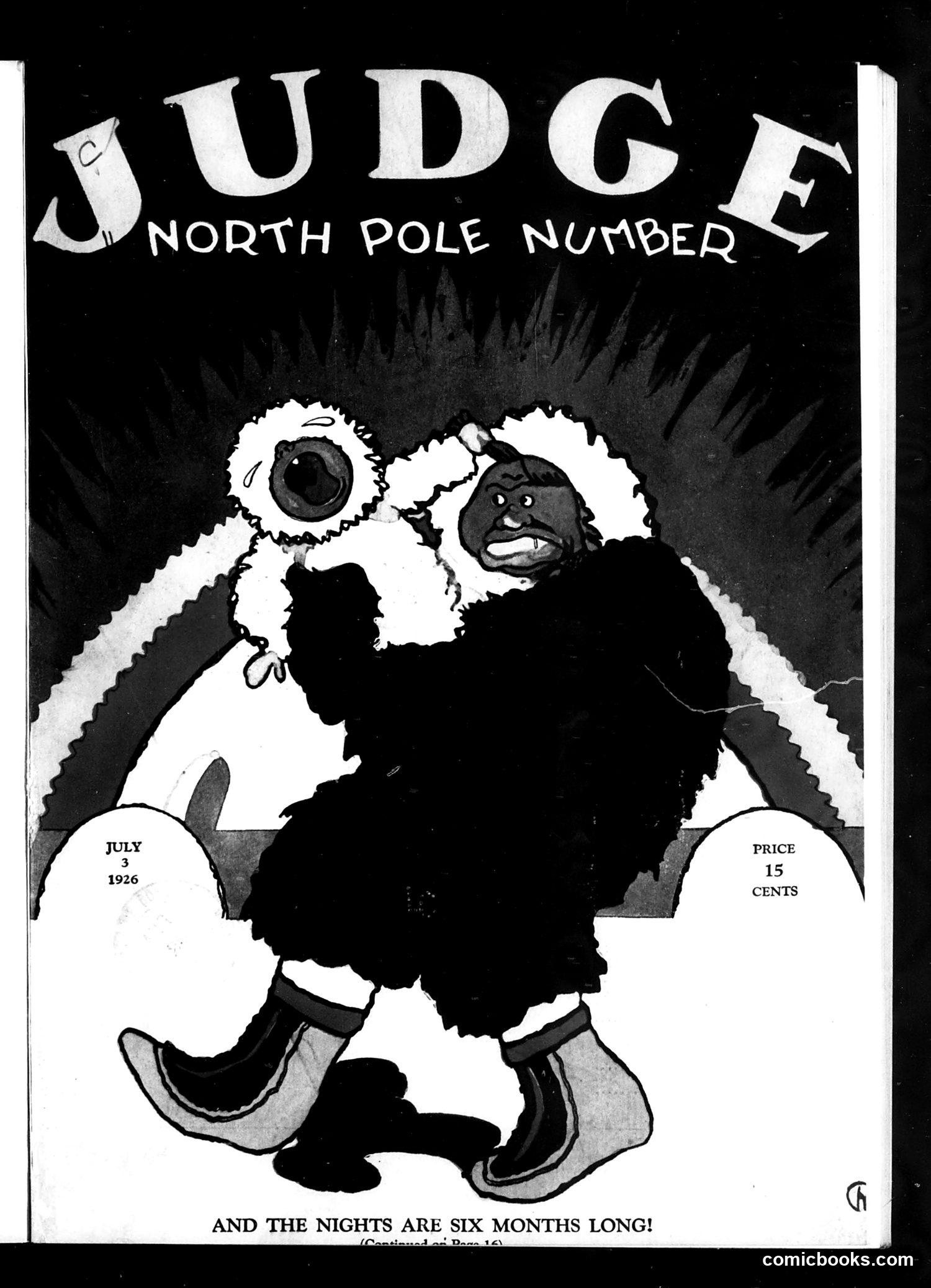
This cover satirizes Arctic exploration during the 1920s. The figure appears to be a polar explorer or adventurer holding a small white seal or Arctic animal, with the title "Judge—North Pole Number" and the tagline "And the nights are six months long!" The imagery plays on the exotic appeal of polar expeditions, which were popular adventure narratives of the era. The exaggerated, comedic depiction of the explorer with the animal suggests mockery of the romanticized heroism surrounding Arctic exploration expeditions. The 15-cent price and July 1926 date indicate this is likely a summer holiday issue capitalizing on the season's adventure themes. The overall tone appears to be gentle satire rather than harsh political commentary.
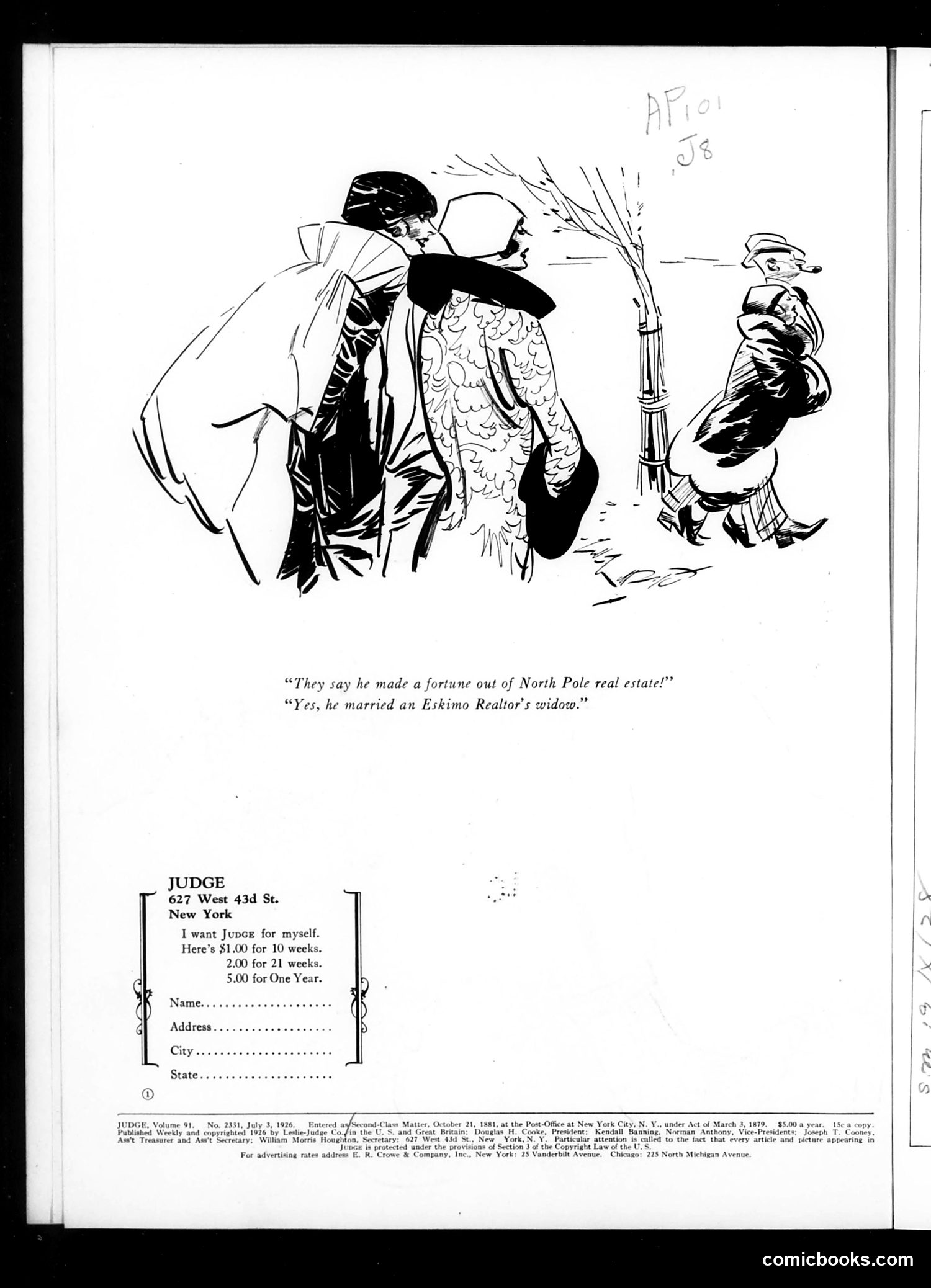
This cartoon satirizes wealth acquired through Arctic exploration and real estate speculation. Two well-dressed figures discuss a man who "made a fortune out of North Pole real estate" by marrying "an Eskimo Realtor's widow." The joke targets the era's fascination with Arctic expeditions and the absurd notion that one could profit from polar land claims. The humor hinges on the incongruity of treating the Arctic as real estate and the comedic image of marrying into wealth via an Eskimo woman's property holdings—poking fun at both get-rich-quick schemes and the exoticization of Indigenous peoples common to the period. The publication information indicates this is from Judge magazine, July 3, 1926, establishing this as 1920s satire of contemporary speculation and exploration trends.
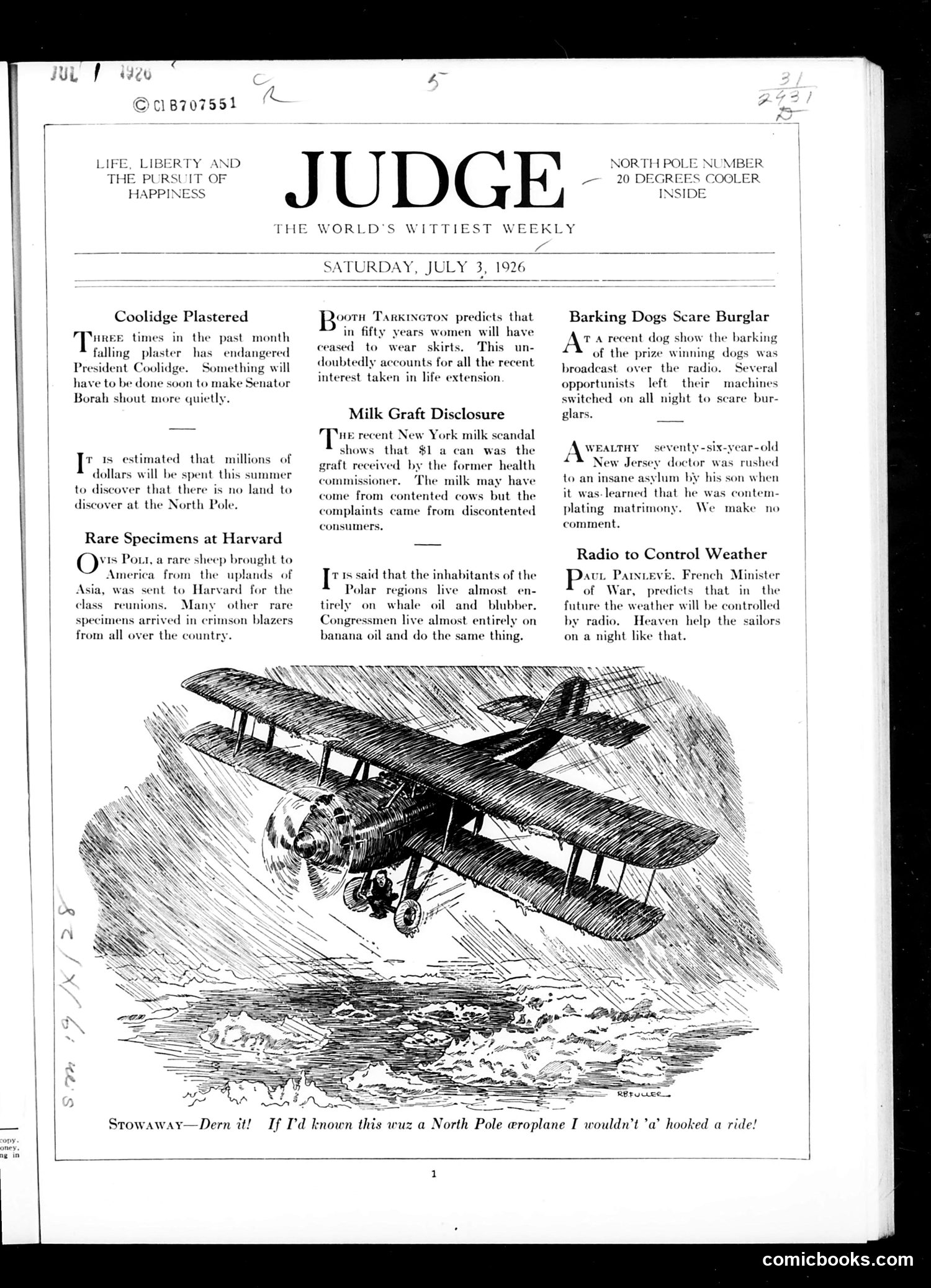
The main cartoon depicts a small airplane flying near the North Pole with the caption "STOWAWAY—Dern it! If I'd known this wuz a North Pole aeroplane I wouldn't 'a' hooked a ride!" The joke satirizes Arctic exploration expeditions popular in the 1920s. A stowaway has accidentally hitched a ride on a polar expedition aircraft, discovering too late his dangerous mistake. The humor derives from the contrast between naive opportunism (hopping aboard for free travel) and the harsh, life-threatening reality of polar aviation—an extremely hazardous undertaking at that time. The cartoon reflects contemporary fascination with Arctic exploration while mocking both the foolishness of stowaways and the absurdity of early aviation ventures to Earth's most inhospitable regions.
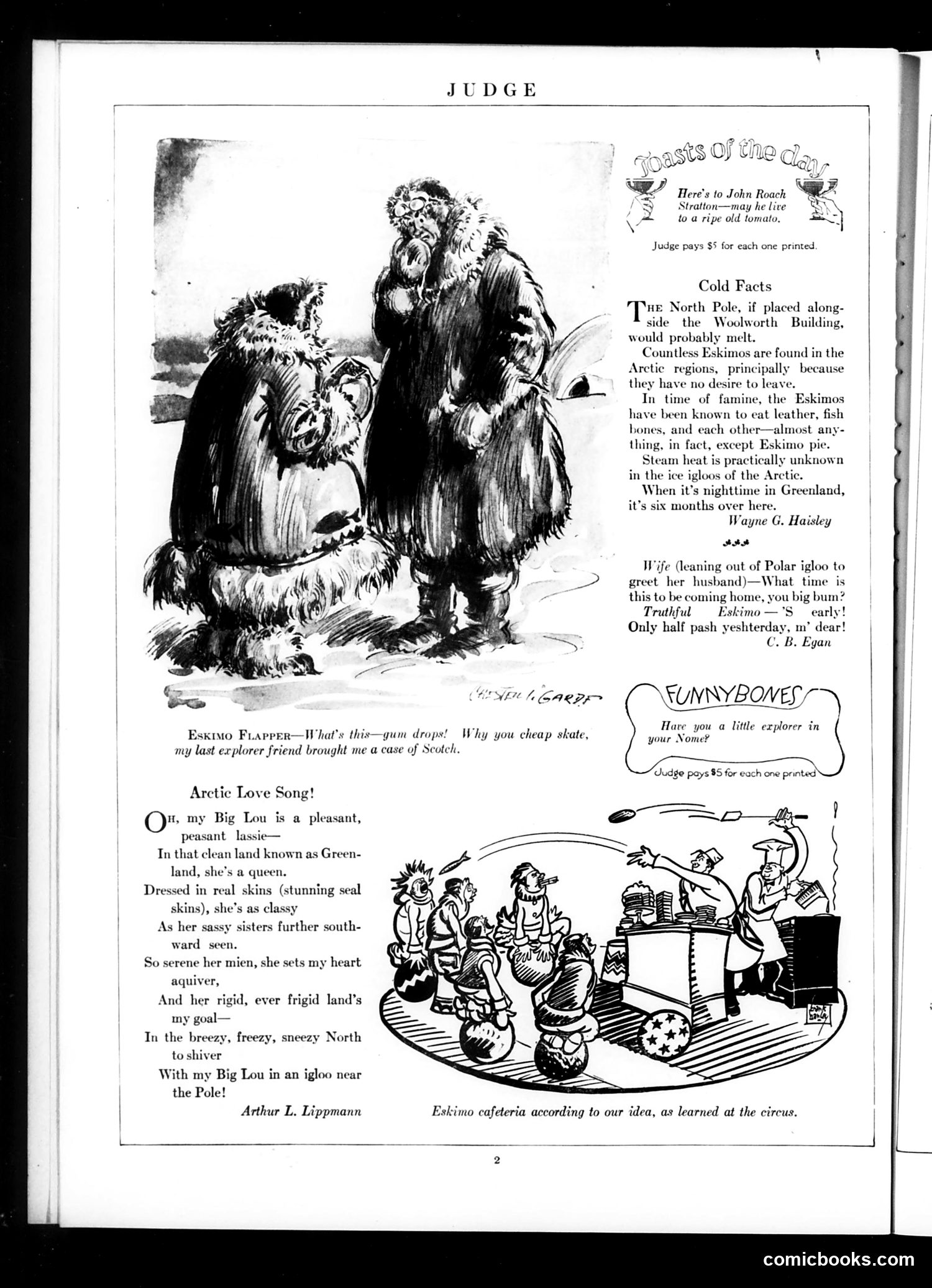
This page contains three distinct pieces of Arctic-themed humor: 1. **"Eskimo Flapper"** (top cartoon): A visual gag showing an Eskimo woman in "flapper" style—the trendy, modern fashion of 1920s youth culture. The joke plays on cultural contrast: applying contemporary American fashion terminology to indigenous Arctic peoples. 2. **"Cold Facts"** (right column): Factual information about Arctic conditions and Eskimo survival practices, presented as educational content alongside the humor. 3. **"Arctic Love Song"** (bottom left): A romantic poem humorously depicting an Arctic romance, written in sentimental style but set in an extreme, inhospitable environment. 4. **"Funny Bones"** (right): A visual joke about Arctic explorer culture. 5. **"Eskimo cafeteria"** (bottom): A cartoon depicting Eskimos in modern social settings, contrasting traditional culture with contemporary American leisure activities. The overall theme satirizes the collision between modern American culture and indigenous Arctic life.
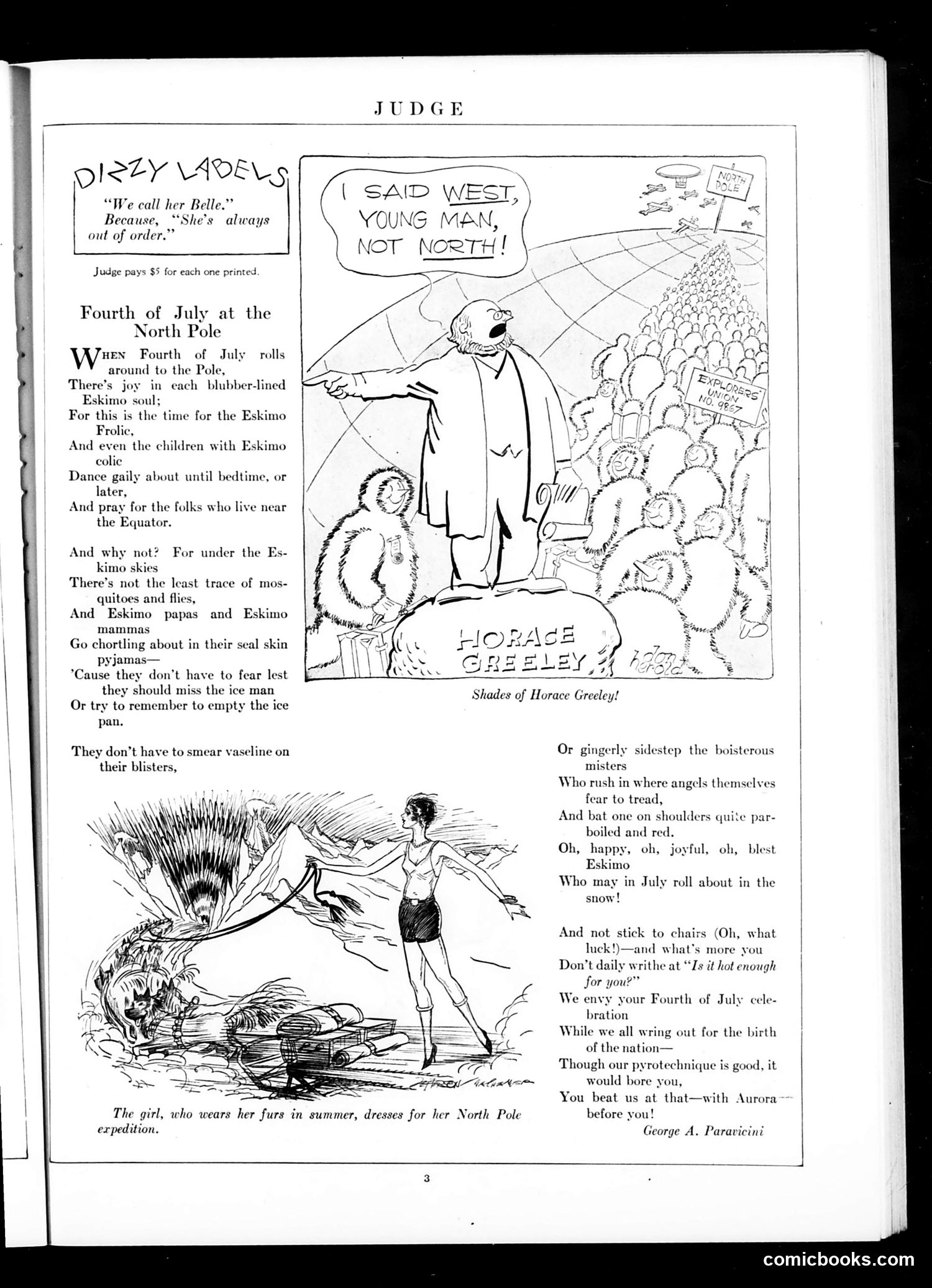
This page satirizes Arctic exploration fever, likely referencing early 20th-century polar expeditions. The main cartoon shows an explorer directing Inuit people, with the caption "I SAID WEST, YOUNG MAN, NOT NORTH!" — a play on Horace Greeley's famous "Go West, young man" maxim. The cartoonist mocks explorers' incompetence and disregard for Indigenous guidance. The accompanying poem celebrates celebrating Independence Day in the Arctic, humorously contrasting American patriotic traditions with extreme polar conditions. References to "Eskimo" culture, seal-skin clothing, and aurora borealis reflect period attitudes toward Indigenous peoples and exotic exploration. The satire targets both the romanticization of polar adventure and the era's colonial attitudes toward Indigenous knowledge and peoples.
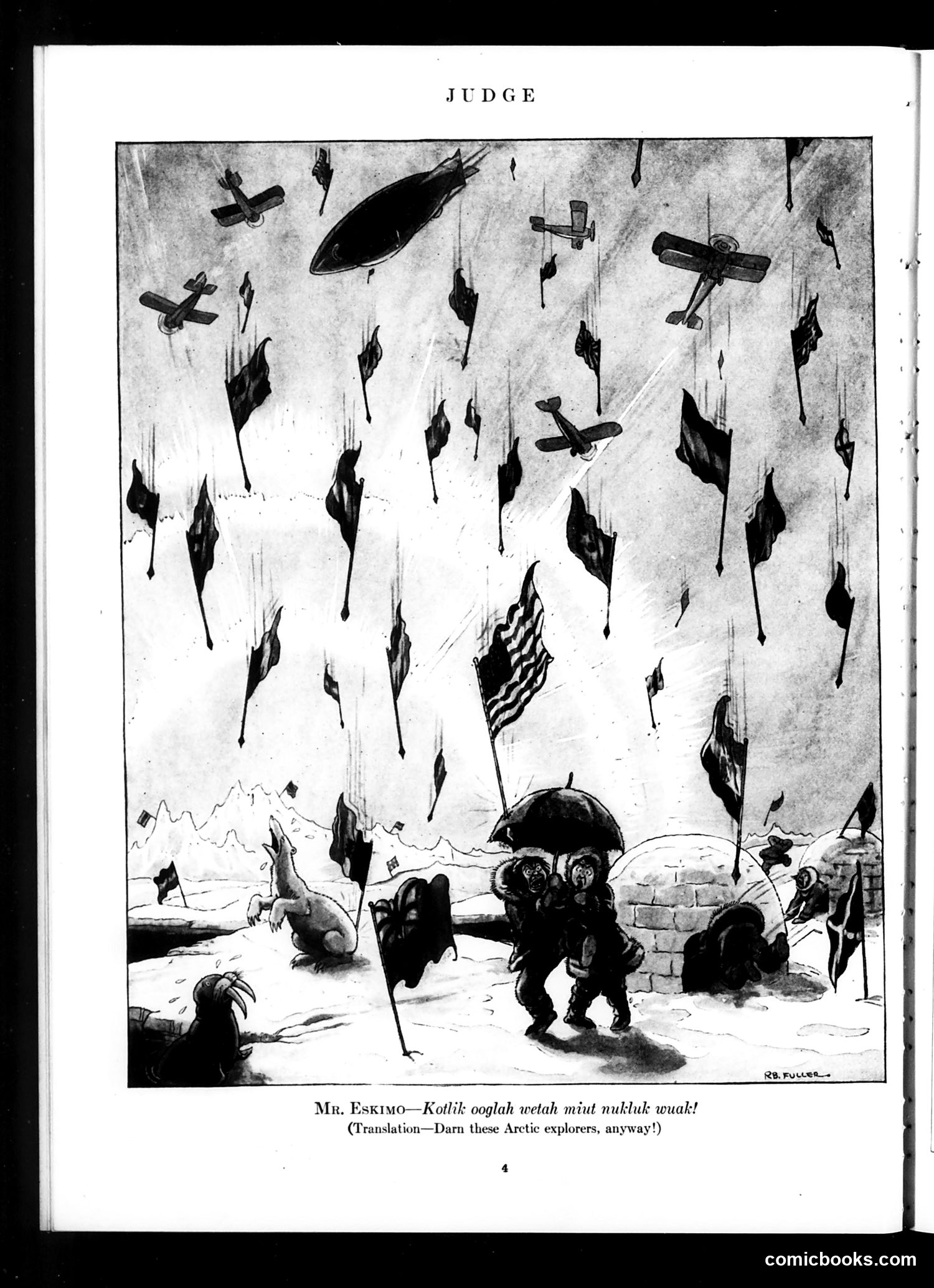
This political cartoon satirizes Arctic exploration, specifically targeting what appears to be early 20th-century polar expeditions. The scene depicts Inuit people ("Mr. Eskimo") amidst falling aircraft and flags in a war-like bombardment from above, with explorers huddled below taking shelter. The satire likely mocks the romantic glorification of Arctic exploration in American culture. The phrase "Darn these Arctic explorers, anyway!" suggests the Inuit perspective—their land is being invaded and disrupted by competing expeditions (multiple flags, aircraft visible). Rather than heroic adventure narratives, the cartoon presents exploration as chaotic, unwelcome intrusion into native territories. The artist (R.B. Fuller) critiques both the competitive nationalism of exploration and the disregard for indigenous peoples already inhabiting these regions.
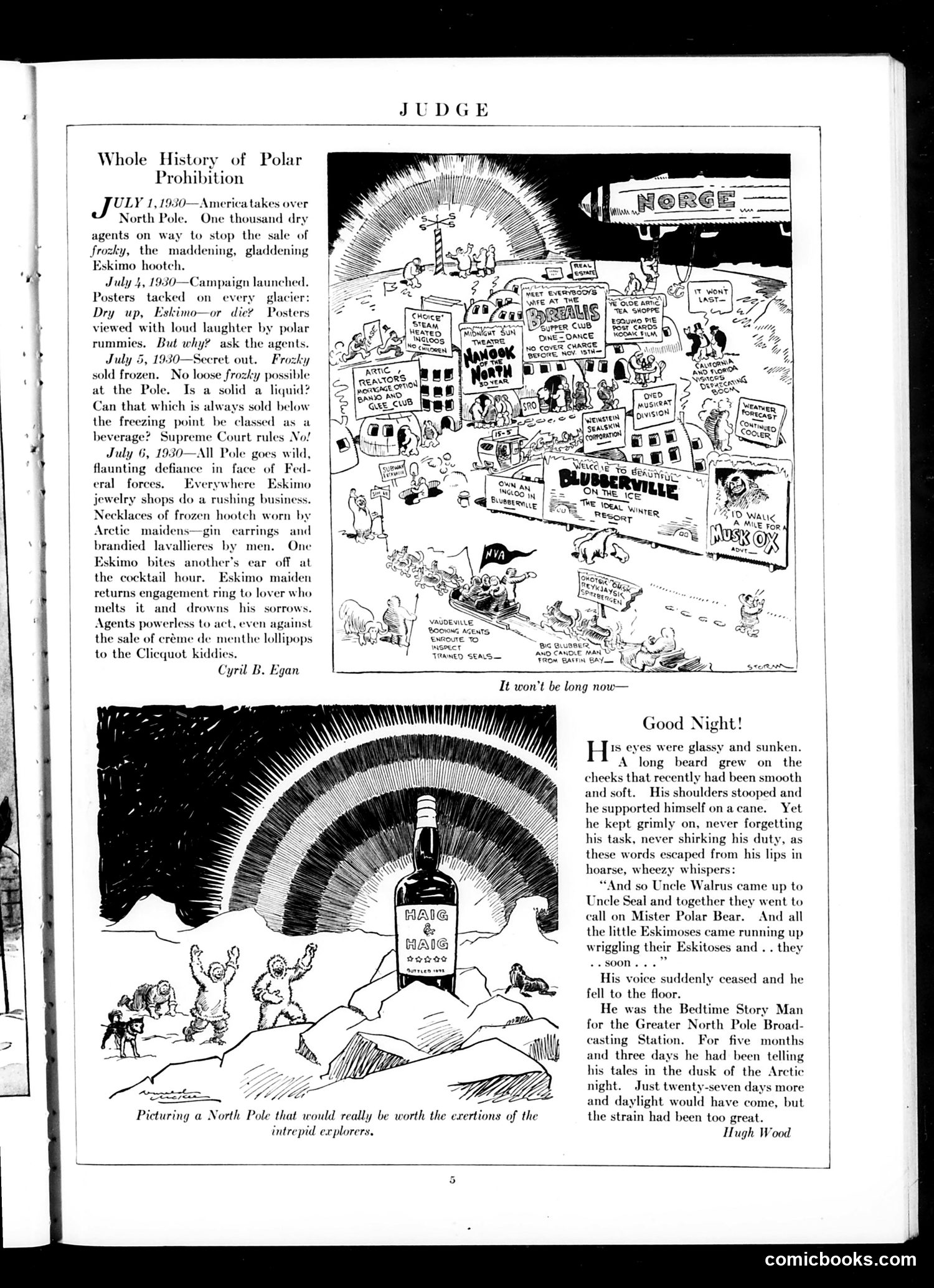
This page satirizes Prohibition enforcement efforts in 1930. The top cartoon by Cyril B. Egan depicts the "Whole History of Polar Prohibition"—a timeline mocking failed attempts to stop alcohol sales at the North Pole. The government deployed agents to prevent "frosty" (frozen) sales, but the satire questions the logic: if alcohol is liquid at room temperature, can freezing it classify it differently? The cartoon ridicules the absurdity of Prohibition enforcement. The bottom illustration accompanies a story titled "Good Night!" about an Arctic explorer—"the Belltime Story Man"—whose strength failed after months telling tall tales at a polar radio station. Both pieces mock Prohibition's impracticality and the strain of Arctic exploration, using humor to critique government policy during the Prohibition era (1920-1933).
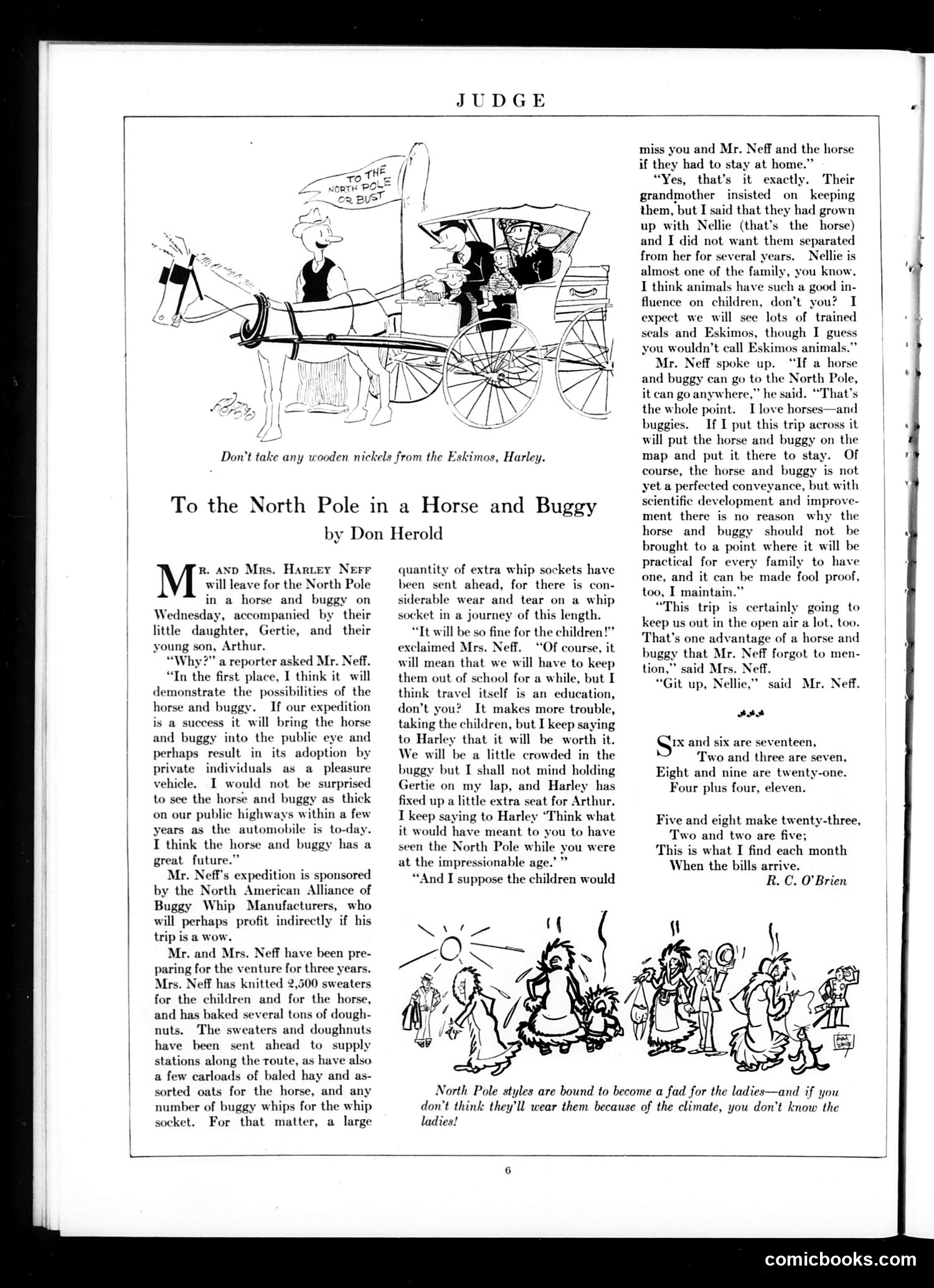
This Don Herold satire mocks technological nostalgia and misguided entrepreneurship. Mr. Neff plans to prove the horse-and-buggy's superiority by traveling to the North Pole—a patently absurd undertaking sponsored by the "North American Alliance of Buggy Whip Manufacturers" (a dying industry). The joke: Neff delusionally insists horses-and-buggies have a "great future" and could replace automobiles, despite the automobile already dominating American roads. His wife's extensive preparations (2,500 knitted sweaters, tons of doughnuts, baled hay stations) highlight the expedition's impracticality. The satire targets those who resist industrial progress through wishful thinking—a common anxiety during early automobile adoption. The caption "Don't take any wooden nickels from the Eskimos, Harley" reinforces the scam-like nature of the venture.
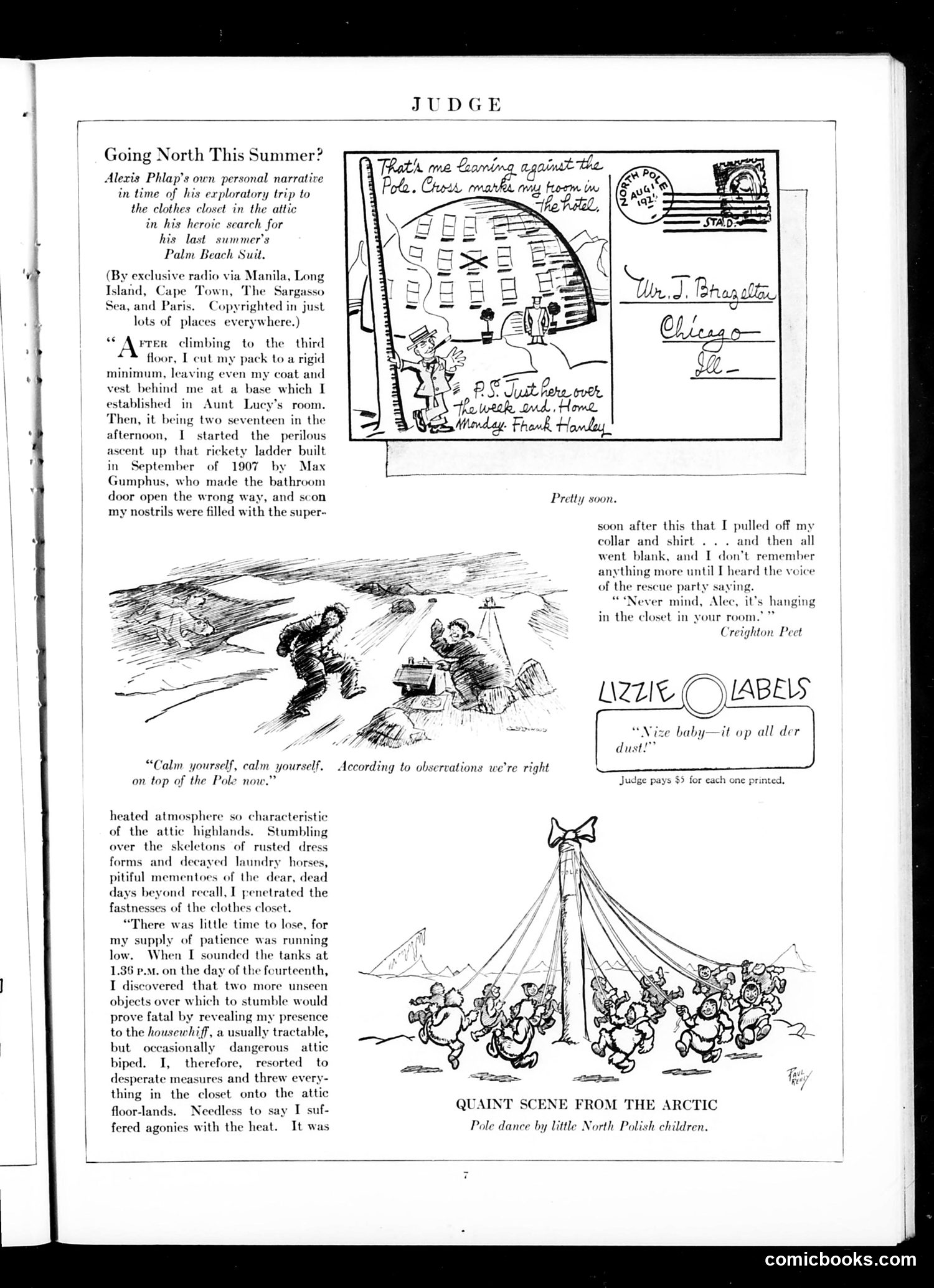
This is a humorous domestic narrative, not political satire. The piece parodies polar exploration literature (particularly fashionable in the early 1900s) by treating a mundane search for a misplaced Palm Beach suit as an epic expedition. The narrator, Alexis Phlap, describes climbing to the attic as a perilous polar journey, complete with "base camps" and supplies running low. Comic details include: a rickety 1907-built ladder, suffocating attic heat, encountering "skeletons of rusted dress forms," and fear of detection by "the housewife." The joke is the mock-heroic contrast between grandiose exploration rhetoric and the trivial reality—the suit has simply been hanging in a closet the whole time. The postcard and "Arctic" scene with Polish children dancing are supporting gags emphasizing the expedition theme. This satirizes the era's popular adventure narratives while gently mocking the fussiness of summer clothing concerns.
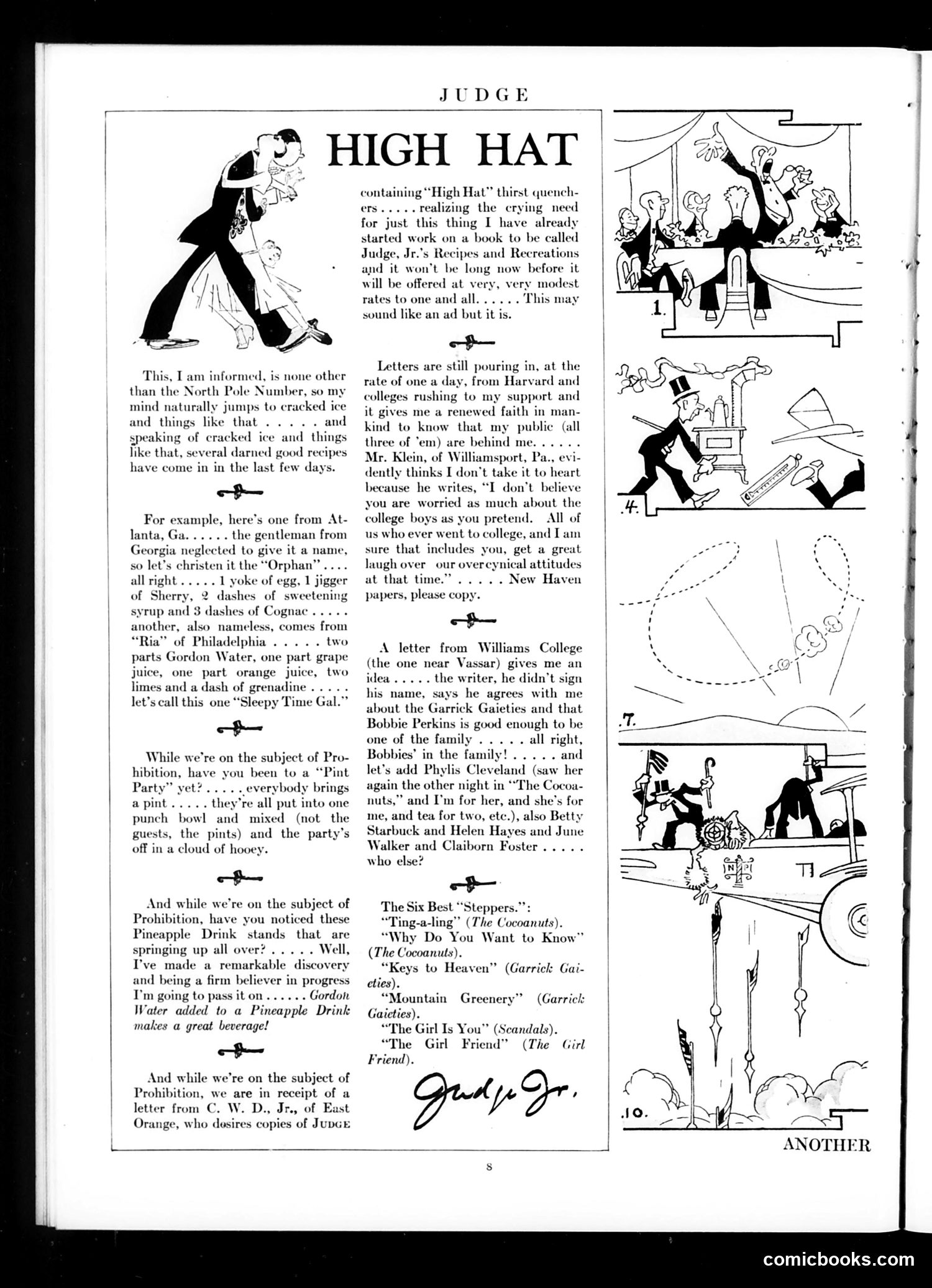
This is a page from Judge magazine's "High Hat" column—a satirical gossip/advice section. The main text is a humorous column by the editor (signed "Judge Jr.") discussing Prohibition-era drinking culture. **Key references:** - **Prohibition**: The 1920s alcohol ban is the target. The column jokes about "pint parties" (guests bring illegal liquor), speakeasies ("pineapple drink stands"), and homemade cocktail recipes being submitted to the magazine. - **"Pint Party"**: A satirical reference to underground social gatherings where bootleg alcohol was pooled together. - **Broadway musicals**: The column discusses contemporary shows like *The Cocoanuts* and *The Girl Friend*, mentioning performers like Phyllis Cleveland and Betty Starbuck. - **College culture**: Letters from Harvard, Williams College, and other institutions suggest young people are embracing the magazine's irreverent anti-Prohibition stance. The cartoons on the right (numbered illustrations) appear to show comedic scenarios related to these themes, though specific details are unclear. The satire mocks Prohibition's failure while celebrating Jazz Age excess and youth rebellion against the law.
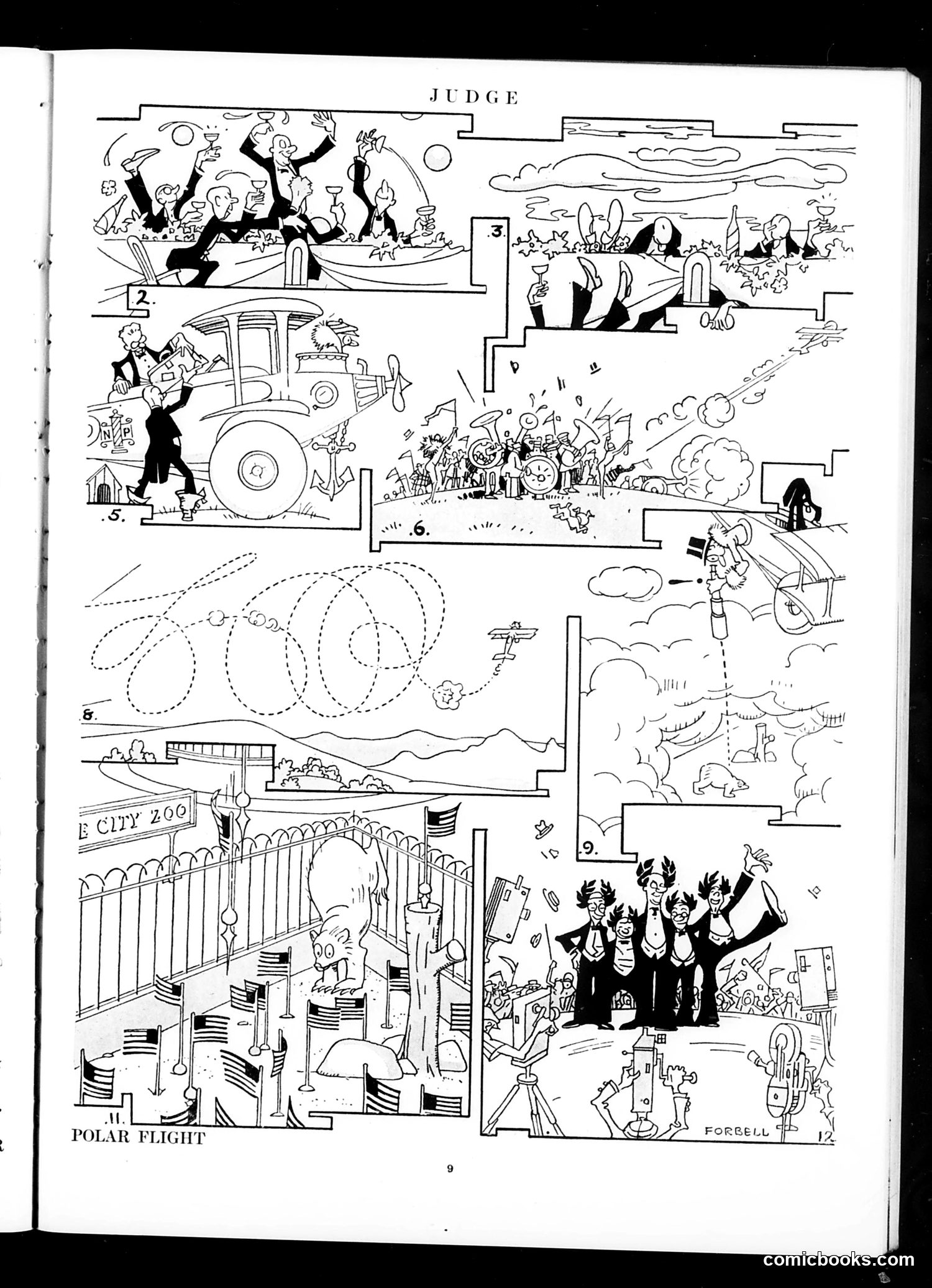
This page titled "JUDGE" contains nine numbered cartoon panels depicting various scenes of chaos and mayhem. The OCR text is too corrupted to read clearly. From the images alone, the cartoons appear to show: - Panel 1: Figures in formal dress in chaotic situations - Panel 5: A large tractor or farm vehicle - Panel 8: A "City Zoo" scene with an elephant - Panel 9: Figures in formal attire celebrating or reacting dramatically The cartoonist is credited as "FORBELL" (bottom right). Without legible text or clearer context, I cannot identify specific political figures, events, or satirical targets. The style and format suggest early-to-mid 20th century American humor, likely satirizing contemporary events or social situations, but the specific references remain unclear from this image alone.
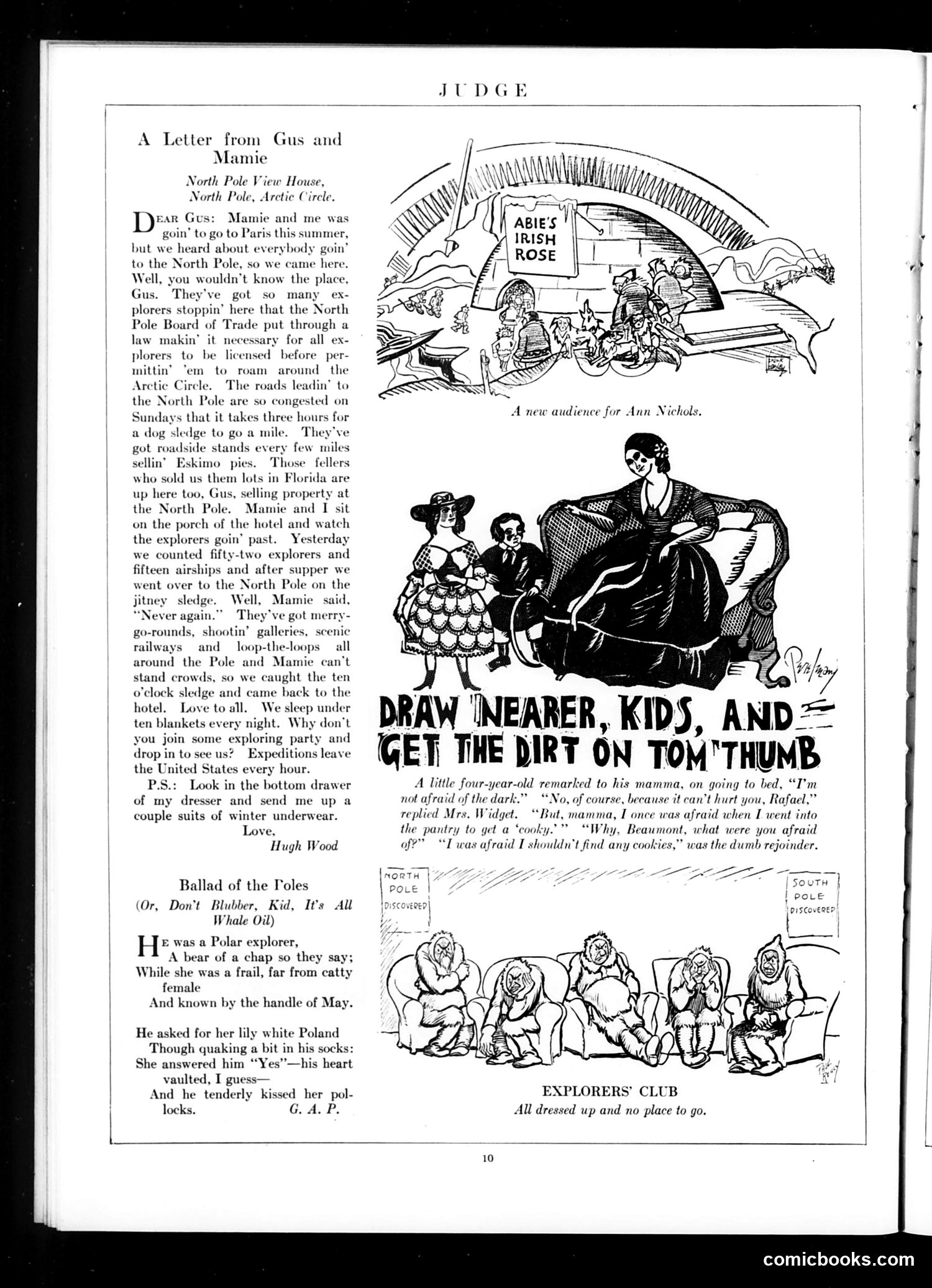
This page satirizes the early 20th-century craze for polar exploration. The letter from "Gus and Mamie" mocks how the North Pole has become a commercialized tourist destination despite—or because of—its remote danger. Once an exclusive frontier for serious explorers, it's now crowded with licensed expeditions, roadside stands selling "Eskimo pies," land-con artists (like those who sold Florida lots), and amusement park attractions ("go-rounds, shootin' galleries, loop-the-loops"). The joke is that modernity and commercialism have turned the ultimate wilderness into an overcrowded, bureaucratic vacation spot. The "Explorers' Club" cartoon at bottom reinforces this: explorers are "all dressed up and no place to go"—their romantic purpose is obsolete in a world where everyone can visit the Pole. The "Tom Thumb" section and "Ballad of the Poles" appear unrelated filler content.
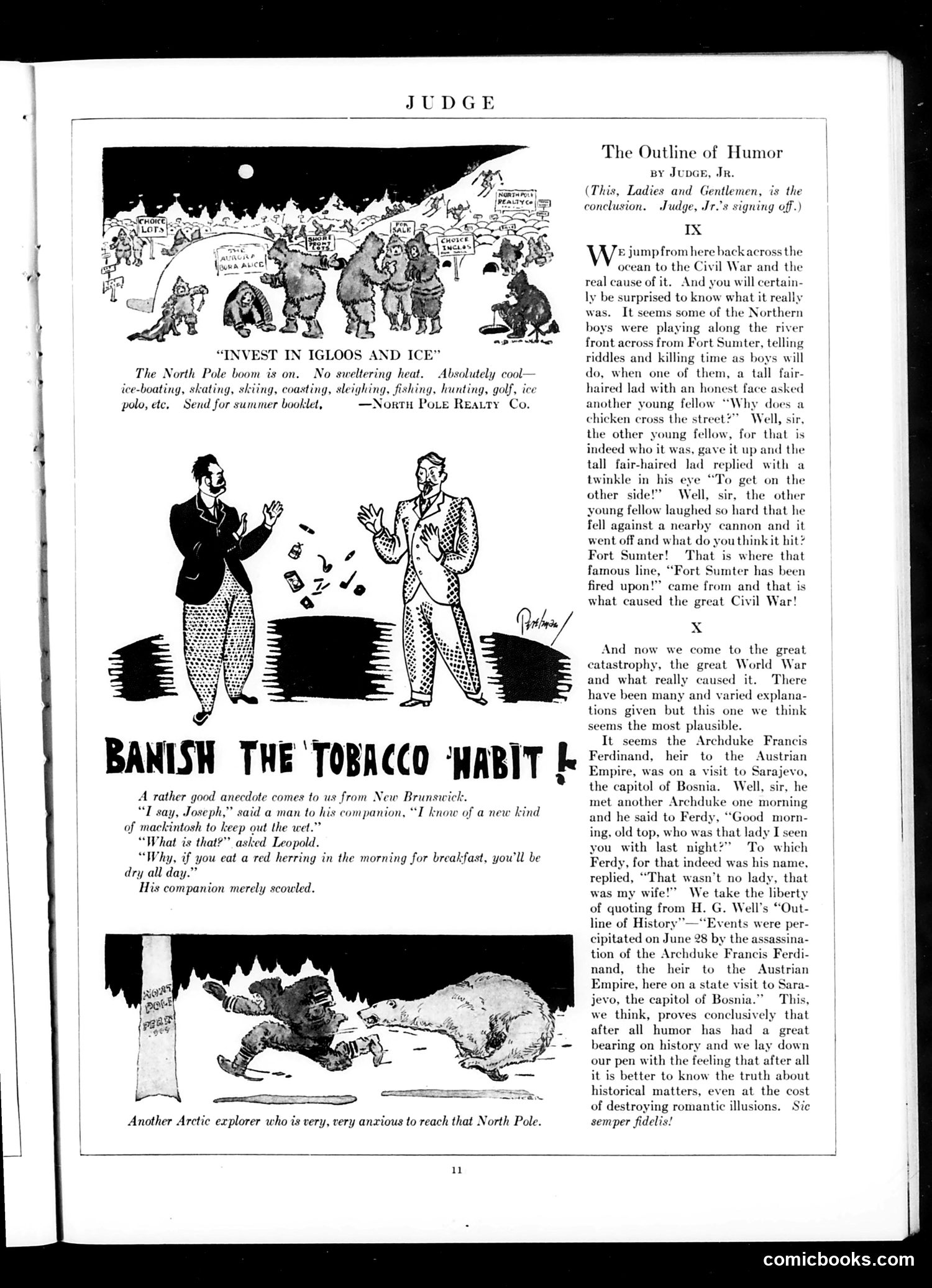
This page contains satirical humor from Judge magazine's "Outline of Humor" column. The cartoons mock absurd business schemes and offer tongue-in-cheek "explanations" of major historical events. The top cartoon advertises a ridiculous North Pole real estate boom, satirizing get-rich-quick schemes and speculative bubbles. The middle section features a bad joke about eating red herrings to stay dry—mocking predictable, groan-worthy humor. The final section presents absurdist "true causes" of historical events: the Civil War supposedly started because someone laughed so hard at a chicken-crossing-the-road joke that they knocked into a cannon at Fort Sumter; World War I resulted from Archduke Franz Ferdinand's wife being mistaken for a lady. The satire mocks how people construct false historical narratives and the human tendency to find simple explanations for complex events. It's also gentle mockery of H.G. Wells's "Outline of History," suggesting his explanations are equally ridiculous as these fabricated ones.
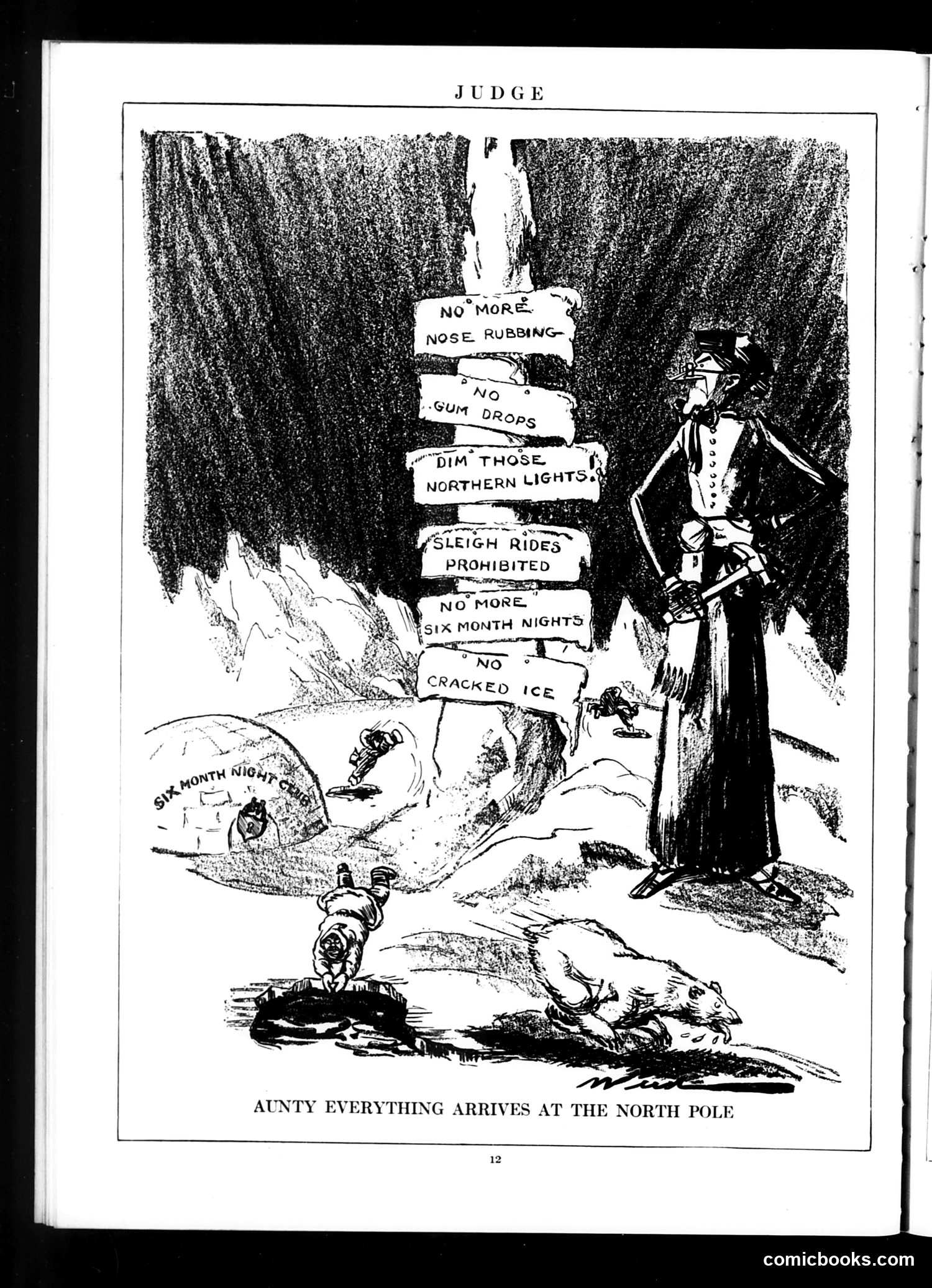
This satirical cartoon depicts a stern female figure (labeled "Judge") standing at the North Pole, enforcing prohibitions via stacked signs: no nose-rubbing, gum drops, dimmed northern lights, sleigh rides, six-month nights, and cracked ice. The cartoon appears to mock excessive regulation and killjoy authority—specifically "Aunty Everything," personifying an overbearing, prudish force that strips away all the magical and pleasurable aspects of Arctic/polar experience. The destroyed sleigh and distressed reindeer below emphasize how her restrictions have made the North Pole barren and joyless. This likely satirizes either specific Progressive-era regulations the magazine opposed, or more broadly critiques puritanical social movements attempting to eliminate popular entertainments and natural pleasures. The "Judge" figure suggests judicial or governmental overreach.
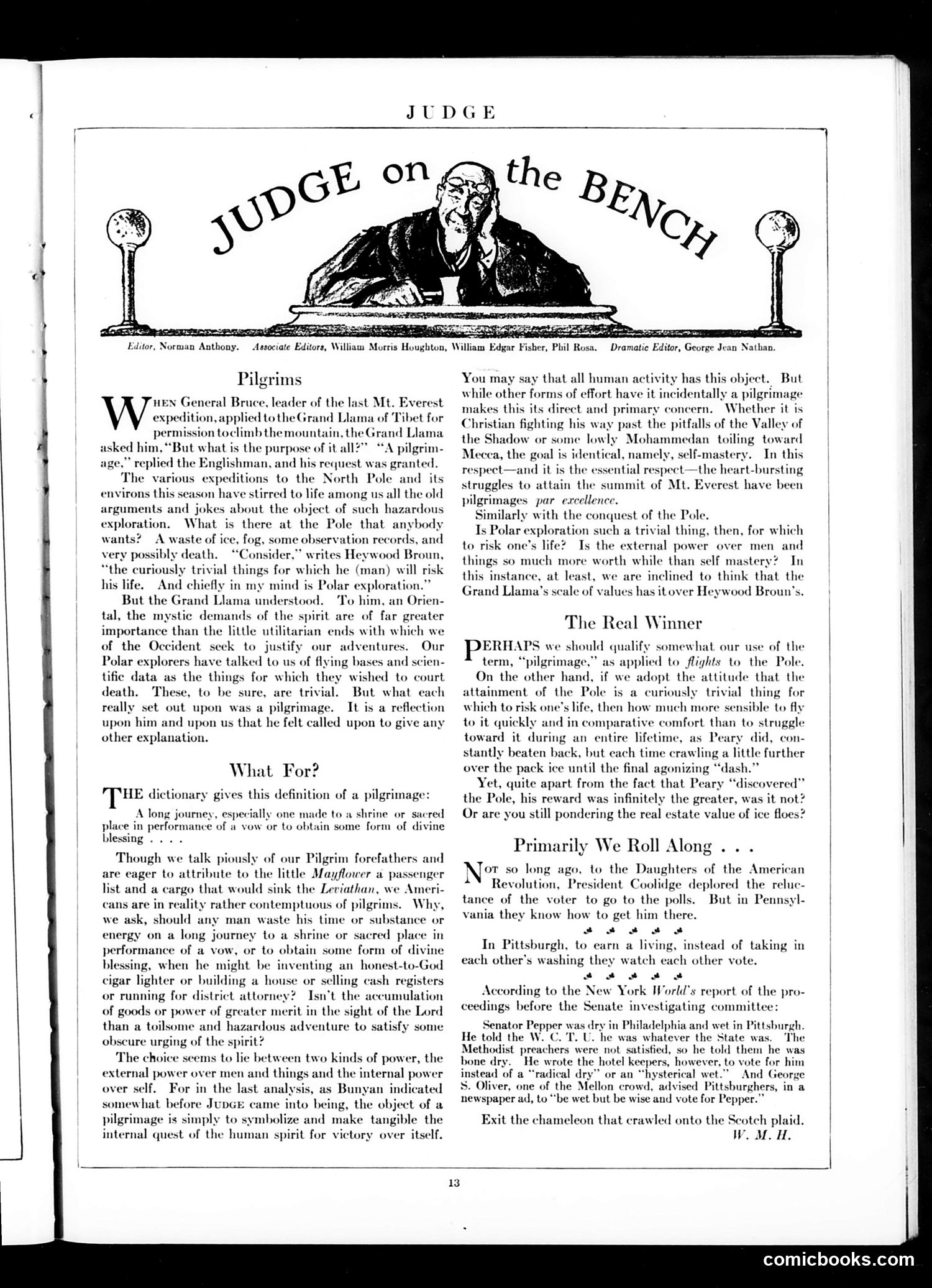
This page contains editorial essays defending polar exploration and mountain climbing as spiritually meaningful "pilgrimages" rather than trivial pursuits. The piece opens with General Bruce's 1924 Mt. Everest expedition, where he told Tibet's Grand Llama the climb was a "pilgrimage." Judge uses this to counter Western skepticism about dangerous expeditions. While American materialists (like humorist Heywood Broun) dismissed polar exploration as wasteful, Judge argues these quests represent spiritual self-mastery—comparing them to Christian pilgrims or Muslims traveling to Mecca. The satire targets American pragmatism: we mock pilgrimage while celebrating profit-seeking. Judge suggests explorers' true motivation is internal triumph, not scientific data, making their spiritual quest more noble than building "cigar lighters" or "cash registers." The piece implicitly critiques modern American values as shallow and commercialized compared to traditional spiritual quests, using exploration as proxy for this broader cultural anxiety about materialism versus meaning.
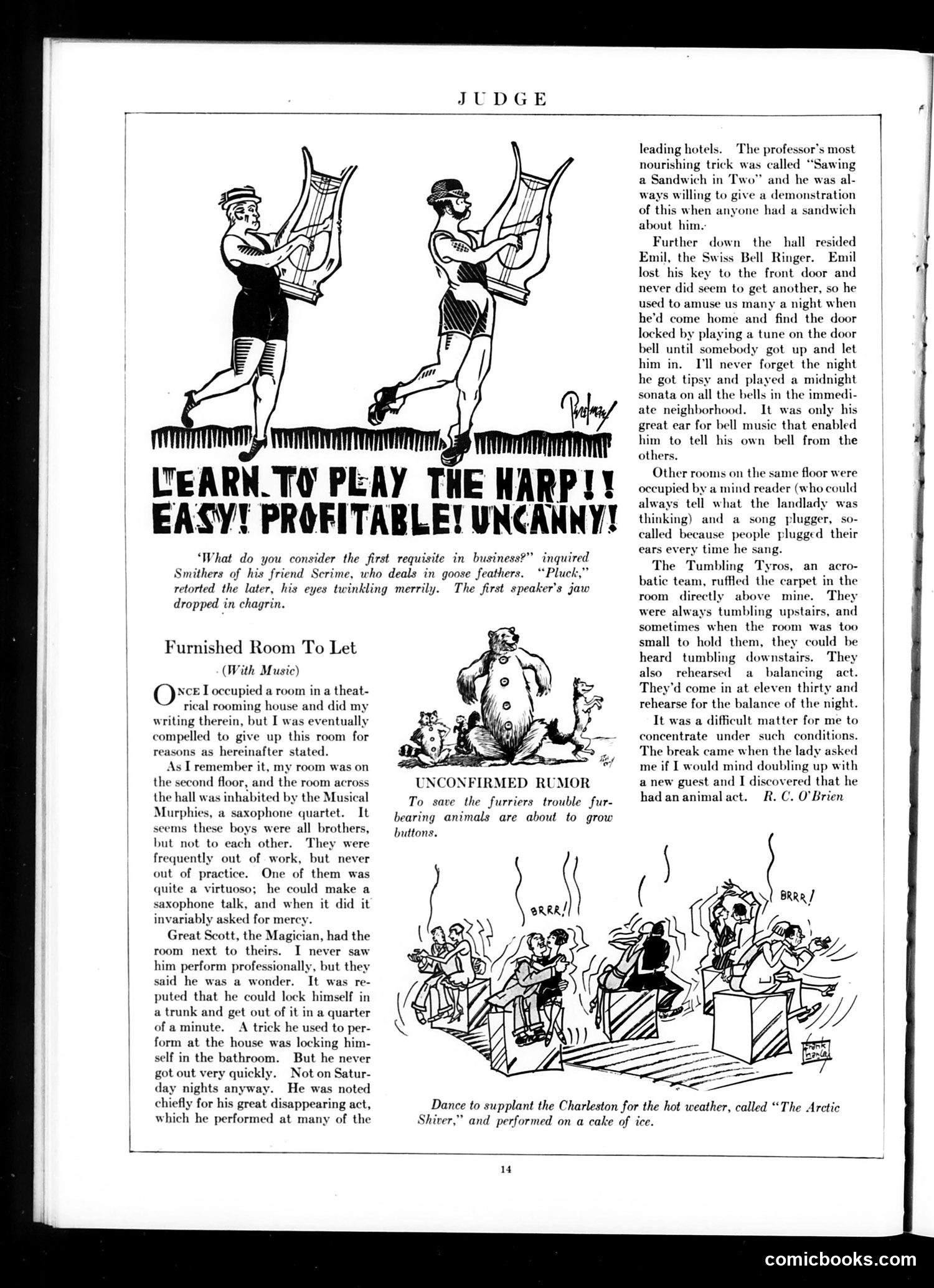
This page contains humorous anecdotes about theatrical boarding-house life, likely from the 1920s based on references to the Charleston dance and the "Arctic Shiver" trend. The top cartoon mocks self-help instruction ("Learn to Play the Harp") with a visual pun: two figures identical except one has "pluck" (courage/determination)—the punchline to a business joke below. The main story, "Furnished Room to Let (With Music)," satirizes the chaotic cohabitation of struggling stage performers: a saxophone quartet playing constantly, a magician obsessed with escaping locked bathrooms, a Swiss bell-ringer who drunkenly plays door-bells as instruments, a mind-reader, a song-plugger (promoter) whose singing is unbearable, acrobats who tumble at all hours, and finally a guest with an animal act. The satire targets both theatrical performers' quirks and urban boarding-house conditions. The "Unconfirmed Rumor" jokes about furriers: protecting fur-bearing animals by giving them buttons (making them useless for coats). The lower cartoon depicts people frantically dancing on ice—"The Arctic Shiver"—as an alternative to the Charleston during hot weather.
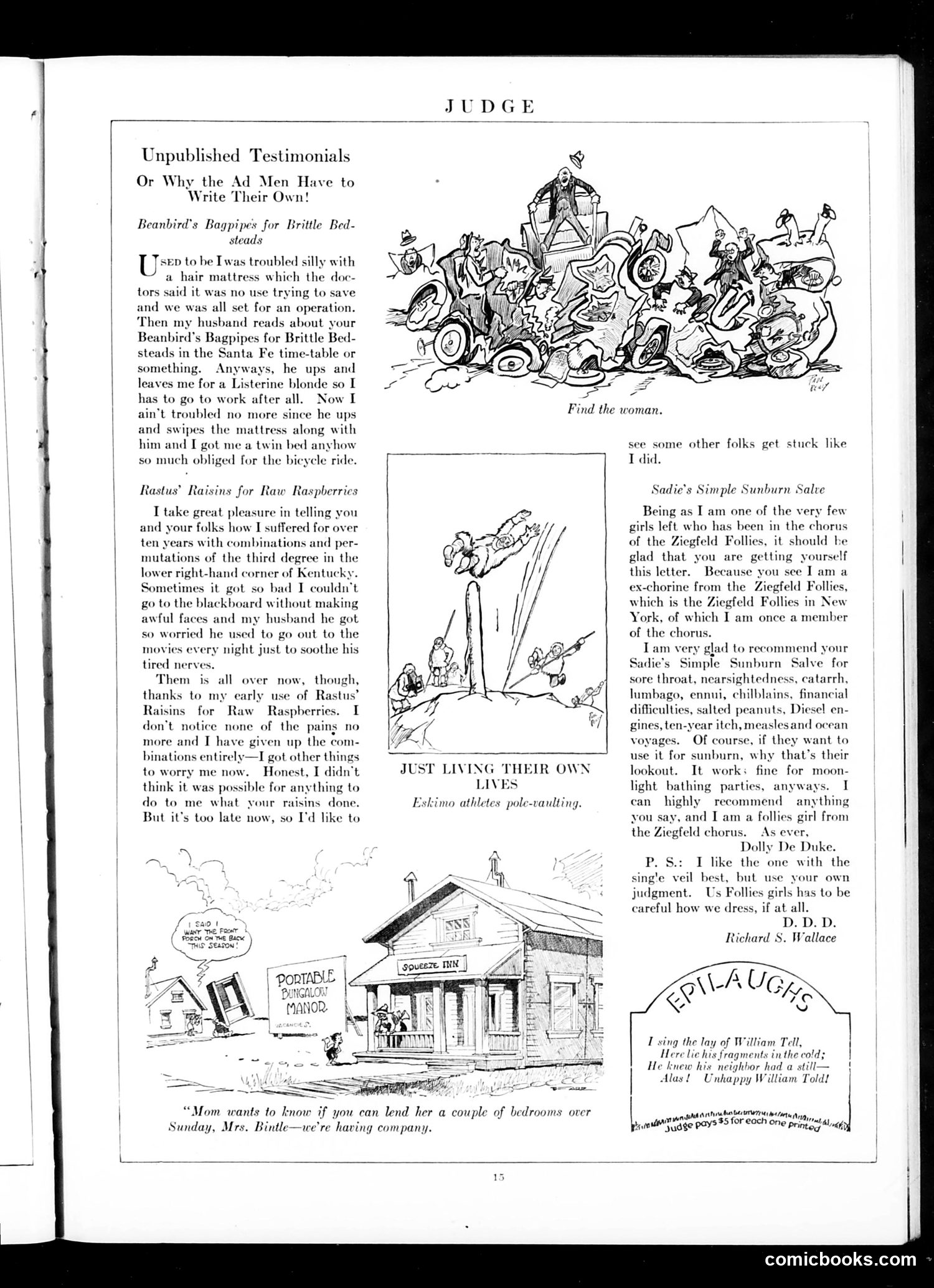
This page satirizes the advertising industry's use of fabricated testimonials. The fake product endorsements—"Beanbird's Bagpipes for Brittle Bedsteads," "Rastus' Raisins for Raw Raspberries," and "Sadie's Simple Sunburn Salve"—are deliberately absurd, with testimonials that undercut themselves. The joke: advertisers must write their own testimonials because no real customers would actually endorse these nonsensical products or make such ridiculous claims. The testimonials contain non-sequiturs (a mattress product leads to abandonment; a sunburn salve cures unrelated ailments like "financial difficulties"), exposing how disconnected advertising claims are from reality. The other cartoons mock similarly absurd ideas: Eskimos pole-vaulting, someone renting bedrooms from neighbors mid-Sunday. This was Judge's critique of 1920s-era advertising's shameless fakery and the gullibility it assumed of consumers.
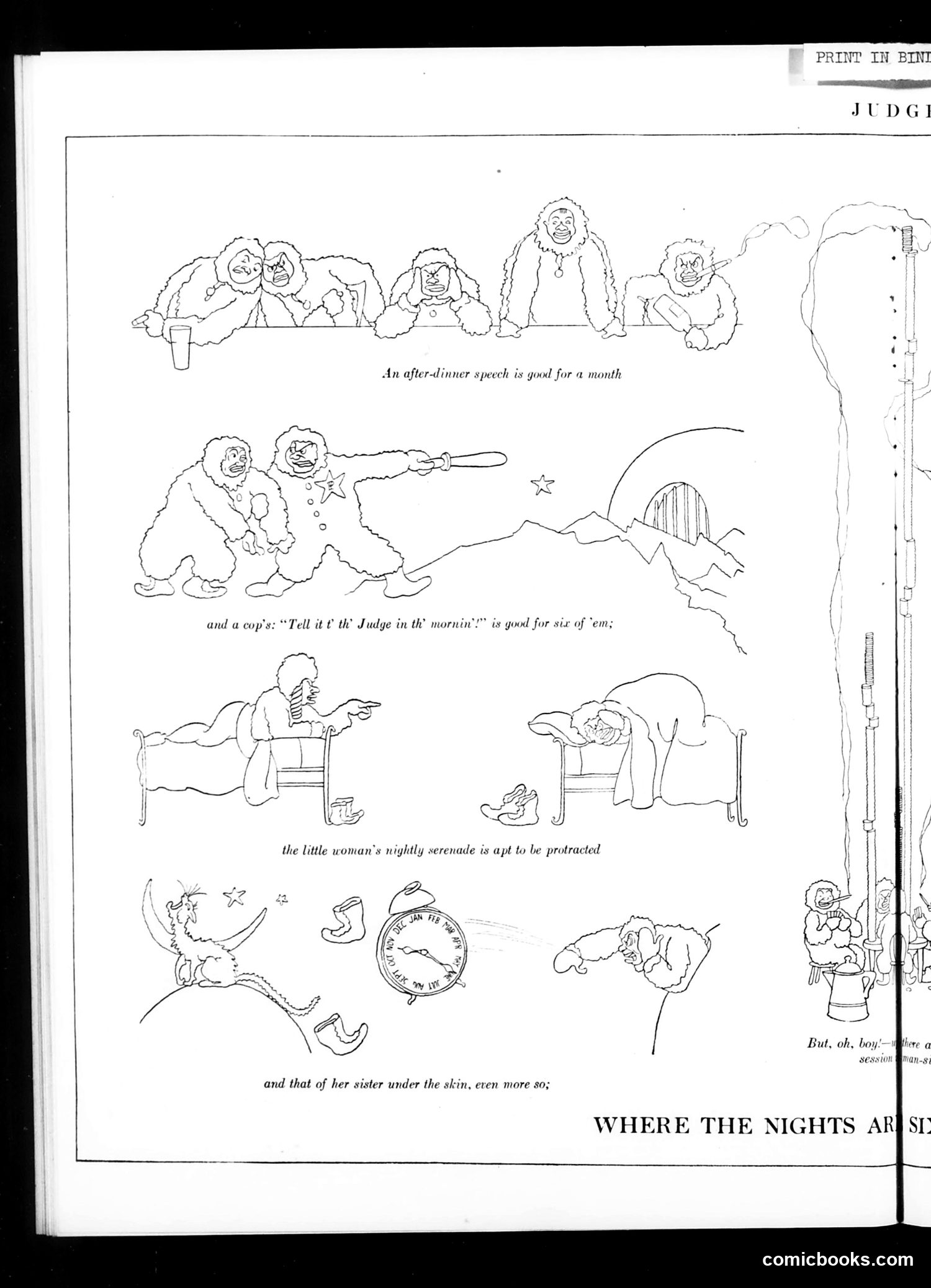
This appears to be a humorous domestic satire about married life and sleep. The cartoon sequences depict: 1. **Top panel**: Multiple figures (possibly judges or authority figures) with text about "after-dinner speech is good for a month" 2. **Middle panels**: A couple where one partner points a telescope/instrument at a crescent moon and stars, with the caption about telling "the Judge in the mornin'" being "good for six of 'em" 3. **Lower panels**: A woman in bed protected by an umbrella/canopy; a man also in bed; clock imagery; and commentary about "the little woman's nightly serenade" needing protection and "her sister under the skin, even more so" The joke appears to satirize snoring and nighttime domestic disturbances—suggesting women's snoring requires literal protection from its volume. This reflects period attitudes about marital comedy and gender stereotypes common to early Judge humor.
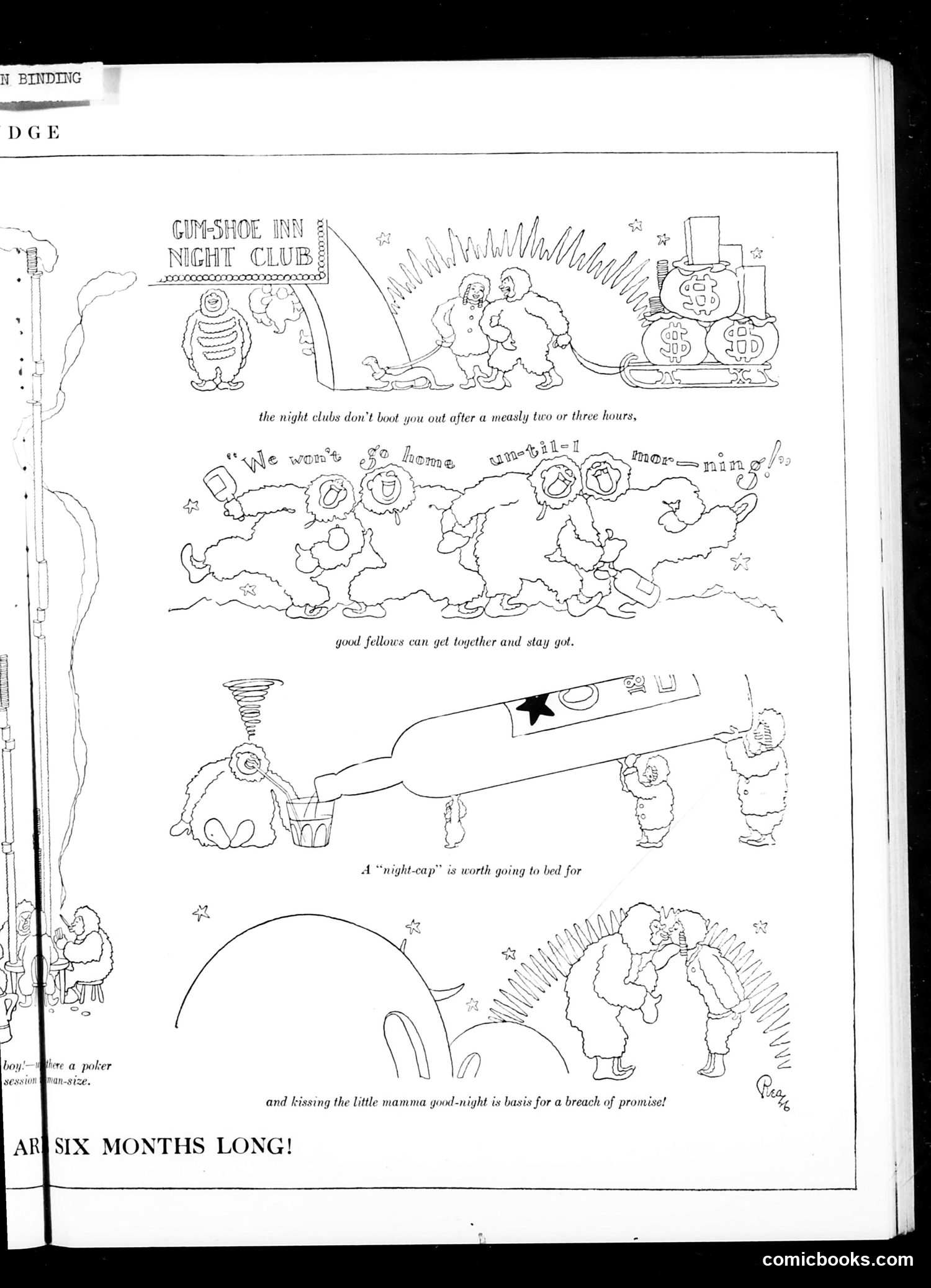
This Judge magazine cartoon satirizes 1920s nightclub culture and its social consequences. The top panel shows a "Gumshoe Inn Night Club" where patrons can stay for extended hours—unlike respectable establishments that close early. The subsequent panels depict the comic chaos that ensues: revelers celebrating wildly, drinking champagne, and engaging in romantic behavior. The final caption warns that such nightclub conduct—particularly kissing a woman goodnight—constitutes "basis for a breach of promise" lasting six months. The satire targets both the loose morality of jazz-age nightlife and the legal/social consequences for men who could be sued by women for broken engagement promises. It reflects contemporary anxieties about changing social norms, particularly regarding courtship and women's legal protections.
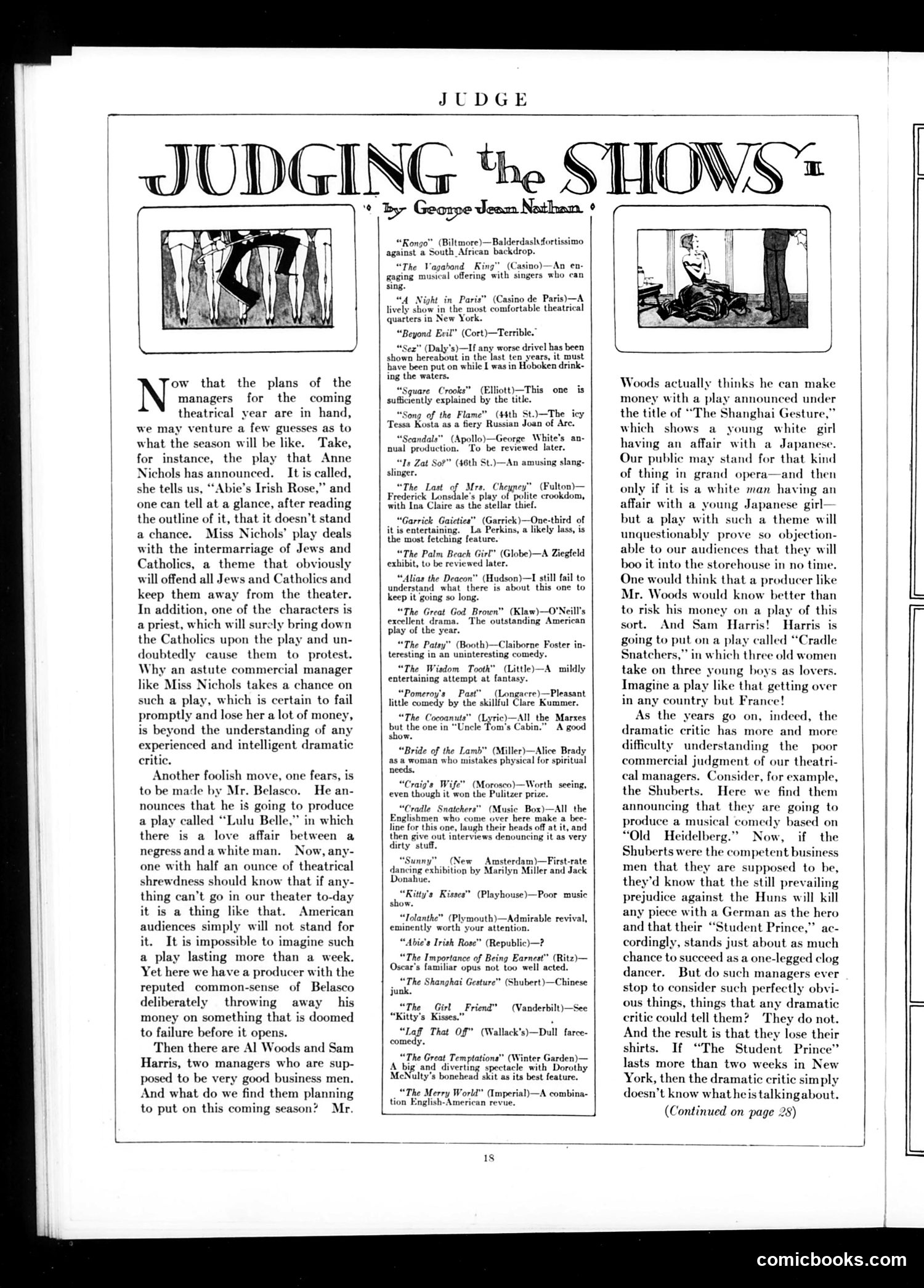
This page is theater criticism by George Jean Nathan for *Judge* magazine's drama section. Nathan reviews upcoming Broadway productions, offering sharp predictions about which plays will succeed or fail. The article's satire targets theatrical producers' poor business judgment. Nathan mocks Anne Nichols's "*Abie's Irish Rose*" (about Jewish-Catholic intermarriage) as certain to offend both communities and fail. He similarly ridicules David Belasco's "*Lulu Belle*" (featuring a romance between a Black woman and white man) as unmarketable to contemporary American audiences—predicting it cannot last a week. The irony: both plays actually became successful, proving Nathan spectacularly wrong. His confident pronouncements about what American audiences "simply will not stand for" missed the mark entirely, making this piece an unintentional comedy about critical misjudgment. The remaining text consists of brief, often scathing reviews of other Broadway shows opening that season.
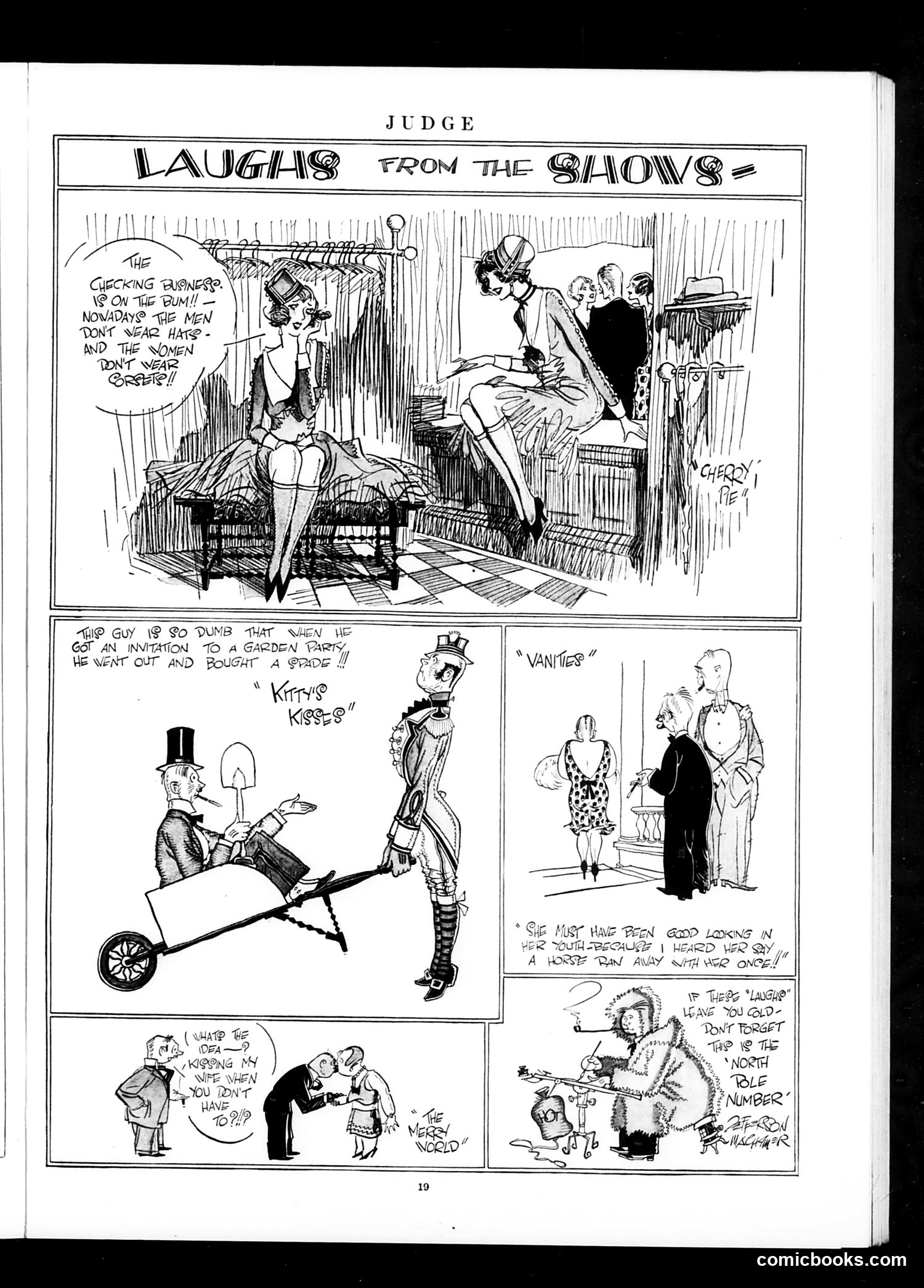
This page collects vaudeville and theatrical jokes satirizing 1920s social attitudes about gender and fashion. **Top panel**: A woman discusses "checking bloomers" on the Rialto (Broadway theater district), noting men now wear hats indoors while women don't wear bloomers—inverting traditional gender norms around clothing and modesty. **Middle panels**: Jokes about a foolish man buying a bride at a garden party; a woman's appearance after a "horse ran away"; and a man kissing his wife despite not having "to" anymore—suggesting changing marital dynamics where affection is no longer obligatory. **Bottom panels**: References to forgetting someone, and a comment about the "North Pole" and "number"—likely theatrical references now unclear. The satire targets anxiety about rapidly shifting gender roles and fashion in the 1920s, when women's clothing (shorter dresses, no bloomers) and social behavior were liberalizing. The humor assumes readers shared conservative concerns about these changes.
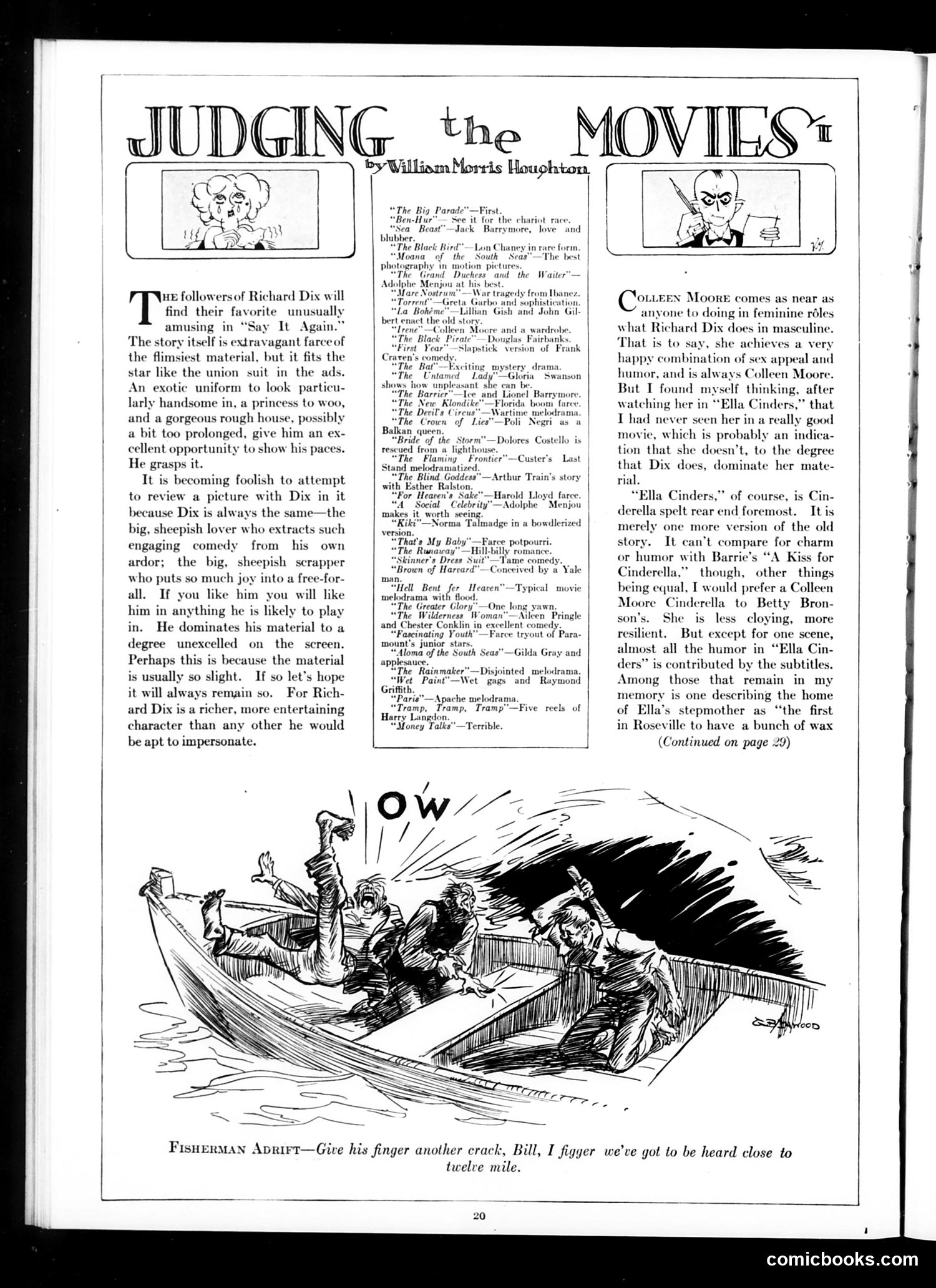
This is a film criticism column from Judge magazine reviewing current Hollywood releases. The critic discusses actor Richard Dix, praising his consistent appeal despite thin material—he's a "big, sheepish lover" who dominates whatever picture he appears in through sheer charisma. The second section evaluates actress Colleen Moore, comparing her favorably to Dix in achieving "sex appeal and humor," though the critic suggests she hasn't yet appeared in a truly excellent film. He specifically reviews "Ella Cinders," a Cinderella adaptation, noting most of its humor comes from the subtitle cards rather than Moore's performance itself. The page includes a list of current film releases with brief assessments, and a cartoon showing fishermen in a boat with the caption about needing to be heard "close to twelve mile"—likely satirizing the silent film era's reliance on visible action rather than dialogue. This reflects 1920s film criticism's focus on star power and physical comedy.
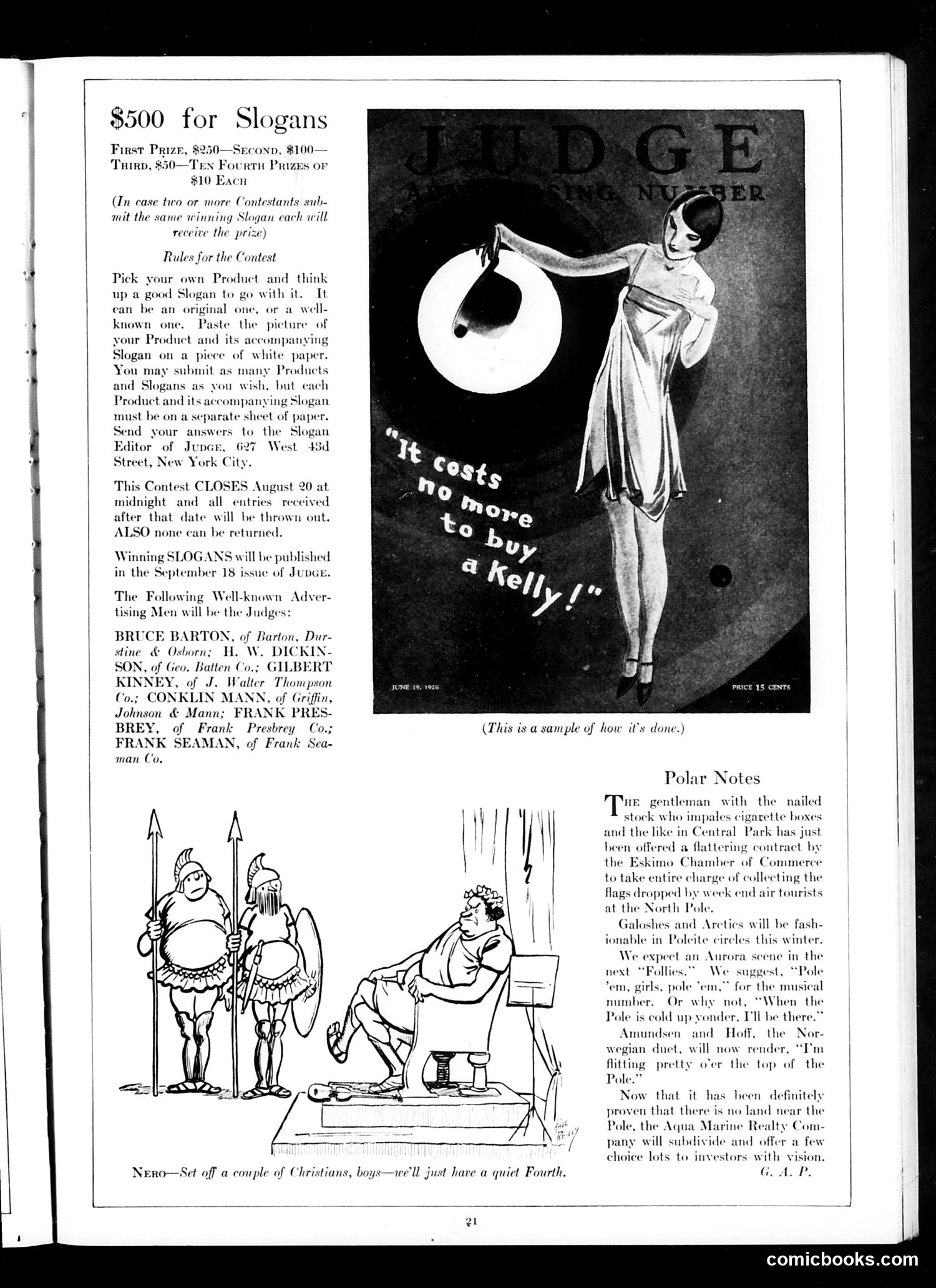
This page contains a **slogan-writing contest** ($500 in prizes) where readers submit advertising slogans paired with product pictures. The sample advertisement shown—a woman holding a Kelly handbag with text "It costs no more to buy a Kelly!"—demonstrates the expected format. The **"Polar Notes"** section is satirical commentary on Arctic exploration trends. It mocks the contemporary fascination with polar expeditions by: 1. Joking about a businessman collecting flags at the North Pole for the Eskimo Chamber of Commerce 2. Predicting Arctic fashion (galoshes) will become trendy in "Poleite circles" 3. Suggesting song titles capitalizing on polar fever ("When the Pole is cold up yonder") 4. Referencing explorers Amundsen and Hoff in a comic operetta 5. Satirizing real estate speculation by suggesting the newly-proven "no land" at the North Pole will be subdivided and sold anyway The humor targets both the era's polar exploration mania and aggressive American commercialism—even impossible locations get real estate schemes.
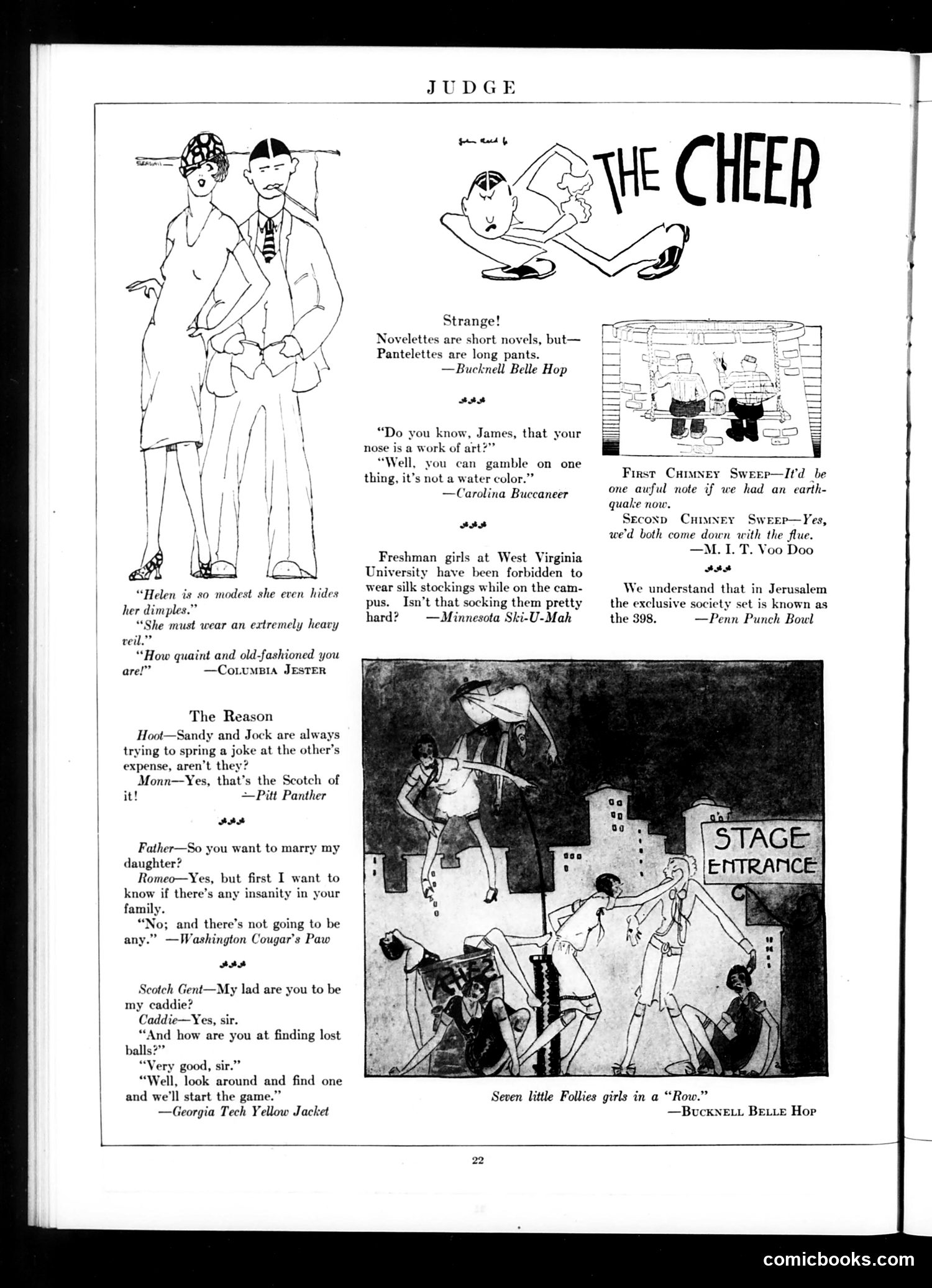
This is a humor/joke compilation page from Judge magazine, featuring various quips and comic bits typical of 1920s collegiate and social satire. **Key content:** The page collects one-liner jokes sourced from college newspapers (Georgia Tech, M.I.T., Penn, etc.), suggesting these were popular formats of campus humor. Topics include romantic courtship ("Father, so you want to marry my daughter?"), ethnic stereotypes (a "Scotch" joke playing on frugality), and contemporary social restrictions (West Virginia University banning silk stockings on female freshmen—the joke being this rule "socks" them hard). Visual elements include a drawing of a fashionably dressed couple and an illustration of chorus girls at a "Stage Entrance," captioned as "Seven little Follies girls in a 'Row'"—likely referencing the Ziegfeld Follies, a popular Broadway revue. The humor is mild social observation rather than sharp political satire: jokes about vanity, courtship anxieties, and college life absurdities.
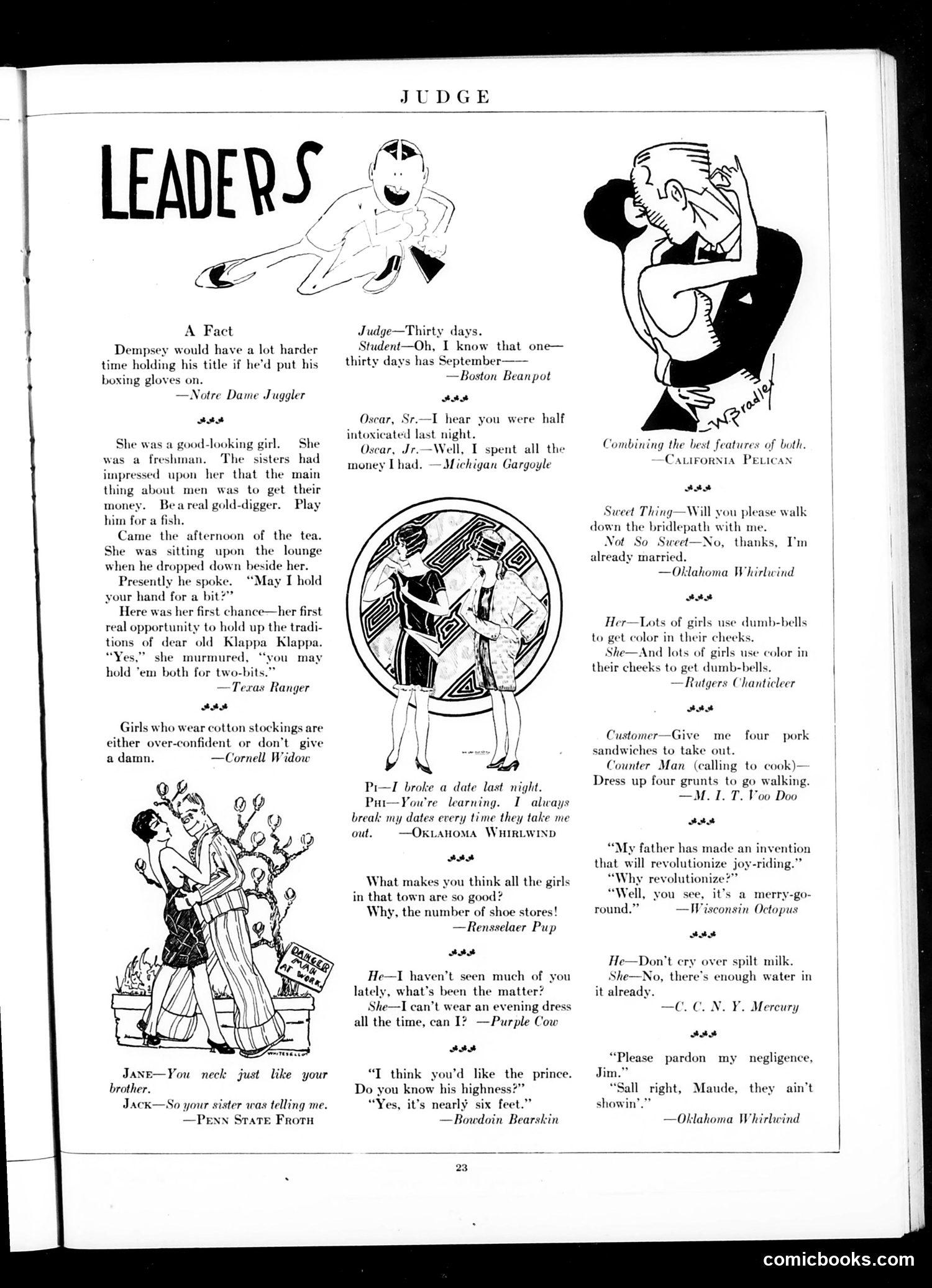
This page from *Judge* collects brief humorous anecdotes and jokes from college newspapers, typical of 1920s satirical humor. The cartoons and quips mock social conventions and emerging youth culture: **Key themes:** - **Gold-digger satire**: A college girl is trained to exploit men financially, reflecting anxiety about women's economic independence and changing courtship norms. - **Dating/necking culture**: Multiple jokes reference physical intimacy and casual relationships, suggesting concern about looser sexual mores among young people. - **Class humor**: Jokes about drunkenness, working-class slang ("grunts"), and fashion expose generational and social divides. - **Gender role reversals**: Women are depicted as manipulative or materialistic, while men appear foolish or easily duped—both reflecting tension over women's expanding social roles. The cartoon of a woman in a telephone booth (captioned about "combining best features") likely satirizes dating complications or miscommunication. Overall, the page reflects 1920s anxiety about youth rebellion against Victorian propriety.
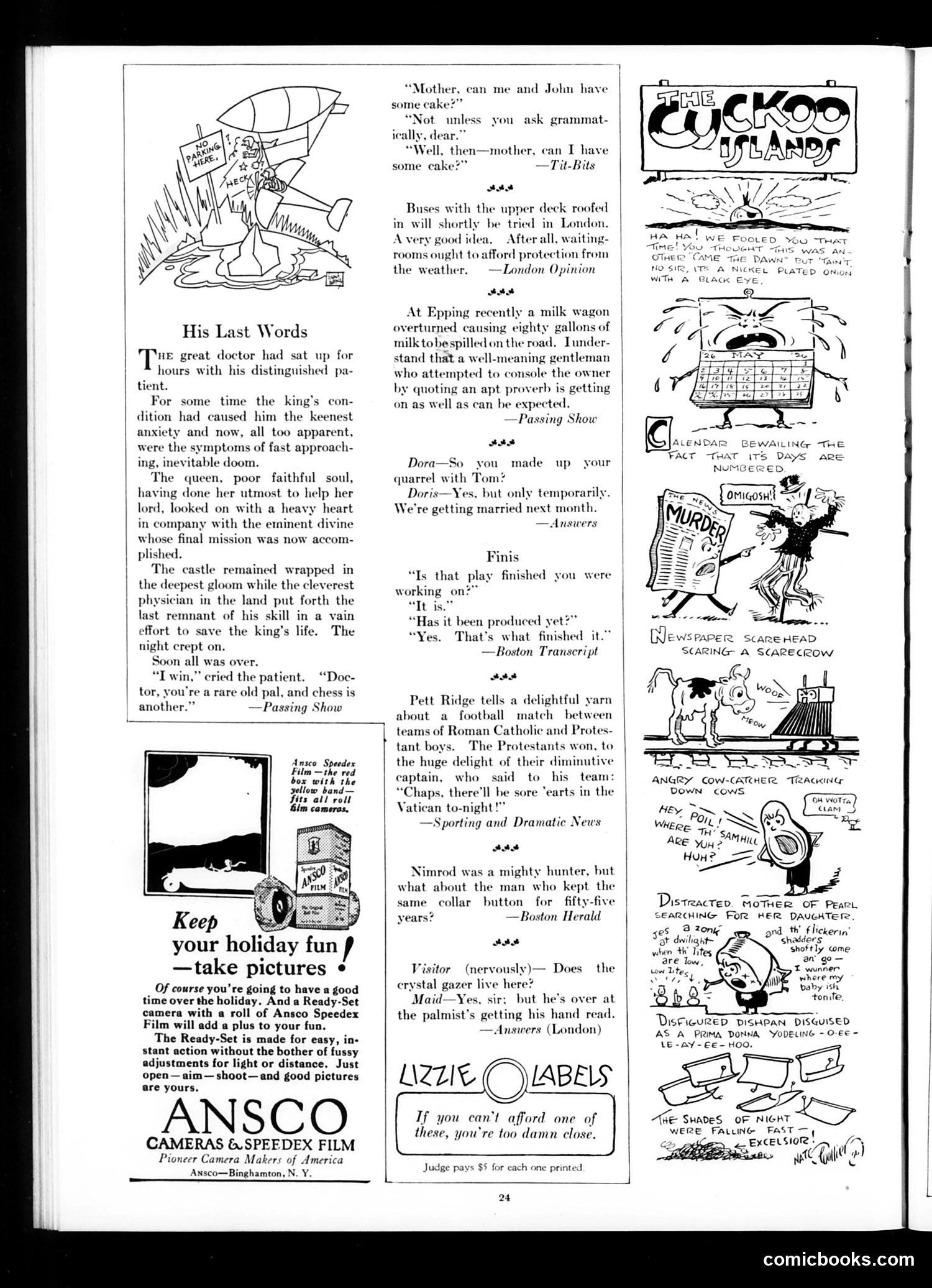
This page contains primarily **humorous short anecdotes and comic strips** rather than political satire. The main text pieces are light jokes: a dying king's last words are about winning at chess; grammar-conscious children; observations about London buses and spilled milk. These reflect early 20th-century British and American humor sensibilities. **"The Cuckoo Islands"** comic strip (top right) depicts characters discovering a magical island, with typical slapstick humor about being fooled. Below are various single-panel gags: an angry cowherd chasing cows, a distracted mother searching for her daughter while daydreaming, a dishpan-disguised opera singer, and a figure yodeling as "shades are falling fast." The page also includes **advertising** for Ansco cameras and film, and **"Lizzie Labels"** (a Judge feature where readers submitted funny captions for judges to rate at $5 each). The humor is gentle, domestic, and whimsical rather than satirical. There's no identifiable political content or caricature of public figures visible on this particular page.
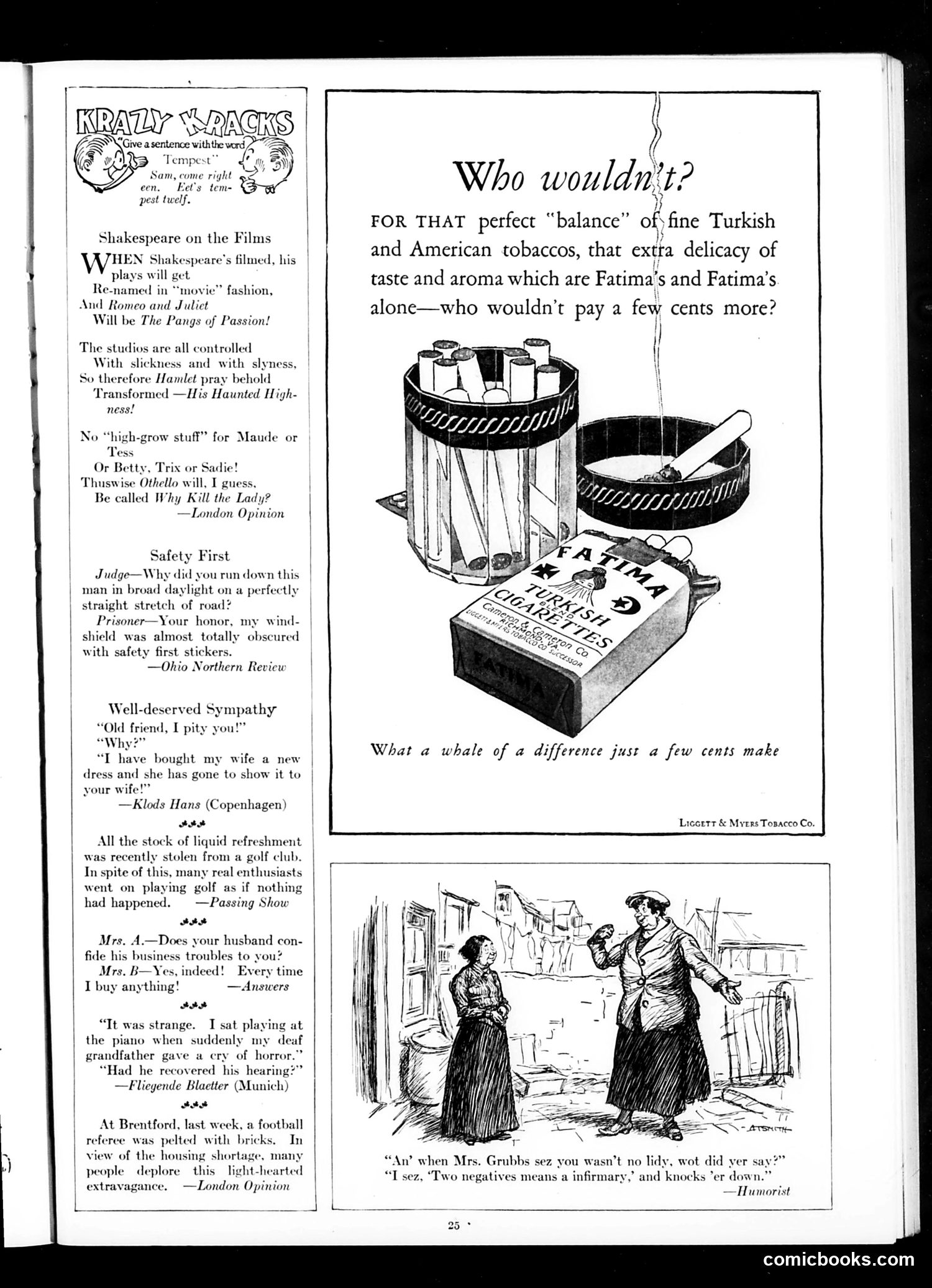
This page contains several distinct humor pieces rather than a single cartoon: **Main Advertisement (Center):** A Fatima cigarettes ad showing tobacco packages and an ashtray, using the rhetorical question "Who wouldn't?" to pitch their product as worth paying extra for due to superior "balance" of Turkish and American tobaccos. **Left Column:** Humor snippets including: - "Shakespeare on the Films" — satirizing how Hollywood would rename classic plays with melodramatic titles (e.g., *Hamlet* becomes "His Haunted Highness," *Othello* becomes "Why Kill the Lady?") - Assorted brief jokes about marriage, hearing loss, and a football referee being pelted with bricks during a housing shortage **Bottom Right:** A sketch showing two working-class women in conversation, with a joke about double negatives and schooling ("Two negatives means a infirmary"). The overall tone reflects early 20th-century satirical humor targeting contemporary concerns: cinema's treatment of classics, marriage dynamics, and social absurdities. The content is British and American in origin (credited publications noted).
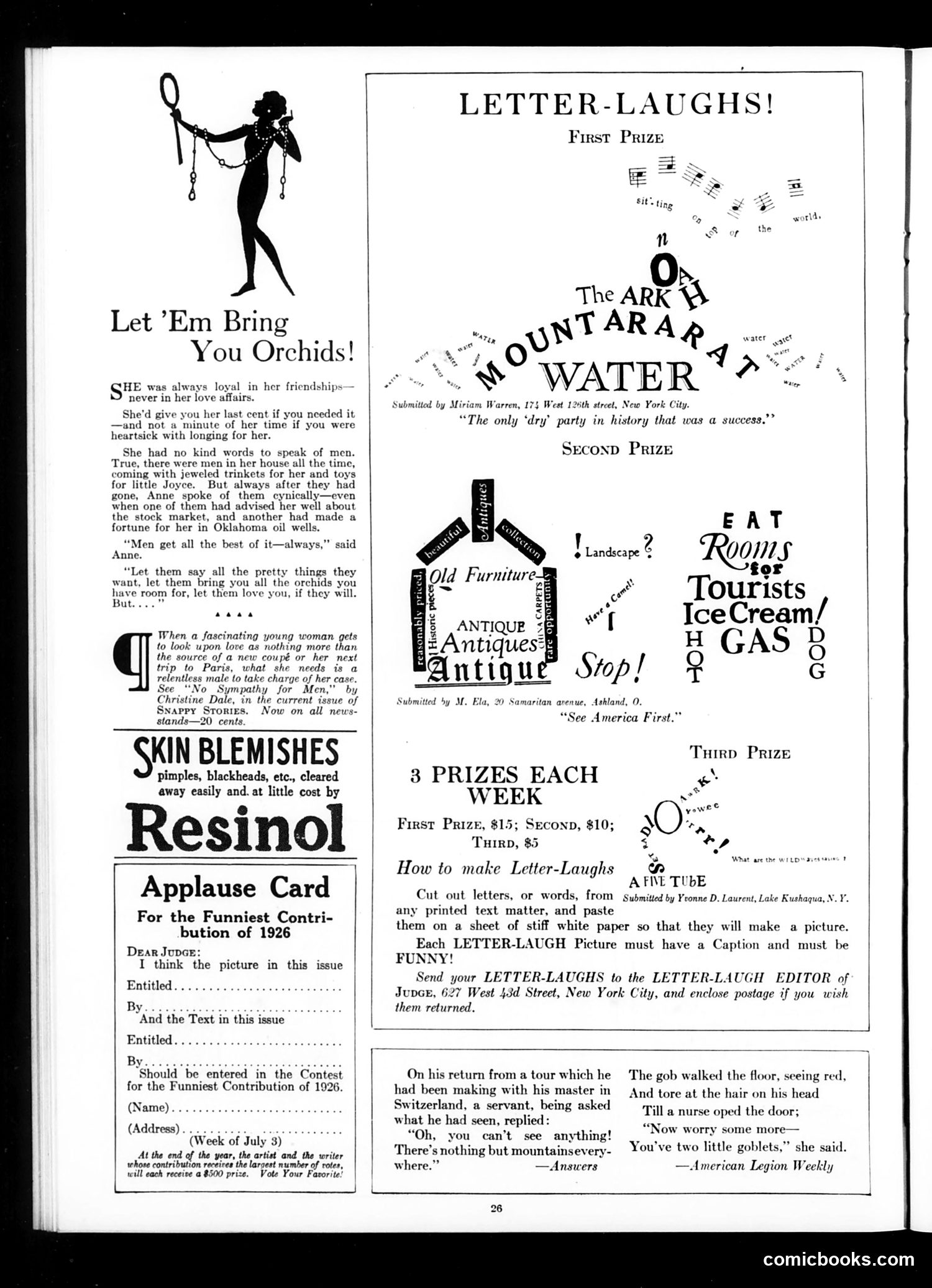
This page showcases Judge magazine's "Letter-Laughs" contest—a reader participation feature where submissions are visual puns created by cutting letters and words from printed text to form pictures with captions. **The three winning entries shown:** 1. **First Prize** ($15): "The Ark at Mount Ararat Water"—letters arranged to depict Noah's Ark, captioned as "the only 'dry' party in history that was a success." This is a Prohibition-era joke: during the 1920s alcohol ban, a "dry party" meant no alcohol, making the biblical flood narrative darkly humorous. 2. **Second Prize** ($10): An antique shop arrangement spelling "Antique," captioned "See America First"—mocking tourist attractions. 3. **Third Prize** ($5): A five-tube radio made from letters. The page also includes period advertisements (Resinol skin cream, a serialized story) and humorous anecdotes. The contest encouraged reader creativity and engagement with the magazine's satirical culture.
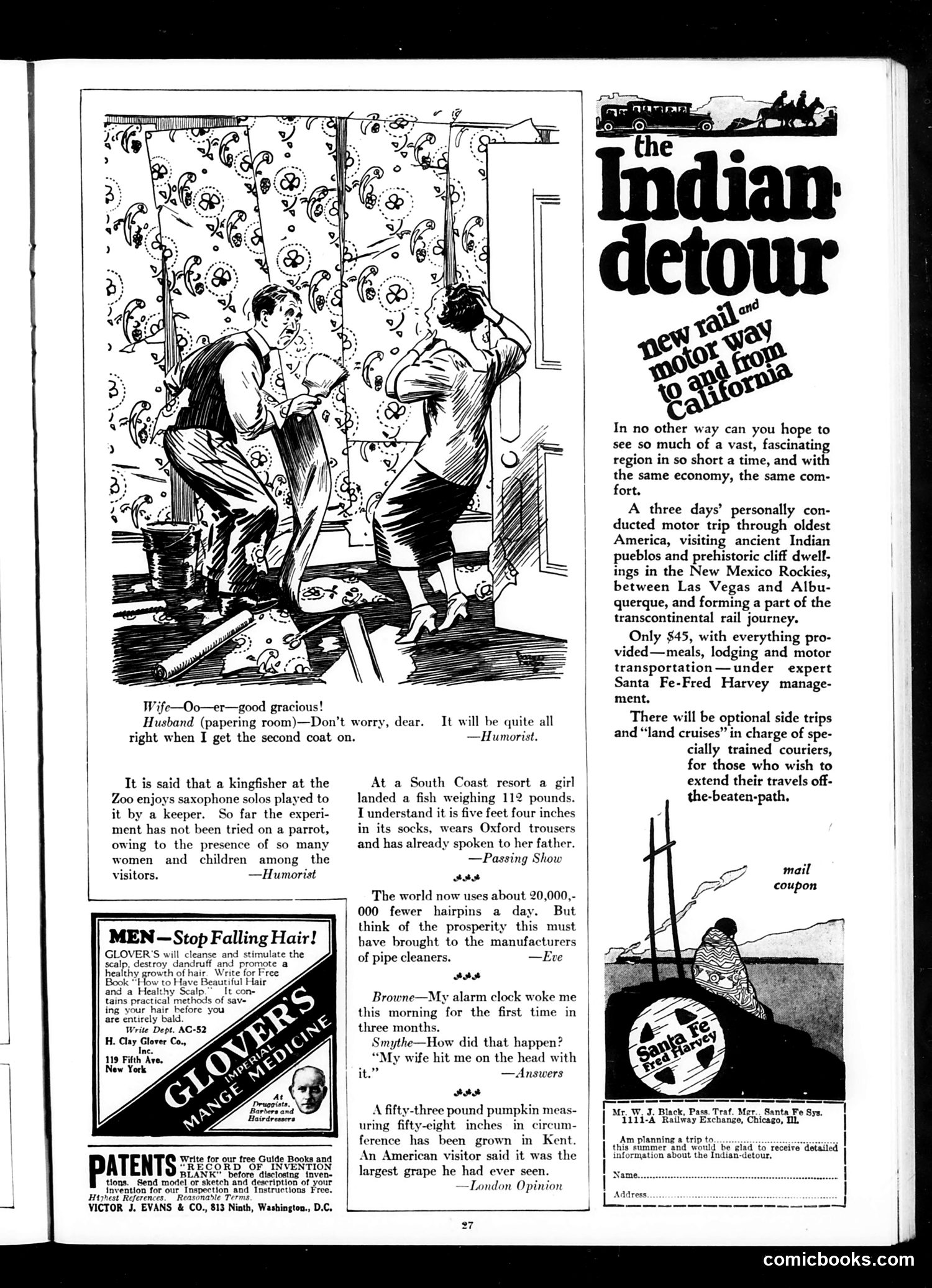
This page is primarily an **advertisement** for a Santa Fe Railway tourist package called "the Indian detour." The dominant illustration shows a husband papering a room while his wife expresses alarm—a domestic humor cartoon unrelated to the main advertisement. The Indian detour promoted a three-day motorized excursion through New Mexico, visiting Native American pueblos and cliff dwellings between Las Vegas and Albuquerque. For $45, tourists received meals, lodging, and transportation under "expert Santa Fe-Fred Harvey management," with optional "land cruises" led by trained guides. The advertisement appeals to affluent leisure travelers seeking authentic cultural experiences presented as "oldest America"—a common early-20th-century approach to indigenous sites as historical curiosities for tourists rather than living communities. The text emphasizes economy and comfort while viewing Native American heritage. The page also contains period humor items and ads for hair-loss products and patent services, typical Judge magazine content. The overall focus is commercial tourism promotion rather than satire.
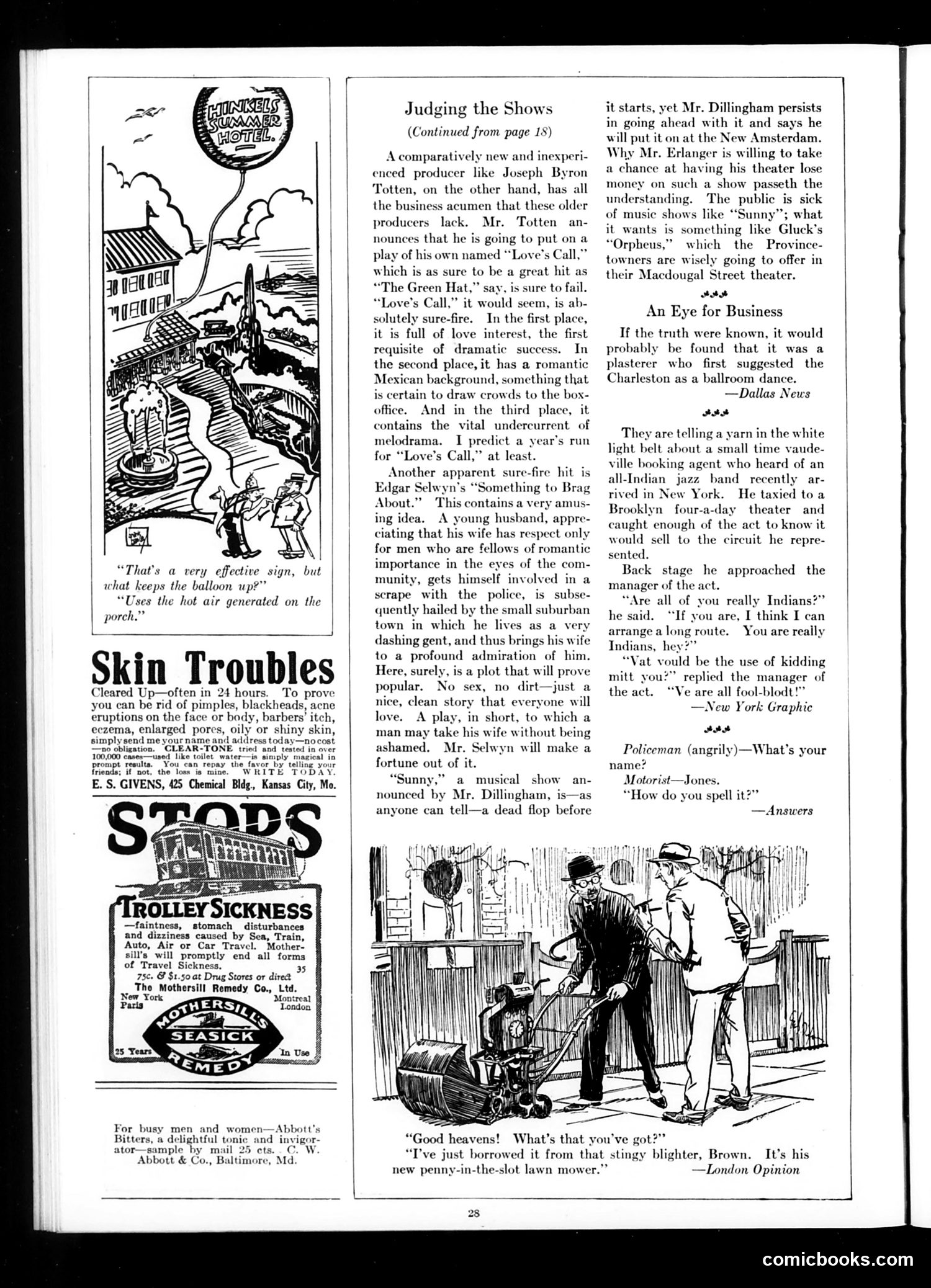
This page mixes theater criticism with humor pieces and advertisements typical of 1920s Judge magazine. The main article critiques Broadway producers' judgment about upcoming shows. It sarcastically praises new producer Joseph Byron Totten's upcoming play "Love's Call" as "sure-fire" due to its love interest and Mexican setting, while dismissing producer Dillingham's musical "Sunny" as a "dead flop" before it even opens—the irony being that confident predictions about theatrical success are often wrong. The cartoon at top mocks political rhetoric: a balloon (representing inflated promises or hot air) is kept aloft by "hot air generated on the porch"—suggesting political speeches are literally full of hot air with no substance. The humor pieces below include anecdotes about business acumen and ethnic stereotypes (the joke about the "all-Indian jazz band" whose manager speaks with a Yiddish accent, undermining the premise). The page also contains period advertisements for skin treatments and travel sickness remedies—standard commercial filler for magazines of this era.
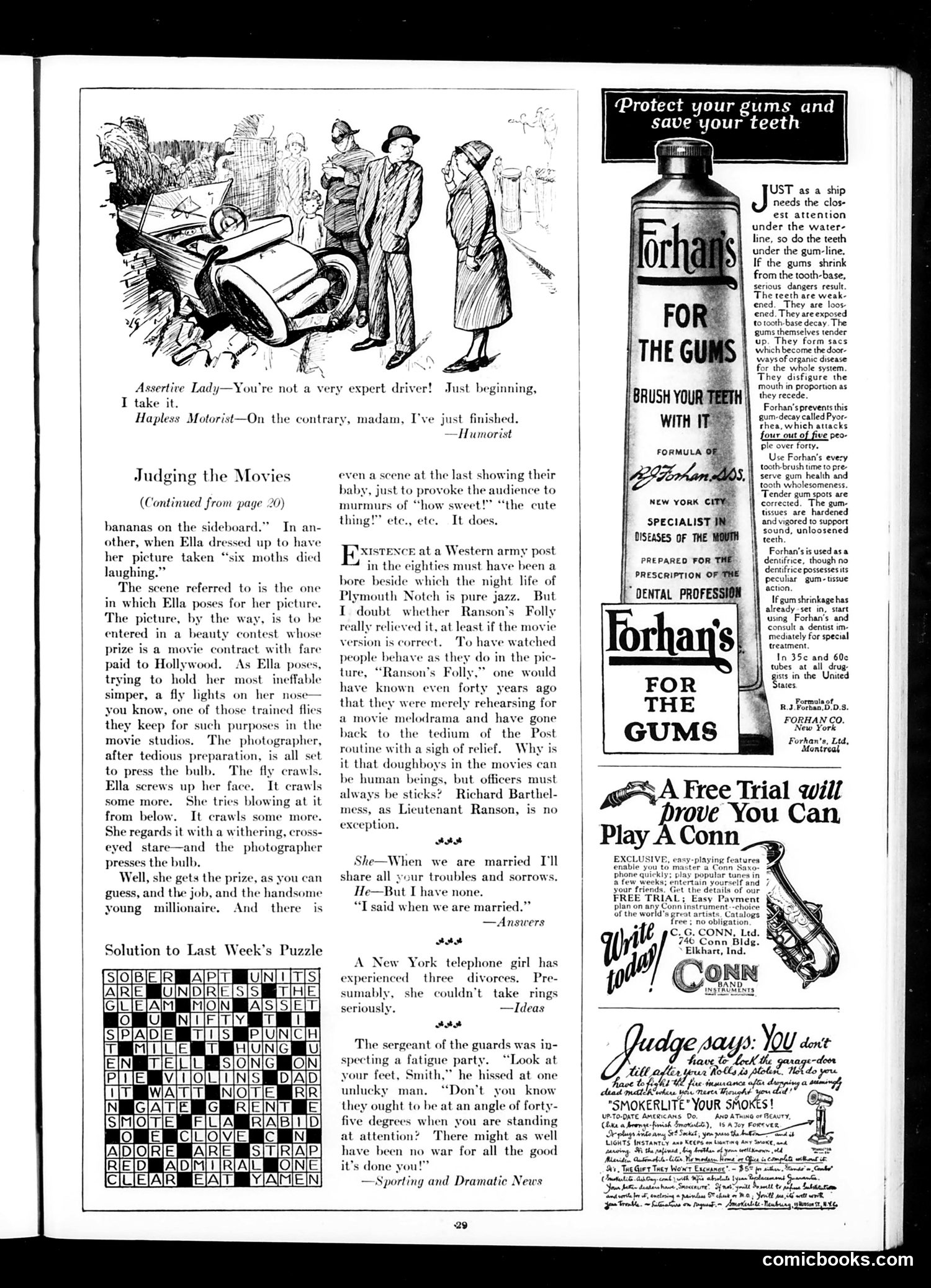
This **Judge magazine page contains primarily advertisements and humor columns** rather than political cartoons. The top cartoon is a simple **motoring joke**: an assertive woman criticizes a driver's skills; he responds he's "just finished"—implying he just completed a driving course, making her criticism poorly-timed. The rest is **vintage advertising and gossip content**. The main ads promote **Forhan's toothpaste** (claiming to prevent gum disease/pyorrhea, common then) and a **Conn phonograph** with a free trial offer. The "Judging the Movies" column reviews early cinema, mocking melodramatic acting conventions—noting that watching stiff military officers in movies seems rehearsed rather than natural. The humor sections include **dating/marriage jokes** (typical 1920s-era social humor about courtship and commitment). **No significant political content** is evident; this reflects the lighter, entertainment-focused portions of the magazine.
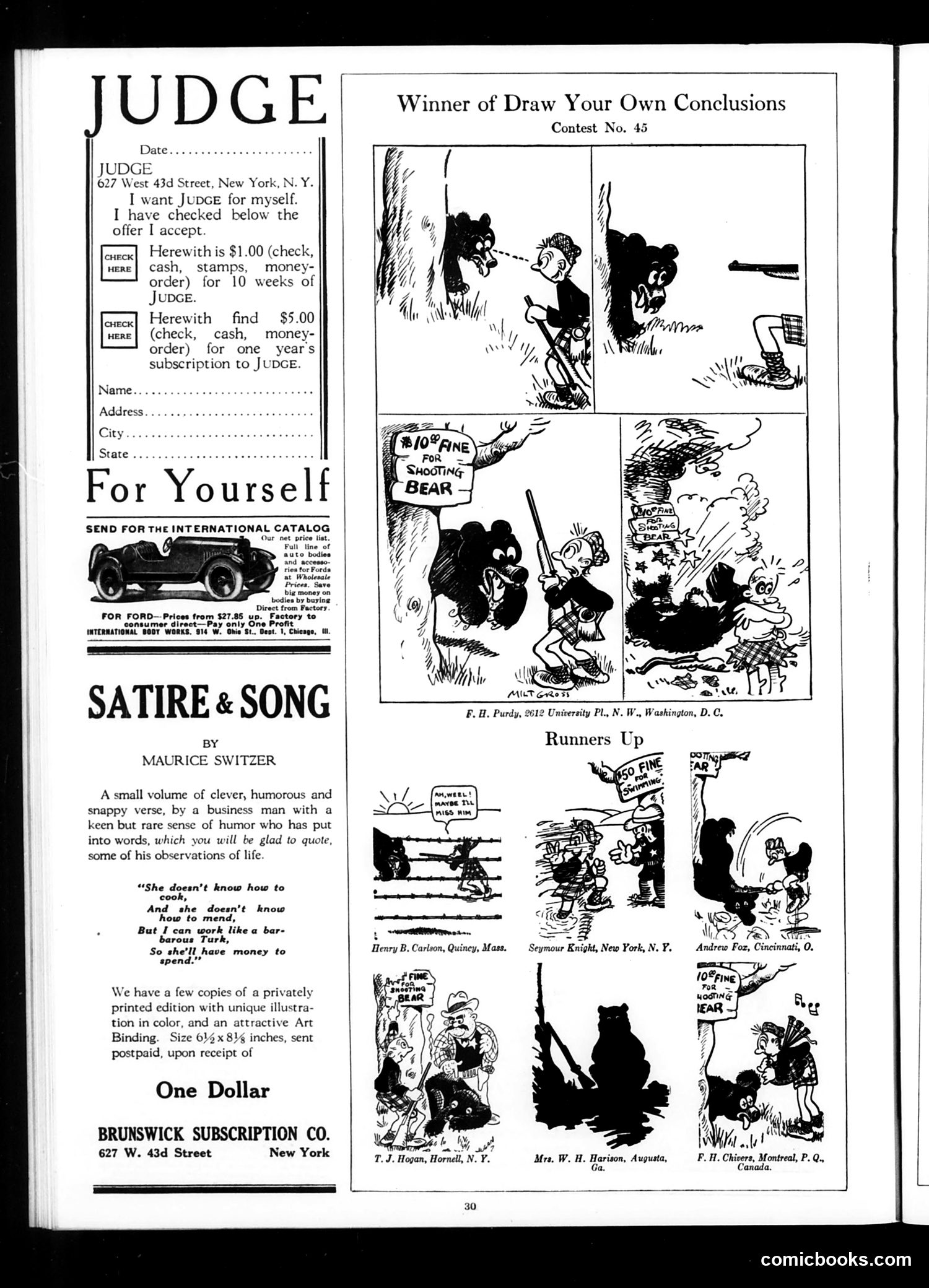
This page showcases the winning and runner-up entries for **Judge magazine's "Draw Your Own Conclusions" Contest No. 45**, a visual humor competition where cartoonists completed a narrative sequence. The **winning cartoon** (by F.A. Purdy) depicts a humorous hunting mishap: a man encounters a bear while carrying a rifle marked "license for shooting bear." The four-panel sequence shows the man's escalating panic and the bear's aggressive response, culminating in comedic chaos. The **runners-up entries** feature similar themes of outdoor misadventures and animal encounters, rendered in the exaggerated, slapstick style typical of early 20th-century American comics. The humor relies on physical comedy and unexpected reversals of fortune common to the era. The page also includes subscription offers for Judge itself and an advertisement for Maurice Switzer's book *Satire & Song*, alongside Ford automobile pricing—typical of magazine content mixing editorial, contests, and advertising.
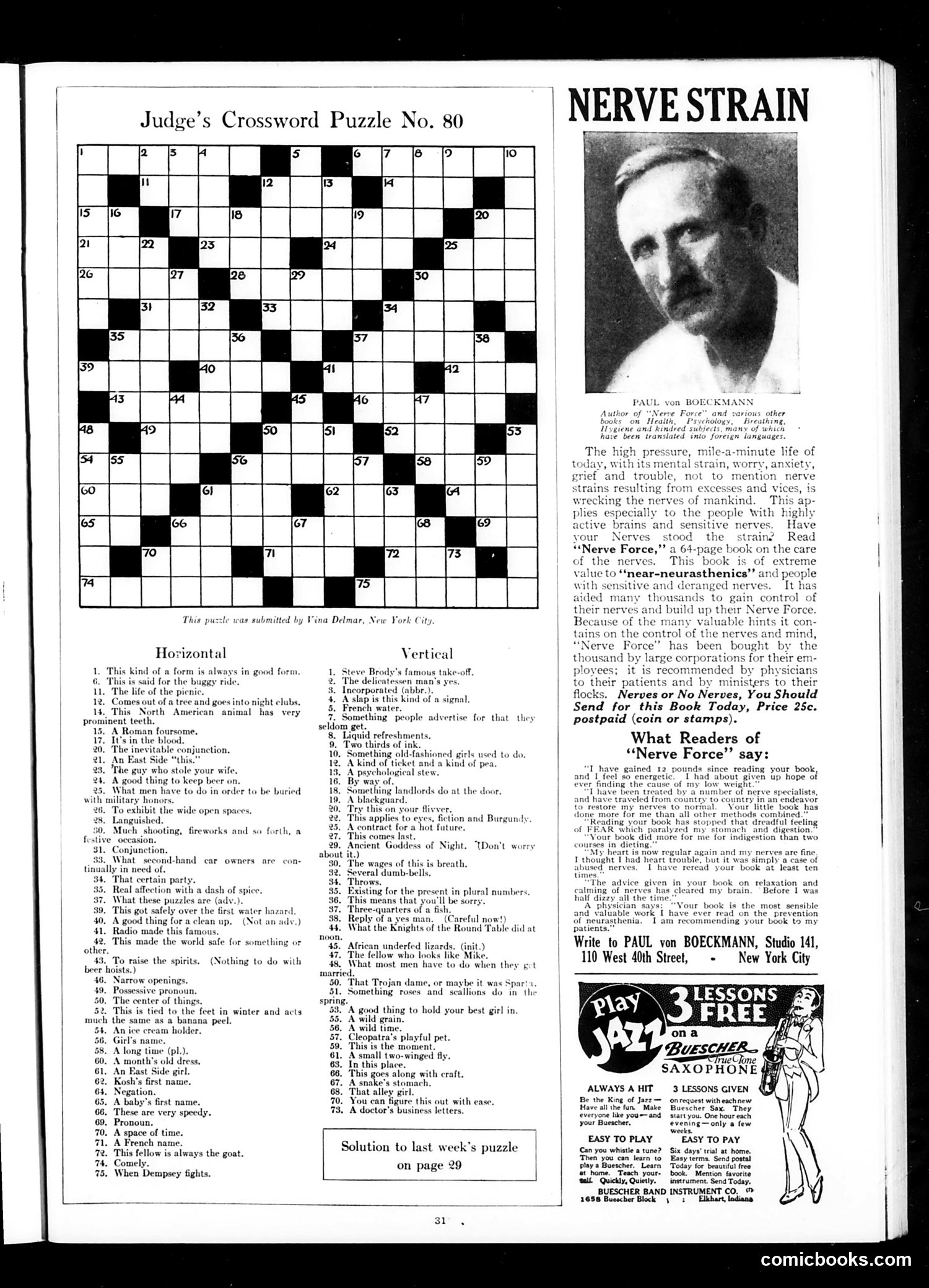
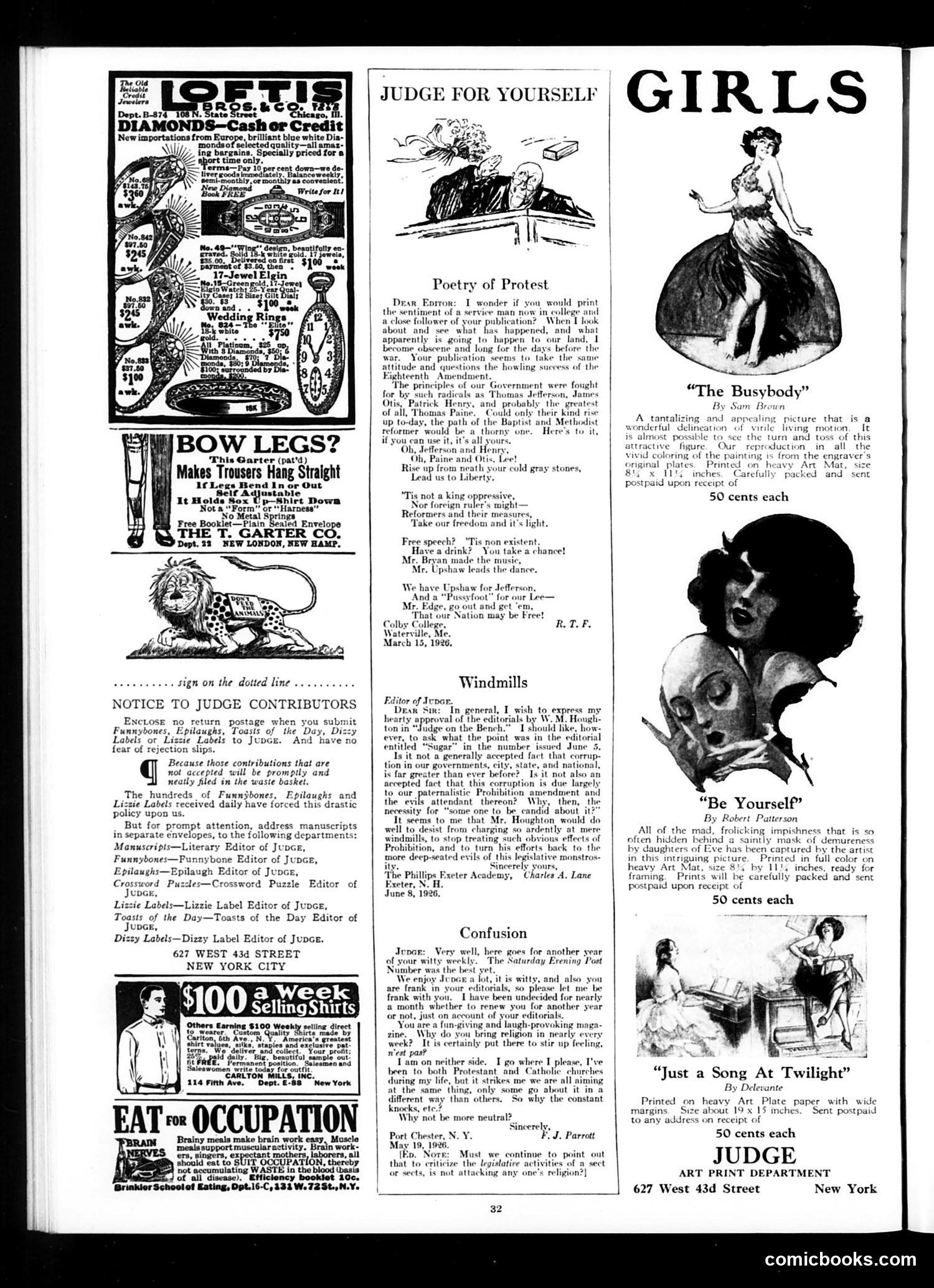
This page from Judge (appears to be 1926, based on visible date) contains **satirical editorial letters and advertisements** rather than narrative cartoons. ## Key Content: **"Poetry of Protest"** — A reader criticizes Judge's editorial stance questioning Prohibition's success and the 18th Amendment. The writer defends Prohibition and attacks those who oppose it, invoking founding fathers like Jefferson and Henry ironically. This reflects the **1920s Prohibition debate** that divided Americans; Judge apparently supported repeal. **"Windmills"** — Another reader praises Judge's anti-Prohibition editorials by W.M. Houghton, arguing that Prohibition itself causes corruption. The writer accuses Houghton of tilting at "windmills"—fighting symptoms rather than root causes of societal problems. The page also contains **product advertisements** (diamond rings, leg garters, men's shirts) and **notices to contributors** with editorial submission instructions. The satirical value lies in **the clash of reader opinions** about Prohibition, illustrating deep social division during this era.
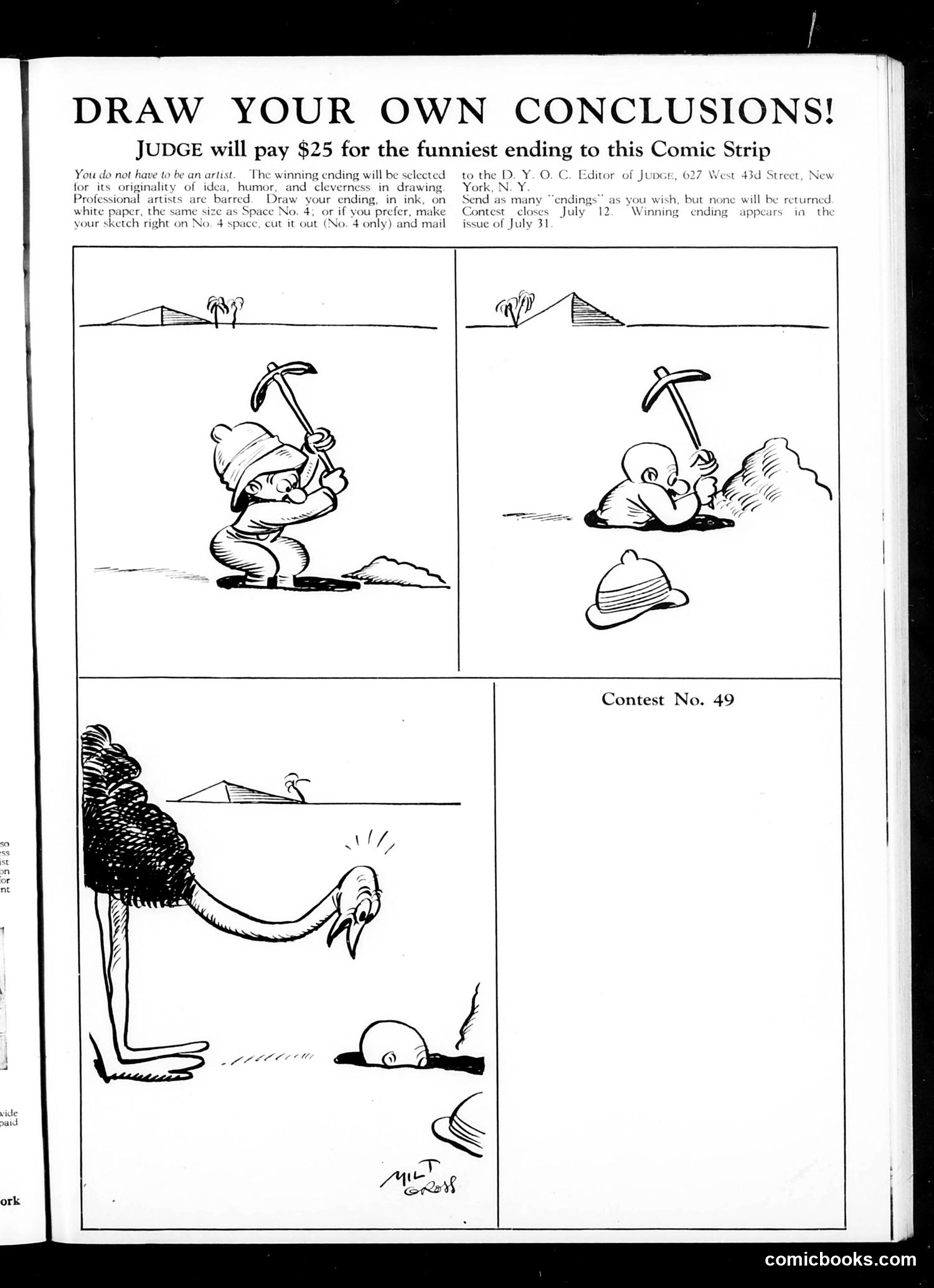
This is a reader-participation contest page, not a political cartoon. Judge magazine invited readers to complete an unfinished comic strip for a $25 prize, with the winning entry to be published. The three completed panels show a small man in a hat mining or digging with a pickaxe in a desert landscape. The sequence depicts him swinging the tool, then apparently striking something that causes his hat to fly off. The final panel (blank) is where readers were to draw their comedic conclusion. The humor relies on slapstick physical comedy—a common genre for early 20th-century comics. The contest excludes professional artists, encouraging amateur participation based on "originality of idea, humor, and cleverness." This democratization of comic creation was typical of Judge's interactive approach to engaging its readership during this era.
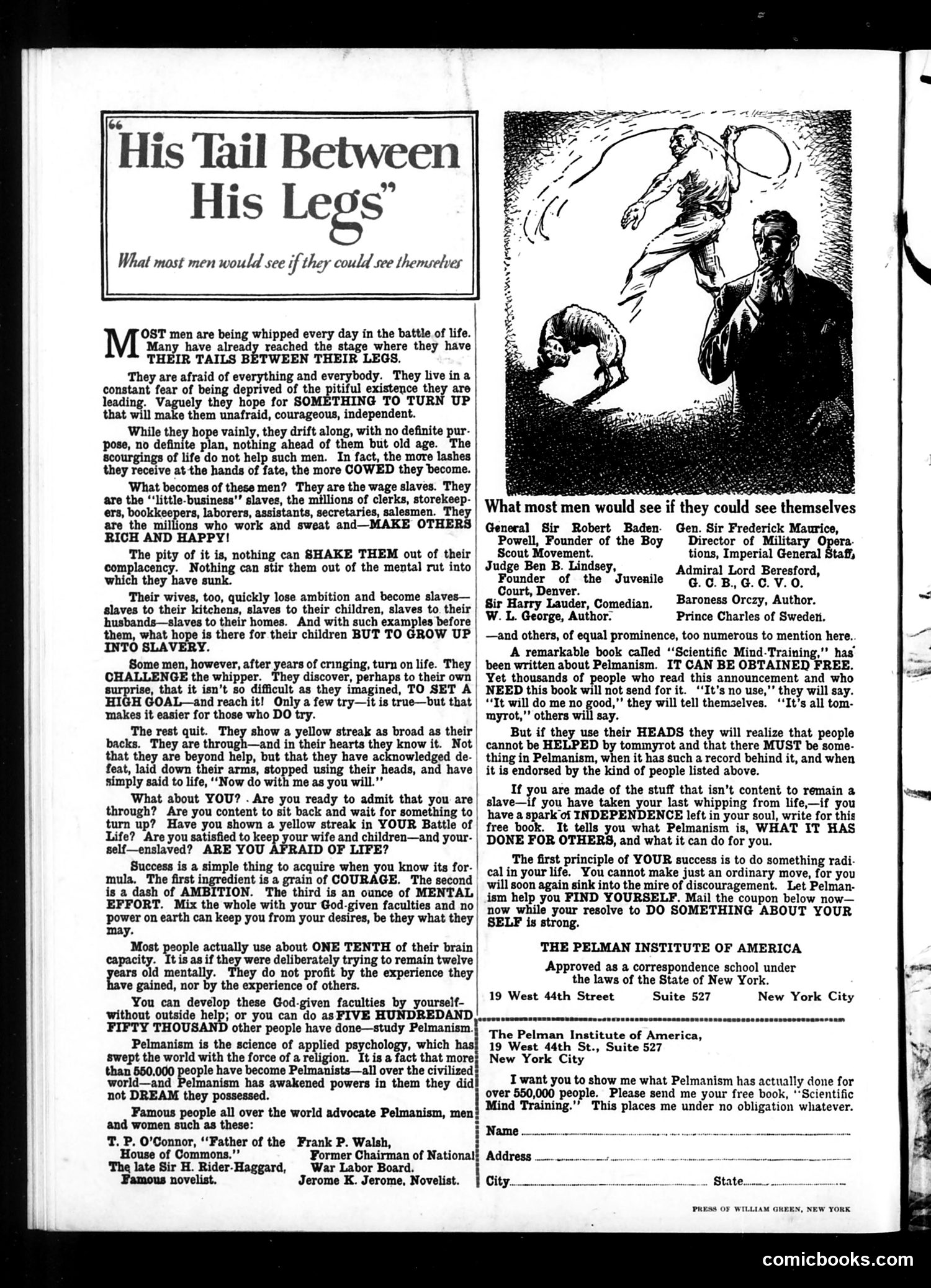
This page combines motivational advertising disguised as social commentary. The cartoon (upper right) depicts a man literally with his tail between his legs—a visual metaphor for cowardice and defeat. The text attacks working-class men as "wage slaves" and "cowards" who accept their lot rather than pursue ambition and independence. It argues they lack courage and mental effort, remaining complacent through fear. The real purpose emerges at the bottom: promoting **Pelmanism**, a mail-order self-improvement course claiming to unlock hidden mental capacity through "applied psychology." The endorsements from celebrities like Jerome K. Jerome lend false authority. This is essentially **victim-blaming dressed as inspiration**—suggesting poverty results from personal failure rather than systemic inequality. The ad exploits insecurity to sell a dubious correspondence course, using Depression-era anxieties about masculinity and social status as marketing hooks.