
Judge, 1926-07-03 · page 15 of 36
Judge — July 3, 1926 — page 15: what you’re looking at
What you’re looking at
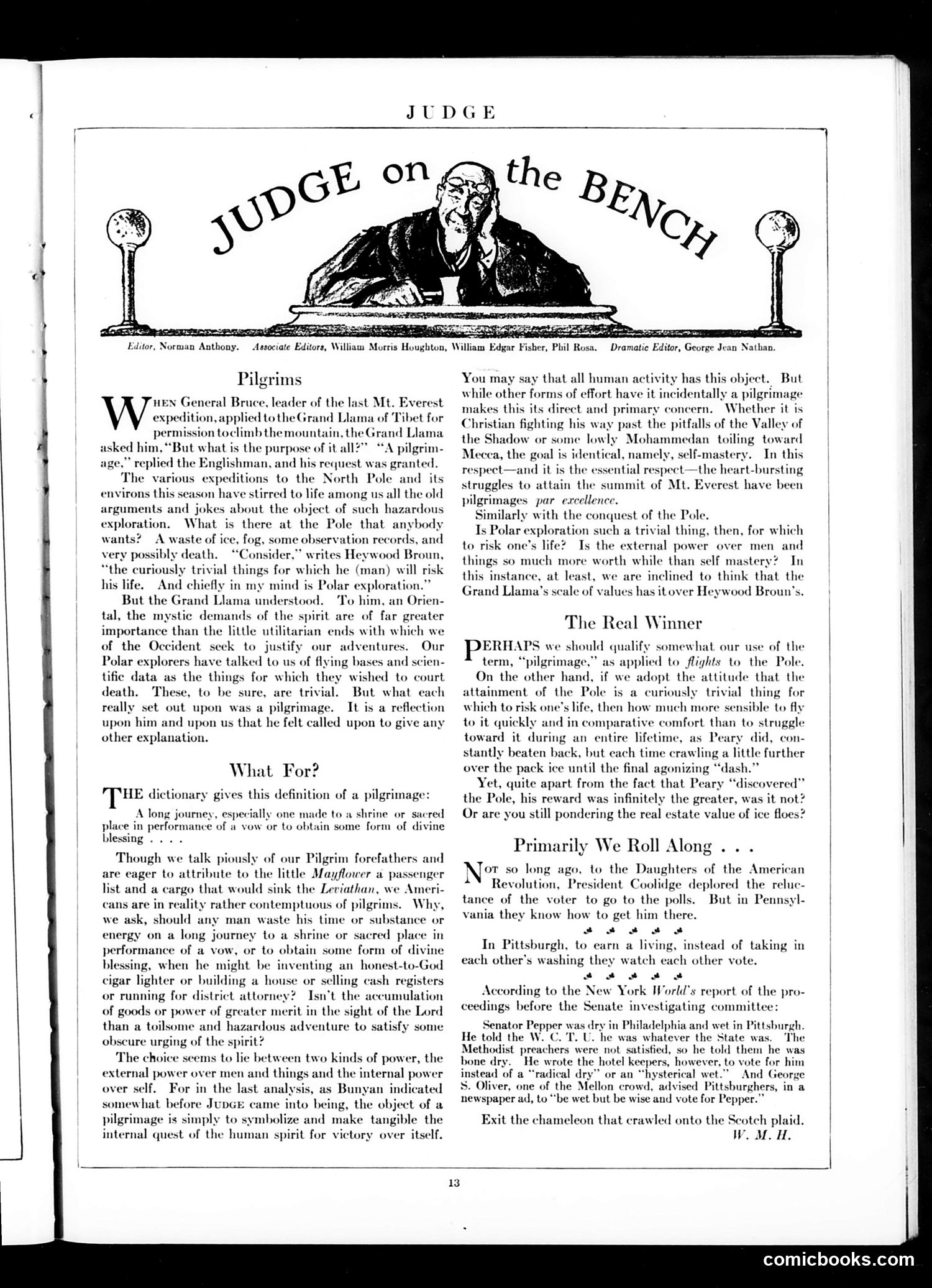
This page contains editorial essays defending polar exploration and mountain climbing as spiritually meaningful "pilgrimages" rather than trivial pursuits. The piece opens with General Bruce's 1924 Mt. Everest expedition, where he told Tibet's Grand Llama the climb was a "pilgrimage." Judge uses this to counter Western skepticism about dangerous expeditions. While American materialists (like humorist Heywood Broun) dismissed polar exploration as wasteful, Judge argues these quests represent spiritual self-mastery—comparing them to Christian pilgrims or Muslims traveling to Mecca. The satire targets American pragmatism: we mock pilgrimage while celebrating profit-seeking. Judge suggests explorers' true motivation is internal triumph, not scientific data, making their spiritual quest more noble than building "cigar lighters" or "cash registers." The piece implicitly critiques modern American values as shallow and commercialized compared to traditional spiritual quests, using exploration as proxy for this broader cultural anxiety about materialism versus meaning.
📄 Transcribed text from this page (OCR, searchable)
Machine-transcribed from the original scan — historical spelling and the odd misread are preserved.
JUDGE Pilgrims neral Bruce, leader of the last Mt. Everest V V expedition, applied totheGrand Llama of Tibet for permission toclimb themountain, the G asked him, “But what is the purpose of it and Llama “A pilgrim- age,” replied the Englishman, and his request was granted. The various expeditions to the North Pole and its environs this season have stirred to life among us all the old arguments and jokes about the object of such hazardous xploration. What is there at the Pole that anybody vants? A waste of ice, fog, some observation records, and very possibly death. “Consider,” writes Heywood Broun, “the curiously trivial things for which he (man) will risk his life. And chiefly in my mind is Polar exploration.” But the Grand Llama understood. ‘To him, an Orien- tal, the mystic demands of the spirit are of far greater importance than the little utilitarian ends with which we of the Occident seck to justify our adventures. Our Polar explorers have talked to us of flying bases and scien- tific data as the things for which they wished to court death. These, to be sure, are trivial. But what each really set out upon was a pilgrimage. It is a reflection upon him and upon us that he felt called upon to give any other explanation. What For? HE dictionary gives this definition of a pilgrimage: A long journey, especially one made to a shrine or. si place in performance of a vow or to obtain some form of divi blessing... . Though we talk piously of our Pilgrim forefathers and are eager to attribute to the little Mayflower a passenger list and a cargo that would sink the Leviathan, we Ameri- cans are in reality rather contemptuous of pilgrims. Why, we ask, should any man waste his time or substance or energy on a long journey to a shrine or sacred place in performance of a vow, or to obtain some form of divine blessing, when he might be inventing an honest-to-God cigar lighter or building a house or selling cash registers or running for district attorney? Isn't the accumulation of goods or power of greater merit in the sight of the Lord than a toilsome and hazardous adventure to satisfy some obscure urging of the spirit? The choice seems to lie between two kinds of power, the external power over men and things and the internal power over self. For in the last analysis, as Bunyan indicated somewhat before JupGE came into being, the object of a pilgrimage is simply to symbol ke tangible the internal quest of the human spi ry over itself, You may say that all human acti while other forms of effort have it ir ty has this object. But identally a pilgrimage makes this its direct and primary concern. Whether it is Christian fighting his way past the pitfalls of the Valley of the Shadow or some lowly Mohammedan toiling toward Mecca, the goal is identical, namely, self-mastery. In this respect—and it is the essential respeet—the heart-bursting struggles to attain the summit of Mt. Everest have been pilgrimages par excellence. Similarly with the conquest of the Pole. Is Polar exploration such a trivial thing, then, for which to risk one’s life? Is the external power over men and things so much more worth while than self mastery? In this instance, at least, we are inclined to think that the Grand Llama’s scale of values has it over Heywood Broun’s. The Real Winner ERHAPS we should qualify somewhat our use of the term, “pilgrimage,” as applied to flights to the Pole. On the other hand, if we adopt the attitude that the attainment of the Pole is a curiously trivial thing for which to risk one’s life, then how much more sensible to fly to it quickly and in comparative comfort than to struggle toward it during an entire lifetime, as I stantly beaten back, but each time crawling a little further over the pack ice until the final agonizing “dash.” Yet, quite apart from the fact that Peary “discovered” the Pole, his reward was infinitely the greater, was it not? Or are you still pondering the real estate value of ice floes? Primarily We Roll Along . . . y did, con- N* so long ago, to the Daughters of the American Revolution, President Coolidge deplored the reluc- But in Pennsyl- tance of the voter to go to the polls. vania they know how to get him there. soa In Pittsburgh, to earn a livin stead of taking in each other's washing they watch each other vote. see we According to the New York World's report of the pro- ceedings before the Senate investigating committee: as dry in Philadelphia and wet in Pittsburgh. . T. U. he was whatever the State was. The Methodist preachers were not satisfied, so he told them he was bone dry. He wrote th el keepers, however, to vote for him instead of a “radical dry” or an “hysterical wet.” And George S. Oliver, one of the Mellon crowd, advised Pittsburghers, in a newspaper ad, to “be wet but be wise and vote for Pepper.” Senator Pepper He told the W. Exit the chameleon that crawled onto the Scotch plaid. W. M. H. comicbooks.com