
Judge, 1926-07-03 · page 20 of 36
Judge — July 3, 1926 — page 20: what you’re looking at
What you’re looking at
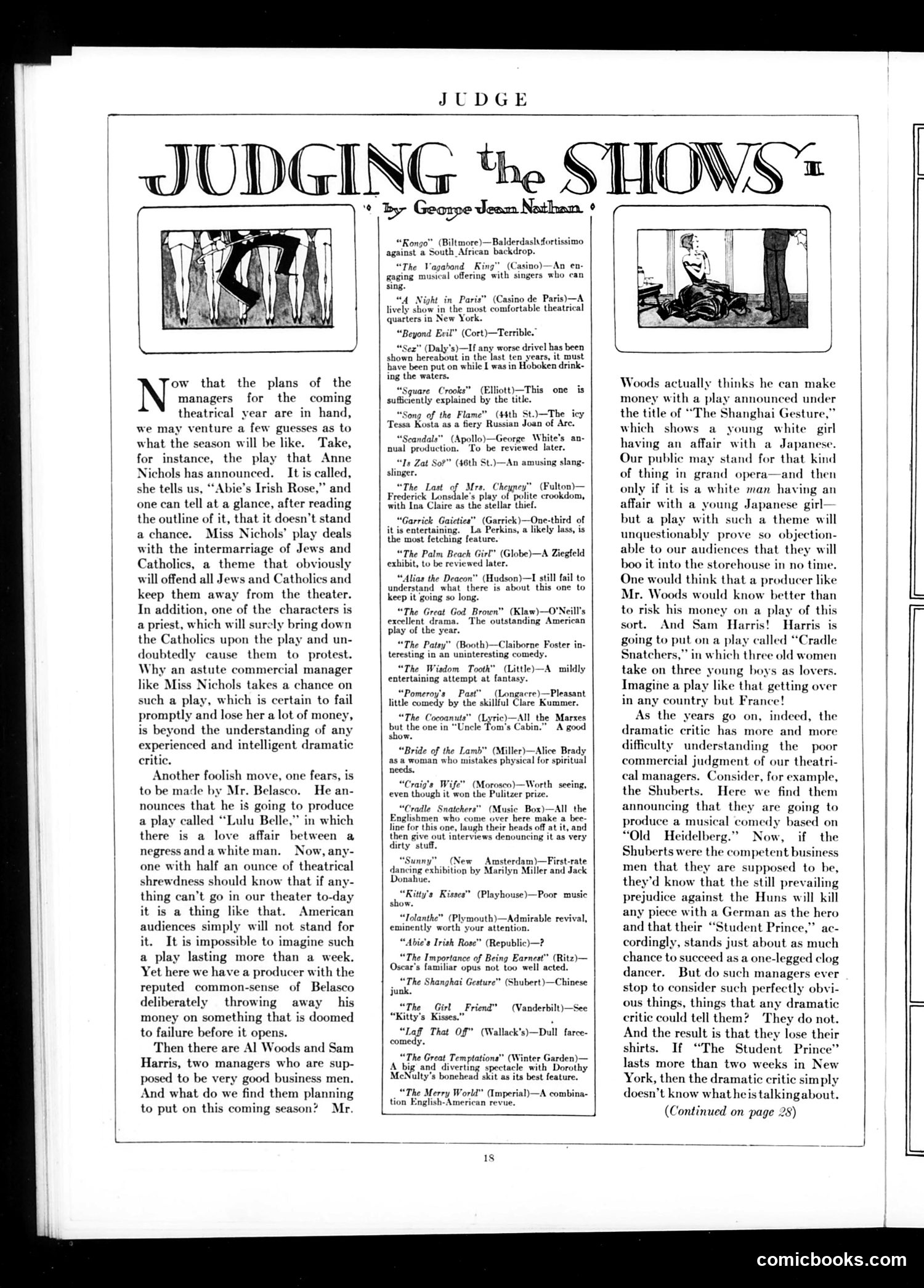
This page is theater criticism by George Jean Nathan for *Judge* magazine's drama section. Nathan reviews upcoming Broadway productions, offering sharp predictions about which plays will succeed or fail. The article's satire targets theatrical producers' poor business judgment. Nathan mocks Anne Nichols's "*Abie's Irish Rose*" (about Jewish-Catholic intermarriage) as certain to offend both communities and fail. He similarly ridicules David Belasco's "*Lulu Belle*" (featuring a romance between a Black woman and white man) as unmarketable to contemporary American audiences—predicting it cannot last a week. The irony: both plays actually became successful, proving Nathan spectacularly wrong. His confident pronouncements about what American audiences "simply will not stand for" missed the mark entirely, making this piece an unintentional comedy about critical misjudgment. The remaining text consists of brief, often scathing reviews of other Broadway shows opening that season.
📄 Transcribed text from this page (OCR, searchable)
Machine-transcribed from the original scan — historical spelling and the odd misread are preserved.
JUDGE JUDGING the SHOWS: ow that the plans of the N managers for the coming theatrical year are in hand, we may venture a few guesses as to what the season will be like. Take, for instance, the play that Anne chols has announced. It is called, she tells us, “‘Abie’s Irish Rose,” and one can tell at a glance, after reading the outline of it, that it doesn’t stand achance. Mis ichols’ play deals with the intermarriage of Jews and Catholics, a theme that obviously will offend all Jews and Catholics and keep them away from the theater. In addition, one of the characters is a priest, which will surcly bring down the Catholics upon the play and un- doubtedly them to protest. Why an astute commercial manager like Miss Nichols takes a chance on such a play, which is certain to fail promptly and lose her a lot of money, is beyond the understanding of any experienced and intelligent dramatic critic. Another foolish move, one fears, is to be made Mr. Belasco. He an- nounces that he is going to produce a play called “Lulu Belle,” in which there is a love affair between a negress anda white man. Now, any one with half an ounce of theatrical shrewdness should know that if any- thing can’t go in our theater to-day it is a thing like that. American audiences simply will not stand for it. It is impossible to imagine such a play lasting more than a week. Yet here we have a producer with the reputed common-sense of Belasco deliberately throwing away his money on something that is doomed cause to failure before it opens. Then there are Al Woods and Sam Harris, two managers who are sup- posed to be very good business men. And what do we find them planning to put on this coming season? Mr. by Georpe Jeom Nathan ¢ “Kongo” (Biltmore)—Balderdash fortissimo against a South African backdrop. “The Vagabond King” (Casino)—An en- gaging musical offering with singers who can sing. A Night in. Paris” (Casino de Paris)—A lively show in the most comfortable theatrical quarters in New York. “Beyond Evil” (Cort)—Terrible.” “Sez” (Daly's)—If any worse drivel has been shown hereabout in the last ten years, it must have been put on while I was in Hoboken drink- ing the waters. “Square Crooks” (Elliott)—This one is sufficiently explained by the title, “Song of the Flame” (44th St.)—The icy Tessa Kosta as a fiery Russian Joan of Arc. “Scandals” (Apollo)—George White's an- nual production. To be reviewed later. 's Zat So?” (46th St.)—An amusing slang- slinger. “The Laat of Mrax Cheyney” (Fulton) — Frederick Lonsdale’s play of polite crookdom, with Ina Claire as the stellar thief. “Garrick Gaicties” (Garrick)—One-third of it is entertaining. La Perkins, a likely lass, is the most fetching feature. “The Palm Beach Girl” (Globe)- exhibit, to be reviewed later. ‘Alias the Deacon” (Hudson)—I still fail to understand what there is about this one to keep it going so long. “The Great God Brown" (Klaw)—O'Neill’s excellent drama, The outstanding American play of the year. “The Patsy” (Booth)—Claiborne Foster in- teresting in an uninteresting comedy. “The Wisdom Tooth” (Little)—A mildly entertaining attempt at fantasy. A Ziegfeld “Pomeroy's Past” (Longacre)—Pleasant little comedy by the skillful Clare Kummer. (Lyric)—All the Marxes Uncle Tom's Cabin.” A good “The Cocoanuts” but the one in “ “Bride of the Lamb” (Miller)—Alice Brady asa woman who mistakes physical for spiritua needs. “Craig's Wife” (Morosco)—Worth seeing, even though it won the Pulitzer prize. “Cradle Snatchers” (Music Box)—All the Englishmen who come over here make a bee- line for this one, laugh their heads off at it, and then give out interviews denouncing it as very dirty stuff. unny” (New Amsterdam)—First-rate dancing exhibition by Marilyn Miller and Jack hue. “Kitty's Kisses” show. “Tolanthe” (Plymouth)—Admirable revival, eminently worth your attention. “‘Abie's Irish Rose” (Republic)—? “The Importance of Being Earnest” (Ritz)— Oscar's familiar opus not too well acted. (Playhouse)—Poor music _ “The Shanghai Gesture” (Shubert )—Chinese junk. “The Girl “Kitty's Kisses.” “Laff That Of” (Wallack’s)—Dull farce- comedy. Friend” —(Vanderbilt)—See “The Great Temptations” (Winter Garden)— A big and diverting spectacle with Dorothy McNulty’s bonehead skit as its best feature. “The Merry World” (Imperial)—A combina- tion English-A Woods actually thinks he can make money with a play announced under the title of “The Shanghai Gesture, which shows a young white girl having an affair with a Japanese. Our public may stand for that kind of thing in grand opera—and then only if it is a white man having an affair with a young Japanese girl— but a play with such a theme will unquestionably prove so objection- able to our audiences that they will boo it into the storehouse in no time. One would think that a producer like Mr. Woods would know better than to risk his money on a play of this sort. And Sam ! Harris is Harris! going to put on a play called “Cradle in which three old women Snatchers, take on three young boys as lovers. Imagine a play like that getting over in any country but France! s the years go on, indeed, the dramatic critic has more and more difficulty understanding the poor commercial judgment of our theatri- cal managers. Consider, for example, the Shuberts. Here we find them announcing that they are going to produce a musical d “Old Heidelberg. N ow, if the Shuberts were the competent business men that they are supposed to be, they'd know that the still prevailing prejudice against the Huns will kill any piece with a German as the hero and that their “Student Prince,” ac- cordingly, stands just about as much chance to succeed as a one-legged clog dancer. But do such managers ever stop to consider such perfectly obvi- ous things, things that any dramatic critic could tell them? They do not. And the result is that they lose their shirts. If “The Student Prince” lasts more than two weeks in New York, then the dramatic critic simply doesn’t know whatheis talking about. (Continued on page 28) 1 IF comicbooks.com > —