
A complete issue · 36 pages · 1926
Judge — March 13, 1926
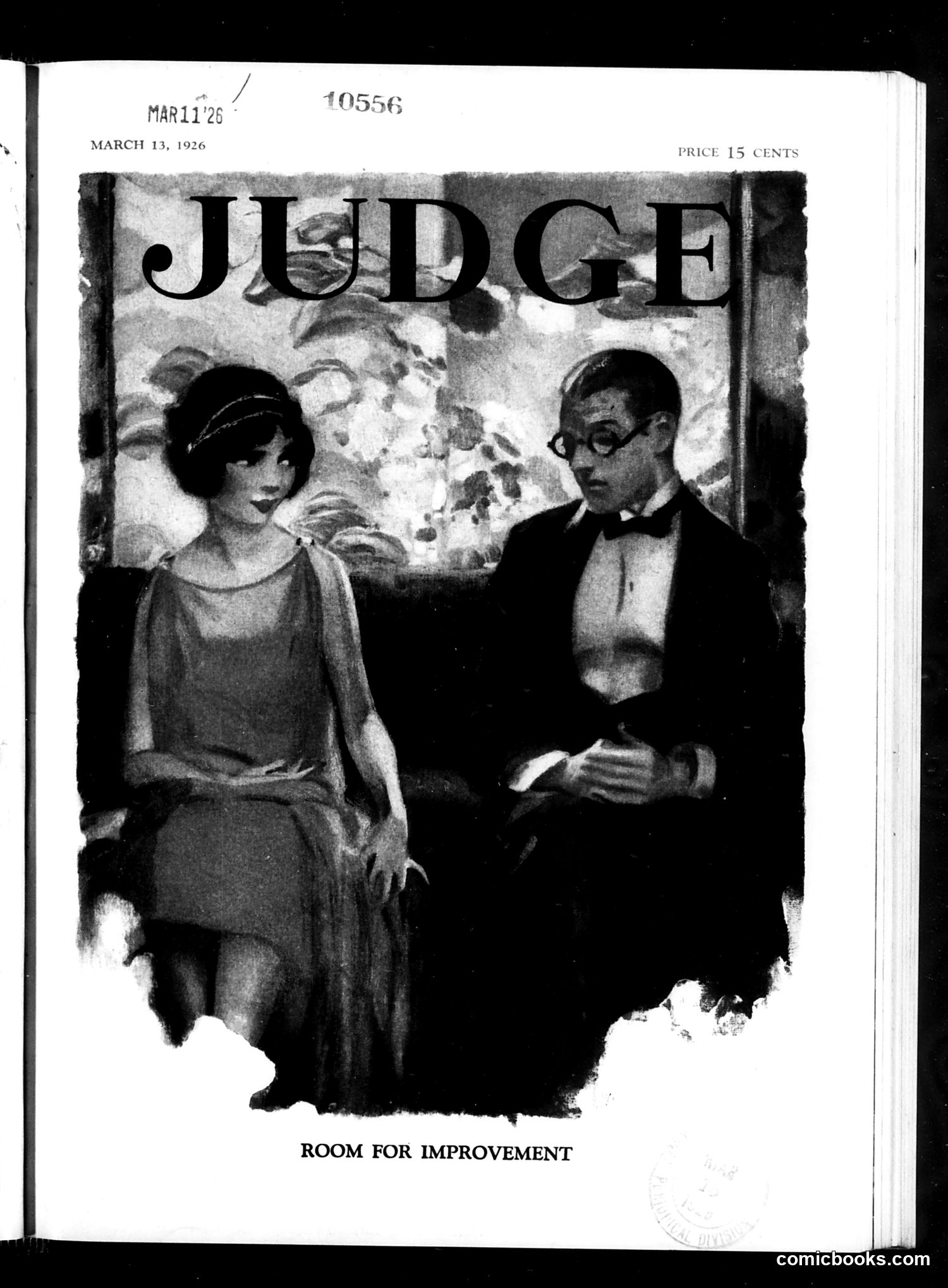
This cartoon depicts a formal social scene with two figures in evening wear examining what appears to be a decorative wall or artwork. The caption "Room for Improvement" suggests social criticism, likely targeting the manners or refinement of the era's upper classes or newly wealthy individuals. The satirical point appears to involve critiquing either: - Someone's taste or judgment in decoration/culture - The pretensions of social climbers - General social awkwardness among the elite The black-and-white photograph-style illustration was typical of Judge's visual humor from this era. Without additional context about contemporary events of March 1926, the specific targets remain unclear, though the formal setting and inspection pose suggest mockery of status-conscious society figures.
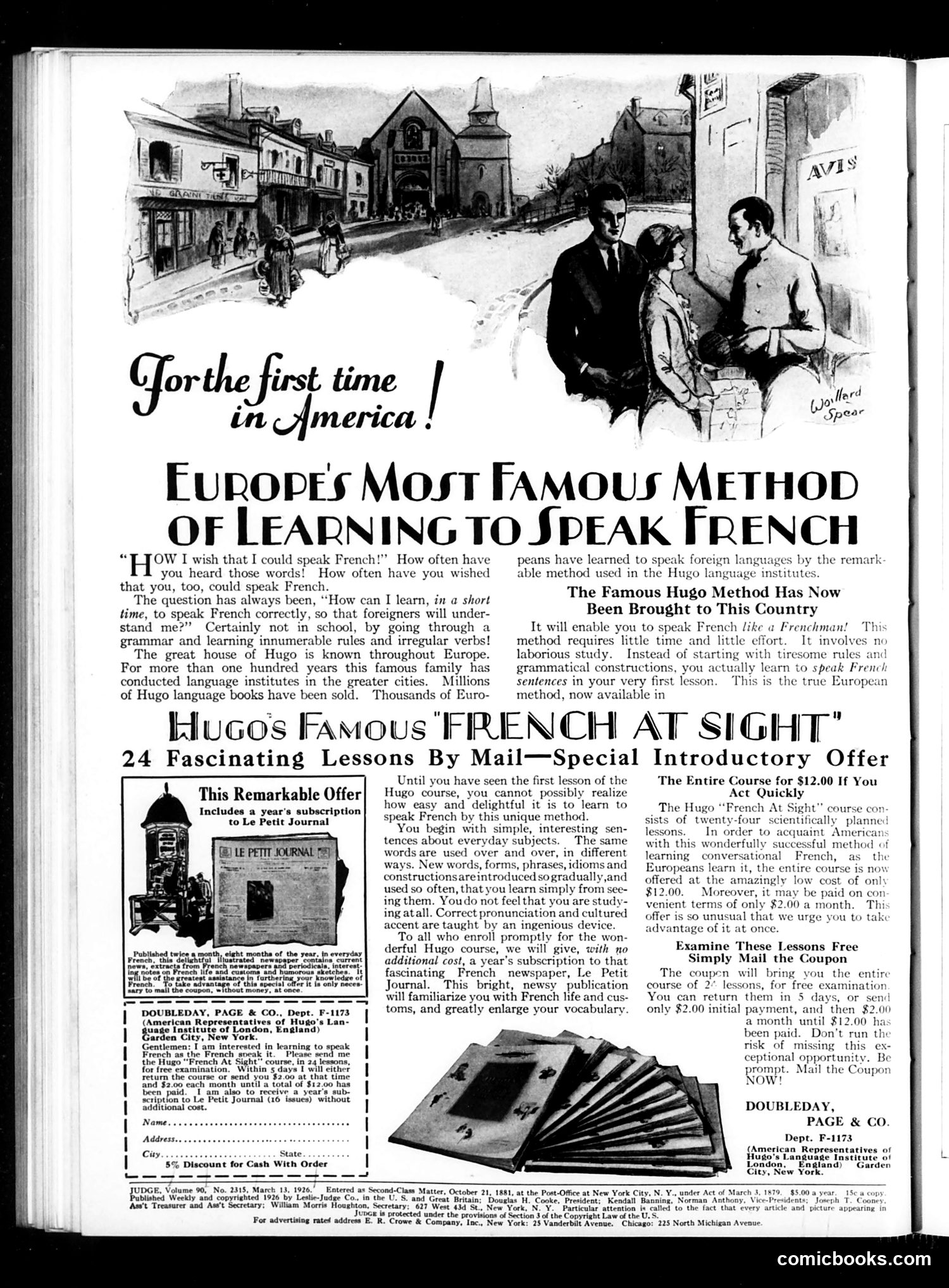
This page is primarily **advertising rather than satirical content**. It promotes "Hugo's Famous French at Sight," a language-learning course offered by mail. The small cartoon at top-right depicts a street scene with what appear to be European figures, illustrating the aspirational European context of learning French. The advertisement appeals to American desires to "speak French like a Frenchman" through a supposedly revolutionary method avoiding grammar rules. It emphasizes the course's European popularity and offers an unusually low introductory price ($2.00). The page reflects early-20th-century American attitudes: admiration for European sophistication, faith in mail-order self-improvement products, and the assumption that proper French-speaking confers social status. The satire, if present, lies in the grandiose marketing claims rather than in explicit political commentary.
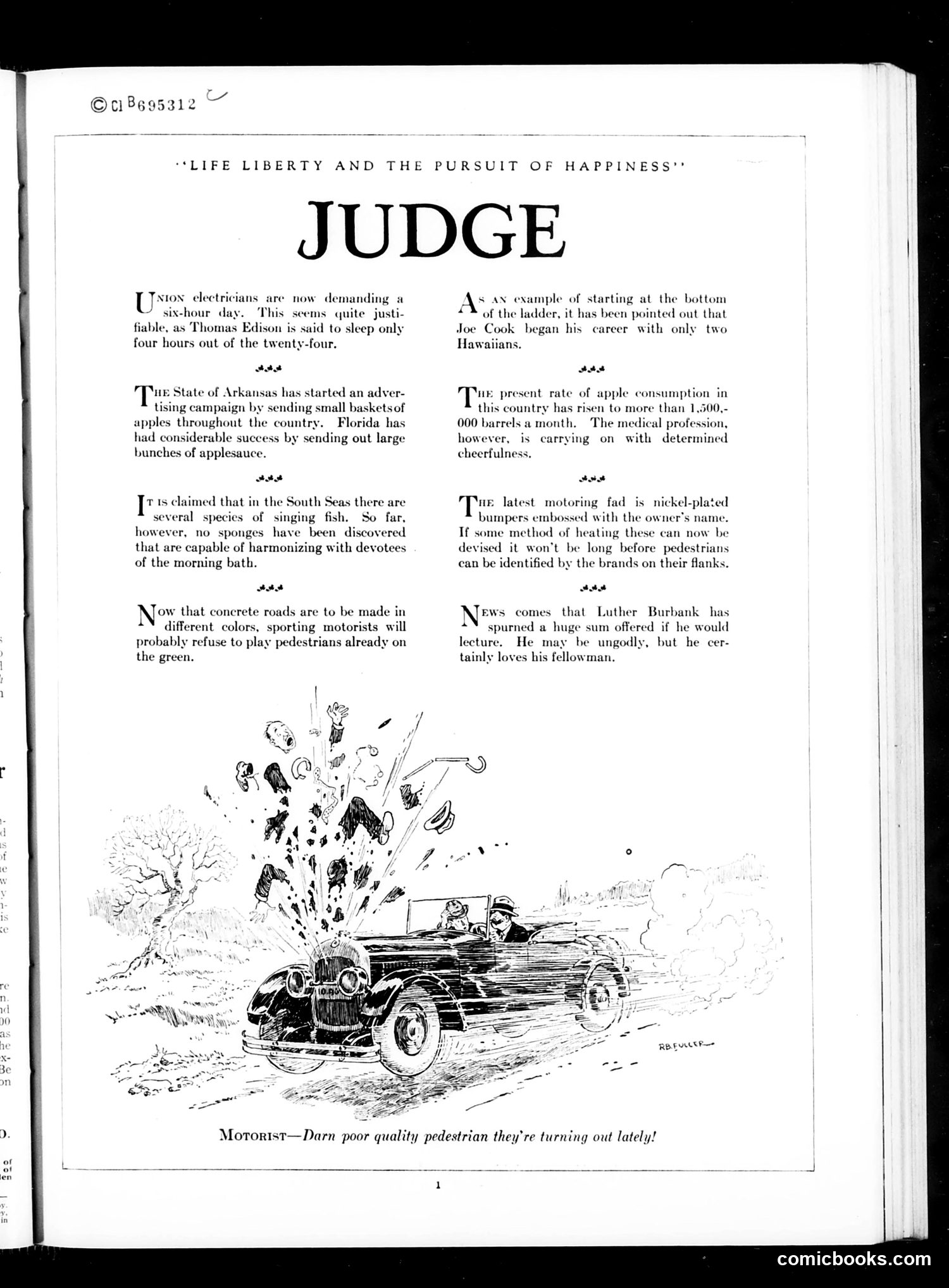
This page contains miscellaneous satirical commentary rather than a focused political cartoon. The main illustration depicts a motorist hitting pedestrians, with the caption "Darn poor quality pedestrian they're turning out lately!" — satirizing reckless driving and the cavalier attitude some early motorists had toward pedestrians' safety. The surrounding text snippets mock various contemporary topics: electricians' work hours, Arkansas's apple advertising campaign, alleged singing fish in the South Seas, colored concrete roads, and Luther Burbank's popularity as a lecturer. These appear to be brief, disconnected jabs at contemporary news items and trends rather than cohesive satire. The overall effect is typical Judge fare: rapid-fire ridicule of modern life's absurdities, aimed at educated readers familiar with current events.
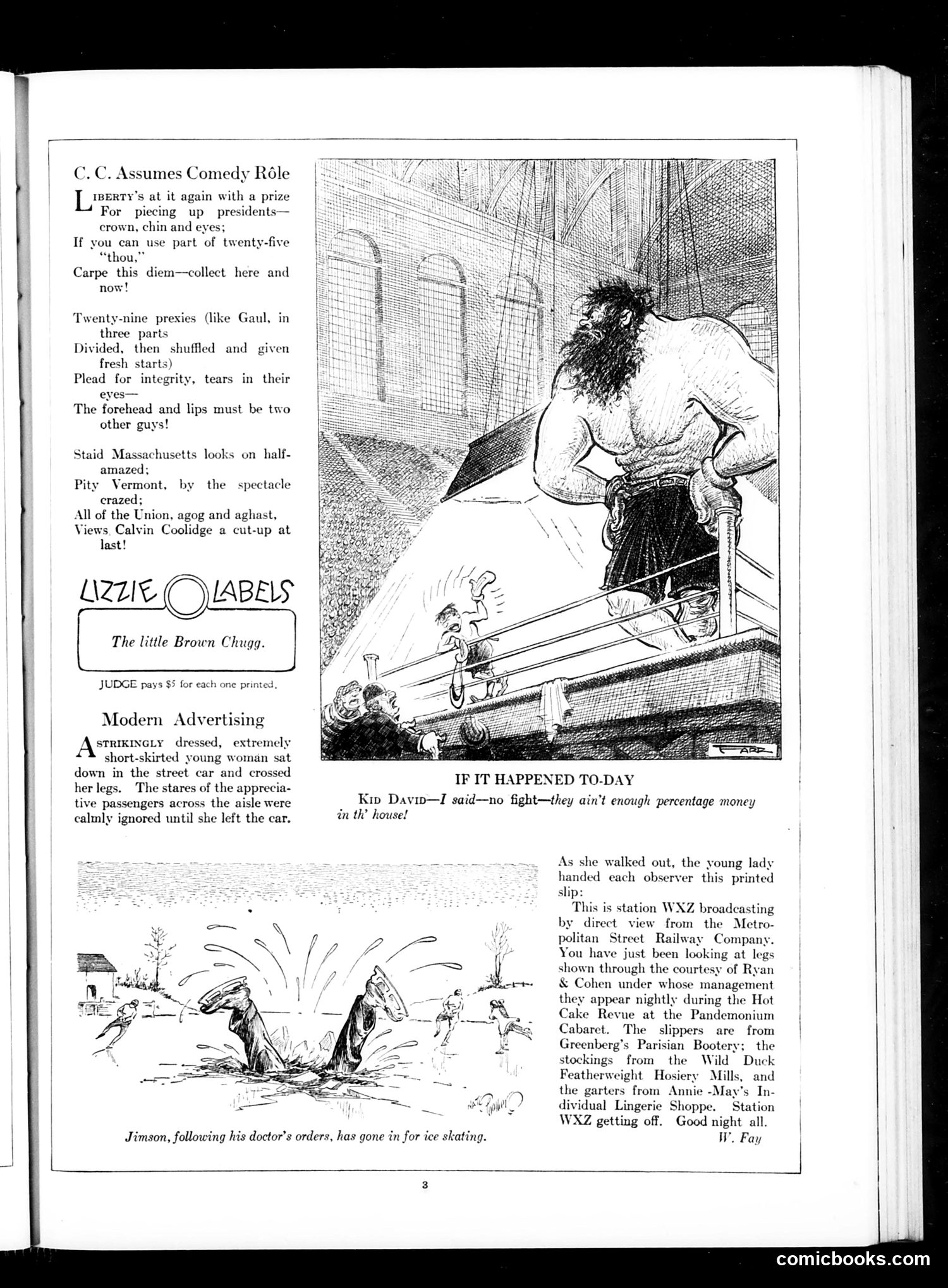
This page contains humor and advertisements rather than direct political commentary. The top section satirizes C.C. (likely Calvin Coolidge), mocking a "Liberty" contest awarding prizes—crown, chin, and eyes—by requiring "twenty-five 'thou'" (archaic speech). The joke ridicules pompous prize contests and Coolidge's known taciturn manner. The main cartoon, "If It Happened To-Day," depicts a small figure (Kid David) challenging a giant, comparing modern disputes to biblical David vs. Goliath. The satire suggests contemporary conflicts lack meaningful stakes—Kid David notes there "ain't enough percentage money in th' house." Below is a humorous illustration of someone ice skating per doctor's orders, showing comedic mishap. The page also includes "Lizzie Labels" advertising and Modern Advertising copy, making this primarily entertainment-focused content.
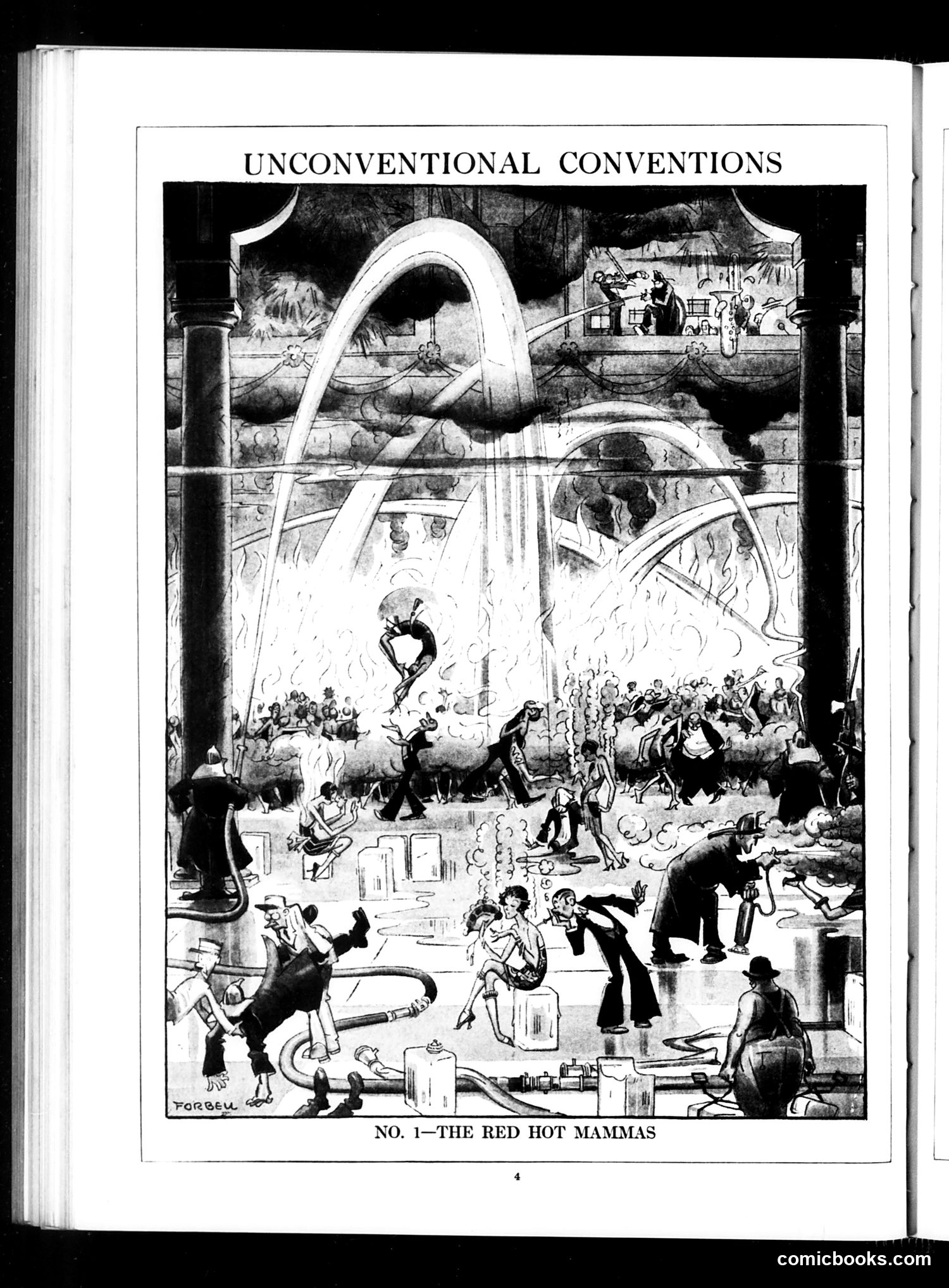
This cartoon satirizes the "Red Hot Mammas," a popular entertainment act of the 1920s featuring female performers known for energetic, sexually suggestive dancing and jazz music. The chaotic scene depicts a wild nightclub or theater performance with audience members and performers in various states of excitement and disorder. The satire targets Jazz Age social conventions—the title "Unconventional Conventions" suggests the cartoon mocks how the younger generation was abandoning traditional morality. The swirling imagery and frantic composition convey judgmental disapproval of this "hot" music and dance craze, which conservative critics viewed as decadent and morally corrupting. Judge magazine, as a satirical publication, uses exaggeration to ridicule both the performers and audiences embracing these new entertainment forms.
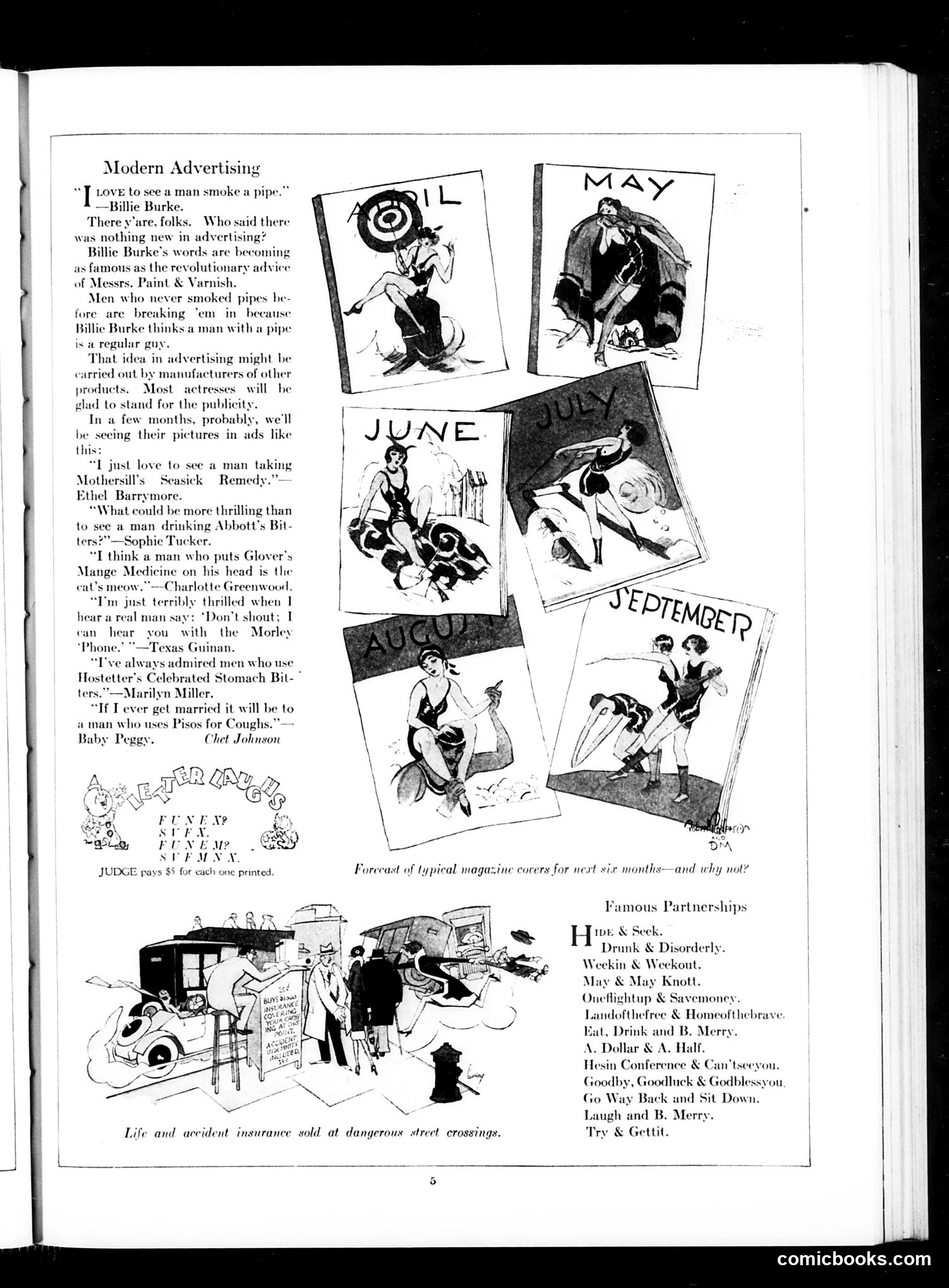
This page satirizes **modern advertising trends** of the era. The left column mocks how advertisers now use celebrity endorsements and absurd claims—featuring quotes from actresses like Billie Burke and Sophie Tucker endorsing mundane products (pipe tobacco, stomach bitters, etc.). The central illustration series shows **predicted magazine covers** for upcoming months, depicting increasingly ridiculous product placements: men smoking pipes, drinking remedies, and using dubious products in exaggerated scenarios. The bottom cartoon satirizes **street-corner insurance sales**, showing a chaotic traffic accident scene where life and accident insurance is being hawked to pedestrians at dangerous crossings—commenting on aggressive, opportunistic marketing tactics. The "Famous Partnerships" list appears to mock absurd brand name combinations popular in advertising.
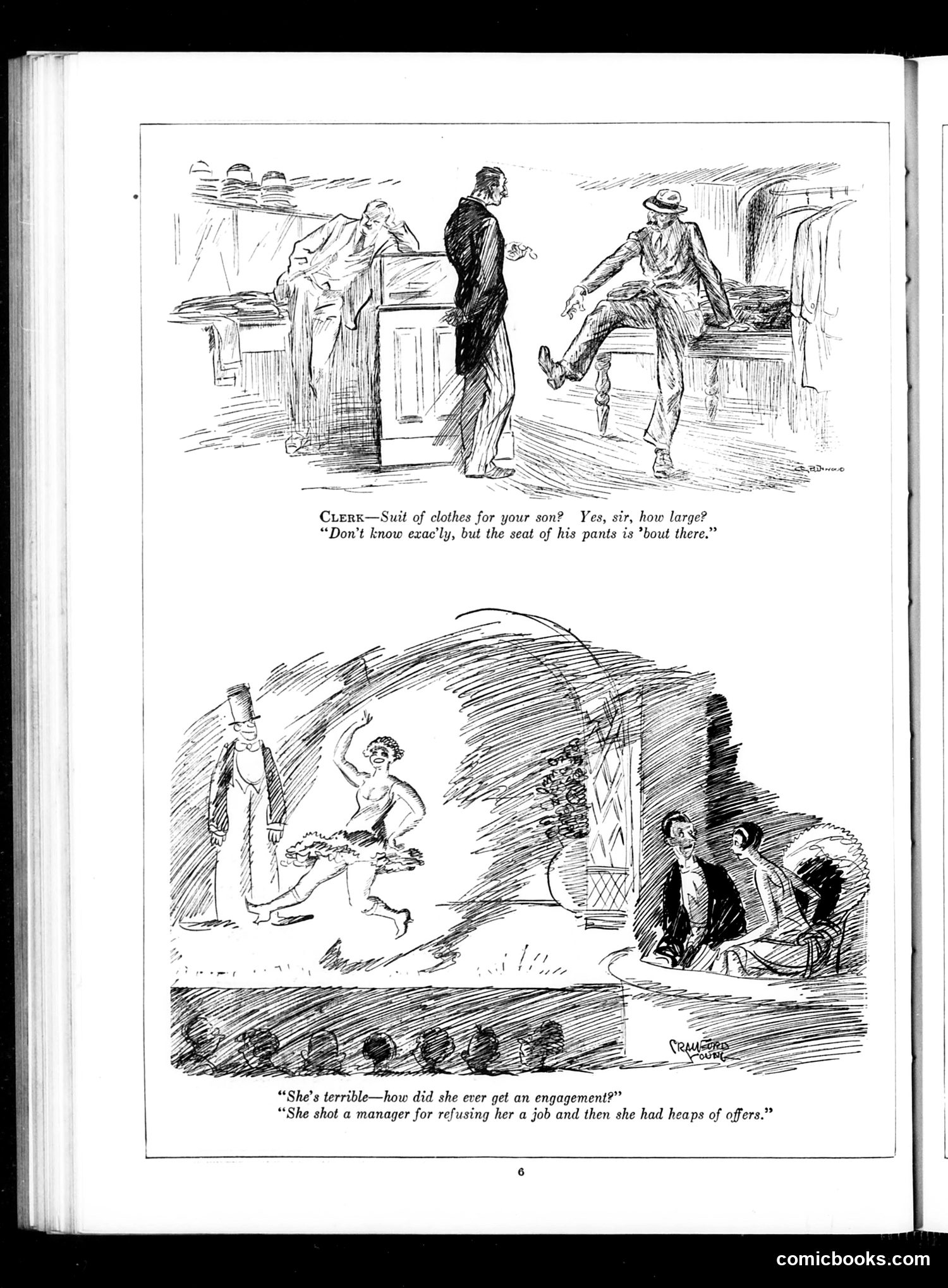
This page contains two unrelated cartoons satirizing early 20th-century social issues: **Top cartoon:** A clothing clerk helps a customer buy a suit. The joke plays on the customer's vague description of his son's size—he can only specify where "the seat of his pants" reaches, implying the boy is either very tall or the father is uncertain about basic measurements. It's gentle humor about male incompetence in domestic matters. **Bottom cartoon:** References a female performer or actress who shot a theater manager after he refused to hire her. Rather than facing consequences, she subsequently received "heaps of offers"—suggesting people now want to hire her out of fear or notoriety. This satirizes both workplace harassment in entertainment and society's perverse reward of violent behavior through attention and opportunity. The cartoon critiques both the manager's initial refusal and the absurd outcome.
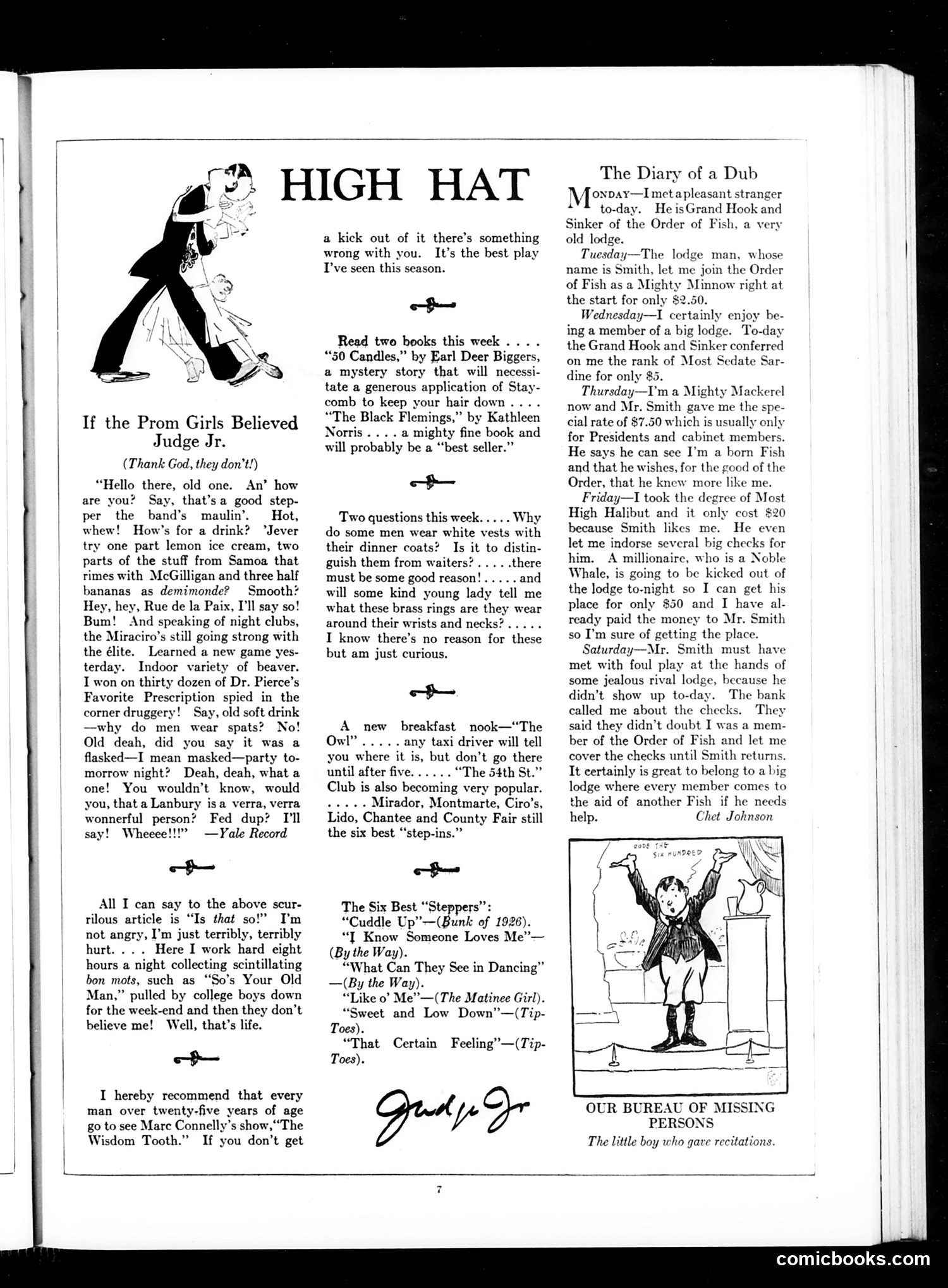
This Judge magazine page contains satirical humor about 1920s elite social culture and fraternal organizations. **"High Hat"** mocks pretentious young socialites affecting exaggerated sophistication—using affected speech ("Deah, deah"), name-dropping fashionable nightclubs (Ciro's, Lido), and obsessing over trivial etiquette questions (why wear spats?). The satire targets their empty affectation and borrowed bon mots. **"The Diary of a Dub"** satirizes predatory fraternal lodge schemes. A con-artist named Smith recruits a naive member into "The Order of Fish," rapidly escalating membership fees ($2.50 to $20) while bestowing grandiose-sounding ranks ("Mighty Mackerel," "Most High Halibut"). The victim is manipulated into endorsing checks, suggesting Smith exploited fraternal lodge culture—which did exist in the 1920s—as cover for financial fraud. The diary's abrupt ending ("met with foul play") darkly implies Smith may have murdered the diarist. Both pieces satirize 1920s pretension and con-artistry targeting the wealthy and gullible.
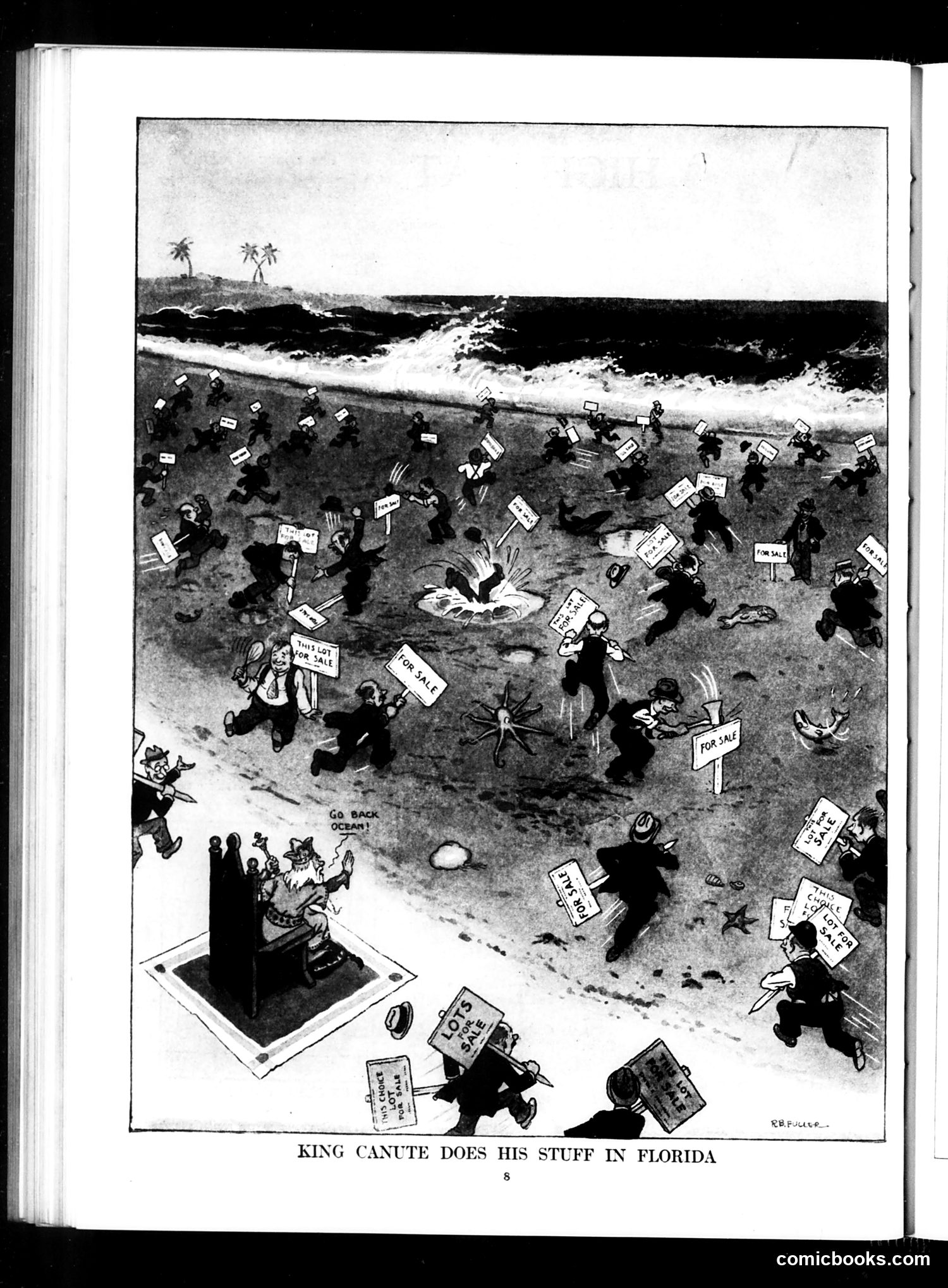
This political cartoon satirizes real estate speculation in Florida, likely from the 1920s land boom era. The title references King Canute, the legendary medieval king who commanded the ocean to halt—a symbol of futile defiance against nature. The cartoon depicts a beach scene where numerous figures carry "FOR SALE" signs amid crashing waves. The joke appears to be that real estate promoters are aggressively selling Florida beachfront property despite obvious dangers (the turbulent ocean). They're behaving like King Canute—stubbornly attempting the impossible. A central figure in dark clothing (possibly representing a real estate developer or promoter) stands prominently. The satire mocks the reckless optimism and deceptive marketing practices of land speculators who ignored environmental hazards to profit from the Florida real estate craze. The chaos on the beach reinforces the criticism that these sales efforts were absurd and doomed.
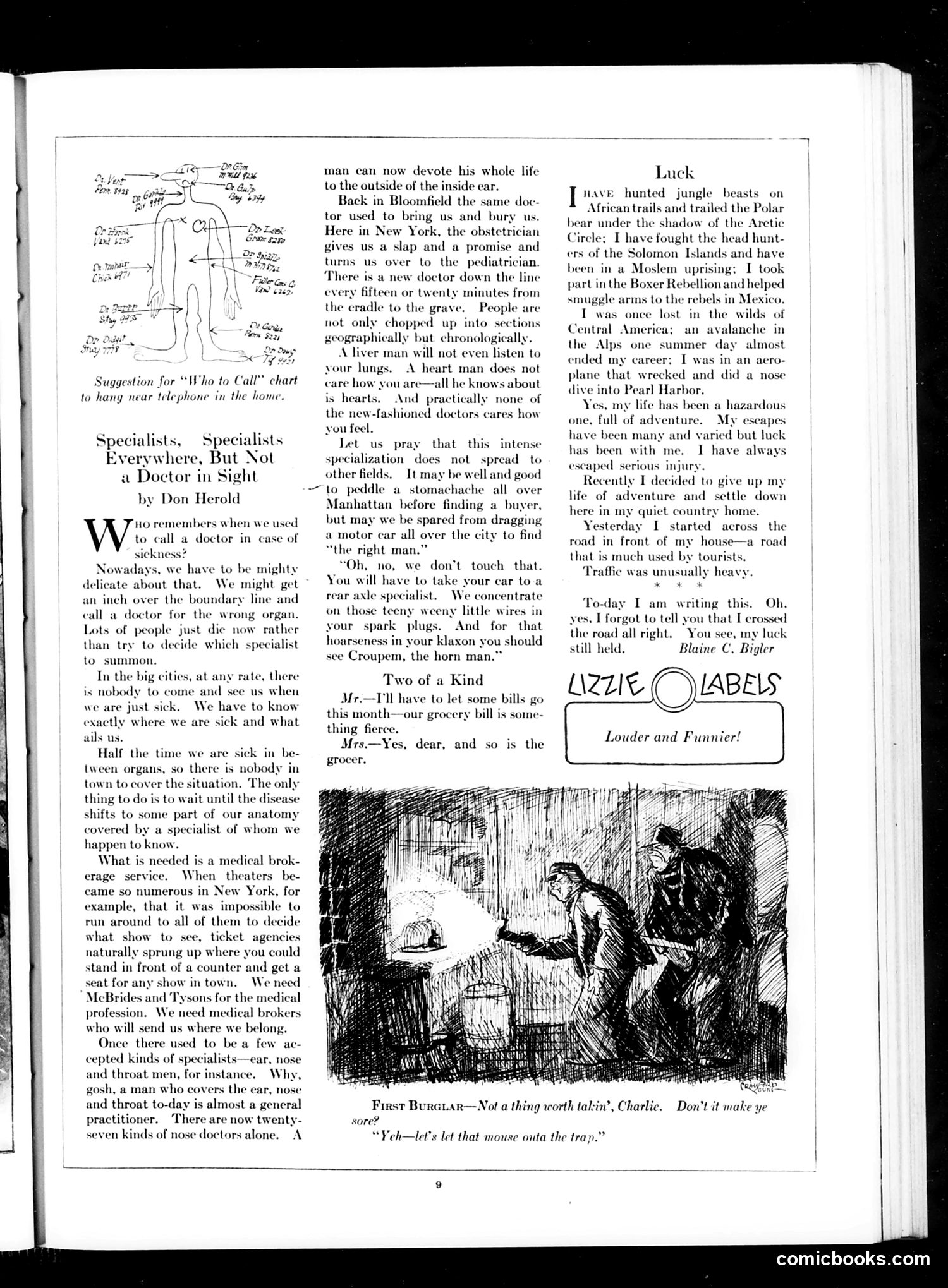
This page satirizes the modern medical specialization boom of early-20th-century America. **Main Article ("Specialists, Specialists Everywhere")**: Don Herold's essay mocks how medical practice has fragmented into absurdly narrow specialties. He contrasts rural doctors of the past (who delivered babies and conducted funerals) with urban specialists so focused on single organs or body parts that they refuse to treat patients holistically. The satire peaks with his claim there are "twenty-seven kinds of nose doctors alone" and a specialist for "the outside of the inside ear." He proposes a "medical brokerage service" to navigate this chaos—paralleling theater ticket agencies. **The Cartoon**: Shows a burglar telling his partner the house has nothing worth stealing, with the caption "let's let that mouse outa the trap"—unrelated social commentary about poverty during economic hardship. **"Luck" Story**: A humorous account by Blaine C. Bigler describing miraculous escapes from danger worldwide, culminating in settling quietly at home—implying bad luck now ironically strikes in mundane domesticity. The page critiques how professionalization, while well-intentioned, creates absurd fragmentation.
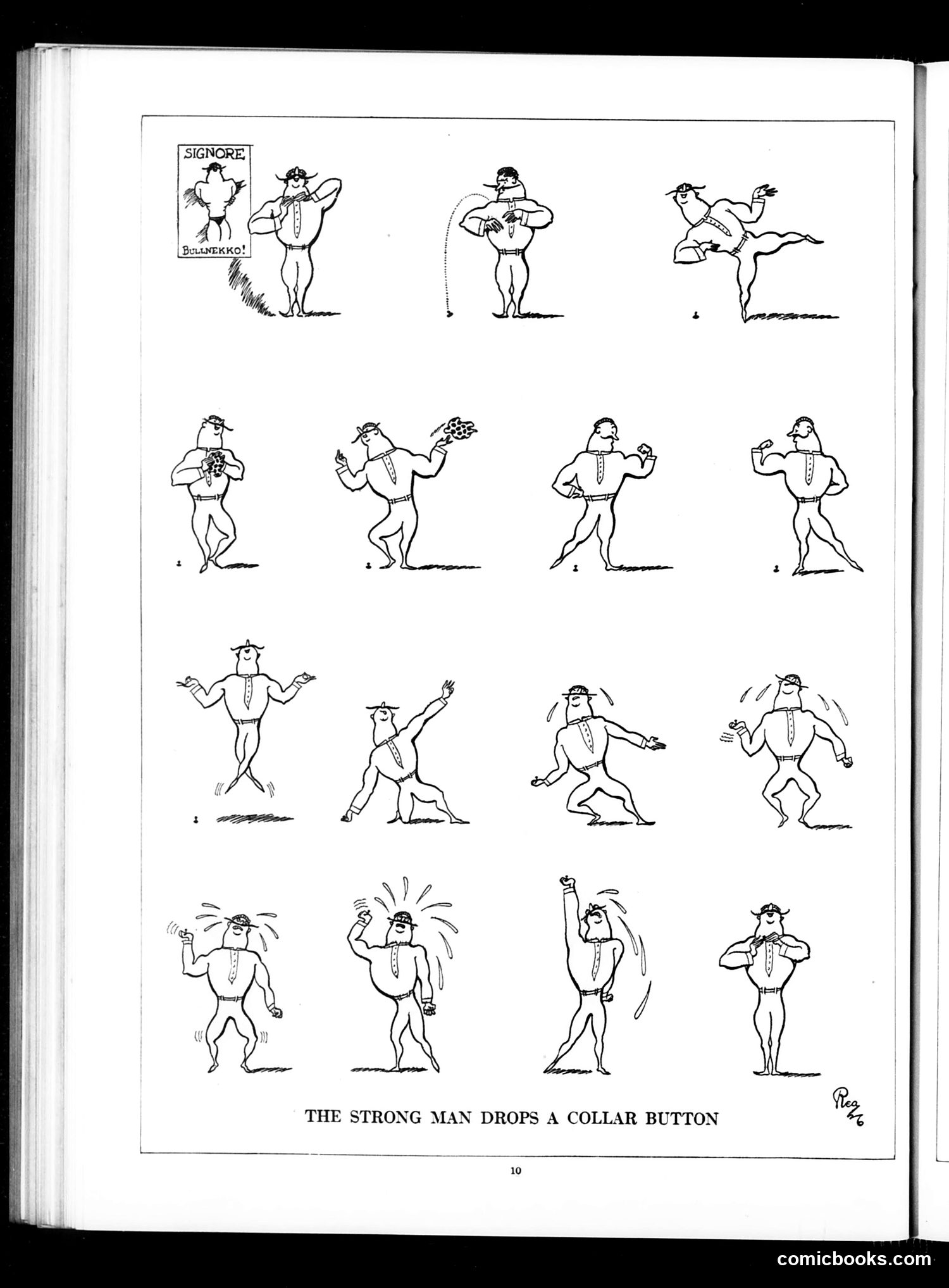
This satirical comic strip depicts a muscular strongman character repeatedly losing and searching for a single collar button. The humor derives from the contrast between his extraordinary physical strength (shown performing feats like lifting heavy objects and performing acrobatic poses in the top rows) and his complete helplessness over a tiny, mundane item. The joke appears to be a commentary on masculine vulnerability—that even the most powerful man is undone by life's small domestic inconveniences. The escalating emotional reactions (shown in the bottom rows with the figure increasingly distressed and agitated) emphasize this ironic inversion of expectations. This represents early 20th-century satirical humor about gender roles and the gap between public masculine displays and private domestic realities.
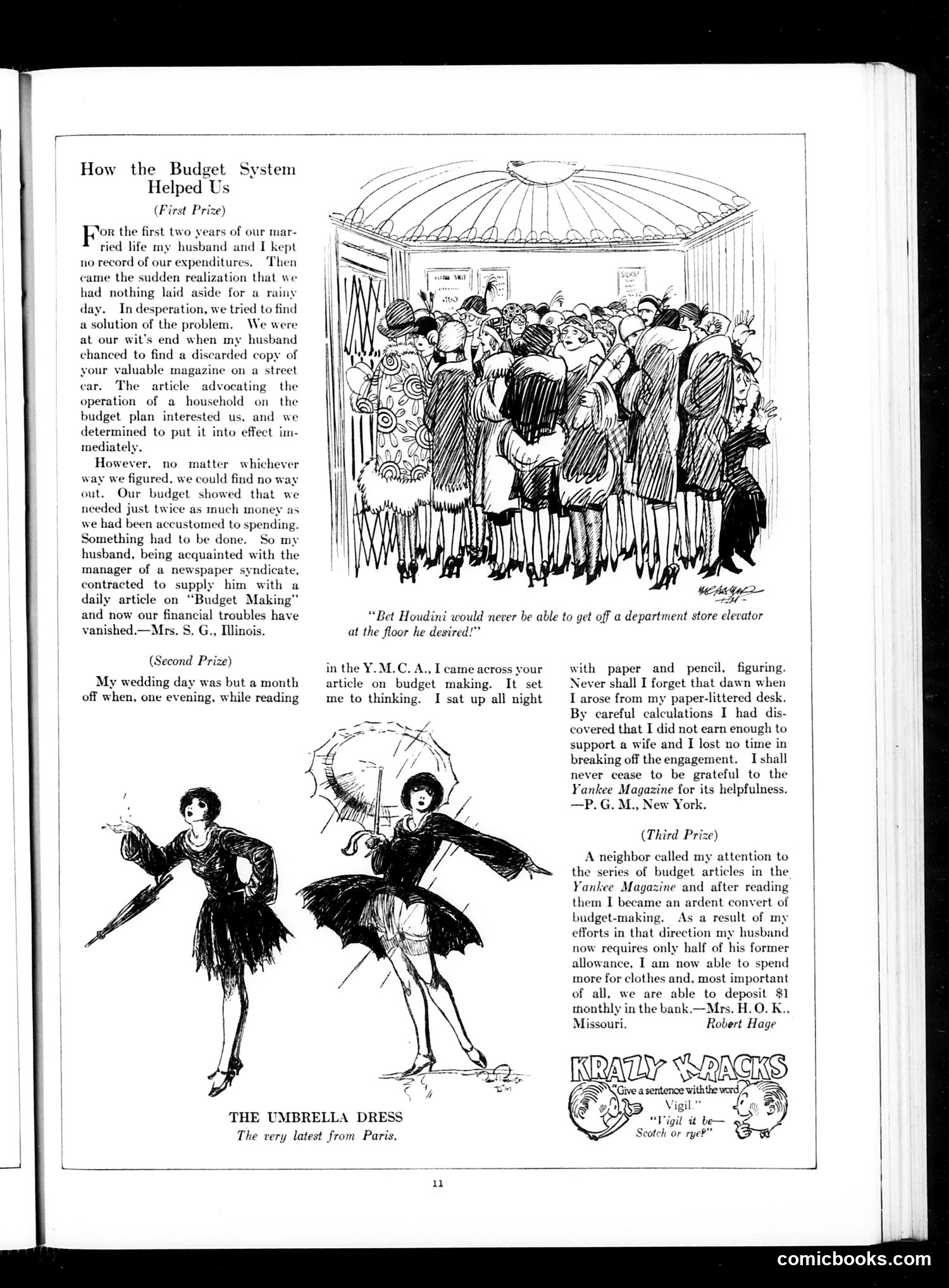
This page satirizes the early-20th-century budgeting craze by presenting three prize-winning letters about how budget advice transformed readers' lives—with darkly comic results. The **First Prize** story shows a couple who discovered budgeting via a *Judge* magazine article, then realized they needed twice their income. Solution: the husband wrote daily budget columns for a newspaper syndicate, solving their problems through ironic circular logic. The **Second Prize** entry describes a man who, after calculating he couldn't afford marriage via budget math, broke off his engagement—treating financial spreadsheets as relationship guidance. The **Third Prize** letter presents the only "success" story: a wife cut her husband's allowance in half through budgeting discipline, letting her spend more on clothes herself. The cartoon above (showing an impossibly crowded elevator) appears unrelated, likely satirizing department store chaos. The satire's point: budgeting advice, while well-intentioned, produces absurd, sometimes socially destructive outcomes when taken literally.
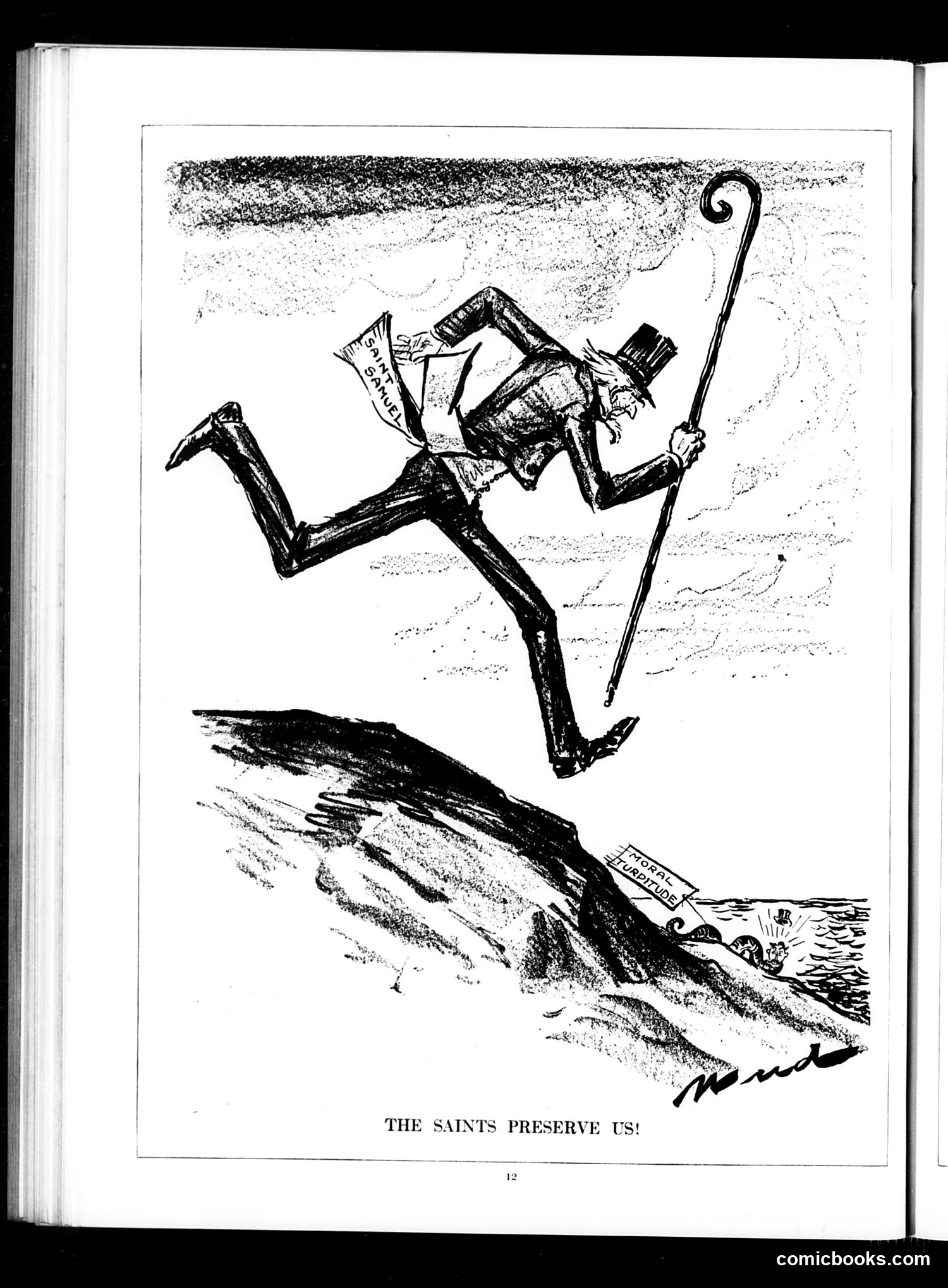
This political cartoon depicts a thin, elegantly dressed figure in a top hat leaping dramatically across a chasm while wielding a cane like a pole vault. Below, a sinking ship labeled "REPUBLIC" is going down. The figure appears to be a caricatured politician or public figure desperately escaping disaster. The title "The Saints Preserve Us!" suggests ironic prayer for salvation. The cartoon satirizes a political leader abandoning the nation (represented by the Republic) during crisis, prioritizing personal survival over duty. The stylized, exaggerated pose emphasizes cowardice or self-interest. Without the publication date visible, the specific political crisis referenced remains unclear, though it likely comments on perceived governmental failure or dereliction during a period of national emergency.
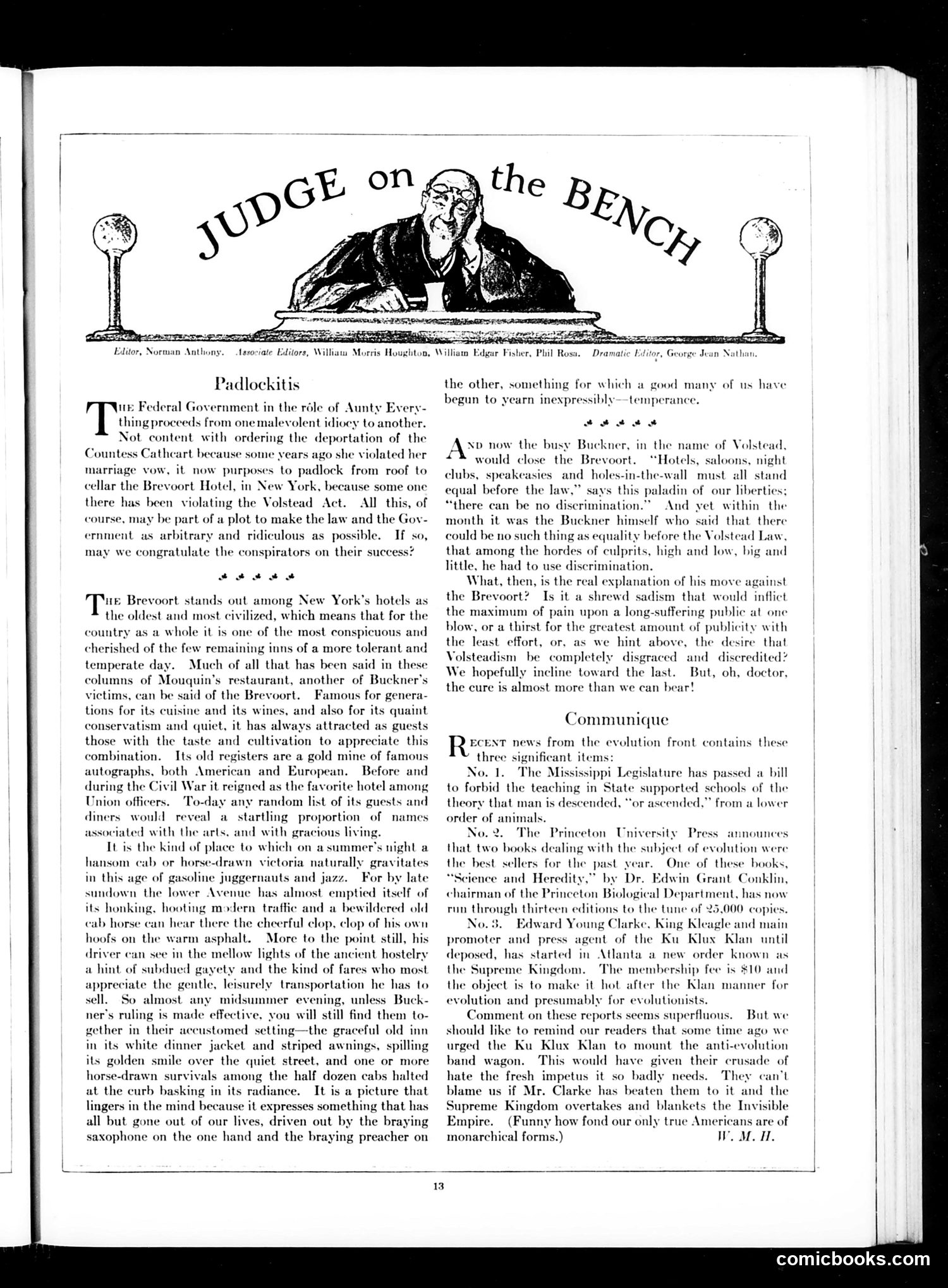
This editorial cartoon satirizes **William H. Buckner**, Prohibition enforcement official, for proposing to padlock the historic **Brevoort Hotel** in New York City due to alleged Volstead Act violations (illegal alcohol service). The satire's targets: 1. **Government hypocrisy**: Buckner claims "no discrimination" enforcing Prohibition equally, yet admits using discretion against "high and low" offenders—contradicting himself. 2. **Arbitrary power**: The piece attacks government overreach, comparing Buckner's actions to random persecution (earlier citing deportation of Countess Cathcart). 3. **Cultural destruction**: The Brevoort represents pre-Prohibition gentility—famous hotel with Civil War officers' signatures, fine dining, horse-drawn carriages. Closing it symbolizes loss of "temperance" (ironically, restraint) in favor of zealous puritanism. 4. **Motivation questioned**: The author suggests Buckner's true motives are sadism, publicity-seeking, or deliberately discrediting Prohibition itself through excessive enforcement. The joke: aggressive Prohibition enforcement destroys the very civilized restraint it claims to protect.
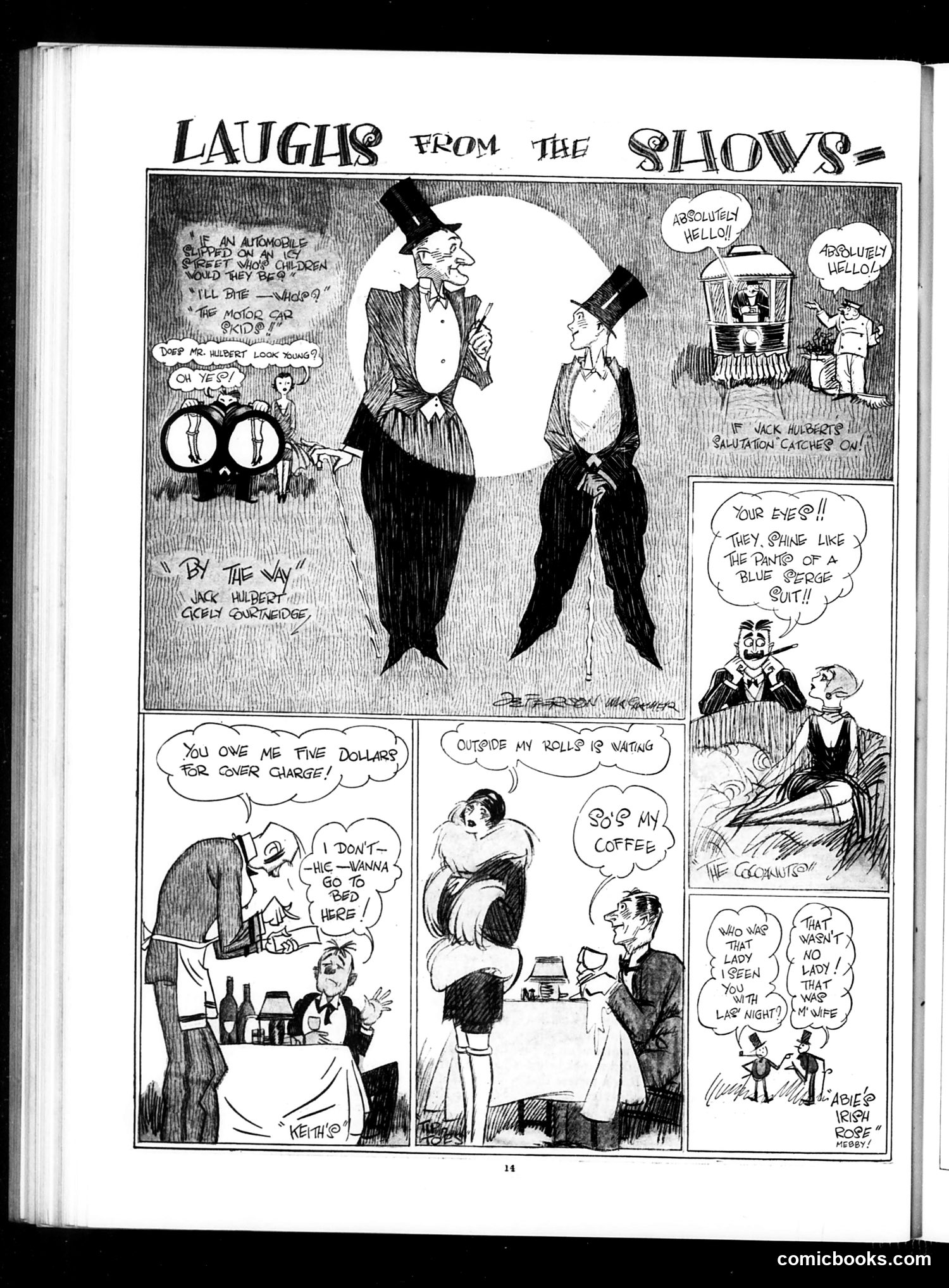
This page collects humor derived from stage performances, credited to cartoonists Jack Hilbert and Coefy Everridge. The top panel shows two well-dressed gentlemen in top hats discussing theatrical matters. Below are three separate gags: one about a debt collector demanding payment for "cover charge," another featuring a woman waiting for her coffee during what appears to be a romantic encounter, and a third depicting two people discussing whether they've met a particular woman before ("that wasn't no lady"). The humor relies on observational comedy about dating, money troubles, and social awkwardness—typical vaudeville and stage-comedy fare. The "blue serge suit" reference likely alludes to common theatrical costume elements. These are brief, punchy jokes extracted from full theatrical productions for Judge magazine's readers.
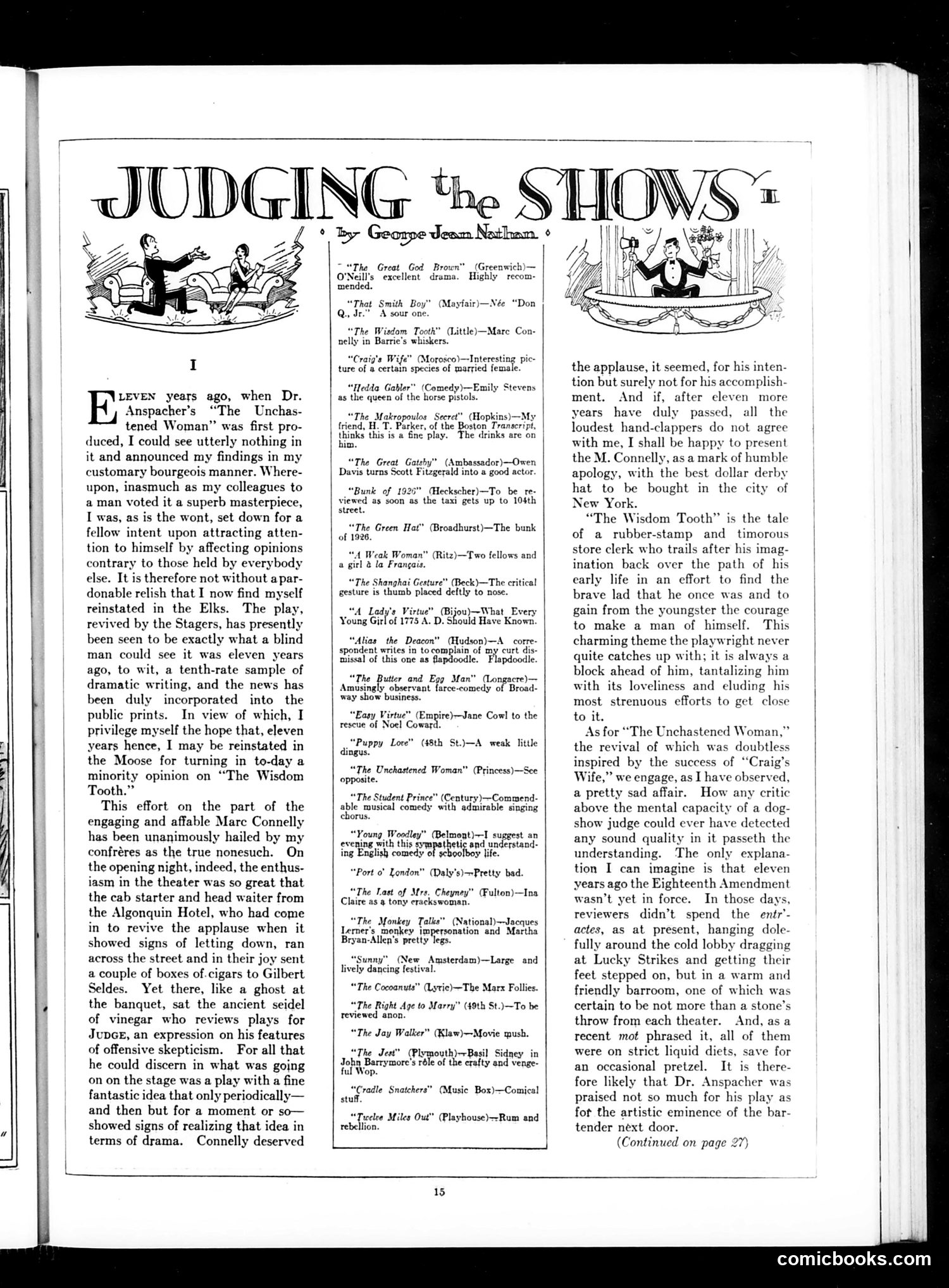
This page features George Jean Nathan's theatrical column reviewing Broadway shows from 1926. The two illustrated vignettes show critics in exaggerated poses—one sprawled in a chair, another gesturing dramatically from a platform. Nathan satirizes his own contrarian reputation: eleven years prior, he'd panned "The Unchastened Woman" while colleagues unanimously praised it. Now, vindicated by its current revival being recognized as mediocre, he jokes about earning reinstatement to fraternal clubs (the Elks, the Moose) for his unpopular opinions. The column mocks Marc Connelly's "The Wisdom Tooth," calling it derivative of J.M. Barrie despite enthusiastic critical reception. Nathan positions himself as the lone skeptic in a theater world prone to groupthink and manufactured applause (literally summoning crowd support from hotel staff). The accompanying reviews employ caustic one-liners rating contemporary plays, establishing Nathan's persona as Broadway's curmudgeonly truth-teller amid collective delusion.
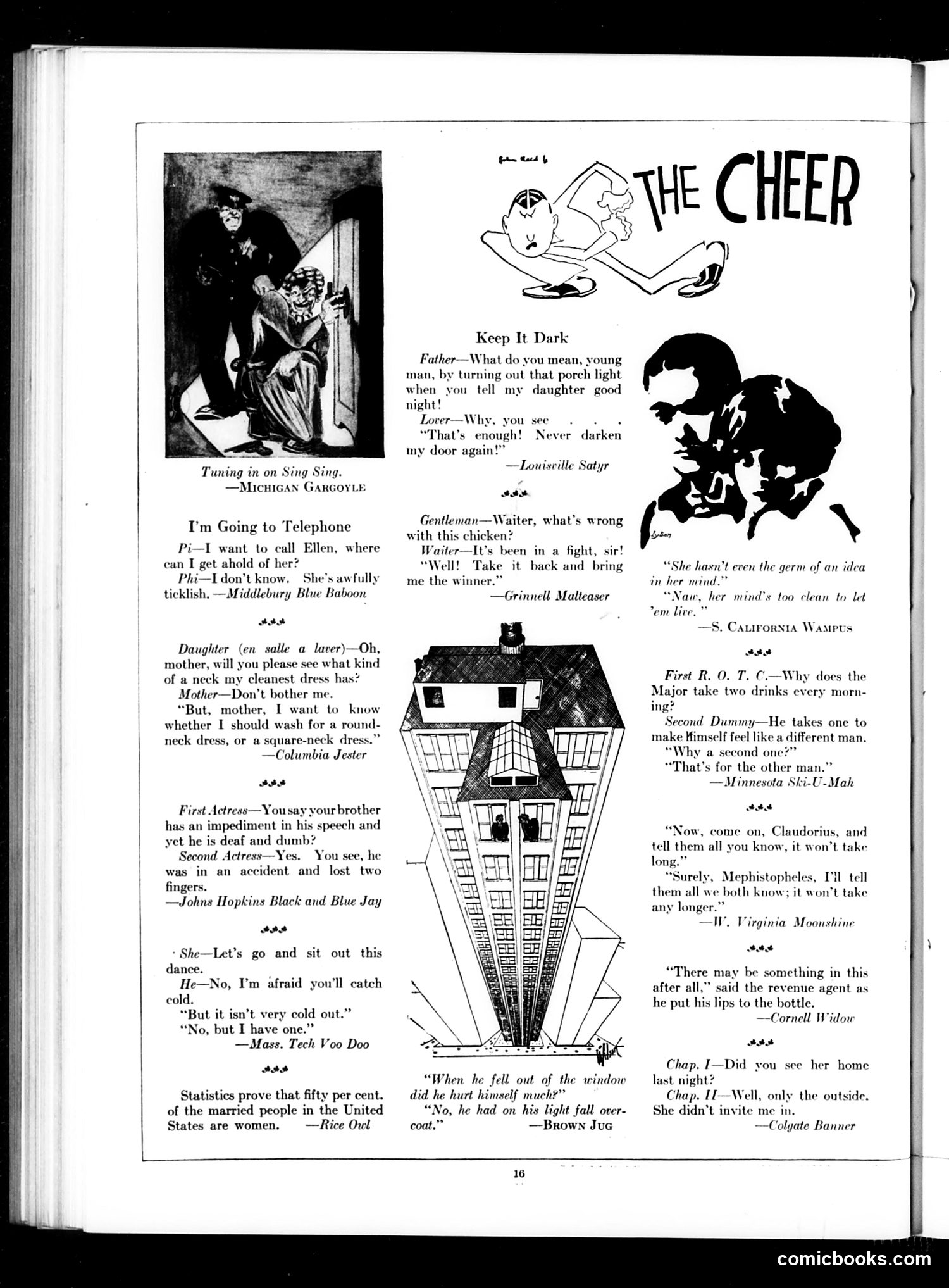
This is a collection of short jokes and quips from college humor magazines, typical of early-20th-century American college publications. The page showcases collegiate wit addressing common social situations: **Key themes:** - **Dating/courtship anxieties**: Porch lights, catching cold while sitting out dances, physical affection - **Family dynamics**: A stern father preventing a suitor from visiting, a distracted mother - **Campus life**: References to R.O.T.C. (military training), drinking culture - **Period-specific humor**: A revenue agent sampling bootleg alcohol (referencing Prohibition era) The jokes rely on wordplay, double meanings, and gentle social commentary rather than sharp political satire. The cartoon illustration of a haunted house and references to "Claudorius" and "Mephistopheles" suggest classical or gothic humor. The humor is genteel and wholesome by modern standards, reflecting 1920s-era college culture where these publications lampooned student life and social conventions.
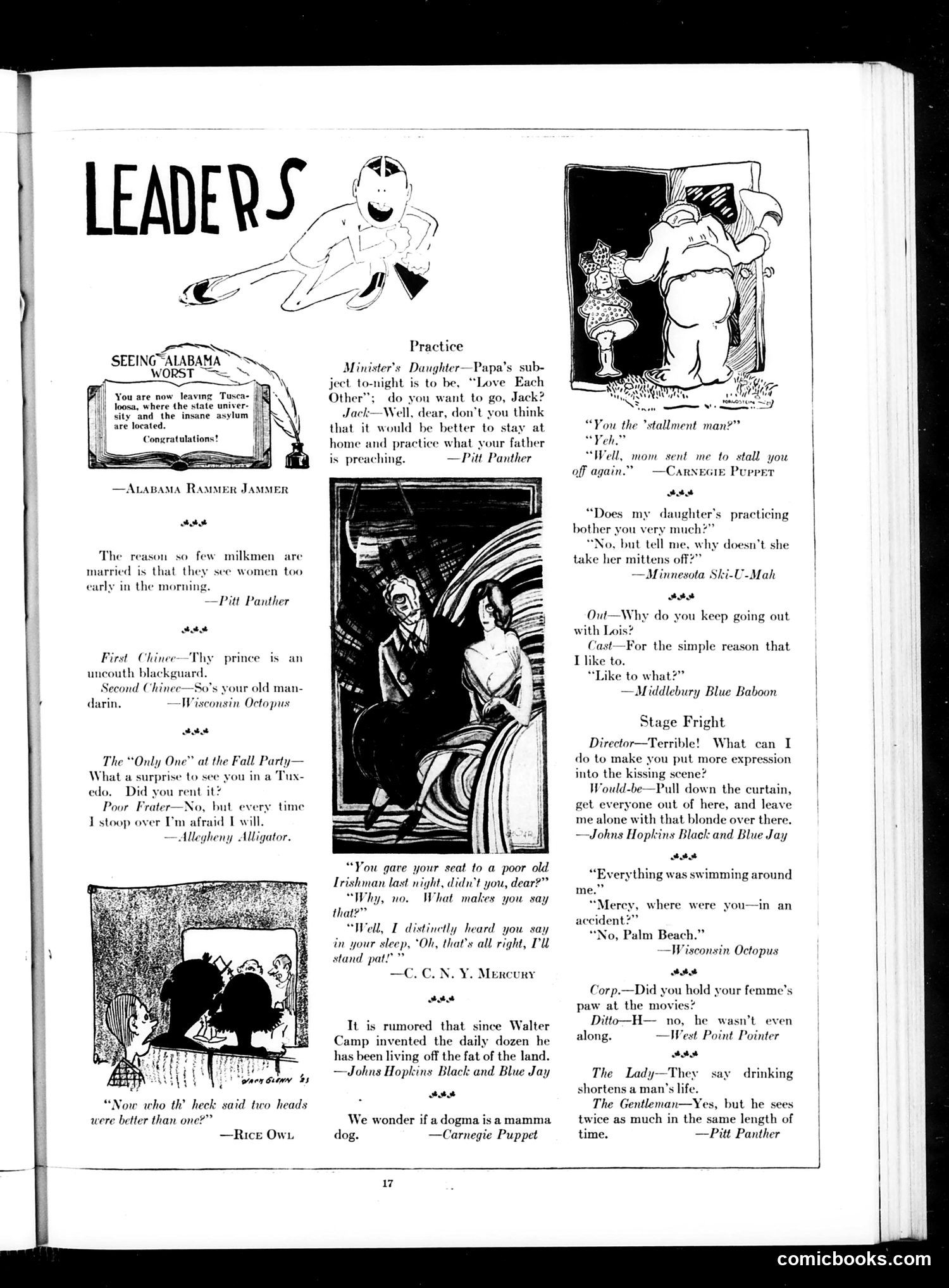
This page from *Judge* presents college humor and satirical one-liners typical of early 20th-century American collegiate magazines. The content consists largely of joke submissions from various college publications. **Key elements:** - **"Seeing Alabama Worst"**: A crude joke about Alabama's University and state asylum being co-located, mocking the state's intellectual reputation. - **Multiple college humor jokes** sourced from campus papers (Pitt Panther, Wisconsin Octopus, Rice Owl, etc.), covering standard topics: dating, romance, drinking, courtship etiquette, and generational tensions. - **Social satire**: References to milkmen, rental tuxedos, stage kissing, and romantic mishaps reflect 1920s-era dating conventions and class consciousness. - **"Palm Beach" reference**: Suggests a fashionable resort destination associated with wealth or excess. The page lacks overt political content, instead offering lighthearted social commentary aimed at college-educated readers familiar with campus life traditions and contemporary dating rituals.
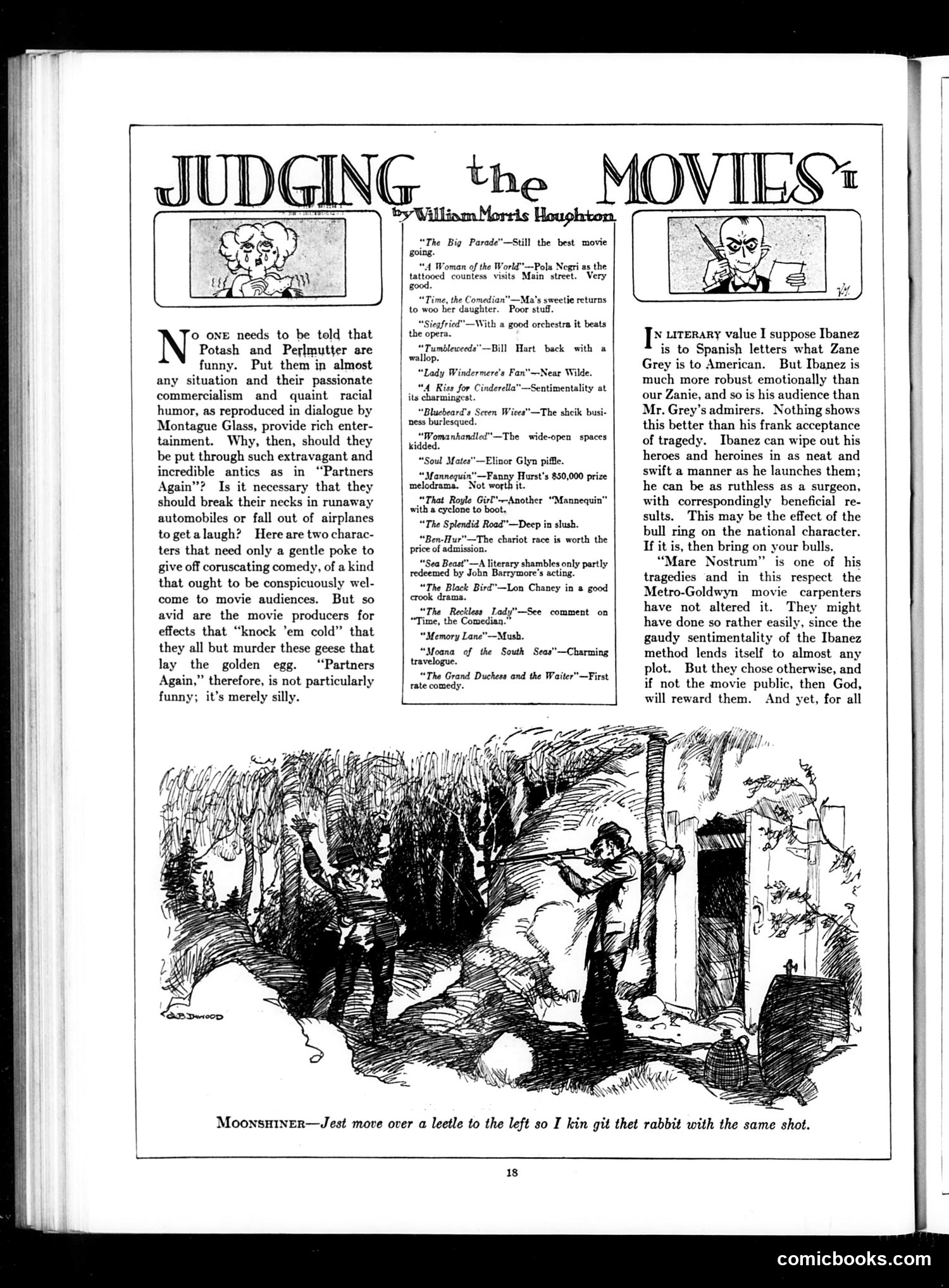
This page presents William Morris Houghton's film reviews alongside a separate cartoon. The reviews critique 1920s silent films, favoring those with literary merit (like Ibanez's "Mare Nostrum") while dismissing formulaic comedies and overwrought productions. Houghton praises "The Big Parade" and criticizes "Partners Again" for relying on excessive slapstick rather than the subtle charm of its Jewish characters Potash and Perlmutter. The bottom cartoon, titled "Moonshiner," depicts rural bootleggers during Prohibition. One moonshiner instructs another to adjust position so he can shoot a rabbit with the same shot—a joke about careless gunfire among unsophisticated criminals. The Prohibition-era reference would resonate with Judge's readers during the 1920s alcohol ban, mocking the incompetence of illegal distillers.
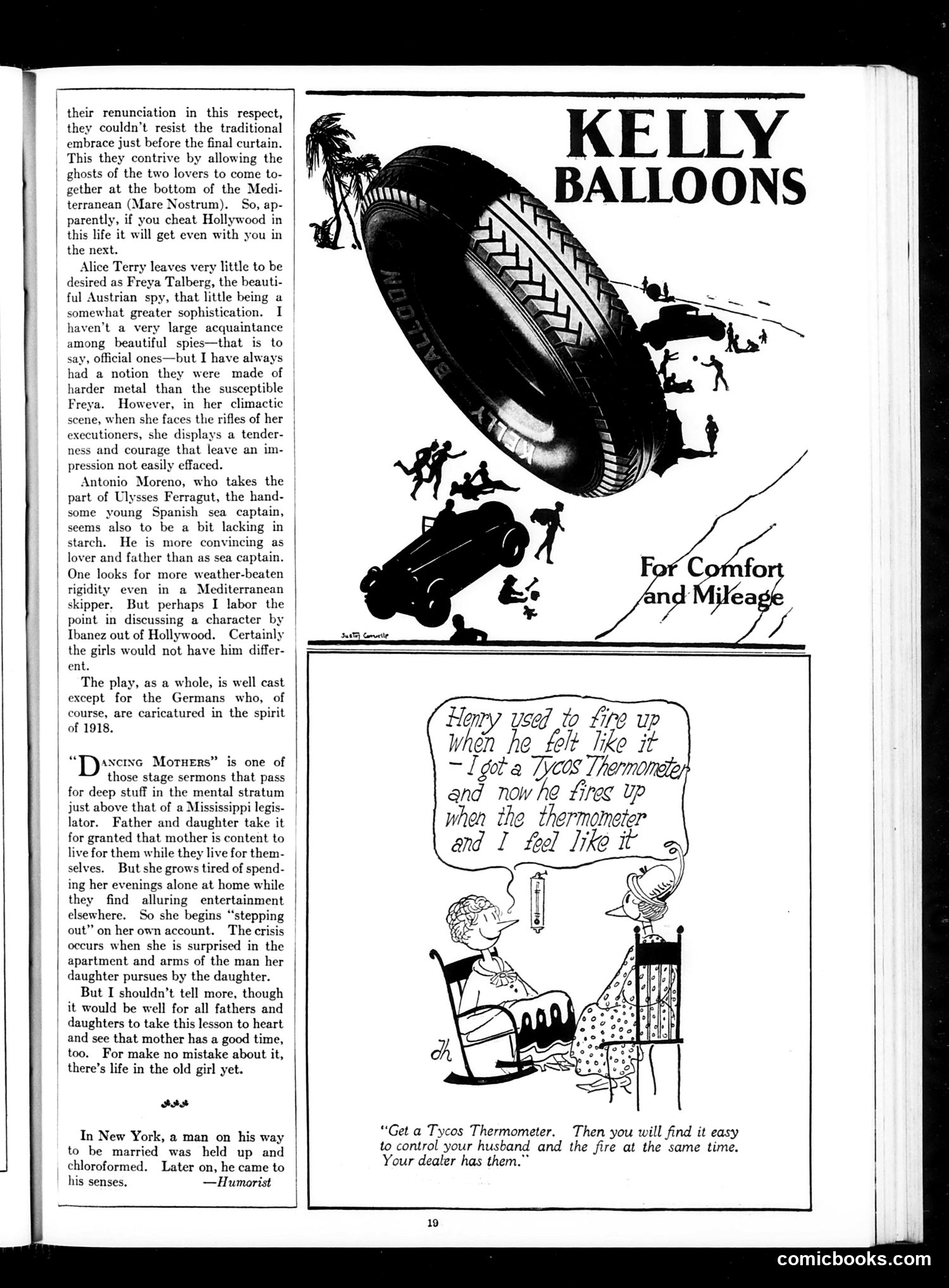
This page contains two distinct elements: a theater review and an advertisement. **The Review** discusses a film featuring actors Alice Terry and Antonio Moreno. The critic notes the Germans are "caricatured in the spirit of 1918"—a reference to anti-German sentiment from World War I, which had ended four years prior. This reveals the lingering hostility of the postwar period. **The Kelly Balloons Advertisement** is a sexist domestic humor comic. It depicts a husband who "used to fire up when he felt like it" until his wife got a Tycos thermometer. The joke suggests the thermometer lets her control both household heating *and* her husband's temper simultaneously—implying women manipulate domestic comfort to dominate their spouses. This reflects early 20th-century advertising's casual presentation of marital power dynamics as humorous rather than problematic.
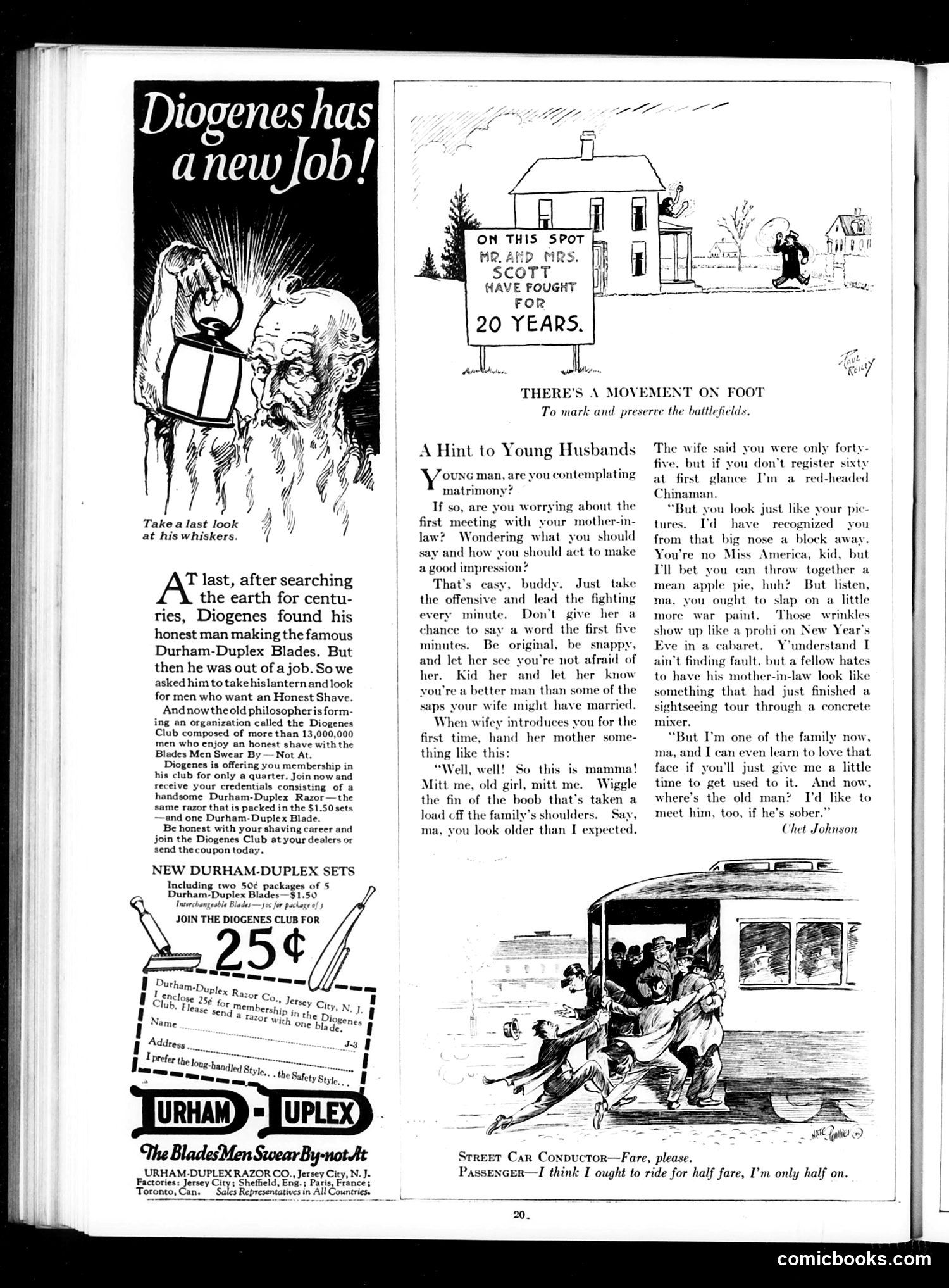
The page is primarily a **razor blade advertisement** using classical allusion. It references **Diogenes**, the ancient Greek philosopher famous for searching with a lantern for an honest man. The ad's joke: Diogenes finally found his honest man—working for Durham-Duplex razor manufacturers. Now jobless, he's recruiting members for the "Diogenes Club" to find men who want honest shaves. The page also contains unrelated filler content: "A Hint to Young Husbands" offers dated, aggressive courtship advice (aggressively domineer over your mother-in-law), and a bottom comic strip shows a streetcar passenger claiming they should pay half fare because they're "only half on." These appear to be typical magazine padding—the humor now reads as crude and dated. The Diogenes campaign was the advertisement's main selling point, playing on readers' classical education to create brand prestige around "honesty."
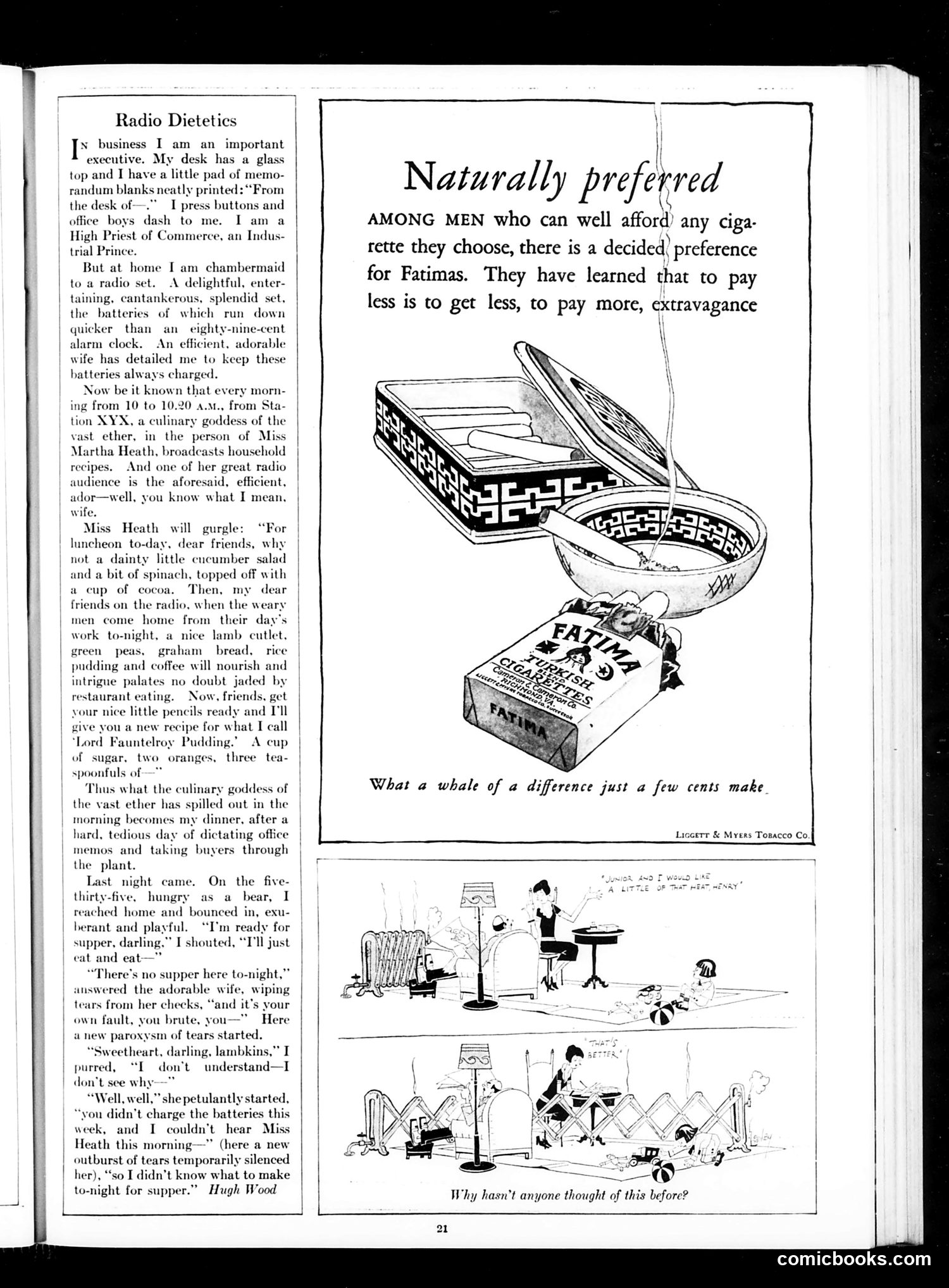
This page combines two unrelated items: **Left side ("Radio Dietetics"):** A humorous story by Hugh Wood about a businessman whose wife depends entirely on radio broadcasts from "Miss Martha Heath" for dinner recipes. When the radio batteries die and she misses that morning's broadcast, she has no idea what to cook, leading to marital comedy. The satire mocks both radio's growing cultural dominance in the 1920s-30s and domestic dependency—the joke being that a wife has outsourced all meal planning to a radio personality. **Right side:** An advertisement for Fatimas cigarettes, featuring decorative boxes on a scale. The ad's message—that paying more for premium cigarettes is worth it—uses the phrase "naturally preferred" to suggest affluent men inherently choose this brand. The cartoon below ("Why hasn't anyone thought of this before?") appears to satirize some domestic convenience or product, though the exact reference is unclear without additional context. Both items reflect early 20th-century American consumer culture and gender roles.
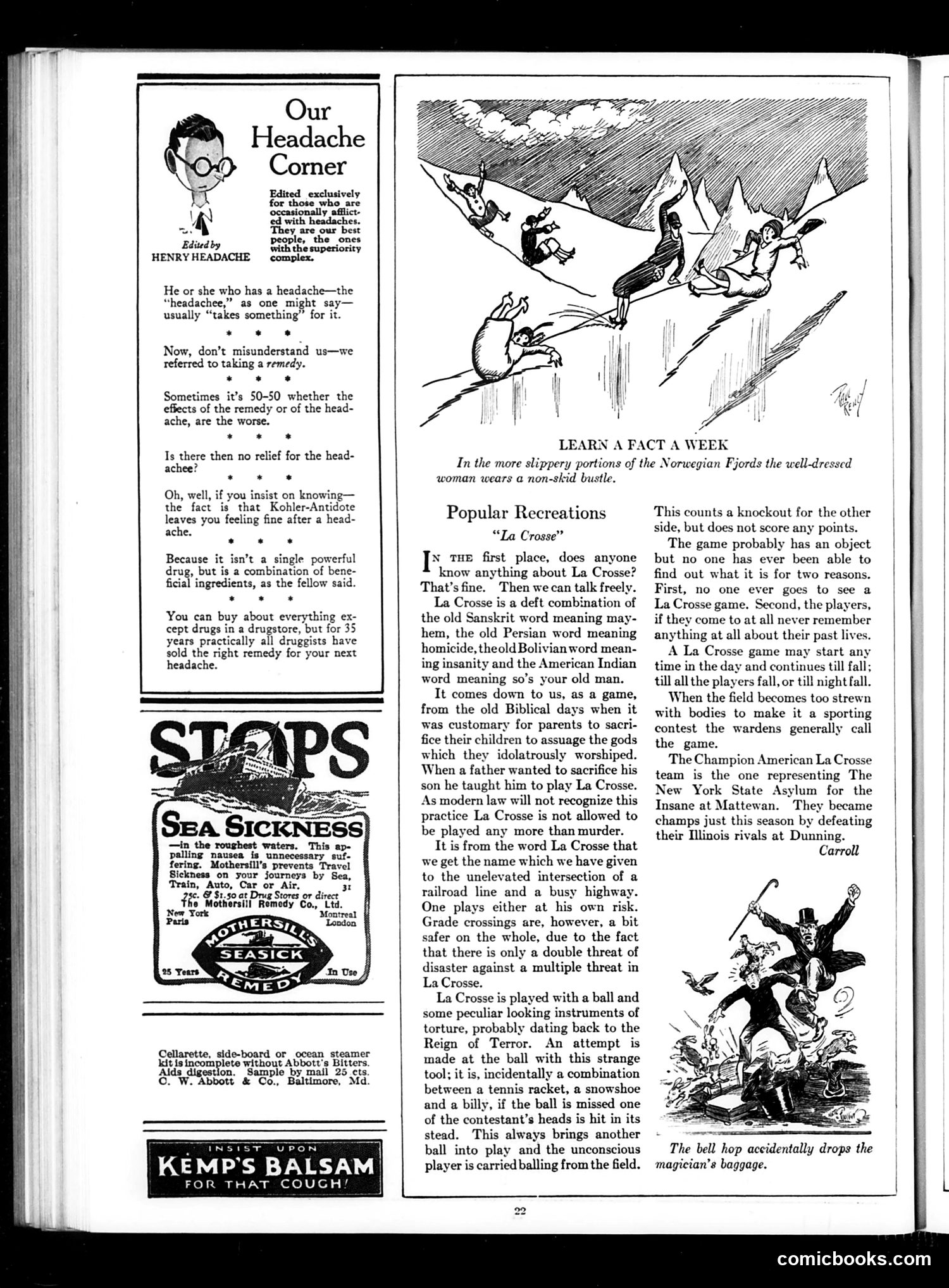
This page combines satirical humor with period advertising. The left side features "Our Headache Corner," edited by Henry Headache, which uses headaches as a metaphor for life's afflictions suffered by society's "superior" people. The humor is self-deprecating—suggesting headache sufferers are pretentious types who complain constantly. The right side contains the main satire: "Learn a Fact a Week" mocks Norwegian fashion with absurdist humor, while the "Popular Recreations" section provides a deliberately tongue-in-cheek history of lacrosse. The text claims the sport's name derives from Sanskrit "mayhem," Persian "homicide," and Bolivian "insanity"—obviously fabricated. The description humorously portrays lacrosse as dangerously violent, with players regularly knocked unconscious, and suggests no spectators attend because players can't remember anything afterward. This satirizes both the sport's brutality and its obscurity to general audiences.
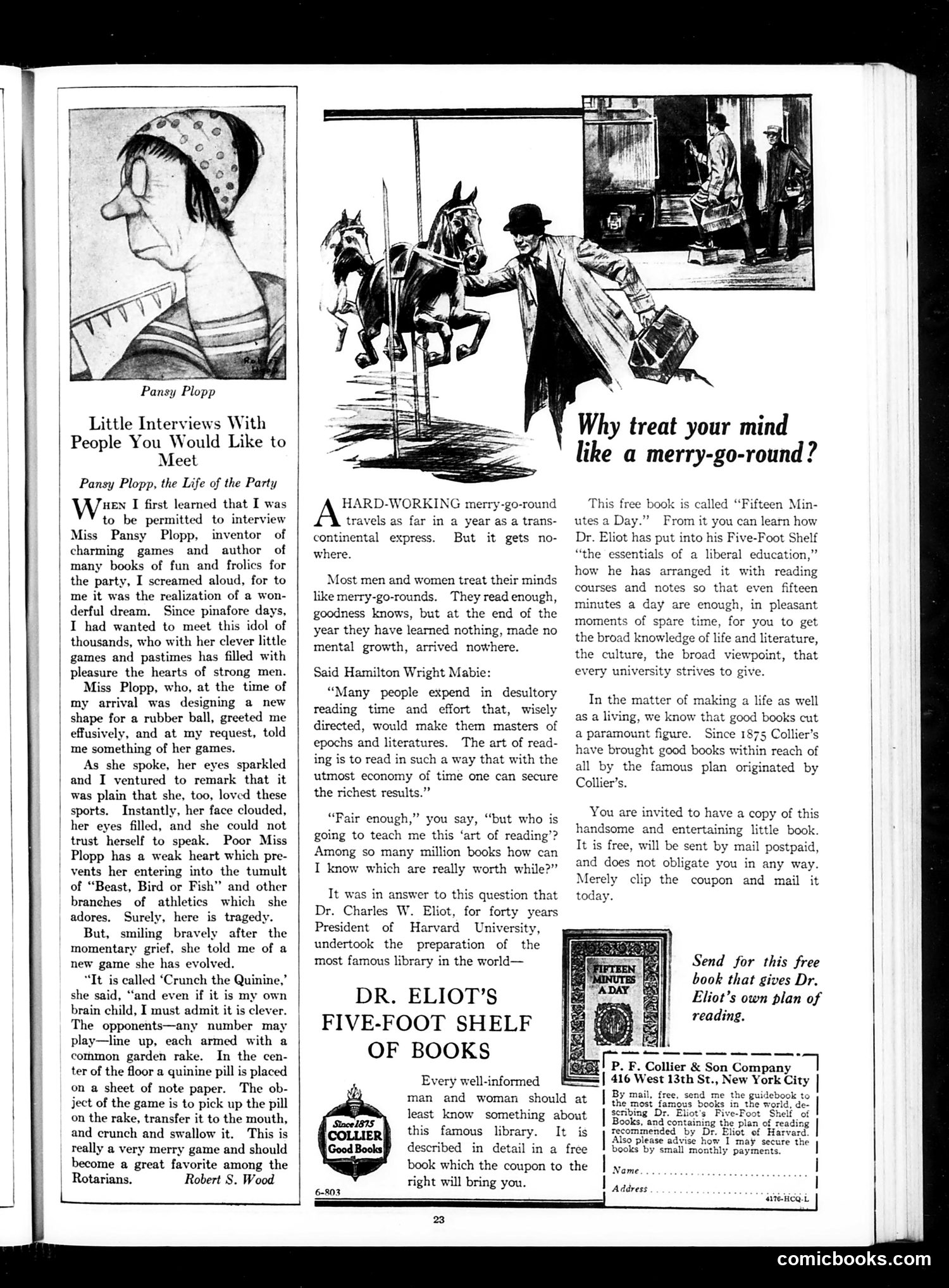
This page contains two distinct elements: a humorous interview and an educational advertisement. **"Pansy Plopp" Interview (Left):** A satirical profile of a fictional party-game inventor presented as an idol to "thousands." The joke centers on the absurdity of her invented games—particularly "Crunch the Quinine," where players use garden rakes to pick up and swallow a quinine pill. The satire mocks both the triviality of party entertainment culture and the overwrought admiration of celebrity game designers. The irony that Miss Plopp cannot actually participate in the athletics she loves adds comedic pathos. **"Merry-Go-Round" Advertisement (Right):** An ad for Dr. Charles W. Eliot's "Five-Foot Shelf of Books"—a famous curated library launched by Harvard's president. The metaphor compares mindless reading (like a merry-go-round that "gets nowhere") to purposeful, directed learning. It promotes Eliot's collection as the solution to intellectual stagnation, offering free guidebooks and installment purchasing. The page juxtaposes frivolous entertainment against serious self-improvement.
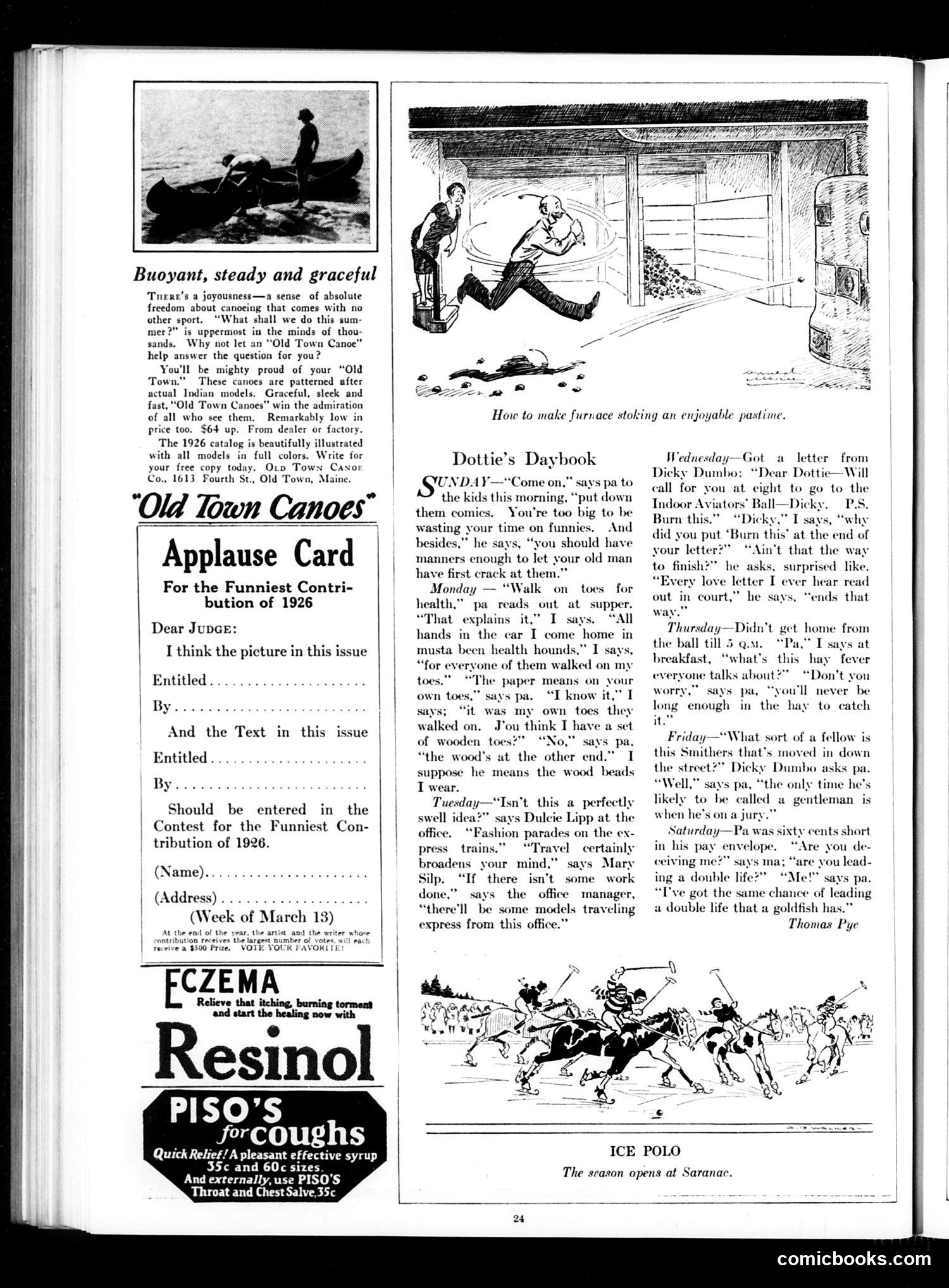
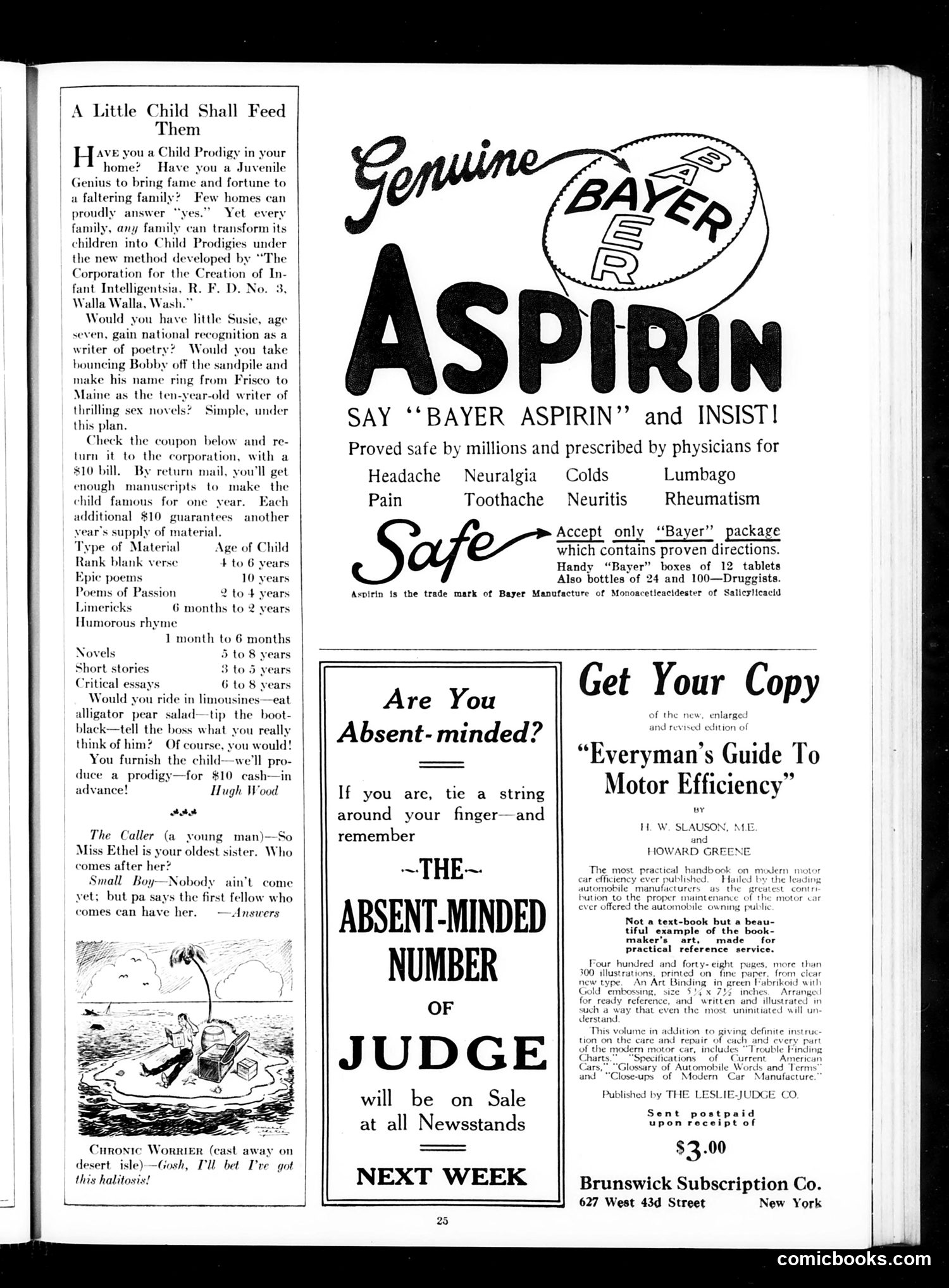
This page satirizes a get-rich-quick scheme targeting parents' aspirations. The main article mocks a fraudulent "Corporation for the Creation of Infant Intelligentsia" that promises to manufacture child prodigies for $10. **The Scam:** Parents send money and receive pre-written manuscripts (poems, novels, critical essays) to publish under their child's name, guaranteeing instant fame. The satire highlights the absurdity: you provide the child, the corporation provides the fake genius. **The Joke:** It exposes parental vanity and desperation for status—the willingness to pay for manufactured success rather than genuine talent. The price list (matching material types to age groups) adds comedic bureaucratic detail. The small accompanying jokes ("The Caller," "Chronic Worrier") are unrelated filler typical of Judge's format. The remaining page consists mainly of period advertisements (Bayer Aspirin, motor efficiency guides), reflecting the magazine's commercial nature.
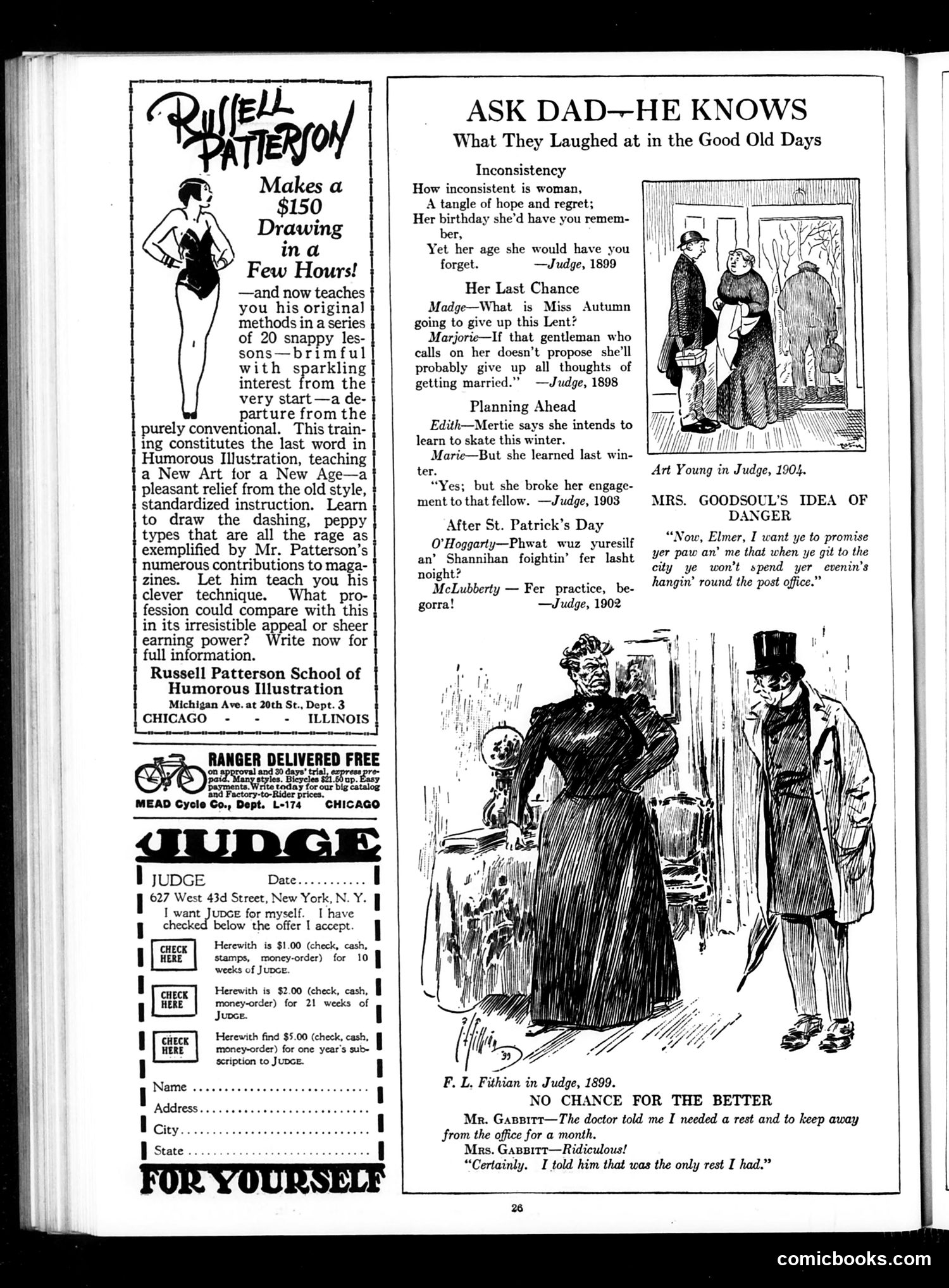
This page from *Judge* contains vintage humor reprinted under "Ask Dad—He Knows," showcasing early 1900s satirical jokes about gender and social life. **Main satirical content:** The jokes mock women's perceived contradictions—particularly their vanity and inconsistency. One jokes that women demand you remember their birthday but won't reveal their age. Another mocks "Miss Autumn" for repeatedly breaking engagements, suggesting women use Lent as an excuse to abandon marriage plans. **The cartoons** illustrate domestic and social scenarios: one shows a working-class family warning their daughter about urban temptation (loitering near post offices); another depicts an Irish laborer's post-St. Patrick's Day fight; the final joke shows a wife denying her husband any respite from work, suggesting she finds his absence from home as her only peace. **The satire reflects period attitudes:** women as flighty and self-centered, working-class ethnic stereotypes (Irish accents), and marital discord framed as comedy. The humor assumes a male reader appreciating criticism of women's logic and wives' domination over husbands.
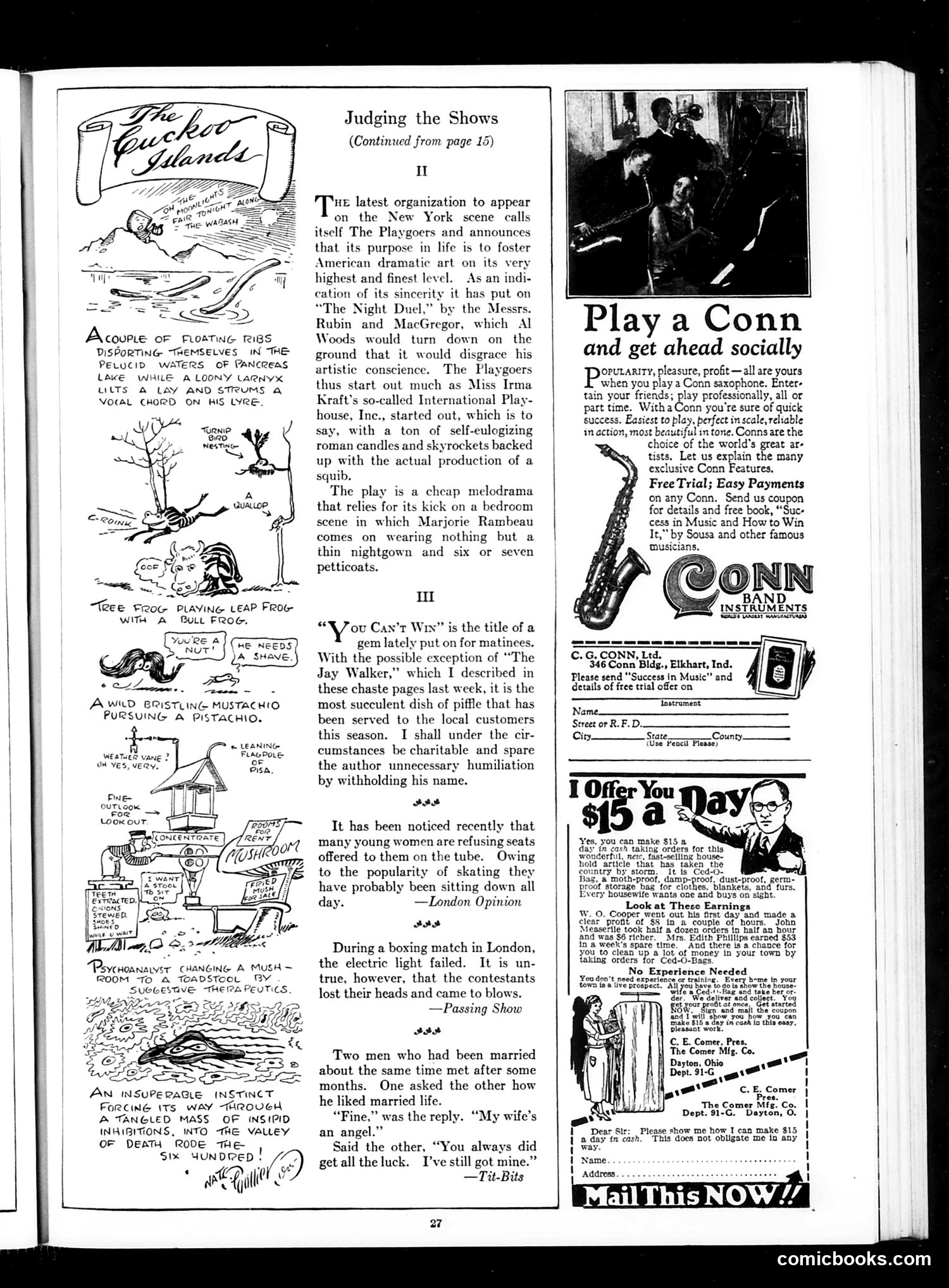
This page contains theater criticism and humorous sketches. The left side features surreal, whimsical drawings lampooning absurdist or pretentious theatrical productions—including nonsensical imagery like floating ribs in "Pancreas Lake" and a psychoanalyst transforming mushrooms. The main text critiques The Playgoers, a new New York theater organization claiming to foster "American dramatic art on its very highest and finest level." The critic dismisses their actual productions as cheap melodrama, particularly calling out "The Night Duel" as something even commercial producer Al Woods would reject. He similarly skewers "You Can't Win" as worthless filler. The page also includes brief humorous anecdotes and observations from other publications about social behavior. The right side contains advertisements, primarily for Conn saxophones and musical instruments, exploiting the aspirational claim that owning one brings "popularity, pleasure, profit."
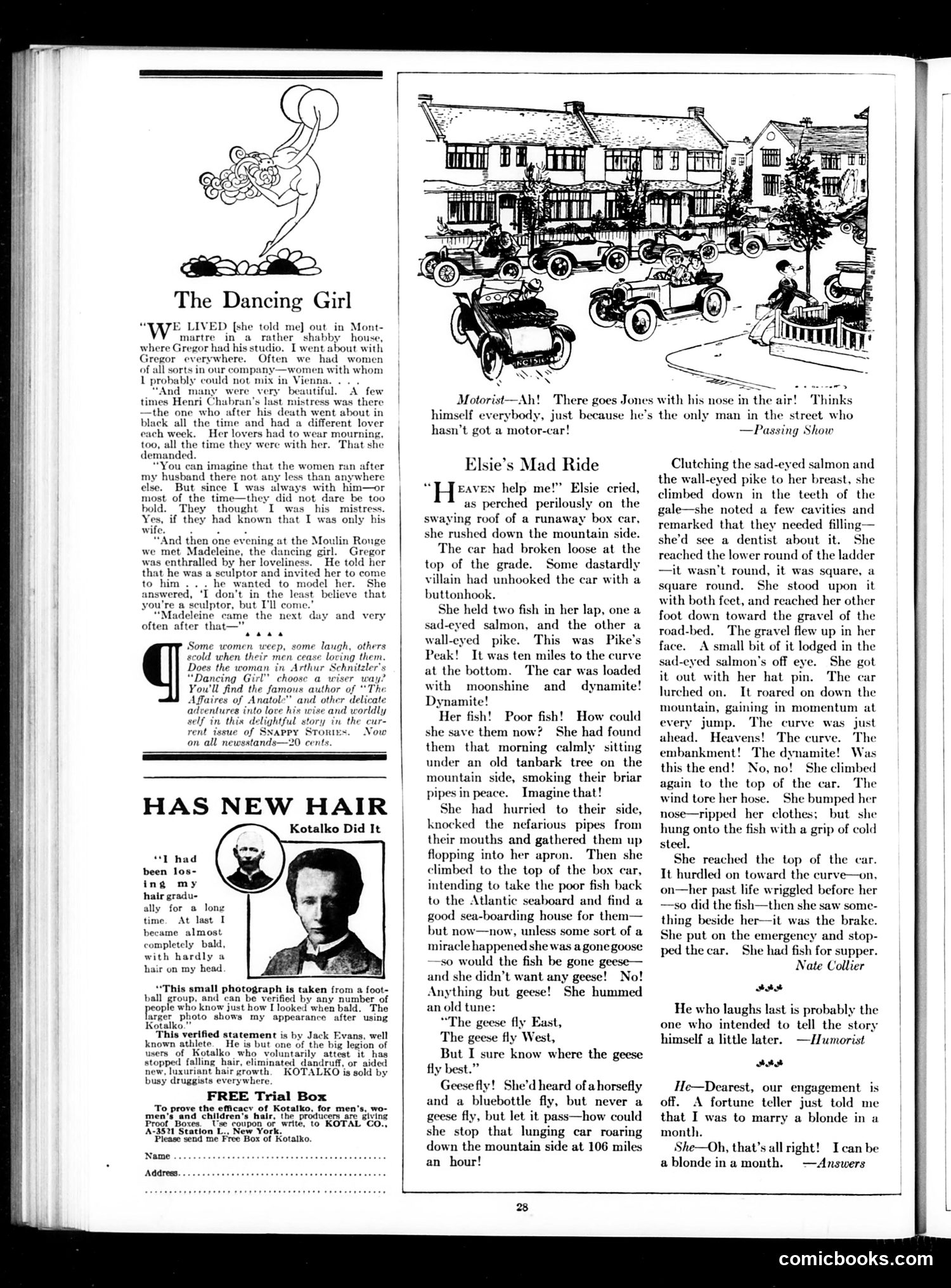
This page contains humor and advertisements typical of early 20th-century American magazines: **"The Dancing Girl"** advertises Arthur Schnitzler's serialized story about a sculptor's romantic entanglement with a Parisian dancer—sophisticated, morally ambiguous adult fiction marketed to Judge's readers. **"Motorist" cartoon** satirizes social pretension: a man feels superior because he owns a motorcar, the era's new status symbol. The joke critiques how emerging automobile ownership created class distinctions. **"Elsie's Mad Ride"** is absurdist fiction—intentionally ridiculous melodrama about a runaway boxcar loaded with dynamite, where the protagonist's chief concern is saving two talking fish (a salmon and pike smoking pipes). This parodies over-the-top adventure stories through deliberate exaggeration. **"Has New Hair" section** is a testimonial advertisement for Kotalko hair treatment, featuring before/after photographs supposedly from "Jack Evans, well known athlete." The page reflects Judge's mix of sophisticated satire, slapstick humor, and commercial advertising aimed at educated, middle-class readers.
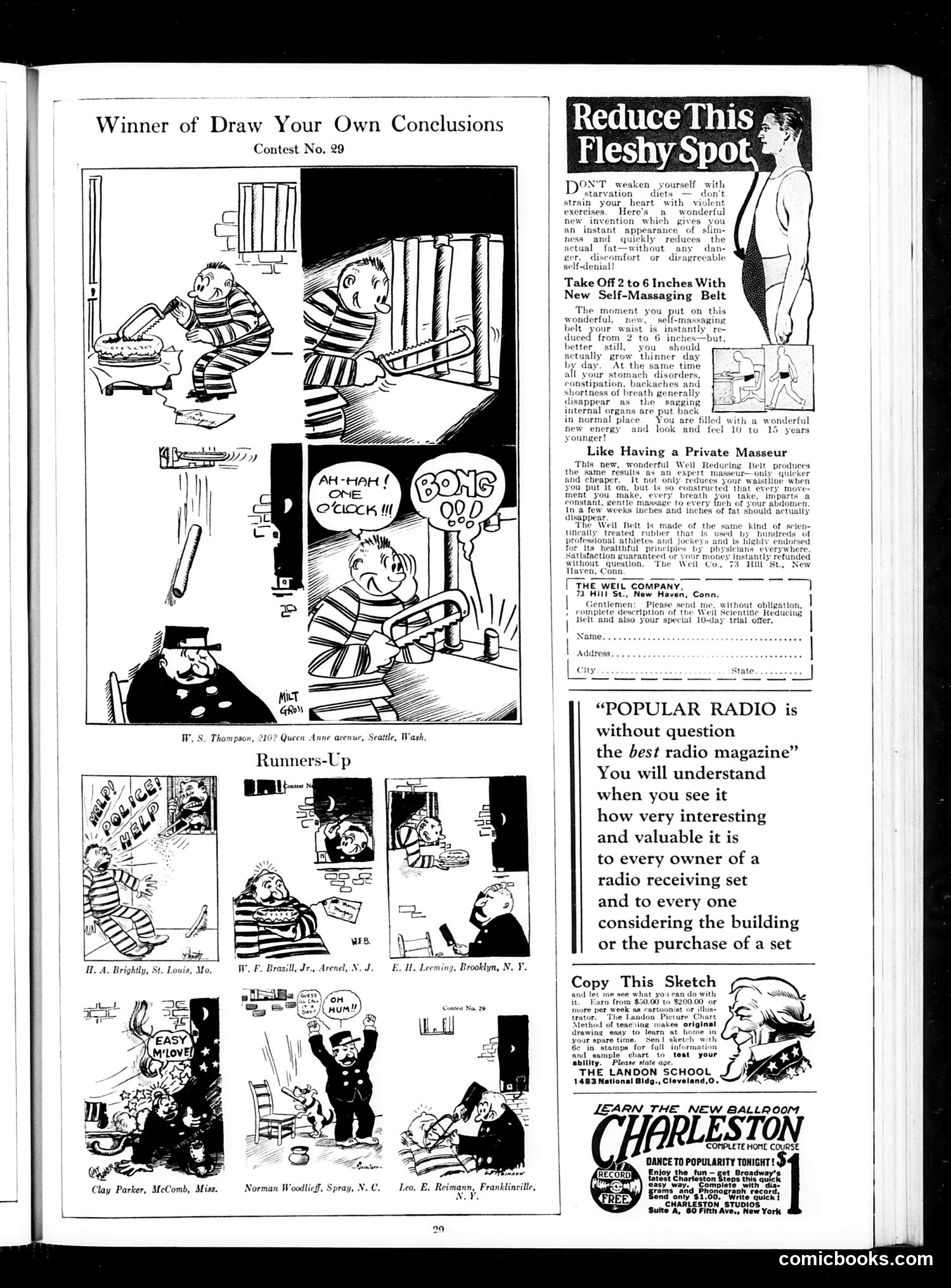
This page presents the winning entry in Judge magazine's Contest No. 29, showing a cartoon strip depicting a child's nighttime mischief. The winner, H.S. Thompson from Seattle, Washington, drew a humorous sequence: a young child in striped pajamas creates chaos—raiding the kitchen, running through the house at midnight (marked "AH-HAH! O'CLOCK!!!"), and causing general bedlam with sound effects like "BOING" and "WHAM!" The joke plays on the absurdity of a small child's uncontrolled energy and destructiveness during what should be quiet sleeping hours. Below are "Runners-Up" entries by other contestants, all depicting similar domestic comedy scenarios with children misbehaving. The surrounding advertisements for weight-reduction belts, radio magazines, dance lessons, and art schools are typical period commercial content unrelated to the cartoon's satirical message.
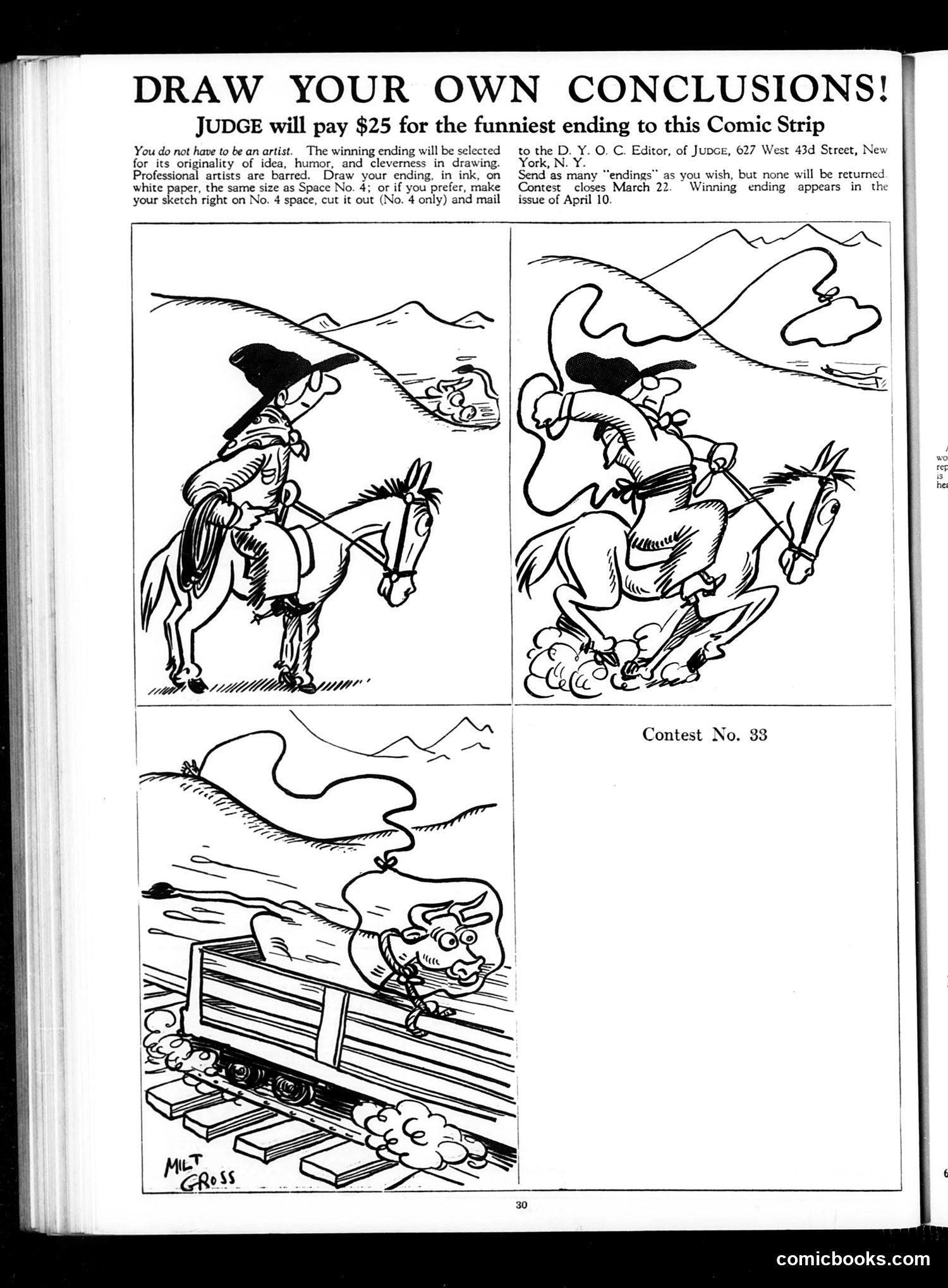
This is a reader-participation contest page, not political satire. Judge magazine invited readers to complete three unfinished comic strips for $25 prize money. The three panels show: 1. A cowboy on horseback lassoing something 2. The same cowboy character now riding wildly on a bucking horse 3. A small character being launched from railroad tracks The contest invited amateur submissions (professionals excluded) for humorous endings. Entries were due March 22, with the winning submission to appear in the April issue. This type of interactive content was common in early-to-mid 20th century humor magazines, allowing reader engagement and generating content without paying professional cartoonists. The comic strips themselves appear to be generic Western/slapstick scenarios designed as open-ended setups.
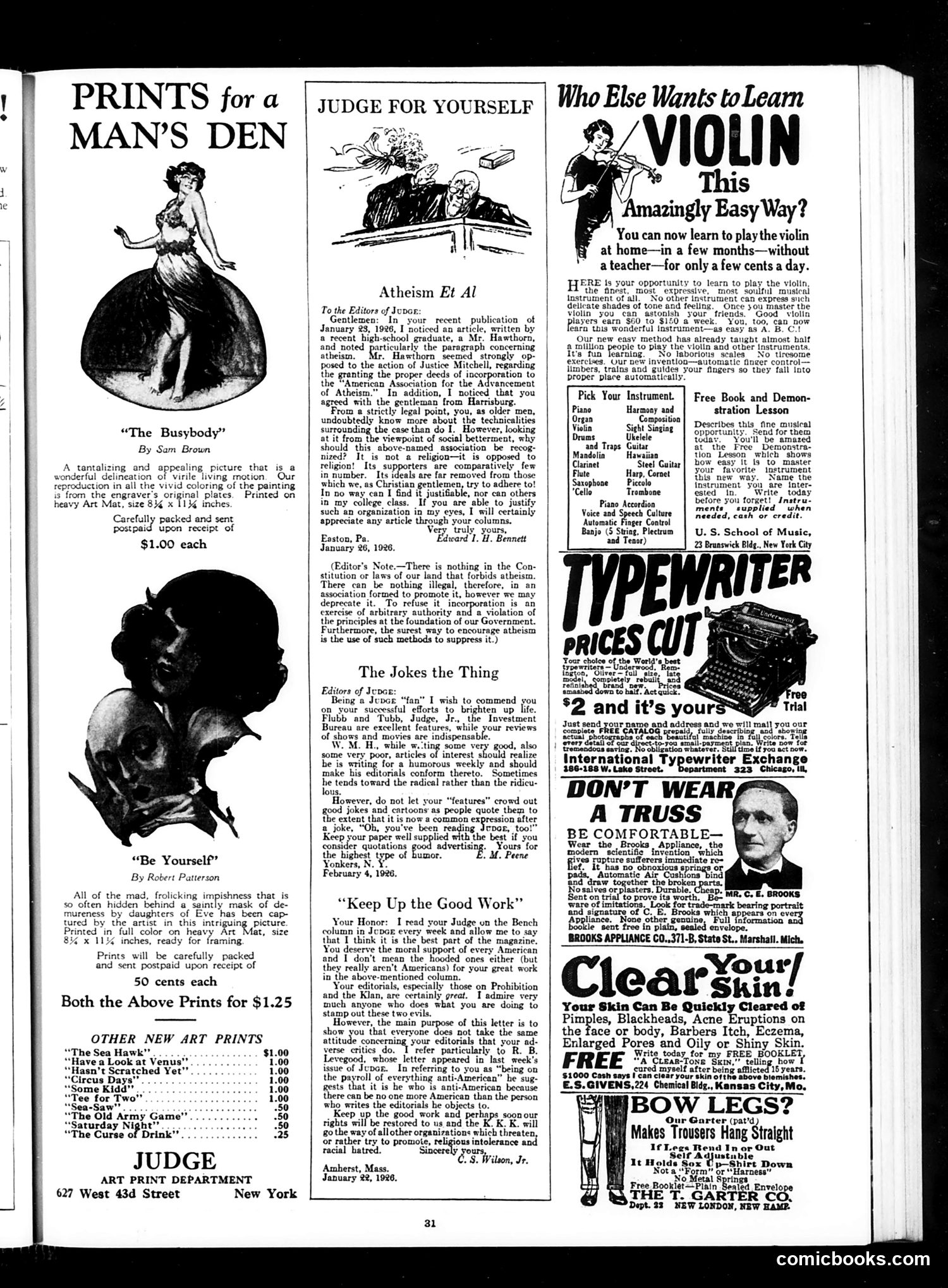
This page is primarily **advertising and reader correspondence**, not political cartooning. The content includes: **Art prints for sale**: Two decorative prints ("The Busybody" and "Be Yourself") marketed to male readers—typical of Judge's demographic. The images depict women in flirtatious poses, reflecting 1920s attitudes toward "pin-up" style art. **Reader letters**: - A high school graduate argues *against* incorporating an atheist organization, citing Christian values - The editor responds defending constitutional rights and free speech principles—a notable liberal position for 1926 **Other advertisements**: Violin lessons, typewriters, medical devices (truss, bow-legs corrector), and skin treatments—common period advertising. The atheism debate reflects 1920s social tensions between religious traditionalists and secular modernists, though the editor's principled defense of legal incorporation suggests Judge positioned itself as relatively progressive on civil liberties issues.
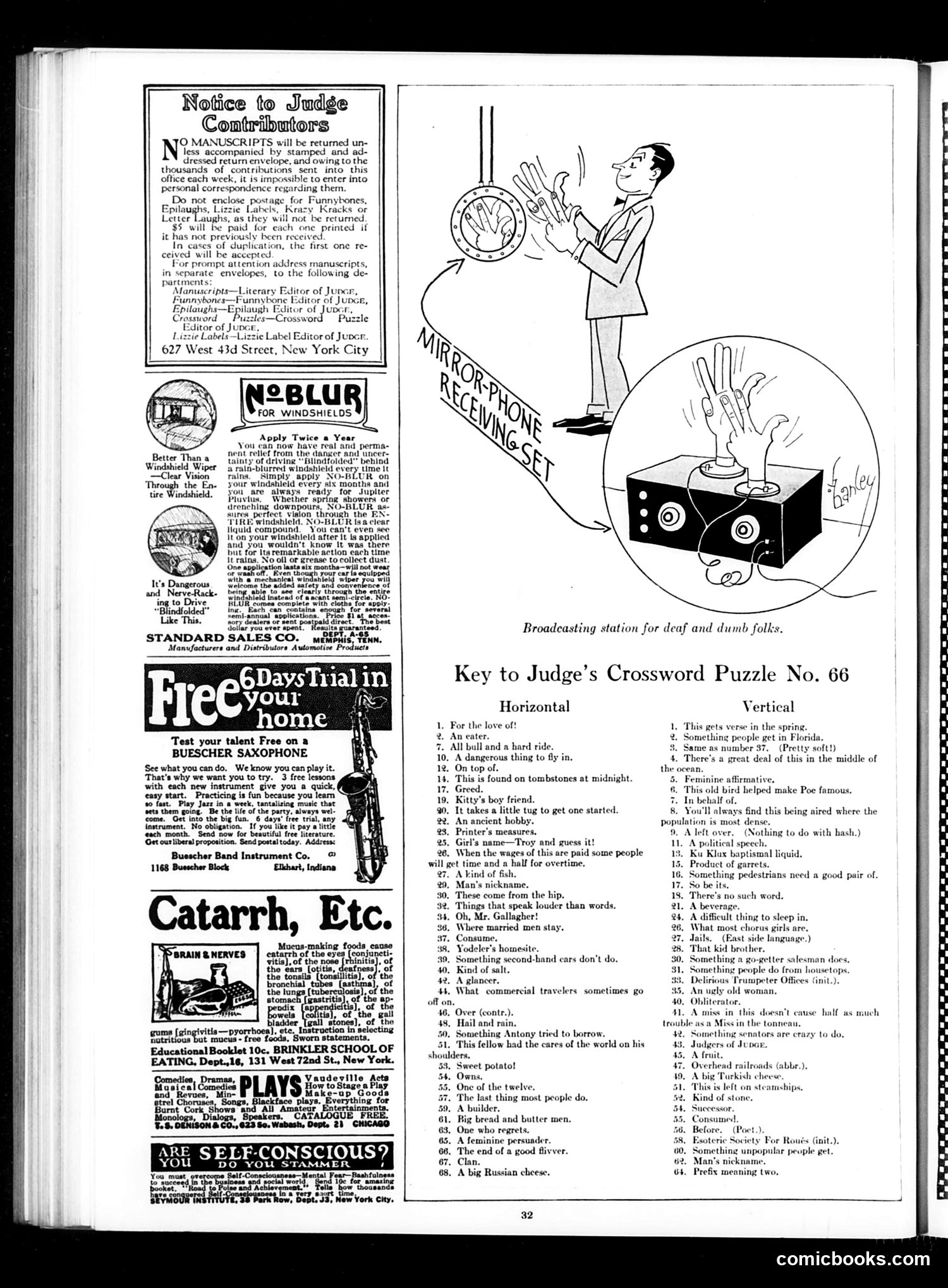
This is primarily an **advertising and submissions page** from Judge magazine, a satirical American publication. The main content includes: **Editorial Notice**: Instructions for manuscript contributors, explaining submission procedures to various departments (Literary, Funnybones, Epilaughs, Crossword Puzzle, Lizzie Labels). **The Only Cartoon**: A humorous illustration labeled "Broadcasting station for deaf and dumb folks" depicts a man operating a mirror-telephone receiving set—a visual pun suggesting that deaf and blind people might use visual/tactile methods for radio communication. This reflects early-1920s attitudes toward disability, treating it as subject for mild humor. **Advertisements**: The page is dominated by product ads (NO-BLUR windshield treatment, Buescher saxophones, catarrh remedies, stammering cures) typical of the era. These reveal contemporary consumer concerns and medical claims now considered dubious. The crossword puzzle answer key appears at bottom, indicating this was a regular magazine feature.
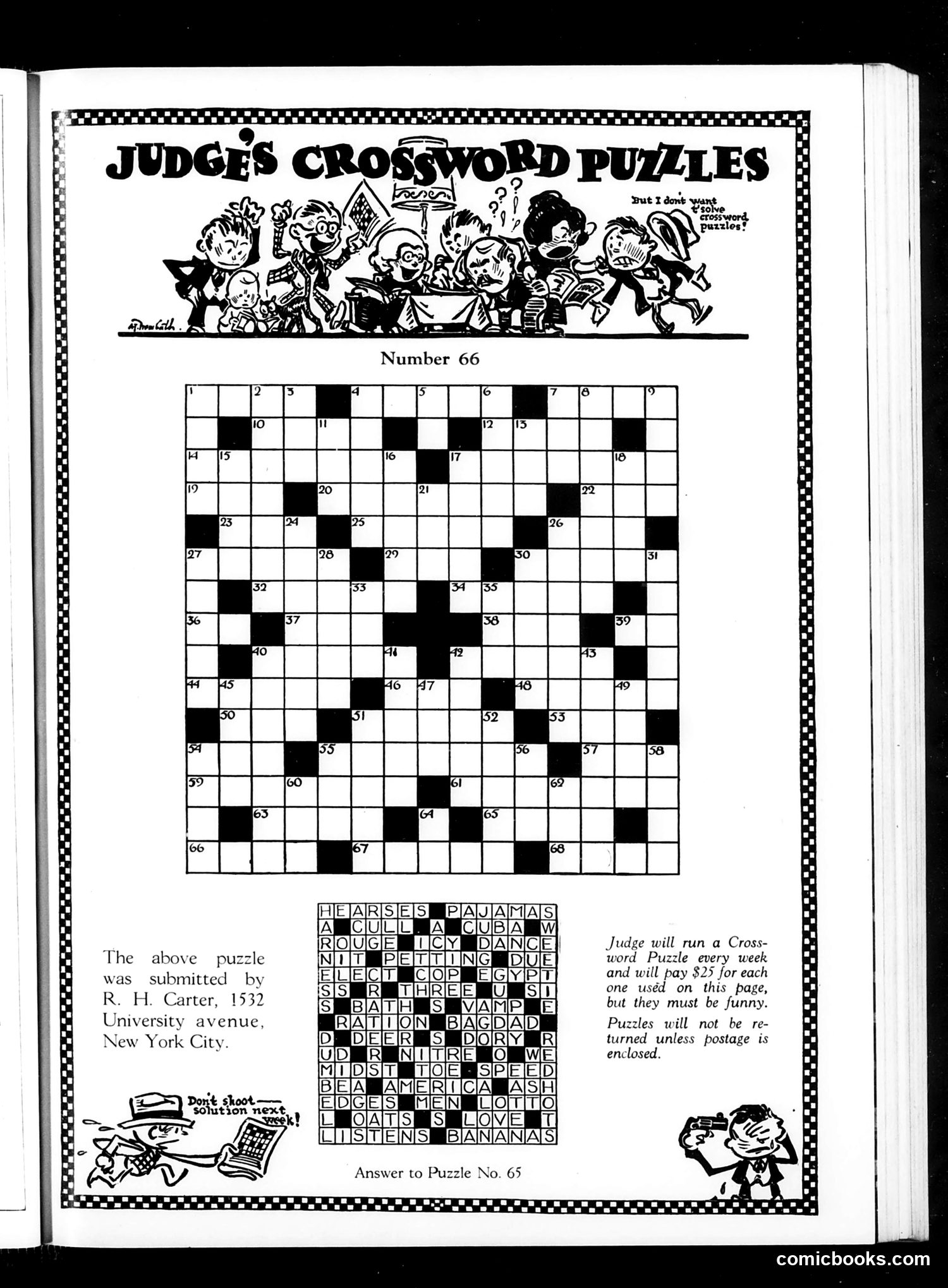
This page presents **Judge's Crossword Puzzle No. 66**, a standard feature of the satirical magazine. The puzzle itself contains no political satire—it's a straightforward crossword grid submitted by reader R. H. Carter of New York City. The noteworthy content is Judge's **offer to pay $25 per puzzle** published, with the specific requirement that puzzles "must be funny." This reflects the magazine's editorial philosophy: even recreational content should serve its satirical mission. The decorative header shows cartoon characters enjoying puzzles, emphasizing entertainment value. Below is the answer key to the previous week's puzzle (No. 65). This was a standard recurring feature in Judge during the early-to-mid 20th century, combining reader engagement with light humor.
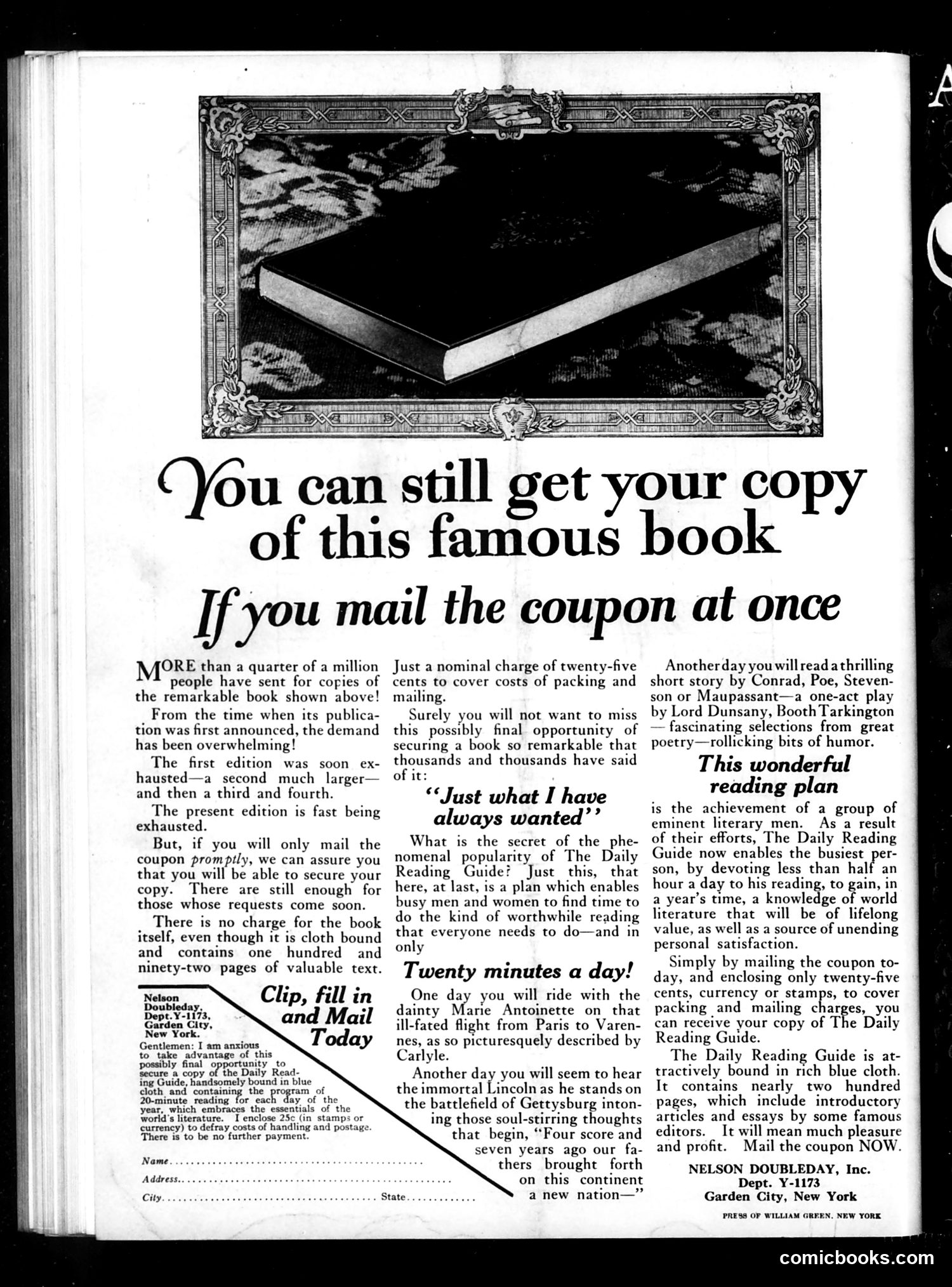
This page is **primarily advertising**, not satire or political commentary. It promotes *The Daily Reading Guide*, a mail-order book compilation published by Nelson Doubleday, Inc. The advertisement uses aspirational appeals targeting busy professionals: it promises access to classic literature—excerpts from Carlyle, Lincoln's Gettysburg Address, and stories by Conrad and Poe—requiring only "twenty minutes a day" of reading. The pitch emphasizes that over 250,000 people have already ordered copies, creating artificial scarcity ("present edition is fast being exhausted"). The ornate border framing an image of the bound book mimics fine art presentation to suggest cultural prestige. The coupon mechanism and "nominal" twenty-five-cent charge (covering only postage) were standard direct-mail tactics of the era. There is no political satire visible here—it's a straightforward, if enthusiastically worded, commercial solicitation designed to appeal to educated readers anxious about self-improvement and cultural literacy.