
Judge, 1926-03-13 · page 11 of 36
Judge — March 13, 1926 — page 11: what you’re looking at
What you’re looking at
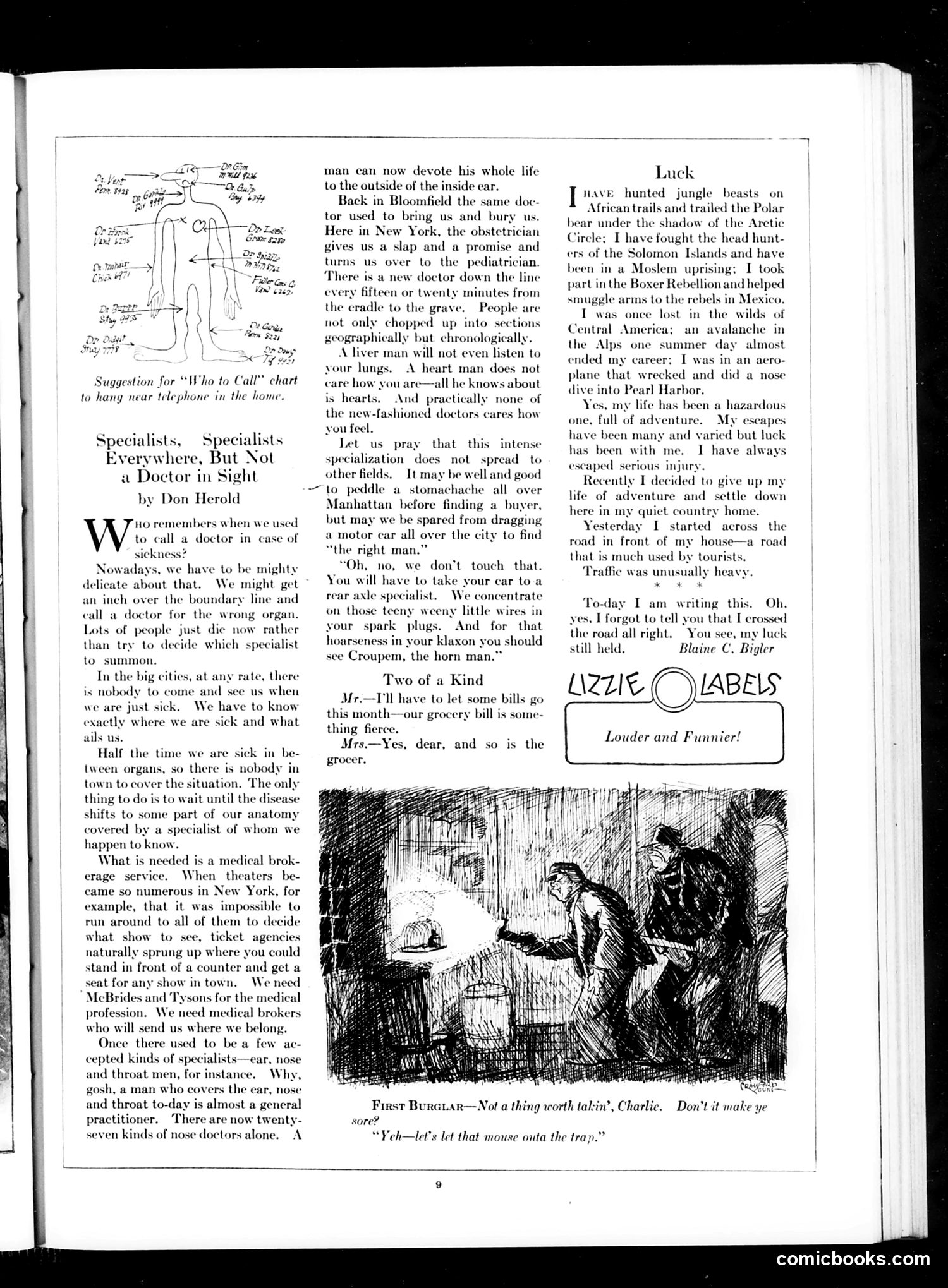
This page satirizes the modern medical specialization boom of early-20th-century America. **Main Article ("Specialists, Specialists Everywhere")**: Don Herold's essay mocks how medical practice has fragmented into absurdly narrow specialties. He contrasts rural doctors of the past (who delivered babies and conducted funerals) with urban specialists so focused on single organs or body parts that they refuse to treat patients holistically. The satire peaks with his claim there are "twenty-seven kinds of nose doctors alone" and a specialist for "the outside of the inside ear." He proposes a "medical brokerage service" to navigate this chaos—paralleling theater ticket agencies. **The Cartoon**: Shows a burglar telling his partner the house has nothing worth stealing, with the caption "let's let that mouse outa the trap"—unrelated social commentary about poverty during economic hardship. **"Luck" Story**: A humorous account by Blaine C. Bigler describing miraculous escapes from danger worldwide, culminating in settling quietly at home—implying bad luck now ironically strikes in mundane domesticity. The page critiques how professionalization, while well-intentioned, creates absurd fragmentation.
📄 Transcribed text from this page (OCR, searchable)
Machine-transcribed from the original scan — historical spelling and the odd misread are preserved.
Suggestion for “Who to Call” chart to hang near telephone in the home. Specialists, Specialists Everywhere, But Not a Doctor in Sight by Don Herold Ho remembers when we used \ \ to call a doctor in case of sickness? Nowadays, we have to be mighty delicate about that. We might get an inch over the boundary line and call a doctor for the wrong organ. Lots of people just die now rather than try to decide which specialist to. summon. In the big cities, at any rate, there is nobody to come and see us when we are just sick. We have to know ‘xactly where we are sick and what ails us. Half the time we are sick in be- tween organs, so there is nobody in town to cover the situation. The only thing to do is to wait until the disease shifts to some part of our anatomy covered by a specialist of whom we happen to know. What is needed is a medical brok- erage service. When theaters be- came so numerous in New York, for example, that it was impossible to run around to all of them to decide what show to see, ticket agencies naturally sprung up where you could stand in front of a counter and get a seat for any show in town. We need McBrides and Tysons for the medical profession. We need medical brokers who will send us where we belong. Once there used to be a few ac- cepted kinds of specialists—ear, nose and throat men, for instance. Why, gosh, a man who covers the ear, nose and throat to-day is almost a general practitioner. There are now twenty- seven kinds of nose doctors alone. A man can now devote his whole life to the outside of the inside ear. Back in Bloomfield the same doc- tor used to bring us and bury us. Here in New York, the obstetrician gives us a slap and a promise and turns us over to the pediatrician, ‘There is a new doctor down the linc every fifteen or twenty minutes from the cradle to the grave. People are not only chopped up into sections geographically but chronologically. A liver man will not even listen to your lungs. A heart man does not care how you are—all he knows about is hearts. And practically none of the new-fashioned doctors cares how you feel. Tet us pray that this intense specialization does not spread to other fields. It may be well and good to peddle a stomachache all over Manhattan before finding a buyer, but may we be spared from dragging a motor car all over the city to find “the right man.” “Oh, no, we don’t touch that. You will have to take your car toa rear axle specialist. We concentrate on those teeny weeny little wires in your spark plugs. And for that hoarseness in your klaxon you should see Croupem, the horn man.” Two of a Kind Mr.—I'll have to let some bills go this month—our grocery bill is some- thing fierce. Mrs.—Yes, dear, and so is the First Burctar—Nof a thing worth talcin’, Charlie. sore? Luck [ "ve hunted jungle beasts on African trails and trailed the Polar bear under the shadow of the Arctic Circle; I have fought the head hunt- ers of the Solomon Islands and have been in a Moslem uprising; I took part in the Boxer Rebellion and helped smuggle arms to the rebels in Mexico. I was once lost in the wilds of Central America; an nehe in the Alps one summer day almost ended my career; I was in an a plane that wrecked and did a dive into Pearl Harbor. Yes, my life has been a ha one, full of adventure. My escapes have been many and varied but luck has been with me. I have alway. escaped serious injury. Recently I decided to give up my life of adventure and settle down here in my quiet country home. Yesterday I started across the road in front of my house—a road that is much used by tou Traffic was unusually heavy To-day I am writing this. Oh, yes, I forgot to tell you that I crossed the road all right. You see, my luck still held. Blaine C. Bigler Don’t it make ye “¥eh—let’s let that mouse outa the trap.” comicbooks.com