
A complete issue · 36 pages · 1926
Judge — January 9, 1926
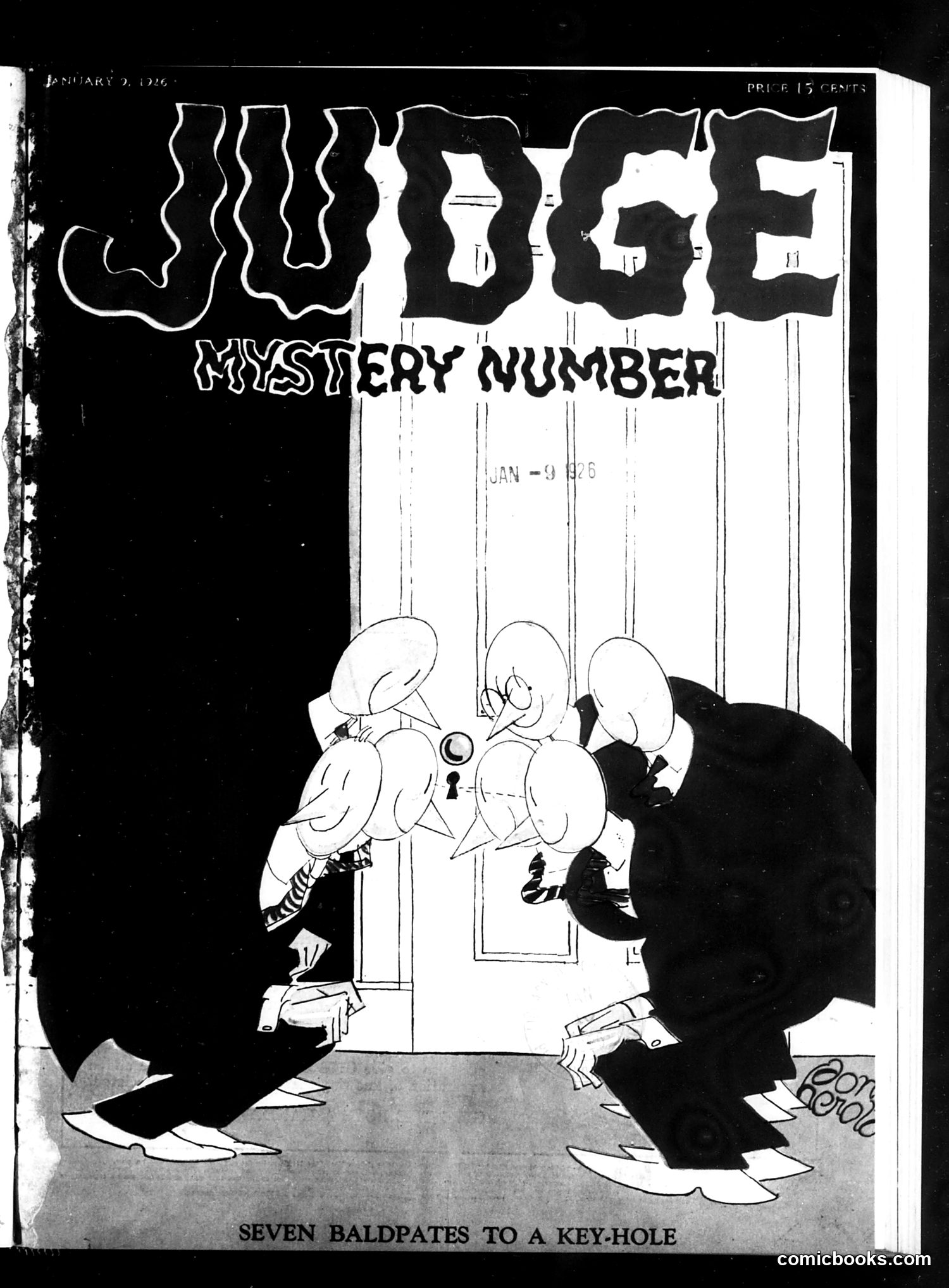
**"Seven Baldpates to a Key-Hole"** This cartoon satirizes Prohibition-era speakeasy culture. The image shows seven bald men peering through a keyhole at what appears to be an illegal drinking establishment (indicated by the "JUDGE" masthead styled as "UDGE" with a keyhole design above). The phrase "seven baldpates" is a humorous, dehumanizing reference to the men as interchangeable figures—their baldness emphasizing their sameness. The joke mocks both Prohibition enforcement efforts and the public's obsessive curiosity about illegal speakeasies during the 1920s. It suggests widespread, undiscriminating interest in underground bars, treating participants as ridiculous voyeurs rather than serious criminals or libertines.
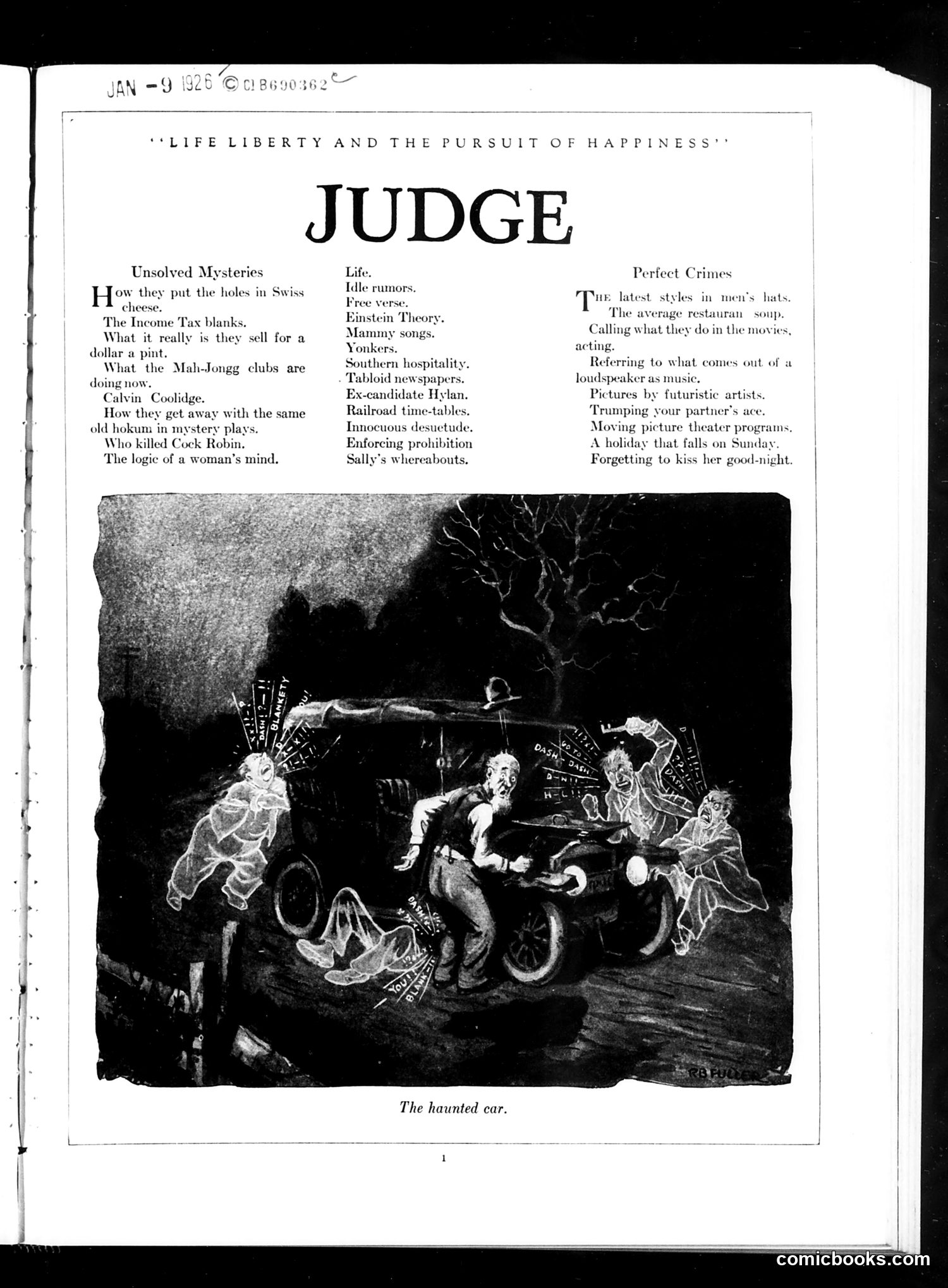
This page from Judge magazine (dated January 9, 1925) features a satirical cartoon titled "The Haunted Car." The illustration depicts a man in a car surrounded by ghostly or supernatural figures emerging from the vehicle itself, suggesting the car is "haunted." The likely satire concerns automobile safety or mechanical defects of the era—the "ghosts" probably represent dangers, accidents, or victims associated with early automobiles, which had serious safety problems. The headings above list mundane mysteries and petty grievances ("How they put holes in Swiss cheese," "Calvin Coolidge"), followed by "Perfect Crimes" relating to modern annoyances, suggesting the cartoon critiques how people treat automobile dangers as accepted everyday occurrences rather than serious hazards.
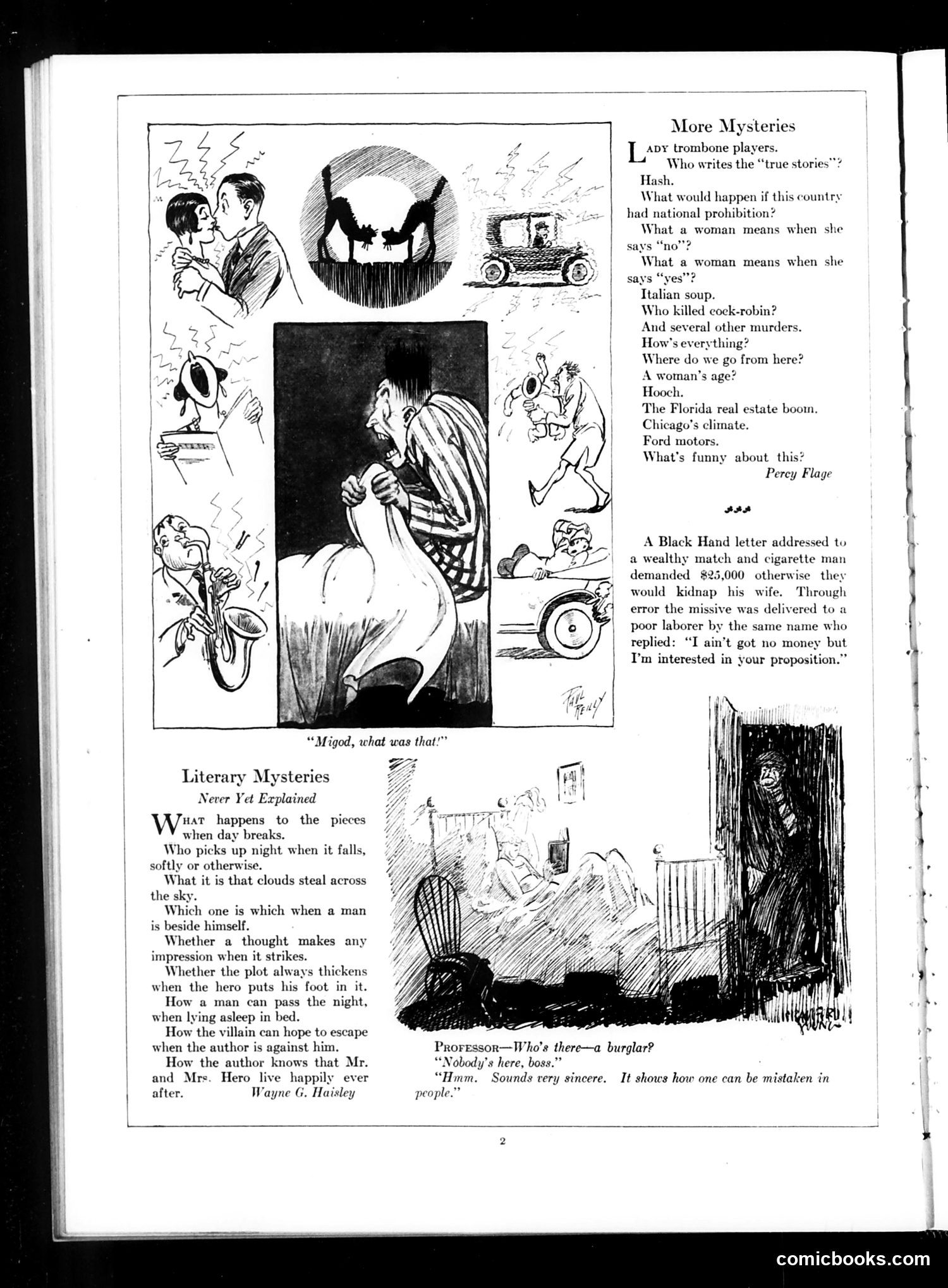
This page combines humor columns with cartoons satirizing everyday mysteries and social absurdities. **"More Mysteries"** lists rhetorical questions about puzzling social conventions—what women mean by "yes" versus "no," Italian soup origins, unexplained murders, and topical issues like Prohibition's effects, the Florida real estate boom, and Ford motors. The humor relies on readers sharing frustration with these cultural enigmas. **"Literary Mysteries"** mocks predictable fiction tropes: missing plot pieces, convenient character timing, and implausible heroic escapes. It satirizes both authors' lazy storytelling and readers' willingness to accept contrived narratives. The cartoons illustrate these absurdities visually—a burglar encounter, domestic confusion. The page targets educated readers familiar with both real social frustrations and popular literature's conventions.
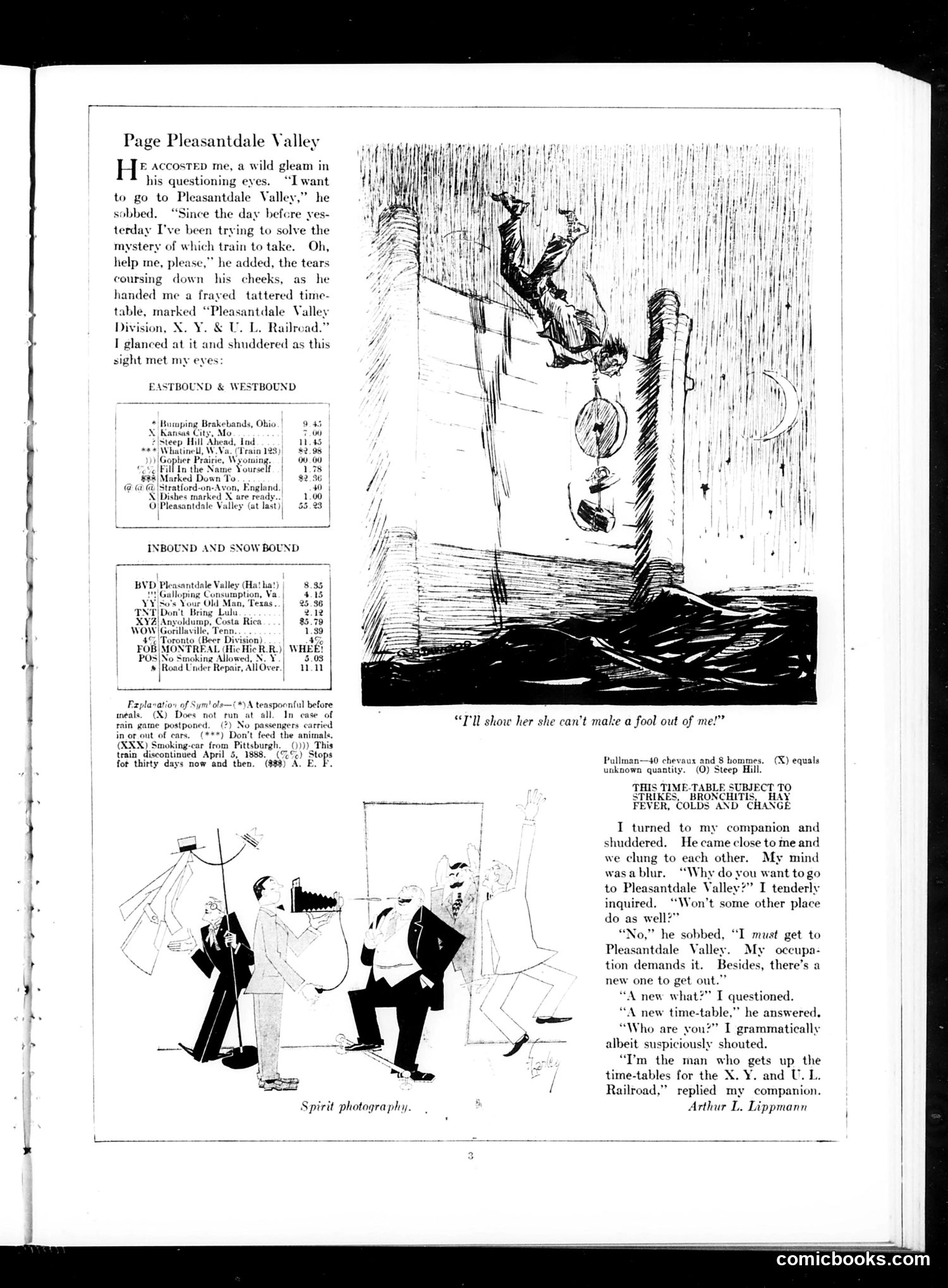
This page contains two distinct satirical cartoons from *Judge* magazine. **Top cartoon:** A man dangles upside-down from a rope over railroad tracks, with the caption "I'll show her she can't make a fool of me!" The accompanying narrative reveals he's desperate to reach Pleasantdale Valley to resolve a mystery. The satire appears to target both railroad complications and romantic desperation—suggesting the lengths men will go to for love or pride. **Bottom cartoon ("Spirit photography"):** Two men in formal dress appear to be conducting or discussing a séance or spiritualist photography session. This likely satirizes the era's popular fascination with spiritualism and fake mediums claiming to photograph ghosts—a common target of *Judge's* humor mocking pseudoscience and gullibility among the wealthy.
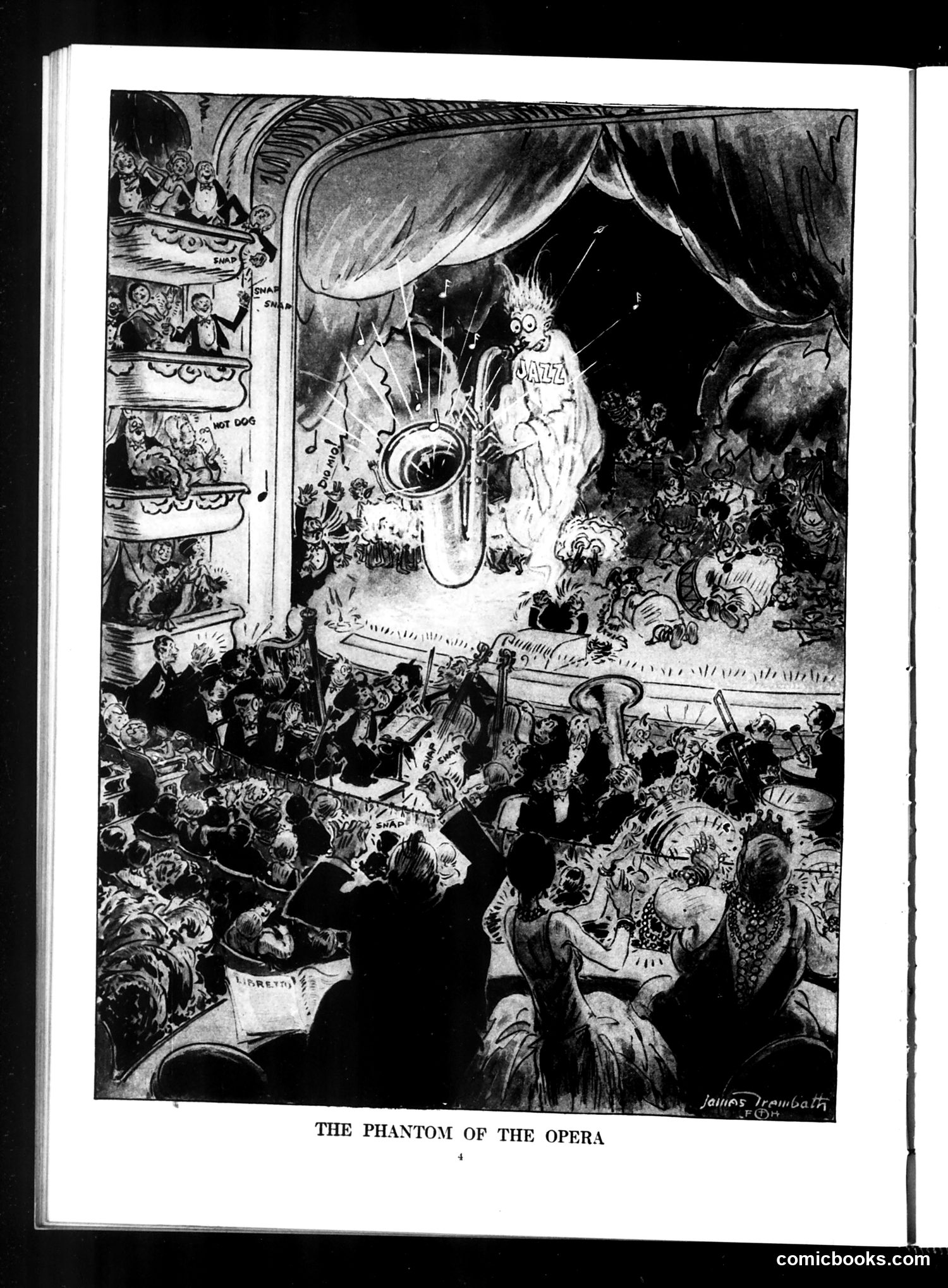
This illustration appears to be a theatrical satire referencing the famous opera "The Phantom of the Opera," likely inspired by the popular 1925 film. The image depicts a grand opera house interior packed with audience members, with an elaborate stage featuring dramatic curtains and atmospheric effects. A figure (the "phantom") appears suspended or dramatic above the crowd, while performers and spectators fill the venue. The satire likely comments on the opera's popularity and melodramatic appeal to American audiences, or possibly mocks the theatrical excess and sensationalism of the production itself. The crowded scene emphasizes the work's mass entertainment appeal during this period. Without additional context, the specific political or social critique remains unclear, though Judge typically targeted contemporary cultural phenomena and public obsessions.
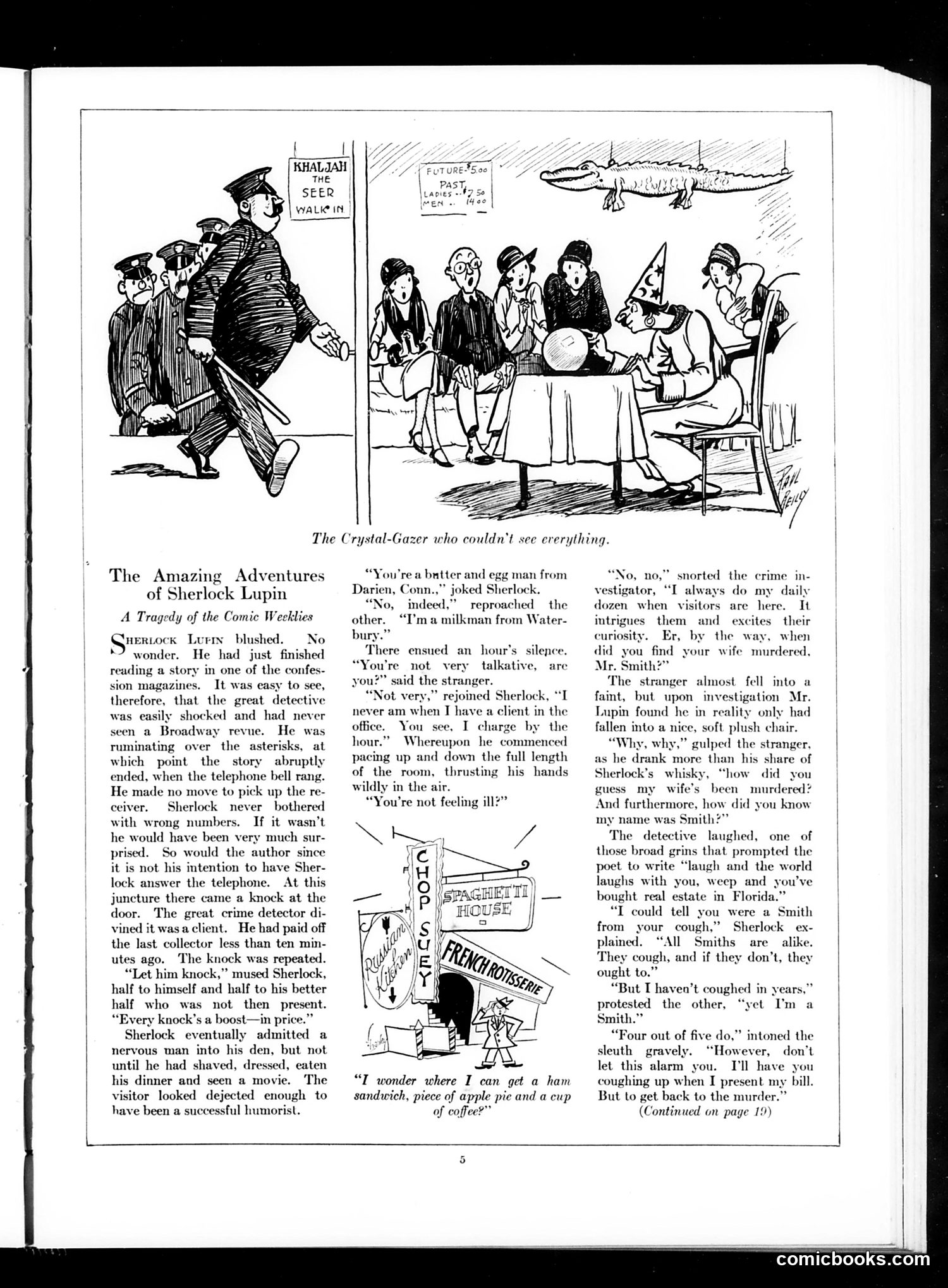
This page presents a humorous detective parody combining Sherlock Holmes with Arsène Lupin, the famous fictional gentleman-thief. The story mocks both characters through absurd situations. The top cartoon shows "The Crystal-Gazer who couldn't see everything"—satirizing fortune tellers and their claimed abilities. The main narrative features Sherlock meeting a stranger who claims to be from Connecticut but speaks with affectations. The joke centers on Sherlock's supposed deductive powers failing him: he cannot identify the visitor correctly and makes embarrassing errors about a supposed murder. The text repeatedly undercuts his reputation as the world's greatest detective. This is satirical entertainment mocking both detective fiction conventions and pretentious "scientific" deduction, popular Judge magazine fare from the early 20th century.
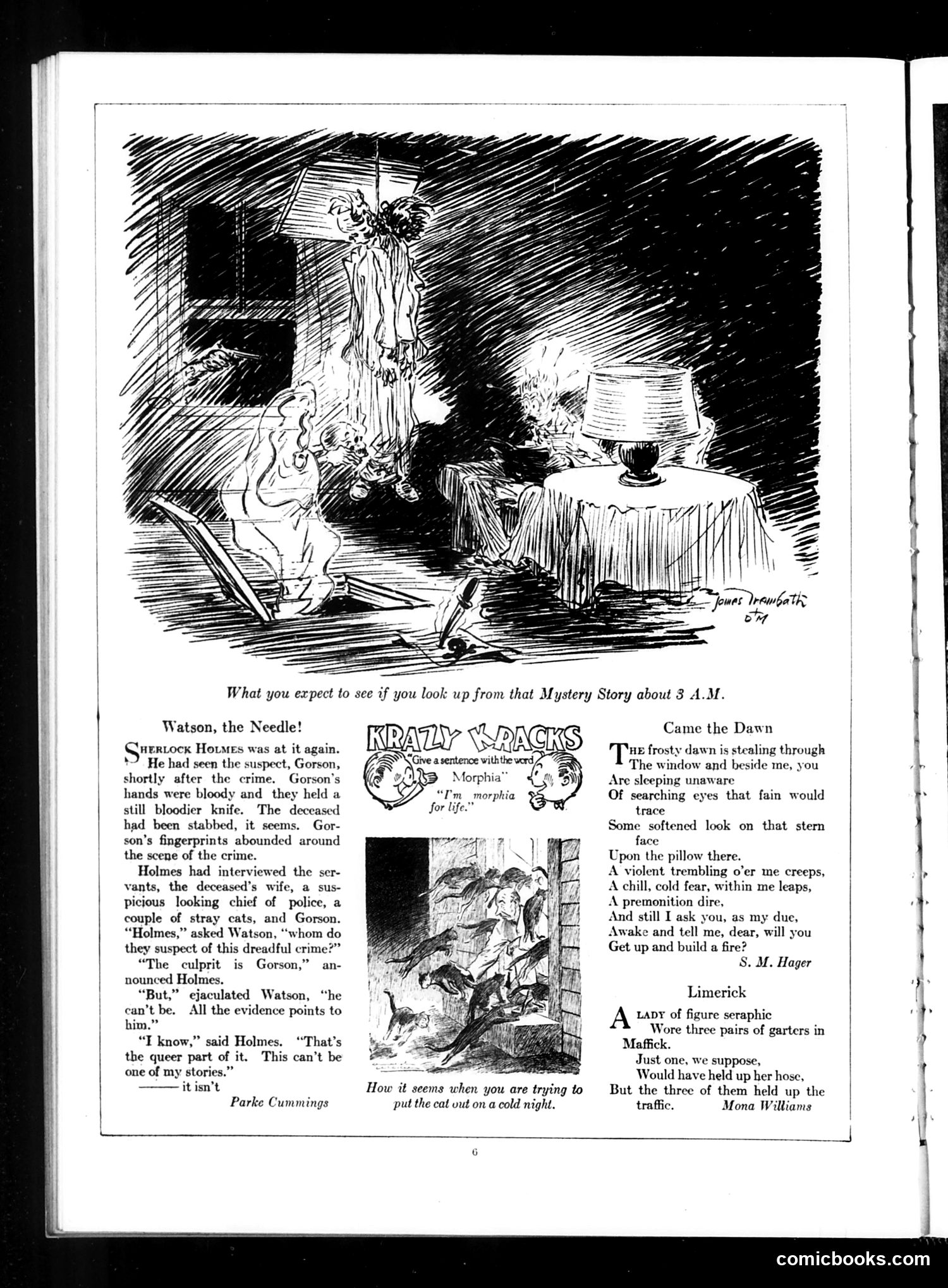
This Judge page contains three distinct pieces of humor: **Main Cartoon (top):** A parody of Sherlock Holmes stories. The joke: Holmes deduces the obvious suspect (Gorson) based on overwhelming evidence—bloody hands, knife, fingerprints everywhere—then admits "This can't be one of my stories" because real detective fiction requires obscure clues and surprising solutions. It's satire of mystery-story conventions where the obvious answer is never correct. **Illustration (center):** Shows the surreal hallucinations someone might experience at 3 AM while reading mystery stories, versus the mundane reality of struggling to put a cat outside on a cold night. **Poetry & Limerick (right):** Sentimental Victorian poetry ("Came the Dawn") contrasted with a humorous limerick about a woman wearing three garters—one would suffice to hold up stockings, but three cause traffic disruption, presumably because of the spectacle. Light sexual humor typical of the era. The page mixes literary satire, domestic humor, and light verse—characteristic Judge content targeting educated, urbane readers familiar with popular fiction tropes.
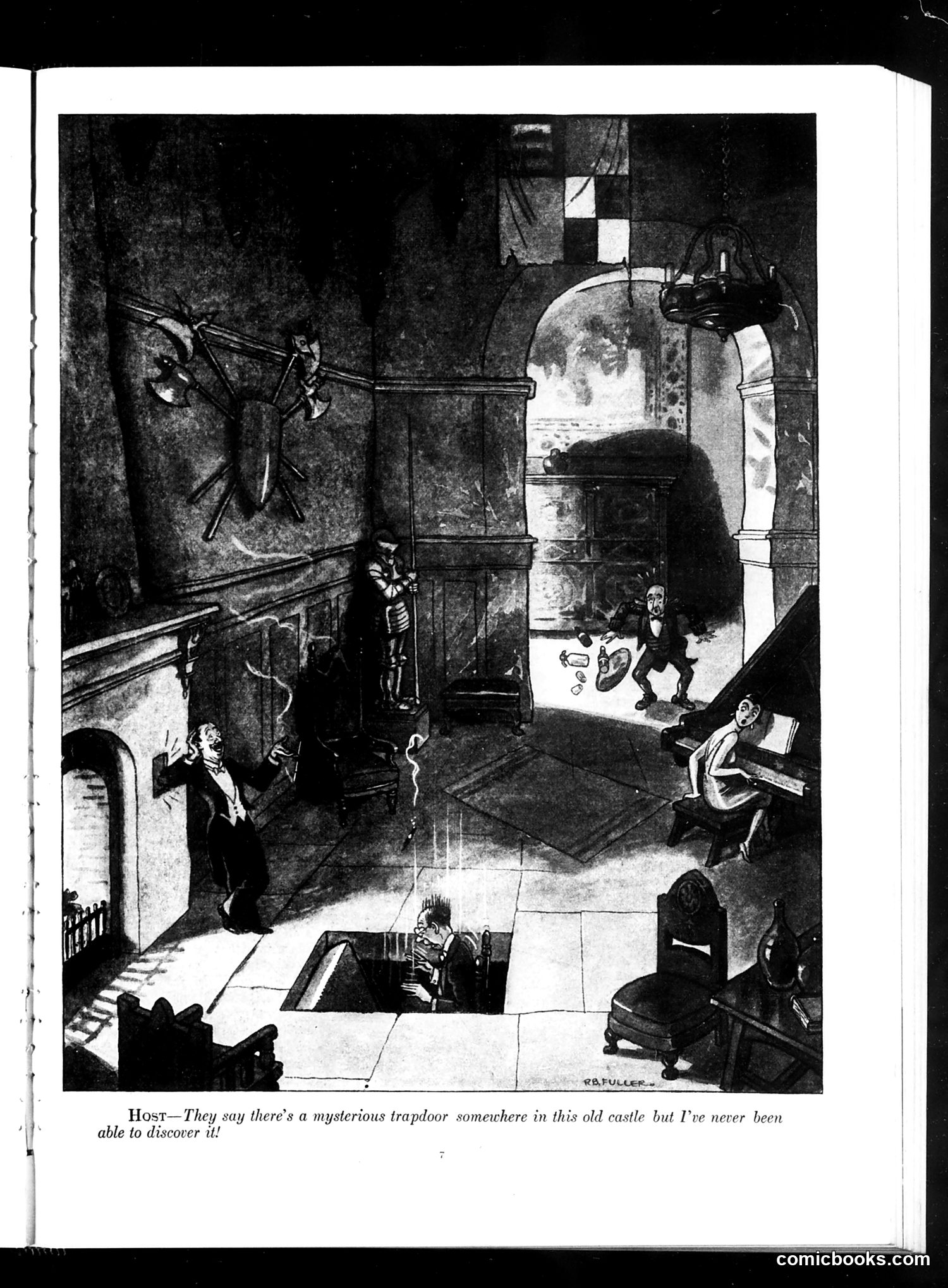
This is a single-panel cartoon depicting a Gothic castle interior with several figures in formal dress. The host (speaking) appears to be giving a tour to guests, mentioning a legendary hidden trapdoor nobody can locate. The humor is visual rather than political: one guest is literally falling through an open trapdoor in the floor—the very trapdoor the host claims not to have found. This is classic slapstick irony: while the host denies knowledge of the trap's location, a visitor has accidentally discovered it the hard way. The cartoon appears to be general domestic humor rather than political satire, playing on common Gothic mansion tropes and the physical comedy of someone's misfortune. The artist is credited as "Rafuller."
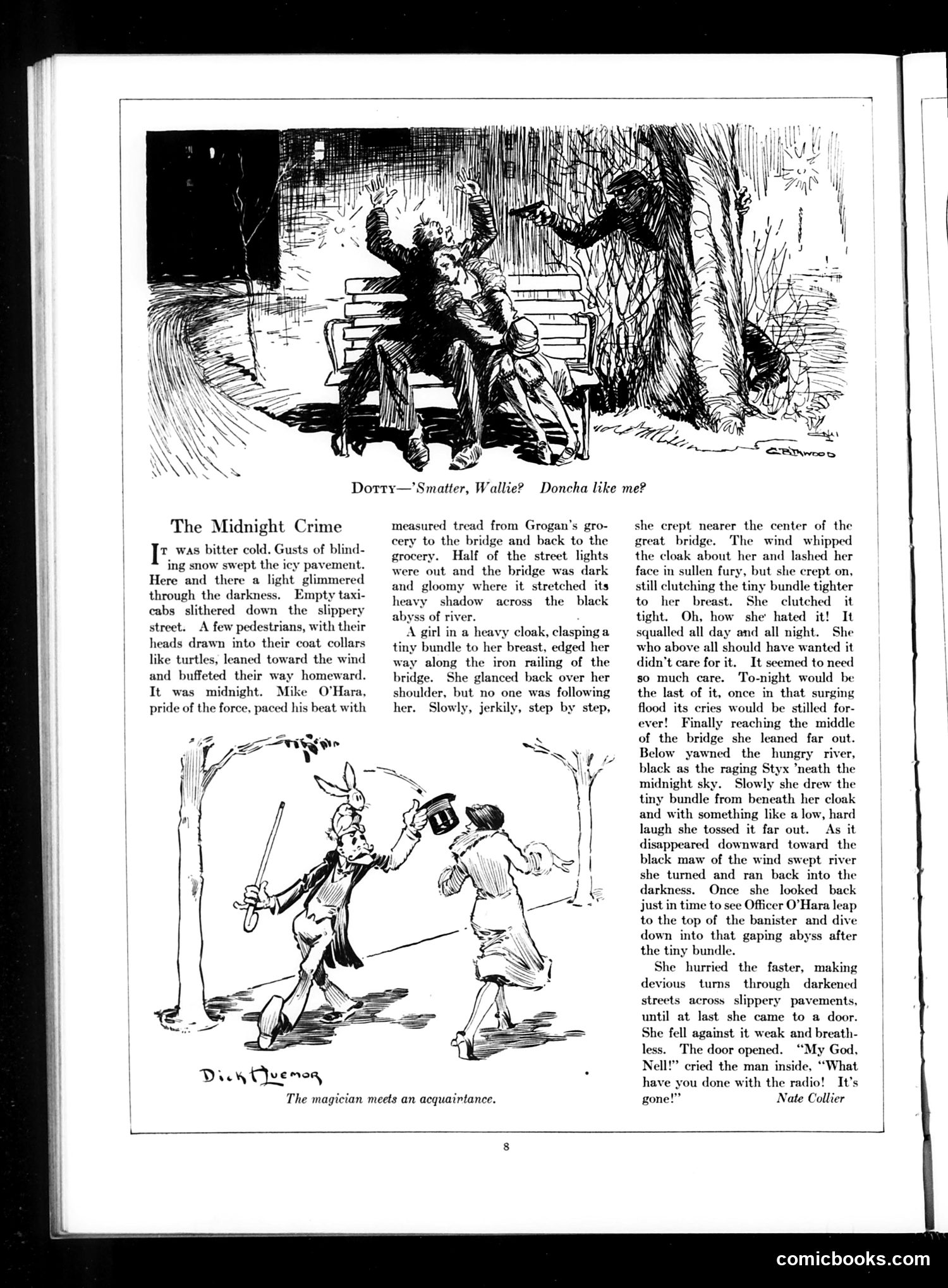
This is a darkly comic short story by Nate Collier that subverts melodramatic expectations. The narrative builds as a tragic tale of infanticide: a desperate woman on a bridge at midnight tosses a bundle into a river while Officer O'Hara heroically dives after it. The punchline reveal is the satire's point: the "tiny bundle" is not a baby—it's a **radio**. The man inside the door frantically asks, "What have you done with the radio! It's gone!" This mocks the melodramatic crime stories popular in contemporary fiction and pulp magazines, which Judge regularly parodied. It also likely reflects 1920s-30s anxieties about new technology (radios were relatively novel, expensive items). The joke works by exploiting readers' assumptions about what constitutes a "crime" worthy of such dramatic narrative treatment, only to reveal the "midnight crime" is mere petty theft—presented with absurdly overwrought prose. The accompanying cartoons provide lighter visual humor unrelated to the main story.
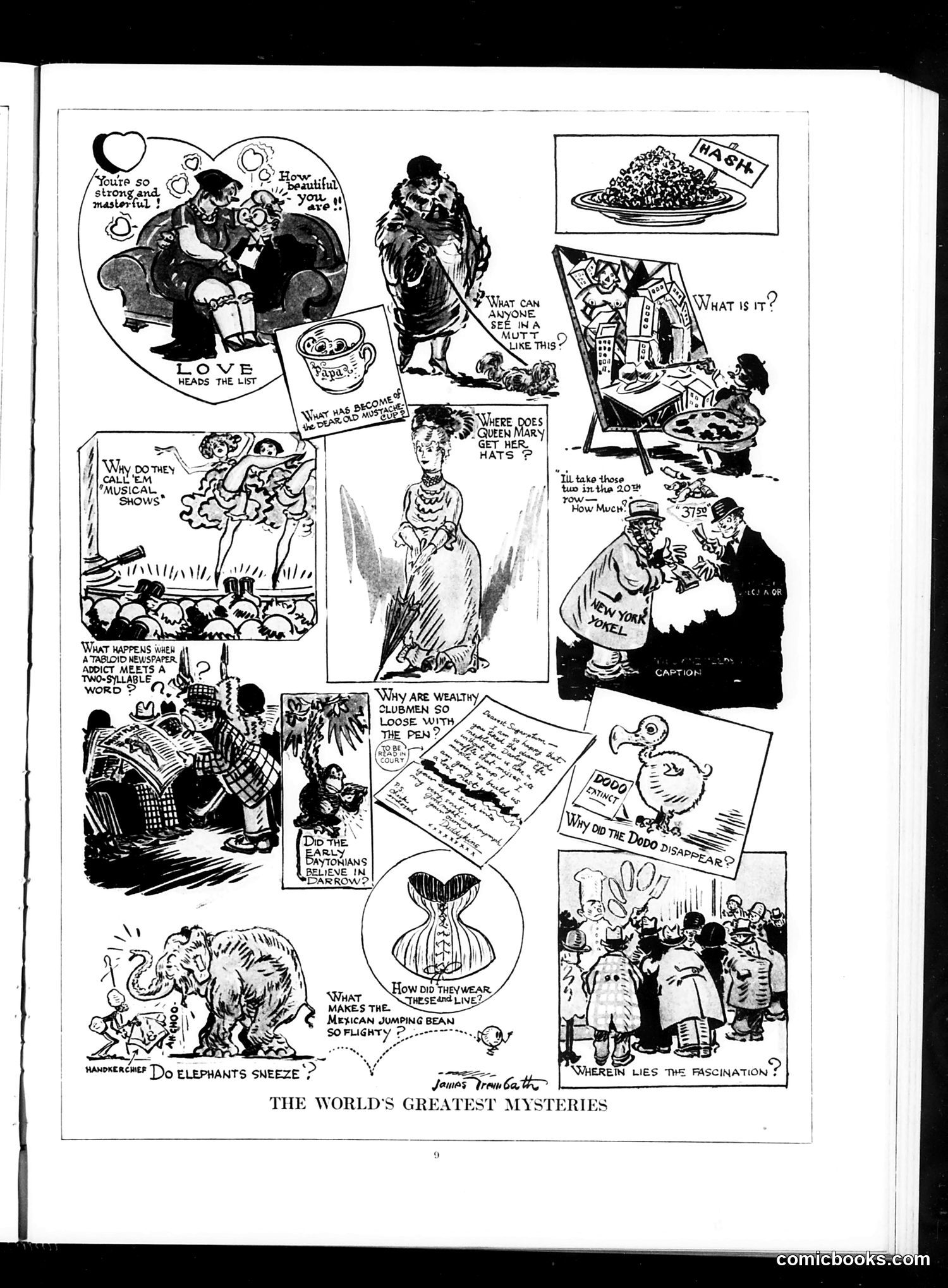
This is a humorous satirical page posing absurd questions as if they were profound mysteries. The cartoons parody popular culture fascinations and upper-class pretensions: - "Love Leads the List" mocks sentimentality in entertainment - "Why do they call 'em musical shows?" questions theatrical naming - References to Queen Mary's hats and wealthy clubmen's pen usage satirize society obsessions - "Mexican Jumping Bean" and "Do Elephants Sneeze?" are deliberately ridiculous, mocking what people find inexplicably fascinating - The hash image and price tag likely mock consumerism or food fads - A handwritten note and "Dodo" reference (extinct bird) suggest wondering about obsolete things The overall satire targets middle and upper-class preoccupation with trivial mysteries and fashionable curiosities rather than substantive matters. It's Judge magazine's characteristic mockery of contemporary society's misplaced fascinations.
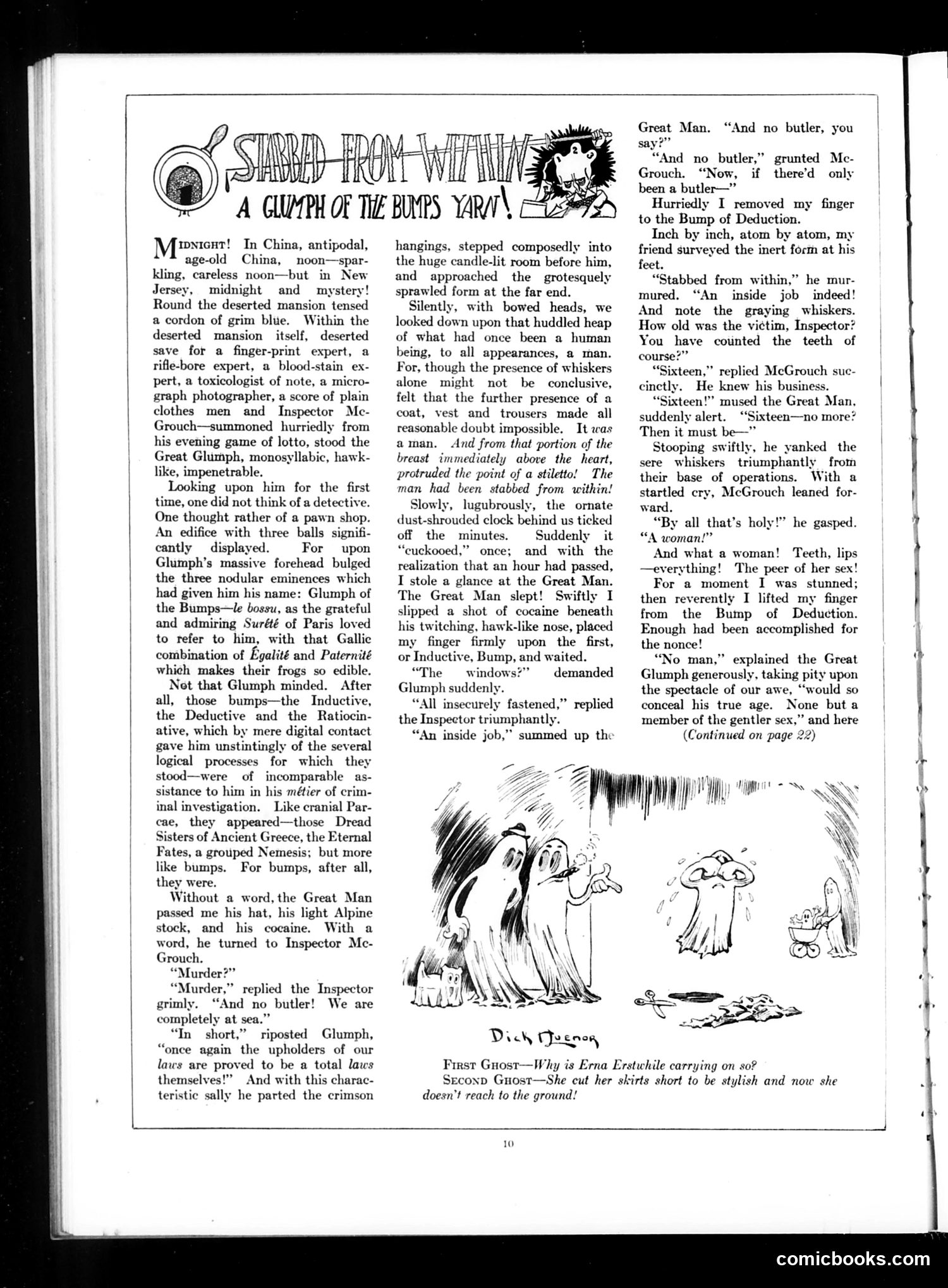
This is a parody of detective fiction, specifically mocking the pseudoscientific craze of **phrenology**—the belief that personality and mental abilities could be determined by bumps on the skull. The story centers on "Glumph of the Bumps," a famous detective whose three prominent forehead bumps supposedly represent "Inductive," "Deductive," and "Ratioccinative" reasoning. The satire works by treating these bumps as literally magical sources of detective powers: the narrator physically stimulates them to activate Glumph's deductive abilities. The murder mystery itself is absurdly simple (stabbed with a stiletto, no butler), yet Glumph solves it through bumps rather than actual logic. Judge ridicules both detective fiction conventions and the widespread pseudoscience of phrenology that American audiences took seriously. The joke is that Glumph's "genius" derives from anatomical nonsense, not real investigative work.
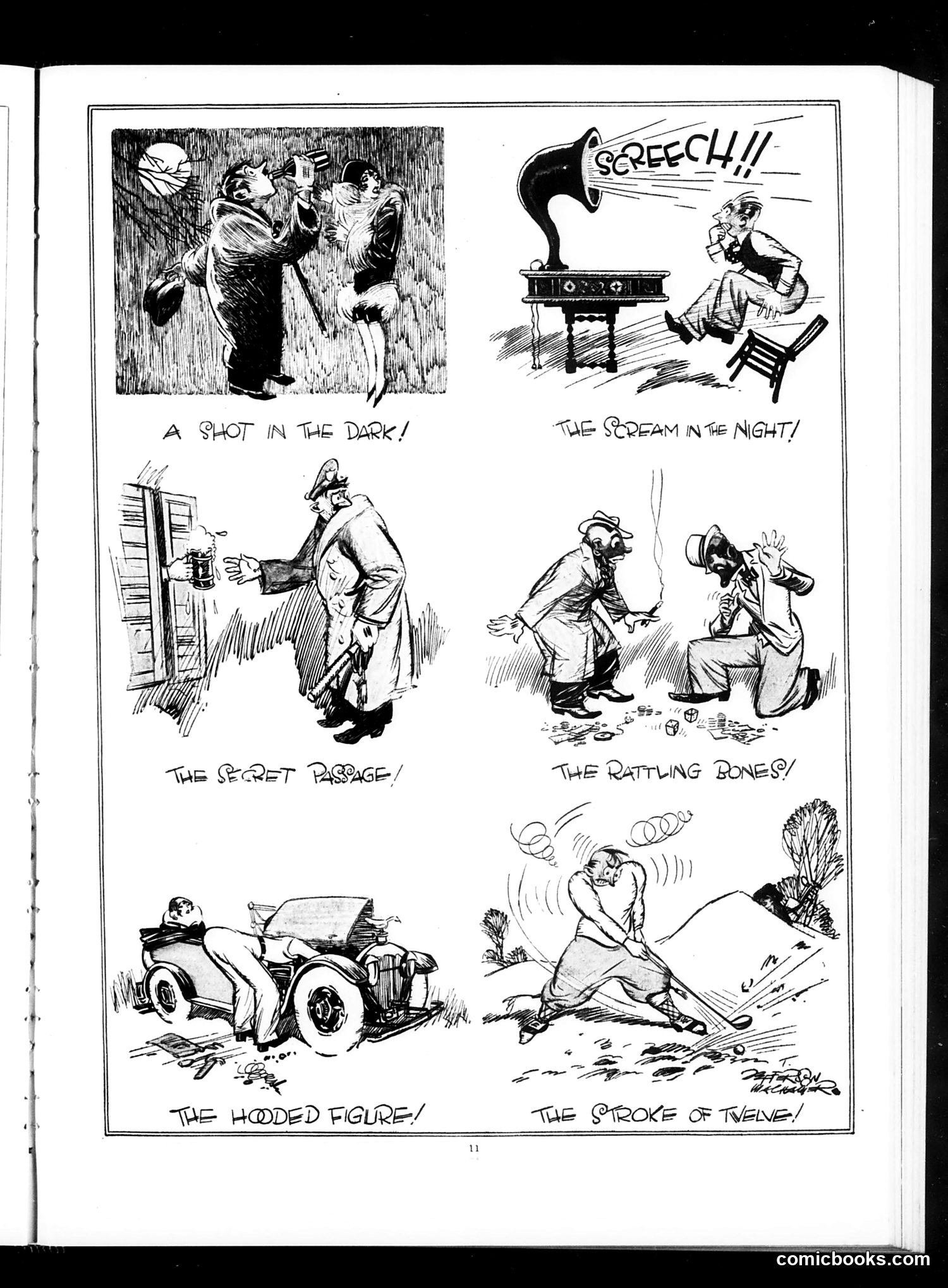
This page presents six cartoon vignettes depicting common sources of fear or disturbance in domestic life, each labeled with dramatic titles: "A Shot in the Dark," "The Scream in the Night," "The Secret Passage," "The Rattling Bones," "The Hooded Figure," and "The Stroke of Twelve." The cartoons satirize contemporary anxieties about mysterious nighttime occurrences—burglars, strange noises, supernatural-seeming events—that likely alarmed readers of the era. Rather than depicting actual supernatural phenomena, each scene reveals mundane explanations: the "hooded figure" is a car, "rattling bones" appears to be children with tin cans, and screams come from a phonograph. The humor mocks how ordinary occurrences become terrifying when unexplained, reflecting early 20th-century anxieties about modern urban or suburban life and the power of imagination to create fear.
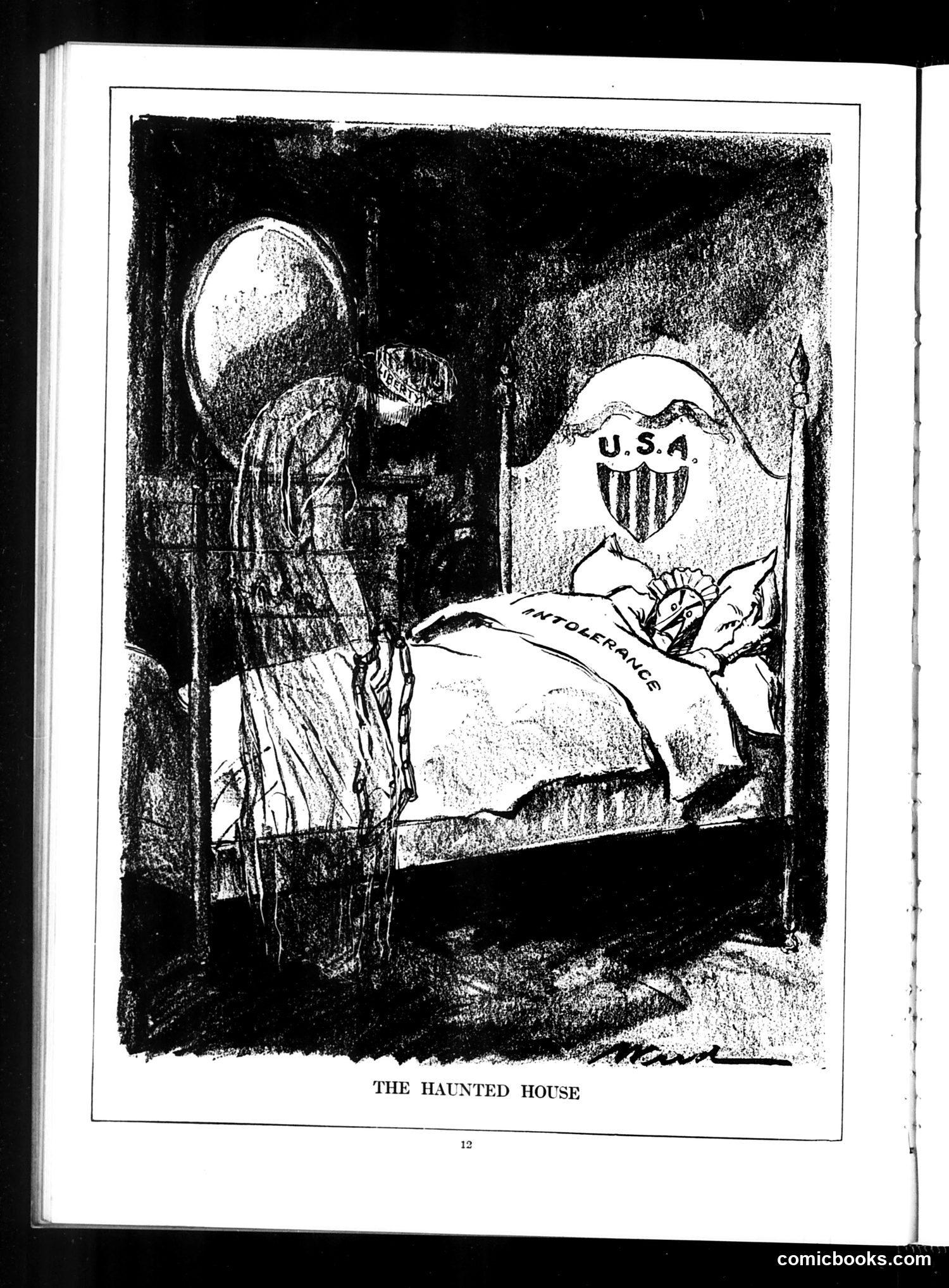
This political cartoon from *Judge* magazine uses the metaphor of a haunted house to critique American isolationism or neglect of international concerns. A ghostly figure labeled "U.S.A." lies in bed, appearing sick or troubled, while a draped figure (likely representing Death, Fate, or a foreign threat) stands at the bedside. The word "INTOLERANCE" appears on the bedding, suggesting that American prejudice or isolationist policies are the source of the nation's "haunting" troubles. The cartoon implies that the U.S. cannot escape consequences—represented as a ghost or specter—by ignoring international problems or maintaining intolerant domestic policies. The "haunted house" serves as a visual pun: America's own home is made unstable by these internal and external failures.
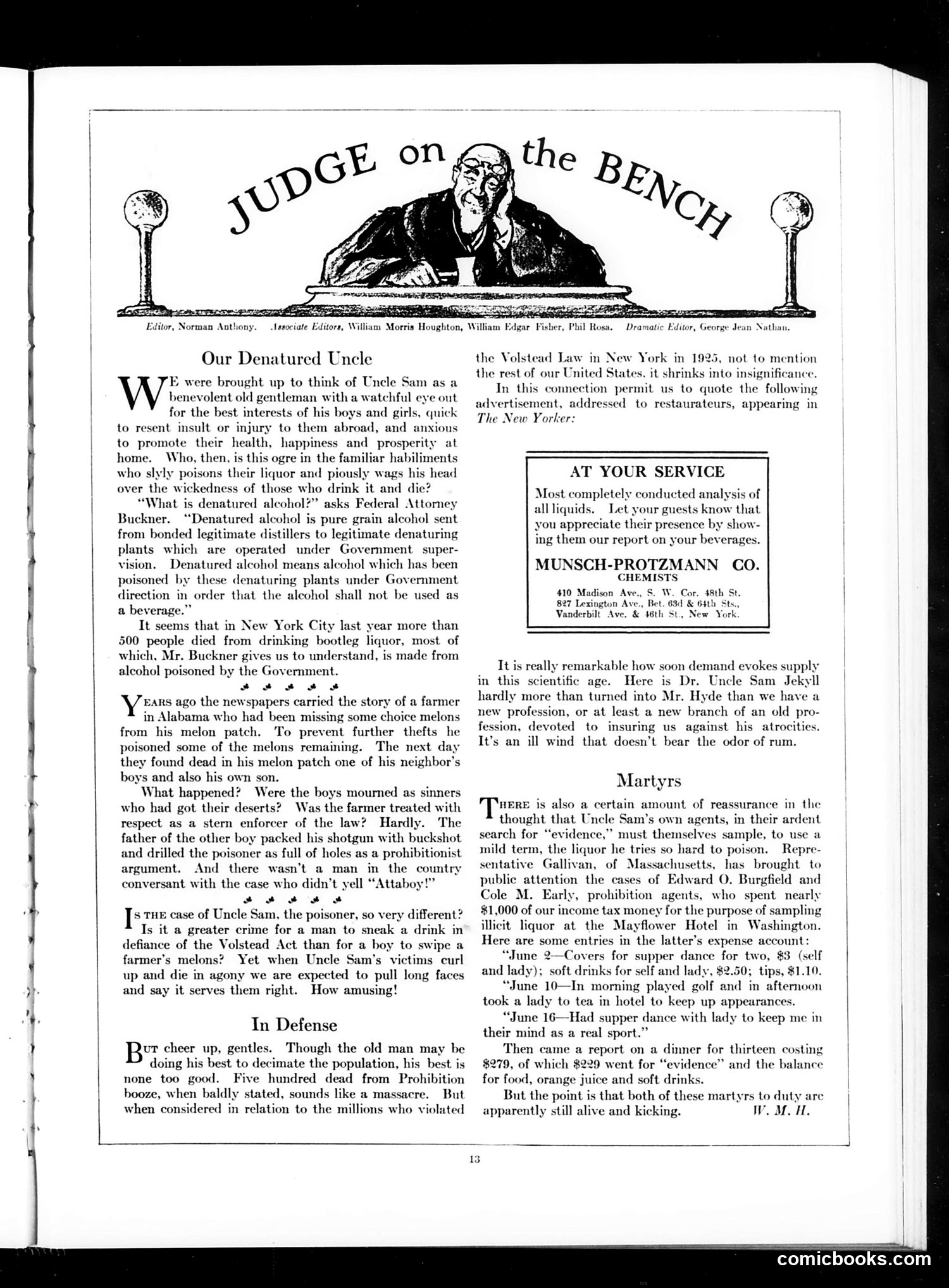
This article satirizes the U.S. government's contradictory stance during Prohibition (1920-1933). The central complaint: Uncle Sam enforces the Volstead Act by poisoning alcohol to prevent illegal drinking, yet this poisoned bootleg liquor kills over 500 New Yorkers yearly. The satire employs an analogy: a farmer who poison-traps melons to stop theft, killing his neighbor's son, would face lynching—yet the government faces no such consequence for intentionally distributing lethal poison. The article argues this hypocrisy is "amusingly" glossed over with moral posturing. The secondary joke targets profiteers: entrepreneurs now offer "chemical analysis services" to restaurants certifying beverage safety—profiting from the government's own poisoning policy. The closing reference to "Dr. Jekyll and Mr. Hyde" captures the core paradox: Uncle Sam presents himself as benevolent protector while acting as poisoner. The piece exposes Prohibition's deadly, unintended consequences and the moral inconsistency of enforcing it through state-sanctioned poisoning.
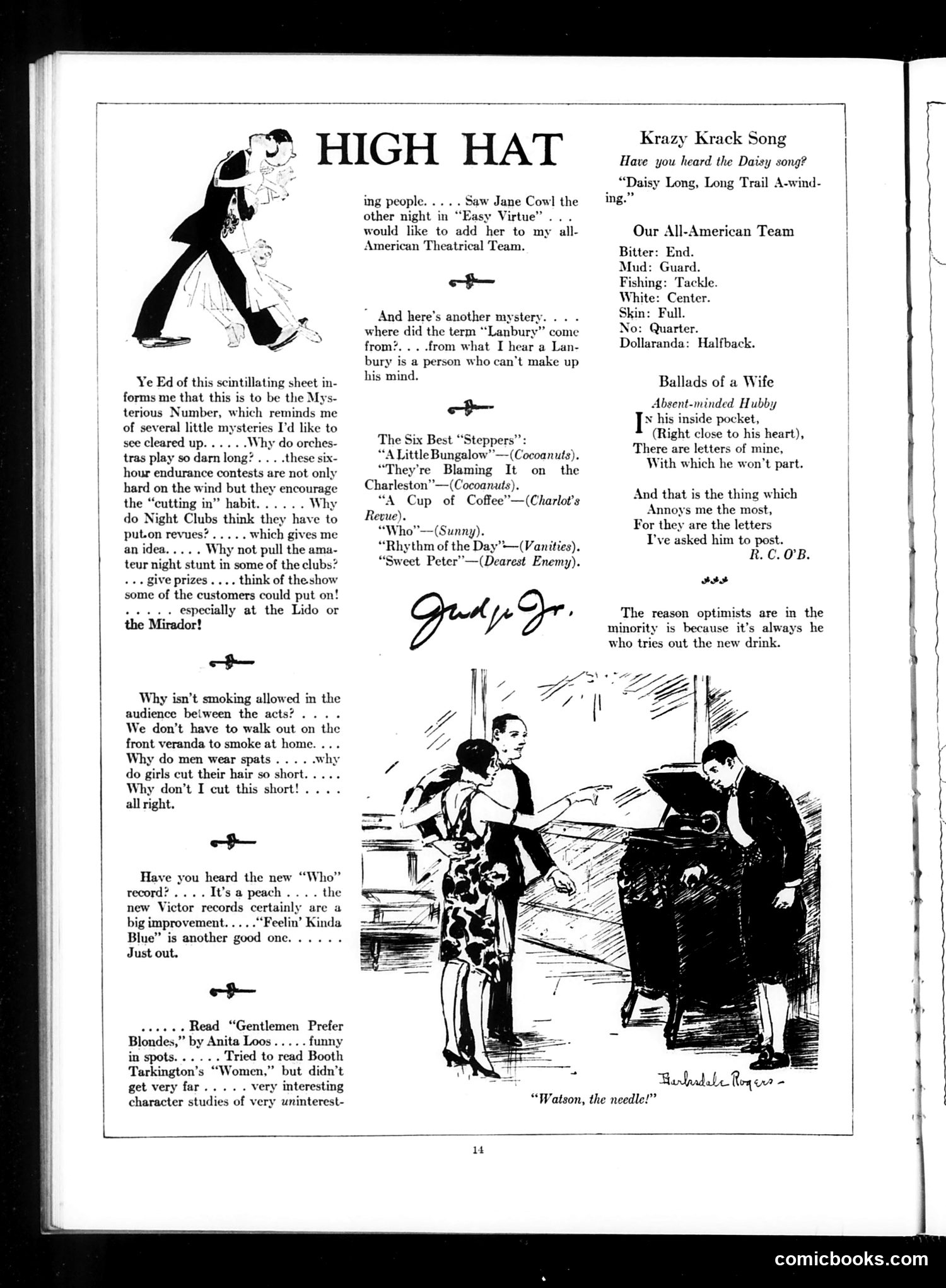
This page from Judge magazine (likely 1920s based on references) is a humor column titled "High Hat" by the editor. The content reflects Jazz Age social commentary: **Main Features:** The left column poses rhetorical questions about contemporary nightclub culture—why orchestras play too long, why night clubs feature expensive revues, why smoking isn't allowed during acts. These are gentle satirical jabs at emerging entertainment venues and their management. **Cultural References:** - Multiple mentions of Broadway shows ("Easy Virtue," "Cocoanuts," "Sunny") - Popular records and songs of the era - Jazz Age pastimes (night clubs, the Charleston) - "Gentlemen Prefer Blondes" by Anita Loos (1925) **The Cartoon:** The bottom illustration, captioned "Watson, the needle!" appears to reference Sherlock Holmes's drug use, shown here as a domestic scene where a woman addresses a man about a syringe—likely satirizing either drug culture or spousal nagging about needles/sewing. **Overall Tone:** Urbane, witty commentary on modern entertainment, manners, and relationships rather than hard political satire.
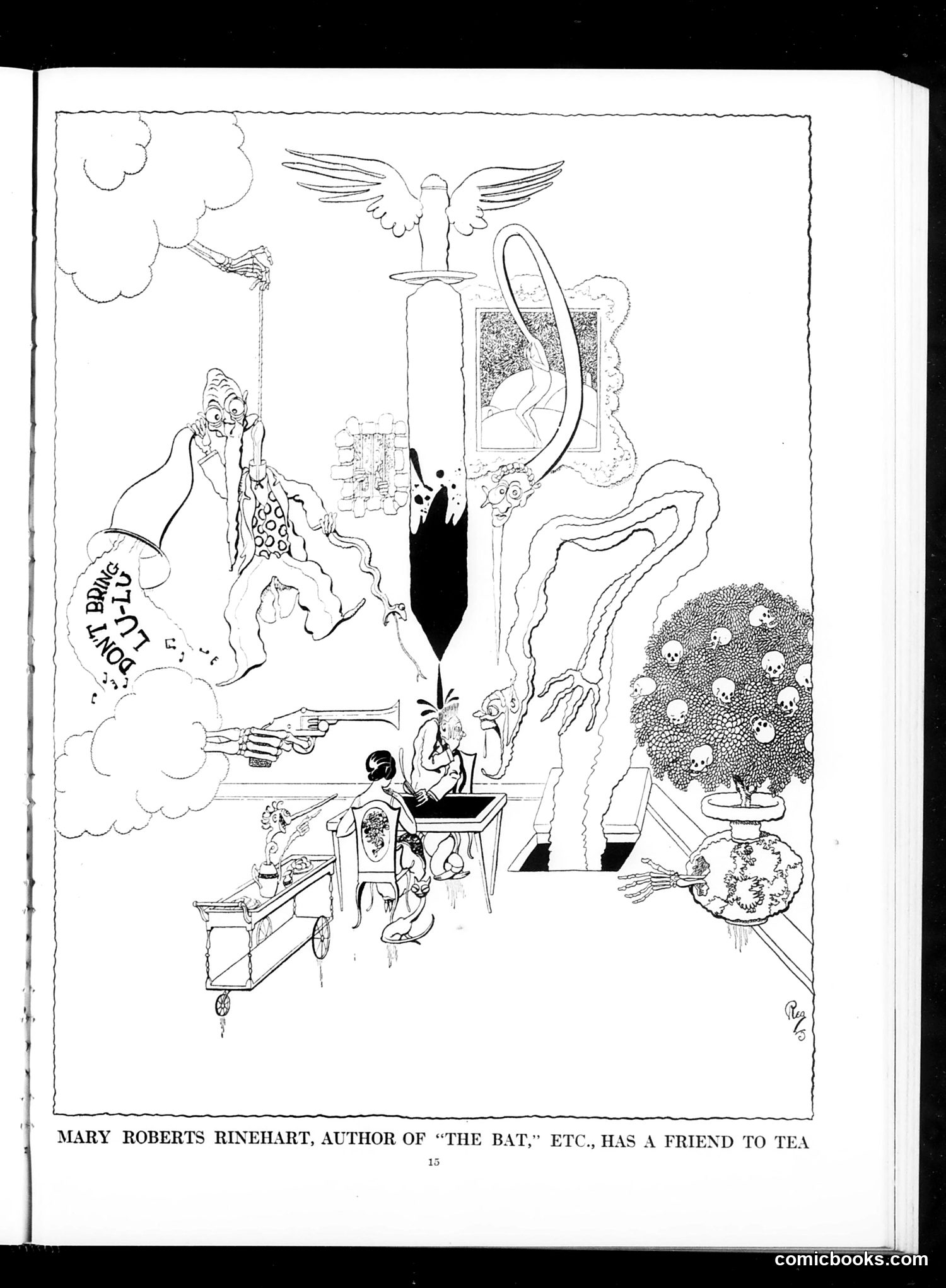
This is a satirical illustration about Mary Roberts Rinehart, a famous mystery writer ("The Bat" was her popular play). The cartoon depicts her hosting tea in a surreal, gothic-influenced setting populated by grotesque characters and supernatural elements—skulls, skeletal figures, winged creatures, and ominous imagery. The joke appears to be a playful commentary on Rinehart's genre: her friend to tea is surrounded by the macabre, death-obsessed aesthetic typical of mystery and horror fiction she wrote. Rather than a normal domestic scene, her parlor resembles a gothic thriller's setting, suggesting that Rinehart's creative mind—or her social circle—inhabits a world of dark mysteries. It's gentle mockery of her literary reputation, implying that such an author would naturally surround herself with grotesque company.
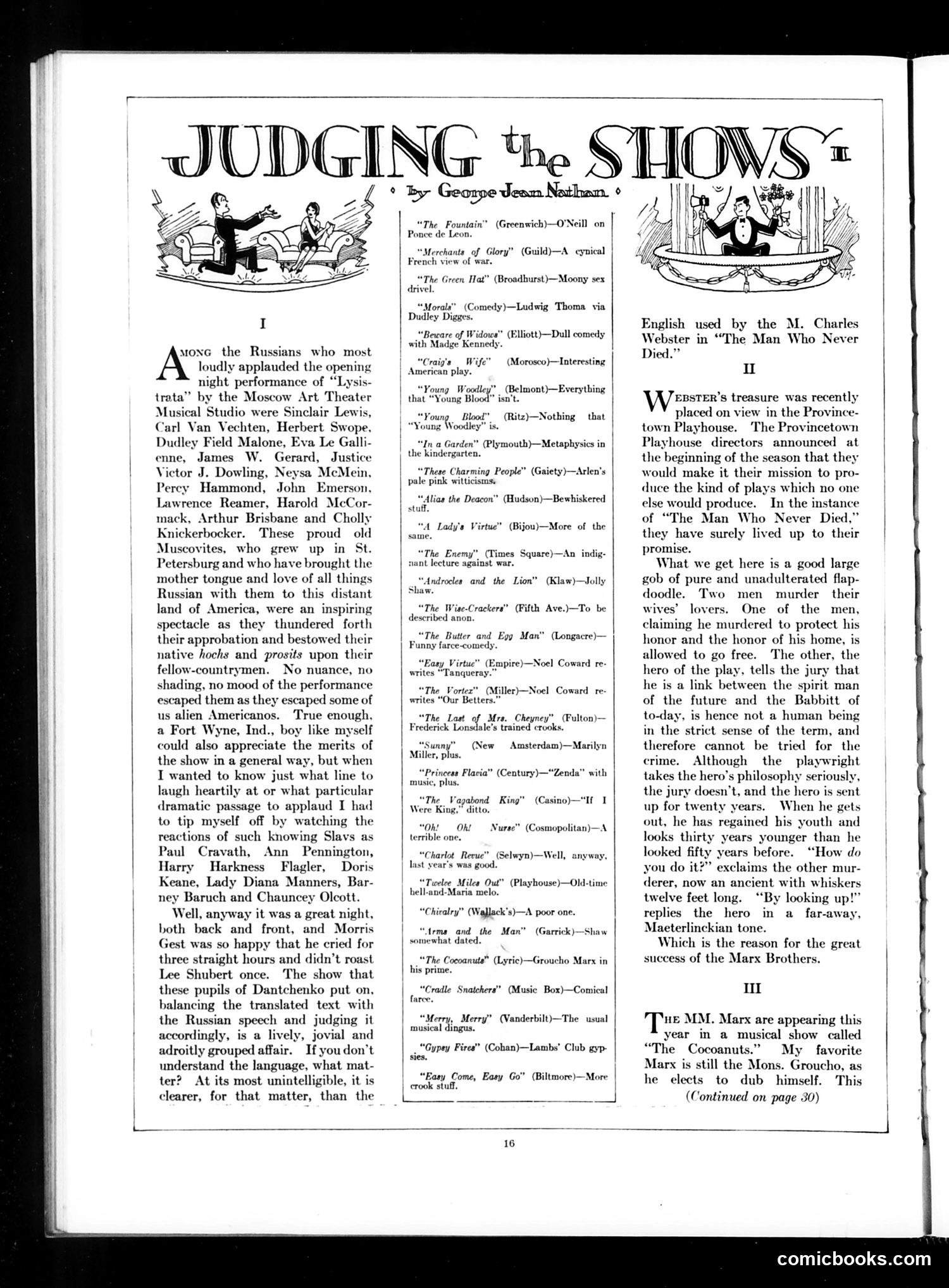
This page is a theater review column by George Jean Nathan, a prominent drama critic of the 1920s. The text is NOT a political cartoon—it's satirical theater criticism. **The Setup:** Nathan sarcastically describes Russian expatriates at the Moscow Art Theater's production of "Lysistrata" (the ancient Greek anti-war comedy), listing prominent attendees like Sinclair Lewis and Herbert Swope. He humorously suggests these Russians understood nuances he, a "Fort Wayne boy," had to decode by watching their reactions. **The Satire:** Nathan mocks both the pretentious audience members and himself for needing cultural guidance. He then provides caustic capsule reviews of current Broadway shows, using phrases like "moony sex drivel" and "pale pink witticisms" to dismiss plays as frivolous. **The Point:** This critiques 1920s theater culture—mocking both high-society sophistication and mediocre commercial productions. It's insider-focused satire for Judge's educated readership.
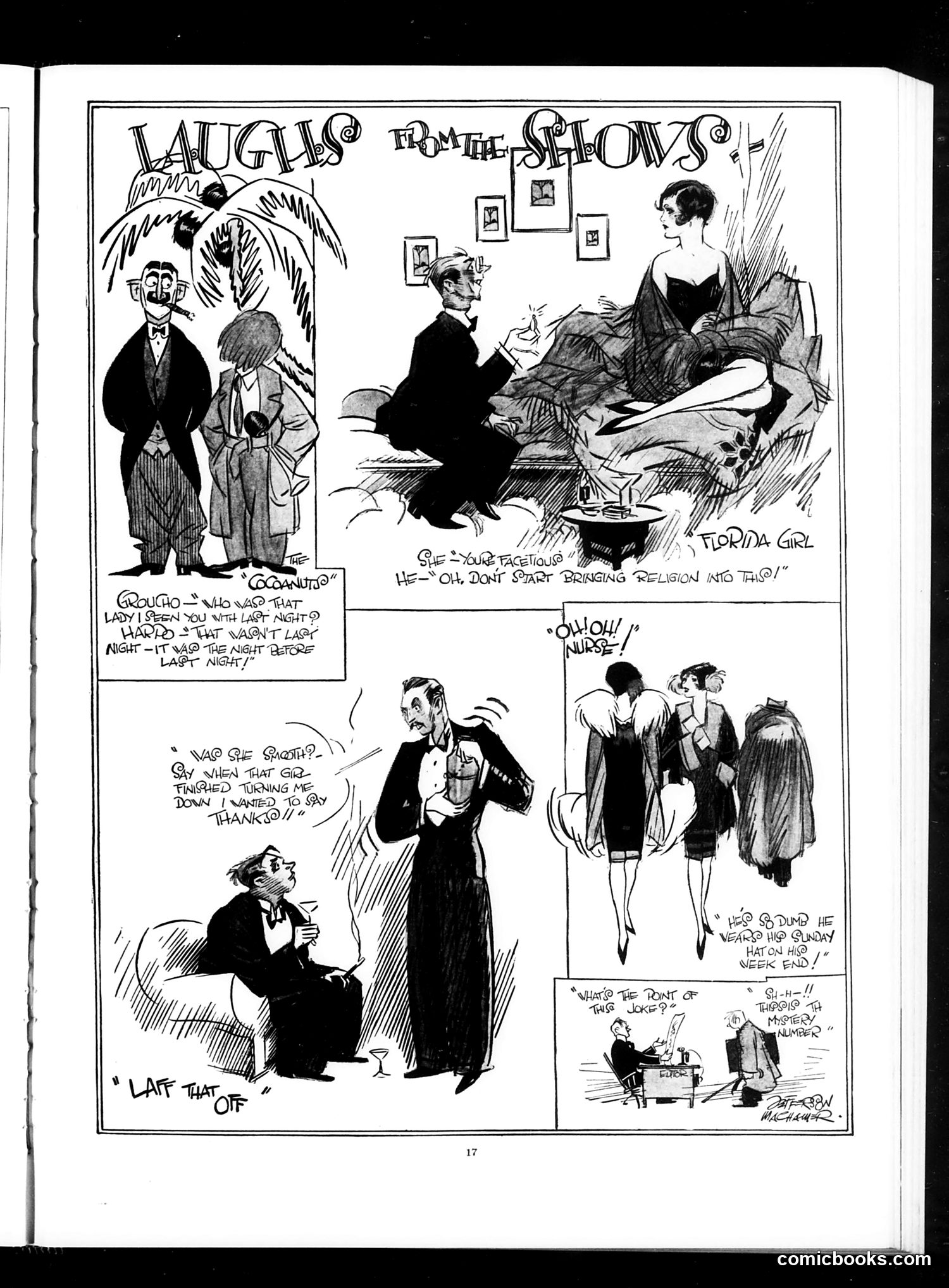
This is a comedy page satirizing social behavior and romantic entanglements among the upper classes. The main strip, titled "Florida Girl," depicts a man caught in an awkward situation with a woman, likely involving infidelity or deception—he's confronted about being seen with "that lady" the previous night, claiming it was someone else. The subsequent panels show the comedic fallout: the man attempting to explain himself to an increasingly angry woman, a nurse being called, and what appears to be the social embarrassment spreading ("he carried her gloomy hat on her week end"). The humor relies on period conventions: the scandalized reactions to improper romantic conduct, the man's desperate excuses, and the social consequences of being caught in compromising situations. The "Florida Girl" likely represents a seductress or outsider disrupting proper society—a common satirical trope of the era mocking both infidelity and the pretense of respectability among the wealthy.
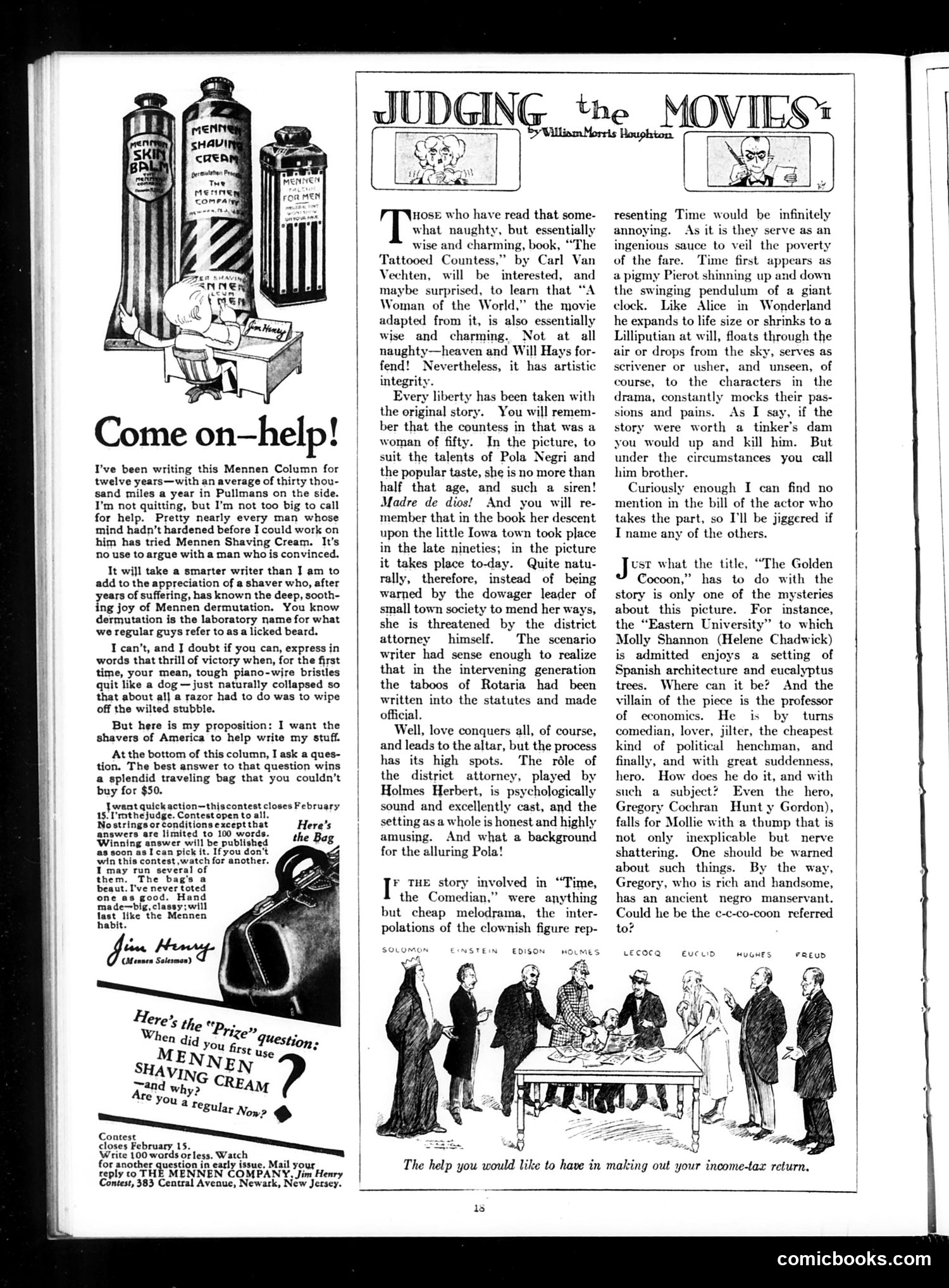
This page contains two distinct sections: **Left side:** A Mennen Shaving Cream advertisement disguised as a personal column by "Jim Henry," offering a $50 traveling bag to readers who best answer: "When did you first use Mennen Shaving Cream—and why? Are you a regular now?" This is native advertising—a sponsored advertorial common in early 20th-century magazines. **Right side:** Film criticism by William Norris Houghton reviewing two 1925 movies: "A Woman of the World" (starring Pola Negri, adapted from Carl Van Vechten's novel *The Tattooed Countess*) and "Time, the Comedian." The reviewer discusses how the film updates the story's setting from the 1890s to the present day, and notes that actress Pola Negri's youth in the role creates narrative adjustments. The criticism is lighthearted and approving of the filmmakers' choices. The bottom illustration shows men around a table, captioned as depicting help with income-tax calculations—likely a topical reference to contemporary tax concerns.
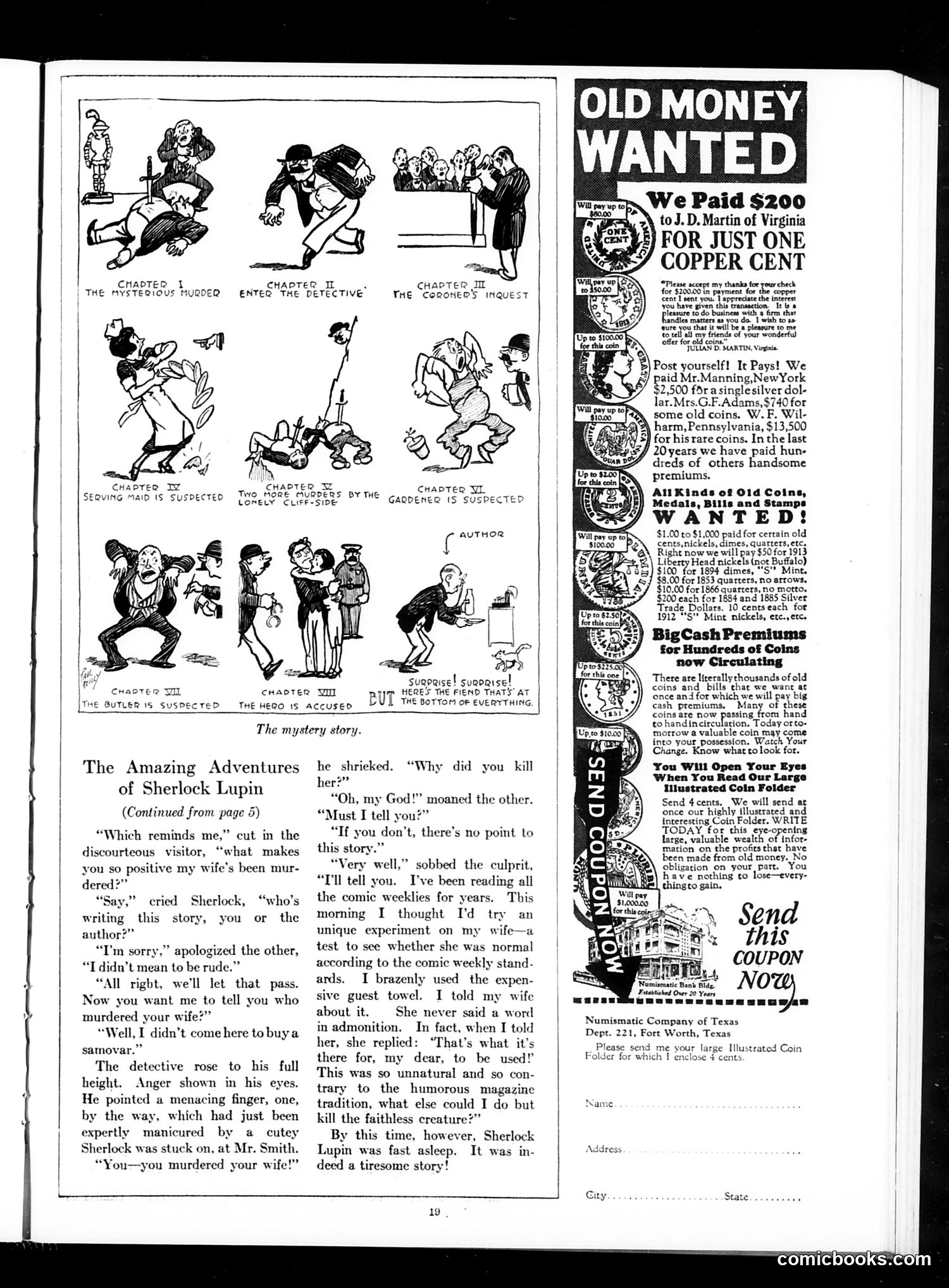
**The Comic Strip:** "The Amazing Adventures of Sherlock Lupin" is a parody of detective fiction conventions. The nine-panel setup mockingly follows the standard "mystery story" formula—mysterious murder, detective arrives, butler suspected, hero accused, shocking revelation. The satire culminates in an absurd punchline: a man murders his wife because she *didn't complain* about him using the guest towel, violating the "humorous magazine tradition" where wives are nagging shrews. The detective falls asleep mid-confession, dismissing the whole tedious genre as tiresome. This mocks both popular detective stories and comic-weekly stereotypes about domestic life where long-suffering wives constantly berate husbands. **The Advertisement:** The right column is an unrelated coin-buying advertisement from the Numismatic Company of Texas, offering cash premiums for rare coins and currency.
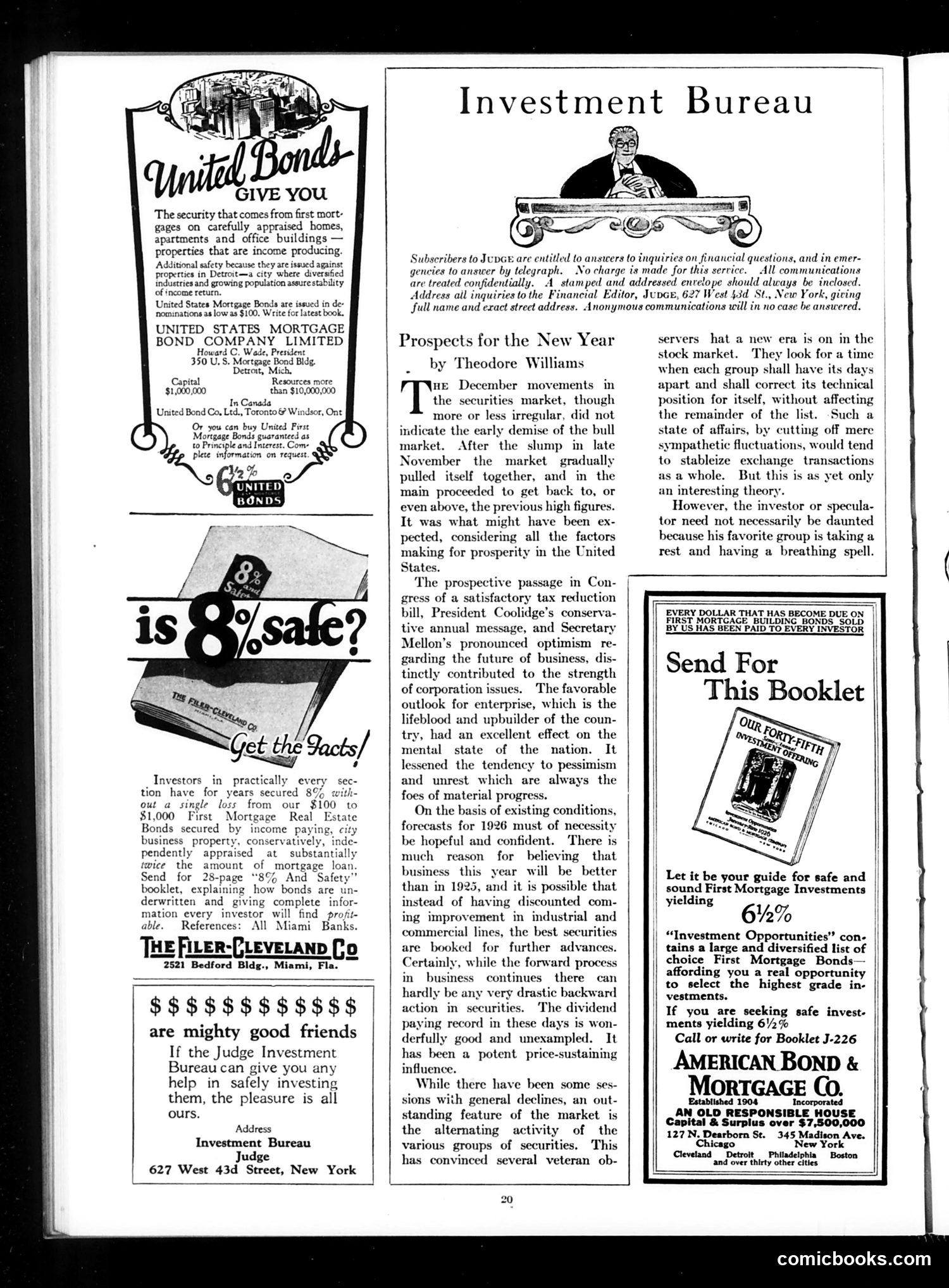
This page is primarily **financial advertising** from the 1920s, with minimal satirical content. The layout features multiple investment firm advertisements promoting mortgage bonds and stock market opportunities, surrounding a short article titled "Prospects for the New Year" by Theodore Williams. The article reflects **post-1925 economic optimism**, referencing President Coolidge's conservative policies and Secretary Mellon's business-friendly outlook. It discusses stock market recovery and predicts continued prosperity in 1926—notably, this was written during the economic boom preceding the 1929 crash. The satirical element is subtle: the repeated emphasis on "safety" and "guaranteed returns" in the advertisements, juxtaposed with talk of booming securities, contains ironic foreshadowing for modern readers who know this optimism was misplaced. The "8% sale" and promises of no losses appear quaint given the coming Depression. **Judge's Investment Bureau** section offers itself as a trusted financial advisor—a service typical of magazines' revenue strategies in this era.
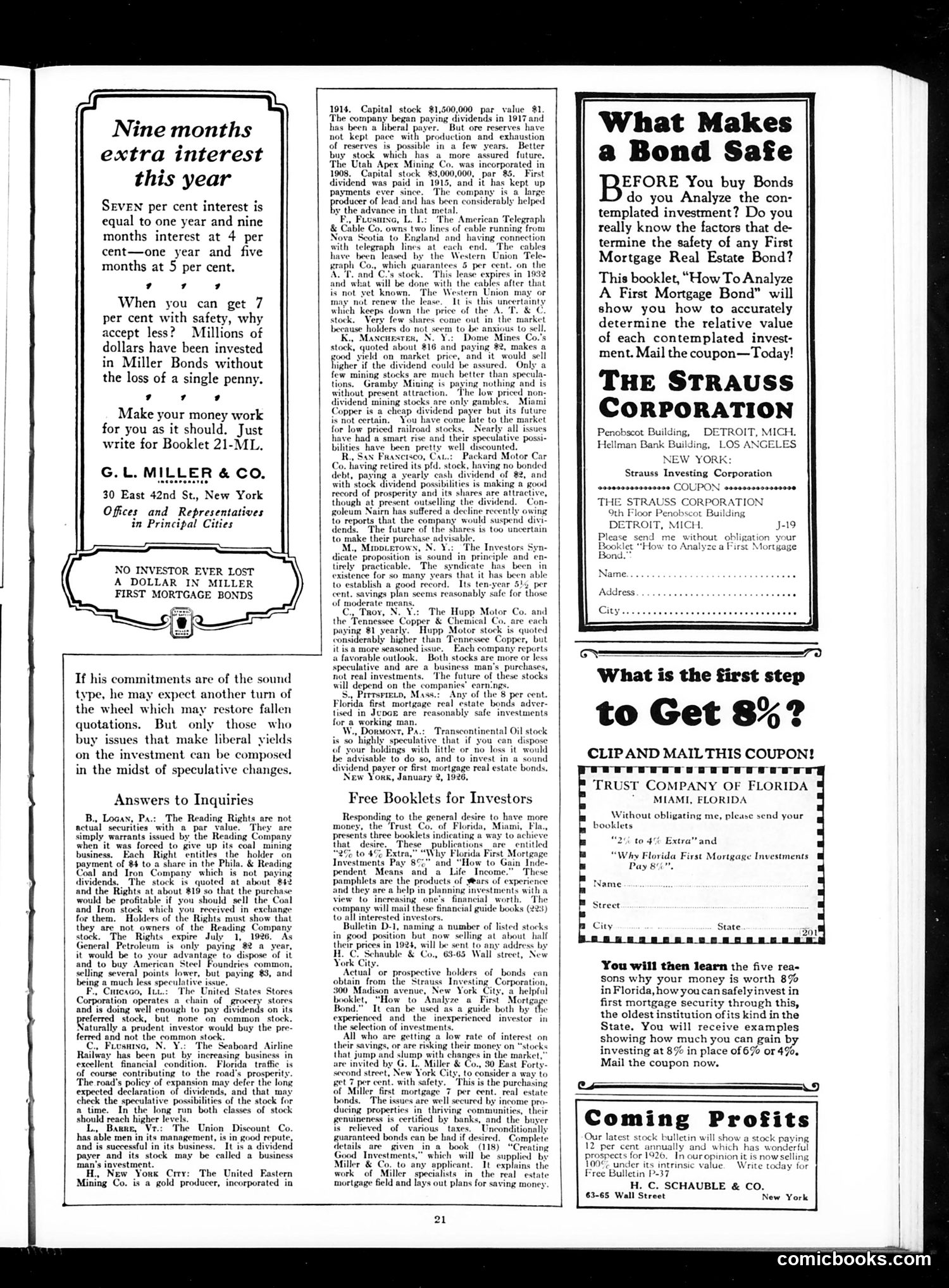
This page is primarily **financial advertising and investment advice**, not political satire. It consists of: 1. **Advertisement for G.L. Miller & Co.** (left column): Promoting Miller Bonds as safe investments offering 7% interest, claiming "no investor ever lost a dollar." 2. **"Answers to Inquiries" column** (center-left): Investment advice responding to reader questions about various stocks and bonds—Reading Rights, American Steel Foundries, Seaboard Airline Railway, mining companies, etc. 3. **"What Makes a Bond Safe"** (upper right): The Strauss Corporation promoting a booklet teaching bond analysis for real estate mortgages. 4. **Free investor booklets** (right column): Multiple companies offering educational materials—Trust Company of Florida, H.C. Schauble & Co. **Historical context**: This appears to be from the 1920s (pre-1929 crash), when investment promotion was largely unregulated. The repeated emphasis on "safety" and "no losses" reflects the optimistic speculation era before the Depression exposed such claims as hollow. There are **no political cartoons or satirical commentary** on this page.
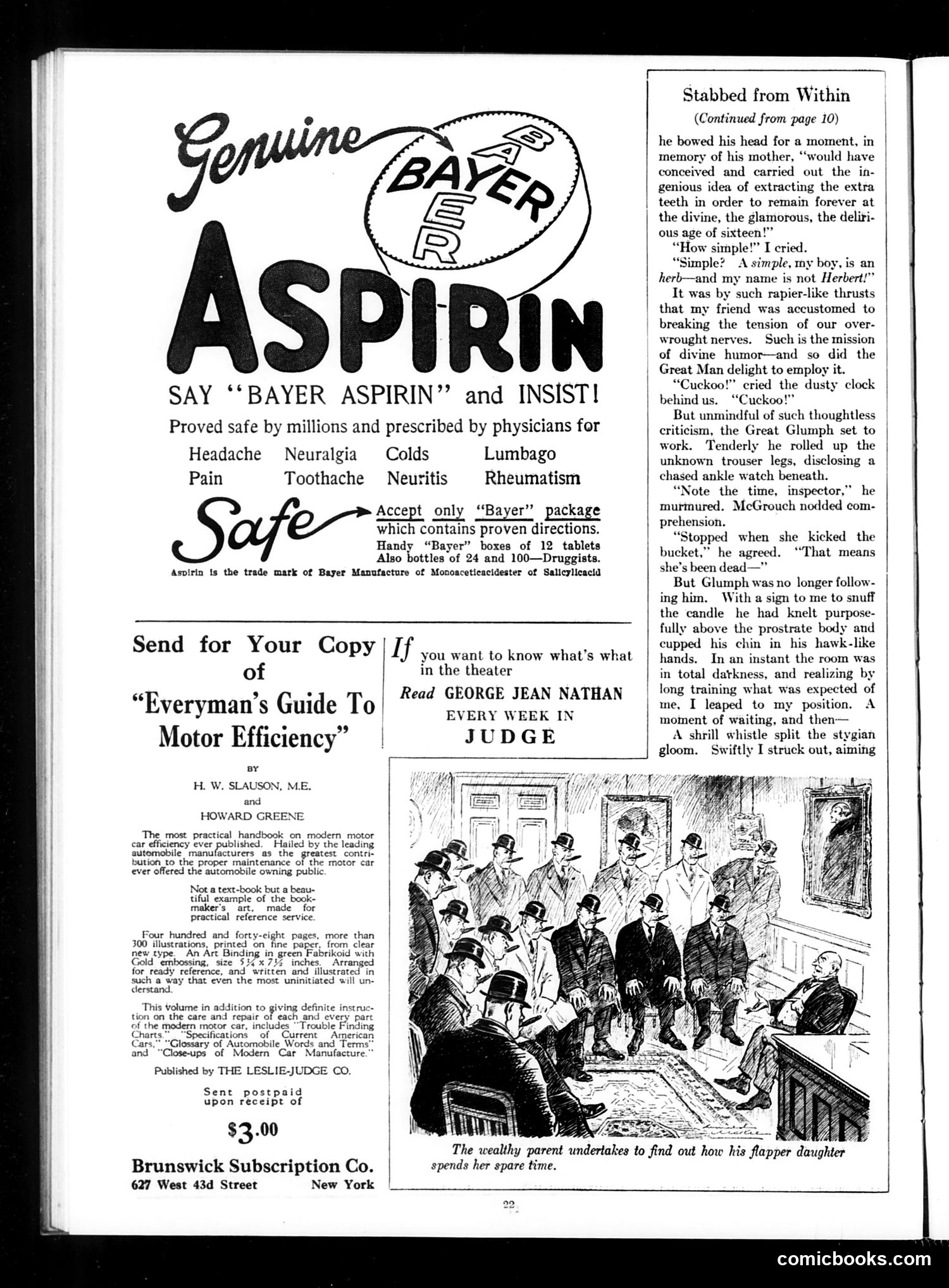
This page contains mixed content: a **Bayer Aspirin advertisement** (top left) and a **serialized mystery/detective story** ("Stabbed from Within," continued from page 10). The story excerpt depicts a detective investigation, likely featuring characters named Glumph (the detective) and Inspector McGrouch examining a dead body by candlelight. The narrative uses theatrical, somewhat overwrought prose typical of early 20th-century mystery fiction—complete with witty repartee and dramatic revelations. A whistle and sudden darkness suggest action or danger. The accompanying **cartoon illustration** shows a wealthy parent discovering his flapper daughter surrounded by fashionable young people, satirizing the social anxiety among the upper class about youth culture and "spare time" activities during the Jazz Age. The Bayer ad emphasizes the product's safety and physician endorsement, a key marketing strategy before modern FDA regulations. Overall, this is a typical Judge magazine page mixing advertising with entertainment content.
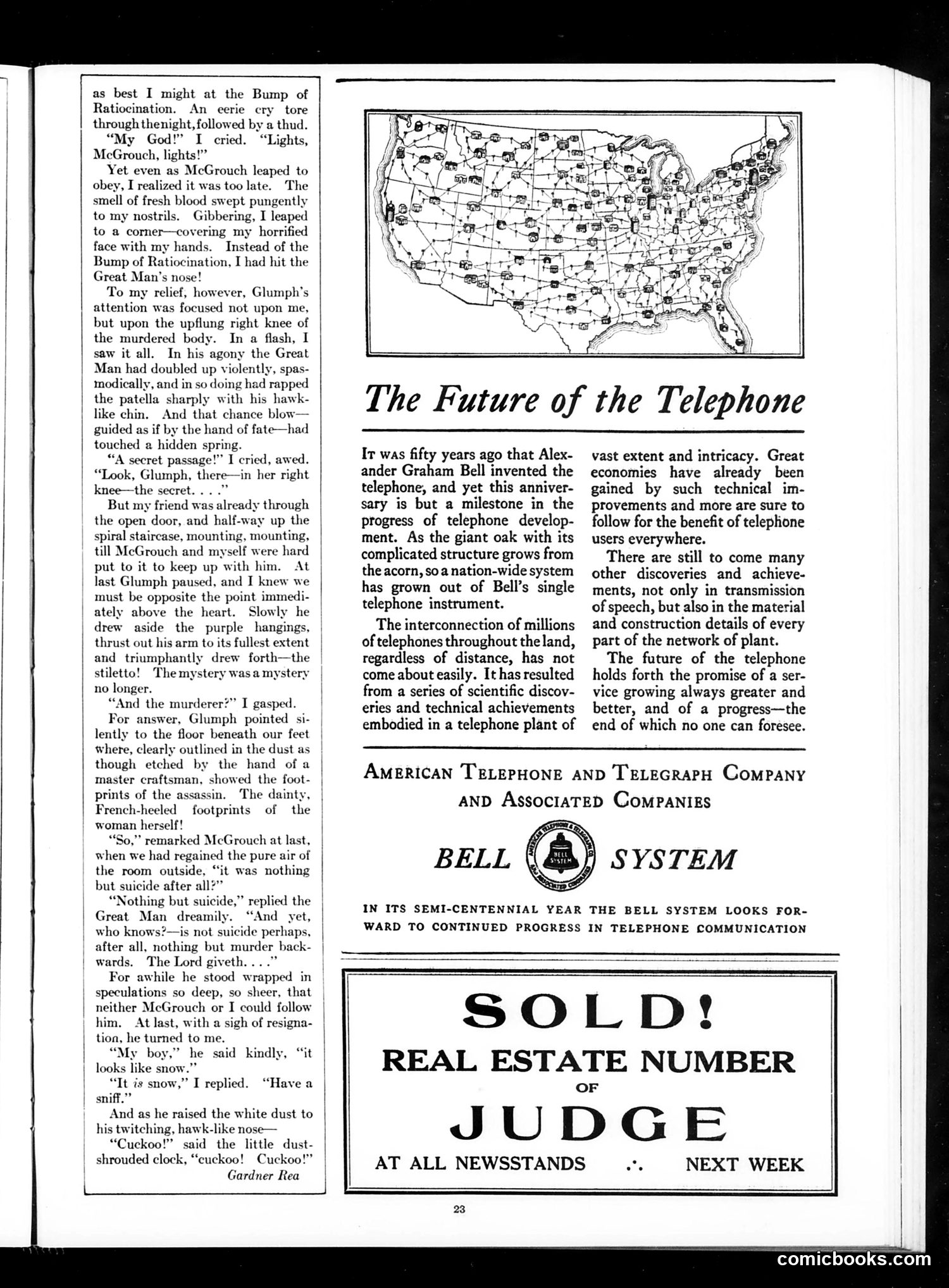
This page contains two distinct elements: **Left side:** A fictional detective story parody ("The Bump of Ratiocination") by Gardner Rea. The melodramatic narrative mocks overwrought mystery fiction—featuring a "Great Man" detective, dramatic discoveries of secret passages, and absurd plot twists (a murder-suicide determined by footprints in dust). The tone is deliberately silly and self-aware, satirizing the overwrought pulp mystery conventions popular in early 20th-century literature. **Right side:** A straightforward corporate advertisement for the Bell System (AT&T and associated companies), celebrating fifty years since Alexander Graham Bell's telephone invention. It promotes the telephone network's achievements and future progress in communication technology. The juxtaposition is likely intentional—Judge paired entertainment satire with a prominent advertisement, a common magazine practice of the era.
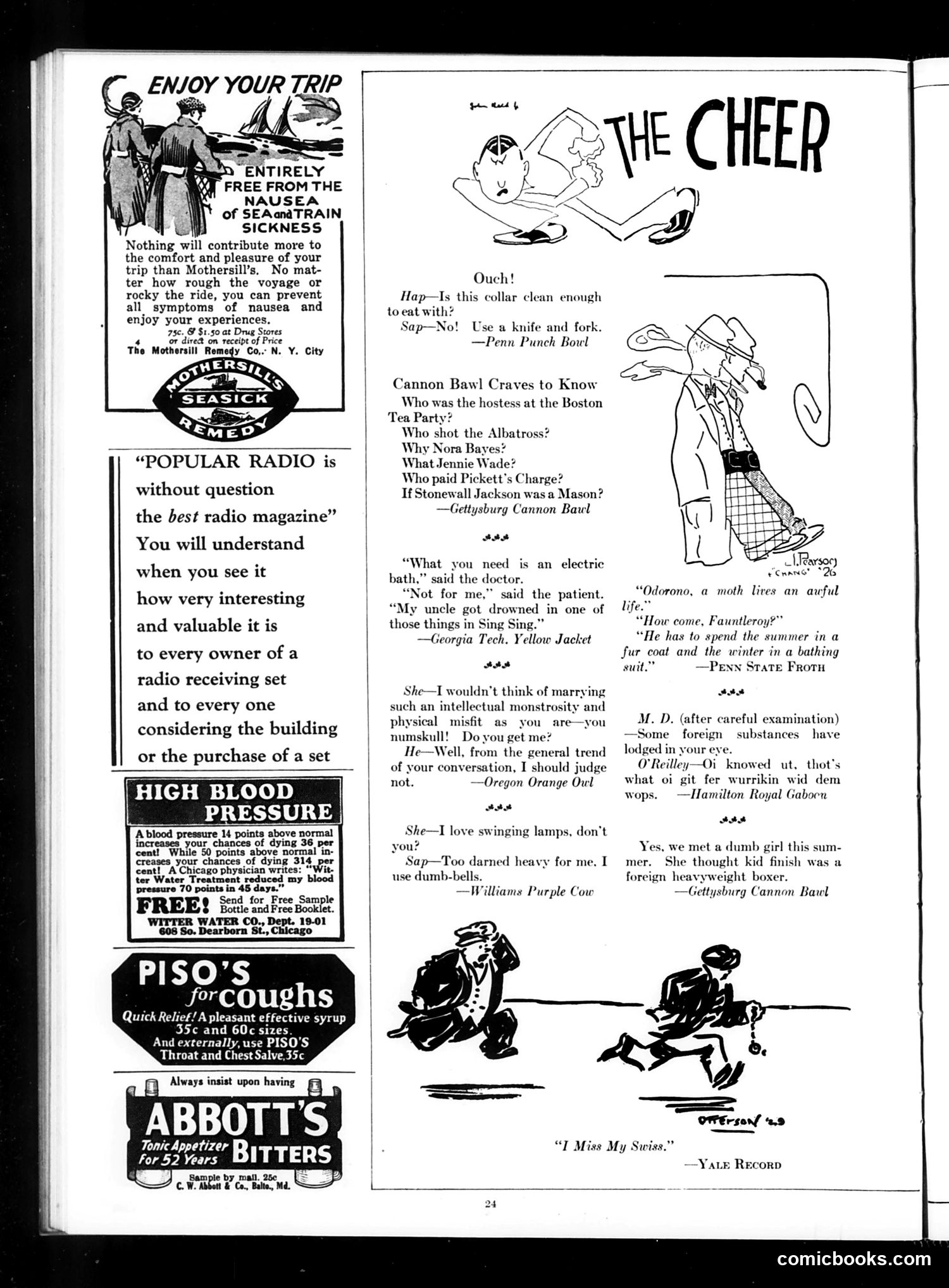
This page from Judge magazine (a satirical publication) contains mostly **advertisements and humor columns** rather than political cartoons. The left side features patent medicine ads (Mothersill's seasickness remedy, blood pressure treatment, Piso's cough syrup) typical of early 20th-century magazines—many making dubious health claims. **"The Cheer"** section comprises short jokes submitted by readers from college publications. The humor is genteel and unsophisticated by modern standards: puns about collars and eating utensils, deliberately absurd "questions" (who shot the albatross?—a literary reference), and jokes about relationships and physical mismatches. One cartoon shows a figure captioned "I Miss My Swiss"—likely referencing Switzerland or Swiss people, possibly related to WWI-era sentiments, though the specific context is unclear. The jokes reflect early 20th-century collegiate humor: mildly insulting, focused on wordplay and unexpected twists, with occasional ethnic stereotyping ("wops"). No coherent political message is evident on this page.
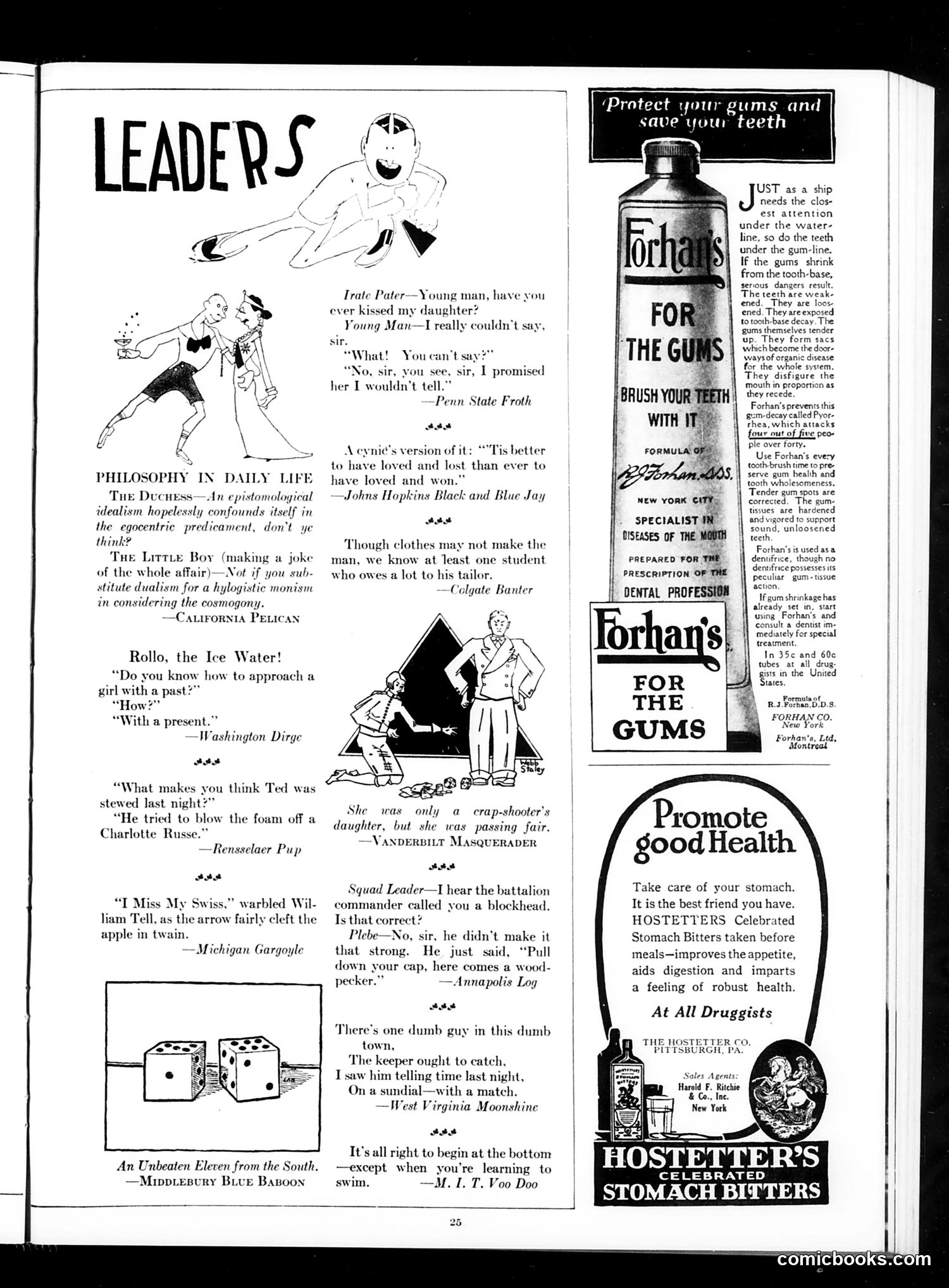
This page from Judge magazine is primarily a **humor section** collecting jokes and witticisms from college publications (Penn State Froth, Michigan Gargoyle, Annapolis Log, etc.)—a common feature in satirical magazines of this era. The "Leaders" section contains brief, punchy jokes rather than political satire: - Mock-serious philosophical debates (the "Duchess" exchange) - Wordplay and romantic humor ("approach a girl with a past") - College pranks and drinking references ("Charlotte Russe" foam) One cartoon shows a girl and woman with debris, captioned about "a crap-shooter's daughter...passing fair"—a play on the "X's daughter" joke formula popular at the time. The right side features **period advertisements** for Forhan's toothpaste and Hostetter's Stomach Bitters—commonplace commercial endorsements in magazines. This page reflects **early 20th-century college humor culture** rather than hard political satire, emphasizing wordplay, innuendo, and references to student life that were considered witty by contemporary readers.
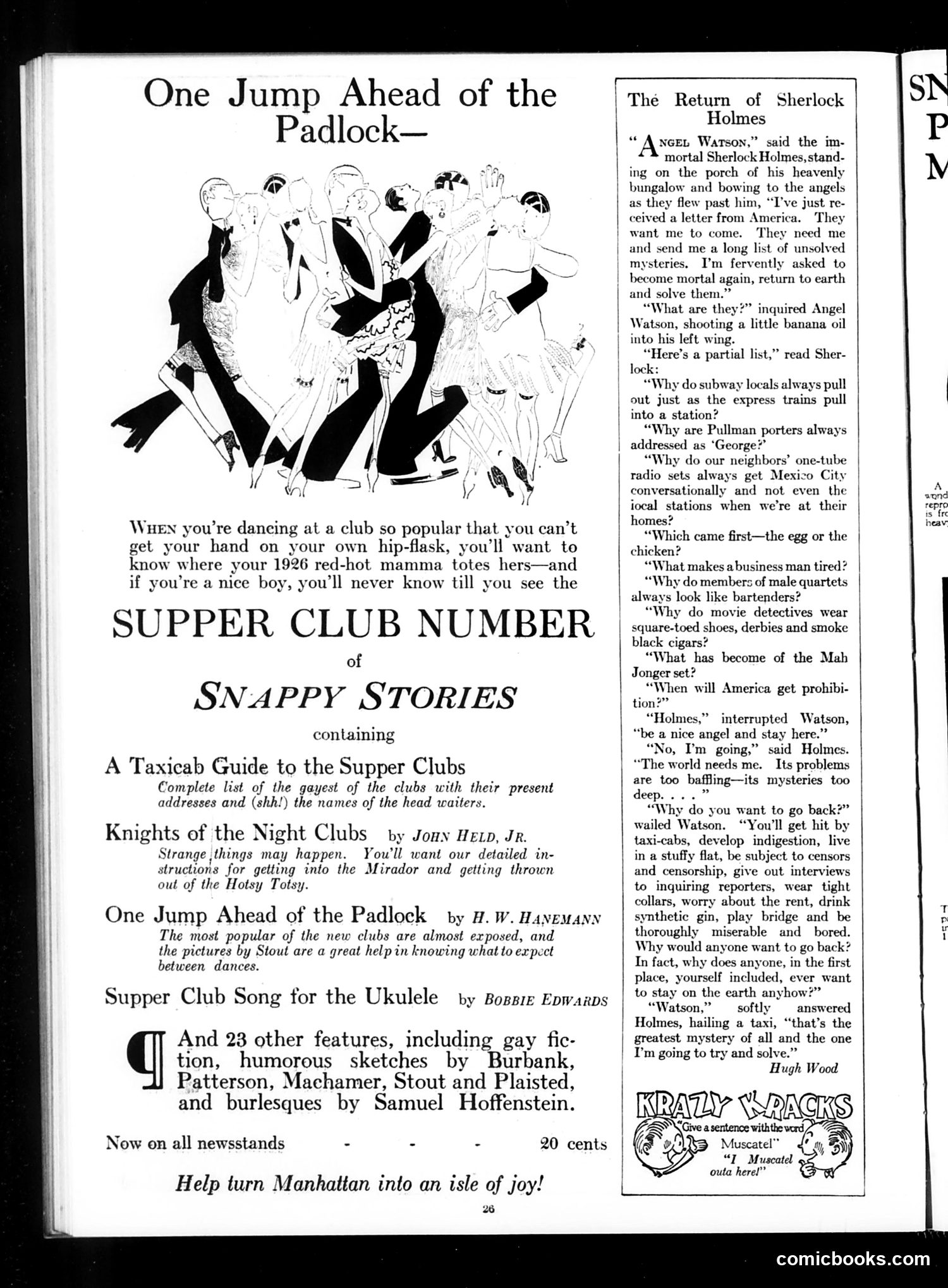
This page satirizes **Prohibition-era speakeasy culture** (1920s). The main advertisement promotes "Snappy Stories" magazine, marketing guides to illegal supper clubs operating "one jump ahead of the padlock"—referring to how authorities would padlock establishments serving alcohol. The humor targets the hypocrisy and absurdity of Prohibition: wealthy clubgoers openly flouting laws by hiding hip-flasks, while authorities nominally enforce closures. References to "red-hot mamma," "Mirador," and "Hotsy Totsy" (actual famous speakeasies) add specificity. The Sherlock Holmes piece (right) uses the detective's return from heaven to list mundane American frustrations—a tongue-in-cheek commentary on modern life's mysteries. His final decision to return to Earth despite its miseries reflects contemporary disillusionment, contrasting with the carefree speakeasy culture the magazine simultaneously promotes. The overall message: Judge magazine sells entertainment celebrating the glamorous rule-breaking that defined 1920s urban nightlife.
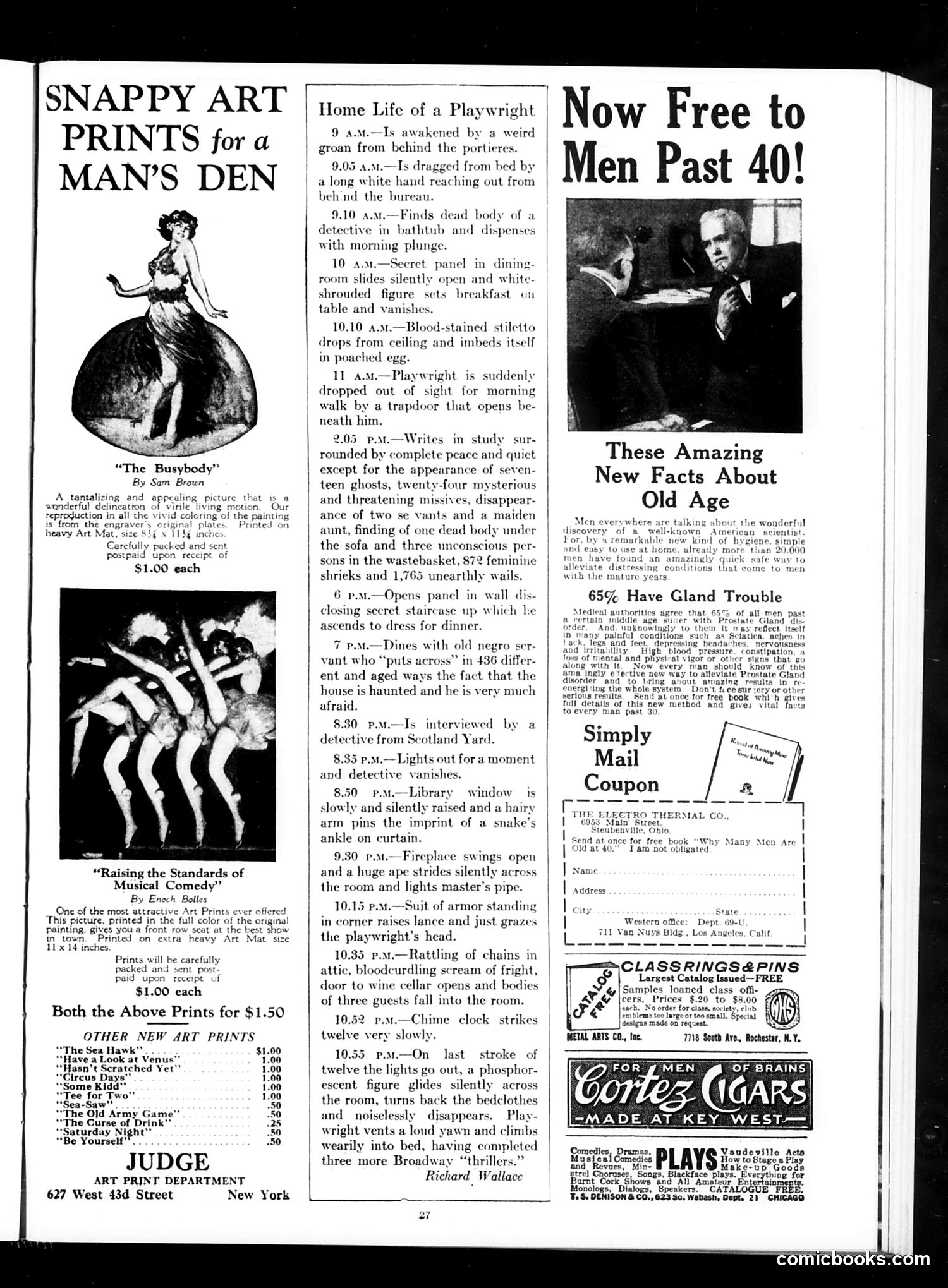
This page primarily contains **advertising and entertainment content** rather than political satire. The main cartoon feature is "Home Life of a Playwright," a humorous timeline mocking the melodramatic conventions of **Broadway thriller plays** (popular theatrical genre of the era). It satirizes the absurd accumulation of horror-movie tropes—dead bodies, secret panels, ghostly apparitions, mysterious weapons, and dramatic supernatural events—that playwrights packed into productions to thrill audiences. The joke is that despite all this chaos occurring in a single day, the playwright simply yawns and goes to bed, having completed his sensationalistic drama. The art prints advertised ("The Busybody," "Raising the Standards of Musical Comedy") feature drawings by period illustrators Sam Brown and Enoch Bolles, depicting stylized female figures—typical "pinup" style artwork marketed for men's dens. The remaining content consists of commercial advertisements unrelated to satire: health tonics promising gland treatments for older men, cigars, and theatrical notices.
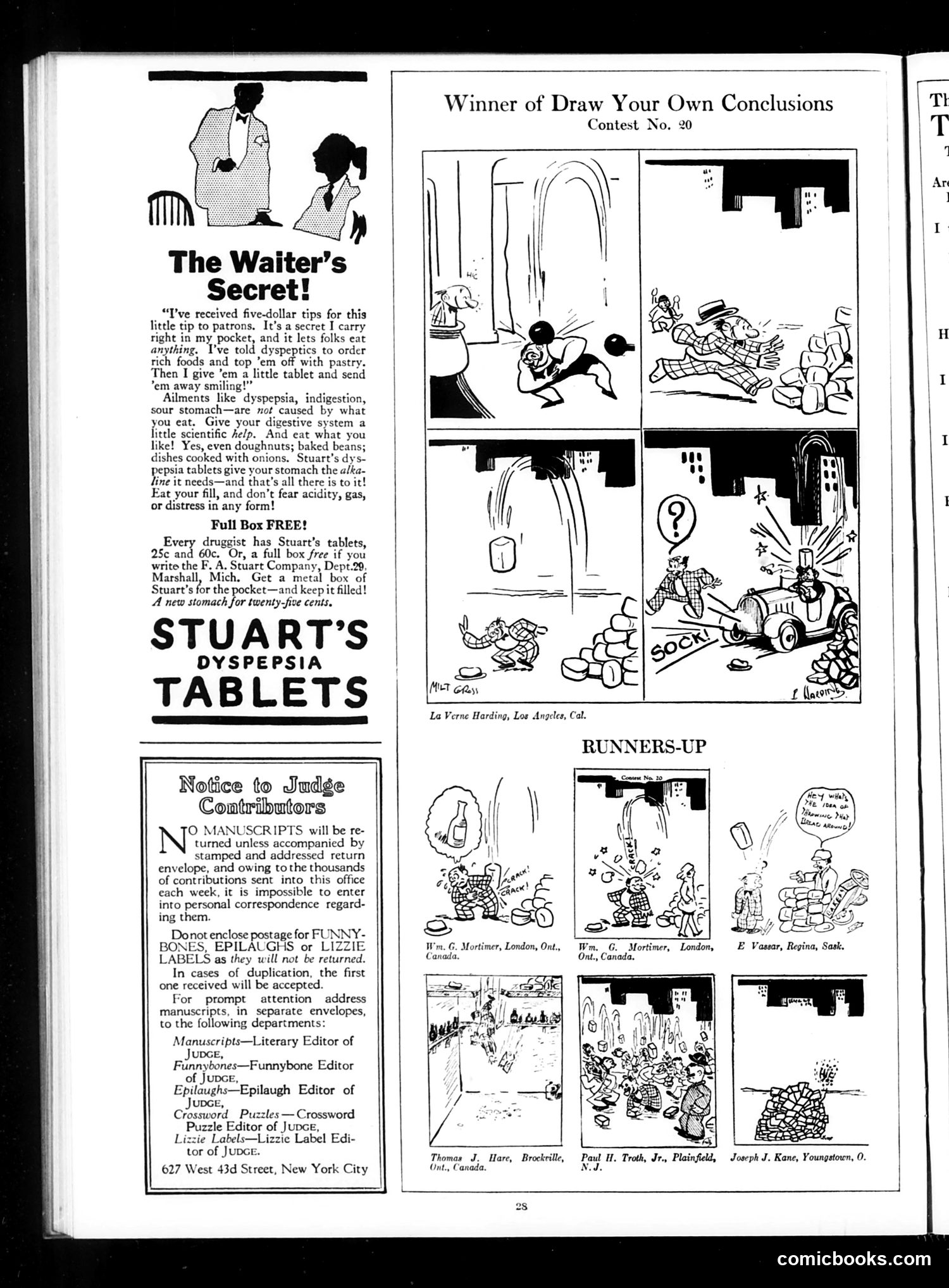
This page showcases Judge magazine's contest-winning cartoon (top right) and runners-up submissions. The winning entry by La Verne Harding depicts a physical comedy scenario: a character swinging from a rope or vine indoors, crashing into furniture and scattering objects—the "conclusion" readers must draw concerns the inevitable chaos and destruction. The runners-up show similar visual gag premises: domestic mishaps, crowded scenes, and sight-comedy situations where the viewer must infer the humorous outcome or cause. The page also includes a Stuart's Dyspepsia Tablets advertisement disguised as editorial content—a common 1920s-30s advertising practice. A waiter touts the product by claiming it lets customers eat rich foods without digestive consequences, reflecting period attitudes about stomach ailments as treatable through patent medicines. The submission guidelines below reflect Judge's high volume of amateur contributions to their various humor categories (Funnybones, Epilaughs, etc.).
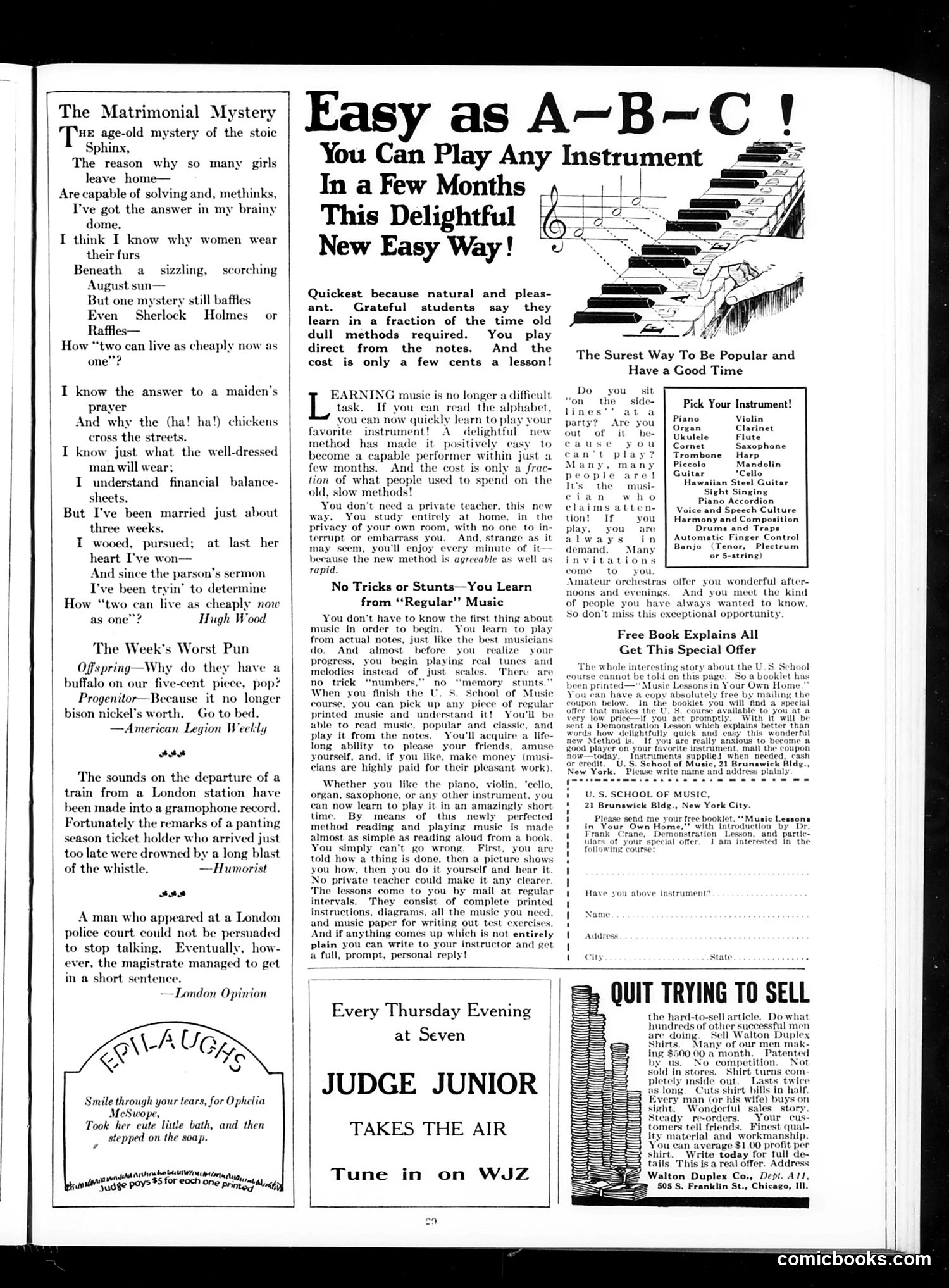
This page from *Judge* magazine contains primarily **advertisements and humorous prose pieces**, not political cartoons requiring historical context. The main content is a large advertisement for the "U.S. School of Music," promoting a mail-order music instruction method claiming anyone can learn an instrument "in a few months" through simple, affordable lessons. This reflects early 20th-century American optimism about self-improvement and commercial correspondence courses. The left column contains several short humorous pieces: a poem by Hugh Wood about the difficulty of living cheaply as a married couple; newspaper humor reprints from *American Legion Weekly* and *London Opinion*; and a brief joke about an opera character named Ophelia McSwope. Other advertisements include notices for radio programs and a men's shirt company. **No significant political satire or caricatures appear on this page.** It's primarily commercial and light entertainment content typical of *Judge*'s mixed format during this period.
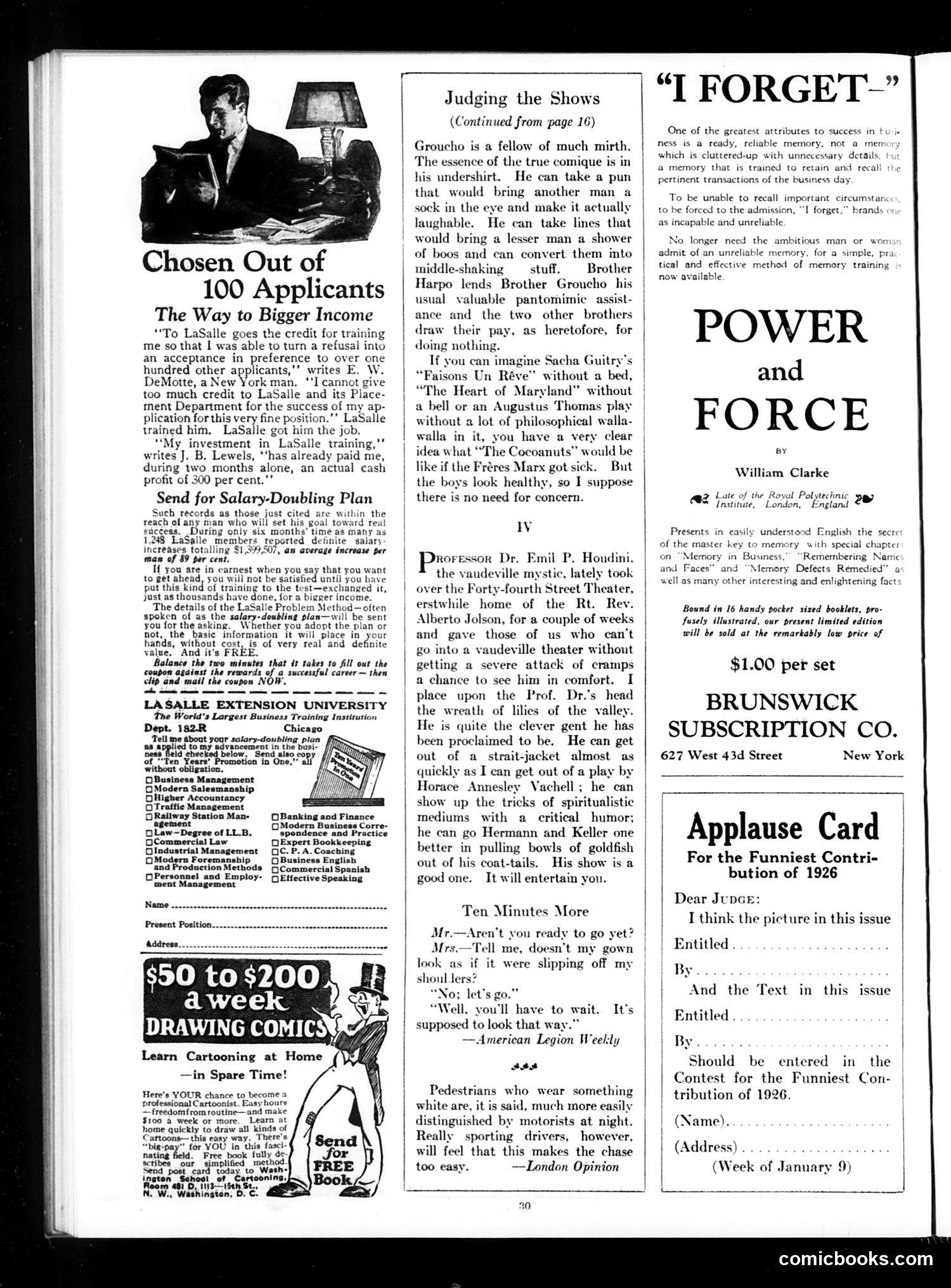
This page is primarily a collection of advertisements and brief entertainment reviews from Judge magazine, circa 1926 (based on the applause card dated "Funniest Contribution of 1926"). **Advertisement Content:** The dominant advertisements promote LaSalle Extension University's business training program, claiming graduates achieved significant salary increases. Another ad offers cartooning lessons promising "$50 to $200 a week." **Entertainment Review:** The "Judging the Shows" section briefly reviews a Marx Brothers production (likely "The Cocoanuts"). The reviewer notes that Groucho Marx's humor depends on his delivery and ability to make puns funny, while praising Harpo's pantomime. The review jokes that the other brothers "draw their pay...for doing nothing." **No Political Cartoons:** This page contains no political satire or cartoons requiring historical context—it's straightforward commercial promotion and entertainment criticism typical of Judge's content.
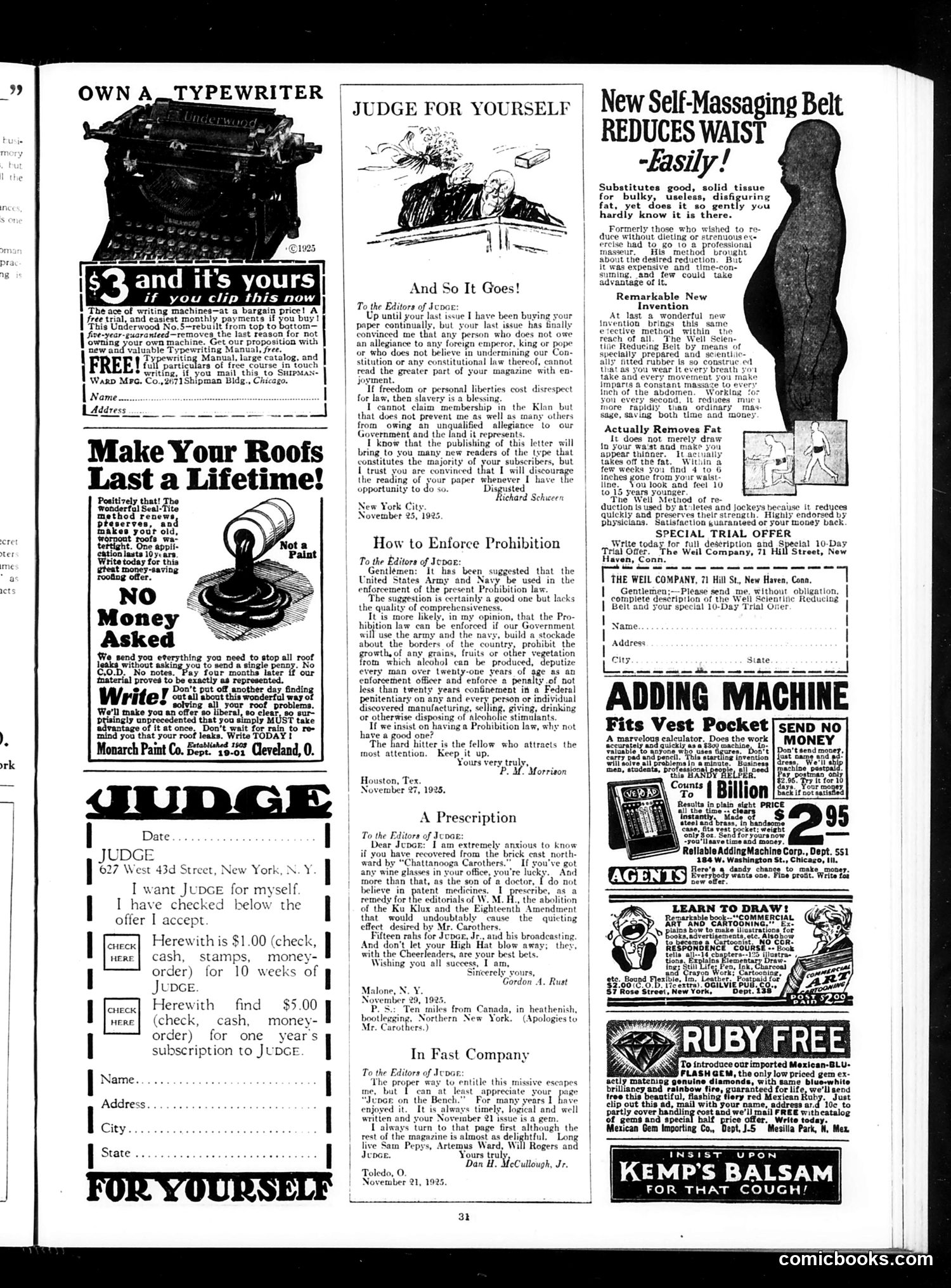
This page is primarily **advertisements and reader letters**, not political cartoons. The notable content is a letter titled "How to Enforce Prohibition" that satirizes the impracticality of Prohibition enforcement (the 1920s alcohol ban). The author mockingly proposes absurdly extreme measures: using the Army and Navy, building border stockades, prohibiting all grain/fruit cultivation, deputizing every adult, and imposing 20-year prison sentences for any alcohol involvement. The satire's point: these proposals expose how unenforceable Prohibition actually is. By taking the law's intent to its logical extreme, the writer ridicules both the law itself and those seriously debating its enforcement during this contentious period of American history. The other letters express criticism of Judge magazine for allegedly anti-government bias and attacks on patriotism—likely referencing Judge's editorial stance during post-WWI debates about national loyalty and constitutional interpretation.
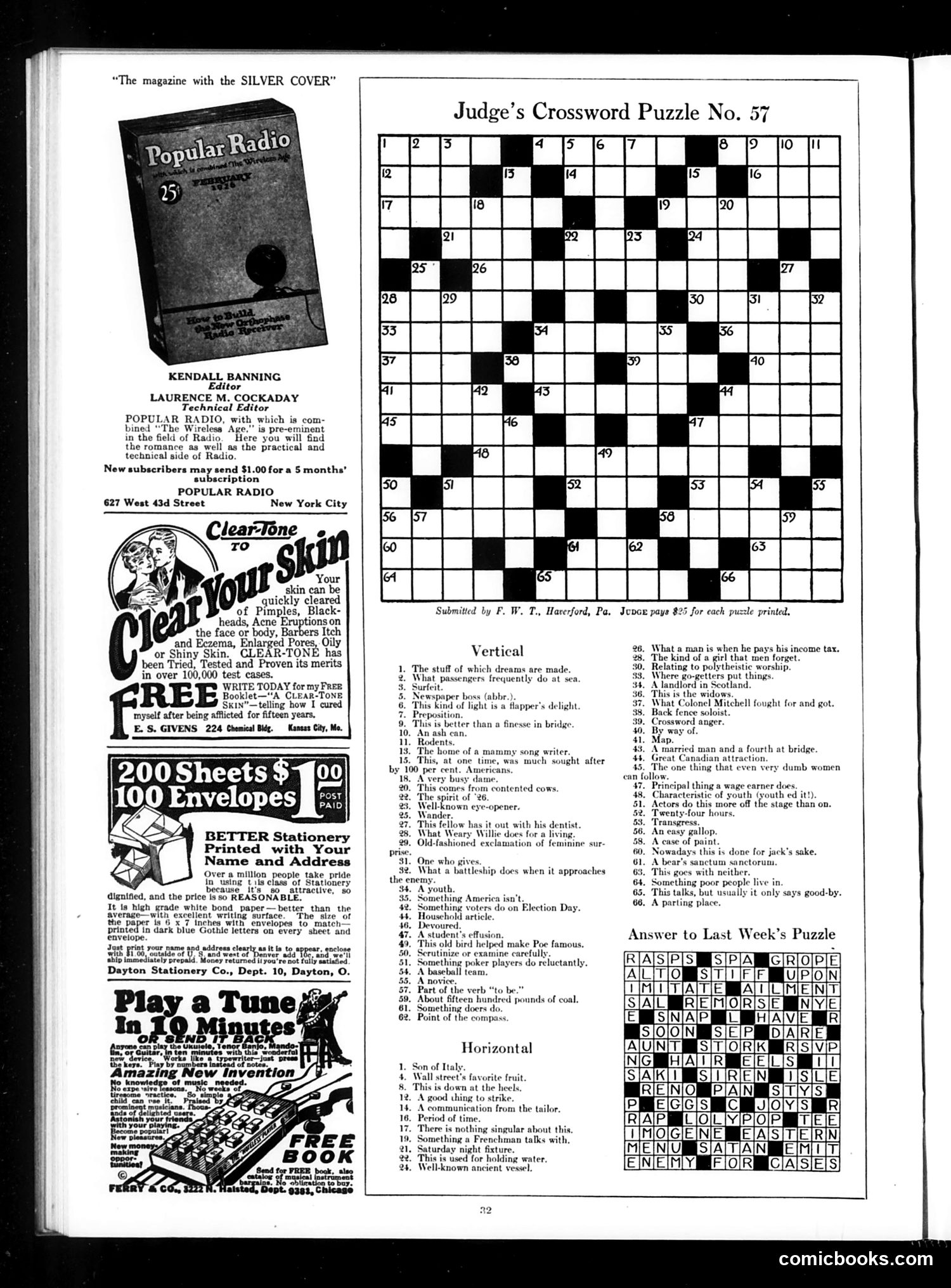
This page is primarily **advertising and puzzle content**, not political satire. The main feature is "Judge's Crossword Puzzle No. 57," a standard word puzzle typical of 1920s entertainment magazines. The advertisements reveal period-specific concerns: a "Clear-Tone" skin product promising to cure acne and blemishes (reflecting vanity culture); printed stationery services; and Popular Radio magazine promoting wireless technology as a cutting-edge field. The crossword clues contain period vernacular—references to "flappers" (modern young women of the 1920s), "go-getters," and phrases like "the spirit of '26" (meaning 1926). One clue mentions "Colonel Mitchell," likely Billy Mitchell, the controversial military aviator who fought for air power. There is **no obvious political cartoon** on this page. The content is straightforward commercial and entertainment material typical of Judge's revenue-generating sections, reflecting 1920s consumer culture and popular interests rather than social satire.
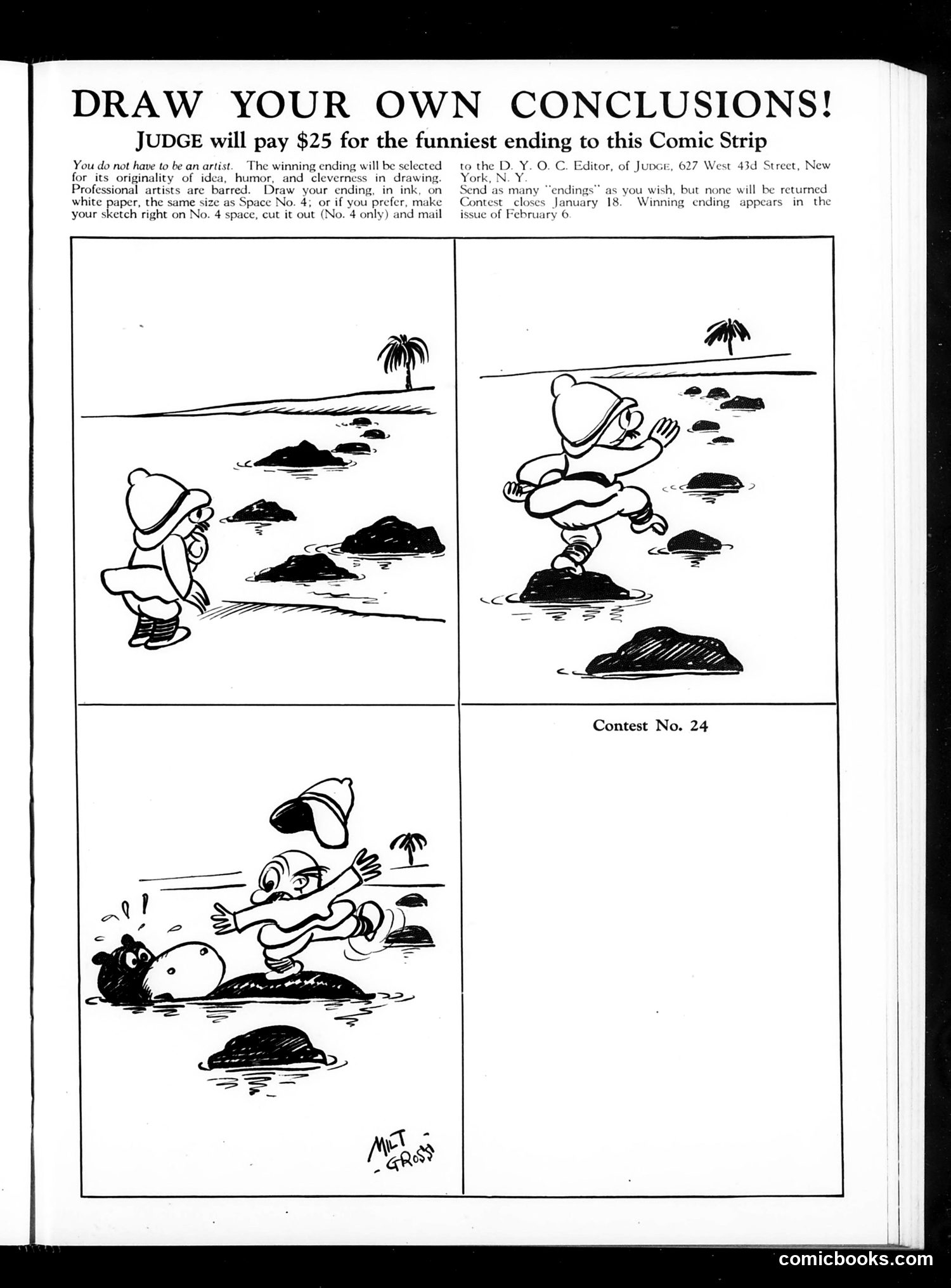
This is a **reader-participation contest page** from *Judge* magazine, not political satire. The page presents an incomplete comic strip showing a character in a desert setting with rocks and a palm tree, apparently in some kind of predicament or situation. The contest invites readers to draw their own humorous endings to the strip, with *Judge* offering a $25 prize for the funniest conclusion. Participants could submit ink drawings on white paper matching the size of the blank space provided (labeled "No. 4"), or draw directly in that space and mail their entries. The contest closed January 18, with winning entries to appear in the February 6 issue. This was a common *Judge* magazine feature—crowdsourcing humor from readers while generating engagement and content.
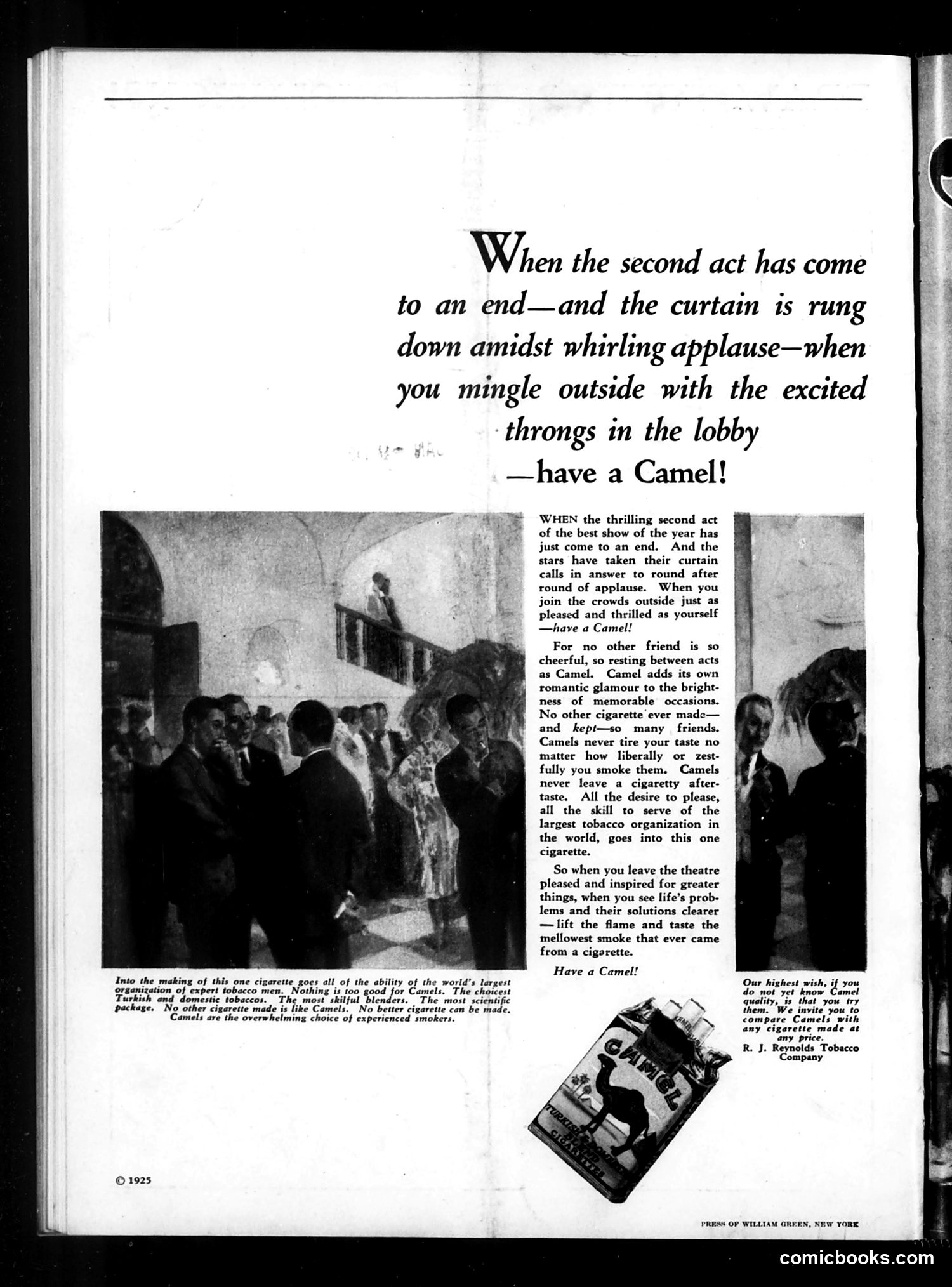
This is not a cartoon or satire—it's a **Camel cigarette advertisement** from 1925. The page uses the theatrical setting of an intermission to market cigarettes to affluent consumers. The image shows a crowded theater lobby scene. The ad associates Camel smoking with sophisticated leisure: attending Broadway-quality shows, mingling with "excited throngs," and enjoying life's refined moments. The copywriting emphasizes that Camels are the choice of "experienced smokers" and claims superior tobacco quality and lack of aftertaste. This represents mainstream 1920s advertising before health concerns about smoking were widely acknowledged. The R.J. Reynolds Tobacco Company positioned Camels as a status symbol and social lubricant for the cultured middle and upper classes—a "friend" for life's important occasions. By modern standards, the health claims are dubious, but the advertisement's appeal to aspiration and social belonging reflects period marketing strategy.