
Judge, 1926-01-09 · page 18 of 36
Judge — January 9, 1926 — page 18: what you’re looking at
What you’re looking at
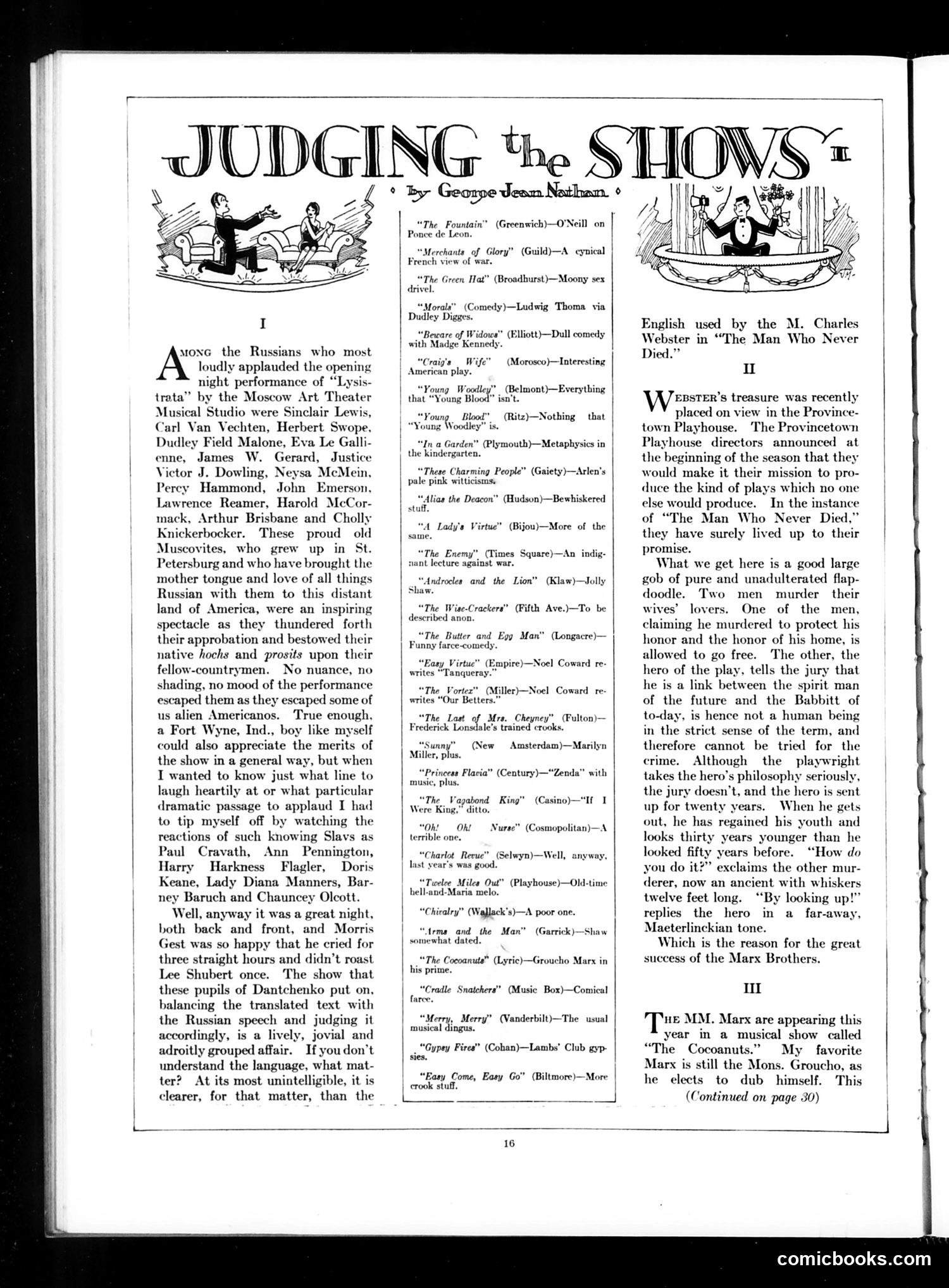
This page is a theater review column by George Jean Nathan, a prominent drama critic of the 1920s. The text is NOT a political cartoon—it's satirical theater criticism. **The Setup:** Nathan sarcastically describes Russian expatriates at the Moscow Art Theater's production of "Lysistrata" (the ancient Greek anti-war comedy), listing prominent attendees like Sinclair Lewis and Herbert Swope. He humorously suggests these Russians understood nuances he, a "Fort Wayne boy," had to decode by watching their reactions. **The Satire:** Nathan mocks both the pretentious audience members and himself for needing cultural guidance. He then provides caustic capsule reviews of current Broadway shows, using phrases like "moony sex drivel" and "pale pink witticisms" to dismiss plays as frivolous. **The Point:** This critiques 1920s theater culture—mocking both high-society sophistication and mediocre commercial productions. It's insider-focused satire for Judge's educated readership.
📄 Transcribed text from this page (OCR, searchable)
Machine-transcribed from the original scan — historical spelling and the odd misread are preserved.
JUDGING ‘he SHOWS * onc the Russians who most A loudly applauded the opening night performance of “‘Lysis- trata” by the Moscow Art Theater Musical Studio were Sinclair Lewis, Carl Van Vechten, Herbert Swope, Dudley Field Malone, Eva Le Galli- enne, James W. rard, Justice Victor J. Dowling, Neysa McMein, Perey Hammond, John Emerson, Lawrence Reamer, Harold McCor- mack, Arthur Brisbane and Cholly Knickerbocker. These proud old Muscovites, who grew up in St. Petersburg and who have brought the mother tongue and love of all things Russian with them to this distant land of America, were an inspiring spectacle as they thundered forth their approbation and bestowed their native hochs and prosits upon their fellow-countrymen. No nuance, no shading, no mood of the performance escaped them as they escaped some of us alien Americanos. True enough, a Fort Wyne, Ind., boy like myself could also appreciate the merits of the show in a general way, but when I wanted to know just what line to laugh heartily at or what particular dramatic p: e to applaud I had to tip myself off by watching the reactions of such knowing Slavs as Paul Cravath, Ann Pennington, Harry Harkness Flagler, Doris Keane, Lady Diana Manners, Bar- ney Baruch and Chauncey Olcott. Well, anyway it was a great night, both back and front, and Morris Gest was so happy that he cried for three straight hours and didn’t roast Lee Shubert once. The show that these pupils of Dantchenko put on, balancing the translated text with the Russian speech and judging it accordingly, is a lively, jovial and adroitly grouped affair. If youdon’t understand the language. ter? At its most unintelligible, it is clearer, for that matter, than the * By George Jeon Nathan. “The Fountain” (Greenwich)—O'Neill on Ponce de Leon. “Merchante of Glory” French view of war. (Guild)—A cynical | “The Green Hat” (Broadburst)—Moony sex drivel. “Morals” (Comedy)—Ludwig Thoma via Dudley Digge: “Beware of Widows” (Elliott)—Dull comedy with Madge Kennedy “Craig's Wife” — (Morosco)—Interesting American play. Young Woodley” (Belmont)—Everything that “Young Blood” isn’t. "Young Blood (Ritz)—Nothing that ung Woodley” is. “In a Garden” lymouth)—Metaphysics in the kindergarten. “These Charming People” (Gaiety)—Arlen's pale pink witticistns. 4 ae the Deacon” (Hudson)—Bewhiskered | stuff. { Lady's Virtue” (Bijou)—More of the The Enemy" (Times Square)—An indig- it lecture against war. | pidtndrocea and. the Lion” (Klaw)—Jolly “The Wise-Crackers” described anon. “The Butter and Egg Man” Funny farce-comedy. (Fifth Ave.)—To be (Longacre) — Empire)—Noel Coward re- “The, Vortex” (Miller)—Noel Coward re- writes “Our Betters.” “The Last of Mra. Cheyney” (Fulton)— Frederick Lonsdale’s trained crooks. “Sunny” (New Amsterdam)—Marilyn Miller, plus. “Princeas Flavia” (Century)—“Zenda” with music, plus. The Vagabond King” Were King,” ditto. (Casino)—"If 1 “Oh! — Oh! — Nurse” (Cosmopolitan)—A terrible one. “Charlot: Revue” Selwyn)—Well, last year's was good. anyway, “Twele Miles Out” hell-and-Maria melo. “Chivalry” (Wallack’s)—A poor one. (Playhouse)—Old “Arma and the Man” somewhat dated. (Garrick) —! “The Cocoanute” (Lyric)—Groucho Marx in his prime. i “Cradle Snatchers” (Music Box)—Comical farce. “Merry, Merry” (Vanderbilt)—The usual musical dingus. _“Gypay Fires” (Cohan)—Lambs’ Club gyp- sies. “Easy Come, Easy Go” (Biltmore)—More crook stuff. L English used by the M. Charles Webster in “The Man Who Never Died.” I Wesster’s treasure was recently placed on view in the Province- town Playhouse. The Provincetown Playhouse directors announced at the beginning of the season that they would make it their mission to pro- duce the kind of plays which no one else would produce. In the instance of “The Man Who Never Died,” they have surely lived up to their promise. W we get here is a good large gob of pure and unadulterated flap- doodle. Two men murder their wives’ lovers. One of the men, claiming he murdered to protect his honor and the honor of his home, is allowed to go free. The other, the hero of the play, tells the jury that he is a link between the spirit man of the future and the Babbitt of to-day, is hence not a human being in the strict sense of the term, and therefore cannot be tried for the crime. Although the playwright takes the hero's philosophy seriou: the jury doesn’t, and the hero is sent up for twenty years. When he gets out, he has regained his youth and looks thirty rs younger than he looked fifty years before. ‘‘How do you do it?” exclaims the other mur- derer, now an ancient with whiske: twelve feet long. ‘‘By looking up!” replies the hero in a far-away, Maeterlinckian tone. Which is the reason for the great success of the Marx Brothers. sang T= MM. Marx are appearing this year in a musical show called “The Cocoanuts.” My favorite Marx is still the Mons. Groucho, as he elects to dub himself. This (Continued on page 30) comicbooks.com