
Judge, 1926-01-09 · page 15 of 36
Judge — January 9, 1926 — page 15: what you’re looking at
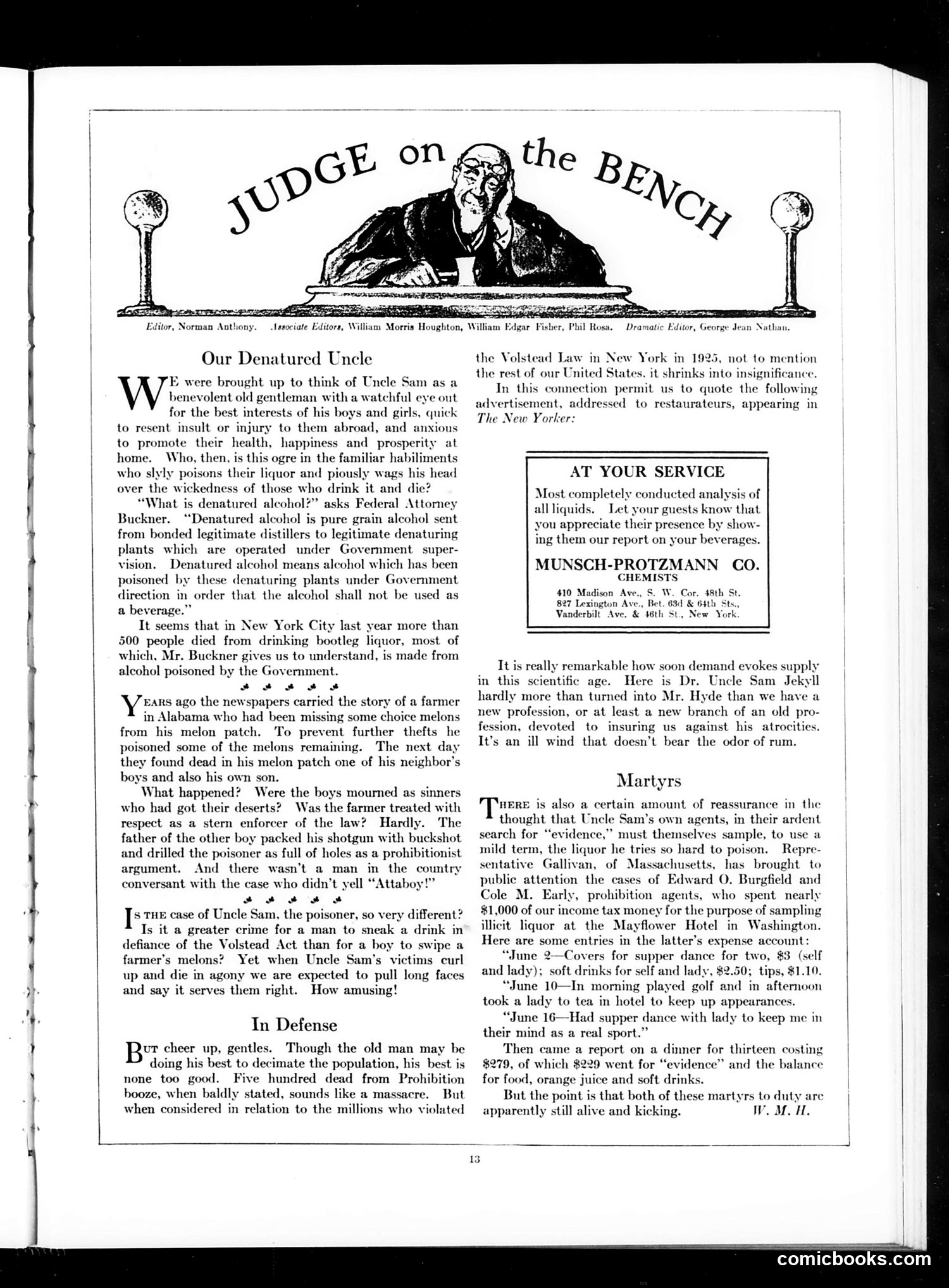
What you’re looking at
This article satirizes the U.S. government's contradictory stance during Prohibition (1920-1933). The central complaint: Uncle Sam enforces the Volstead Act by poisoning alcohol to prevent illegal drinking, yet this poisoned bootleg liquor kills over 500 New Yorkers yearly. The satire employs an analogy: a farmer who poison-traps melons to stop theft, killing his neighbor's son, would face lynching—yet the government faces no such consequence for intentionally distributing lethal poison. The article argues this hypocrisy is "amusingly" glossed over with moral posturing. The secondary joke targets profiteers: entrepreneurs now offer "chemical analysis services" to restaurants certifying beverage safety—profiting from the government's own poisoning policy. The closing reference to "Dr. Jekyll and Mr. Hyde" captures the core paradox: Uncle Sam presents himself as benevolent protector while acting as poisoner. The piece exposes Prohibition's deadly, unintended consequences and the moral inconsistency of enforcing it through state-sanctioned poisoning.
📄 Transcribed text from this page (OCR, searchable)
Machine-transcribed from the original scan — historical spelling and the odd misread are preserved.
ee ee Editor, Norman Anthony. Our Denatured Uncle ‘ X YE were brought up to think of Uncle Sam as a benevolent old gentleman with a watchful eye out for the best interests of his boys and girls, quick to resent insult or injury to them abroad, and anxious to promote their health, happiness and prosperity at home. Who, then, is this ogre in the familiar habiliments who slyly poisons their liquor and piously wags his head over the wickedness of those who drink it and die? “What is denatured alcohol?” asks Federal Attommey Buckner. “Denatured alcohol is pure grain alcohol sent from bonded legitimate distillers to legitimate denaturing plants which are operated under Government super- mn. Denatured alcohol means alcohol which has been poisoned by these denaturing plants under Government direction in order that the alcohol shall not be used as a beverage.” It seems that in New York City last year more than 500 people died from drinking bootleg liquor, most of which, Mr. Buckner gives us to understand, is made from alcohol poisoned by the Government. se oe we EARS ago the newspapers carried the story of a farmer n Alabama who had been missing some choice melons from his melon patch. To prevent further thefts he poisoned some of the melons remaining. The next day they found dead in his melon patch one of his neighbor's boys and also his own son. What happened? Were the boys mourned as sinners who had got their deserts? Was the farmer treated with respect as a stern enforcer of the law? Hardly. The father of the other boy packed his shotgun with buckshot and drilled the poisoner as full of holes as a prohibitionist argument. And there wasn’t a man in the country conversant with the case who didn’t yell “Attaboy!” te eee I s THE case of Uncle Sam, the poisoner, so very different? Is it a greater crime for a man to sneak a drink in defiance of the Volstead Act than for a boy to swipe a farmer's melons? Yet when Uncle Sam’s victims curl up and die in agony we are expected to pull long faces and say it serves them right. How amusing! In Defense B" cheer up, gentles. Though the old man may be doing his best to decimate the population, his best is none too good. Five hundred dead from Prohibition booze, when baldly stated, sounds like a massacre. But when considered in relation to the millions who violated fesociate Editors, William Morris Houghton, William Edgar Phil Rosa, Dramatic Editor, George Jean Nathan. the Volstead Law in New York in 1925, the rest of our United States. it shrinks into insignificance. In this connection permit us to quote the following advertisement, addressed to restaurateurs, appearing in The New Yorker: not to mention AT YOUR SERVICE Most completely conducted analysis of allliquids. Let your guests know that you appreciate their presence by show- ing them our report on your beverages. A UNSCH-PROTZMA) co. CHEMISTS ison A Cor. 48th St. 827 Lexington Ave., Bet. 63d & 64th Sts., Vanderbilt Ave. & 46th St, New York It is really remarkable how soon demand evokes supply in this scientific age. Here is Dr. Uncle Sam Jekyll hardly more than turned into Mr. Hyde than we have a new profession, or at least a new branch of an old pro- fession, devoted to insuring us against his atrocities. It’s an ill wind that doesn’t bear the odor of rum. Martyrs Taere is also a certain amount of reassurance in the thought that Uncle Sam’s own agents, in their ardent search for “evidence,” must themselves sample, to use a mild term, the liquor he tries so hard to poison. Repre- sentative Gallivan, of Massachusetts, has brought to public attention the cases of Edward O. Burgfield and Cole M. Early, prohibition agents, who spent nearly $1,000 of our income tax money for the purpose of sampling illicit liquor at the Mayflower Hotel in Washington. Here are some entries in the latter’s expense account: “June 2—Covers for supper dance for two, 83 (self and lady); soft drinks for self and lady, $2.50; tips, $1.10. “June 10—In morning played golf and in afternoon took a lady to tea in hotel to keep up appearances. “June 16—Had supper dance with lady to keep me in their mind as a real sport.” Then came a report on a dinner for thirteen costing $279, of which $229 went for “evidence” and the balance for food, orange juice and soft drinks. But the point is that both of these martyrs to duty are apparently still alive and kicking. W. MH. comicbooks.com