
A complete issue · 36 pages · 1926
Judge — January 2, 1926
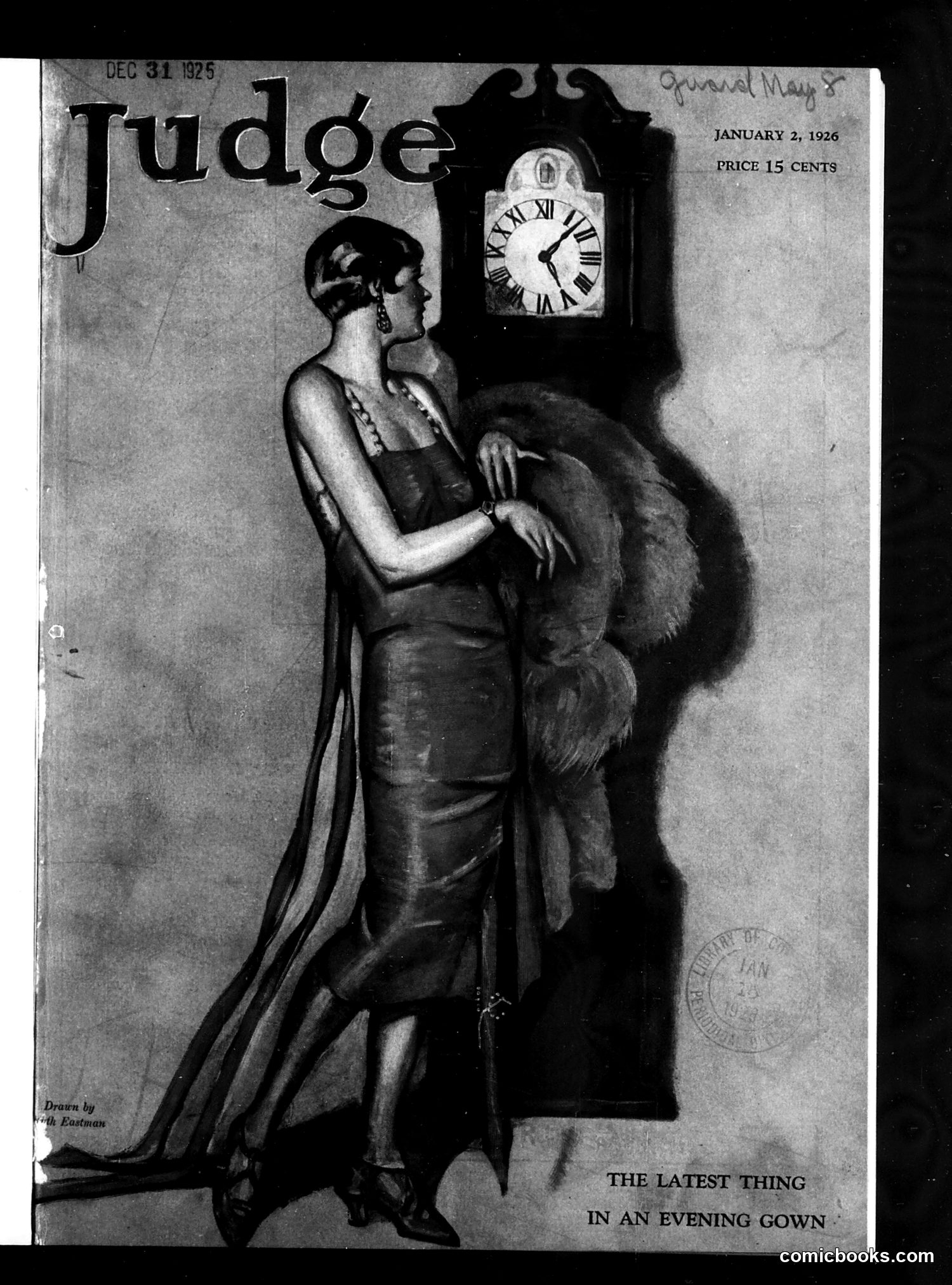
This is a fashion-focused cover from Judge magazine's January 2, 1926 issue, priced at 15 cents. The illustration, drawn by Ralph Eastman, depicts an elegant woman in an evening gown with a fur stole, gazing at a grandfather clock showing approximately 3 o'clock. The caption "The Latest Thing in an Evening Gown" appears to be satirizing 1920s fashion trends. The woman's sleek, dropped-waist silhouette and minimal ornamentation reflect the "flapper" era aesthetic that dominated the decade. The clock's prominent placement may suggest commentary on fashionable evening wear or the timing of social events, though the specific satirical point remains somewhat unclear from the image alone. This represents typical Judge magazine content: fashion satire for an educated, middle-class audience.
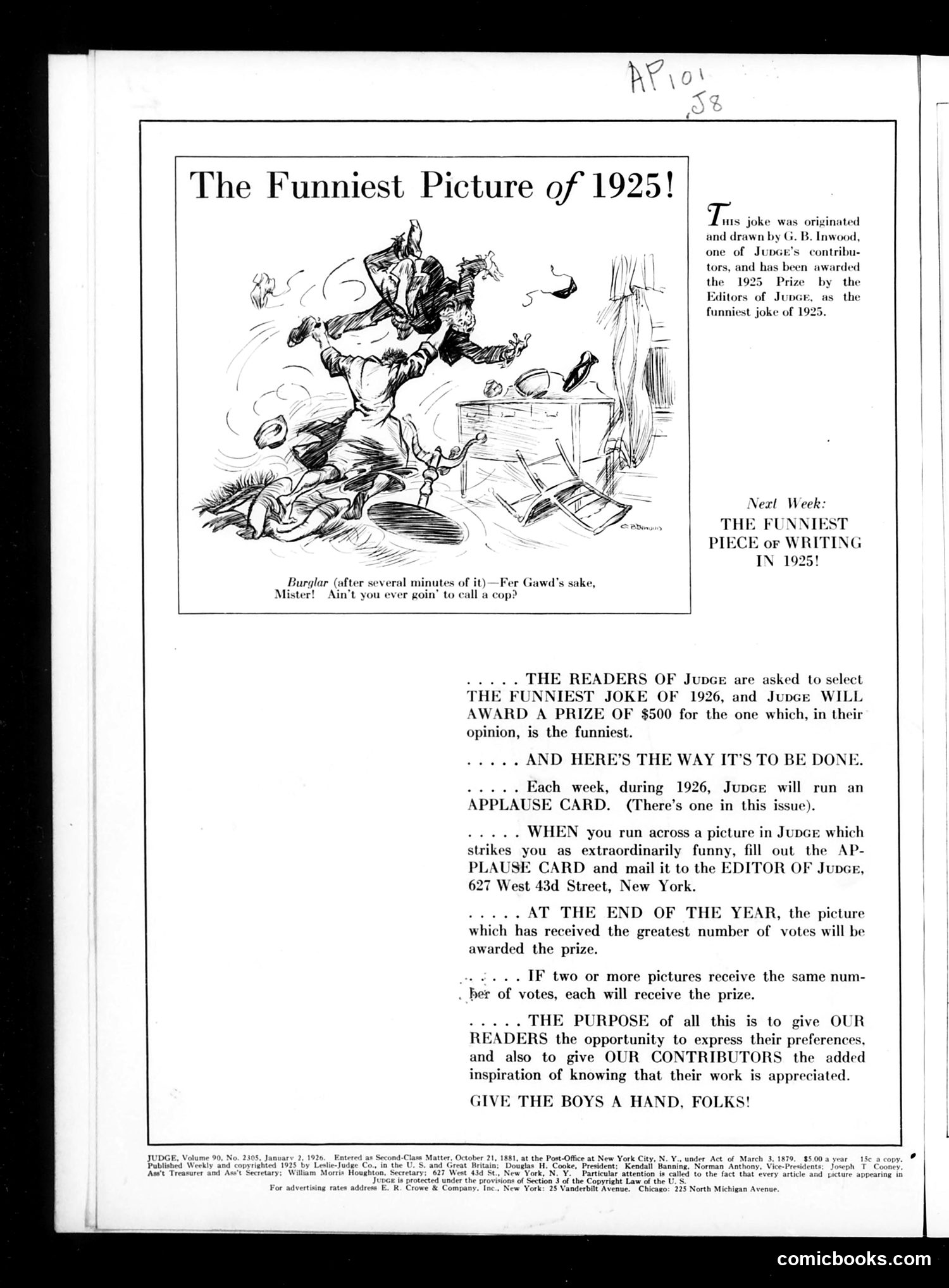
This page features Judge magazine's 1925 humor contest announcement alongside a cartoon by G.B. Inwood. The winning cartoon depicts a burglar caught mid-robbery, surrounded by chaos—overturned furniture, scattered objects, and what appears to be a small dog attacking him. The burglar's exasperated caption reads: "For Gawd's sake, Mister! Ain't you ever goin' to call a cop?" The joke plays on role reversal: typically, a burglar fears police intervention, but here he's desperately pleading for law enforcement to *stop* the homeowner's aggressive response (likely the dog and/or owner). The humor derives from the burglar being more threatened by civilian resistance than legal consequences. The page primarily announces Judge's 1926 reader contest to select the year's funniest joke, offering a $500 prize.
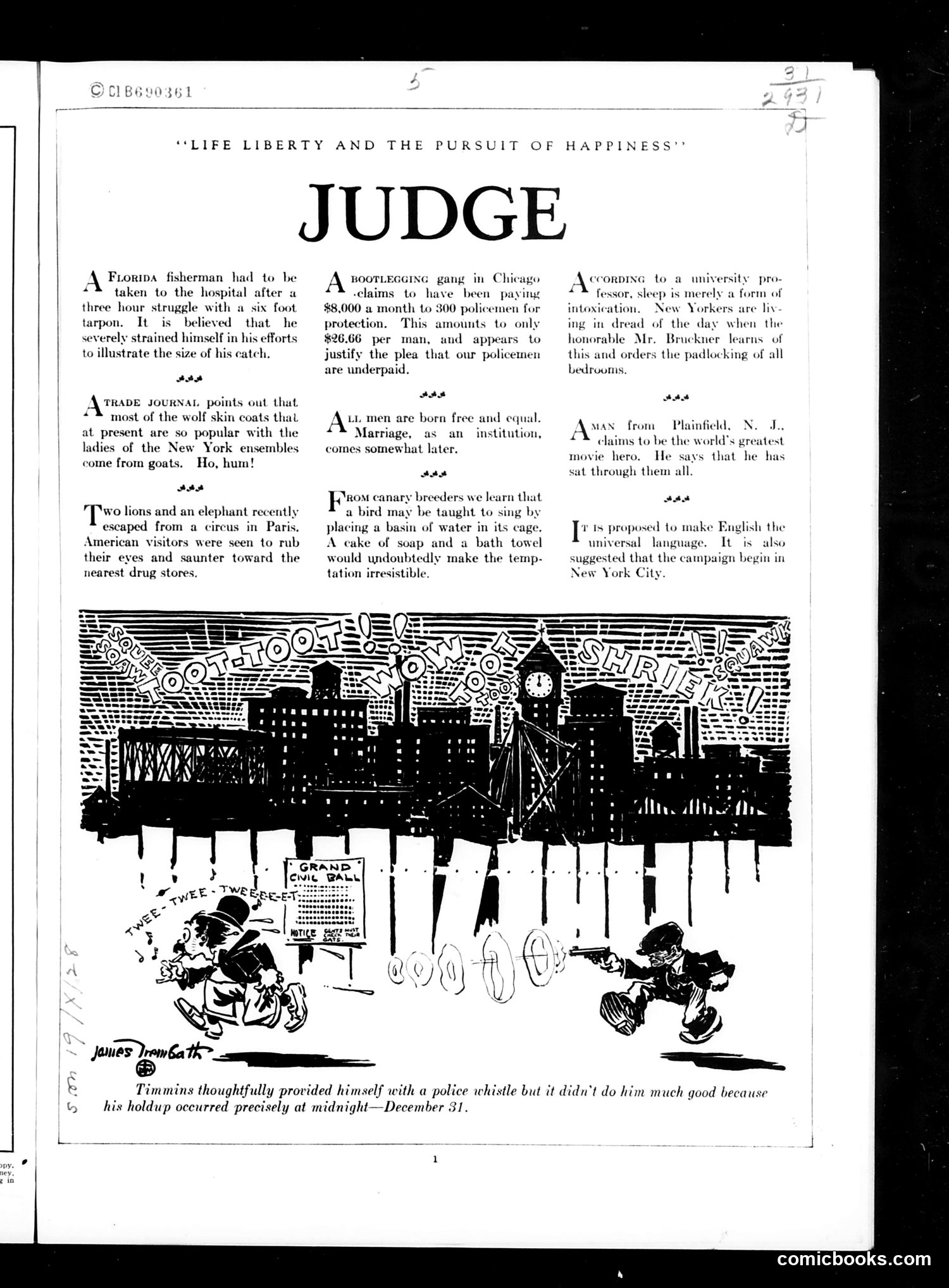
This page from Judge magazine contains a satirical cartoon by James Montgomery Flagg accompanying brief humorous anecdotes. The main cartoon depicts two figures running away from a nighttime city scene with a police vehicle visible. The caption explains the joke: someone named "Timmins" obtained a police vehicle for a holdup, but his robbery occurred at midnight on December 31st—likely New Year's Eve—when police were presumably occupied elsewhere, rendering the stolen vehicle useless for his criminal purposes. The surrounding text consists of unrelated satirical observations about contemporary topics: police underpayment, Chicago bootleggers, New York socialites, escaped circus animals in Paris, and proposals to make English a universal language. The humor relies on timing and irony—the criminal's careful planning undermined by bad luck.
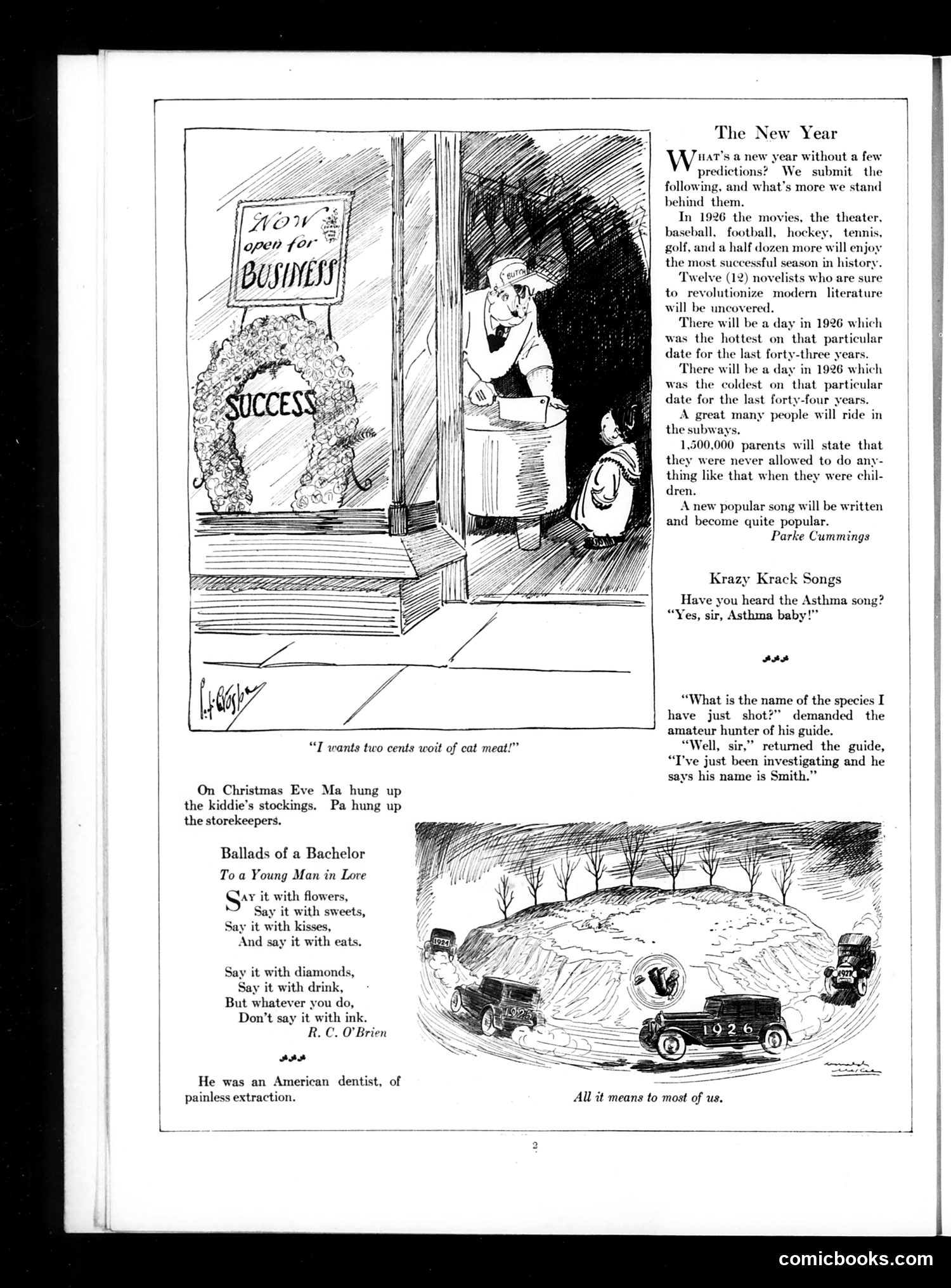
The top cartoon satirizes American optimism about business success. A figure labeled "Not open for BUSINESS" displays "SUCCESS" in a window—a visual contradiction suggesting that business success remains inaccessible despite American confidence. The character wants "two cents worf of cat meat," highlighting economic hardship and modest purchasing power during this period. Below are lighter pieces: "Krazy Krack Songs" offers humorous song titles ("Yes, sir, Asthma baby!"), and "Ballads of a Bachelor" presents romantic advice in verse form. The bottom illustration showing 1926 vehicles represents New Year's optimism about modern transportation and progress. The page reflects 1926 American attitudes—mingling economic anxiety with faith in technological advancement and popular entertainment.
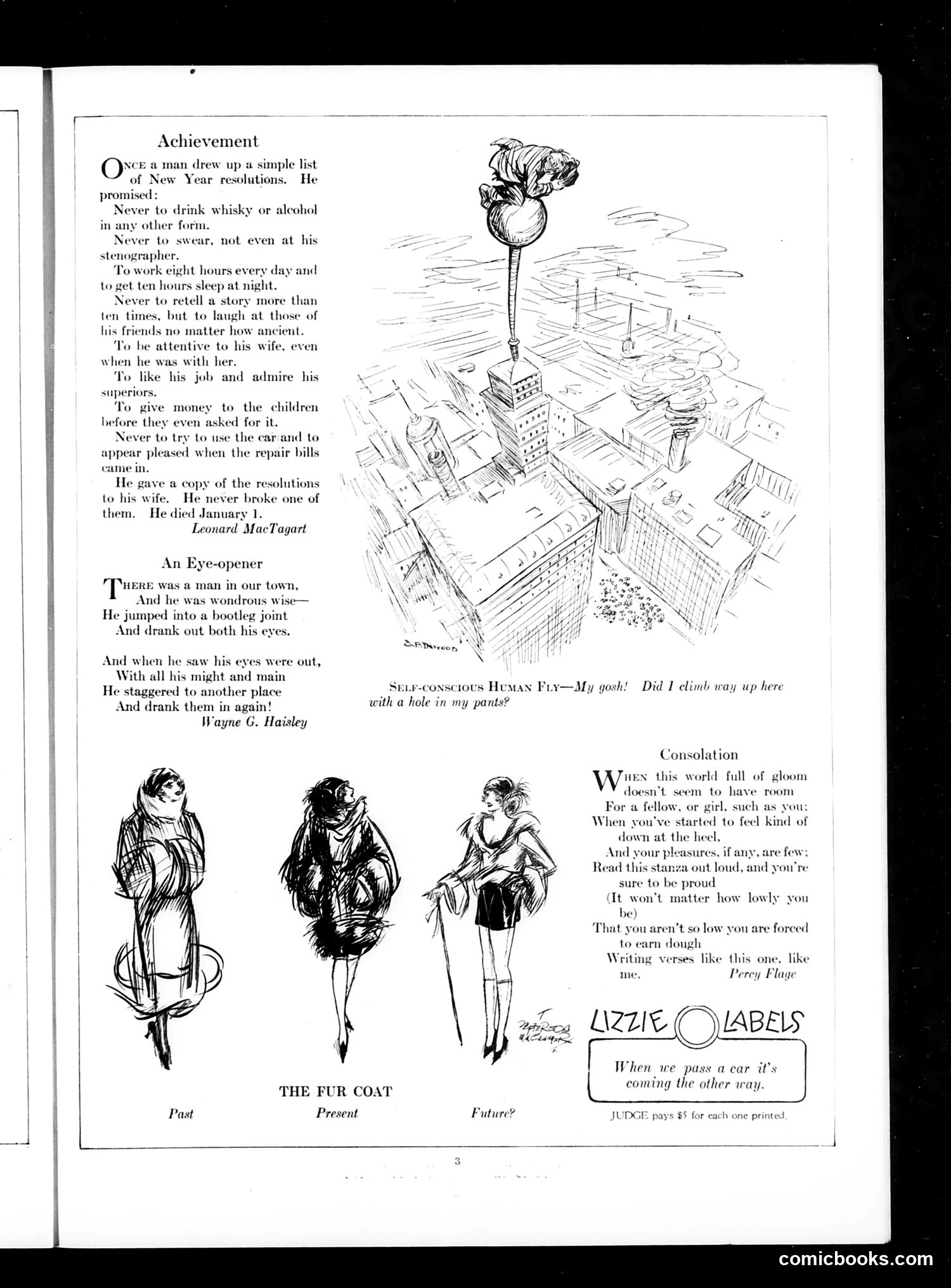
This page contains humorous verses and illustrations rather than political satire. The main content includes: **"Achievement"** - A biographical tribute to someone (author Leonard MacTaggart) listing his New Year's resolutions: abstinence from alcohol, profanity, hard work, sleep discipline, and marital attentiveness. He died January 1st, suggesting the resolutions were short-lived—a common satirical joke about failed New Year's promises. **"An Eye-opener"** and **"Consolation"** - Poems about drinking and social disappointment, typical of Judge's humor. **"The Fur Coat"** - Three fashion illustrations showing a woman's wardrobe evolution labeled "Past," "Present," and "Future," likely satirizing changing fashions or women's materialism. **"Lizzie Labels"** - A small comic feature offering prizes for submitted captions. The page emphasizes social humor and fashion satire rather than political commentary.
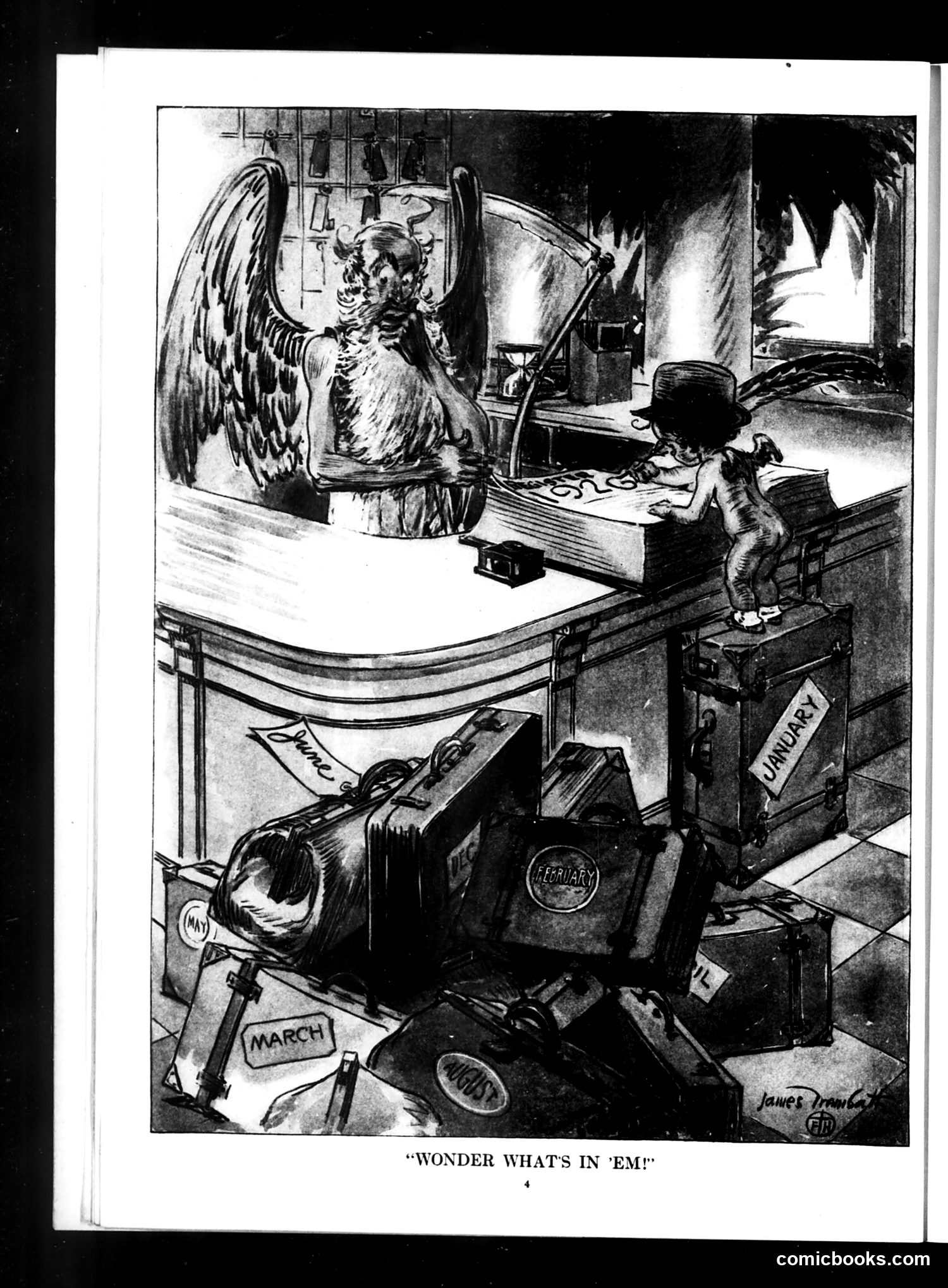
This political cartoon depicts an angel or winged figure examining filing cabinets labeled with months (visible: "January," "February," "March"). A small devil-like creature peers curiously at the files from atop a desk. The title "Wonder What's In 'Em!" suggests mystery or suspicion about hidden contents. The cartoon likely satirizes government or institutional secrecy—the contrast between angelic authority and devilish curiosity implies tension between transparency and concealment. The monthly organization suggests these are records or documents being deliberately kept from public view. This reflects early-to-mid 20th century concerns about bureaucratic opacity and what classified or hidden information might reveal about official conduct.
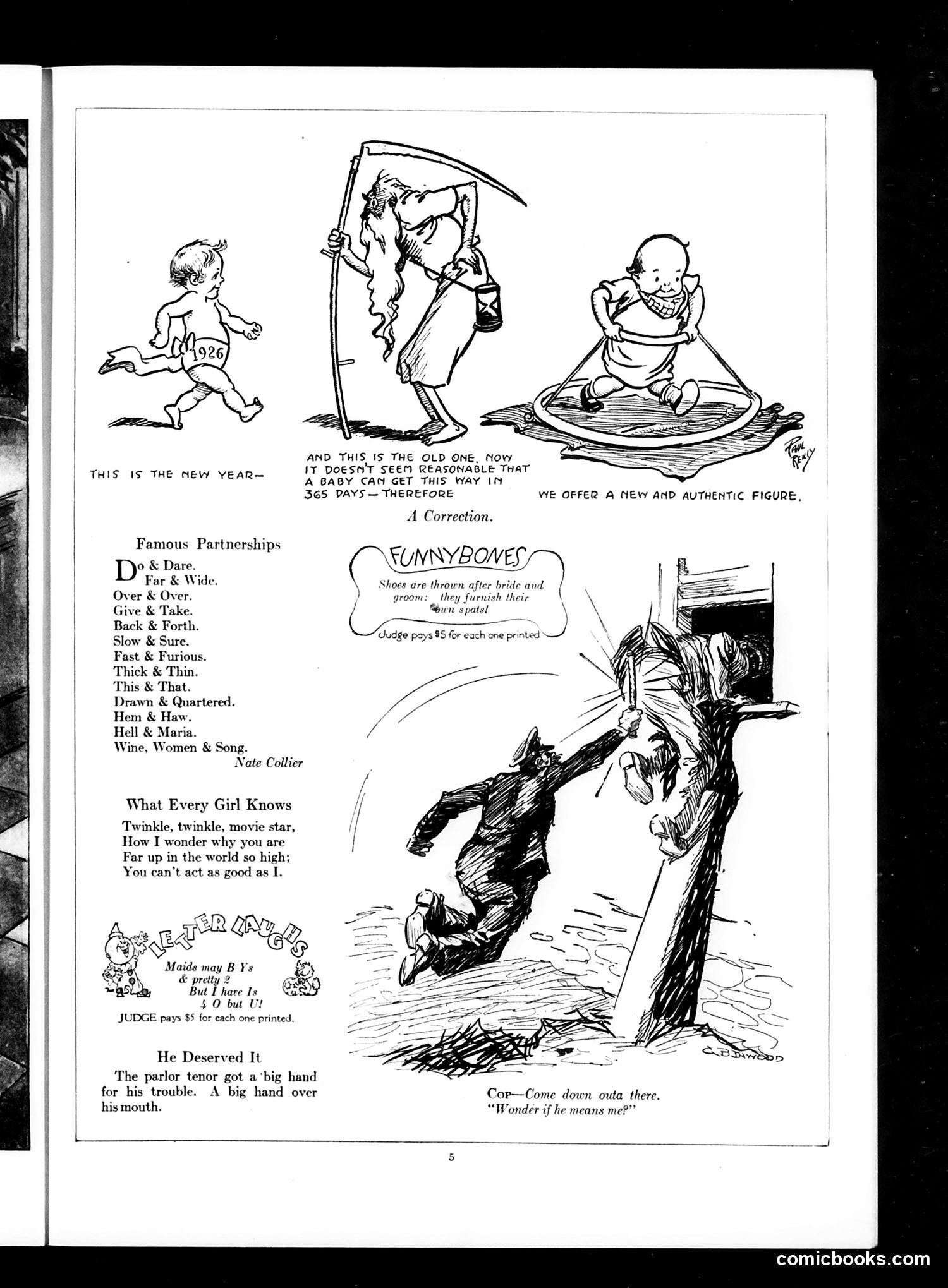
This page contains mostly **humor and light satire** rather than political commentary. The top cartoon "A Correction" jokes about New Year's resolutions: it contrasts 1926 (depicted as an energetic baby) with the exhausted "old year" (Death with a scythe), suggesting babies need 365 days to mature while the departing year looks worn out. The page also includes **wordplay humor** sections like "Famous Partnerships" (listing contrasting phrase pairs) and "What Every Girl Knows" (a parody of the nursery rhyme "Twinkle, Twinkle, Little Star"). The bottom cartoon depicts a rural scene with unclear context—possibly a joke about attempted harm or threat ("Come down outa there. Wonder if he means me?"). Overall, this appears to be a **general humor and entertainment page** with minimal political content.
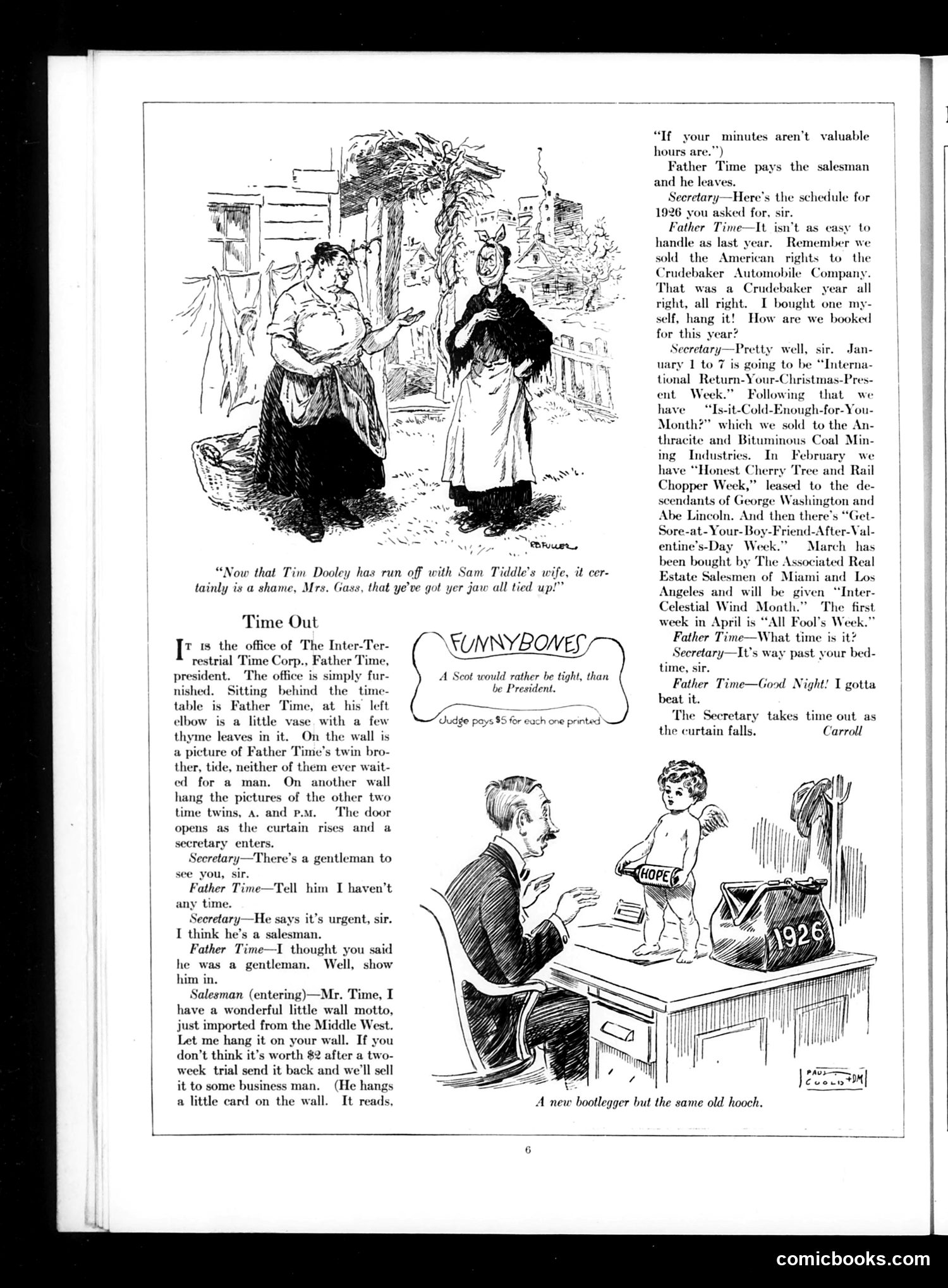
This page contains two satirical pieces about commercialization and American business culture in the 1920s. **Main Cartoon:** "Time Out" personifies Father Time as a busy executive whose schedule is sold off in themed weeks to various industries—much like modern advertising campaigns. The satire mocks how American commerce has commodified even abstract concepts. References include the Studebaker automobile company (misspelled "Crudebaker"), coal mining industries, and real estate salesmen in Miami and Los Angeles, suggesting how thoroughly corporate America had penetrated everyday life by 1926. **"Funny Bones" Section:** A salesman tries to sell Father Time a motivational wall motto ("A Scot would rather be tight, than be President"), satirizing the era's obsession with mass-produced business aphorisms and sales tactics. The broader joke: even Time itself cannot escape being packaged and sold—a commentary on American capitalism's reach into all corners of life.
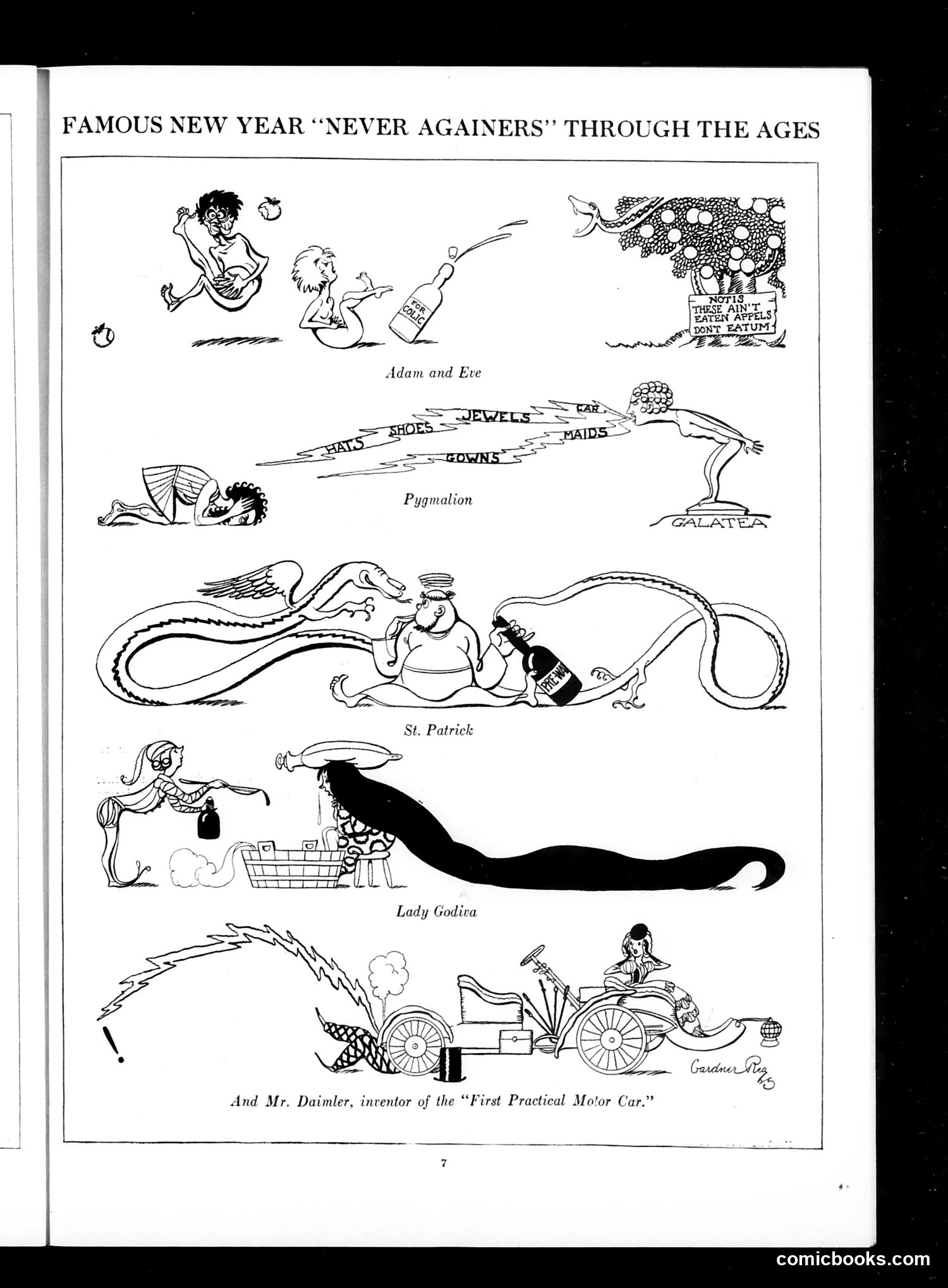
This page satirizes famous historical figures as "Never Againers"—people who swore they'd never repeat past mistakes. Each cartoon depicts them failing to keep such resolutions: **Adam and Eve** represent the original sin they promised never to repeat. **Pygmalion** shows a figure pursuing materialistic desires (hats, shoes, jewels, maids, gowns). **St. Patrick** depicts him struggling with snakes despite his legendary feat of banishing them. **Lady Godiva** shows her riding naked again despite her famous one-time sacrifice. **Mr. Daimler** (motorcar inventor) appears unable to resist driving despite apparent accidents. The joke: humans—even the most famous—inevitably repeat their mistakes and vices despite New Year's resolutions. It's a cynical commentary on human nature and the futility of self-improvement promises.
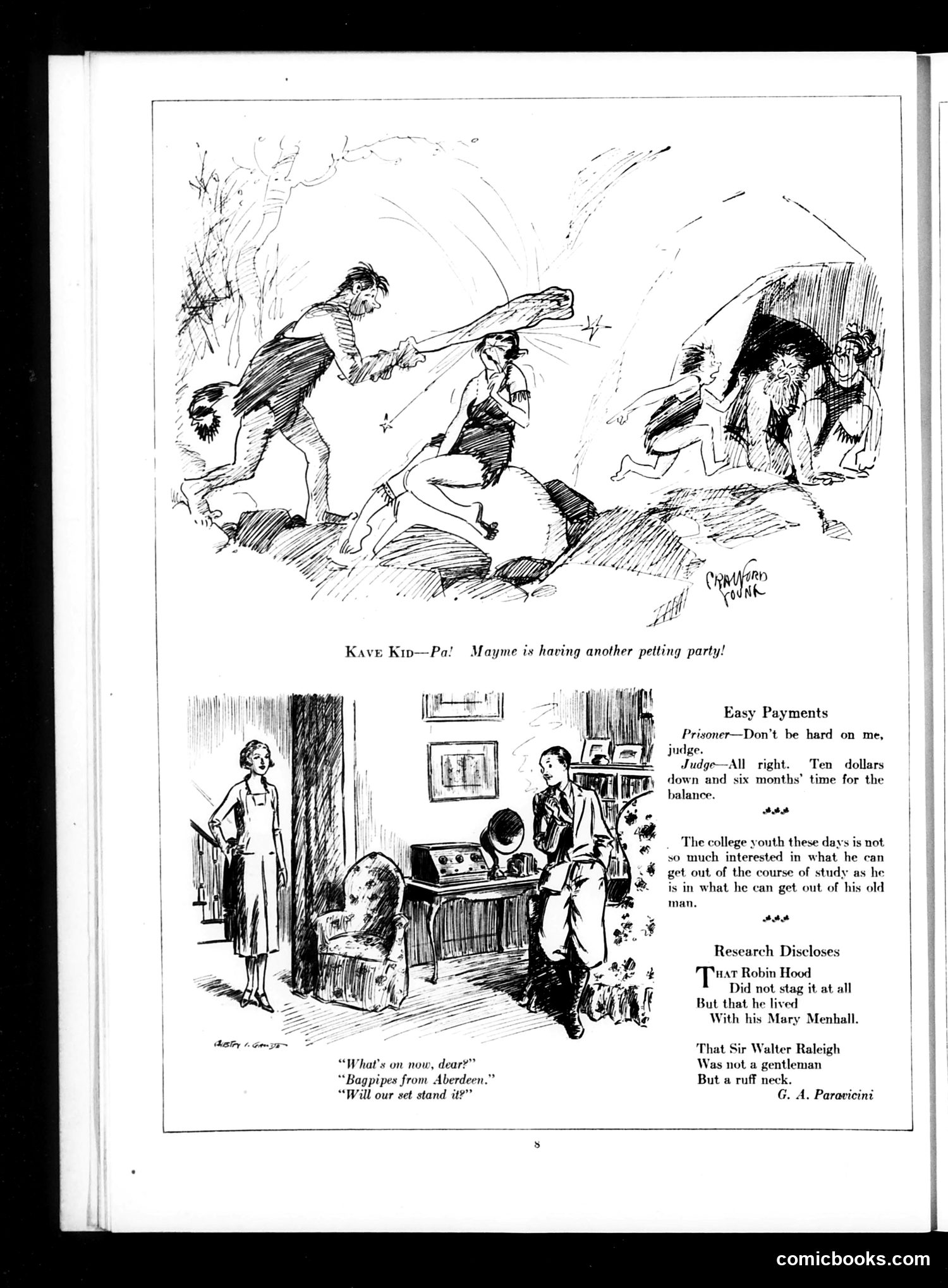
This page contains three separate satirical pieces: **"Kave Kid" cartoon (top):** Depicts children engaged in a "petting party"—a 1920s-era term for young people kissing and physical affection. The parent's exasperated cry suggests moral concern about youth behavior, satirizing contemporary anxieties over loosening social standards among the young. **"Easy Payments" cartoon (middle):** A judge offers an imprisoned criminal installment-plan sentencing—ten dollars down, six months to pay the balance. This mocks both lenient justice and the era's aggressive consumer "easy payment" financing schemes by absurdly applying commercial language to criminal punishment. **"Research Discloses" (right):** Brief, humorous "historical corrections" debunking romantic legends—Robin Hood lived with "Mary Menhall" rather than robbing the rich; Sir Walter Raleigh was merely a "ruff neck" (working-class laborer), not a gentleman. These jokes deflate historical mythology through crude reinterpretation. Overall, the page satirizes youth morality, judicial leniency, consumer credit culture, and mythmaking.
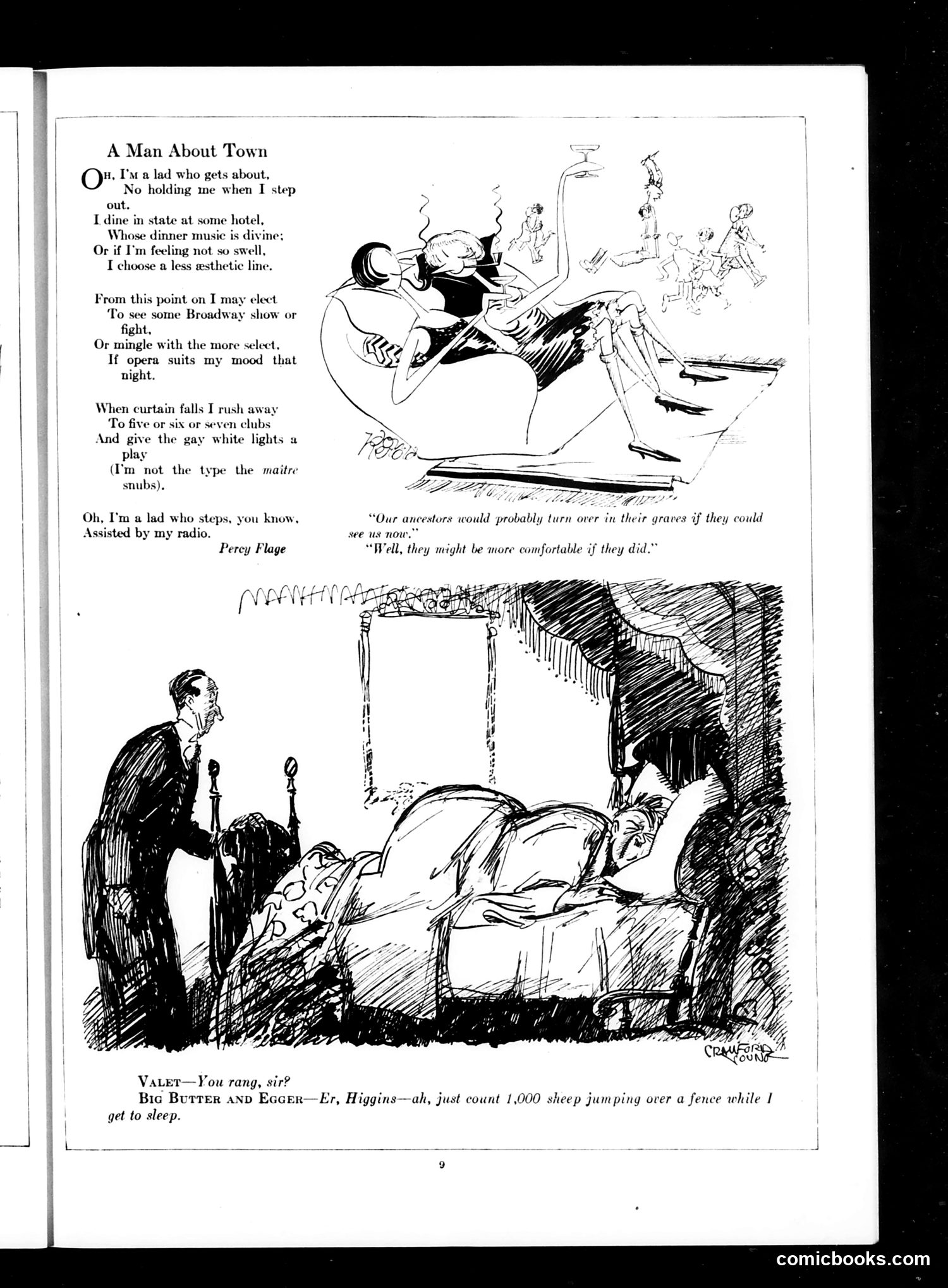
This page satirizes the leisure lifestyle of a wealthy urban bachelor in the Jazz Age. The poem by Percy Flage depicts a man constantly moving between hotels, Broadway shows, fights, exclusive clubs, and opera—spending lavishly on entertainment and dining while claiming to be "a lad who gets about." The bottom cartoon mocks this lifestyle's absurdity: the man rings his valet at night, then—rather than engaging in any cultured activity—asks the servant to count 1,000 sheep jumping a fence to help him sleep. This deflates the pretentious image presented above. The joke: despite all his expensive entertainments and "select" venues, he still needs childish sleep aids. The satire critiques both the shallow materialism of the wealthy leisure class and the contradiction between their sophisticated self-image and mundane reality. The "radio" reference suggests modern convenience culture enabling this lifestyle.
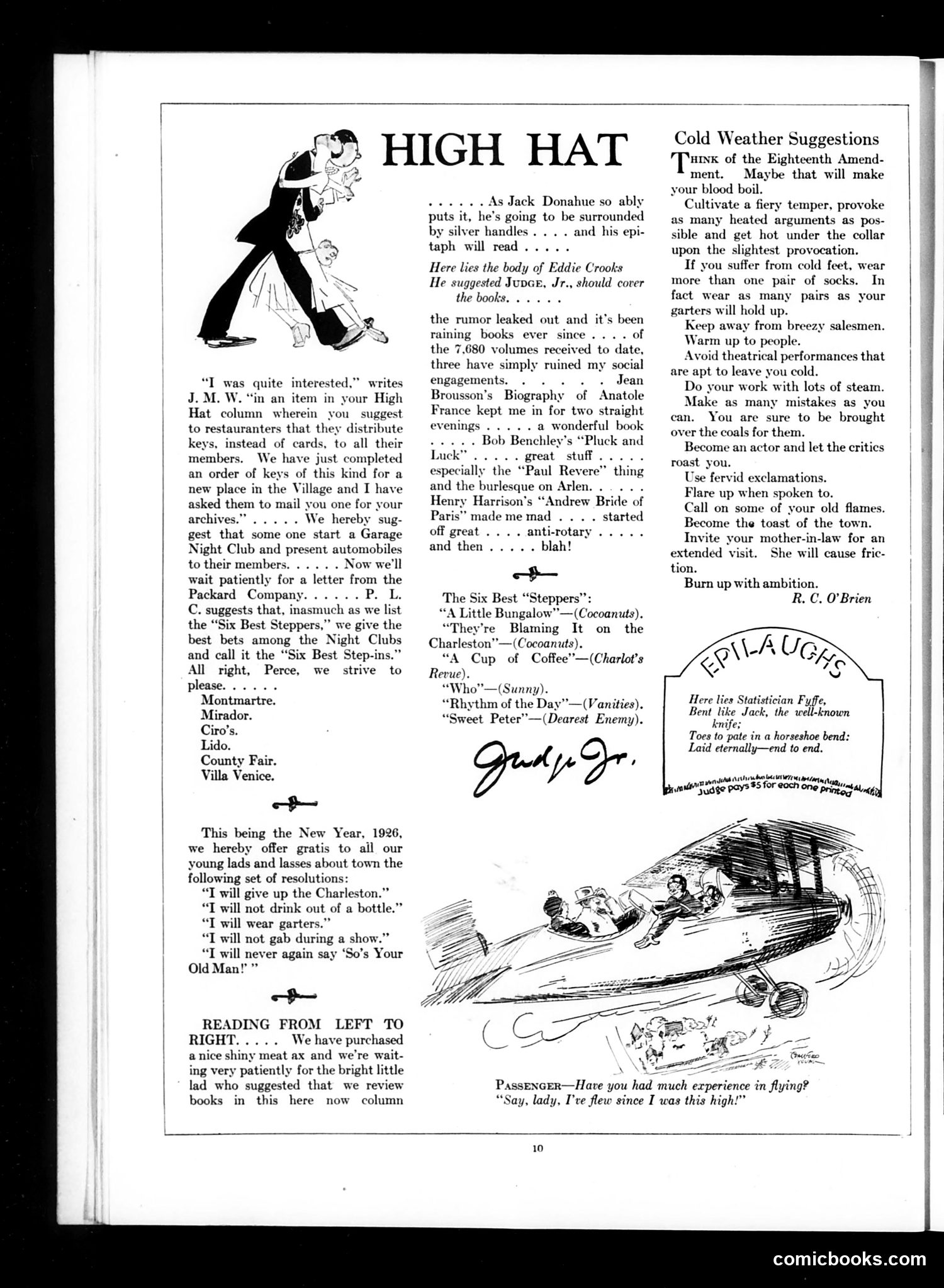
This is a satirical column from Judge magazine (1926) mocking contemporary trends and reader suggestions. The main targets are: **Prohibition-era nightlife**: References to speakeasies ("Night Clubs," venues like Ciro's and Montmartre) and the ironic "resolutions" (giving up Charleston dancing, not drinking from bottles) satirize the hypocrisy of the Jazz Age during Prohibition. **Reader mockery**: The column ridicules a correspondent who suggested restaurants distribute keys to members instead of cards—implying exclusive access to illegal establishments. Judge sarcastically suggests someone start a "Garage Night Club" giving away automobiles to members, escalating the absurdity. **Book review complaint**: An irritated editor mentions receiving 7,680 book volumes after a reader suggested covering books, sarcastically "killing off" the suggester (Eddie Crooks) in a mock epitaph. **Cold weather humor**: Unrelated advice column playing on double meanings ("get hot under the collar," "burn up with ambition"). The cartoon shows passengers in an early airplane—visualizing the era's fascination with aviation as modern entertainment.
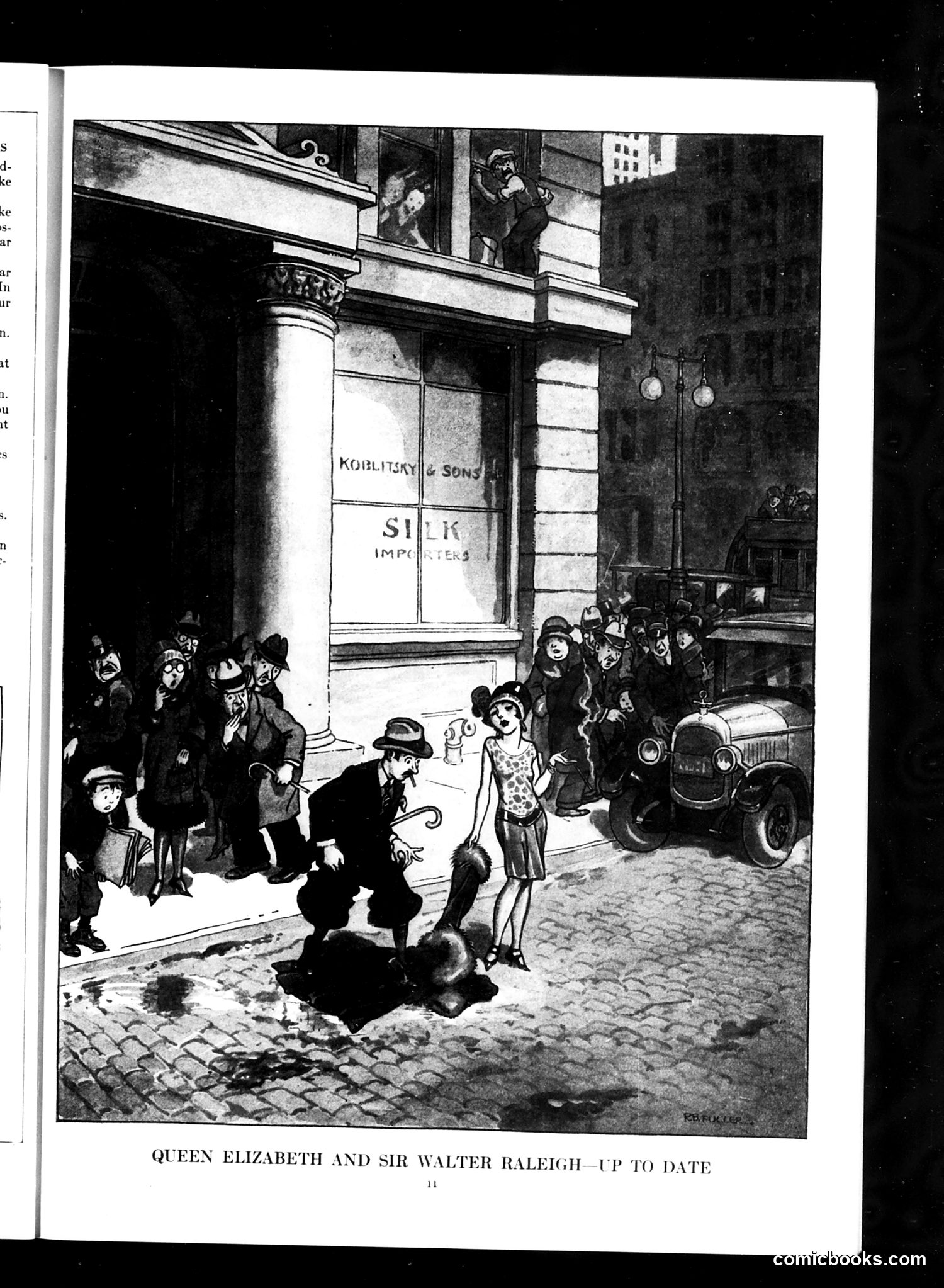
This cartoon depicts a modernized, comedic version of the historical meeting between Queen Elizabeth I and Sir Walter Raleigh. The scene transposes the Elizabethan-era figures into a 1920s urban setting, complete with period automobiles, storefronts, and fashionably-dressed pedestrians in contemporary clothing and hats. The storefront visible reads "Koblitsky & Sons" with "Silk Importers," suggesting a commercial Manhattan street scene rather than a royal court. The satire appears to mock the romanticized historical narrative by placing these legendary figures in mundane, modern commercialism—reducing grand historical drama to everyday city life. This "up to date" juxtaposition was characteristic of Judge magazine's humor: deflating pretension by applying historical narratives to contemporary, ordinary circumstances.
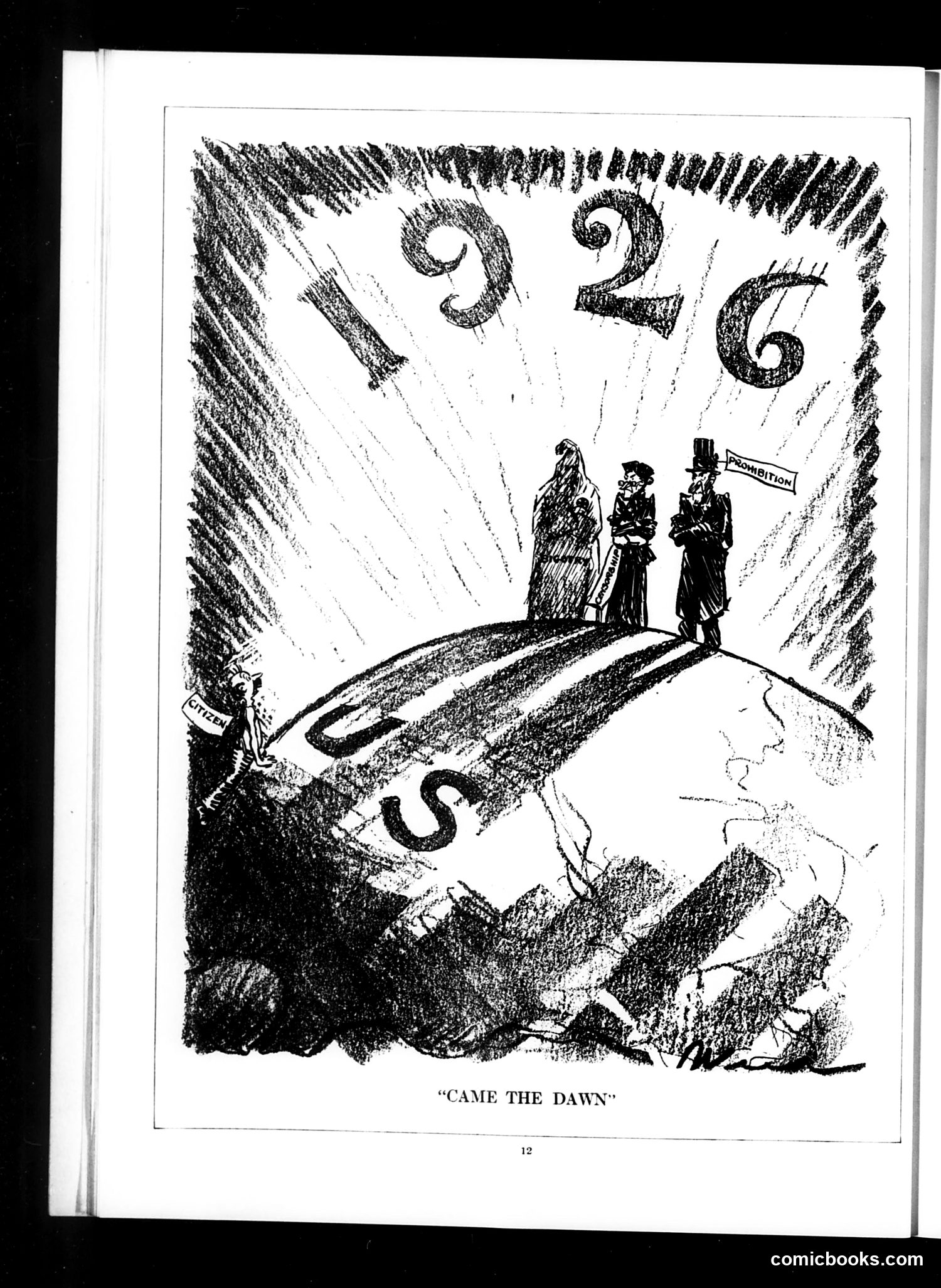
This cartoon depicts three figures standing on a mountainous landscape marked with numbers 1926, gazing at large numerals (1, 9, 2, 7, 6) looming above them. One figure holds a "Prohibition" banner. The cartoon appears to reference **Prohibition-era politics**, likely satirizing concerns about what the coming year (possibly 1927) would bring under continued alcohol prohibition policies. The "Citizen" label on the left figure suggests commentary on ordinary Americans' perspective. The ominous tone—with dark shading and dramatic lighting—implies foreboding rather than optimism about the future direction of Prohibition enforcement or its consequences. Without additional context, the specific political figures or events referenced remain unclear, though the cartoon critiques Prohibition's ongoing impact on American society.
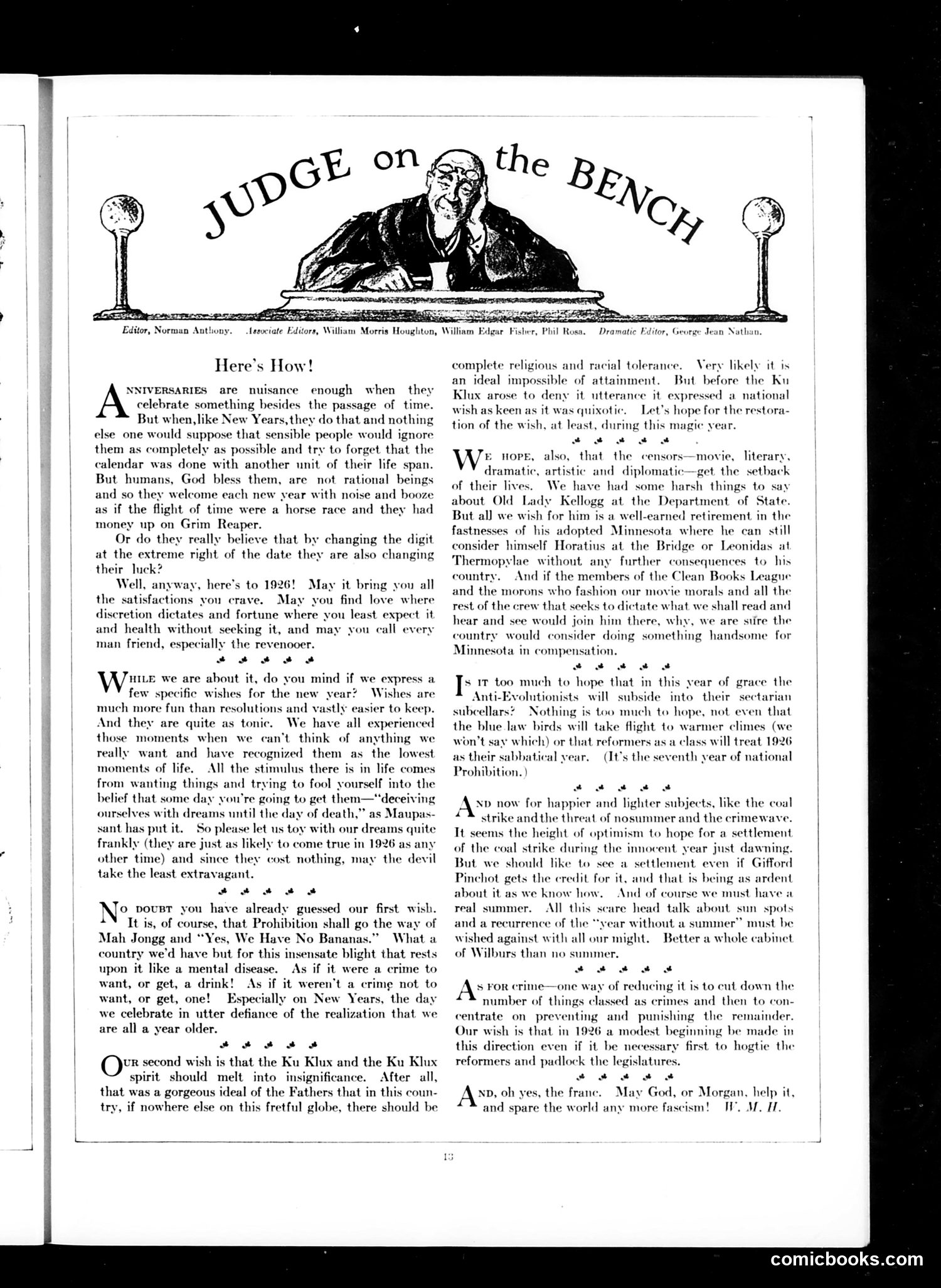
This editorial column presents satirical "wishes" for the coming year, disguised as New Year's resolutions. The primary targets are: **Prohibition**: The writer sarcastically wishes for its repeal, comparing it to forgotten fads like Mah Jongg. The underlying point: Prohibition is an absurd, unenforceable law that violates personal freedom. **The Ku Klux Klan**: The piece wishes for the KKK's decline, framing American tolerance as a "gorgeous ideal of the Fathers" that the Klan threatens. This reflects 1920s concerns about the KKK's resurgence and racial/religious intolerance. **Movie/Literary Censorship**: References "Old Lady Kellogg" (likely Frank Kellogg, Secretary of State) and the "Clean Books League," mocking moral censorship efforts as restrictive. **Anti-Evolution Movement**: A final jab at religious fundamentalists opposing evolution in schools. The tone is sophisticated mockery—wishing these nuisances would "go away" rather than directly attacking them, reflecting Judge's educated readership.
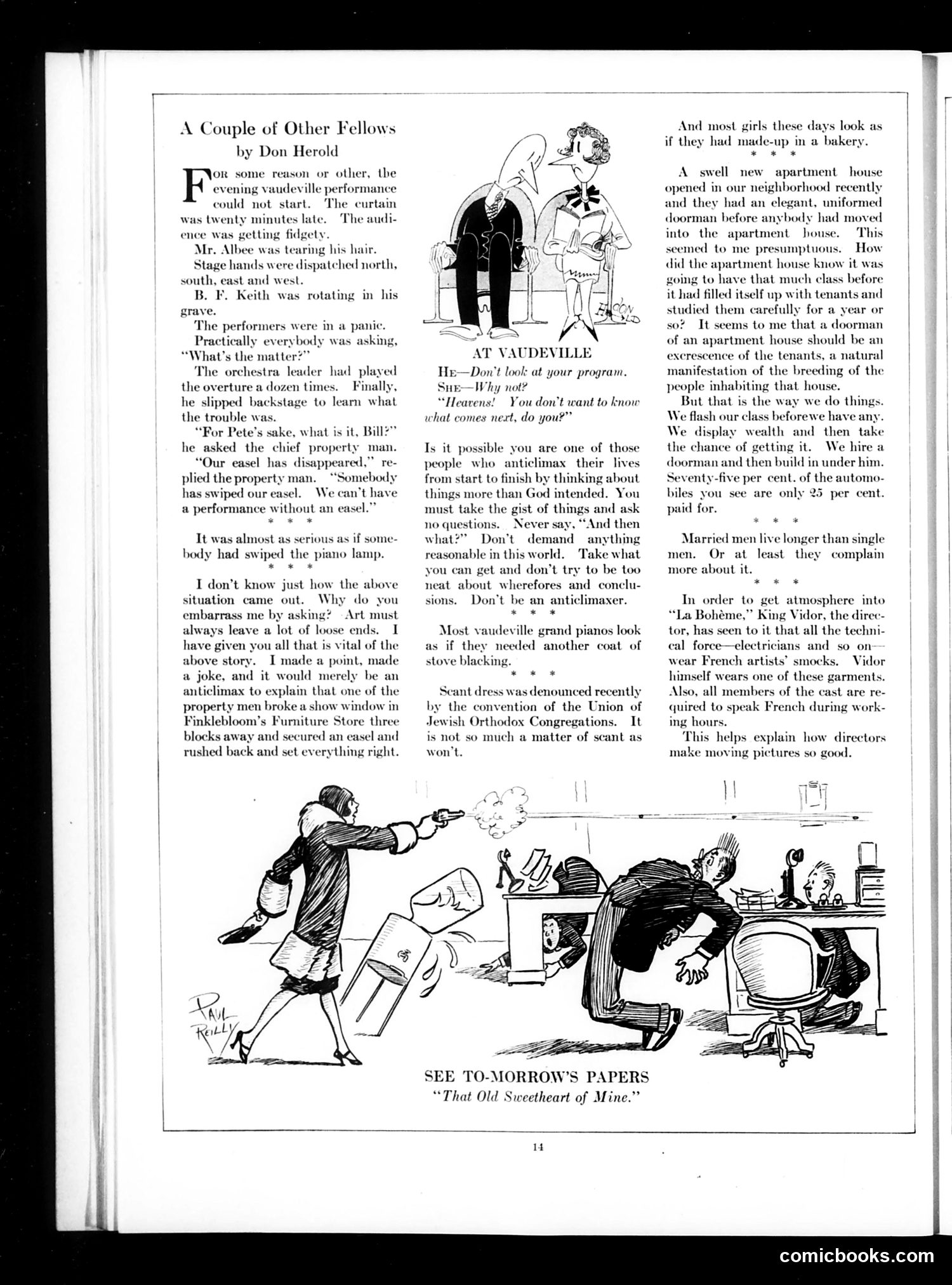
This page contains two separate humorous essays satirizing American social pretense and poor planning: **The Vaudeville Story** mocks theatrical incompetence—a missing easel (a trivial prop) halts an entire performance, yet the narrator refuses to explain the resolution, claiming art requires "loose ends." It's absurdist comedy about how minor details derail elaborate productions. **The Vaudeville Dialogue** and subsequent commentary critique people who overthink life, demanding explanations rather than accepting circumstances. The writer ridicules social climbing and false displays of wealth—apartment buildings hiring doormen before tenants arrive, cars mostly unpaid for, women over-applying makeup. **The Film Industry Mockery** targets King Vidor's affectation: requiring electricians to wear French smocks and cast members to speak French while filming "La Bohéme" to create "atmosphere." Herold suggests this performative authenticity—dressing the part rather than genuine artistry—explains Hollywood's actual mediocrity. The humor derives from exposing the gap between pretense and reality in American entertainment and consumer culture circa the 1920s.
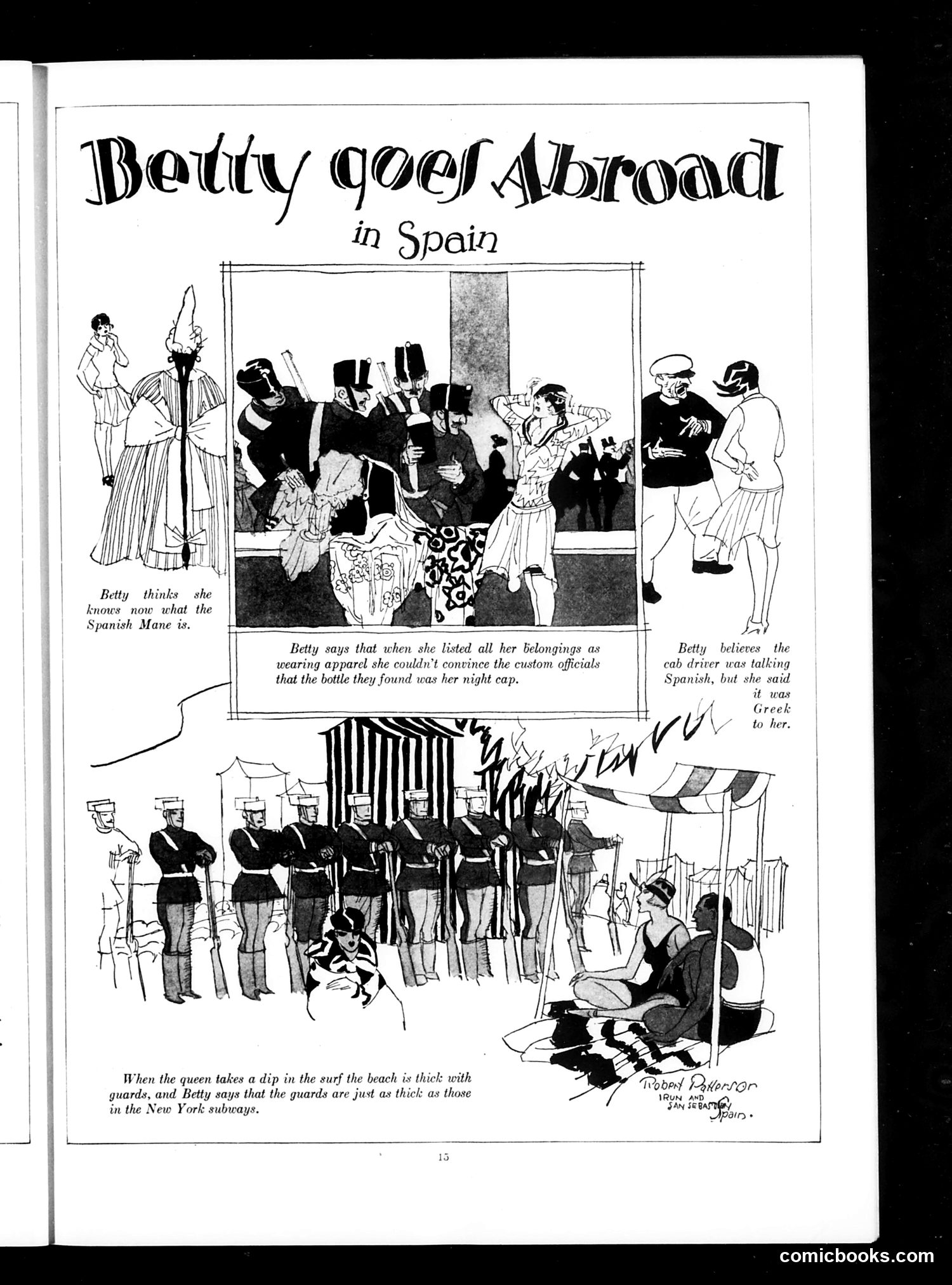
This is a humorous travel comic about an American woman named Betty visiting Spain. The satire targets American tourists' ignorance and cultural misunderstandings abroad: **The jokes:** - Betty mistakes a "Spanish Mane" (likely a hairstyle) for something else - Customs officials find a bottle in her luggage she claims is a "night cap" (nightwear), playing on the double meaning - She misidentifies the cab driver's language as Greek rather than Spanish - She compares Spanish royal beach guards unfavorably to New York City subway crowds, suggesting American urban conditions are equally chaotic or rough **The satire:** The humor relies on depicting Betty as a typically ignorant American tourist who travels abroad without understanding local customs, language, or culture—a common theme in 1920s-era Judge magazine satire about American travelers encountering foreign societies.
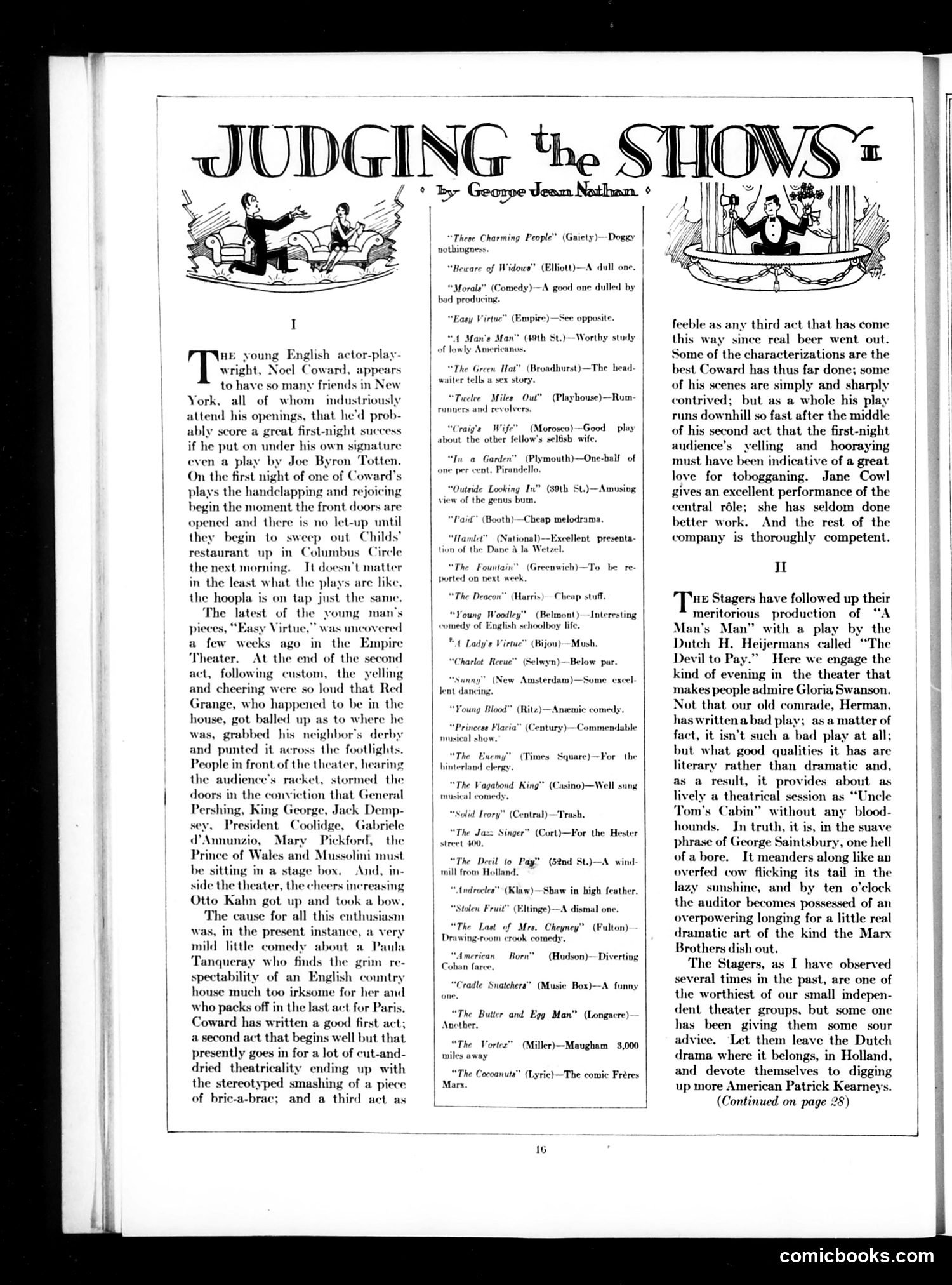
This page critiques English playwright Noel Coward's New York success, arguing it stems from devoted fans rather than theatrical merit. The reviewer claims Coward's opening nights generate such fervent applause that the actual quality of his plays becomes irrelevant—the "hoopla" would occur regardless of the script's quality. The satire peaks when describing the audience reaction to "Easy Virtue": the cheering was so loud that football star Red Grange, sitting in the theater, became confused and punted someone's hat across the stage. The reviewer sarcastically suggests onlookers thought famous figures like President Coolidge or King George must be present, causing the commotion. Meanwhile, wealthy theater patron Otto Kahn capitalized on the chaos by standing and taking a bow himself. The piece mocks celebrity-driven theater culture and audience irrationality, suggesting Coward's reputation exceeds his actual talent.
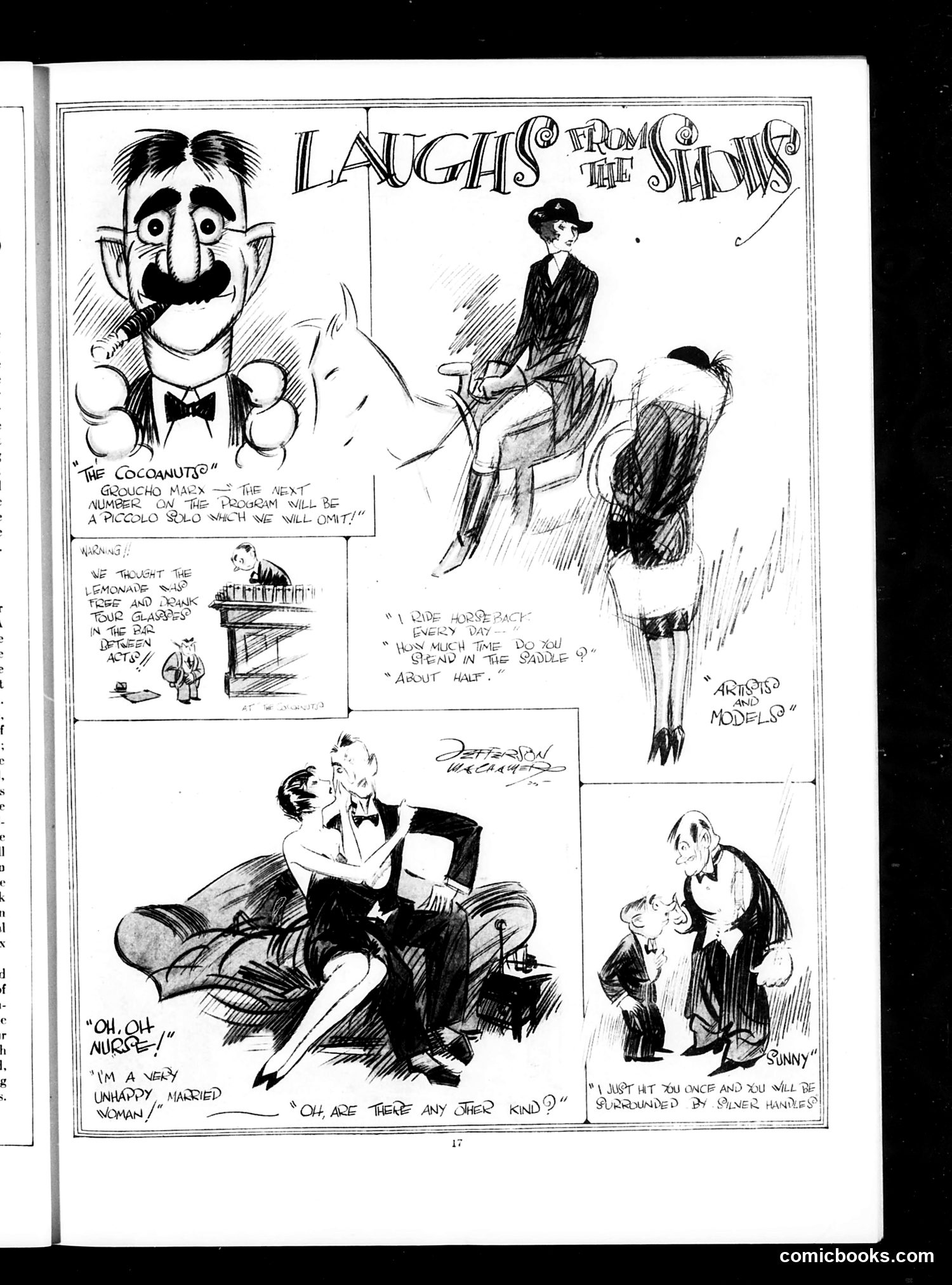
This page contains several comic vignettes satirizing early 20th-century social situations. The top panel features "The Cocoanuts" — likely referencing a Marx Brothers comedy — mocking vaudeville performers. The middle-right scene shows a man on horseback claiming to ride daily; the joke appears to be about exaggeration or pretense. The lower panels focus on domestic humor: one depicts an unhappy married couple (the woman calling for a "nurse"), satirizing marriage dissatisfaction. Another shows what appears to be a small child and adult, with text about being "surrounded by silver handles" — possibly mocking wealthy or pretentious parenting. The overall theme emphasizes common social pretenses and domestic discontent of the era, using caricature and crude situations typical of Judge's humor. Without clearer context on specific references, the exact targets of some jokes remain unclear, though marriage and class affectation appear central.
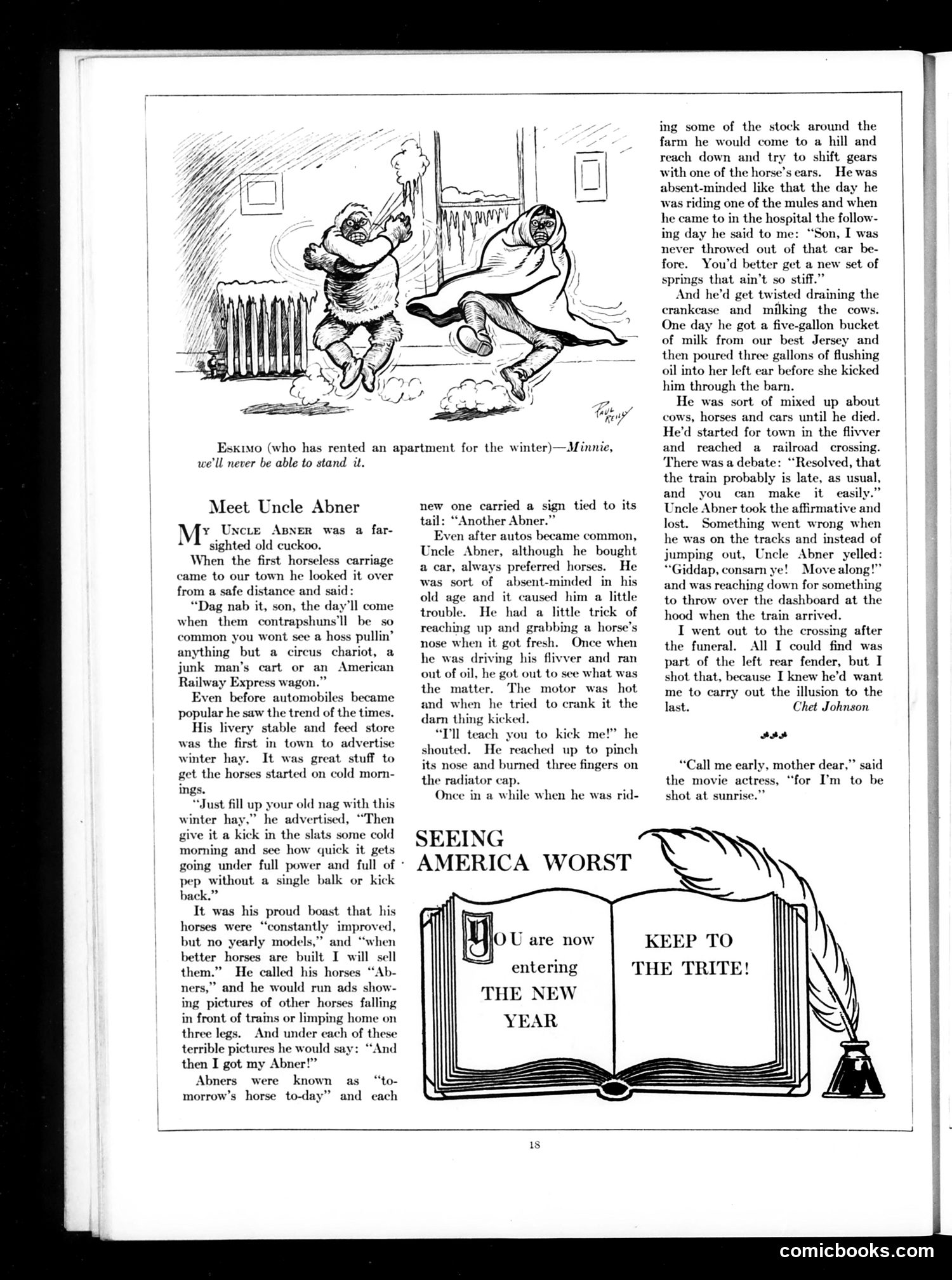
This page contains two distinct pieces: **"Meet Uncle Abner"** is a humorous character sketch about an old livery-stable owner who stubbornly clings to horses even as automobiles become widespread. The satire mocks his resistance to technological progress—he obsessively promotes his horse breed ("Abners") while the world modernizes. The joke escalates absurdly: he confuses cars with horses (yanking ears for gears, trying to "giddap" at a train crossing), ultimately dying when he mistakes a train for a stalled automobile. The piece satirizes old-fashioned stubbornness and the generational gap between horse-culture diehards and the automotive age. **The second item** is a New Year's greeting advertisement ("KEEP TO THE TRITE!") accompanying a small, unrelated anecdote about an actress being shot at sunrise—likely a pun on film industry terminology. The Eskimo cartoon at top appears to be a separate, brief domestic joke about winter apartment living.
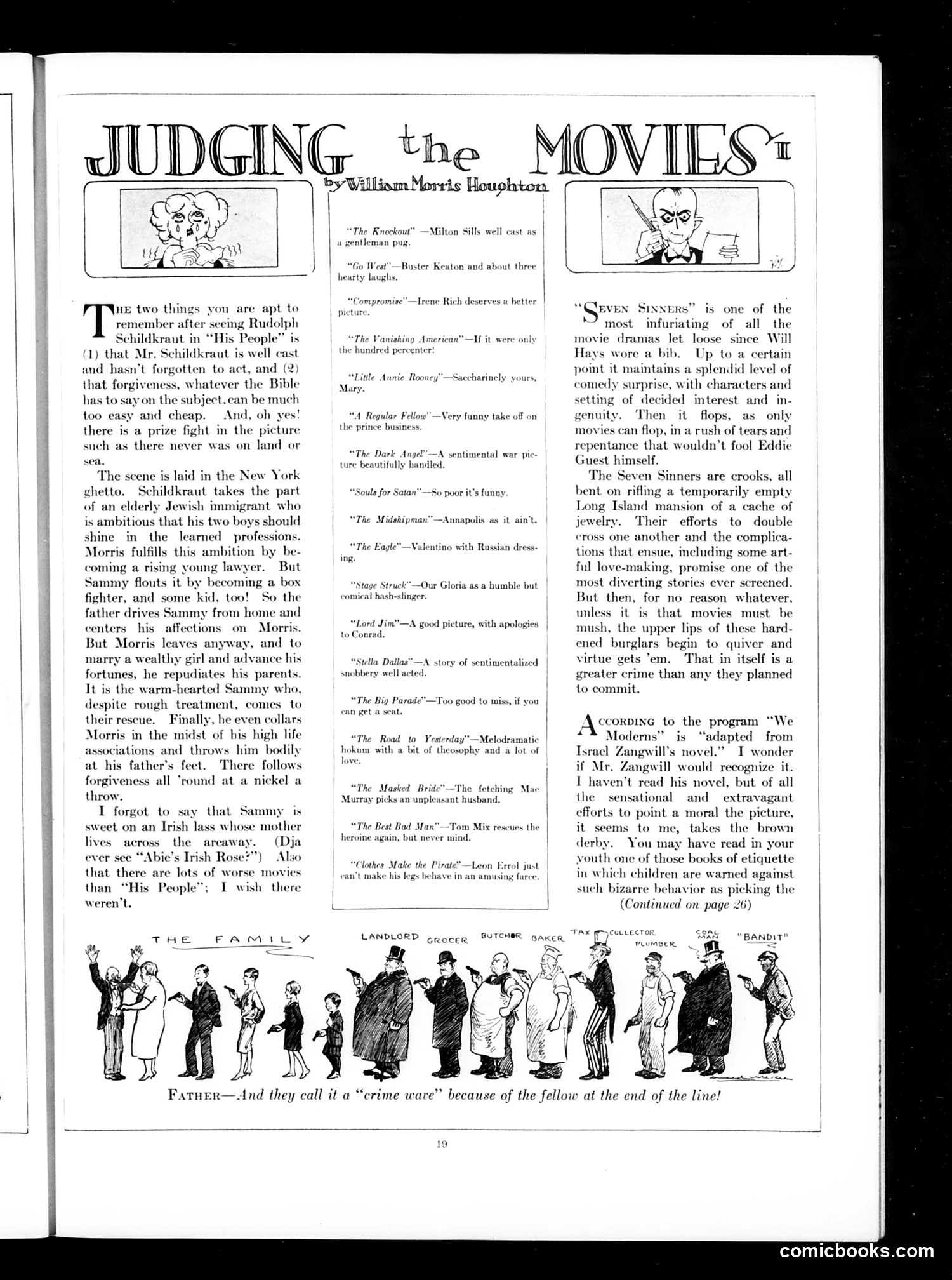
This is a film review column by William Morris Houghton critiquing recent movies. The main article discusses **"His People,"** starring Rudolph Schildkraut, about a Jewish immigrant father in New York's Lower East Side whose two sons pursue different paths—one becomes a lawyer, the other a boxer. The satire centers on the contrasting outcomes and the father's initial rejection of his boxing-son before ultimate forgiveness. The column also reviews numerous other films including "Seven Sinners" (a crime drama criticized for devolving into maudlin sentimentality), "We Moderns" (adapted from Israel Zangwill's novel), and various other contemporary releases with brief, often dismissive quips. At the bottom is an unrelated illustration showing various character archetypes labeled "The Family," ending with a "Bandit" figure—captioned as a "crime scare" joke about criminal stereotyping.
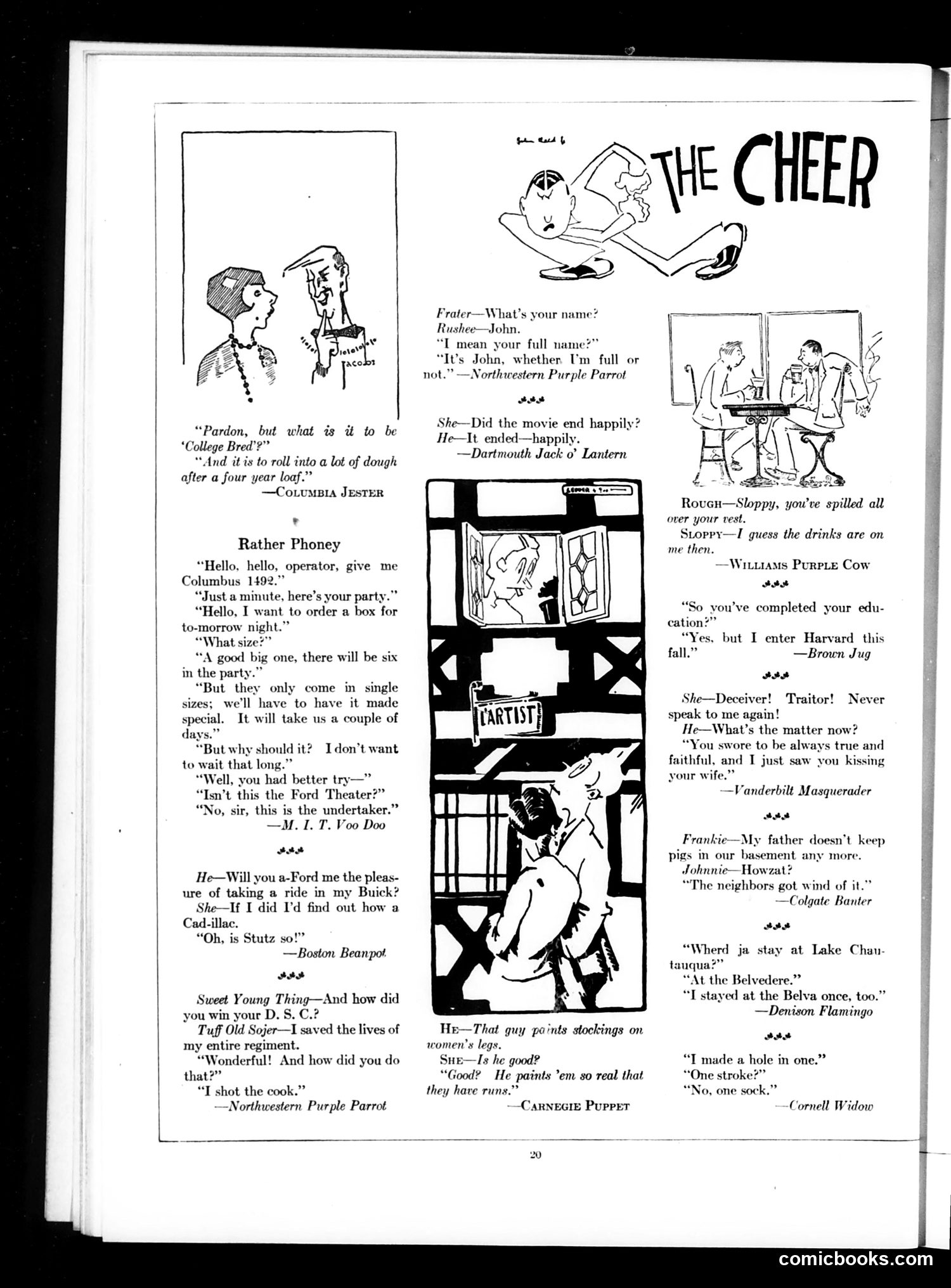
This is a humor anthology page from Judge, featuring jokes and comic strips from various college and satirical magazines of the era. The content reflects early 20th-century collegiate and social humor: **Key themes:** - **College life satire**: Jokes about lazy students ("roll into a lot of dough after a four year loaf"), university social hierarchies, and fraternity pledging - **Dating/romance humor**: Double-entendres about courtship and infidelity ("I just saw you kissing your wife") - **Automobile humor**: Puns on car brands (Ford, Buick, Cadillac, Stutz) — cars were still novel enough to be comedy fodder - **World War I references**: A D.S.C. (Distinguished Service Cross) medal joke; the cook-shooting anecdote reflects trench-war dark humor - **Physical comedy**: A central panel cartoon showing slapstick mishaps The humor is largely innocent by modern standards—wordplay, puns, and situations that would appeal to college-educated readers. The attributed college publications (Northwestern Purple Parrot, Brown Jug, etc.) suggest these were reprinted from student magazines.
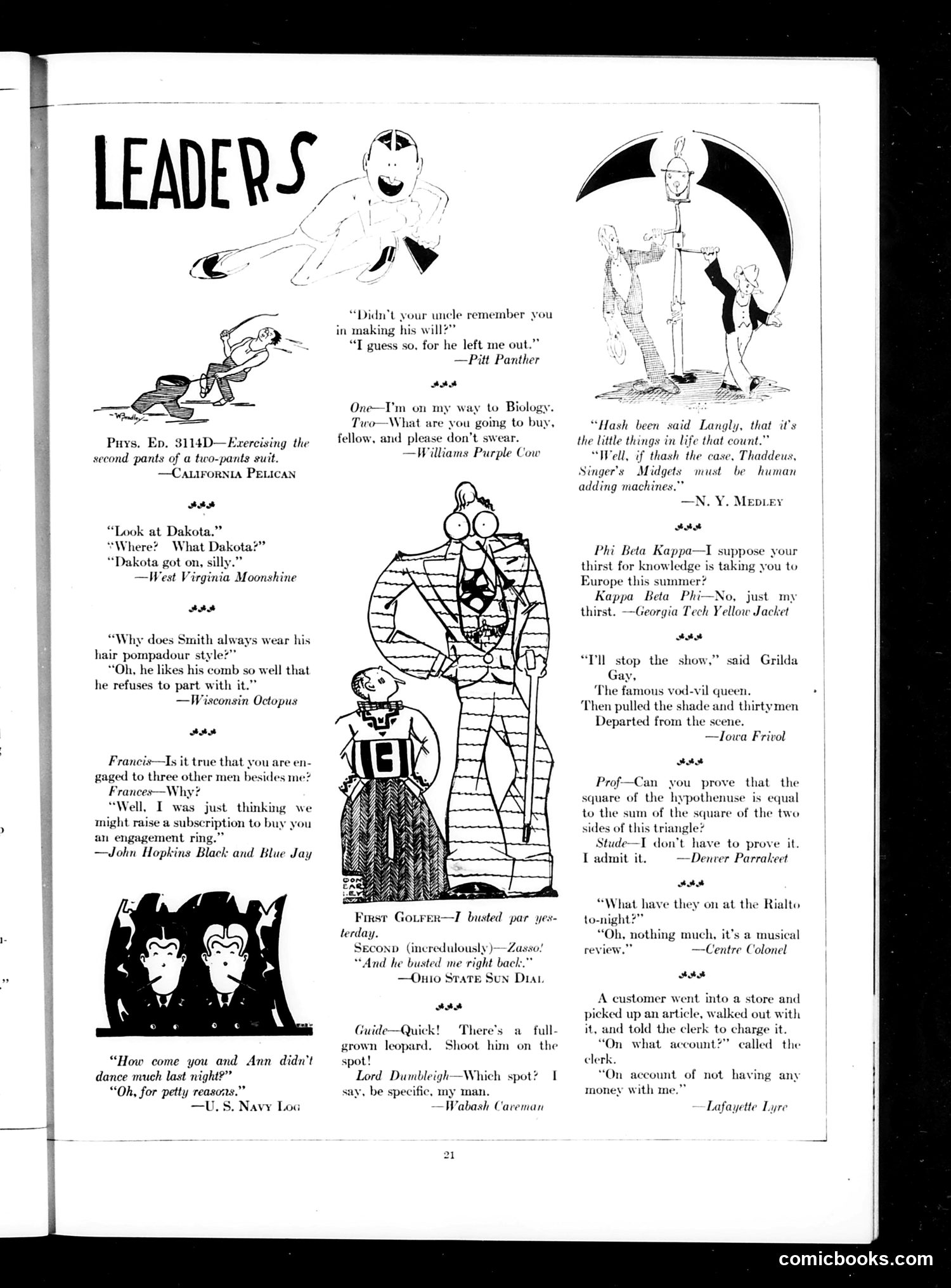
This page collects short jokes and quips from college humor magazines (California Pelican, Wisconsin Octopus, etc.), a common Judge feature. The humor is largely collegiate and relies on wordplay rather than political satire. **Key jokes:** - Physical humor: exercising in a two-pants suit, hair pompadour jokes - Dating/romance: a man engaged to multiple women can't afford an engagement ring - Puns: "Dakota got on" (a play on "Dakota" sounding like "the cote of..."), biology student swearing, leopard shooting location confusion - Social observation: vaudeville performer pulling shades as the "show," a student admitting rather than proving the Pythagorean theorem, someone charging an item with "no money with me" The cartoons are minimal illustrations supporting these gags. There's no identifiable political content—this is mainstream college humor from what appears to be the 1910s-20s era, emphasizing clever wordplay and gentle mockery of student life and social pretension.
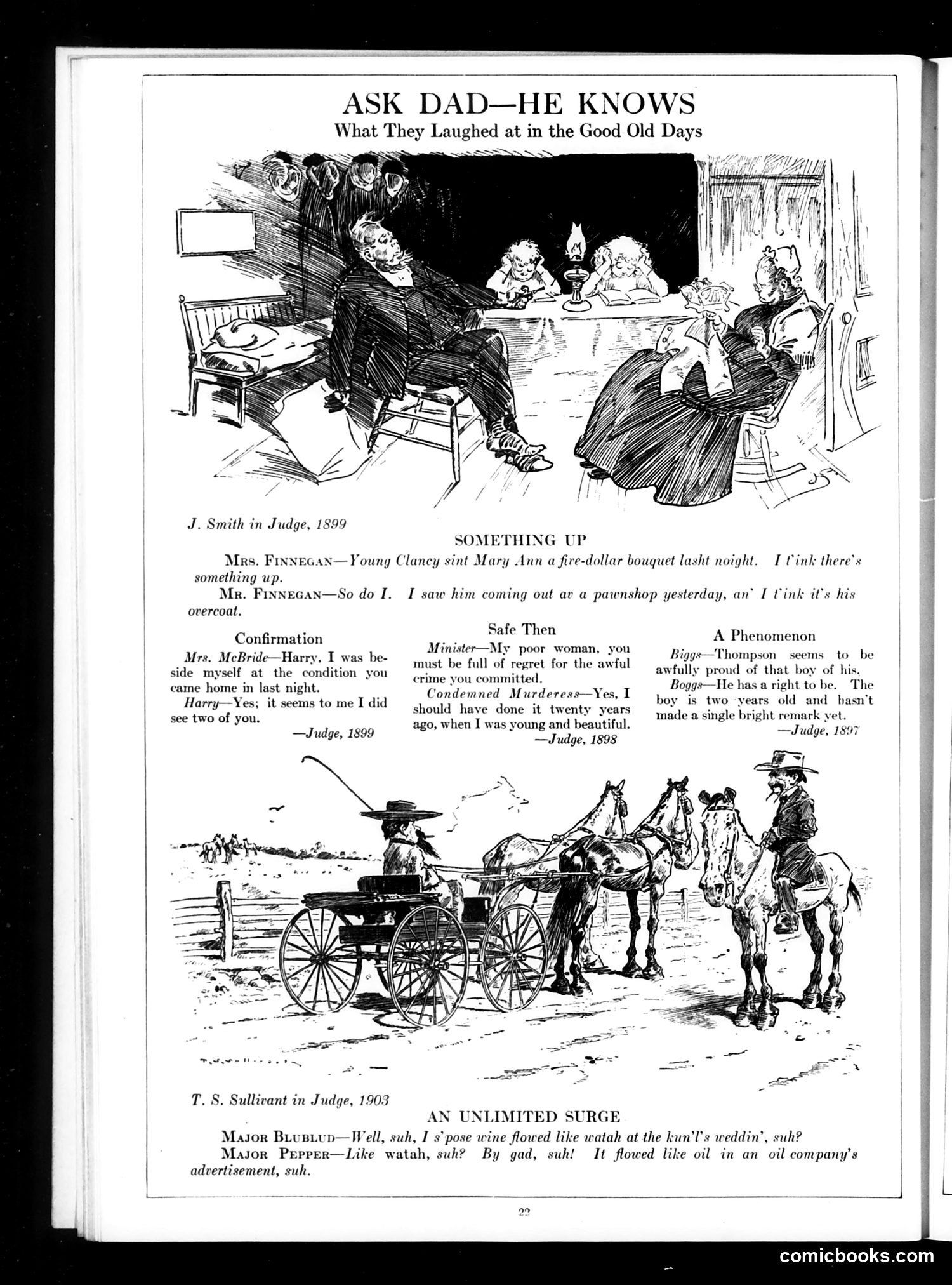
This page contains several unrelated humorous vignettes typical of Judge magazine's format. **"Something Up"** (1899): Irish-American characters Mrs. and Mr. Finnegan discuss young Clancy's expensive bouquet to Mary Ann. The joke: Mr. Finnegan spotted Clancy leaving a pawnshop, implying he pawned his overcoat to afford the flowers—a satirical comment on working-class Irish immigrants' financial desperation masked by romantic gestures. **Other brief jokes** mock drunkenness ("Confirmation"), parental pride in a non-verbal toddler ("A Phenomenon"), and marital discord. **"An Unlimited Surge"** (1903): Two Southern gentlemen (addressed as "Major") discuss wine at a colonel's wedding. The satire: comparing wine flow to "oil company advertisements" mocks the era's aggressive corporate advertising, suggesting the wedding's excess mirrors commercial hyperbole rather than genuine celebration. All pieces use ethnic and regional dialects (Irish, Southern) as comedic markers typical of Judge's era.
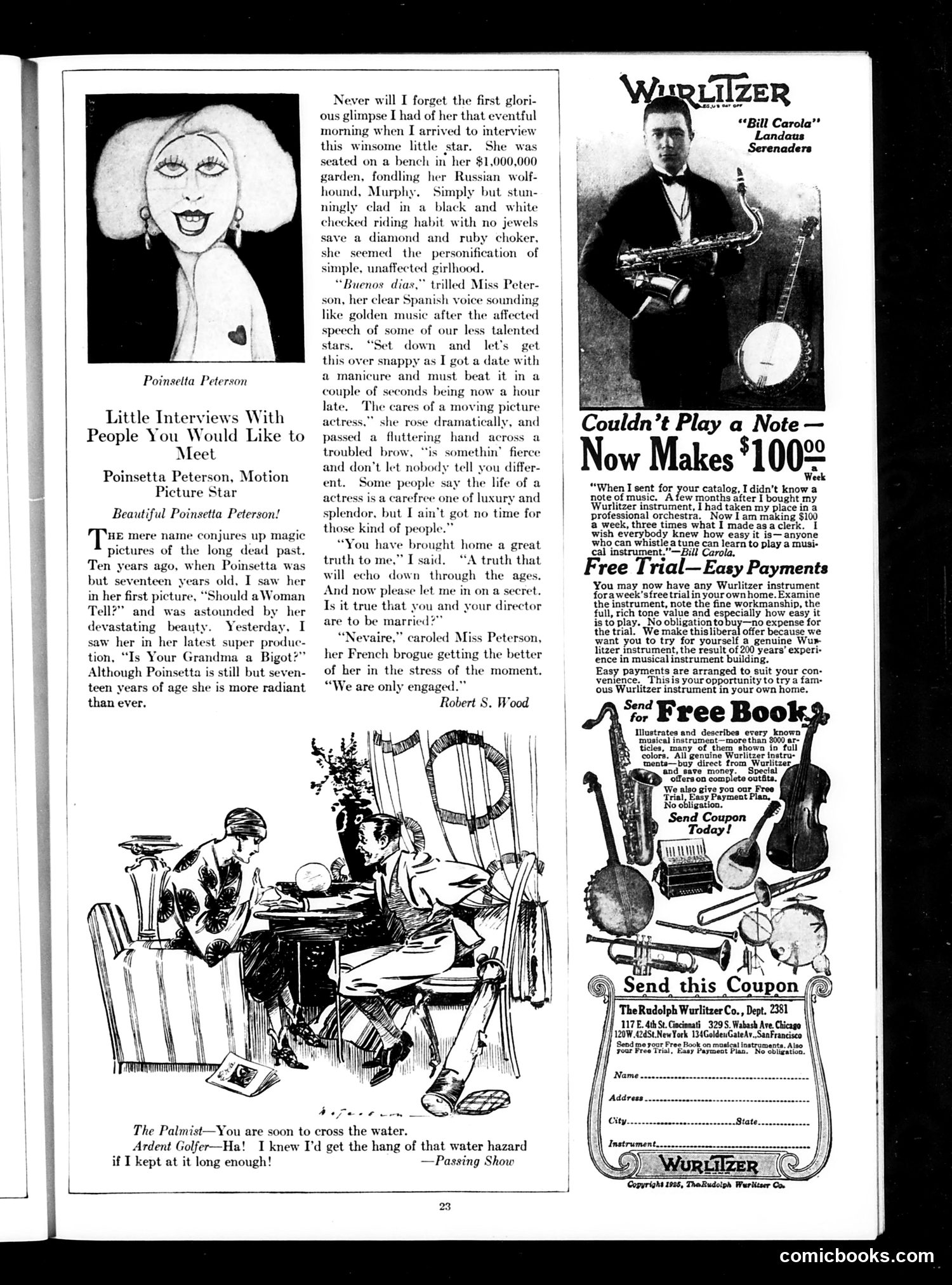
This is a satirical profile of a motion-picture actress named Poinsetta Peterson. The satire mocks the pretensions and affectations of Hollywood stars. Peterson is described as perpetually seventeen years old despite a ten-year career, living in a $1,000,000 garden with a Russian wolfhound. The joke centers on the contrast between her carefully curated image of "simple, unaffected girlhood" and her actual behavior—she speaks in affected accents (switching between Spanish "Buenos días" and French "Nevaire"), speaks in crude slang ("Ain't got no time"), and is dismissively preoccupied with a manicure appointment. The satire exposes how movie stars manufactured personas of elegance while revealing vulgar, self-absorbed personalities. The accompanying cartoon shows a similar contrast: a woman at a vanity in modest attire contrasting with the pretentiousness described in the text.
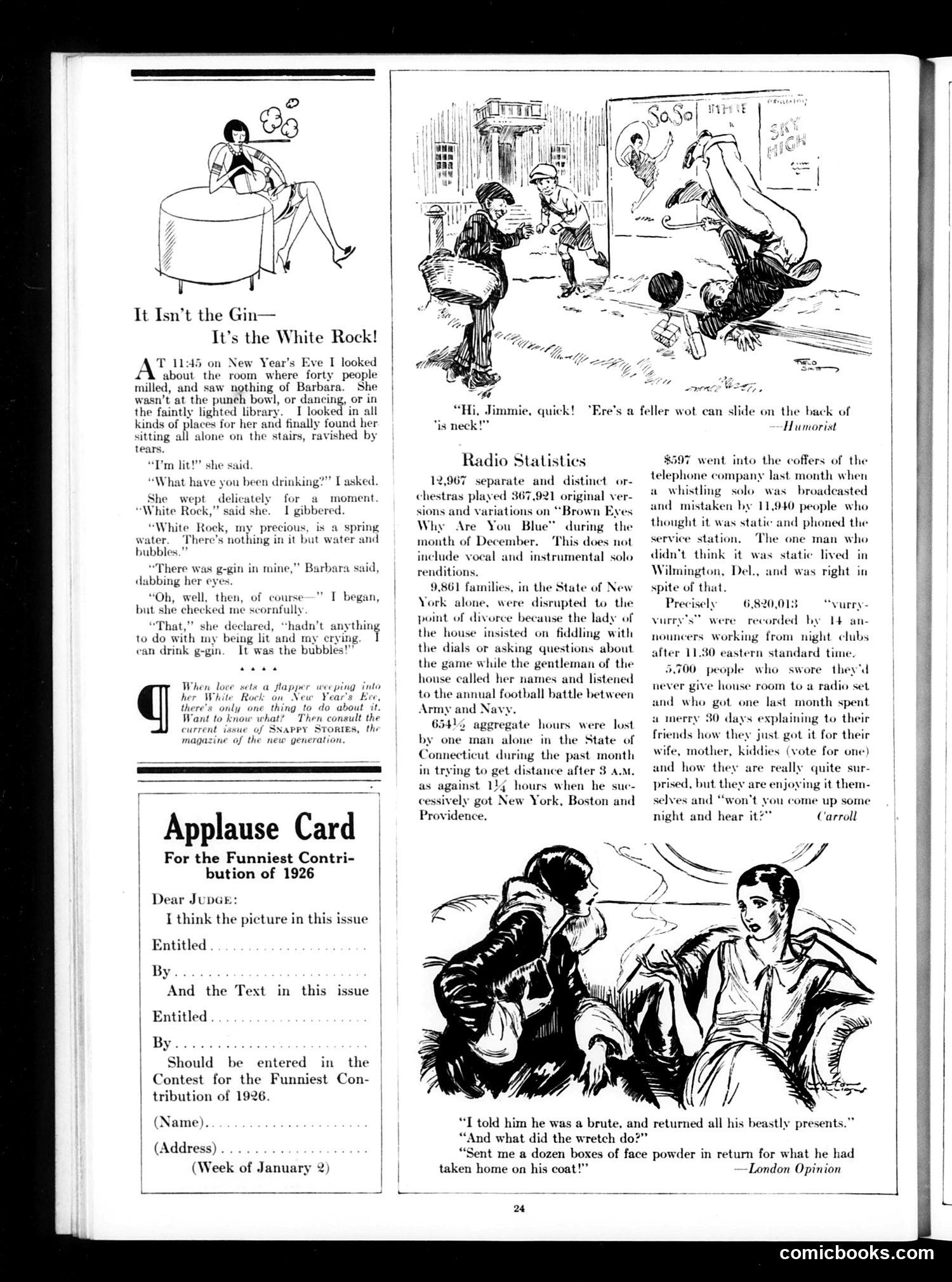
This 1926 Judge page satirizes the absurdity of Prohibition-era drinking culture. A woman named Barbara gets drunk on New Year's Eve, but attributes her intoxication not to the gin someone secretly added to her White Rock (a brand of sparkling water), but to the carbonation itself—claiming the "bubbles" made her cry and lose control. The joke mocks both the ridiculous rationalizations people used during Prohibition and the pretense that substituting gin for "innocent" mixer made drinking acceptable. White Rock, as a commercial brand, becomes the implicit culprit in this backwards logic, making the advertisement-styled title ironic. The page also includes unrelated filler: "Radio Statistics" listing absurd complaints about early radio use (divorce over radio dials, wasted phone calls chasing distant stations), and a submission card for readers' funny contributions—typical magazine padding of the era.
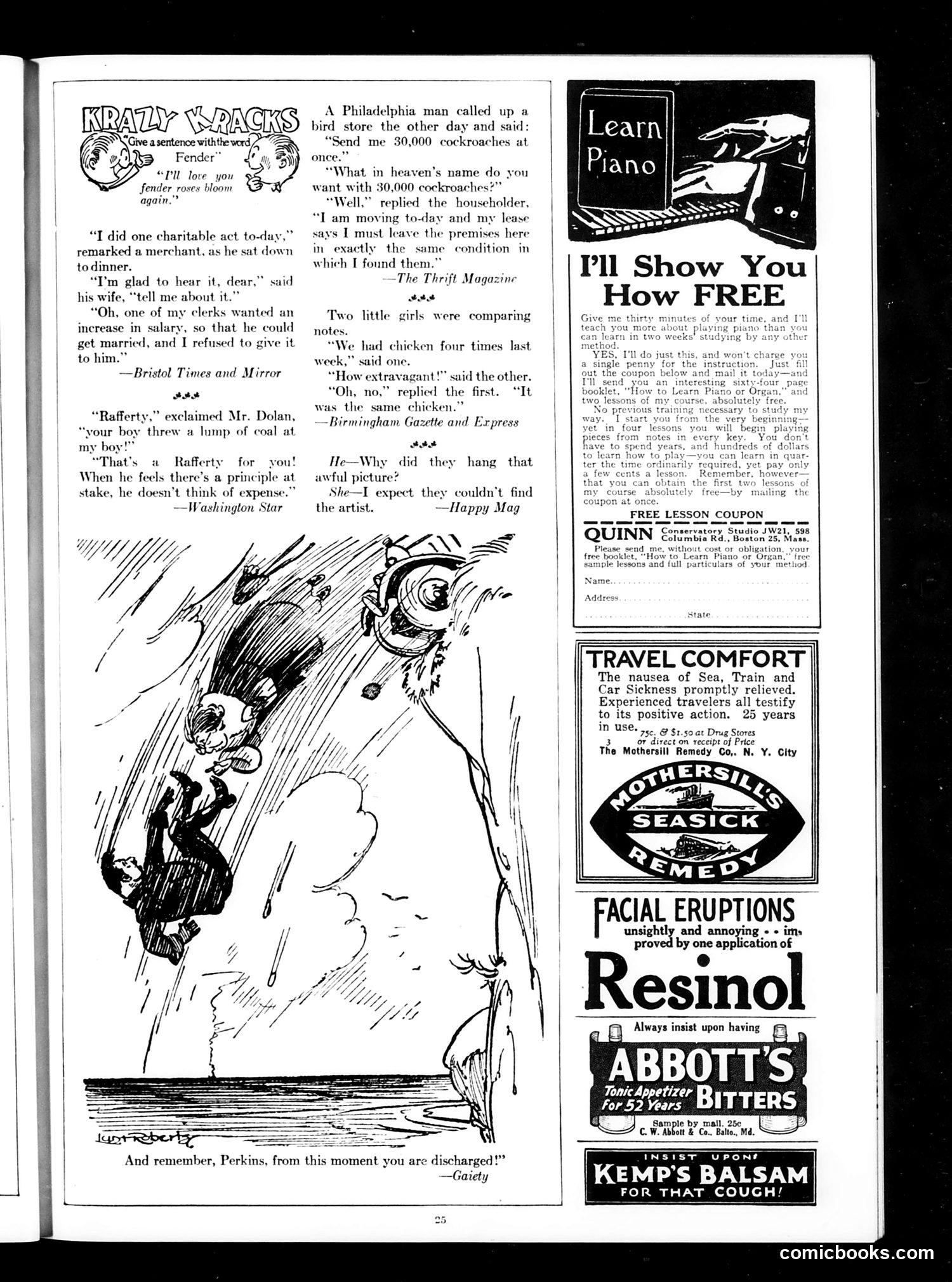
This page contains **humorous anecdotes and advertisements** rather than political cartoons. The jokes satirize early 20th-century social attitudes: 1. **The merchant's "charity"**: Mocks hypocrisy—refusing a clerk a raise for marriage is framed as principled frugality, not cruelty. 2. **The coal-throwing boy**: Celebrates working-class defiance; "Rafferty" represents Irish-American toughness and willingness to fight for principle over practicality. 3. **The cockroach anecdote**: Satirizes tenant dishonesty and moving-day deceptions common in urban housing. 4. **The "same chicken"**: Gentle humor about Depression-era thriftiness and resourcefulness. The page also features period **patent medicine advertisements** (seasickness remedy, Abbott's Bitters, Resinol) and a piano lesson promotion—typical monetization strategies for magazines of this era. The large cartoon depicts someone being fired, illustrating workplace vulnerability.
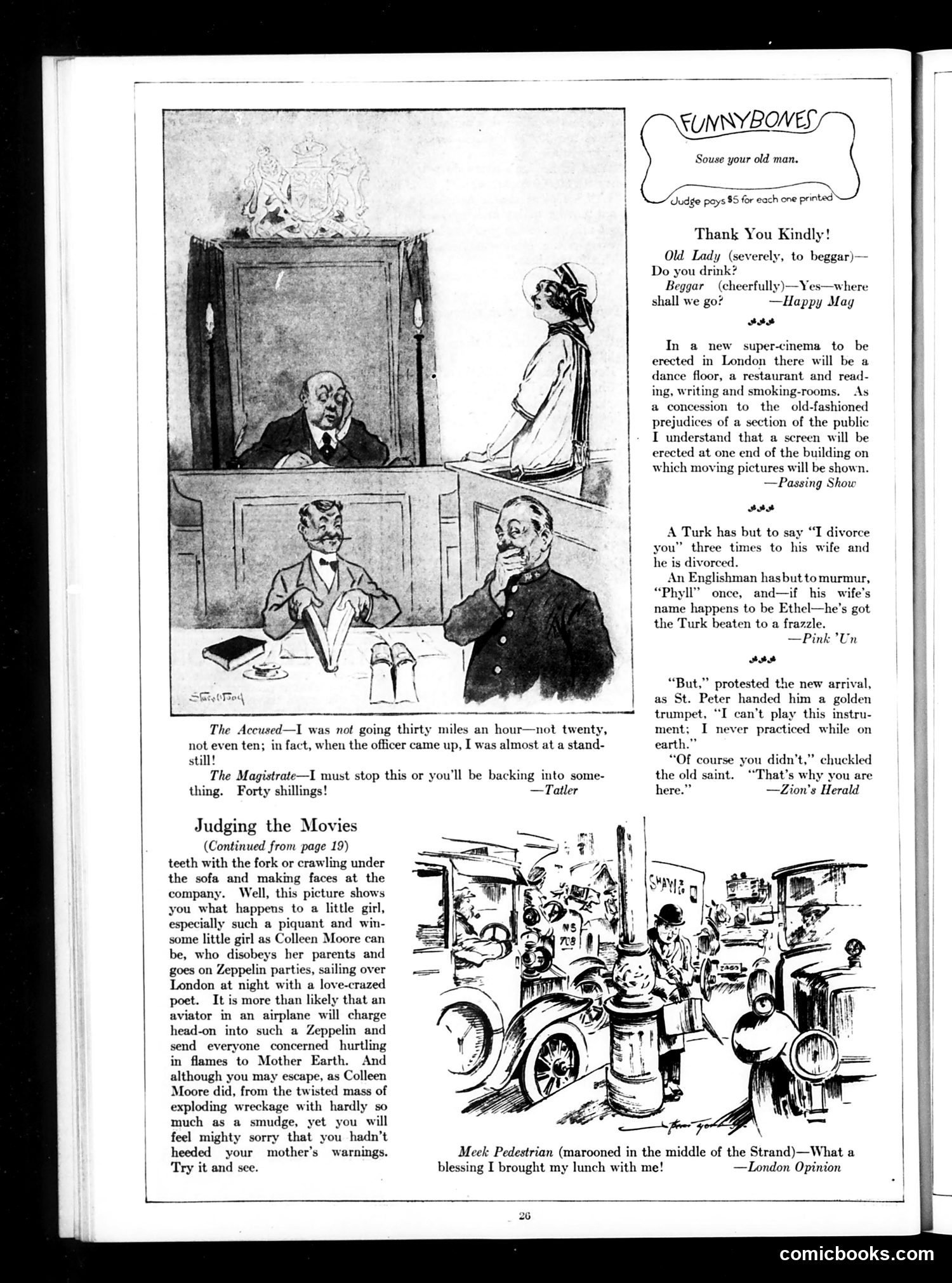
This Judge magazine page combines several humor pieces satirizing early 1920s society and cinema. **Main Cartoon (top):** A traffic court scene mocking a speeding defendant who absurdly claims he was nearly stopped when caught. The magistrate threatens to fine him for "backing into something"—satirizing how the accused keeps contradicting himself into worse admissions. **"Meek Pedestrian" cartoon (bottom right):** A London street scene poking fun at chaotic urban traffic, where a pedestrian trapped mid-street treats it as an opportunity for lunch—dark humor about dangerous city conditions. **Movie Review Section:** Criticizes Colleen Moore's film, mocking its plot where a girl disobeys parents, goes on Zeppelin parties with a "love-crazed poet," and survives a crash. The reviewer sarcastically suggests this proves you should heed mother's warnings. **Various Quips:** Short jokes about divorce, alcohol, and religious hypocrisy—typical Judge fare mocking social attitudes of the era. The page reflects 1920s anxieties: reckless youth, aviation dangers, traffic hazards, and changing morality.
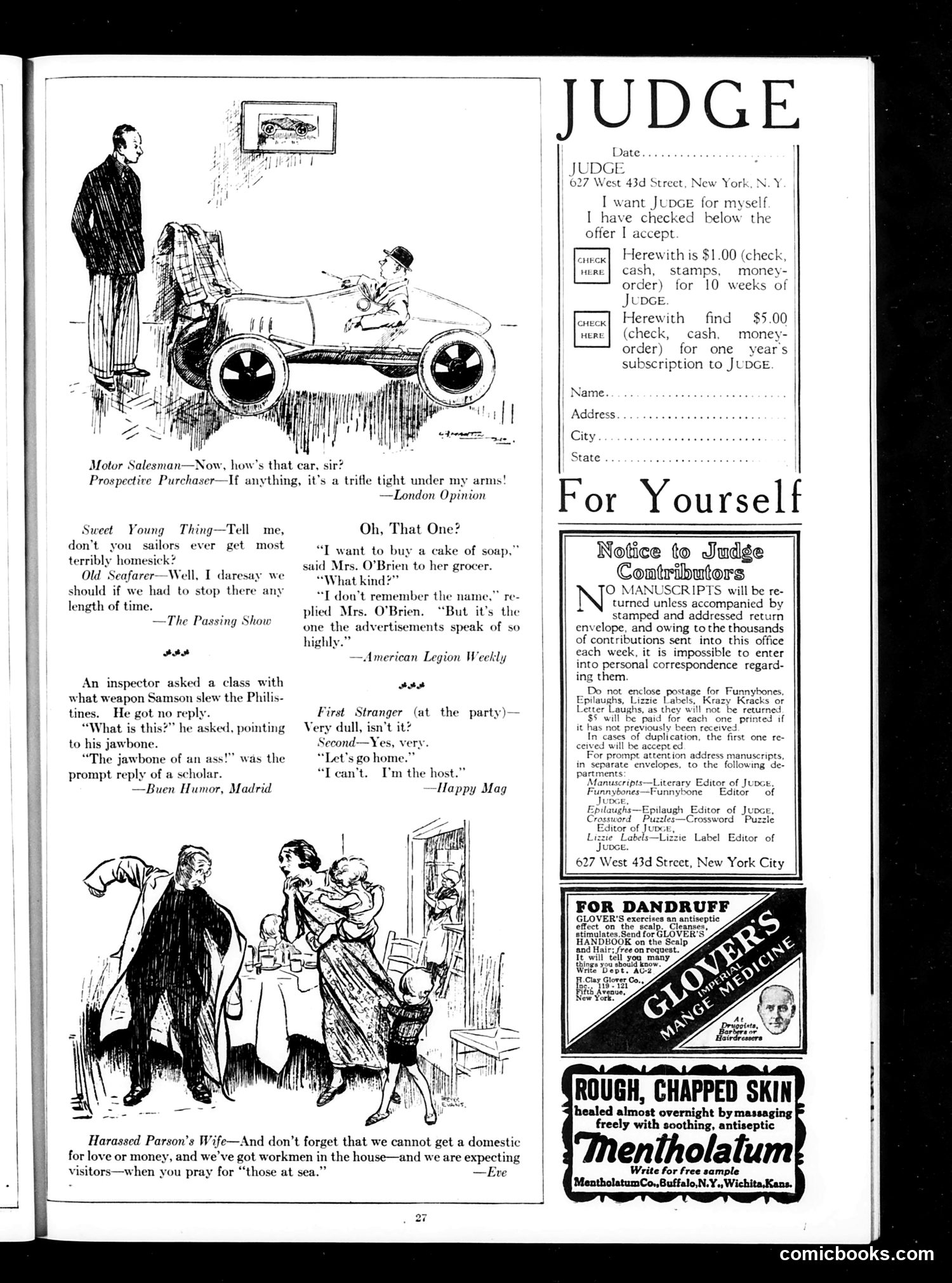
This page from *Judge* (a major American satirical magazine) contains several brief humorous cartoons and jokes targeting early 20th-century social life. **The Motor Salesman cartoon** satirizes uncomfortable early automobiles—the "prospective purchaser" complains the car is "tight under my arms," mocking how cramped and poorly-designed these vehicles were. **Other jokes mock**: homesick sailors, a schoolboy's crude wordplay (answering "jawbone of an ass" literally), and a woman who can't remember a product name despite heavy advertising—satirizing both consumer culture and advertising's failure to communicate. **The "Harassed Parson's Wife" cartoon** criticizes domestic labor scarcity and class anxiety: a minister's wife, stressed about servants and workmen, instructs him to pray for "those at sea"—suggesting the wealthy prefer distant charity to addressing their own household problems. The remainder comprises subscription offers and period advertisements (Glover's dandruff remedy, Mentholatum). The content reflects 1920s-era concerns: technology, labor shortages, advertising saturation, and class pretension.
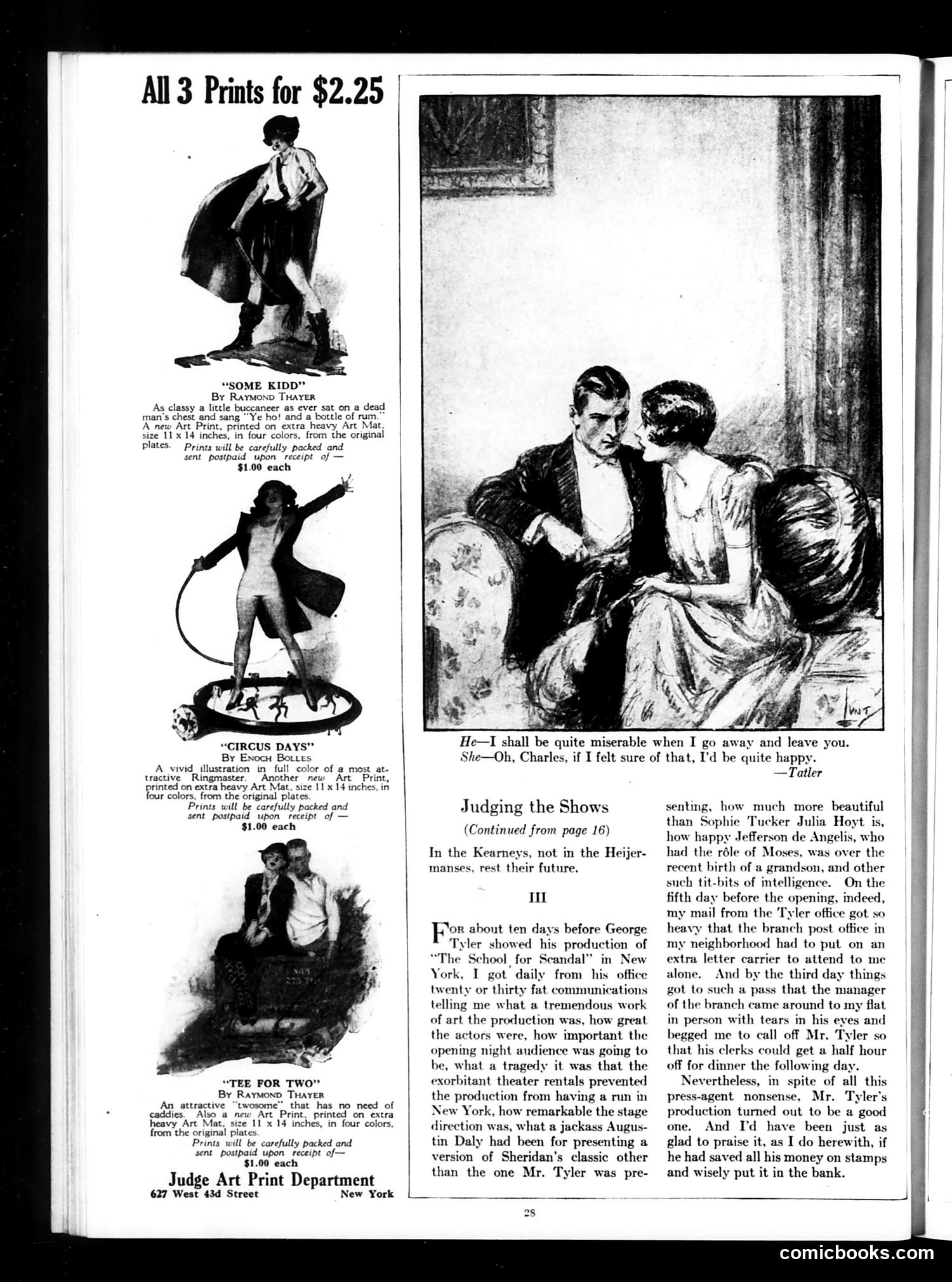
This Judge magazine page contains three art print advertisements and a theater review column. **The Art Prints** (left side): Judge is selling three color prints by Raymond Thayer and Enoch Bolles for $1 each—"Some Kidd" (a romanticized pirate), "Circus Days" (a ringmaster), and "Tee for Two" (a golfing couple). These were popular decorative prints of the era. **The Dialogue Cartoon** (top right): A couple exchanges bittersweet romantic banter—he claims he'll be miserable leaving her; she replies she'd only be happy if she could be sure of that. It's satirizing affected sentiment and emotional manipulation in relationships. **The Theater Review** (bottom right): Critic discusses George Tyler's production of *School for Scandal*. The key satire: Tyler's office bombarded the critic with twenty-to-thirty promotional letters daily, including absurd claims (comparing actress Julia Hoyt favorably to Sophie Tucker, mentioning an actor's grandson's birth). Despite the obnoxious publicity blitz, Tyler's production was actually good—but the critic notes he'd praise it anyway, suggesting the hype was unnecessary.
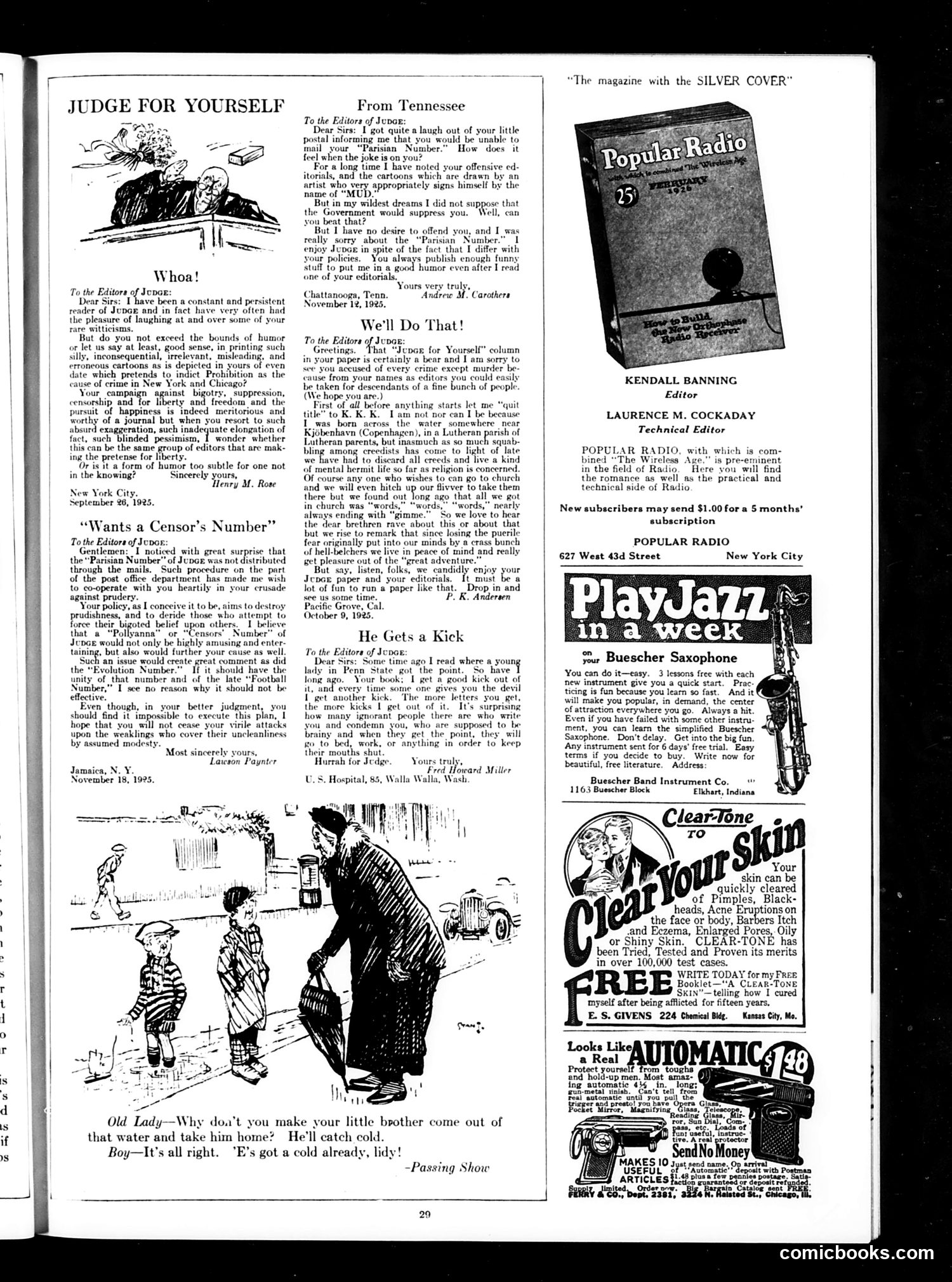
This page contains reader letters to *Judge* magazine's editorial column, debating the magazine's satirical approach to Prohibition and social censorship. **Key Context:** - Letter writers dispute whether *Judge*'s cartoons attacking Prohibition as a cause of crime are fair satire or irresponsible exaggeration - References to suppressed "Parisian Number" indicate the U.S. Post Office banned a specific issue—likely for sexual content - Writers defend *Judge*'s crusade against "prudishness" and censorship while others question the magazine's logical consistency in attacking censorship while exaggerating facts **The Satire:** The letters themselves become meta-commentary: readers accuse *Judge* of hypocrisy—using misleading cartoons while claiming to fight against suppression of free speech. One letter sarcastically notes the irony of *Judge* being censored for its "Parisian" (sexually suggestive) content. **1925 Context:** This reflects Prohibition-era debates over government censorship, moral crusades, and whether satirical exaggeration serves truth or undermines it. The page is primarily text-based reader correspondence rather than visual cartoons.
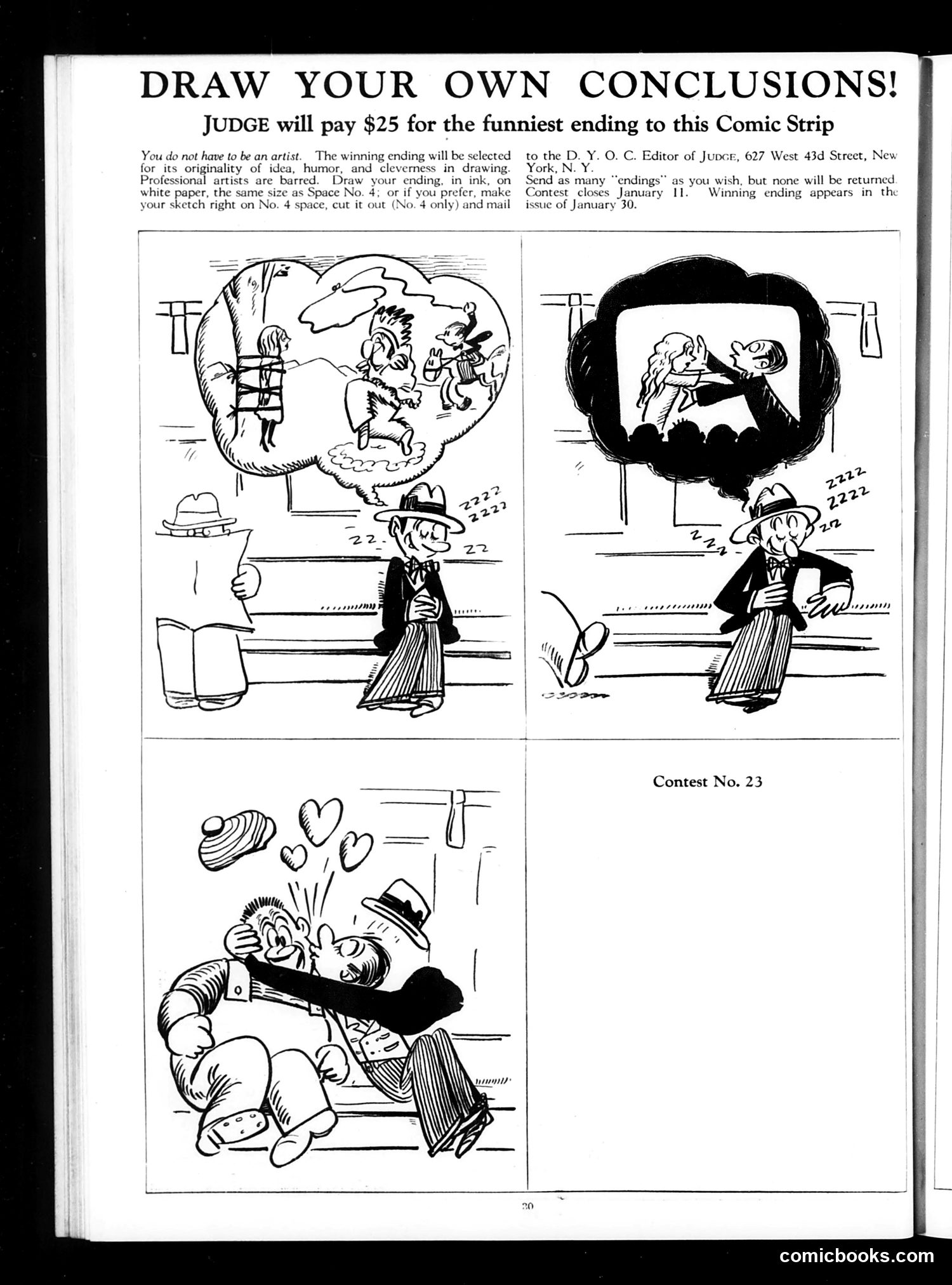
This is a **reader participation contest** from *Judge* magazine, not editorial satire. The page shows an incomplete comic strip (Contest No. 23) with three panels depicting a man in a hat sleeping on a bench, dreaming of romantic scenarios. Readers are invited to draw their own funny ending to the fourth panel. *Judge* offered $25—a substantial sum in this era—for the wittiest conclusion, restricted to amateur artists (professionals excluded). The humor relies on the dreamlike absurdity: the sleeping vagrant's fantasies contrast with his modest circumstances on a park bench. This reflects *Judge's* era as an interactive, participatory publication, where readers could contribute to content. The contest format served both as entertainment and cost-effective content generation for the magazine. The winning ending would appear in the January 30 issue.
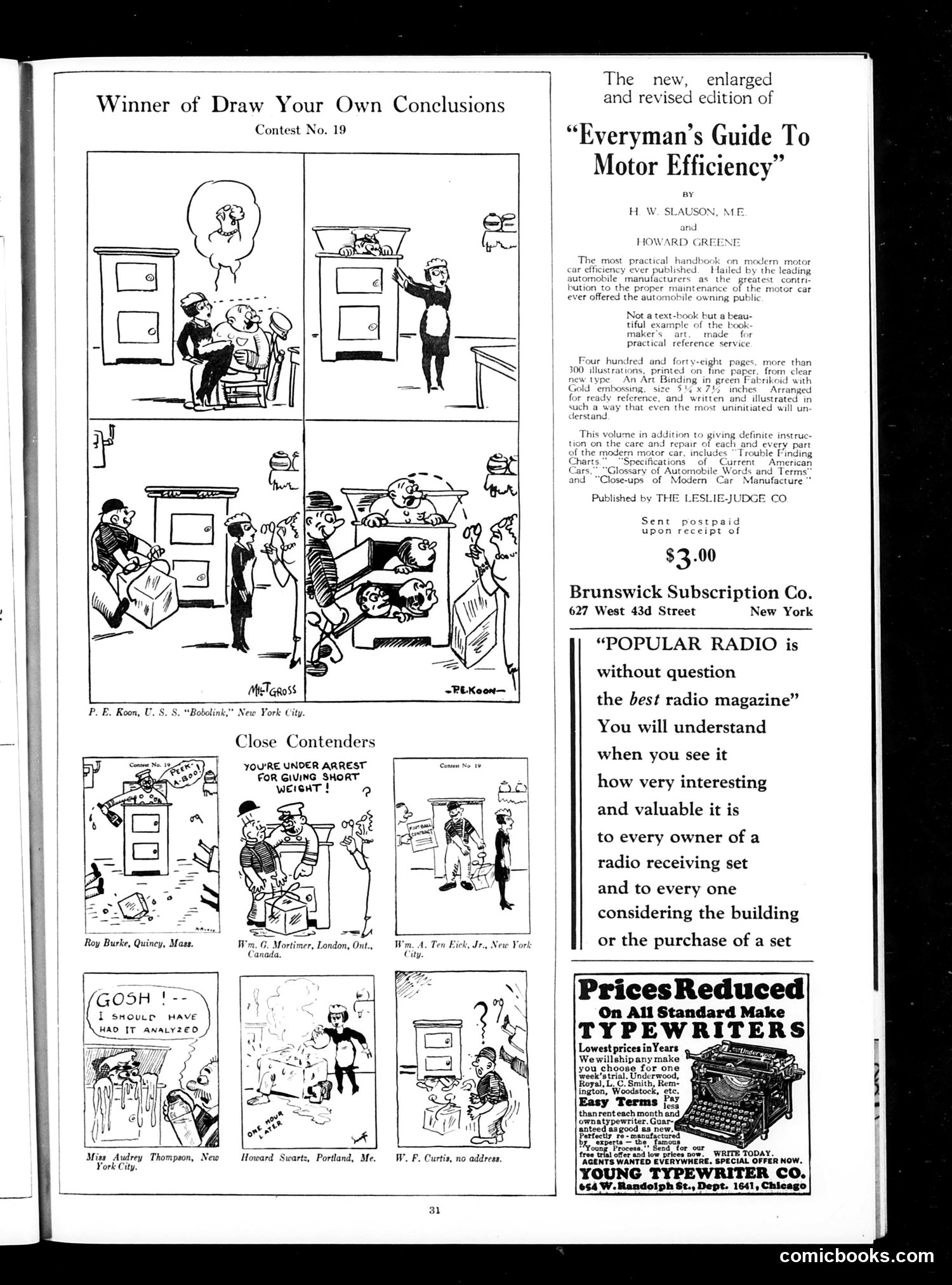
This page features the winning entry in "Draw Your Own Conclusions Contest No. 19," a cartoon by P.E. Koon depicting domestic life with a humorous take on household appliances or utilities. The main cartoon shows four panels illustrating what appears to be a comedic scenario involving a kitchen cabinet or storage unit. The satire likely comments on modern domestic conveniences and their sometimes bewildering or problematic use by average households—a common Judge theme mocking the gap between technological advancement and practical household competence. The "Close Contenders" section below shows runner-up submissions with similar domestic humor themes, including references to weight issues and arrest (likely wordplay). The page is heavily padded with advertisements for motor efficiency guides, radio magazines, typewriters, and subscription services—typical of 1920s-era Judge magazine. These ads provide period context but aren't part of the editorial content's satirical message.
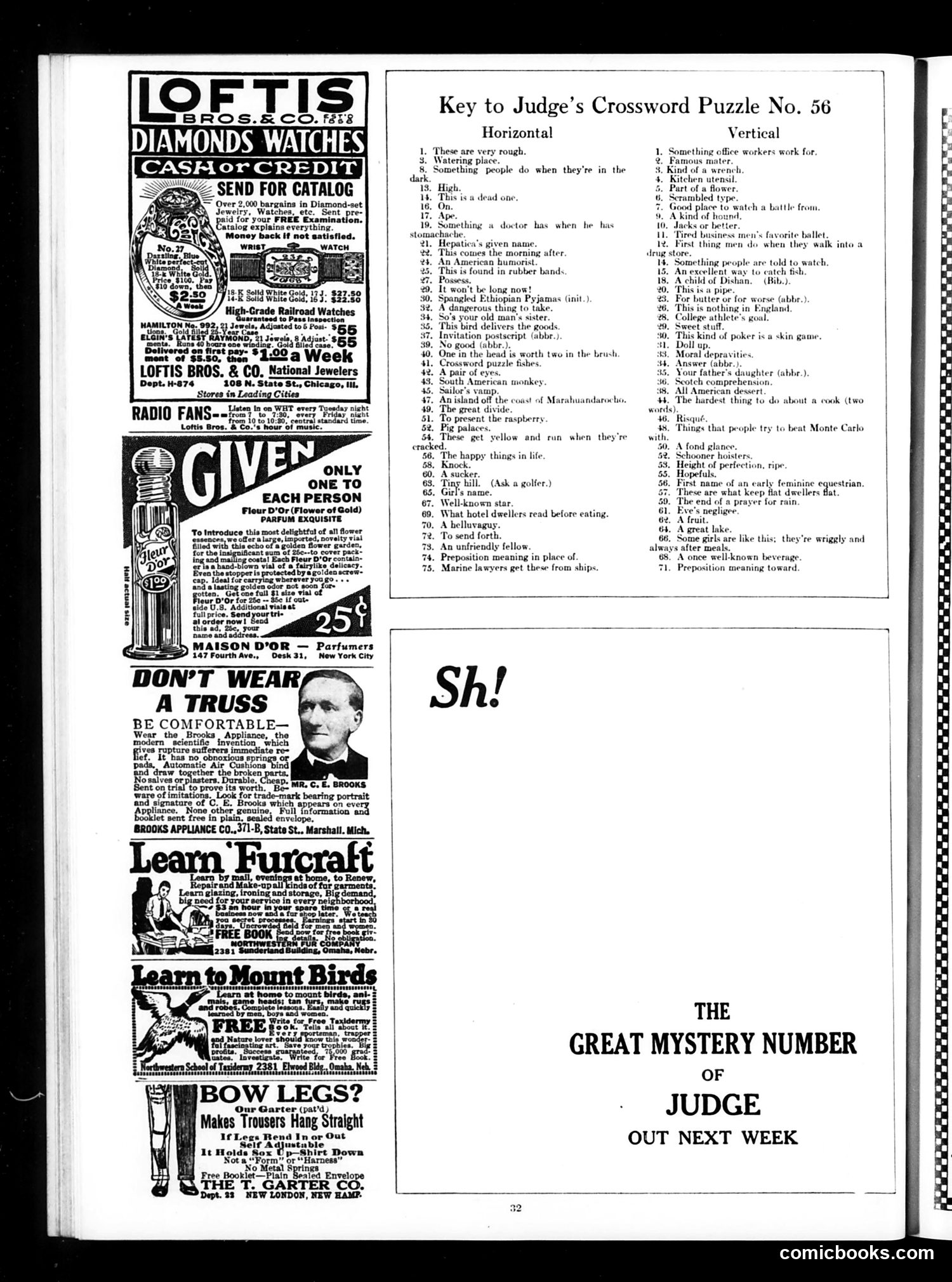
This page is primarily **advertising and puzzle content**, not editorial satire. The left side features vintage advertisements for luxury goods (Loftis diamonds watches, Maison D'Or perfume, Brooks truss/medical appliance, and T. Garter Co. leg garters)—typical of early 20th-century magazine marketing targeting middle-class readers seeking health remedies and status symbols. The right side presents the **answer key to Judge's Crossword Puzzle No. 56**, a popular feature of the era. The final element announces "THE GREAT MYSTERY NUMBER OF JUDGE OUT NEXT WEEK," a teaser for upcoming content. There is **no political cartoon or satire visible** on this page. It represents the magazine's business model: combining light entertainment (puzzles) with lucrative advertising revenue. The ads themselves reflect period concerns: medical devices for bodily insecurities, luxury watches as status markers, and personal grooming products.
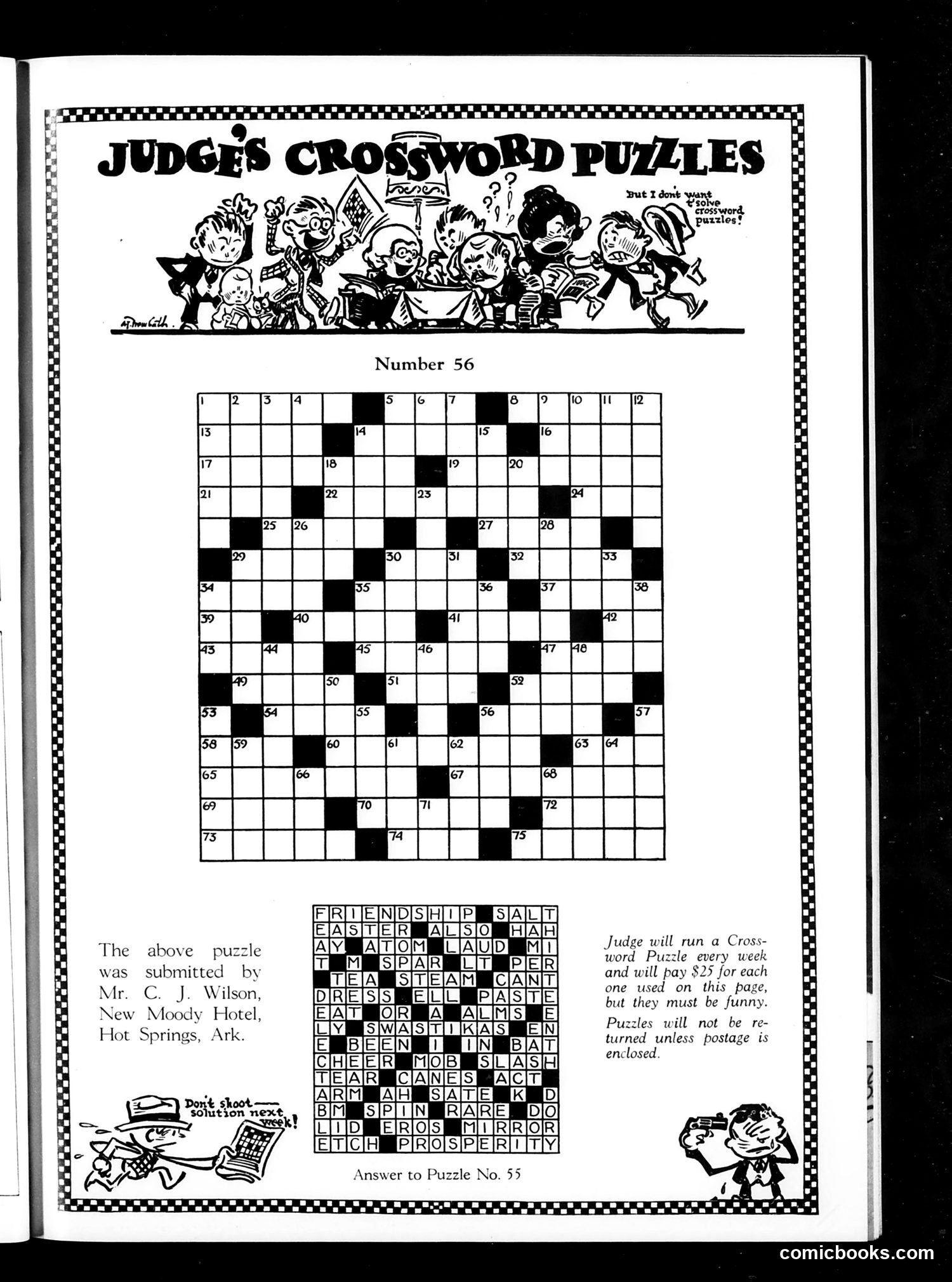
This page presents **Judge's weekly crossword puzzle** (Number 56), a standard feature of the satirical magazine. The puzzle itself contains no political content—it's simply a word game. The page includes the **answer key to the previous week's puzzle** (No. 55), displayed in a filled grid. Below this, text announces that Judge will publish weekly crosswords paying $25 per puzzle used, inviting reader submissions. The page features cartoonish illustrations typical of Judge's style—including a character labeled "Don't shoot—solution next week!" suggesting humorous editorial commentary about puzzle difficulty. This represents Judge's broader function: beyond political satire, the magazine offered entertainment and reader engagement through puzzles and contests, making it a comprehensive leisure publication for early-to-mid 20th century audiences.
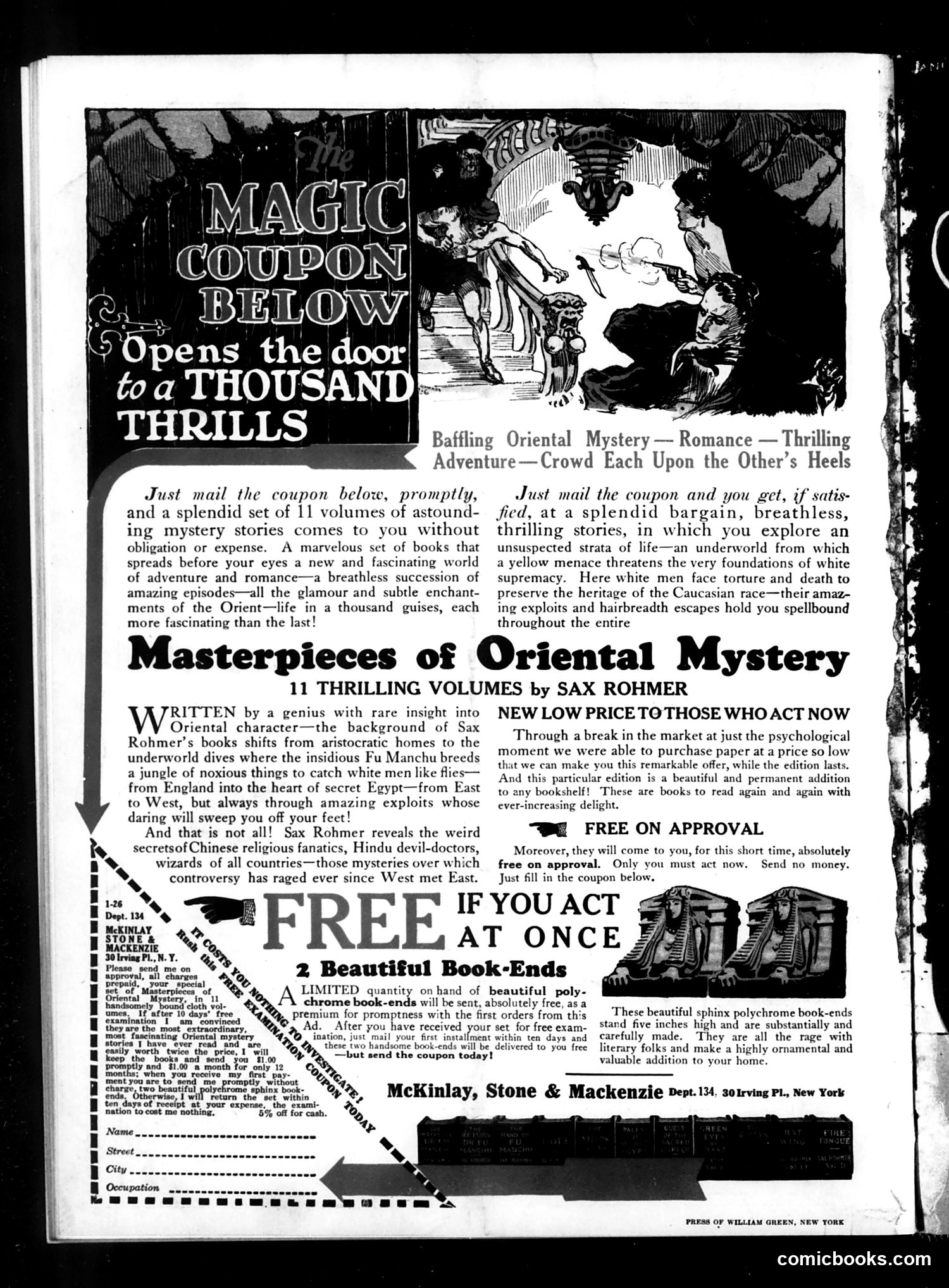
This page is primarily a mail-order advertisement for Sax Rohmer's 11-volume book series, not political satire. However, it reveals period racial attitudes worth noting for modern readers. The ad promotes Rohmer's "Oriental Mystery" fiction—featuring his famous villain Fu Manchu—using explicitly racialized language. It describes stories where "white men face torture and death to preserve the heritage of the Caucasian race" against "a yellow menace [that] threatens the very foundations of white supremacy." This reflects early 20th-century "Yellow Peril" anxieties: fears of Asian (particularly Chinese) immigration and influence in Western countries. The advertisement weaponizes these fears to sell entertainment, depicting Asians as inherently sinister, mysterious, and threatening to white dominance. For modern readers, this starkly illustrates how casually racist tropes were embedded in mainstream commercial advertising of the era—presented not as fringe ideology but as entertainment marketing.