
Judge, 1926-01-02 · page 18 of 36
Judge — January 2, 1926 — page 18: what you’re looking at
What you’re looking at
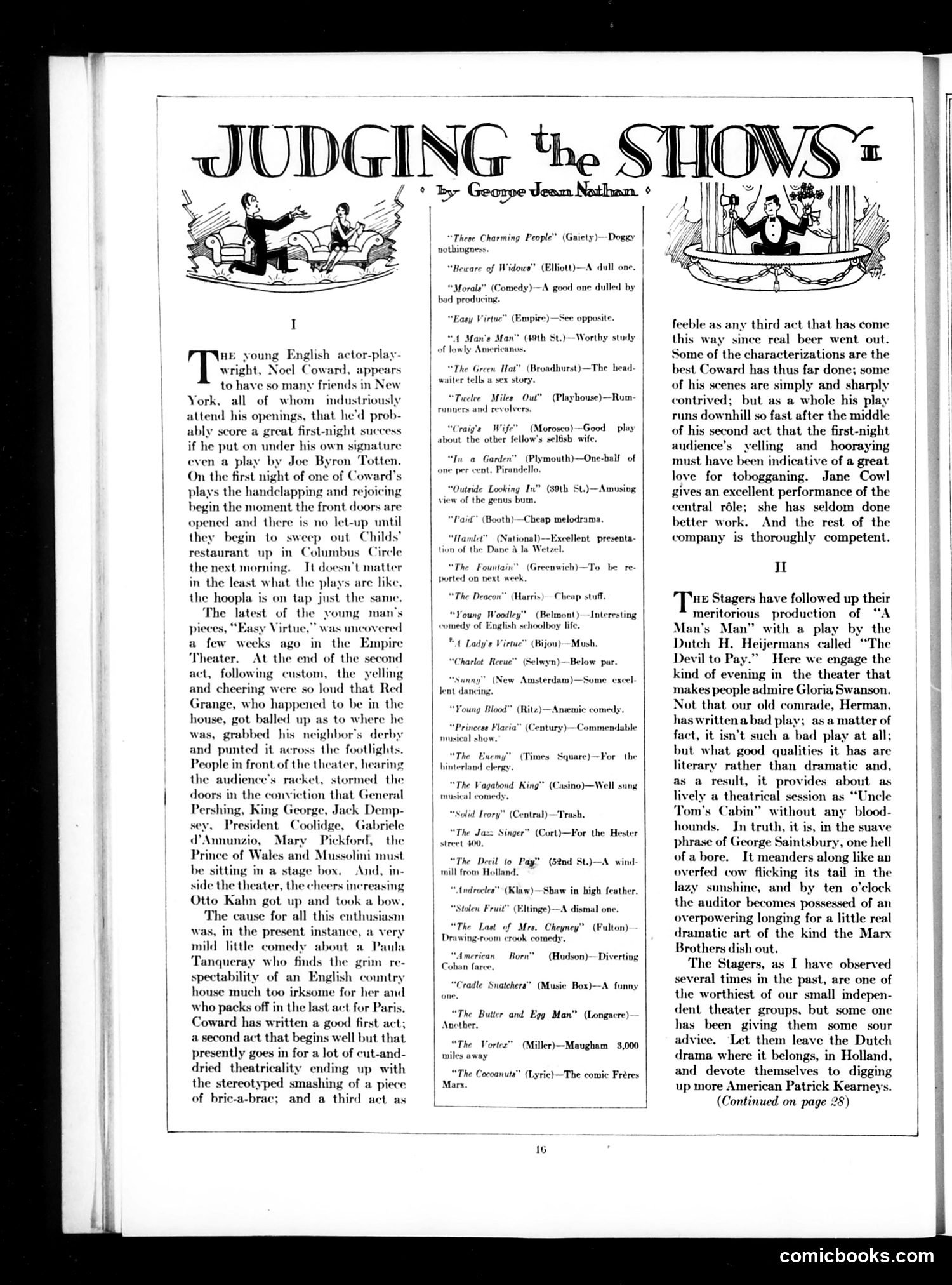
This page critiques English playwright Noel Coward's New York success, arguing it stems from devoted fans rather than theatrical merit. The reviewer claims Coward's opening nights generate such fervent applause that the actual quality of his plays becomes irrelevant—the "hoopla" would occur regardless of the script's quality. The satire peaks when describing the audience reaction to "Easy Virtue": the cheering was so loud that football star Red Grange, sitting in the theater, became confused and punted someone's hat across the stage. The reviewer sarcastically suggests onlookers thought famous figures like President Coolidge or King George must be present, causing the commotion. Meanwhile, wealthy theater patron Otto Kahn capitalized on the chaos by standing and taking a bow himself. The piece mocks celebrity-driven theater culture and audience irrationality, suggesting Coward's reputation exceeds his actual talent.
📄 Transcribed text from this page (OCR, searchable)
Machine-transcribed from the original scan — historical spelling and the odd misread are preserved.
HE young English actor-play- wright, Noel Coward, appears to have so many friends in New York, all of whom industriously attend his openings, that he'd prob- ably score a great first-night success if he put on under his own signature even a play by Joe Byron Totten. On the first night of one of Coward's plays the handclapping and rejoicing begin the moment the front doors are opened and there is no let-up until they begin to sweep out Childs’ restaurant up in Columbus Circle the next morning. It doesn’t matter in the least what the plays are like, the hoopla is on tap just the same. The latest of the young man’s pieces, “Easy Virtue,” was uncovered a few weeks ago in the Empire Theater. At the end of the second act, following custom, the yelling and cheering were so loud that Red Grange, who happened to be in the house, got balled up was, grabbed his neighbor's derby and punted it across the footlights. People in front of the thes the audience's racket, stormed the door: the conviction that General Pershing, King George, Jack Demp- President Coolidge, Gabriele d’Annunzio, Mary Pickford, the Prince of Wales and Mussolini must be sitting in a stage box. And, in- side the theater, the cheers increasing Otto Kahn got up and took a bow. The cause for all this enthusiasm was, in the present instance, a very mild little comedy about a Paula ‘Tanqueray who finds the grim re- spectability of an English country house much too irksome for her and who packs off in the last act for Paris, Coward has written a good first act; a second act that begins well but that presently goes in for a lot of cut-and- dried theatricality ending up with the stereotyped smashing of a piece of bric-a-brac; and a third act as s to where he er, hearing se} ° oe “These Charming People” nothingness. (Gaiety)—Dogey “Beware of Widows” (Elliott)—A dull one. (Comedy)—A good one dulled by bad producing. “Easy Virtue” (Empire) —See opposite. “A Man's Man’ lowly Americ Oth St.)—Worthy study “The Green Hat" (Broadhurst)—The bead + tells a sex story. Twelce Miles Out” runners and revolvers. “Craig's Wife” (Morosco)~Good _ play about the other fellow’s selfish wife. (Playhouse)—Rum ‘nm @ Garden" (Plymouth)—One-balf of ‘one per cent. Pirandello, “Outside Looking In” view of the genus bum. (39th St.)—Amusing “Paid” (Booth)—Cheap melodrama. (National), dla “Hamlet” tion of the Ds cellent presenta- vel, “The Fountain™ ported on next week, (Greenwich)—To be re- “The Deacon” (Harris) Cheap stuf “Young Woodley” (Belmont) comedy of English schoolboy life. Mush, Interesting "4 Lady's Virtue” (Bijou) “Charlot Recue” (Selwyn)—Below par. (New Amsterdam)—Some excel: ra lent da “Young Blood” (Ritz)—Anemic comedy “Princess Flavia” (Century)—Commendable musical show. “The Enemy” hinterland cle (Times Square)—For the “The Vagabond King” musical comedy. (Casino}—Well sung “Solid Feory” “The Jaz: street 400, (Central) (Cort)—For the Hester ~Trash. Singer” “The Decil to Pay’ mill from Holland. ” (52nd StJ—A wind “Androctes” (Klaw)—Shaw in high feather. “Stolen Fruit” (Elinge) “The Last of Mrs. Cheyney” Drawing-room crook comedy. ‘A dismal one. (Fulton) “American Korn” — (Hudson)—Diverting Cohan farce, “Cradle Snatchers” (Music Box)—A funny “The Butter and Egg Man” (Longacre) Another. “The miles away Vorter” (Miller)—Maugham 3,000 “The Cocoanut (Lyric)—The comic Fréres | Marx JUDGING the SH ny third act that has come y since real beer went out. Some of the characterizations are the best Coward has thus far done; some of his scenes are simply and sharply contrived; but as a whole his play runs downhill so fast after the middle of his second act that the first-night audience's yelling and hooraying must have been indicative of a great love for tobogganing. Jane Cowl gives an excellent performance of the central réle; she has seldom done better work. And the rest of the company is thoroughly competent. II HE Stagers have followed up their meritorious production of “A Man’s Man” with a play by the Dutch H. Heijermans called “The Devil to Pay.” Here we engage the kind of evening in the theater that makes people admire Gloria Swanson. Not that our old comrade, Herman, has written a bad play; as a matter of fact, it isn’t such a bad play at all; but what good qualities it has are literary rather than dramatic and, as a result, it provides about as lively a theatrical session as “Uncle Tom's Cabin” without any blood- hounds. Jn truth, it is, in the suave phrase of George Saintsbury, one hell ofa bore. It meanders along like av overfed cow flicking its tail in the lazy sunshine, and by ten o'clock the auditor becomes possessed of an overpowering longing for a little real dramatic art of the kind the Marx Brothers dish out. The Stagers, as I have observed several times in the past, are one of the worthiest of our small indepen- dent theater groups, but some one has been giving them some sour advice. Let them leave the Dutch drama where it belongs, in Holland, and devote themselves to digging up more American Patrick Kearneys. (Continued on page 28) comicbooks.com