
A complete issue · 36 pages · 1925
Judge — October 24, 1925
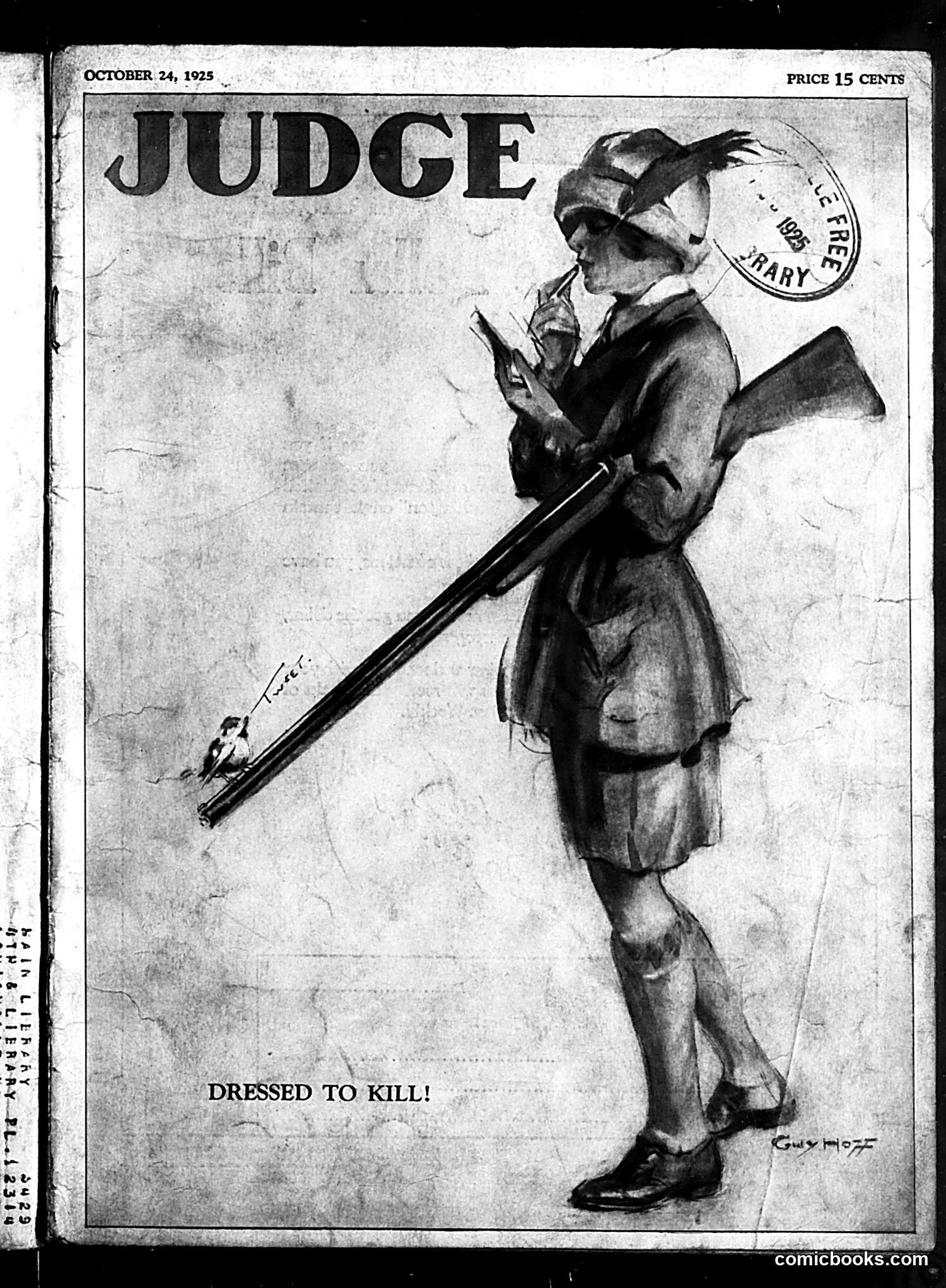
This is the cover of *Judge* magazine from October 24, 1925. The illustration, signed by Guy Hoff, depicts a woman in hunting attire holding a rifle with the caption "DRESSED TO KILL!" The satire plays on a double meaning: "dressed to kill" was a common phrase meaning fashionably or attractively dressed, while the image literally shows a woman in hunting clothes with a gun. This suggests commentary on women's changing roles in the 1920s—the "New Woman" of the Jazz Age who participated in activities traditionally reserved for men, like hunting. The small bird near the rifle barrel adds to the hunting theme. The satirical point appears to mock or comment on evolving gender norms and women's increasing independence and participation in leisure activities during this era.
This is primarily an **advertisement/promotion** rather than political satire. Judge magazine is soliciting readers to send in rare one-dollar bills featuring George Washington with specific characteristics: containing "ten letters" in the name "Washington" and having a "green back." The promotion offers a prize of ten weeks' free subscription to Judge ("The World's Wittiest Weekly") to anyone who can produce such a bill. The phrase "Incidentally, do it now" adds urgency. This appears to be a **scam or joke promotion**—the criteria described seem designed to be impossible to satisfy, making it either a humorous hoax or a scheme to collect actual currency under false pretenses. Readers are assured their identities won't be published, which raises further suspicion about the legitimacy of the offer.
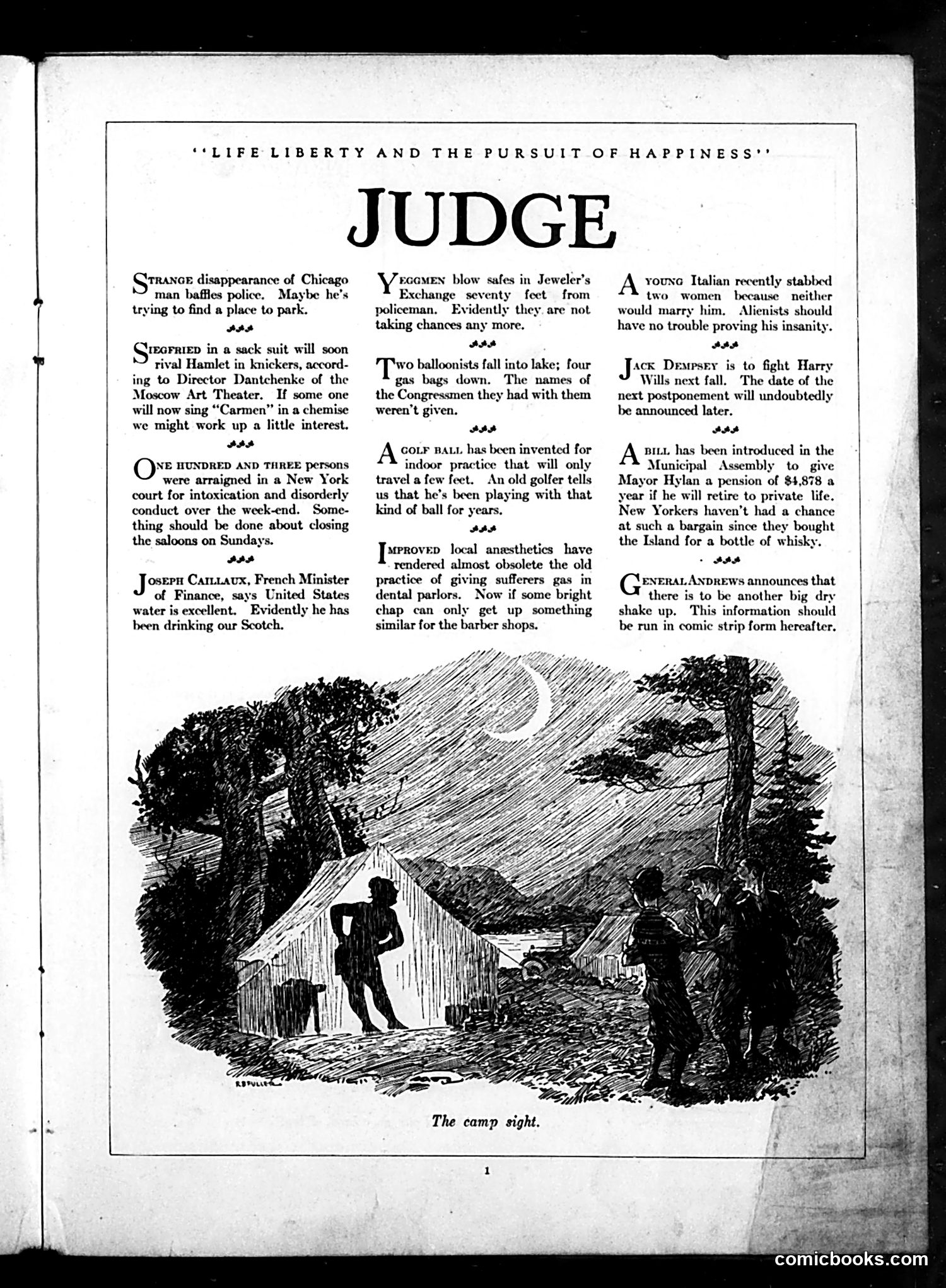
This page presents brief satirical news items ("Judge" column) typical of the magazine's format. The content mocks contemporary issues: - **Chicago housing crisis**: A man can't find parking - **Theater rivalry**: A competing production of "Carmen" - **New York saloon regulations**: Proposed Sunday closings - **Joseph Caillaux reference**: France's Finance Minister allegedly drinks American Scotch (implying questionable taste or diplomatic dependence) - **Two balloonists**: A humorous anecdote about an accident - **Golf and dental innovations**: Satirizing modern conveniences - **Mayor Hylan's pension bill**: NYC political news The illustration depicts a camping scene, likely accompanying an unrelated joke or story. These items represent Judge's typical mix of domestic politics, international humor, and absurdist observations on modern American life—the magazine's bread-and-butter satirical approach.
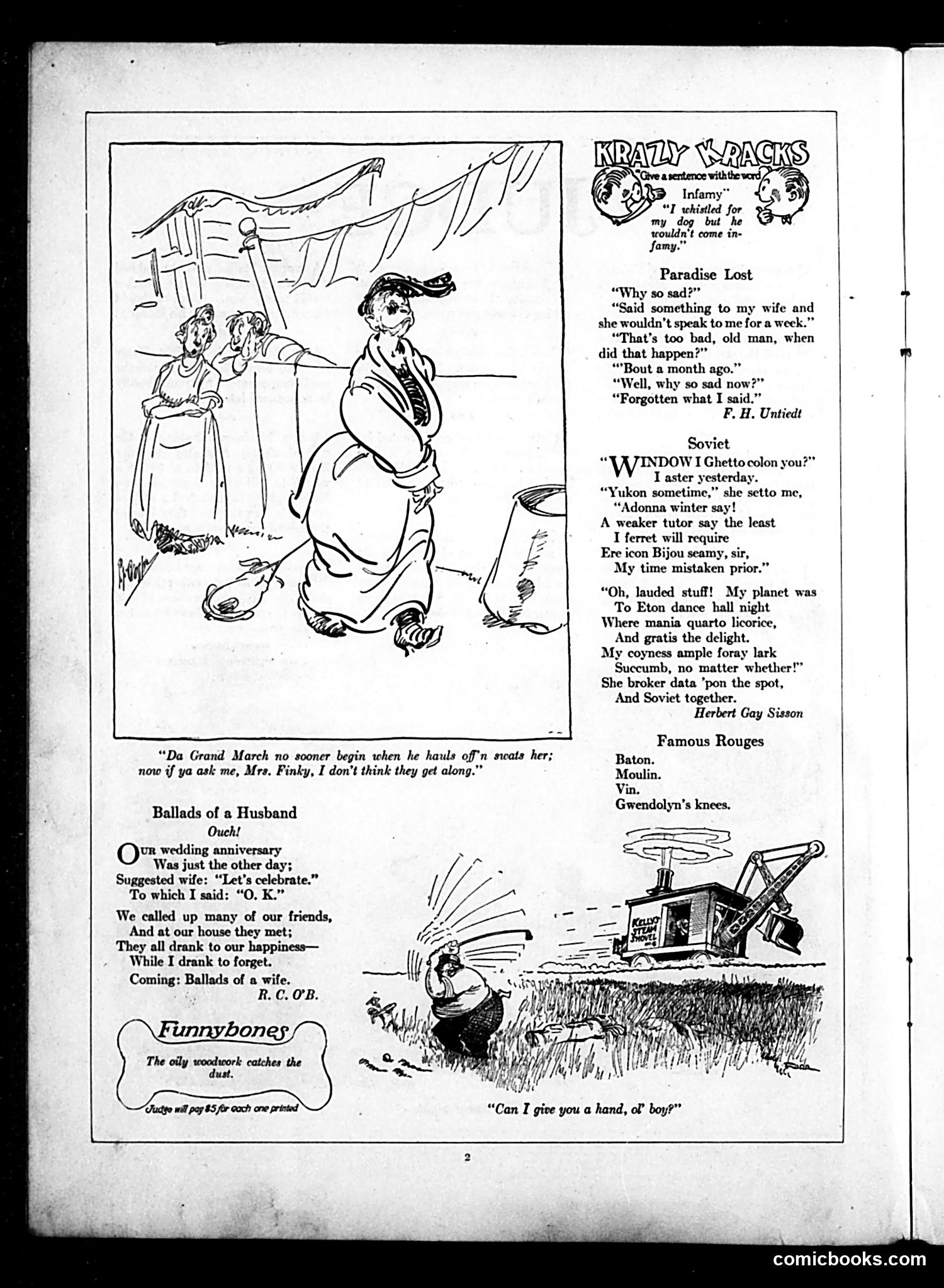
This page contains primarily **humorous verse and jokes** rather than political cartoons. The content includes: **"Ballads of a Husband"** - A domestic comedy poem about a couple's anniversary celebration, poking fun at married life and the husband's forgetfulness. **"Krazy Kracks"** - Brief joke snippets with puns and wordplay, including references to "Paradise Lost" and "Soviet." **"Famous Rouges"** - A humorous list of places/people associated with "rouge" (makeup). The **main cartoon** (top left) shows a domestic scene where a man appears to be in trouble with his wife over laundry or clothing—typical early-20th-century humor about gender roles and household tensions. The bottom cartoon depicts someone being struck by farm equipment, captioned "Can I give you a hand, ol' boy?"—dark humor about a farming accident. This page reflects **domestic and slapstick comedy** typical of Judge's general-interest humor rather than political satire.
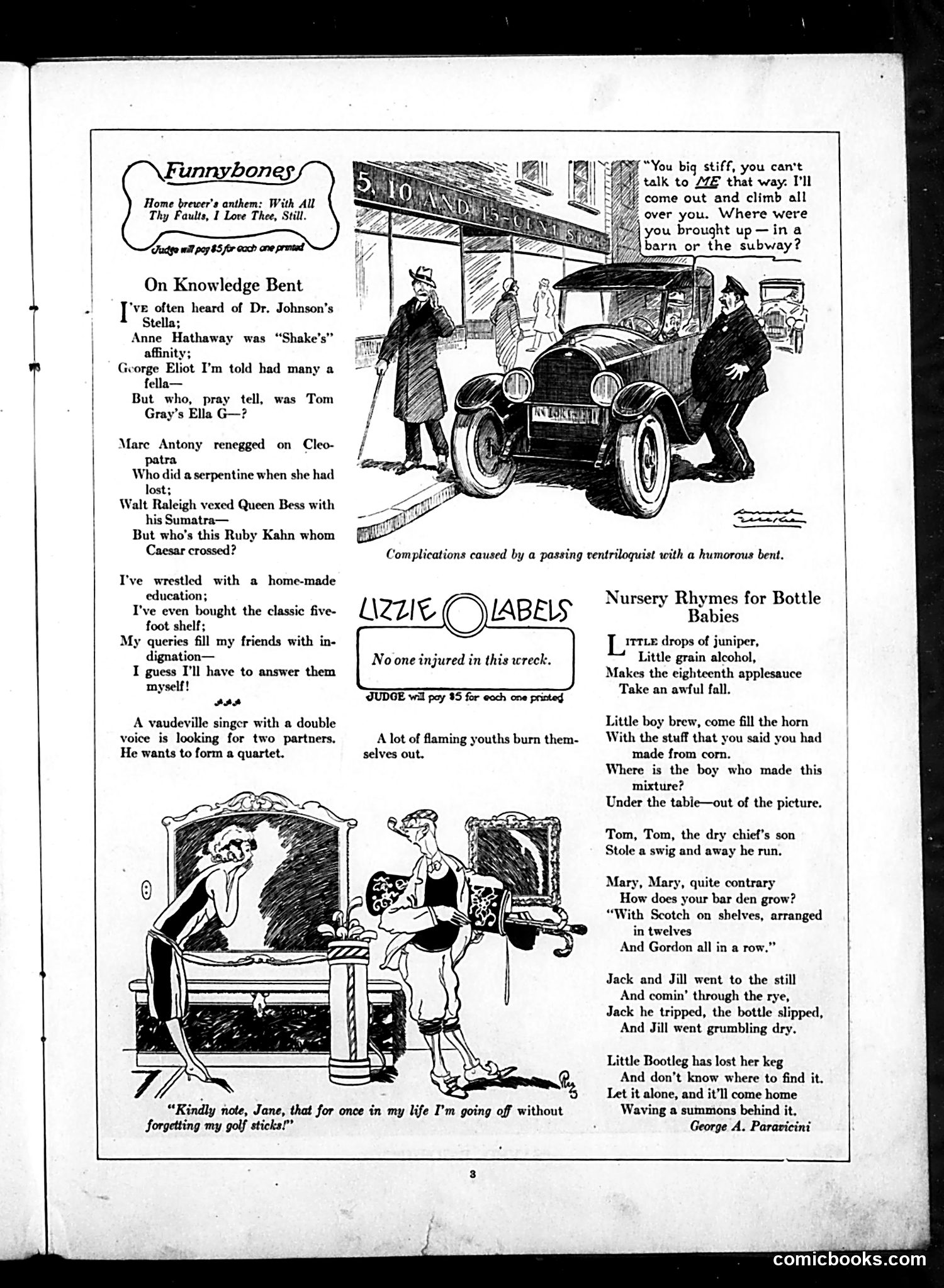
This page contains humorous verse and illustrations rather than political cartoons. **"On Knowledge Bent"** is a poem listing famous historical and literary figures—Dr. Johnson, Anne Hathaway, George Eliot, Tom Gray—playing on their achievements or scandals. **The main cartoon** depicts a car accident where a ventriloquist's dummy has caused "complications." The humor relies on the absurdity of blaming an inanimate object for traffic damage. **"Nursery Rhymes for Bottle Babies"** parodies traditional nursery rhymes with alcohol-related content (juniper, grain alcohol, Scotch), satirizing excessive drinking through mock-innocent verse. The **"Lizzie Labels"** notice indicates Judge paid judges $15 for accepted contributions. Overall, this page emphasizes wordplay and domestic humor rather than political satire—typical of Judge's lighter entertainment content.
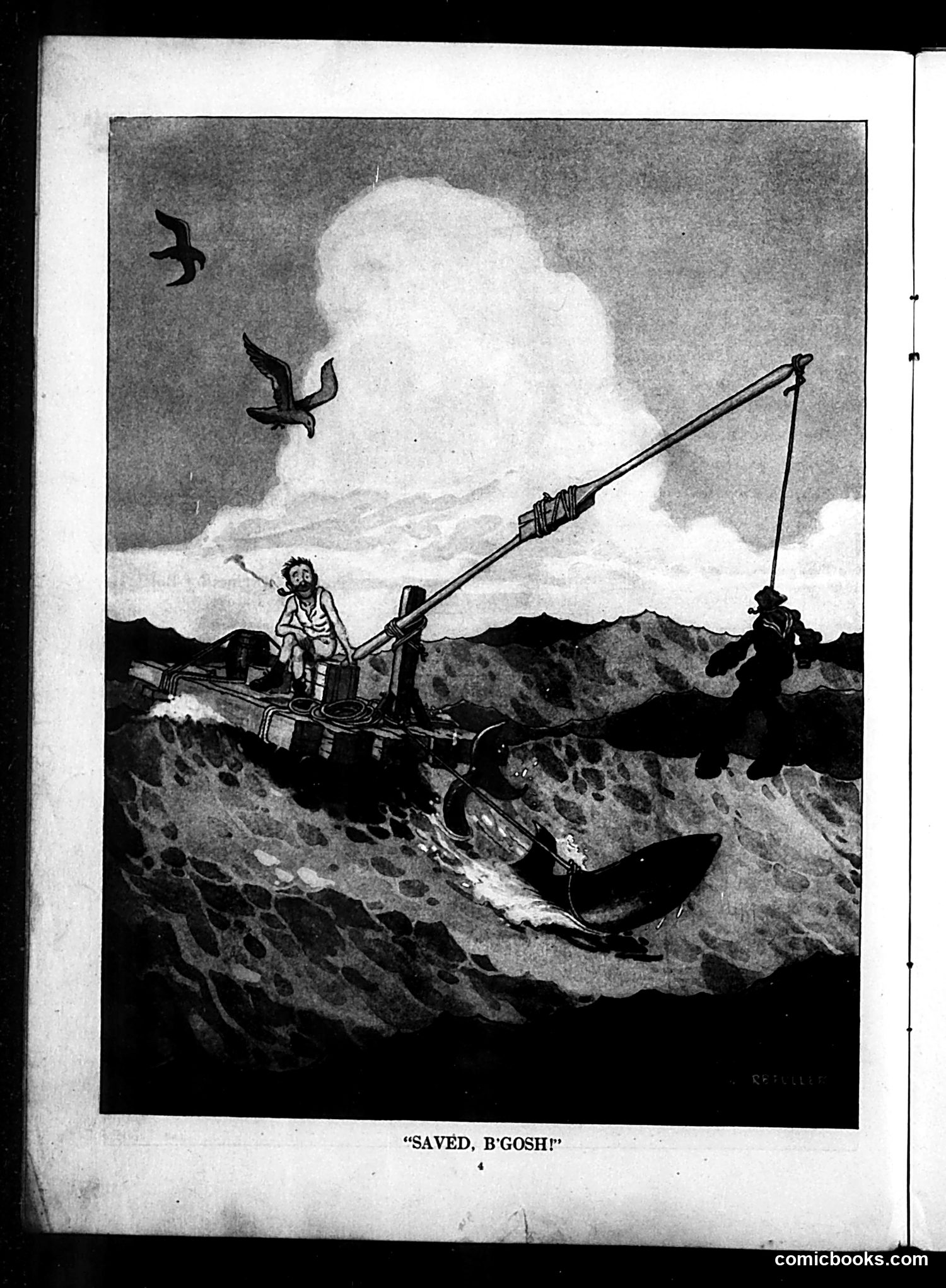
This political cartoon depicts a dramatic rescue scene with surreal, nightmarish elements. Two figures appear to be fishing or using a mechanical contraption to pull someone from turbulent waters, while demonic or devilish creatures hover menacingly overhead. The title "Saved, B'gosh!" suggests a miraculous intervention or escape from danger. Without additional context from the magazine's publication date or accompanying articles, the specific political reference remains unclear. However, Judge typically lampooned contemporary political figures and events. The hellish imagery and rescue scenario likely satirize a controversial political situation or politician's narrow escape from scandal or downfall. The grotesque creatures may represent threatening forces—possibly political opponents, corruption, or social chaos—from which someone or some group was providentially saved.
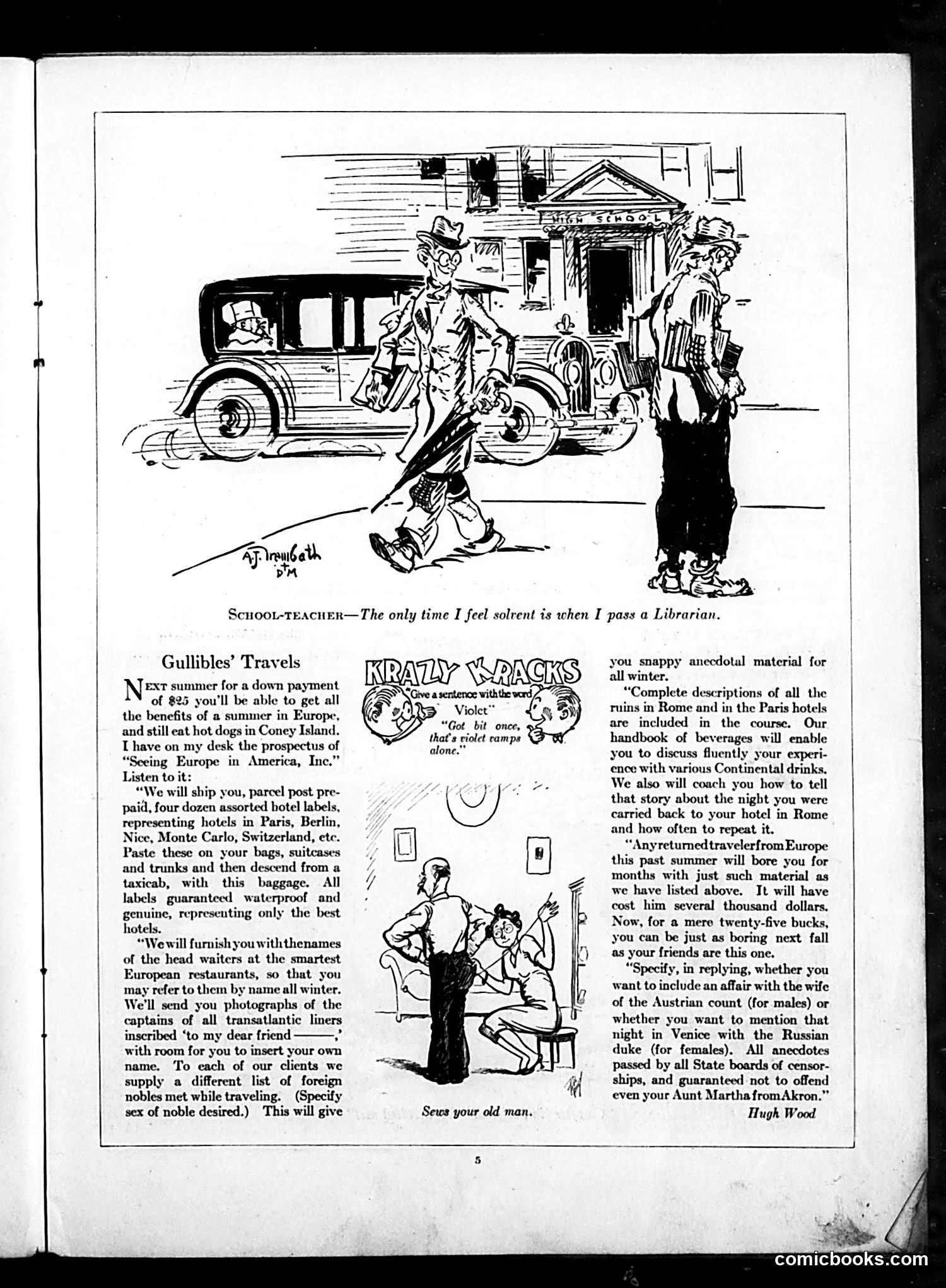
**Top Cartoon**: A school-teacher passes a librarian and remarks, "The only time I feel solemn is when I pass a Librarian." The joke satirizes librarians as stereotypically serious and austere figures—a common cultural stereotype of the era portraying them as humorless authority figures. **Advertisement Content**: "Gullibles' Travels" and "Krazy Whacks" sections advertise travel packages to Europe for $25 down payment, humorously promising to equip tourists with anecdotes and "continental" sophistication. The satire mocks Americans seeking to appear cultured after European travel, while the bottom illustration shows a waiter serving drinks, likely referencing the Continental lifestyle being marketed. The page primarily contains humorous travel-related advertising rather than political commentary.
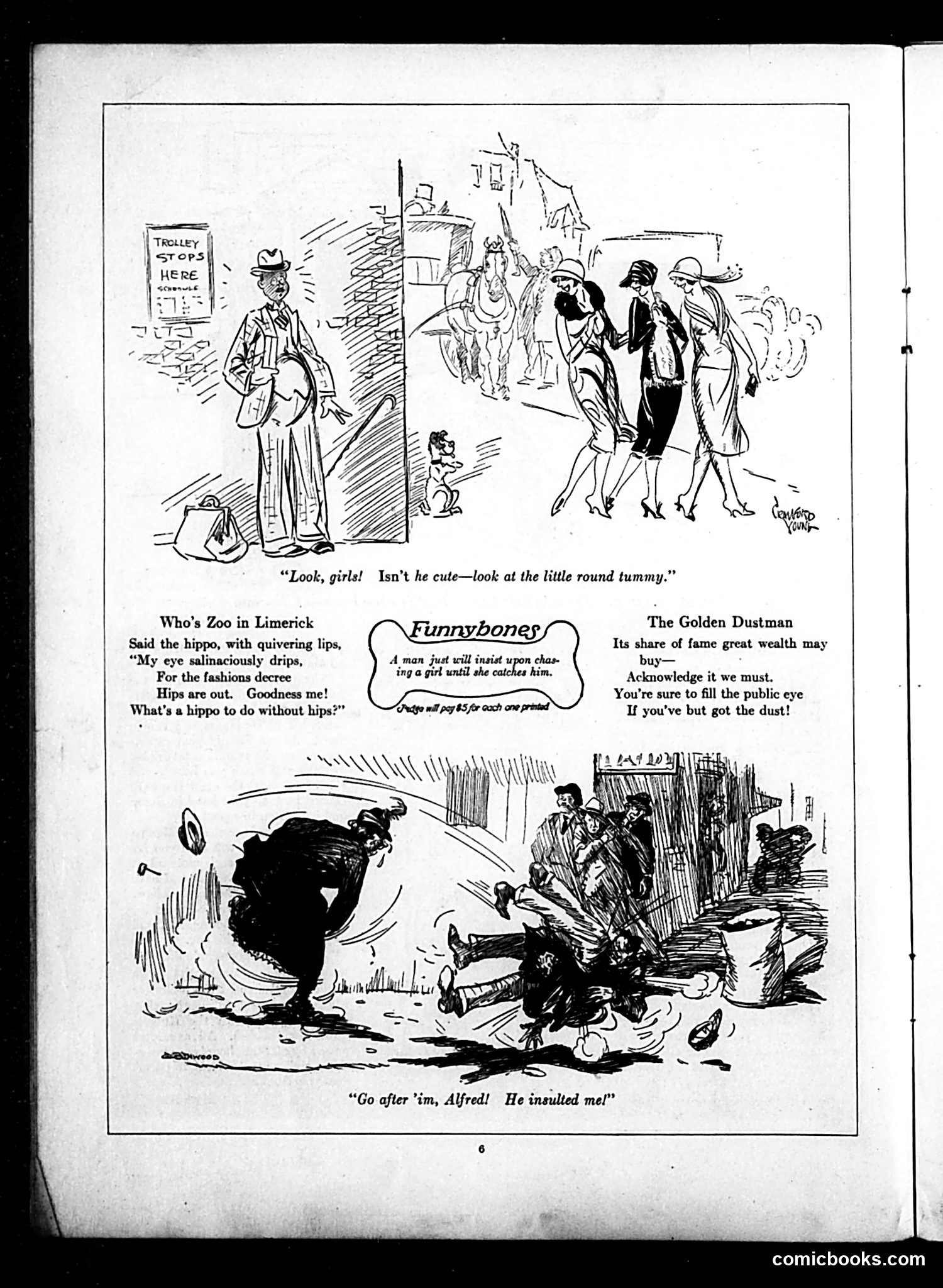
This Judge magazine page contains three separate comedic pieces satirizing 1920s social trends. **Top cartoon**: Mocks flapper fashion. A man at trolley stops admires a woman's "round tummy"—the opposite of the fashionable flat-chested silhouette women were artificially creating through binding and diet. The joke ridicules how extreme and unnatural the fashion ideal had become. **"Who's Zoo in Limerick"**: A hippo laments that fashion now requires slim hips, leaving him—naturally round-hipped—hopelessly out of style. This anthropomorphic humor extends the fashion satire absurdly. **"The Golden Dustman"**: Appears to reference wealth and fame, suggesting that fortune and public attention matter more than genuine merit or character—a cynical commentary on celebrity and materialism. **Bottom cartoon**: Shows a slapstick fight scene with the caption "Go after 'im, Alfred! He insulted me!"—physical comedy emphasizing masculine honor and confrontation over insult.
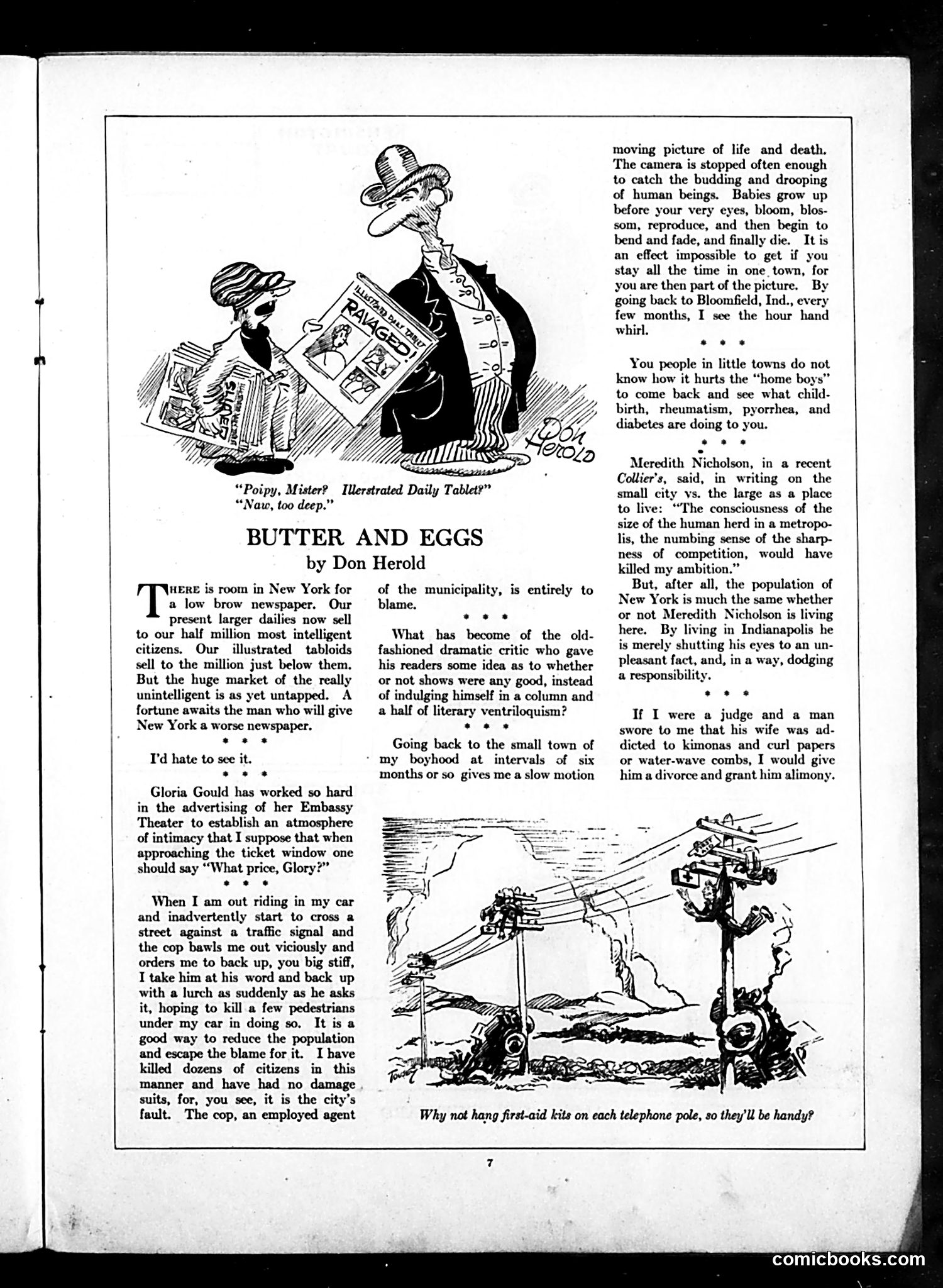
This page is a satirical essay collection by Don Herold, not a traditional political cartoon. The top illustration shows a man and woman reading a tabloid newspaper labeled "Illustrated Daily Tablet," with the woman asking "Poopy, Mister?" and the man responding "Naw, too deep"—mocking the growing market for lowbrow newspapers aimed at unintelligent readers. Herold's essays mock various aspects of 1920s American life: sensationalist journalism, over-intellectualized theater criticism, the artificiality of urban living versus small-town life (he references returning to Bloomfield, Indiana), and urban hazards like dangerous traffic. He sarcastically defends killing pedestrians by blaming the traffic cop rather than himself. The bottom illustration of tangled telephone poles captioned "Why not hang first-aid kits on each telephone pole?" is Herold's deadpan commentary on urban infrastructure hazards and bureaucratic incompetence. The tone throughout is cynical social criticism disguised as humorous observations.
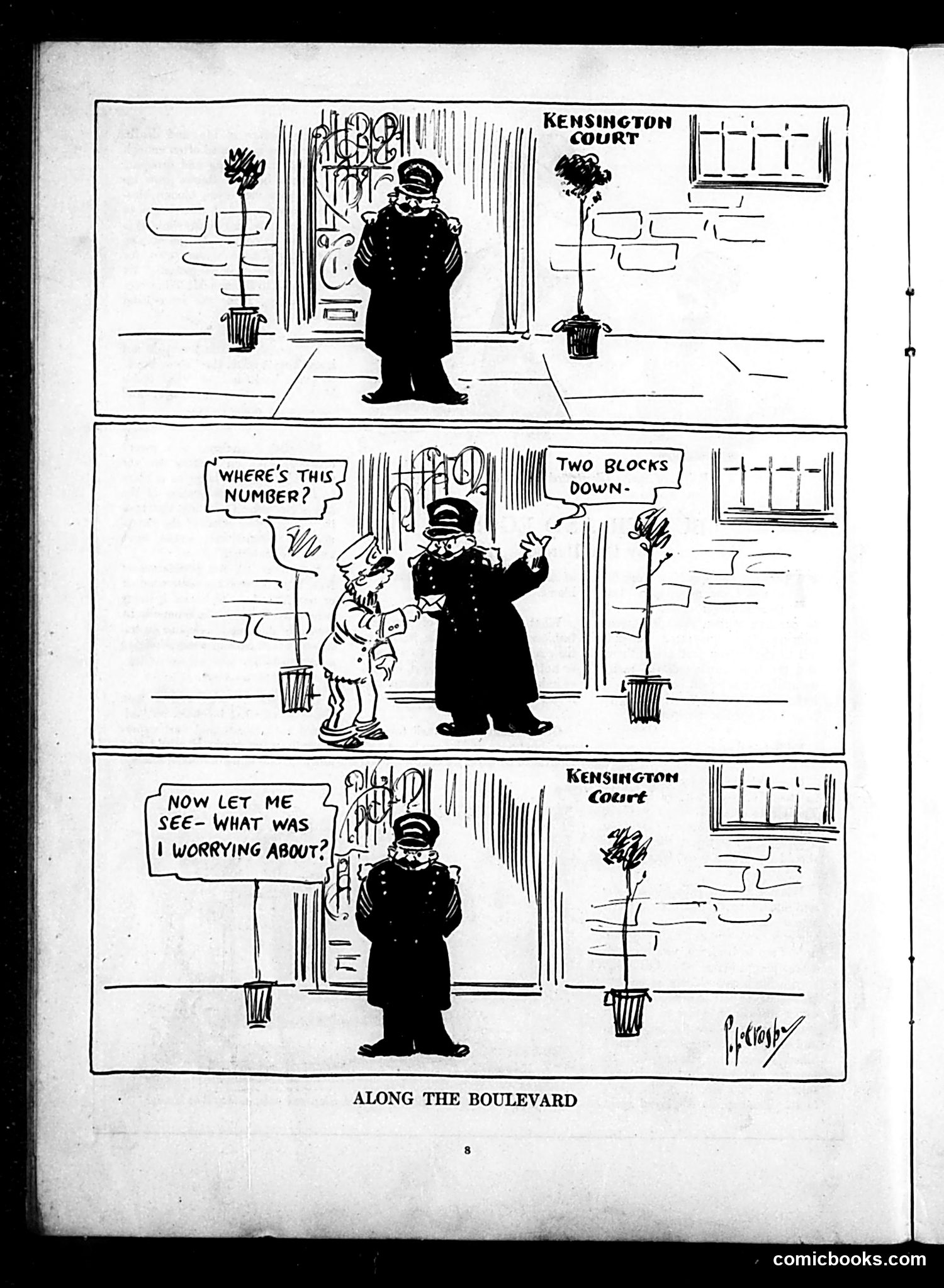
This three-panel comic depicts a uniformed police officer or official at Kensington Court (a London address) seeking a house number. In panel one, he stands confused outside the building. Panel two shows a resident responding to his query "Where's this number?" with "Two blocks down." Panel three reveals the officer's concern: he was worried about a missing house number, but now realizes the address he seeks is actually located elsewhere. The humor appears to derive from the officer's relief upon discovering the number's location, rather than from any missing signage at Kensington Court itself. The joke plays on British urban geography and bureaucratic confusion over addresses.
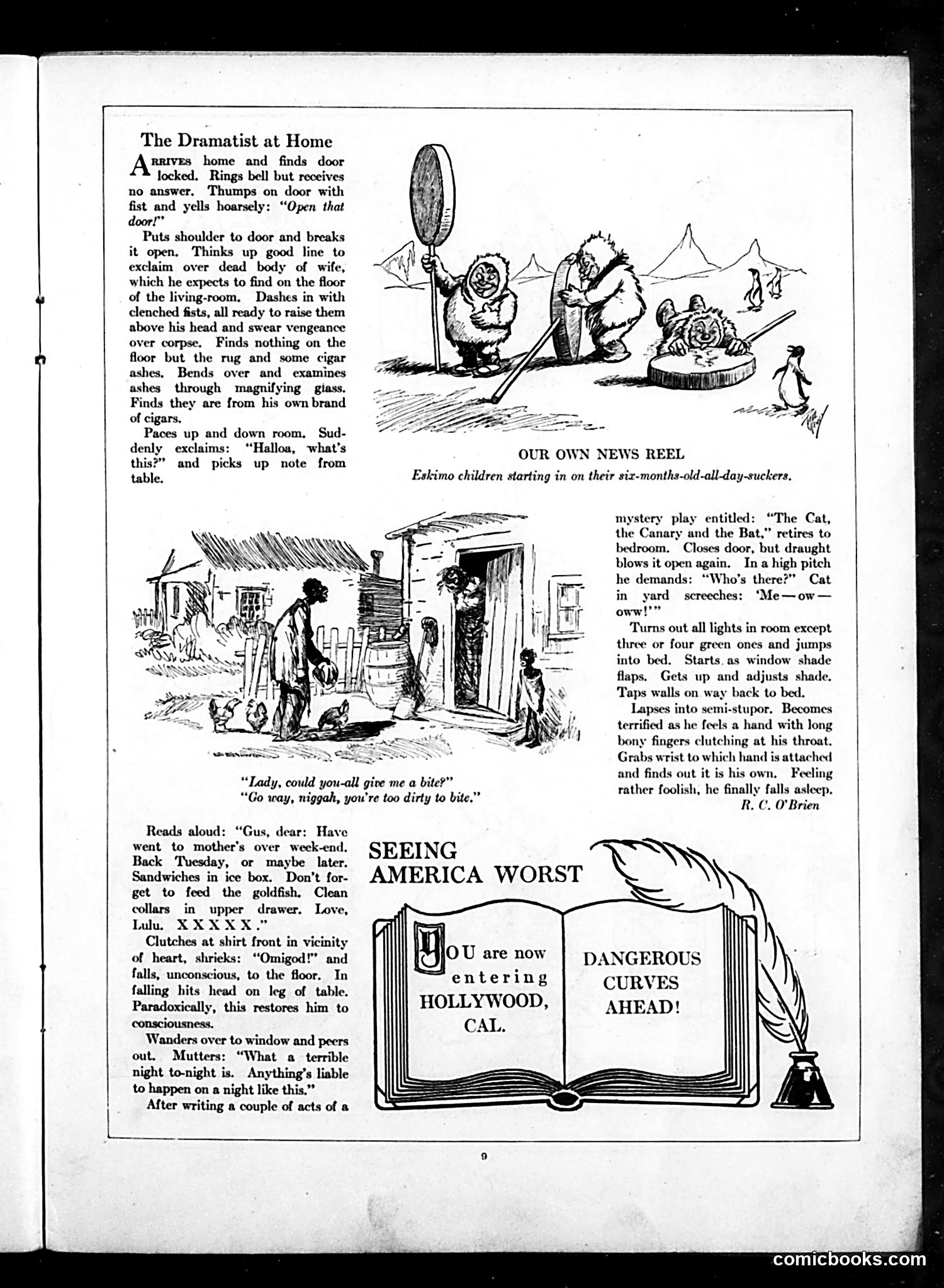
This page satirizes melodramatic playwrights of the early 20th century. The main piece, "The Dramatist at Home," mocks writers who construct overwrought theatrical scenarios. A dramatist returns home expecting to discover his wife dead—anticipating he can craft an emotional death scene. Instead, he finds nothing, reads a mundane note, and spends the night in his own paranoid terror (imagining bony fingers at his throat—his own hand). The satire targets the gap between theatrical artifice and reality: playwrights obsessed with manufactured drama miss actual life's simplicity. His elaborate emotional preparation becomes absurd when confronted with domesticity (rug, cigar ashes, a note about goldfish). The "Our Own News Reel" section appears to be brief satirical vignettes. The page also includes a sidebar advertisement warning of "Dangerous Curves Ahead" near Hollywood, California—a playful reference to both dangerous driving and attractive women in the film industry. The crude racist joke at bottom reflects period attitudes but represents the magazine's offensive content.
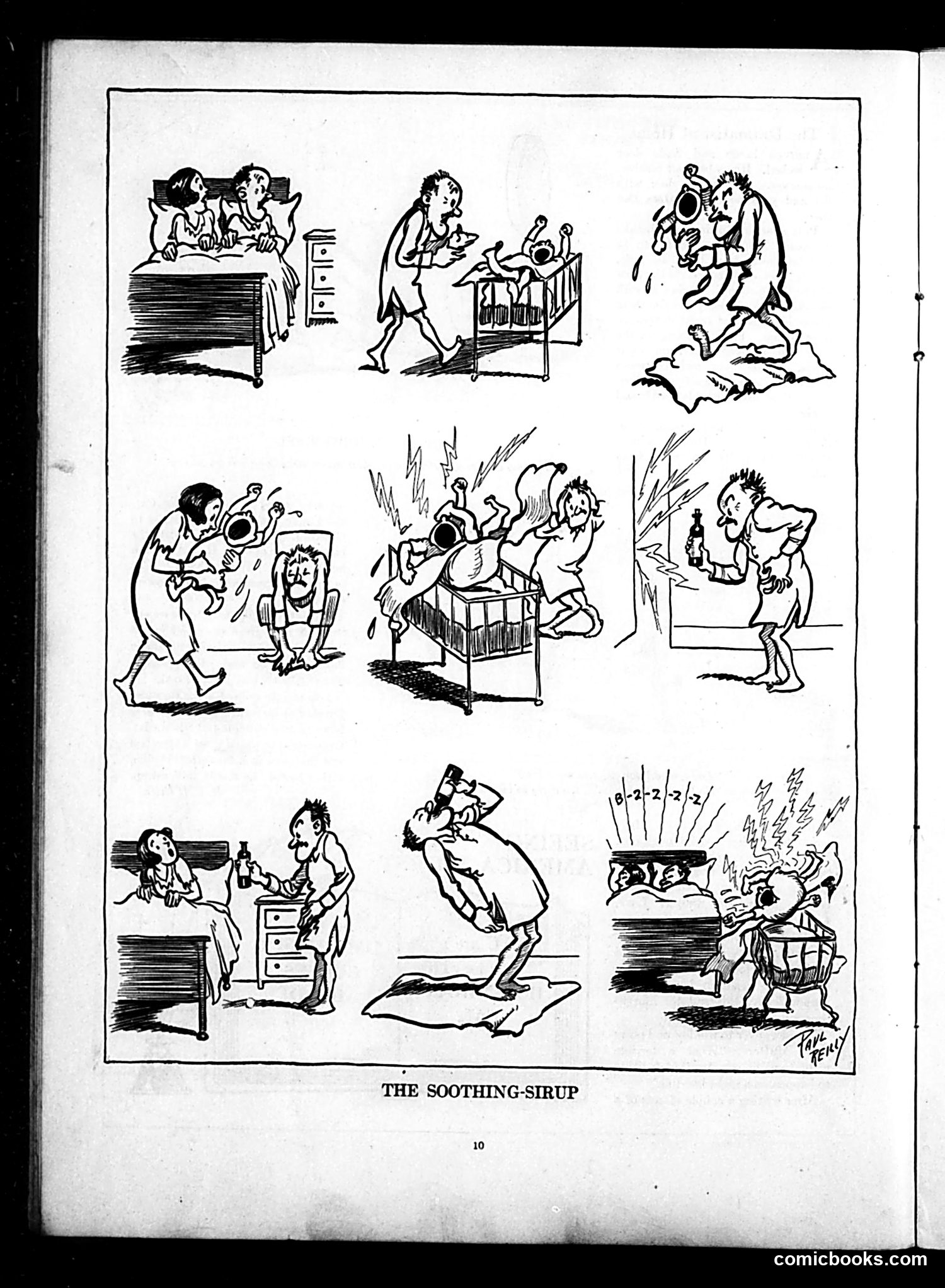
This satirical comic strip depicts the chaotic consequences of giving infants soothing syrup (likely opium-based medicines common in the late 19th/early 20th century). The nine-panel sequence shows: - Parents administering the syrup to crying babies - Drugged infants becoming unnaturally calm or stuporous - Increasingly absurd and dangerous situations resulting from the medication's effects - The final panels showing complete household chaos and disorder The satire mocks both the widespread use of addictive patent medicines on children and parental negligence. These syrups were marketed as safe remedies but contained opioids and other dangerous drugs, creating addicted infants. Judge attacks this medical practice through visual comedy, showing how the "solution" creates worse problems than the original crying.
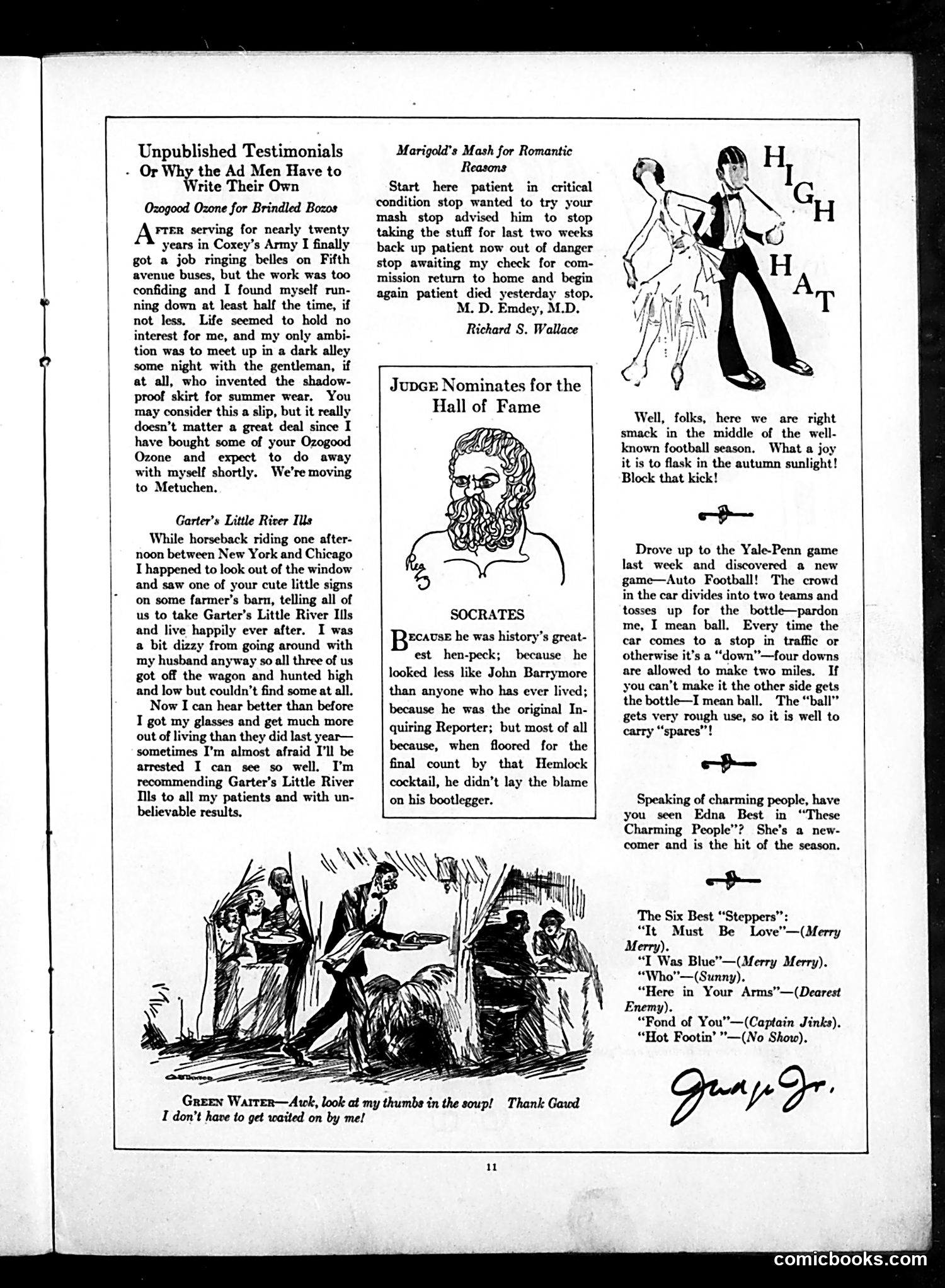
This page satirizes patent medicine advertising through fake testimonials. The "Unpublished Testimonials" section mocks the exaggerated health claims common in early 20th-century ads by presenting absurd endorsements: one writer credits a product with making him suicidal ("expect to do away with myself shortly"), another claims eyeglasses she didn't find nevertheless improved her vision, and a doctor admits a patent medicine killed his patient but he's awaiting his commission payment anyway. The "Socrates" cartoon nominates a fictional man for a "Hall of Fame" for being history's greatest hen-pecked husband—a joke about nagging wives that reflects period domestic humor. Other content includes football season commentary, a reference to actress Edna Best in the play "These Charming People," and a list of popular song titles. The "Green Waiter" cartoon depicts working-class humor about soup service. The overall tone mocks both fraudulent advertising practices and various social conventions of the era.
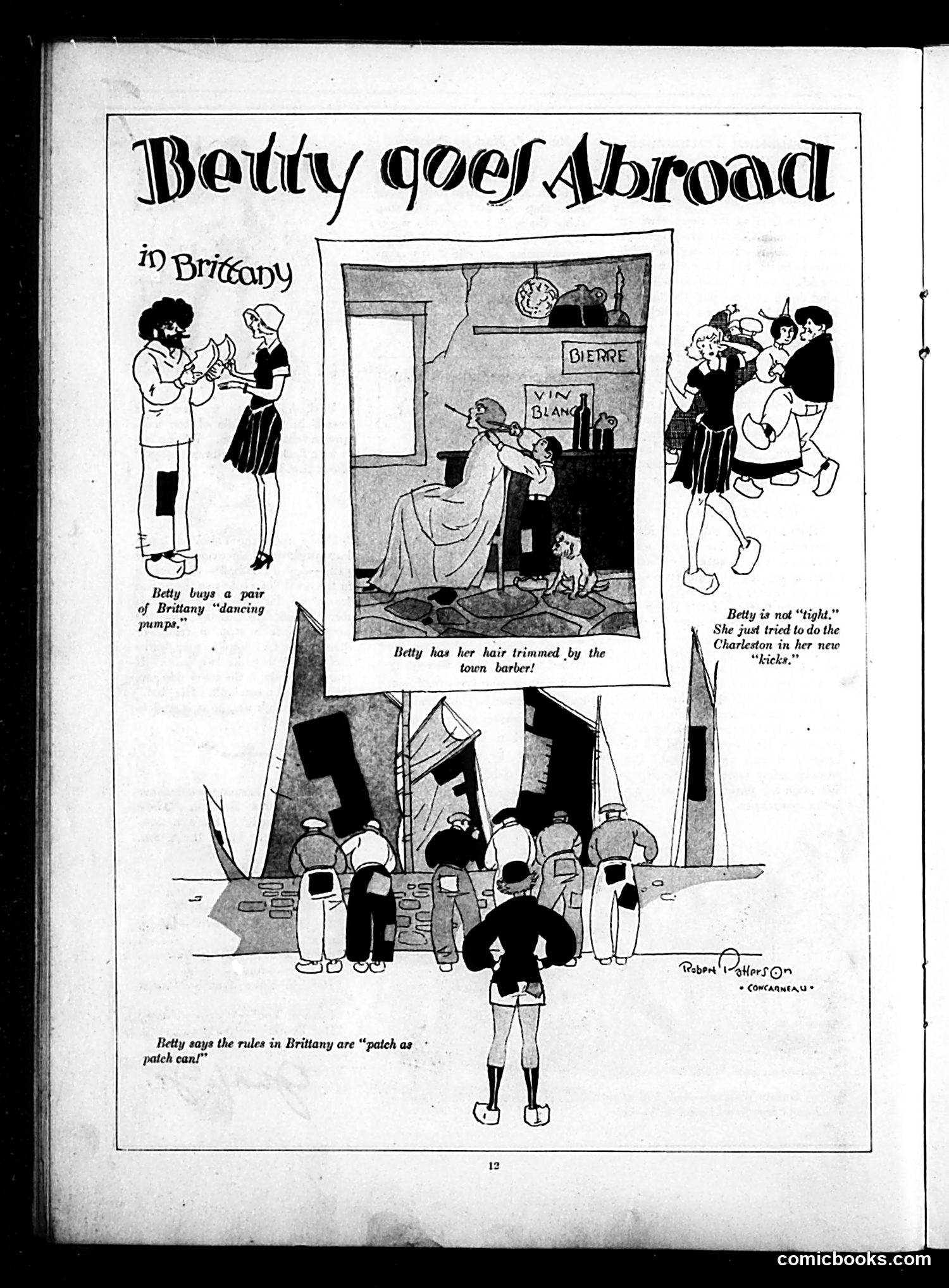
This is a humorous comic strip about an American woman named Betty vacationing in Brittany, France. The satire plays on cultural differences and the 1920s craze for jazz-age dancing (the Charleston). The jokes include: Betty buying local "dancing pumps" and attempting the Charleston in her new French kicks, awkwardly failing at the dance; getting a haircut at a local Breton barber; and observing that French social rules are "as patch as patch can" (meaning haphazard or unpredictable). The central panel shows her in a French café with signs for "Cidre," "Vin Blanc," and "Bière." The strip gently mocks both American tourists abroad trying to fit in with local fashions and the perceived looseness of French social customs compared to American propriety.
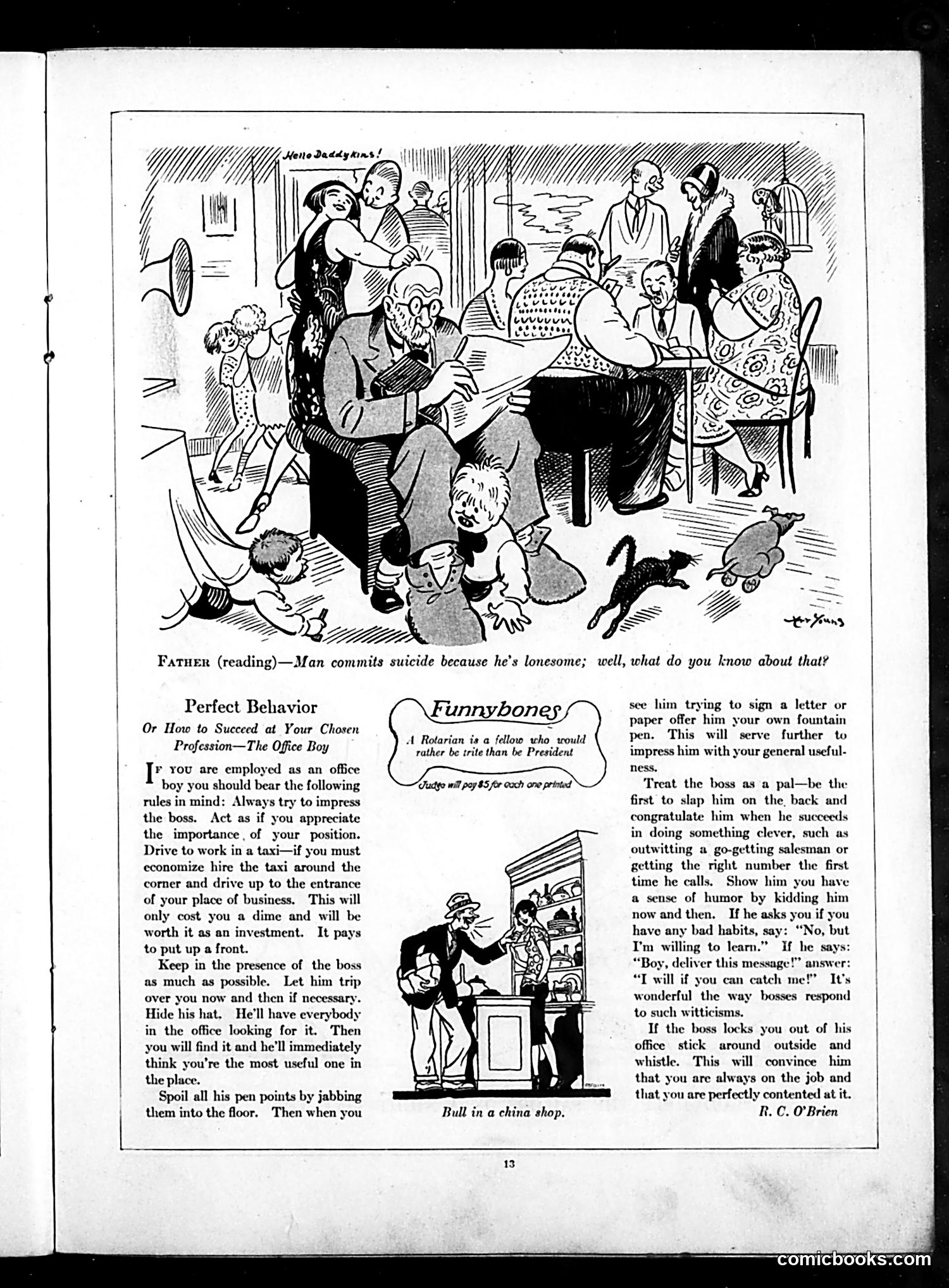
This satirical piece mocks the era's obsequious workplace culture by presenting absurdly bad advice disguised as career guidance. The article advises an office boy to: - Arrive by taxi (even if he must economize) to impress the boss with false status - Deliberately sabotage the boss's pen points so he can heroically "find" them - Hide the boss's hat to create opportunities to appear helpful - Answer direct orders with smart-aleck refusals ("I will if you can catch me!") The satire targets both the performative, dishonest workplace dynamics of the era and the naive office boy's desperation to advance through manipulation rather than genuine work. By presenting these transparently terrible strategies as "success," the author ridicules the hollow pretense that permeated early 20th-century American business culture. The accompanying cartoon shows a chaotic office party, visually reinforcing the satirical tone that workplace "perfection" is actually incompetent theater.
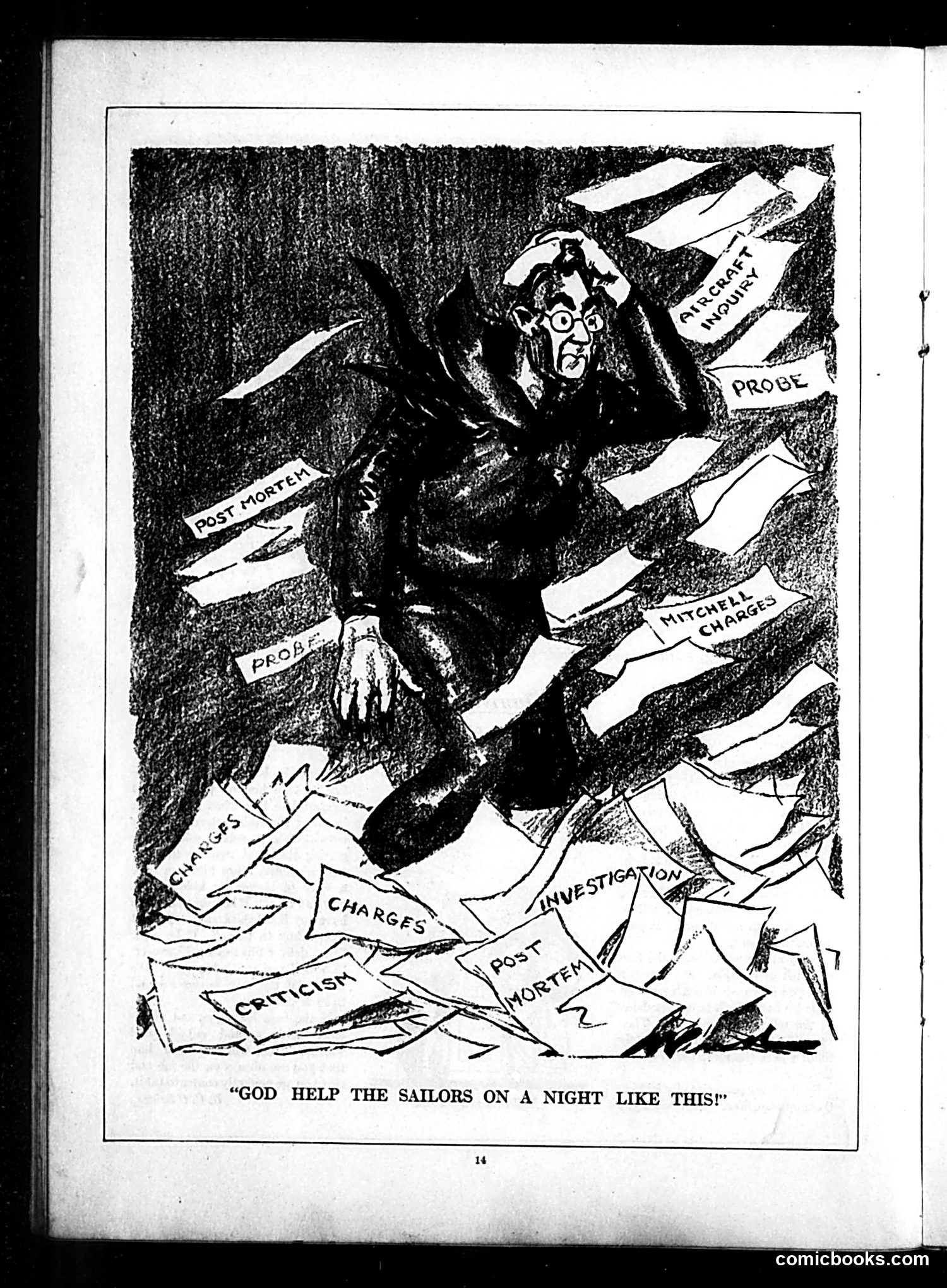
This political cartoon depicts a demonic or ghostly figure surrounded by floating papers labeled with various investigative and legal troubles: "Post Mortem," "Probe," "Inquest," "Mitchell Charges," "Investigation," "Charges," "Criticism," and "Post Mortem Investigation." The figure appears to be a caricature representing a specific political target being overwhelmed by multiple concurrent scandals, investigations, and accusations. The caption's prayer for sailors suggests the figure is creating chaos and turbulence like a storm at sea. Without knowing the specific publication date, I cannot identify which public figure this represents. However, the cartoon clearly satirizes someone facing simultaneous legal and political crises, suggesting their troubles are mounting to catastrophic levels—a common Judge magazine theme attacking political enemies.
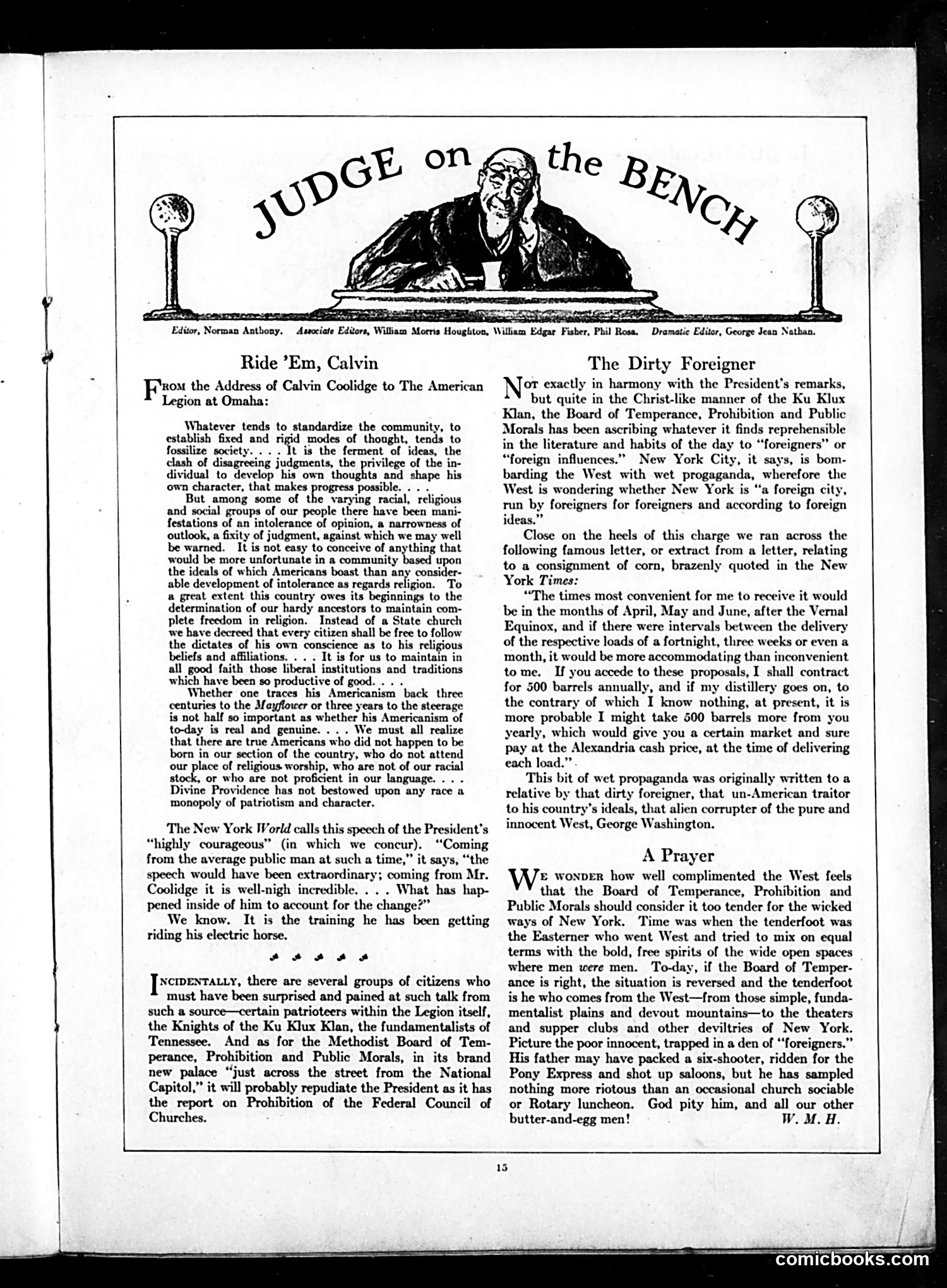
This page satirizes President Calvin Coolidge and contemporary nativist hysteria. The masthead cartoon depicts a "Judge on the Bench" presiding over political commentary. **"Ride 'Em, Calvin"** praises Coolidge's speech to the American Legion advocating religious tolerance and defending immigrants' patriotism against nativist suspicion. The joke: Judge attributes this unexpected progressivism to Coolidge practicing on an "electric horse"—implying mechanical repetition rather than genuine conviction. Judge notes the speech contradicts Coolidge's typical timidity. **"The Dirty Foreigner"** criticizes the Methodist Board of Temperance and Prohibition and the Ku Klux Klan for blaming societal problems on "foreign influences," particularly targeting New York City. The piece mocks this xenophobic scapegoating, contrasting it with Coolidge's more enlightened rhetoric. Judge supports Coolidge against religious fundamentalists and anti-immigrant groups while doubting his sincerity. The satire targets both nativist organizations and Coolidge's character simultaneously.
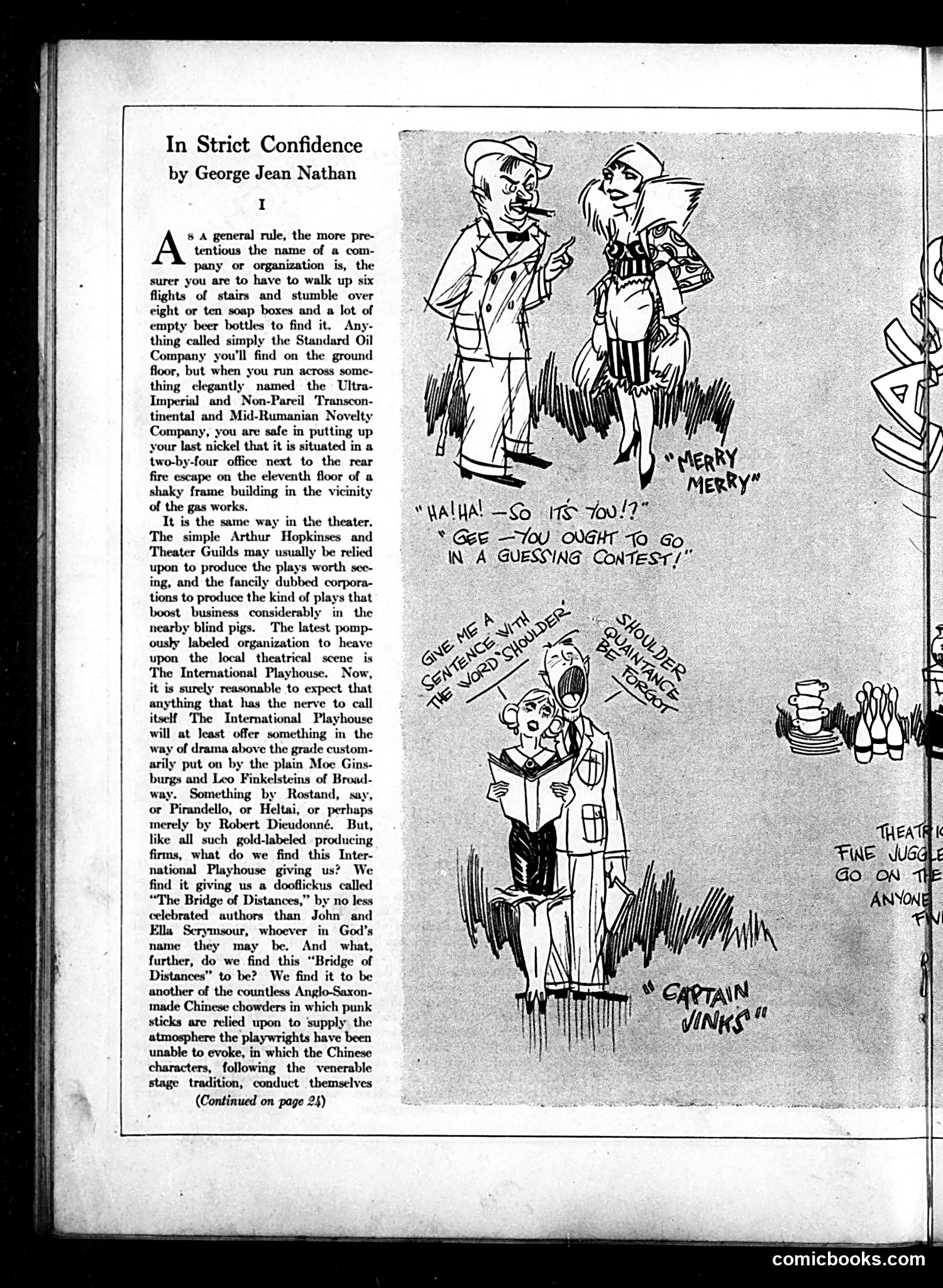
This is theater criticism disguised as humorous social commentary. Nathan satirizes pretentious theater companies through a simple rule: the fancier the organizational name, the worse the actual product. The cartoons illustrate his point. The top panel shows two theatrical types discussing a "guessing contest"—likely mocking a recent production's obscurity. The lower panel depicts someone holding a script titled "Captain Jinks," presumably another forgettable play. Nathan's specific target is "The International Playhouse," a newly arrived theatrical organization claiming sophistication. He expected productions by respected playwrights (Rostand, Pirandello, Heltai, or Dieudonné) but instead found "The Bridge of Distances" by unknown authors John and Ella Scrymsour—which he dismisses as another "Anglo-Saxon-made Chinese chowder," meaning a derivative pseudo-exotic play relying on theatrical clichés rather than genuine drama. The satire reflects early 20th-century theatrical criticism: dismissing earnest but mediocre producers while celebrating simpler, more honest theatrical ventures.
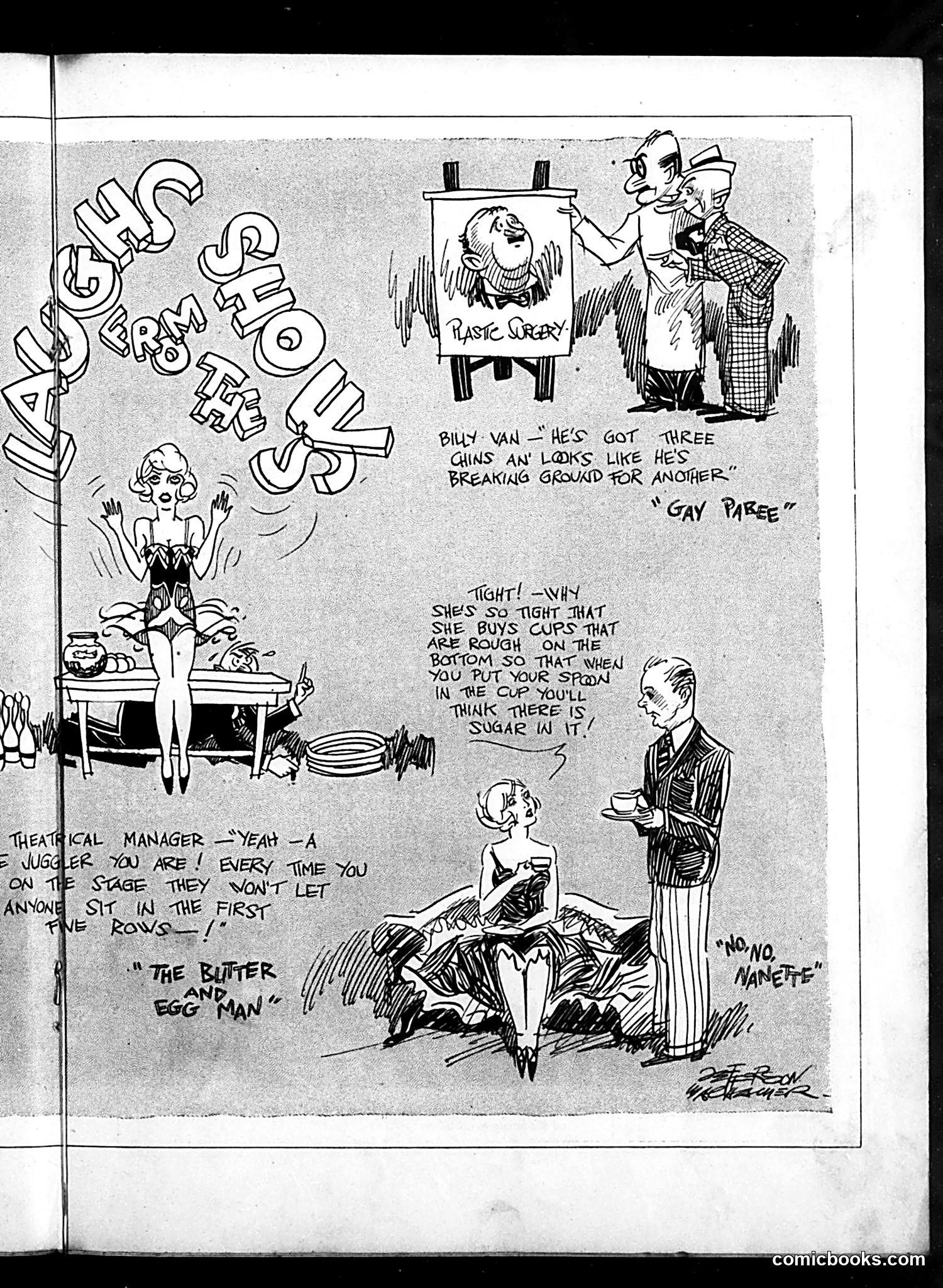
This page contains three separate satirical vignettes mocking early 20th-century social types: **"Gay Paree"** references Billy Van, apparently a performer known for romantic conquests ("three gins and looks like he's breaking ground for another"). **"The Butter and Egg Man"** ridicules a theatrical manager character who allows only front-row seating for paying audiences—a dig at theater industry gatekeeping and elitism. **The third sketch** satirizes a woman so frugal she buys intentionally rough-bottomed cups, believing customers will perceive sugar residue as intentional sweetening. This mocks both penny-pinching and consumer gullibility during an era of widespread food adulteration concerns. The cartoons target vanity, theatrical pretension, and economic anxiety of the era. The term "butter and egg man" refers to wealthy, naive investors—a period-specific insult now obscure to modern readers.
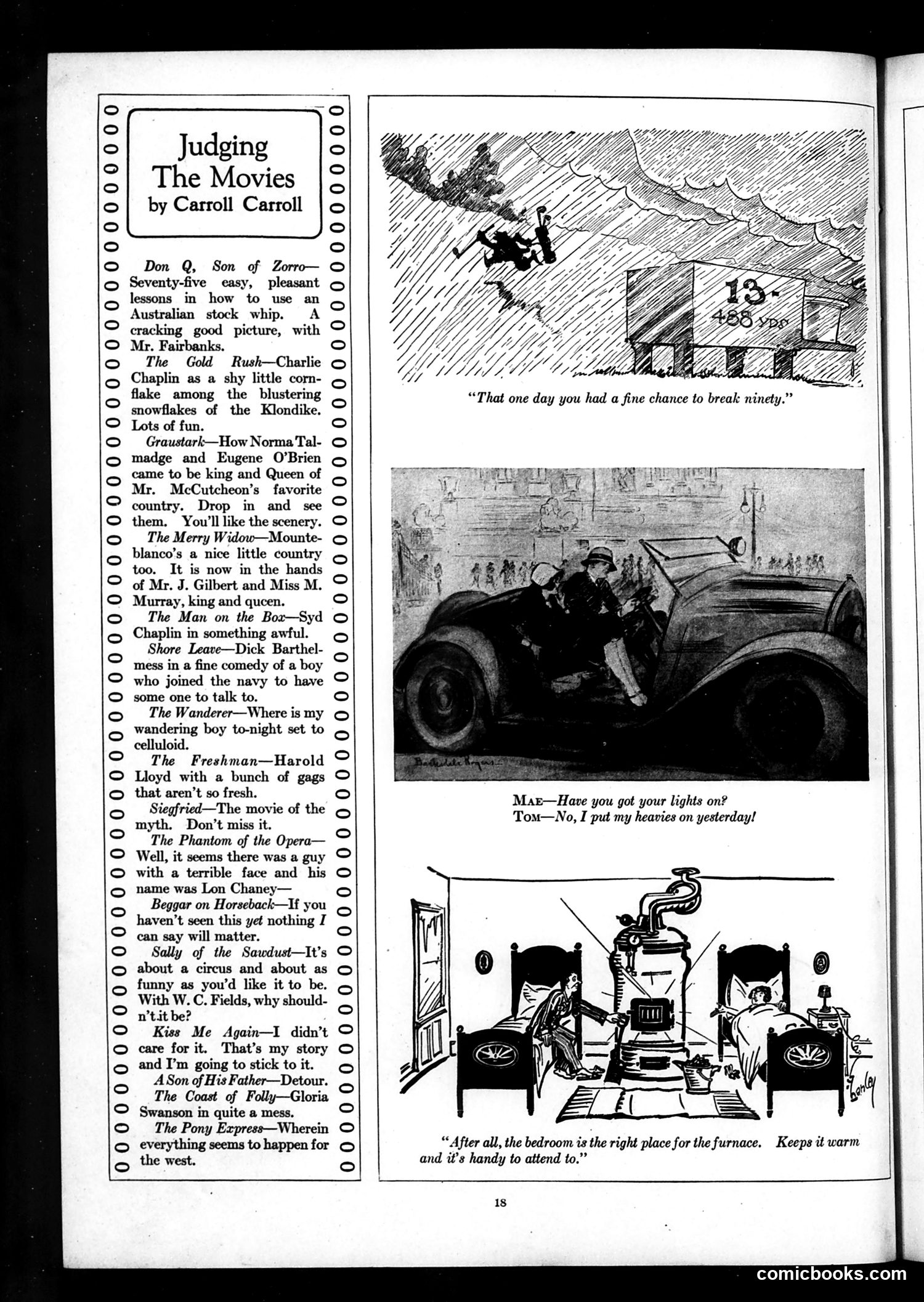
This is a 1920s *Judge* magazine page featuring movie reviews and two cartoon jokes. **The Top Cartoon**: References "Don Q, Son of Zorro" — the caption jokes that the film is essentially a 75-lesson tutorial in whip-cracking, mocking how the plot serves mainly as a vehicle for stunt work by star Douglas Fairbanks. **The Bottom Cartoon**: A domestic humor joke about a couple. "Mare" asks Tom if he has his car lights on; Tom replies he "put my heavies on yesterday" — meaning he placed heavy blankets or quilts on the bed instead. The furnace cartoon below jokes about placing a bedroom above a furnace for heating convenience, satirizing working-class home heating solutions during the era before modern central heating. The movie reviews left mock popular 1920s films with irreverent one-liners about their plots and stars (Chaplin, Harold Lloyd, Lon Chaney). The satire assumes readers know these films and stars well enough to appreciate the snark.
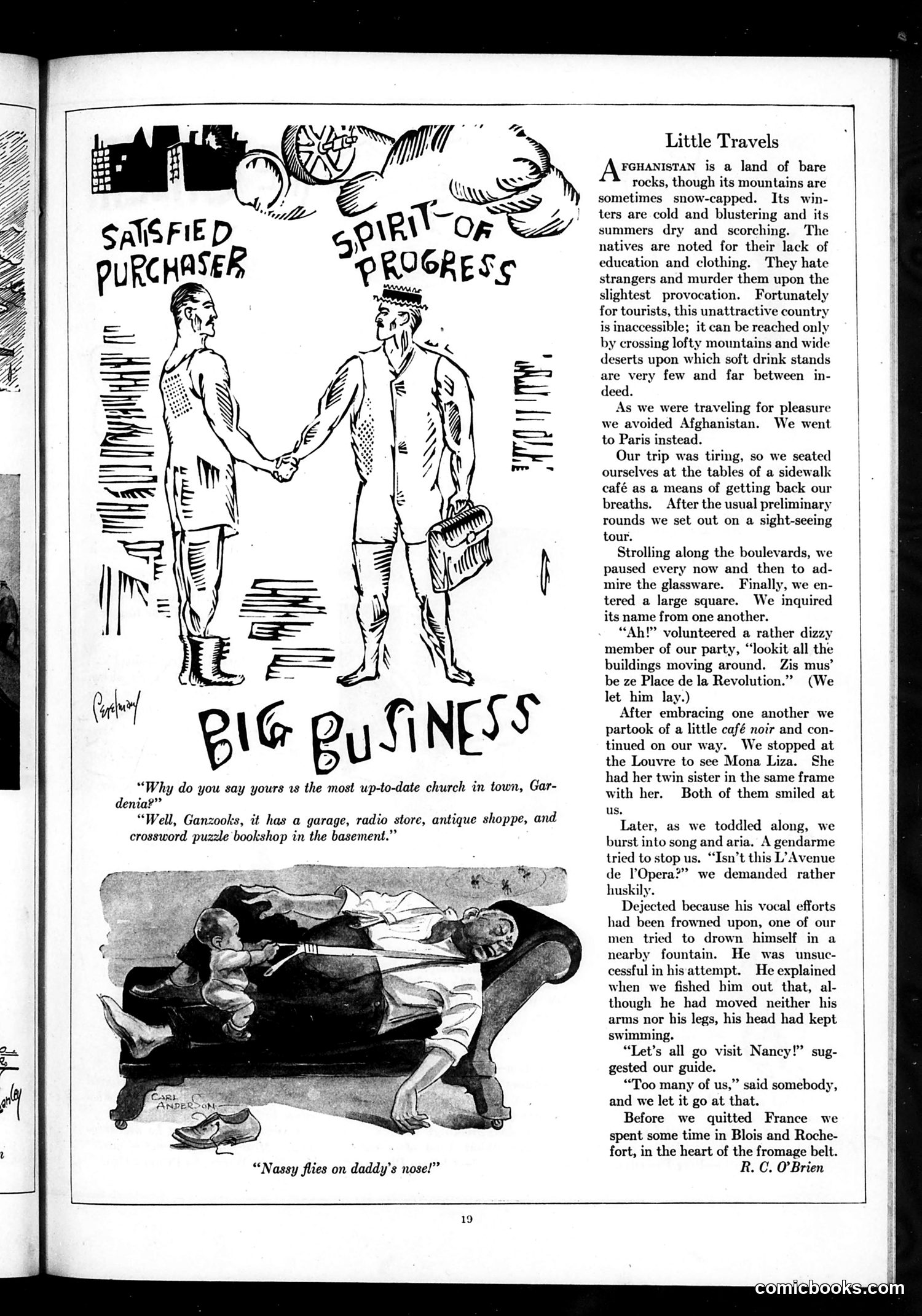
The page contains two distinct pieces of satire: **Top Cartoon ("Big Business"):** Two nude businessmen shake hands beneath labels "Satisfied Purchaser" and "Spirit of Progress." The joke mocks how modern commerce disguises itself with progressive rhetoric while conducting naked exploitation—the figures are literally stripped bare, exposing the truth beneath corporate language. **Church Joke:** Satirizes how American churches modernize by adding commercial amenities (garage, radio store, antique shop, crossword puzzle bookshop) rather than spiritual substance. It critiques shallow materialism masquerading as religious progress. **"Little Travels" Essay:** A humorous travel piece mocking American tourists abroad. It lampoons their ignorance (confusing locations, drunken behavior, inability to speak French properly), their superficiality (visiting famous sites without understanding them), and their entitlement. The piece suggests Americans travel for leisure rather than education, treating iconic places like the Louvre as tourist attractions rather than cultural treasures. Together, these pieces reflect 1920s-30s Judge magazine's recurring theme: American society prioritizes commerce and appearance over substance and genuine culture.
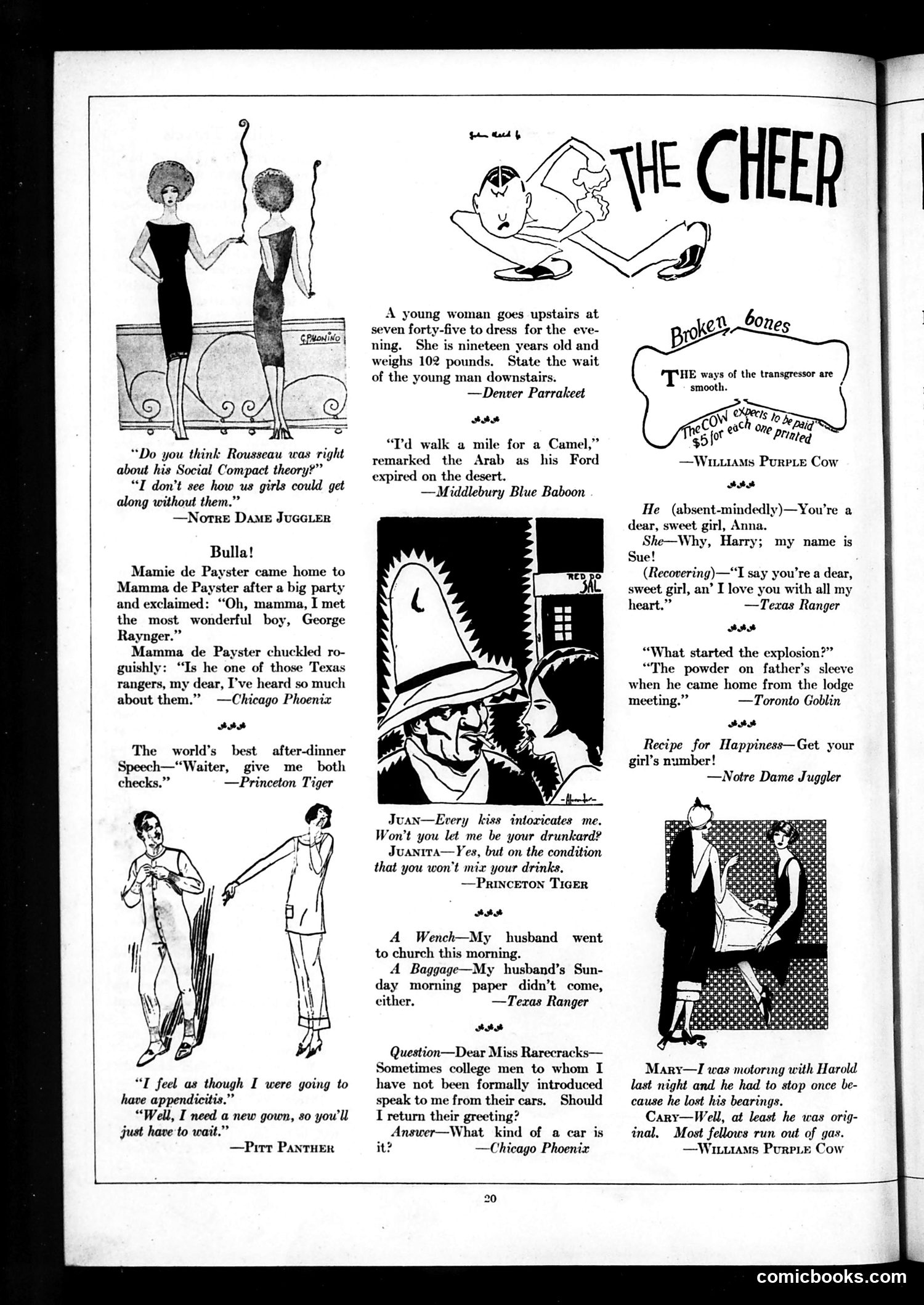
This is a humor compilation page from Judge magazine featuring jokes and cartoons from college publications and regional papers, typical of 1920s satirical humor. The cartoons mock contemporary social situations: a woman's perspective on philosophy (misunderstanding Rousseau), a mother's confusion about "Texas Rangers," and dating scenarios. Visual gags include a man with appendicitis anxiety, an Arab's broken-down Ford, and a lover's embarrassing name-mix-up. The humor reflects post-WWI attitudes: gender dynamics ("girls...without them"), consumerism ("need a new gown"), automotive culture (repeated car references), and casual romance ("get your girl's number"). Notably, one joke plays on Camel cigarette advertising ("I'd walk a mile for a Camel"), and another references Prohibition-era drinking ("mix your drinks"). The credited sources—college papers like Notre Dame, Princeton, and regional publications—suggest this page compiled humor submitted by readers, typical of Judge's editorial approach to 1920s popular culture.
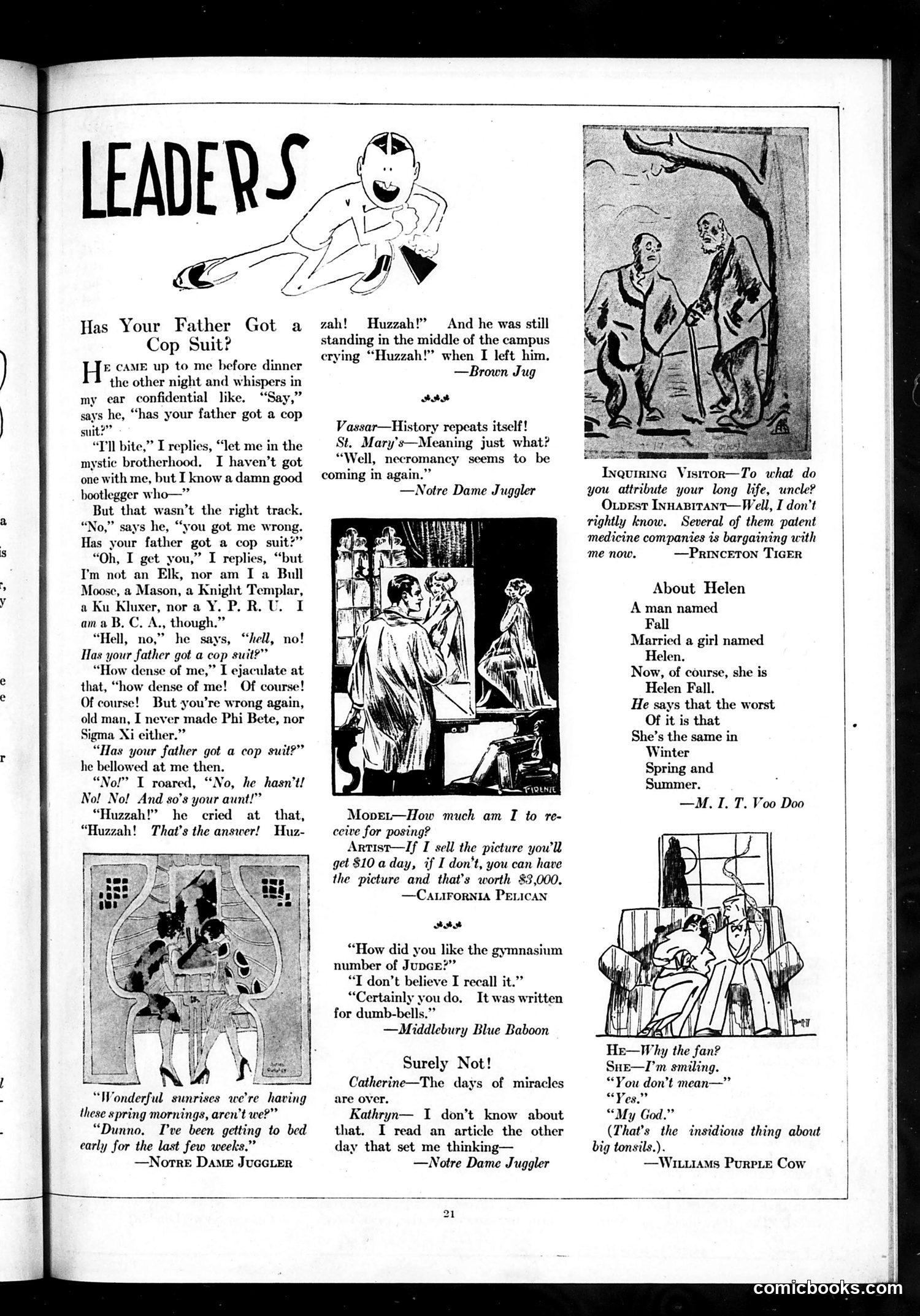
This humor piece satirizes **Prohibition-era police corruption**. The joke turns on a misunderstanding: a college student initially interprets "cop suit" as slang for membership in fraternal organizations (Elks, Masons, etc.). The actual meaning reveals the darker reality—the questioner is asking whether the student's father owns a police uniform, implying he could use it for illegal bootlegging operations. The punchline ("Huzzah! That's the answer! Huzzah!") celebrates when the student denies his father is a cop, meaning he's *not* in a position to interfere with or profit from bootlegging. The satire targets how **police themselves were complicit in Prohibition's failure**, either by corruption (helping bootleggers) or by being useless enforcers. By treating the question as triumphant revelation, Judge mocks the widespread understanding that police involvement was essential to illegal alcohol operations during the 1920s.
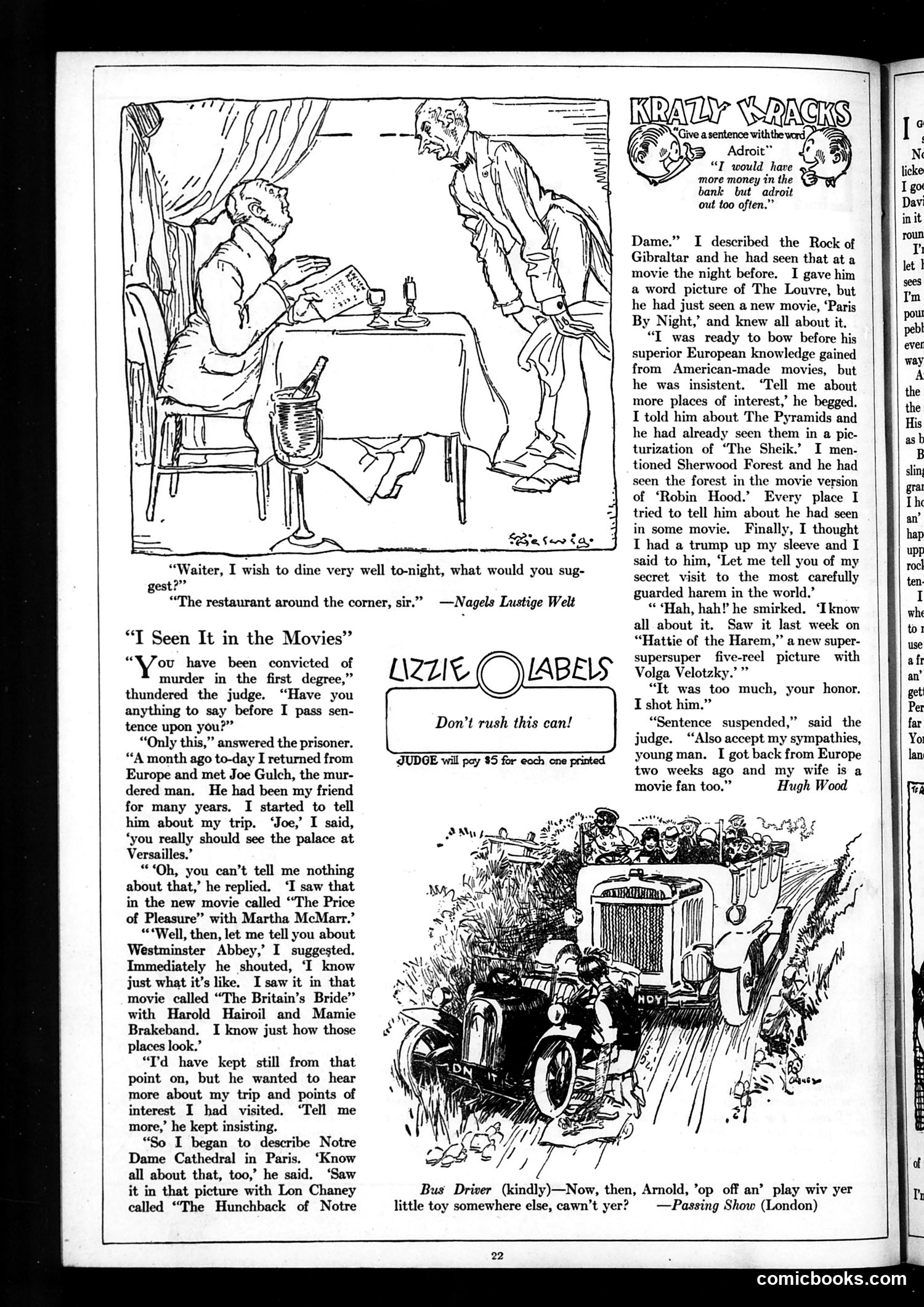
**Top Cartoon:** A waiter recommends dining "at the restaurant around the corner" rather than his own establishment—a self-deprecating joke about the quality of restaurant service. **Main Story: "I Seen It in the Movies"** This satirizes 1920s movie culture's dominance over real-world experience. A prisoner murders his friend because the victim has seen every European landmark the prisoner describes—but only through Hollywood films. The victim constantly interrupts with "I saw that in a movie" for Versailles, Westminster Abbey, Notre Dame, the Pyramids, Robin Hood's Forest, and even a harem scene. The satire's point: Americans' knowledge of the world comes exclusively from cinema rather than travel or education. The judge, himself a movie fan, sympathizes and suspends the sentence—suggesting the absurdity is widespread and culturally accepted. **Bottom Cartoon:** A London bus driver tells a child to play elsewhere—unrelated humor about urban life. The page reflects anxiety about cinema's growing cultural influence in replacing traditional sources of knowledge and experience.
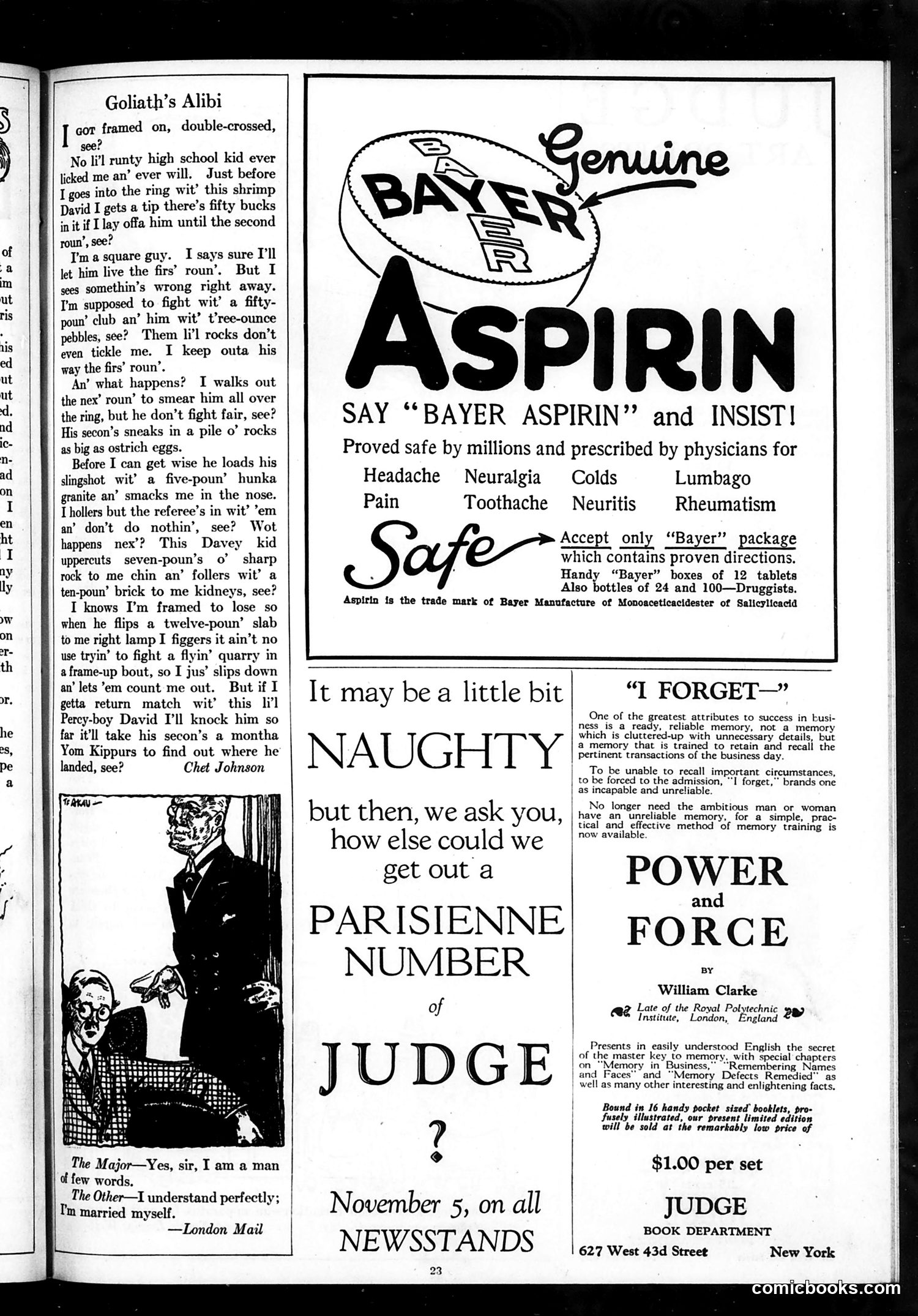
**The Main Cartoon (Left):** This is a humorous retelling of the Biblical David and Goliath story from Goliath's perspective. A boxer named Goliath claims he was "framed"—that he threw the famous fight against the much smaller David because he was bribed with fifty dollars to let David survive the first round. Goliath alleges David's team cheated: while Goliath fought with legitimate equipment, David used a slingshot loaded with rocks, bricks, and granite chunks. The referee supposedly colluded with David's corner. Goliath presents himself as the actual victim of an unfair match and corruption. **The Satire:** The joke inverts the famous underdog narrative. Instead of celebrating David's triumph through skill and courage, this version mocks the loser's excuses—a common trope where defeated fighters blame conspiracies rather than accept defeat. The heavy dialect and working-class boxing vernacular ("I'm a square guy") add humor to what is essentially a sore-loser complaint. **Right Side:** Mostly advertisements (Bayer Aspirin, memory-training book) and unrelated content—typical magazine filler of the era.
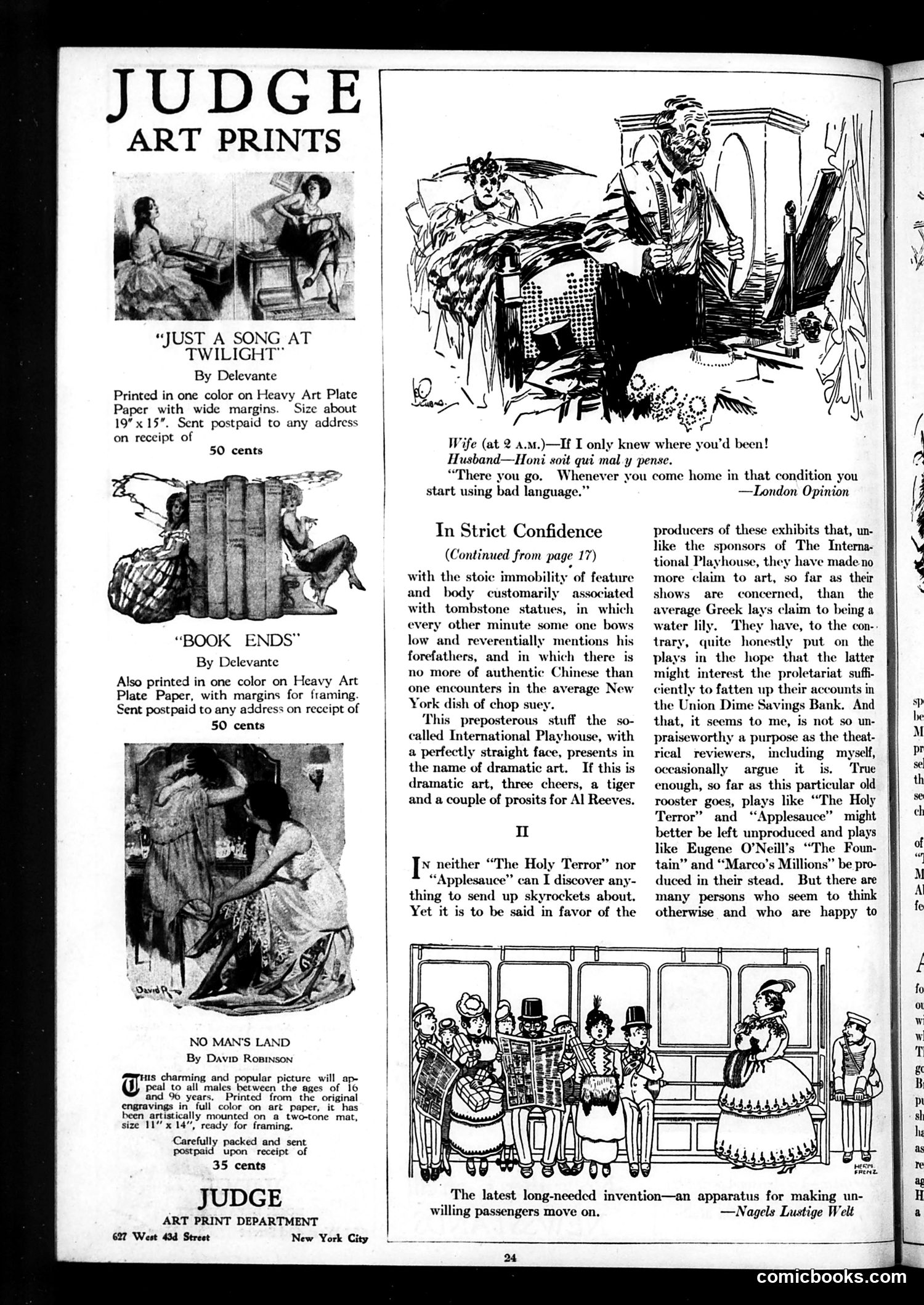
This page is primarily an **advertising section for Judge Art Prints** rather than satirical political content. The three advertised prints by artists Delevante, Delevante, and David Robinson depict domestic and social humor typical of early 20th-century Judge magazine: 1. **"Just a Song at Twilight"** shows a domestic scene where a wife confronts her husband arriving home late at 2 a.m. The husband responds with the French phrase "Honi soit qui mal y pense" (shame on him who thinks evil of it)—a deflection that prompts her to complain he always uses "bad language" when caught in such situations. The satire targets male infidelity and the absurdity of linguistic evasion. 2. **"Book Ends"** and **"No Man's Land"** appear to be general interest domestic humor prints aimed at male audiences. The page also contains an article **"In Strict Confidence"** critiquing theatrical productions at the International Playhouse, comparing them unfavorably to more straightforward entertainment productions. A cartoon caption at bottom references an "apparatus for making unwilling passengers move on"—likely satirizing public transportation crowding.
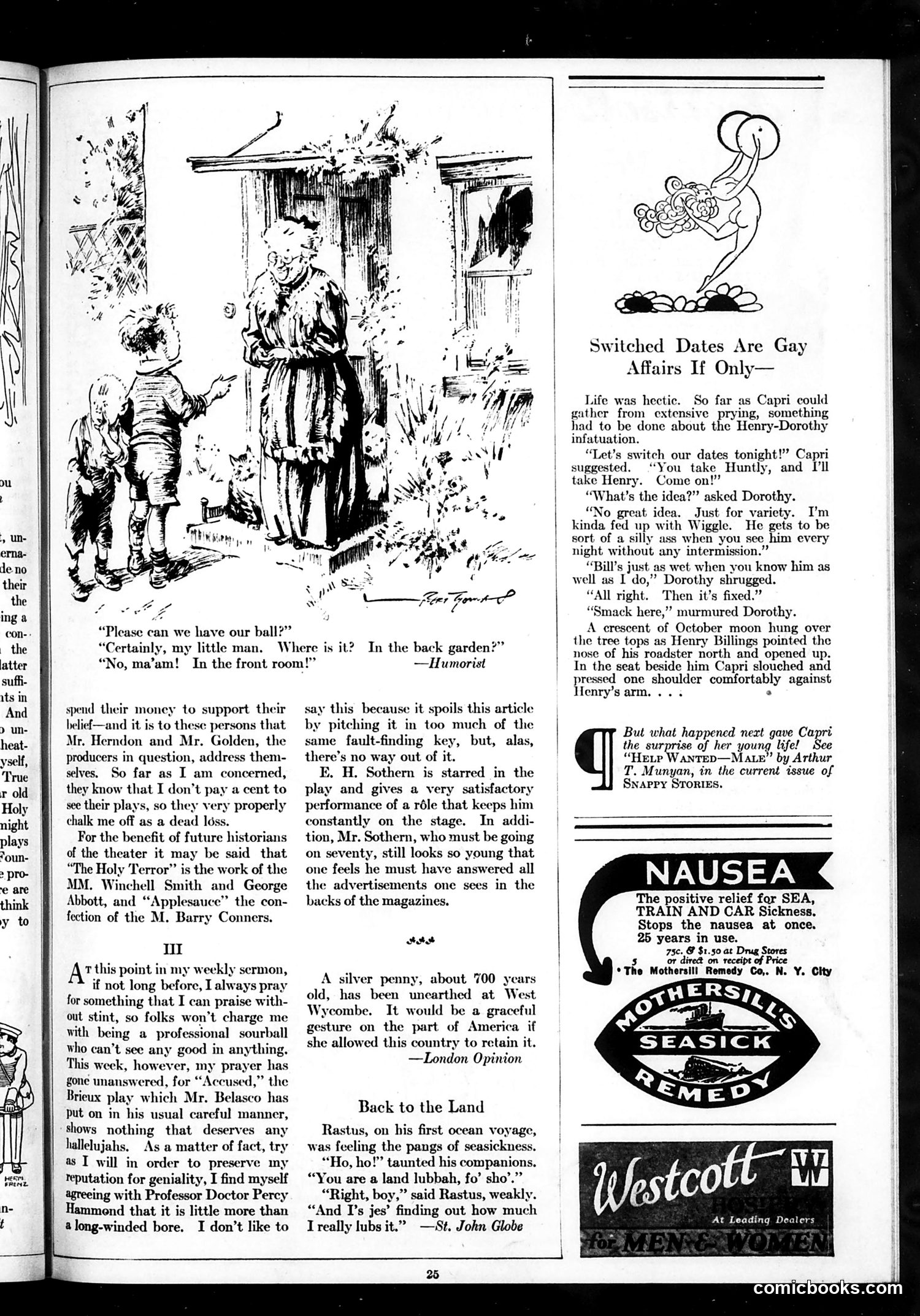
This page from *Judge* contains theater criticism and several unrelated short pieces typical of the magazine's format. **Main Content:** The top cartoon shows a domestic scene where children ask their mother for a ball, with the humorous misdirection of its location—a gentle joke about household chaos. **Theater Criticism:** The lengthy column reviews three Broadway plays: "The Holy Terror," "Applesauce," and "Accused" (starring E.H. Sothern). The critic is notably harsh, particularly dismissive of "Accused" as tedious, while acknowledging Sothern's performance despite his advanced age (around 70). **Other Items:** - A brief opinion piece suggesting America return a 700-year-old silver penny found in England - A dialect humor piece about "Rastus" (a racial stereotype character common in early 20th-century humor) experiencing seasickness - A short story teaser advertising "Help Wanted—Male" from *Snappy Stories* - Period advertisements for seasickness remedies and men's clothing The page reflects *Judge*'s mix of sophisticated theater criticism with lowbrow entertainment and casual racial stereotyping typical of 1920s American periodicals.
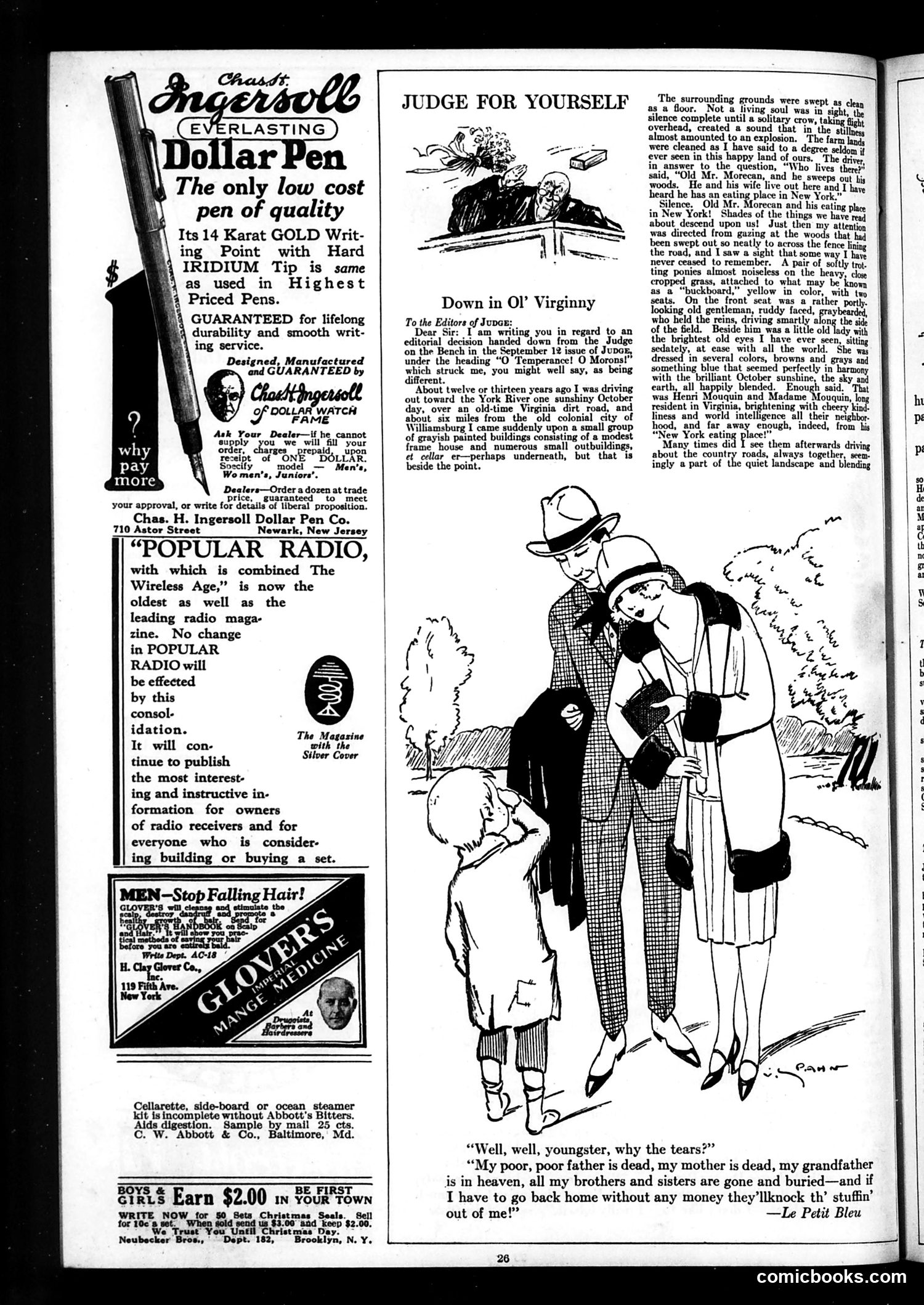
This appears to be a reader's letter to *Judge* magazine responding to an editorial titled "O Temperance! O Morons!" The writer defends a positive experience he had in Virginia with Henri Mouquin and his wife, who owned an eating establishment (restaurant) in New York. The letter describes encountering them driving a buckboard through pristine Virginia countryside—the farm meticulously maintained. The writer seems to be countering *Judge*'s editorial mockery by offering evidence that these were accomplished, cultured people: Henri Mouquin was clearly a successful restaurateur, and both he and his wife were refined, intelligent individuals. The satire is implicit: the reader is asking *Judge* readers to "judge for yourself" whether the Mouquins fit the stereotypes the magazine may have promoted about certain social groups. The pristine farm and prosperous New York restaurant suggest respectability and success contradicting whatever disparaging characterization the magazine had made.
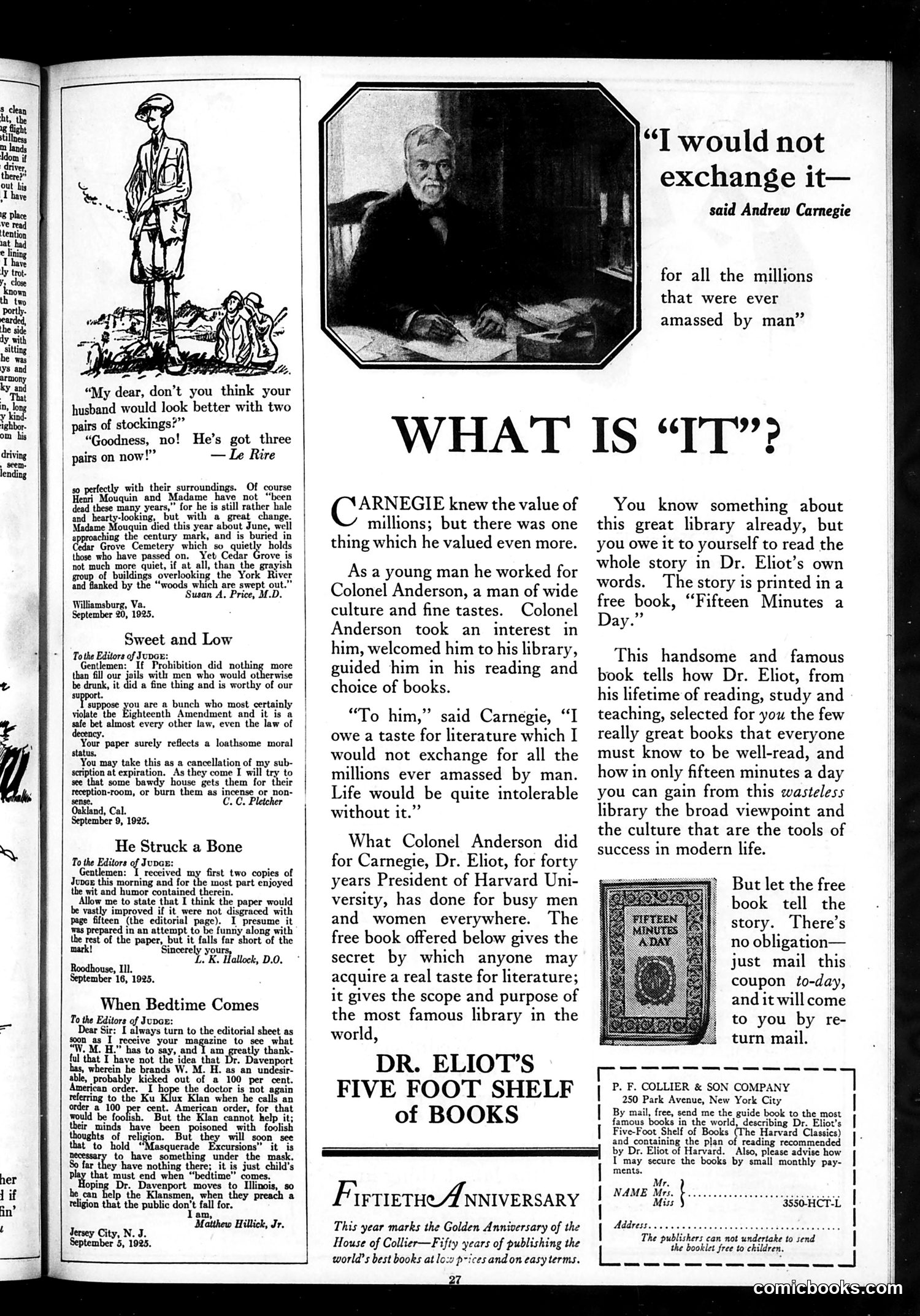
This page contains a small cartoon and primarily advertisement/editorial content rather than political satire. **The Cartoon**: A brief joke from *Le Rire* (French humor magazine) depicts a couple discussing hosiery—a woman suggests her husband would look better in two pairs of stockings; he replies he's already wearing three pairs. This appears to joke about post-WWI fabric shortages or rationing, making light of scarcity. **Main Content**: The page heavily promotes Andrew Carnegie's quote about valuing literature above millions, advertising Dr. Eliot's "Five Foot Shelf of Books"—a famous curated collection marketed as essential reading for cultural self-improvement. The text frames education and refined taste as superior to wealth. **Letters Section**: Reader complaints address *Judge's* editorial content, Prohibition enforcement, and criticism of the KKK—reflecting 1925 social tensions. The page reflects early 20th-century American values: the importance of self-education, respectability through cultural refinement, and tension between traditional morality and modernism.
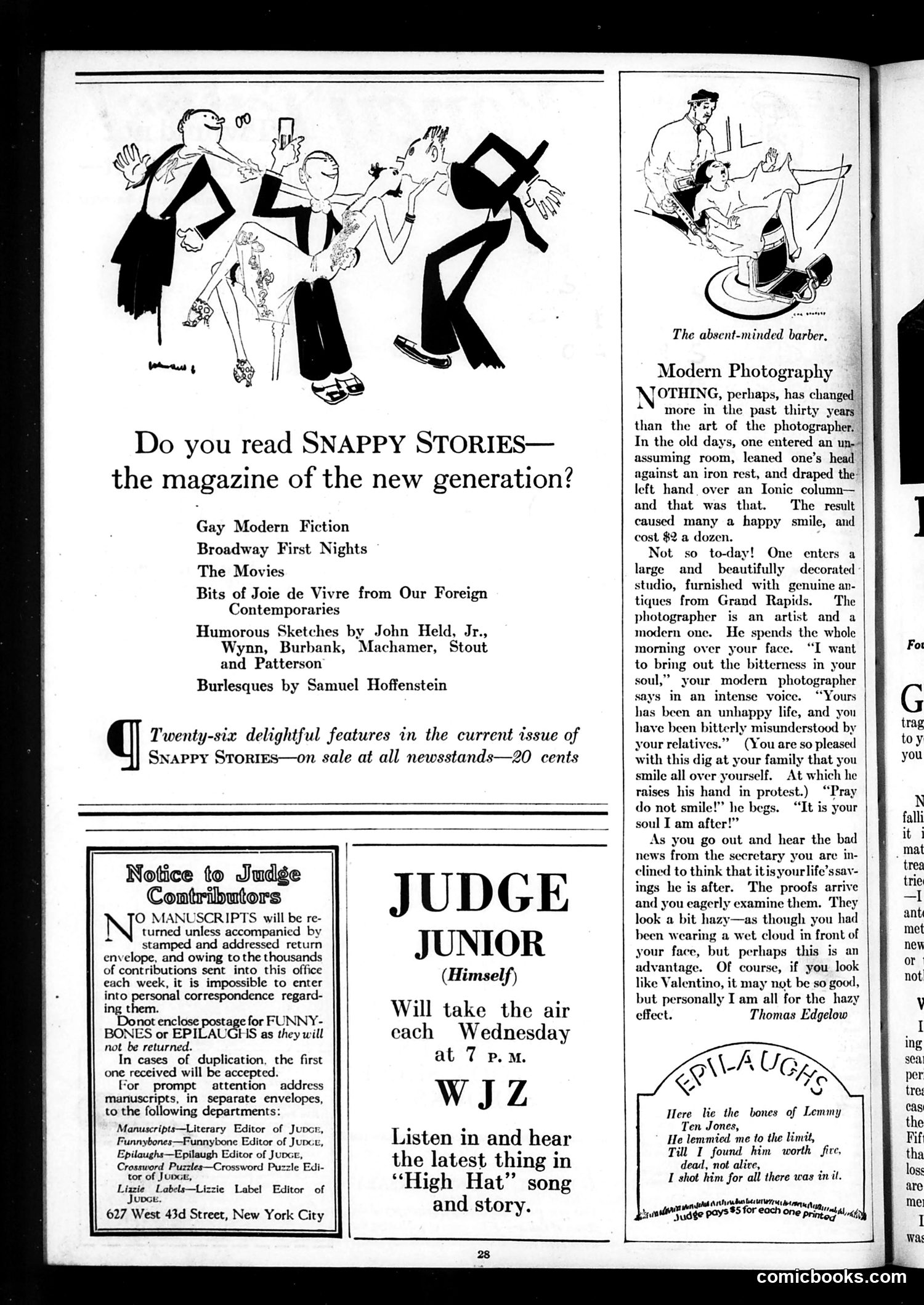
This page primarily contains **advertisements and editorial content** rather than political satire. The main cartoon, "The absent-minded barber," depicts a humorous sketch (likely by John Held Jr., credited on the page) showing a barber who has apparently made a client's hair stand on end—a visual gag about careless barbering. The substantial text block titled "Modern Photography" satirizes **1920s artistic pretension**. It mocks the contrast between old photography (simple, cheap, quick) and contemporary "modern" photography studios. The satire targets the affected artist-photographer who psychoanalyzes clients ("I want to bring out the bitterness in your soul"), charges exorbitantly, and produces deliberately unflattering, hazy portraits—then justifies poor results as intentional artistic choices. The joke is that customers pay premium prices for inferior work disguised as avant-garde artistry. The page also advertises *Snappy Stories* magazine and includes submission guidelines for *Judge* contributors, plus a radio station announcement (WJZ).
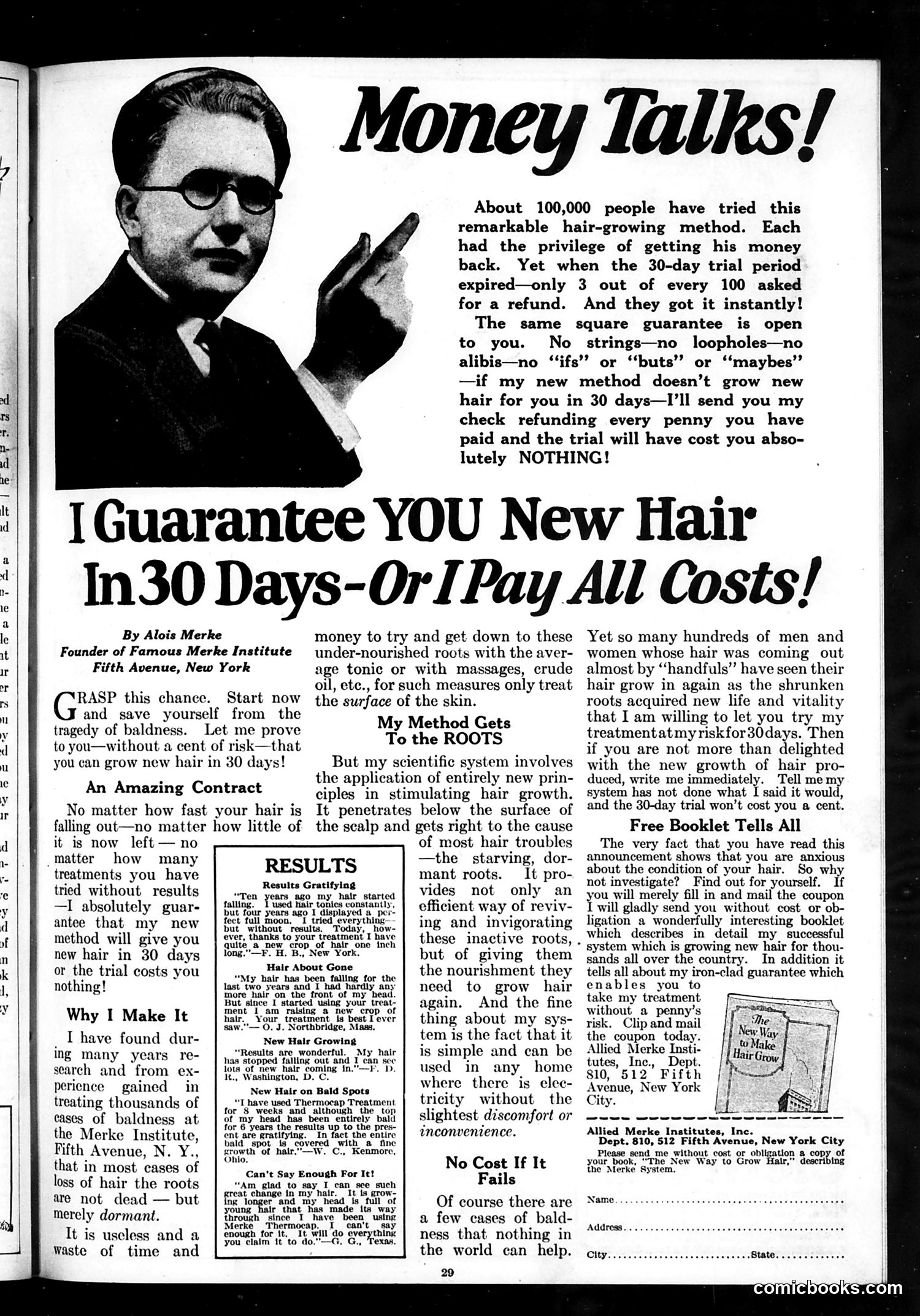
This page is **not satire or a political cartoon**—it's a full-page advertisement masquerading as editorial content, a common deceptive practice of the era. The ad promotes the "Merke Institute" hair-growth treatment by Alois Merke, claiming a guaranteed 30-day hair regrowth or full refund. The pitch exploits common anxieties about baldness while using pseudo-scientific language ("penetrates below the surface," targets "dormant roots") to sound credible. The manipulative statistics claim 97 of 100 users kept their money—presented as proof of efficacy rather than recognizing selection bias (satisfied customers wouldn't request refunds). Customer testimonials (which may be fabricated) provide false social proof. For modern readers: This exemplifies early-20th-century **medical fraud**—unregulated health claims, vague scientific jargon, manufactured testimonials, and risk-reversal promises designed to seem credible while making extraordinary claims. Judge magazine's publication of this reflects minimal advertising standards before FDA regulations.
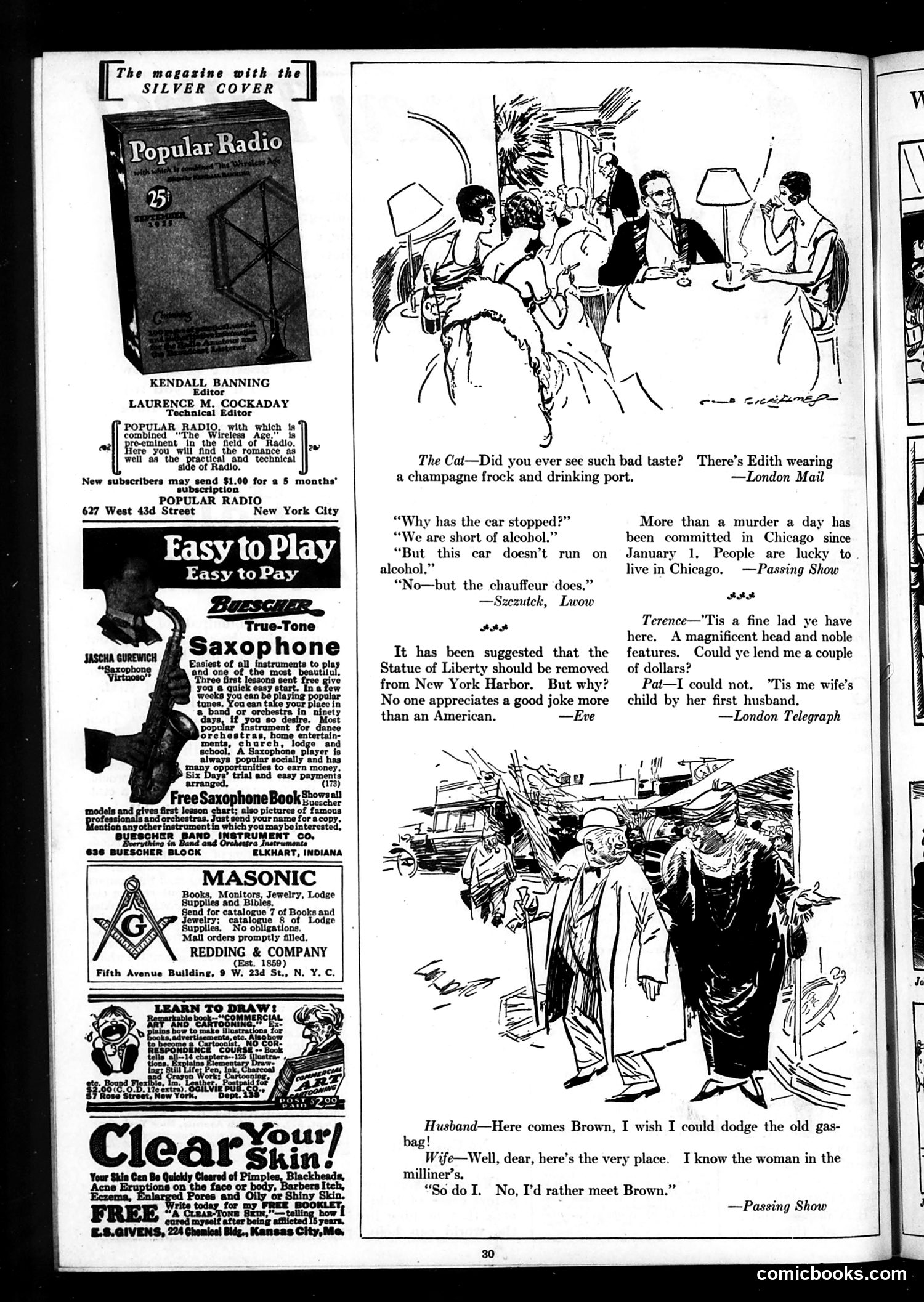
This page is primarily **advertisements and humor jokes** rather than political cartoons. The content reflects 1920s social concerns: **The Jokes:** - References to **Prohibition era drinking** (car won't run without alcohol in the chauffeur, not the engine; champagne frock with port wine) - **Chicago crime wave** commentary (murders cited as frequent) - Gender/marital humor (wife avoiding acquaintance by hiding in milliner's shop; Irish immigrant joke about paternity) **The Advertisements:** - **Popular Radio** magazine (promoting early radio technology) - **Buescher saxophone** (instrument marketing) - Masonic supplies and religious materials - Skin care products **Historical Context:** The page captures early 1920s American life: Prohibition-era drinking as humor fodder, emerging radio technology, organized fraternal societies, and traditional gender dynamics. The repeated alcohol jokes suggest how central Prohibition was to contemporary conversation, while the saxophone ad reflects Jazz Age popular culture. The overall tone is light satirical commentary on modern urban American life rather than serious political critique.
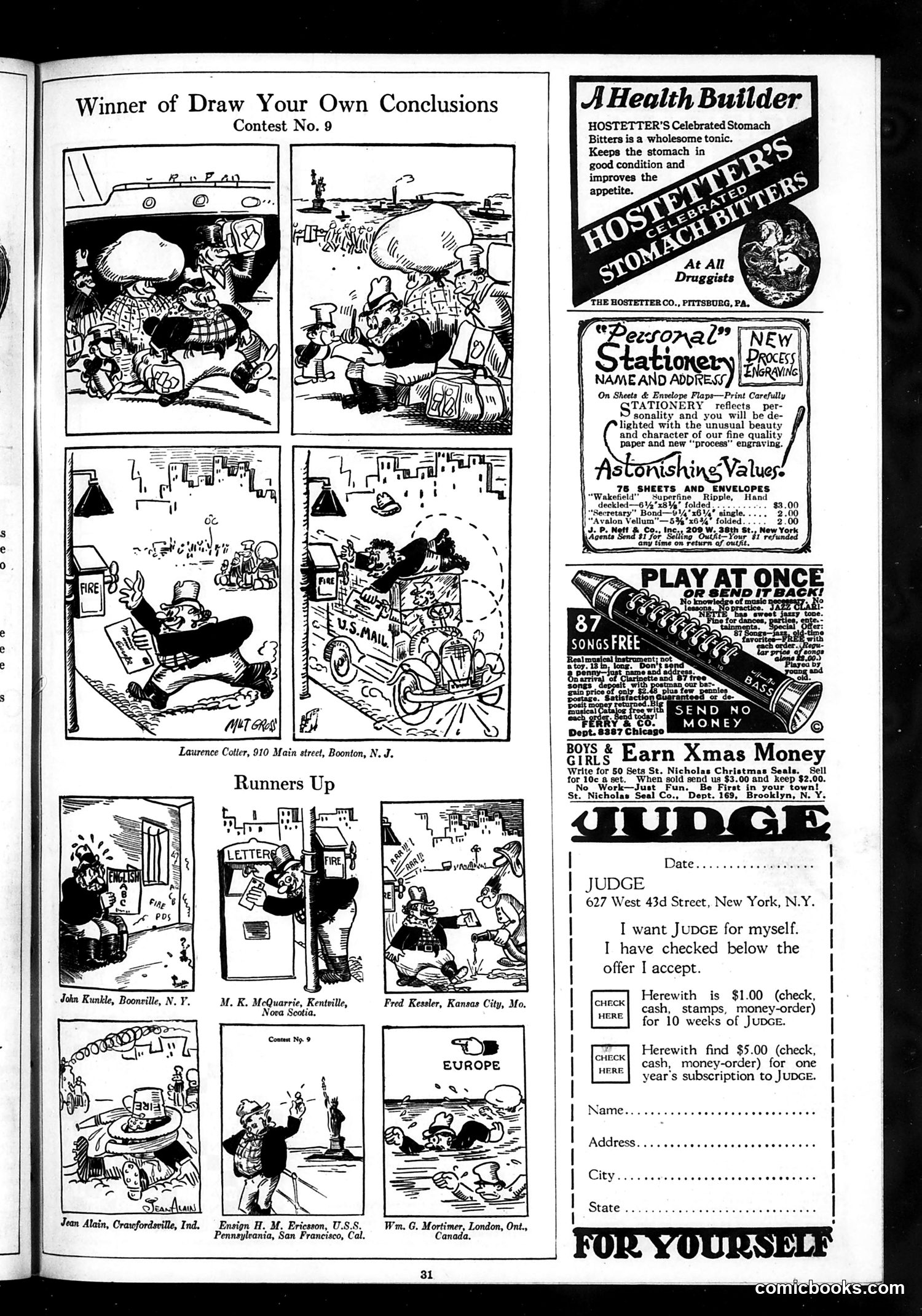
This page from *Judge* magazine showcases a "Draw Your Own Conclusions" contest—a satirical feature where readers submit cartoon captions or interpretations. The winning entry by Laurence Cotter (from New Jersey) and several runners-up are displayed as black-and-white comic panels depicting absurdist or humorous scenarios involving everyday situations. The cartoons appear to use visual gags and exaggeration typical of early 20th-century American humor, though the specific satirical targets aren't immediately clear from the image alone. The page also contains period advertisements (Hostetter's Stomach Bitters, stationery, a record player offer) and a subscription form for *Judge* itself—standard magazine content of the era. Without clearer visibility of the cartoon details, the precise political or social commentary remains difficult to specify with certainty.
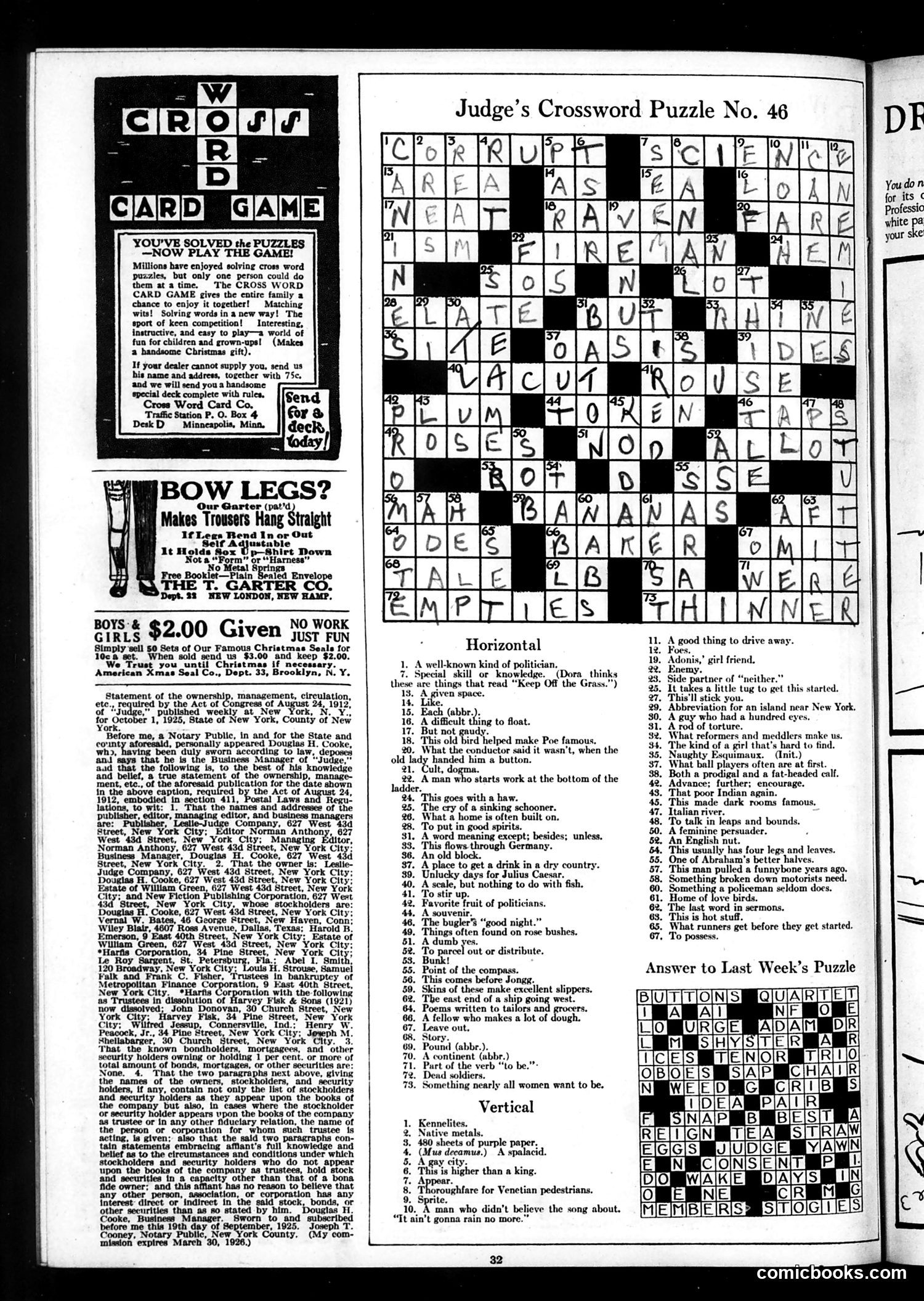
This page is primarily **advertisements and puzzle content** rather than political satire. The main items are: 1. **"Cross Word Card Game"** ad — promotes a new board game adaptation of the crossword puzzle craze sweeping America in the 1920s. 2. **"Bow Legs?" ad** — sells a garter device claiming to make trousers hang straight, marketed to boys and girls for $2.00. 3. **Judge's Crossword Puzzle No. 46** — the magazine's featured puzzle with clues. 4. **Ownership statement** — required legal disclosure listing the magazine's publishers, editors, and stockholders. The page reflects 1920s consumer culture: commercialized leisure (crossword games), youth-targeted products (corrective garters), and the magazine's established position as a major American publication. No particular political cartoon or satirical content appears on this page—it's typical filler and advertising material common in period magazines.
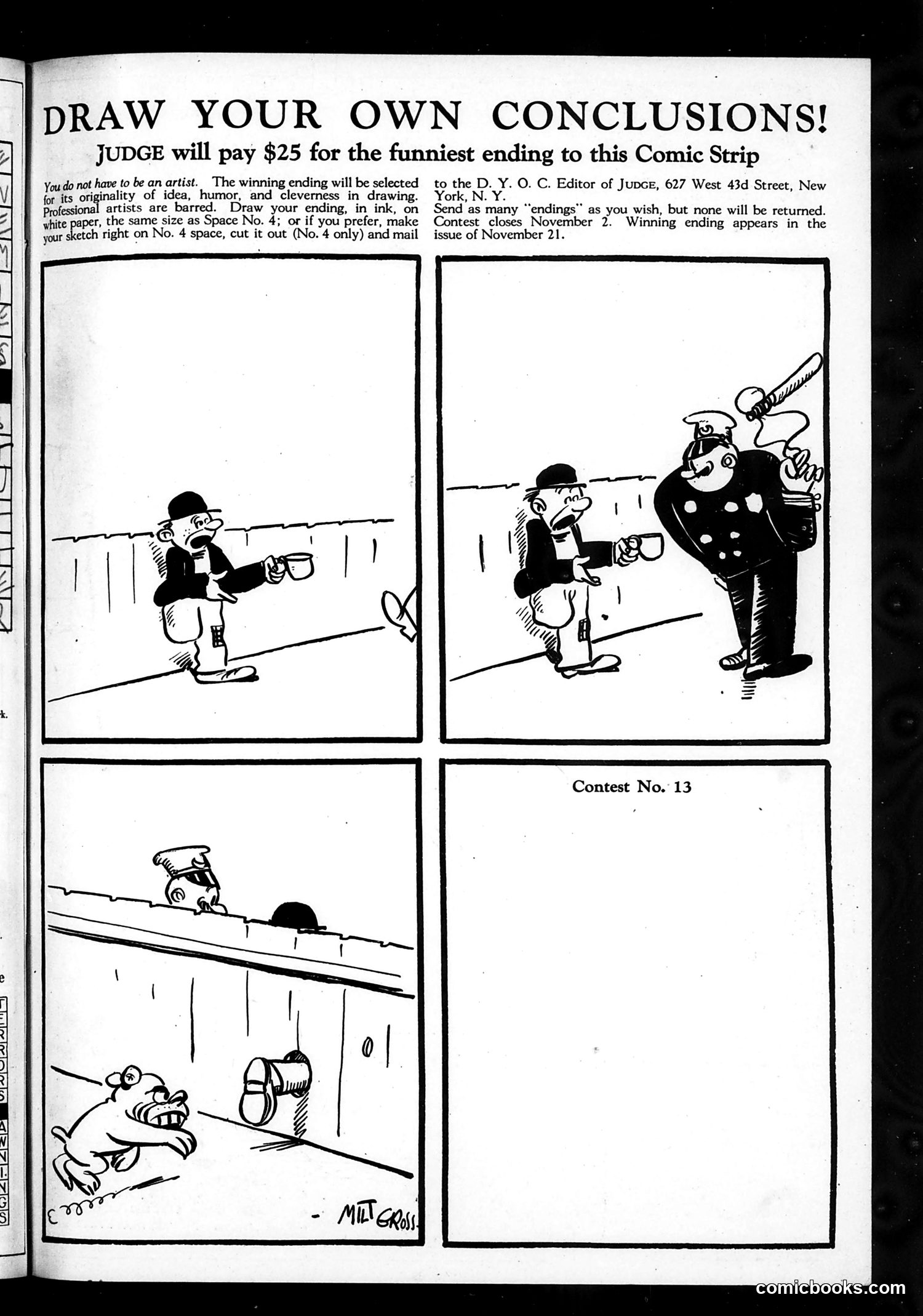
This is a reader-participation contest page from *Judge* magazine (Contest No. 13). The publication invited amateur artists and non-artists alike to submit comic strip endings for a $25 prize—a substantial sum at the time. The three completed panels show a narrative sequence: a small man in a bowler hat holds a coffee cup while facing an increasingly large, aggressive uniformed figure (possibly a police officer or military man) wielding a club. The third panel depicts the small man's perspective from below, suggesting he's been knocked down or overpowered. The humor likely derives from a classic "everyman vs. authority" scenario common to early 20th-century satire. The contest invited readers to complete the fourth panel (left blank) with their own punchline. This democratization of cartooning—allowing non-professionals to compete—reflects *Judge*'s satirical, populist approach to social commentary through visual humor.
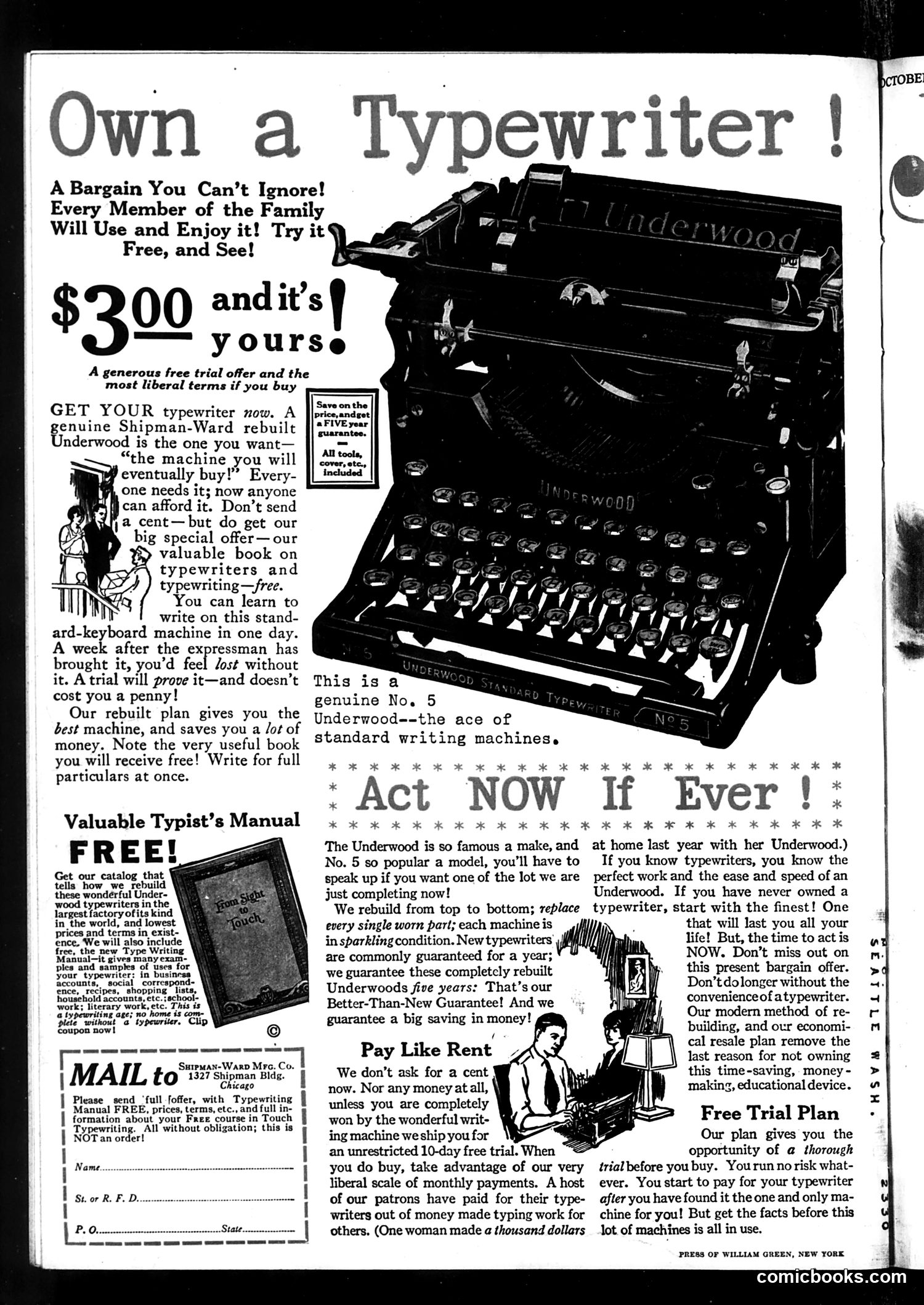
This is a **full-page advertisement**, not a cartoon or satire. It promotes the Underwood No. 5 typewriter through the Shipman-Ward Manufacturing Company, priced at $300 with a free trial. The pitch targets middle-class families, emphasizing that "every member of the family will use and enjoy it." Key selling points include: - **Free trial period** (10 days, unrestricted) - **Payment plans** ("Pay Like Rent") allowing customers to earn money through typing work to cover costs - **Rebuilt machines** with a 5-year guarantee (vs. typical 1-year warranties) - **Free instruction manual** and typing course The advertisement reflects early 20th-century aspirations: typewriters were still luxury items, but marketing positioned them as essential household tools and income-generating devices. The mention of "one woman made a thousand dollars" suggests women's economic independence through secretarial work—a notable social reference for the era. This is **advertising copy**, not satirical content, though Judge magazine's readers might have found the aggressive marketing pitch amusing.