
Judge, 1925-10-24 · page 9 of 36
Judge — October 24, 1925 — page 9: what you’re looking at
What you’re looking at
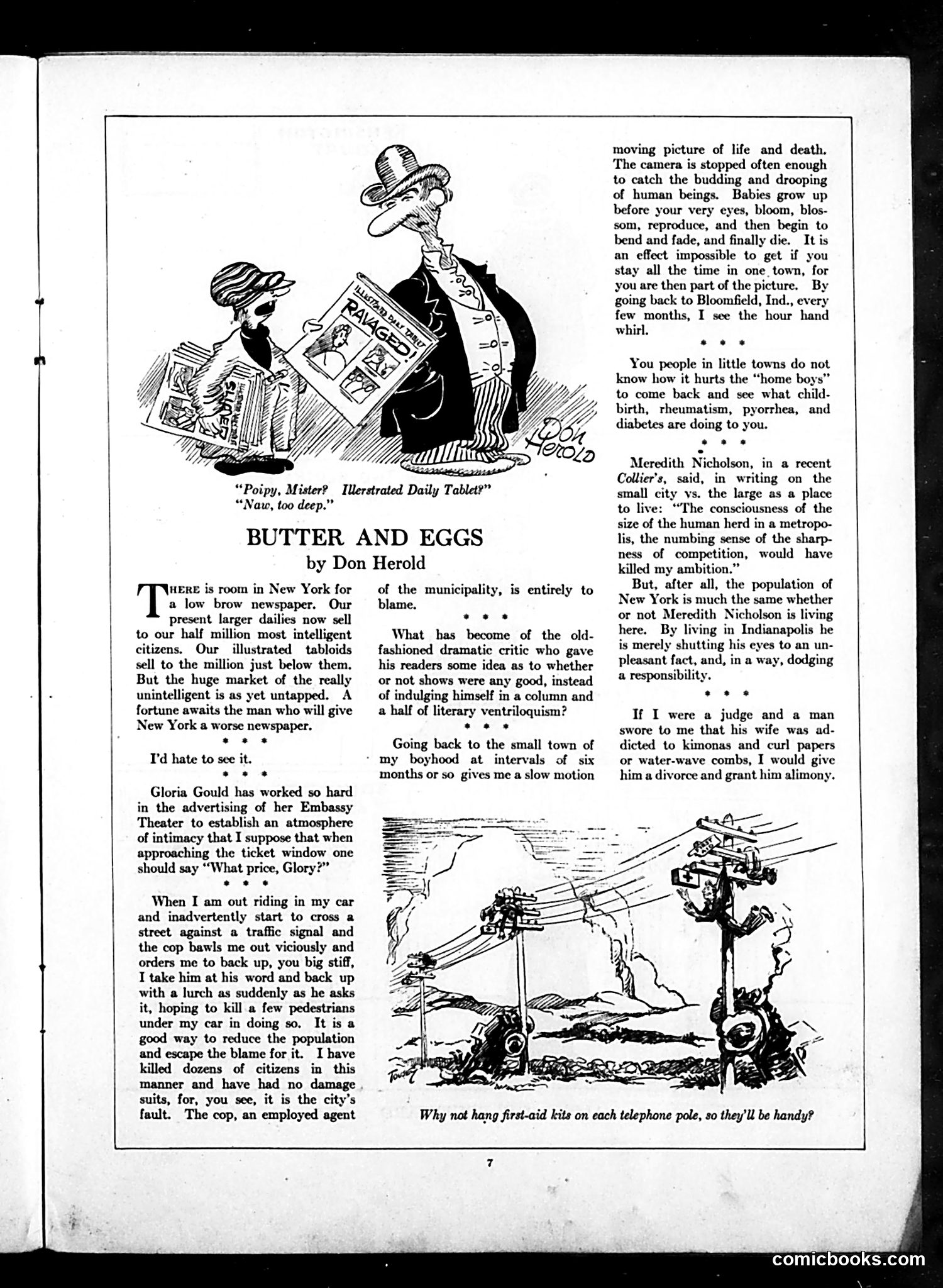
This page is a satirical essay collection by Don Herold, not a traditional political cartoon. The top illustration shows a man and woman reading a tabloid newspaper labeled "Illustrated Daily Tablet," with the woman asking "Poopy, Mister?" and the man responding "Naw, too deep"—mocking the growing market for lowbrow newspapers aimed at unintelligent readers. Herold's essays mock various aspects of 1920s American life: sensationalist journalism, over-intellectualized theater criticism, the artificiality of urban living versus small-town life (he references returning to Bloomfield, Indiana), and urban hazards like dangerous traffic. He sarcastically defends killing pedestrians by blaming the traffic cop rather than himself. The bottom illustration of tangled telephone poles captioned "Why not hang first-aid kits on each telephone pole?" is Herold's deadpan commentary on urban infrastructure hazards and bureaucratic incompetence. The tone throughout is cynical social criticism disguised as humorous observations.
📄 Transcribed text from this page (OCR, searchable)
Machine-transcribed from the original scan — historical spelling and the odd misread are preserved.
“Poipy, Mister? Ierstrated Daily Tablet?” “Naw, too deep.” BUTTER AND EGGS by Don Herold HERE is room in New York for I a low brow newspaper. Our present larger dailies now sell to our half million most intelligent citizens, Our illustrated tabloids sell to the million just below them. But the huge market of the really unintelligent is as yet untapped. A fortune awaits the man who will give New York a worse newspaper. see I'd hate to see it. see Gloria Gould has worked so hard in the advertising of her Embassy Theater to establish an atmosphere of intimacy that I suppose that when approaching the ticket window one should say “What price, Glory?” eee When I am out riding in my car and inadvertently start to cross a street against a traffic signal and the cop bawls me out viciously and orders me to back up, you big stiff, I take him at his word and back up with a lurch as suddenly as he asks it, hoping to kill a few pedestrians under my car in doing so. It is a good way to reduce the population and escape the blame for it. I have killed dozens of citizens in this manner and have had no suits, for, you see, it is the city’s fault. The cop, an employed agent of the municipality, is entirely to blame. eee What has become of the old- fashioned dramatic critic who gave his readers some idea as to whether or not shows were any good, instead of indulging himself in a column and a half of literary ventriloquism? eae Going back to the small town of my boyhood at intervals of six months or so gives me a slow motion moving picture of life and death. The camera is stopped often enough to catch the budding and drooping of human beings. Babies grow up before your very eyes, bloom, blos- som, reproduce, and then begin to bend and fade, and finally die. It is an effect impossible to get if you stay all the time in one town, for you are then part of the picture. By going back to Bloomfield, Ind., every few months, I see the hour hand whirl. eee You people in little towns do not know how it hurts the “home boys” to come back and see what child- birth, rheumatism, pyorrhea, and diabetes are doing to you. Meredith Nicholson, in a recent Collier's, said, in writing on the small vs. the large as a place to live: “The consciousness of the size of the human herd in a metropo- lis, the numbing sense of the sharp- ness of competition, would have killed my ambition.” But, after all, the population of New York is much the same whether or not Meredith Nicholson is living here. By living in Indianapolis he is merely shutting his eyes to an un- pleasant fact, and, in a way, dodging a responsibility. If I were a judge and a man swore to me that his wife was ad- dicted to kimonas and curl papers or water-wave combs, I would give him a divorce and grant him alimony. Why not hang first-aid kits on each telephone pole, so they'll be handy? comicbooks.com 7) |