
Judge, 1925-10-24 · page 17 of 36
Judge — October 24, 1925 — page 17: what you’re looking at
What you’re looking at
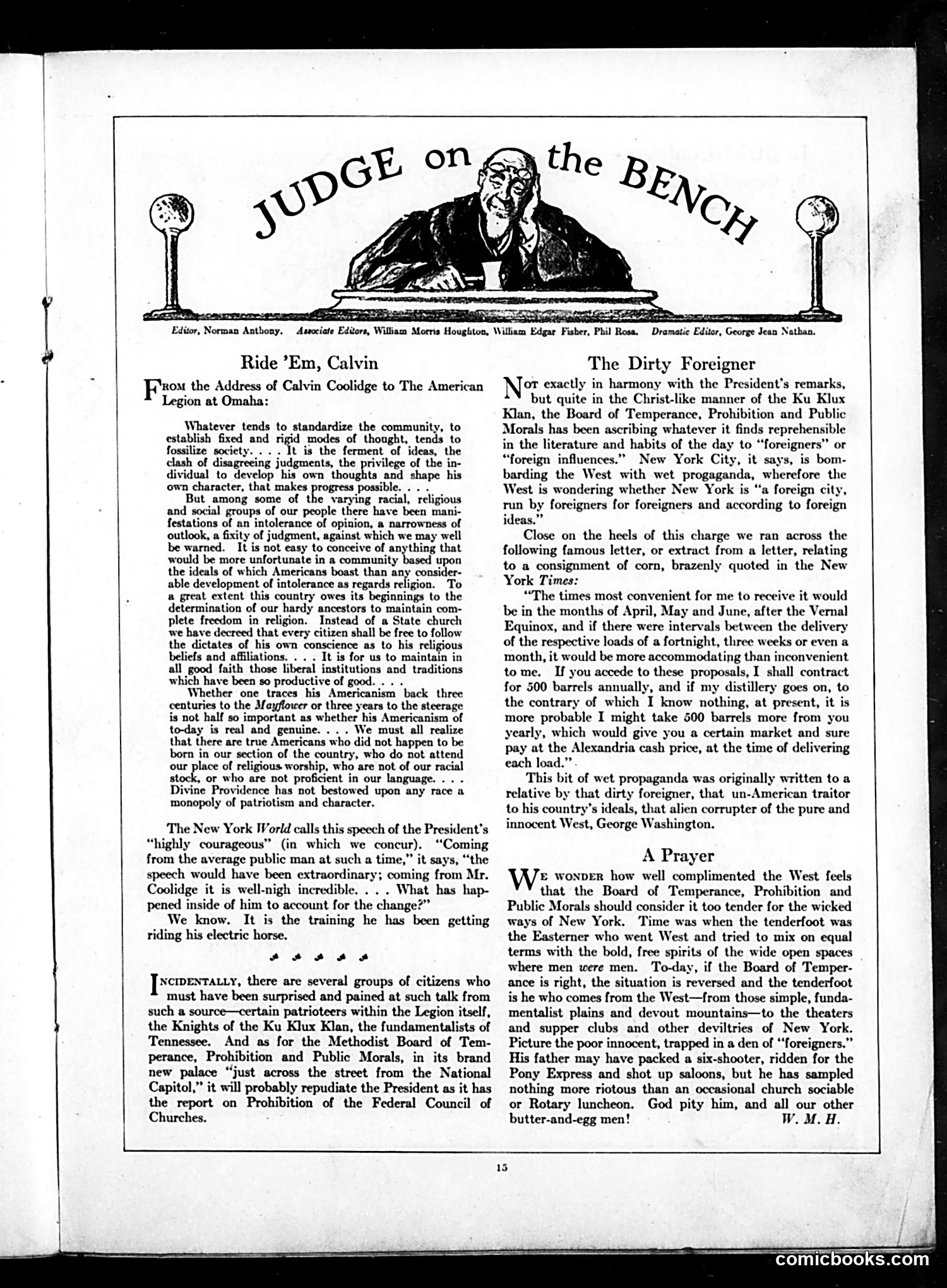
This page satirizes President Calvin Coolidge and contemporary nativist hysteria. The masthead cartoon depicts a "Judge on the Bench" presiding over political commentary. **"Ride 'Em, Calvin"** praises Coolidge's speech to the American Legion advocating religious tolerance and defending immigrants' patriotism against nativist suspicion. The joke: Judge attributes this unexpected progressivism to Coolidge practicing on an "electric horse"—implying mechanical repetition rather than genuine conviction. Judge notes the speech contradicts Coolidge's typical timidity. **"The Dirty Foreigner"** criticizes the Methodist Board of Temperance and Prohibition and the Ku Klux Klan for blaming societal problems on "foreign influences," particularly targeting New York City. The piece mocks this xenophobic scapegoating, contrasting it with Coolidge's more enlightened rhetoric. Judge supports Coolidge against religious fundamentalists and anti-immigrant groups while doubting his sincerity. The satire targets both nativist organizations and Coolidge's character simultaneously.
📄 Transcribed text from this page (OCR, searchable)
Machine-transcribed from the original scan — historical spelling and the odd misread are preserved.
Editor, Norman Anthony. Ride ’Em, Calvin Freou the Address of Calvin Coolidge to The American Legion at Omaha: Whatever tends to standardize the community, to establish fixed and rid modes of thought, tends to fossilize society. . is the ferment of ideas, the clash of disagreeing judgments, the privilege of the in- dividual to develop his own thoughts and shape his own character, that makes progress possible. . . . But among some of the varying racial, religious and social groups of our people there have been mani- festations of an intolerance of opinion, a narrowness of outlook, a fixity of judgment, against which we may well be warned. It is not easy to conceive of anything that would be more unfortunate in a community the ideals of which Americans boast than ai able development of intolerance as regards religion. a great extent this country owes its beginnings to the determination of our hardy ancestors to maintain com- plete freedom in religion. Instead of a State church we have decreed that every citizen shall be free to follow the dictates of his own conscience as to his reli beliefs and affiliations. . . . It is for us to main! all good faith those liberal institutions and traditions which have been so productive of good. . Whether one traces his Americanism back three centuries to the Mayflower or three years to the steerage is not half so important as whether his Americanism of to-day is real and genuine. . We must all realize that there are true Americans who did not happen to be boats in 3 ote section of the country, who do not attend of religious worship, who are not of our racial pee or who are not proficient in our language. . Divine Providence has not bestowed upon any race a monopoly of patriotism and character. The New York World calls this speech of the President's “highly courageous” (in which we concur). “Coming from the average public man at such a time,” it says, “the speech would have been extraordinary; coming from Mr. Coolidge it is well-nigh incredible. . . . What has hap- pened inside of him to account for the change?” We know. It is the training he has been getting riding his electric horse. -~ ae eae NCIDENTALLY, there are several groups of citizens who must have been surprised and pained at such talk from such a source—certain patrioteers within the Legion itself, the Knights of the Ku Klux Klan, the fundamentalists of Tennessee. And as for the Methodist Board of Tem- perance, Prohibition and Public Morals, in its brand new palace “just across the street from the National Capitol,” it will probably repudiate the President as it has the report on Prohibition of the Federal Council of Churches. Associate Editors, Wiliam Morris Houghton, William Edgar Fisher, Phil Rosa. Dramatic Editor, George Jean Nathan. The Dirty Foreigner i or exactly in harmony with the President’s remarks, but quite in the Christ-like manner of the Ku Klux Klan, the Board of Temperance, Prohibition and Public Morals has been ascribing whatever it finds reprehensible in the literature and habits of the day to “foreigners” or “foreign influences.” New York City, it says, is bom- barding the West with wet progaganda, wherefore the West is wondering whether New York is “a foreign city, run by foreigners for foreigners and according to foreign ideas.” Close on the heels of this charge we ran across the following famous letter, or extract from a letter, relating to a consignment of corn, brazenly quoted in the New York Times: “The times most convenient for me to receive it would be in the months of April, May and June, after the Vernal Equinox, and if there were intervals between the delivery of the respective loads of a fortnight, three weeks or even a month, it would be more accommodating than inconvenient tome. If you accede to these proposals, I shall contract for 500 barrels annually, and if my distillery goes on, to the contrary of which I know nothing, at present, it is more probable I might take 500 barrels more from you yearly, which would give you a certain market and sure pay at the Alexandria cash price, at the time of delivering each load.” This bit of wet propaganda was originally written to a relative by that dirty foreigner, that un-American traitor to his country’s ideals, that alien corrupter of the pure and innocent West, George Washington, A Prayer W: WONDER how well complimented the West feels that the Board of Temperance, Prohibition and Public Morals should consider it too tender for the wicked ways of New York. Time was when the tenderfoot was the Easterner who went West and tried to mix on equal terms with the bold, free spirits of the wide open spaces where men were men. To-day, if the Board of Temper- ance is right, the situation is reversed and the tenderfoot is he who comes from the West—from those simple, funda- mentalist plains and devout mountains—to the theaters and supper clubs and other deviltries of New York. Picture the poor innocent, trapped in a den of “foreigners.” His father may have packed a six-shooter, ridden for the Pony Express and shot up saloons, but he has sampled nothing more riotous than an occasional church sociable or Rotary luncheon. God pity him, and all our other butter-and-egg men! W. M.H.