
Judge, 1925-10-24 · page 18 of 36
Judge — October 24, 1925 — page 18: what you’re looking at
What you’re looking at
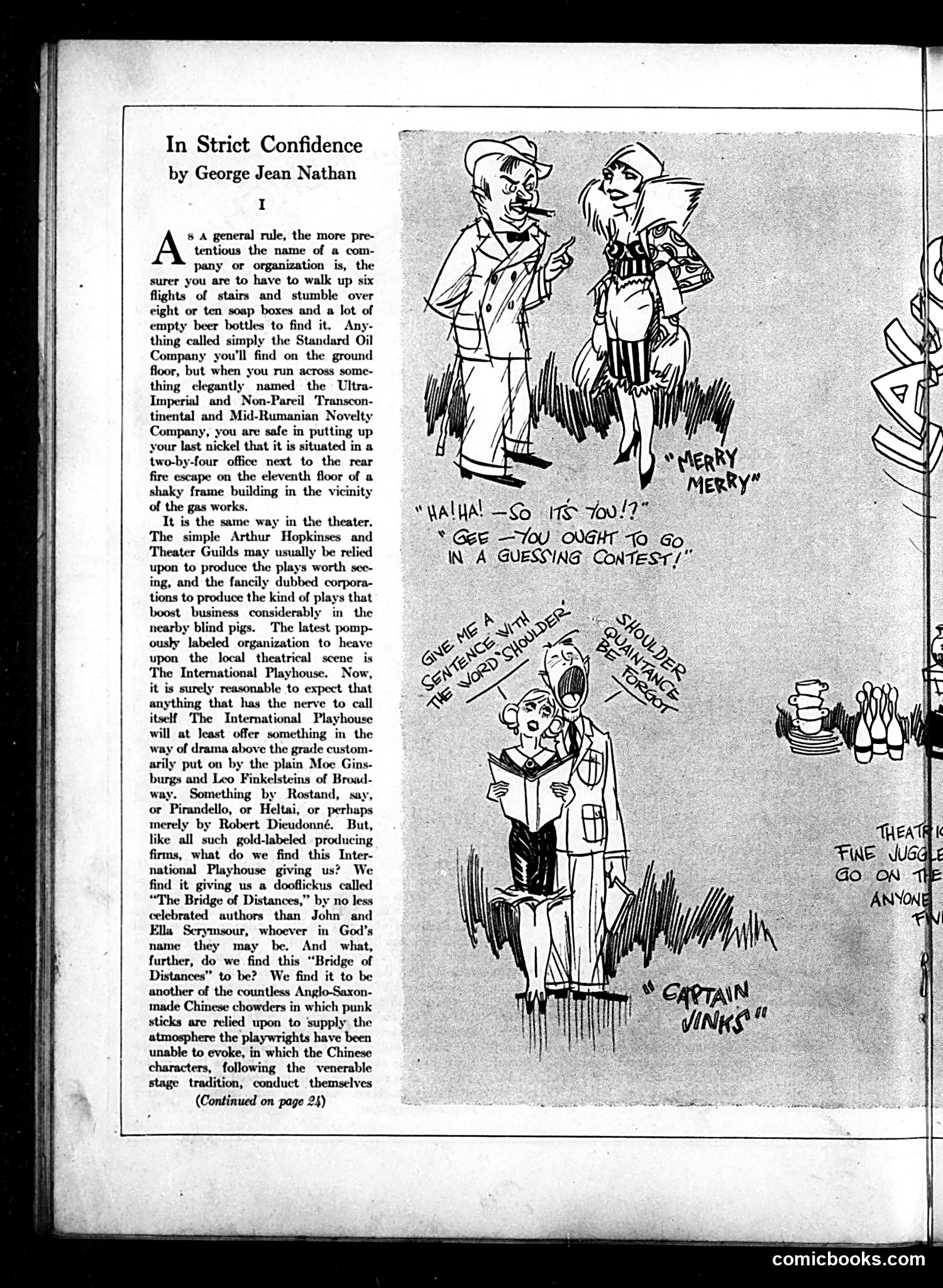
This is theater criticism disguised as humorous social commentary. Nathan satirizes pretentious theater companies through a simple rule: the fancier the organizational name, the worse the actual product. The cartoons illustrate his point. The top panel shows two theatrical types discussing a "guessing contest"—likely mocking a recent production's obscurity. The lower panel depicts someone holding a script titled "Captain Jinks," presumably another forgettable play. Nathan's specific target is "The International Playhouse," a newly arrived theatrical organization claiming sophistication. He expected productions by respected playwrights (Rostand, Pirandello, Heltai, or Dieudonné) but instead found "The Bridge of Distances" by unknown authors John and Ella Scrymsour—which he dismisses as another "Anglo-Saxon-made Chinese chowder," meaning a derivative pseudo-exotic play relying on theatrical clichés rather than genuine drama. The satire reflects early 20th-century theatrical criticism: dismissing earnest but mediocre producers while celebrating simpler, more honest theatrical ventures.
📄 Transcribed text from this page (OCR, searchable)
Machine-transcribed from the original scan — historical spelling and the odd misread are preserved.
| In Strict Confidence by George Jean Nathan I A 8 A general rule, the more pre- tentious the name of a com- pany or organization is, the surer you are to have to walk up six flights of stairs and stumble over eight or ten soap boxes and a lot of empty beer bottles to find it. Any- thing called simply the Standard Oil Company you'll find on the ground floor, but when you run across some- thing clegantly named the Ultra- Imperial and Non-Pareil Transcon- tinental and Mid-Rumanian Novelty Company, you are safe in putting up your last nickel that it is situated in a two-by-four office next to the rear fire escape on the eleventh floor of a shaky frame building in the vicinity ; . ; of the gas works. ny j, « It is the same way in the theater. WAL Hat —$0 TS Tov: q The simple Arthur Hopkinses and * Gee —YoU OUGHT 70 Go Theater Guilds may usually be relied ” upon to produce the plays worth sec- INA GUESSING CONTEST / ing, and the fancily dubbed corpora- tions to produce the kind of plays that 4 boost business considerably in the nearby blind pigs. The latest pomp- ousky labeled organization to heave upon the local theatrical scene is The International Playhouse. Now, it is surely reasonable to expect that anything that has the nerve to call itself The International Playhouse will at least offer something in the way of drama above the grade custom- arily put on by the plain Moe Gins- burgs and Leo Finkelsteins of Broad- way. Something by Rostand, say, or Pirandello, or Heltai, or perhaps merely by Robert Dieudonné. But, like all such gold-labeled producing THEATE I firms, what do we find this Inter- ae fr ‘ FINE Nec) national Playhouse giving us? We i P| 5 if find it giving us a dooflickus called | : Go ON “The Bridge of Distances,” by no less ; | <= ANYONE celebrated authors than John and i pes Mes | Ella Scrymsour, whoever in God’s ; BAG name they may be. And what, further, do we find this “Bridge of Distances” to be? We find it to be another of the countless Anglo-Saxon- made Chinese chowders in which punk sticks are relied upon to ‘supply the atmosphere the playwrights have been unable to evoke, in which the Chinese characters, following the venerable stage tradition, conduct themselves comicbooks.com