
A complete issue · 37 pages · 1925
Judge — September 12, 1925
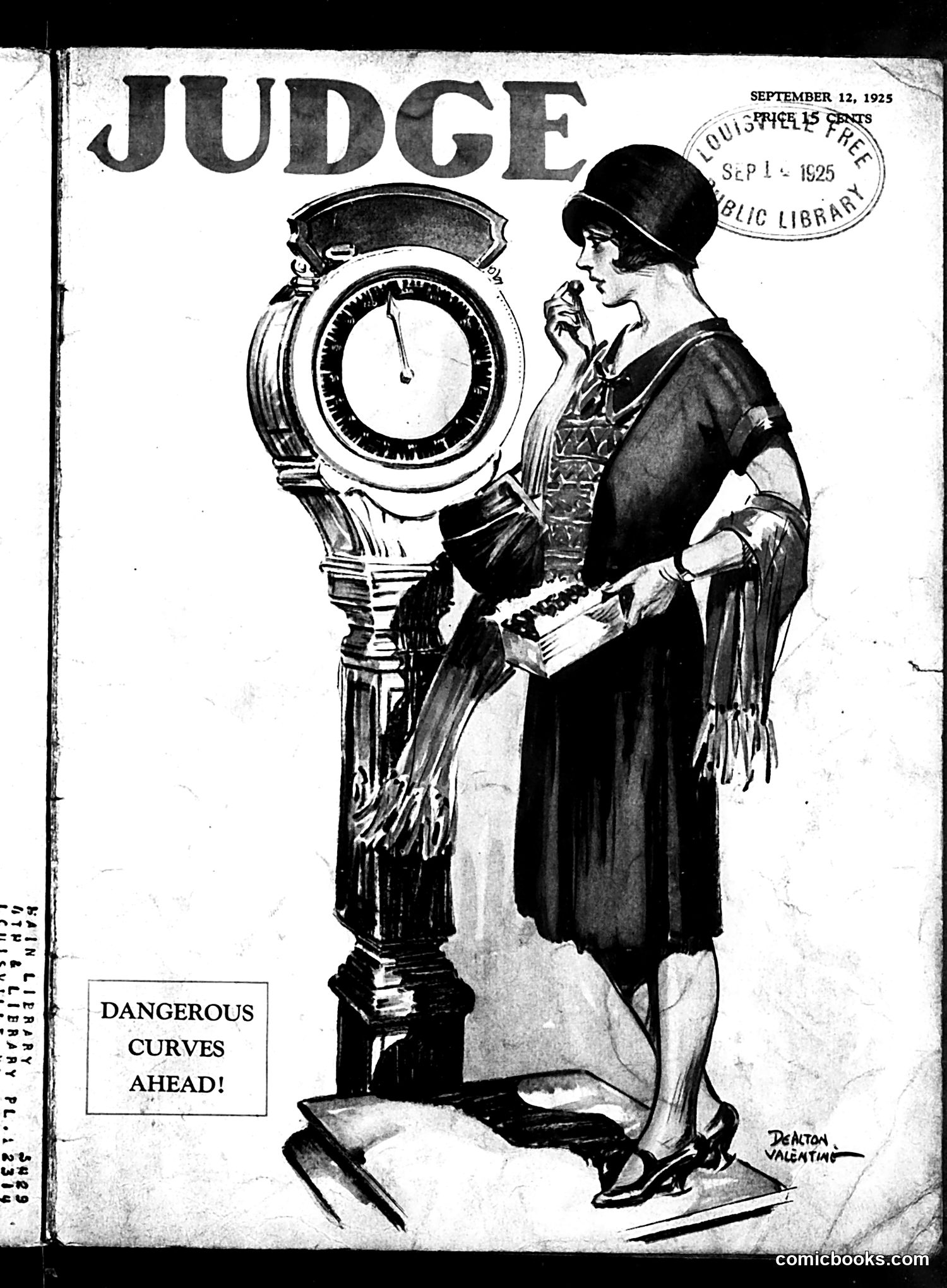
This cover depicts a woman in 1920s fashion standing beside an oversized clock or scale. The phrase "Dangerous Curves Ahead!" serves as a double entendre typical of Jazz Age humor. In the 1920s context, "dangerous curves" refers both to the literal curved shape of the woman's body and to the social anxieties surrounding the "New Woman"—the modern, independent flapper who challenged Victorian norms through fashion, behavior, and lifestyle. The clock suggests time passing or racing forward. The satire mocks contemporary moral panic about women's changing roles and sexuality during the Roaring Twenties, presenting feminine modernity itself as a cautionary "road hazard" to warn against. The artist's signature reads "DeLacton Valentino" (or similar).
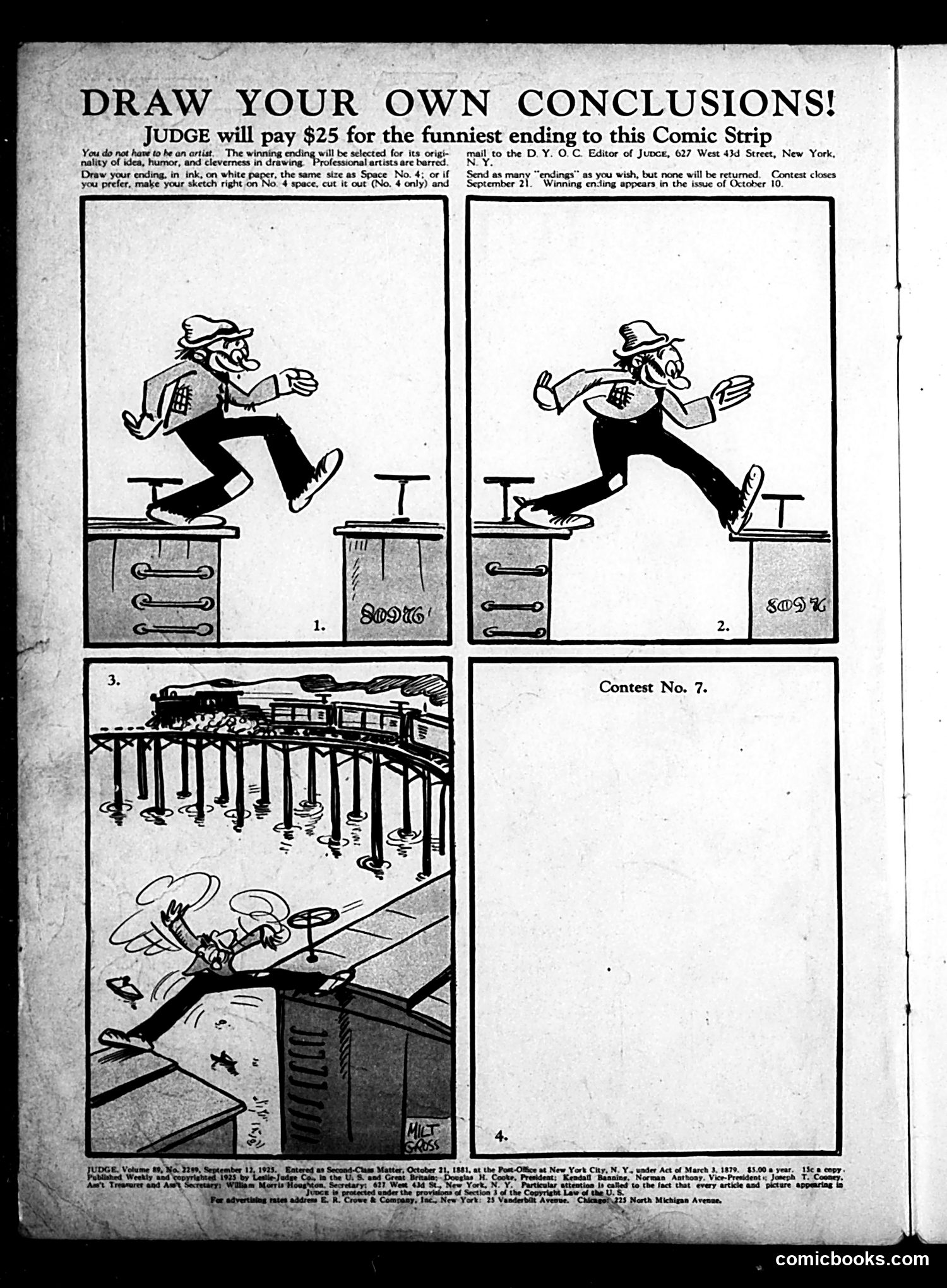
This page is primarily a **reader contest**, not political commentary. Readers are invited to "draw your own conclusions" by completing an unfinished comic strip, with the winning entry to be published in Judge magazine. The three completed panels (numbered 1-3) show a slapstick narrative: a man in a hat jumping between furniture, apparently fleeing or chasing something, culminating in a train scene where he appears to be in peril or distress below a bridge. Panel 4 is blank—reserved for reader submissions. The contest offers a $25 prize and specifies that drawings should be submitted by September 21. This is an **interactive entertainment feature** rather than satire or political commentary—typical of Judge's humor-focused content from this era (1925, based on the masthead date).
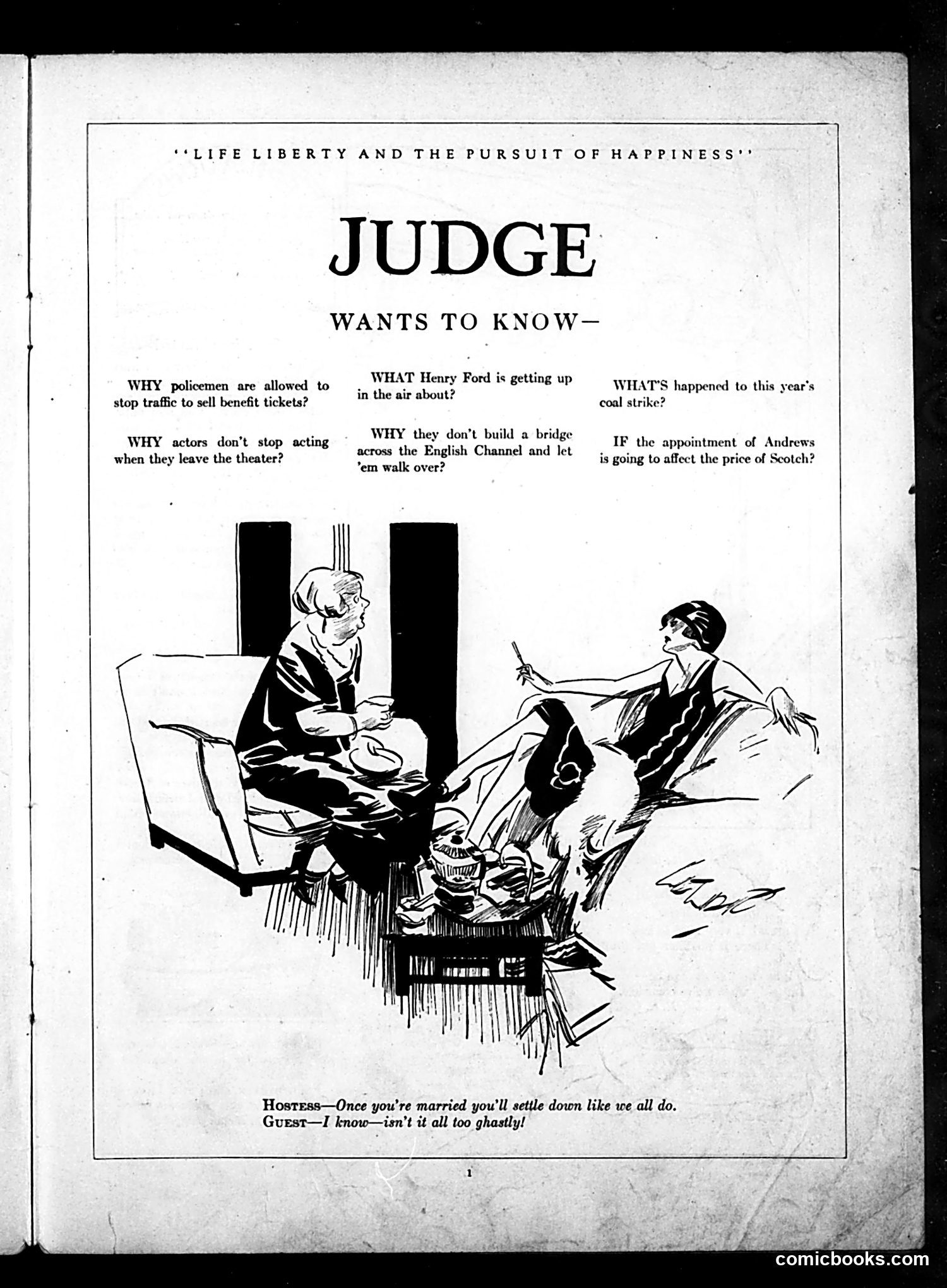
This satirical page lists questions a "Judge" wants answered about contemporary issues: traffic enforcement for benefit tickets, actors continuing performances after theater closing, Henry Ford's aviation activities, building a Channel bridge, a coal strike, and an Andrews appointment affecting Scotch whiskey prices. The main cartoon depicts a hostess and guest in conversation. The hostess remarks that once married, one settles down "like we all do," to which the guest responds "I know—isn't it all too ghastly!" The satire targets the social expectation that marriage leads to domesticity and loss of freedom—presented as an inevitably depressing outcome. The illustration's tone suggests this was meant as humorous commentary on marriage's perceived constraints, particularly relevant to early-20th-century audiences navigating changing social conventions.
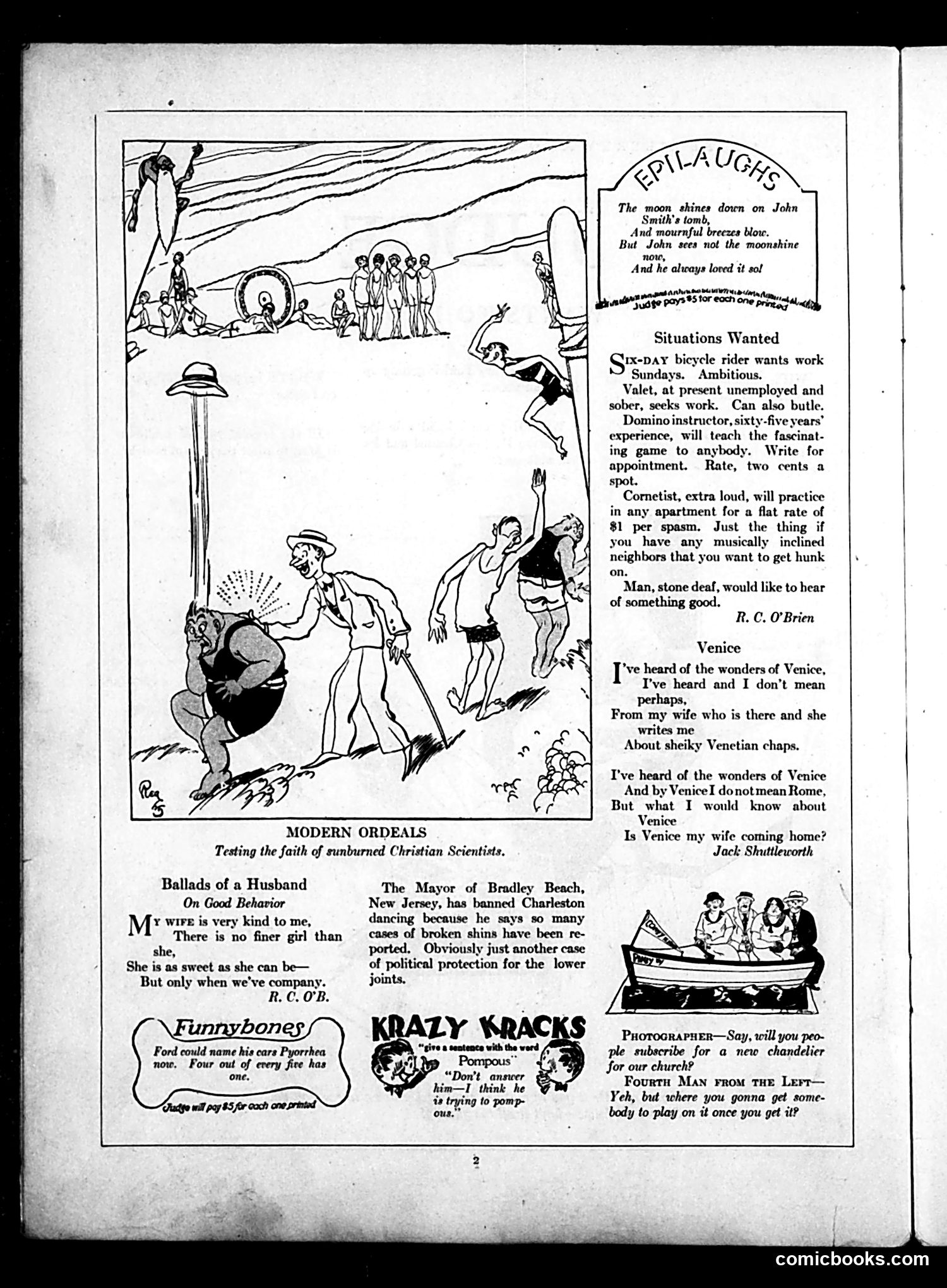
The main cartoon, "Modern Ordeals: Testing the faith of unburned Christian Scientists," satirizes Christian Science by depicting practitioners suffering various mishaps—a man struck by a pole, another burned at a stake, people drowning—while apparently trusting in faith rather than practical intervention. The satire mocks Christian Scientists' reliance on spiritual healing over medical treatment, a common criticism of the faith movement in early 20th-century America. The surrounding content includes humorous classified advertisements ("Situations Wanted") and satirical verses. One notes the Mayor of Bradley Beach banning Charleston dancing due to reported broken shins—poking fun at both the dance craze and moral panic of the 1920s. Overall, this page reflects Judge's satirical approach to contemporary social movements and moral anxieties.
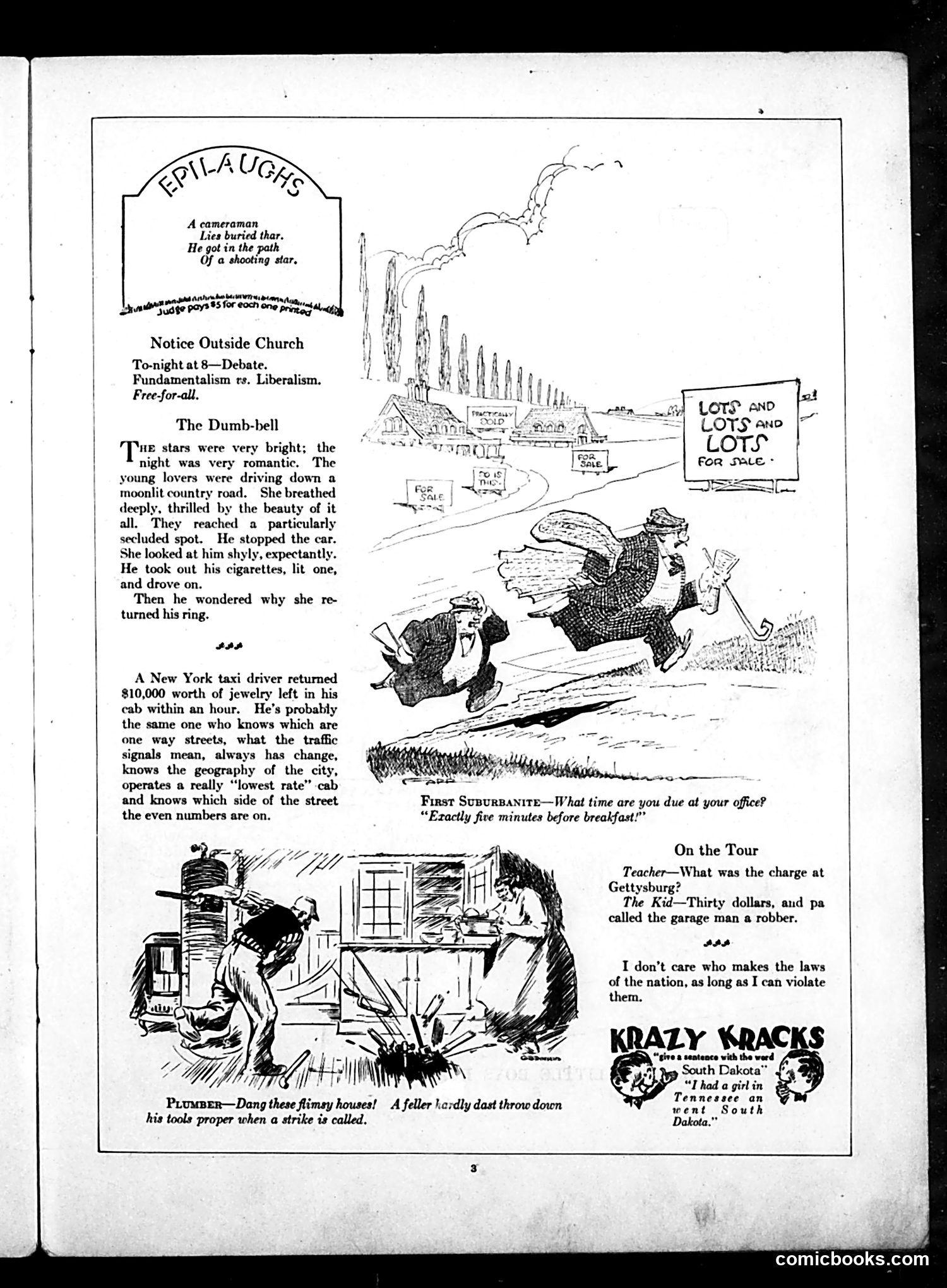
This page contains several distinct items: **"The Dumb-bell"**: A brief story about young lovers on a country road where the man removes his ring, apparently causing the woman to question their relationship. **NYC Taxi Driver anecdote**: Humorously notes that a taxi driver returned $10,000 in jewelry, suggesting such honesty is rare given drivers' knowledge of city streets and traffic signals. **Two captioned cartoons**: - A real estate agent advertising "Lots and Lots and Lots for Sale" - A plumber and homeowner arguing about tools during a strike **"On the Tour"**: A teacher-student exchange about Civil War costs at Gettysburg, with dark humor about robbery. **"Krazy Kracks"**: Advertisement for a film featuring South Dakota scenery. The content is typical early-20th-century Judge magazine fare: light social satire, brief humorous anecdotes, and advertising mixed with editorial cartoons mocking everyday characters and situations.
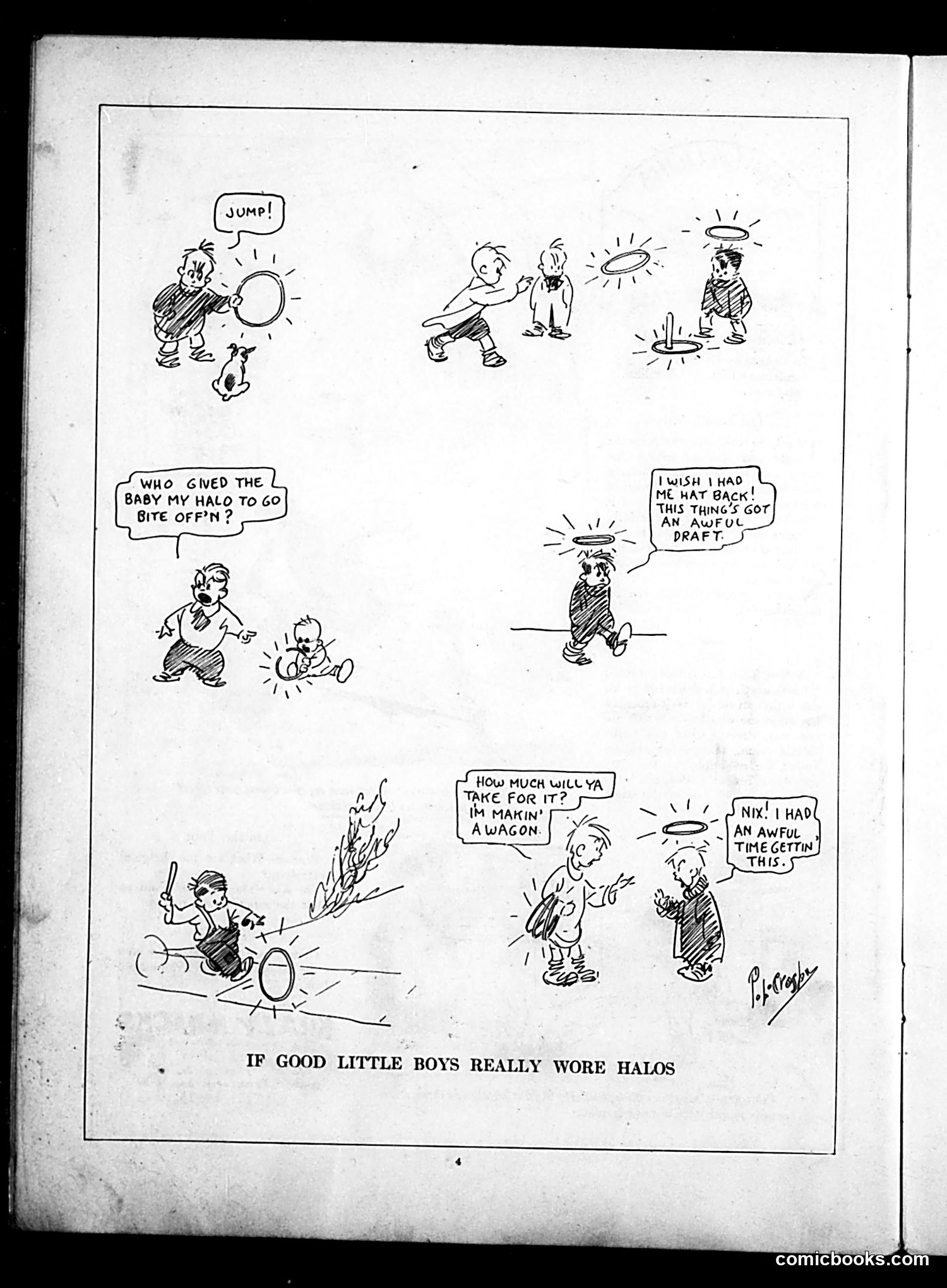
This is a humorous cartoon strip imagining what would happen if children who behaved well actually displayed visible halos like religious depictions of angels and saints. The comic shows a series of escalating mischief scenarios: children playing with hoops ("Jump!"), throwing them around, one child complaining his halo was bitten by a baby, another frustrated that his halo has drafts, and finally a child dragging a wagon that's caught fire while claiming he's "making" one and asking another child "how much will ya take for it?" The satire's point is straightforward: real children constantly misbehave and cause chaos, so if halos actually appeared on "good" children, they'd be in constant danger of damage and loss. It's gentle commentary on childhood behavior versus adult expectations of angelic innocence.
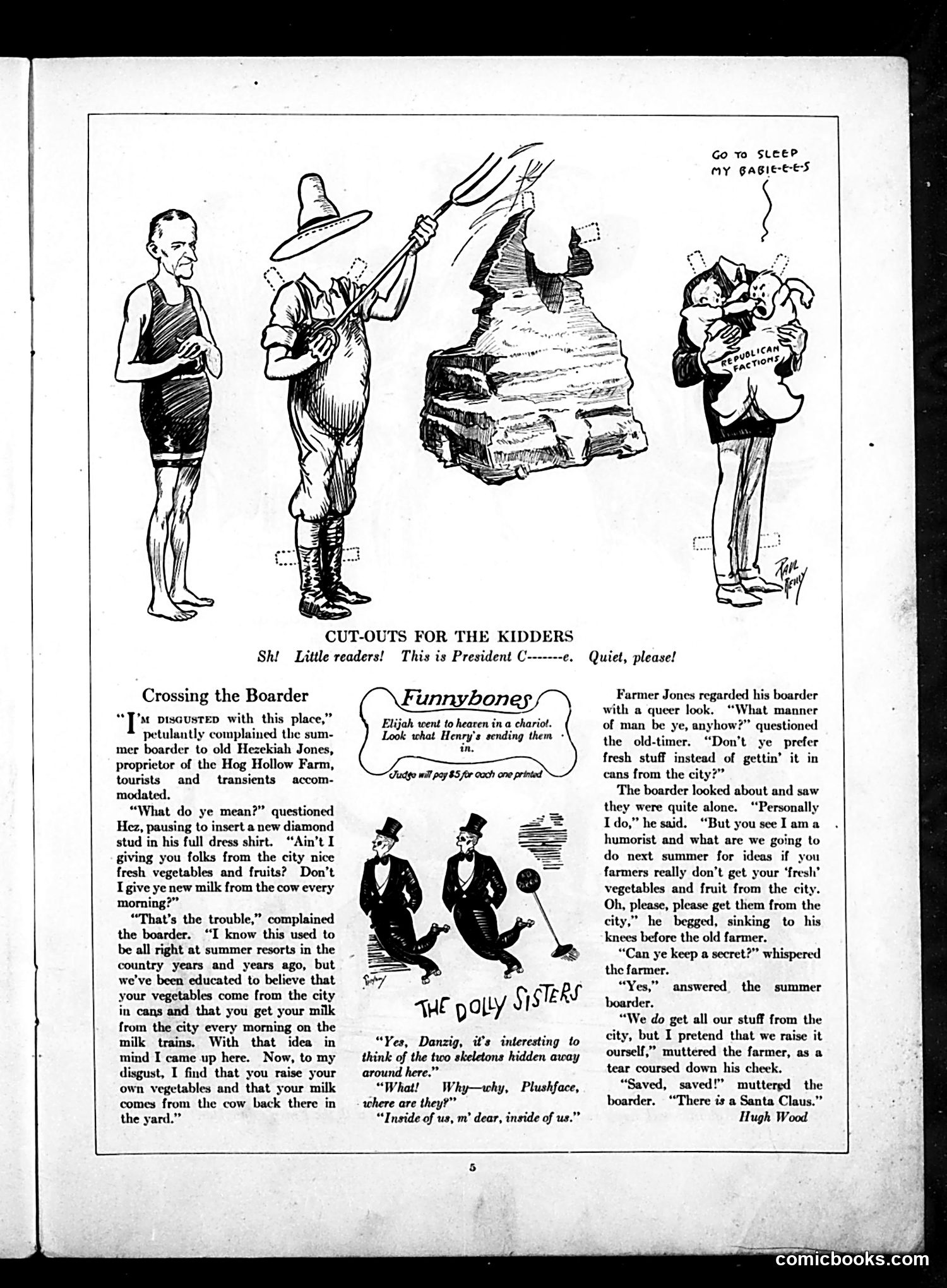
This page contains humor content rather than explicit political satire. The top section features "Cut-Outs for the Kiddies" showing paper dolls of political figures (one labeled "President C------" with text about keeping quiet), suggesting this targets children with political mockery. The main story, "Crossing the Border," satirizes rural-urban cultural differences. A city boarder staying at a farm complains about lack of fresh produce and milk, claiming city residents prefer store-bought goods. The farmer discovers the boarder is a "humorist" who pretends to raise vegetables himself to appear authentic to city people—mocking urban affectation and the romanticization of rural life. The humor depends on early 20th-century tension between agricultural and urban lifestyles.
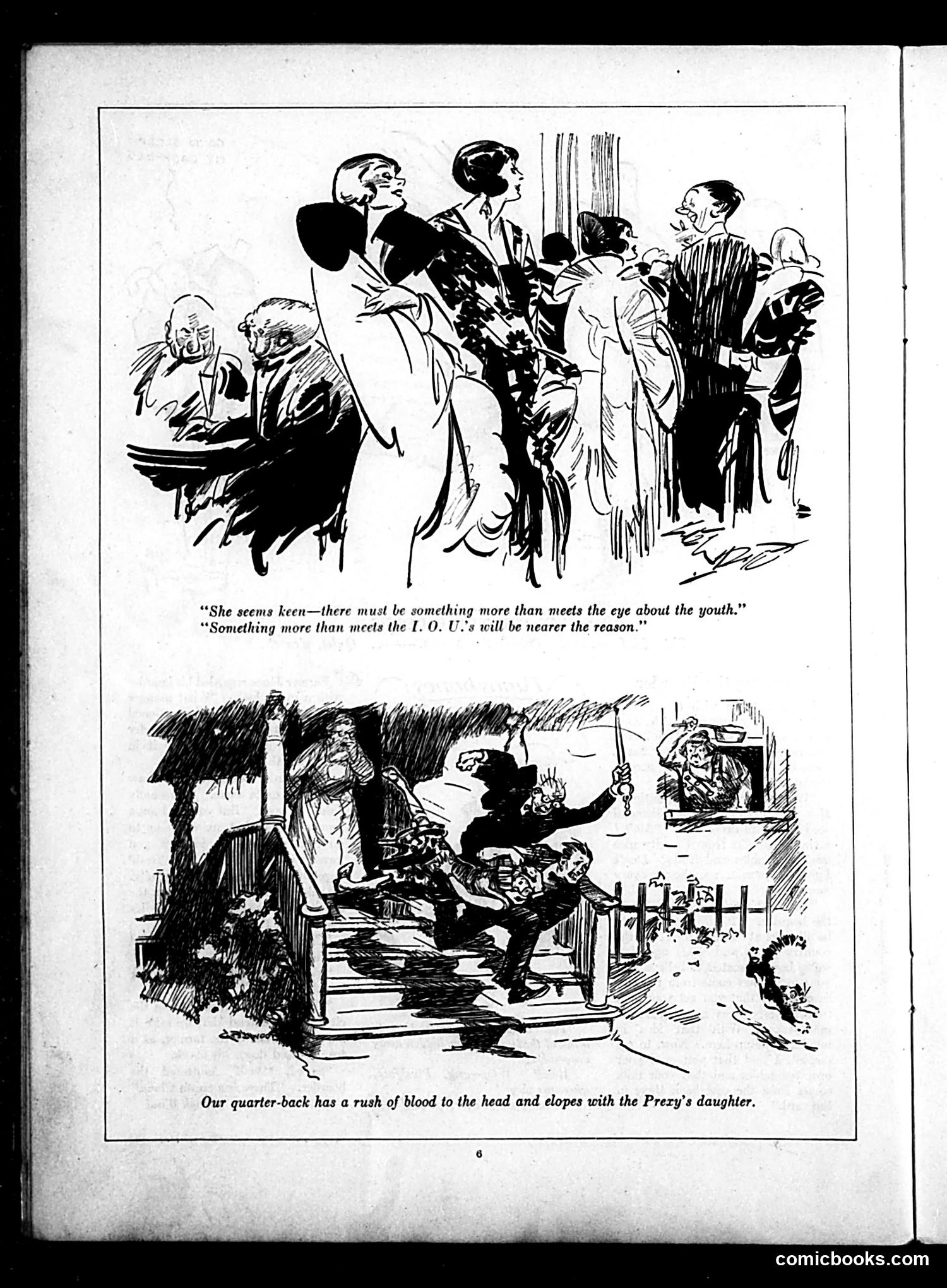
The top cartoon depicts a social scene where observers note a young woman seems "keen" on a youth. The joke's punchline reveals the real attraction: the young man has I.O.U.'s (IOUs—debts or promissory notes), implying he's wealthy or financially promising. The satire mocks how financial status, not genuine character or charm, determines romantic interest. The bottom cartoon shows a college "quarter-back" (football player) eloping with "the Prexy's daughter" (the president's daughter). This satirizes the clichéd romantic melodrama common in popular fiction and college stories of the era—the athletic hero running away with the authority figure's daughter represents youthful rebellion and scandal. Both cartoons mock social pretense and predictable romantic narratives of early 20th-century American life.
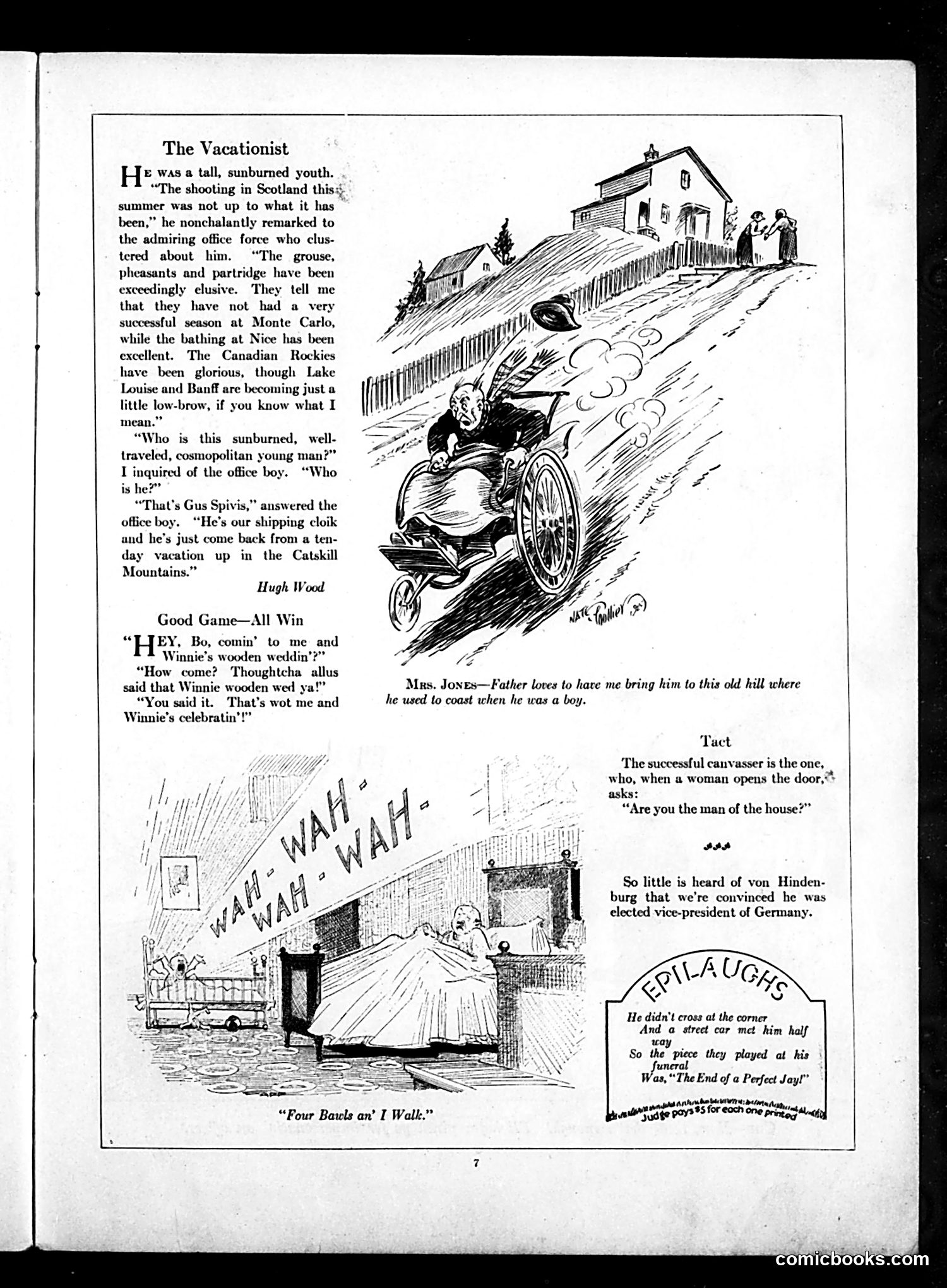
This page contains four separate satirical pieces typical of early 20th-century humor: **"The Vacationist"** mocks a shipping clerk named Gus Spivis who, after a modest ten-day vacation in the Catskill Mountains, pretentiously brags to office colleagues about exclusive European resorts (Monte Carlo, Nice, Scottish shooting, Canadian Rockies) as if he'd visited them all. The satire targets social climbing and fabricated worldliness. **"Good Game—All Win"** is a brief joke about a couple celebrating a "wooden wedding" (fifth anniversary)—the humor derives from a pun on "wooden" (the traditional gift) versus the wife refusing marriage. **"Tact"** offers a short observation about salesmanship—asking "Are you the man of the house?" when a woman answers the door. **"Epilaughs"** appears to be a humorous epitaph about someone hit by a streetcar, with dark wordplay. The page uses characteristic Judge-style ink illustrations and satirizes working-class pretension and period social conventions. The von Hindenburg reference (unclear without date) appears to be contemporary political commentary.
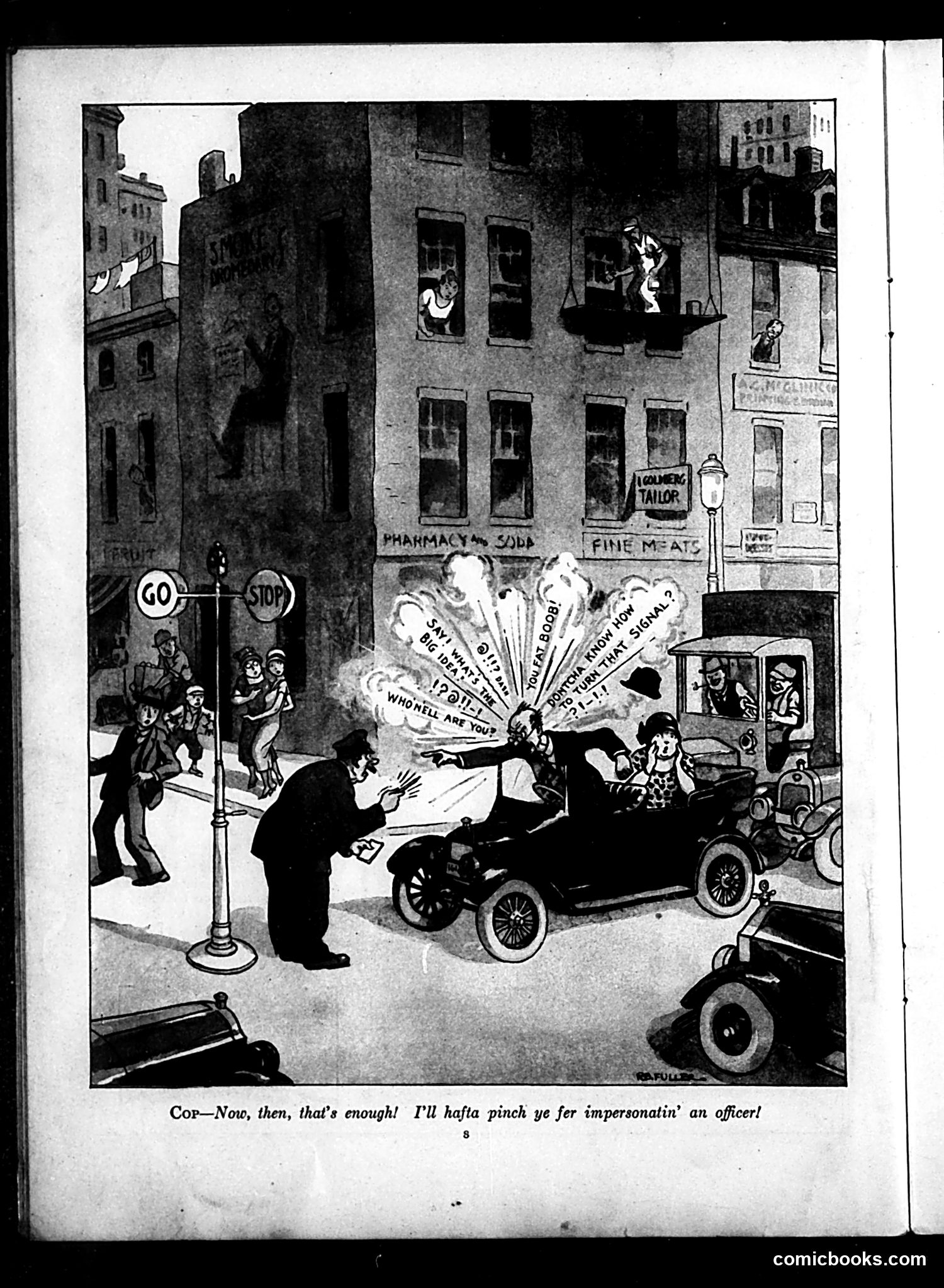
This cartoon satirizes traffic enforcement and police authority in urban America. A police officer confronts a driver at an intersection, threatening to arrest him for "impersonating an officer." The joke's point: The driver's car appears to be displaying numerous warning signs and signals—depicted as radiating from the vehicle like a peacock's tail. These signs (reading "STOP," "GO," "PROCEED WITH CAUTION," "WATCH YOUR STEP," etc.) suggest the driver is behaving *like* a traffic cop himself, directing pedestrians and other vehicles rather than obeying traffic rules. The satire mocks both aggressive drivers who act as self-appointed traffic regulators and the era's growing tension between automobiles and traditional street culture. The storefronts visible (pharmacy, tailor, fine meats) establish an urban neighborhood setting affected by increasing vehicle congestion.
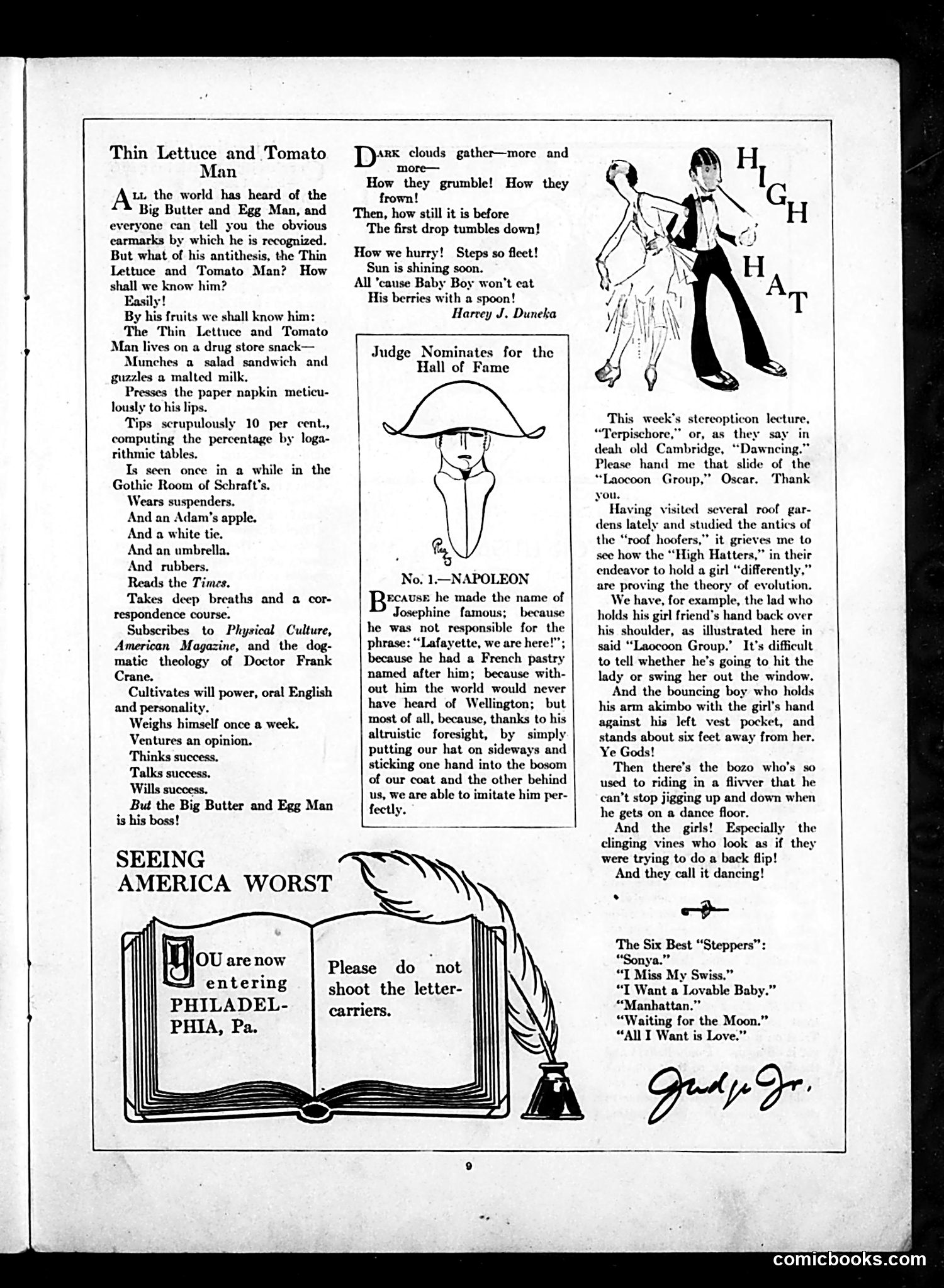
This satirical page mocks 1920s social types and cultural trends: **"Thin Lettuce and Tomato Man"** ridicules an ascetic, self-improving type who frequents drug store lunch counters, obsessively calculates tips, reads self-help literature, and practices "will power"—yet remains subordinate to the wealthy "Big Butter and Egg Man" (slang for a wealthy, flashy businessman). The satire targets pretentious self-improvement culture. **"Napoleon" Hall of Fame entry** jokes that Napoleon's fame derives entirely from secondary sources: his wife Josephine, a French pastry named after him, and Wellington's fame—and most absurdly, because Americans can imitate his pose (hand-in-coat) by simply wearing their hats sideways. **"Philadelphia" warns** visitors not to shoot letter-carriers, suggesting Philadelphia's reputation for violence. **"Dancing" critique** mocks youth dancing styles—men holding women at awkward angles (the "Laocoon Group" pose) while claiming to dance, and women doing exaggerated moves. The author dismisses modern dancing as ungraceful and ridiculous.
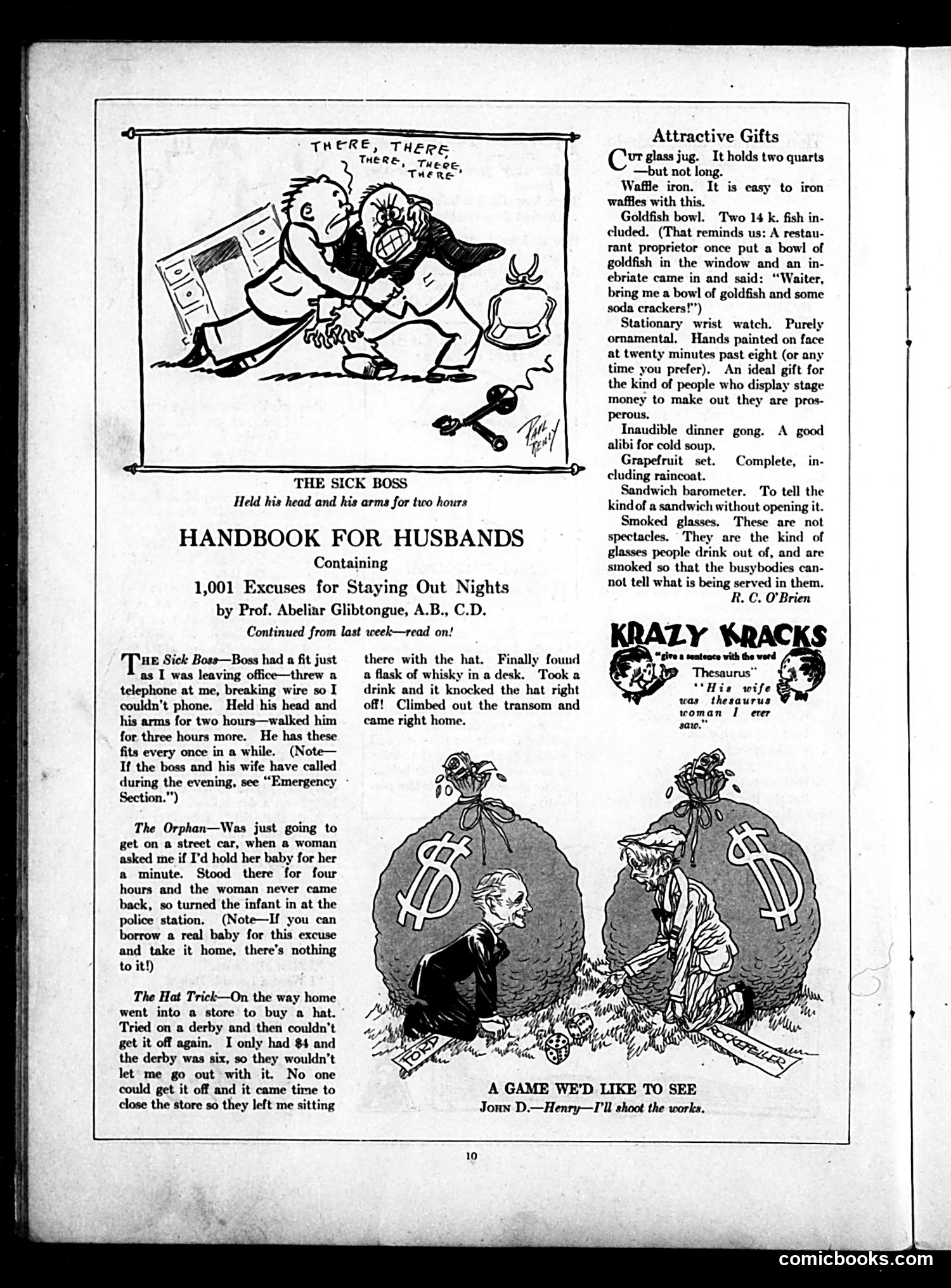
This page satirizes married men's deceptions through a humorous "handbook" offering absurd excuses for staying out. The main cartoon shows "The Sick Boss"—an employer having a dramatic fit, justifying an employee's absence. The listed excuses reveal period anxieties about marital accountability: "The Orphan" involves babysitting a stranger's child for hours; "The Hat Trick" describes getting stuck in a store trying on hats, requiring whisky and escape through a transom window. The satire targets husbands who invent elaborate stories to avoid domestic responsibility, mocking both male dishonesty and the social expectations forcing them to fabricate. The "Attractive Gifts" sidebar—listing useless items like stationary watches and "smoked glasses" to hide drink contents—extends the joke about deception and pretense. This reflects early 20th-century anxieties about marriage, gender roles, and male independence versus domestic obligation.
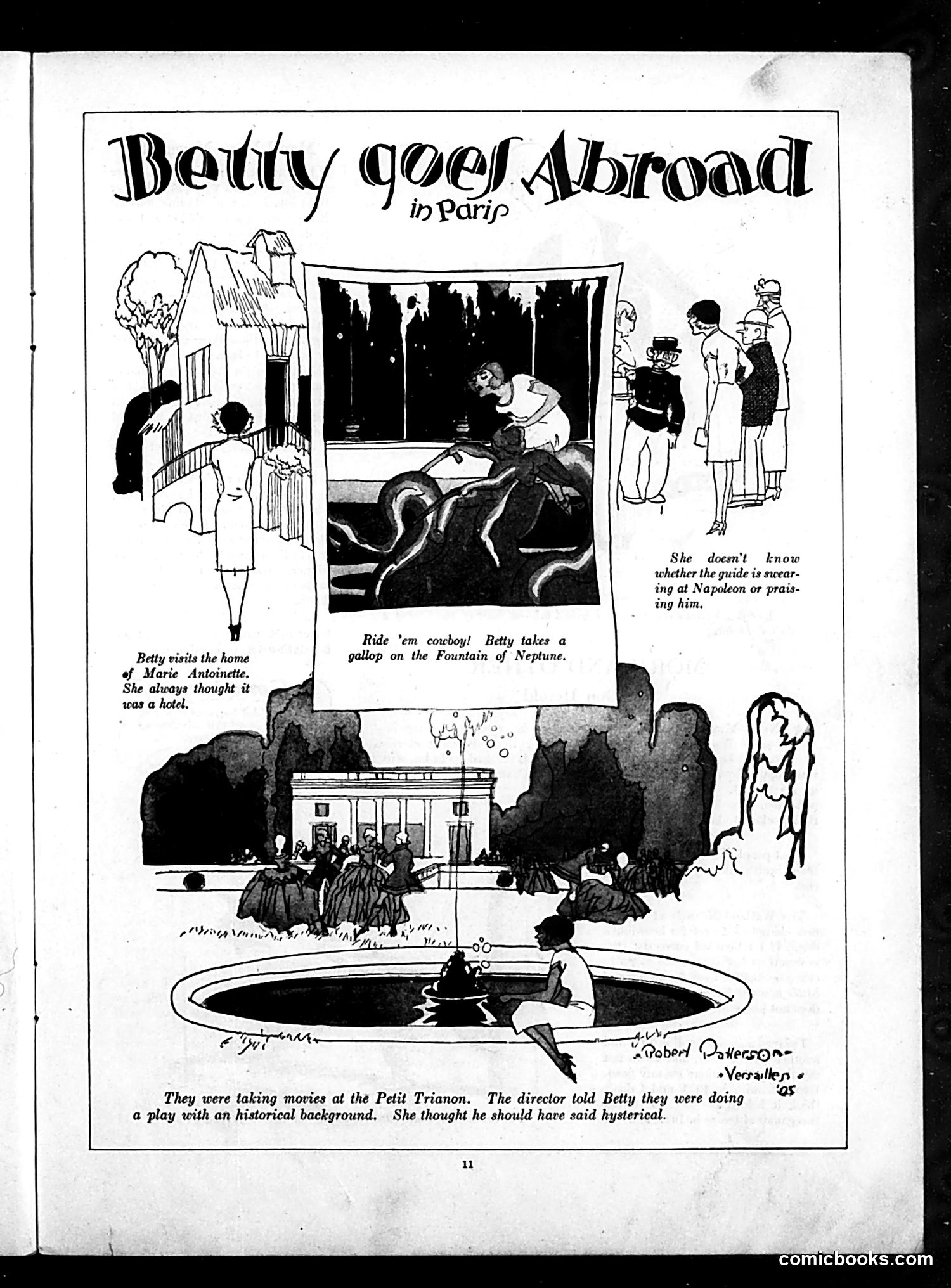
This appears to be a humorous comic strip about an American tourist named Betty visiting Paris. The satire targets American cultural ignorance abroad through Betty's comical misunderstandings: 1. **Marie Antoinette's home**: Betty mistakes the palace for a hotel, reflecting stereotypical American unfamiliarity with European history and architecture. 2. **The Fountain of Neptune**: She treats it irreverently as a carnival ride ("Ride 'em cowboy!"), embodying the brash American tourist stereotype. 3. **Historical ignorance**: The final caption jokes that Betty confuses "historical background" with "hysterical"—suggesting Americans are both illiterate and boisterous. 4. **The guide's commentary**: A guide can't tell if he's insulting or praising Napoleon, implying Betty's presence makes serious discourse impossible. The cartoon satirizes both American tourists' lack of sophistication and their disrespect for European cultural monuments, a common theme in 1920s American humor.
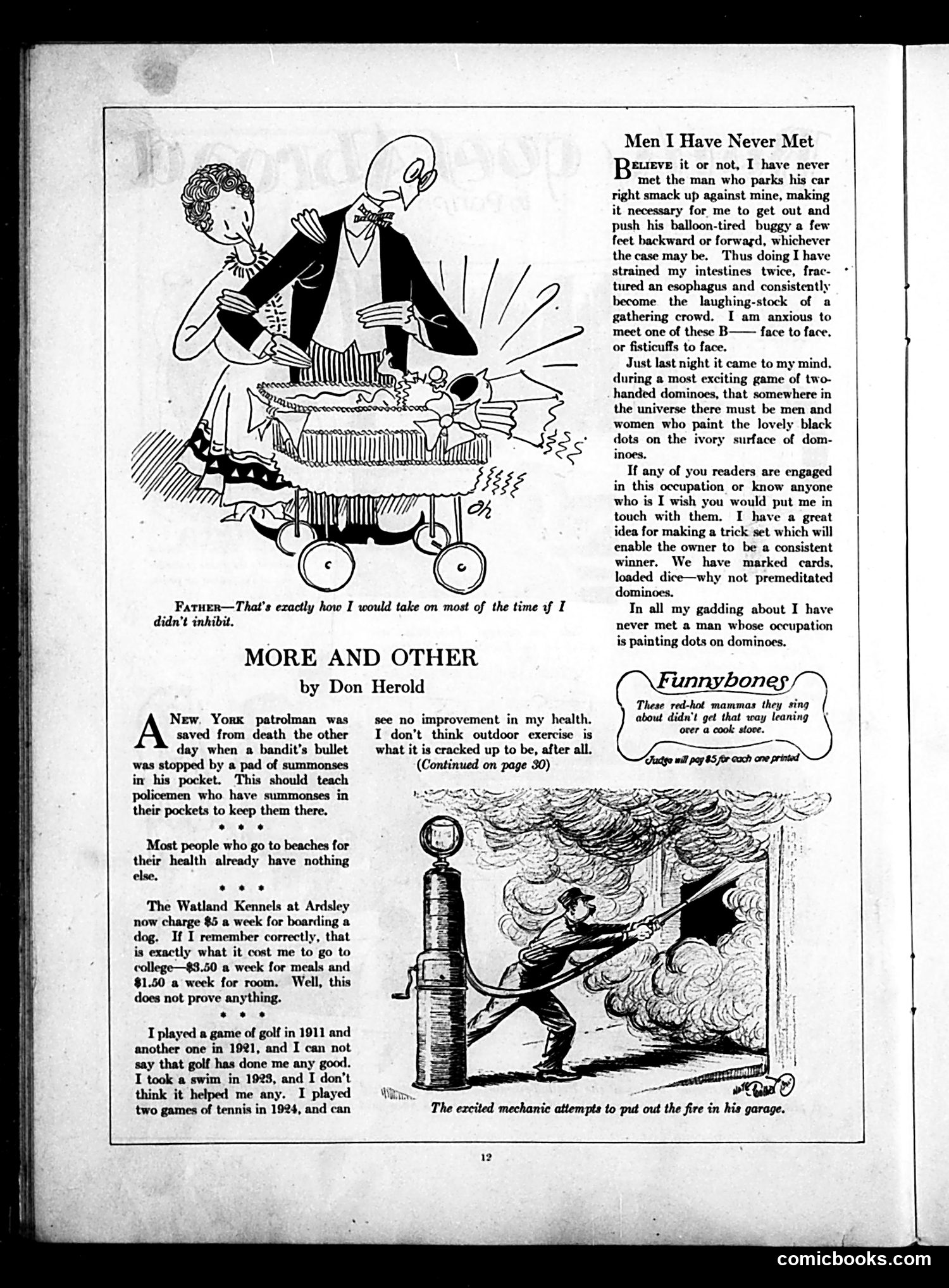
This page contains humorous personal essays by Don Herold rather than political cartoons. The main content mocks everyday frustrations and absurd social observations: **"Men I Have Never Met"** complains about the unnamed person who parks too close, causing the author physical injury while moving their car—a relatable urban annoyance. He also humorously notes he's never met whoever actually manufactures dominoes with painted dots, and proposes selling cheated domino sets (paralleling marked cards and loaded dice). **"More and Other"** is satirical commentary on claimed health benefits: a bulletproof pad of summonses "protects" a cop; beaches offer nothing to the already-destitute; dog boarding costs equal college tuition (suggesting both are poor values); and his personal athletic pursuits (golf, swimming, tennis) have provided zero health improvement. The bottom cartoon shows a mechanic attempting to extinguish a garage fire. The caption references "red-hot mammas"—period slang for attractive women—with crude innuendo about how they "got that way." The humor relies on everyday relatability and cynical observations rather than political satire.
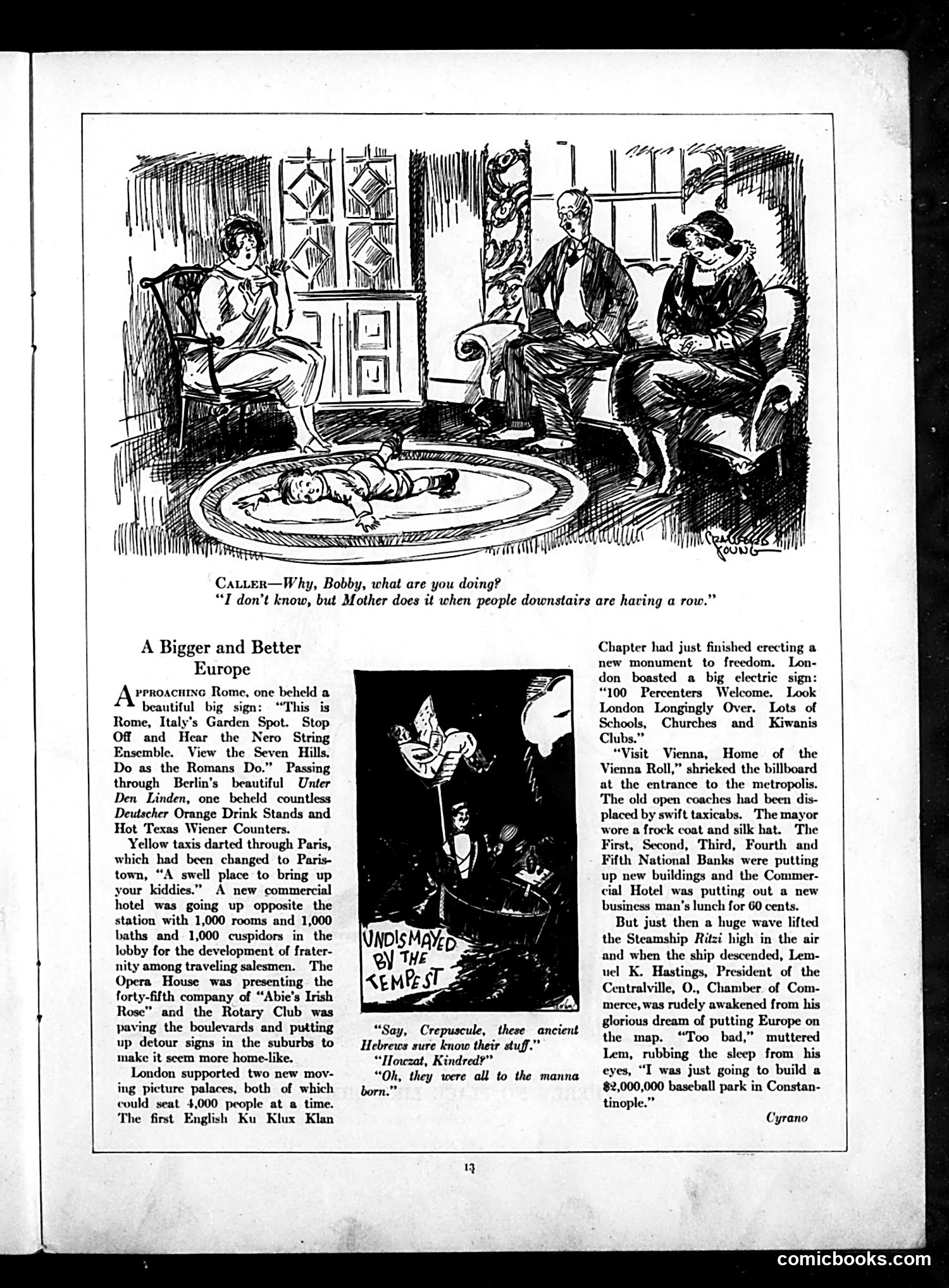
This satirical story mocks American commercialism and cultural imperialism in post-WWI Europe. The narrative describes European capitals being transformed into Americanized tourist destinations: Rome gets promotional signage, Berlin features hot dog stands, Paris becomes "Paris-town," and London supports massive movie theaters showing American entertainment like "Abie's Irish Rose." The satire peaks when an American businessman dreams of imposing American development schemes—banks, commercial hotels, even a baseball park in Constantinople—on Europe's historic cities. The dream ends abruptly when he awakens on a ship, deflating his grandiose vision. The joke targets American expansionism and the erasure of European cultural distinctiveness through commercialism. It suggests Americans abroad are transforming ancient civilizations into indistinguishable, profit-driven replicas of American small towns, reducing everything to business opportunities and leisure commodities.
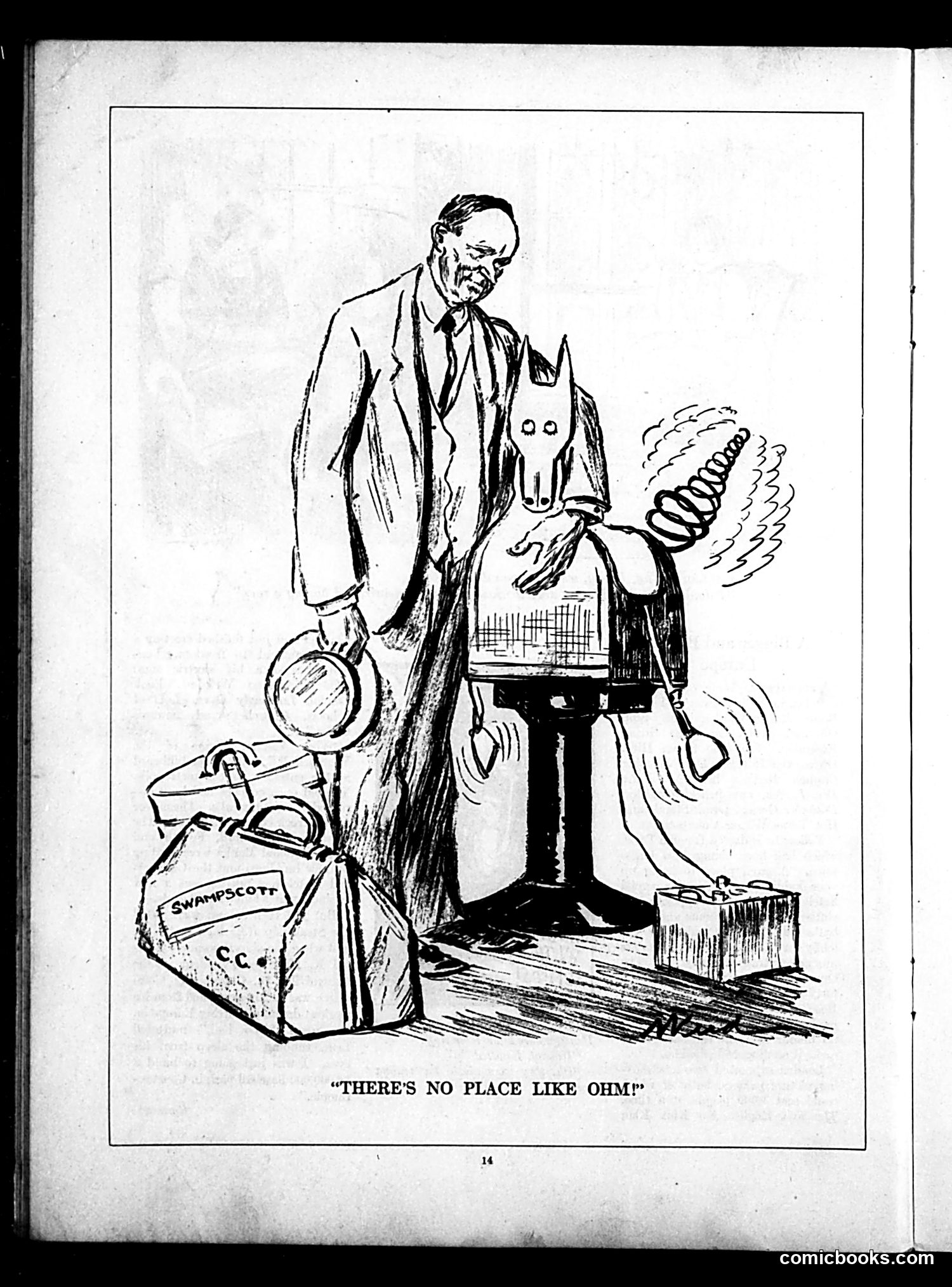
This political cartoon depicts a man in formal dress standing beside a mechanical device or automaton with a horse-like head. The figure holds various tools and is accompanied by a suitcase labeled "SWAMPSCOTT" and "C.C." The caption plays on Dorothy's famous line from *The Wizard of Oz* ("There's no place like home"), substituting "OHM"—a unit of electrical resistance. This suggests satire about technological progress or electrical innovation during the early 20th century. The mechanical horse and industrial tools indicate the cartoon critiques mechanization or industrial development, possibly warning against abandoning natural life for artificial advancement. The specific references to "Swampscott" and "C.C." remain unclear without additional context.
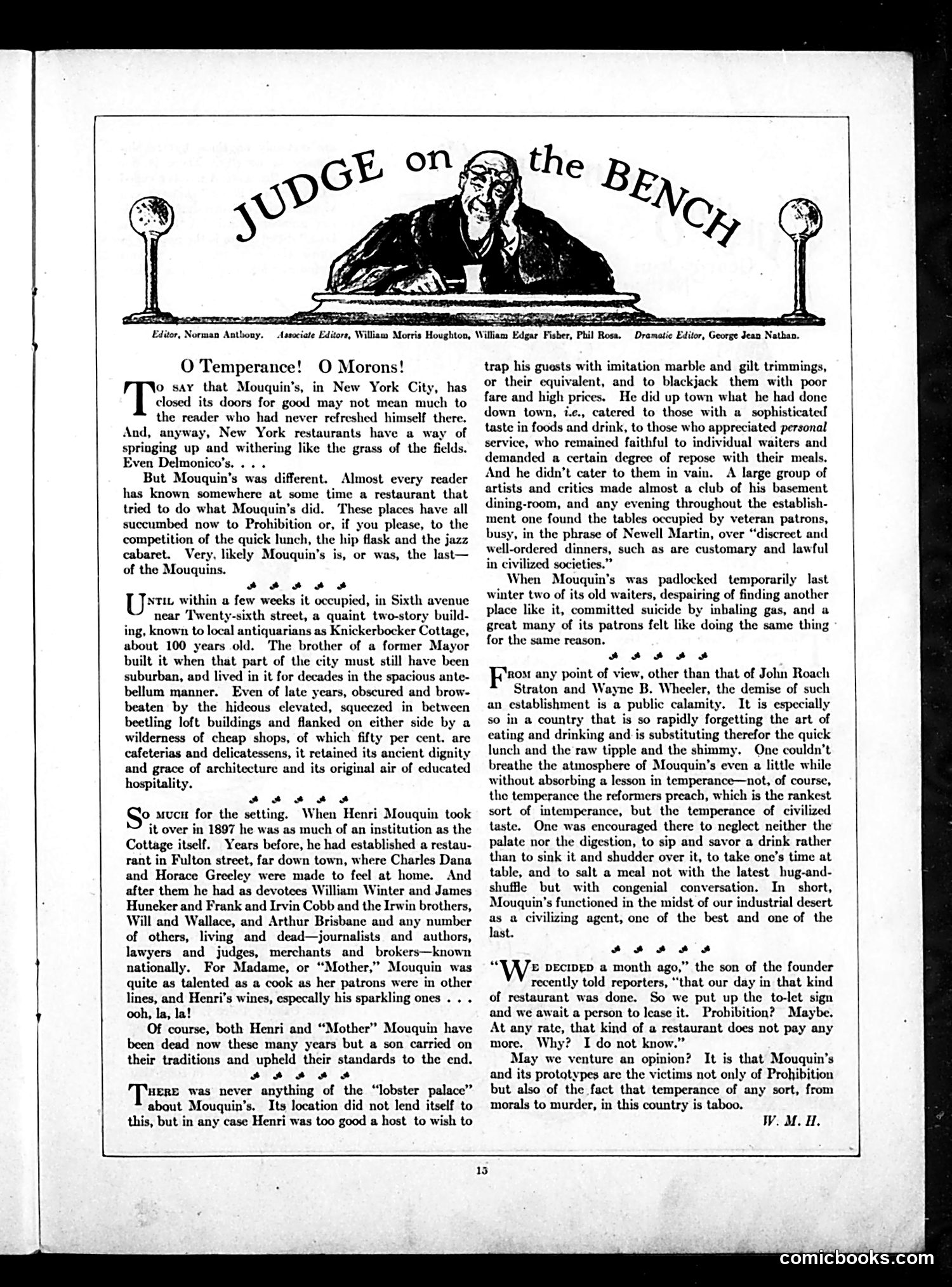
This article laments the closure of Mouquin's, a prestigious New York restaurant, blaming **Prohibition** for destroying establishments catering to refined diners. The piece nostalgically celebrates Mouquin's 100-year history as a sophisticated gathering place for prominent journalists, writers, and judges—including Charles Dana and Horace Greeley—who valued quality cuisine, personal service, and dignified atmosphere. The satire targets Prohibition's consequences: the article notes two elderly waiters committed suicide after the closure, and many patrons felt similarly desperate. The author sarcastically condemns "temperance" advocates and "morons" supporting Prohibition, arguing it replaced fine dining with "quick lunch, hip flask and jazz cabaret" culture. The "Judge on the Bench" header suggests ironic commentary—judges (who enforce laws) themselves patronized establishments now illegal under Prohibition.
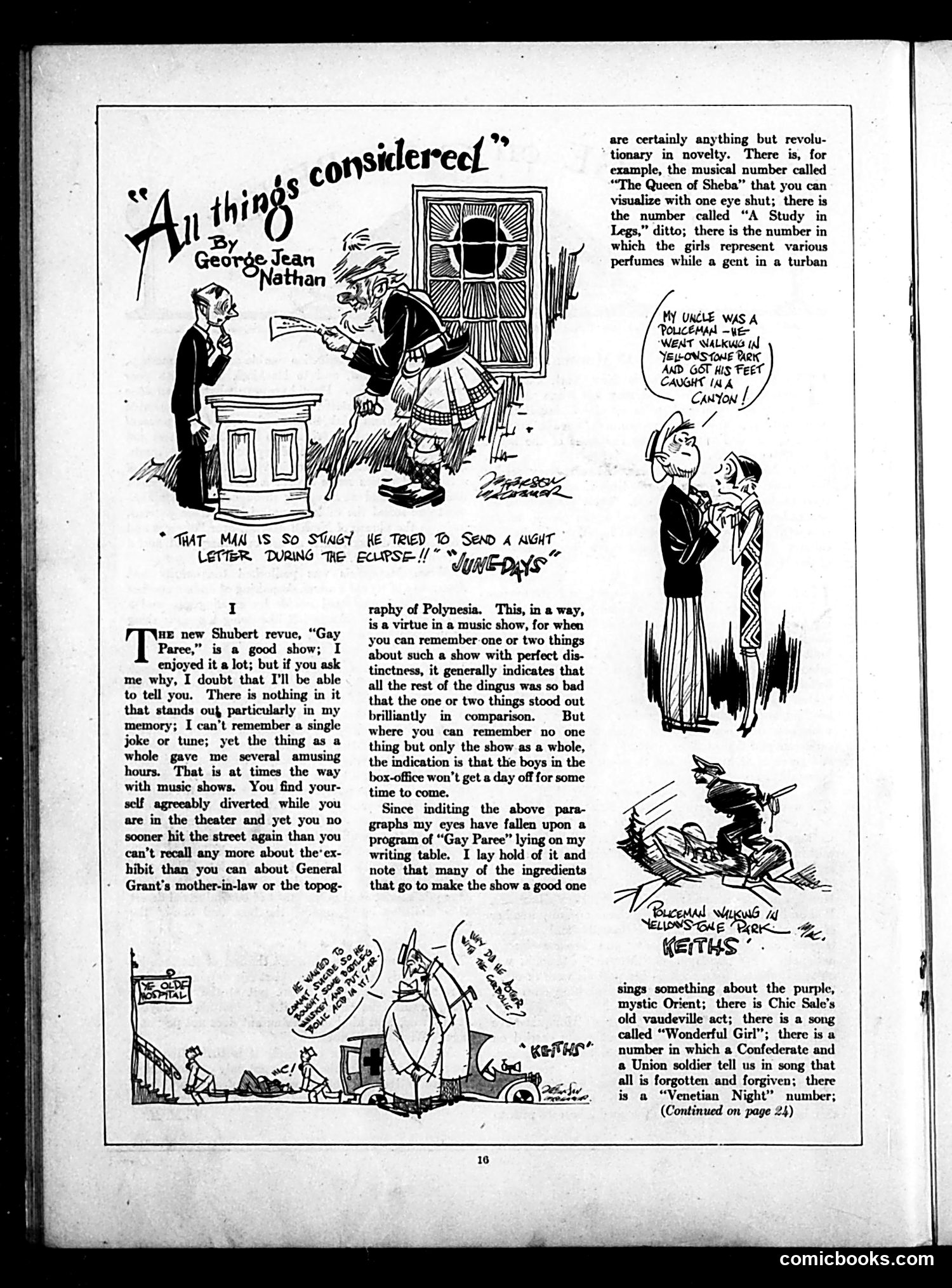
This page reviews the Shubert theatrical revue "Gay Paree," a Broadway musical production. Nathan, a prominent theater critic, offers a paradoxical critique: the show entertained him thoroughly, yet he remembers nothing specific about it—no jokes, melodies, or standout moments. Nathan argues this actually indicates quality in musical theater. When a show is memorable *only* for isolated elements, it suggests the rest was poor, making those pieces stand out. But when nothing individual is memorable, it means the entire production was cohesively entertaining enough to satisfy audiences without relying on gimmicks. The review then lists the show's generic, unoriginal musical numbers—"The Queen of Sheba," "A Study in Legs," Confederate-Union reconciliation songs—illustrating his point that "Gay Paree" succeeds through overall competence rather than innovation. The cartoons are unrelated vignettes typical of Judge magazine's comedic content.
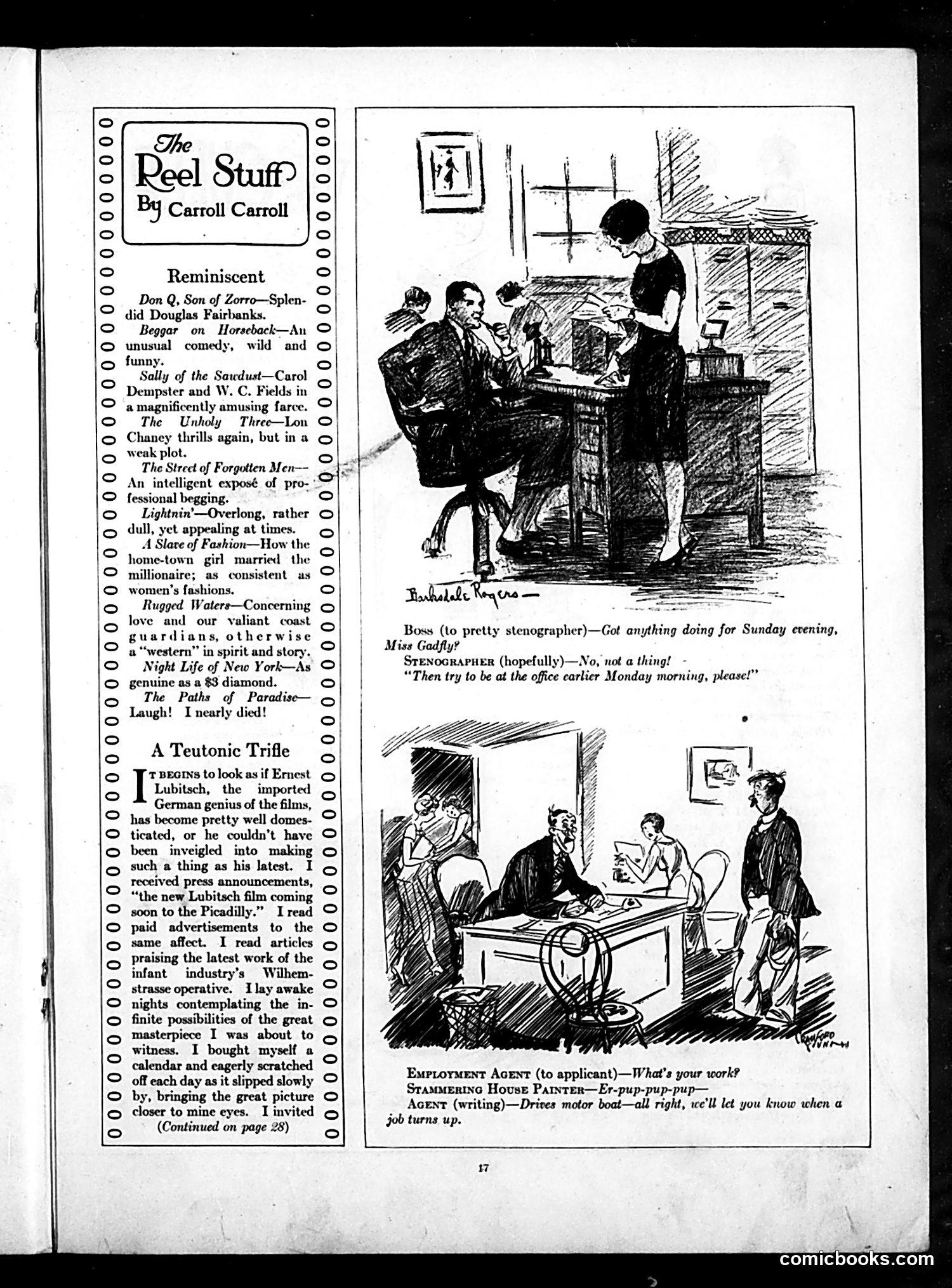
This page contains two distinct elements: **Left column:** A film review column by Carroll Carroll critiquing recent movies (Don Q, Beggar on Horseback, Sally of the Sawdust, etc.). The opening article discusses director Ernest Lubitsch, a celebrated German filmmaker, with the reviewer sarcastically praising advance hype for his latest film while building anticipation. **Right side:** Three separate office humor cartoons satirizing workplace dynamics: 1. A boss propositioning a stenographer ("Miss Gadfly") for Sunday; when she declines, he cynically tells her to come in early Monday—implying her refusal to socialize will hurt her job prospects. 2. An employment agent interviewing applicants; a stammering house painter's incoherent responses are humorously "translated" as "drives motor boat." These jokes reflect early 1920s workplace attitudes: sexual coercion of female employees and mockery of working-class job-seekers. The satire targets both exploitative bosses and dismissive hiring practices.
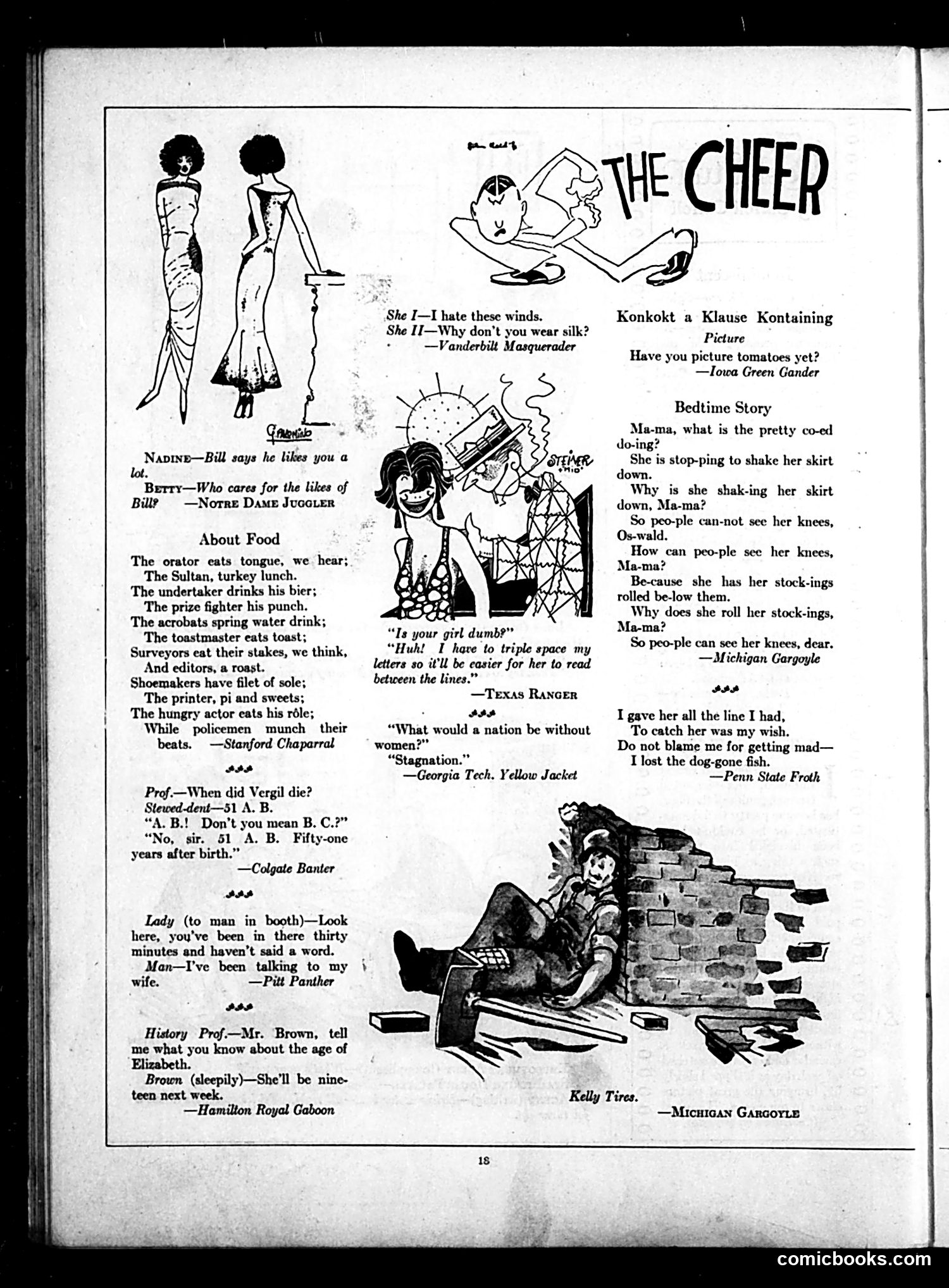
This page from *Judge* magazine collects humorous short jokes and verses from various college publications (Notre Dame, Stanford, etc.), typical of early 20th-century college humor. **The humor relies on puns and double meanings**: "The printer, pi and sweets" (printer's type "pi"); "shoemakers have filet of sole" (sole = fish and shoe part); "policemen munch their beats" (police beats/rhythm). **Social commentary appears in gender jokes**: A "Bedtime Story" mockingly explains why women roll down their stockings—to show their knees while appearing modest. This reflects anxieties about women's changing fashion and morality in the Jazz Age. **The cartoons** (showing flappers and a figure against bricks labeled "Kelly Tires") appear decorative rather than directly political. Overall, this is collegiate humor emphasizing wordplay and light social satire about dating, education, and women's behavior—typical mainstream American humor of the period.
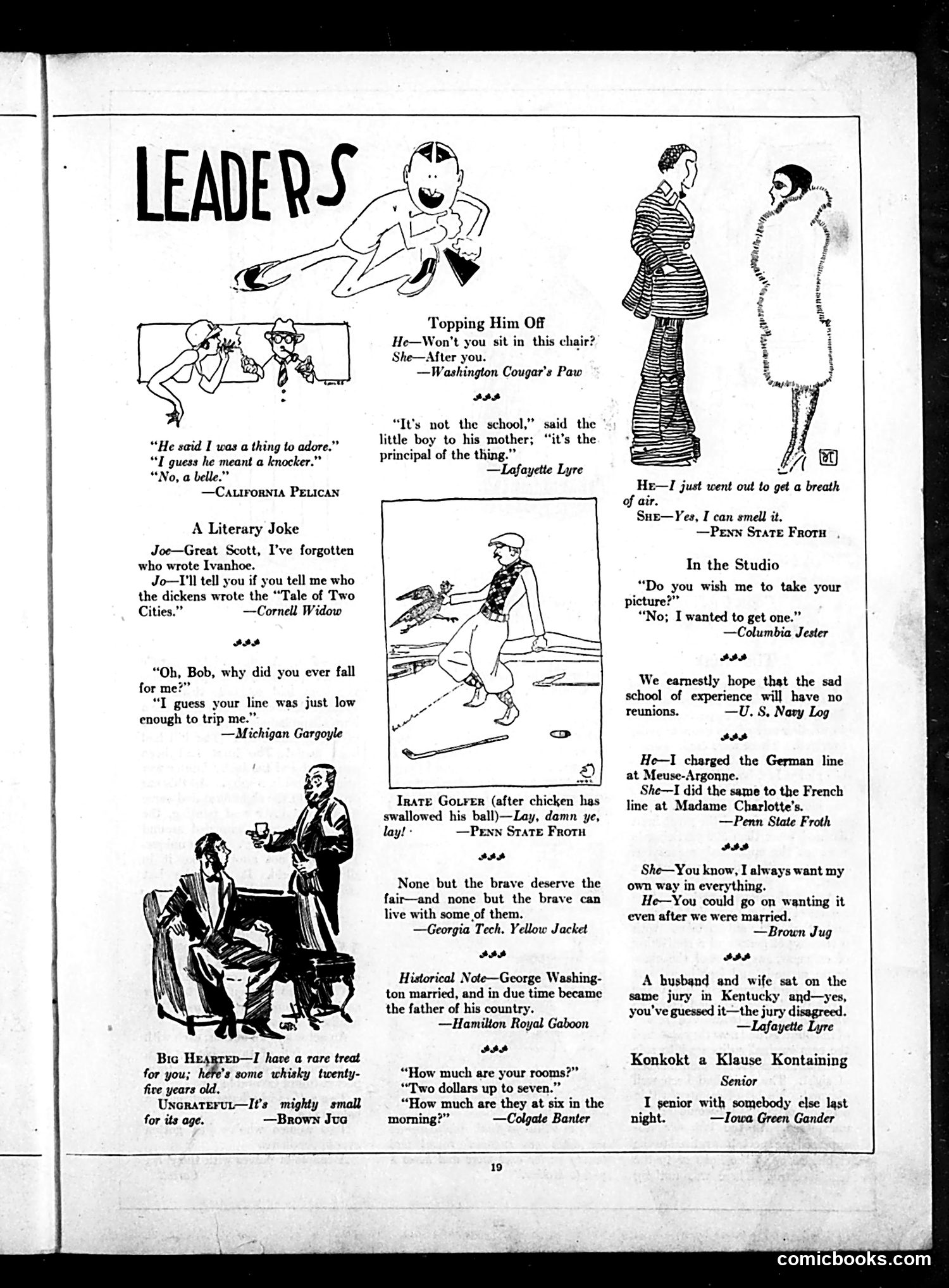
This page collects humorous quips from various college humor magazines (Cornell Widow, Michigan Gargoyle, etc.), a common feature in Judge during the early 20th century. The cartoons and jokes reflect period social attitudes: gender dynamics (women portrayed as materialistic or demanding), WWI references (Meuse-Argonne offensive), and college life comedy. Notable elements include: - **"Irate Golfer"**: A slapstick joke about a chicken swallowing a golf ball—straightforward physical humor - **WWI references**: "Charged the German line at Meuse-Argonne" contrasts male combat with female shopping aggression, suggesting women's wartime behavior was equally forceful - **Gender satire**: Multiple jokes present women as difficult, demanding, or materialistic ("always want my own way") - **Courtship humor**: Plays on romantic language and misunderstandings between sexes The overall tone reflects 1910s-1920s casual sexism and the novelty of referencing recent WWI experiences as humor fodder. These were considered witty observations about contemporary social relations.
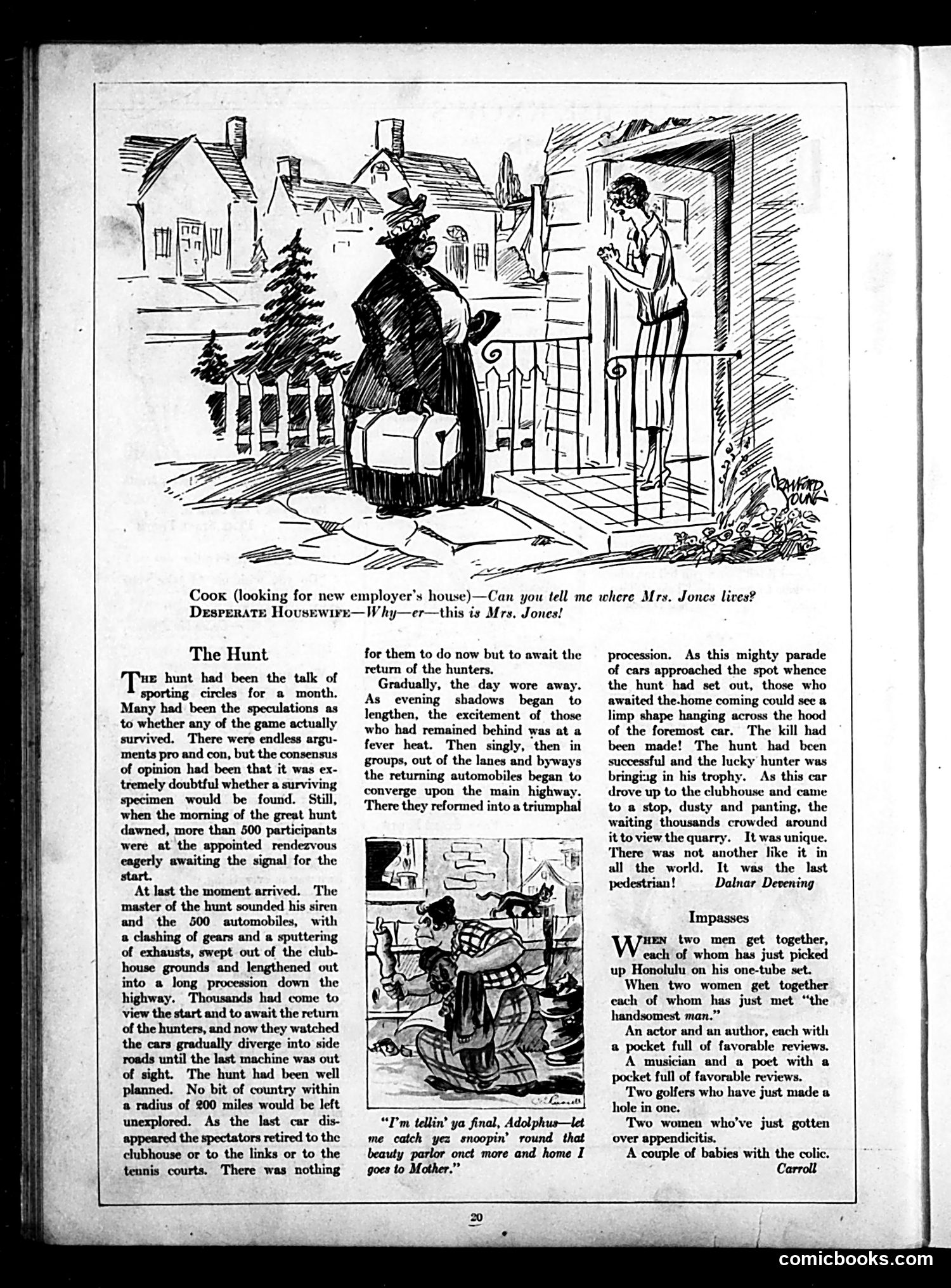
**Top Cartoon:** A domestic servant (cook) arrives at a house seeking a new job. She asks for directions to "Mrs. Jones's" house—only to discover the poorly dressed, frazzled woman answering the door *is* Mrs. Jones. The joke satirizes the economic decline of middle-class housewives during this era (likely 1920s), who could no longer afford household help and had to do their own domestic work, resulting in their disheveled appearance. **"The Hunt":** This story satirizes automobile culture and modern leisure. A massive hunt of 500 cars searches 200 miles of countryside for "game." The dramatic climax reveals the trophy: "the last pedestrian"—a person struck down by a car. It's dark satire about how automobiles were displacing pedestrians from American streets, treating them as hunted prey. The irony is that finding an actual pedestrian alive has become rarer than finding traditional game animals. **"Impasses":** Brief humorous observations about awkward social situations where two people with identical recent experiences (new radio sets, attractive encounters, etc.) have nothing left to discuss.
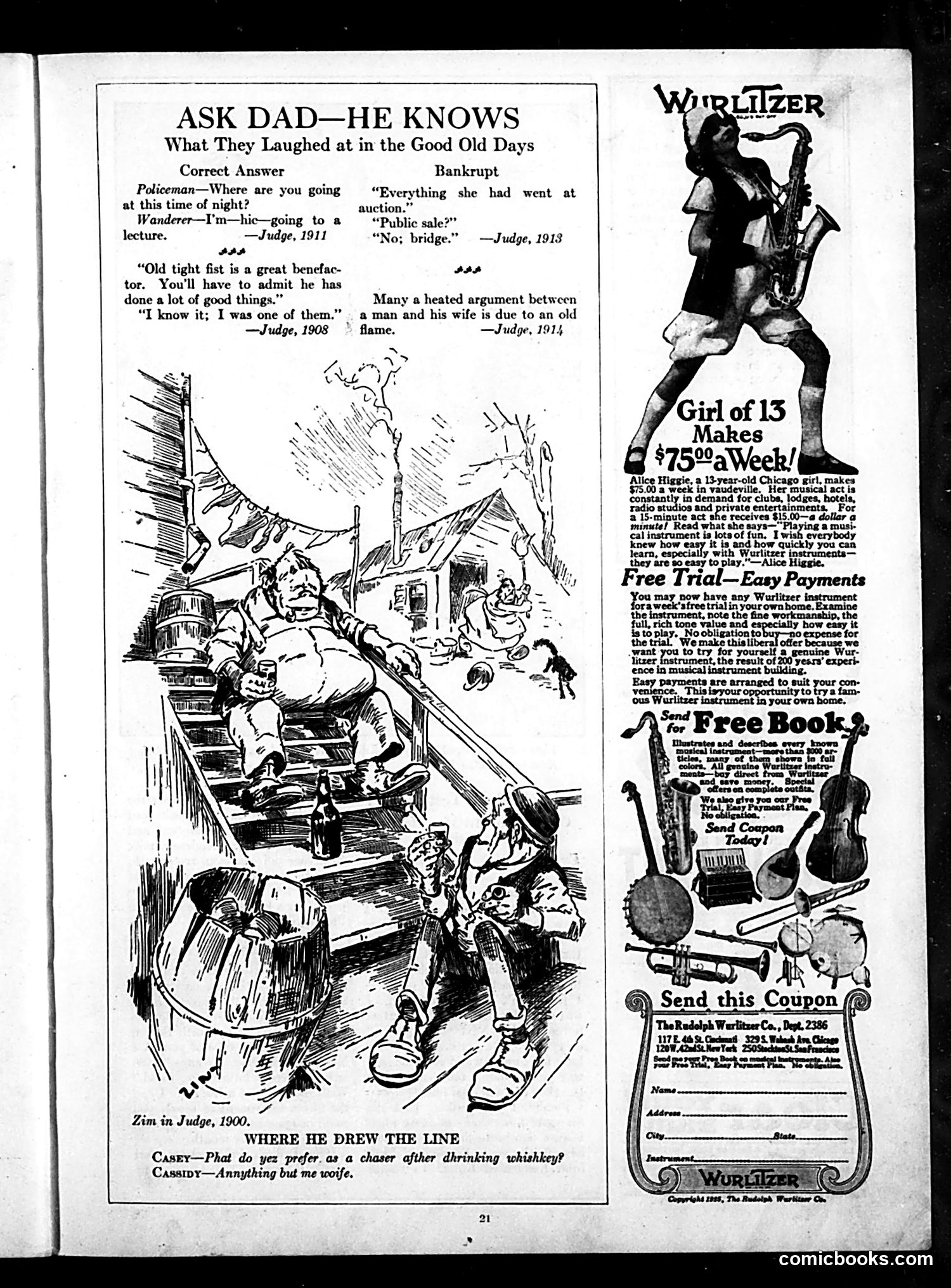
This page collects humorous "vintage" jokes labeled "Ask Dad—He Knows / What They Laughed at in the Good Old Days," presenting early 1900s-1910s humor to readers nostalgic for earlier eras. The jokes reveal period attitudes: a drunk man claims he's attending a lecture (1911); a miser is praised as a benefactor because his stinginess benefited others (1908); a wife's bankruptcy auction is confused with a bridge game (1913); marital arguments stem from "old flames" (1914); and two men agree that after whiskey, anything is preferable to one's wife (undated). The main cartoon shows a domestic scene with exaggerated characters in chaotic surroundings, illustrating the wife-aversion theme. The page also features period advertisements: a 13-year-old Chicago girl earning $75/week playing saxophone, and Wurlitzer instruments offered on trial payment plans. For modern readers, these jokes primarily mock wives as nagging/undesirable and celebrate male drinking culture and financial miserliness—attitudes reflecting early 20th-century gender dynamics now considered offensive.
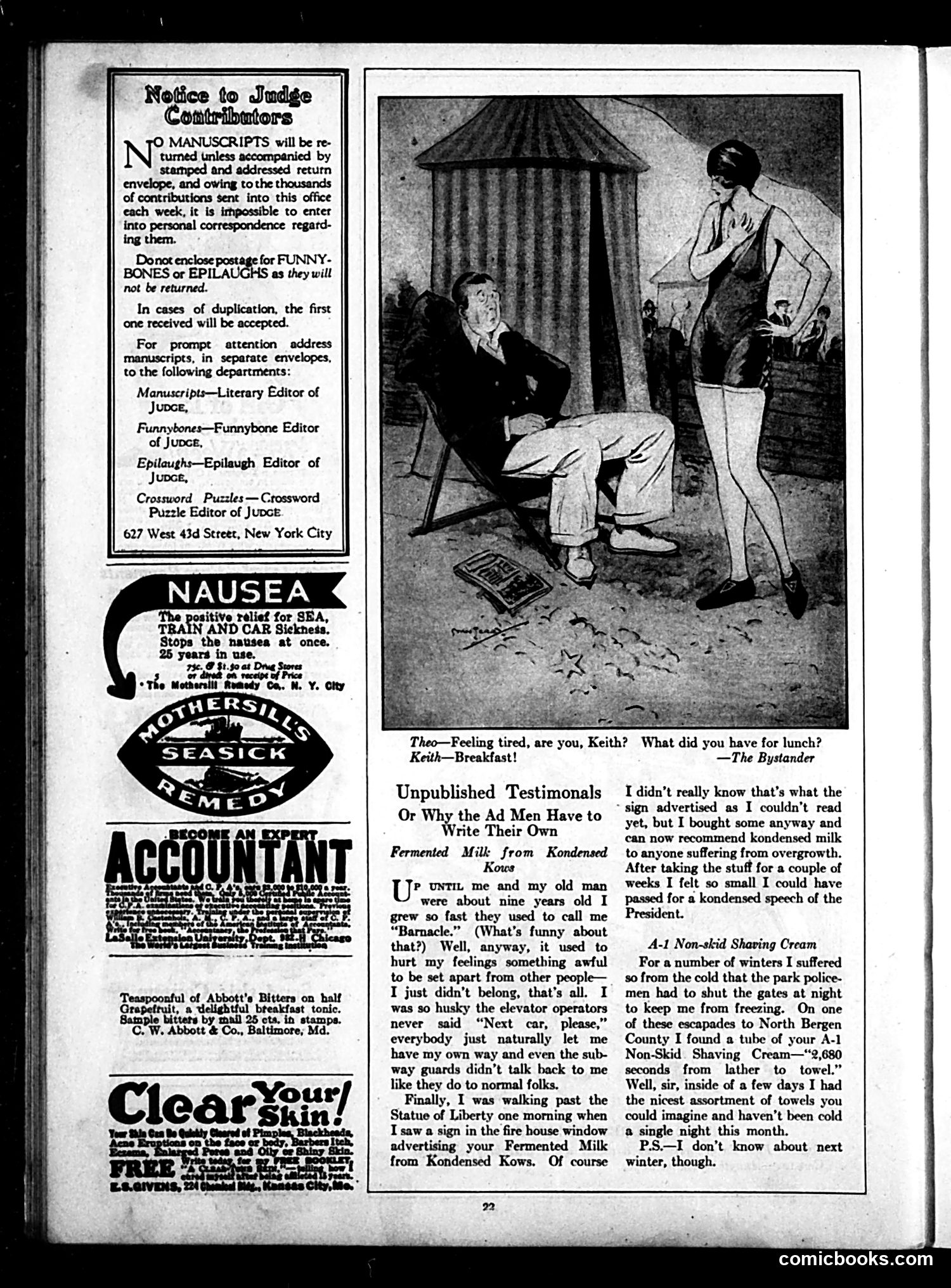
This page is primarily **administrative and advertising content** rather than satirical commentary. The left column contains **submission guidelines** for Judge magazine, directing contributors to mail manuscripts to specific editors by department (Literary, Humor, Puns, Crosswords) at their New York office. The main cartoon shows a man lounging while a woman stands nearby. The caption's joke relies on **unexpected timing**: when asked what he had for lunch, "Keith" replies "Breakfast!"—implying he's been idle so long that breakfast time has stretched into the lunch hour. It's a mild gag about laziness or lethargy. The page is dominated by **fake testimonials**—humorous advertisements written by Judge staff themselves, labeled as such. These mock the convention of authentic customer testimonials by presenting absurdist scenarios: a man who grew so large he needed condensed milk to shrink, or someone whose shaving cream solved winter freezing. The satire targets **dishonest advertising practices** of the era, where companies invented implausible customer endorsements.
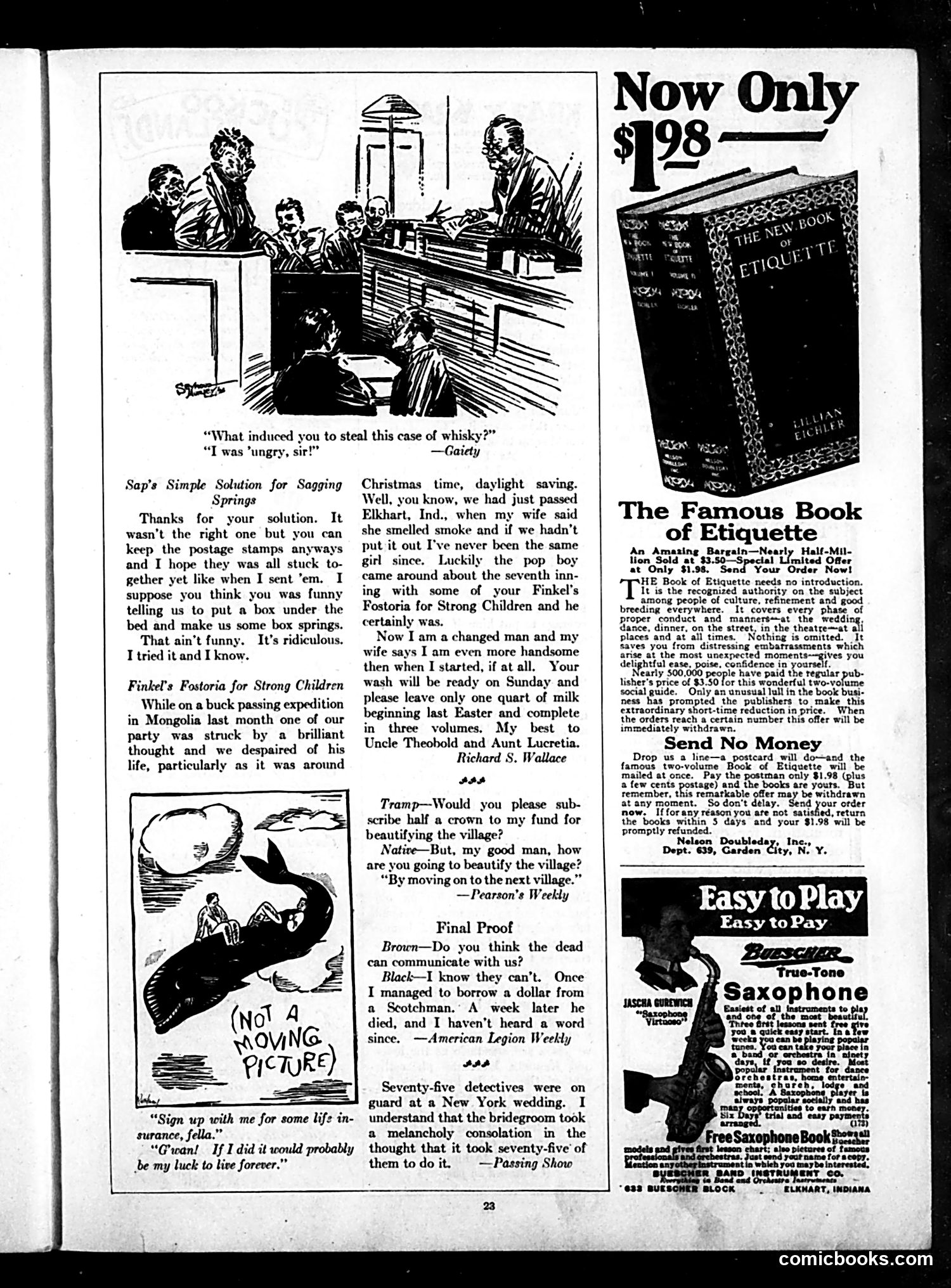
This page from *Judge* contains several satirical humor pieces typical of the magazine's style: **Main Cartoon (top left):** A courtroom scene where a defendant claims he stole whisky because he was "hungry." The satire mocks both the absurd excuse and the legal system's treatment of poverty-driven crime—suggesting the desperate poor offered transparently false justifications to courts. **Humor Columns:** Short jokes from various sources (*Gaiety*, *Pearson's Weekly*, *American Legion Weekly*, *Passing Show*) that mock: - Absurd advice-column solutions - Class differences (the Scotsman's stinginess even in death) - Marriage surveillance (75 detectives at a wedding implies wealthy anxiety or scandal) - Tramps exploiting charity **Right Side:** Advertising for *The Book of Etiquette* and a saxophone—standard commercial content of the era. The page's overall theme reflects early 20th-century satirical concerns: class conflict, legal absurdity, poverty, and the aspirational middle-class desire for proper conduct (*etiquette* books were popular).
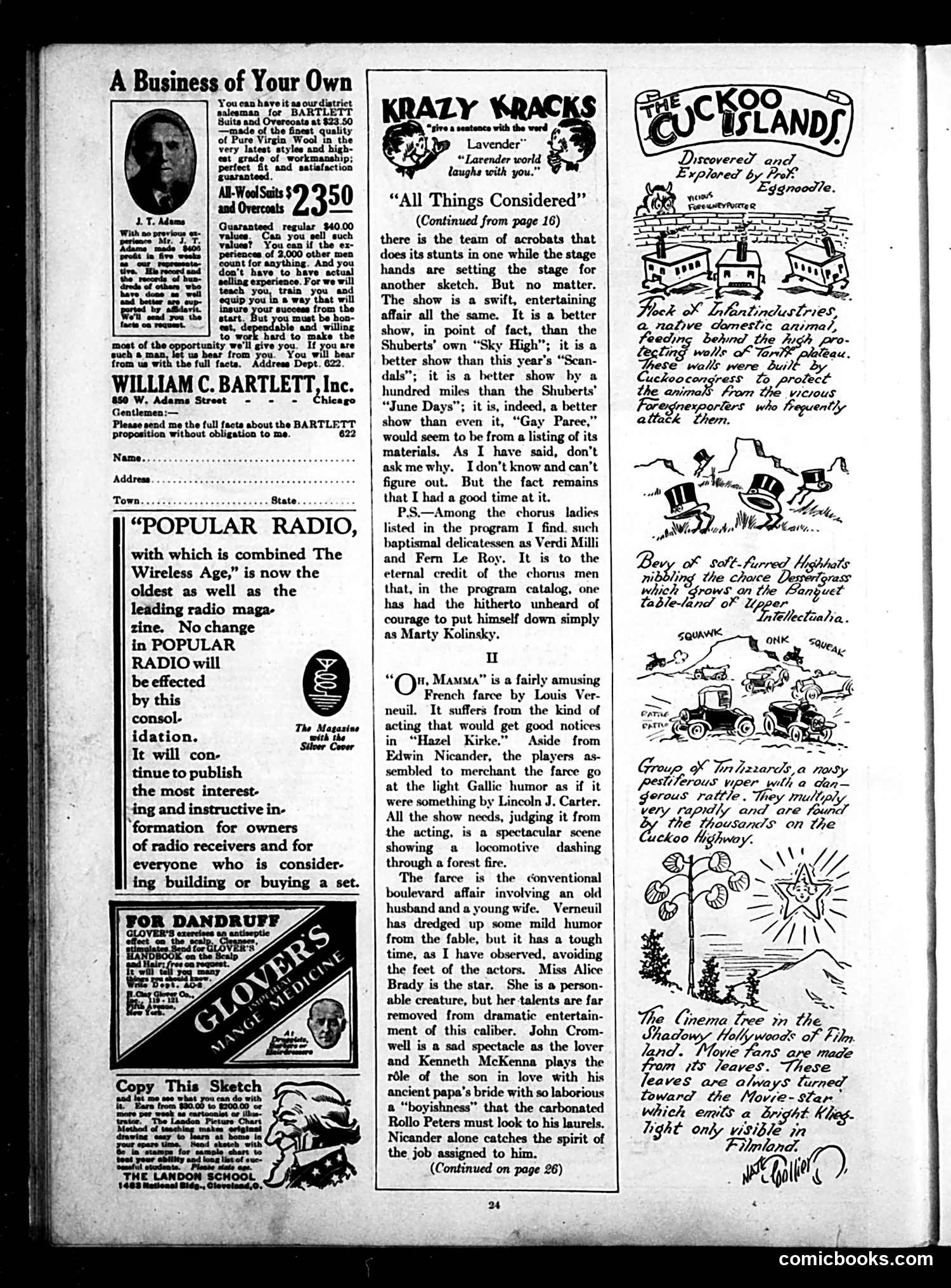
This is a **whimsical illustrated feature**, not political satire. It presents a fictional "discovery" of an imaginary island, styled as mock-scientific exploration documentation. The cartoon depicts fantastical creatures supposedly found on "Cuckoo Island" — including "Infantindustries," "Ughhats," and "Trillizards" — with humorous, nonsensical descriptions written in a fake-academic tone. The "Cinema tree" reference appears to be a joke about Hollywood's artificiality. The humor relies on **absurdist imagination** rather than social commentary: invented animals with made-up names, fake Latin scientific descriptions, and deliberately silly sketches. The byline credits "Prof. Eygneodile" as the "discoverer," maintaining the joke's fictional frame. This represents **light entertainment humor** typical of 1920s magazine comedy — playful, imaginative parody of exploration narratives and scientific writing, with no apparent political target. It's essentially comedic fantasy for amusement.
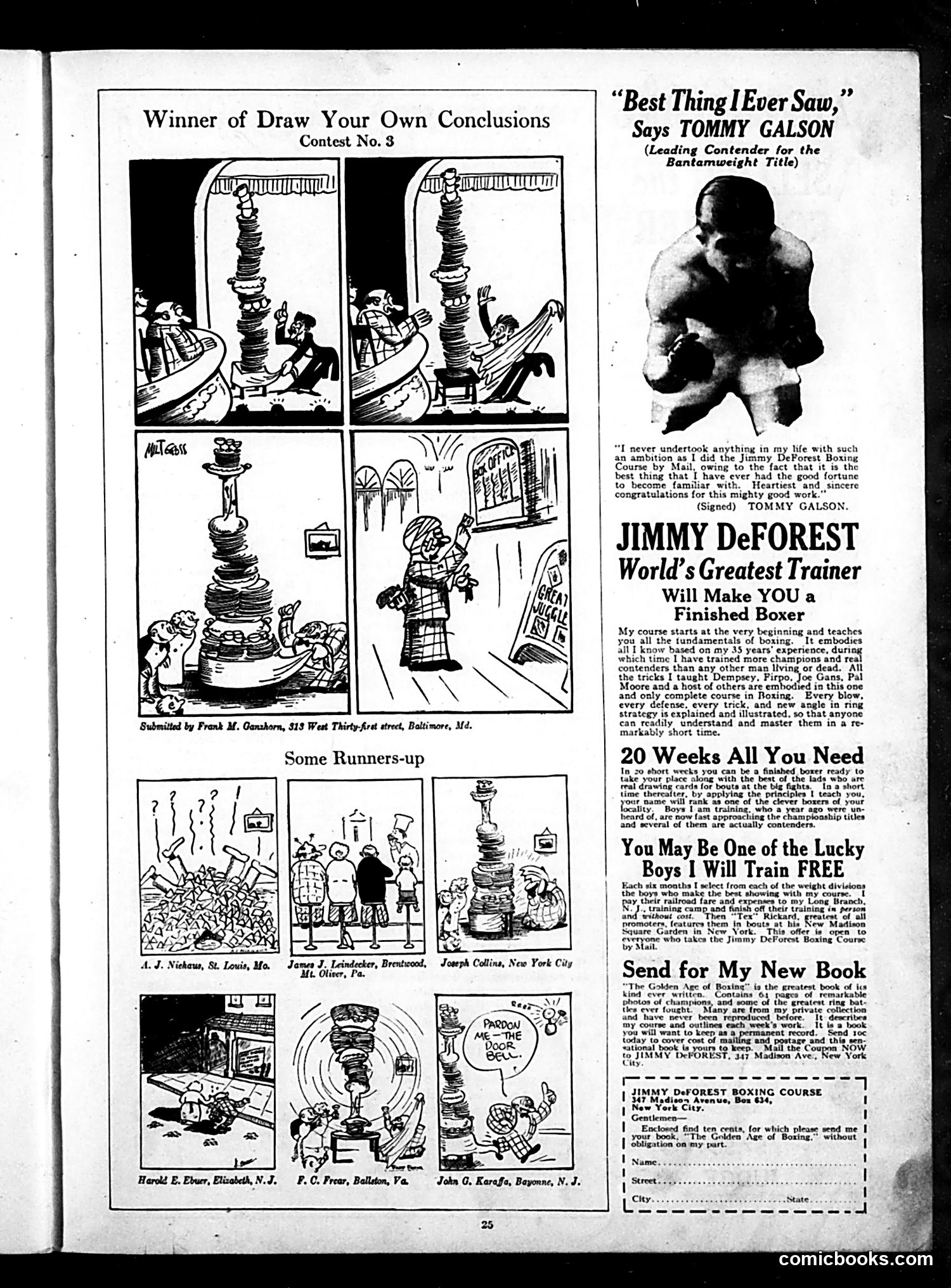
This page contains two distinct elements: a cartoon contest and boxing advertisements. **The Cartoon Contest ("Draw Your Own Conclusions"):** The winning entry depicts a tall, precariously stacked tower of objects (appearing to include furniture, people, and miscellaneous items) threatening to topple. The joke invites readers to interpret the satirical meaning themselves—likely commenting on economic instability, social disorder, or precarious modern life balancing on the brink of collapse. The "runners-up" cartoons show similar abstract or surreal scenarios inviting interpretation. **The Advertisements:** The page is dominated by Jimmy DeForest's boxing training course advertisement. DeForest claims to be "World's Greatest Trainer" who taught famous boxers like Jack Dempsey. He advertises a mail-order course promising to create "finished boxers" in 20 weeks, plus offers to train selected students free at his Long Branch facility. Tommy Galson, a "leading contender for the Bantamweight Title," endorses the course enthusiastically. This reflects early 20th-century direct-mail marketing culture, where famous trainers capitalized on boxing's popularity by selling correspondence courses.
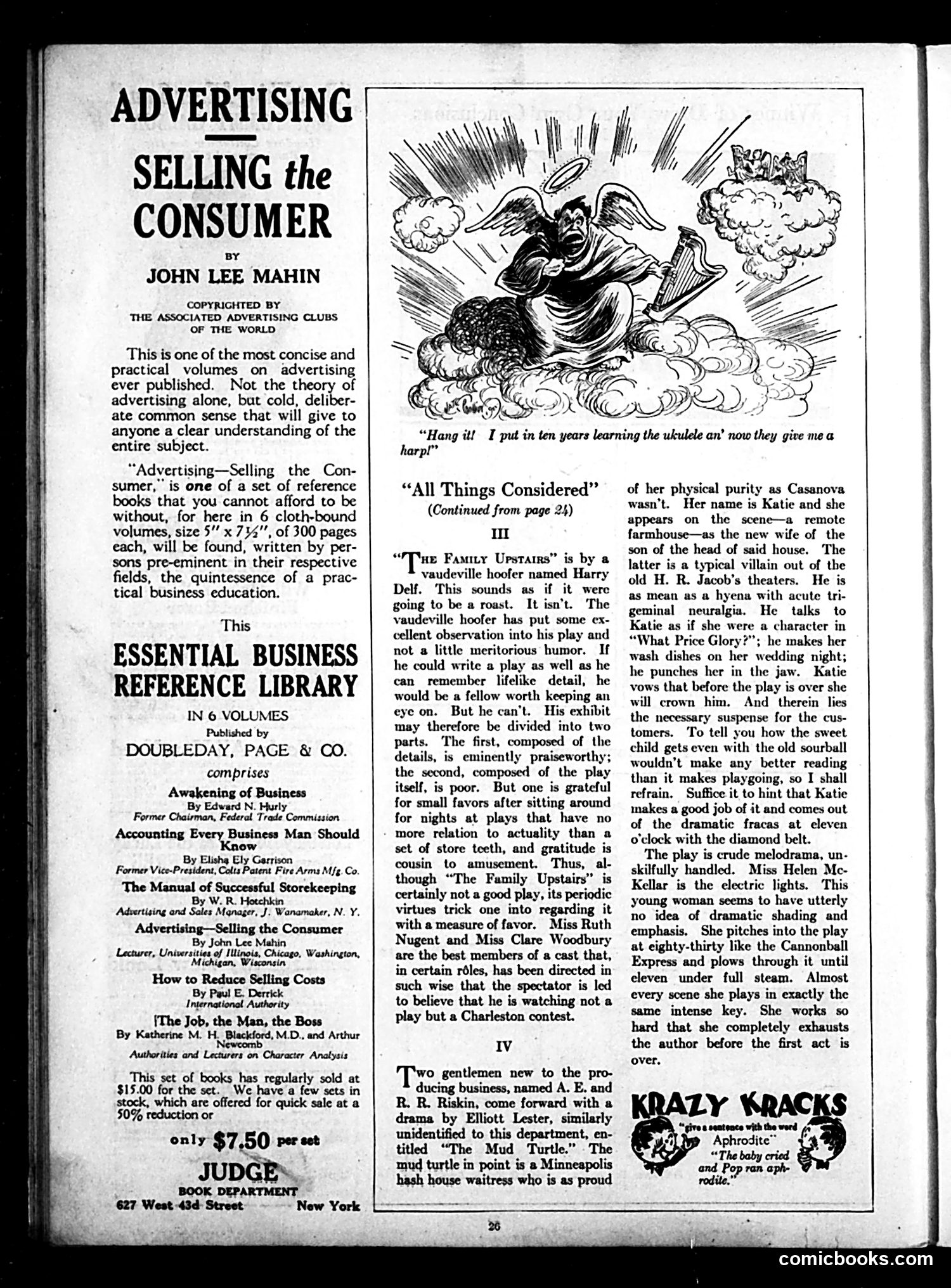
This page is primarily **advertising and book reviews**, not political satire. The main cartoon shows an angel or heavenly figure handing a harp to a frustrated musician, who complains: "Hang it! I put in ten years learning the ukulele an' now they give me a harp!" **The joke**: The musician's frustration reflects 1920s anxieties about technological and cultural obsolescence. The ukulele was trendy during this era, but the cartoon suggests even hard-won modern skills become worthless quickly—you're rewarded with something utterly different (a harp, associated with antiquated heavenly music). It's a mild jab at rapid cultural change and the futility of specialization. The page otherwise advertises the "Essential Business Reference Library," a six-volume set on business practices, and reviews theatrical productions including *The Family Upstairs* and *The Mud Turtle*—minor period dramas noteworthy mainly for their realistic details rather than overall quality.
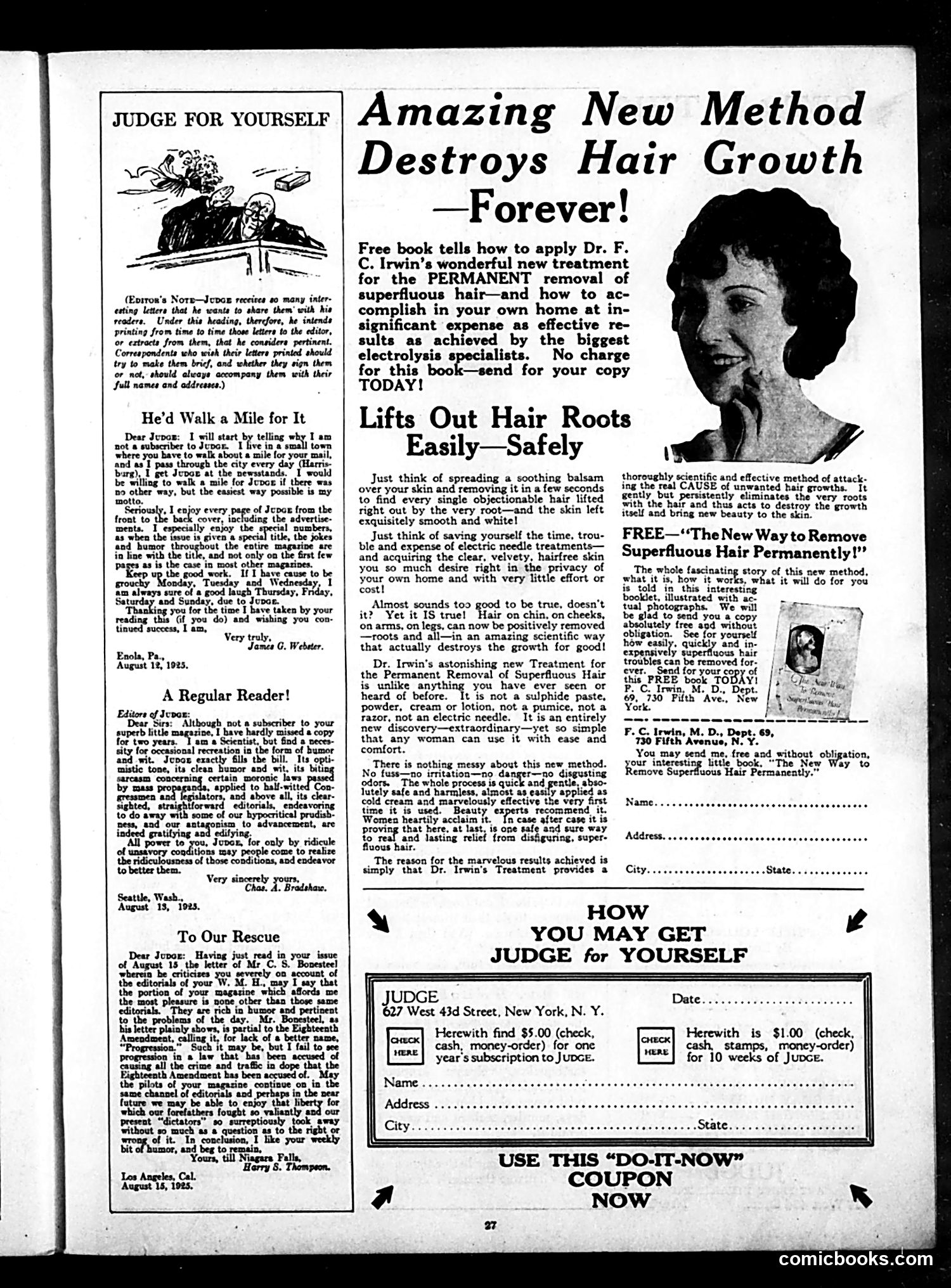
This page from *Judge* magazine (1925) is primarily **advertising disguised as editorial content**. The "Judge for Yourself" section features reader letters praising the magazine—a common marketing tactic—alongside a full-page advertisement for Dr. F.C. Irwin's hair removal treatment. The ad promises permanent removal of unwanted hair through a mysterious new method, claiming it's safer and cheaper than electrolysis. It uses typical early-20th-century advertising language: testimonials, a free booklet offer, and vague scientific claims ("entirely new discovery"). The illustration shows a woman's profile, marketed toward female readers concerned with beauty standards of the era. The satirical irony for modern readers: *Judge* was a humor magazine, yet this pseudoscientific hair-removal pitch occupies prime real estate on its pages—illustrating how magazines historically blurred editorial and advertising content, and how dubious medical claims exploited beauty anxieties. The "Judge for Yourself" framing suggests critical thinking while promoting unverified treatments.
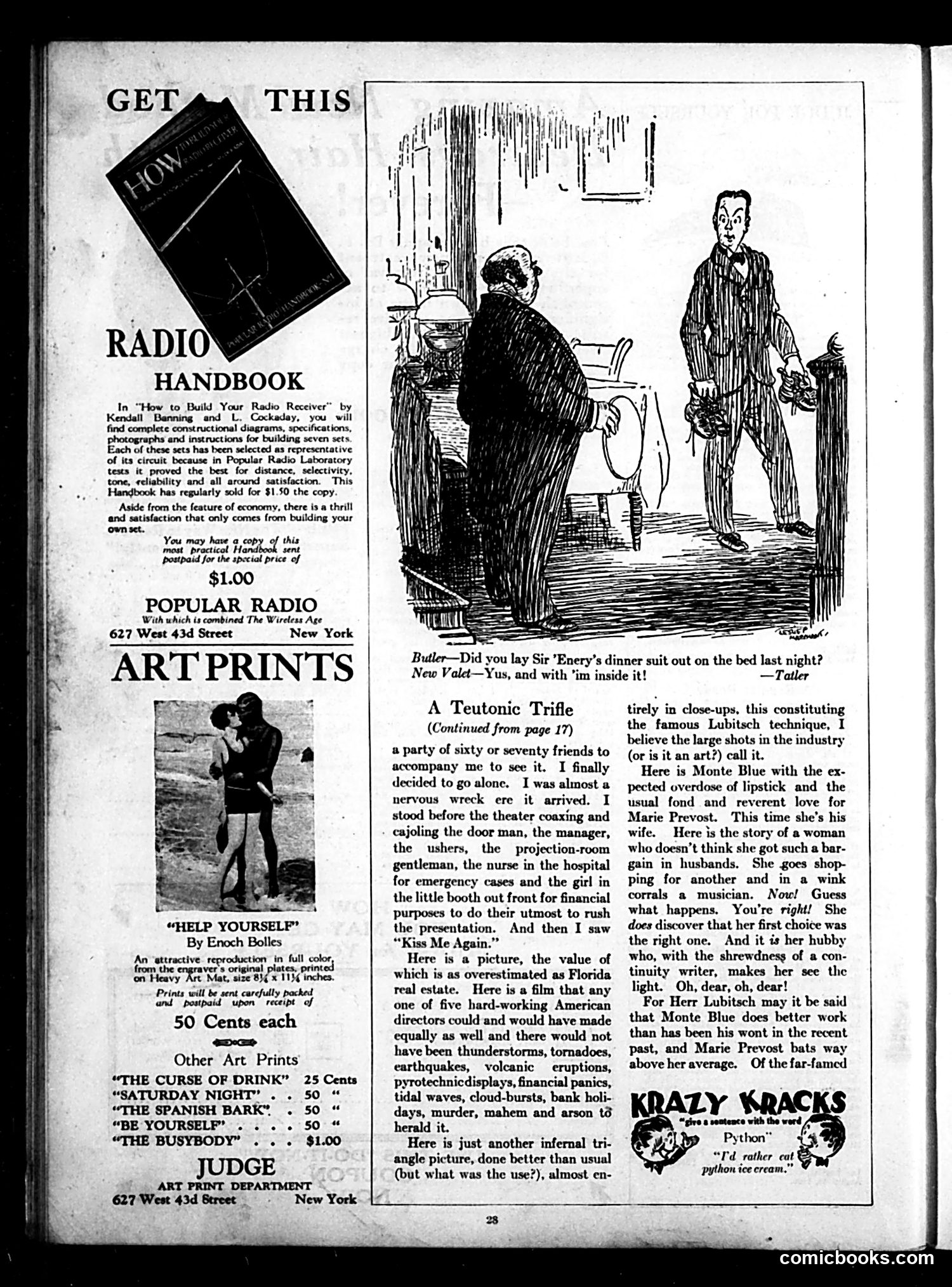
The main cartoon depicts a domestic comedy: a new valet reports to his employer "Butler" that he laid out Sir Henry's dinner suit on the bed—with Sir Henry still inside it. This is visual slapstick humor playing on the valet's literal obedience and the absurdity of the situation. The accompanying article is a scathing film review of "Kiss Me Again," a silent film featuring Monte Blue and Marie Prevost. The critic mocks the movie's overhyped reputation, calling it an ordinary "infernal triangle" (romantic) picture that doesn't warrant the dramatic fanfare surrounding it. The review sarcastically suggests any competent American director could have made it equally well. While praising the lead actors' performances slightly, the author dismisses the film's technique and plot as unoriginal—typical Judge satire targeting contemporary cultural excess and inflated artistic pretensions.
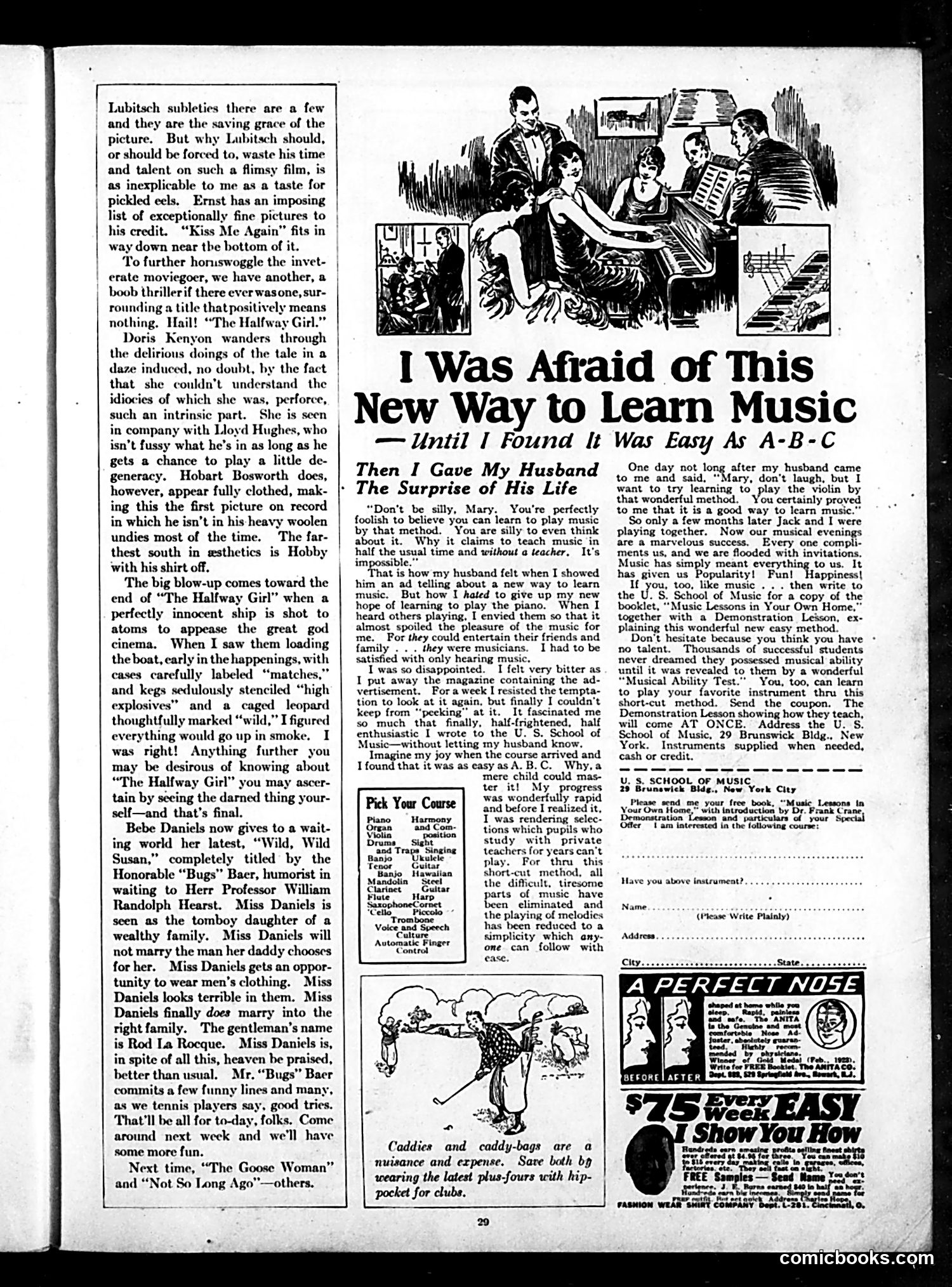
This page primarily contains **film reviews** and **advertising**, not political satire in the traditional sense. The reviews mock three silent films: Ernst Lubitsch's "Kiss Me Again" (criticized as beneath his talent), "The Halfway Girl" (called a "boob thriller" with nonsensical plot involving an absurdly dramatic ship explosion), and Bebe Daniels' "Wild, Wild Susan" (praised as better than usual, though the title by "Bugs" Baer—humorist for William Randolph Hearst—is deemed silly). The satire targets **Hollywood's flimsy filmmaking**—implausible plots, weak scripts, and actors' indifference to material quality. The reviewer expresses contempt for audience gullibility and studio mediocrity. The page's main content is a **testimonial advertisement** for the U.S. School of Music's mail-order method, featuring a woman's story about learning piano without a teacher, presented as overcoming spousal skepticism.
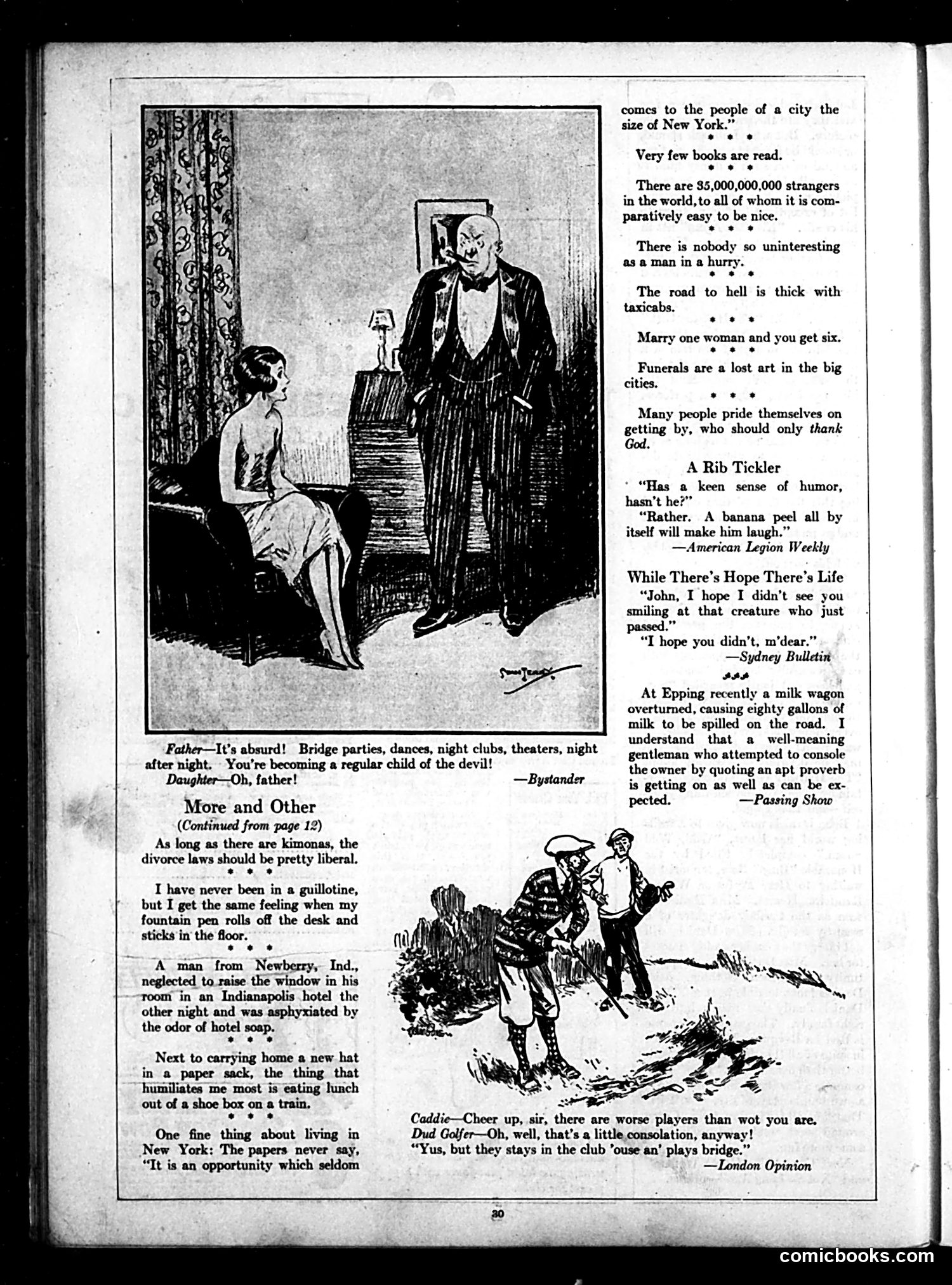
This page from Judge magazine presents a collection of satirical observations and humorous cartoons typical of early 20th-century American wit. **Main cartoon (top):** Shows a stern father lecturing his daughter about her nightlife—"bridge parties, dances, night clubs, theaters, night after night." He warns she's becoming "a regular child of the devil." This satirizes generational anxiety about modern urban leisure and changing social morality, particularly regarding women's newfound freedoms. **Bottom cartoon:** Depicts a caddie consoling a poor golfer, noting "worse players" exist—but they stay indoors playing bridge instead. This gentle golf humor mocks incompetent duffers while also reinforcing the satirical theme that bridge (the card game) is ubiquitous and somewhat ridiculous. **Text snippets:** Quick observational jokes targeting modern life—taxi abundance, hotel soap smell, urban alienation, divorce liberality, and book-reading scarcity. The humor reflects 1920s anxieties about urbanization, modernity, and social change.
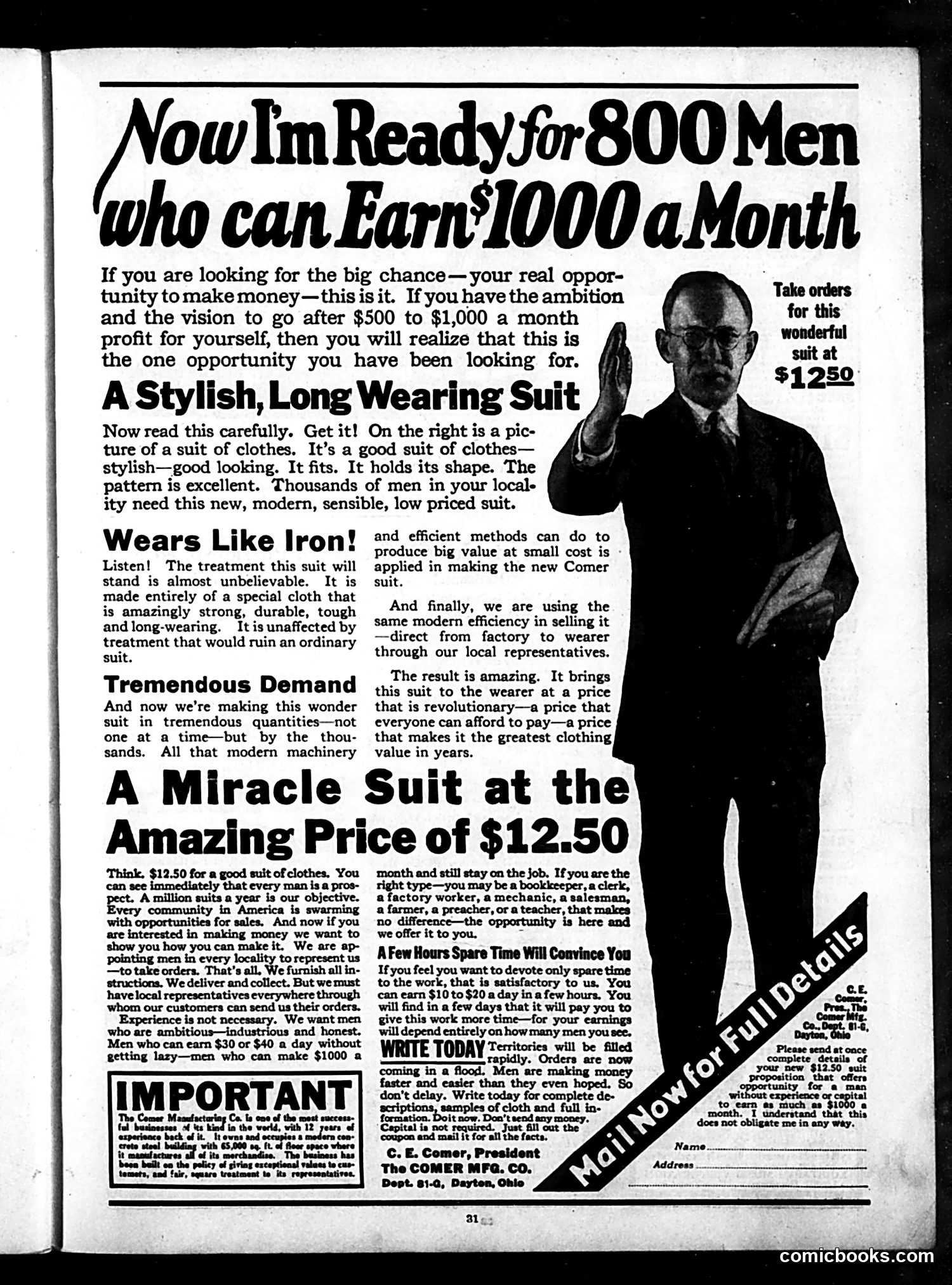
This page is **not a cartoon or satire** — it's a full-page advertisement (likely early 20th century) for the Comer Manufacturing Company promoting a $12.50 suit and recruiting sales representatives. The ad uses classic high-pressure sales tactics common to the era: promises of "$500 to $1,000 a month profit," claims of "tremendous demand," and recruitment language ("We are appointing men in every locality"). The image shows a man in a suit demonstrating the garment's durability. The copy emphasizes the suit's quality ("Wears Like Iron!") and the business opportunity to earn commissions by taking orders in your local area. **For modern readers:** This represents the aggressive direct-sales and multilevel-marketing schemes that proliferated in early American business — selling both a product and "the opportunity" to recruit others as representatives. The promises of easy money and minimal qualifications required echo modern MLM pitches.
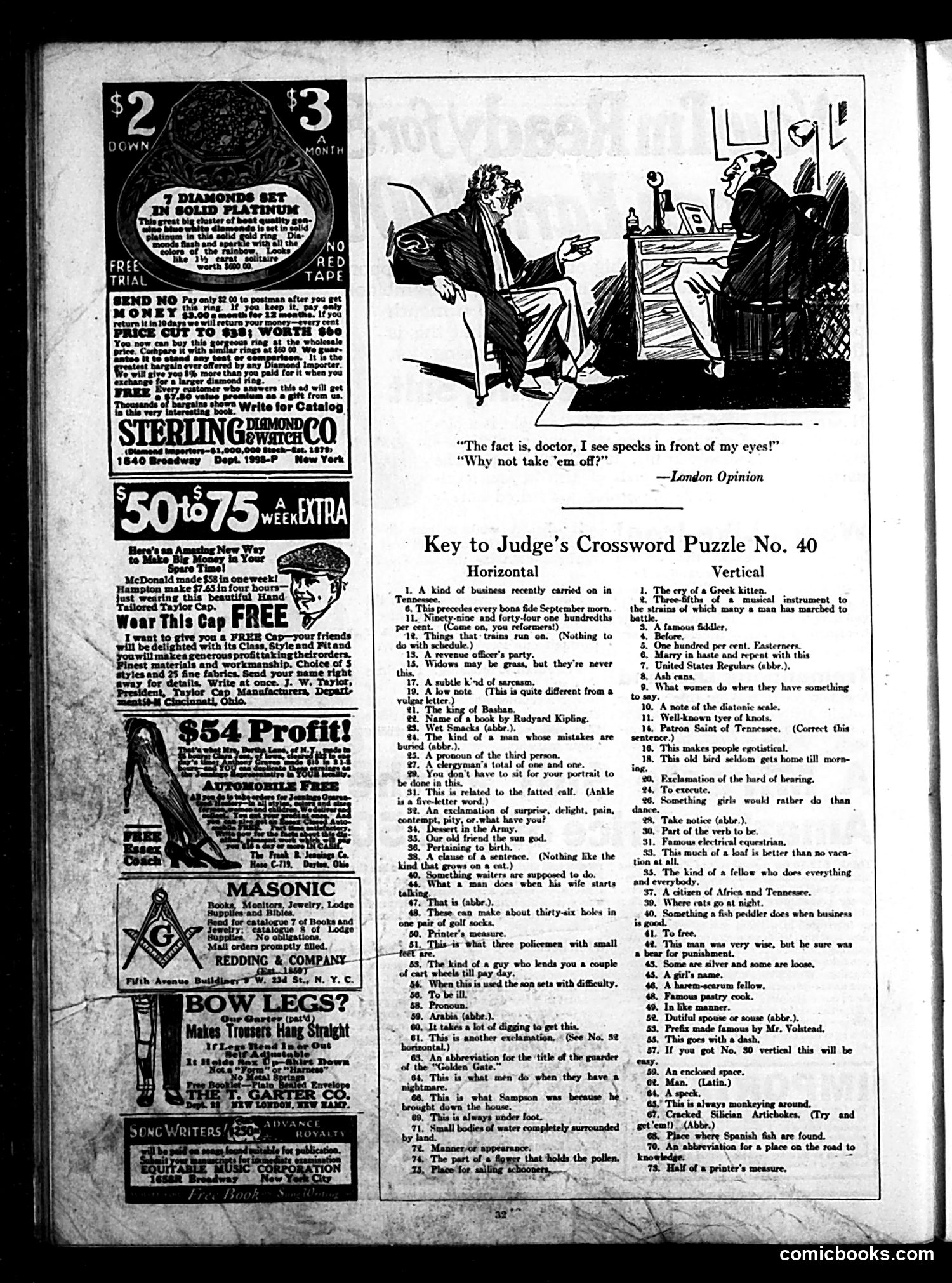
This page from *Judge* magazine contains primarily **advertisements and a crossword puzzle**, not political cartoons requiring historical context. The single cartoon present shows a doctor-patient interaction. A man complains to his doctor: "The fact is, doctor, I see specks in front of my eyes!" The doctor responds: "Why not take 'em off?" This is a simple visual pun—the doctor assumes the man wears spectacles ("specs") rather than suffering an eye condition. It's credited to *London Opinion*, suggesting it's a reprinted joke. The bulk of the page consists of the "Key to Judge's Crossword Puzzle No. 40," with horizontal and vertical clues. The advertisements visible include offers for diamond rings, caps, automobiles, masonic materials, and other products typical of early 20th-century magazines. **No significant political or social satire appears on this page**—it's primarily commercial and entertainment content.
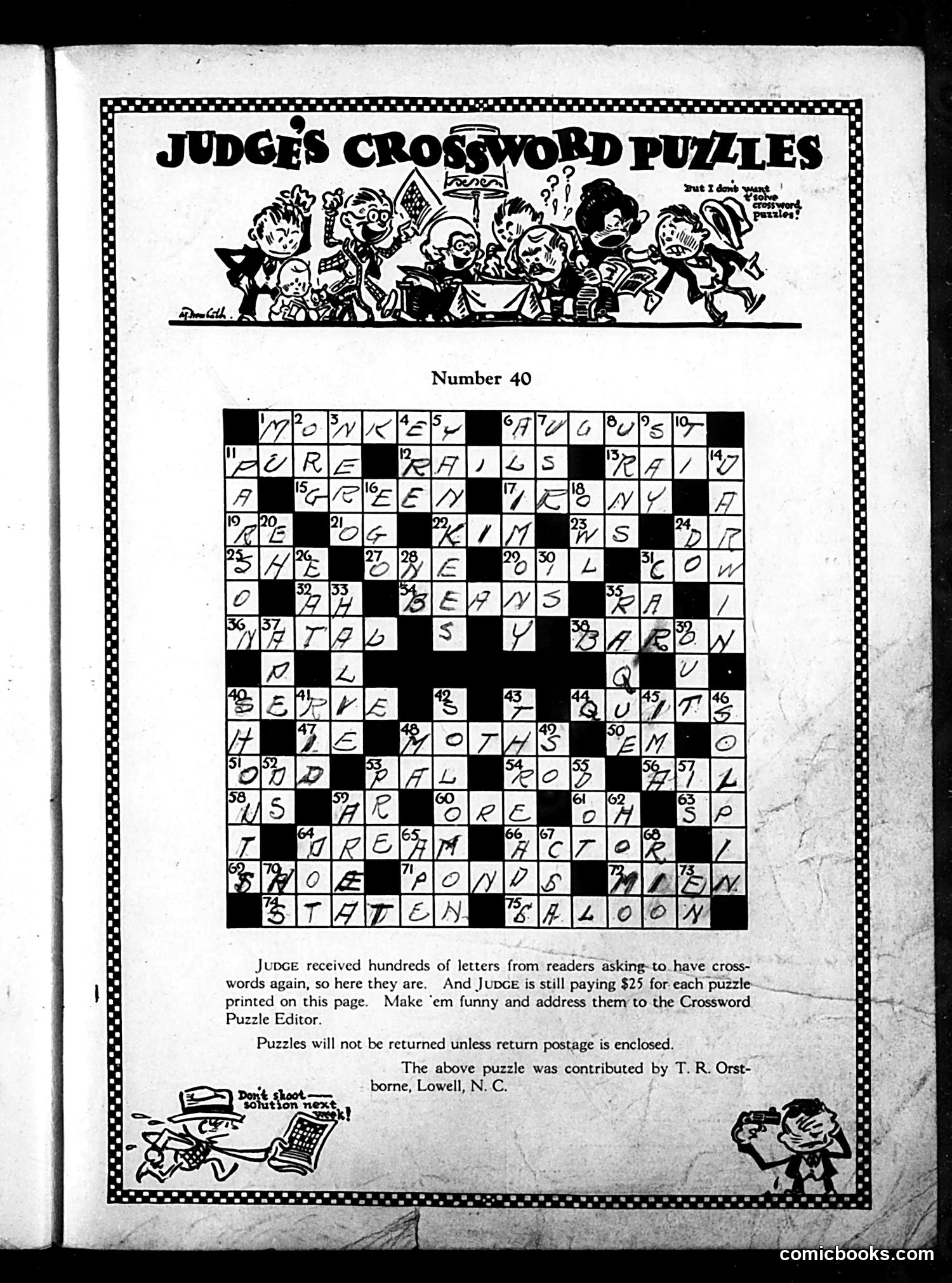
This page is primarily a **crossword puzzle** (Number 40) with minimal satirical content. The page serves a practical function: Judge magazine received numerous reader requests for crossword puzzles, so they're republishing them as regular content. The key information is in the accompanying text: Judge offers **$25 payment** for each original puzzle submitted and printed. This was an incentive to encourage readers to contribute homemade puzzles rather than relying solely on staff-created content—a common practice in Depression-era magazines seeking affordable content. The puzzle itself was contributed by T. R. Orstborne of Lowell, North Carolina, exemplifying this reader-submission model. The decorative header features cartoon characters typical of Judge's lighthearted branding, but there's no specific political or social satire on this particular page—it's simply a service feature targeting the period's crossword puzzle craze.
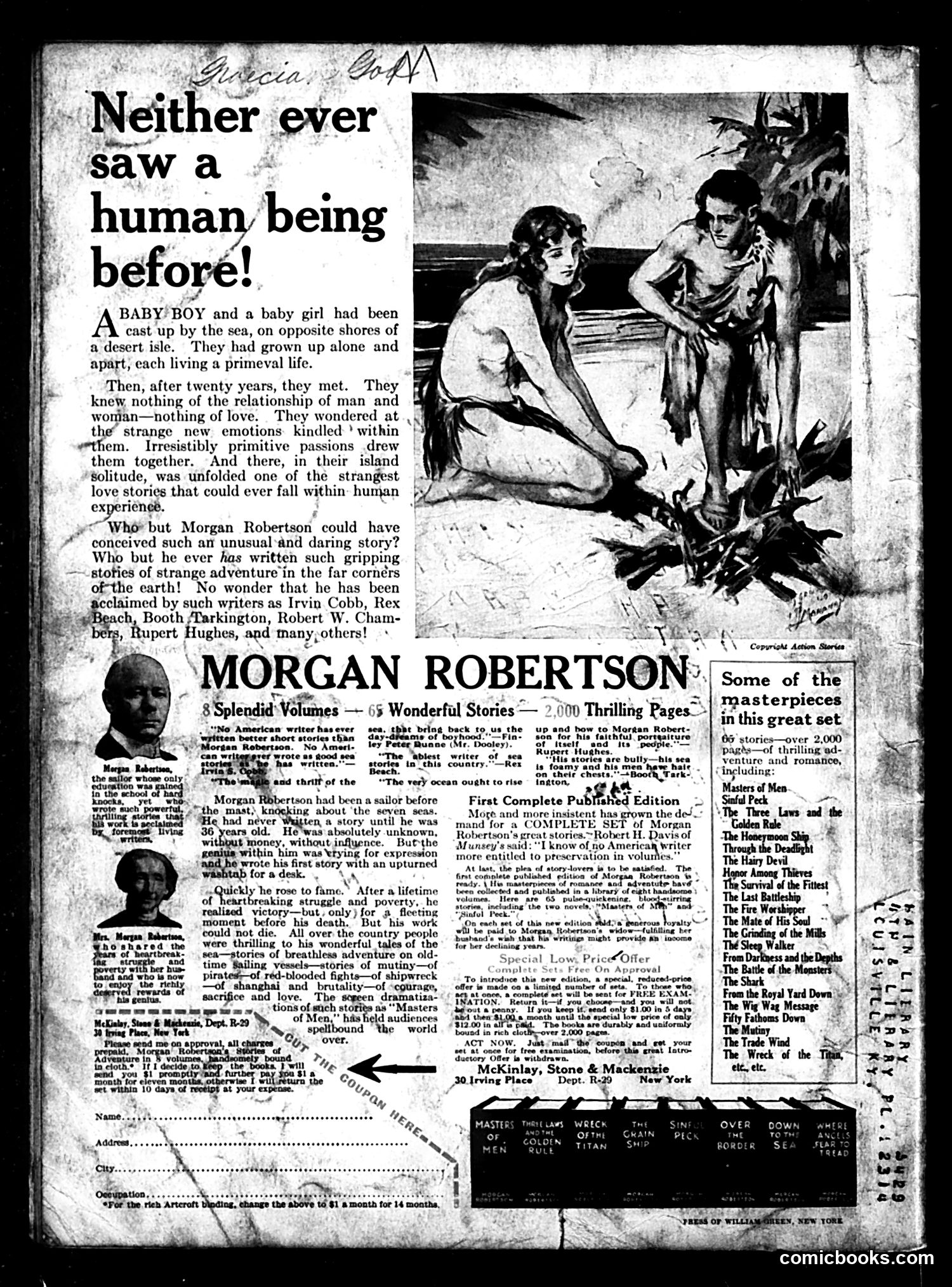
This is primarily **advertising copy**, not political satire. The page promotes a complete published edition of Morgan Robertson's collected works—65 stories across 8 volumes totaling 2,000 pages. Robertson was a popular American writer known for maritime adventure fiction. The ad emphasizes his reputation through endorsements from contemporary literary figures (Irvin Cobb, Rex Beach, Booth Tarkington). The illustrated narrative at top left describes his unlikely success: a sailor-turned-writer who struggled for years before achieving fame, only to die shortly after. The ad notes that proceeds from this edition benefit Robertson's widow. The "special low price offer" ($1 down, installment payments) was a common early 20th-century sales technique. The coupon at bottom allowed readers to request a free examination set before committing to purchase. This represents **consumer advertising in Judge magazine**, not editorial commentary or satire on public figures or events.
I can see this is a page from *Judge* magazine with a white spine/binding visible on the left side. However, the image is almost entirely black or extremely dark, making it impossible to discern any cartoon imagery, caricatures, text, or other content details beyond the publication name watermark at the bottom. Without being able to see the actual cartoon(s) or read the OCR text clearly in the image itself, I cannot identify the figures, political references, or explain the satire. The darkness may be due to image quality, scanning issues, or the original page condition. To provide an accurate historical analysis, I would need a clearer or higher-contrast version of this page.