
Judge, 1925-09-12 · page 28 of 37
Judge — September 12, 1925 — page 28: what you’re looking at
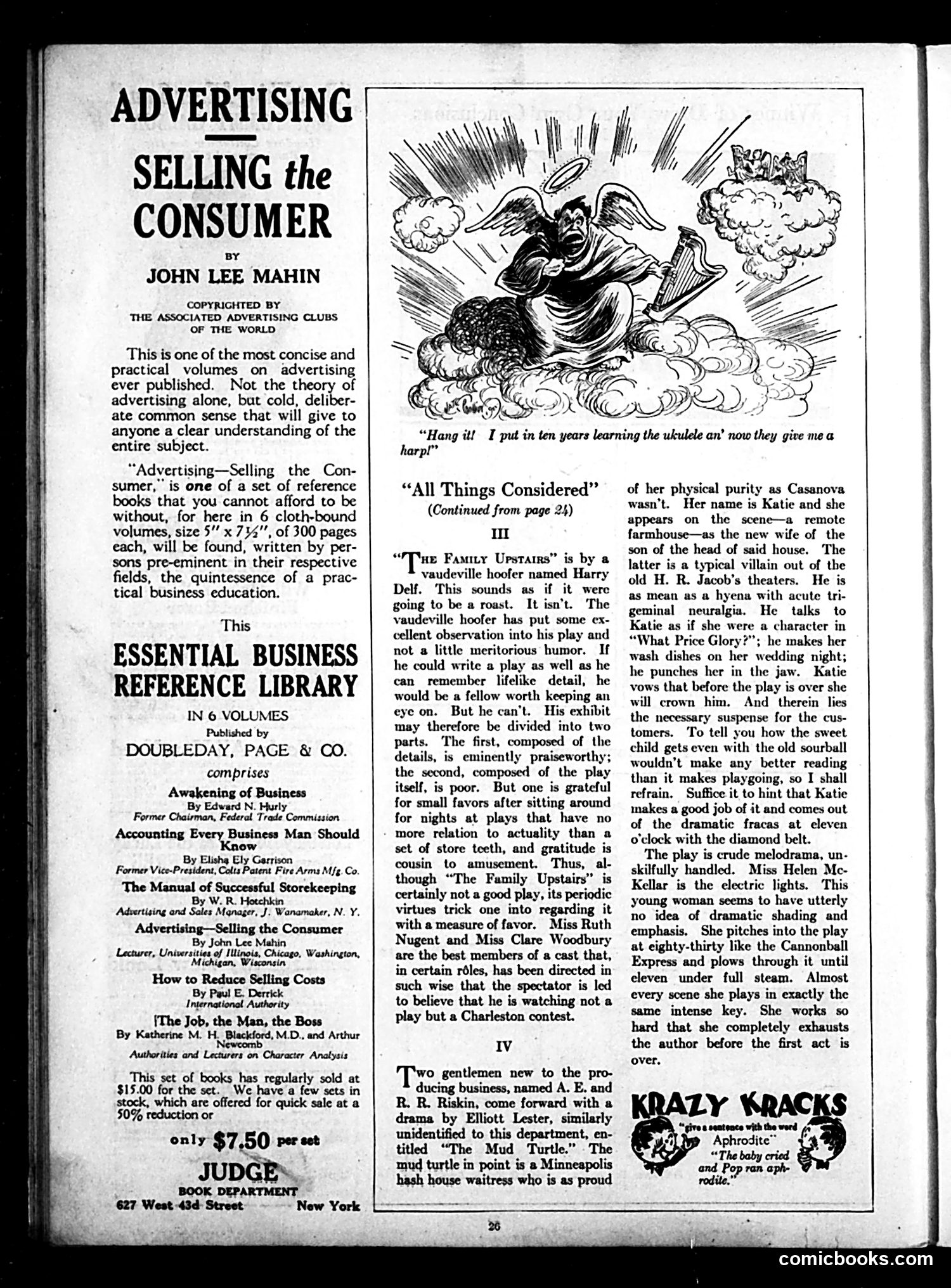
What you’re looking at
This page is primarily **advertising and book reviews**, not political satire. The main cartoon shows an angel or heavenly figure handing a harp to a frustrated musician, who complains: "Hang it! I put in ten years learning the ukulele an' now they give me a harp!" **The joke**: The musician's frustration reflects 1920s anxieties about technological and cultural obsolescence. The ukulele was trendy during this era, but the cartoon suggests even hard-won modern skills become worthless quickly—you're rewarded with something utterly different (a harp, associated with antiquated heavenly music). It's a mild jab at rapid cultural change and the futility of specialization. The page otherwise advertises the "Essential Business Reference Library," a six-volume set on business practices, and reviews theatrical productions including *The Family Upstairs* and *The Mud Turtle*—minor period dramas noteworthy mainly for their realistic details rather than overall quality.
📄 Transcribed text from this page (OCR, searchable)
Machine-transcribed from the original scan — historical spelling and the odd misread are preserved.
ADVERTISING SELLING the CONSUMER JOHN LEE MAHIN COPYRIGHTED BY THE ASSOCIATED ADVERTISING CLUBS OF THE WORLD This is one of the most concise and practical volumes on advertising ever published. Not the theory of advertising alone, but cold, deliber- ate common sense that will give to anyone a clear understanding of the entire subject. “Advertising—Selling the Con- sumer,” is one of a set of reference books that you cannot afford to be without, for here in 6 cloth-bound volumes, size 5’ x 734”, of 300 pages each, will be found, written by per- sons pre-eminent in their respective fields, the quintessence of a prac- tical business education. This ESSENTIAL BUSINESS REFERENCE LIBRARY IN 6 VOLUMES Published by DOUBLEDAY, PAGE & CO. comprises Awakening of Business By Edward N. Hurly Former Chairman, Federal Trade Commission Accounting Every Business Man Should Know By Elisha Ely Garrison Former Vice-President, Colts Patent Fire Arms Mfg. Co. The Manual of Successful Storekeeping By W. R. Hotchkin Advertising and Sales Manager, J. Wanamaker, N. Y. Advertising—Selling the Consumer Lecturer, Ur is Jia Chi Washi + Universtien of J nats, Chicago, ington, How to Reduce Selling Costs By Paul E. Derrick International Authority {The Job, the Man, the Boss By Katherine M. H. Blackford, M.D., and Arthur Newcomb Authorities and Lecturers on Character Analysis This set of books has regularly sold at $15.00 for the set. We have a Het acta in stock, which are offered for quick sale at a 50% reduction or only $7.50 per : BOOK DEPARTMENT 627 West -43d- Street New York “Hang it! I put in ten years learning the ukulele an’ now they give mea harp!” “All Things Considered” (Continued from page 24) pong “Tue Famity Upstairs” is by a vaudeville hoofer named Harry Delf. This sounds as if it were going to be a roast. It isn’t. The vaudeville hoofer has put some ex- cellent observation into his play and not a little meritorious humor. If he could write a play as well as he can remember lifelike detail, he would be a fellow worth keeping an eye on. But he can’t. His exhibit may therefore be divided into two parts. The first, composed of the details, is eminently praiseworthy; the second, composed of the play itself, is poor. But one is grateful for small favors after sitting around for nights at plays that have no - more relation to actuality than a set of store teeth, and gratitude is cousin to amusement. Thus, al- though “The Family Upstairs” is certainly not a good play, its periodic virtues trick one into regarding it with a measure of favor. Miss Ruth Nugent and Miss Clare Woodbury are the best members of a cast that, in certain réles, has been directed in such wise that the spectator is led to believe that he is watching not a play but a Charleston contest. IV Tre gentlemen new to the pro- ducing business, named A. E. and R. R. Riskin, come forward with a drama by Elliott Lester, similarly unidentified to this department, en- titled “The Mud Turtle.” The mud turtle in point is a Minneapolis hash house waitress who is as proud of her physical purity as Casanova wasn’t. Her name is Katie and she appears on the scene—a remote farmhouse—as the new wife of the son of the head of said house. The latter is a typical villain out of the old H. R. Jacob’s theaters. He is as mean as a hyena with acute tri- geminal neuralgia. He talks to Katie as if she were a character in “What Price Glory?”; he makes her wash dishes on her wedding night; he punches her in the jaw. Katie vows that before the play is over she will crown him. And therein lies the necessary suspense for the cus- tomers. To tell you how the sweet child gets even with the old sourball wouldn’t make any better reading than it makes playgoing, so I shall refrain. Suffice it to hint that Katie makes a good job of it and comes out of the dramatic fracas at eleven o'clock with the diamond belt. The play is crude melodrama, un- skilfully handled. Miss Helen Mc- Kellar is the electric lights. This young woman seems to have utterly no idea of dramatic shading and emphasis. She pitches into the play at eighty-thirty like the Cannonball Express and plows through it until eleven under full steam. Almost every scene she plays in exactly the same intense key. She works so hard that she completely exhausts the author before the first act is LY ¥RAC “ give sentence with the werd Aphrodite” “The baby cried ind Pe pol Fr comicbooks.com