
Judge, 1925-09-12 · page 17 of 37
Judge — September 12, 1925 — page 17: what you’re looking at
What you’re looking at
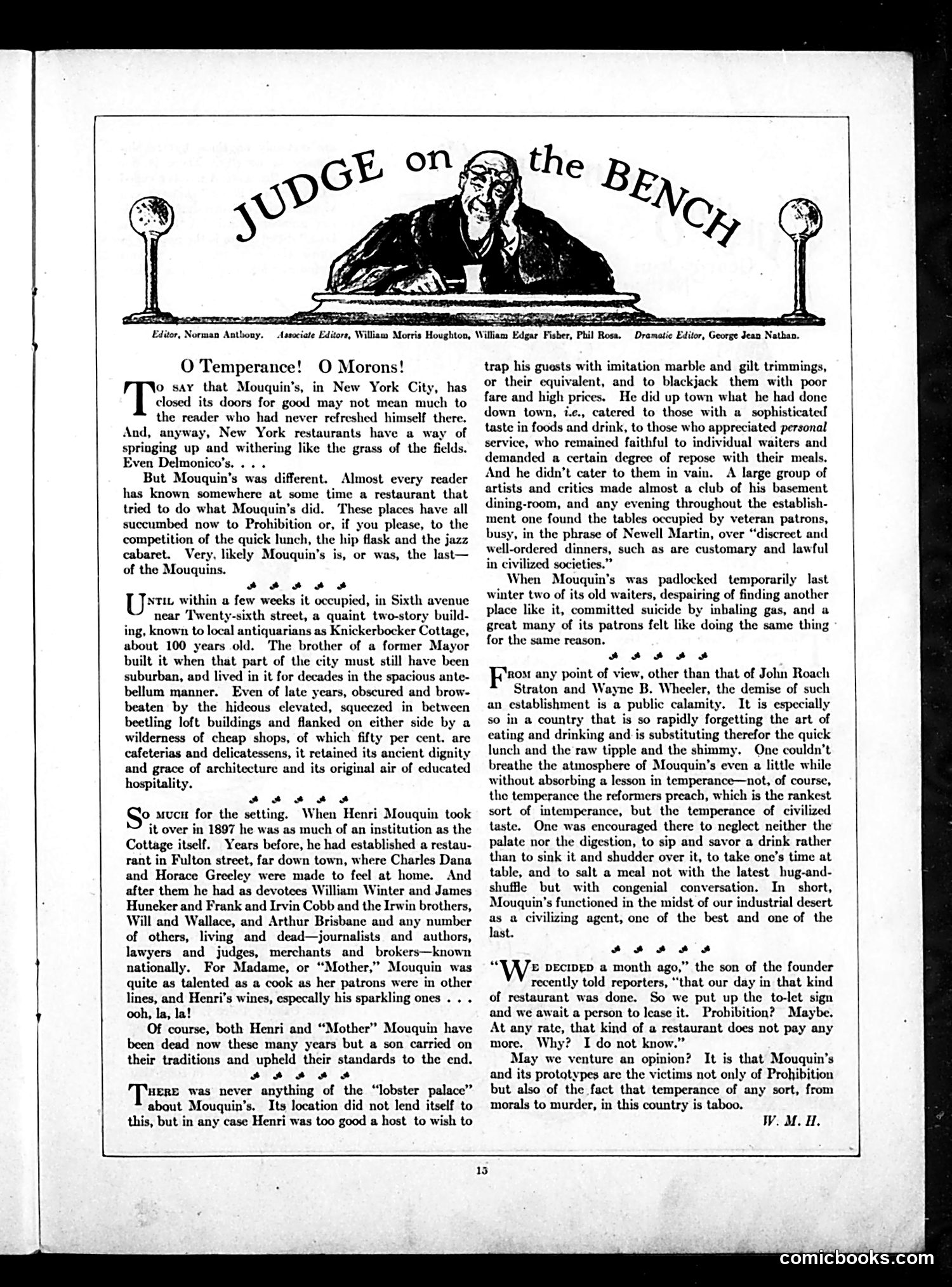
This article laments the closure of Mouquin's, a prestigious New York restaurant, blaming **Prohibition** for destroying establishments catering to refined diners. The piece nostalgically celebrates Mouquin's 100-year history as a sophisticated gathering place for prominent journalists, writers, and judges—including Charles Dana and Horace Greeley—who valued quality cuisine, personal service, and dignified atmosphere. The satire targets Prohibition's consequences: the article notes two elderly waiters committed suicide after the closure, and many patrons felt similarly desperate. The author sarcastically condemns "temperance" advocates and "morons" supporting Prohibition, arguing it replaced fine dining with "quick lunch, hip flask and jazz cabaret" culture. The "Judge on the Bench" header suggests ironic commentary—judges (who enforce laws) themselves patronized establishments now illegal under Prohibition.
📄 Transcribed text from this page (OCR, searchable)
Machine-transcribed from the original scan — historical spelling and the odd misread are preserved.
Editor, Norman Anthony. O Temperance! O Morons! jo say that Mouquin’s, in New York City, has I closed its doors for good may not mean much to the reader who had never refreshed himself there. And, anyway, New York restaurants have a way of springing up and withering like the grass of the fields. Even Delmonico’s. But Mouquin’s was different. Almost every reader has known somewhere at some time a restaurant that tried to do what Mouquin’s did. These places have all succumbed now to Prohibition or, if you please, to the competition of the quick lunch, the hip flask and the jazz cabaret. Very, likely Mouquin’s is, or was, the last— of the Mouquins. aA seas Us™ within a few weeks it occupied, in Sixth avenue near Twenty-sixth street, a quaint two-story build- ing, known to local antiquarians as Knickerbocker Cottage, about 100 years old. The brother of a former Mayor built it when that part of the city must still have been suburban, and lived in it for decades in the spacious ante- bellum manner. Even of late years, obscured and brow- beaten by the hideous elevated, squeezed in between beetling loft buildings and flanked on either side by a wilderness of cheap shops, of which fifty per cent. are cafeterias and delicatessens, it retained its ancient dignity and grace of architecture and its original air of educated hospitality. e~a a aes Se mucu for the setting. When Henri Mouquin took it over in 1897 he was as much of an institution as the Cottage itself. Years before, he had established a restau- rant in Fulton street, far down town, where Charles Dana and Horace Greeley were made to feel at home. And after them he had as devotees William Winter and James Huneker and Frank and Irvin Cobb and the Irwin brothers, Will and Wallace, and Arthur Brisbane and any number of others, living and dead—journalists and authors, lawyers and judges, merchants and brokers—known nationally. For Madame, or “Mother,” Mouquin was quite as talented as a cook as her patrons were in other lines, and Henri’s wines, especally his sparkling ones . . . ooh, la, la! Of course, both Henri and “Mother” Mouquin have been dead now these many years but a son carried on their traditions and upheld their standards to the end. sae as Tere was never anything of the “lobster palace” about Mouquin’s. Its location did not lend itself to this, but in any case Henri was too good a host to wish to Associate Editors, William Morris Houghton, William Edgar Fisher, Phil Rosa. Dramatic Editor, George Jean Nathan. trap his guests with imitation marble and gilt trimmings, or their equivalent, and to blackjack them with poor fare and high prices. He did up town what he had done down town, i.e., catered to those with a sophisticated taste in foods and drink, to those who appreciated personal service, who remained faithful to individual waiters and demanded a certain degree of repose with their meals, And he didn’t cater to them in vain. A large group of artists and critics made almost a club of his basement dining-room, and any evening throughout the establish- ment one found the tables occupied by veteran patrons, busy, in the phrase of Newell Martin, over “discreet and well-ordered dinners, such as are customary and lawful in civilized societies.” When Mouquin’s was padlocked temporarily last winter two of its old waiters, despairing of finding another place like it, committed suicide by inhaling gas, and a great many of its patrons felt like doing the same thing for the same reason. Ce i dad Fr any point of view, other than that of John Roach Straton and Wayne B. Wheeler, the demise of such an establishment is a public calamity. It is especially so in a country that is so rapidly forgetting the art of eating and drinking and is substituting therefor the quick lunch and the raw tipple and the shimmy. One couldn’t breathe the atmosphere of Mouquin’s even a little while without absorbing a lesson in temperance—not, of course, the temperance the reformers preach, which is the rankest sort of intemperance, but the temperance of civilized taste. One was encouraged there to neglect neither the palate nor the digestion, to sip and savor a drink rather than to sink it and shudder over it, to take one’s time at table, and to salt a meal not with the latest hug-and- shuffle but with congenial conversation. In short, Mouquin’s functioned in the midst of our industrial desert as a civilizing agent, one of the best and one of the last. e-sae as “We DECIDED a month ago,” the son of the founder recently told reporters, “that our day in that kind of restaurant was done. So we put up the to-let sign and we await a person to lease it. Prohibition? Maybe. At any rate, that kind of a restaurant does not pay any more. Why? I do not know.” May we venture an opinion? It is that Mouquin’s and its prototypes are the victims not only of Prohibition but also of the fact that temperance of any sort, from morals to murder, in this country is taboo. W. M. H.