
Judge, 1925-09-12 · page 15 of 37
Judge — September 12, 1925 — page 15: what you’re looking at
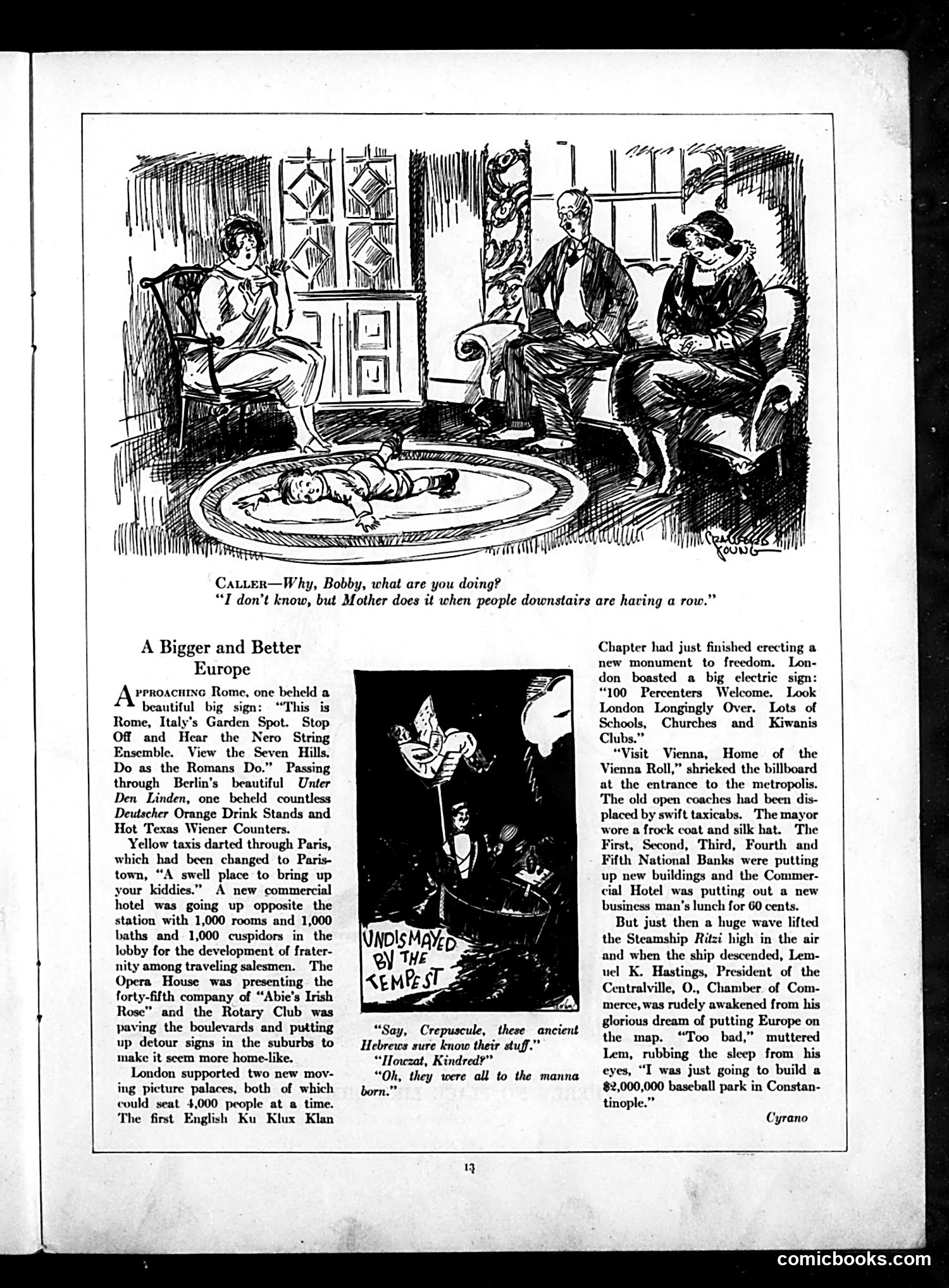
What you’re looking at
This satirical story mocks American commercialism and cultural imperialism in post-WWI Europe. The narrative describes European capitals being transformed into Americanized tourist destinations: Rome gets promotional signage, Berlin features hot dog stands, Paris becomes "Paris-town," and London supports massive movie theaters showing American entertainment like "Abie's Irish Rose." The satire peaks when an American businessman dreams of imposing American development schemes—banks, commercial hotels, even a baseball park in Constantinople—on Europe's historic cities. The dream ends abruptly when he awakens on a ship, deflating his grandiose vision. The joke targets American expansionism and the erasure of European cultural distinctiveness through commercialism. It suggests Americans abroad are transforming ancient civilizations into indistinguishable, profit-driven replicas of American small towns, reducing everything to business opportunities and leisure commodities.
📄 Transcribed text from this page (OCR, searchable)
Machine-transcribed from the original scan — historical spelling and the odd misread are preserved.
A Bigger and Better Europe Alrnoaciixe Rome, one beheld a beautiful big sign: “This is Rome, Italy’s Garden Spot. Stop Off and Hear the Nero String Ensemble. View the Seven Hills. Do as the Romans Do.” Passing through Berlin’s beautiful Unter Den Linden, one beheld countless Deutscher Orange Drink Stands and Hot Texas Wiener Counters. Yellow taxis darted through Paris, which had been changed to Paris- town, “A swell place to bring up your kiddies.” A new commercial hotel was going up opposite the station with 1,000 rooms and 1,000 baths and 1,000 cuspidors in the lobby for the development of frater- nity among traveling salesmen. The Opera House was presenting the forty-fifth company of “‘Abie’s Irish Rose” and the Rotary Club was paving the boulevards and putting up detour signs in the suburbs to make it seem more home-like. London supported two new mov- ing picture palaces, both of which could seat 4,000 people at a time. The first English Ku Klux Klan Catter—Why, Bobby, what are you doing? “TI don’t know, but Mother does it when people downstairs are having a row.” “Say, Crepuscule, these ancient Hebrews sure know their stuff.” “Hovwzat, Kindred?” “Oh, they were all to the manna born.” Chapter had just finished erecting a new monument to freedom. Lon- don boasted a big electric sign: “100 Percenters Welcome. Look London Longingly Over. Lots of Schools, Churches and Kiwanis Clubs.” “Visit Vienna, Home of the Vienna Roll,” shrieked the billboard at the entrance to the metropolis. The old open coaches had been dis- placed by swift taxicabs. The mayor wore a frock coat and silk hat. The First, Second, Third, Fourth and Fifth National Banks were putting up new buildings and the Commer- cial Hotel was putting out a new business man’s lunch for 60 cents. But just then a huge wave lifted the Steamship Ritzi high in the air and when the ship descended, Lem- uel K. Hastings, President of the Centralville, O., Chamber. of Com- merce, was rudely awakened from his glorious dream of putting Europe on the map. “Too bad,” muttered Lem, rubbing the sleep from his eyes, “I was just going to build a $2,000,000 baseball park in Constan- tinople.” Cyrano comicbooks.com