
A complete issue · 36 pages · 1925
Judge — July 11, 1925
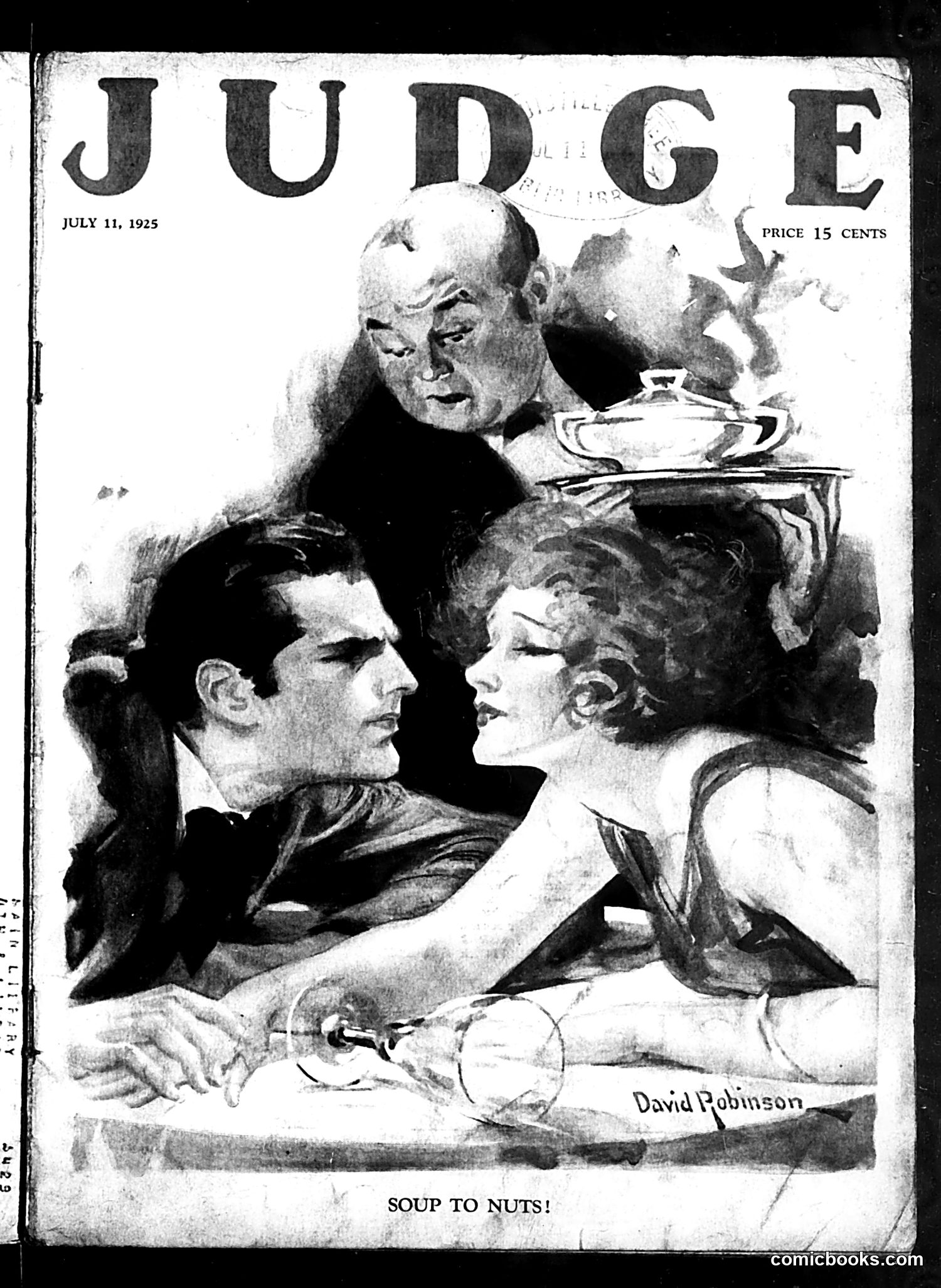
This cover illustrates the phrase "Soup to Nuts!" — a period expression meaning "from beginning to end" or "complete coverage." The cartoon depicts three figures in what appears to be a dining scenario: a man and woman at a table being served by a chef holding a tureen. The signature reads "David Robinson," a prominent Judge illustrator. The satire likely comments on contemporary dining, hospitality, or possibly domestic relations — common Judge subjects. The "soup to nuts" caption suggests completeness or thoroughness in whatever situation is being depicted. Without additional context about specific 1925 events or social commentary, the precise target of satire remains unclear, though the intimate dining scene suggests commentary on courtship, marriage, or social dining conventions of the era.
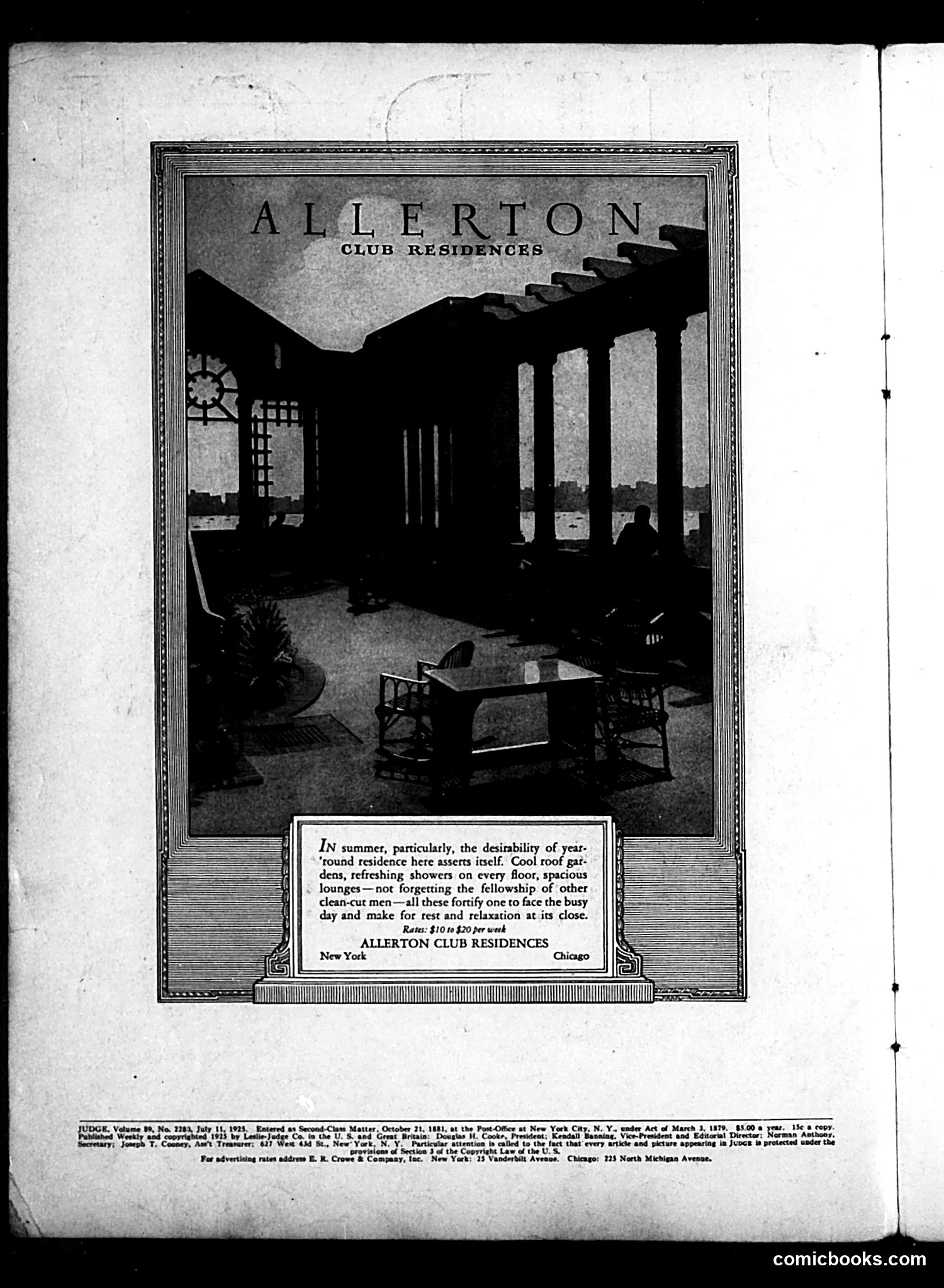
This page is **primarily an advertisement**, not political satire. It promotes the Allerton Club Residences, a membership housing facility with locations in New York and Chicago. The image shows an elegant interior space with columns, comfortable seating, and large windows—designed to appeal to affluent professionals. The advertisement emphasizes amenities: "cool roof gardens, refreshing showers on every floor, spacious lounges," positioned as desirable for busy men seeking rest and relaxation. The pitch targets white-collar professionals ("clean-cut men") who need comfortable year-round urban housing. Rates listed as "$10 to $20 per week" suggest middle to upper-middle-class clientele for this era. There is no political cartoon or satire present on this page—it's a straightforward luxury housing advertisement from *Judge* magazine's advertising section.
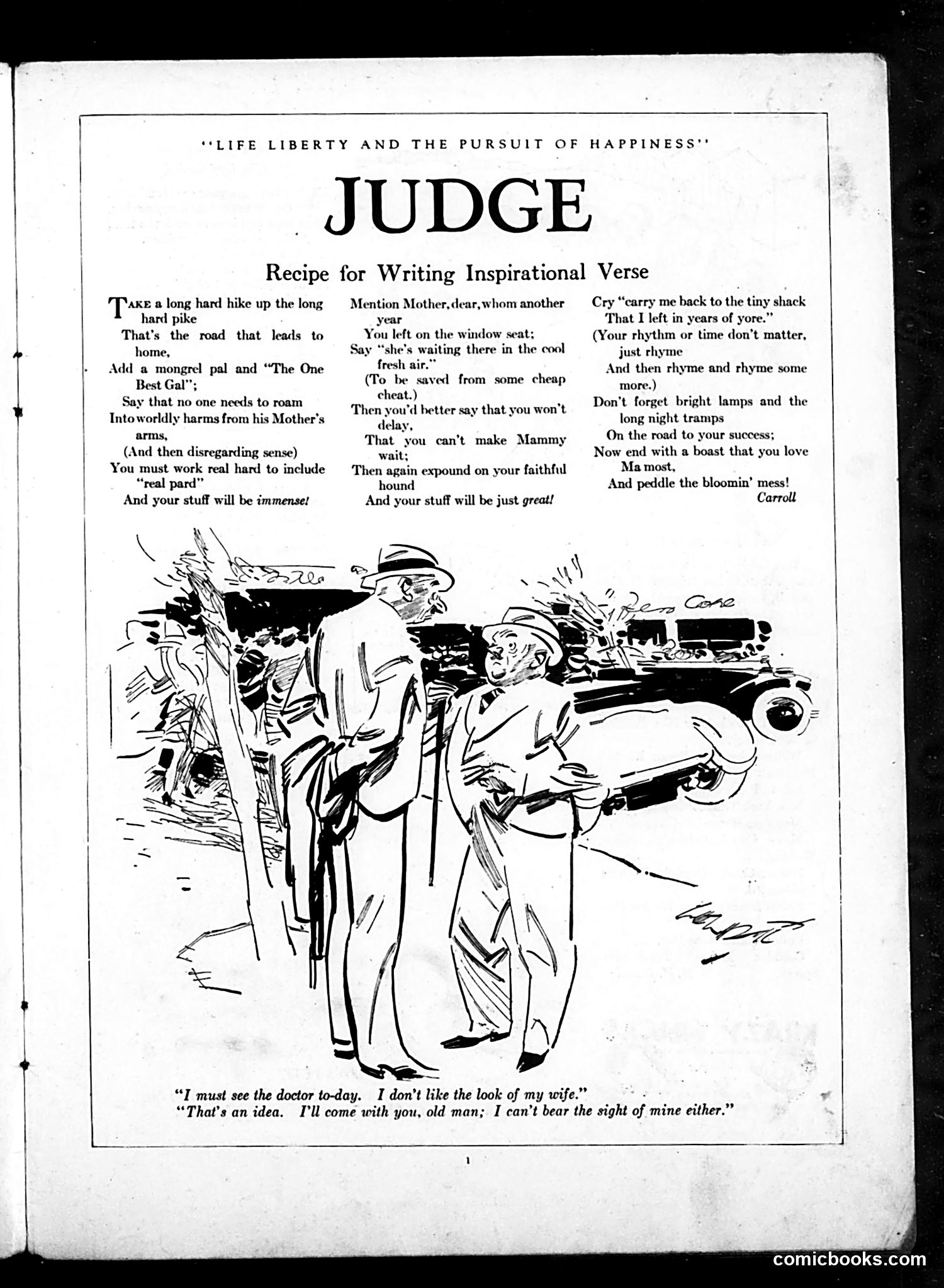
This page presents a satirical "recipe" for writing inspirational verse, mocking sentimental poetry popular in the early 20th century. The main cartoon depicts two men—one in a hat and coat, the other appearing disheveled—conversing near automobiles. The dialogue suggests one man is accompanying the other to see a doctor, with a joke about his wife's appearance. The recipe text above ridicules clichéd inspirational writing by suggesting authors include: hiking narratives, mention of mothers, rhyming, and romantic imagery about boating. The satire targets the formulaic, emotionally manipulative nature of popular verse from this era, poking fun at writers who recycled identical themes and sentiments to create "immense" work.
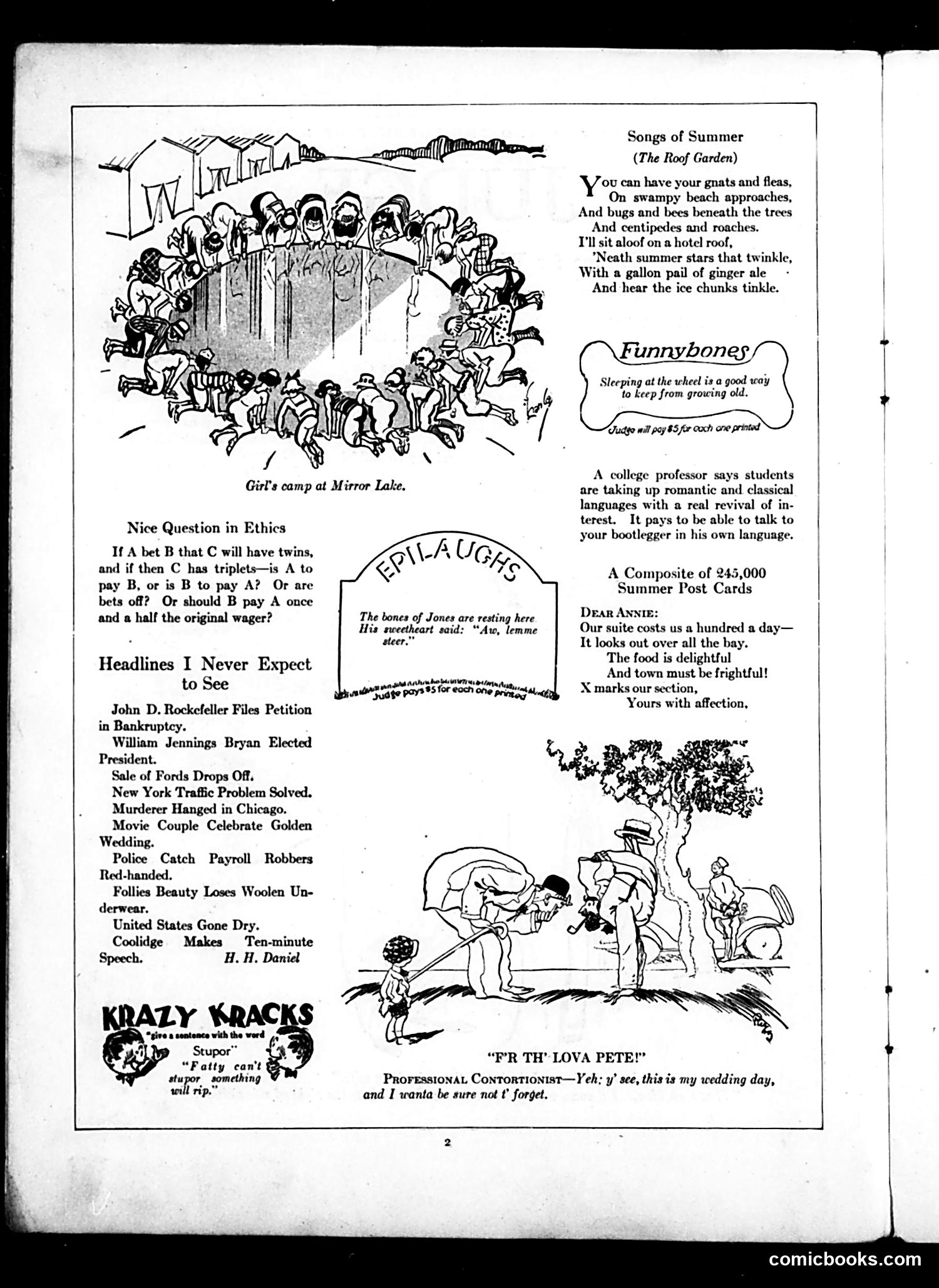
This appears to be a humor and satire page from Judge magazine. The main content includes: **"Songs of Summer (The Roof Garden)"** - A poem mocking the pretensions of roof garden culture, suggesting that despite claims of enjoying nature, patrons actually deal with urban pests (gnats, fleas, bugs, centipedes, roaches). **"Nice Question in Ethics"** - A logic puzzle about debt payment, typical of the era's humor columns. **"Headlines I Never Expect to See"** - Satirical fake headlines suggesting absurd reversals (Rockefeller bankrupt, Bryan elected president, Ford sales dropping, Coolidge making speeches). These mock contemporary figures and their perceived contradictions. **"For Th' Lova Pete!"** - A cartoon satirizing wedding day anxieties and contortionists' flexibility. The page primarily satirizes urban life, summer leisure culture, and contemporary public figures through humor and wordplay typical of 1920s American satire magazines.
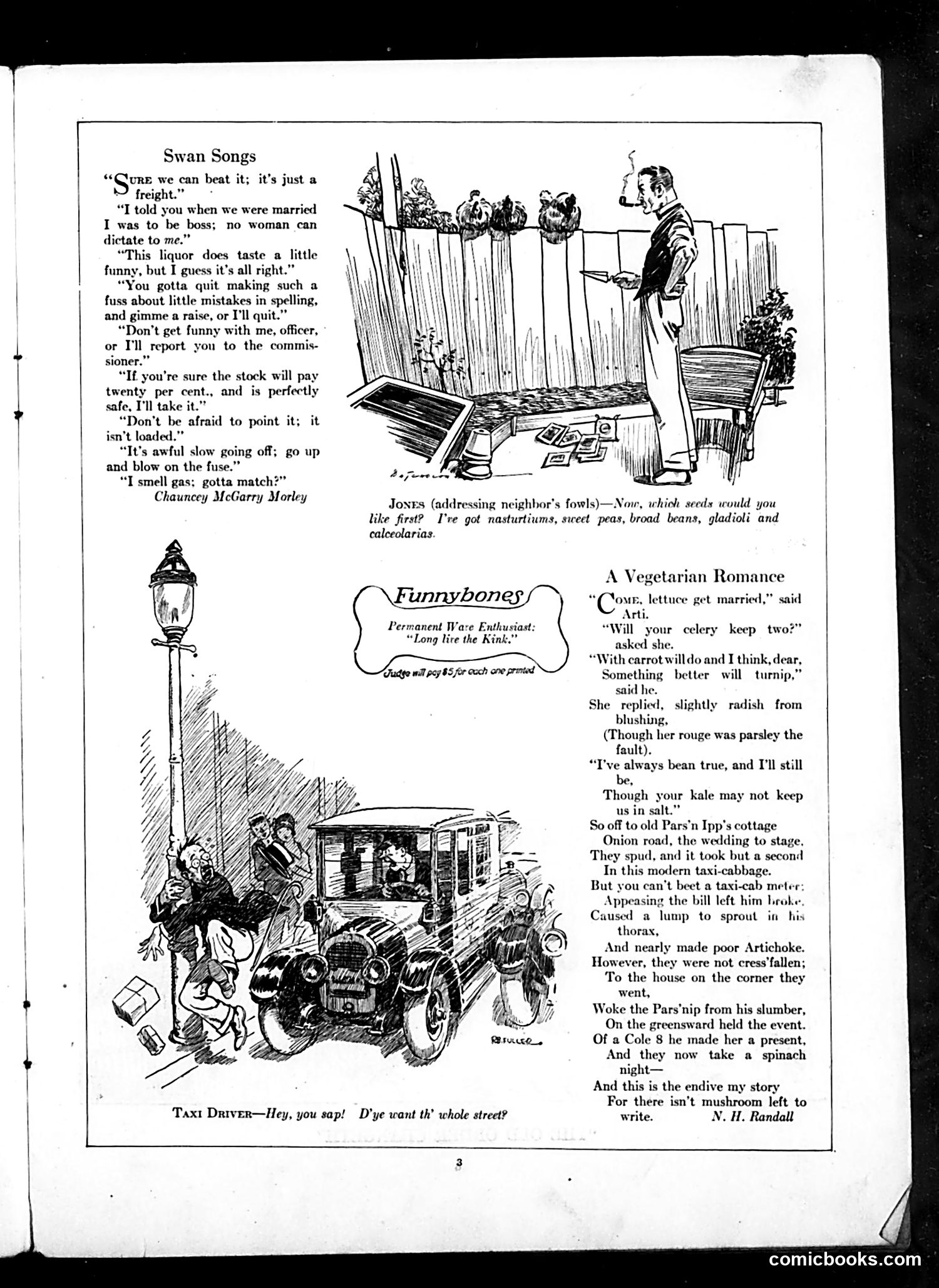
This page contains three humorous pieces from an early-to-mid 20th century American satirical magazine. **"Swan Songs"** presents marital discord quotes attributed to "Chauncey McGarry Morley," mocking domestic arguments over finances and authority—typical period satire about marriage conflicts. **"Funnybones"** offers a brief joke about "Permanent Wave Enthusiast" and "Long live the Kink." **"A Vegetarian Romance"** satirizes a relationship between vegetables (Arti the artichoke and Celery), using vegetable puns. The poem concludes with a taxi-cab mishap at a wedding, playing on the absurdity of personified vegetables and the chaos of modern transportation. The taxi cartoon below captions a crowded vehicle with "Taxi Driver—Hey, you sap! D'ye want th' whole street?"—mocking urban congestion and driver frustration.
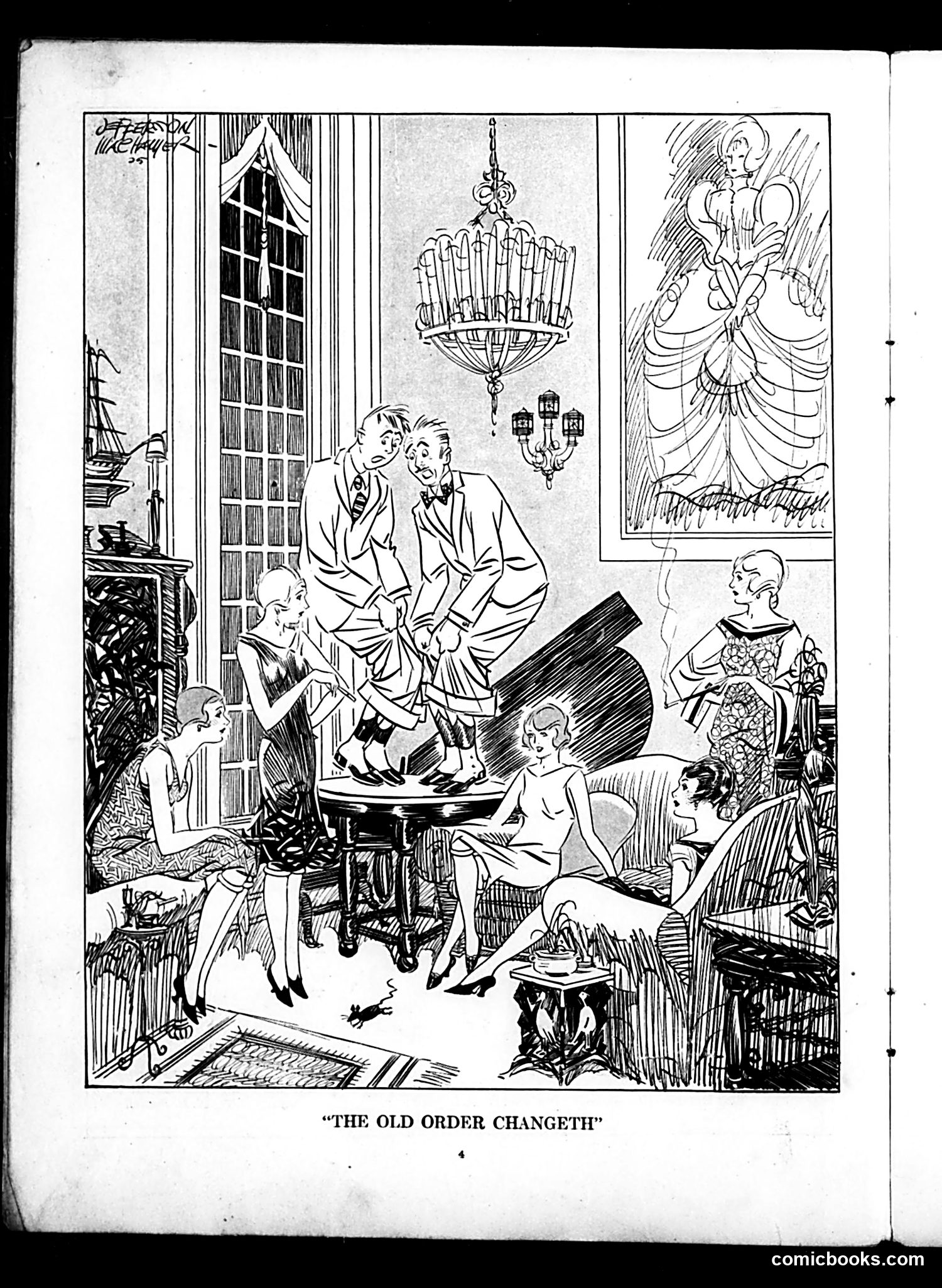
This satirical illustration depicts an elegant drawing room scene where two older gentlemen appear to be instructing or entertaining a group of younger women. The title "The Old Order Changeth" suggests commentary on generational or social change. The cartoon likely satirizes shifting social customs—possibly mocking how traditional etiquette, values, or behaviors are being passed to a new generation, or conversely, how the younger generation is disrupting established norms. The formal interior (with chandelier, fireplace, and fine furnishings) emphasizes the upper-class context. Without additional context about the specific Judge issue date, the exact historical reference remains unclear. The satire appears to address social transformation among the wealthy, though whether it criticizes old ways or new ones cannot be determined from the image alone.
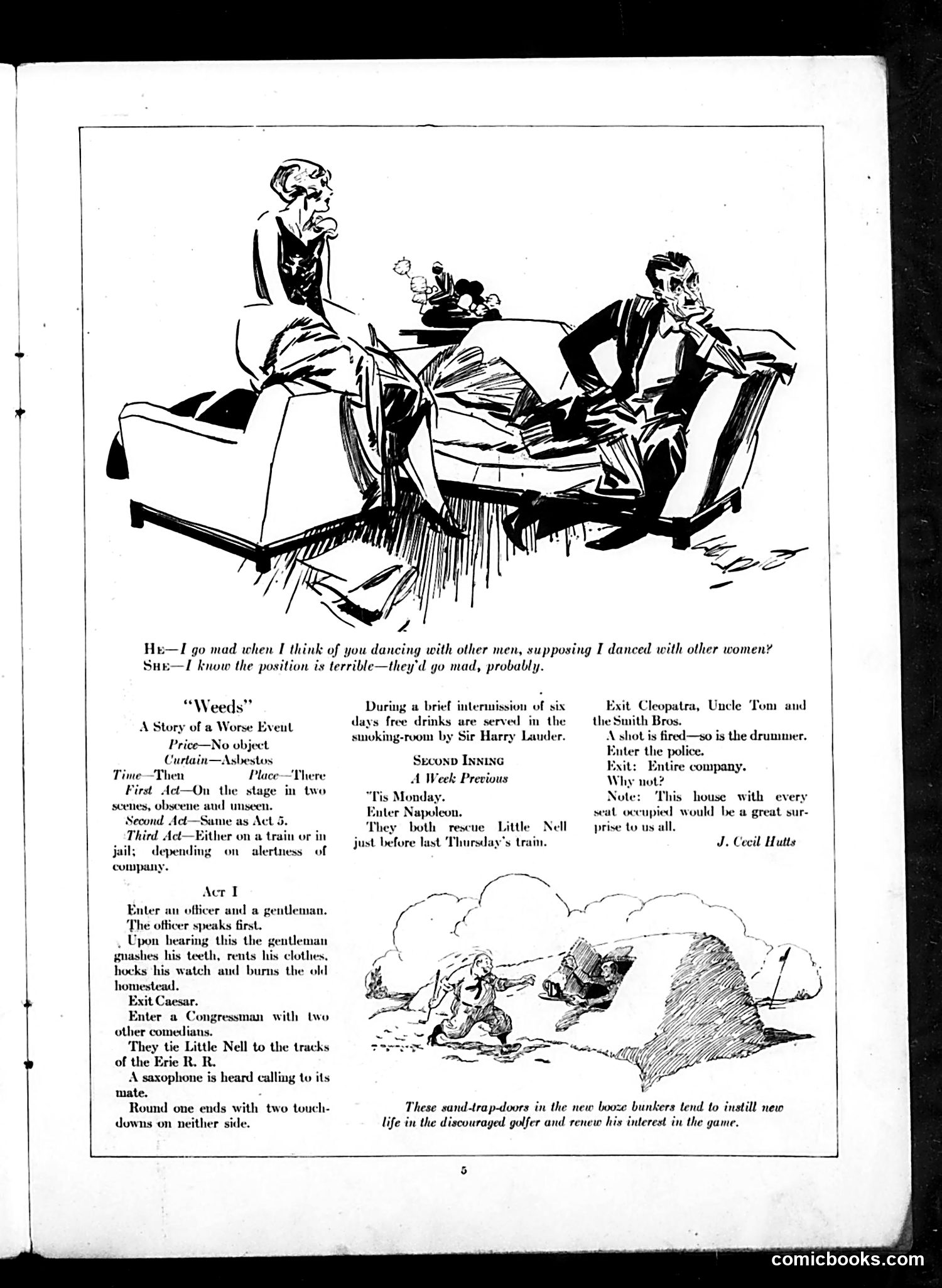
This page contains a theatrical play synopsis titled "Weeds: A Story of a Worse Event" by J. Cecil Hatto, set in Asbestos. The top cartoon depicts a domestic dispute—a woman confronts a man about dancing with other women, while he defensively suggests she'd be equally upset if he danced with other men. This illustrates early 20th-century marital jealousy humor. The play synopsis describes comic scenarios involving a Congressman, an officer, and a character named "Little Nell" tied to railroad tracks—evoking melodramatic theatrical tropes of the era. The bottom illustration shows sand-trap bunkers in golf, captioned as encouraging discouraged golfers to renew interest in the game—likely satirizing golf's growing popularity among wealthy Americans.
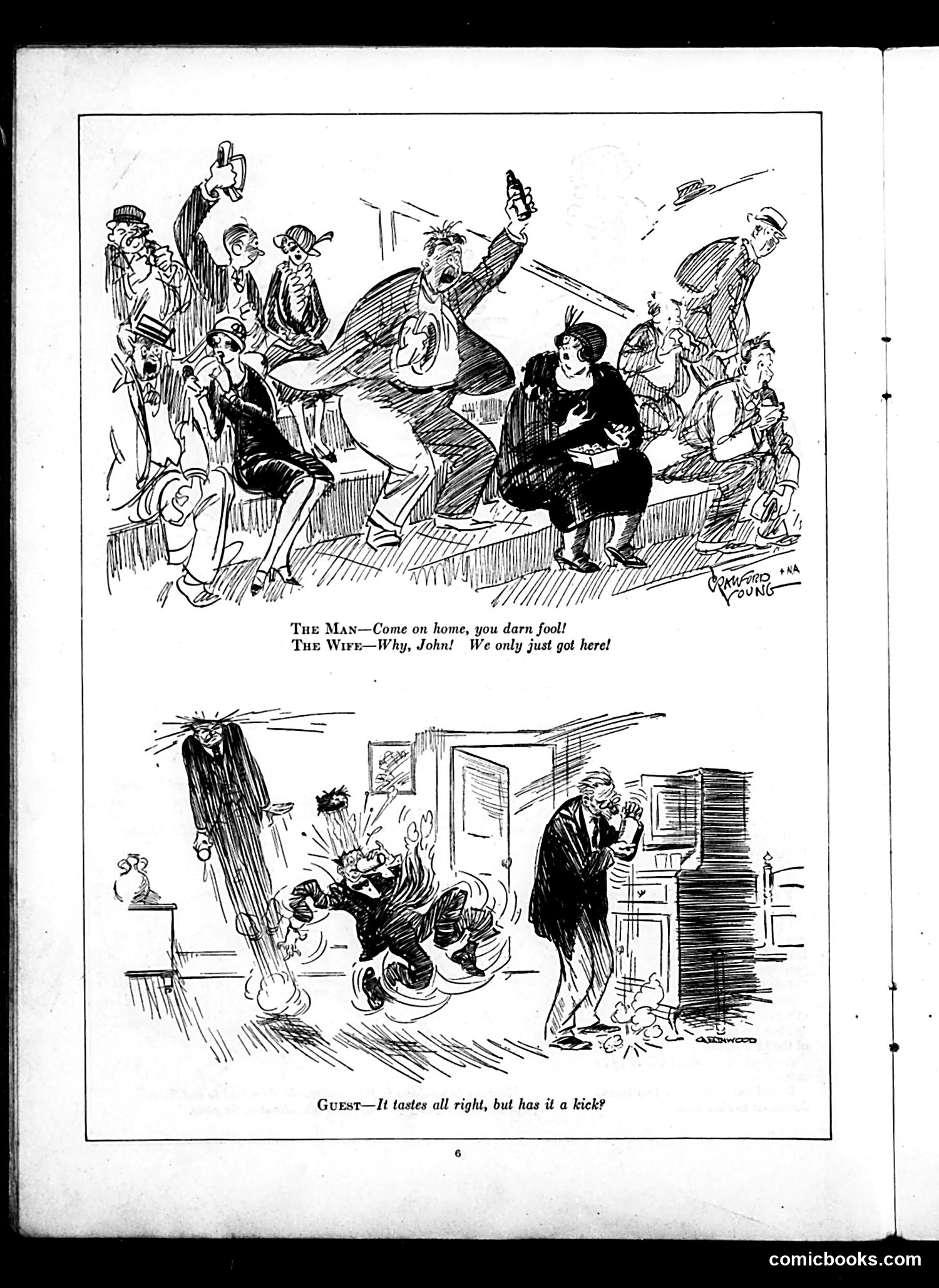
This page contains two cartoons satirizing early 20th-century social behavior. **Top cartoon**: A husband and wife attend what appears to be a lively party. The man wants to leave immediately ("Come on home, you darn fool!"), while the wife protests they've only just arrived. The joke mocks marital discord and differing social preferences—he finds parties tedious while she wants to stay and enjoy herself. **Bottom cartoon**: A guest samples what appears to be homemade alcohol (likely Prohibition-era bootleg liquor), asking the host if it has "a kick"—slang for alcoholic potency. The host's nervous reaction suggests the drink is dangerously strong. This satirizes the risks of Prohibition-era illegal liquor, which was often poorly made and unsafe. Both cartoons humorously capture domestic and social tensions of the era.
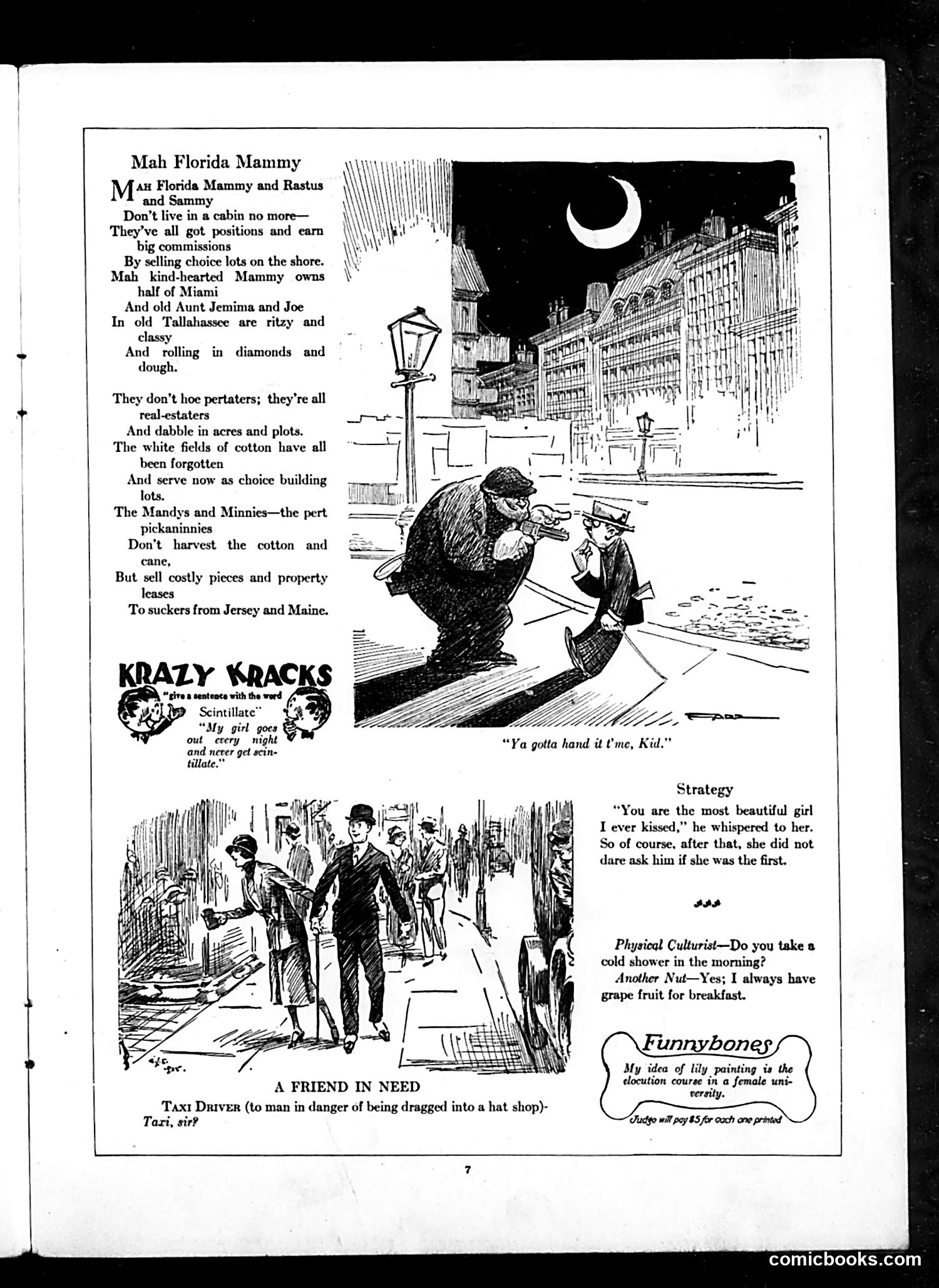
This poem satirizes the Florida real estate boom of the 1920s. It lampoons the sudden wealth of Black Floridians who've abandoned agricultural labor ("cotton have all been forgotten") to become real estate dealers, selling property to Northern migrants ("suckers from Jersey and Maine"). The satire operates on multiple levels: it mocks the speculative frenzy itself, suggests Black Floridians are shrewd con artists exploiting naive Northerners, and uses offensive racial dialect and caricature stereotypes ("pickaninnies," "Aunt Jemima") typical of 1920s Judge magazine. The poem's ironic tone suggests skepticism about whether this sudden prosperity is legitimate or sustainable. The page also contains unrelated comic bits: "Krazy Kracks" wordplay jokes, a gag about a taxi driver, romance humor, and "Funnybones" quips—standard filler content for the magazine.
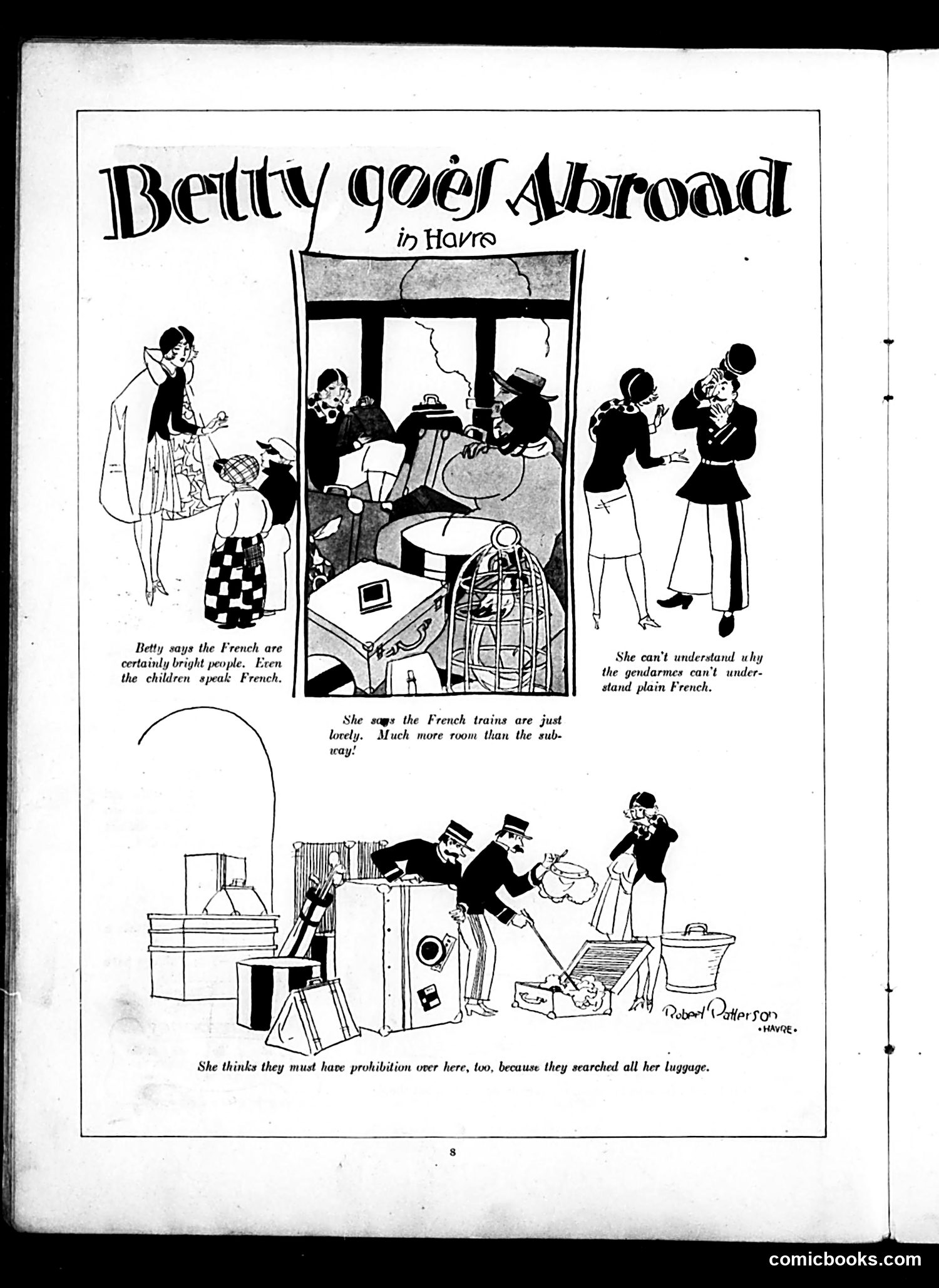
This is a humorous cartoon about an American woman's misadventures traveling in France (Havre/Le Havre). The satire targets American cultural ignorance and ethnocentrism: **The jokes:** - Betty admires that "even children speak French" — oblivious that she's in France - She's baffled that French police ("gendarmes") can't understand her "plain French" — implying she speaks English poorly or with an American accent - She praises French trains for having more room than "the subway" — comparing European rail to American transit - The luggage-searching scene suggests customs officials ransacked her bags, which she blames on "prohibition over here" **The satire targets** American tourists' assumption that the world should accommodate their language and expectations, their provincial comparisons, and their confused assumptions about foreign customs.
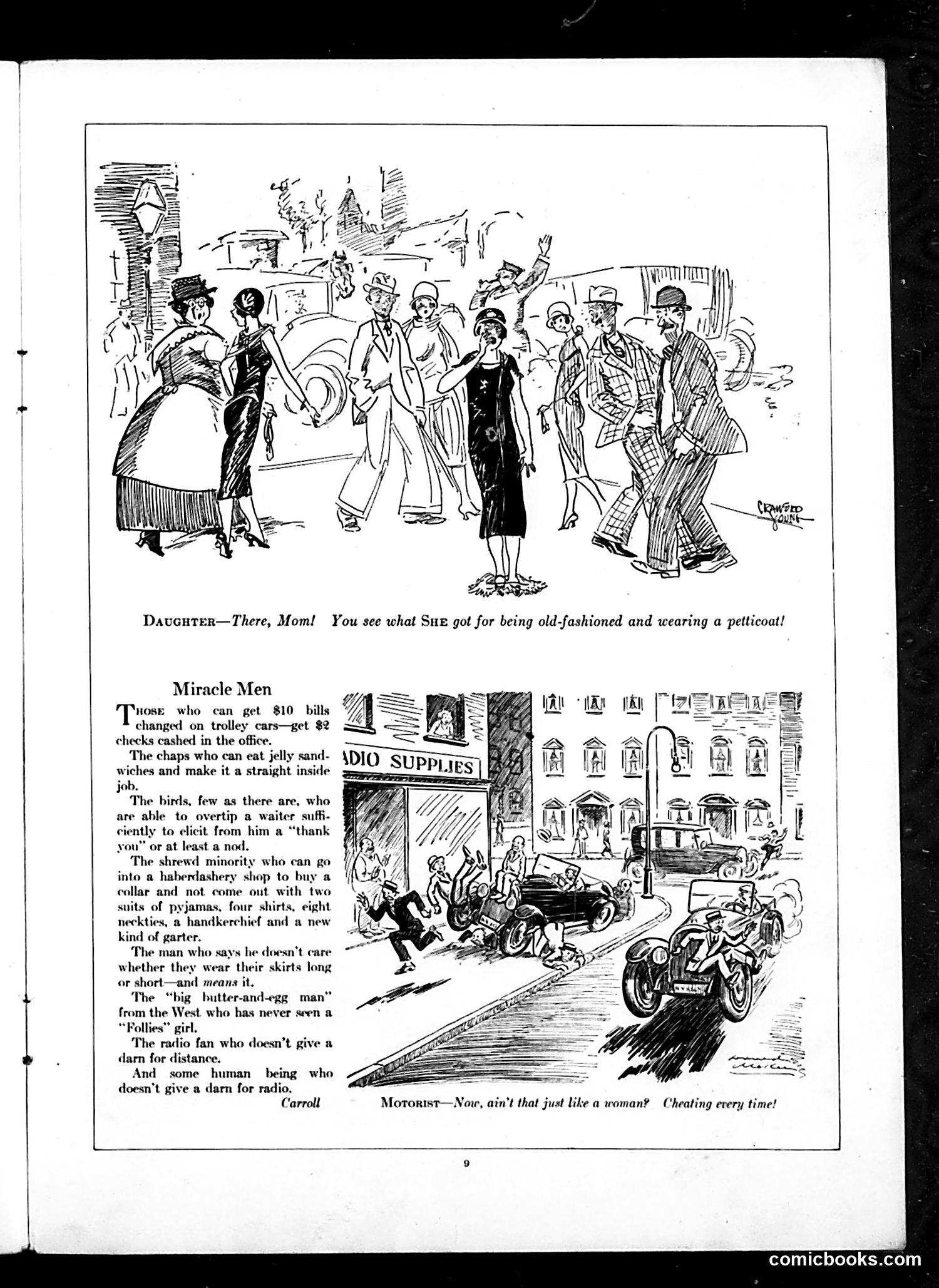
**Top Cartoon:** A young woman in modern (1920s) short dress is mocked by her mother for wearing a petticoat—the opposite of the caption's irony. The joke satirizes generational conflict over fashion: the daughter represents the modern "flapper" rejecting Victorian modesty, while the mother clings to old-fashioned dress codes. The cartoon mocks both generations' rigidity. **"Miracle Men" Section:** A humorous essay listing impossibly rare male behaviors—men who don't overspend, who tip appropriately, who resist upselling in shops, who genuinely don't care about women's hemlines. The final items mock radio enthusiasts and indifference to radio itself. **Bottom Cartoon:** A motorcyclist accuses a female driver of "cheating" in traffic. The motorist's complaint ironically mirrors complaints about women drivers while simultaneously suggesting women "cheat" at driving—satirizing both automotive hazards and period sexism about female competence. The page reflects 1920s anxieties about changing gender roles, consumerism, and new technologies.
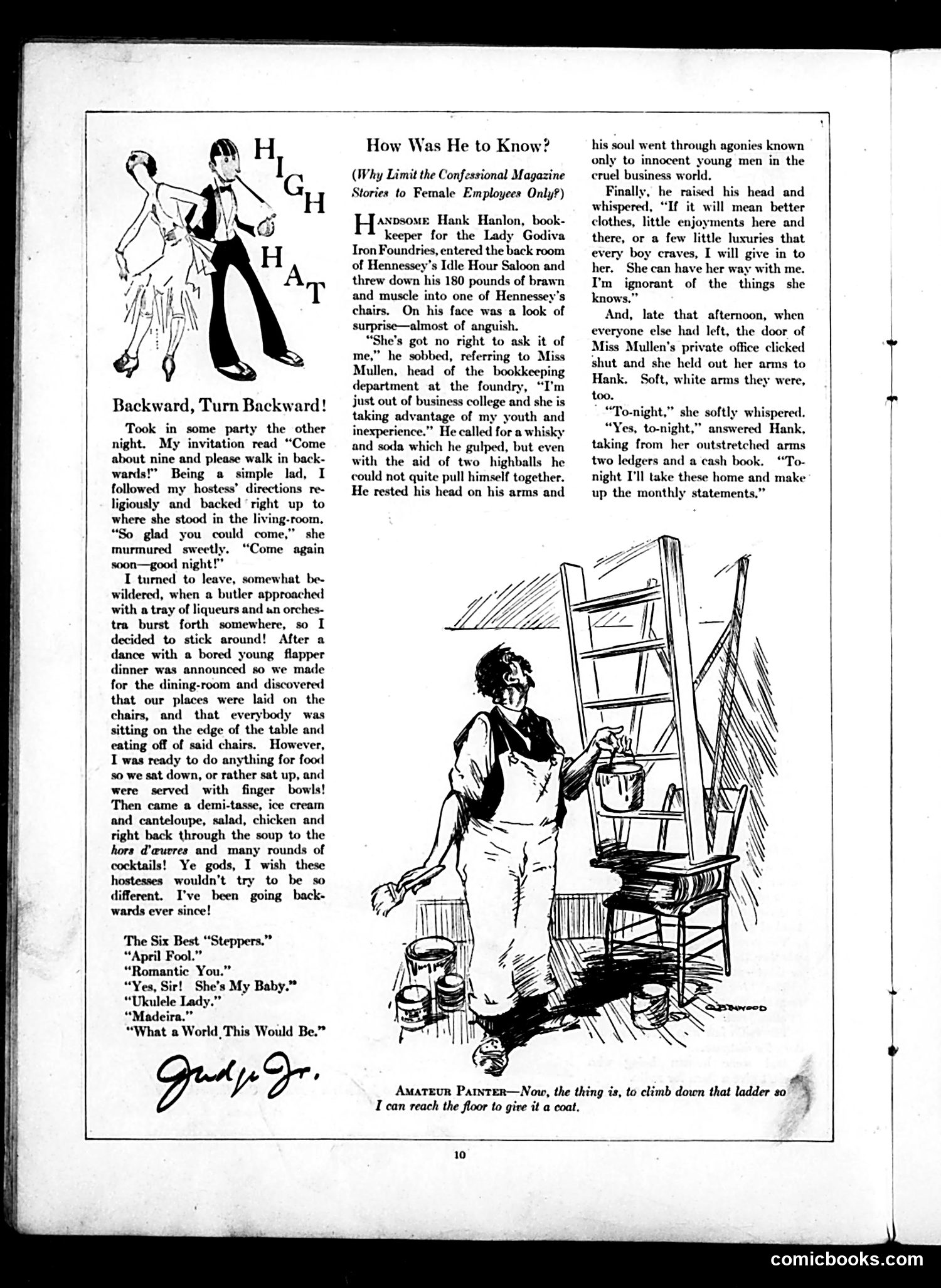
This page contains three distinct pieces satirizing 1920s social conventions and workplace dynamics: **"Backward, Turn Backward!"** mocks nouveau-riche hostesses attempting absurd "sophistication." The joke is that a naive guest literally follows instructions to walk backward into a party, then discovers the hostess has arranged everything backwards—guests sit on tables eating off chairs, courses served in reverse order. The satire targets pretentious hosts trying too hard to be "different" and unconventional. **"How Was He to Know?"** is the primary story, which parodies workplace confession magazines (then popular). A young male bookkeeper fears his female boss Miss Mullen is exploiting his youth and inexperience. The setup suggests seduction, but the punchline reveals she merely wants him to take ledgers home to complete monthly statements—a mundane task. The satire inverts typical confession narratives where women are victimized; here, the man's anxiety over a simple work request is treated as melodramatic. **"Amateur Painter"** (bottom cartoon) shows a painter on a ladder with a painting challenge unrelated to the page's themes. The overall effect ridicules both excessive workplace formality and overwrought romantic anxieties in modern business life.
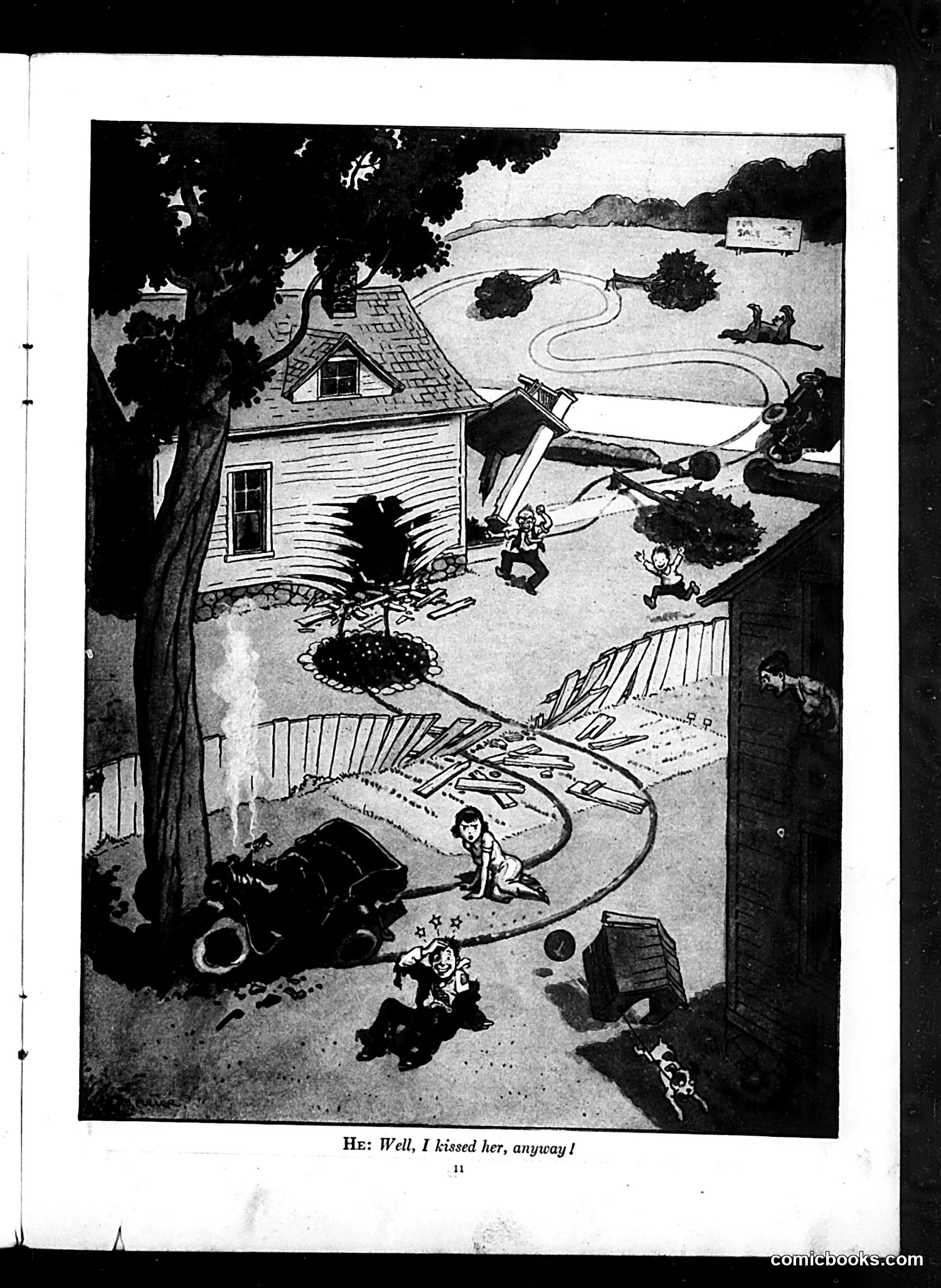
This appears to be a single-panel cartoon from *Judge* magazine showing an aerial view of a residential property with a house, yard, and water visible in the background. Multiple figures are scattered throughout the scene engaged in various activities. The caption reads: "He: Well, I kissed her, anyway!" The cartoon likely depicts a domestic or romantic scenario where a male figure has kissed a female despite some apparent obstacle or disapproval—suggested by the "anyway" qualifier. The scattered figures and detailed yard setting suggest this may be commenting on public behavior, propriety, or social conventions around courtship or physical affection. Without additional context about the specific historical period or social norms of *Judge's* publication date, the precise satirical target remains unclear, though it appears to mock attitudes toward romantic behavior.
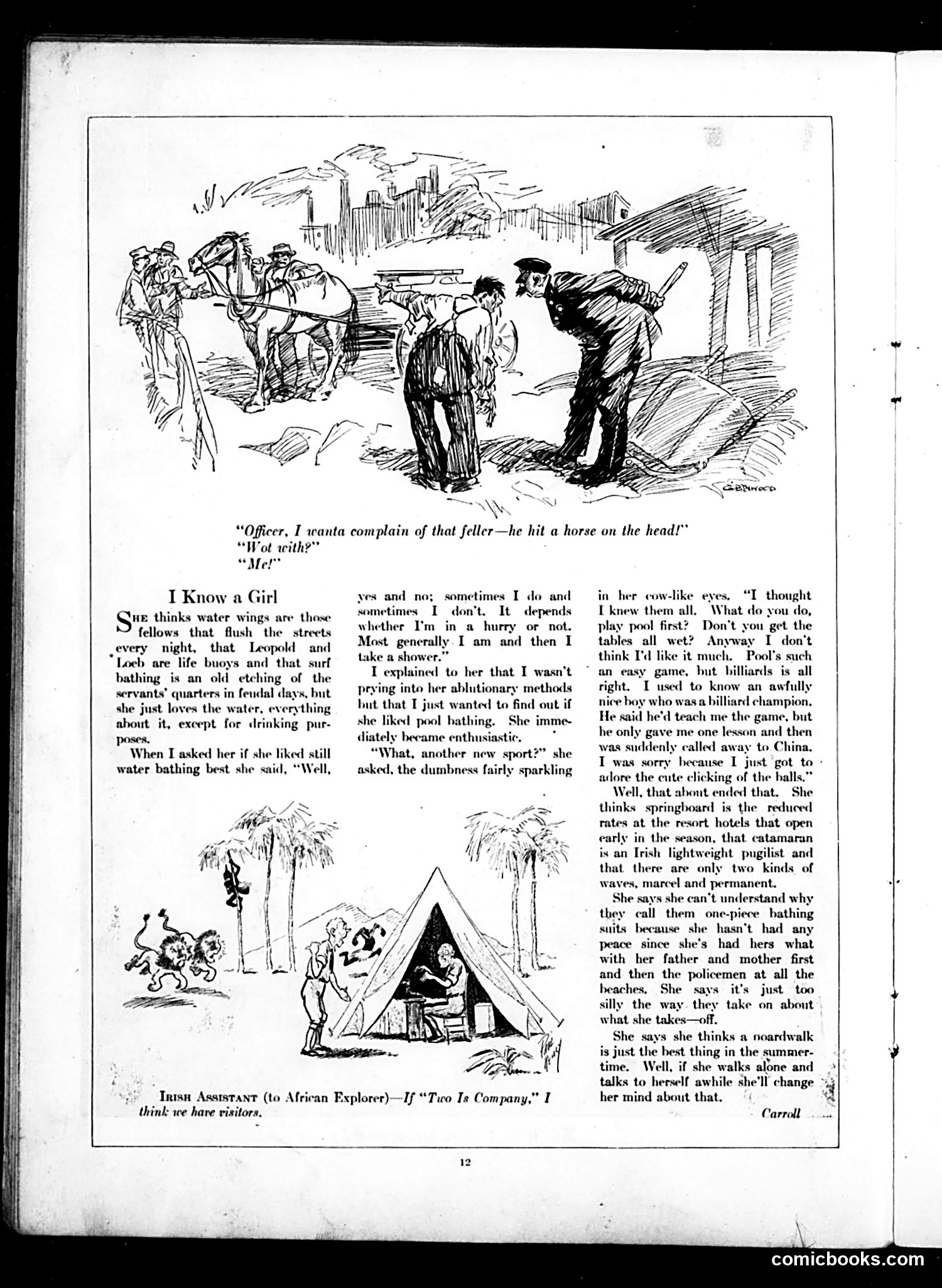
This page contains two distinct items: **Top cartoon:** A police complaint sketch where a man claims another man hit "a horse on the head" with "me" (himself). The joke plays on the complainant's apparent stupidity—he's reporting being used as a weapon, presented as absurd comedy. **Main article: "I Know a Girl"** by Carroll is satirical commentary on a young woman's spectacular ignorance. She confuses everyday terms (water wings are street-flushing equipment; Leopold and Loeb are life buoys; surf bathing is feudal servants' art). The satire mocks her intellectual emptiness while she remains cheerfully oblivious. The **Irish Assistant cartoon** (bottom) makes a crude joke about colonial-era racial attitudes, playing on the phrase "two is company, three's a crowd." The humor targets female naiveté and stupidity—typical of era conventions in Judge magazine—and relies on the reader finding humor in women's supposed ignorance about sports, bathing, and basic vocabulary. The tone is condescending by modern standards.
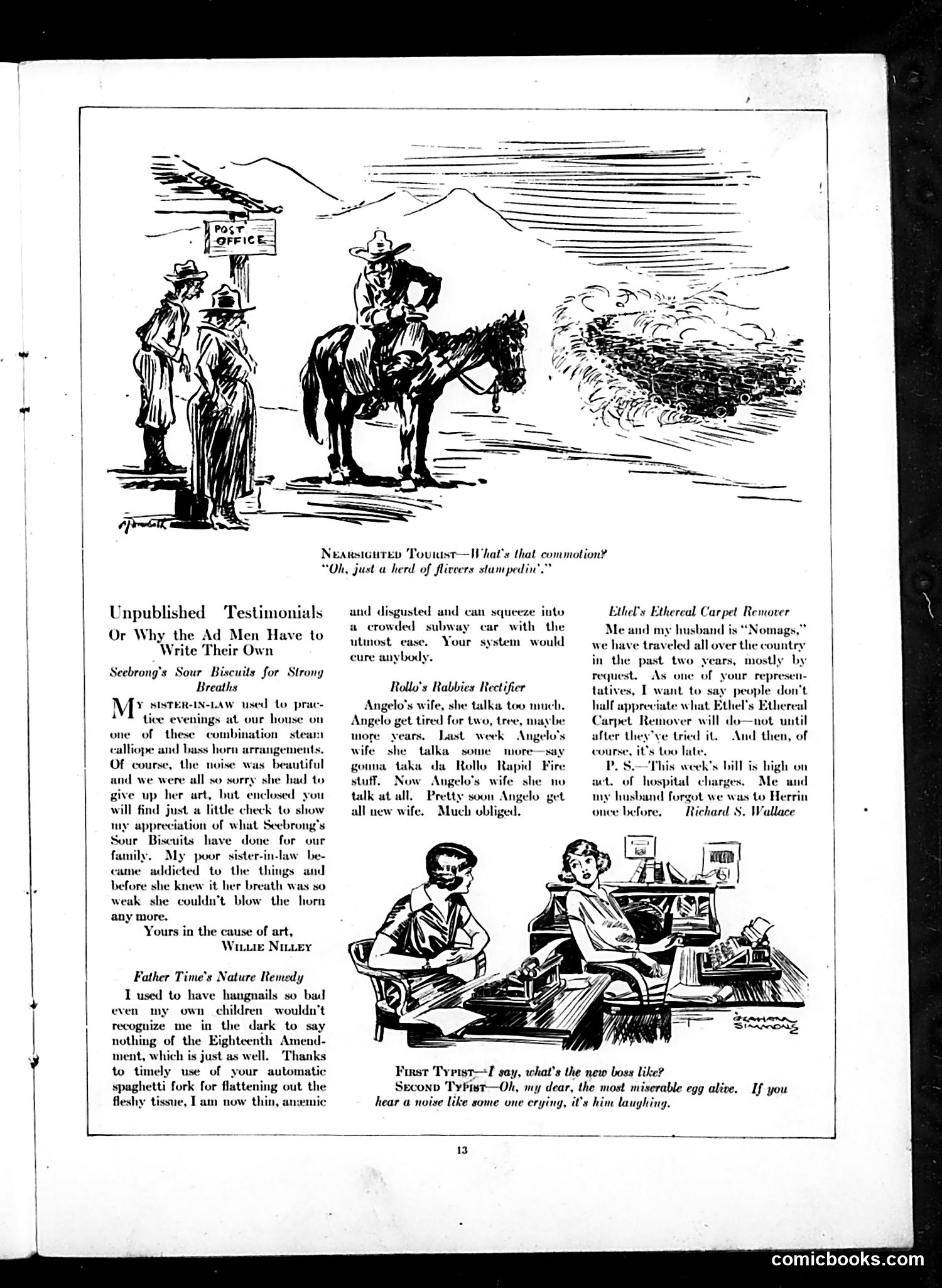
This is a humor page from *Judge* magazine featuring mock product testimonials and workplace jokes. **Top cartoon**: A cowboy on horseback encounters two men at a "Post Office" sign. The caption jokes that the commotion is "just a herd of flivvers stampeding"—*flivver* being slang for the cheap Model T Ford. The humor plays on the disruption of rural life by automobiles. **Testimonials section**: Fake endorsements for absurd products ("Sour Biscuits for Strong Breaths," "Rabbies Rectifier," "Carpet Remover") written in exaggerated immigrant dialects and broken English. These mock both patent medicine advertising (common in the era) and ethnic stereotypes. **Bottom cartoons**: Office humor—one shows typists at desks; dialogue jokes that the new boss is so miserable his crying sounds like laughter. The page satirizes advertising culture, ethnic caricatures, and workplace tedium through absurdist humor typical of early 20th-century American satirical magazines.
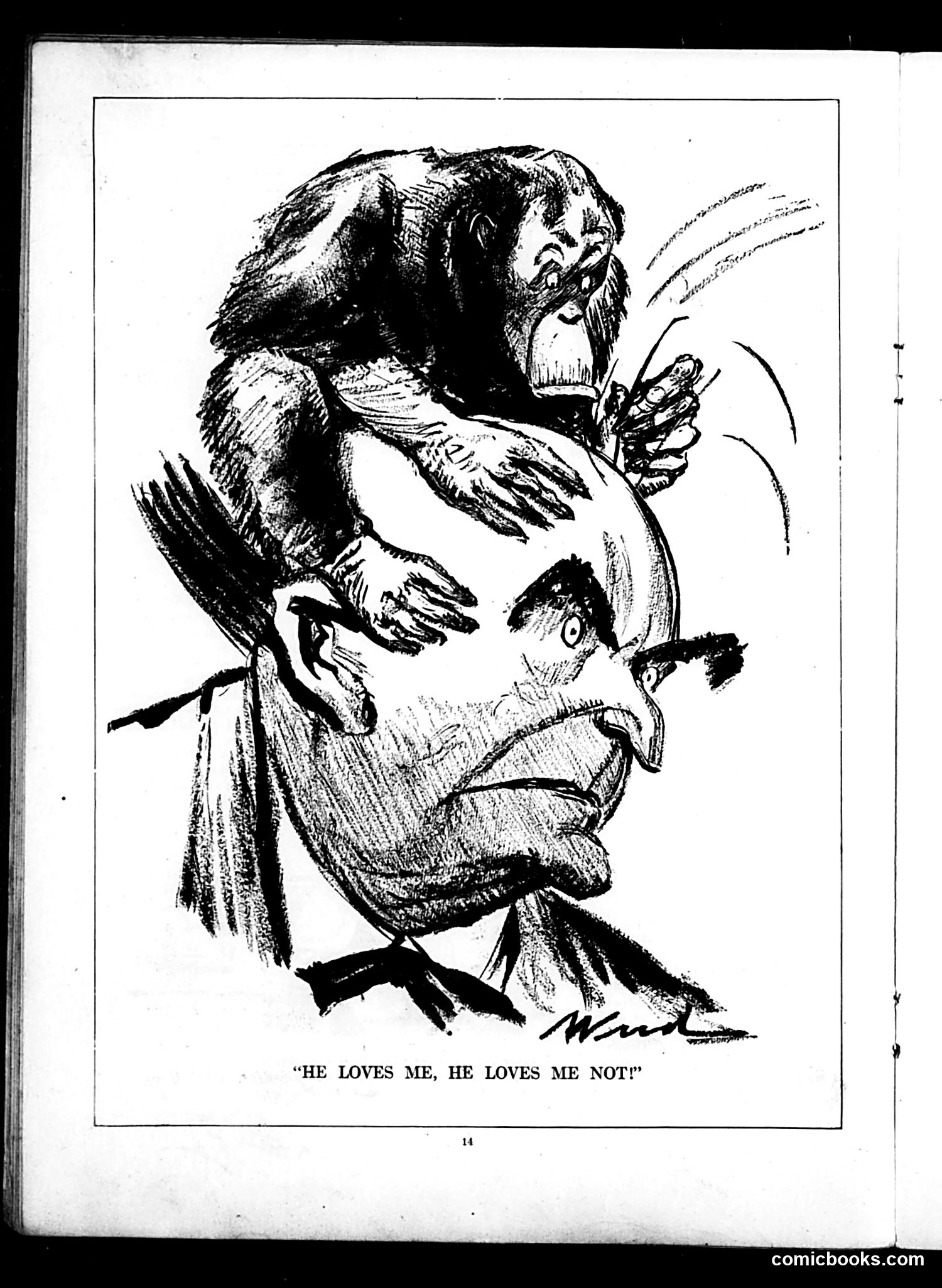
This single-panel political cartoon depicts a caricatured male figure with exaggerated features plucking petals from a flower while reciting the children's game "He loves me, he loves me not." The figure appears anxious or conflicted about the outcome. The cartoon likely satirizes uncertainty about romantic affection or political support, though without additional context from the magazine's date or surrounding articles, the specific target remains unclear. The exaggerated facial features and caricature style suggest the figure represents a particular public figure or political personality of the era, but I cannot definitively identify who without more information. The satire seems to mock indecision or emotional vulnerability in a public figure.
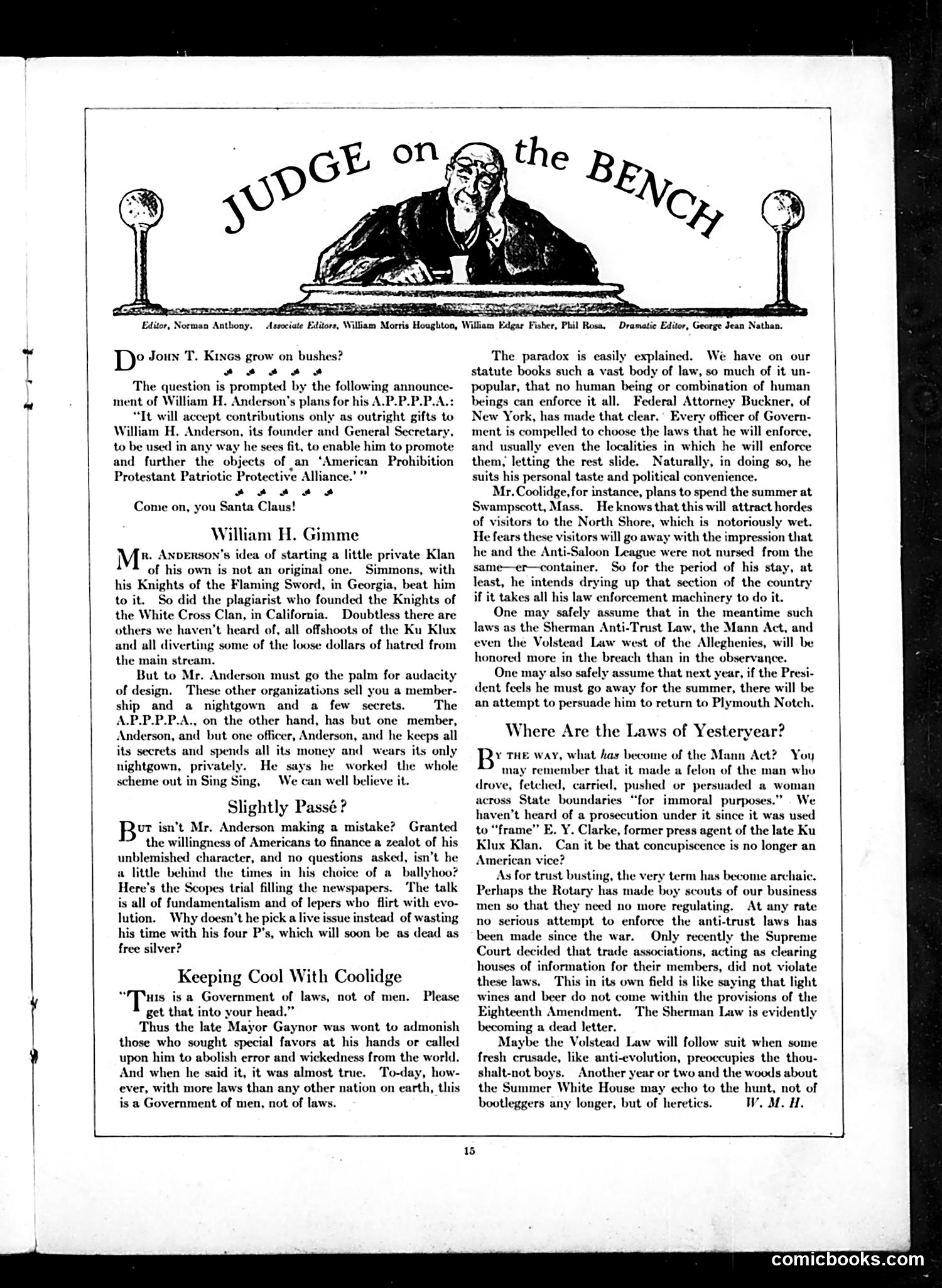
This page attacks **William H. Anderson**, founder of the "American Prohibition Protestant Patriotic Protective Alliance" (A.P.P.P.P.A.), a private organization seeking donations to enforce Prohibition laws. **The satire's points:** 1. **"William H. Gimme"**: Anderson is mocked for soliciting money solely for himself with no accountability—unlike other organizations offering memberships or structure. The cartoon suggests he's profiteering from Prohibition zealotry. 2. **Klan comparison**: Judge compares Anderson's private organization to the KKK and similar hate groups, implying his operation exploits prejudice and "loose dollars of hatred." 3. **Outdated crusade**: The article criticizes Anderson for championing Prohibition when the Scopes evolution trial dominates headlines—suggesting his cause is yesterday's battle. 4. **Selective law enforcement**: The closing section "Keeping Cool with Coolidge" argues that too many laws exist for anyone to enforce all of them equally, so officials choose which to enforce based on personal politics—undermining the rule of law Anderson supposedly champions. The overall message: Anderson's self-serving scheme represents the hypocrisy and ineffectiveness of zealous Prohibition enforcement.
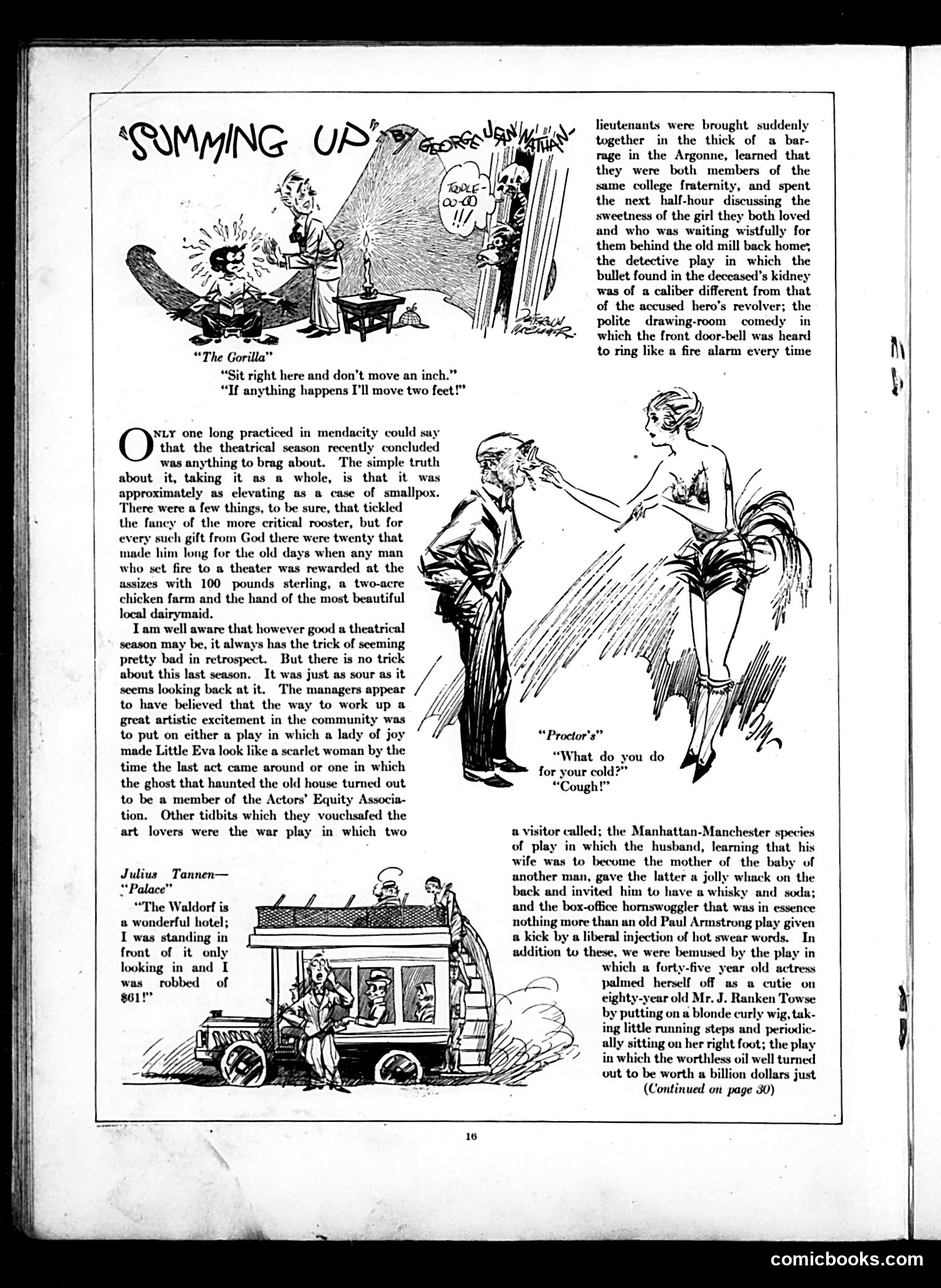
This page is a sardonic review of the recent theatrical season by drama critic Julius Tannen. The author argues the season was mediocre—"approximately as elevating as a case of smallpox"—and catalogs its failures: melodramas with implausible evidence, drawing-room comedies with absurd door-bell gags, war plays with contrived fraternity scenes, and morality plays disguised as entertainment. The cartoons illustrate specific theatrical absurdities: "The Gorilla" shows slapstick chaos; "Proctor's" depicts a coughing patient—likely mocking a play's simplistic health-related plot. "The Waldorf" references Tannen's own quip about theater district crime. The critique targets Broadway's perceived desperation to fill seats through cheap sentiment and sensationalism rather than genuine artistry. References to "Actors' Equity Association" suggest labor disputes affecting production quality.
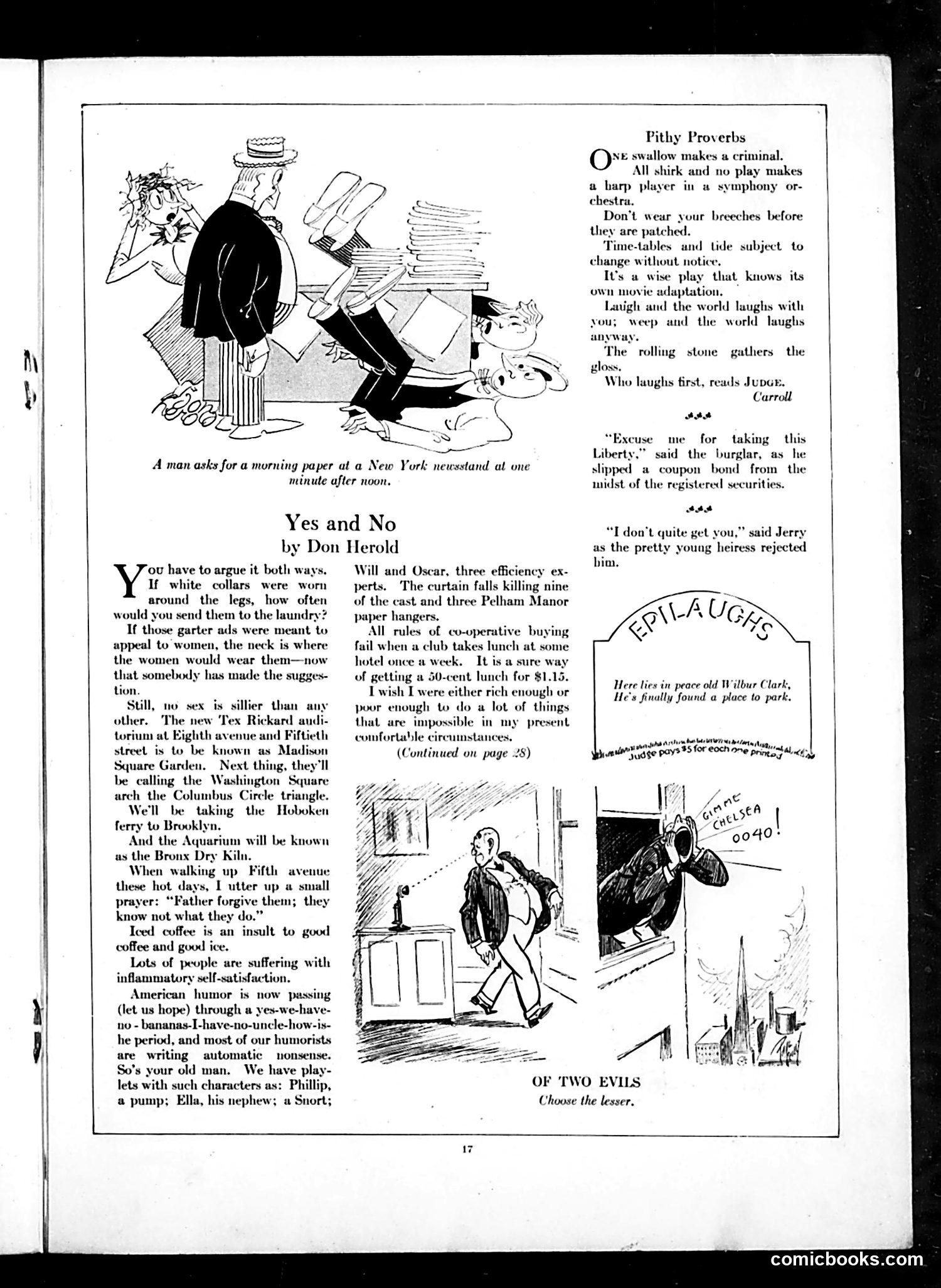
This satirical essay mocks the absurdity of modern American life and contemporary humor trends. Herold criticizes: **Naming absurdities**: New York landmarks being renamed illogically (the new Tex Rickard auditorium called "Madison Square Garden" instead; Washington Square arch as "Columbus Circle triangle"). **Advertising logic**: Garter ads that make no sense—if meant for women, they'd be worn on the neck, not legs. **Contemporary humor**: American comedians are churning out "automatic nonsense" with ridiculous character names (Phillip, a pump; Ella, his nephew) and absurd plots (curtains falling, killing cast members and random Pelham Manor paper hangers). **Social complaints**: Iced coffee ruining good coffee; people suffering from "inflammatory self-satisfaction"; cooperative buying clubs paying inflated prices. The cartoons illustrate: a frantic newsstand customer asking for morning papers at noon (impossible timing), and a burglar politely excusing himself while stealing bonds. The humor targets contemporary absurdities and the lowered standards of American wit.
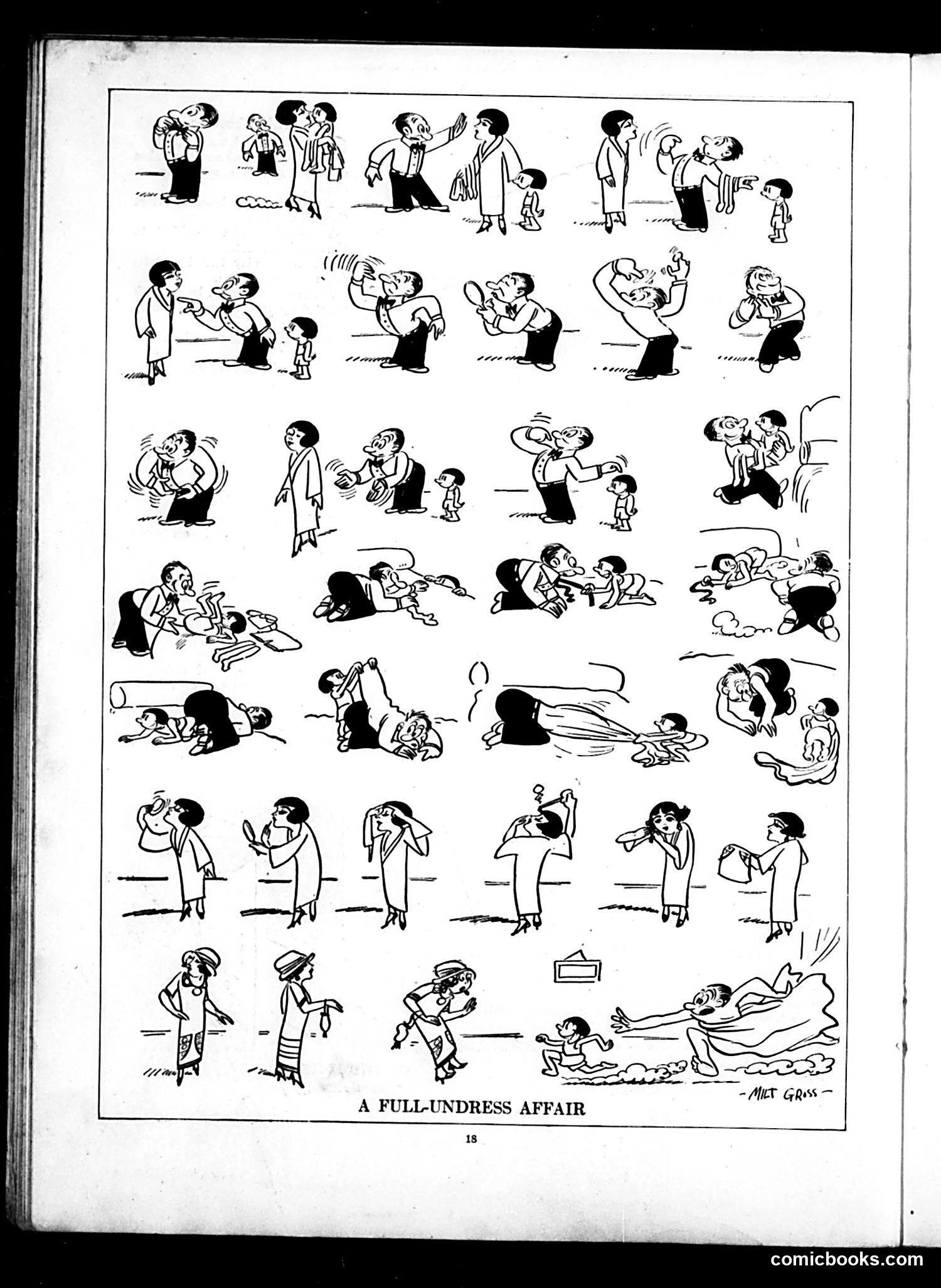
This cartoon by Milt Gross is a sequential comic depicting a child's mishap with clothing. The strip shows a small child progressively losing their dress through various comedic situations—getting caught on objects, being pulled by adults, and encountering mishaps. The title's pun ("full-undress" rather than "full-dress") plays on the irony that formal occasions typically require proper dress, while here the child ends up increasingly undressed. The humor derives from slapstick physical comedy typical of early 20th-century comics: the child's escalating wardrobe disasters and the exaggerated reactions of surrounding adults. It's lighthearted humor targeting family readers, without apparent political or social commentary—simply comedic observations of childhood chaos and the fragility of clothing.
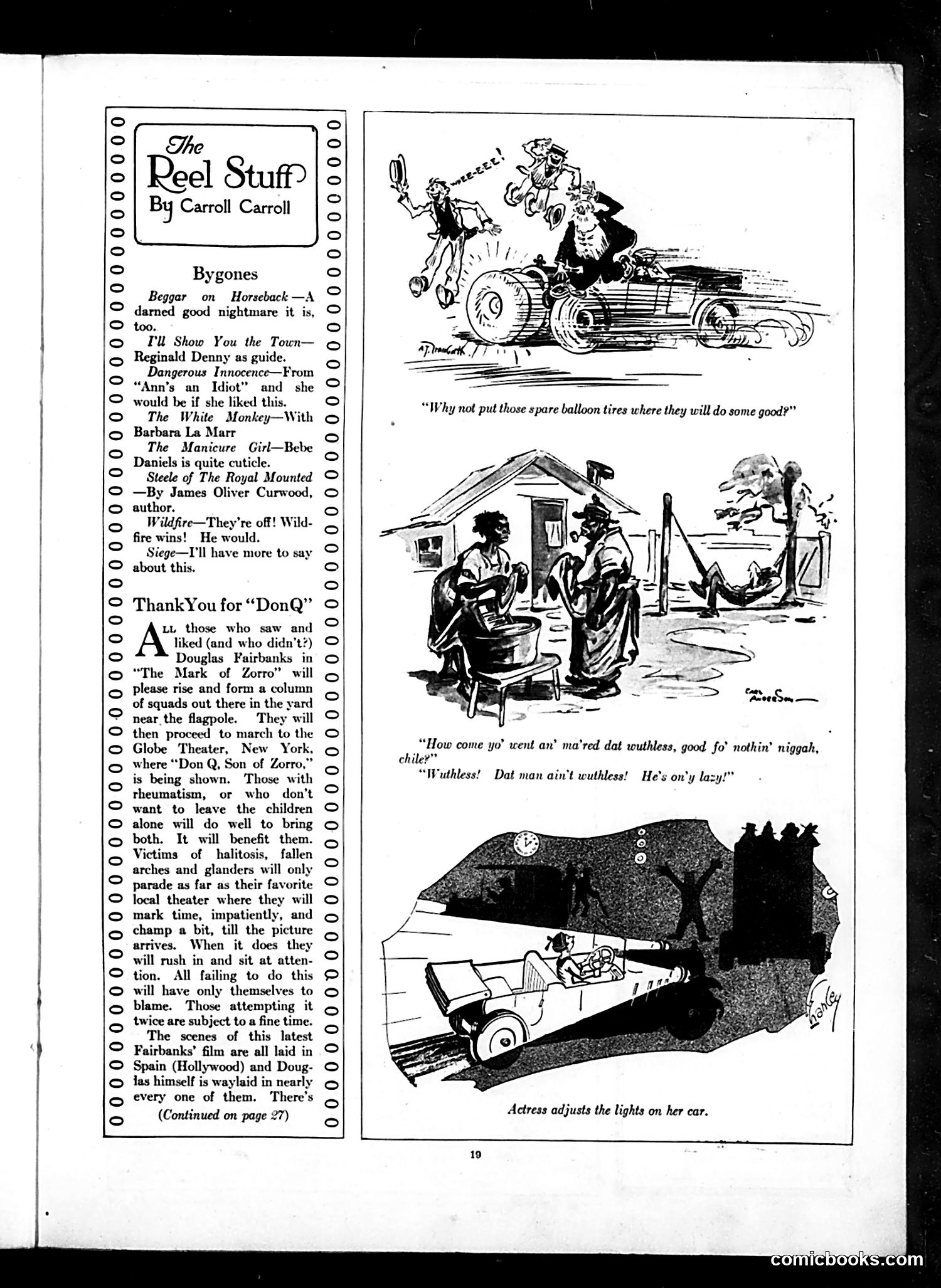
This page contains "The Reel Stuff" film column by Carroll Carroll, reviewing current movies. The three cartoon illustrations are humorous commentary on contemporary films: 1. **Top cartoon**: Shows two figures in a speeding car with loose tires, captioned "Why not put those spare balloon tires where they will do some good?" — satirizing a film's implausible action sequences. 2. **Middle cartoon**: Depicts rural characters discussing laziness versus worthlessness, illustrating social stereotypes from a movie's portrayal of working-class life. 3. **Bottom cartoon**: Shows a woman adjusting car headlights in darkness, likely mocking a film's technical inaccuracies or unrealistic scenarios. The column discusses Douglas Fairbanks films and "The Mark of Zorro," suggesting these illustrations parody the exaggerated or absurd situations common in silent-era adventure movies.
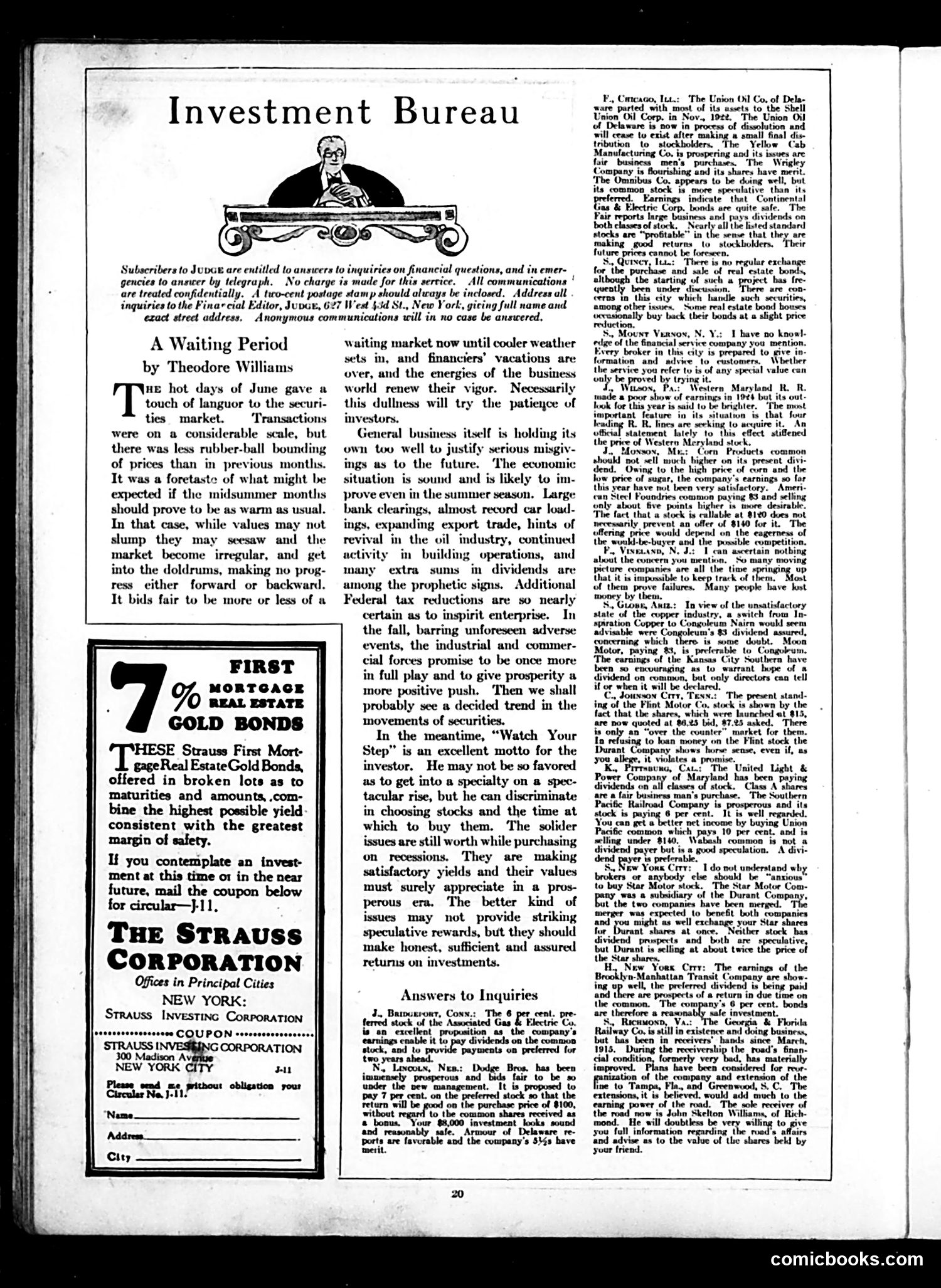
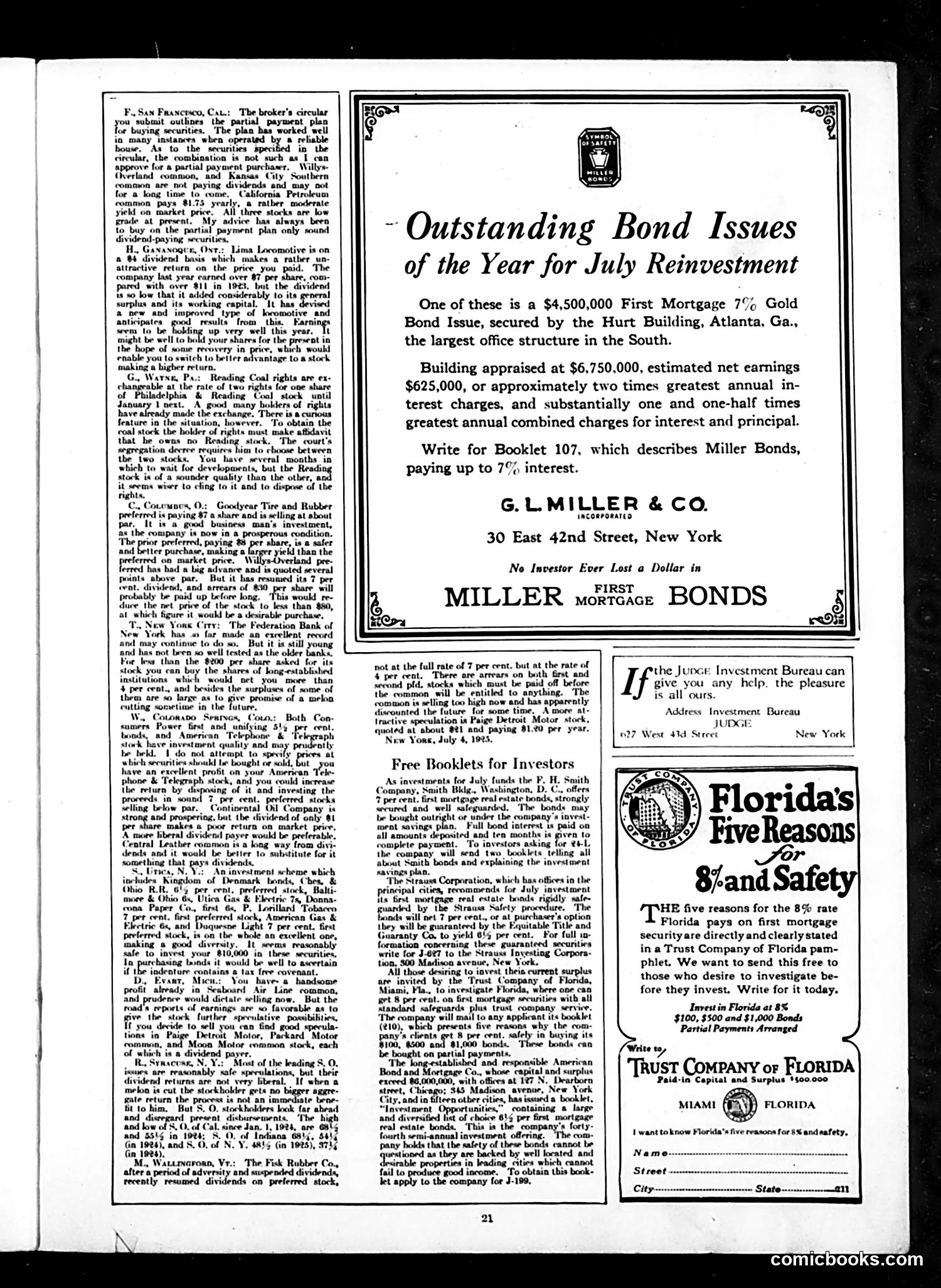
This page is primarily **financial advertising**, not satirical content. It contains investment advice columns addressing reader questions about stocks and bonds, alongside commercial advertisements for investment firms. The visible advertisements promote: - **G.L. Miller & Co.** (New York bond brokers) highlighting a $4.5 million First Mortgage bond issue secured by the Hurt Building in Atlanta - **Investment Bureau** offering advisory services - **Trust Company of Florida** promoting 8% mortgage bonds with "five reasons for safety" The left column contains financial Q&A discussing dividend yields, stock quality, and investment strategies for various securities (Lima Locomotive, Reading Coal, Goodyear Tire and Rubber, etc.). This reflects 1920s investment culture emphasizing dividend income and company fundamentals. There is **no political satire or cartoon** visible on this page—it's a straightforward financial services section typical of Judge's later years when the magazine increasingly featured business-oriented content.
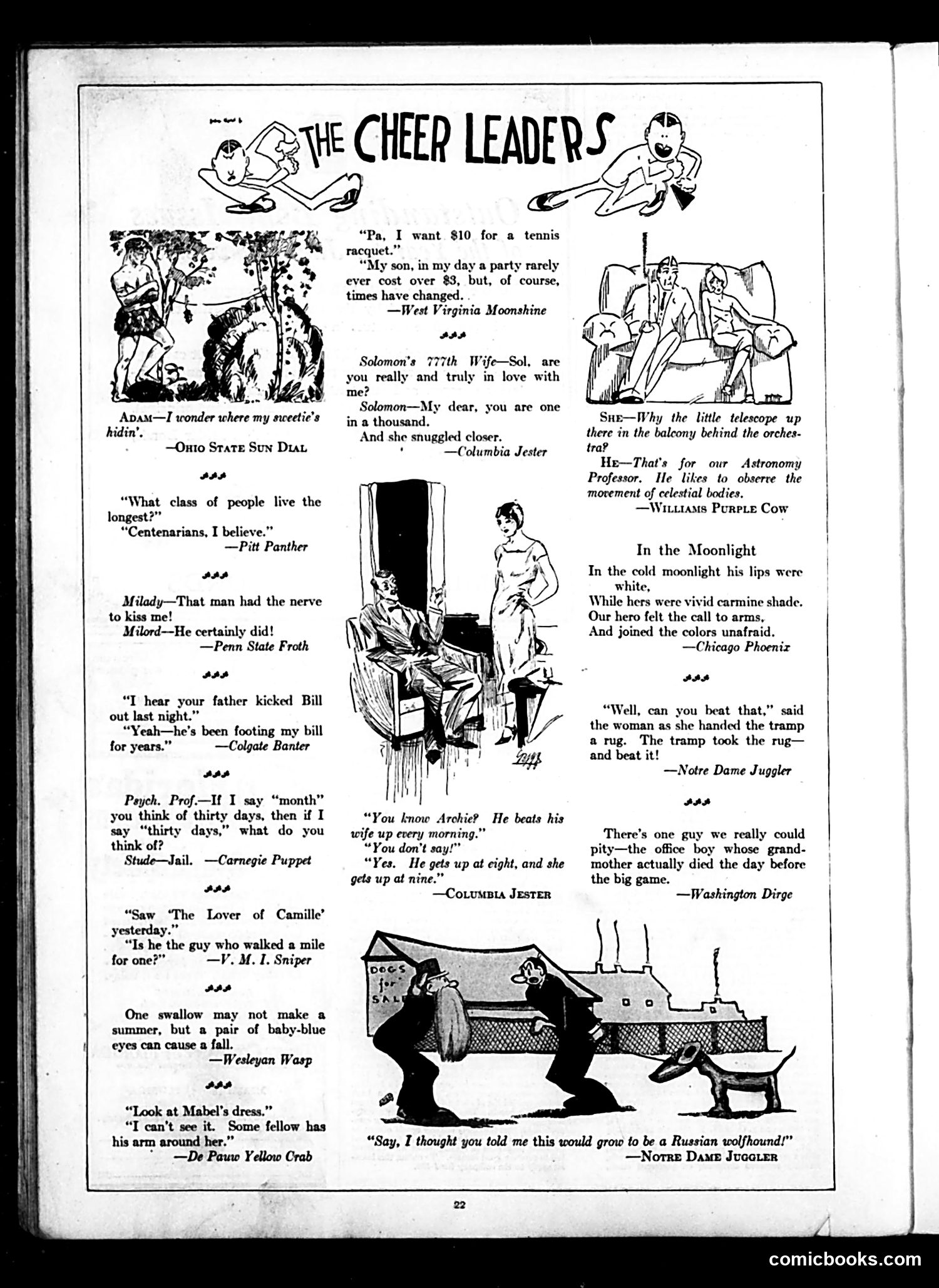
This is a collection of brief jokes and witticisms from various college humor magazines, arranged around cartoons. The content reflects early 20th-century collegiate life and dating customs. **Key themes:** - **Dating/romance anxieties**: Multiple jokes about young men pursuing women, kissing, and arm-in-arm walks - **Generational economics**: A father dismissing his son's $10 request for a tennis racket, noting prices were cheaper "in my day"—reflecting post-WWI inflation concerns - **Marital humor**: Solomon's 777th wife joke (polygamy as comedy), and a domestic violence joke played for laughs ("he beats his wife up every morning") - **College life**: References to campus pranks, astronomy professors, office boys, and "the big game" - **Visual gags**: A dog-breeding mishap cartoon; a tramp beating a rug literal-mindedly The satire targets youthful naiveté, generational gaps, and social pretension. By modern standards, some content—particularly the domestic violence joke—appears shockingly casual.
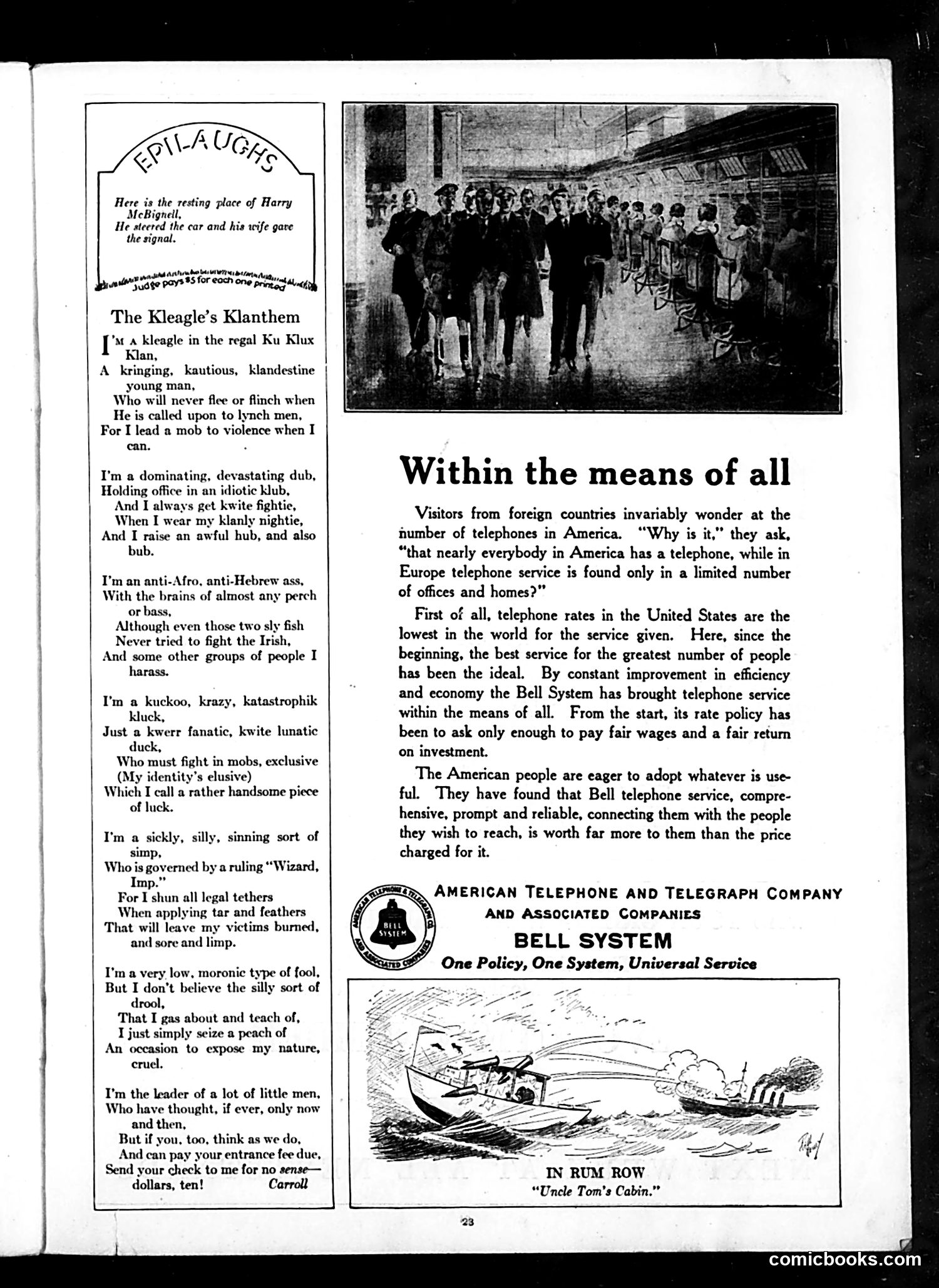
This page contains two distinct items: **Left side: "The Kleagle's Klanthem"** is a satirical poem mocking the Ku Klux Klan. A "Kleagle" was a KKK officer title. The poem, attributed to "Carroll," uses deliberate misspellings (words starting with "K") to ridicule the organization while explicitly condemning its racism, violence, and mob lynching. It portrays Klan members as ignorant, cowardly (hiding behind masks and group violence), and morally corrupt—willing to torture people ("tar and feathers"). The satire is direct: the Klan is presented as foolish, brutal, and un-American. **Right side and bottom: Bell Telephone advertisement** promoting affordable telephone service as accessible to all Americans, contrasting American telephone availability favorably against limited European service. An illustration depicts a rustic riverside scene ("In Rum Row"). The page juxtaposes fierce anti-Klan satire with corporate advertising—an unusual editorial choice reflecting Judge's progressive stance against extremist hate groups during the KKK's 1920s resurgence.
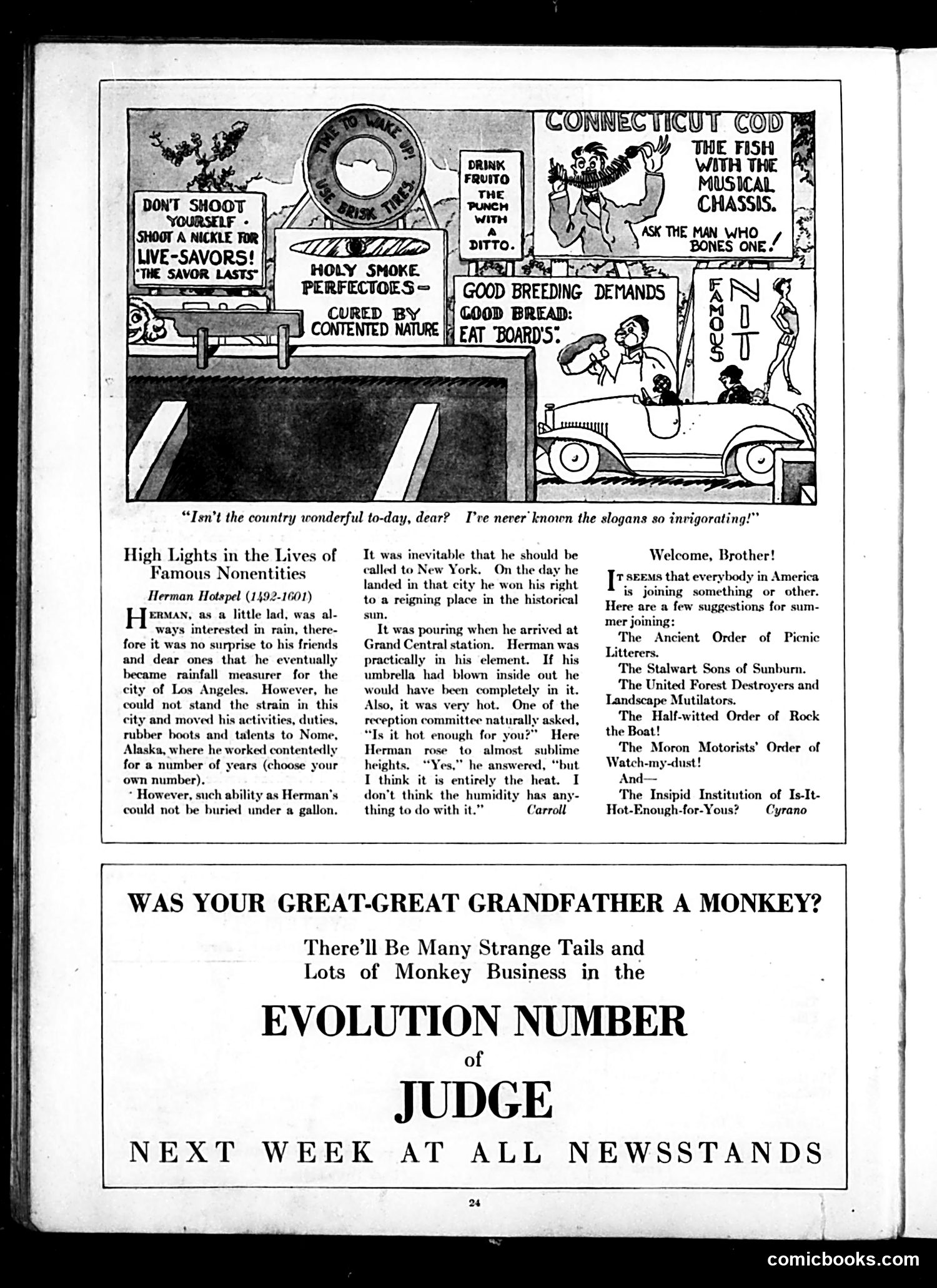
This page from the satirical magazine **Judge** contains several distinct pieces mocking American culture and contemporary trends: **Top cartoons** satirize commercial advertising and social crazes—absurd slogans ("Don't shoot yourself"), health drink promotions, and the proliferation of membership organizations. The final panel mocks shallow civic participation, listing ridiculous "Orders" people might join (Picnic Litterers, Forest Destroyers, etc.), suggesting Americans mindlessly join any group. **"Herman Hotspel" profile** is a humorous "biography" of a minor functionary (rainfall measurer) whose only notable achievement is a banal observation about humidity. It satirizes the magazine's recurring feature celebrating obscure "nonentities"—poking fun at the human tendency to inflate trivial accomplishments. **Bottom advertisement** promotes Judge's upcoming "Evolution Number," appearing to reference contemporary debates over Darwinian evolution—a controversial topic in 1920s America, particularly regarding human origins. The provocative headline "Was Your Great-Great Grandfather a Monkey?" suggests the issue will address evolution skepticism with satirical humor.
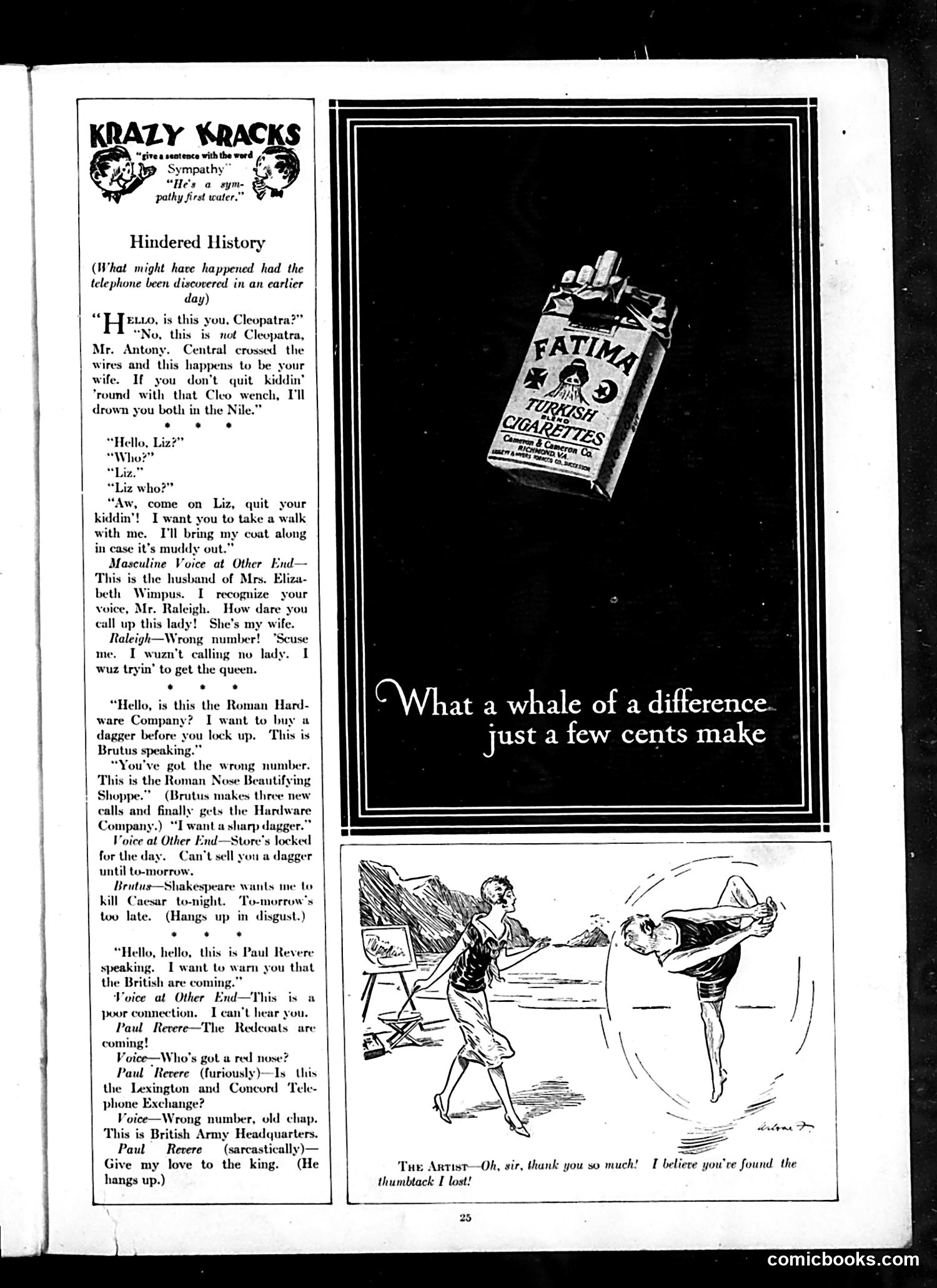
This satirical piece imagines how telephone technology would have disrupted famous historical moments. The humor relies on anachronism: applying modern telephone inconveniences (wrong numbers, poor connections, closed businesses) to critical historical events. The sketches mock: - **Antony and Cleopatra**: A crossed wire exposes infidelity to Antony's wife - **Sir Walter Raleigh**: A jealous husband intercepts his call to Queen Elizabeth - **Brutus**: Unable to reach the hardware store to buy a dagger for Caesar's assassination (delayed by business hours) - **Paul Revere**: His famous warning about British troops gets garbled through a "poor connection" The cartoon's point: modern communication technology creates obstacles and misunderstandings that would have prevented history's pivotal moments. It's a gentle satire on how phones create domestic chaos and bureaucratic frustration—common complaints of the early telephone era when this was published.
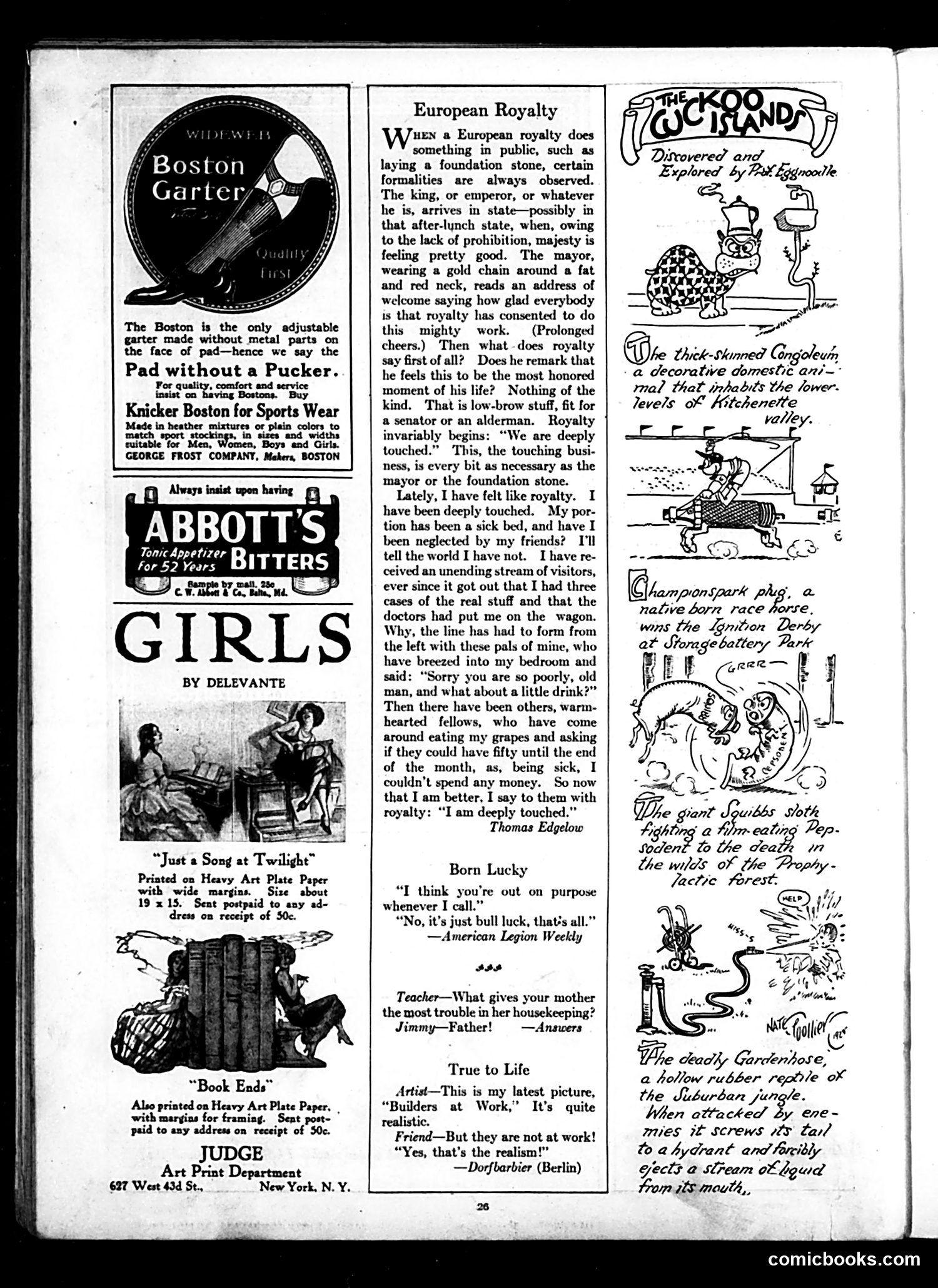
This page is primarily **advertising and humor content** rather than political satire. The left side features product ads (Boston Garter, Abbott's Bitters) and a book promotion for "Girls" by Delevante, with sample artwork. The center contains **"European Royalty,"** a humorous essay by Thomas Edgelow mocking the pretensions of European monarchy. The joke: when royalty performs public ceremonies (laying foundation stones), they always claim to be "deeply touched"—a formulaic, insincere gesture. Edgelow compares this to his own experience recovering from illness, where visitors exploited his situation (asking for loans, eating his grapes) while claiming concern. He now responds with mock-royal "I am deeply touched"—satirizing empty sentiment. The right side shows **"The Cuckoo Island,"** a whimsical cartoon strip featuring invented fantastical creatures (the "thick-skinned Congoleum," a "native race horse"). These appear to be playful nonsense illustrations rather than political commentary. The page also includes short joke items about luck and honesty, typical of Judge's humor format.
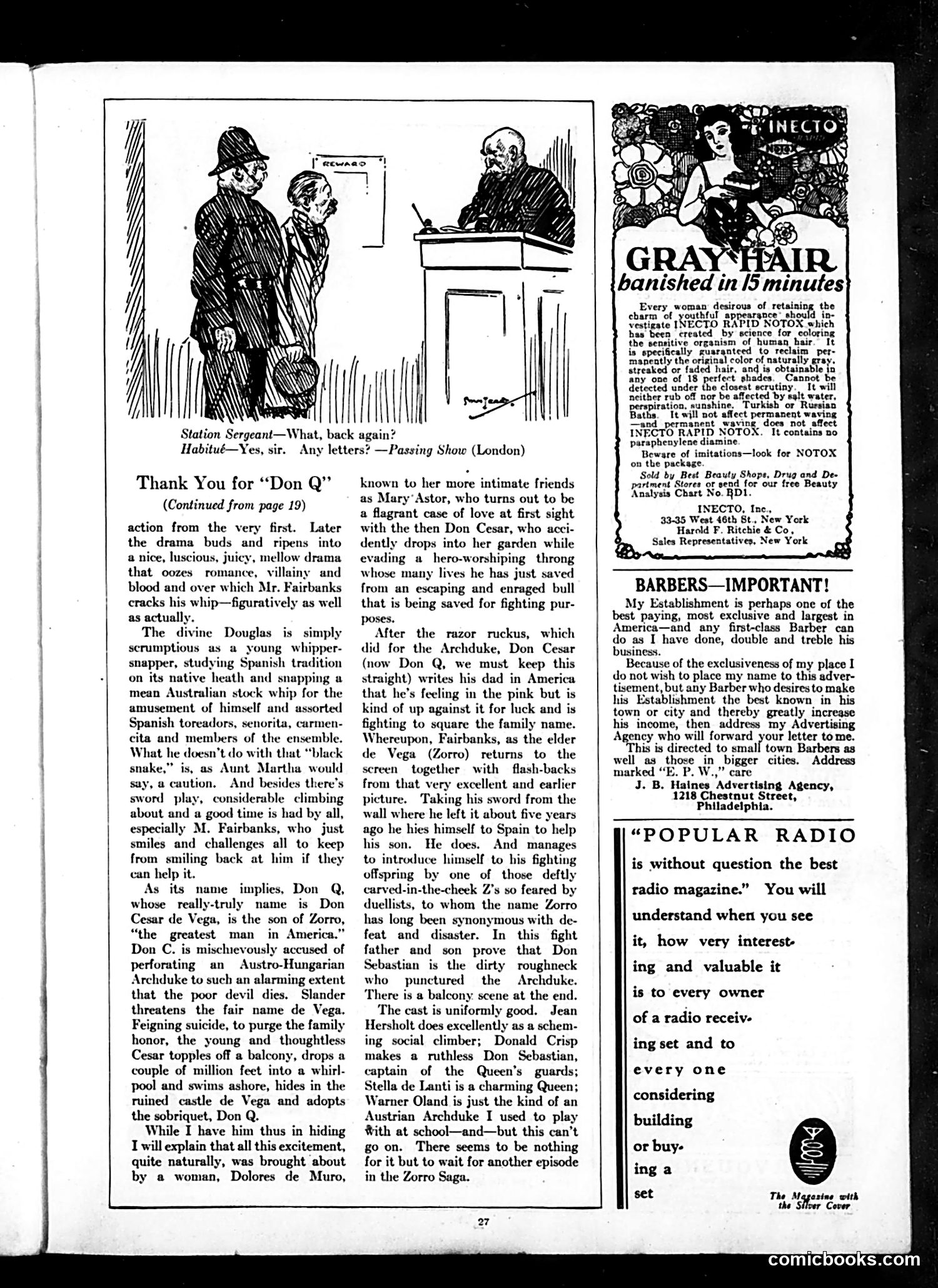
**The cartoon** (top left) is a simple gag: a station sergeant asks a habitual offender "What, back again? Any letters?" The joke relies on the assumption that this repeat visitor is so frequently detained that the sergeant expects him to receive mail at the police station—a comment on habitual criminality. **The main content** is a favorable review of the film "Don Q, Son of Zorro," starring Douglas Fairbanks. The critic praises Fairbanks's swashbuckling performance, sword work, and physical comedy. The plot involves Fairbanks playing Don Q, son of the legendary Zorro, who must clear his family name after being falsely accused of assassinating an Austrian Archduke. The review emphasizes action, romance, and Fairbanks's athletic prowess. **The advertisements** include a hair-coloring product ("Insecto Rapid Notox") and notices for barber shops and radio sets—typical period advertising with no particular satirical content.
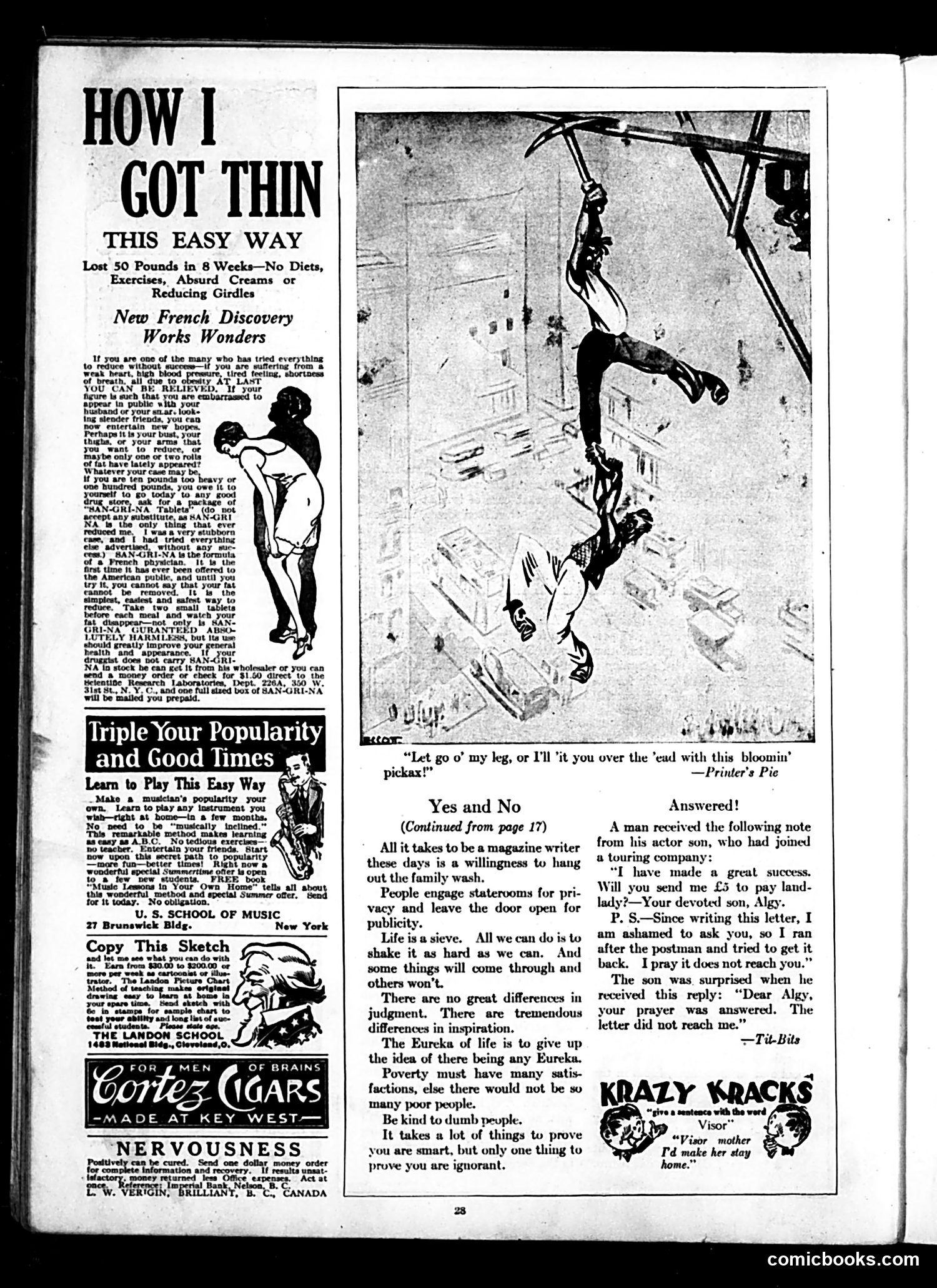
This page is primarily **advertising** rather than editorial satire. The main featured content promotes "Sangurina Tablets," a fraudulent weight-loss product claiming to shed 50 pounds in 8 weeks through a "New French Discovery"—a common marketing trope of the era exploiting fascination with European remedies. The small cartoon (bottom right) shows a comedic domestic dispute, with one figure threatening another with a pickax over a leg—likely representing marital conflict or slapstick humor typical of Judge's comic content. The "Yes and No" column offers aphoristic observations about life and writing—philosophical musings rather than political satire. The page also includes advertisements for music lessons and cigars. **What's notable for modern readers:** Early 20th-century Judge pages mixed serious satire with dubious patent medicine ads, reflecting the era's lack of consumer protection regulations and widespread medical fraud.
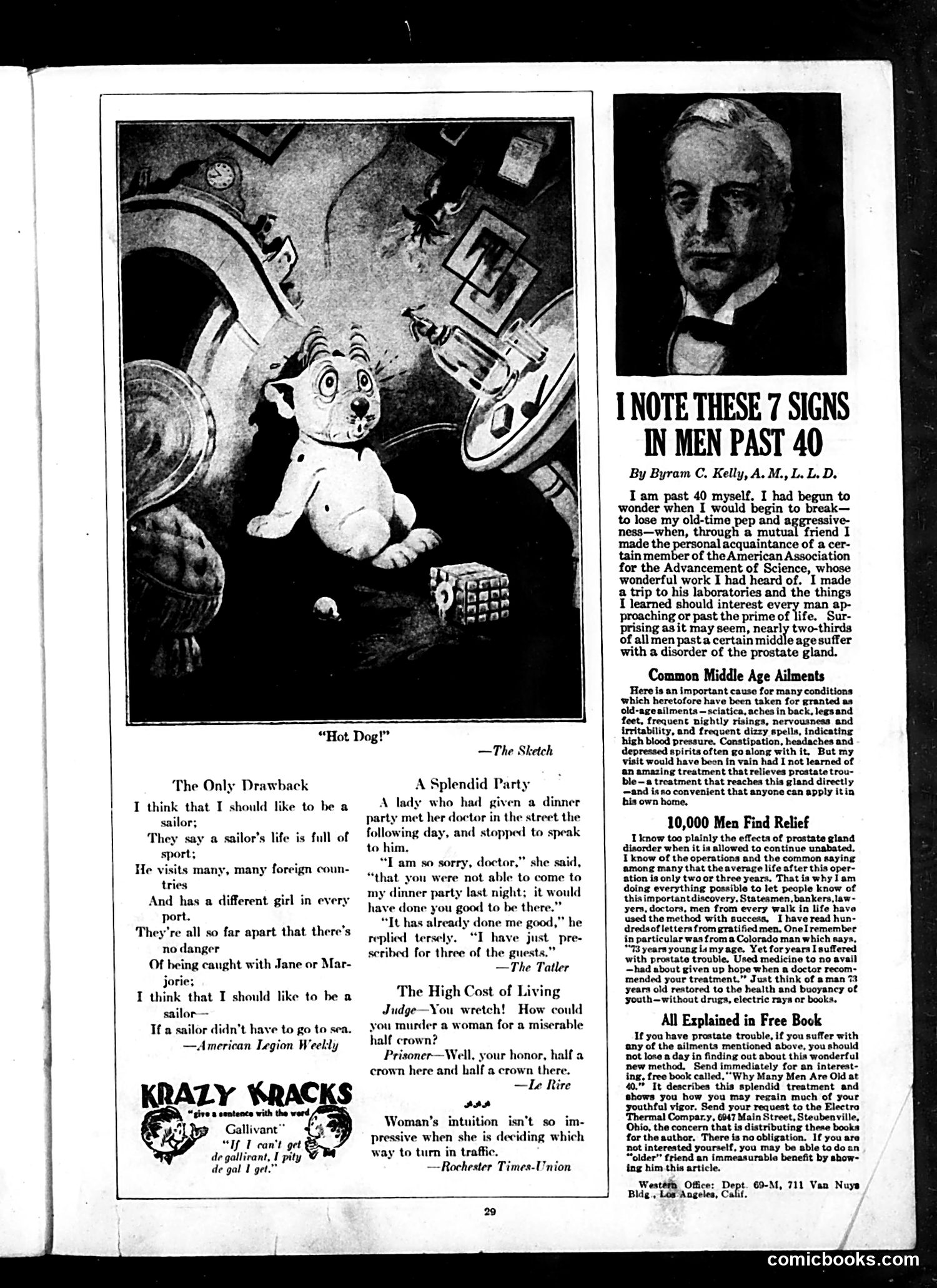
This page from *Judge* (a satirical weekly) contains: **Left side**: Humorous poems and jokes mocking common desires and social absurdities—a sailor wanting seafaring life without going to sea; jokes about infidelity, medical humor, and cost-of-living complaints. The "Hot Dog" cartoon shows a dog amid chaotic domestic items. **Right side**: A prominent **advertisement disguised as editorial content** by Byram C. Kelly promoting a prostate treatment. This represents classic early 20th-century quack medicine marketing—claiming to relieve age-related ailments and restore vigor without surgery, drugs, or "electric rays." The testimonial format (10,000 men claiming relief) was typical deceptive advertising of the era. **The satire**: The juxtaposition is revealing: *Judge* printed this alongside its satirical content, possibly ironically. The ad's pseudoscientific claims about "prostate gland disorder" affecting "nearly two-thirds" of middle-aged men epitomizes the medical fraud preying on aging male anxieties that *Judge* typically mocked.
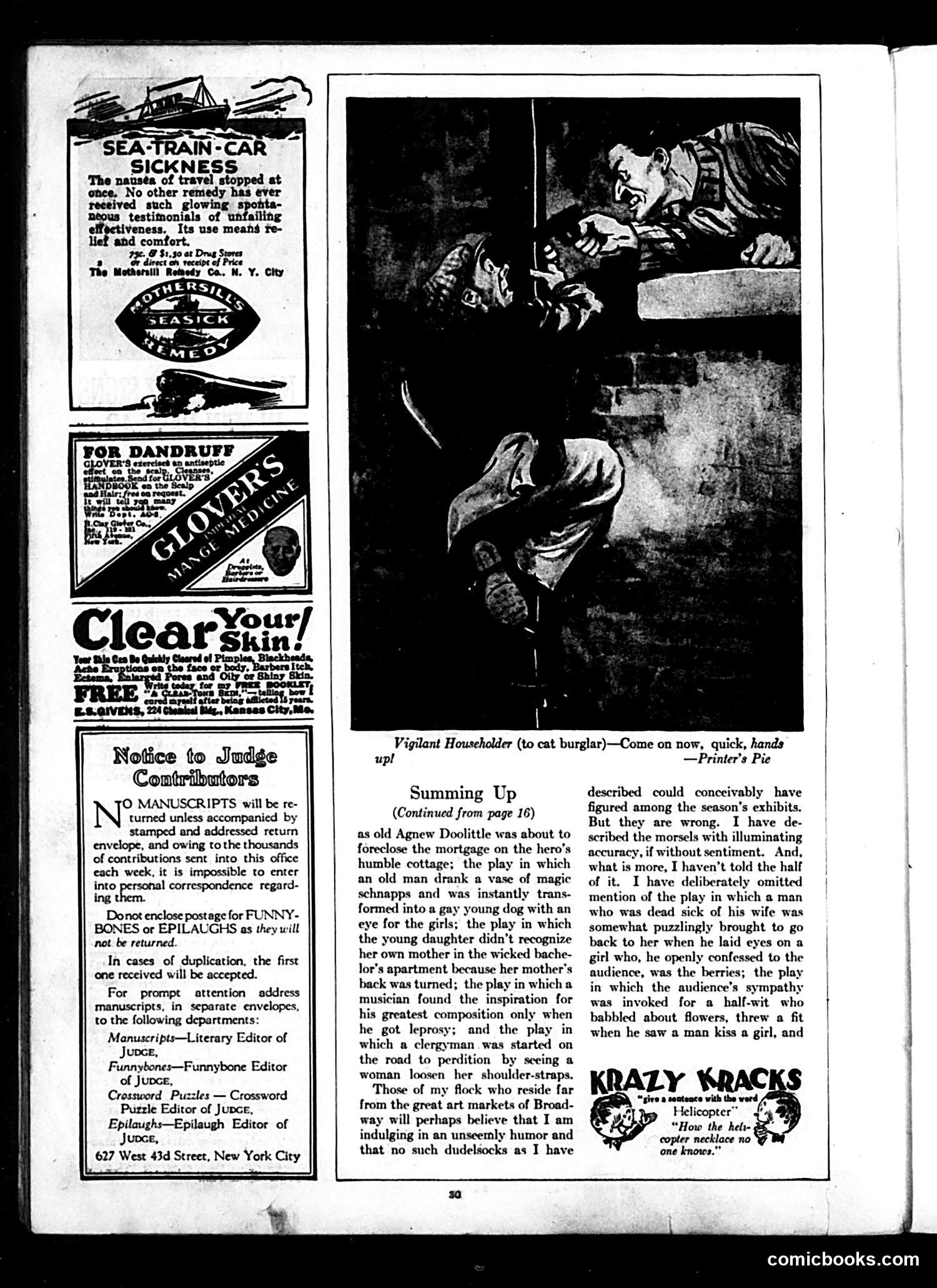
This page is primarily **advertisements and editorial content** rather than political satire. The main cartoon shows a "Vigilant Householder" confronting a cat burglar, with the householder demanding the burglar surrender ("hands up!"). This is a straightforward domestic humor joke about home security, not political commentary. The bulk of the page contains: 1. **Product ads** (sea-sickness remedy, dandruff gloves, skin cream) 2. **Editorial notice** to contributors about manuscript submission policies 3. **"Summing Up"** column—a theater critic sarcastically listing absurd Broadway plots from the season (old men transformed into young men, mistaken identities, etc.), mocking melodramatic and formulaic theatrical conventions of the era 4. **"Krazy Kracks"** wordplay joke section The satire targets **theater clichés** rather than politics. No identifiable public figures appear. This is a typical Judge page mixing light humor, advertisements, and entertainment criticism.
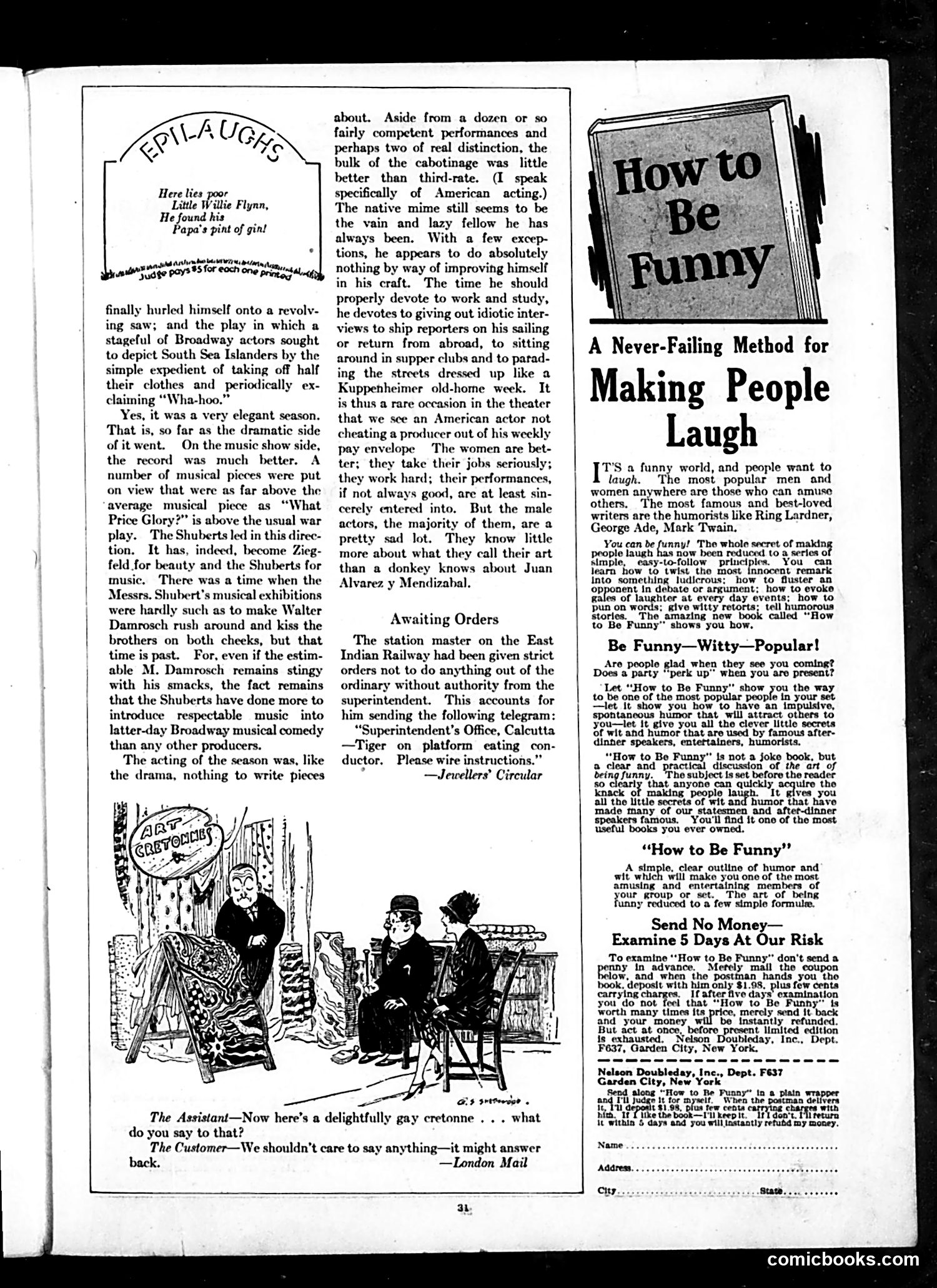
The bottom half of this page is primarily an advertisement for a book titled "How to Be Funny: A Never-Failing Method for Making People Laugh," published by Nelson Doubleday, Inc. It promotes the book's promised techniques for developing wit and humor. Above that is a brief cartoon and caption exchange set in a shop. An assistant shows fabric ("cretonne") to a customer; the customer's response plays on the fabric's name, suggesting it might literally answer back—a mild pun typical of early 20th-century humor publications. The upper left contains verse about "Little Willie Flynn" finding his father's gin—gallows humor about accidental death, reflecting the dark comedic style common in Judge magazine. The main article discusses the 1924 Broadway season, criticizing American actors as vain and lazy while praising female performers and Shubert musical productions. It references theatrical figures and trends specific to that era.
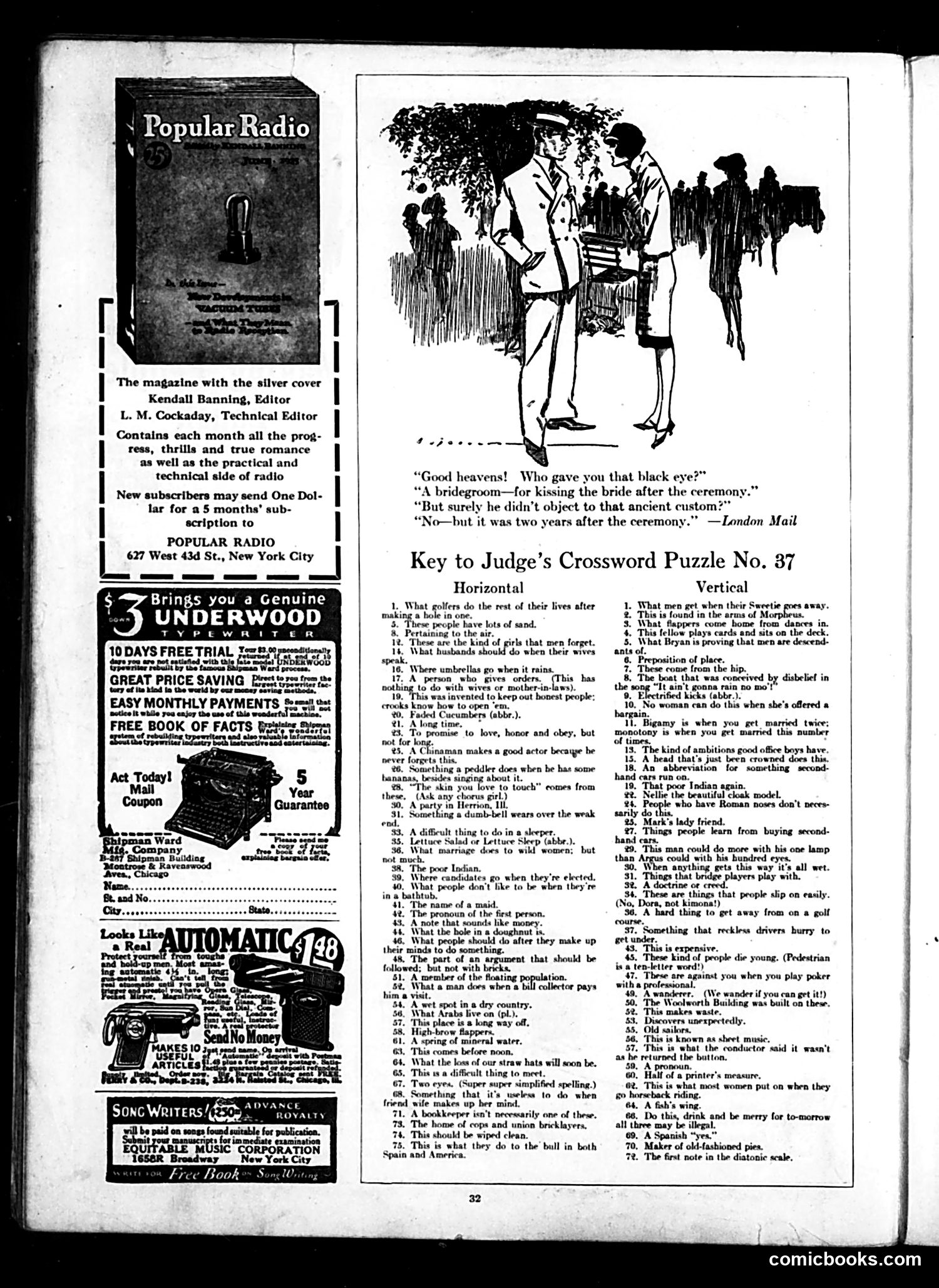
This page is primarily **advertisements and a crossword puzzle**, not political satire. The cartoon at top shows a domestic humor joke: a bridegroom has a black eye. When asked who gave it to him, he explains a bride gave it to him "for kissing the bride after the ceremony." The punchline—it happened "two years after the ceremony"—suggests he kissed *someone else's* bride, implying infidelity or impropriety. This is mild marital humor typical of the era. The bulk of the page contains advertisements (Underwood typewriter, Popular Radio magazine, etc.) and "Key to Judge's Crossword Puzzle No. 37"—a full crossword answer key with clues referencing 1920s topics: flappers, bathtubs, chorus girls, and contemporary slang. **No political content is present.** This appears to be a standard magazine filler page from Judge's advertising/entertainment section rather than its satirical editorial content.
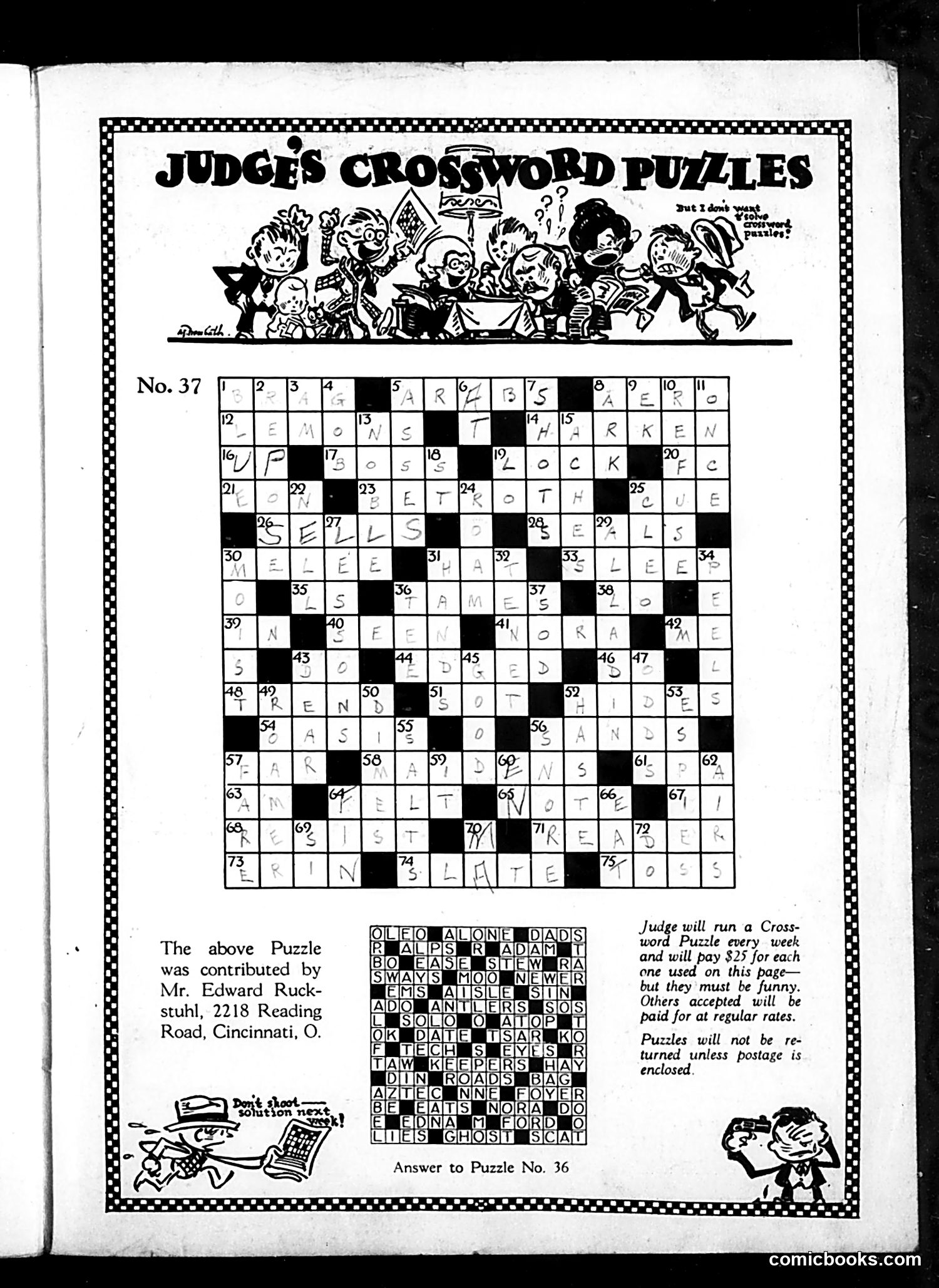
This page presents a crossword puzzle contest rather than a political cartoon. Judge magazine offered $25 payment for crossword puzzles submitted by readers, with the contributor credited as Edward Ruckstuhl from Cincinnati, Ohio. The page includes the puzzle grid, the answer key to the previous puzzle (No. 36), and submission guidelines. Notably, Judge stipulated that accepted puzzles "must be funny"—indicating they sought puzzles with humorous or clever cluing rather than standard crosswords. The magazine would pay additional rates for other accepted submissions. The cartoonish header and footer illustrations are typical Judge decorative elements but don't convey specific satire. This represents Judge's interactive reader-engagement strategy during the crossword puzzle craze of the early 20th century.
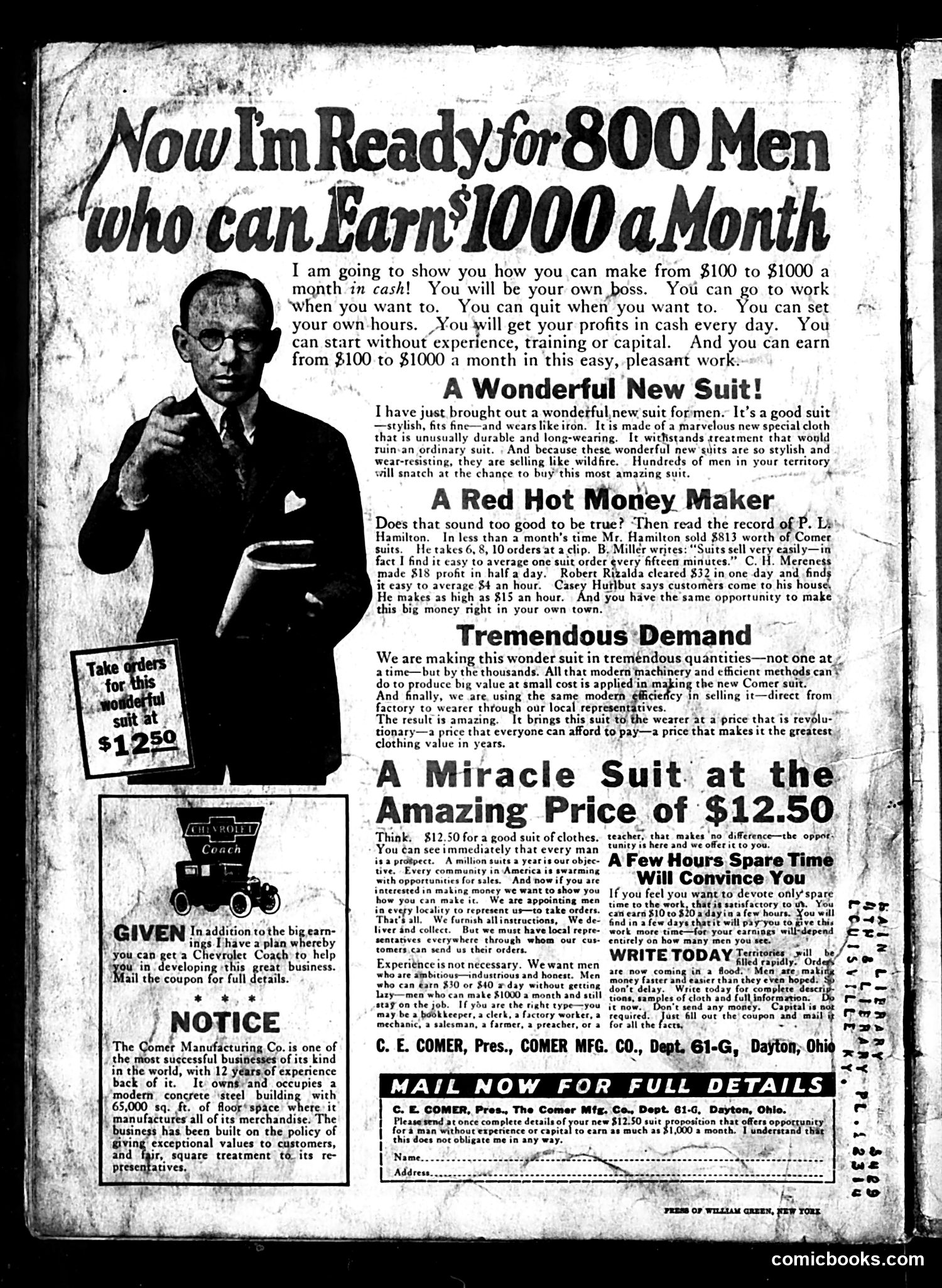
This is primarily a **business opportunity advertisement**, not political satire. It promotes the Comer Manufacturing Company's mail-order suit sales scheme, pitched as a get-rich-quick opportunity for 800 men wanting to earn "$100 to $1000 a month." The advertisement uses classic early 20th-century marketing tactics: testimonials from supposedly successful salesmen (P. Le Hamilton, B. Miller, etc.), claims of extraordinary earnings ($15-$32 per day), and an appeal to independence ("be your own boss"). The $12.50 suit price is presented as revolutionary value. A secondary incentive—a free Chevrolet Coach—sweetens the deal for recruits. **For modern readers**: This resembles contemporary multi-level marketing schemes. The vague promises, emphasis on recruitment over actual product sales, and testimonials are red flags suggesting this was likely exploitative. Judge may have included this to mock such schemes, though the page's tone is ambiguous—it reads more as a genuine business ad than satire.