
A complete issue · 37 pages · 1925
Judge — June 27, 1925
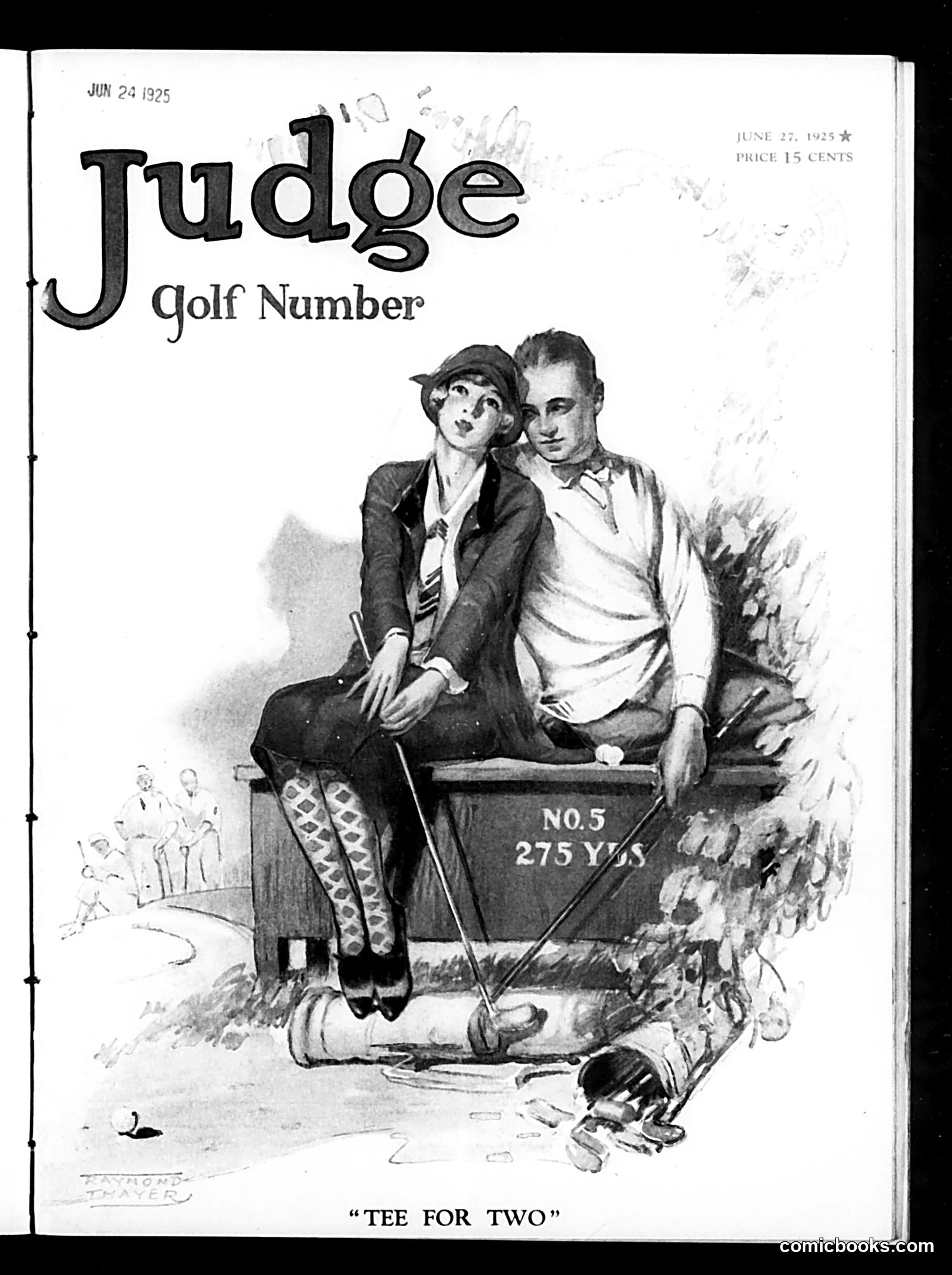
This is a "Golf Number" special issue of Judge (price 15 cents). The cover illustration titled "Tee for Two" depicts a couple at a golf course—a woman in a dark jacket and cap, and a man in light clothing, both seated on what appears to be a golf bag marked "NO.5 275 YDS." The cartoon satirizes golf as a romantic or social activity for couples in the 1920s. The intimate positioning and the subtitle suggest golfing was marketed as fashionable leisure entertainment for men and women during this Jazz Age period. The illustration captures the era's modern recreational culture where golf courses served as social venues. The overall tone is lighthearted, depicting golf as trendy entertainment rather than purely serious sport.
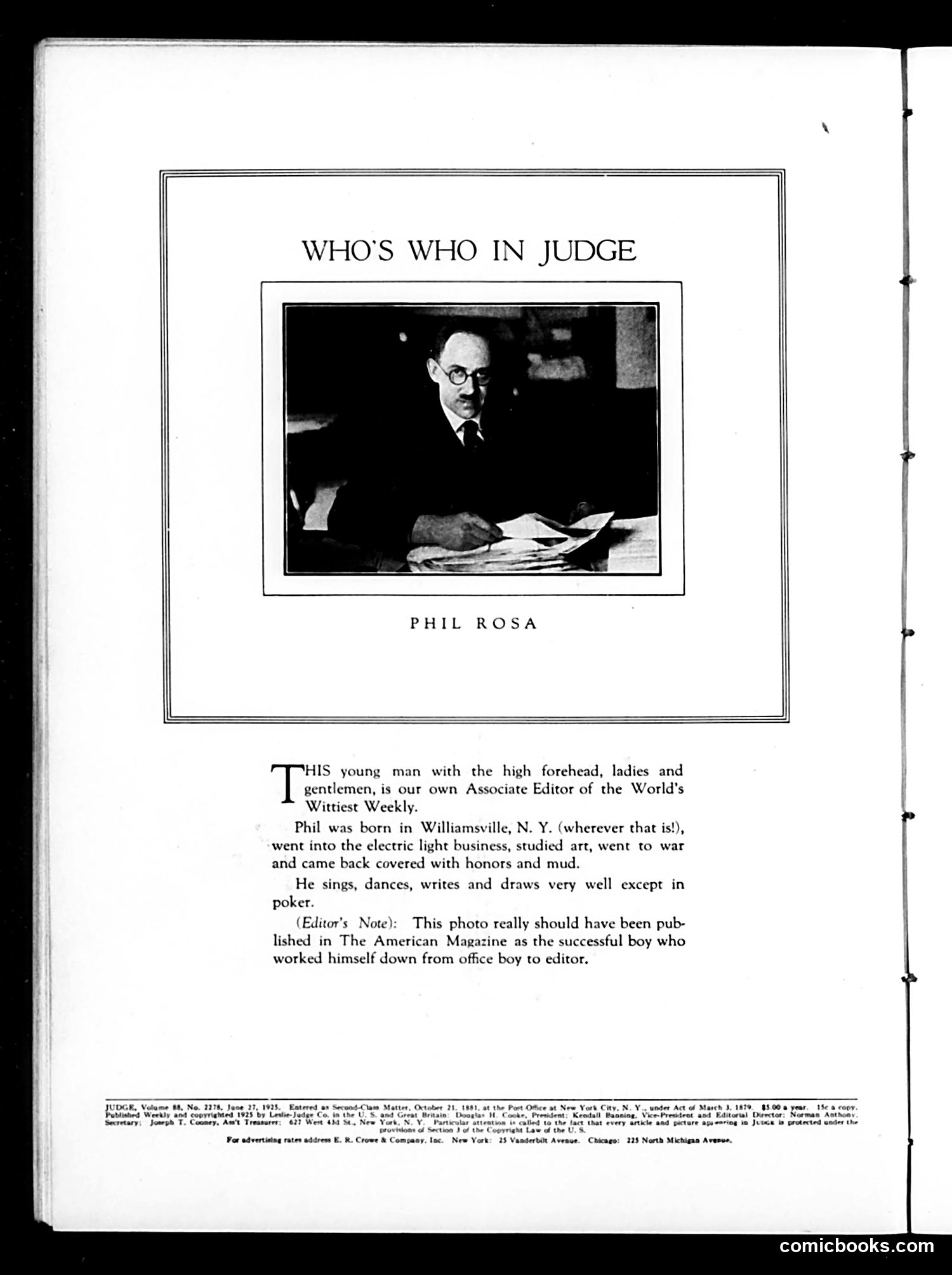
This is a biographical profile section rather than a political cartoon. It features **Phil Rosa**, identified as Associate Editor of *Judge* magazine's "World's Wittiest Weekly" edition. The accompanying text humorously sketches Rosa's background: born in Williamsville, New York, worked in electrical lighting, studied art, served in World War I. The joke emphasizes his diverse talents—"sings, dances, writes and draws very well except in poker"—a humorous admission of a personal weakness. An editor's note suggests this photo should have appeared in *The American Magazine* as a success story about someone who "worked himself down from office boy to editor," indicating this is light self-promotion for *Judge's* own staff and editorial operations.
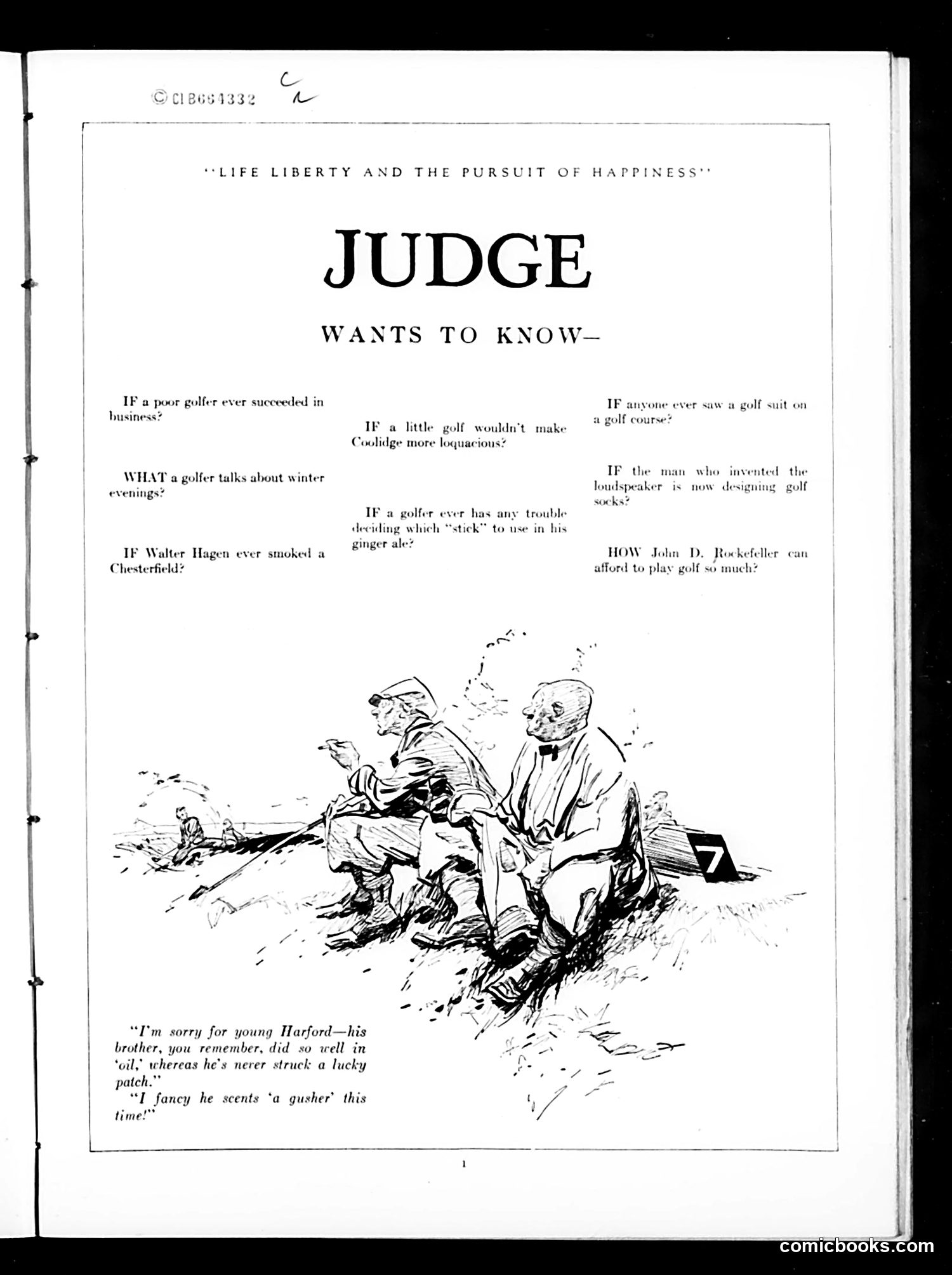
This page from *Judge* magazine presents satirical questions about golf and wealthy figures. The headline references the Declaration of Independence phrase "Life, Liberty and the Pursuit of Happiness," applying it humorously to golf culture. The questions mock: - **Poor golfers in business** – questioning unlikely success - **Walter Hagen** – a famous golfer, possibly about smoking habits - **John D. Rockefeller** – his enormous wealth funding golf expenses - **Golf culture generally** – including fashion (golf suits) and equipment debates The illustration shows two men on a golf course discussing another golfer named "Harford," suggesting he's a chronic poor player who never succeeds. The satire targets both golf obsession among the wealthy and class commentary on who can afford the sport. The humor relies on readers' familiarity with these public figures and golf's growing popularity in early 20th-century America.
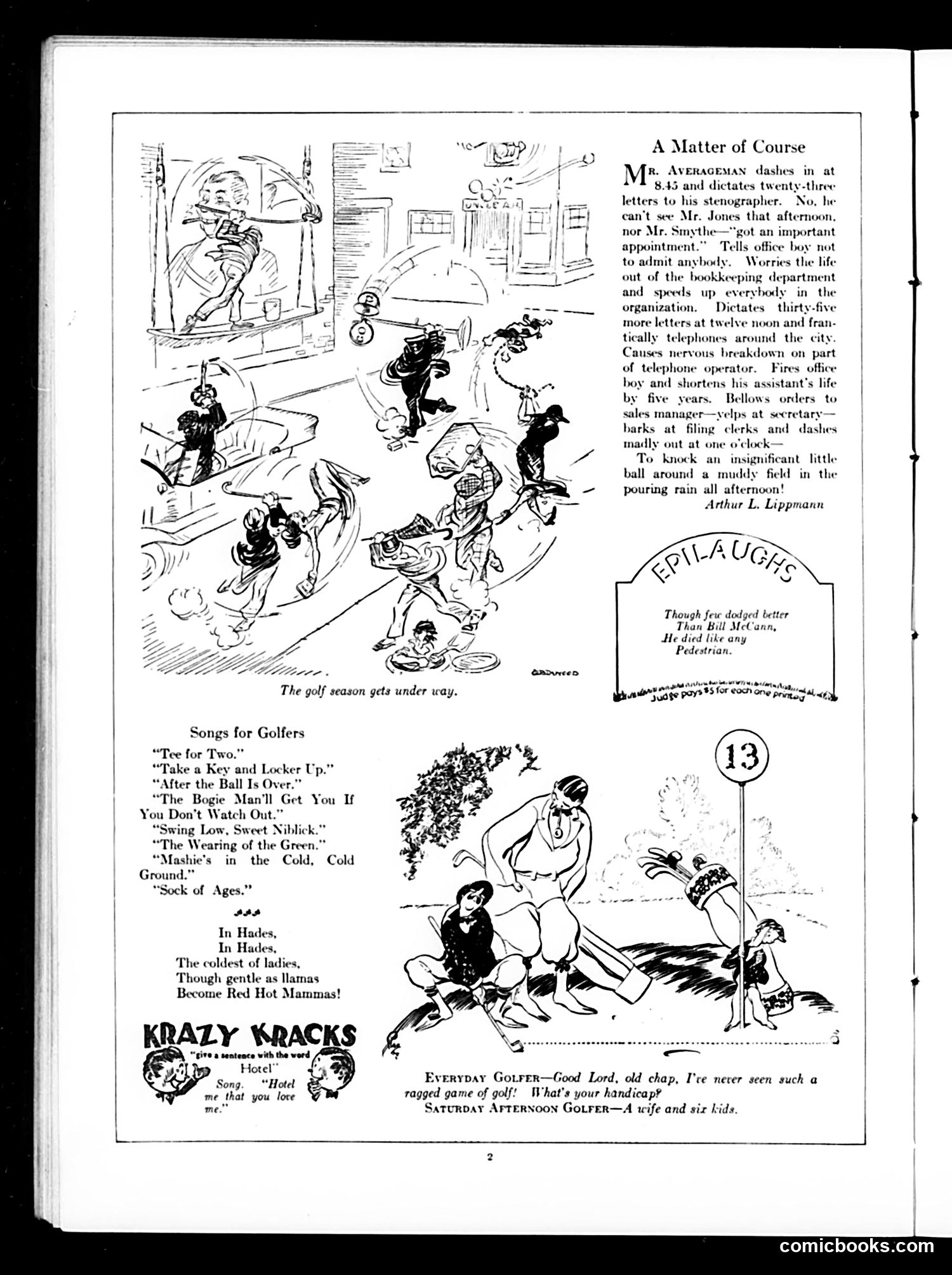
This page combines office satire with golf humor, typical of Judge's early 20th-century content. **"A Matter of Course"** mocks a harried businessman (Mr. Averageman) juggling constant workplace demands—dictating letters, managing phone calls, dealing with staff incompetence. The sketch satirizes the frantic pace of modern office life and managerial frustration with subordinates. **"The Golf Season Gets Under Way"** depicts golfers in comedic situations, including what appears to be a woman playing poorly. The accompanying "Songs for Golfers" and dialogue jokes target golf's growing popularity among the middle class, poking fun at enthusiastic but unskilled amateur players. The **"Krazy Kracks"** advertisement promotes a hotel, representing typical period advertising. Overall, the page reflects Jazz Age anxieties about modern work culture and leisure pursuits.
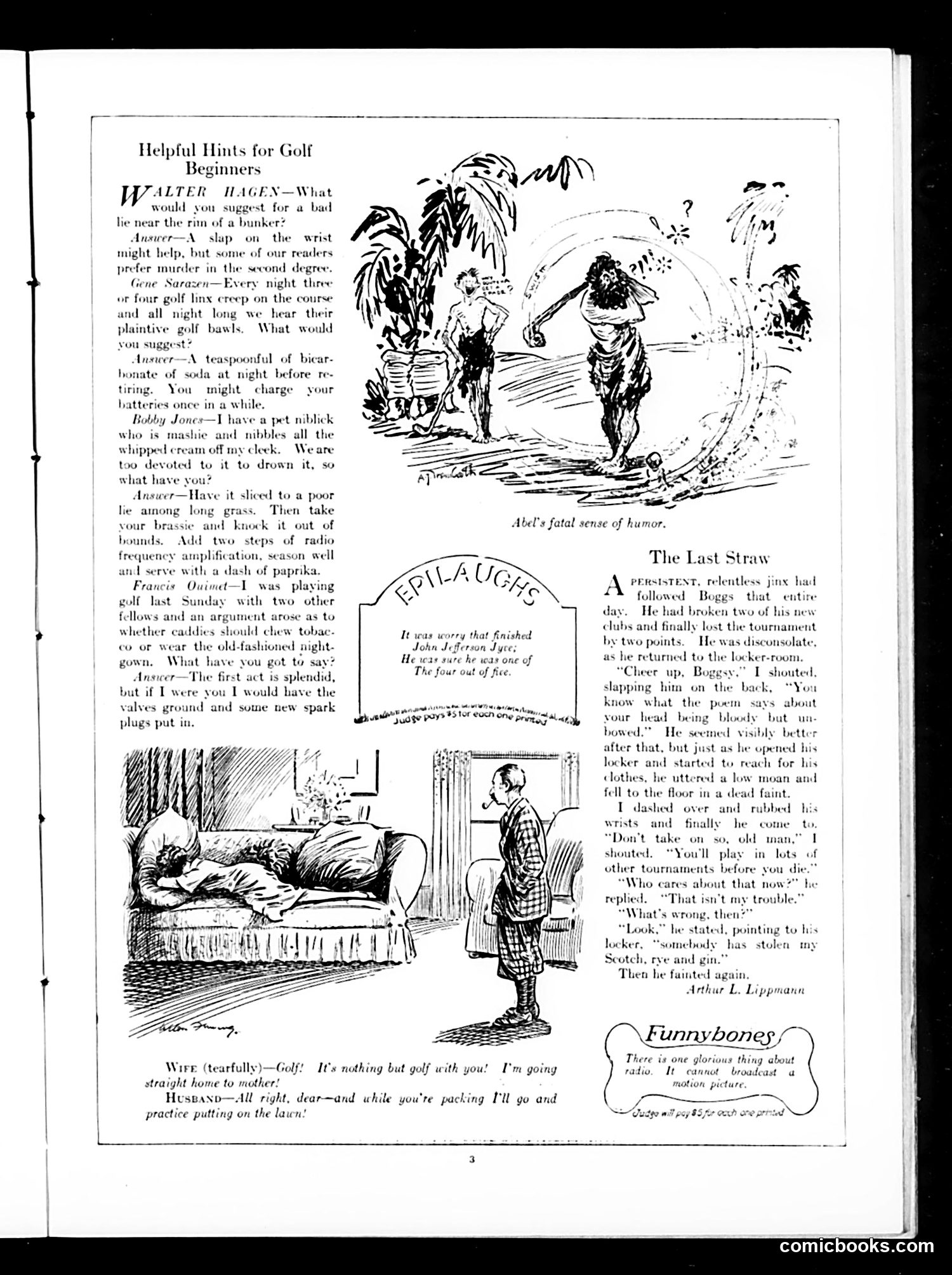
This page contains **humorous advice and anecdotes** rather than political satire. The "Helpful Hints for Golf Beginners" section features comedic tips from various contributors about golf etiquette and technique—notably, suggestions like applying bicarbonate of soda before bed and keeping a pet bullock nearby for practice. The main cartoon shows a wife cheerfully telling her husband she's leaving him to play golf, while he objects. The humor relies on the then-contemporary popularity of golf among leisure classes and marital comedy. "The Last Straw" recounts a golfer's frustrating tournament loss, using golf as the setup for domestic humor. The "Funnybones" section makes a pun about radio broadcasting. **Overall:** This is **social humor** about early 20th-century leisure activities and marriage dynamics, not political commentary.
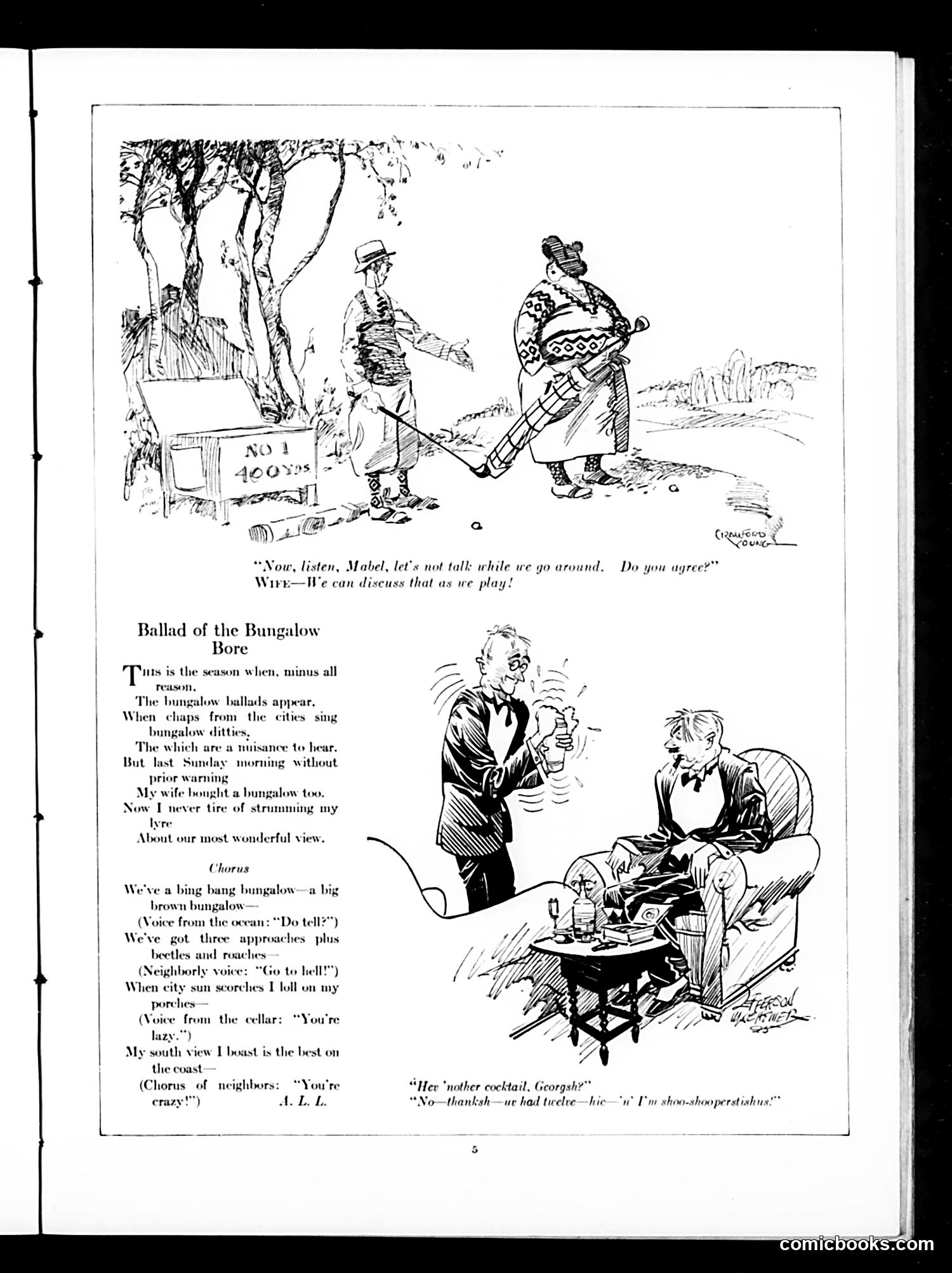
This page satirizes the tedious social phenomenon of the bungalow owner who won't stop talking about his property. The top cartoon shows a couple trying to play golf while a man interrupts them with unsolicited commentary about his bungalow's "wonderful view." The poem below mocks this figure further—a man who bought a bungalow and now endlessly discusses it. The humor derives from his inability to enjoy anything without relating it back to his home: even when the city sun scorches his porch or beetles infest it, he's compelled to bore neighbors with details. The lower illustration depicts him gesticulating wildly while annoying a seated listener with yet another cocktail-hour monologue about his prized bungalow, capturing the exasperation of those forced to endure his obsessive bragging.
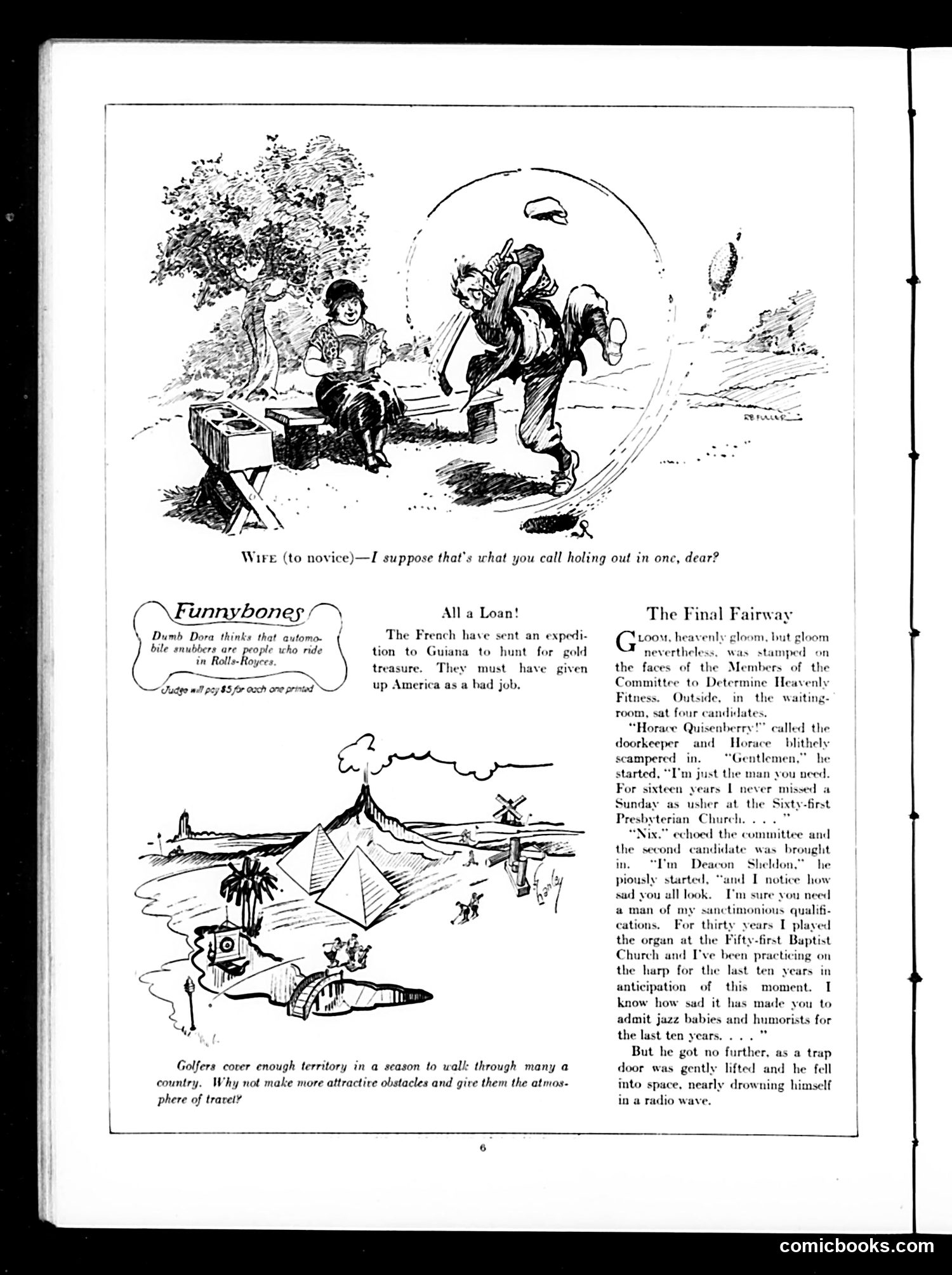
This page contains three humor pieces satirizing early 20th-century American society: **"Wire (to novice)"** mocks golf etiquette—a wife's naive question about "holing out in one" suggests she misunderstands golfing terminology. **"Funnybones"** offers quick jokes: one mocks wealthy car owners (confusing "automobile snubbers" with Rolls-Royce riders), another satirizes France's colonial gold-hunting in Guiana as abandoning America as a "bad job." **"The Final Fairway"** is a longer satirical story ridiculing religious hypocrisy. A heavenly admissions committee rejects sanctimonious candidates: one prides himself on never missing church duties; another boasts of organ-playing and harp practice. Both are rejected, with the second literally falling through a trap door. The satire targets those whose faith centers on performing religious duties rather than genuine virtue, while the committee's casual mention of admitting "jazz babies and humorists" suggests the afterlife itself has modernized beyond stuffy piety.
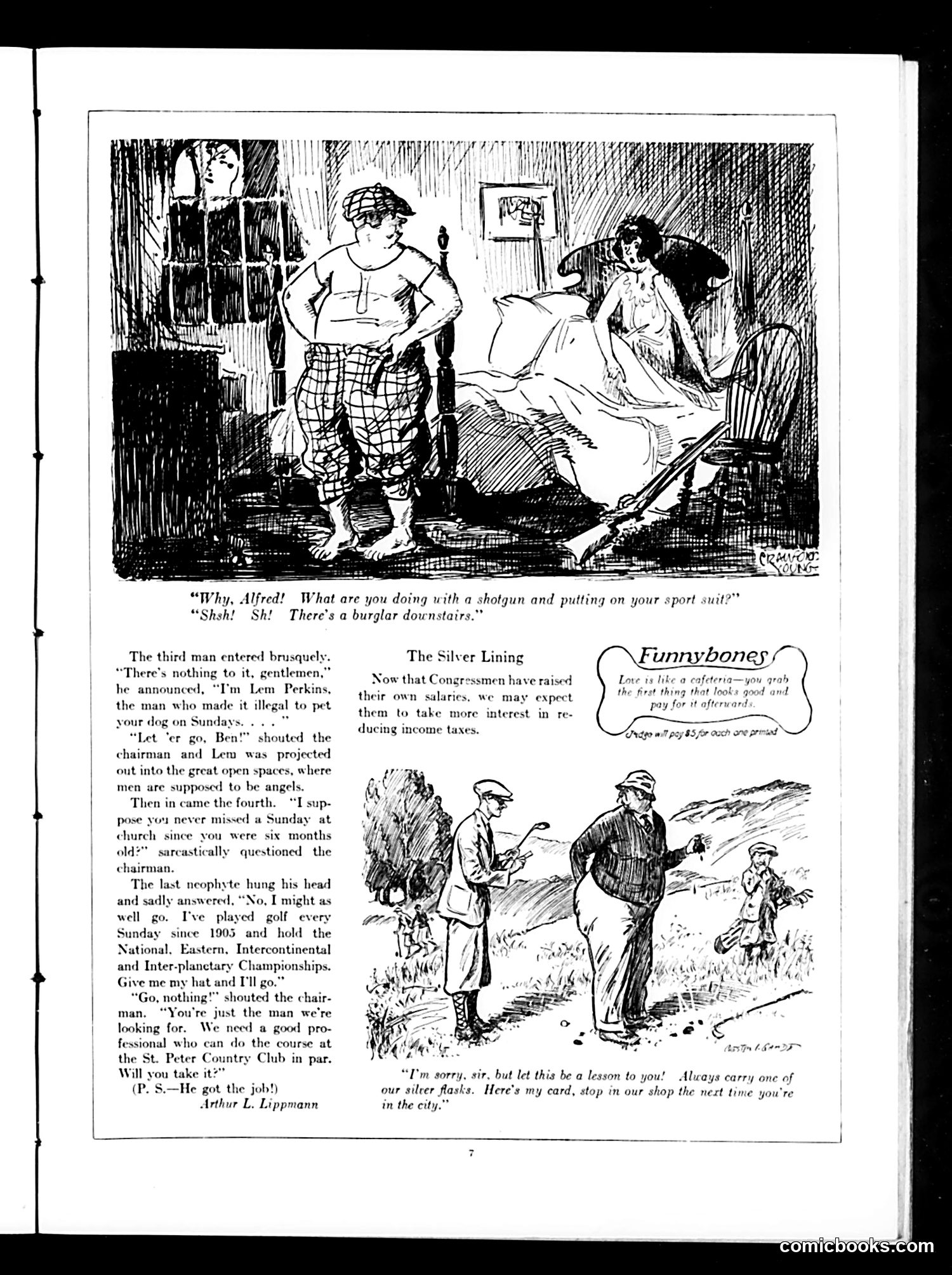
**Top Cartoon:** A domestic comedy about Sunday blue laws. A man dressed in hunting gear prepares to shoot a "burglar," but it's actually a pretext to hunt on Sunday—when such activity was legally prohibited. The joke mocks overly restrictive Sabbath laws that banned recreational activities. **Middle Story:** Satirizes religious hypocrisy and Sunday observance laws. Lem Perkins, who criminalized petting dogs on Sunday, gets ejected by a church committee. The irony: they then recruit a professional golfer who admits playing golf every Sunday since 1905—breaking the same laws—because he's useful to them. The satire targets selective enforcement and the absurdity of Sabbath restrictions that the wealthy ignore. **"Silver Lining":** Political commentary mocking Congress. The joke: Congressmen who just raised their own salaries claim they'll reduce income taxes—an obviously hollow promise. Satirizes self-serving politicians making contradictory claims. **Bottom Cartoon:** An advertisement disguised as humor, promoting silver flasks (for alcohol, likely whiskey).
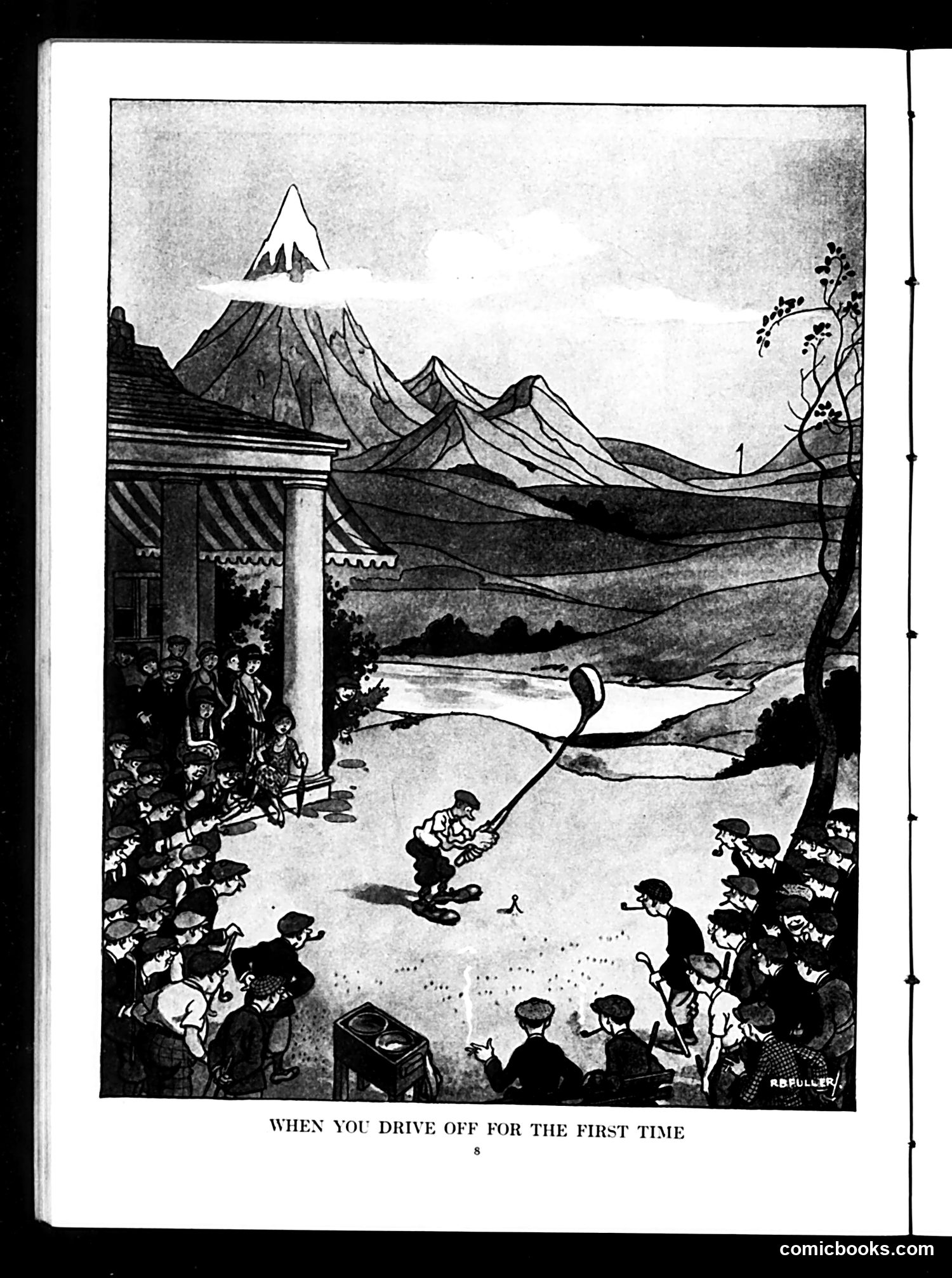
This satirical cartoon depicts an automobile driver's maiden voyage as a momentous public spectacle. A crowd gathers at a pavilion to watch a single driver navigate what appears to be a golf course or open field, treating the event with ceremonial importance—comparable to a major sporting competition or festival. The humor lies in exaggerating how novel and remarkable automobile driving was to early 20th-century society. What we now consider routine was then extraordinary enough to draw crowds as entertainment. The mountainous backdrop and formalized setting emphasize the theatrical, almost heroic nature of this "first drive," satirizing both public fascination with automobiles and the driver's presumed self-importance in this historic personal moment.
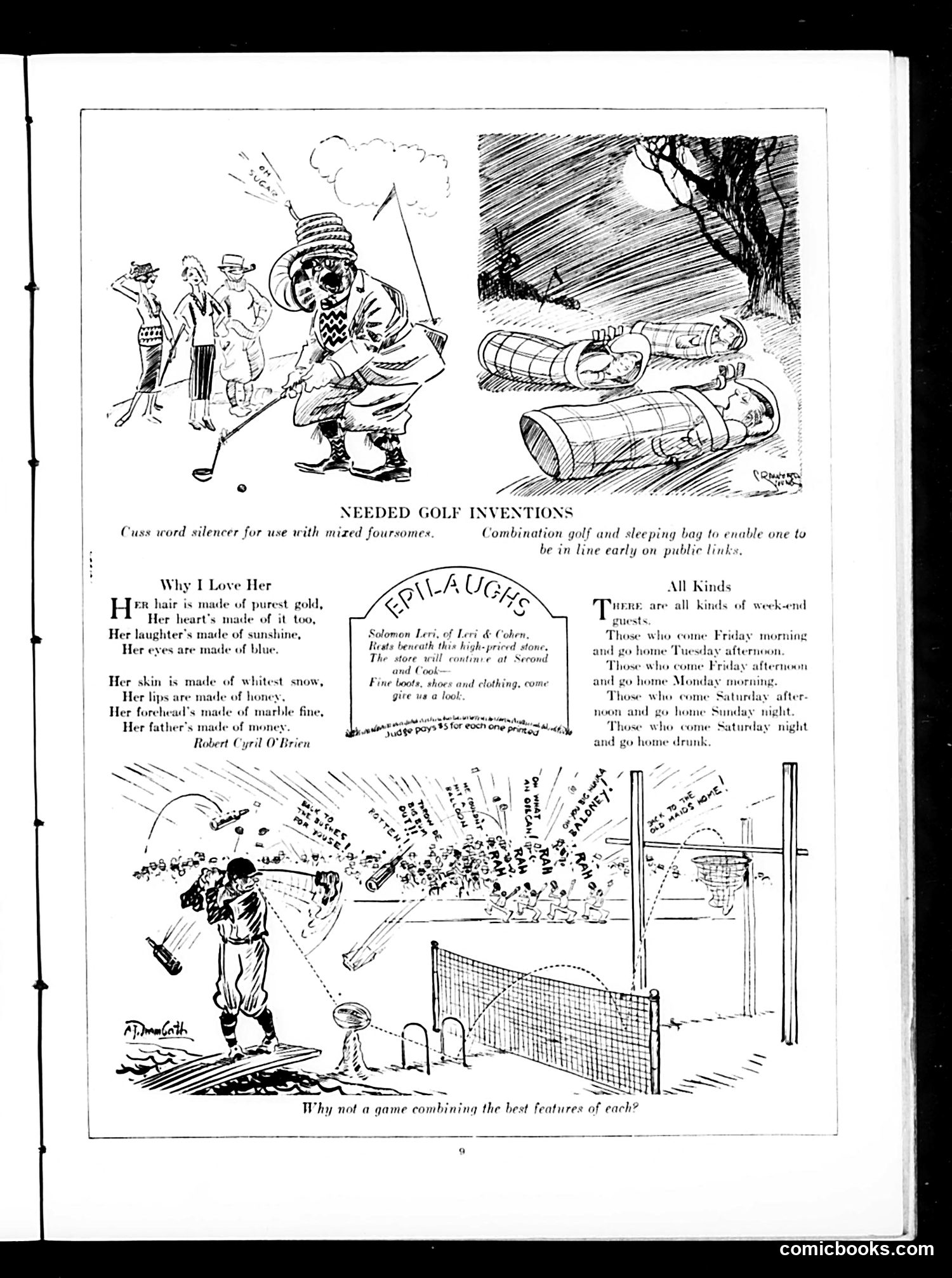
This page from *Judge* magazine contains humorous satirical content about early 20th-century leisure and social customs. The top section presents "Needed Golf Inventions"—absurdist suggestions mocking golf culture: a "cuss word silencer" for mixed-gender foursomes (implying men curse during golf), and a combination golf/sleeping bag device so players can arrive early to claim tee times on public links (satirizing competitive crowding at public courses). The poem "Why I Love Her" by Robert Cyril O'Brien is sentimental verse about a woman made of precious materials, climaxing with "Her father's made of money"—a satirical punchline exposing that the speaker's affection is mercenary, dependent on her family's wealth. The "Epilaughs" section humorously catalogs different weekend-guest types and their arrival/departure patterns. The bottom cartoon depicts baseball and golf, captioned "Why not a game combining the best features of each?"—suggesting absurd sport hybrids. Overall, the page satirizes upper-class leisure activities, materialism, and social pretension through exaggeration and wordplay.
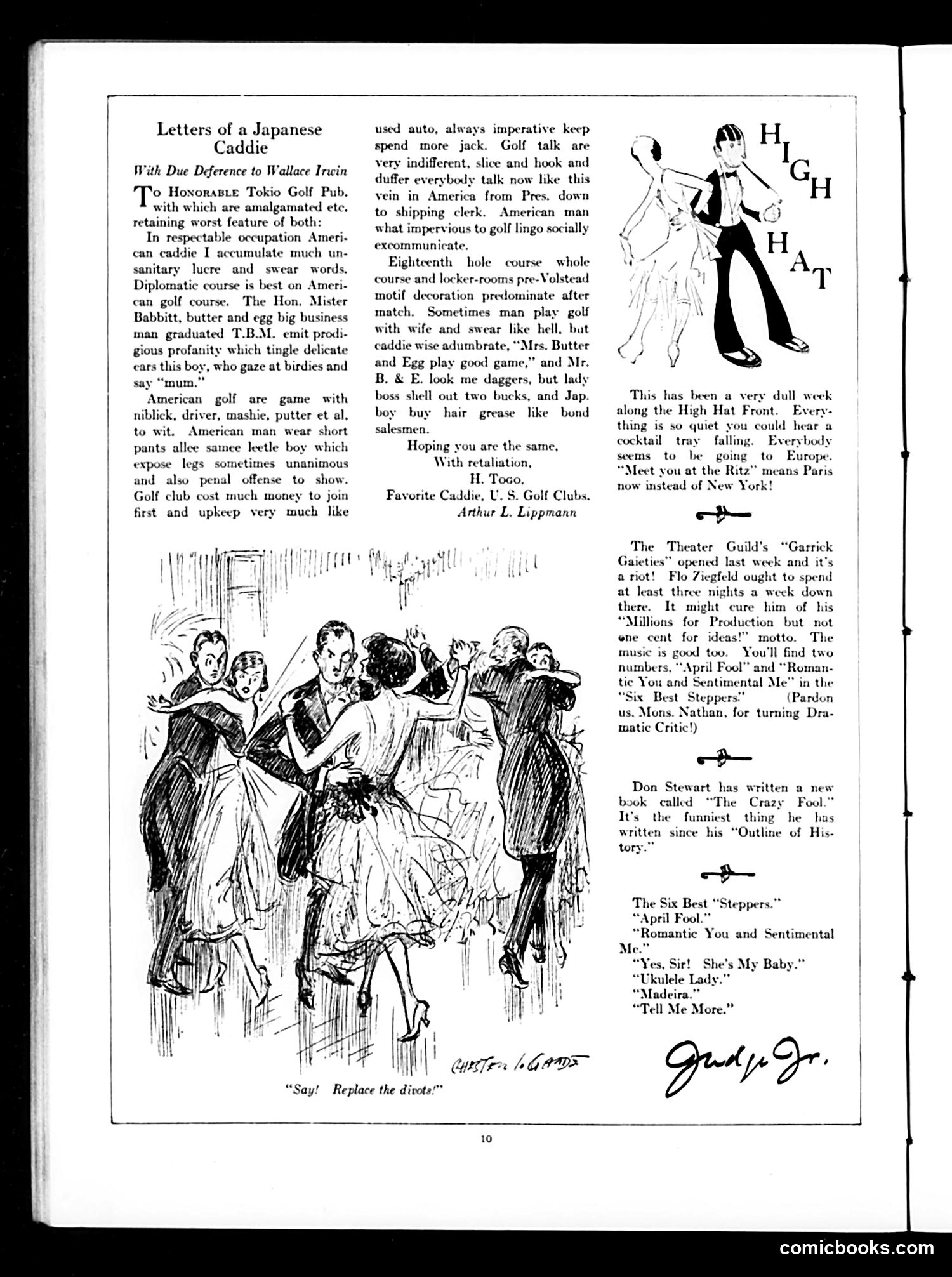
This page from *Judge* magazine contains a satirical column mimicking the broken English of a Japanese golf caddie writing letters home to Tokyo. The piece parodies both working-class immigrant speech patterns and wealthy American golfers' pretension and vulgarity during Prohibition era (pre-Volstead motif mentioned). The caddie observes that American golfers use golf jargon to seem sophisticated while wearing undignified short pants and swearing excessively. The satire targets American materialism and class anxiety—businessmen ("butter and egg" types) obsessed with displaying wealth through country club membership. The accompanying sketch shows party guests in formal wear dancing, captioned "Say! Replace the divets!"—a crude pun mocking refined society's ignorance of golf etiquette. The column is credited to Arthur L. Lippmann and presented as homage to Wallace Irwin, who popularized broken-English immigrant humor in early 20th-century American publications.
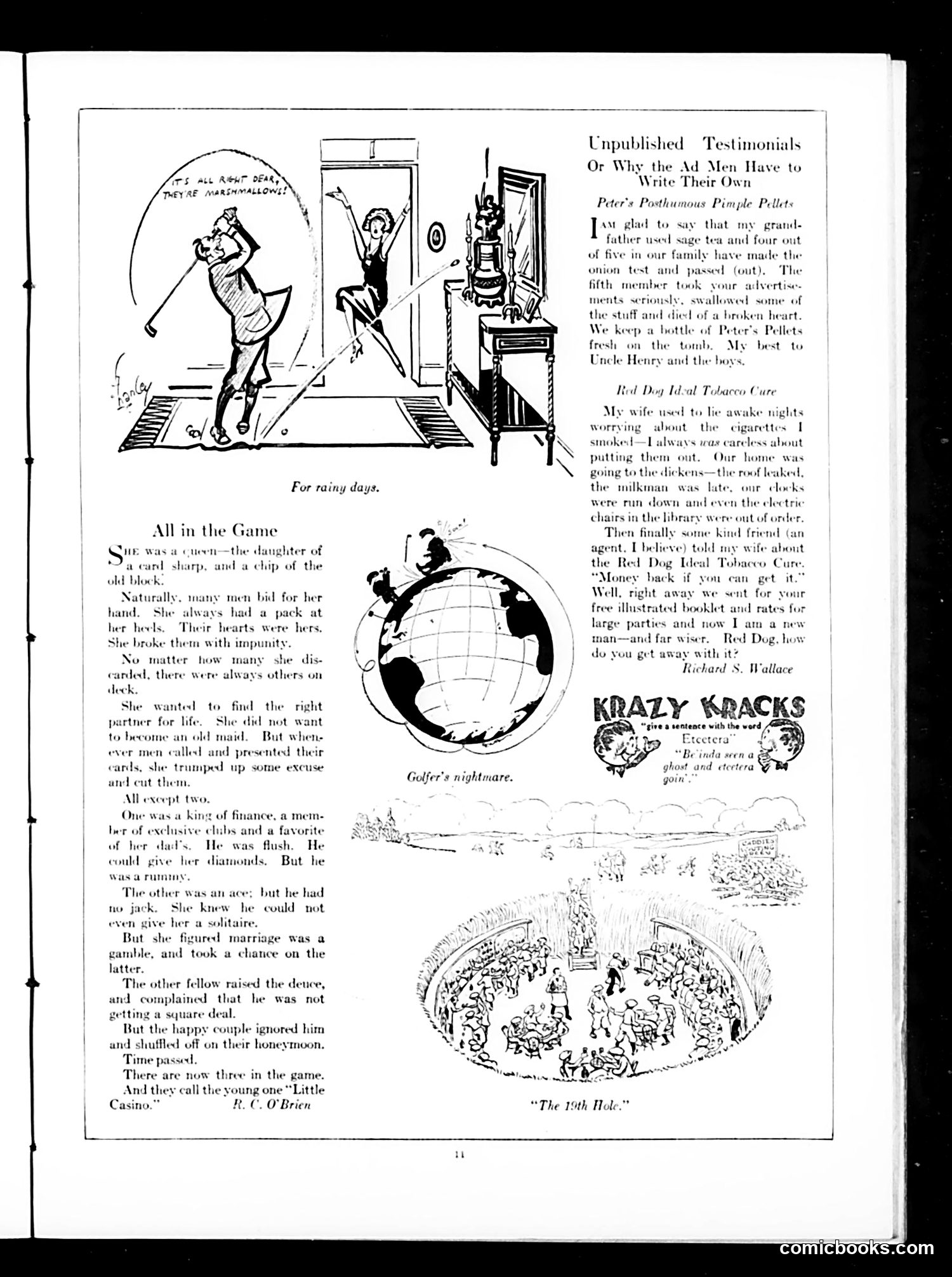
## "All in the Game" This story uses **playing card metaphors** to satirize courtship and marriage among the wealthy. The female protagonist is courted by multiple suitors: a wealthy financier ("king of finance," "flush") who is an alcoholic ("rummy"), and a poor but honest man ("ace" with "no jack"—no money). She chooses the poor man for love over wealth, defying her father's expectations. The satire targets **class anxiety and marriage pragmatism** of the era—the assumption that women should marry for financial security. By having her reject the rich drunk, the story mocks both the materialistic father and suggests romantic choice matters. The ending joke ("Little Casino") implies their marriage produces modest means. ## Sidebar Testimonials These are **parodies of fake product advertisements**. They mock the common magazine practice of publishing fabricated customer testimonials praising dubious products like "Peter's Pimple Pellets" and "Red Dog Ideal Tobacco Cure." The absurd claims (swallowing pills causes "broken heart") expose how advertisers invented false endorsements to sell ineffective nostrums.
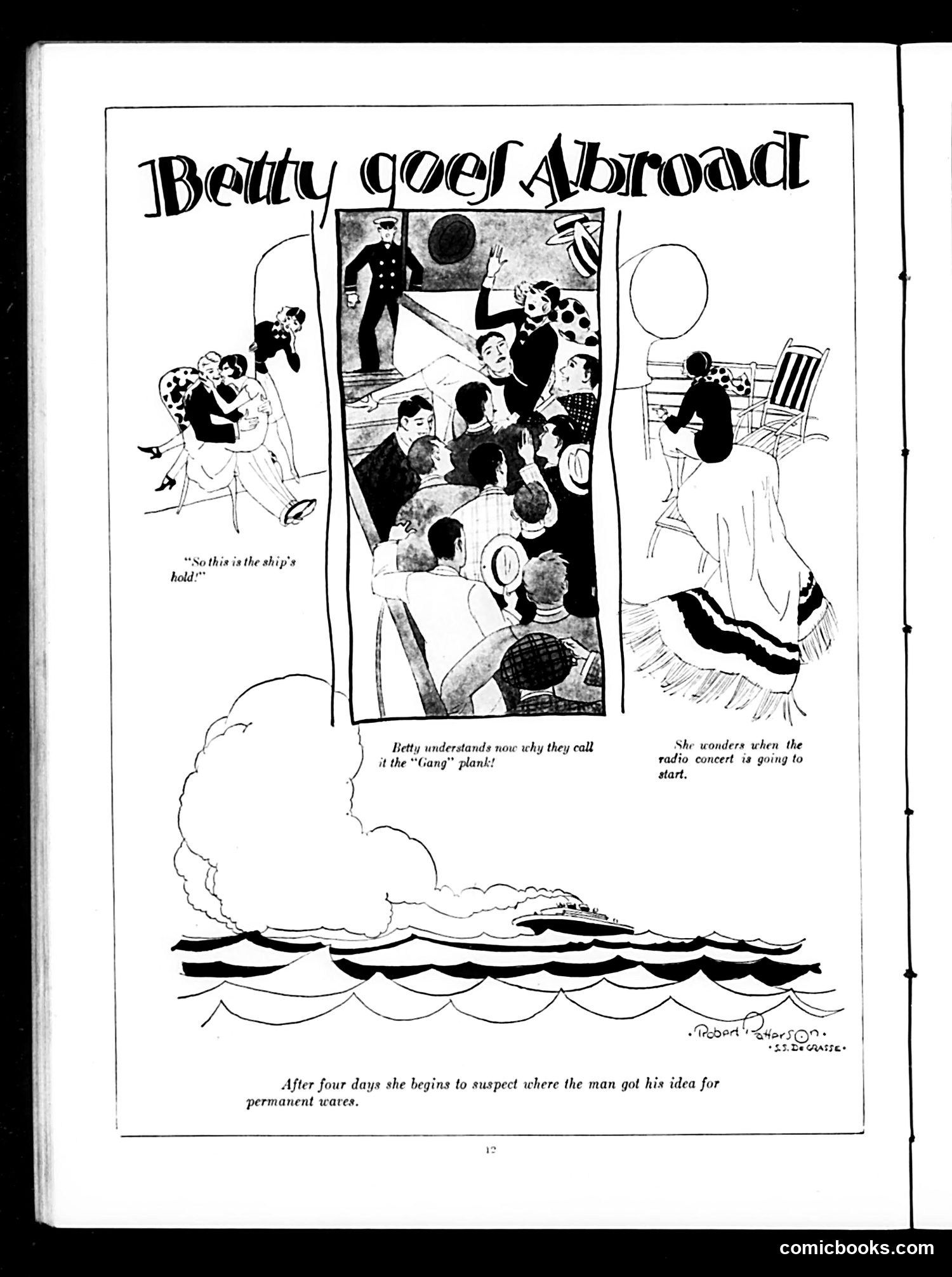
This is a comedic strip about a woman named Betty traveling by ship. The humor relies on visual puns and shipboard mishaps: 1. **"Gang plank"** - The left panel shows Betty encountering rowdy sailors, making her understand why it's called the "gang" plank (a pun on "gang" meaning a group of rough people). 2. **Radio concert** - Betty awaits entertainment that apparently never materializes. 3. **"Permanent waves"** - The final panel reveals the punchline: after four days of rough seas, Betty suspects the ship's motion inspired the hairstyling technique of permanent waves, as the constant rocking would naturally create wave patterns in hair. The satire gently mocks both shipboard life and the vanity of modern beauty treatments, suggesting their origins in mundane circumstances rather than sophisticated salons.
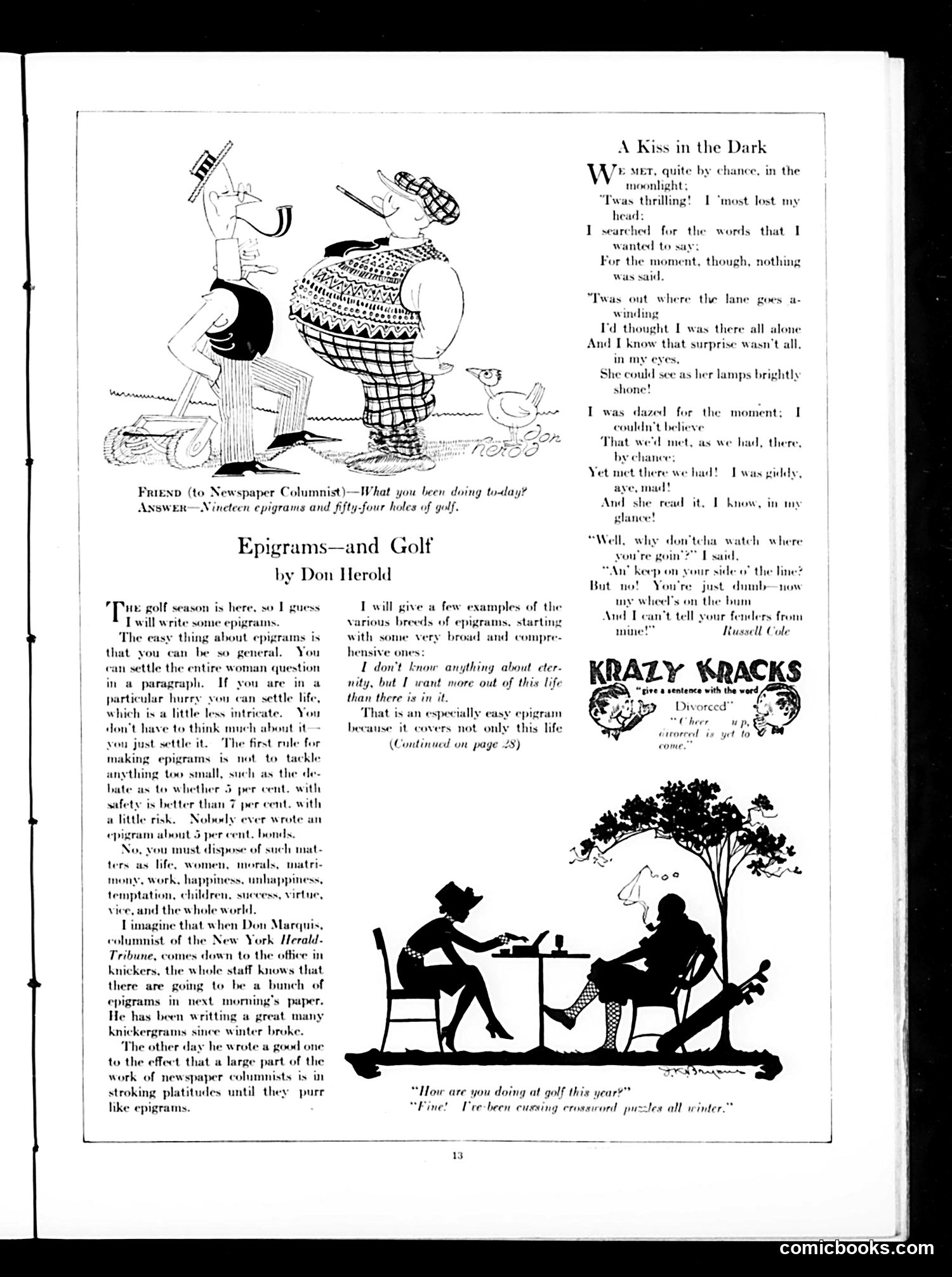
This page showcases Don Herold's humorous essay on writing epigrams (witty, concise sayings). The satire targets newspaper columnists who superficially "settle" complex topics—marriage, life, virtue—in brief, clever paragraphs without real depth. Herold specifically references Don Marquis, a renowned New York Herald-Tribune columnist known for prolific output, suggesting such writers churn out aphorisms in volume ("knickergrams") rather than substance. The accompanying poem "A Kiss in the Dark" depicts a romantic moonlight encounter. The bottom illustration shows two figures playing cards under a tree with the caption "How are you doing at golf this year? Fine! I've been cursing crossword puzzles all winter"—a joke about seasonal leisure activities and how golf frustrates players as much as crosswords frustrate word-puzzle enthusiasts. The "Krazy Kracks" section offers quick one-liners typical of period humor magazines.
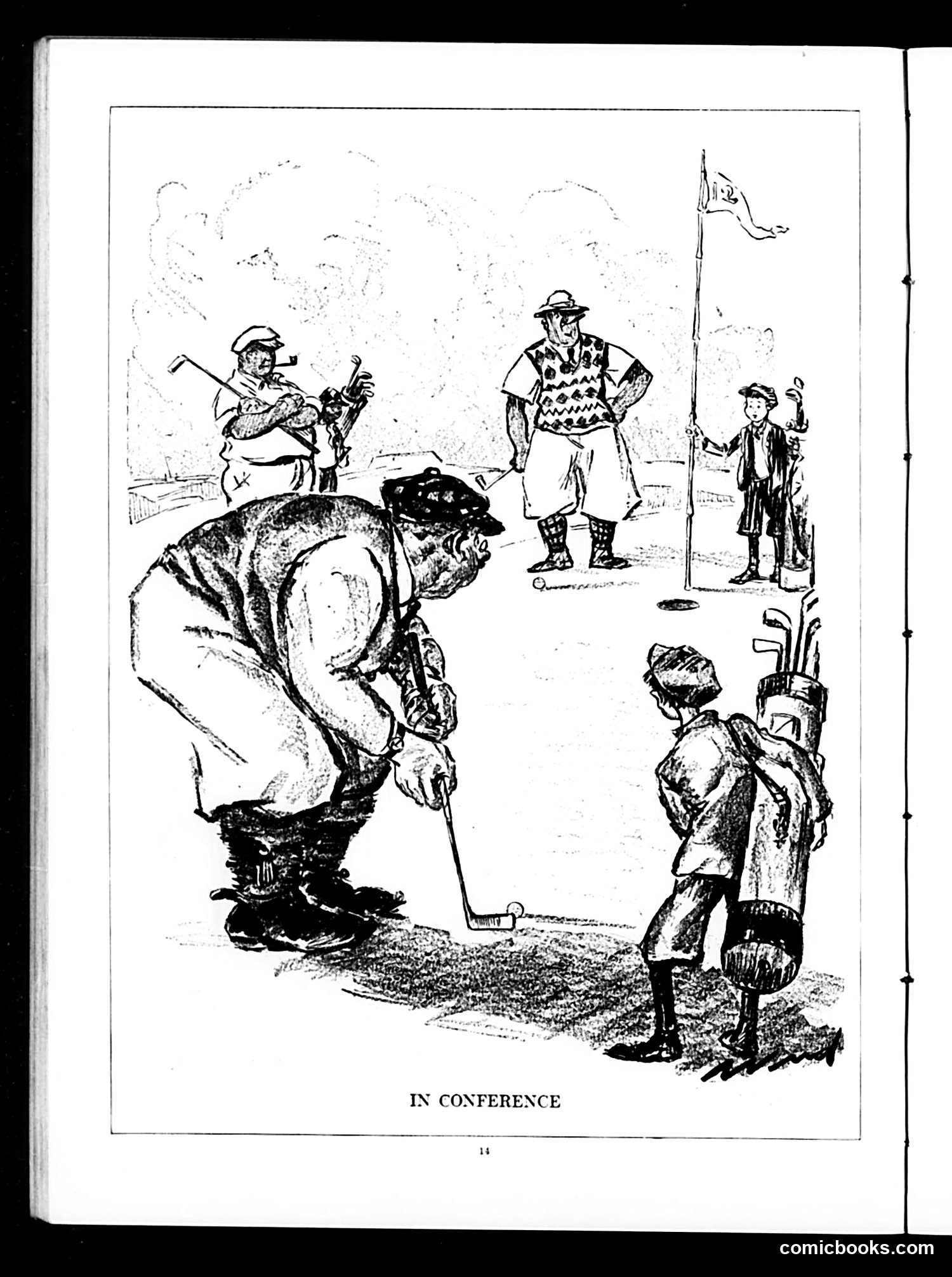
This political cartoon depicts a golf scene where a large, rotund figure (likely representing a politician or business leader of the era) bends over to putt while smaller figures—appearing to be golfers and officials—confer in the background. The title "In Conference" suggests that important discussions or decisions are happening, possibly satirizing how power brokers conduct business on the golf course rather than through formal channels. The exaggerated physique of the central figure suggests wealth and excess. The composition implies that golf was where real political or business dealings occurred among the elite, away from public scrutiny. Without specific identifying details visible, the exact figures referenced remain unclear, but the cartoon likely critiques informal power structures and backroom decision-making practices common in early 20th-century American politics or business.
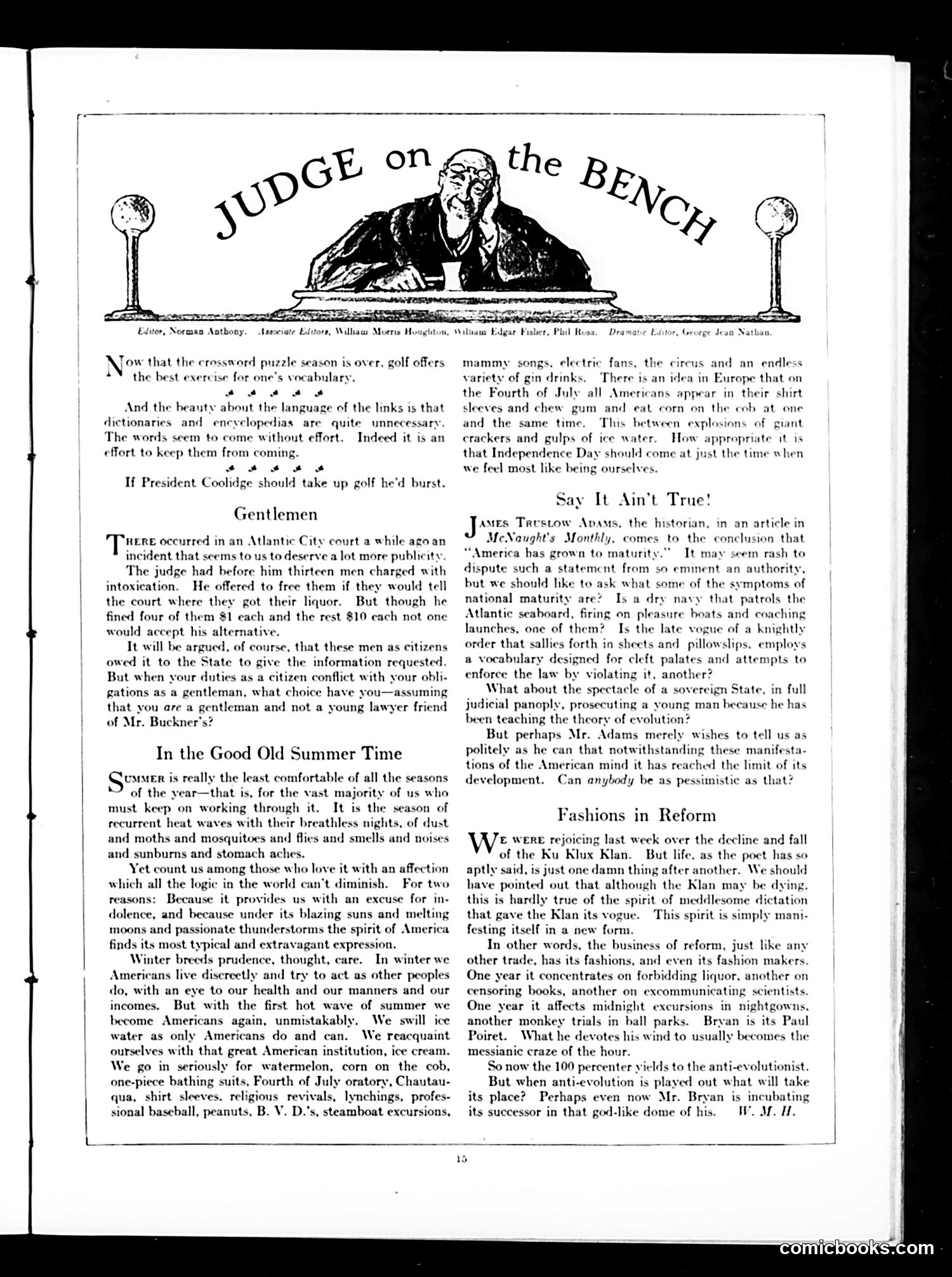
This page from *Judge* magazine contains several satirical pieces targeting American society and politics circa the 1920s. **"Judge on the Bench"** (masthead): A standard editorial cartoon format. **Key Articles:** 1. **"Gentlemen"**: Satirizes an Atlantic City court case where thirteen men charged with intoxication refused to inform on their liquor suppliers, citing gentlemanly honor over civic duty. The piece mocks this misplaced loyalty. 2. **"In the Good Old Summer Time"**: Celebrates American summer excess—ice cream, watermelon, gum-chewing, loose clothing, and "religious revivals, lynchings, professional baseball"—as authentically American behavior, contrasting American informality with European restraint. 3. **"Say It Ain't True!"**: Critiques historian James Truslow Adams's claim that "America has grown to maturity." The satire points to counterexamples: a naval force "firing on pleasure boats," the Ku Klux Klan operating in "sheets and pillowslips," and a state prosecuting someone for teaching evolution—suggesting America remains immature despite industrial development. The page reflects 1920s anxieties about Prohibition enforcement, the KKK's resurgence, and evolution debates.
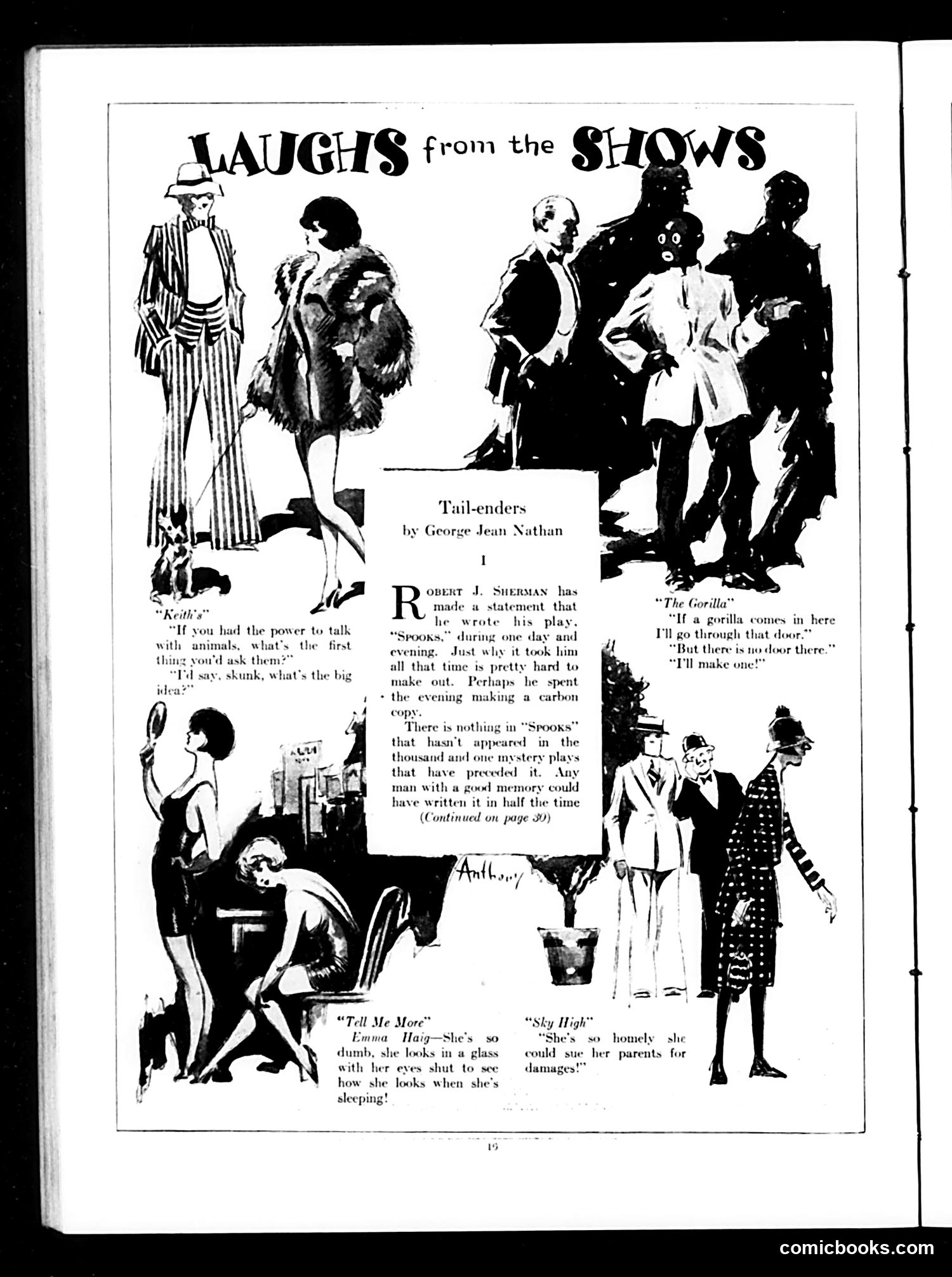
This page collects theatrical humor and critiques from George Jean Nathan, a prominent drama critic. The central article mocks playwright Robert J. Sherman, suggesting he spent an entire evening writing his play "Spooks" when it merely recycles tired mystery-play conventions—implying he could have carbon-copied existing works faster. The surrounding cartoon vignettes mock theatrical performances and actors: - **"Keith's"** jokes about talking to animals - **"The Gorilla"** references a gorilla act (likely vaudeville) - **"Tell Me More"** satirizes actress Emma Haig as stupid - **"Sky High"** insults an unnamed actress's appearance These are typical Judge satirical takes on Broadway and vaudeville performers of the era—biting commentary on shows' quality and entertainers' intelligence or looks. The humor relies on readers' familiarity with contemporary theatrical productions.
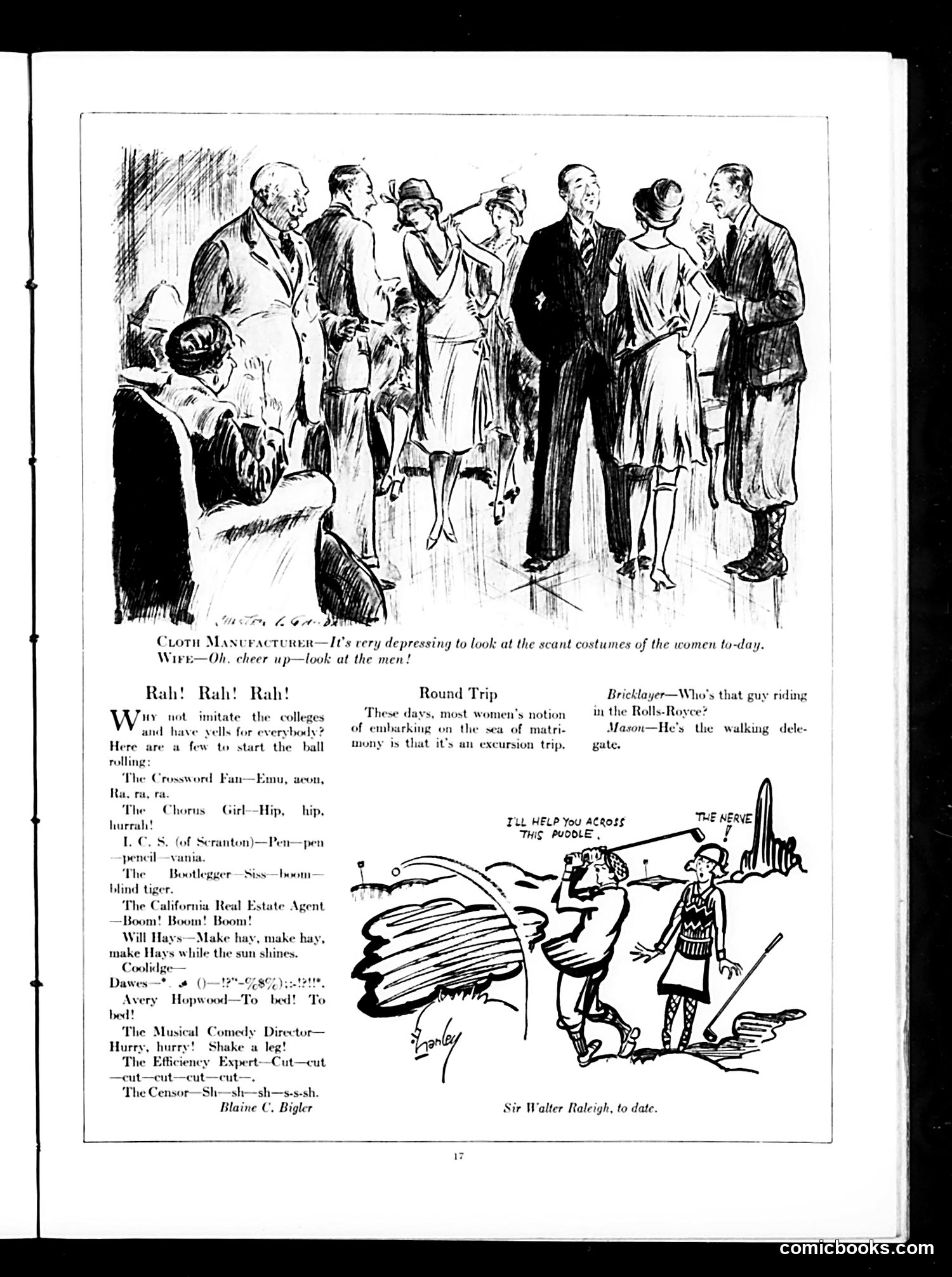
This page contains early-1920s satirical humor targeting contemporary figures and trends. **Top cartoon:** A cloth manufacturer complains about women's scanty modern fashions; his companion quips that men's clothing is equally sparse—a jab at both Jazz Age fashion liberalization and gender role changes. **"Rah! Rah! Rah!"** section: Parodies college cheering by creating mock "yells" for various 1920s types—crossword puzzle enthusiasts, chorus girls, bootleggers (Prohibition-era illegal alcohol dealers), and notably political figures: Will Hays (film censor), Calvin Coolidge (president), and Charles Dawes (vice president). The jokes play on wordplay and current events (Prohibition, film censorship). **"Round Trip"** section: Two brief jokes—one about honeymoons as "excursion trips" (mocking modern attitudes toward marriage), another suggesting a wealthy car owner is a "walking delegate" (likely a labor union reference). **Bottom cartoon:** Shows someone helping another across a puddle, captioned "Sir Walter Raleigh, to date"—a nostalgic jab at modern chivalry's decline. Overall, the page satirizes 1920s modernization, politics, and social change.
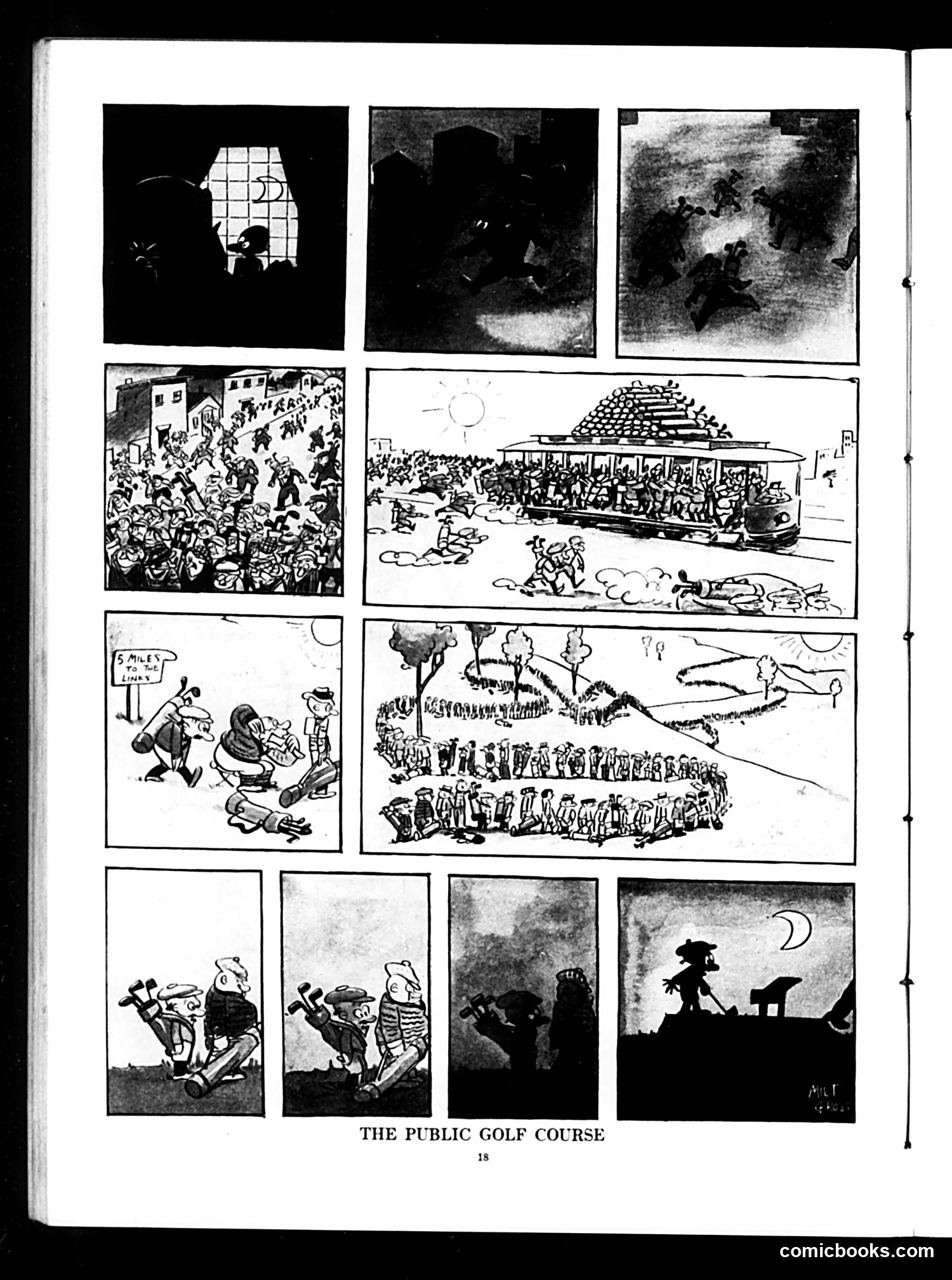
This appears to be a satirical comic strip titled "The Public Golf Course" depicting the chaos of a newly democratized golf facility open to the general public. The sequence shows escalating disorder: crowds overwhelming the course, a packed trolley, masses of people gathering, and finally silhouettes suggesting nighttime mayhem. The satire mocks the clash between golf's traditional exclusivity (country clubs for the wealthy) and public access. The packed, rowdy scenes suggest anxiety about "common" people invading an elite recreational space—a social commentary on class tensions and changing access to previously restricted leisure activities. The final panels' darkness and disorder emphasize the implicit message: public democracy on the golf course produces chaos rather than genteel sport.
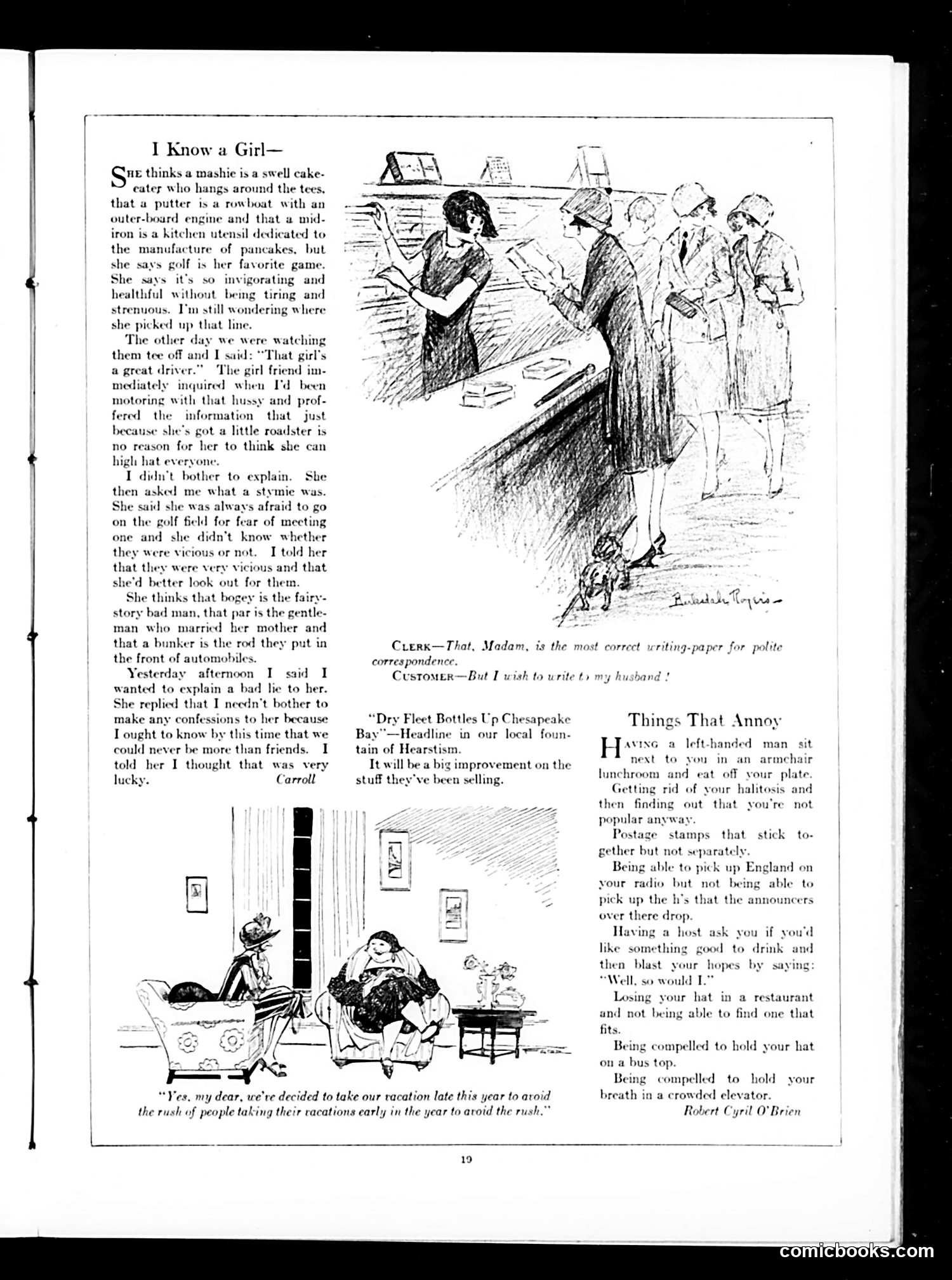
This page contains two unrelated humor pieces typical of Judge magazine's satirical style. **"I Know a Girl"** mocks a woman who claims golf is her favorite sport despite profound ignorance of golf terminology and rules. She confuses golf equipment with kitchen items and automobiles, misunderstands basic golfing concepts (a "stymie" as a monster, "bogey" as a fairy-tale villain), and appears primarily interested in gossiping about other women's automobiles. The humor satirizes women's pretended sophistication about leisure activities they don't actually understand—a common trope in early 20th-century comedy about gender roles and social climbing. **"Things That Annoy"** is a brief satirical list of modern irritations, including crowded public transportation, inconsistent radio reception, postage stamps that malfunction, and losing possessions. These are gentle social observations rather than pointed political satire. The page also includes a small exchange about writing paper, humorously suggesting the customer has marital confessions to make rather than polite correspondence to write.
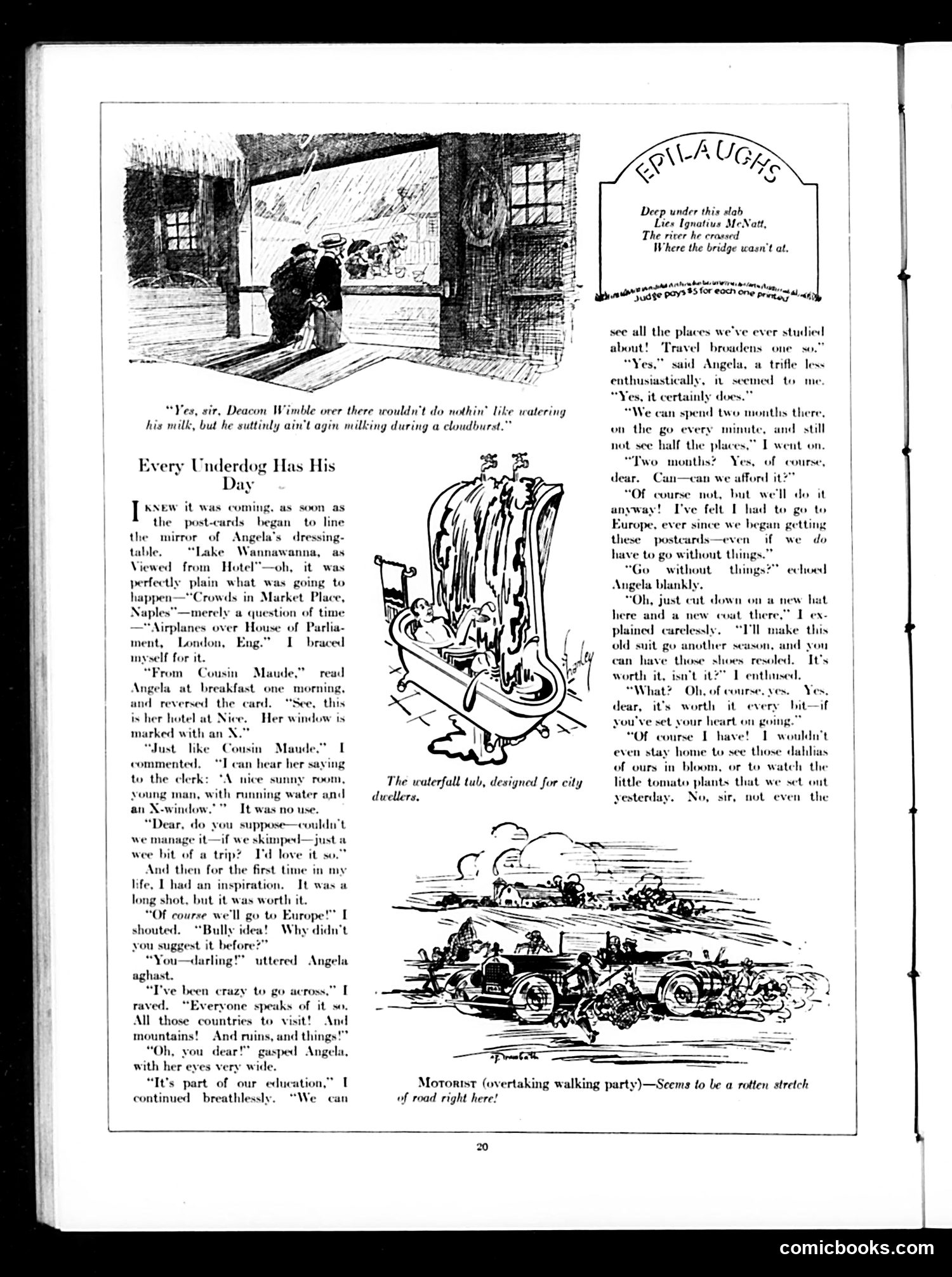
This story satirizes the aspirational travel fever of the early 20th century middle class. A husband, inspired by his wife Angela's postcards from relatives visiting famous European destinations (Naples, London, Nice), impulsively promises a European tour—despite their obvious financial constraints. The satire targets both spouses: Angela's social climbing through postcard-collecting and casual envy of relatives' travels, and the husband's transparent manipulation (suggesting the trip as "education" while casually proposing they sacrifice new clothes and skip home gardening). The joke is the ironic title—the "underdog" (a financially modest couple) temporarily gains advantage through a reckless promise that will burden them for years. The accompanying cartoon about a motorist hitting a "rotten stretch of road" appears to offer a parallel metaphor: rough going ahead. The page mocks both consumer materialism and marital dynamics of the era.
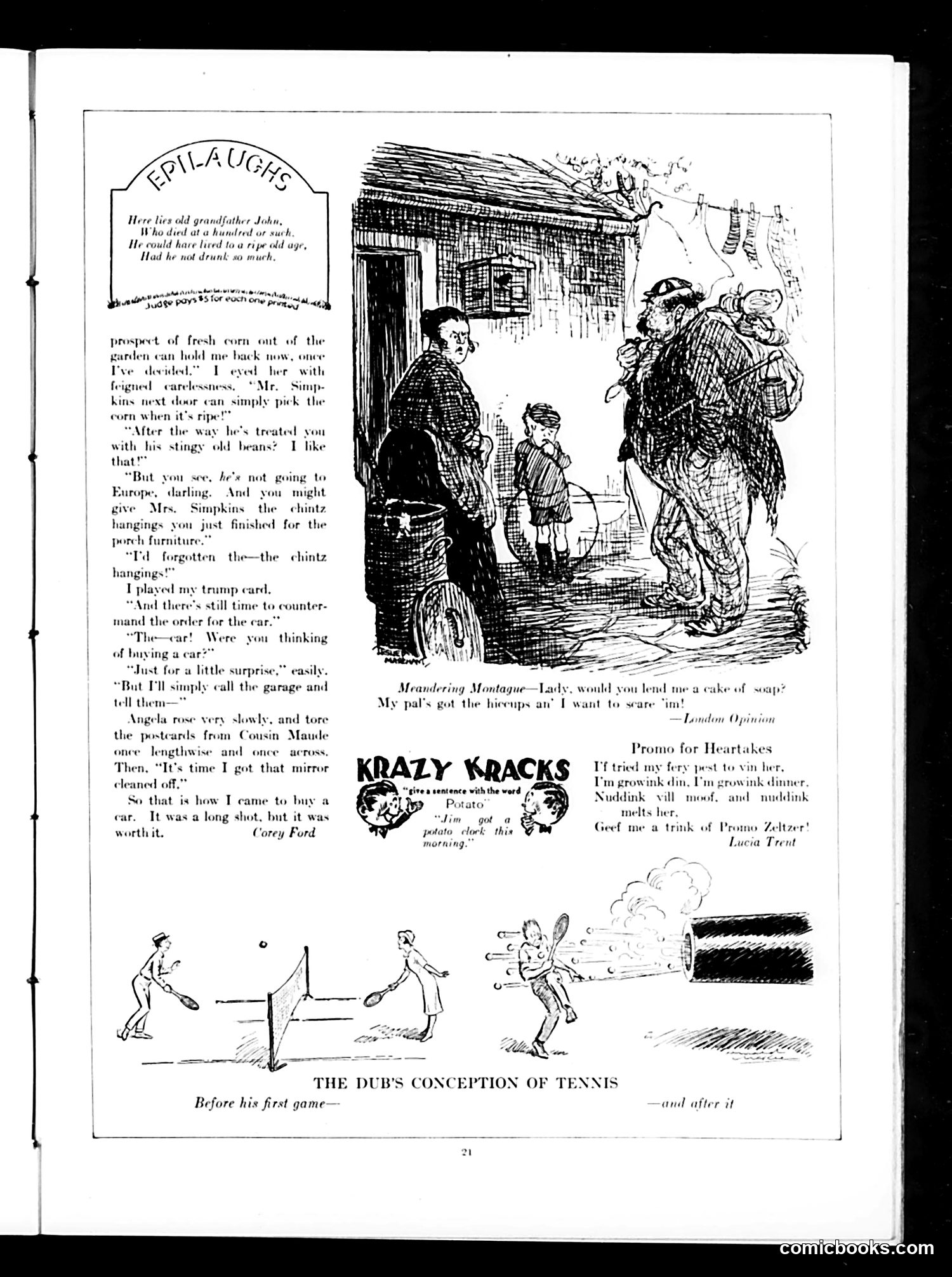
This page from *Judge* magazine contains three separate humorous pieces: **"Epiloghs"** (top left): A satirical tombstone epitaph mocking excessive drinking, paired with a story about a man who manipulates his wife into buying a car by offering her fresh corn and chintz hangings as incentives—a joke about petty domestic negotiation. **"Krazy Kracks"** (center): A pun-based humor section where "potato" is mispronounced as "po-tah-to," typical of ethnic comedy stereotyping common in this era. **"Meandering Montague"** (center-right): A brief comic scene with working-class characters, featuring crude humor about hiccups and soap. **"Promo for Heartakes"** (right): An advertisement for Promo Seltzer using broken English/dialect humor, again relying on ethnic stereotyping for comedic effect. **"The Dub's Conception of Tennis"** (bottom): A visual gag showing how a novice player imagines tennis versus reality—contrasting his awkward, exaggerated pre-game fantasies with his exhausted, defeated post-game condition. The page reflects early 20th-century humor conventions, including heavy reliance on ethnic caricature and dialect humor that would be considered offensive today.
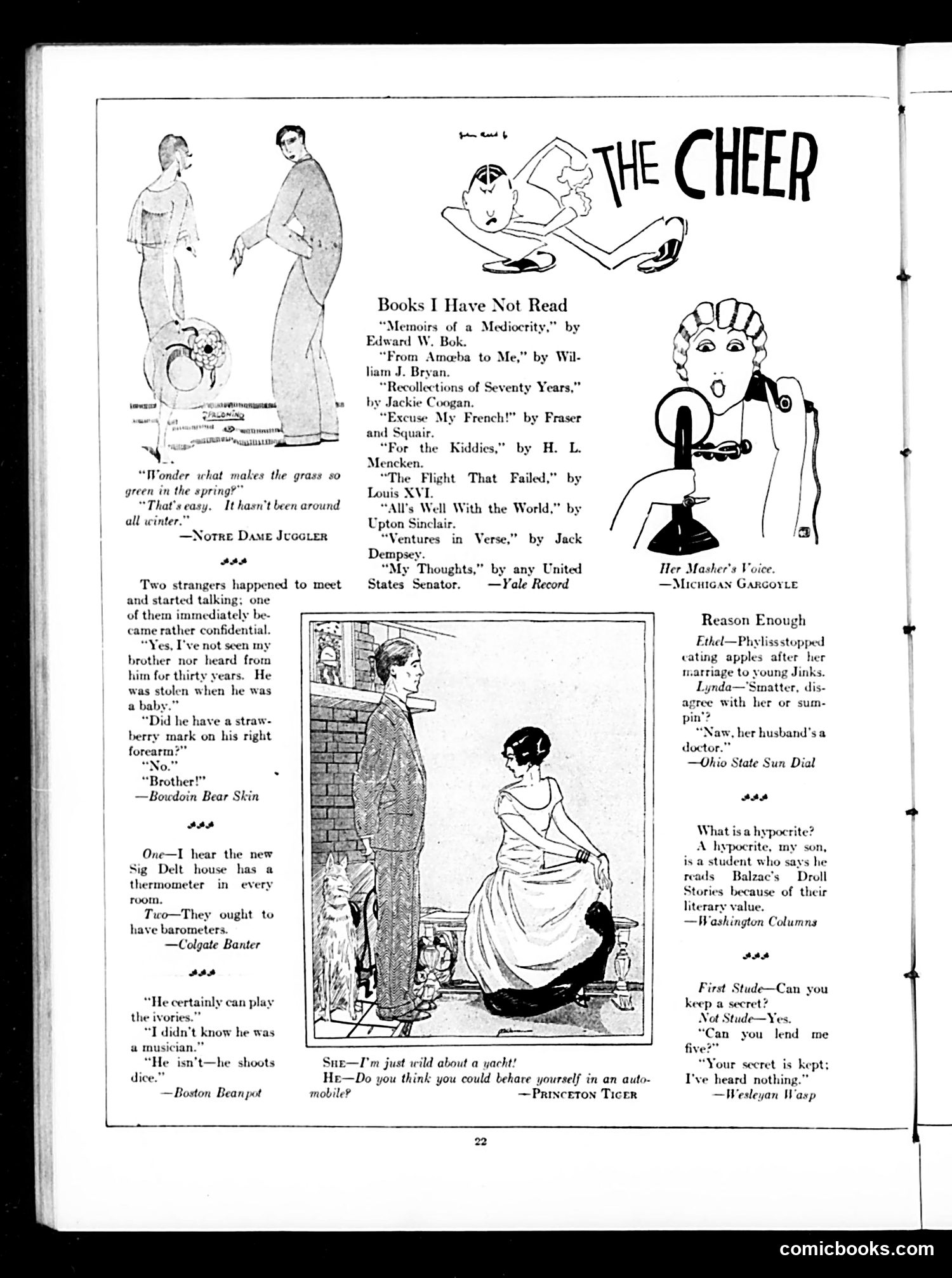
This is a humor compilation page from Judge, featuring short jokes and quips typical of 1920s American college and social satire. The main cartoon depicts a woman at a telephone excited about a yacht, while a man warns her against misbehaving in an automobile—satirizing the social anxieties of the Jazz Age regarding young women's newfound freedoms and unsupervised dating. The "Books I Have Not Read" section mocks contemporary public figures through fake memoir titles: Edward Bok's mediocrity, William Jennings Bryan's self-importance, child actor Jackie Coogan's premature "recollections," and boxer Jack Dempsey attempting poetry. The joke is these figures' inflated egos or incongruity with authorship. Other jokes target college life (thermometers in fraternity houses), hypocrisy (students reading Balzac for "literary value"), and gender dynamics (a doctor husband causing a wife to stop eating apples—likely implying dietary restrictions). The overall tone reflects upper-class collegiate humor and gentle social observation characteristic of the era.
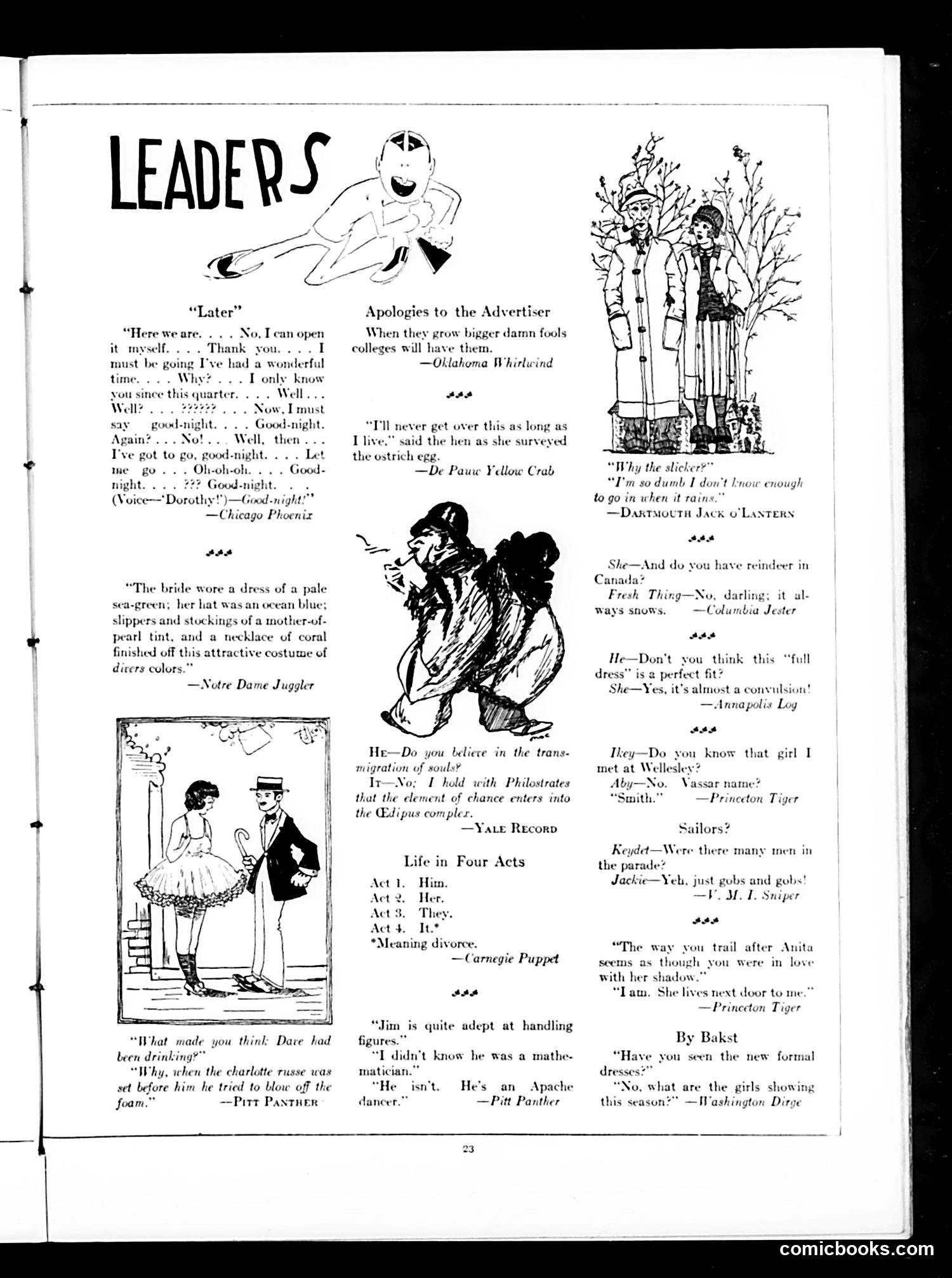
This page is a collection of brief jokes and witticisms culled from college and university humor publications, arranged around pen-and-ink illustrations. The cartoons show social scenarios typical of early 20th-century college life: a lingering goodbye between dating couples, a formal couple discussing fashion, and an illustration of a bride in colorful attire. The jokes satirize college students' pretensions and behaviors—their attempts at philosophical discourse, romantic entanglements, fashion concerns, and social awkwardness. References to specific colleges (Yale, Pitt, Princeton, Vassar, Wellesley) indicate these were competitive humor publications. One joke mocks drunk behavior; another pokes fun at an "Apache dancer" (a style of risqué entertainment popular in Paris). The overall tone is light mockery of young people's social ambitions and romantic mishaps rather than serious political satire. This appears to be filler content typical of Judge's editorial approach.
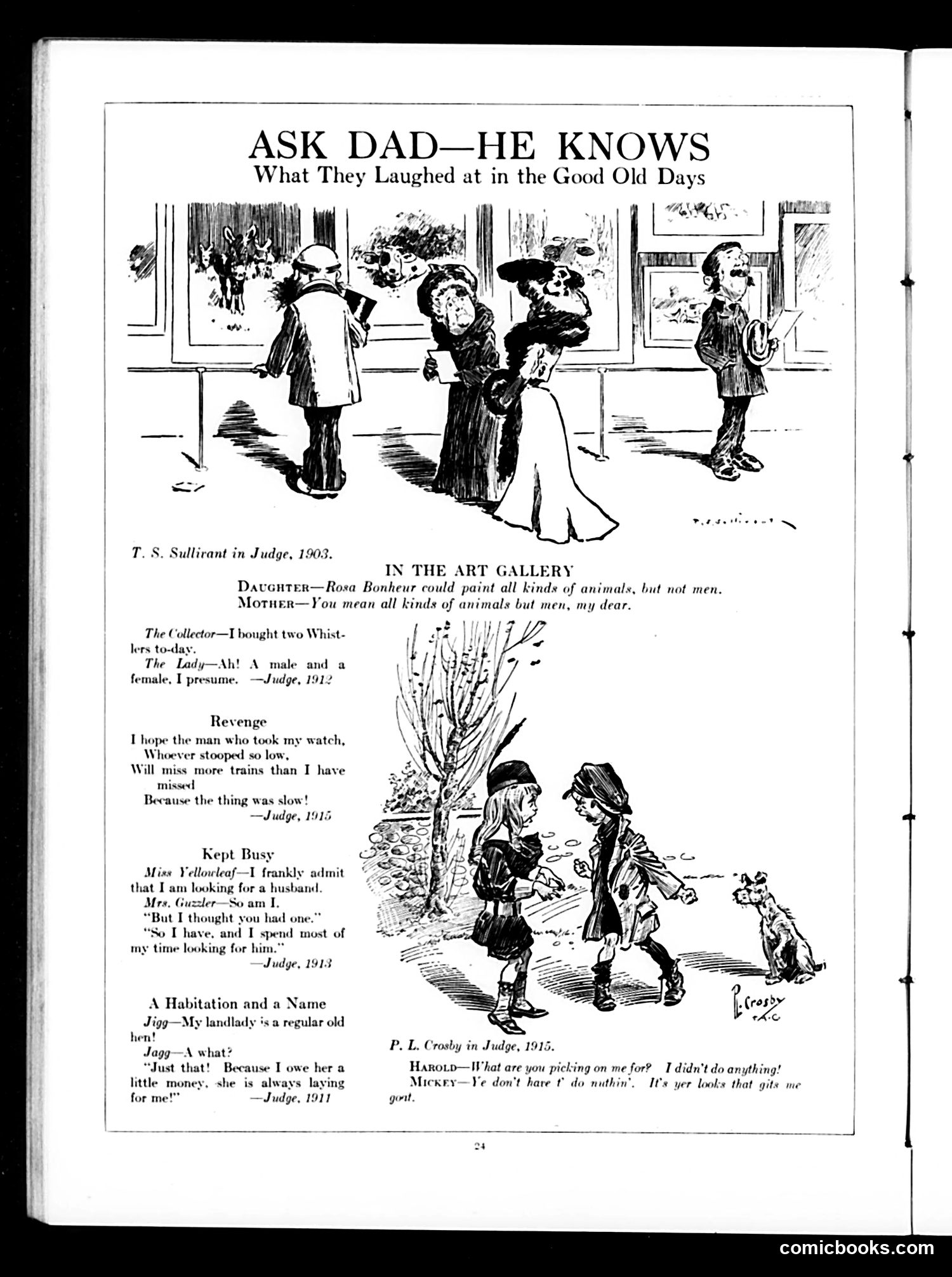
This page collects vintage humor from Judge magazine (early 1900s-1915), labeled "Ask Dad—He Knows," presenting old jokes as quaint period entertainment. The humor relies on dated assumptions: - **"In the Art Gallery"**: A sexist joke—the punchline is that a woman artist (Rosa Bonheur) supposedly couldn't paint men, implying women lack certain capabilities. - **"The Collector"**: Wordplay on "Whistlers" (James McNeill Whistler paintings), with a woman misunderstanding "male and female" as referring to genders rather than artistic subjects. - **"Kept Busy"**: Marital humor mocking wives—Mrs. Guzzler spends her time nagging her husband about money owed, presented as absurd female behavior. - **"A Habitation and a Name"**: A landlady is compared to a "hen" for demanding rent payment—trivializing women's legitimate concerns. - **"Revenge" and "Harold/Mickey"**: Mild observational humor without clear offensive intent. The broader joke: these represent what "Dad" found amusing in earlier times—the page's framing suggests nostalgia for simpler, more openly misogynistic humor.
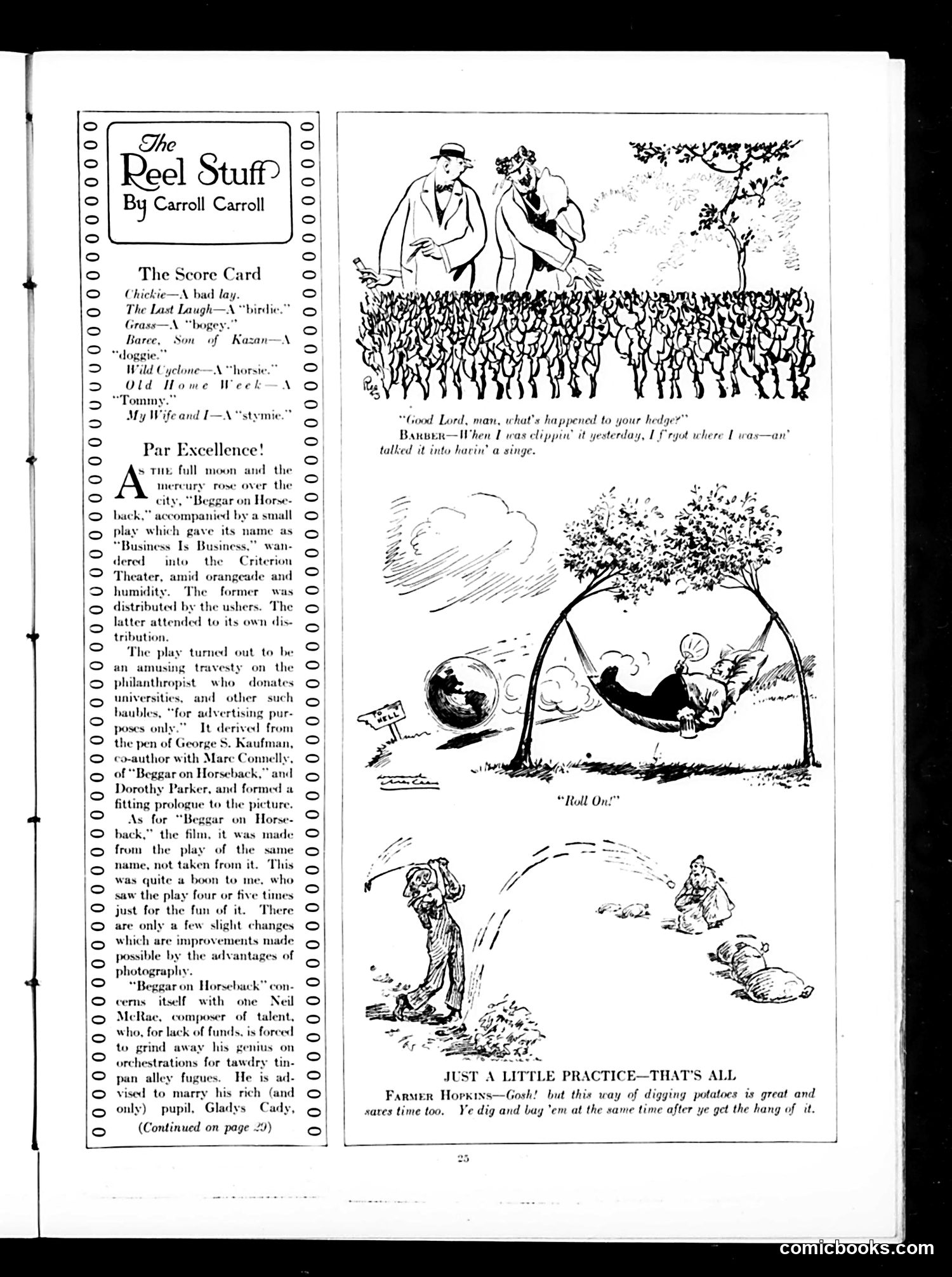
This page reviews "Beggar on Horseback," a 1925 film adapted from a play by George S. Kaufman, Marc Connelly, and Dorothy Parker. The article praises the film as a satire on wealthy philanthropists who donate to institutions primarily for publicity rather than genuine charity. The cartoons are unrelated gag comics typical of Judge magazine's format. The top cartoon shows a barber who accidentally burned a customer's hair while distracted. The bottom cartoon depicts a farmer comically using a digging method that combines two tasks—literally "digging and laying" potatoes simultaneously—presented as efficient but absurd labor-saving innovation. These standalone jokes reflect Judge's satirical humor about everyday American life and human folly, contrasting with the film review's critique of wealthy hypocrisy. The page demonstrates the magazine's mix of cultural commentary and light social satire.
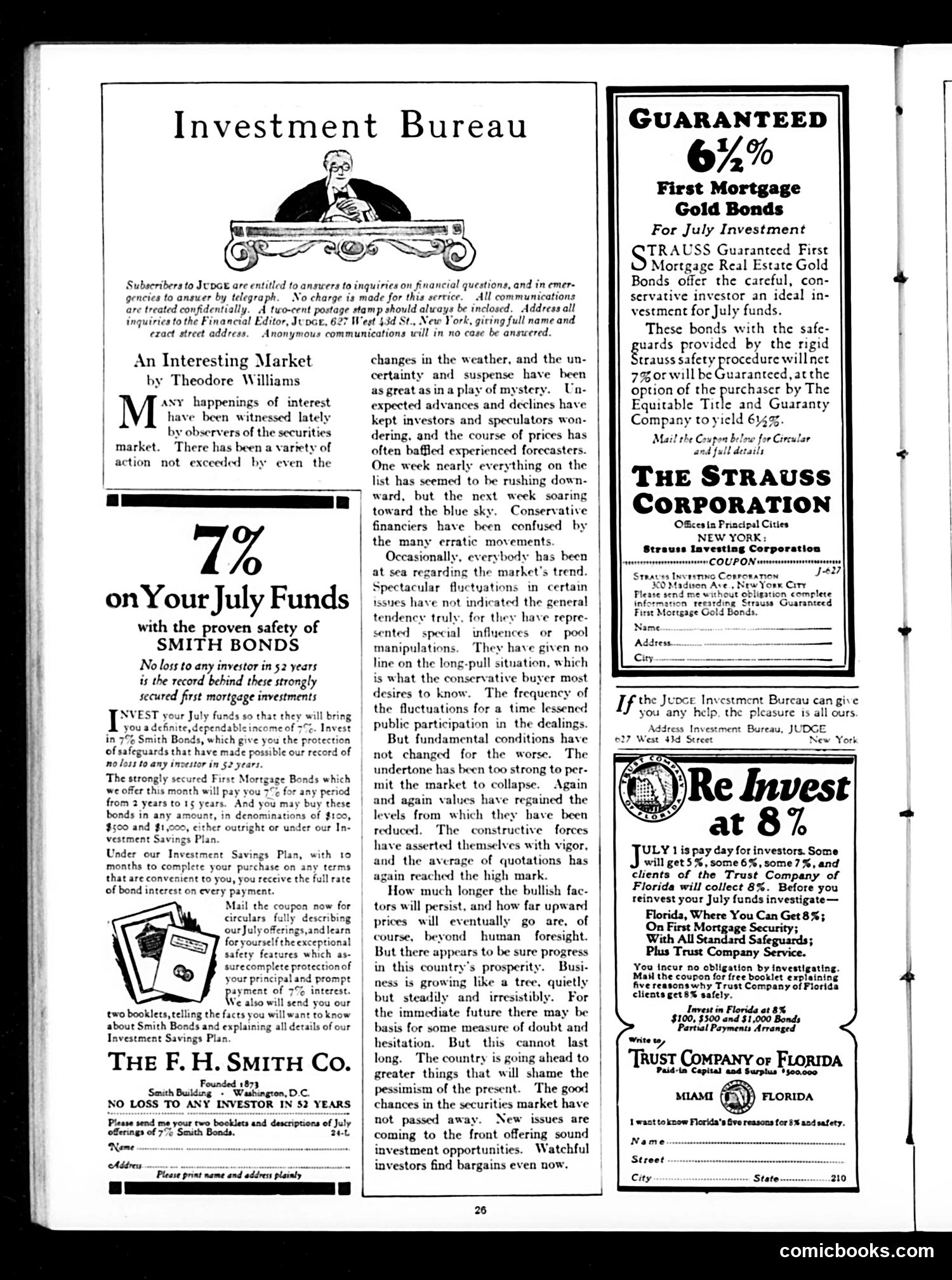
This is primarily an **advertising page**, not a satirical cartoon page. It contains three financial investment advertisements from the 1920s era, with minimal editorial content. The page features: 1. **"An Interesting Market" by Theodore Williams** — A brief editorial discussing stock market volatility. Williams describes erratic price swings that confuse even experienced investors, but concludes that "fundamental conditions" remain sound and the market will continue upward. This reflects the optimistic pre-1929 market sentiment. 2. **Three investment ads** promoting bonds at 7% returns — The F.H. Smith Co., The Strauss Corporation, and Trust Company of Florida all promise guaranteed returns on first mortgage bonds, emphasizing safety and steady income. **Historical context**: These ads appeared when stocks were considered risky and bonds were the "safe" investment choice — the opposite of modern convention. The ads' repeated emphasis on "no loss" and "safety" suggests investors still remembered earlier market crashes.
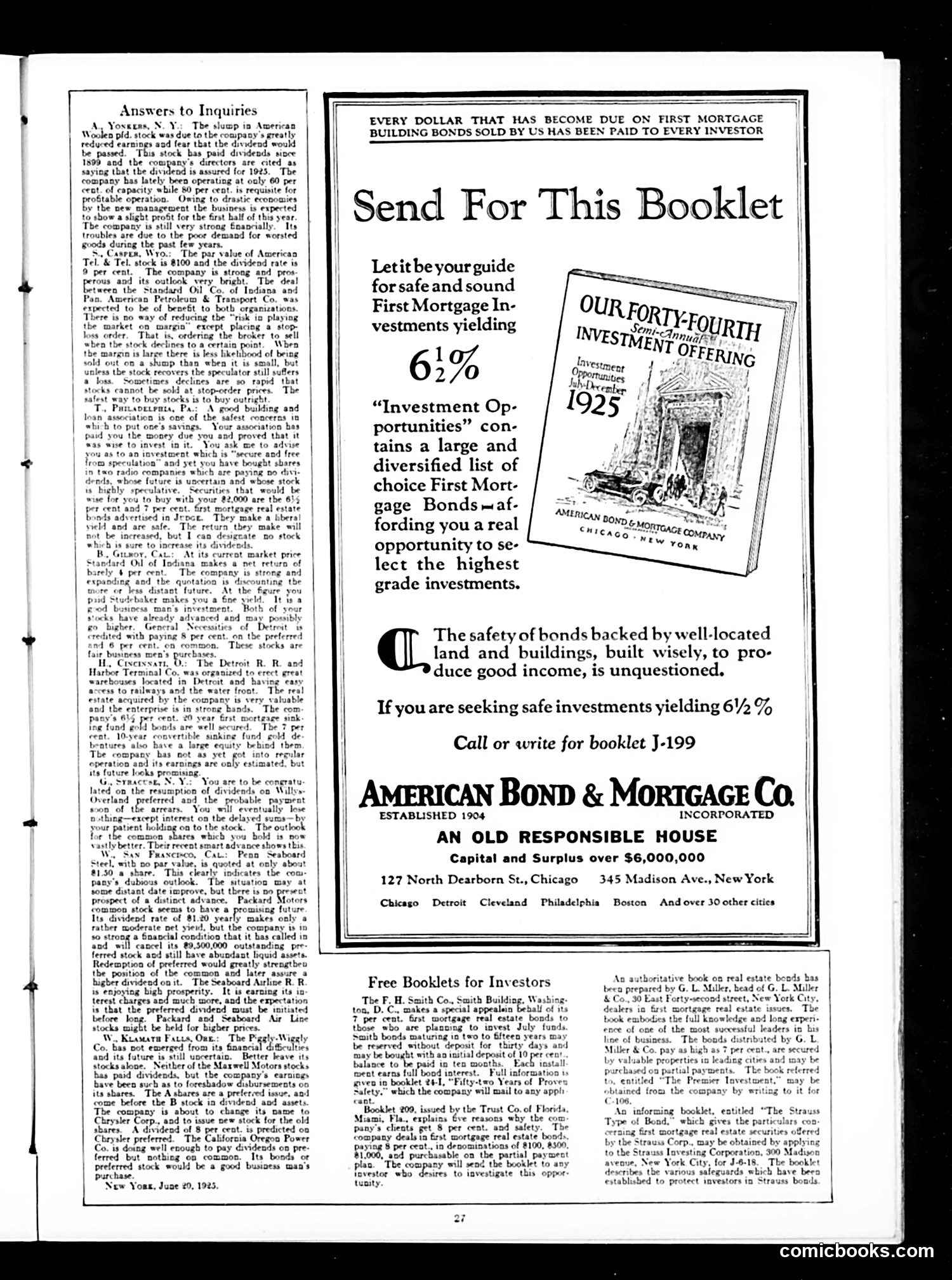
This page is **primarily advertising**, not satire. The main content is a full-page advertisement for American Bond & Mortgage Company promoting First Mortgage Bonds yielding 6½%. The left column contains "Answers to Inquiries"—a financial advice column addressing reader questions about stocks like American Woolens, AT&T, Studebaker, and Detroit railroads. This reflects 1925's investment culture when magazines provided direct stock guidance. The satirical element is **minimal or absent**. Rather, the page reflects the era's assumptions: that ordinary citizens actively traded stocks on margin, that building-and-loan associations were common savings vehicles, and that bond investments were considered safely "secure and free from speculation"—a claim that would be darkly ironic given the 1929 crash occurring just four years later. The page documents pre-Depression investment optimism and the financial accessibility (and risk) available to average readers.
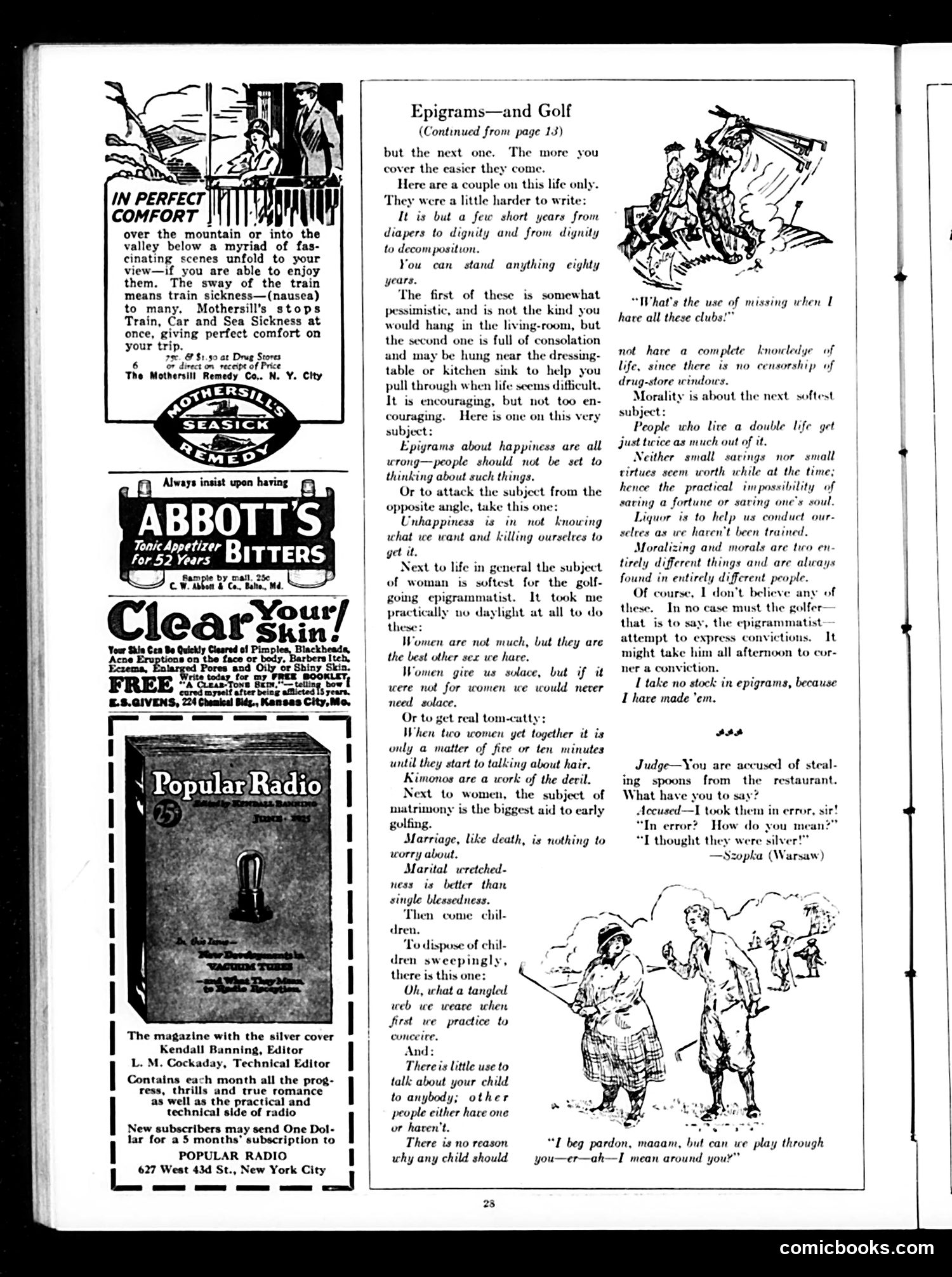
This page primarily features **humorous epigrams about life, marriage, and golf**, attributed to a golf-focused epigrammatist. The content mocks cynical observations about human nature—particularly women, marriage, and morality—presented as witty one-liners typical of early 20th-century satirical writing. The two cartoons illustrate the epigrams: one shows golfers debating club selection ("What's the use of missing when I have all these clubs!"), and another depicts golfers on a course with the caption about playing through a group. The page's tone suggests **satire of golf culture and contemporary social attitudes**, especially misogynistic views presented as clever wisdom. The closing confession—"I take no stock in epigrams, because I have made 'em"—reveals self-aware irony: the author undermines his own cynical pronouncements. The surrounding advertisements (Mothersill's remedy, Abbott's Bitters, Popular Radio) are typical period content, unrelated to the editorial material.
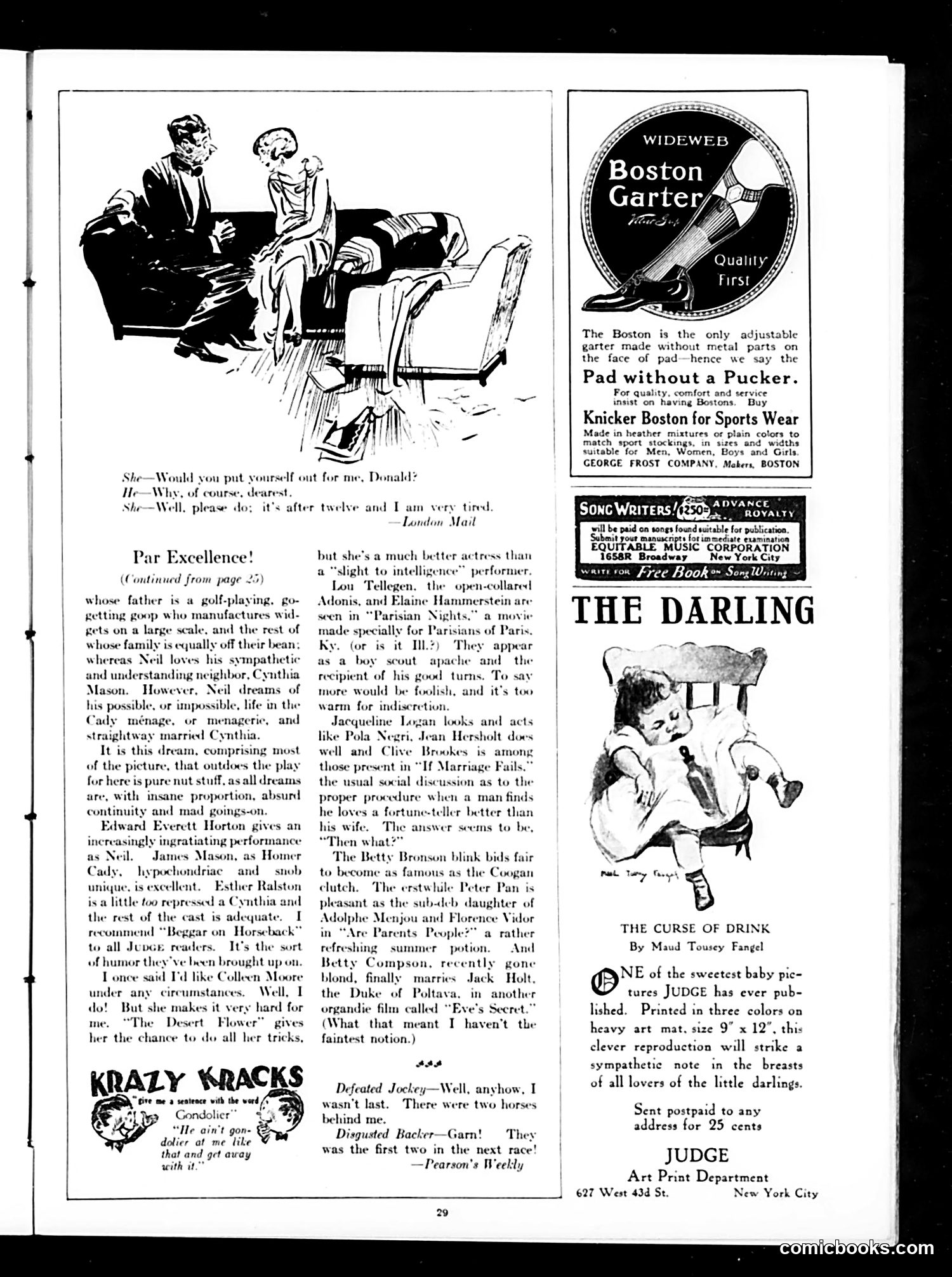
The page contains **mostly advertisements and entertainment reviews**, not political content. The main cartoon is "**Par Excellence**"—a domestic humor sketch where a woman asks her husband Donald to "put yourself out for me," then requests he leave because she's tired. The joke plays on the double meaning of "put yourself out" (make an effort vs. literally exit). Below is "**Krazy Kracks**," a wordplay joke about "gondolier" (a Venetian boatman), presented as a student's sentence exercise. The page includes **film reviews** of 1920s silent movies featuring actors like Colleen Moore and Betty Bronson, praising or mocking their performances with period-specific theatrical language. **Advertisements** dominate: Boston Garter hosiery, sheet music royalties, and a Judge magazine baby print titled "The Curse of Drink." This reflects Judge's typical content—light domestic humor, entertainment gossip, and commercial notices—rather than satirical commentary on politics or social issues.
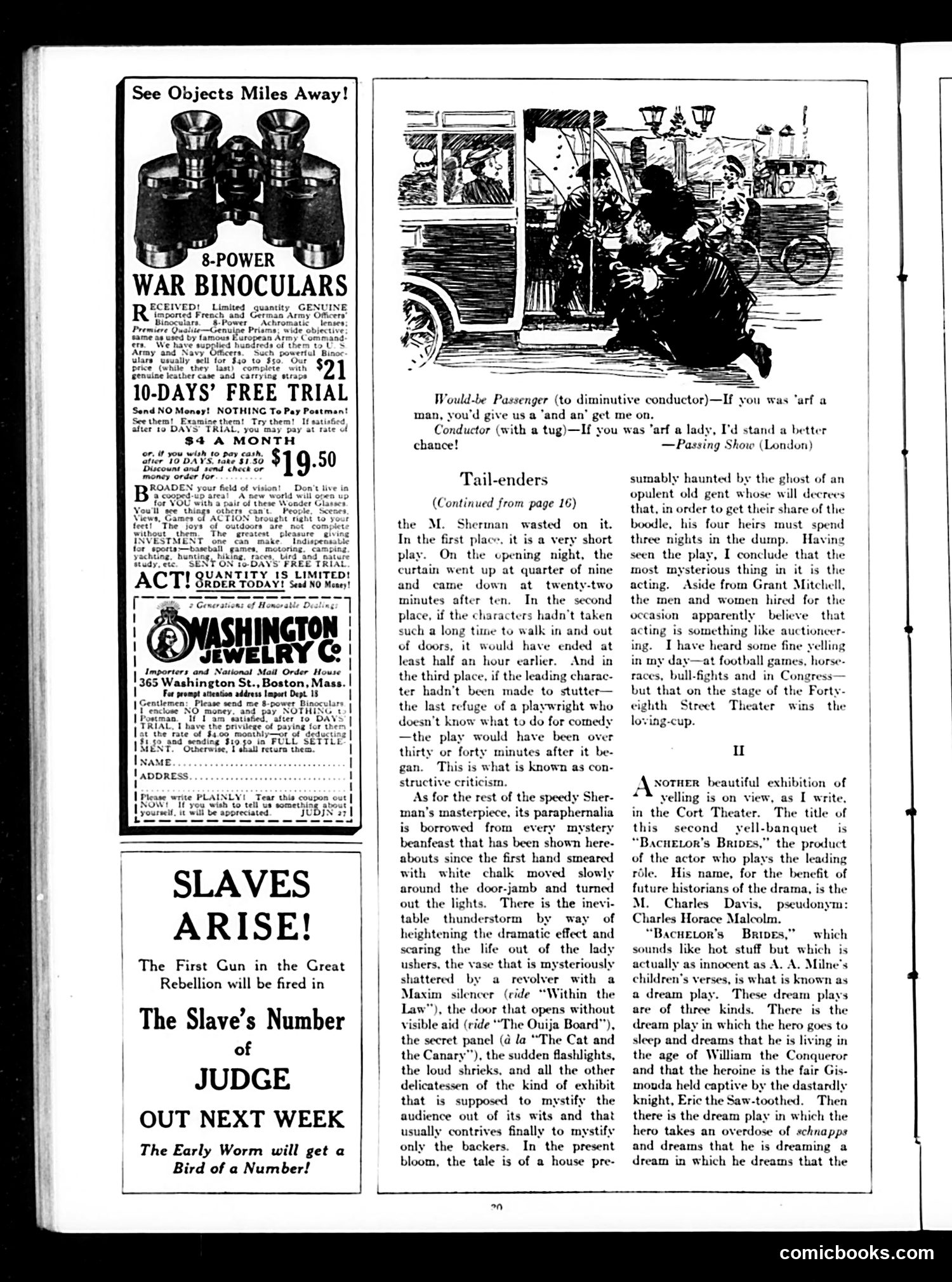
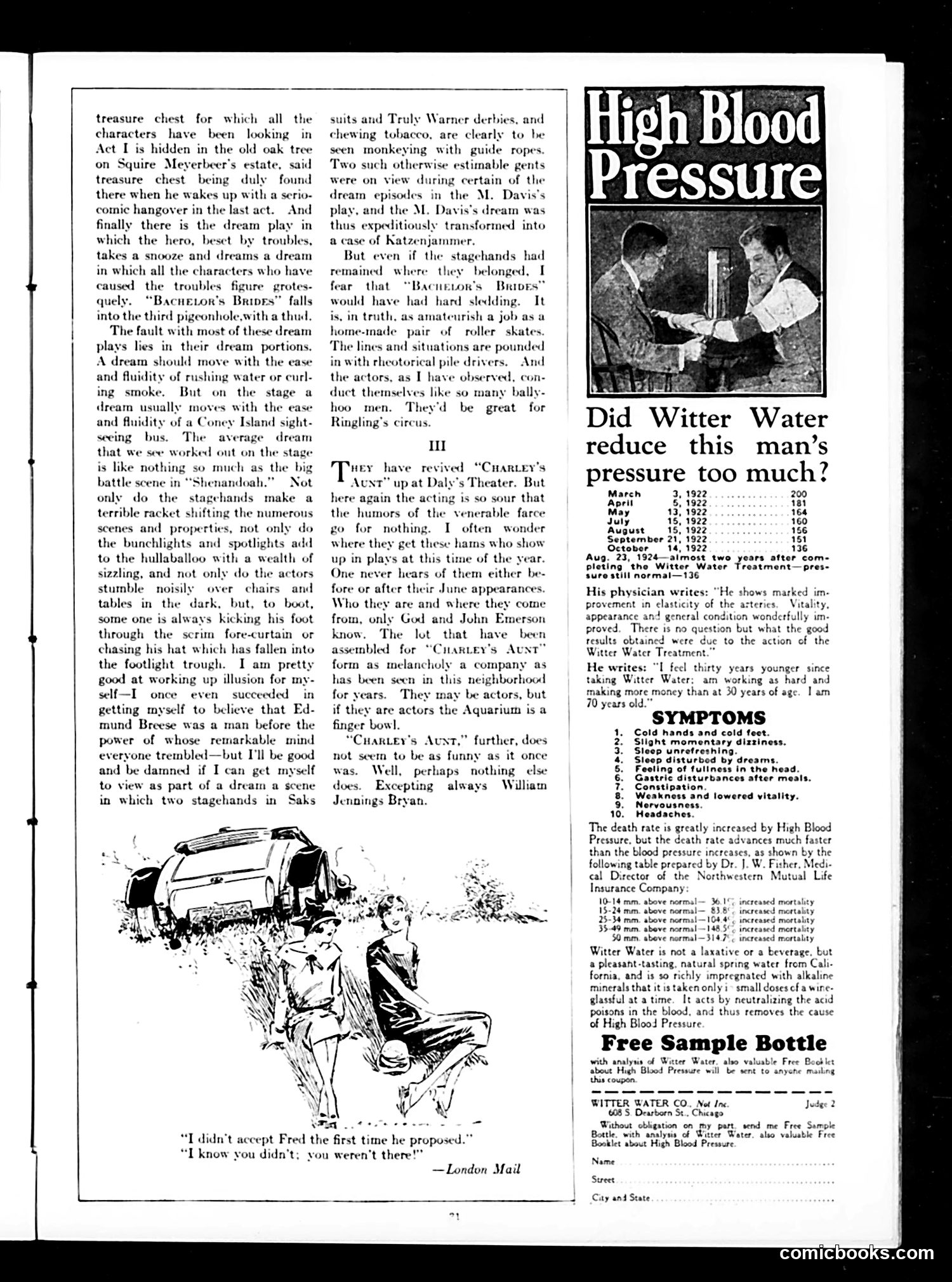
This page contains theater criticism (left) and a medical advertisement (right). **Left side:** A drama critic reviews recent Broadway productions, including "Bachelor's Brides" and a revival of "Charley's Aunt." The reviewer complains that dream sequences in plays are poorly executed—stagehands in street clothes (Saks suits and "Truly Warner derbies") are visibly shifting scenery, destroying the theatrical illusion. He dismisses the acting as amateurish "ham" performances, wondering where theaters find such poor actors who appear only in summer productions. He sarcastically notes that only William Jennings Bryan (the three-time presidential candidate, seemingly a standing joke about irrelevance) remains consistently unfunny. **Right side:** An advertisement for "Witter Water," claiming to treat high blood pressure. It presents before/after blood pressure readings showing improvement and includes a physician's testimonial. The ad promises a "Free Sample Bottle," typical of early-20th-century patent medicine marketing.
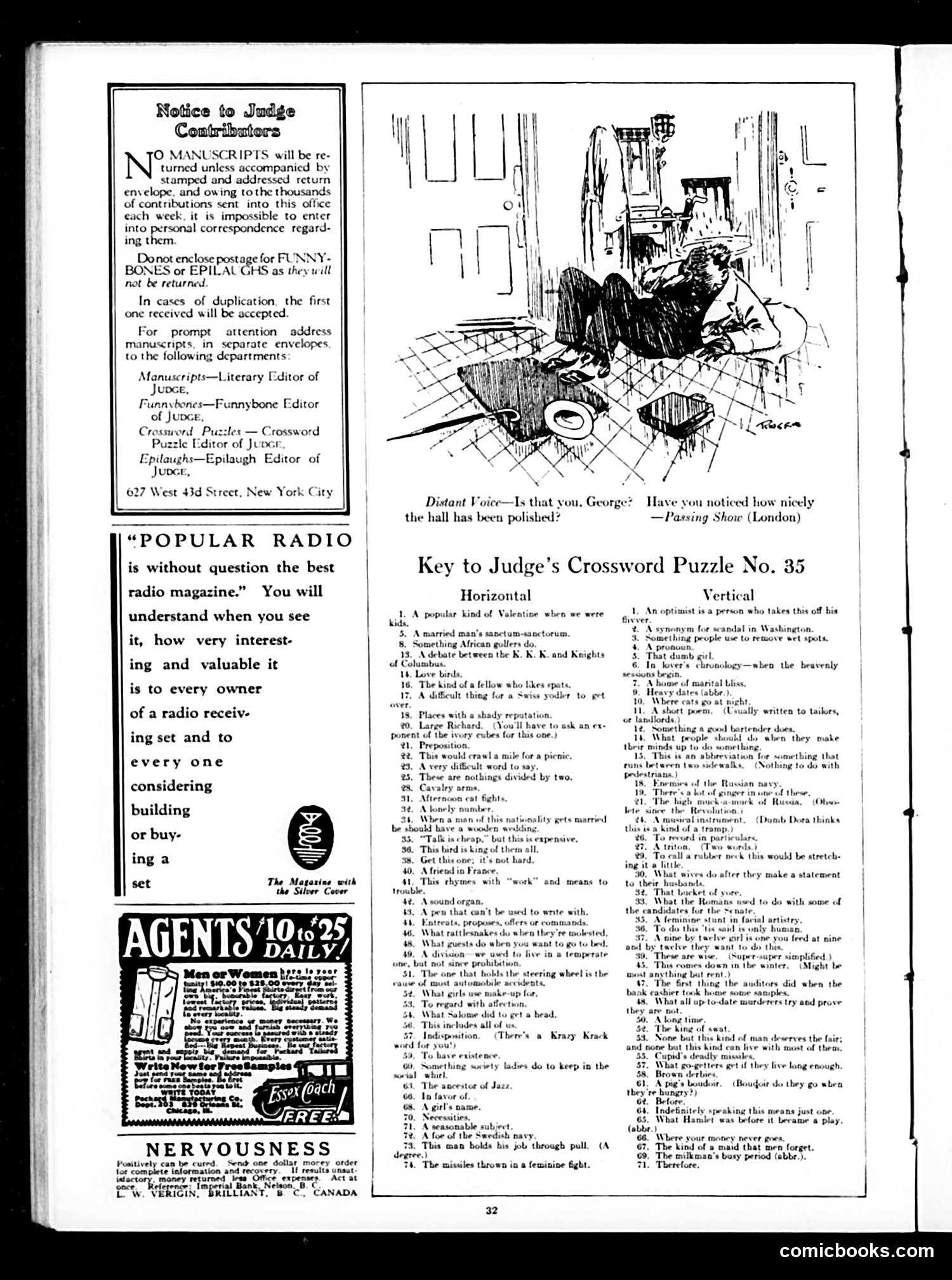
This page is primarily **administrative and advertising** rather than satirical content. The main cartoon—"Distant Voice"—depicts a domestic scene where a man calls out asking if "George" is there and whether he's noticed the hall has been polished. This appears to be a **gentle domestic humor joke**, likely playing on marital dynamics or servant relationships, though the specific reference is unclear without fuller context. The page's primary purpose is **practical**: it contains submission guidelines for Judge contributors (manuscripts, jokes, crosswords, epitaphs), advertisements for Popular Radio magazine and various employment/sales opportunities, and the solution key to "Judge's Crossword Puzzle No. 35." The crossword clues themselves contain period references (the K.K.K., mentions of Jazz history, radio technology) that would date this to the 1920s-1930s era, but there's no substantive political satire visible on this particular page. It's largely **housekeeping and classified content** for the magazine.
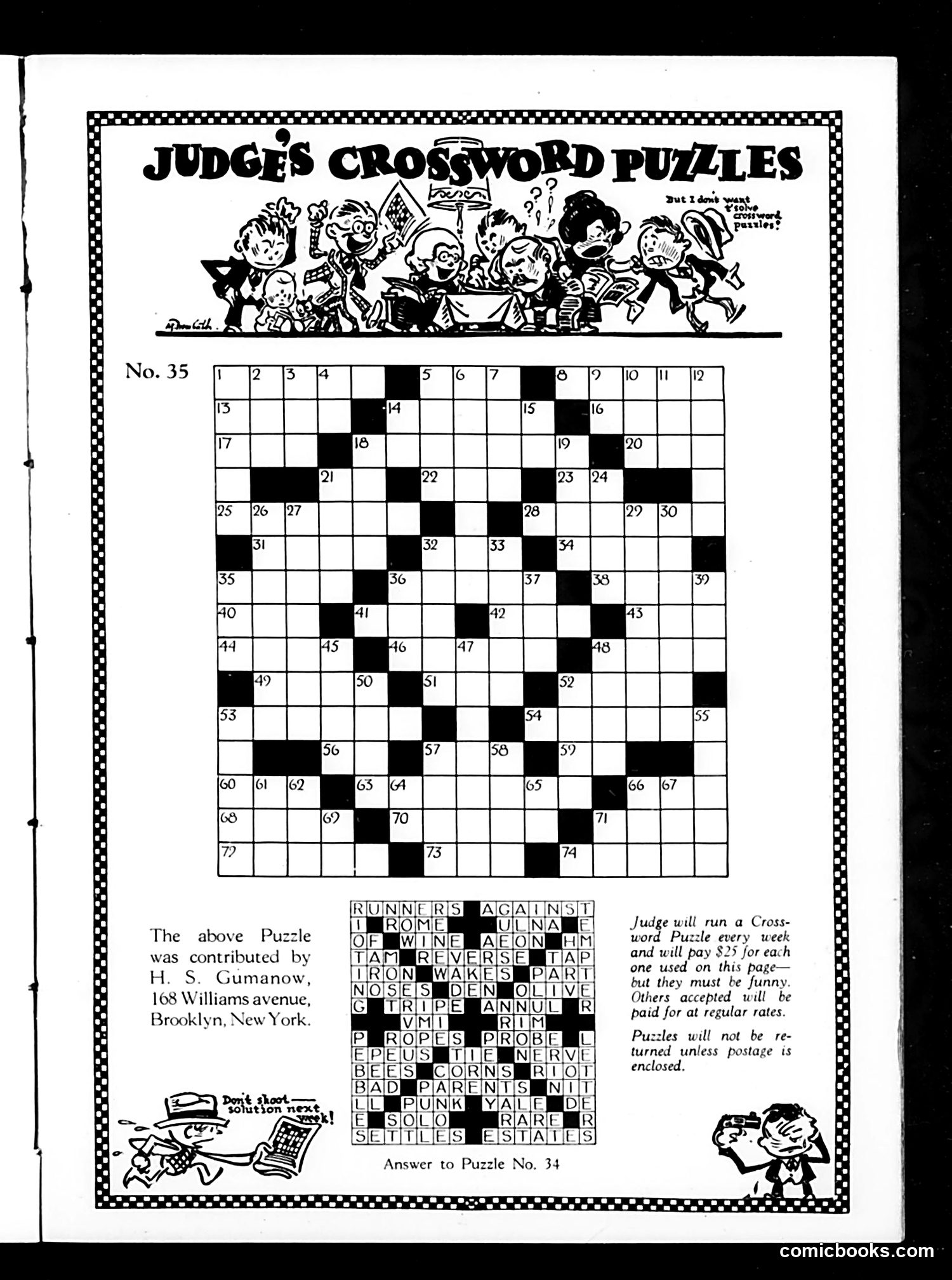
This page is primarily a **crossword puzzle submission**, not a political cartoon. It's "Judge's Crossword Puzzles No. 35," contributed by H.S. Gumanow of Brooklyn. The key context: Judge magazine ran weekly crossword puzzles and paid $25 for "funny" ones—a significant sum in this era. The answer key visible shows the completed puzzle below, with clues like "RUNNERS AGAINST" and "ROME." The cartoonish illustrations are decorative headers/footers typical of Judge's style, not satirical commentary. The small cartoon of someone struggling with the puzzle reinforces the humorous intent—the puzzle itself *is* the entertainment and the joke. This reflects the 1920s-30s crossword craze that swept America, where the puzzles themselves became a popular leisure activity. Judge capitalized on this trend by creating puzzle content that readers found engaging enough to submit themselves.
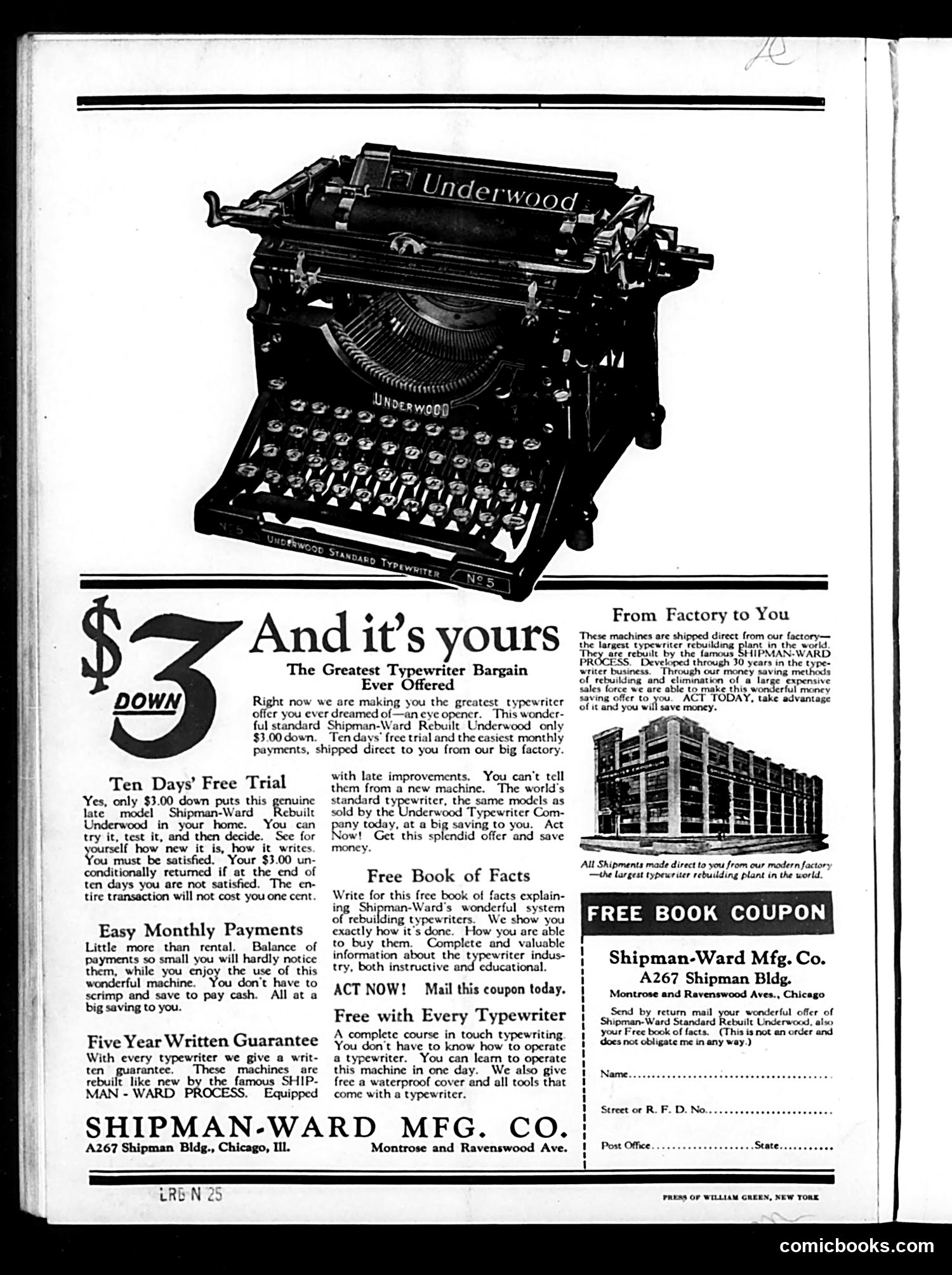
This page is **primarily a product advertisement**, not a political cartoon. It promotes Shipman-Ward Manufacturing Company's rebuilt Underwood typewriters. The appeal targets early-20th-century consumers with limited cash: a $3 down payment, ten-day free trial, easy monthly installments, and a five-year guarantee. The "From Factory to You" messaging emphasizes direct sales bypassing retail markup—a common sales pitch during this era. The photograph shows a standard Underwood typewriter, the era's market-leading model. The factory building image reinforces the company's scale and legitimacy. This reflects Judge magazine's reliance on advertising revenue. While Judge published satirical content elsewhere, this particular page is straightforward commercial promotion with no discernible political or social satire—merely business-minded marketing to Depression-era or post-war consumers seeking affordable office equipment.

I can see this appears to be a blank or nearly blank page from Judge magazine, with only "comicbooks.com" visible at the bottom right. The page itself contains no discernible cartoon, illustration, text content, or satirical commentary that I can analyze. Without visible comic panels, caricatures, political figures, or written content on the actual page, I cannot identify what this publication addressed, who the cartoonist was, or what social or political satire it contained. This may be a blank interior page, a damaged scan, or a page that failed to reproduce clearly in this image. To provide meaningful historical context, I would need a page with visible cartoon imagery or OCR'd text content.