
Judge, 1925-06-27 · page 17 of 37
Judge — June 27, 1925 — page 17: what you’re looking at
What you’re looking at
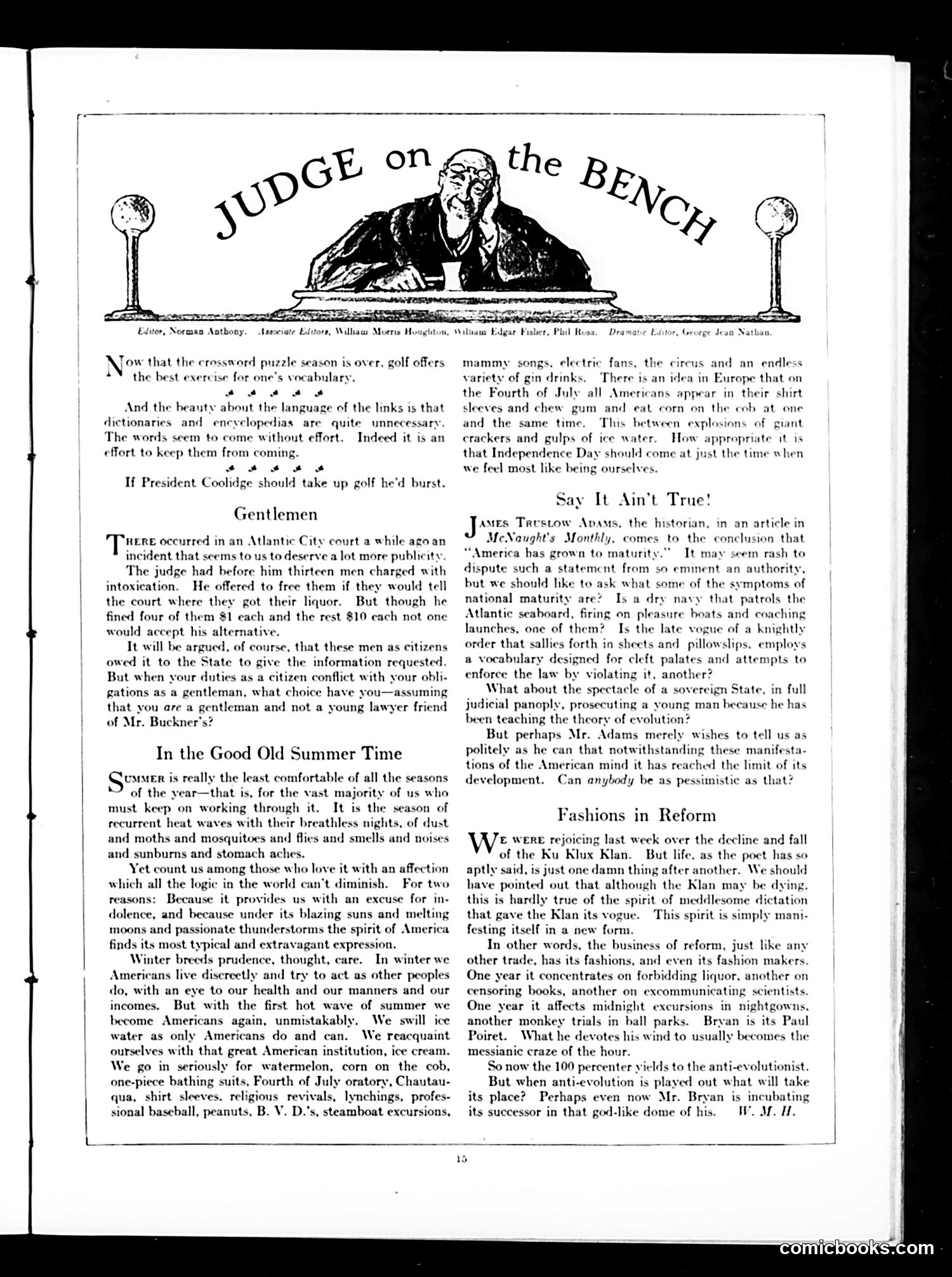
This page from *Judge* magazine contains several satirical pieces targeting American society and politics circa the 1920s. **"Judge on the Bench"** (masthead): A standard editorial cartoon format. **Key Articles:** 1. **"Gentlemen"**: Satirizes an Atlantic City court case where thirteen men charged with intoxication refused to inform on their liquor suppliers, citing gentlemanly honor over civic duty. The piece mocks this misplaced loyalty. 2. **"In the Good Old Summer Time"**: Celebrates American summer excess—ice cream, watermelon, gum-chewing, loose clothing, and "religious revivals, lynchings, professional baseball"—as authentically American behavior, contrasting American informality with European restraint. 3. **"Say It Ain't True!"**: Critiques historian James Truslow Adams's claim that "America has grown to maturity." The satire points to counterexamples: a naval force "firing on pleasure boats," the Ku Klux Klan operating in "sheets and pillowslips," and a state prosecuting someone for teaching evolution—suggesting America remains immature despite industrial development. The page reflects 1920s anxieties about Prohibition enforcement, the KKK's resurgence, and evolution debates.
📄 Transcribed text from this page (OCR, searchable)
Machine-transcribed from the original scan — historical spelling and the odd misread are preserved.
Editor, Norman Anthony. Aesseiate Exlitore, Wilhaas Morris New that the erossword puzzle season is over, golf offers + the best exercise for one’s vocabulary. a fF $s St And the beauty about the language of the links is that dictionaries and encyclopedias are quite unnecessary. The words seem to come without effort. Indeed it is an effort to keep them from coming. ss s If President Coolidge should take up golf he'd burst. oe Gentlemen HERE occurred in an Atlantic City court a while agoan incident that seems to us to deserve a lot more publicity The judge had before him thirteen men charged with intoxication. He offered to free them if they would tell the court where they got their liquor. But though he fined four of them $1 each and the rest $10 each not one would accept his alternative. It will be argued, of course, that these men as citizens owed it to the State to give the information requested. But when your duties as a citizen conflict with your obli- gations as a gentleman, what choice have you—assuming that you are a gentleman and not a young lawyer friend of Mr. Buckner’s? In the Good Old Summer Time UMMER is really the least comfortable of all the seasons of the year—that is, for the vast majority of us who must keep on working through it. It is the season of recurrent heat waves with their breathless nights, of dust and moths and mosquitoes and flies and smells and noises and sunburns and stomach aches. Yet count us among those who love it with an affection which all the logic in the world can't diminish. For two reasons: Because it provides us with an excuse for in- dolence, and because under its blazing suns and melting moons and passionate thunderstorms the spirit of America finds its most typical and extravagant expression. Winter breeds prudence, thought, care. In winter we Americans live discreetly and try to act as other peoples do, with an eye to our health and our manners and our incomes. But with the first hot wave of summer we become Americans again, unmistakably. We swill ice water as only Americans do and can. We reacquaint ourselves with that great American institution, ice cream. We go in seriously for watermelon, corn on the cob, one-piece bathing suits, Fourth of July oratory, Chautau- qua, shirt sleeves, religious revivals, lynchings, profes- sional baseball, peanuts, B. V. D.’s, steamboat excursions, Jeao Nathan mammy songs, electric and an endless variety of gin drinks. There is an idea in Europe that on the Fourth of July all Americans appear in their shirt sleeves and chew gum and eat corn on the cob at one and the same time, This between explosions of giant crackers and gulps of ice water. Independence Day should come at just the time when we feel most like being ourselves. fan How appropriate it is Say It Ain't True! Jon Tavstow Apams, the historian, in an article in McNaught’s Monthly, comes to the conclusion that “America bas grown to maturity.” It may dispute such a statement from so eminent but we should like to ask wh: national maturity are? seem rash to n authority, some of the symptoms of Is a dry navy that patrols the Atlantic seaboard, firing on pleasure boats and coaching launches, one of them? Is the late vogue of a knightly order that sallies forth in sheets and_pillowslips, a vocabulary designed for cleft ates and attempts to enforce the law by violating it, anothe What about the spectacle of a sovereign State, in full judicial panoply, prosecuting a young man because he has been teaching the theory of evolution? But perhaps Mr. Adams merely wishes to tell us as politely as he can that notwithstanding these manifesta- tions of the American mind it has reached the limit of its development. Can anybody be as pessimistic as that? employs Fashions in Reform © WERE rejoicing last week over the decline and fall of the Ku Klux Klan. But life, as the poet has so aptly said, is just one damn thing after another. We should have pointed out that although the Klan may be dying, this is hardly true of the spirit of meddlesome dictation that gave the Klan its vogue. festing itself in a new form. In other words, the business of reform, just like any other trade, has its fashions, and even its fashion makers. One year it concentrates on forbidding liquor, another on censoring books, another on excommunicating scientists. One year it affects midnight excursions in nightgowns, another monkey trials in ball parks. Bryan is its Paul Poiret. What he devotes his wind to usually becomes the messianic craze of the hour. So now the 100 percenter yields to the anti-evolutionist. But when anti-evolution is played out what will take its place? Perhaps even now Mr. Bryan is incubating its successor in that god-like dome of his, W. M. H. This spirit is simply mani-