
Judge, 1925-06-27 · page 27 of 37
Judge — June 27, 1925 — page 27: what you’re looking at
What you’re looking at
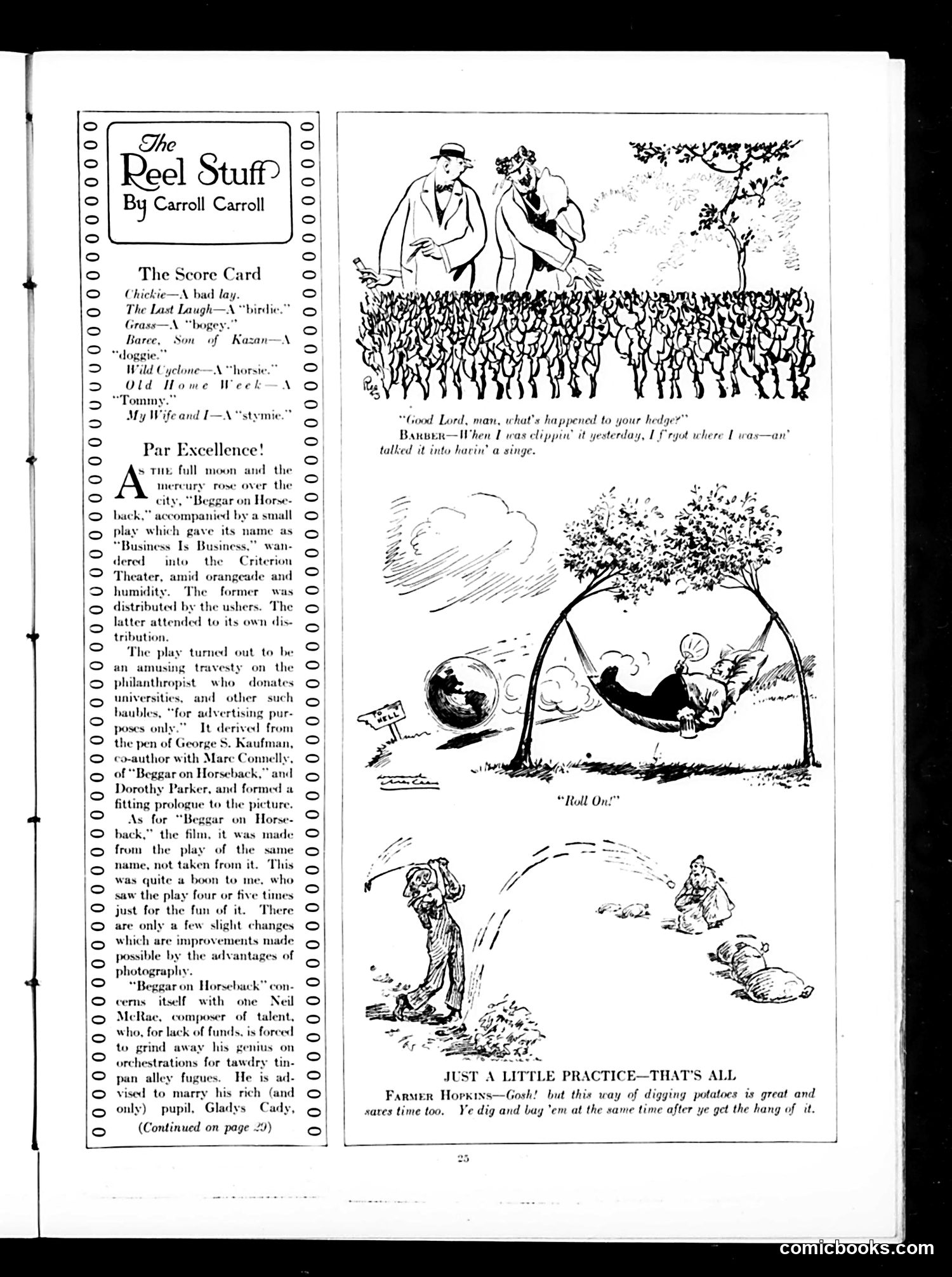
This page reviews "Beggar on Horseback," a 1925 film adapted from a play by George S. Kaufman, Marc Connelly, and Dorothy Parker. The article praises the film as a satire on wealthy philanthropists who donate to institutions primarily for publicity rather than genuine charity. The cartoons are unrelated gag comics typical of Judge magazine's format. The top cartoon shows a barber who accidentally burned a customer's hair while distracted. The bottom cartoon depicts a farmer comically using a digging method that combines two tasks—literally "digging and laying" potatoes simultaneously—presented as efficient but absurd labor-saving innovation. These standalone jokes reflect Judge's satirical humor about everyday American life and human folly, contrasting with the film review's critique of wealthy hypocrisy. The page demonstrates the magazine's mix of cultural commentary and light social satire.
📄 Transcribed text from this page (OCR, searchable)
Machine-transcribed from the original scan — historical spelling and the odd misread are preserved.
00000000 MOO0000000000000000000000000000000000000N00000000 The Reel Stuf By Carroll Carroll The Score Card Chickie—A bad la The Last Laugh Grase—\ “bogey Bare, Son of Kazan—A\ “doggie.” Wild Cyclone Old Home “Tommy.” My Wife and I—\"stymie.” virdie.” Par Excellence! s THE full moon and the city, “Beggar on Horse- back,” accompanied by a small play which gave its name as “Business Is Business.” wan- dered into” the — Criterion Theater, nid orangeade and humidity. The former was distributed by the ushers. The latter attended to its own dis- tribution. The play turned out to be an amusing travesty on the philanthropist. who donates universities, and other such bau “for advertising pur- poses only.” It derived from the pen of George $. Kaufman, co-author with Mare Connelly, of “Beggar on Horseback,” and Dorothy Parker, and formed a fitting prologue to the picture. As for “Beggar on Horse- back,” the film, it was made from the play of the same name, not taken from it. This was quite a boon to me, who saw the play four or five times just for the fun of it. There are only a few slight changes which are improvements made possible by the advantages of photography. “Beggar on Horseback” con- cers itself with one Neil McRae, composer of talent, who, for lack of funds, is forced to grind away his genius orchestrations for tawdry tin- pan alley fugues. He is ad- vised to marry his rich (and ouly) pupil, Gladys Cady, (Continued on page 2) 000, 4 | | | “Good Lord, man, what's happened to your hed: Banser—When I was clippin’ it yesterday, 1 frgot where | was—an™ talked it into havin’ a singe. 0000000000000000000000000000000000 JUST A LITTLE PRACTICE—THAT'S ALL | Faruer Hopxins—Gosh! but this way of digging potatoes is great and sates time too. Ye dig and bay ’em at the same time after ye get the hang of it. 000000000000000000 — | L