
A complete issue · 36 pages · 1925
Judge — June 20, 1925
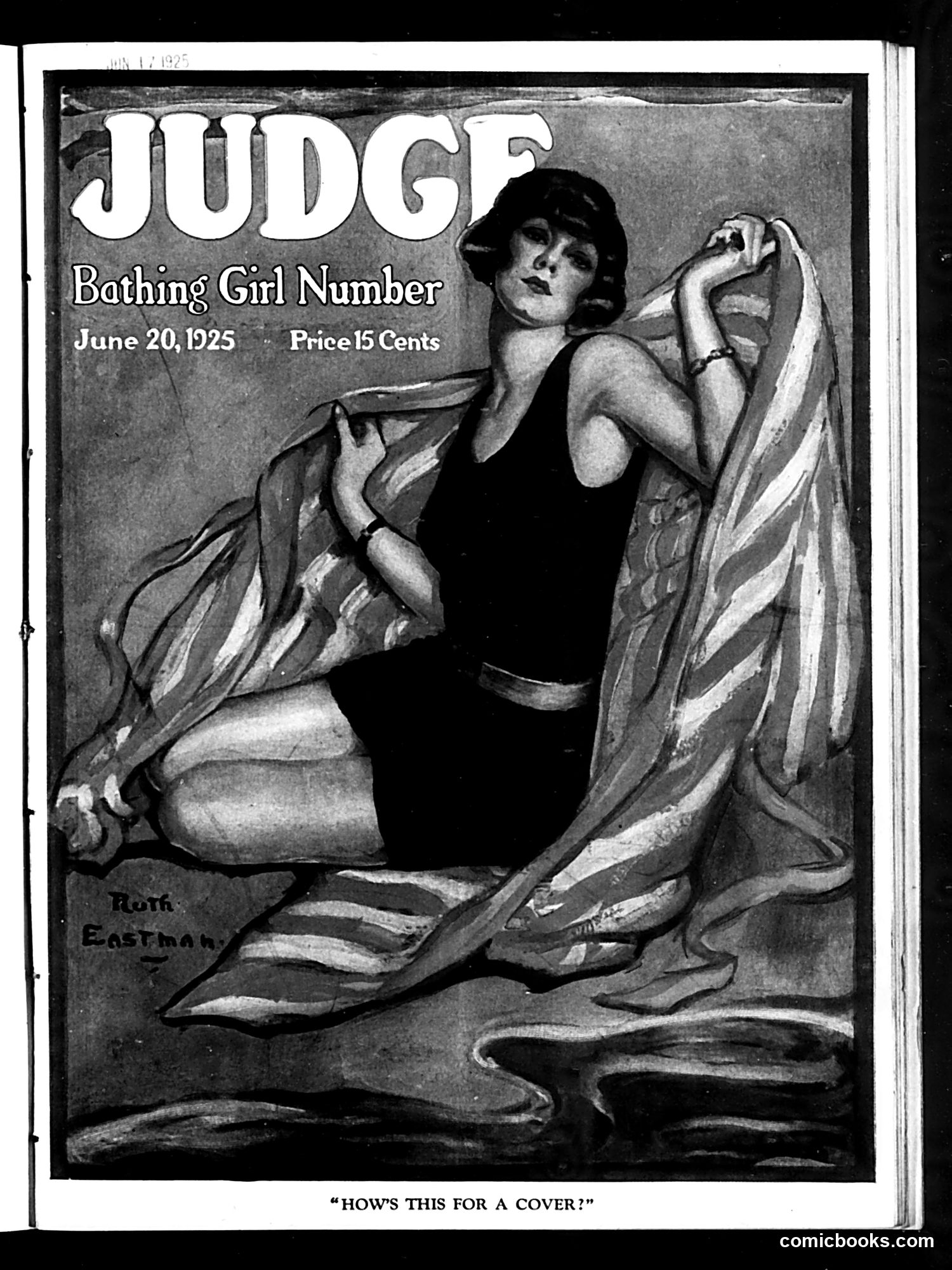
This is the cover of Judge magazine's "Bathing Girl Number" from June 20, 1925, priced at 15 cents. The illustration by Ruth Eastman depicts a woman in a black bathing suit dramatically posing with flowing fabric, accompanied by the caption "HOW'S THIS FOR A COVER?" The satire appears self-referential—Judge is literally asking readers' opinions on its own cover choice. In 1925, bathing girl imagery was popular magazine cover material, particularly during summer months. This was part of the era's cultural shift toward more relaxed attitudes about women's bodies and beach fashion. The pose and theatrical styling reflect Art Deco aesthetics typical of 1920s illustration. The "Bathing Girl Number" was a common magazine specialty issue format of the period.
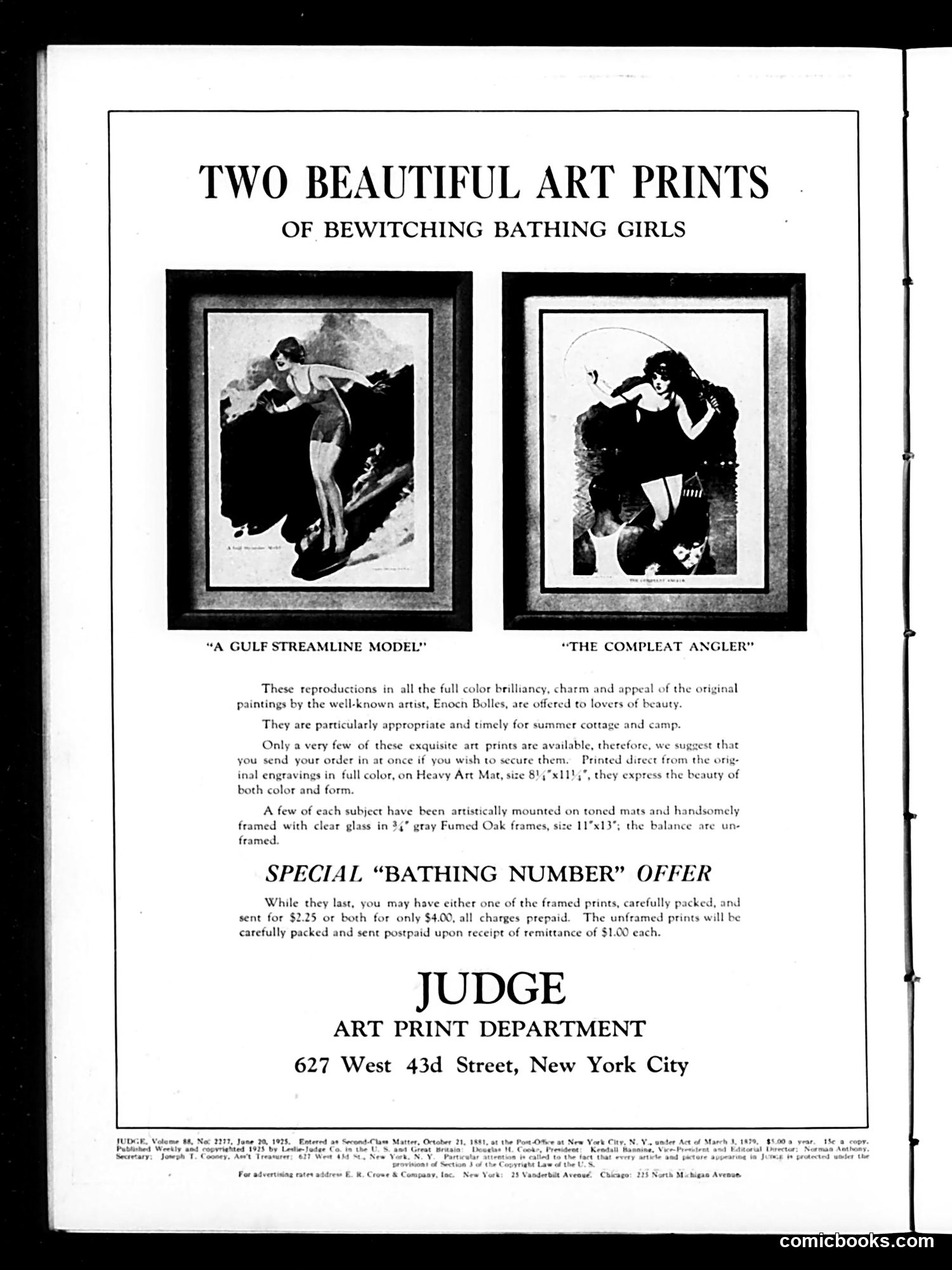
This page is primarily **advertising rather than satire or political commentary**. It promotes art prints by Enoch Bolles, a well-known illustrator of the 1920s era, featuring two bathing girls titled "A Gulf Streamline Model" and "The Compleat Angler." The humor in the title "Two Beautiful Art Prints of Bewitching Bathing Girls" is mild and typical of the period—playing on the appeal of attractive young women in swimwear, which was a popular commercial art subject during this era of increasing female leisure and beach culture. The "Special Bathing Number Offer" frames the prints as timely summer merchandise. The page includes ordering information for Judge's Art Print Department in New York City, with pricing details for framed and unframed options.
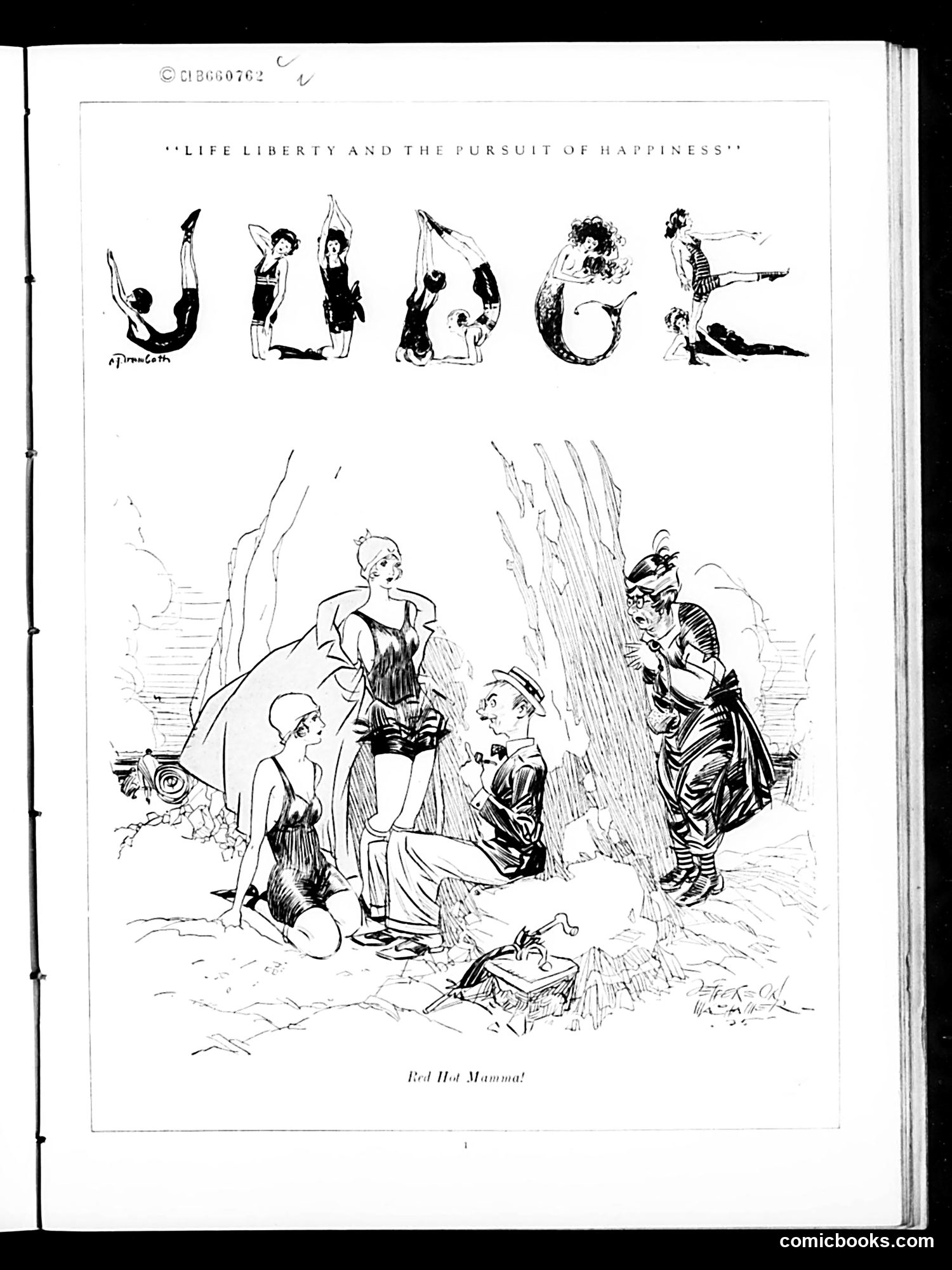
The page is titled **"Life Liberty and the Pursuit of Happiness"** — a reference to the Declaration of Independence. The top shows five stylized figures spelling "JUDGE" through acrobatic poses, a visual pun on the magazine's name. The bottom cartoon, labeled **"Red Hot Mamma!"** depicts what appears to be a flapper-era scene with several figures in 1920s dress gathered outdoors. A woman in revealing attire is central, with men (including what appears to be a uniformed officer on the right) attending to her. The "red hot mamma" reference suggests satire of Jazz Age social freedoms and changing sexual mores—specifically mocking the era's scandalous new female independence and fashion. The uniformed figure's presence may suggest commentary on social or legal regulation attempts. The cartoon critiques both modern women's liberation and perhaps the hypocrisy of authority figures surrounding such behavior.
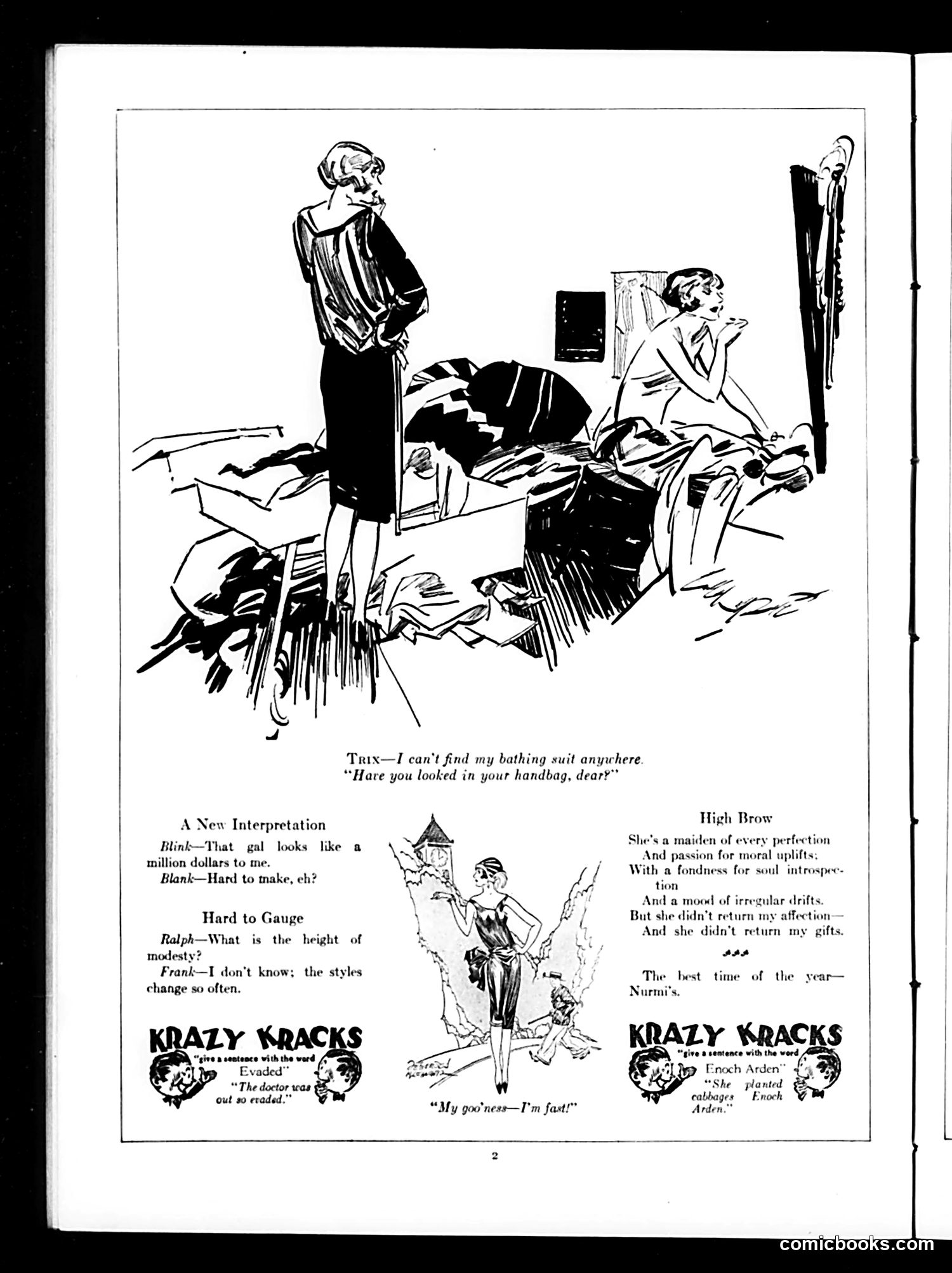
This page from *Judge* magazine contains three separate humorous items targeting early 20th-century social conventions: **Top cartoon**: Shows a woman searching her handbag while others lounge in disarray, with the caption about a missing bathing suit. The joke satirizes the chaos of modern domestic life and women's increasing independence—the woman is active and practical while others relax. **"A New Interpretation" and "Hard to Gauge"**: Brief joke exchanges mocking social pretension and fashion's constant changes, reflecting anxieties about shifting class markers and women's evolving roles. **"Krazy Kracks"**: Two small comic strips with wordplay about evasion and French gardens, representing the magazine's lighter humor content alongside social commentary. Overall, the page reflects *Judge's* focus on satirizing changing gender roles and modern social behaviors of the era.
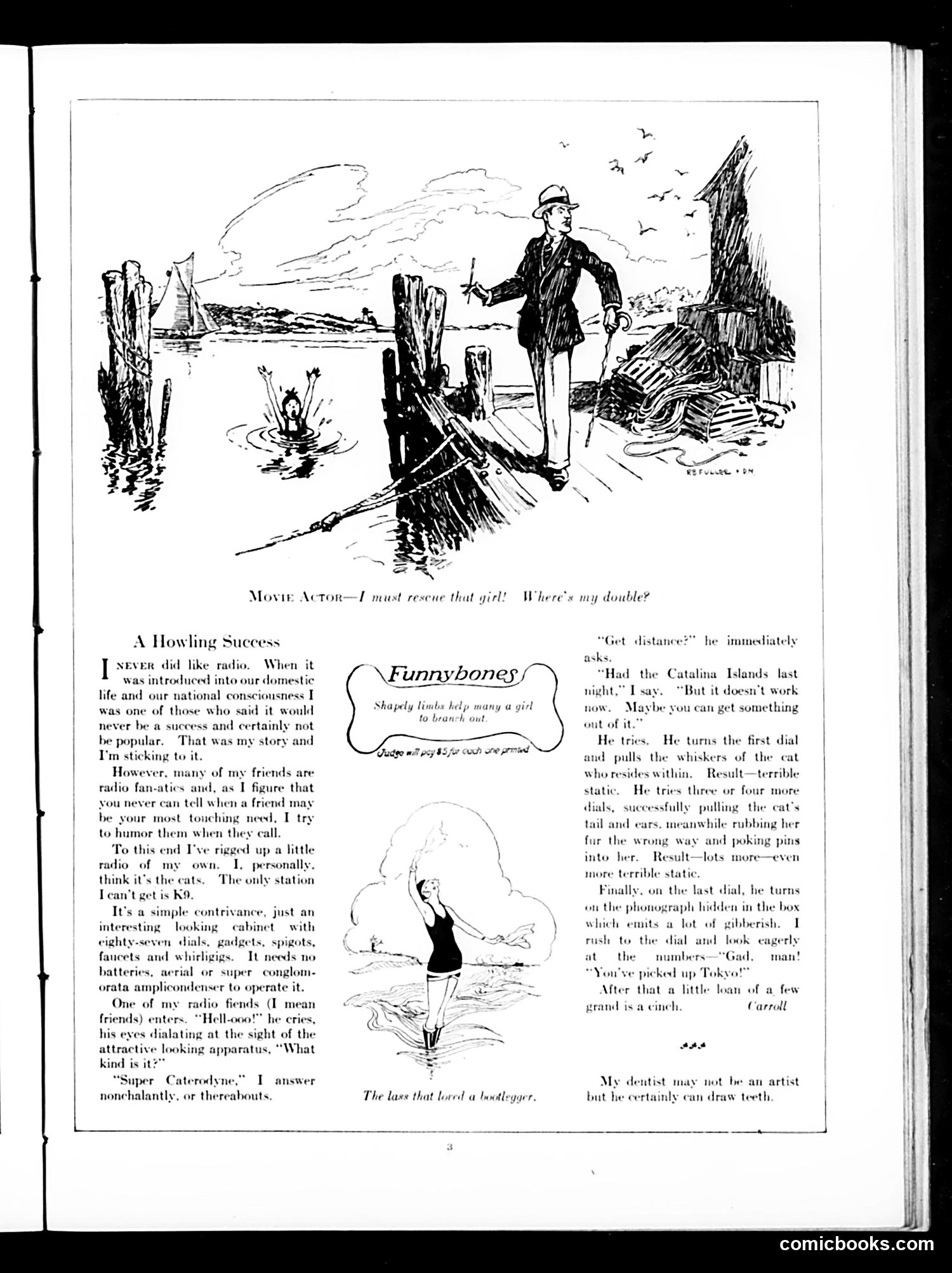
This page features two distinct pieces of content: **Top Cartoon**: "A Howling Success" depicts a movie actor on a dock saying "I must rescue that girl! Where's my double?" The satire mocks silent film conventions—actors relying on stunt doubles for dramatic rescue scenes, undermining the authenticity audiences expect from heroic performances. **"Funnybones" Section**: A humorous piece about using a cat as a makeshift telephone receiver, describing comic mishaps when dialing (getting cat fur, ears, and tail caught). The joke plays on early radio/telephone technology's novelty and domestic absurdity. **Bottom Item**: A brief quip about dentists being able to draw teeth. The content reflects early 20th-century satire targeting emerging entertainment media (silent films, radio) and household technologies.
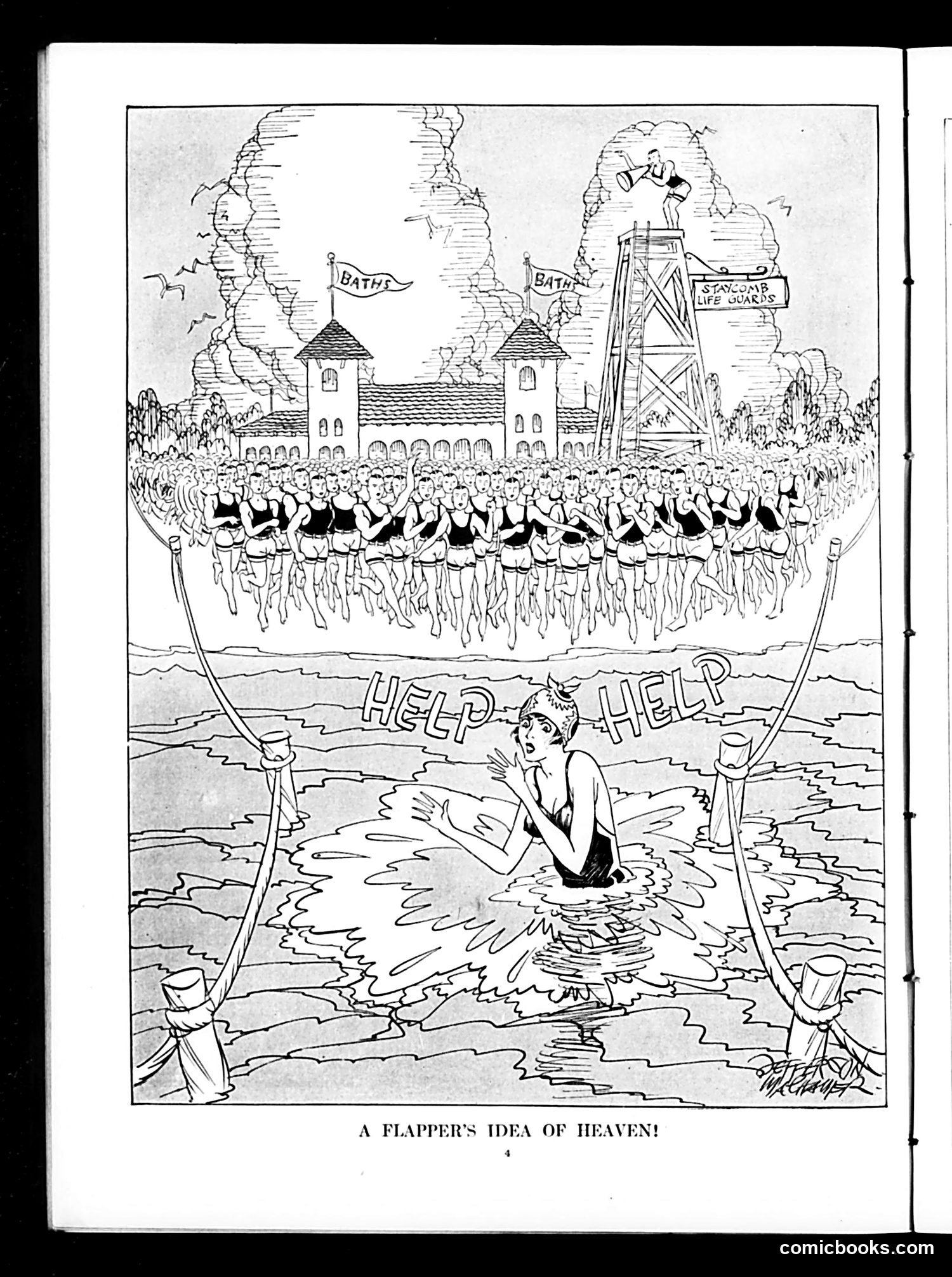
This cartoon satirizes 1920s "flapper" culture—young women who embraced modern fashion, dancing, and social freedoms that scandalized conservative society. The caption suggests what such a woman imagines as paradise. The image shows a woman in a bathing suit in water, calling "Help! Help!" while surrounded by onlookers at an elaborate bath house. The humor appears to derive from the contradiction between the flapper's liberated image and traditional notions of propriety—she's simultaneously seeking rescue while displaying herself publicly in swimwear, which was controversial at the time. The cartoon mocks flapper values, implying their "heaven" involves public attention, modern leisure facilities, and disregard for modesty—all markers of the social revolution young women were driving in the Jazz Age.
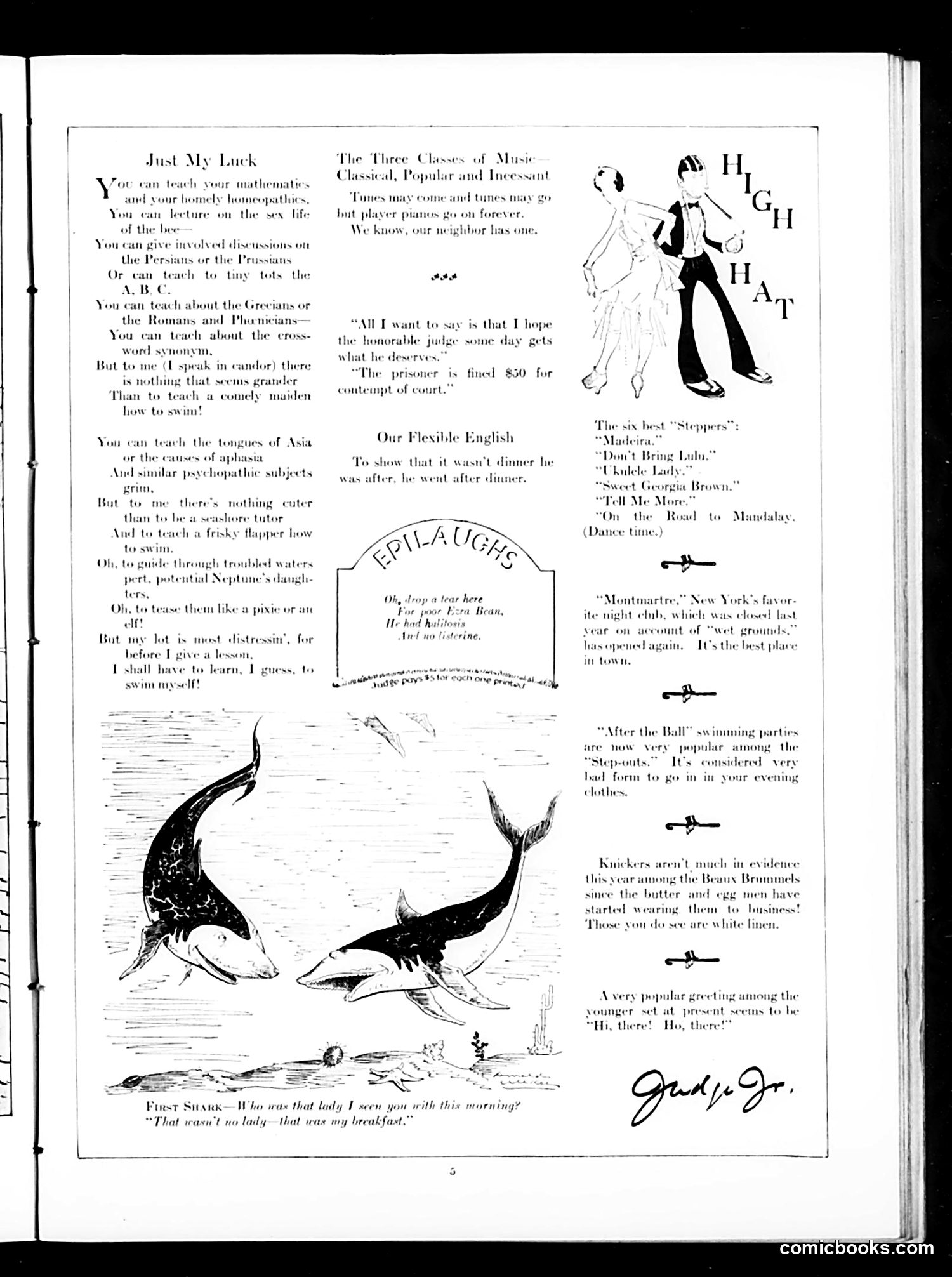
This page contains humor pieces rather than political cartoons. The main content includes: **"Just My Luck"** - a poem satirizing the futility of education, suggesting one can teach almost any subject *except* how to teach comedy. **"The Three Classes of Music"** - a brief joke about musical taste. **"Our Flexible English"** - a short piece on English grammar peculiarities (using "after" twice differently). **The shark cartoon** - Two sharks discuss breakfast, with one claiming "That wasn't my lady—that was my breakfast," a dark joke about mistaken identity. **Right column** - Social commentary on current fashions and behaviors among the wealthy (evening clothes, "Stepsuits," knickers, greetings). The page reflects early 20th-century American humor focused on social observation and wordplay rather than political satire.
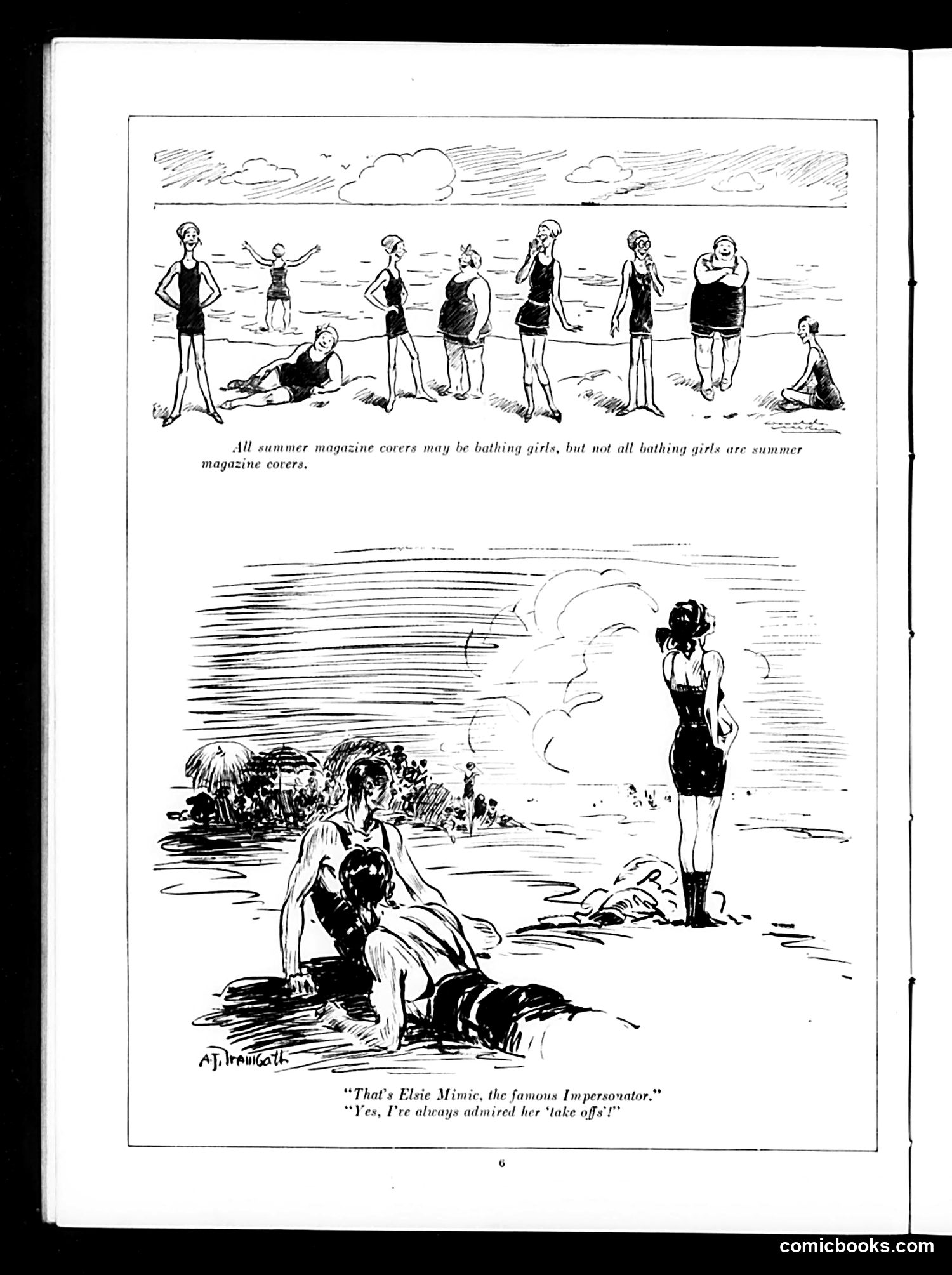
This Judge magazine page contains two cartoons about bathing girls and celebrity impersonators. The **top cartoon** is a logical joke: while summer magazines feature bathing girls on their covers, not every woman in a bathing suit deserves magazine coverage. It shows various beach-goers of differing physiques and poses, satirizing the gap between idealized magazine imagery and reality. The **bottom cartoon** features "Elsie Mimic, the famous Impersonator"—likely a real performer known for mimicry acts, popular entertainment in this era. The humor plays on double meaning: admiring her "take offs" (both her impersonation performances and her removing swimwear). The artwork's signature reads "A.T. Hiringoth." The page satirizes both idealized beauty standards in magazines and the entertainment industry's celebrity culture.
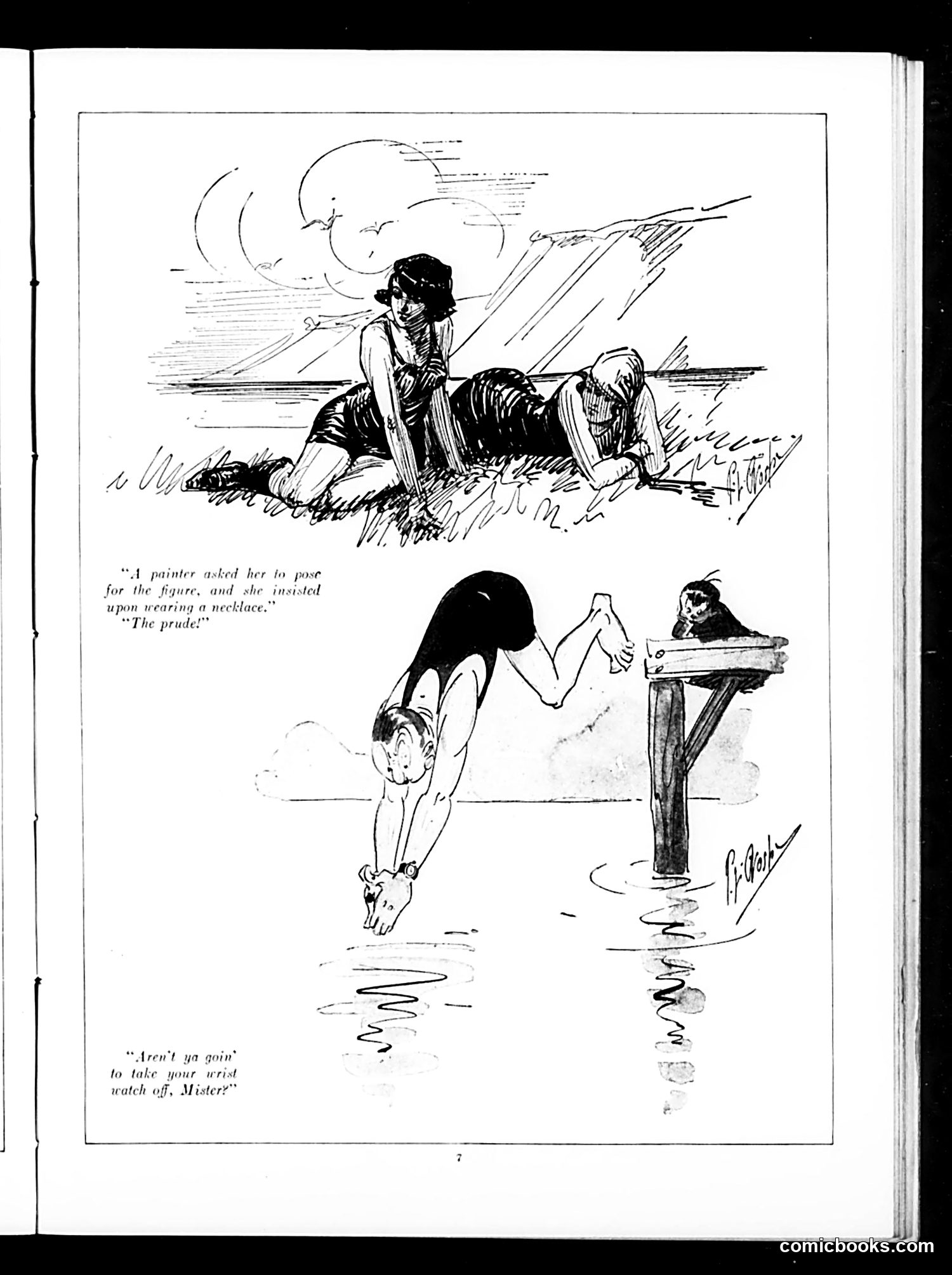
This page contains two related satirical cartoons about hypocrisy regarding modesty and nudity. The top cartoon shows a painter with a female model posing nude—except she insists on wearing a necklace. The painter dismisses her as prudish ("The prude!"), mocking her selective modesty. The bottom cartoon reverses this: a woman prepares to pose nude but asks a male artist to remove his wristwatch. The irony is deliberate—just as the female model's necklace seemed absurdly modest while nude, the man's wristwatch appears similarly incongruous. The satire critiques double standards and the arbitrary nature of "decency." Both cartoons suggest that modesty concerns ring hollow when selective; the accompanying jewelry or accessories highlight the contradiction inherent in partial modesty during full nudity.
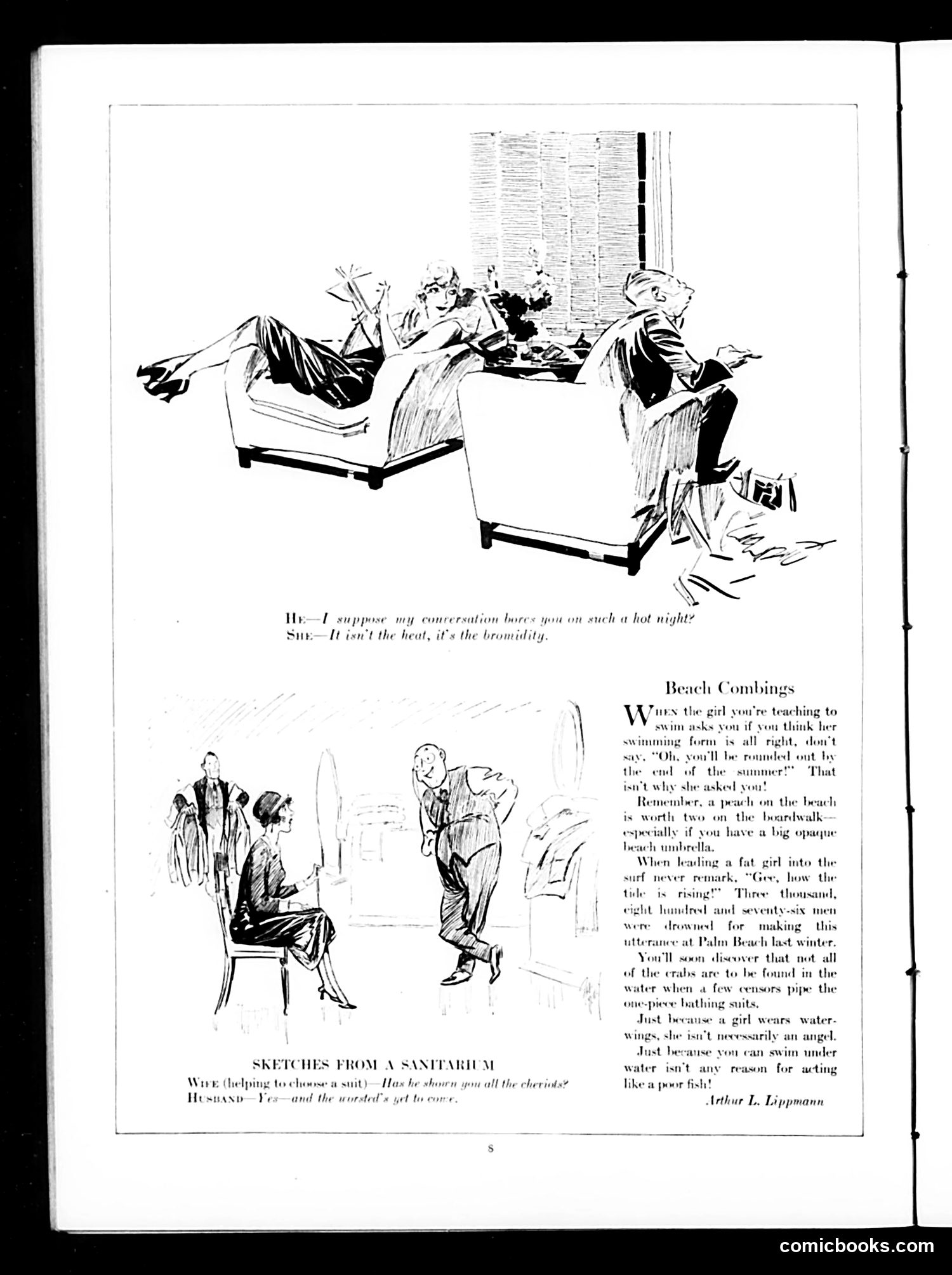
This is a humor page from *Judge* magazine featuring three separate comedic sketches: **Top cartoon**: A couple on a hot night—she complains it's not the heat but the "bromidity" (a dated term for dull, trite conversation). The joke mocks small talk and boredom in relationships. **"Sketches from a Sanitarium"**: A wife helps her husband choose a suit, asking if he's seen "all the cheriots" (likely "chariot"—unclear reference). He replies he's seen them and the "worsted's yet to come" (wordplay: "worst is" + the fabric "worsted"). This appears to be about marital shopping frustrations. **"Beach Combings"**: A column of etiquette advice by Arthur L. Lippmann offering satirical rules for beach behavior—mocking men who make tactless remarks to women about swimming form or weight, censors policing one-piece bathing suits, and people acting foolishly around water. The humor targets both male rudeness and rigid social conventions of the era.
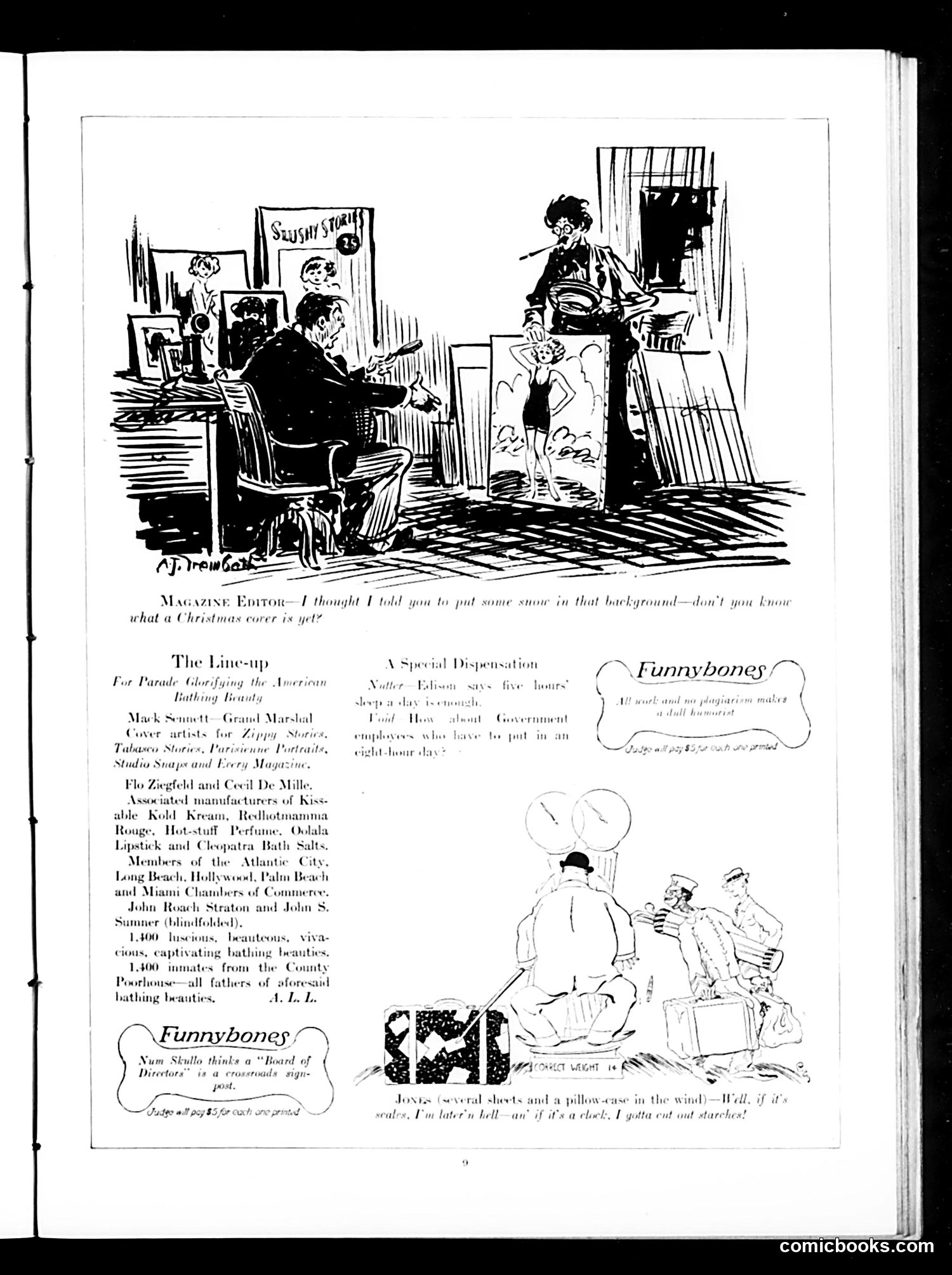
This page satirizes the commercialization of a "bathing beauty" parade—likely the famous Miss America pageant or similar 1920s spectacle. The top cartoon shows a magazine editor demanding "snow in that background" for a Christmas cover, exposing how these events were artificially staged productions rather than authentic celebrations. The "Line-up" section mockingly lists who benefits from the parade: entertainment moguls (Mack Sennett, Flo Ziegfeld, Cecil DeMille), cosmetics and perfume manufacturers, and chambers of commerce from resort towns. The joke identifies 1,400 "luscious" bathing beauties, implying they're interchangeable products. The reference to "John Roach Straton and John S. Sumner (blindfolded)" suggests morality crusaders were willfully ignoring the commercialized sexuality on display—they claim to oppose such spectacles while remaining blind to their prevalence. The cartoons criticize how bathing beauty pageants were corporate marketing tools dressed up as wholesome entertainment.
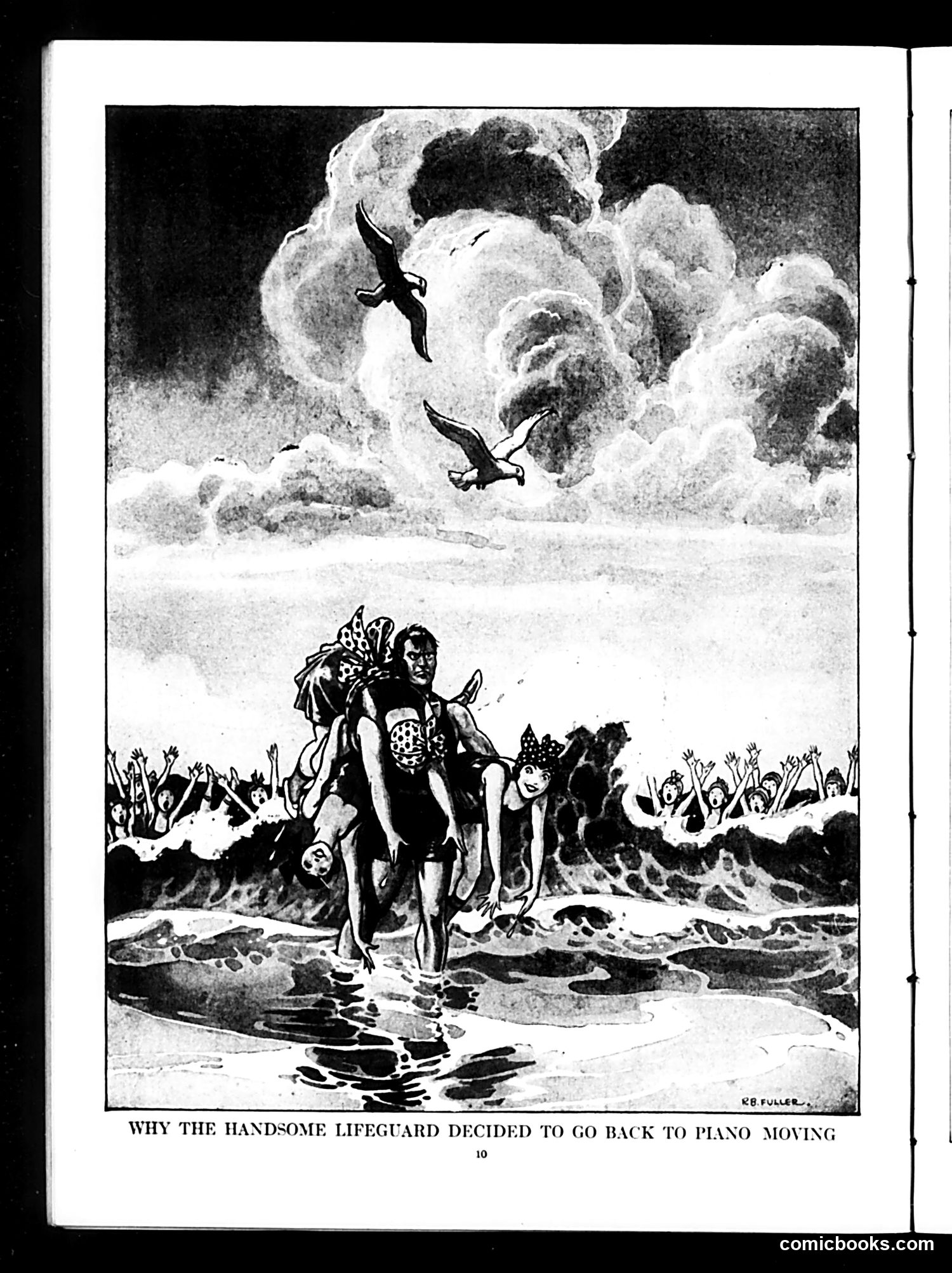
This is a humorous illustration by R.B. Fuller satirizing the dangers of lifeguarding. The cartoon shows a muscular lifeguard rescuing multiple people from turbulent waters while pterodactyls (or similar flying creatures) attack from above and a massive crowd of people desperately reaches toward him from the shore. The joke's premise—stated in the caption—is that this lifeguard has decided to quit and return to the safer occupation of piano moving. The satire implies that even moving pianos (traditionally portrayed as dangerous work) is preferable to the chaos and overwhelming responsibility of beach lifeguarding. The cartoon exaggerates lifeguarding duties to absurd extremes to make the comedic point about impossible working conditions and constant danger.
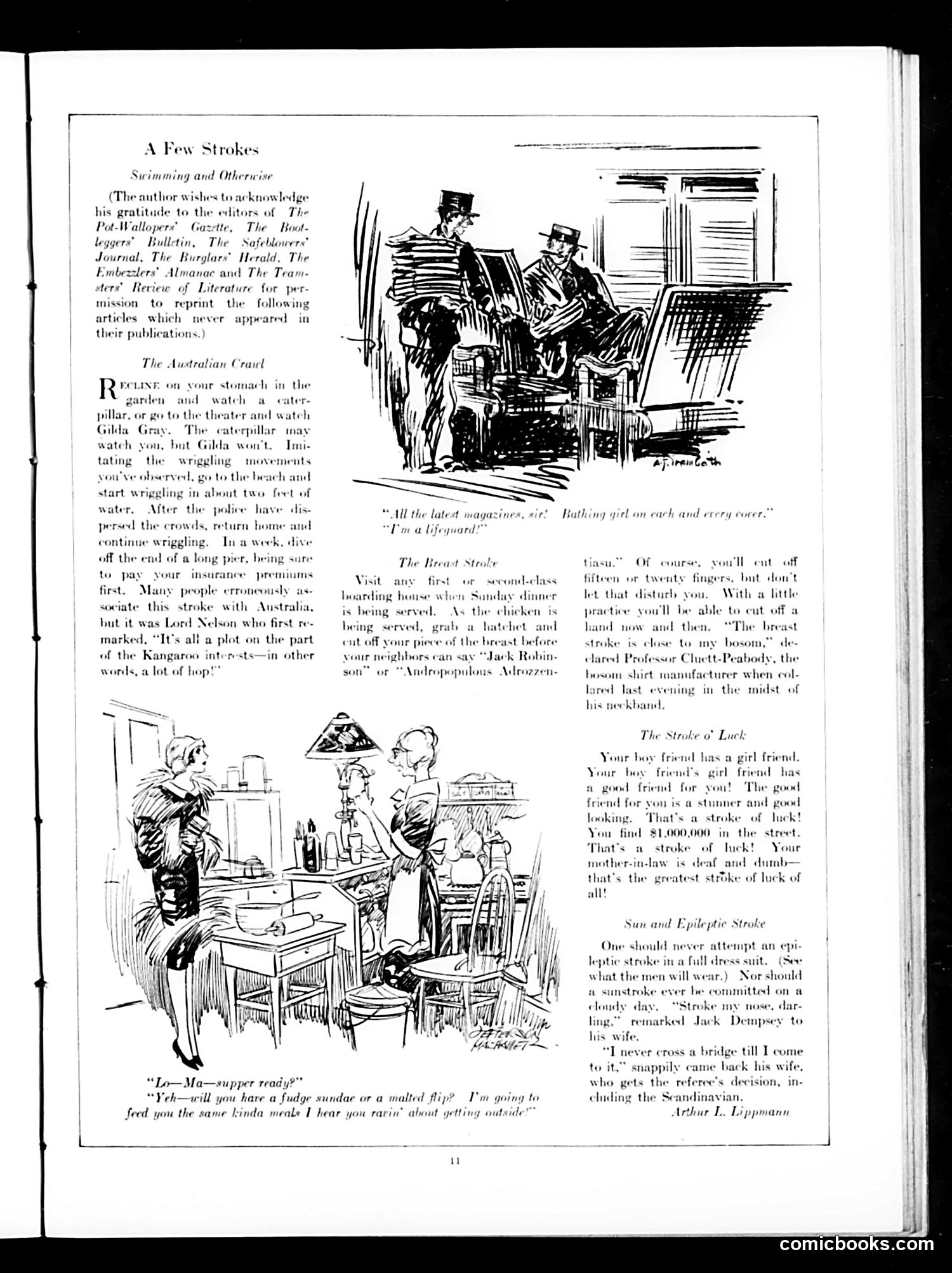
This page satirizes advice column clichés through mock-serious instructional pieces with absurdist humor. The main targets are: **"The Australian Crawl"**: Parodies swimming instruction by mixing legitimate swimming tips with nonsense—ending with Lord Nelson supposedly inventing the stroke as "a plot on the part of the Kangaroo" ("a lot of hop"). The humor mocks both swimming fads and historical attribution errors. **"The Breast Stroke"**: Satirizes dining etiquette columns, offering ridiculous advice about eating chicken at boarding houses while making veiled references to avoiding disturbance. **"The Stroke of Luck"**: Gently mocks how advice columns define "luck"—from finding a boyfriend's attractive friend to discovering $1,000,000, culminating in mother-in-law deafness as the ultimate stroke of luck. The cartoons show domestic scenes; the text credits fictional publications ("Bootleggers' Bulletin," "Burglars' Herald") as the source. This is parody of self-help journalism and advice-giving, common targets in 1920s-era satirical magazines.
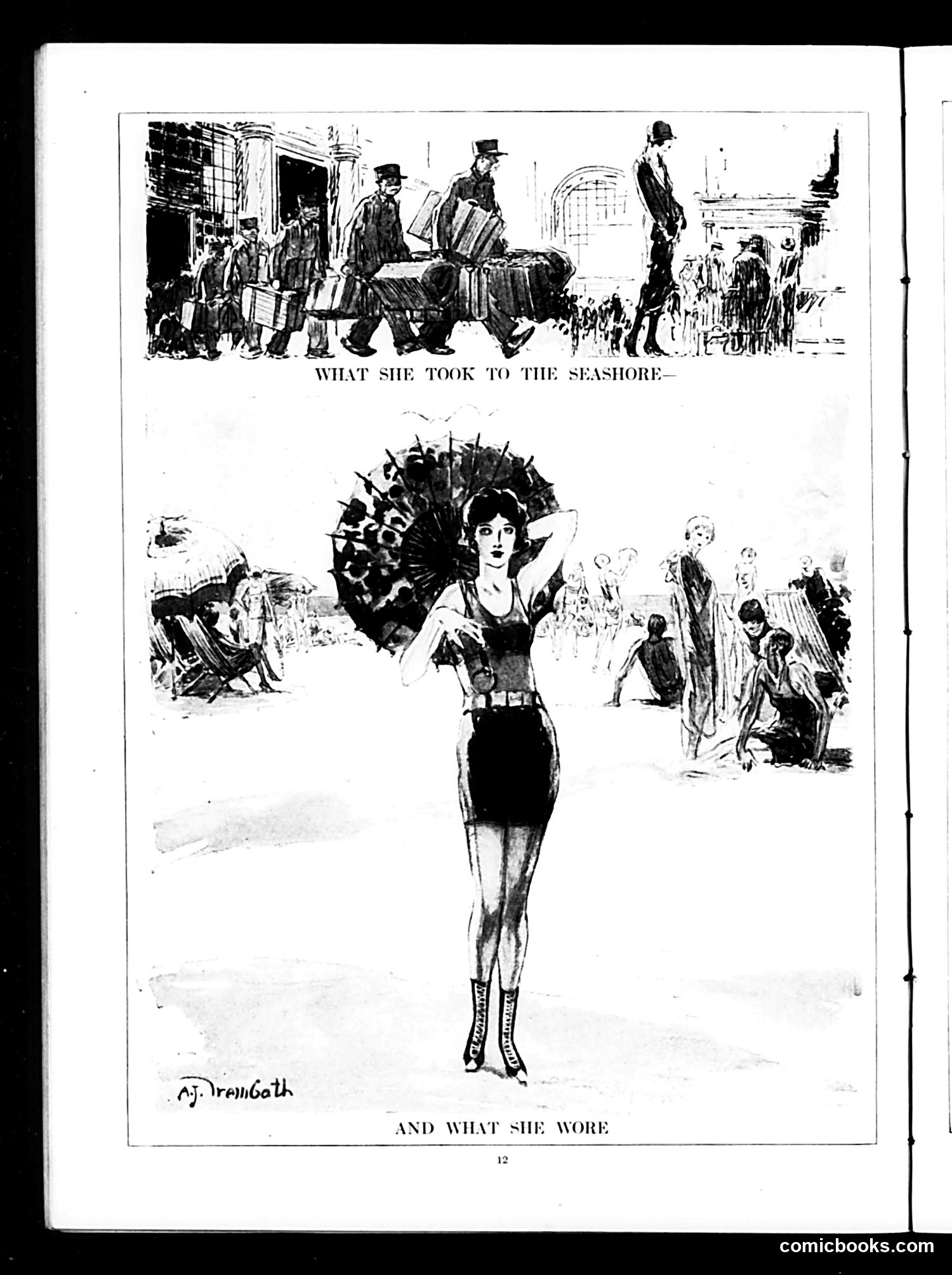
This two-panel satirical illustration by A.B. Tremboth contrasts Victorian-era social expectations with fashion reality at the seaside. The top panel shows a woman arriving at the shore laden with enormous luggage and accompanied by porters and attendants—depicting the excessive baggage and entourage supposedly necessary for a proper seaside visit. The bottom panel presents what she actually wore: a revealing bathing costume with a feathered hat, stockings, and a belt. The figure stands confidently amid beach-goers, suggesting the satire mocks both the pretentious over-preparation shown above and, likely, the scandalous brevity of women's actual bathing attire for the era. The joke targets Victorian hypocrisy—the gap between elaborate social conventions and practical reality, while also potentially satirizing changing (and controversial) women's fashion standards.
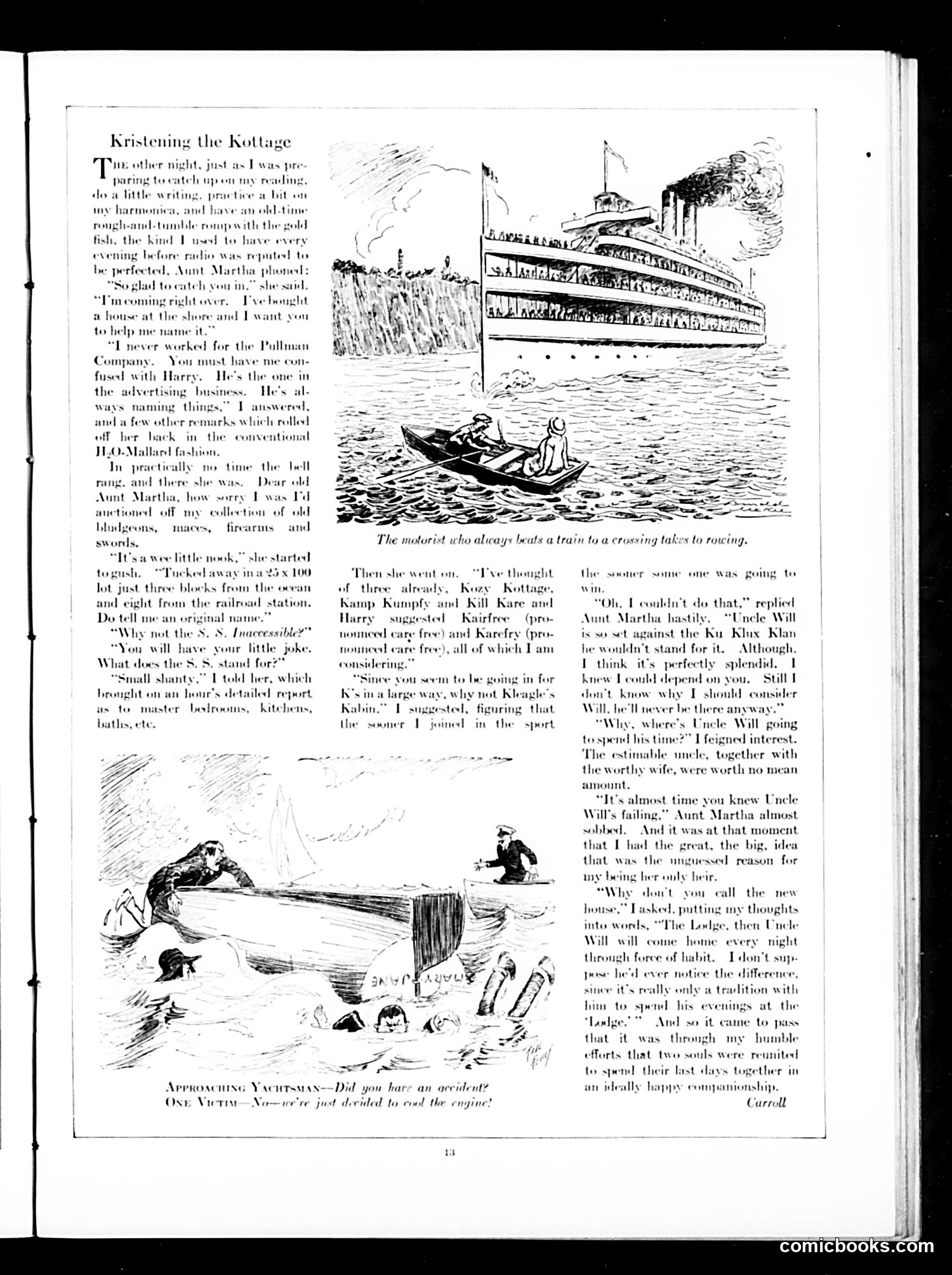
This satirical story mocks the 1920s fad of cutesy alliteration in naming vacation cottages—"Kozy Kottage," "Kamp Kumpfy," "Kill Kare." The narrator's suggestion of "Kleagle's Kabin" (referencing the Ku Klux Klan's organizational structure) is instantly rejected by Aunt Martha, who claims to oppose the KKK, though she finds it "perfectly splendid"—revealing hypocrisy about the Klan's then-rising membership among respectable Americans. The broader joke concerns the narrator's scheme: naming the cottage "The Lodge" will trick Uncle Will into abandoning his evenings at the actual Lodge (a fraternal organization, likely Masonic or similar) and spending time at home instead. The satire targets both the silly naming trends and the shallow motivations behind family gestures—the narrator's "humble efforts" to reunite the couple are really just self-interested scheming for an inheritance.
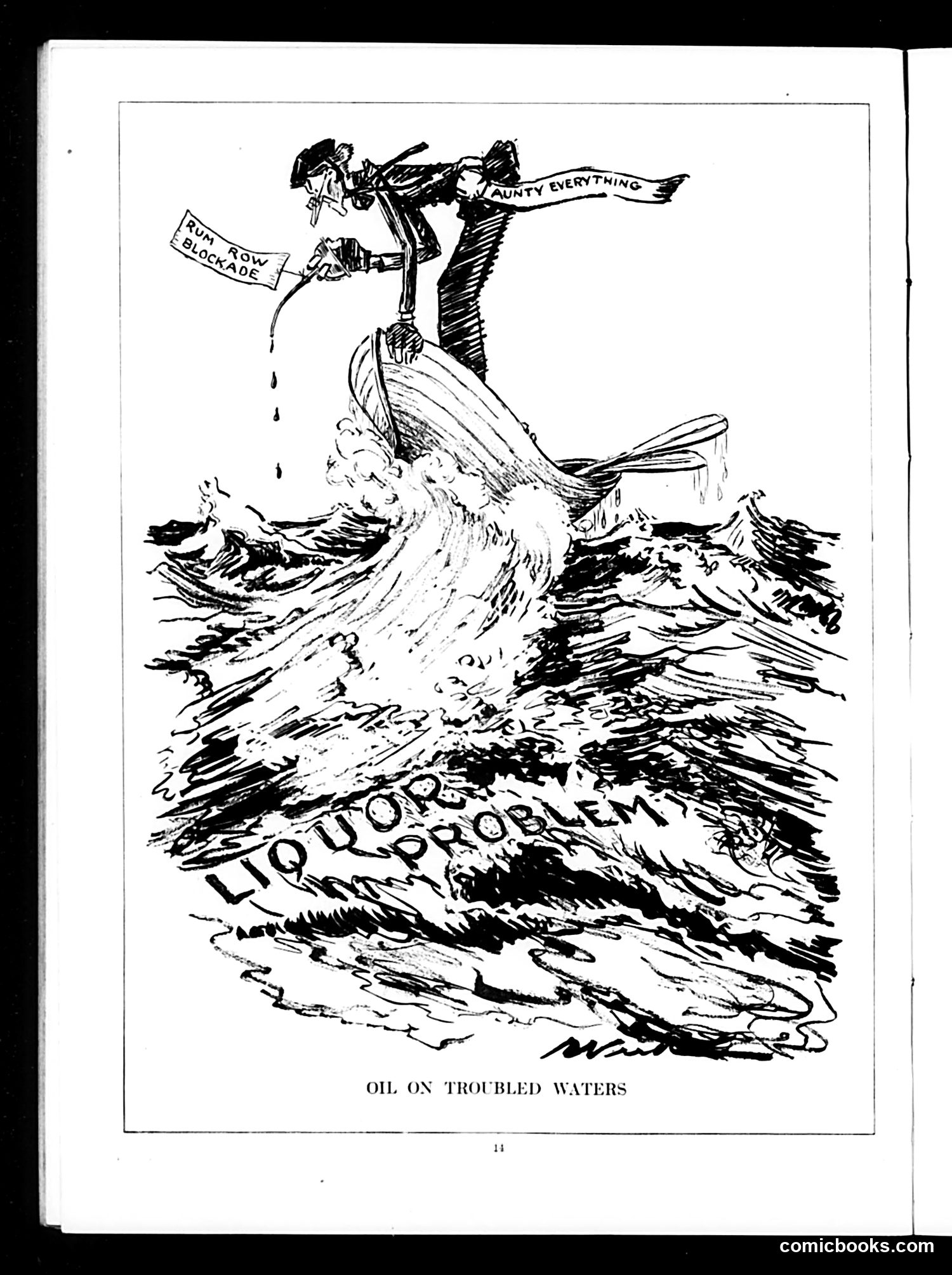
This political cartoon depicts a figure standing atop turbulent waves labeled "LIQUOR PROBLEM," pouring oil from a container marked "RUN NOW BLOCKADE" while proclaiming "AUNTY EVERYTHING." The visual pun on the phrase "oil on troubled waters" (meaning to calm a situation) satirizes Prohibition-era policies. The cartoon criticizes the approach to solving America's liquor problem during Prohibition. The figure appears to represent either a politician or policy-maker whose "solution"—running a blockade—paradoxically worsens the crisis rather than calming it. The imagery suggests that enforcement efforts and blockades are adding fuel to the fire, creating more chaos rather than resolving the underlying social tensions around alcohol prohibition. The satirical point: the government's heavy-handed approach was counterproductive.
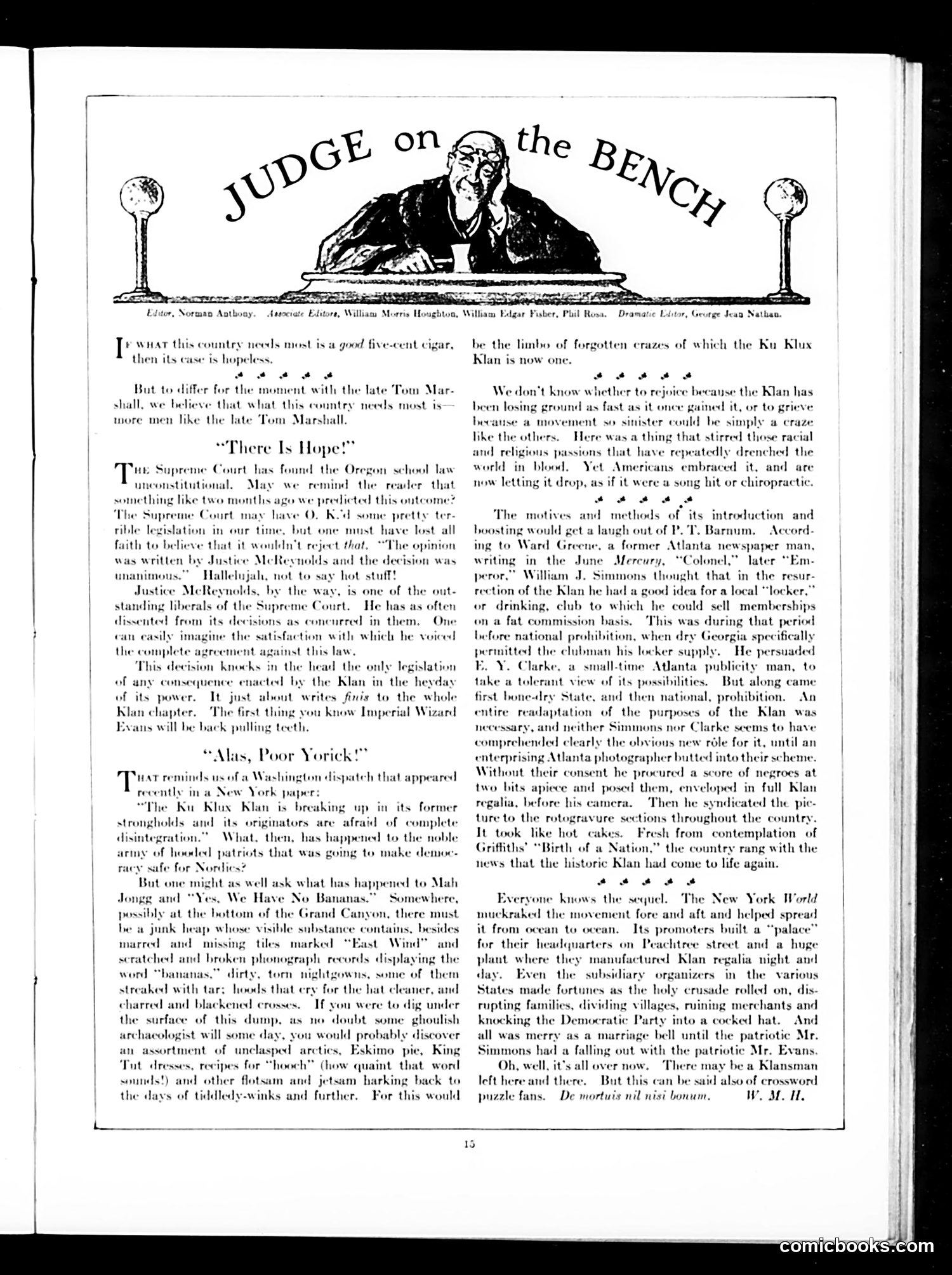
This page celebrates the Supreme Court's decision striking down Oregon's compulsory public school law—legislation the KKK had championed. The column mocks the Klan's rapid collapse, comparing it to forgotten fads like Mahjong and "Yes, We Have No Bananas." The satire's target: the KKK's embarrassing irrelevance. Despite promoting itself as a powerful movement defending "Nordics" and American values, the organization is already becoming cultural detritus. The writer notes the Klan arose from opportunistic commercial motives—William J. Simmons created it partly as a membership-fee scheme—making its grandiose racial ideology appear cynically manufactured rather than genuinely principled. The piece suggests Americans adopted the KKK as casually as they'd abandon any passing trend. The subtext: a movement built on hatred and fear deserves ridicule for its weakness and disposability. By 1925-26 (likely when published), the Klan's political influence was indeed waning, making this satire timely commentary on American gullibility and the movement's ultimate powerlessness.
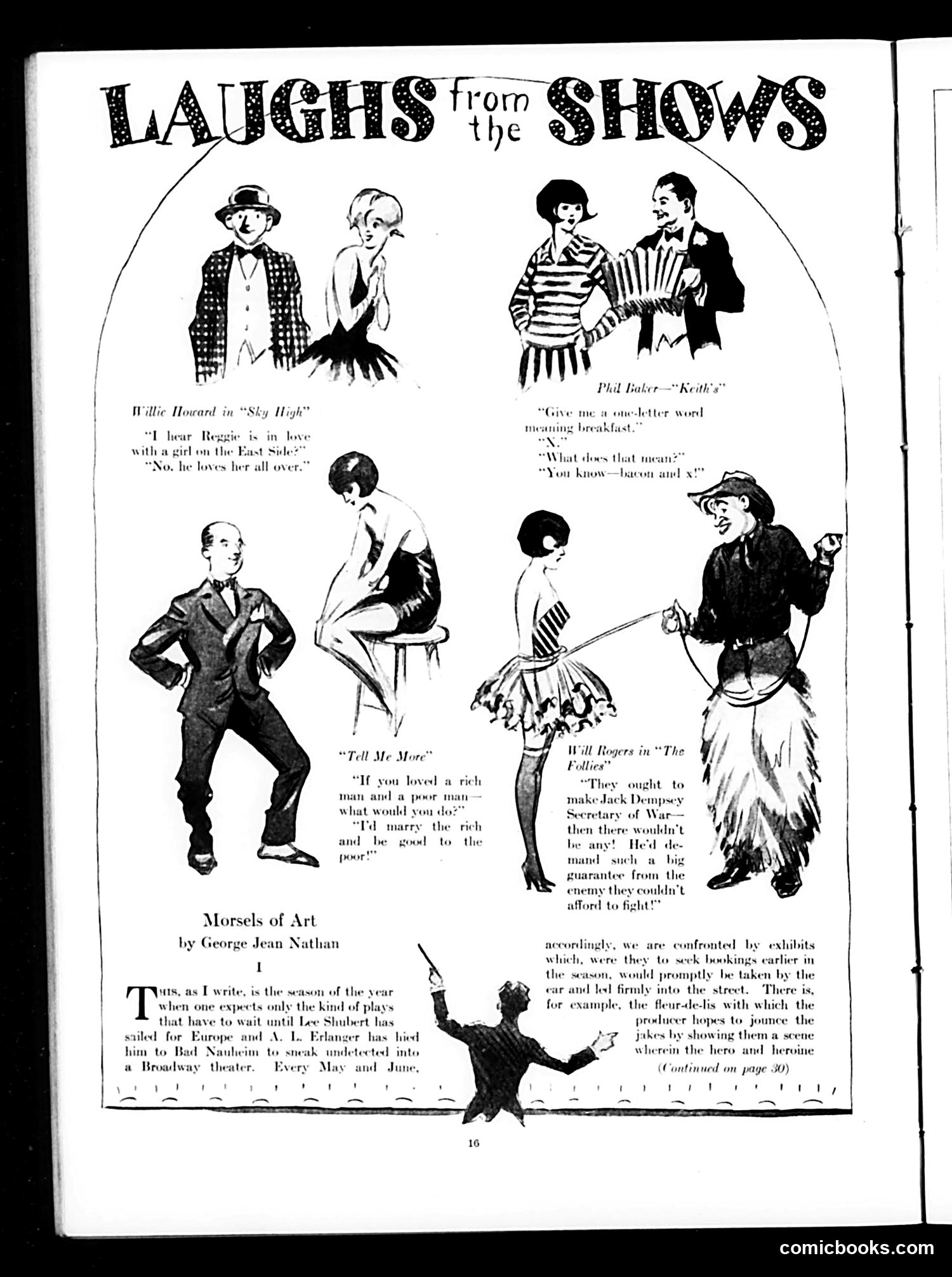
This page collects theatrical humor and commentary. The top section features jokes from Broadway shows, including references to performers Willie Howard ("Sky High"), Phil Baker ("Kerkos"), and Will Rogers ("The Follies"). The jokes are light vaudeville-style gags—wordplay about romance and wartime patriotism (the Secretary of War reference suggests WWI-era context). Below, George Jean Nathan's "Morsels of Art" column critiques Broadway's seasonal output. Nathan observes that May-June theater typically features lower-quality productions—the kind that would be rejected if submitted earlier in the season. He uses the metaphor of a "fleur-de-lis" (decorative flourish) to describe how producers attempt to dress up mediocre scripts with spectacle to fool audiences. The satire targets both theatrical producers for releasing substandard work during slow seasons and audiences for accepting it.
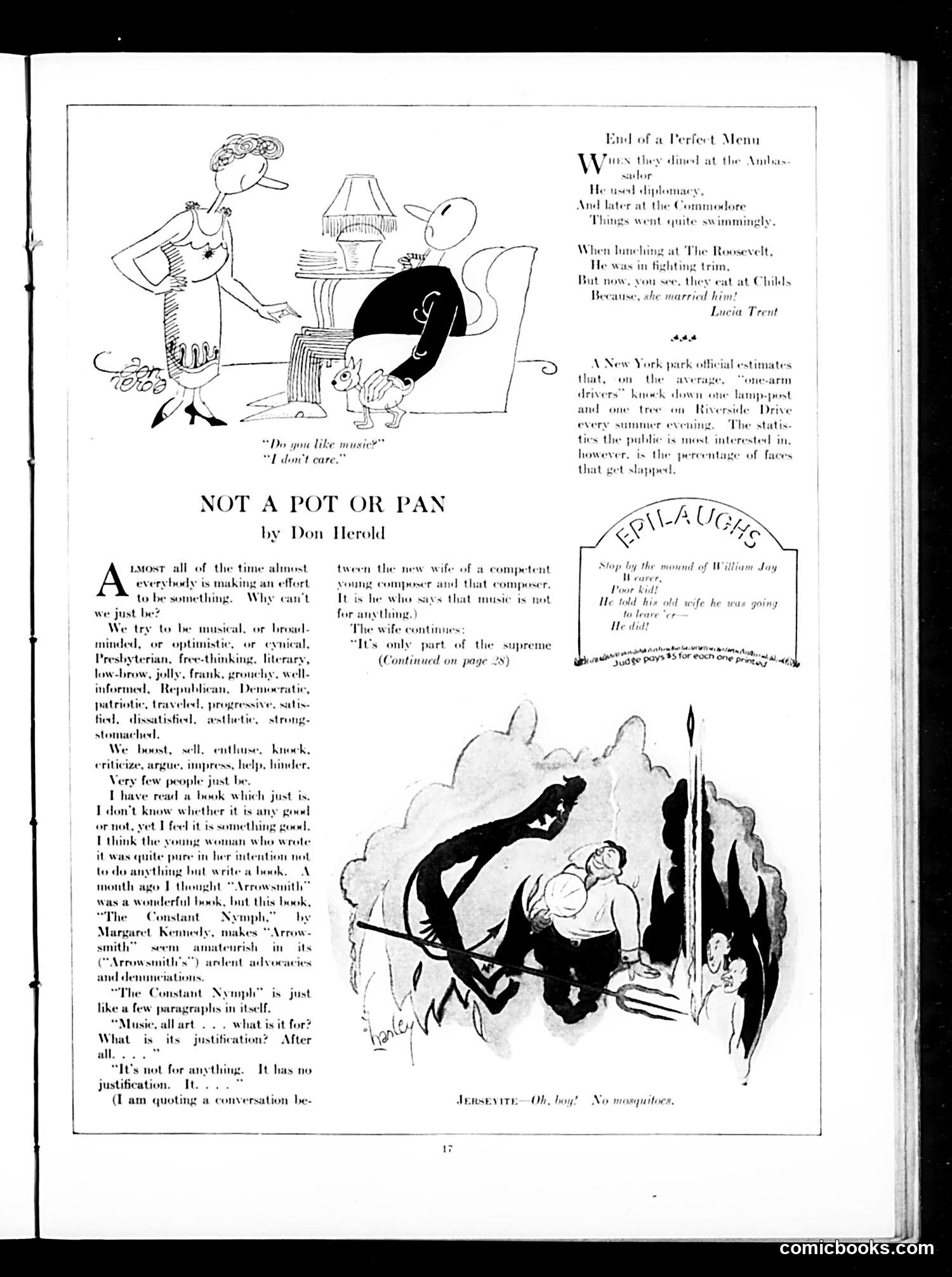
This page contains two distinct pieces of satirical content: **"End of a Perfect Menu"** (poem by Lucia Trent): A social-climbing joke about a woman who married a man and lost her sophisticated lifestyle. The satire mocks how marriage to an ordinary person means downgrading from upscale NYC restaurants (Ambrose, Commodore, Roosevelt) to Child's—a budget cafeteria chain. The humor targets both the woman's materialism and the notion that marriage represents a fall in status. **"Not a Pot or Pan"** (by Don Herold): An essay-cartoon satirizing modern Americans' obsession with self-improvement and adopting personas. Herold argues most people constantly try "to be something"—musical, optimistic, literary, etc.—rather than simply existing. He uses the novel "The Constant Nymph" by Margaret Kennedy as an example of authentic art created without pretension, contrasting it with overwrought social posturing. The lower illustration appears to show a domestic scene, likely related to the marital tension discussed in the accompanying text. Both pieces target 1920s American social anxiety about status, authenticity, and self-presentation.
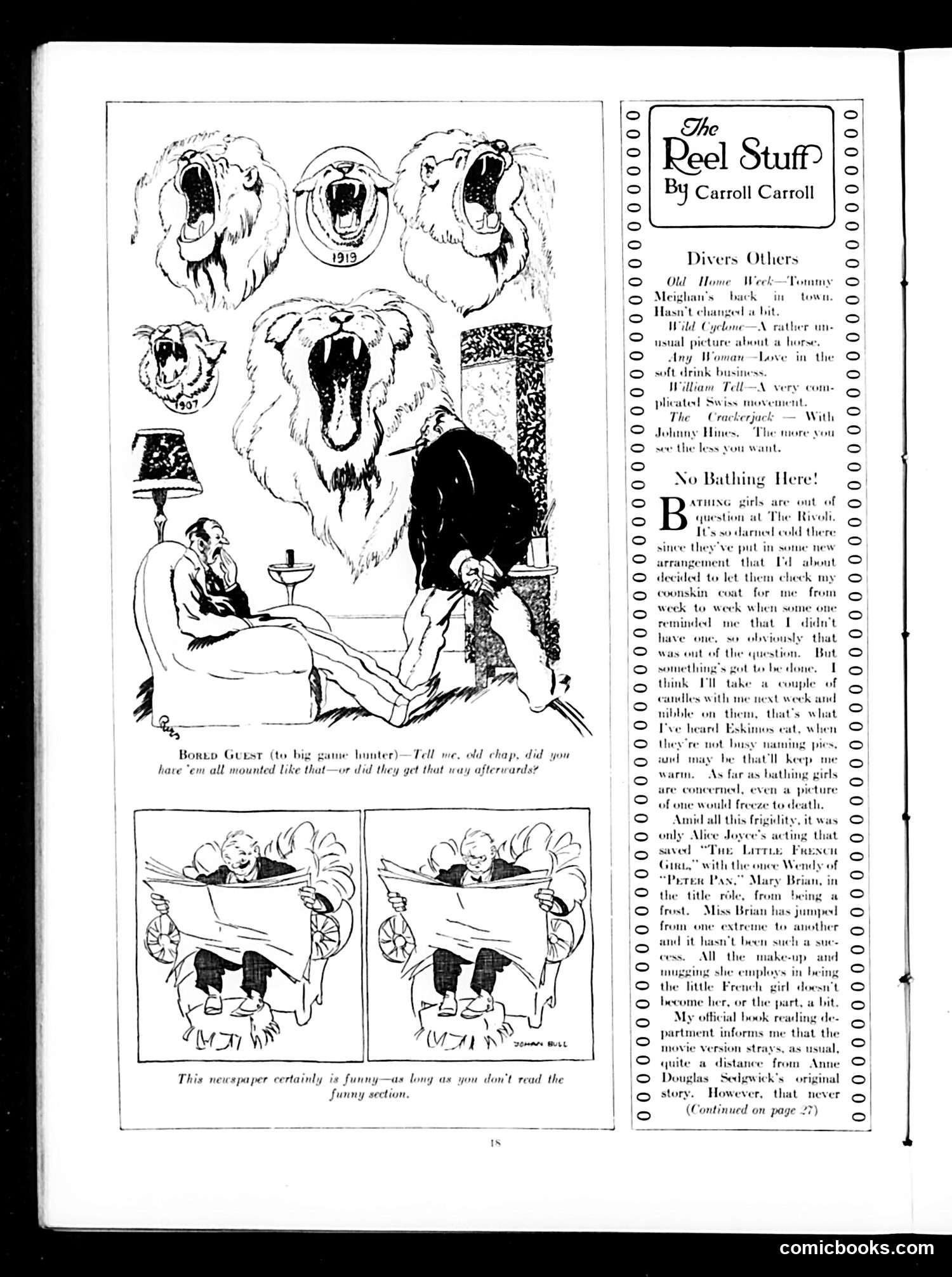
This is a film-review column by Carroll Carroll critiquing recent movies. The main cartoon depicts a big-game hunter showing off mounted animal heads to a guest, joking about whether they were mounted that way or "got that way afterwards"—satirizing exaggerated hunting tales. The "Reel Stuff" section reviews current films (1913-era, based on the date visible), including pictures starring Thomas Meighan and Alice Joyce. The "No Bathing Here!" segment mocks The Rivoli cinema's policy of checking coonskin coats—the writer humorously complains about the cold and jokes about Eskimo diet as compensation. The column also notes Mary Brian's performance in "The Little French Girl" as saving an otherwise mediocre film, and criticizes the movie's loose adaptation of Douglas Sedgwick's source novel. The humor relies on contemporary film references, silent-era star recognition, and early-1920s cinema culture that modern readers would need context to fully appreciate.
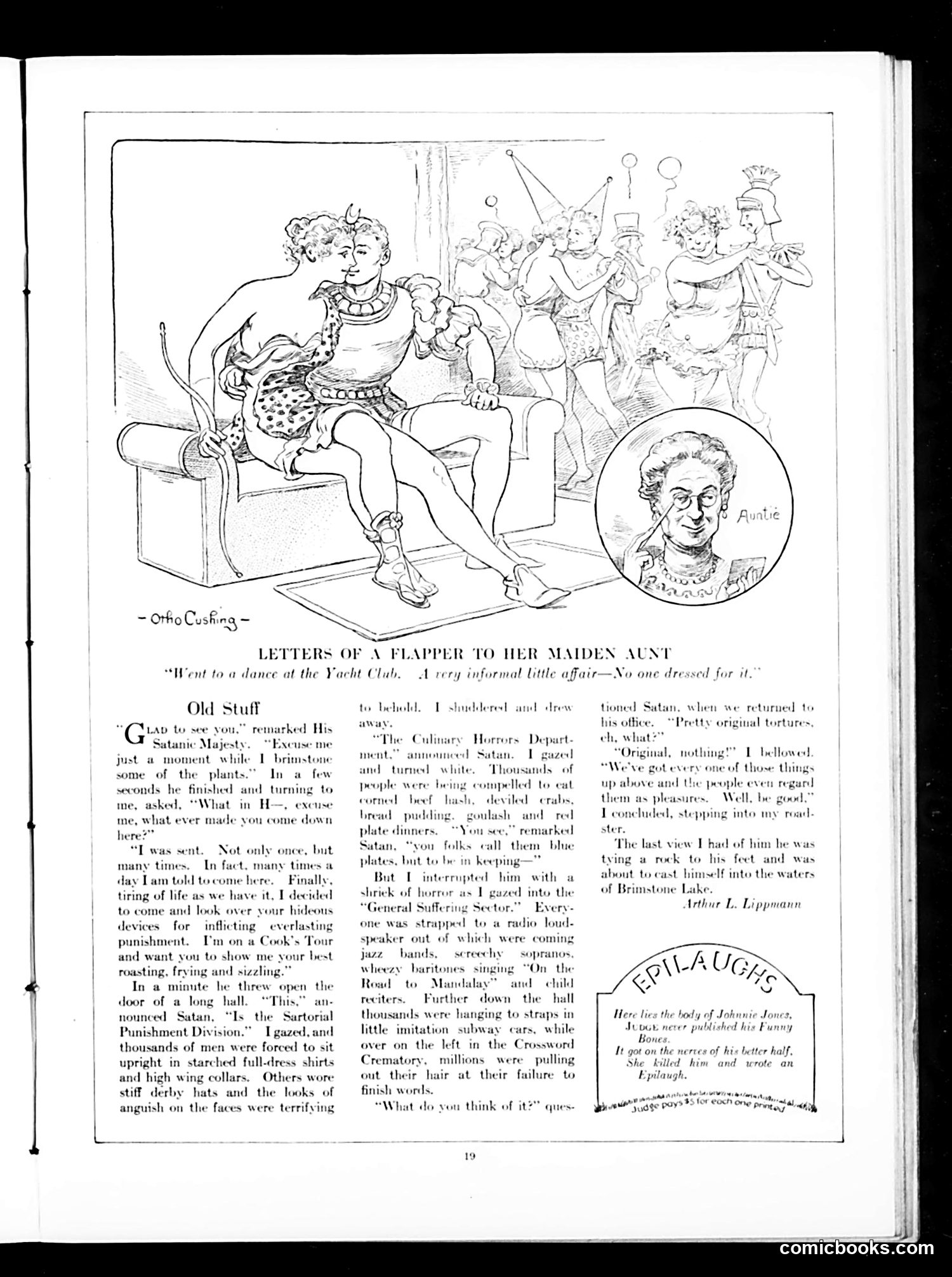
This satirical piece from Judge magazine presents a humorous narrative where Satan gives a tour of Hell's tortures—all of which are mundane modern annoyances rather than traditional fiery punishments. The joke targets 1920s upper-class social conventions and their tedium. Satan's "Punishment Division" includes men forced to wear formal starched shirts and stiff derby hats (the uncomfortable dress codes of respectable society), the "Culinary Horrors Department" (bad institutional food), and most pointedly, a "General Suffering Sector" featuring jazz music, operatic sopranos, and failed crossword puzzles. The satire mocks how modern life's social obligations and popular culture trends—what youth found fashionable—are actually forms of torture. The frame story about a flapper visiting Hell adds contemporary relevance, as flappers were young women rebelling against Victorian strictness. The cartoon's humor lies in inverting expectations: Hell isn't fire and brimstone but rather the irritating constraints of respectability, bad entertainment, and tedious social rituals that characterize "civilized" society.
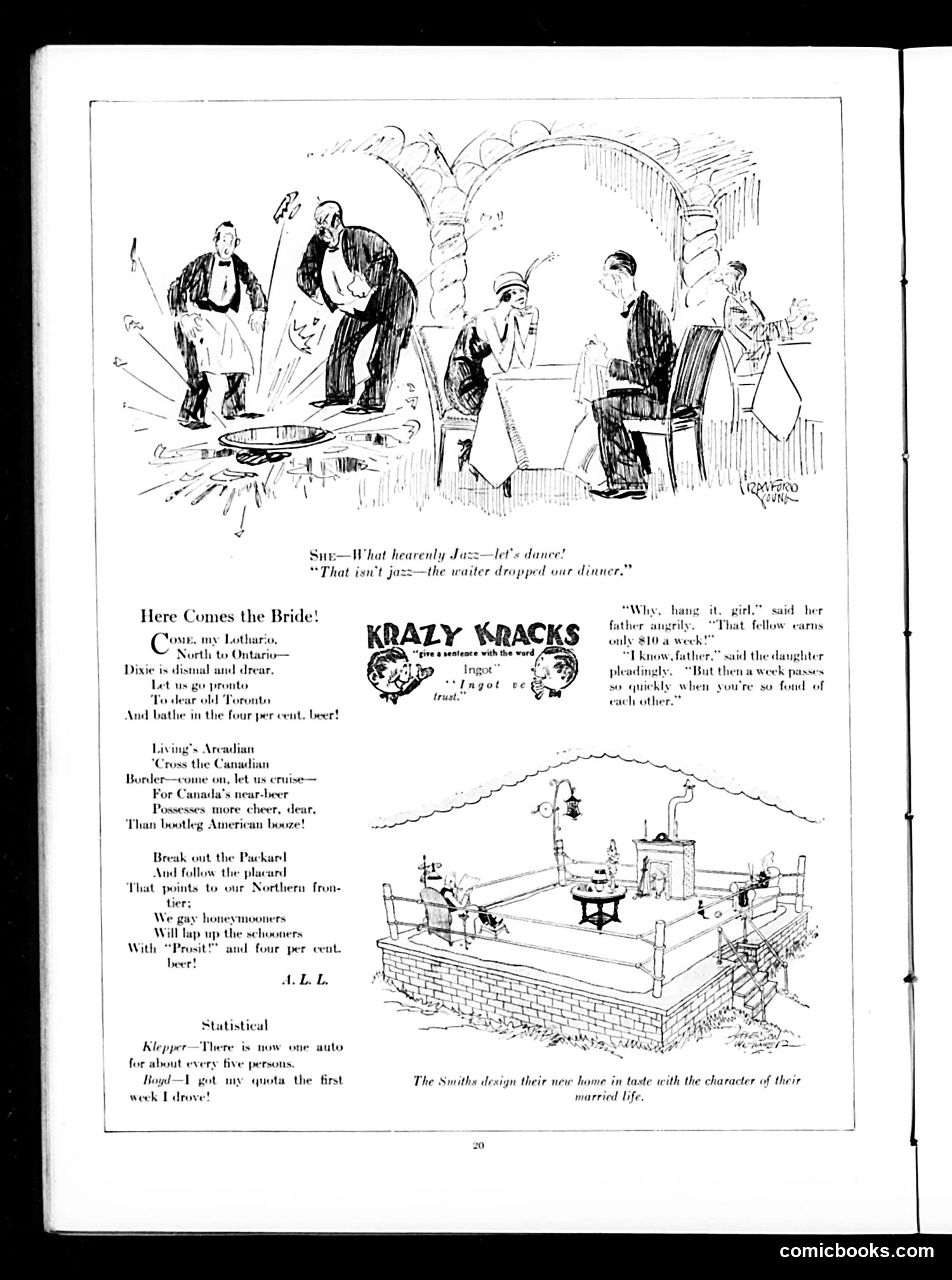
This page satirizes **Prohibition-era tourism and the "near-beer" loophole**. The main cartoon mocks wealthy Americans crossing into Canada to escape U.S. alcohol restrictions. A couple mistakes a waiter's dropped dinner for "jazz" dancing—physical comedy about urban sophistication. The poetry celebrates honeymoons to Canada, where "near-beer" (low-alcohol beverage legally permitted during Prohibition) supposedly tastes better than American bootleg liquor. The satire targets the absurdity: people traveling internationally to legally consume weak beer, and the cultural contradiction that legal near-beer seems preferable to illegal full-strength booze. "Krazy Kracks" presents a father angry his daughter spent only $10 weekly on a boyfriend, while she defends it as reasonable since "a week passes so quickly when you're so fond of each other"—satirizing both stingy courtship budgets and romantic infatuation. The home design cartoon depicts the Smiths' house as literally chaotic, suggesting marriage mirrors domestic discord.
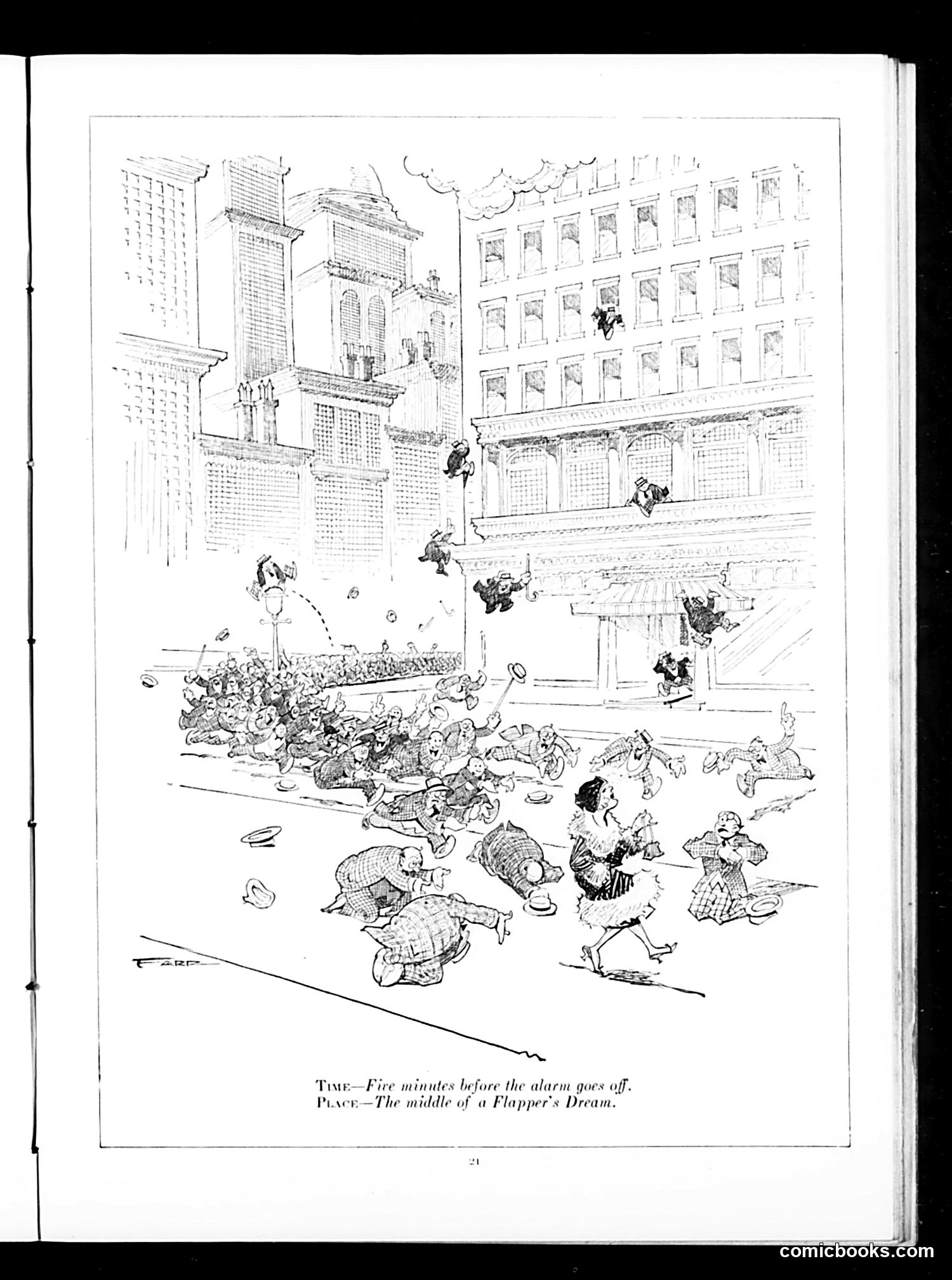
This cartoon depicts a chaotic urban street scene centered on what the caption identifies as "The middle of a Flapper's Dream." The drawing shows numerous figures in 1920s attire scattered across a city plaza before tall buildings, with people in various states of animated activity—some falling, dancing, or gesturing wildly. The "flapper" was a symbol of 1920s youth culture: young women who challenged social conventions through bobbed hair, short skirts, and independent behavior. This satirical cartoon appears to mock the flapper lifestyle by presenting her aspirations as frivolous chaos—a literal dream-state indulgence that exists "five minutes before the alarm goes off," suggesting the fantasy cannot last and reality will intrude. The crowded, disorderly scene implies Judge magazine's skeptical, conservative view of modern youth culture.
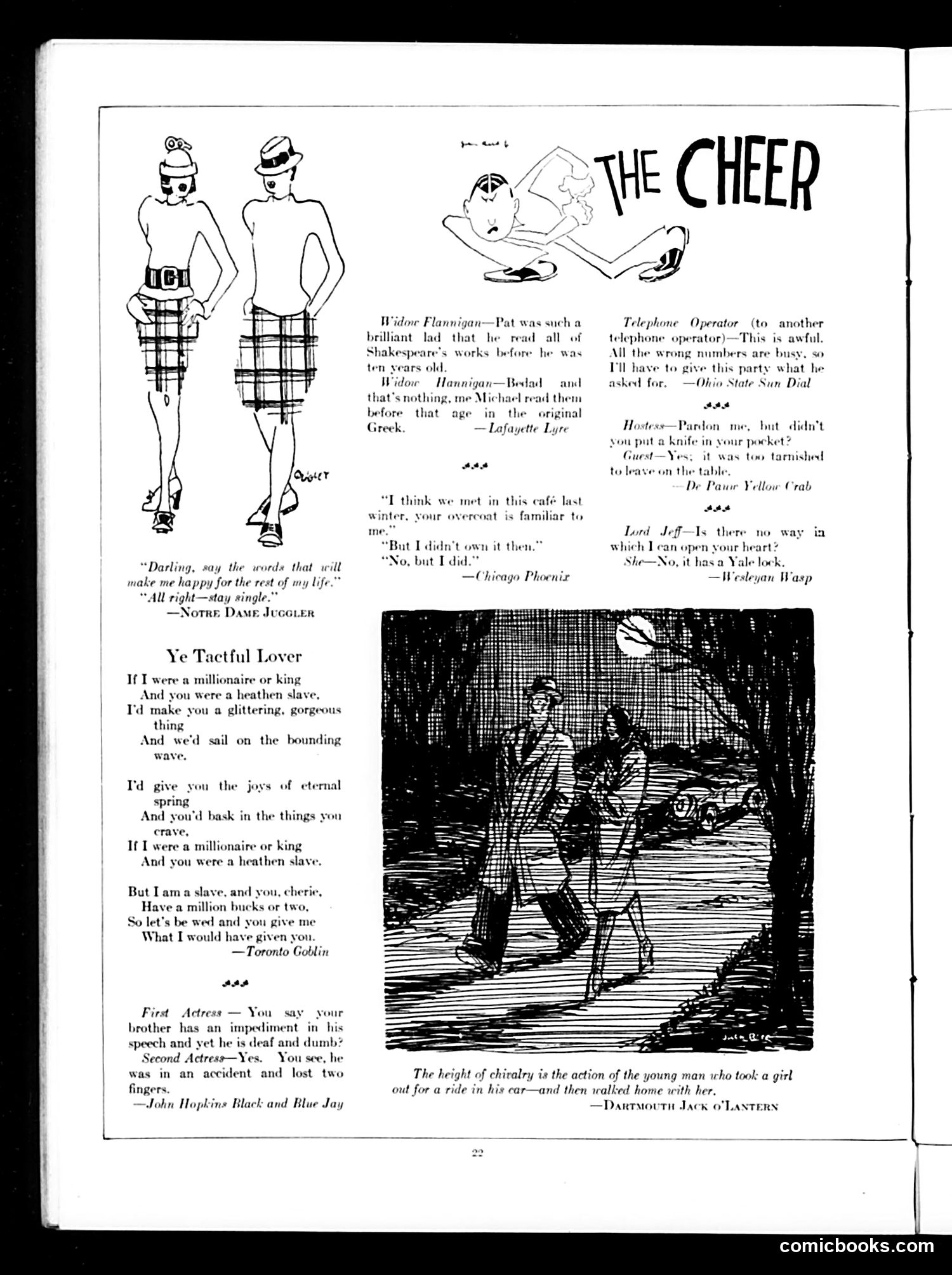
This page from *Judge* magazine contains multiple short humor pieces typical of early 20th-century satirical magazines. The content includes: **Fashion illustration** (top left): Two women in plaid skirts with decorative belts, representing contemporary flapper-style clothing. **Humorous quotes and poems**: Various satirical pieces about courtship, class reversal, and social mishaps. "Ye Tactful Lover" inverts traditional gender economics—a poor man would shower wealth on a woman, but having no money, he asks his wealthy girlfriend to give him what he'd have given her. This satirizes shifting gender roles and economic dynamics of the era. **Joke compilation**: Short quips from college humor magazines (Notre Dame, Ohio State, Wesleyan) and city papers (Chicago, Toronto) covering predictable topics: verbal mishaps, misunderstandings about borrowed items, and awkward social situations. **Illustration** (bottom): A woodcut-style drawing of a couple in a car, accompanying a joke about "chivalry"—the young man took a girl for a ride, then walked home with her (implying he stranded her). The overall tone reflects Jazz Age humor emphasizing romantic entanglements and social ironies.
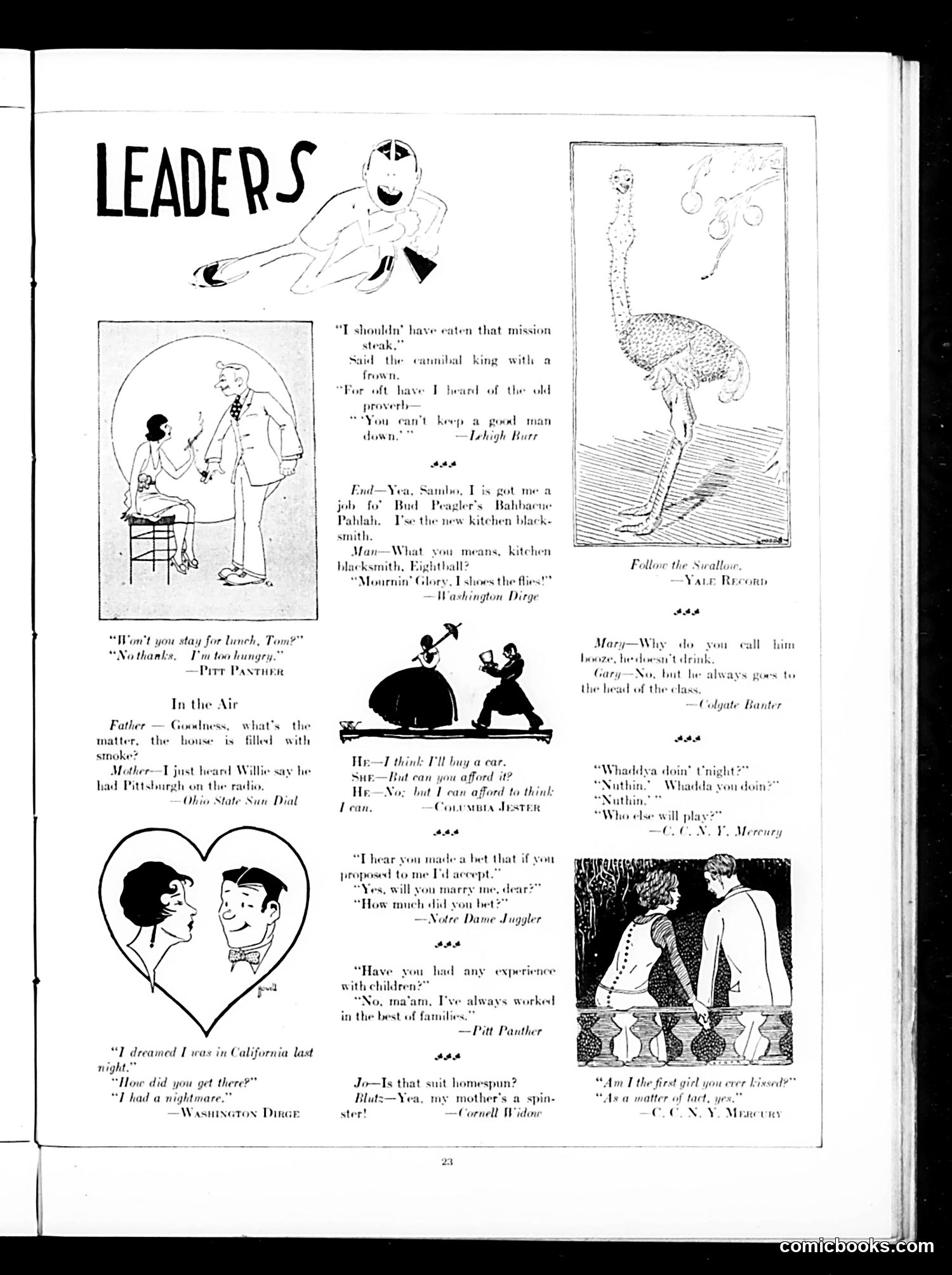
This page collects humorous short jokes and quips from college newspapers and satirical publications, organized by a loose "leaders" theme (prominent figures or personalities). The content includes social humor typical of early-to-mid 20th century American magazines: wordplay about job-seeking, romantic misadventures, and college life. Notable elements include: - Racial caricature in the "kitchen blacksmith" joke (depicting a Black servant character), reflecting the period's casual racist humor - An ostrich illustration labeled "Follow the Swallow" - Various one-liner exchanges mocking dating ("Will you marry me?"), automobiles ("I can't afford a car"), and class differences - College newspaper attributions (Yale, Pitt, Cornell, Notre Dame), suggesting aspirational humor from student publications The satire targets materialism, pretension, and romantic folly rather than political figures. The "leaders" concept appears ironic—celebrating prominent personalities through their foolish statements. This represents mainstream American humor of the era, before such racial content became culturally unacceptable.
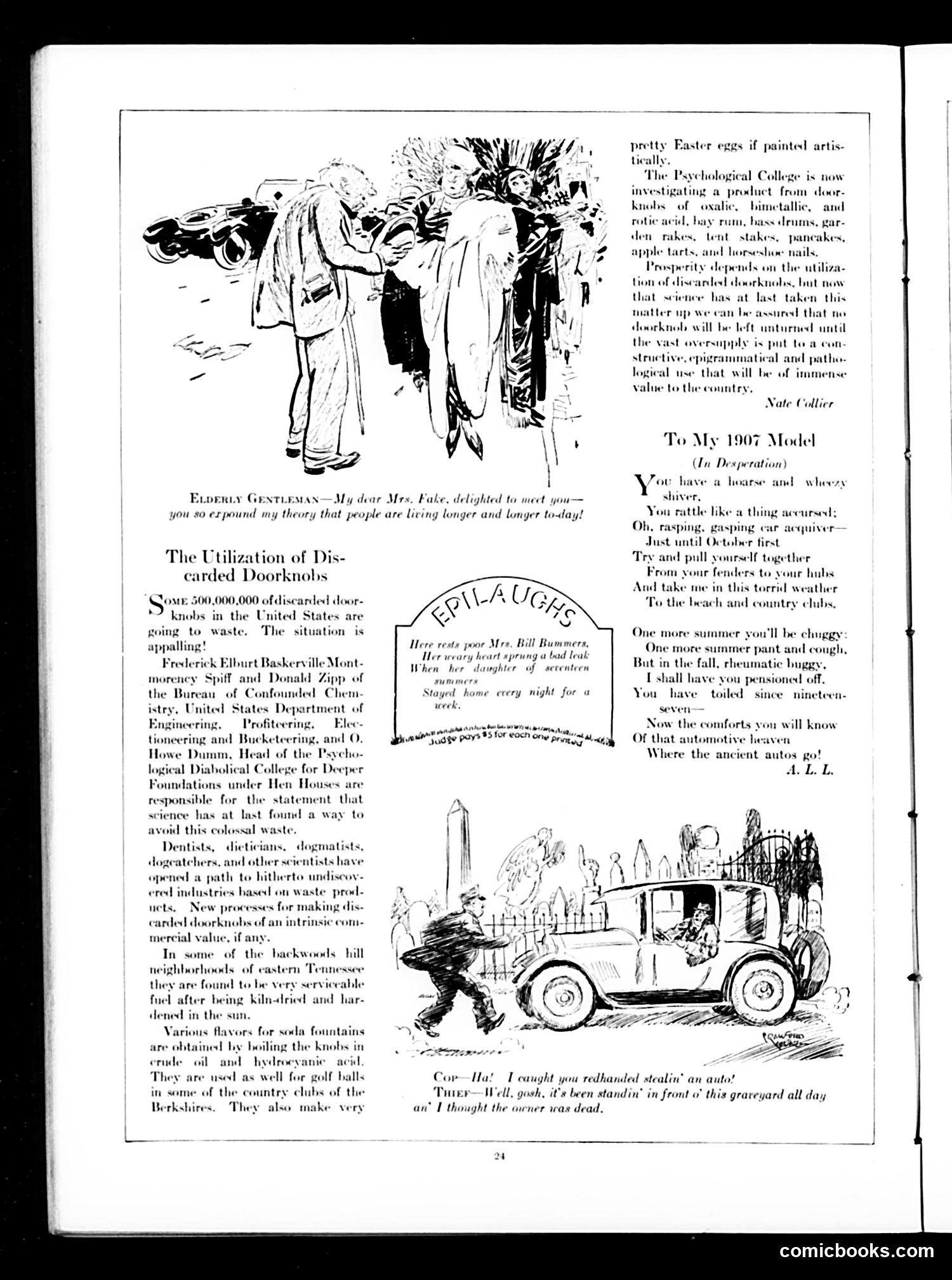
This page contains three distinct satirical pieces: **"The Utilization of Discarded Doorknobs"** mocks wasteful government bureaucracy and pseudo-scientific boondoggling. It ridicules invented government agencies (Bureau of Confounded Chemistry, Department of "Profiteering, Entioneering and Bucketeering") and absurd "solutions" to manufactured problems—transforming 500 million discarded doorknobs into soda fountain flavors, golf balls, and Easter eggs. The satire targets inefficient, self-aggrandizing government waste. **"To My 1907 Model"** is a humorous lament to an aging automobile, personified as a failing companion. It mocks early car unreliability—wheezy engines, poor performance—while joking about retirement after years of service. **The bottom cartoon** depicts a cop catching a thief red-handed stealing a car from a graveyard. The humor derives from the thief's innocent explanation: he assumed the car's owner was dead because it had been abandoned there so long—a jab at early automobile unreliability and obsolescence. All pieces target contemporary concerns: government inefficiency, automobile problems, and industrial waste.
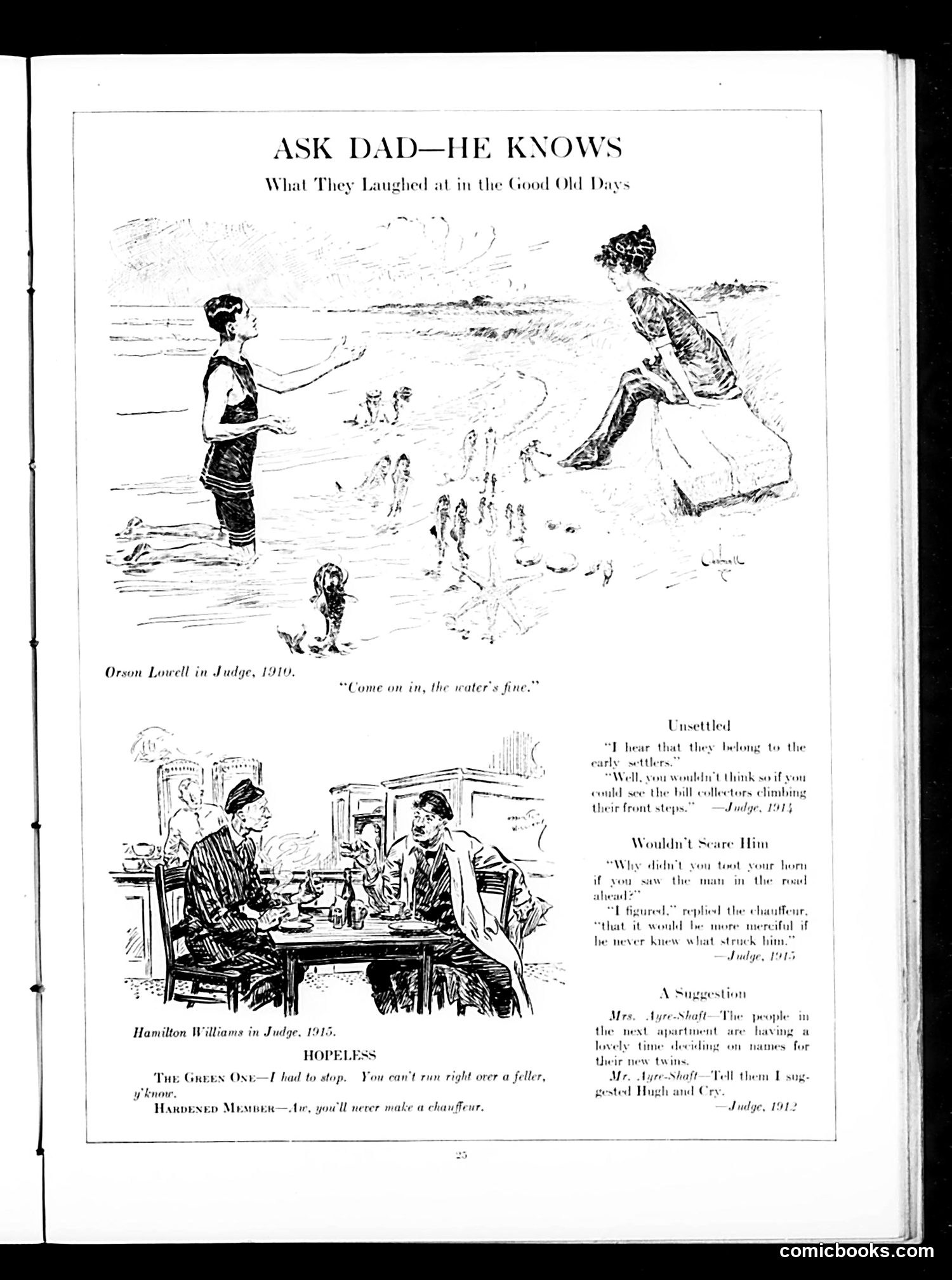
This page collects brief comedic anecdotes from Judge magazine (1910-1915), presented as nostalgic humor about "the good old days." The cartoons and jokes satirize modern anxieties of the era: The top illustration depicts early bathing culture with the phrase "Come on in, the water's fine"—likely poking fun at swimming customs. Other jokes mock emerging technologies and social changes: a chauffeur who can't drive (1912), anxiety about automobile accidents, and the discomforts of urban apartment living (babies crying through thin walls, 1912). The "Hopeless" dialogue between a green driver and hardened motorist reflects early automotive-era humor about dangerous, unpredictable road conditions. These pieces capture pre-WWI American concerns about rapid modernization—cars, urban crowding, changing social norms—presented as humorous generational wisdom from "Dad."
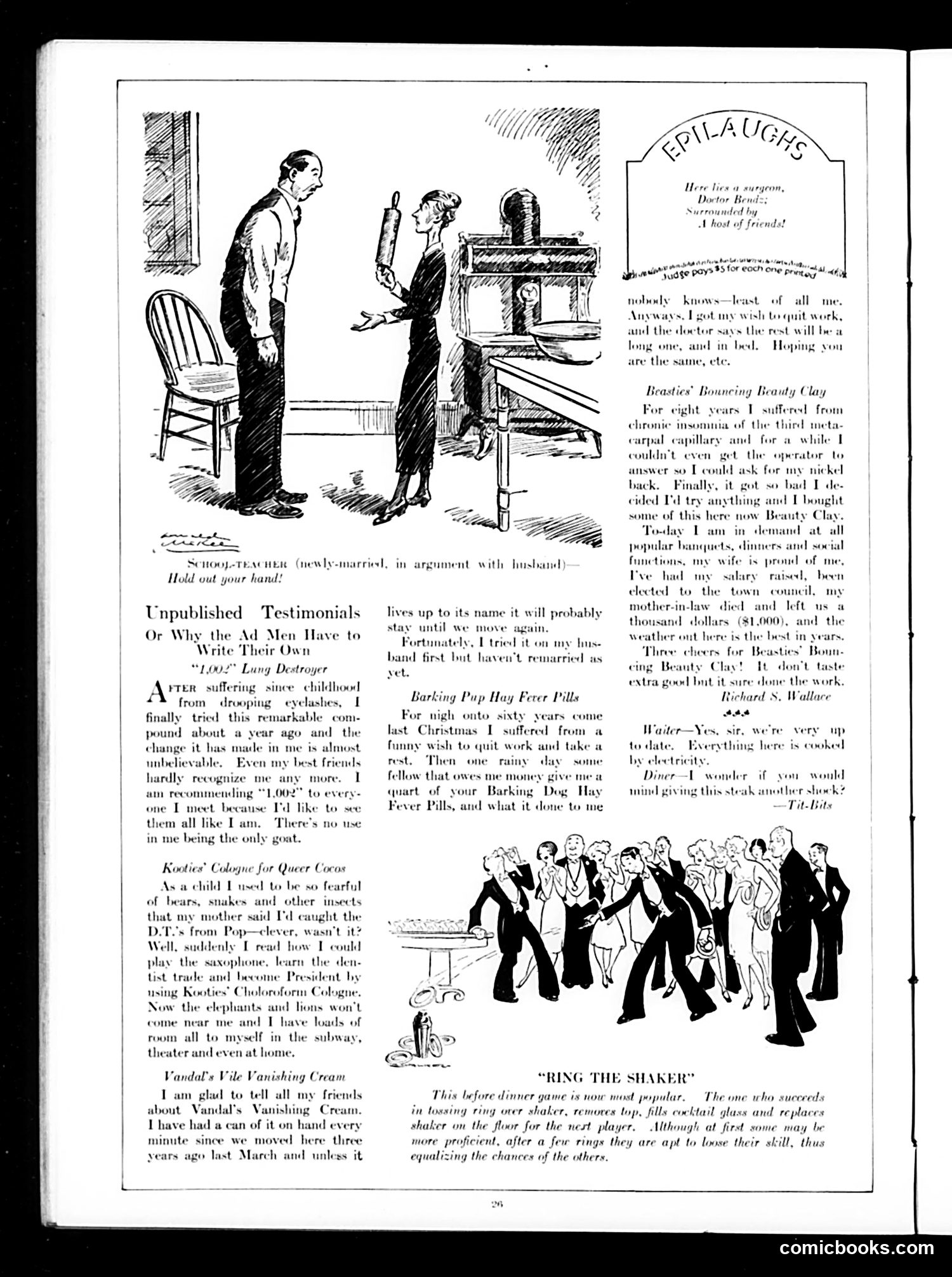
This page contains mock product testimonials and advertisements satirizing patent medicine and dubious consumer products popular in the early 20th century. The "testimonials" are deliberately absurd—products like "1,002 Lung Destroyer," "Barking Pup Hay Fever Pills," and "Kooties' Cologne" make wildly implausible claims (one user claims a product got him elected to town council and caused his mother-in-law to die conveniently). The satire targets the advertising industry's deceptive practices: fake endorsements from ordinary people making exaggerated health claims. The header "Unpublished Testimonials: Or Why the Ad Men Have to Write Their Own" explicitly mocks advertisers fabricating testimonials rather than receiving genuine ones. The cartoon shows a "School-Teacher" couple arguing, and "Ring the Shaker" depicts a parlor game. Together, this page ridicules both snake-oil marketing and consumer gullibility during an era before FDA regulation of medical claims.
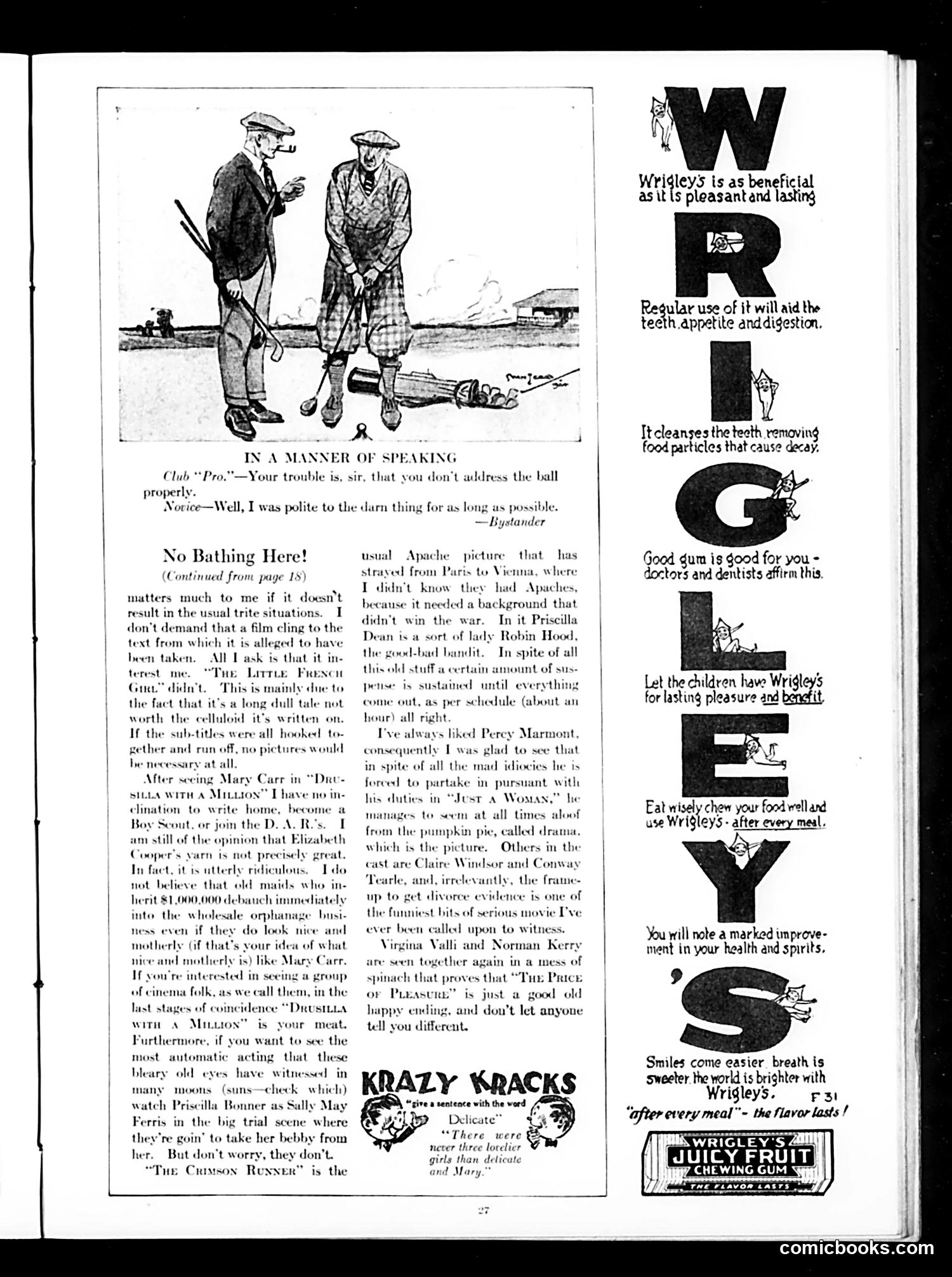
This page contains film criticism and advertising rather than political satire. The main content is a review column critiquing silent films, including *The Little French Girl*, *Drusilla with a Million*, and *Just a Woman*. The critic dismisses several movies as tedious, particularly criticizing aging actress Mary Carr's performance and the implausible plot of wealthy orphan adoptions. The cartoon "In a Manner of Speaking" is a golf joke: a club pro criticizes a novice golfer's swing, and the novice responds that he was polite to the ball—a play on the word "address" (both a golf term and social courtesy). The bulk of the page is a **Wrigley's chewing gum advertisement** claiming health benefits: improved digestion, teeth cleaning, and overall vitality. A "Krazy Kracks" joke about the word "delicate" appears as filler content typical of the era.
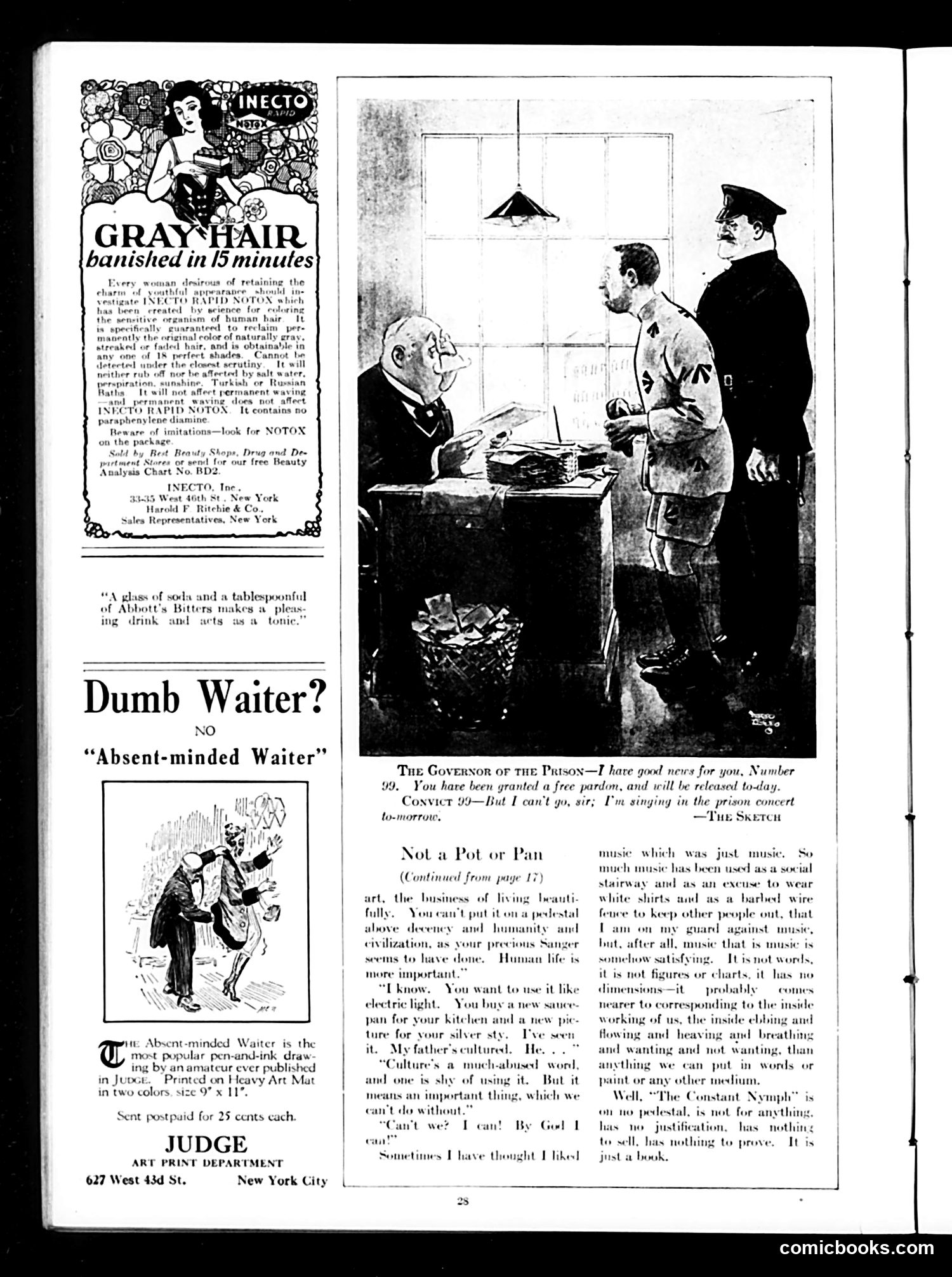
This page contains **advertisements and a prison-themed cartoon sketch**. The main cartoon, titled "The Governor of the Prison," depicts a warden delivering good news to a convict: he's been granted a free pardon and will be released today. The convict's response—"But I can't go, sir; I'm singing in the prison concert to-morrow"—is the joke's punchline. The satire mocks **priorities and human absurdity**: the convict chooses to remain imprisoned rather than accept freedom because he values performing in an entertainment event. It's a commentary on how people become attached to routine, or how trivial matters (entertainment) can overshadow fundamental desires (liberty). The cartoon suggests the ridiculousness of misplaced values. The page also advertises **Inecto hair dye** ("Gray Hair banished in 15 minutes"), **Abbott's Bitters** (as a tonic), and **an "Absent-minded Waiter" print** available from Judge's art department—typical early 20th-century magazine content mixing editorial cartoons with commercial promotions.
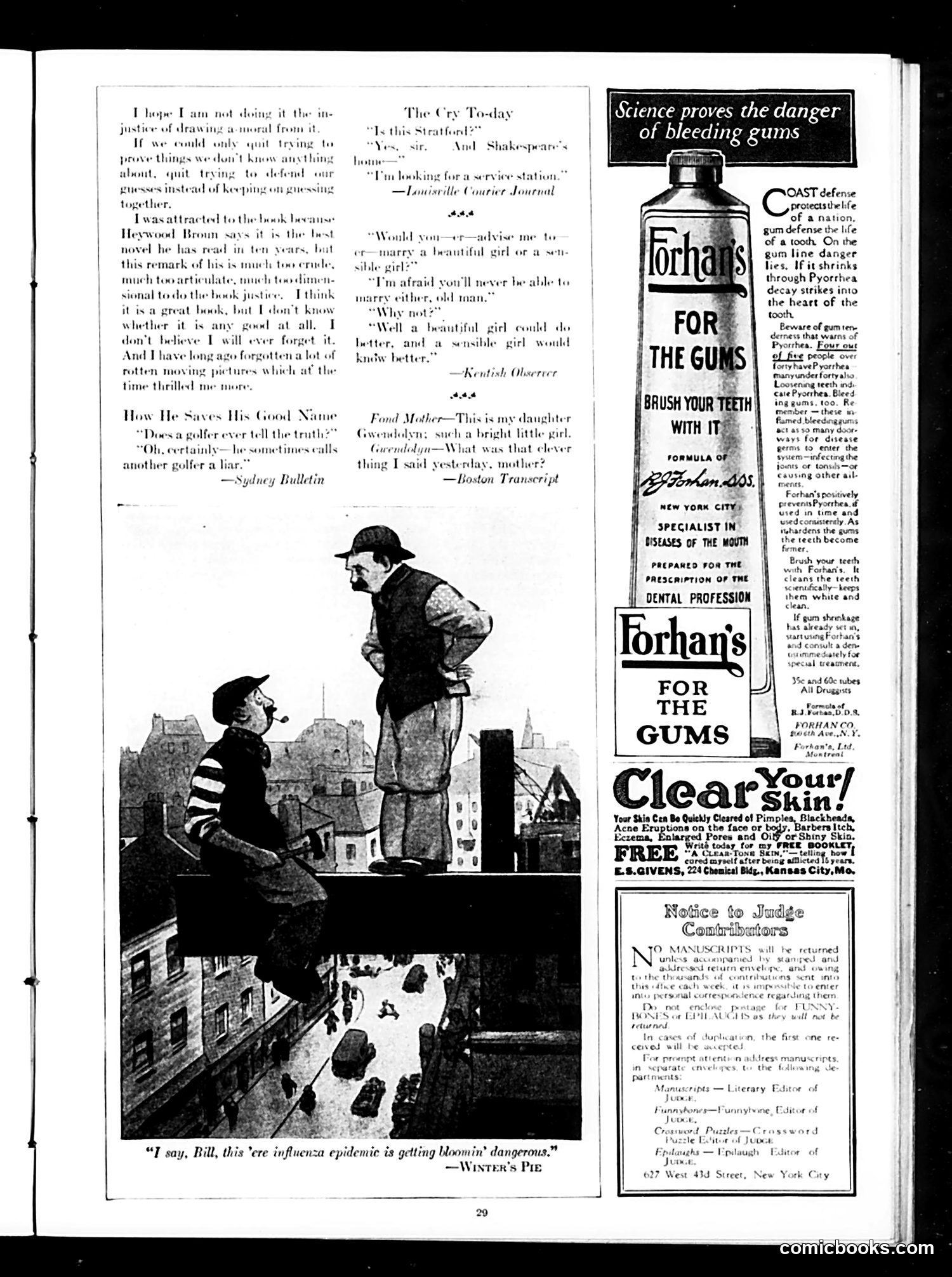
This page contains several short satirical pieces and advertisements typical of Judge magazine's humor. The main cartoon depicts two men on a rooftop overlooking a city skyline, with the caption referencing an "influenza epidemic." This appears to reference the 1918-1920 Spanish Flu pandemic, allowing Judge to satirize public concern about the disease. The text excerpts mock various human behaviors: golfers who claim honesty while insulting rivals, people asking for advice about marriage, and parents overestimating their children's wit. These represent Judge's typical social commentary on middle-class pretension and foolishness. The right side features period product advertisements (Forhan's toothpaste, acne treatment) that make exaggerated health claims—standard for early-20th-century ads before FDA regulation. The overall page reflects Judge's combination of satirical commentary on contemporary life and consumer culture circa 1918-1920.
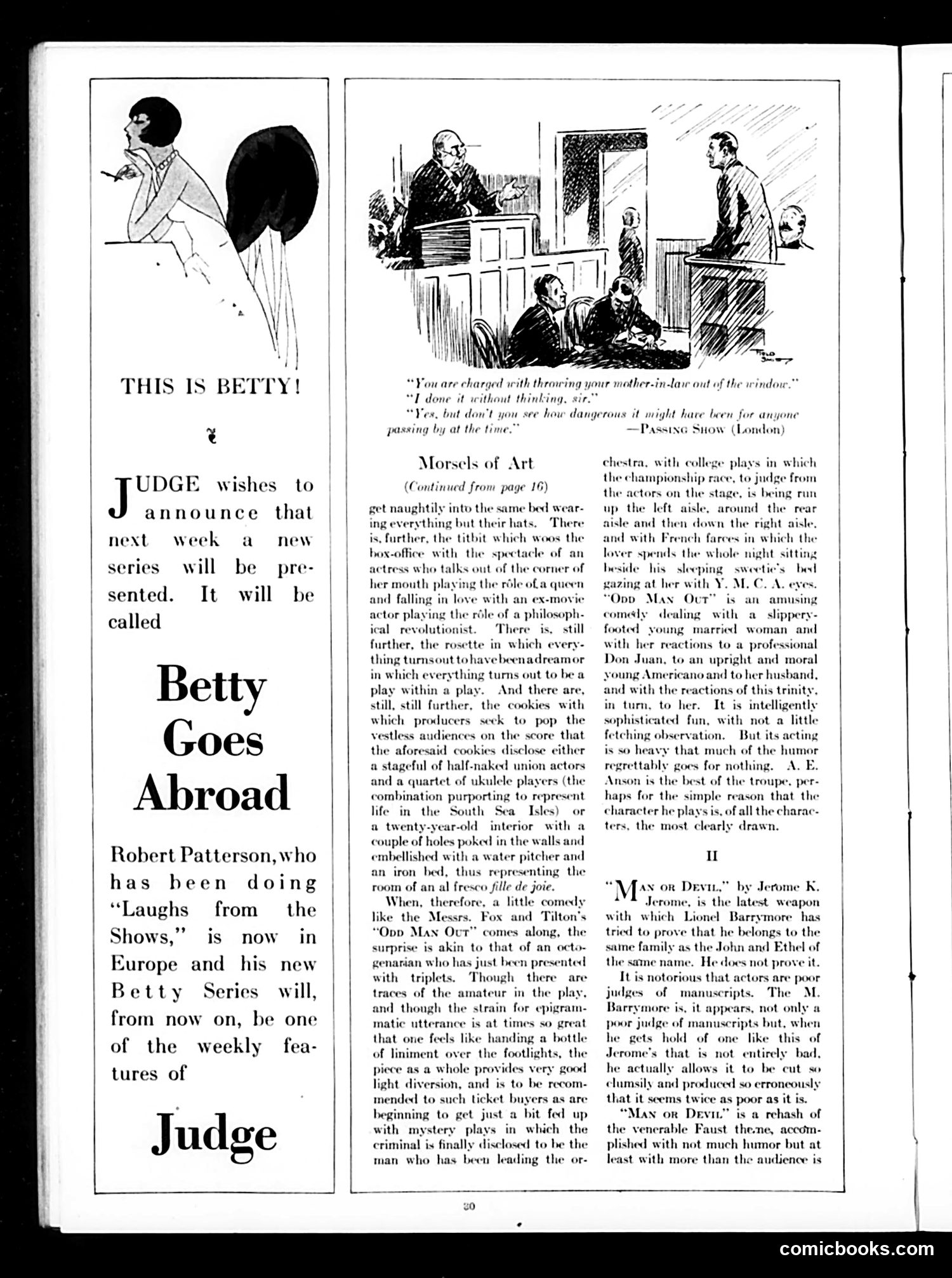
This page announces a new comic series called "Betty Goes Abroad," featuring artist Robert Patterson, who previously created "Laughs from the Shows." Patterson is reportedly in Europe, and this series will become a regular Judge feature. The cartoon at top left shows a stylized woman labeled "This is Betty!"—likely the protagonist of the upcoming series, drawn in the modernist fashion typical of 1920s satirical illustration. The remaining content discusses theatrical reviews under "Morsels of Art," critiquing contemporary stage productions. It reviews plays like "Oop Max Out" (praised as light diversion despite heavy acting) and "Man or Devil" starring Lionel Barrymore (criticized as poorly produced despite decent source material). The page also includes a courtroom joke about a man charged with throwing his mother-in-law out a window. The reviews reflect period concerns about theatrical quality and artistic merit versus commercial entertainment designed to please mass audiences.
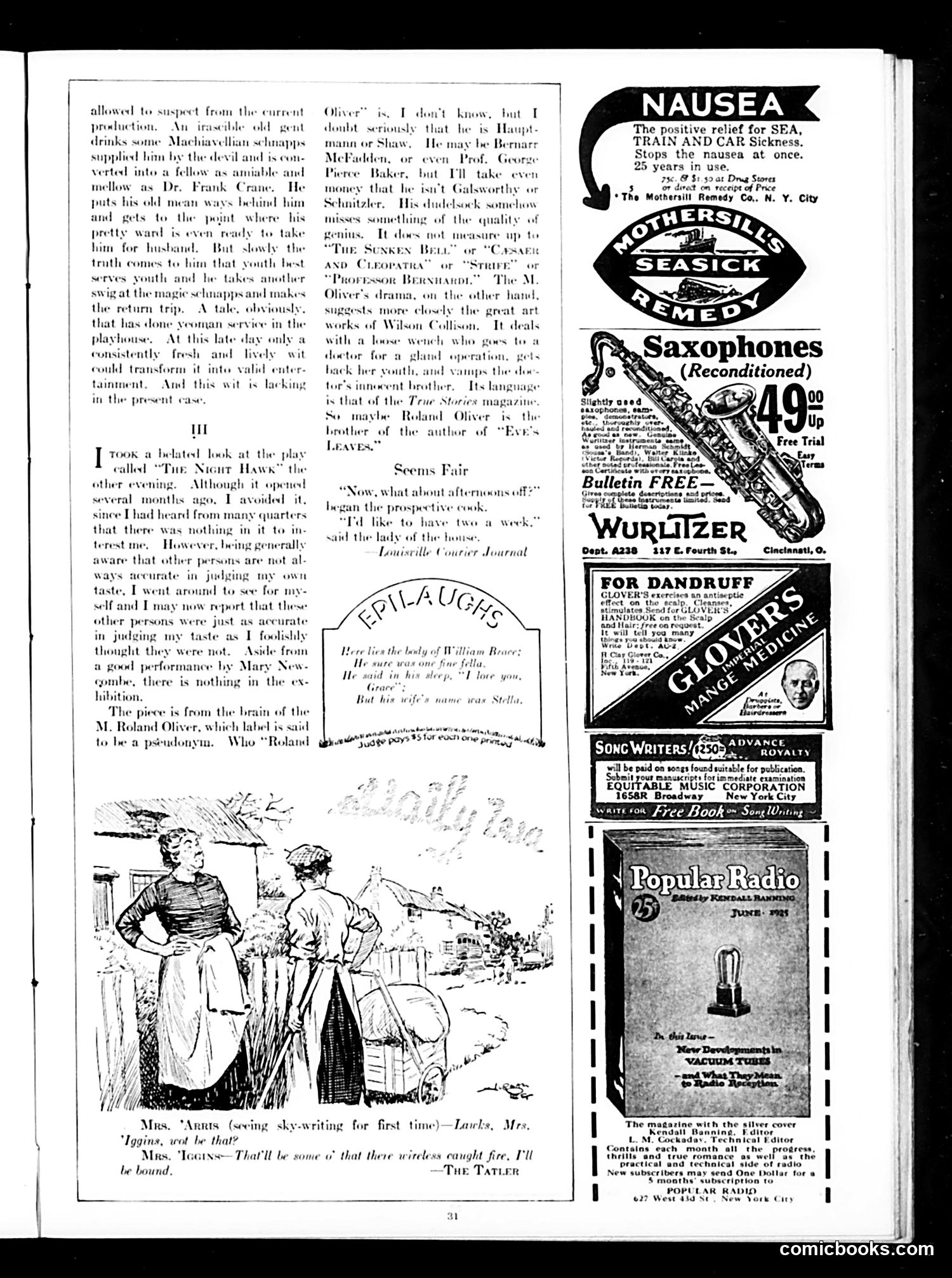
This page contains primarily **literary criticism and advertisements** rather than political satire. The main text reviews a play called "The Night Hawk," attributed to "M. Roland Oliver"—likely a pseudonym. The critic dismisses the work as mediocre, speculating the author might be a lesser-known writer rather than major dramatists like Galsworthy or Shaw. The piece criticizes the play's lack of wit and originality. The cartoon at bottom depicts two working-class women observing sky-writing for the first time, with Mrs. Iggins asking what it is. Mrs. Higgins responds it's "wireless"—a joke about the newfangled wireless radio technology of the era, humorously treating sky-writing as another modern marvel. The surrounding advertisements—for seasickness remedies, reconditioned saxophones, dandruff treatments, and Popular Radio magazine—reflect 1920s consumer culture and emerging technologies like radio broadcasting.
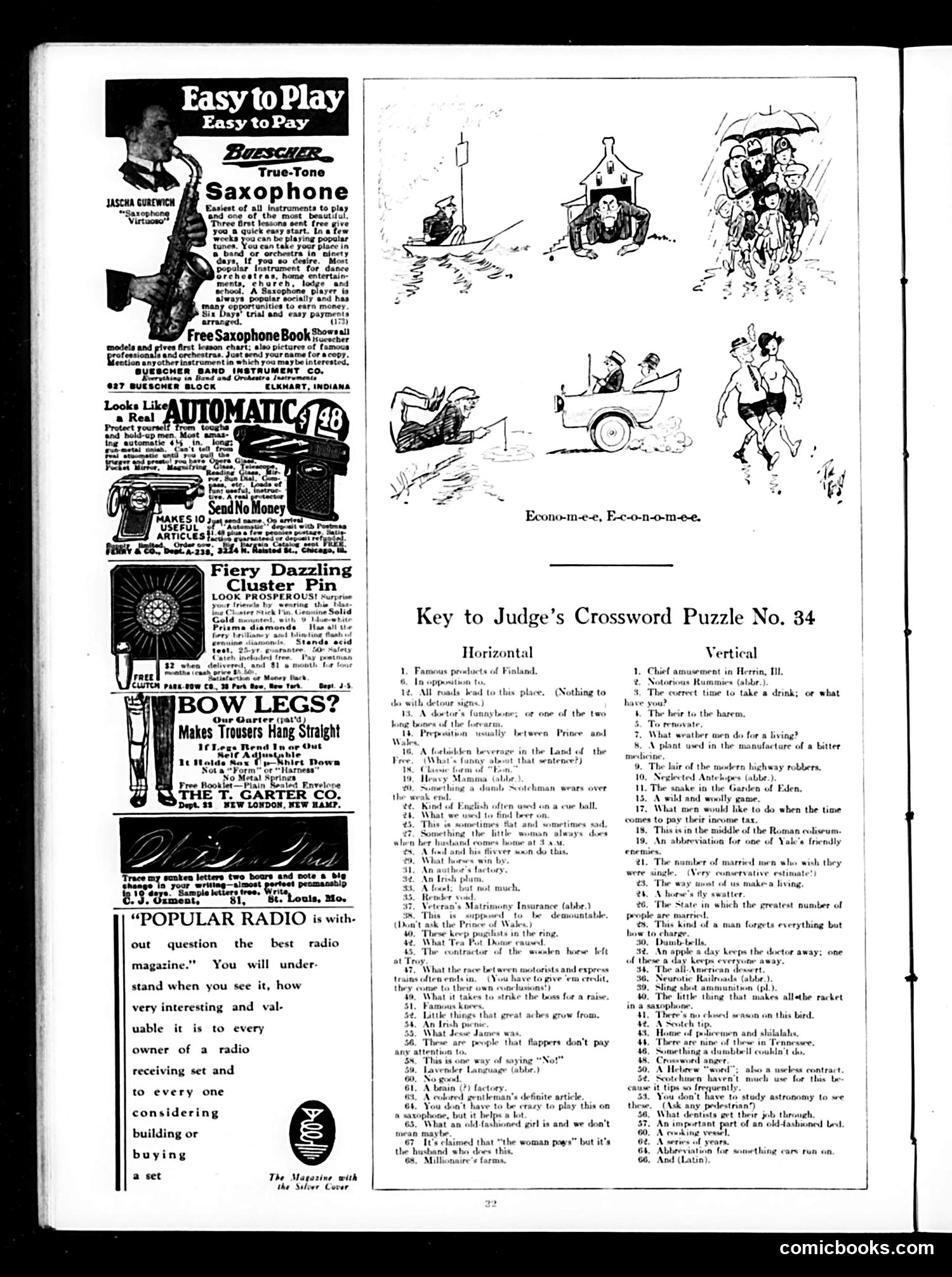
This page is primarily **advertising and puzzle content** rather than political satire. The main advertisements promote consumer goods typical of the 1920s-30s era: a Buescher saxophone (marketed as "easy to play, easy to pay"), an "Automatic" camera, bow-leg correcting garters, and radio receivers. The page's centerpiece is **"Judge's Crossword Puzzle No. 34"** with its answer key. The crossword clues are lighthearted and topical to the era, including references to: - Prohibition-era humor ("notorious rummies") - Contemporary events (Herrin, Illinois; Teapot Dome scandal) - Jazz-age culture (saxophones, dance bands) - Social attitudes about marriage and income taxes The cartoon vignettes at top-right depict everyday humorous scenes—people in boats, outside buildings, running—with the caption "Econo-m-e-e, E-c-o-n-o-mee," likely a pun on economizing during Depression-era hardships. **This is primarily a commercial/entertainment page rather than satirical commentary.**
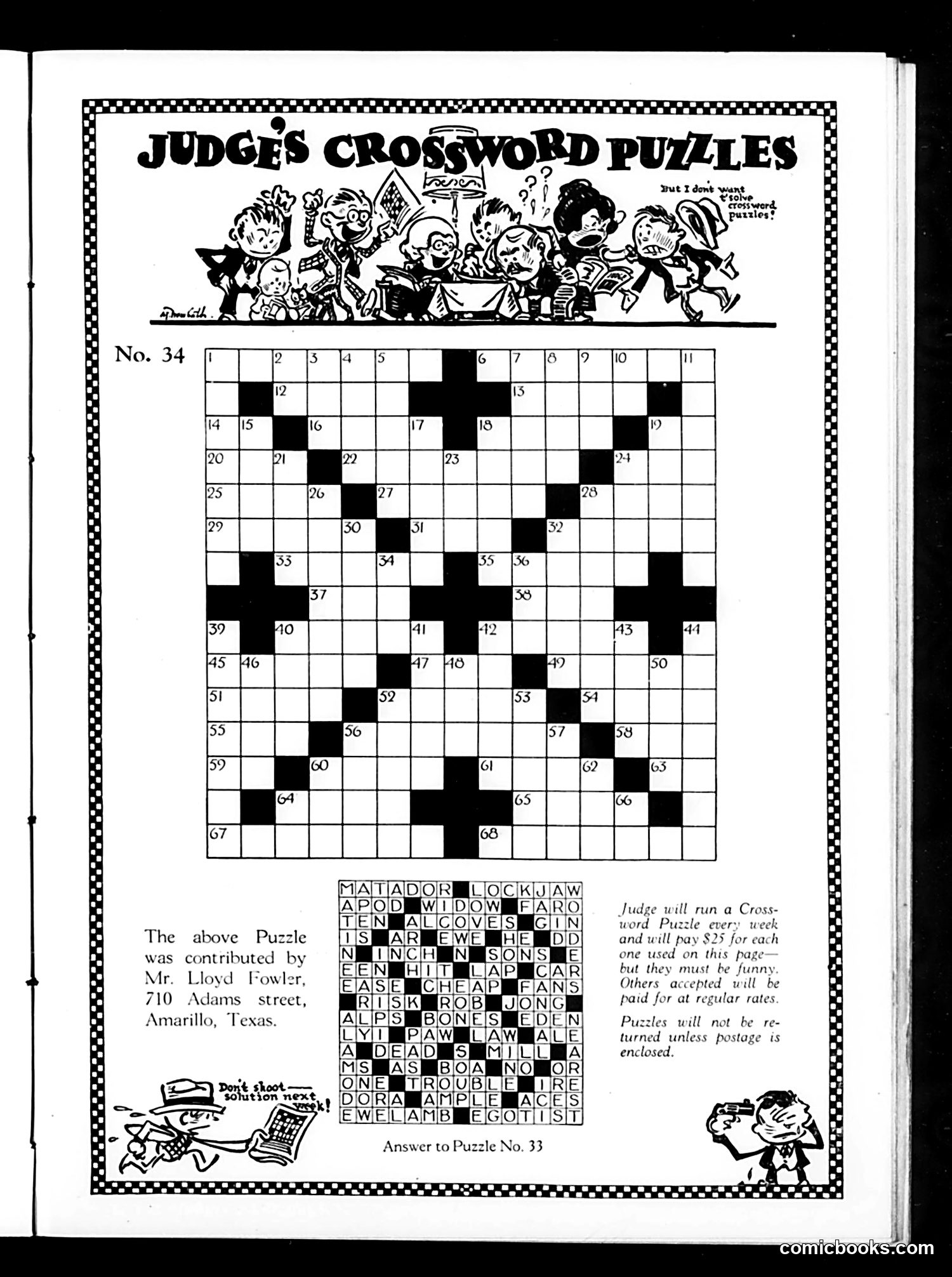
This page features **Judge magazine's weekly crossword puzzle No. 34**, contributed by Lloyd Fowler of Amarillo, Texas. The content is primarily a puzzle with an answer key to the previous week's puzzle (No. 33) displayed below. The top header includes cartoonish illustrations of children and figures in celebratory poses, typical of Judge's playful editorial style. **The satire/joke context:** Judge offered $25 payment for crossword puzzles that were "funny"—suggesting the puzzles themselves should contain witty clues or clever wordplay reflecting current events or social commentary. The magazine paid regular rates for other accepted puzzles. This represents Judge's attempt to engage readers actively while maintaining the publication's satirical mission. The small cartoon at bottom-left ("Don't shoot—solution next!") is a humorous warning to impatient readers. This is primarily **puzzle content rather than political satire**, serving as reader engagement rather than social commentary.
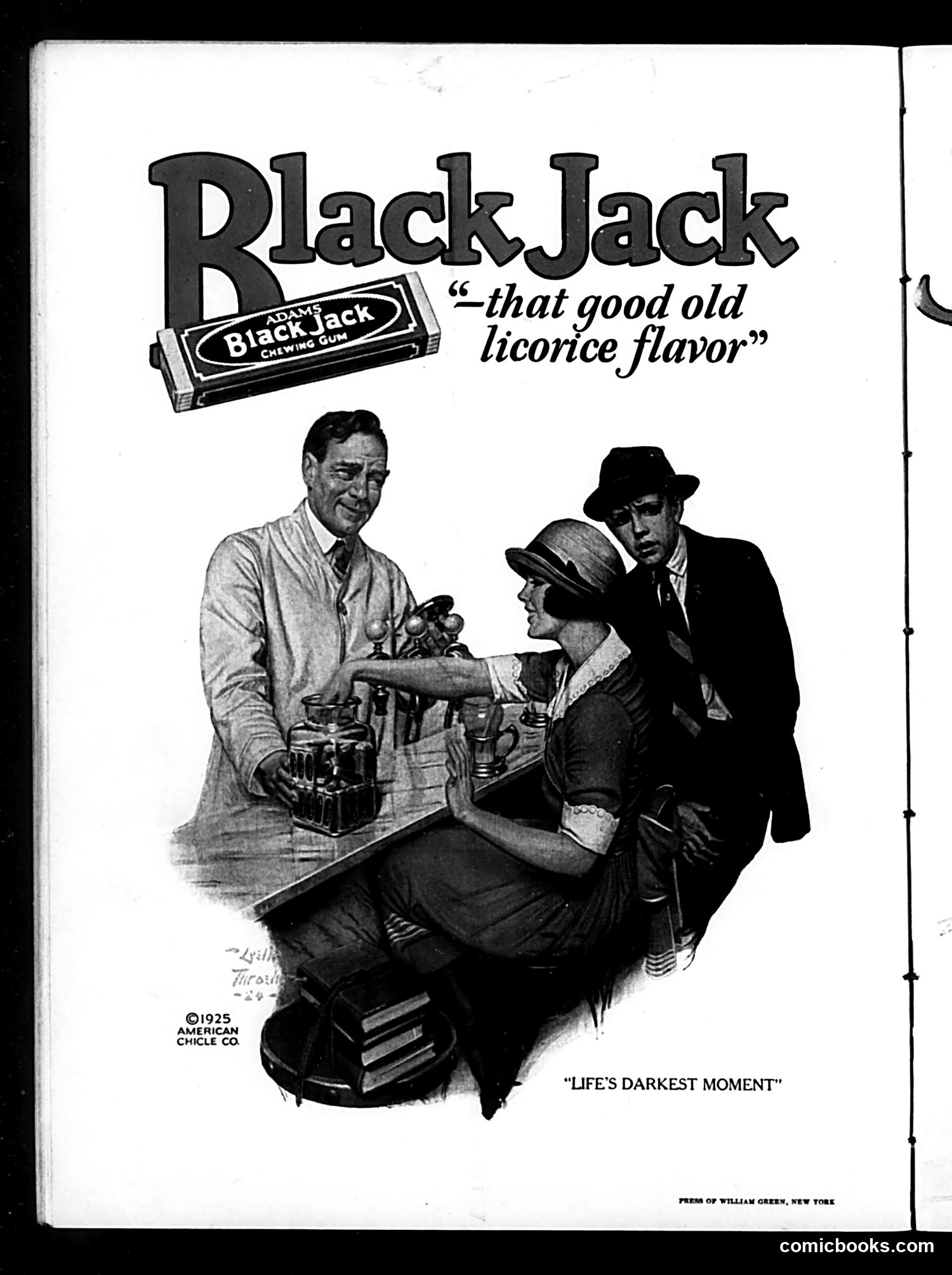
This is a commercial advertisement for BlackJack brand chewing gum, not political satire. The ad depicts a humorous scenario labeled "Life's Darkest Moment"—a bartender serving drinks to two well-dressed men, one of whom appears distressed or surprised. The joke likely plays on Prohibition era (1920-1933) anxieties: the "darkest moment" may reference the legal inability to obtain alcoholic beverages, with the gum offered as an alternative indulgence. The tagline promotes BlackJack's "good old licorice flavor" as a consolation or substitute pleasure. The ©1925 date and American Chicle Co. copyright confirm this is period advertising exploiting contemporary social concerns for commercial purposes.