
Judge, 1925-06-20 · page 32 of 36
Judge — June 20, 1925 — page 32: what you’re looking at
What you’re looking at
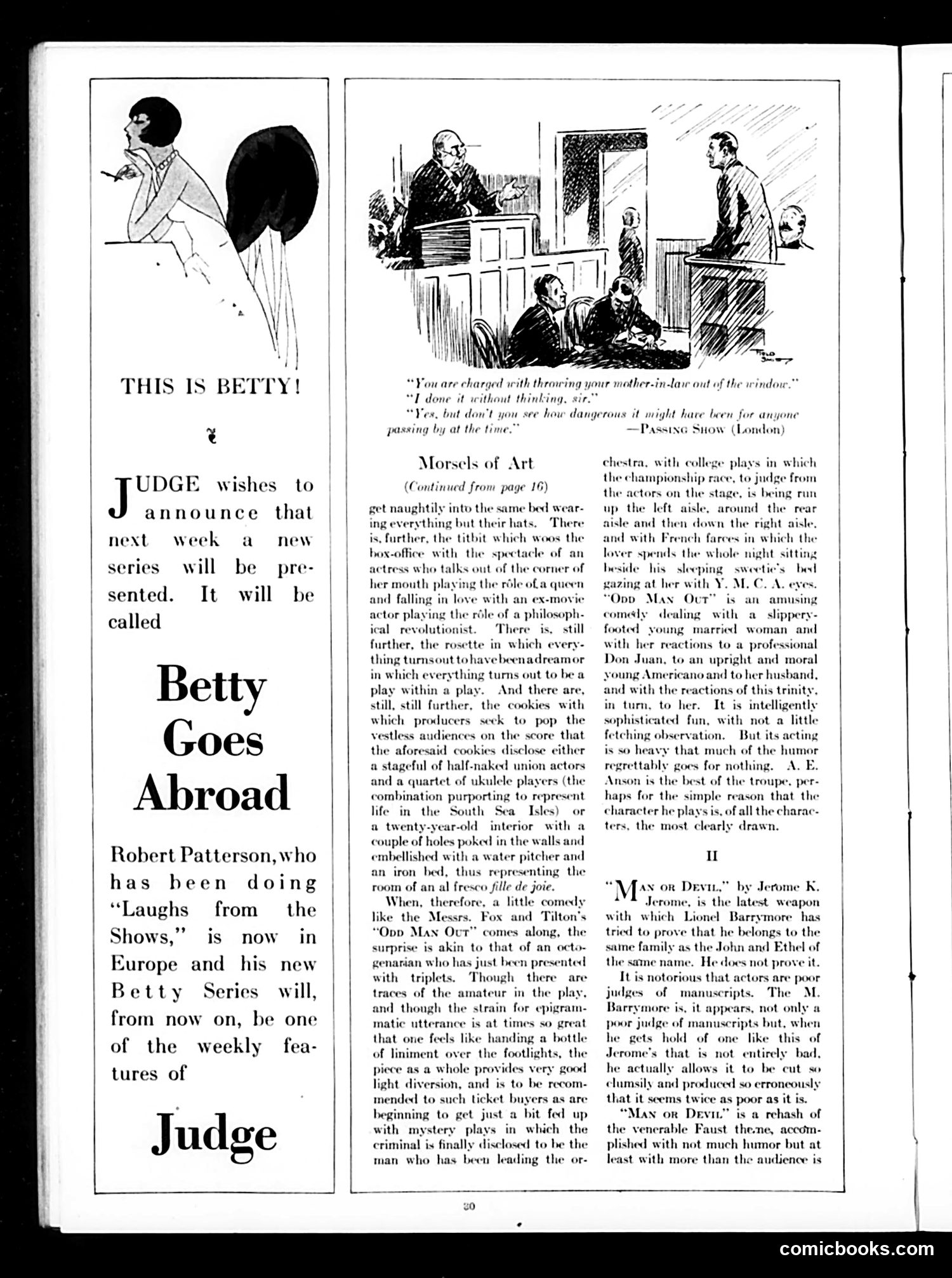
This page announces a new comic series called "Betty Goes Abroad," featuring artist Robert Patterson, who previously created "Laughs from the Shows." Patterson is reportedly in Europe, and this series will become a regular Judge feature. The cartoon at top left shows a stylized woman labeled "This is Betty!"—likely the protagonist of the upcoming series, drawn in the modernist fashion typical of 1920s satirical illustration. The remaining content discusses theatrical reviews under "Morsels of Art," critiquing contemporary stage productions. It reviews plays like "Oop Max Out" (praised as light diversion despite heavy acting) and "Man or Devil" starring Lionel Barrymore (criticized as poorly produced despite decent source material). The page also includes a courtroom joke about a man charged with throwing his mother-in-law out a window. The reviews reflect period concerns about theatrical quality and artistic merit versus commercial entertainment designed to please mass audiences.
📄 Transcribed text from this page (OCR, searchable)
Machine-transcribed from the original scan — historical spelling and the odd misread are preserved.
% UDGE wishes to announce that next. week anew series will be pre- sented. It will be called Betty Goes Abroad Robert Patterson, who has been doing “Laughs from the Shows,” is now in Europe and his new Betty from now on, be one of the weekly fea- tures of Series will, J udge “You are charged with throwing your mother-in-law out of the window.” “1 done it without thinking, sir.” “Ves, but don't you see how dangerous it might hace been for anyone passing by at the time.” Morsels of Art (Continued from page 16) get naughtily into the same bed wear- ing everything but their hats. There is, further, the titbit which woos the box-office with the spectacle of an actress who talks out of the corner of her mouth playing the ré and falling in love with movie actor playing the role of a philosoph- ical revolutionist. There is. still further, the rosette in which ye thing turnsout tohave beenadreamor in which everything tums out to be a play within a play. And there are, still, still further, the cookies with which producers seck to pop. the vestless audiences on the score that the aforesaid cookies disclose either a stageful of half-naked union actors and a quartet of ukulele players (the combination purporting present life in the South Se Isles) or a twenty-year-old interior with a couple of holes poked in the walls and embellished with a water pitcher and an iron bed, thus representing the room of an al fresco fille de joie. When, therefore little comedy like the Messrs. Fox and Tilton’s “Opp Max Oct” comes along, the surprise is akin to that of an octo- genarian who has just been presented with triplets. Though there are traces of the amateur in the play, and though the strain for epigram- matic utterance is at times so great that one feels like handing a bottle of liniment over the footlights, the piece as a whole provides very good light diversion, and is to be recom- mended to such ticket buyers as are beginning to get just a bit fed up with mystery plays in which the criminal is finally disclosed to be the man who has been leading the or- ofa queen —Passine Siow (London) a, With colle the championship ra the actors on the st is being run up the left. ais vund the rear a and then down the right aisle, and with French farces in which the lover spends the whole night: sitting ches! » plays in which judge from le his sleeping sweetie’s bed gazing at her with Y. M,C. A. eves. “Opp Max Out” is an amusing comely dealing with a slippery- footed young married woman and with her reactions to a professional Don Juan, to an upright and moral young Americano and to her husband, and with the reactions of this trinity, in turn, to her. It is intelligently sophisticated fun, with not a little fetching observation. But its acting is so heavy that much of the humor regrettably goes for nothing. A. E. Anson is the best of the troupe. per- haps for the simple reason that the character he p Il the charac. ters, the most clearly drawn. Il “Mes or Devin,” by Jerome K. °F Jerome, is the latest weapon with which Lionel Barrymore has tried to prove that he belongs to the same family as the John and Ethe the same name. I It is notorious t ptors are poor judges of manuscripts. The M. Barrymore is, it appears, not only a poor judge of manuscripts but, when he gets hold of one like this of Jerome's that is not entirely bad, he actually allows it to be cut so clumsily and produced so erroneously that it seems twice as poor as it is. “Man or Devit” is a rehash of the venerable Faust thene, accdm- plished with not much humor but at least with more than the audience is x’s not prove it. comicbooks.com