
A complete issue · 36 pages · 1925
Judge — June 6, 1925
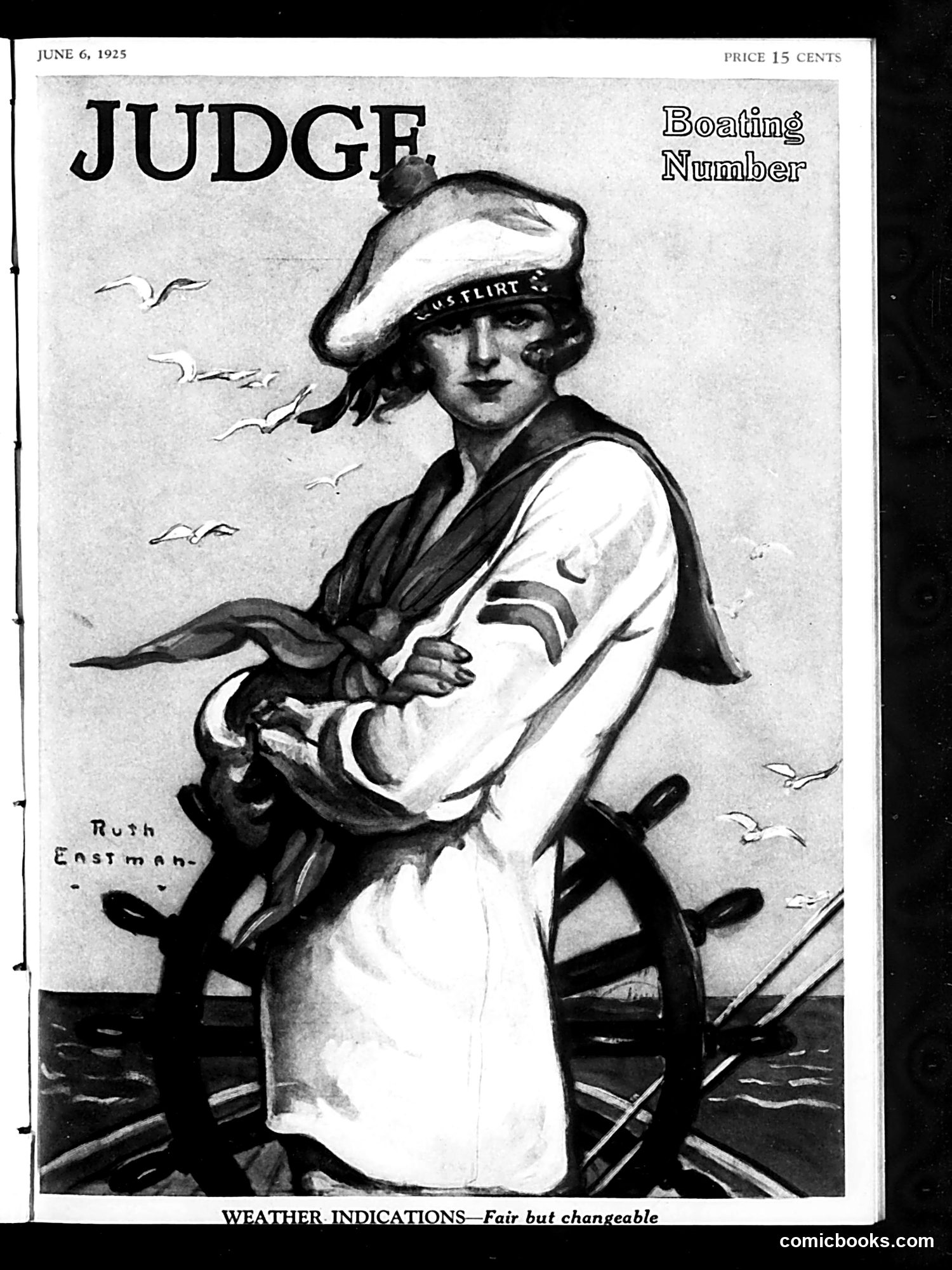
This is a cover illustration by Ruth Eastman depicting a woman in sailor attire at a ship's wheel, labeled "Boating Number." The figure wears a captain's hat with "CURTIS FLINT" visible on the band and holds the wheel confidently while standing on deck with water and seabirds visible. The "Boating Number" designation indicates this is a special summer issue focused on recreational boating—a leisure activity associated with the wealthy during the 1920s Jazz Age. The sailor outfit and commanding pose suggest femininity combined with nautical authority, typical of Judge's light satirical approach to contemporary social trends. The weather forecast at bottom ("Fair but changeable") appears a standard feature.
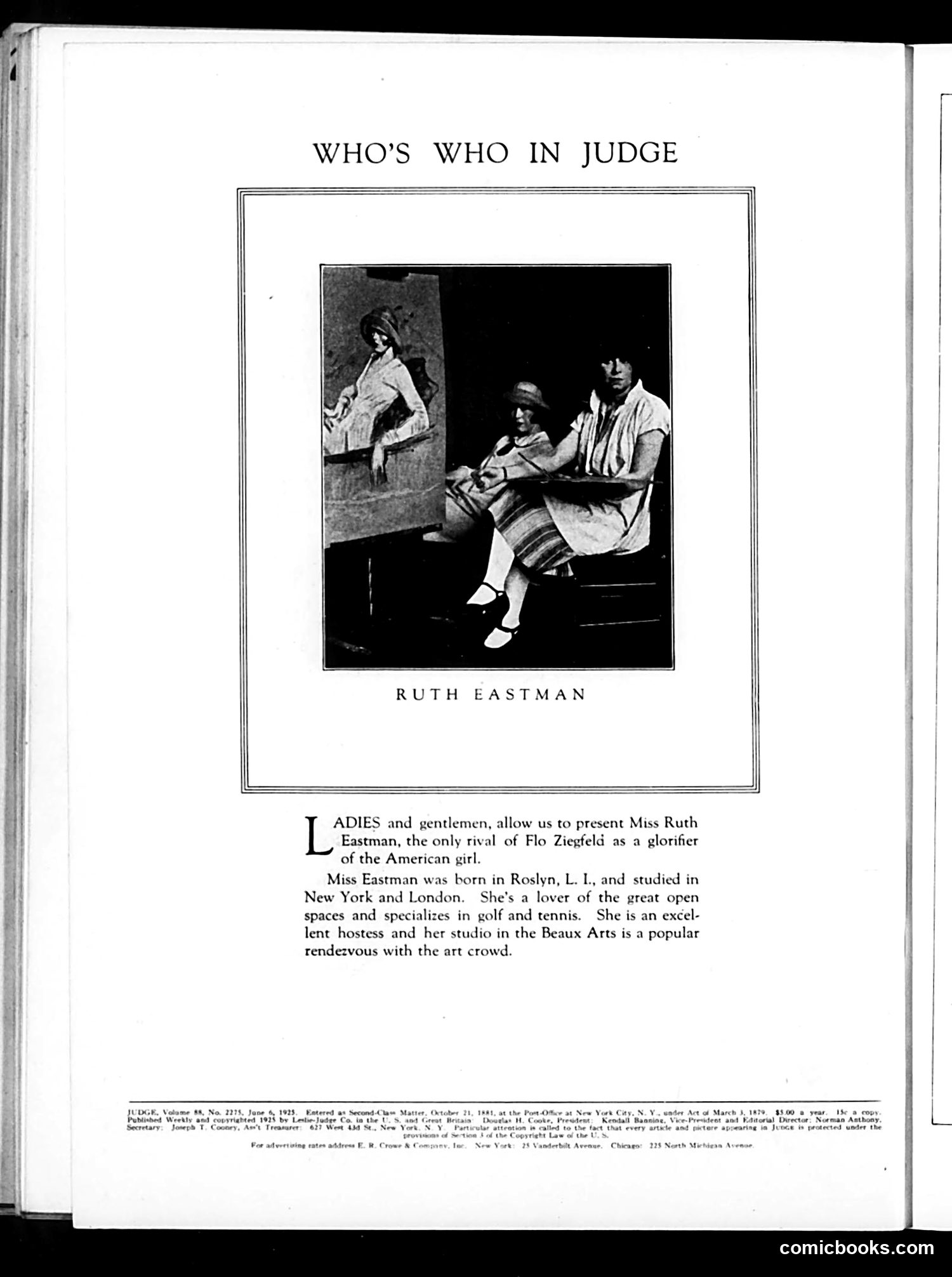
This is a "Who's Who in Judge" profile page featuring Ruth Eastman, a society figure from the 1920s-30s era. The text describes her as "the only rival of Flo Ziegfeld as a glorifier of the American girl"—referencing Flo Ziegfeld, the famous Broadway impresario known for showcasing beautiful women in elaborate productions. The photograph shows Eastman in what appears to be an artist's studio with two other people examining artwork or a figure. The satirical point seems to be that she, like Ziegfeld, curates and presents idealized versions of American femininity, though through art rather than theatrical productions. The reference to her being born in Roslyn, L.I., studying in New York and London, and maintaining a popular Beaux Arts studio suggests she operated in wealthy, artistic circles—positioning her as a cultural tastemaker.
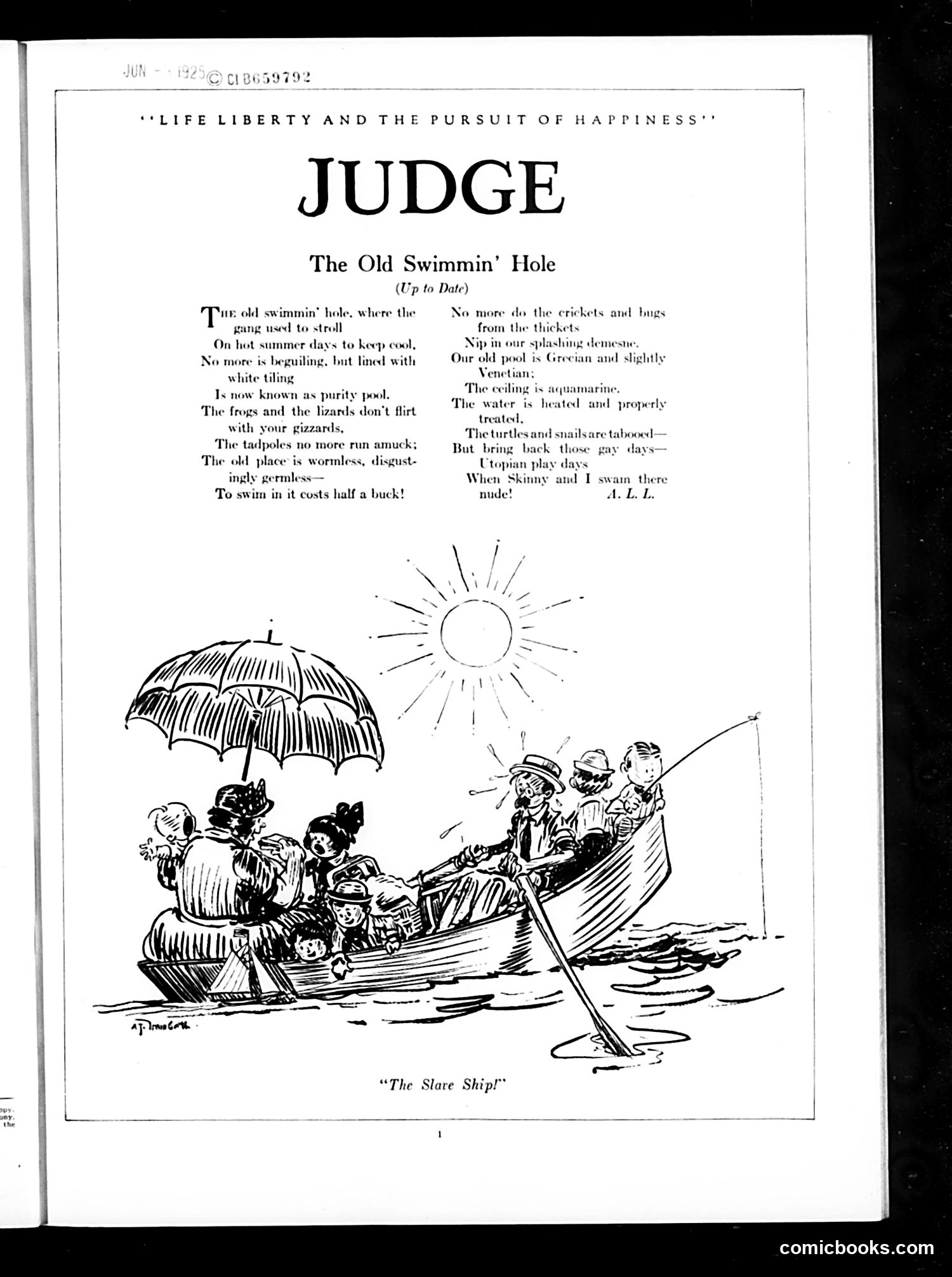
This satirical poem by Judge magazine laments how modernization has ruined a cherished childhood swimming spot. The old swimming hole—once a free, informal gathering place for boys—has been converted into a formal "purity pool" with admission fees (half a buck), chlorine treatment, and regulations prohibiting nude swimming. The accompanying illustration titled "The Slate Ship" depicts families in a boat, contrasting the carefree past with commercialized present leisure. The satire critiques early 20th-century "progress": sanitization, corporate control of public recreation, and the disappearance of spontaneous, accessible fun. The poem nostalgically mourns lost freedom and simplicity, suggesting modernization comes at the cost of authentic childhood experiences and social equality.
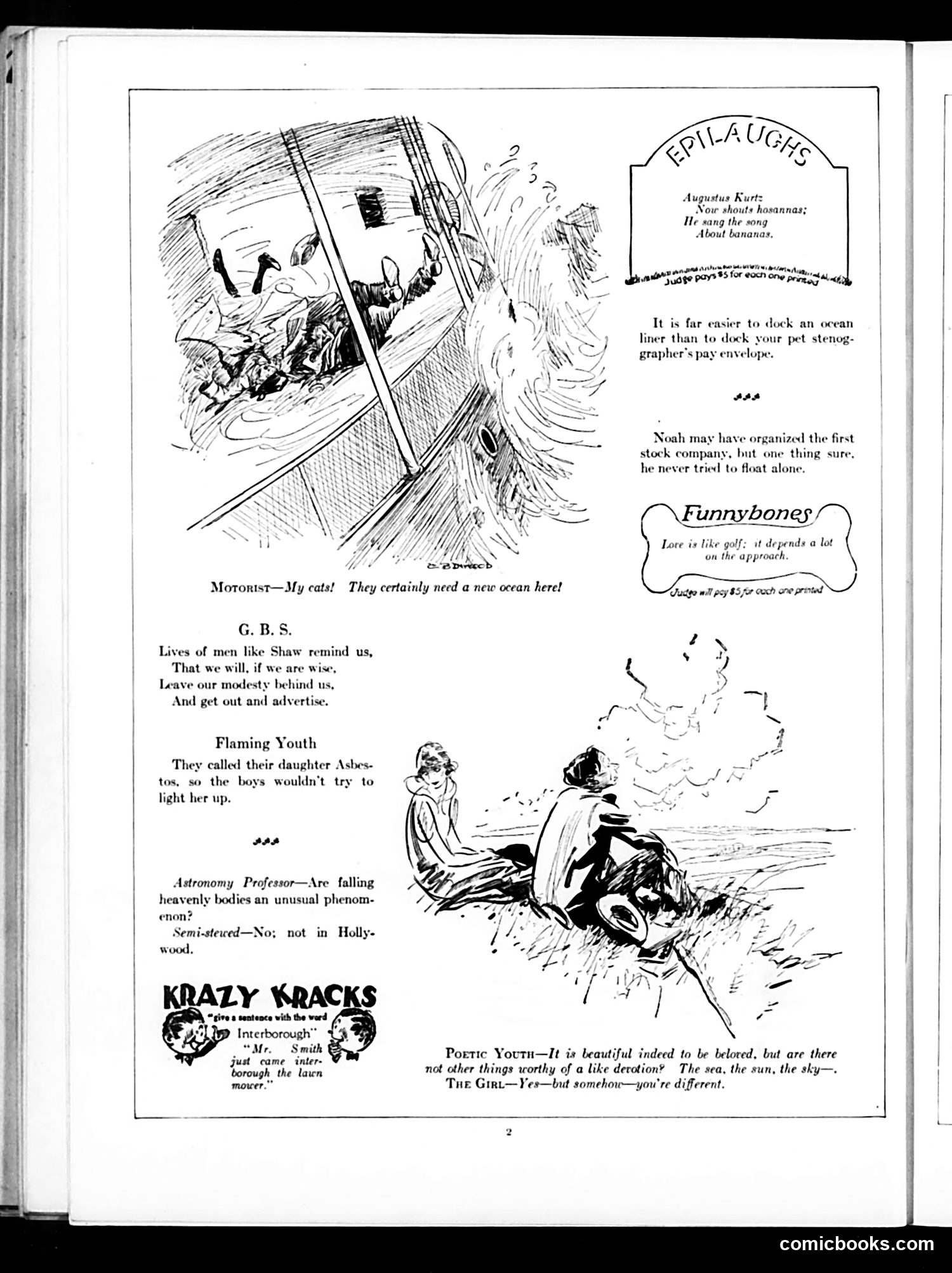
This page contains several unrelated humor pieces typical of Judge's format: **Top cartoon**: A motorist complains about cats needing a new ocean liner—a visual pun about overcrowded ship conditions, likely referencing 1920s-30s maritime travel complaints. **"G.B.S."**: A dig at George Bernard Shaw, the famous playwright, suggesting men like him inspire modest behavior while paradoxically encouraging self-promotion through advertising. **"Flaming Youth"**: A social commentary on naming a daughter "Asbestos" to discourage romantic pursuit—satirizing Jazz Age parenting concerns about youth morality. **"Krazy Kracks"**: A wordplay joke about Interborough (transit system), typical of the magazine's pun-based humor. **Bottom sketch**: Depicts romantic youth debating devotion versus nature's beauty—gentle satire of sentimental young love versus practical concerns. The page reflects Judge's mix of topical commentary, wordplay, and social observation about 1920s-30s American life.
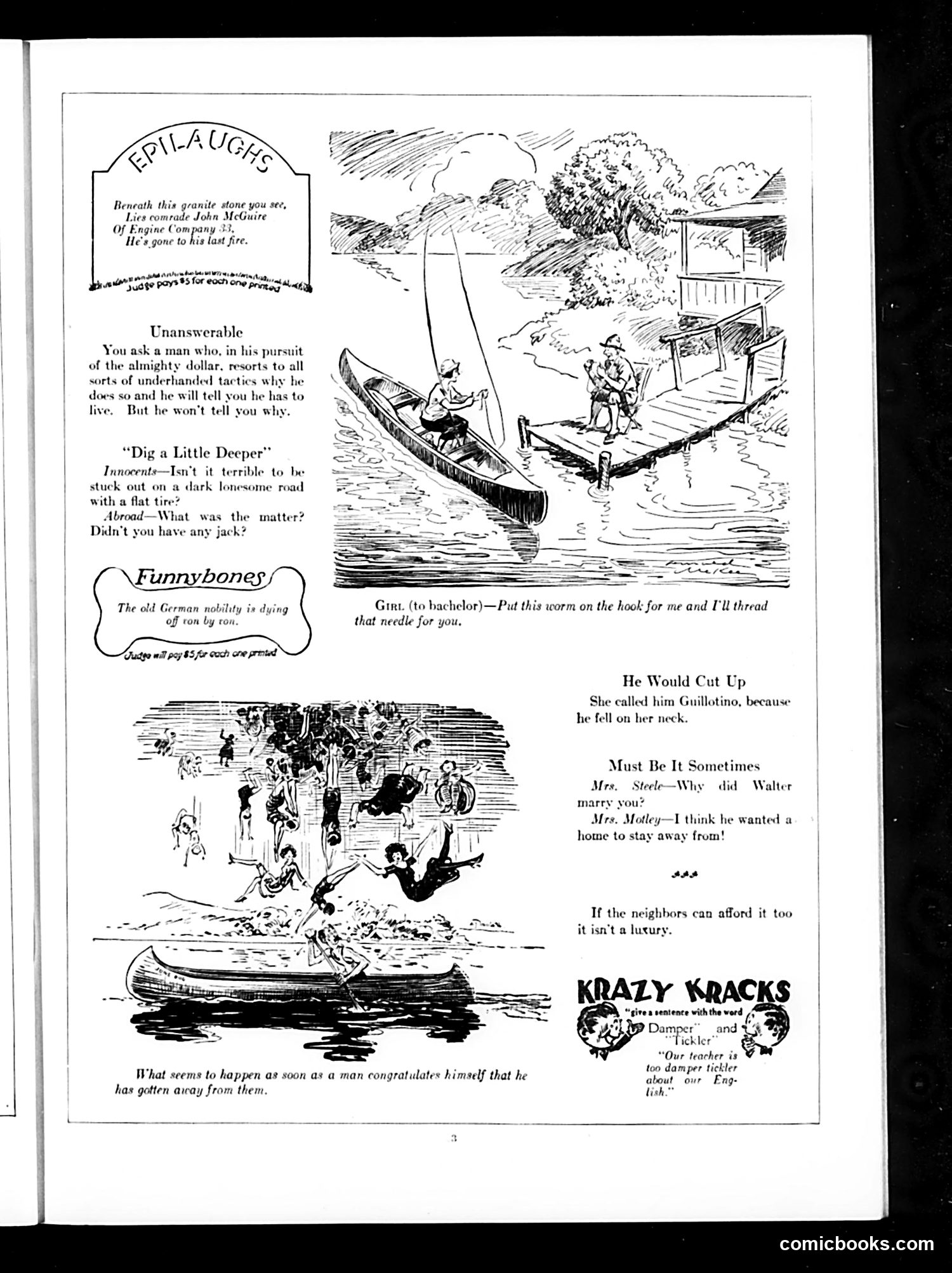
This page contains miscellaneous humor and light satirical content rather than political cartoons. The items include: **"Epilaughs"** — brief epitaphs on gravestones with humorous inscriptions about mundane people and situations. **"Dig a Deeper"** — a joke about someone stranded with a flat tire, lacking a jack (a pun on the tool). **"Funnybones"** — a quip about a dying German nobleman. The illustrated jokes mock everyday social situations: a woman's flirtation with a fisherman, a man nicknamed "Guillotino" for clumsiness, and marital dissatisfaction. The bottom cartoon shows people diving into water, captioned with commentary on human behavior when escaping responsibility. **"Krazy Kracks"** advertises wordplay about "damper" and "tickler" regarding English fish. This appears to be general-interest humor rather than political satire.
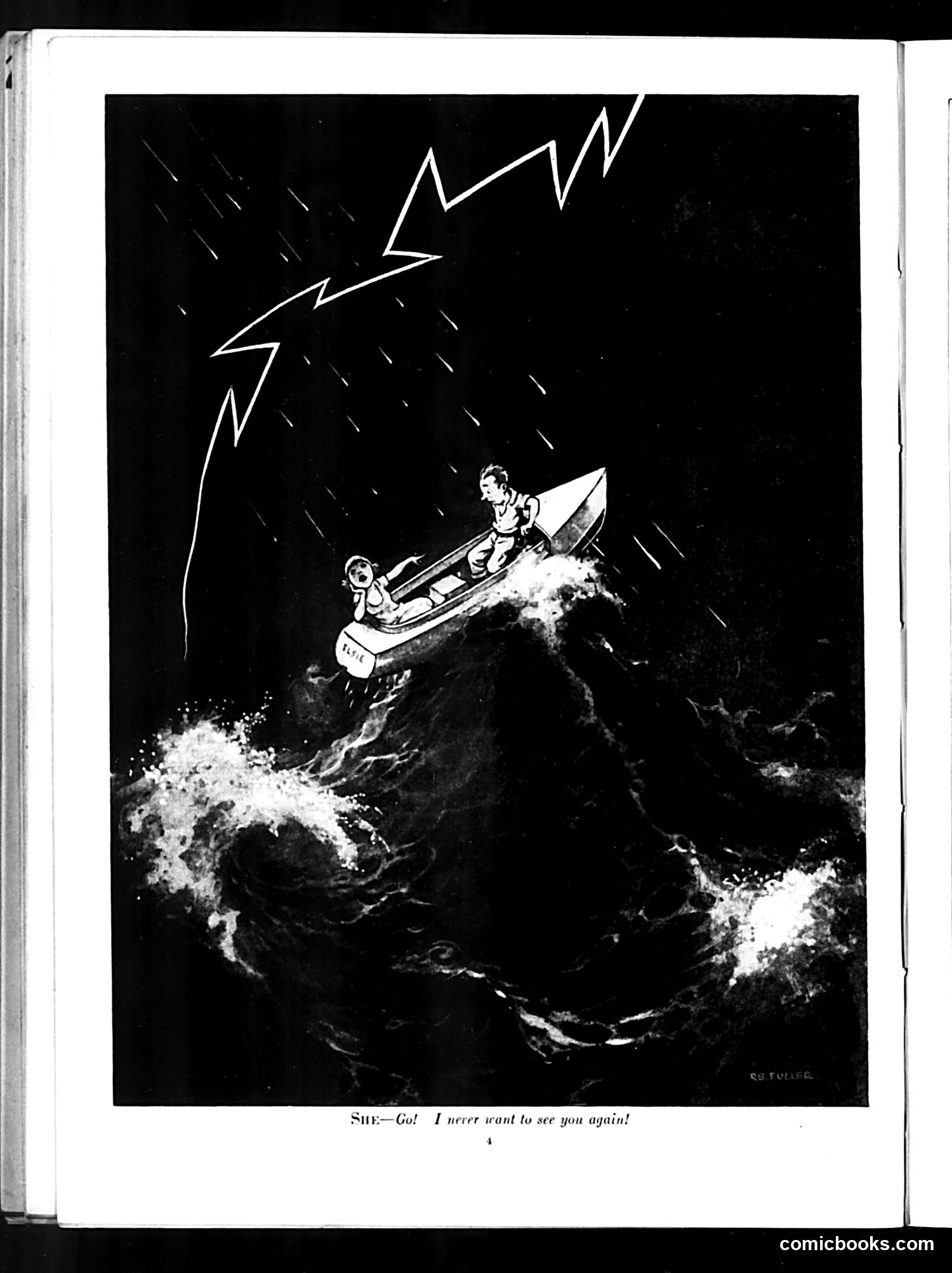
This appears to be a dramatic illustration from Judge magazine depicting a dangerous sea rescue or maritime disaster. Two figures in a small boat navigate turbulent waters amid lightning and heavy rain. The caption reads "SHE—Go! I never want to see you again!" The satire likely comments on a romantic or marital conflict resolved through dramatic circumstances—possibly referencing a real incident or social scandal of the era. The woman's command to leave, coupled with the perilous storm, creates dark irony: she wishes him gone, and nature obliges by putting him in mortal danger. Without additional context about the specific historical event or public figures this references, the cartoon's precise political or social target remains unclear, though it clearly satirizes human drama amid natural catastrophe.
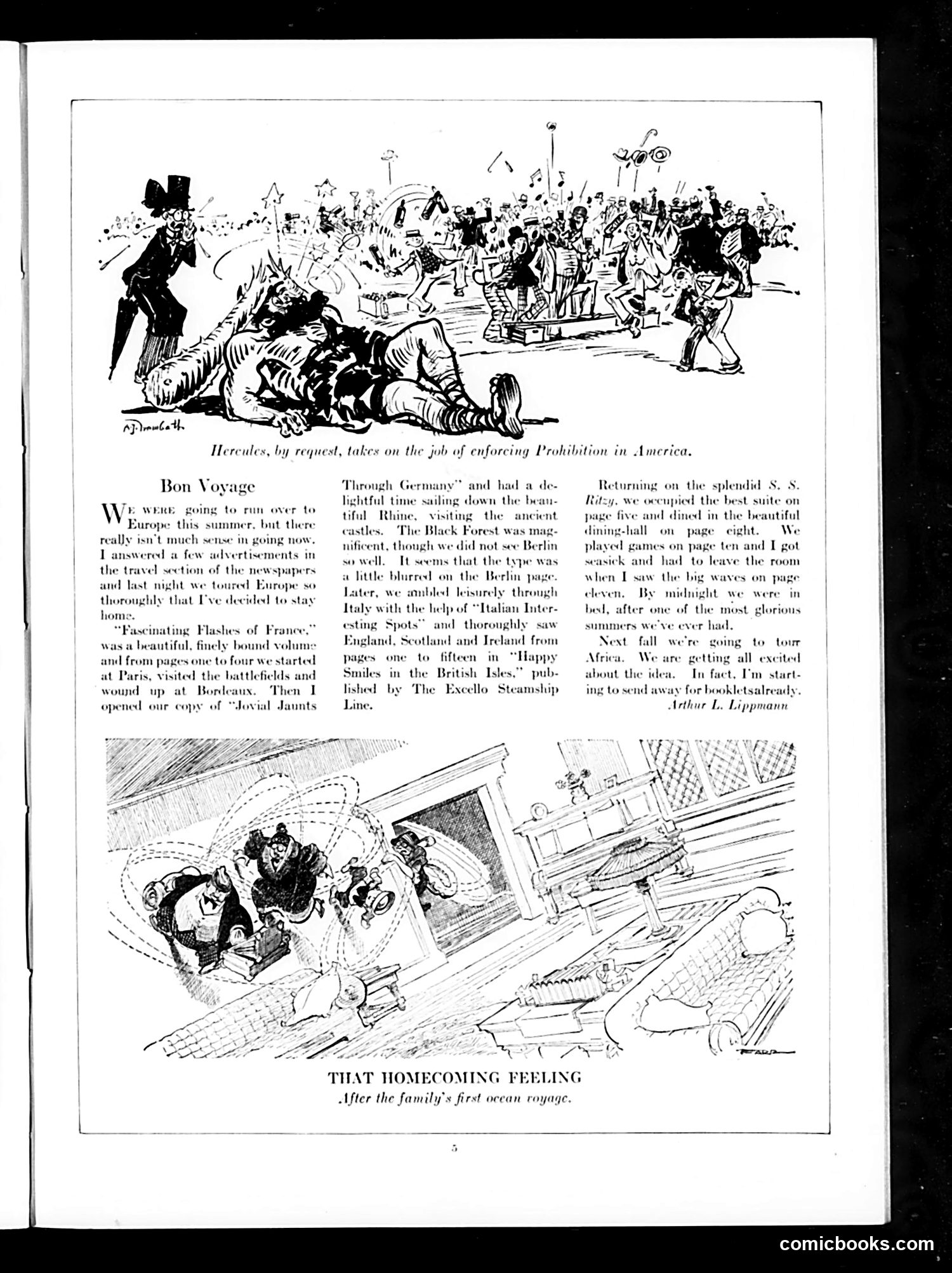
The top cartoon depicts "Hercules, by request, takes on the job of enforcing Prohibition in America." Hercules—the mythological strongman—lies exhausted on the ground surrounded by a chaotic crowd, suggesting that even superhuman effort cannot enforce Prohibition effectively. This satirizes the widespread difficulty and social disruption caused by alcohol prohibition enforcement in 1920s America. The lower cartoon, "That Homecoming Feeling," shows a family returning home by ship after an ocean voyage, with luggage being unloaded. This appears to be humorous domestic commentary rather than political satire. The "Bon Voyage" article discusses European travel, mentioning visits to France, Germany, and the British Isles via steamship, reflecting 1920s leisure travel culture.
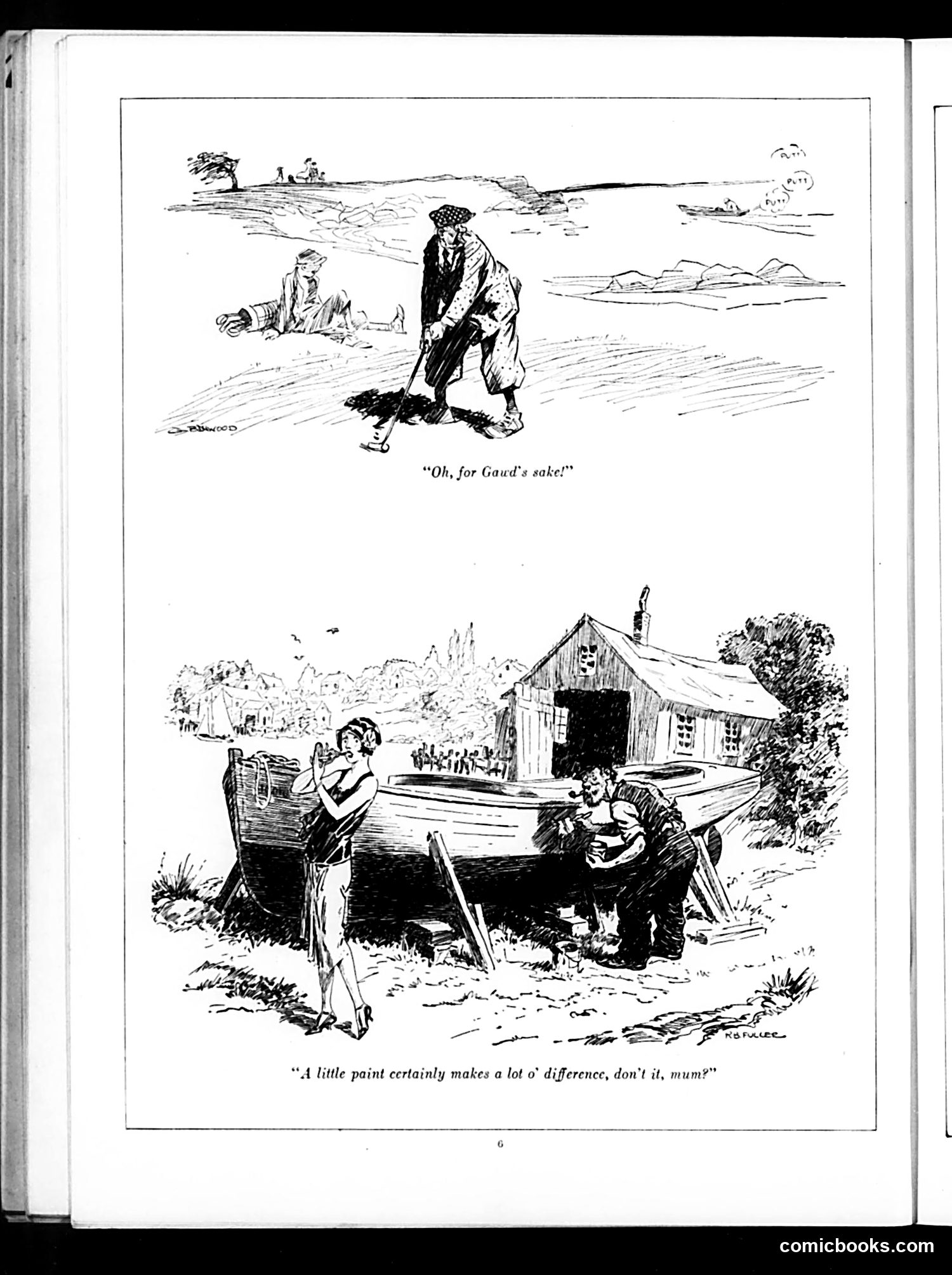
This page contains two editorial cartoons satirizing British coastal life and working-class concerns. **Top cartoon:** A frustrated fisherman or boatman exclaims "Oh, for Gawd's sake!" while gesturing at the sea, likely commenting on poor fishing conditions or maritime hardships affecting working people. **Bottom cartoon:** Two figures examine a dilapidated boat near a cottage, with one saying "A little paint certainly makes a lot o' difference, don't it, mum?" This appears to satirize false economic optimism—suggesting that superficial improvements (literal paint) mask deeper structural problems in working-class life. The ramshackle setting emphasizes the gap between cosmetic fixes and genuine poverty or neglect. Both cartoons use working-class British dialect and seaside settings to critique social conditions or government policy, likely from the early 20th century.
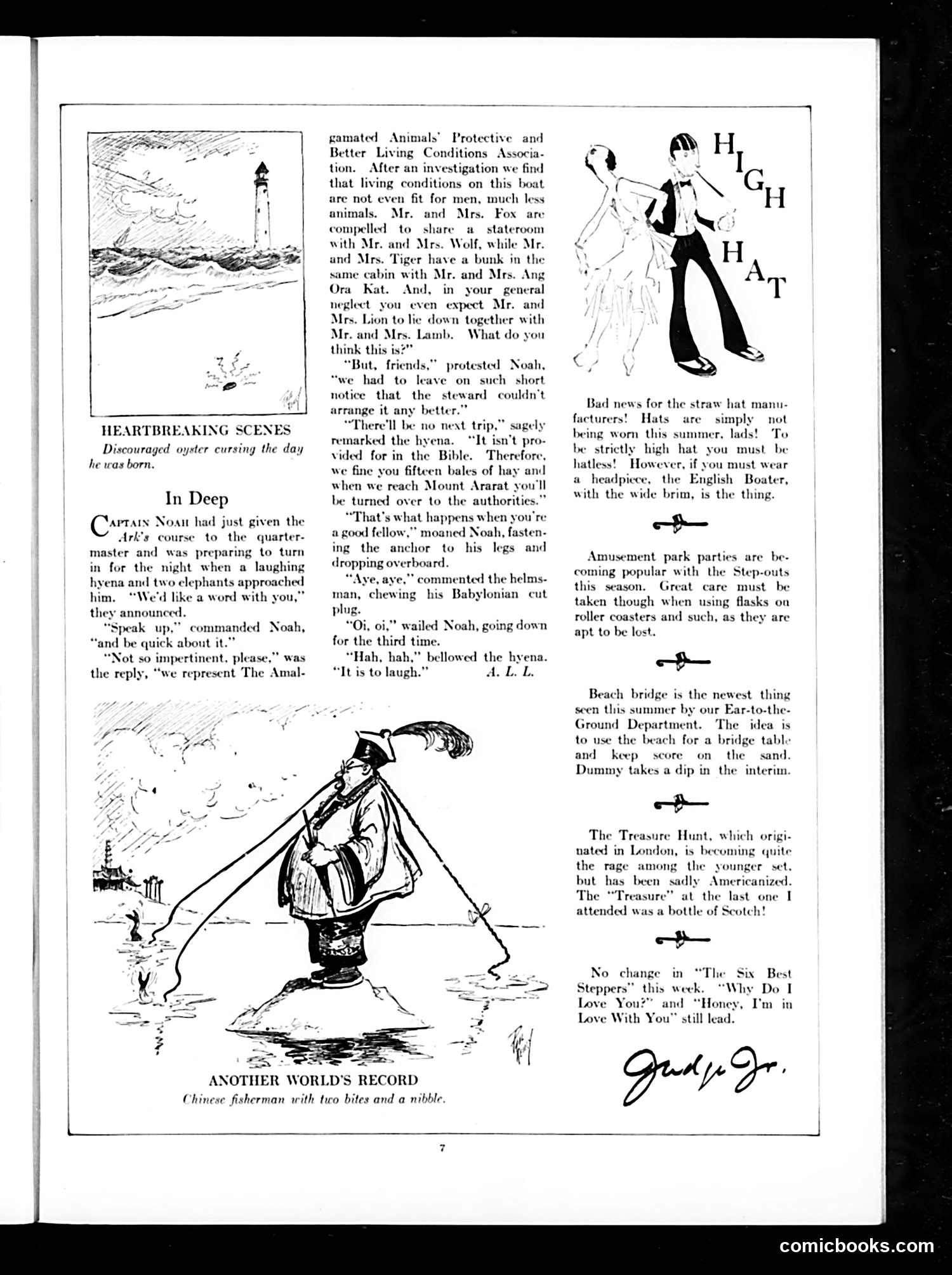
This is a satirical take on Noah's Ark featuring animal labor rights activists. The hyena, elephant, and other animals represent a union or protective association confronting Noah about overcrowding and incompatible roommates—forcing natural predators (foxes with wolves, tigers with cats, lions with lambs) to share tight quarters. The joke mocks both early 20th-century labor organizing movements and the biblical narrative itself. Noah defends himself by claiming logistical necessity, but the animals fine him and threaten legal action, ultimately driving Noah to suicide by anchor. The satire appears to target contemporary labor activism as overly litigious and rigid—even in impossible circumstances. The "absurdist" punishment (threatening biblical consequences for a pre-biblical voyage) adds dark humor. The helmsman's indifferent response ("It is to laugh") suggests the author views such complaints as ridiculous theater.
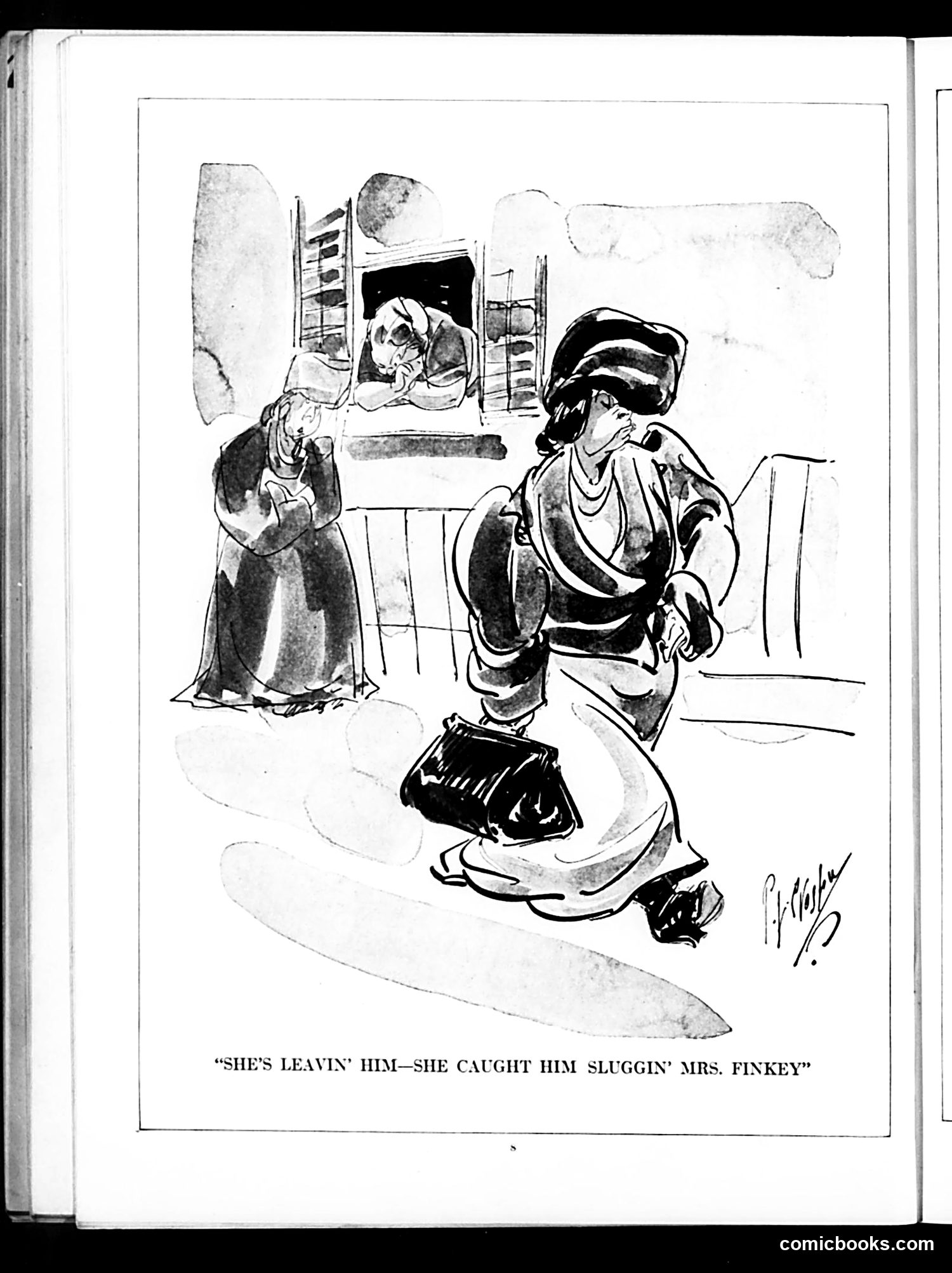
This Judge magazine cartoon depicts a domestic scandal involving infidelity. The caption reveals that a woman is leaving her husband after discovering he's been "slugging" (slang for kissing/making out with) a woman named Mrs. Finkey. The image shows two women—one departing with luggage (the wronged wife), and another energetically gesturing or confronting (likely Mrs. Finkey or a servant reporting the affair). A third figure appears in a window above, possibly the guilty husband. The satire targets marital infidelity and domestic drama, common subjects in early 20th-century humor magazines. The humor relies on the period's social conventions around marriage propriety and the scandal of a husband's visible romantic indiscretion with a named woman, suggesting this may reference a recognizable contemporary scandal, though specific identities remain unclear.
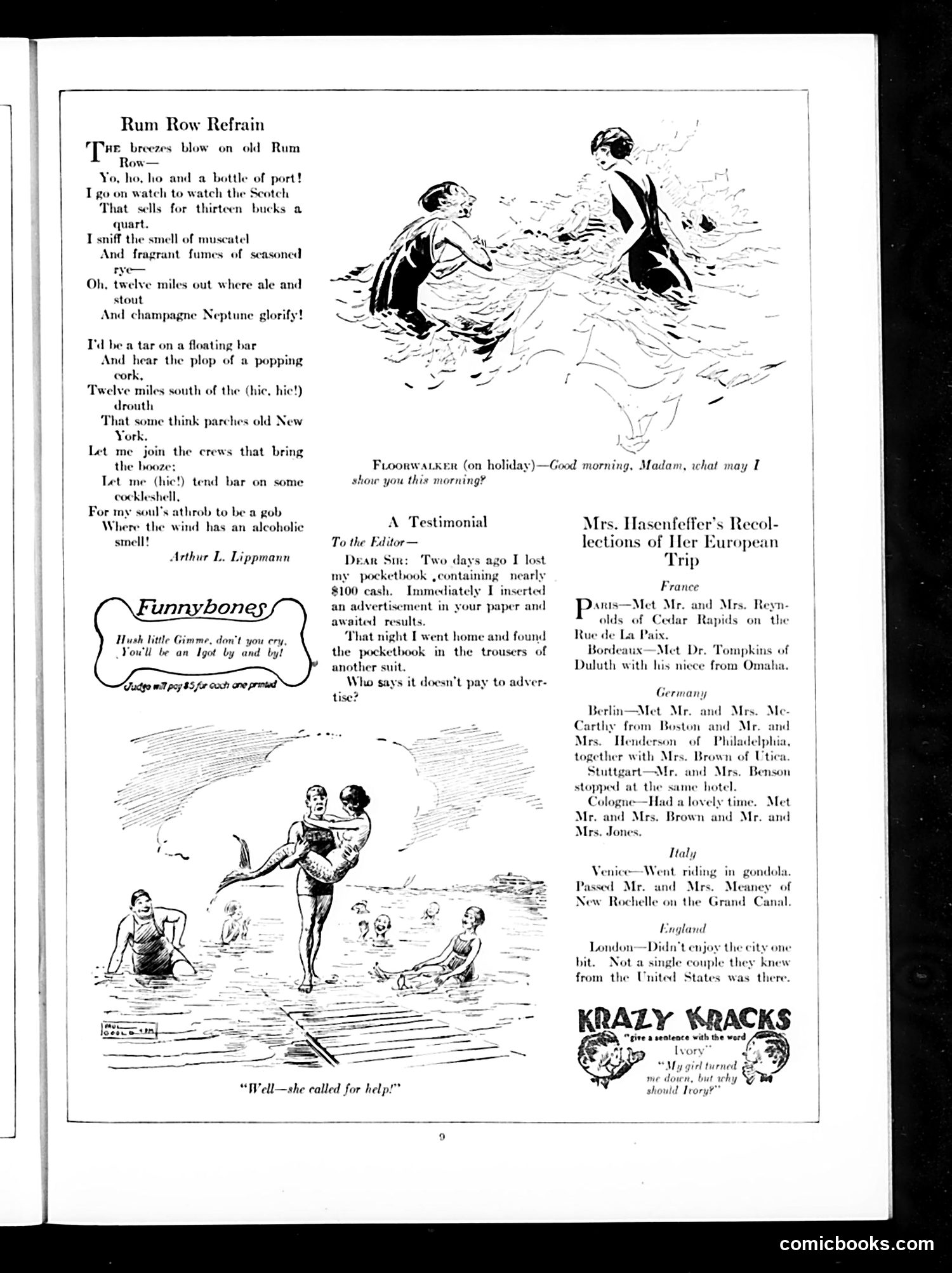
This poem by Arthur L. Lippmann mocks **Prohibition** (likely the 1920s ban on alcohol sales). "Rum Row" refers to the famous offshore smuggling operation—ships anchored twelve miles beyond U.S. jurisdiction where alcohol was legally sold and then illegally brought ashore. The speaker romanticizes working on these smuggling vessels, celebrating the irony that alcohol is freely available just outside American waters while the nation enforces "drouth" (drought) on land. References to "Scotch," "muscatel," "champagne," and "ale" emphasize the absurdity: expensive contraband liquor ($13/quart) thrives despite legal prohibition. The poem satirizes how Prohibition created criminal enterprises rather than eliminating drinking—it made alcohol more desirable, expensive, and associated with seafaring adventure. The nautical language ("tar," "gob," "floating bar") humorously treats smuggling as romantic work. This is political satire criticizing Prohibition's failure and the hypocrisy of a law everyone ignored.
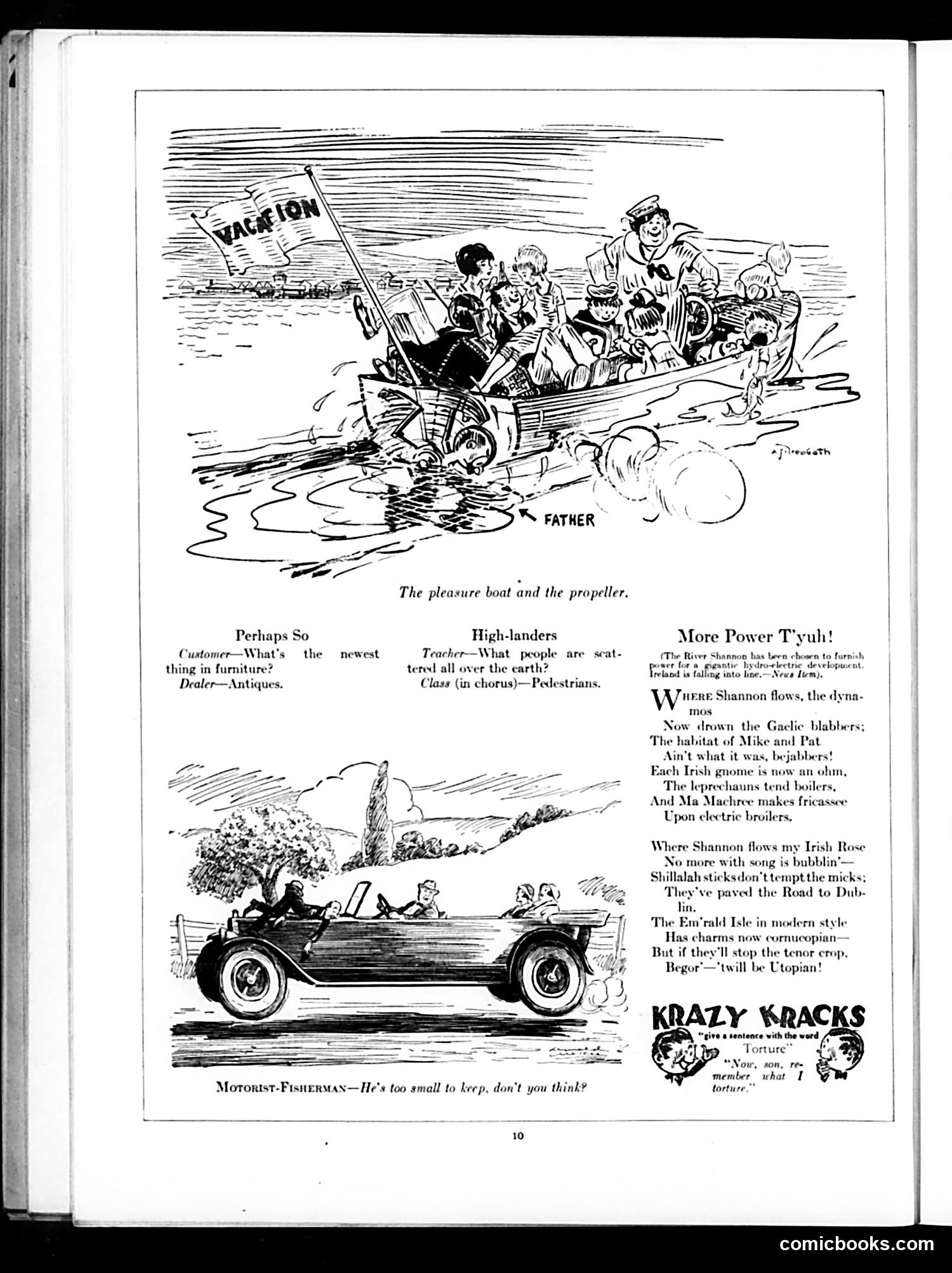
This page contains three unrelated humor items typical of Judge magazine's format: **Top cartoon**: "The pleasure boat and the propeller" depicts a family vacation scene with a "VACATION" flag, satirizing leisure travel mishaps—likely poking fun at motorboat accidents or mechanical failures during family outings. **Middle cartoon**: "Motorist-Fisherman" is a simple one-liner joke about catch-and-release fishing. **Main feature**: "More Power T'yuh!" is Irish-themed satire about hydroelectric development on Ireland's River Shannon. The poem mocks the modernization of rural Ireland—replacing traditional Irish culture (Gaelic speakers, leprechauns, romantic courting) with industrial power generation. The title's accent suggests mocking Irish dialect. This reflects early-20th-century anxieties about industrialization destroying traditional rural life, framed through ethnic stereotypes of Irish people and culture. The three "High-landers" jokes are unrelated one-liners.
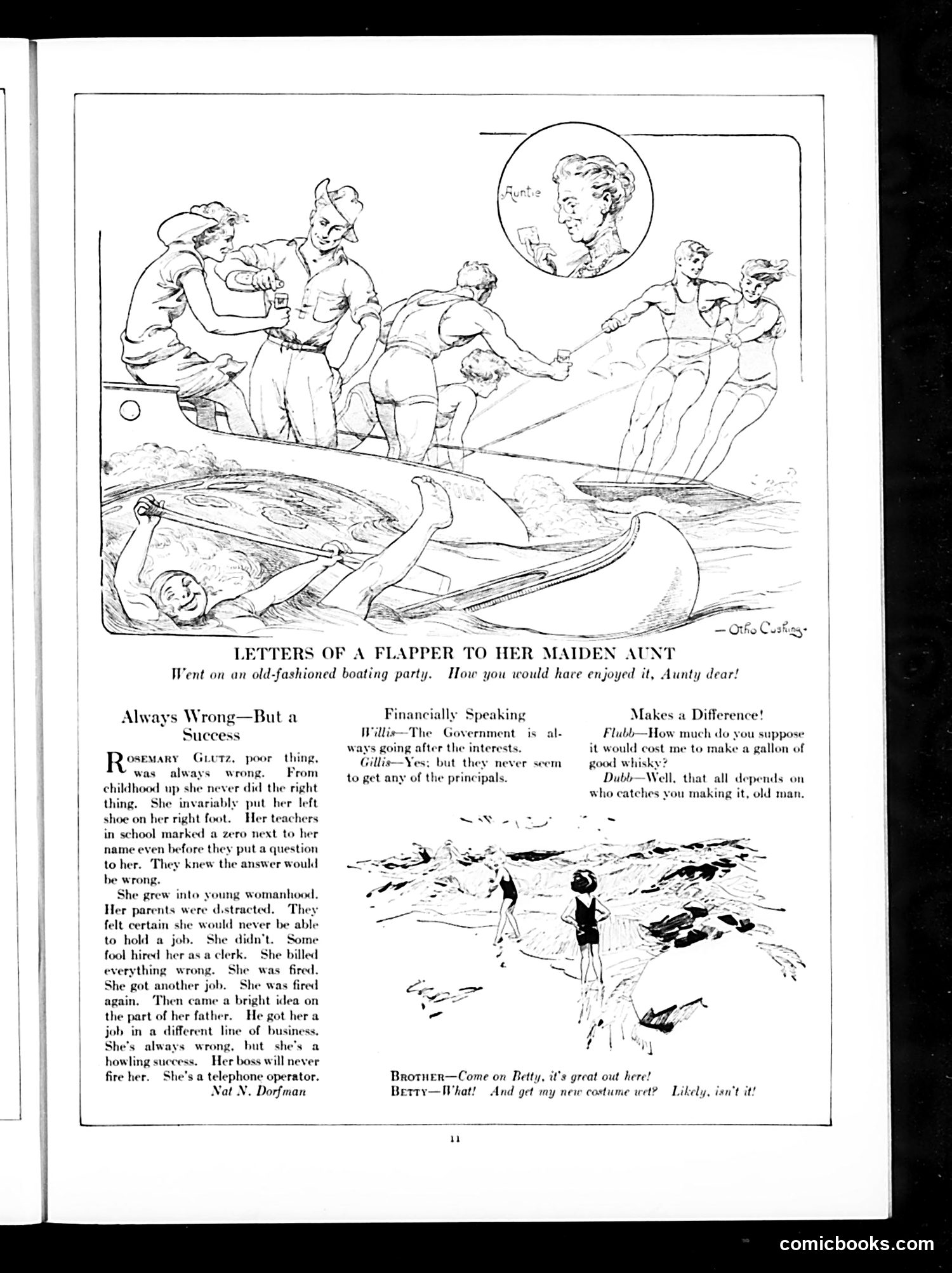
This page from *Judge* magazine contains three separate satirical pieces: 1. **"Always Wrong—But a Success"**: A humorous story by Nat N. Dorfman about Rosemary Glutz, a chronically incompetent woman who fails at every job until becoming a telephone operator—where her wrongness paradoxically makes her successful. The joke: telephone operators were stereotyped as deliberately connecting wrong numbers or cutting off calls, so her natural incompetence fits the job perfectly. 2. **"Financially Speaking"**: A brief joke mocking Prohibition-era alcohol smuggling. Two men discuss making illegal whisky; one asks the cost, the other responds it depends on "who catches you making it"—satirizing widespread lawbreaking and bribery during Prohibition (1920-1933). 3. **"Makes a Difference!"**: A beach-party illustration showing a brother inviting his sister "Betty" to enjoy the water, but she refuses to get her new costume wet. The humor targets vanity and fashion consciousness among young women. All three pieces reflect 1920s attitudes toward women, Prohibition, and consumer culture.
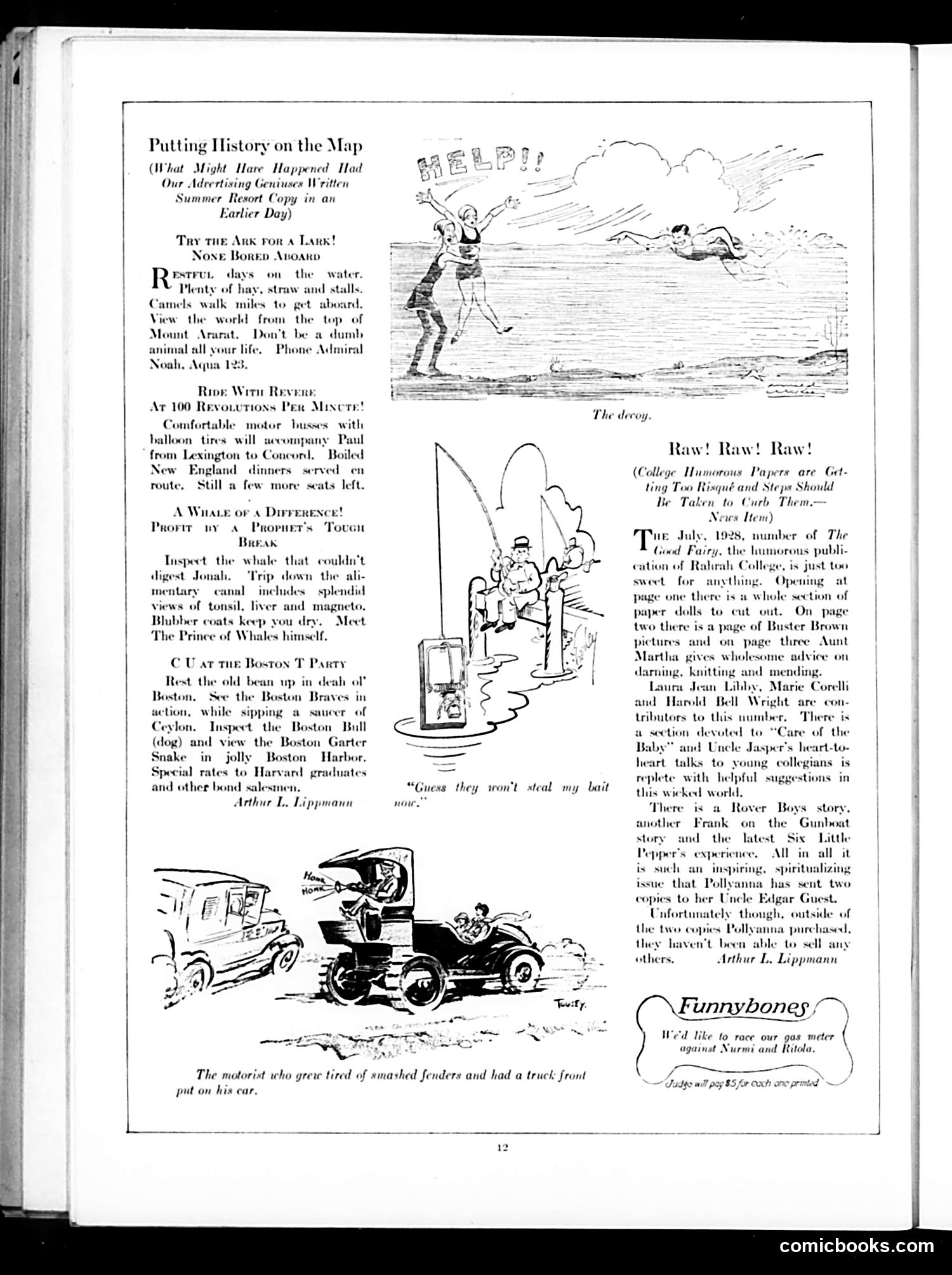
This page contains satirical humor pieces about American life circa 1928. The top section, "Putting History on the Map," parodies resort advertising by imagining how modern marketing copywriters would sell biblical and historical events—Noah's Ark as a summer destination, Paul Revere's ride as a motorcoach tour. The joke mocks overly enthusiastic advertising copy applied to incongruous subjects. "Raw! Raw! Raw!" satirizes complaints that college humor magazines had become too risqué. The author lists deliberately wholesome content (paper dolls, knitting advice, inspirational writers like Pollyanna) to mock the notion that these publications were actually scandalous. It's commentary on moral panic over youth culture. The motorist cartoon jokes about someone installing a truck front-end on his car after repeatedly smashing his fenders—absurdist humor about automotive mishaps. "Funnybones" references Nurmi and Ritola, likely famous runners, in a joke about gas meter consumption versus their speed.
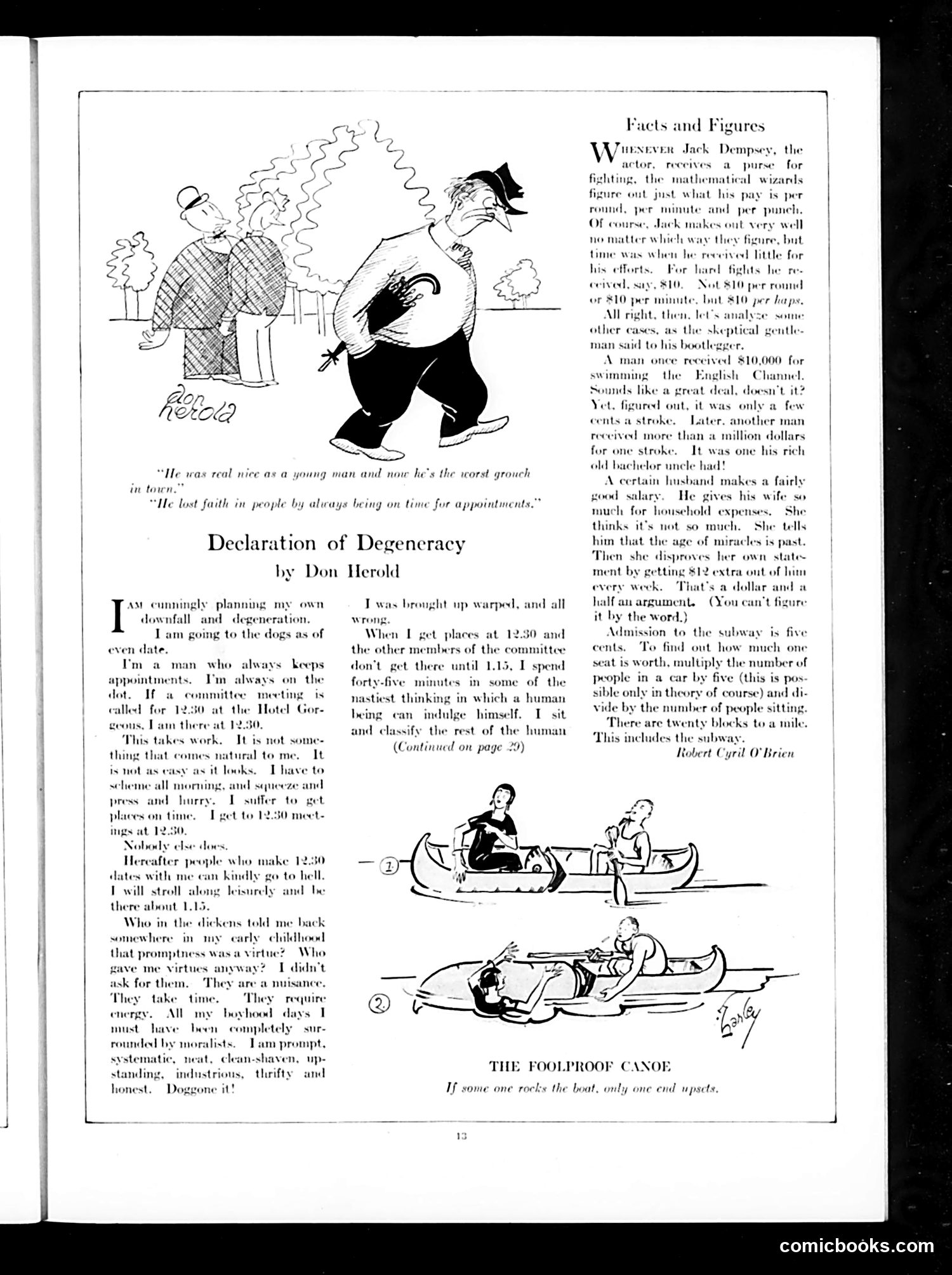
This page contains two distinct pieces of social satire: **Main Article (Don Herold):** A humorous first-person lament about the author's own decline into respectability. Herold ironically claims he's "planning his own downfall" by being punctual, organized, and honest—virtues he presents as making him miserable. The joke: modern society has inverted values. Being reliably on time for appointments actually makes him unpopular (the opening caption jokes that punctuality destroyed his likability). He's trapped by his own virtue, spending forty-five minutes in "nasty thinking" waiting for habitually late committee members. **"Facts and Figures" (Robert Cyril O'Brien):** Brief satirical calculations comparing celebrity earnings. It mocks how absurdly low Jack Dempsey's boxing pay was ($10 per fight), while a swimmer received $10,000 for crossing the English Channel—yet a wealthy man's uncle gave him a million-dollar stroke (likely financial). The subway calculation humorously deconstructs the value of a seat. **"The Foolproof Canoe":** A visual gag about unstable boats, captioned to suggest only one end capsizes if someone rocks it—logically impossible humor.
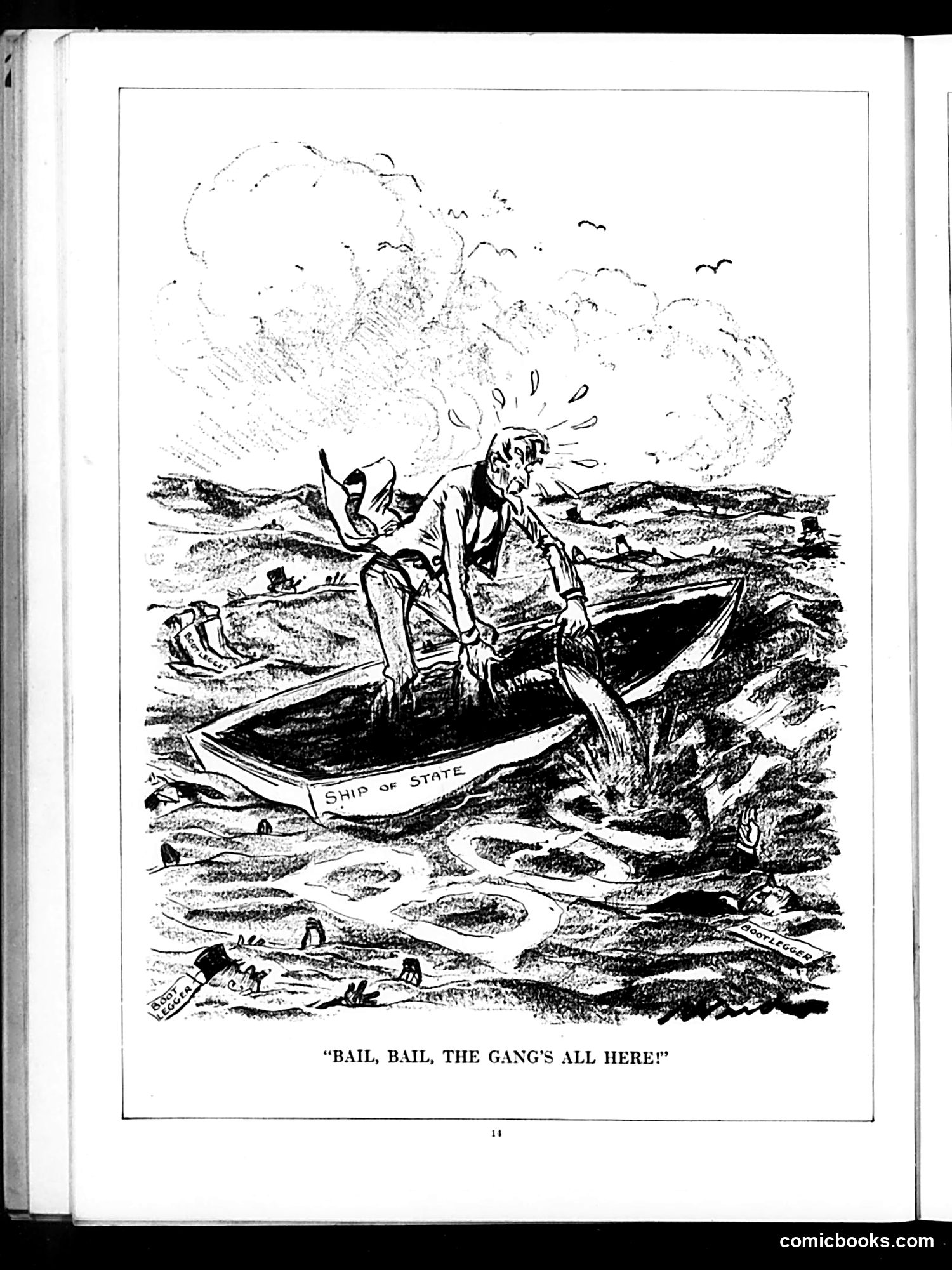
This political cartoon from *Judge* magazine depicts a distressed man bailing water from a sinking boat labeled "SHIP OF STATE." The frantic figure with sweat lines suggests desperation as he attempts to prevent the vessel from going under. Debris and wreckage scatter the ground around him. The caption "BAIL, BAIL, THE GANG'S ALL HERE!" appears to be satirical commentary on political corruption or mismanagement. The "gang" reference likely alludes to corrupt politicians or officials responsible for the nation's troubles, while the solitary figure bailing represents either the public or an honest official desperately trying to save the country from disaster they've created. The cartoon critiques systemic political dysfunction through the sinking-ship metaphor—a common visual trope for national crisis.
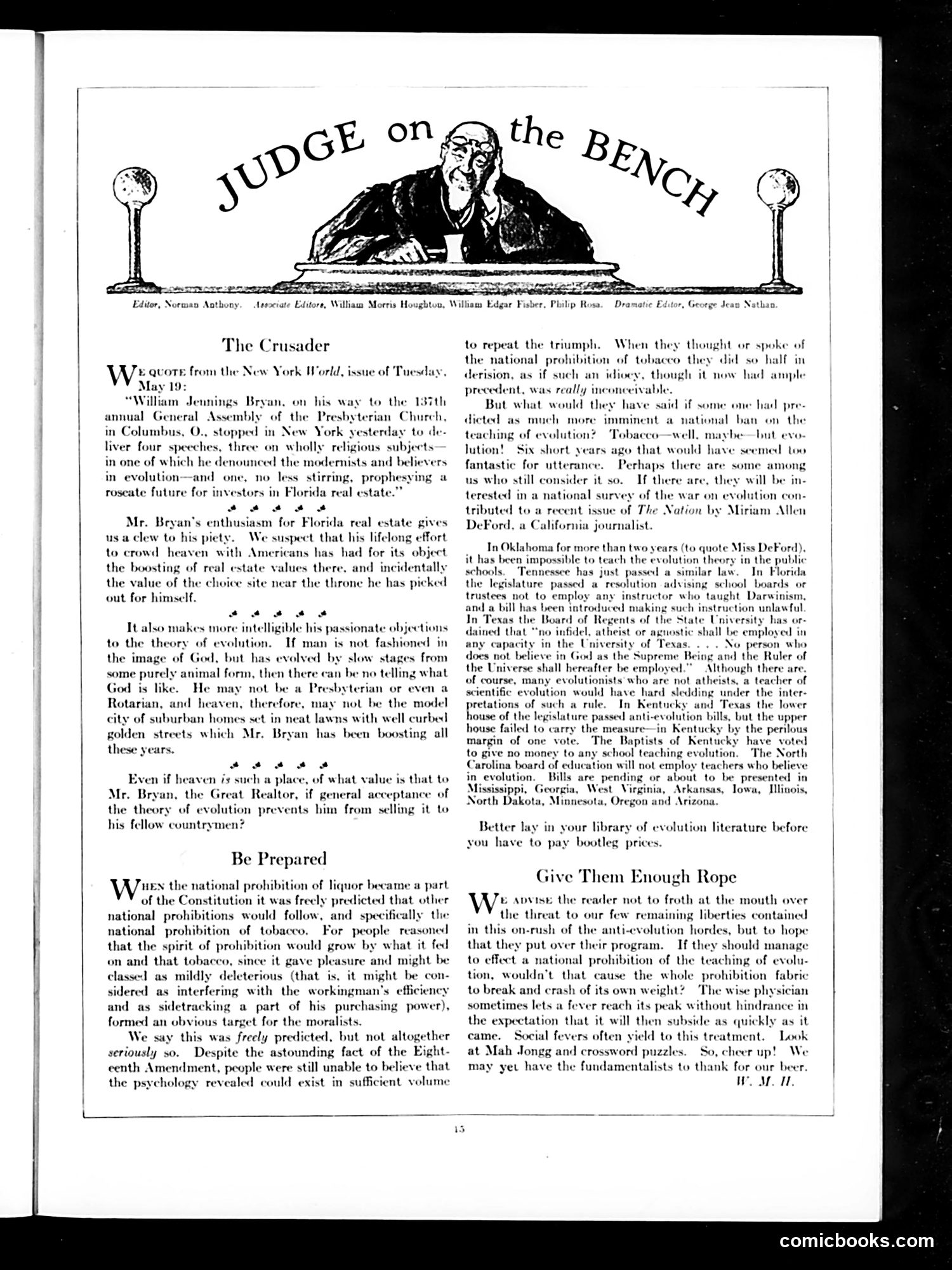
This page attacks William Jennings Bryan, the three-time presidential candidate and prominent Presbyterian, for hypocrisy regarding evolution. **The Setup:** Bryan is shown as "The Crusader" denouncing evolutionary theory on religious grounds while simultaneously promoting Florida real estate investments. Judge's satire suggests Bryan's piety is actually self-interest—he profits from selling Florida property and wants heaven to resemble suburban American developments with "well curbed golden streets." **The Joke:** If man didn't evolve from animals but was created in God's image, then God must resemble respectable Presbyterians and Rotarians. This ensures heaven functions like a proper real estate market. Bryan's religious objections to evolution conveniently protect his vision of profitable heavenly real estate. **Context:** This reflects 1920s debates over teaching evolution in schools, with multiple states passing laws restricting Darwinian instruction. Judge ridicules Bryan's crusade against "modernists" as motivated by financial self-interest rather than genuine theological conviction.
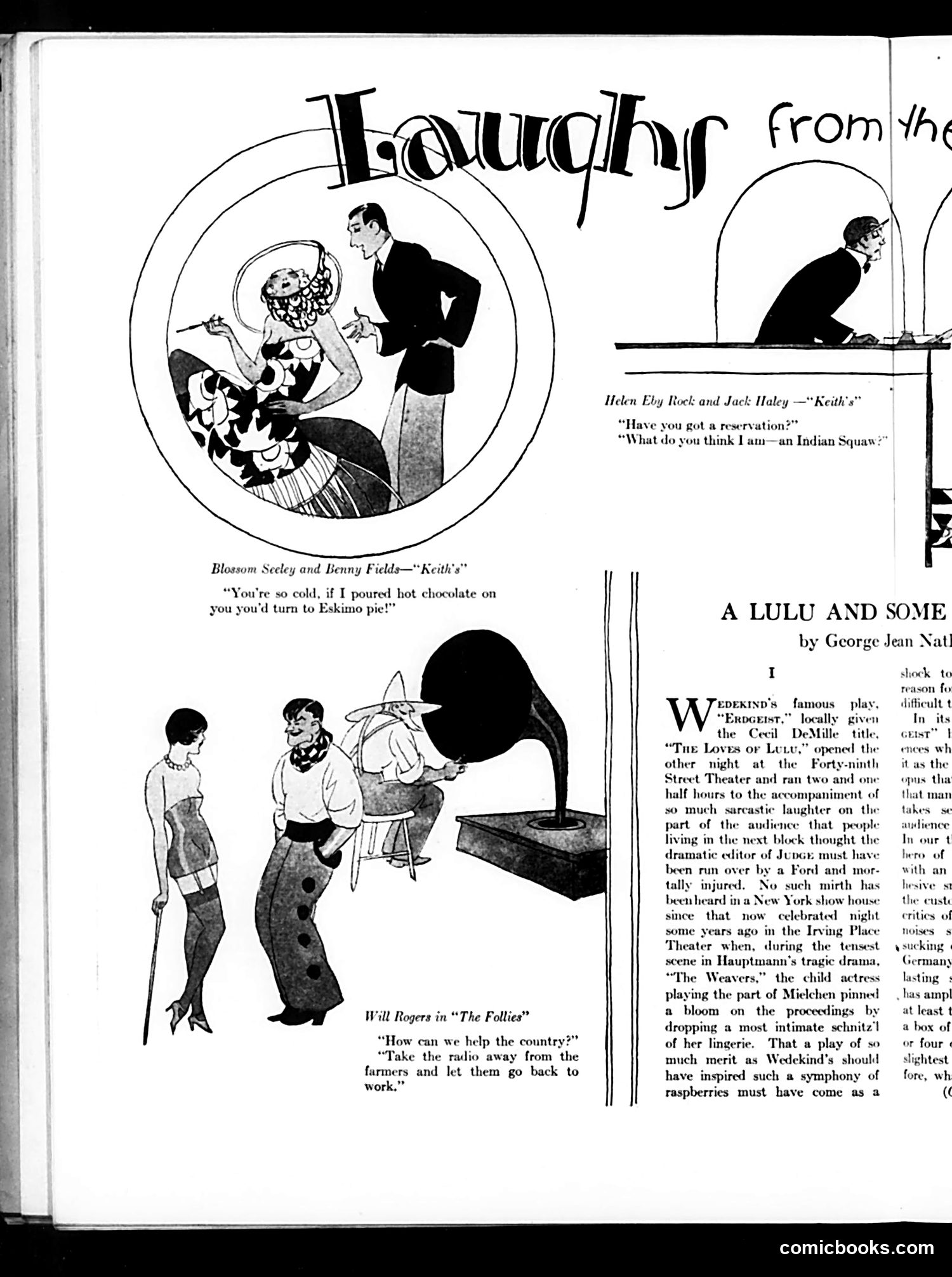
This page contains theatrical humor from what appears to be the 1920s. The top cartoons mock vaudeville performers with ethnic stereotypes typical of that era: one joke plays on "Indian Squaw" as a punchline about reservations, while another references "Eskimo Pie" (a then-popular brand) as an insult about coldness. The main article reviews a Cecil DeMille play called "The Loves of Lulu" at a Broadway theater. The writer notes the audience laughed so hard—sarcastically—that neighbors thought someone had been hit by a car. He compares this to a famous incident years prior at the Irving Place Theater during "The Weavers," when a child actress accidentally dropped something intimate on stage. The satire targets both the pretentious dramatic production and the audience's evident mockery of it. The separate Will Rogers cartoon jokes about solving economic depression by removing radios from farmers—absurdist political humor suggesting government solutions are equally ridiculous.
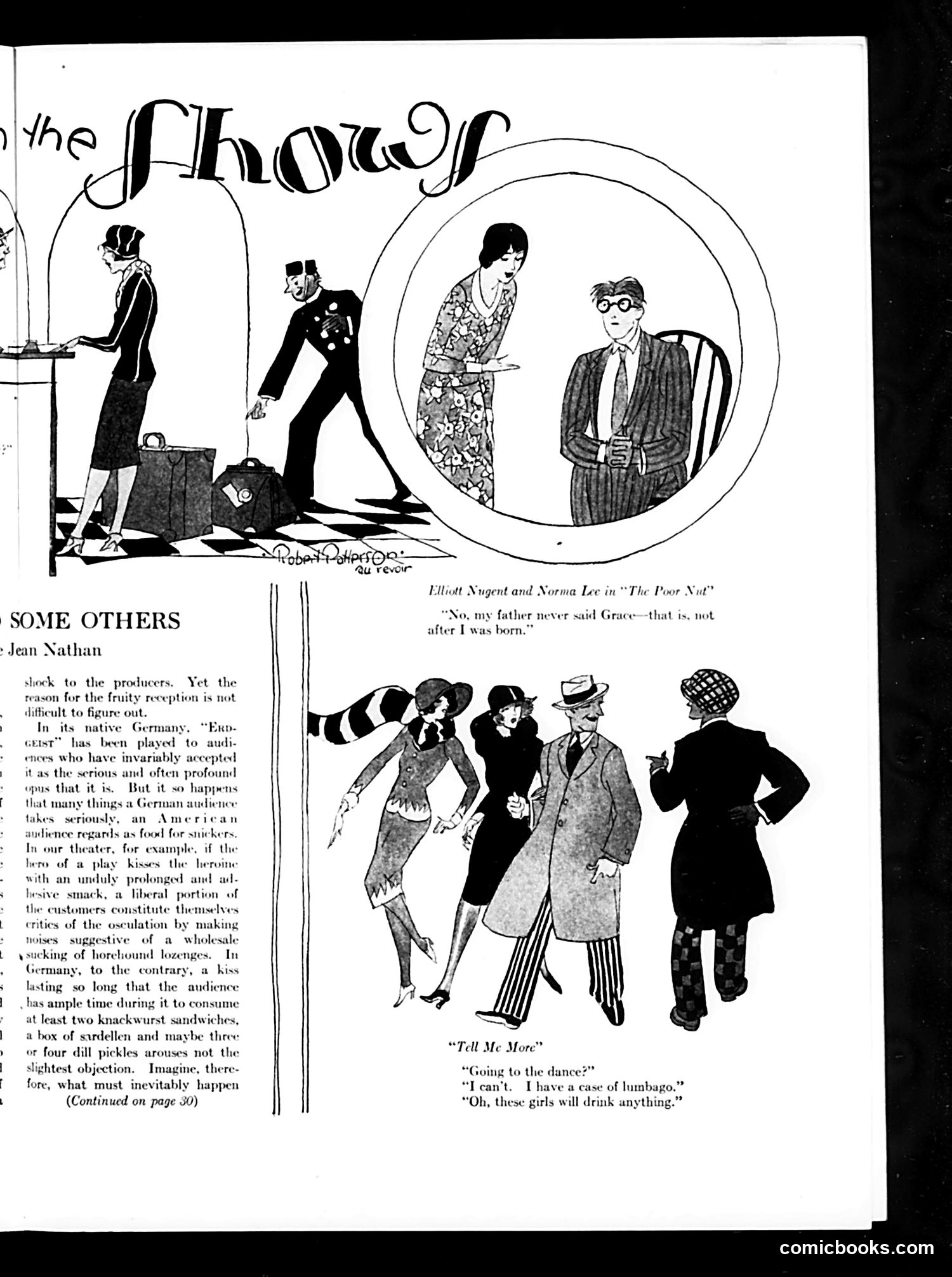
This page from *Judge* magazine contains theater criticism and cartoon commentary on cultural differences between German and American audiences. **Top section:** Critic Jean Nathan discusses how a German play ("Geist") received a puzzled reception in American theaters. The satire contrasts audience reactions: Germans accept prolonged kissing scenes seriously, even taking time to eat during them, while American audiences mock such displays by sucking on lozenges. Nathan suggests what Germans find profound, Americans find ridiculous—a commentary on differing national sensibilities regarding public emotion and propriety. **Bottom cartoons:** "The Poor Nut" and "Tell Me More" are illustrated scenes from contemporary plays. The latter's joke plays on "lumbago" (lower back pain)—a female character claims she can't attend the dance due to this ailment, but another character sardonically responds that "these girls will drink anything," implying she's actually intoxicated rather than ill. This reflects period anxiety about young women's behavior and Prohibition-era drinking. The overall page satirizes transatlantic cultural misunderstandings and modern youth morality.
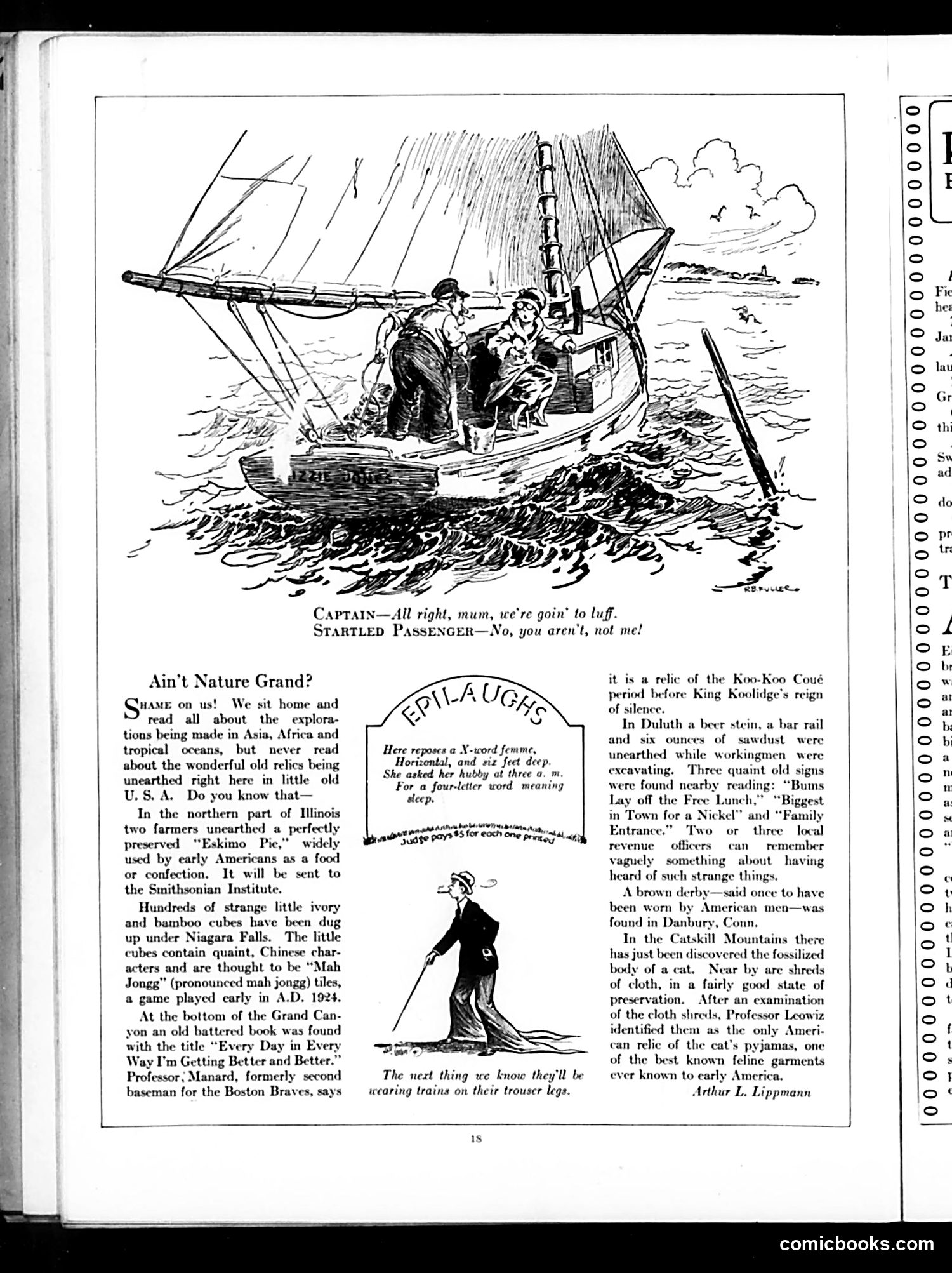
This is a humorous satire mocking Americans' fascination with exotic archaeological discoveries abroad while ignoring absurd "finds" at home. The joke catalogs fictional "ancient relics" supposedly unearthed in the U.S.: a perfectly preserved "Eskimo Pie" in Illinois, Mah-Jongg tiles under Niagara Falls (dated impossibly to 1924), a self-help book in the Grand Canyon, beer-drinking ephemera in Duluth, and a cat in pajamas in the Catskills. The satire targets 1920s fads and recent trends—Coué's auto-suggestion movement ("Every Day in Every Way I'm Getting Better"), Prohibition-era speakeasies, the "cat's pajamas" slang, and the brief popularity of Mah-Jongg. By presenting these contemporary items as ancient artifacts, the piece ridicules both Americans' credulity about "discoveries" and the era's obsession with trendy novelties. The top cartoon adds visual humor: a ship captain startles a passenger by announcing they'll "luff" (sail into the wind), prompting panic about seasickness—a simple slapstick joke about nautical terminology.
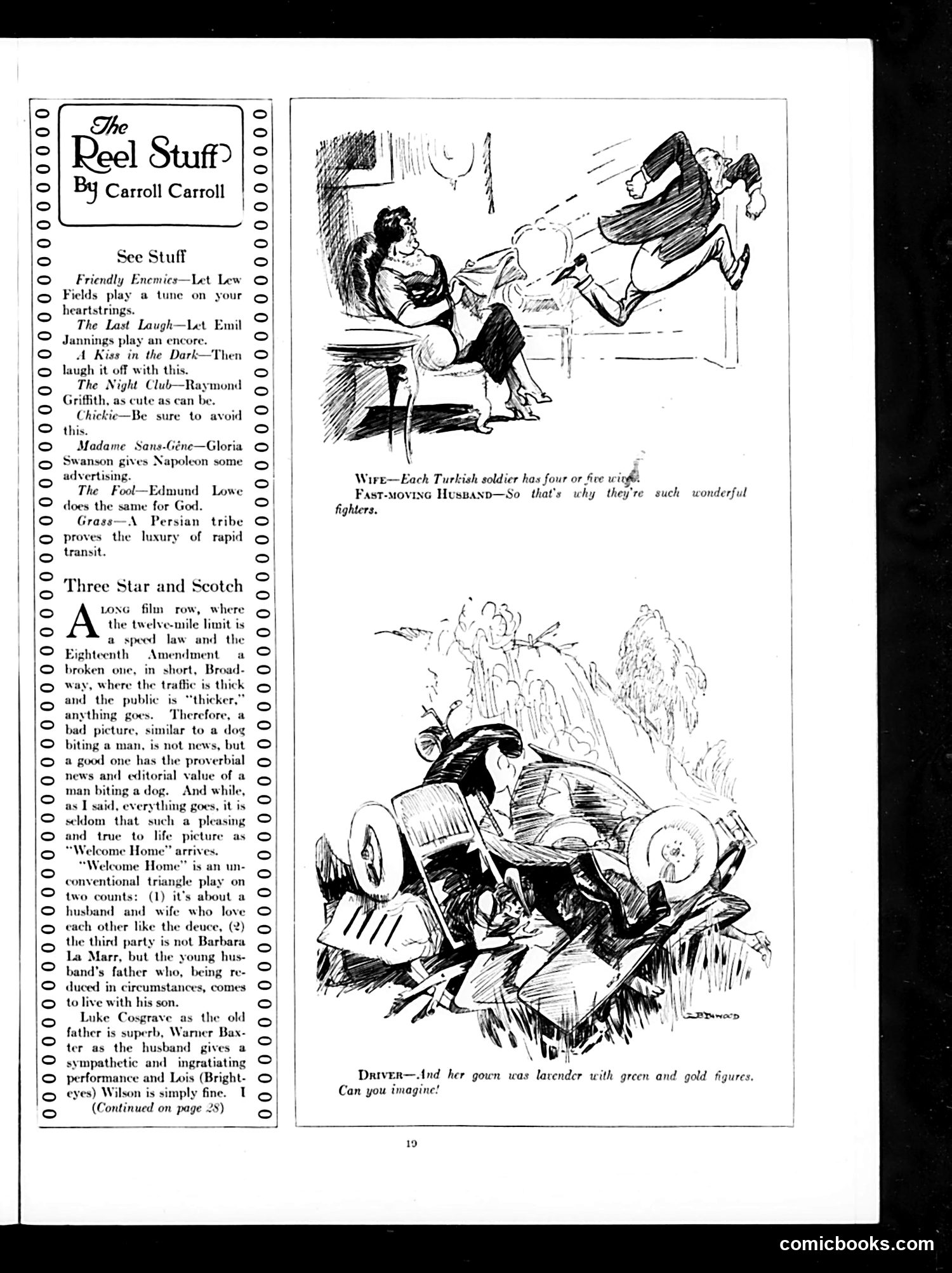
This page contains film reviews by Carroll Carroll for Judge magazine. The top cartoon shows a wife enthusiastically describing her husband's military prowess to a friend, joking that Turkish soldiers are effective fighters because their wives nag them constantly—a domestic humor trope playing on stereotypes about nagging spouses. The bottom cartoon depicts a chauffeur and passenger discussing a woman's outfit in exaggerated detail, mocking the pretentiousness of wealthy society figures obsessing over fashion minutiae. The humor lies in the driver's bemused reaction to such frivolous concern. The left column reviews contemporary 1920s films starring popular actors like Emil Jannings and Gloria Swanson, along with a longer piece on "Welcome Home," praising its unconventional love triangle plot and the performances of Warner Baxter and Lois Wilson. The reviews represent typical entertainment journalism of the era.
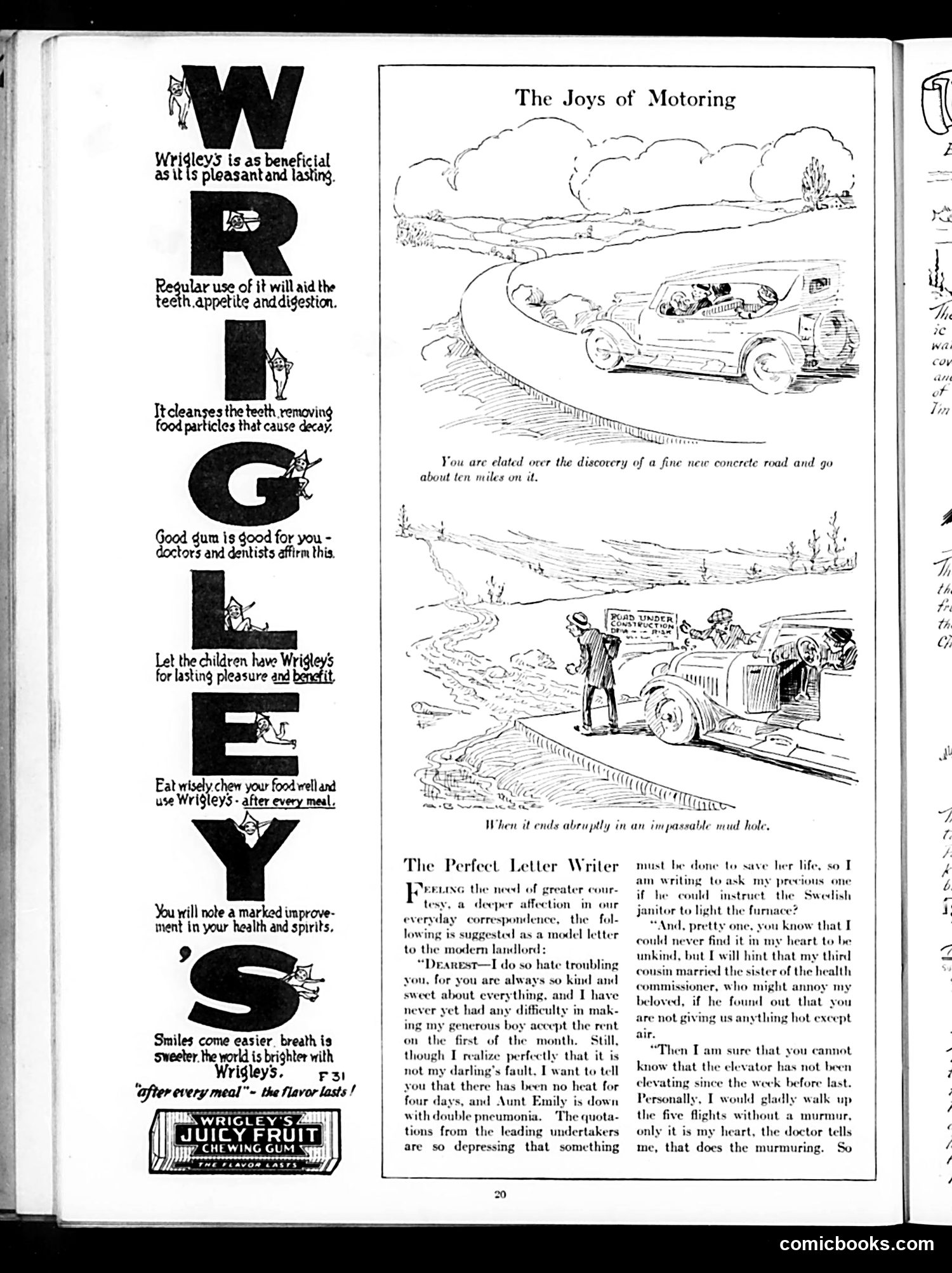
This page contains two distinct sections: **Left side:** A Wrigley's Juicy Fruit gum advertisement using an acrostic format spelling "WRIGLEY" down the page, with health claims typical of early 20th-century advertising—that chewing gum aids digestion, cleans teeth, and improves overall health and mood. **Right side:** Two illustrated features: 1. "The Joys of Motoring"—a humorous two-panel cartoon showing the contrast between the excitement of discovering a new concrete road versus the disappointment when it abruptly ends in an impassable mud hole. This satirizes early automotive enthusiasm and the poor state of American roads. 2. "The Perfect Letter Writer"—a comedic piece modeling an exaggerated, overly-polite complaint letter from a tenant to a landlord about serious problems (no heat for four days, broken elevator, aunt with pneumonia). The satire mocks both the obsequious tone tenants felt forced to use and landlords' indifference to tenant suffering.
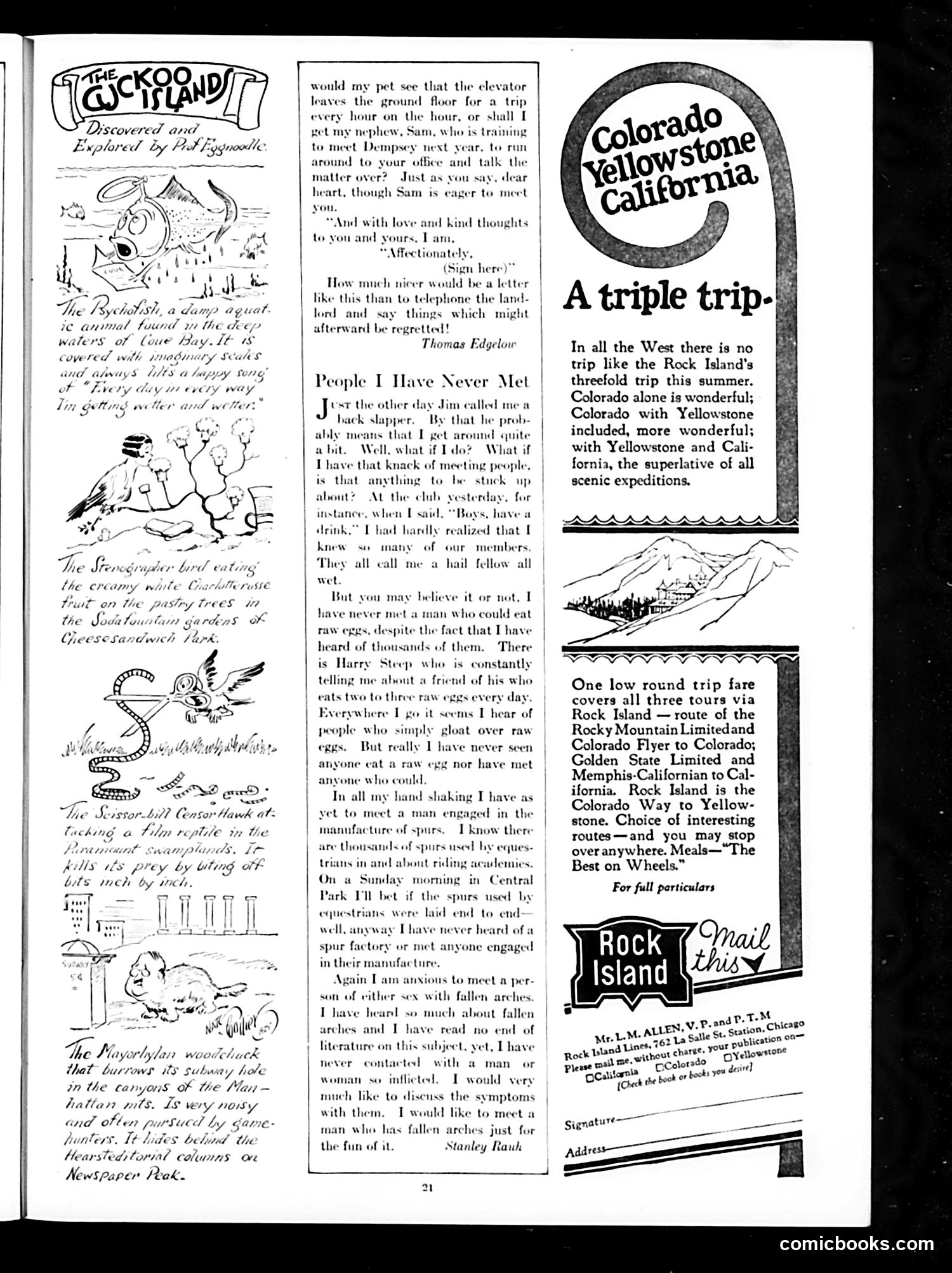
This page mixes whimsical nature illustrations with two distinct pieces of content. **Left side:** "The Cuckoo Land" features illustrated invented creatures with fanciful descriptions—a "Psychotish" from deep waters, a "Sensorgrapher bird," and a "Kayorbylan woodchuck." These appear to be pure nonsense/humor drawings with no political meaning, typical of Judge's lighter content. **Center:** A letter from "Thomas Edgelow" complains about telephone calls, suggesting written letters are preferable—a pre-1920s perspective on communication technology that now reads as quaint. **Right side:** Two pieces address readers directly. "People I Have Never Met" by Stanley Rauh catalogs absurdly specific people the author claims never to have encountered (a man who eats raw eggs, someone with fallen arches, someone manufacturing spurs). This is social satire mocking urban alienation and the strangeness of modern life. Below that is a Rock Island Line railway advertisement promoting a "triple trip" combining Colorado, Yellowstone, and California tourism. The page blends editorial humor, correspondence, and commercial advertising—typical Judge magazine fare.
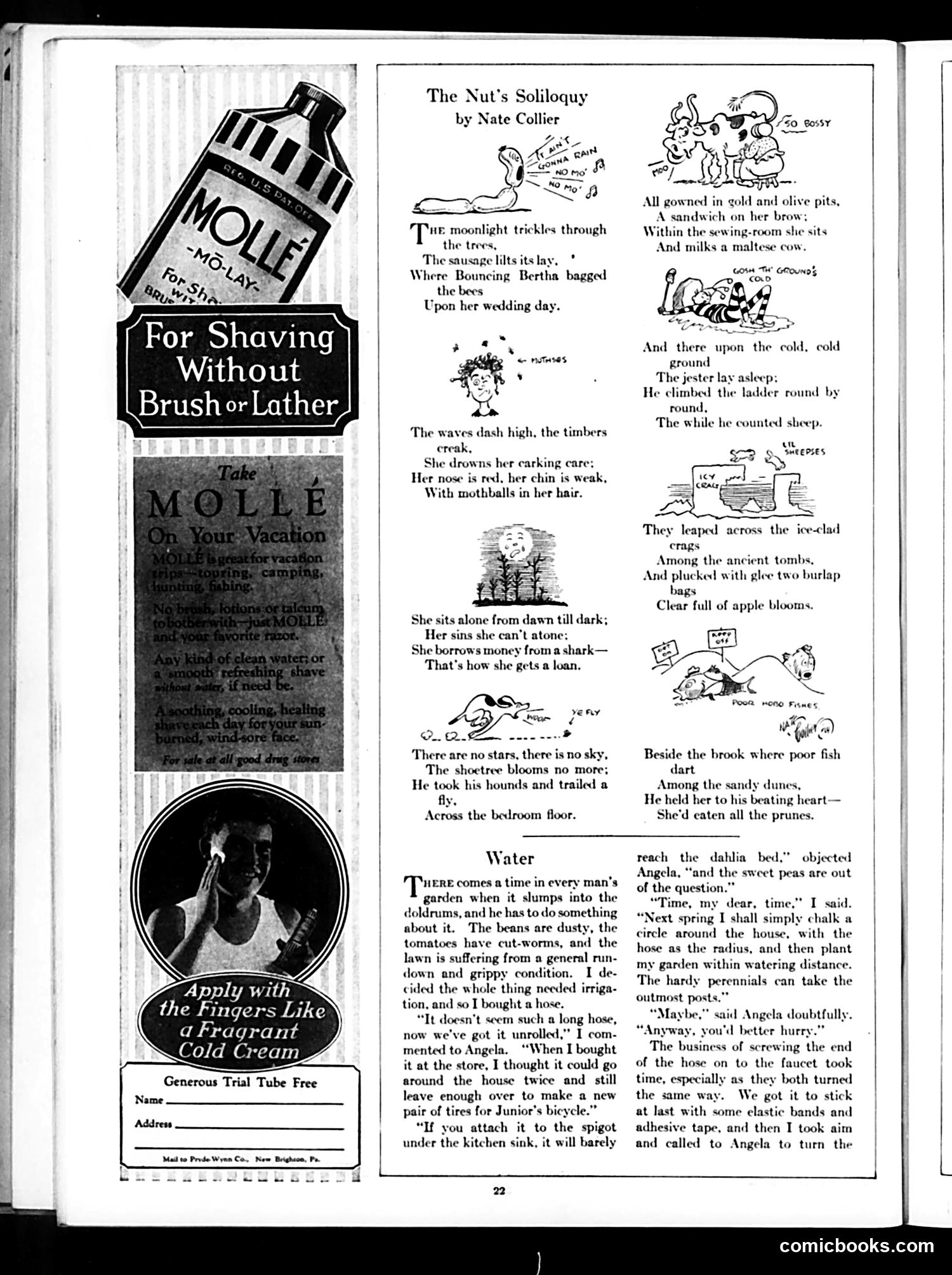
This page contains two distinct elements: **Left side:** A Molle shaving cream advertisement promoting "shaving without brush or lather" by applying it "like a fragrant cold cream." This represents early 20th-century marketing for a convenience product. **Right side:** "The Nut's Soliloquy" by Nate Collier is surreal, absurdist humor—nonsensical poetry with accompanying illustrations. It strings together ridiculous scenarios (a woman with mothballs in her hair borrowing from sharks, a jester counting sheep on a ladder, people stealing apple blossoms) without logical connection. This style of dadaist, stream-of-consciousness humor was popular in magazines like Judge during this era. Below that is a prose piece about garden irrigation—mundane domestic comedy where a man buys a hose expecting it to be longer than it actually is, with his wife Angela's skeptical responses providing gentle satire of optimistic husbands. The page is primarily **humorous content and advertising** rather than political satire, showcasing Judge's mix of absurdist comedy and commercial promotion.
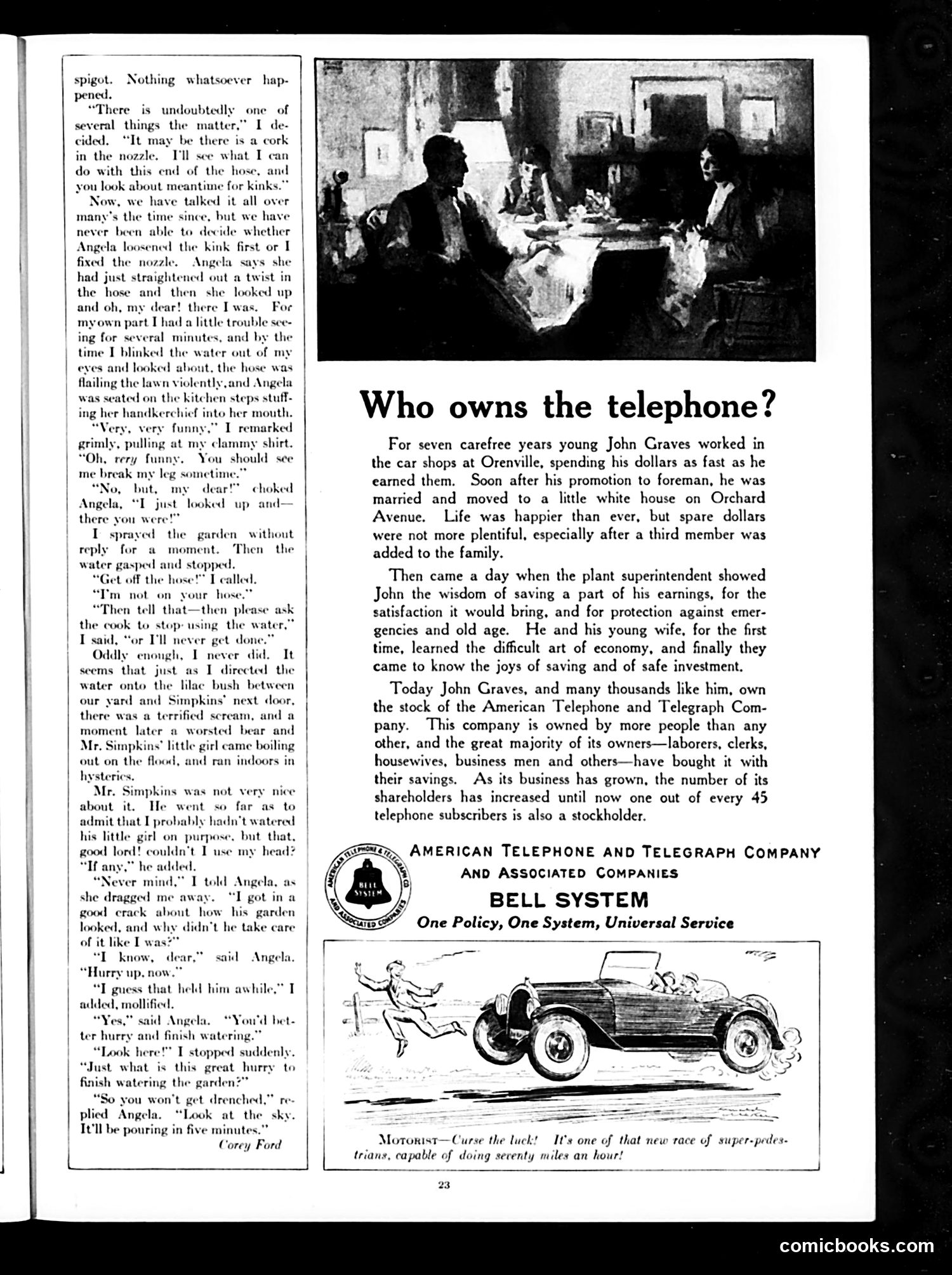
This page contains two distinct elements: **Left side:** A humorous domestic narrative by Corey Ford about a man inadvertently flooding his neighbor's garden while watering his lawn—a comedic mishap involving a malfunctioning hose and an unfortunate encounter with the neighbor's daughter and pet. **Right side:** A corporate advertisement for American Telephone & Telegraph (AT&T/Bell System). The ad uses the fictional character "John Graves" as propaganda, claiming that telephone company stock is democratically owned by ordinary working people—laborers, housewives, and clerks who've saved to invest. The pitch emphasizes "universal service" and widespread shareholding (claiming 1 in 45 subscribers owns stock). **Context:** This appears to be 1920s-era advertising promoting AT&T as a "people's company" during an era of labor unrest and socialist sentiment. The juxtaposition suggests the ad exploits the magazine's entertainment content to reach readers with pro-corporate messaging, subtly countering concerns about monopolistic corporate power by claiming worker-investor participation. The small motorist cartoon below is unrelated humor.
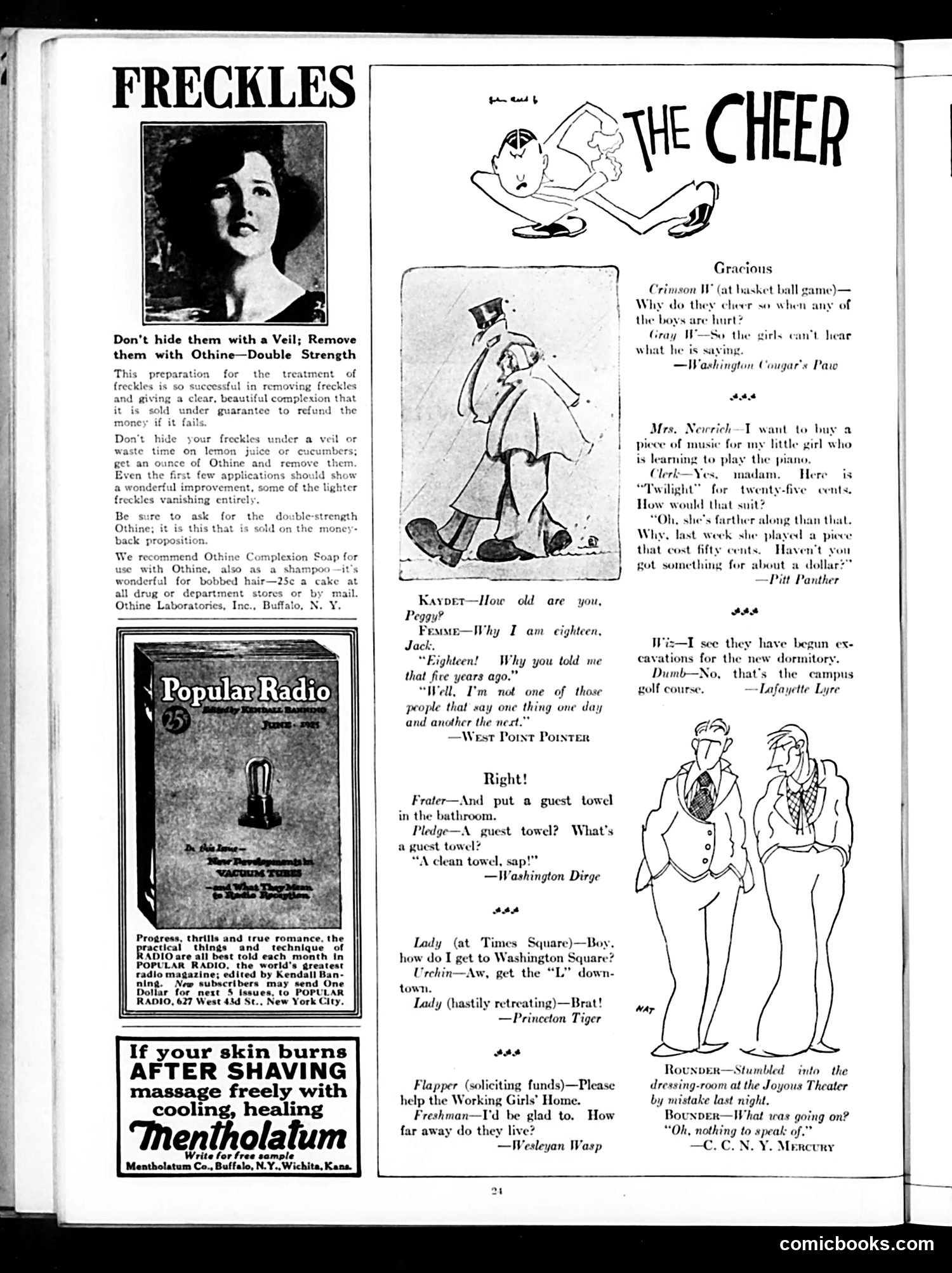
This page from *Judge* consists primarily of brief comic anecdotes rather than political cartoons. "The Cheer" features cartoon vignettes satirizing college life and social etiquette of the 1920s. The jokes target typical period absurdities: a woman claiming the same age for five years; confusion over what a "guest towel" is; a flapper soliciting funds for a "Working Girls' Home" (likely a charitable institution); and misunderstandings about "Washington Square" and campus construction. The humor relies on generational and class-based comedy—confusion between naive freshmen and sophisticated urbanites, malapropisms, and social pretension. The freckle-removal and aftershave advertisements reflect period beauty standards emphasizing smooth, unblemished skin. These appear to be reprinted jokes from various college newspapers (West Point Pointer, Princeton Tiger, Wesleyan Wasp, etc.), typical filler content for *Judge's* satirical magazine format of the era.
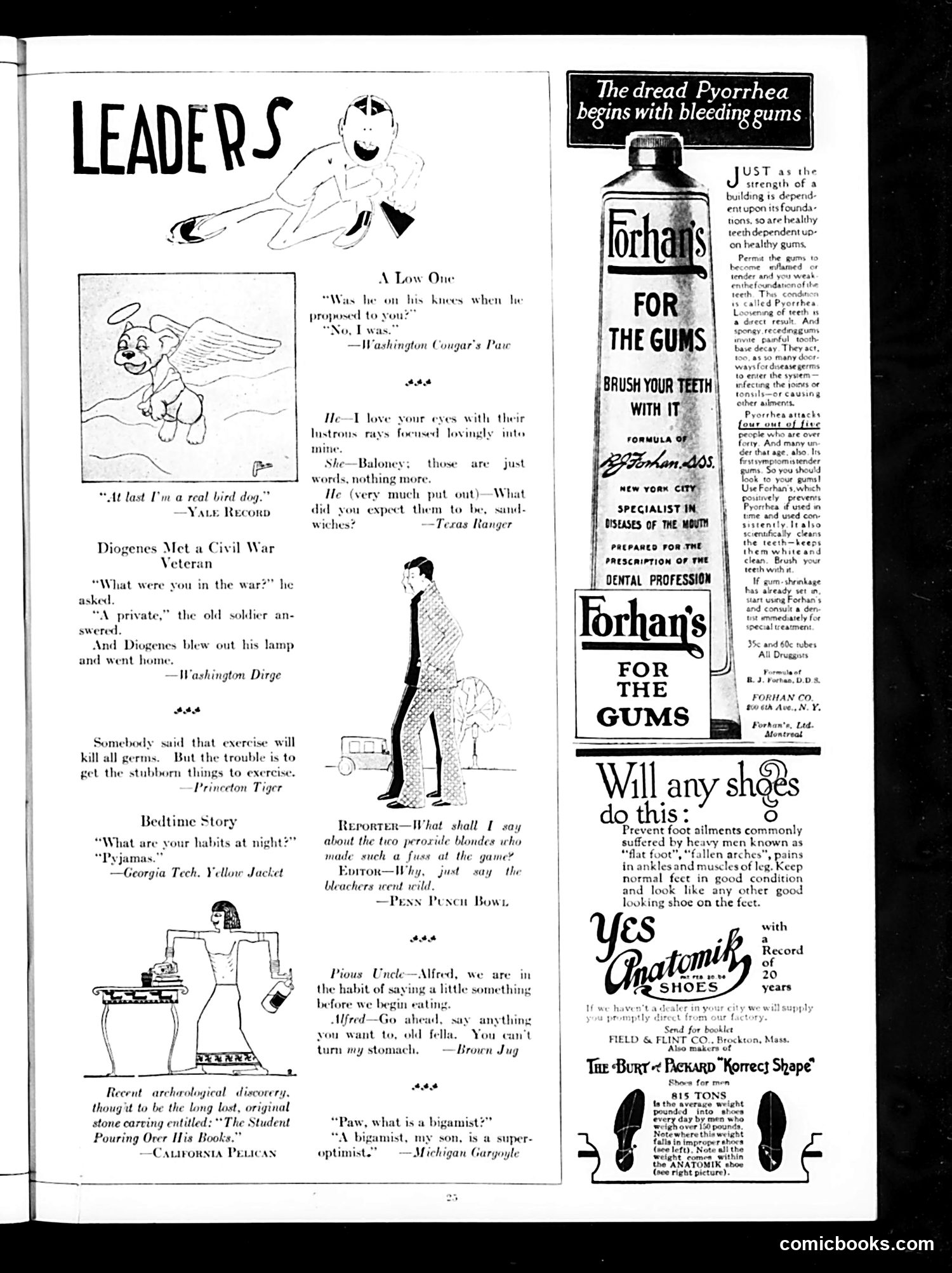
This page combines humor columns with period advertisements. The left side features short jokes and quips from various college humor publications (Yale Record, Princeton Tiger, etc.), typical of Judge's "Leaders" section—witty one-liners on relationships, student life, and social observations. The cartoons themselves are modest: a figure in athletic pose, a sleeping student, and a man with a small car illustrate these brief jokes about romance, military service, and exercise. The right side advertises two products addressing common male anxieties of the era: Forhan's gum treatment (addressing pyorrhea, a then-feared gum disease) and "Yes Anatomik" shoes (claiming to prevent "flat foot" and "fallen arches"—conditions associated with manual laborers and considered unfashionable). Both ads employ pseudo-scientific language to market solutions to bodily "defects" that concerned middle-class readers. Together, the page reflects 1920s-30s concerns: courtship rituals, male vanity, and medicalized anxiety about physical appearance.
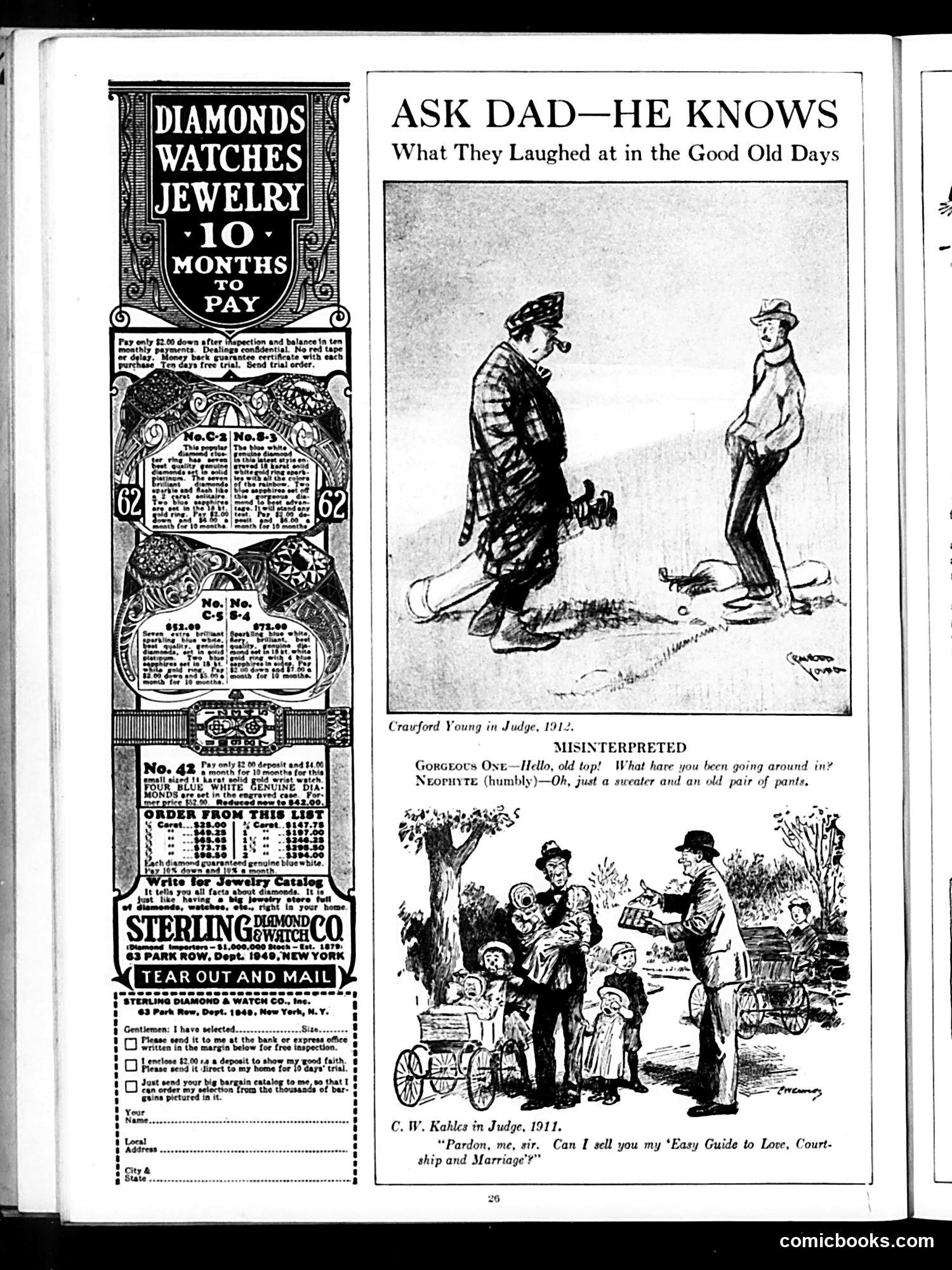
This page combines advertising with vintage humor cartoons from Judge magazine (circa 1911-1912). **Left side:** A Sterling Watch Company advertisement offering diamonds, watches, and jewelry on a 10-month payment plan—typical early-1900s mail-order marketing targeting working-class consumers. **Right side cartoons:** 1. **"Crawford Young in Judge, 1912"** depicts a fashionable woman questioning a shabby man about his appearance. The humor plays on misinterpretation: she assumes his worn clothing indicates he's been engaging in disreputable activities, when he's simply dressed poorly. 2. **"C.W. Kahles in Judge, 1911"** shows a street vendor hawking relationship advice books to gentlemen. The satire targets both naive young men seeking romantic guidance from cheap self-help manuals and the era's proliferation of mail-order advice literature—a common target of Judge's mockery of American consumerism and gullibility. Both comics reflect Judge's satirical focus on social pretension, materialism, and the gap between appearances and reality in early 20th-century America.
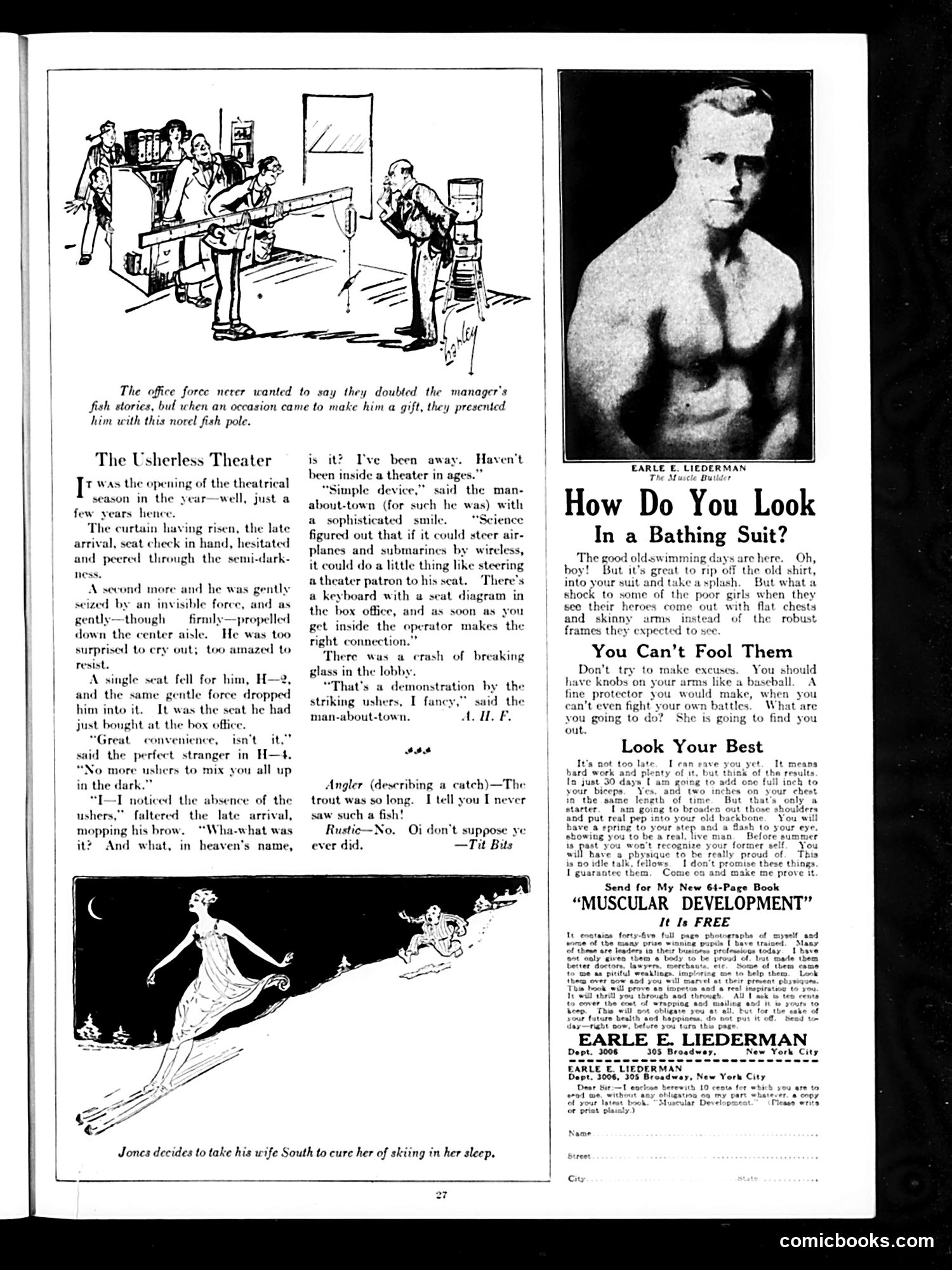
This Judge magazine page contains two satirical pieces: **"The Usherless Theater"** depicts a futuristic automated theater where an invisible force (wireless remote control technology) automatically seats patrons. The joke mocks both emerging technology and labor displacement—striking ushers have been replaced by machines. The humor relies on the novelty of wireless automation in the early 20th century. **"The Office Force Fish Pole"** (cartoon, top left) shows coworkers presenting their manager with a novelty fishing pole, suggesting they doubt his exaggerated fishing stories but are diplomatically giving him a humorous gift. The right side features Earle E. Liederman's bodybuilding advertisement, offering a "Muscular Development" course. This reflects period anxieties about male physical appearance and appeals to insecurity—men should develop visible muscles or risk embarrassment in bathing suits around women. The advertisement exploits masculine vanity and social anxiety, which was a common marketing tactic of the era.
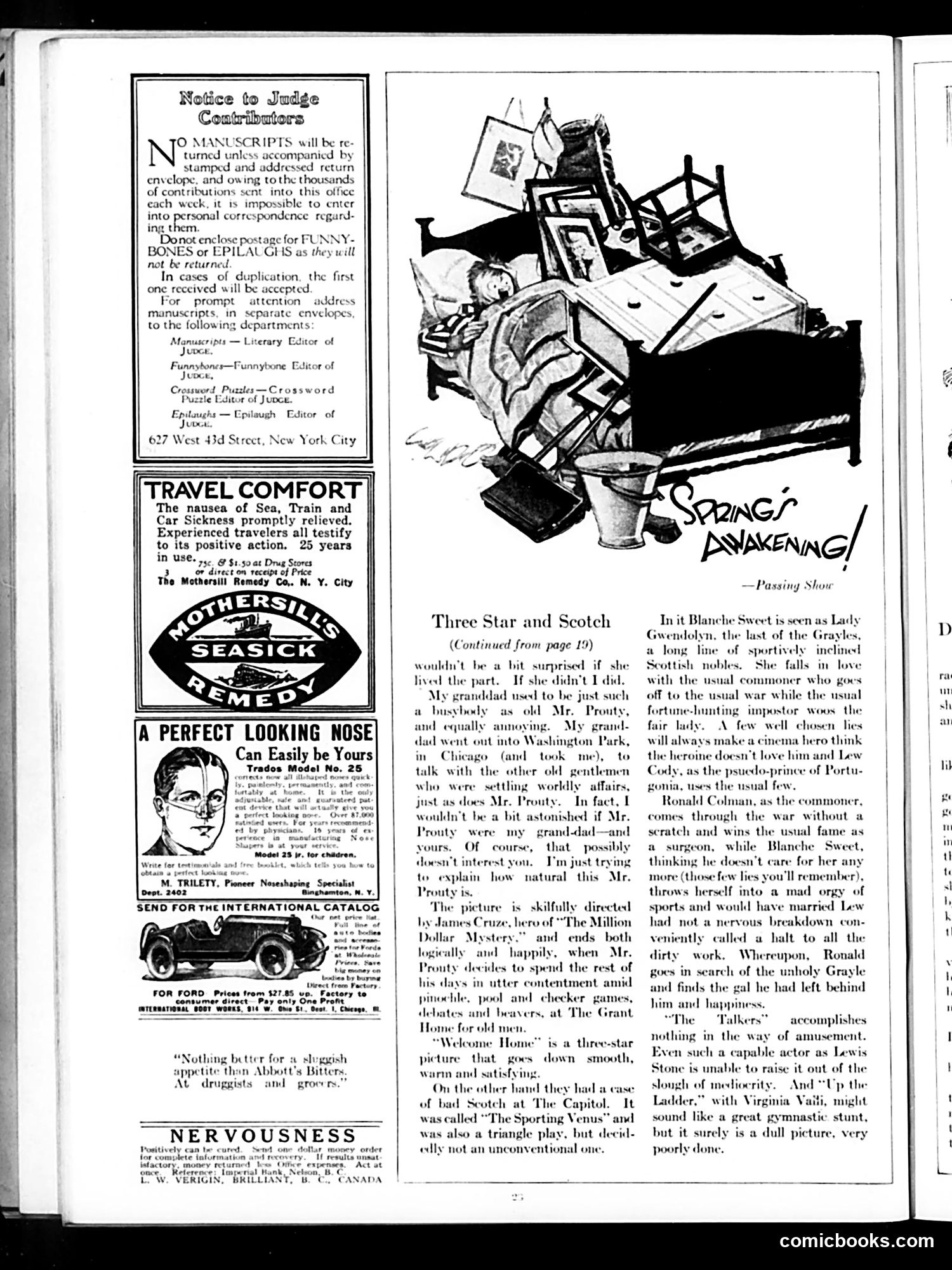
This page is primarily **advertising and editorial notices** for Judge magazine, with a film review column as secondary content. The main visual is a cartoon titled "Spring's Awakening" (credited to "Passing Show"), depicting a figure buried under household items and furniture—a humorous visual metaphor for spring cleaning chaos. The bulk of the page contains **three-star film reviews** of movies featuring actresses like Blanche Sweet and actor Lewis Stone. The reviewer critiques films at various theaters ("The Capitol," "The Grant"), assessing their entertainment value with particular skepticism toward "The Talkers" and "Up the Ladder," deemed dull despite capable actors. The advertisements reflect early-20th-century concerns: seasickness remedies, cosmetic nose-shaping procedures, and treatments for nervousness. The "Notice to Judge Contributors" explains submission policies for the magazine's humor sections. This appears to be from the 1920s-1930s era, when Judge was a major American humor publication competing with similar titles like Life.
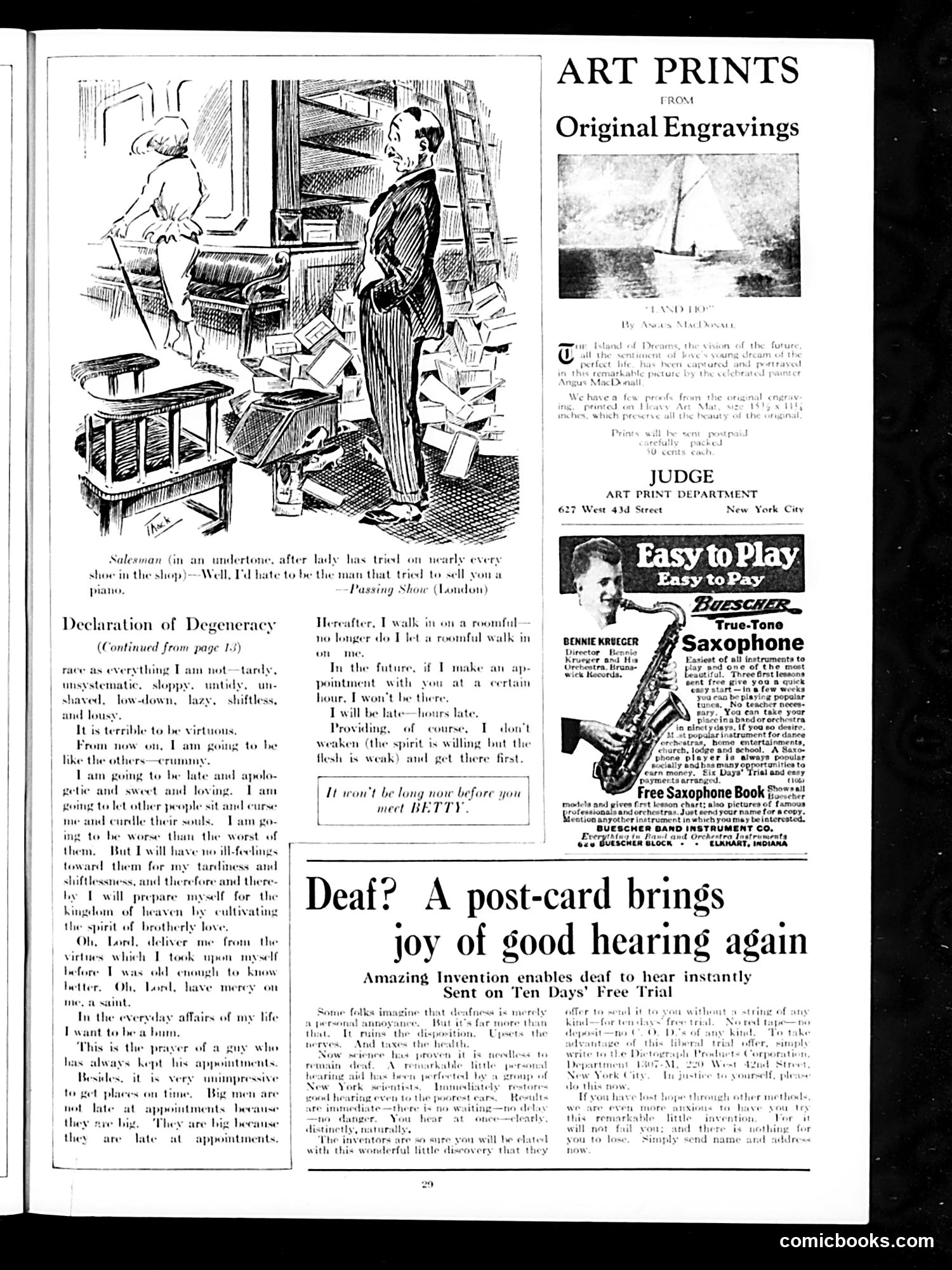
This page contains three distinct elements: **Main Cartoon**: A salesman stands amid scattered items after a woman has tried on nearly every shoe in the shop. The joke: he dreads being the man who tries to sell her a piano—implying she's an impossibly demanding, indecisive customer. It's a domestic humor piece about retail frustration and female consumer behavior, typical of early-20th-century satirical magazines. **"Declaration of Degeneracy"**: A continuation piece where the writer renounces virtue and promises to become lazy, tardy, and dishonest like "the others," claiming this will help him reach heaven through brotherly acceptance. It's self-aware satire mocking contemporary moral hypocrisy. **Bottom Advertisement**: An ad for a device enabling deaf people to hear "instantly" via post-card, presented as a miraculous invention. This appears to be a dubious patent-medicine or mail-order scam typical of the era. The page overall reflects Judge's mix of social satire, domestic humor, and advertiser-supported content.
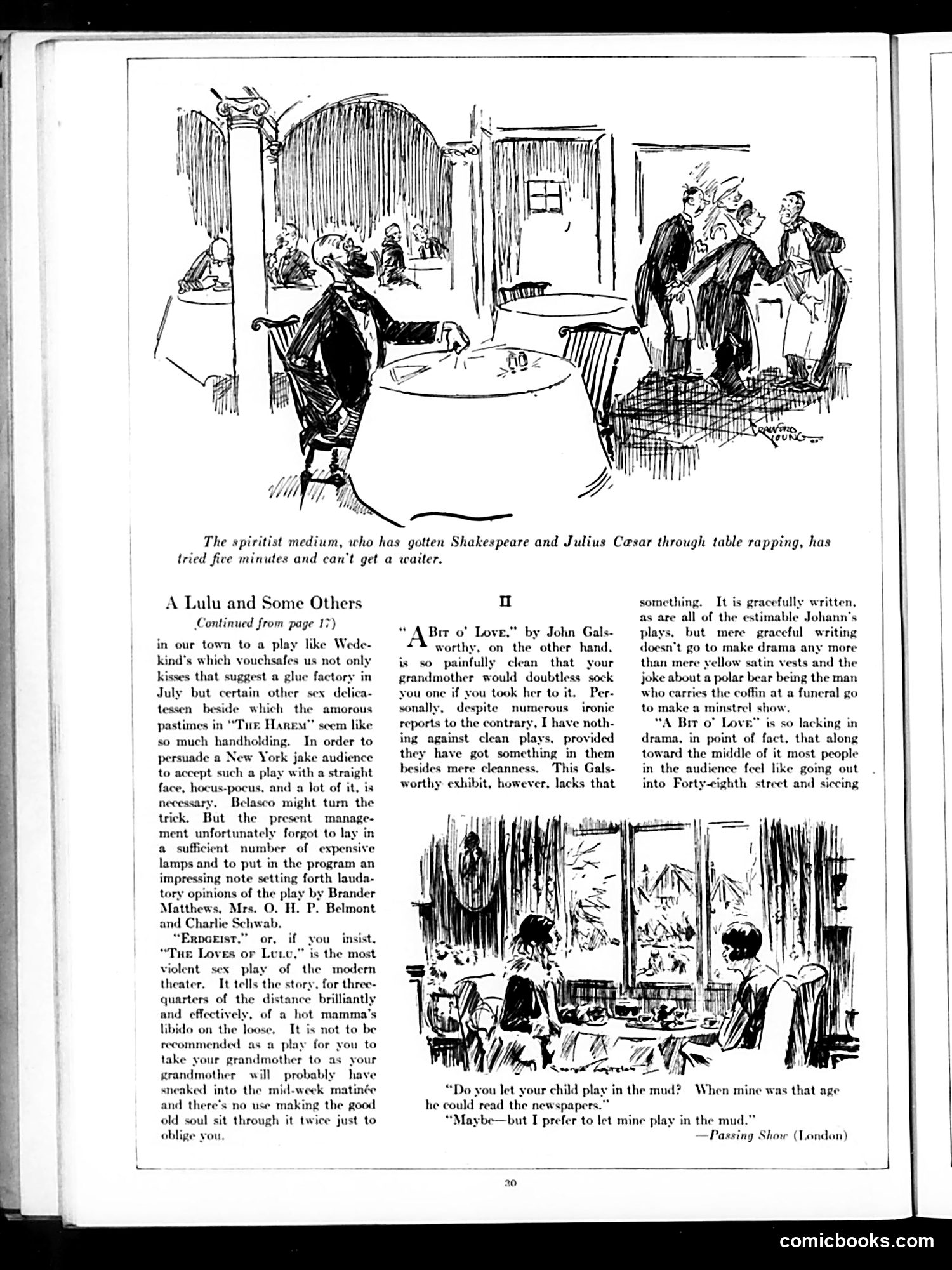
The top cartoon satirizes spiritualism, a popular 19th-early 20th century fad where mediums claimed to contact the dead through séances and "table rapping." The joke: a medium successfully channels famous historical figures (Shakespeare, Julius Caesar) but fails at the mundane task of summoning a waiter—mocking both spiritualism's pretensions and the absurdity of believing in such supernatural claims while practical matters go unmet. The lower section reviews contemporary plays, contrasting two: Wedekind's sexually explicit drama (requiring theatrical tricks to make audiences accept it) versus Galsworthy's morally "clean" but dramatically dull play. The critic argues neither approach—shock value nor prudish restraint—guarantees quality theater. The accompanying cartoon jokes about parenting philosophies: one parent prioritizes literacy; the other allows messiness. It's a lighthearted commentary on competing values in child-rearing.
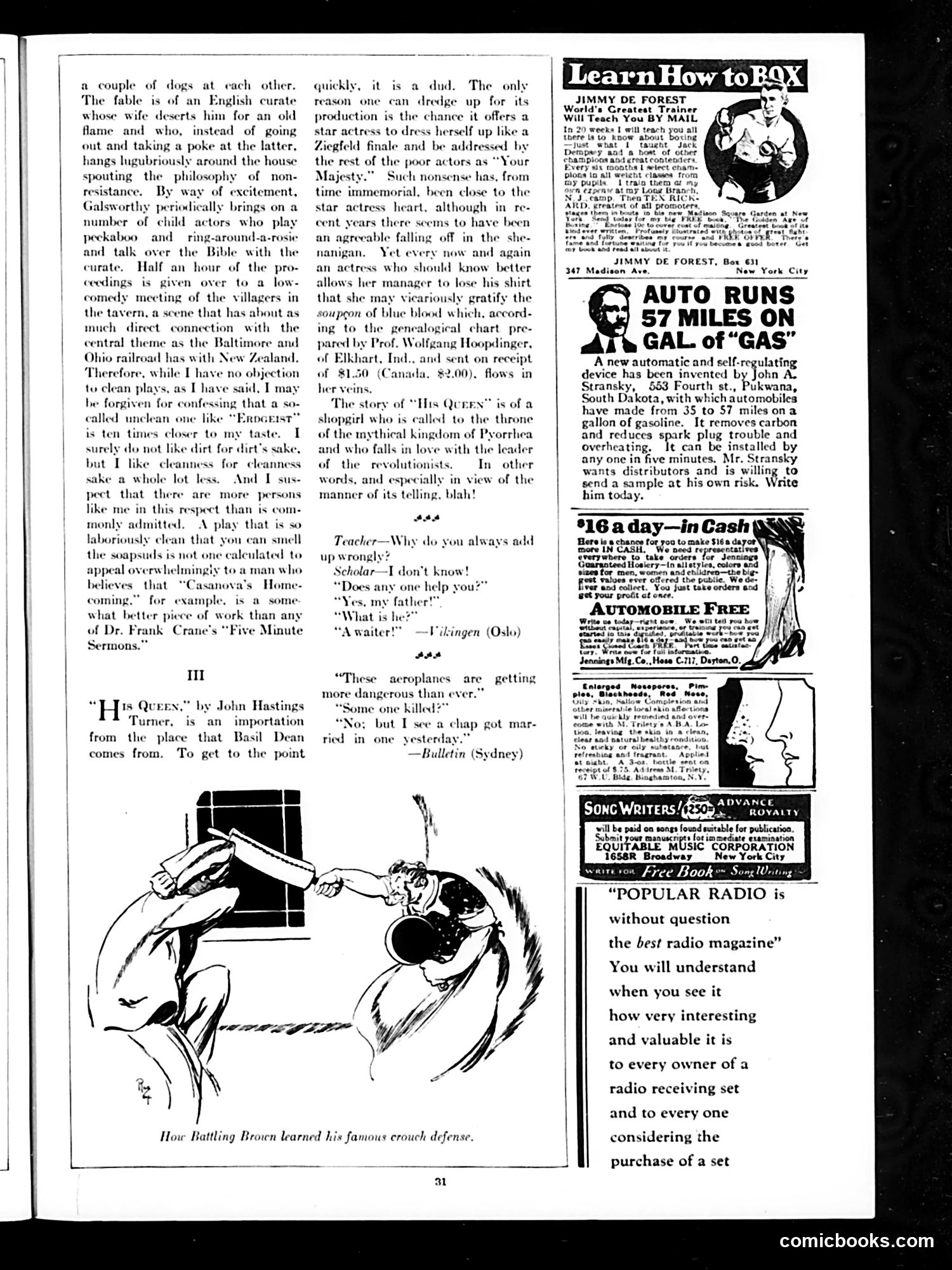
This page from *Judge* magazine contains theater criticism and advertisements typical of the 1920s. **The Theater Criticism (Section III):** The reviewer critiques John Hastings Turner's play "His Queen," about a shopgirl elevated to royalty in a fictional kingdom who falls for a revolutionary leader. The reviewer dismisses it as vapid ("blah!"), arguing the plot exists merely to showcase a star actress in Ziegfeld Follies-style costumes addressing her as "Your Majesty." The critic contrasts this with *The Exorcist* (unclear which version), suggesting audiences prefer edgier material to overly sanitized theatrical fare. **The Cartoon:** Shows two figures in a boxing/fighting stance with the caption "How battling Brown learned his famous crouch defense"—likely a sports reference to a boxer, though the specific figure is unclear without additional context. **Advertisements:** Include boxing instruction, an automobile fuel-efficiency device, songwriting opportunities, and radio magazine promotion—typical commercial content of the era.
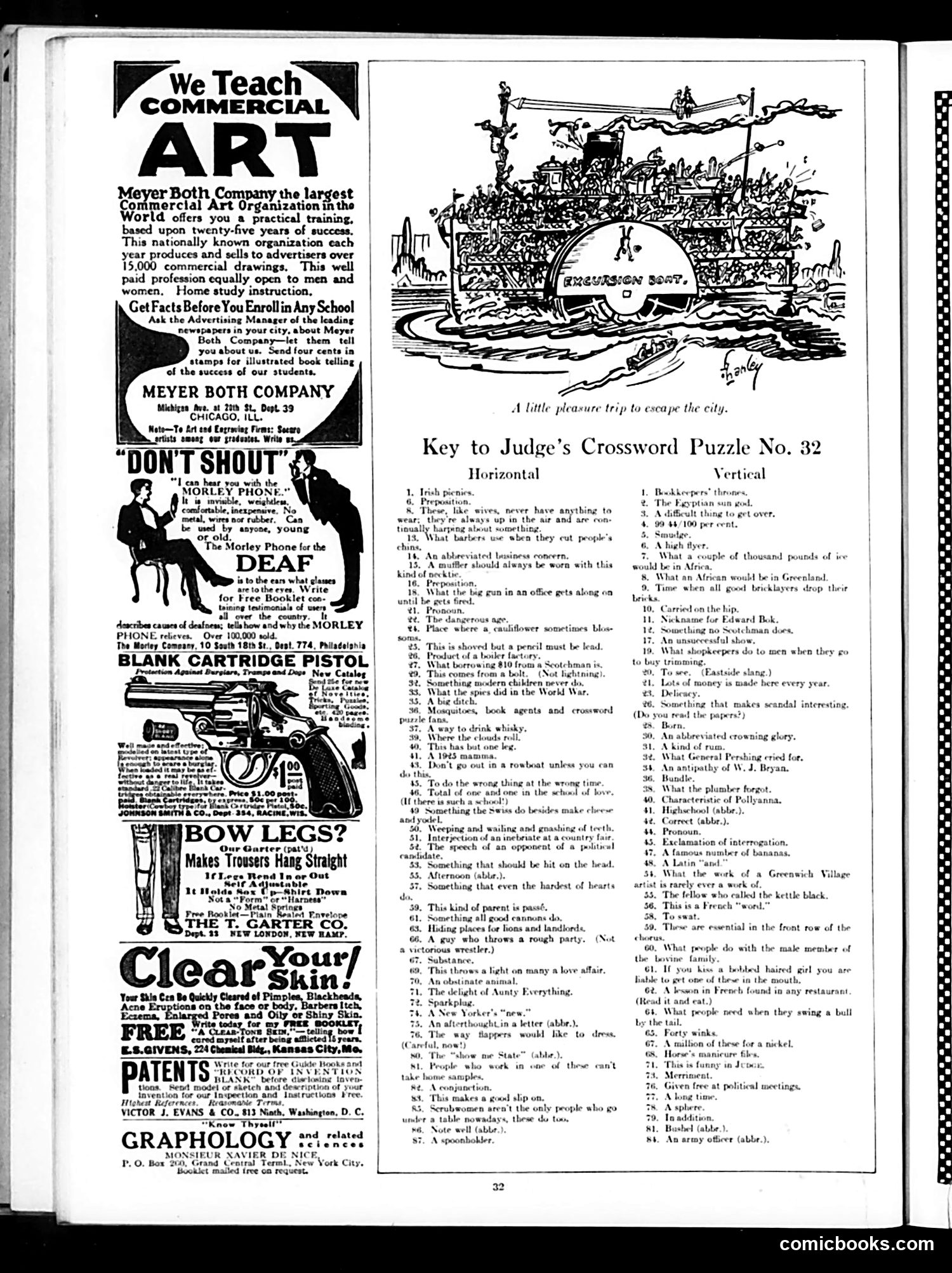
This page is primarily **advertising**, not satirical content. It showcases various commercial products and services typical of early 20th-century America: **Main advertisements include:** - Meyer Both Company's commercial art training school - Morley Phone, a device for deaf people - Blank cartridge pistol for self-defense - T. Garter Company's trouser suspenders - Patent and invention services - Graphology (handwriting analysis) services - Various skin care and medical products **The cartoon** (top right) shows a humorous illustration of people in a recreational vehicle or boat labeled "Excursion Boat," captioned "A little pleasure trip to escape the city"—reflecting early 20th-century leisure culture. **The main content** is Judge's crossword puzzle #32 with clues, occupying the right half of the page. This page reflects the magazine's business model: entertaining content (crossword, cartoons) surrounded by paid advertisements targeting middle-class readers interested in self-improvement, entrepreneurship, and consumer products.
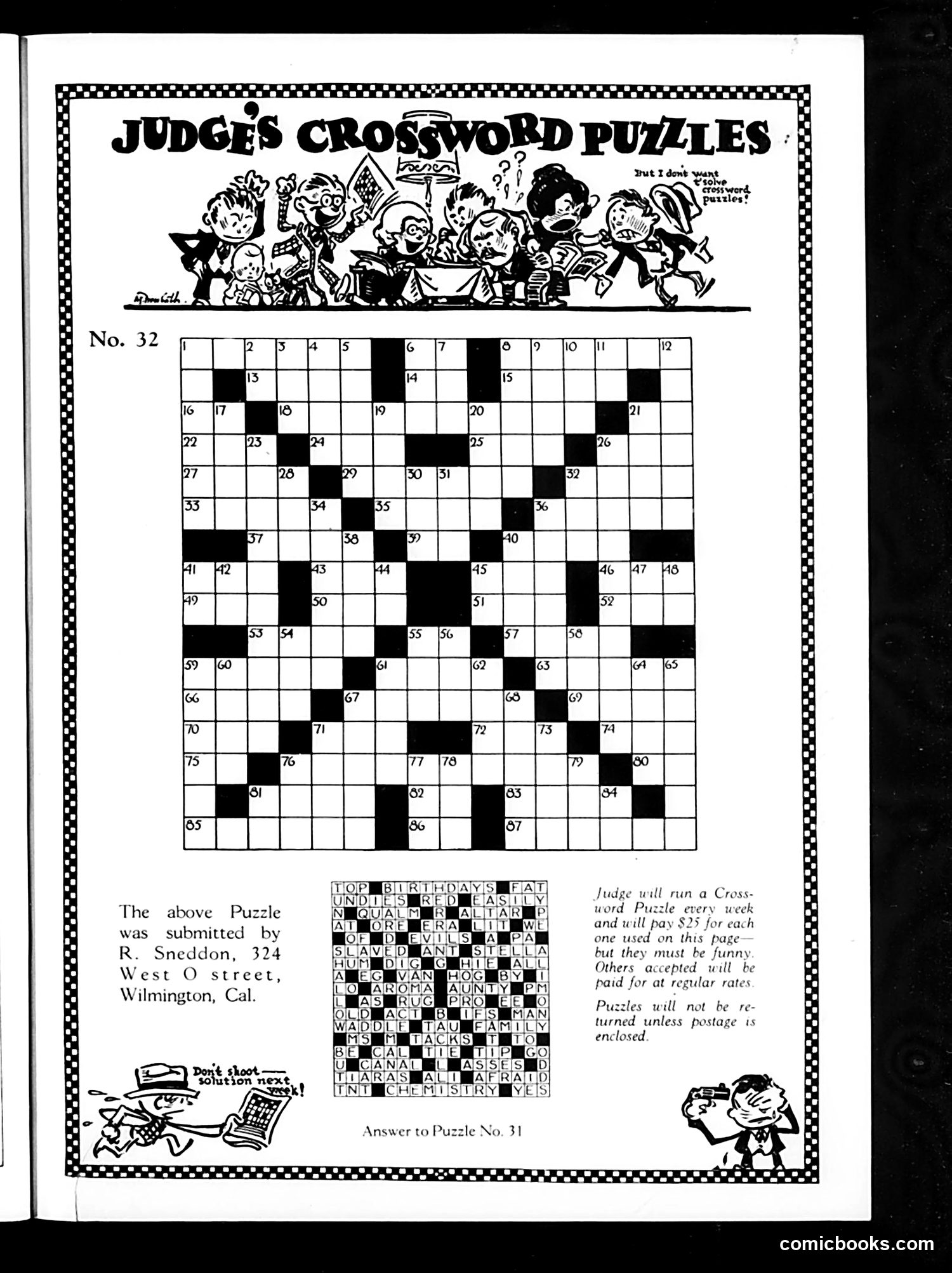
This is primarily a **crossword puzzle submission page**, not a political cartoon. Judge magazine ran a weekly crossword puzzle contest offering $25 payment for accepted puzzles—a substantial sum in the early 20th century. The page shows: - **Puzzle No. 32**, submitted by R. Sneddon of Wilmington, California - **Answer key to Puzzle No. 31** (displayed as a solved grid) - **Contest rules**: Judge would pay $25 per puzzle used, with lower rates for non-selected submissions, requiring puzzles be "funny" rather than standard The decorative header features cartoon characters celebrating puzzle-solving, reflecting the playful tone Judge cultivated. This represents the magazine's interactive approach—inviting reader participation while maintaining editorial control and monetizing content through competitions. The illustration at bottom left shows a character humorously struggling with puzzle-solving, reinforcing the entertainment value Judge associated with the feature.
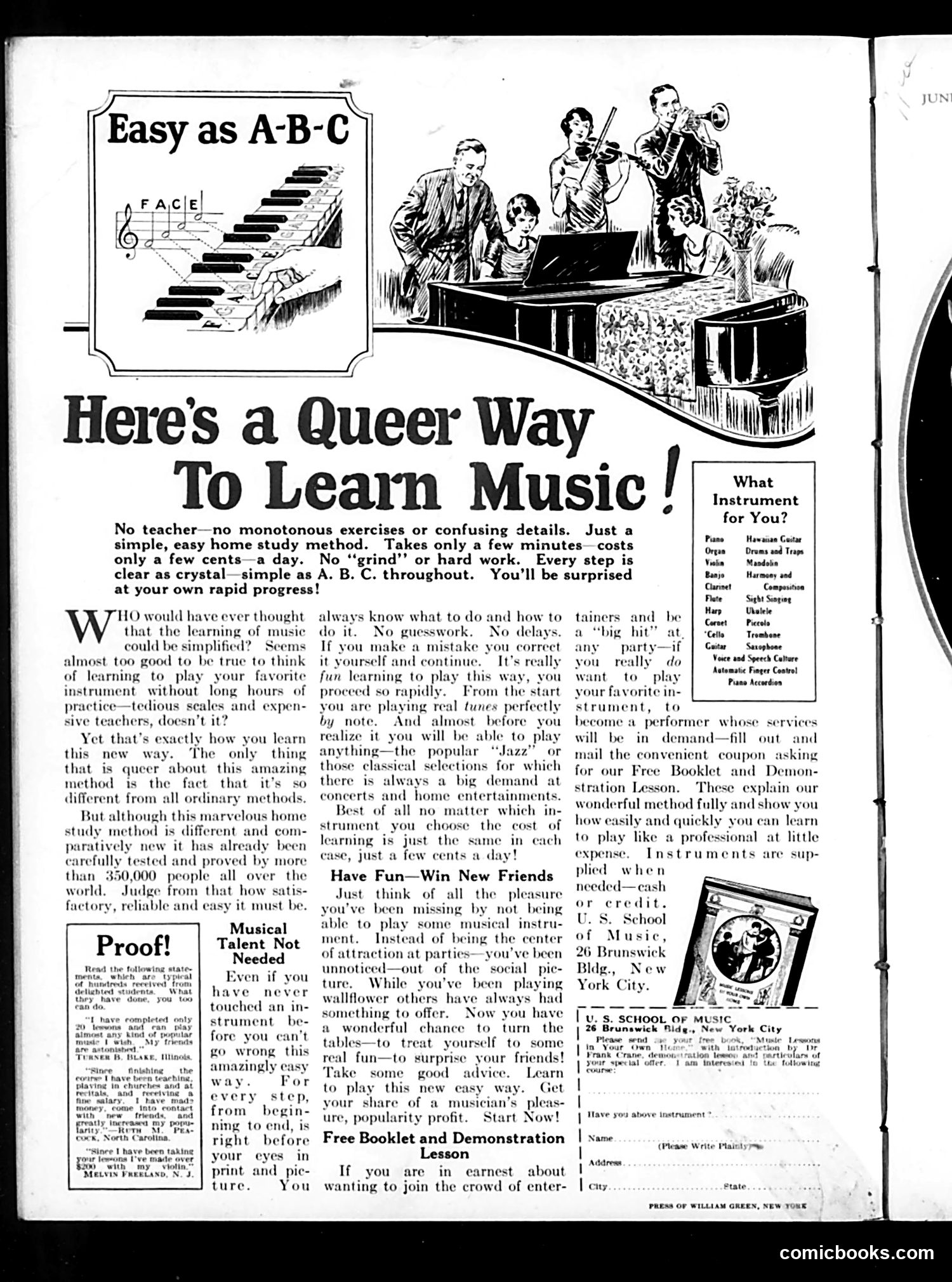
This is primarily a **full-page advertisement**, not a political cartoon. It promotes the U.S. School of Music's correspondence course for learning musical instruments at home. The ad uses the word "queer" in its original sense (meaning "unusual" or "strange"), not in modern slang. The pitch emphasizes: no tedious teachers, no expensive lessons, learning "just a few cents a day," and rapid results—claims typical of early 20th-century mail-order education schemes. The visual shows a happy family ensemble performing together, suggesting the aspirational lifestyle promised to buyers. The "Proof!" testimonials cite satisfied customers as social proof of legitimacy. The accompanying coupon and instrument list (piano, violin, guitar, etc.) complete the direct-mail format. This reflects an era when correspondence learning and mail-order self-improvement were increasingly marketed to American consumers seeking quick, affordable personal advancement—a staple advertising category in magazines like *Judge*.