
A complete issue · 36 pages · 1925
Judge — May 30, 1925
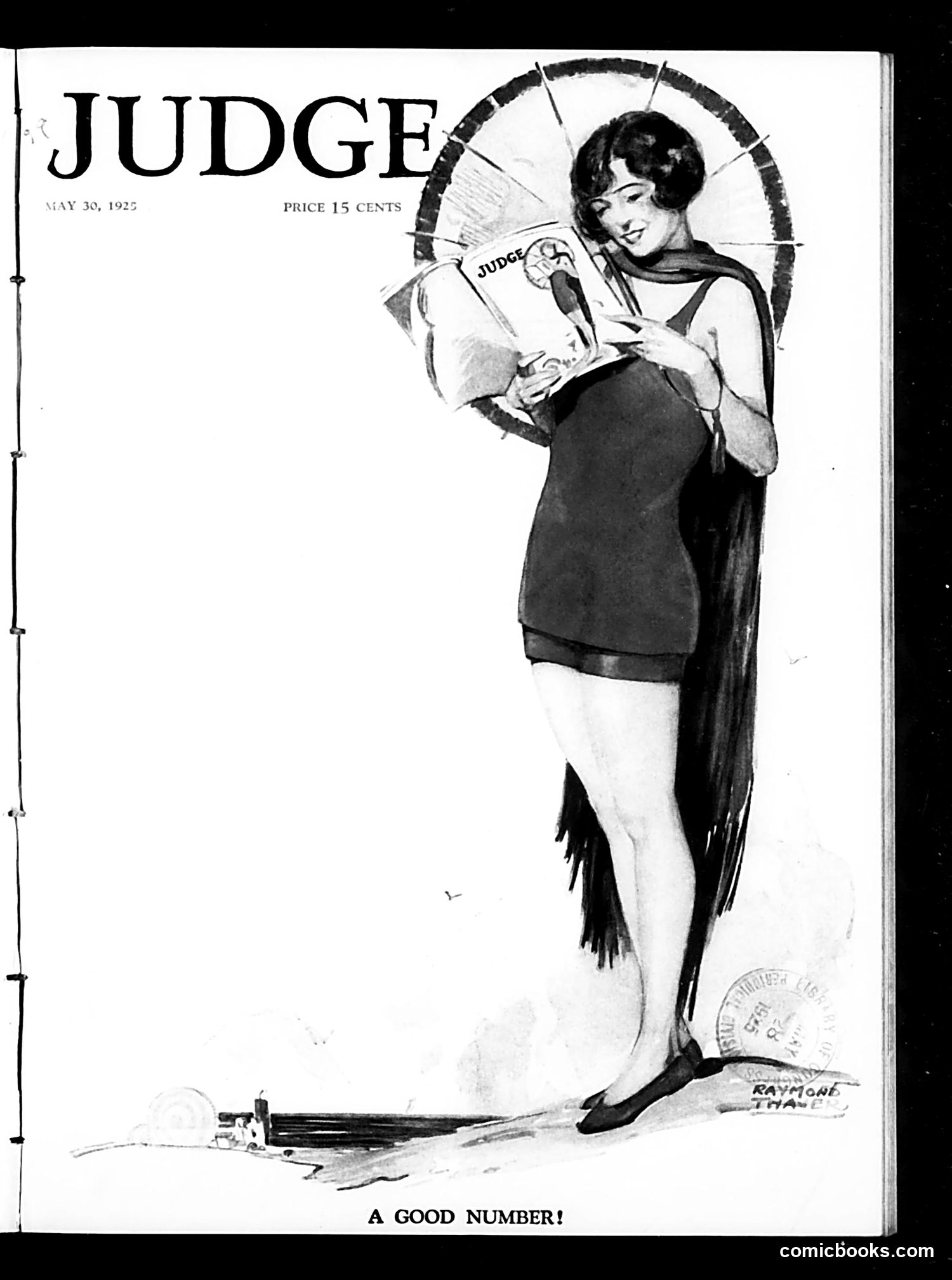
This cover illustration, titled "A Good Number!," depicts a woman in 1920s flapper attire holding a large Judge magazine while posing with an oversized telephone dial or rotary phone mechanism behind her. The image appears to be a visual pun playing on the phrase "a good number"—simultaneously referencing: 1. **The magazine itself** as "a good number" (issue) 2. **A telephone number**, given the prominent dial imagery 3. **The woman as "a number,"** 1920s slang for an attractive woman The cartoon reflects Jazz Age culture and contemporary anxieties about modern technology, femininity, and changing social mores. It's typical of Judge's humorous take on contemporary life and popular culture of the Roaring Twenties.
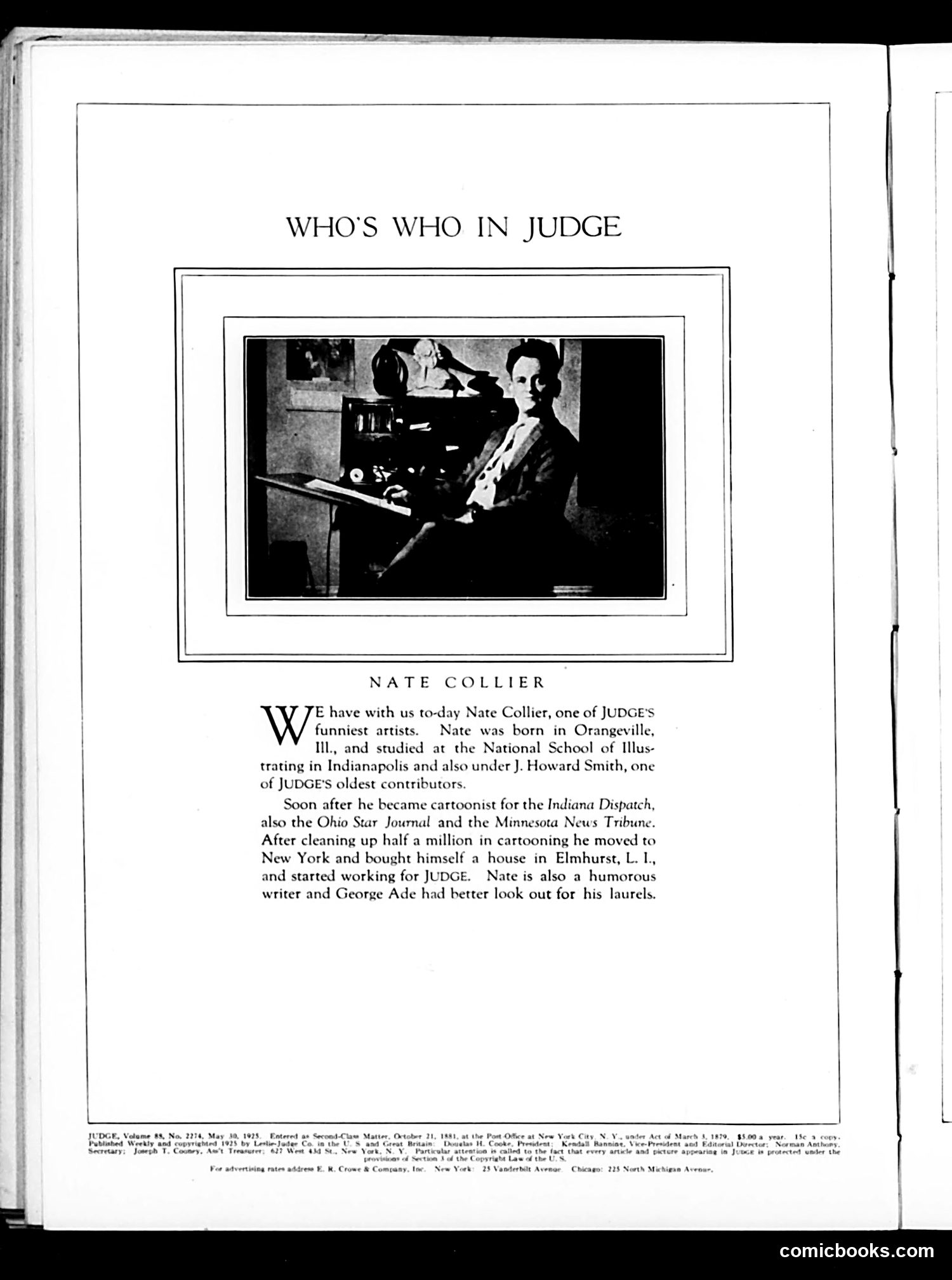
This is a biographical feature introducing **Nate Collier**, one of Judge magazine's contributing artists. The page explains his background: born in Orangeville, Illinois, trained at the National School of Illustrating in Indianapolis, and worked as a cartoonist for the *Indiana Dispatch*, *Ohio Star Journal*, and *Minnesota News Tribune* before moving to New York and joining Judge. The photograph shows Collier at work with what appears to be animation or illustration equipment. The text humorously notes he's a "humorous writer" and jokes that "George Ade had better look out for his laurels"—comparing Collier to the famous Indiana humorist George Ade, suggesting Collier is a rival talent worth watching.
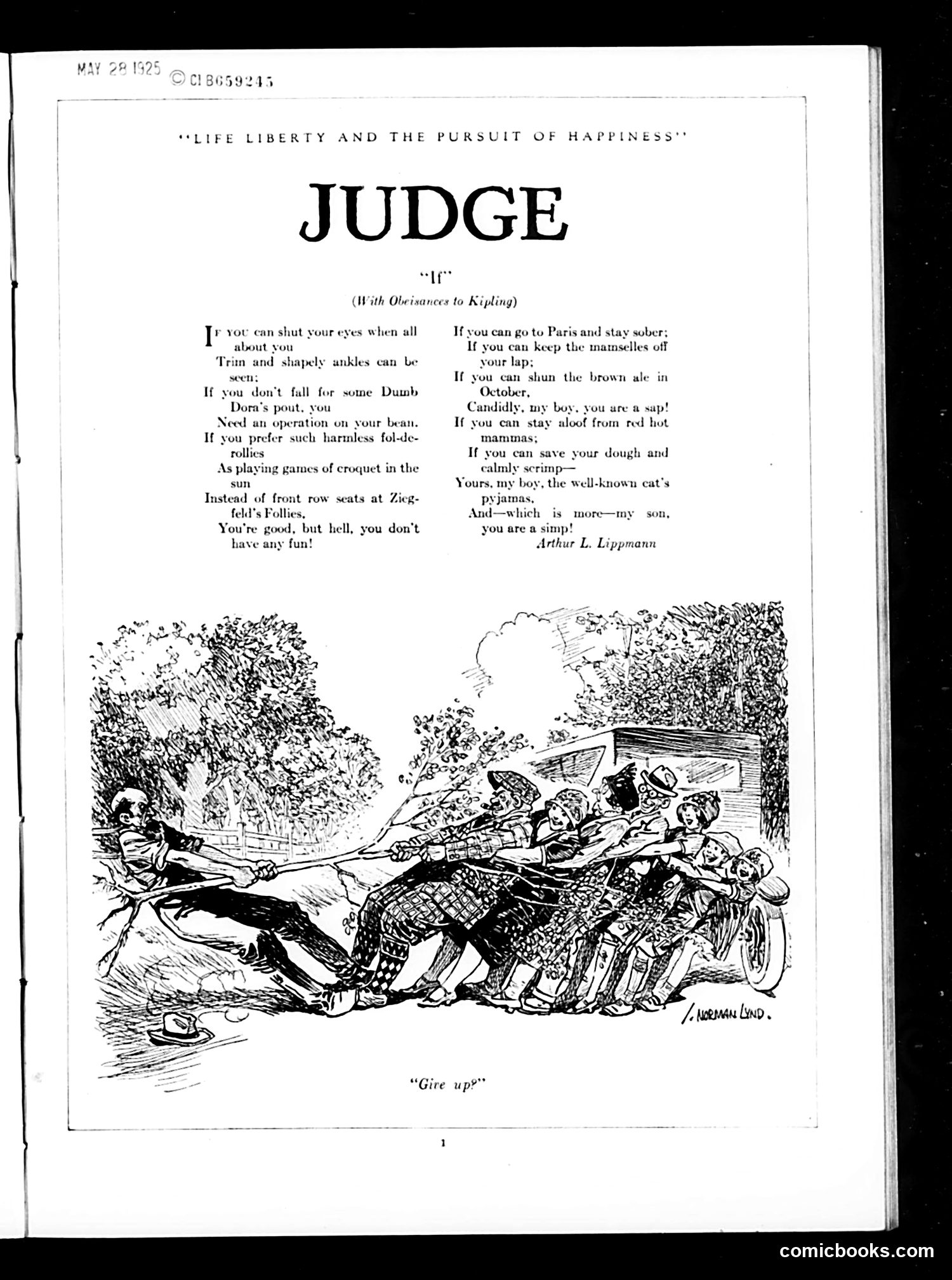
This page satirizes American excess and self-indulgence through the figure of "Judge"—likely representing an authority or moral arbiter. The poem mocks wealthy leisure activities: shutting eyes to social problems, visiting Paris, avoiding work (brown ale in October), and indulging in games and entertainment. The accompanying cartoon depicts a skeletal "Judge" figure pulling a rope attached to a group of well-dressed people in a boat, captioned "Give up!" The satire criticizes how the privileged class ignores social responsibility while pursuing pleasure, with the "Judge" representing either divine judgment or social conscience demanding accountability. The cartoon suggests America's founding ideals are being corrupted by materialism and moral indifference.
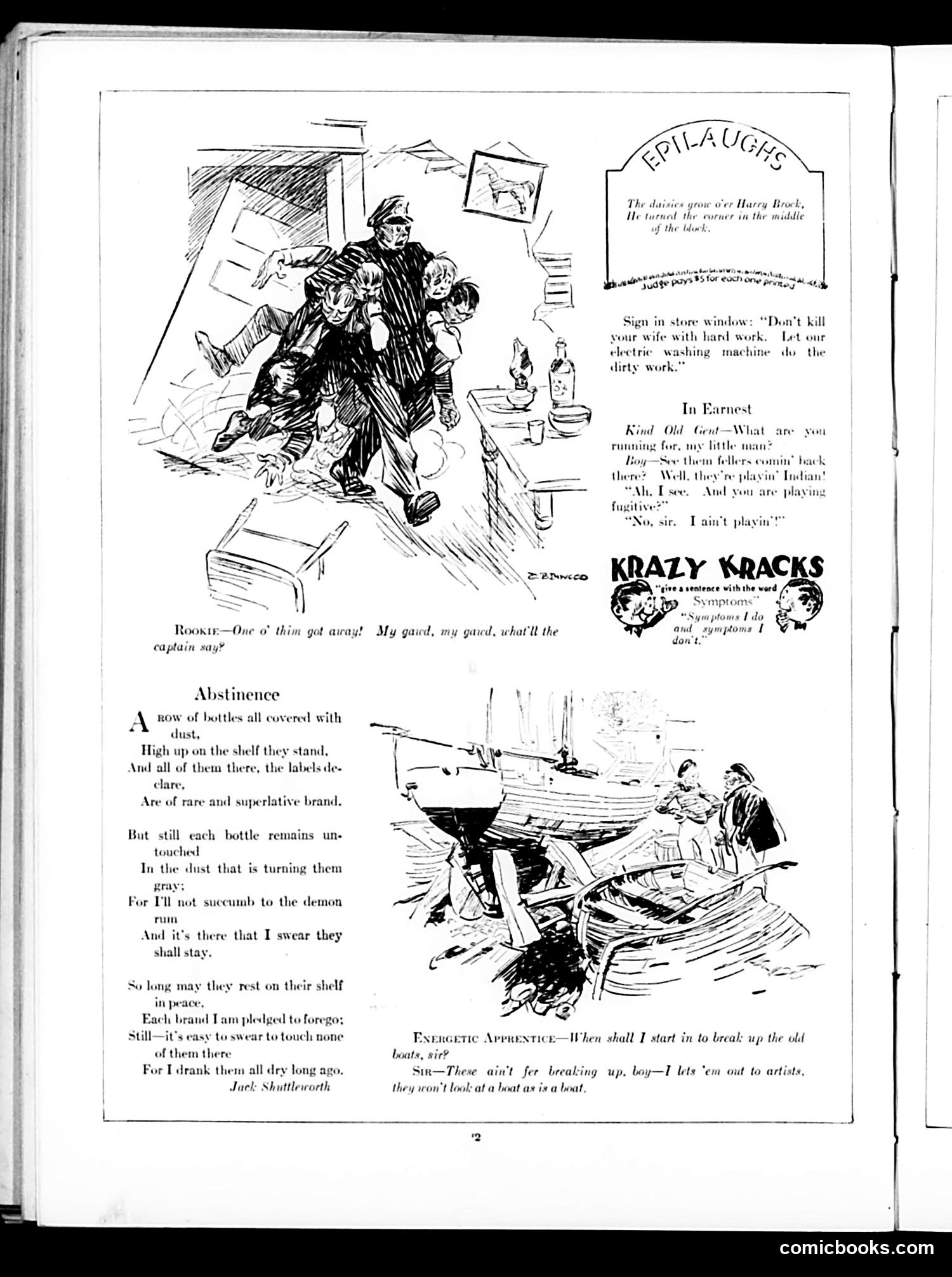
This Judge magazine page contains three distinct pieces: 1. **"Epilaughs"** (top right): Brief humorous epitaphs, including one mocking an electric washing machine advertisement's promise to spare wives from hard labor. 2. **"Rookie" cartoon** (left): Shows a military officer with children, with text suggesting confusion about "playing Indian" versus "playing fugitive"—likely satirizing either WWI-era military recruitment or childhood games mimicking soldiers. 3. **"Abstinence" poem** (bottom left): A temperance poem by Jack Shuttleworth pledging to avoid alcohol, reflecting early 20th-century Prohibition-era debates. 4. **Bottom right cartoon**: Depicts a boat scene with dialogue about breaking up old boats, apparently mocking practical vs. artistic concerns—likely social commentary on economic or class differences. The page reflects early 1900s American concerns: military service, temperance, domestic technology, and class attitudes.
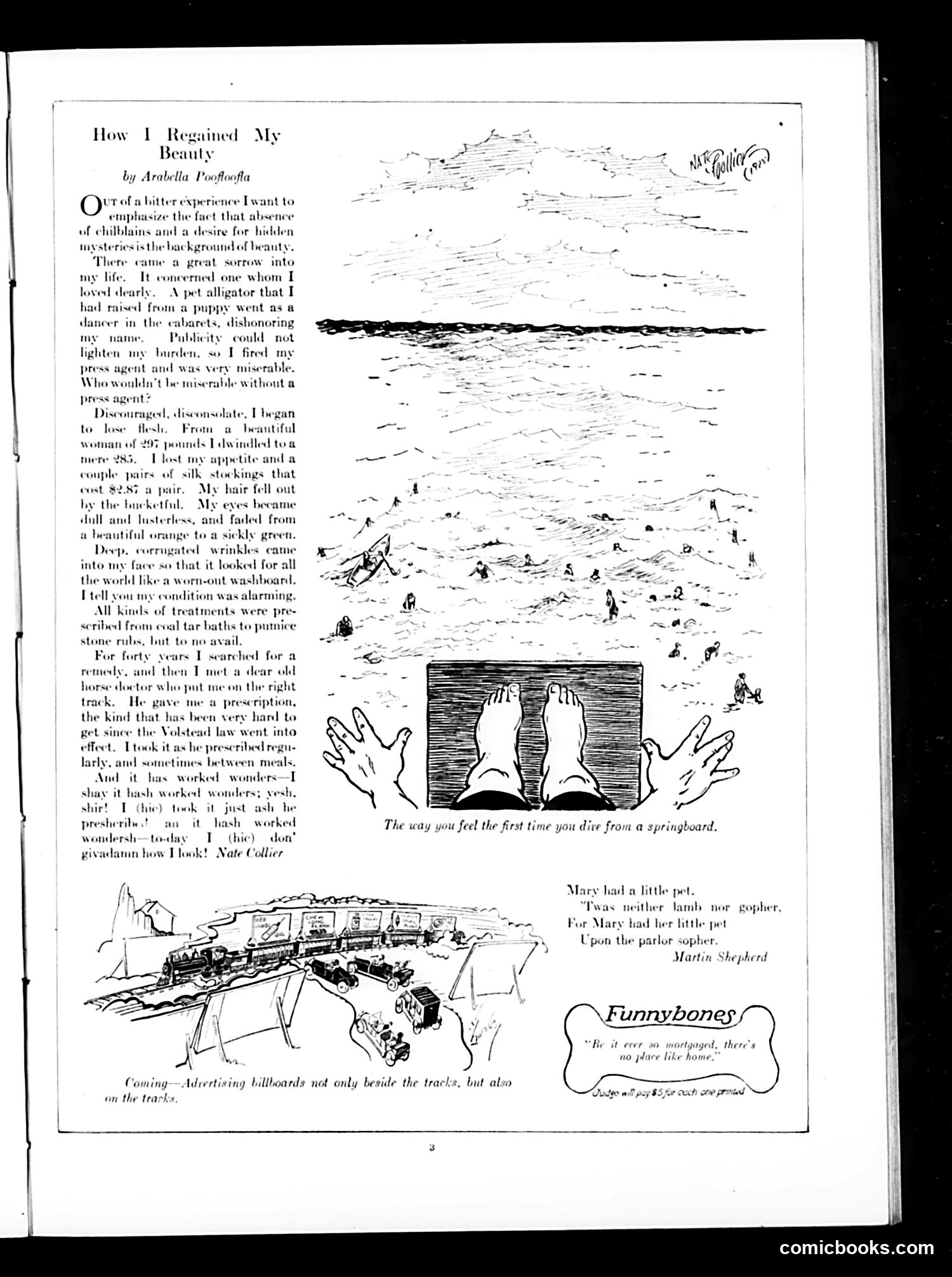
This Judge magazine page contains a personal essay titled "How I Retained My Beauty" by Arabella Poshfoofia, accompanied by illustrative sketches rather than political satire. The piece appears to be **social humor** mocking vanity and beauty obsession. The author describes losing significant weight (from 285 to a lower number) and attributes her "transformation" to various treatments and remedies—none of which worked until she discovered a "Voldstad law" prescription that somehow succeeded. The humor targets: - **Absurd beauty treatments** marketed to wealthy women - **Vanity culture** among the upper classes (implied by the author's affected name) - **Gullibility** regarding miraculous weight-loss claims The sketches of a beach scene and springboard illustrate the vain preoccupations of leisured society rather than delivering political commentary. This is lifestyle satire rather than political cartoon work.
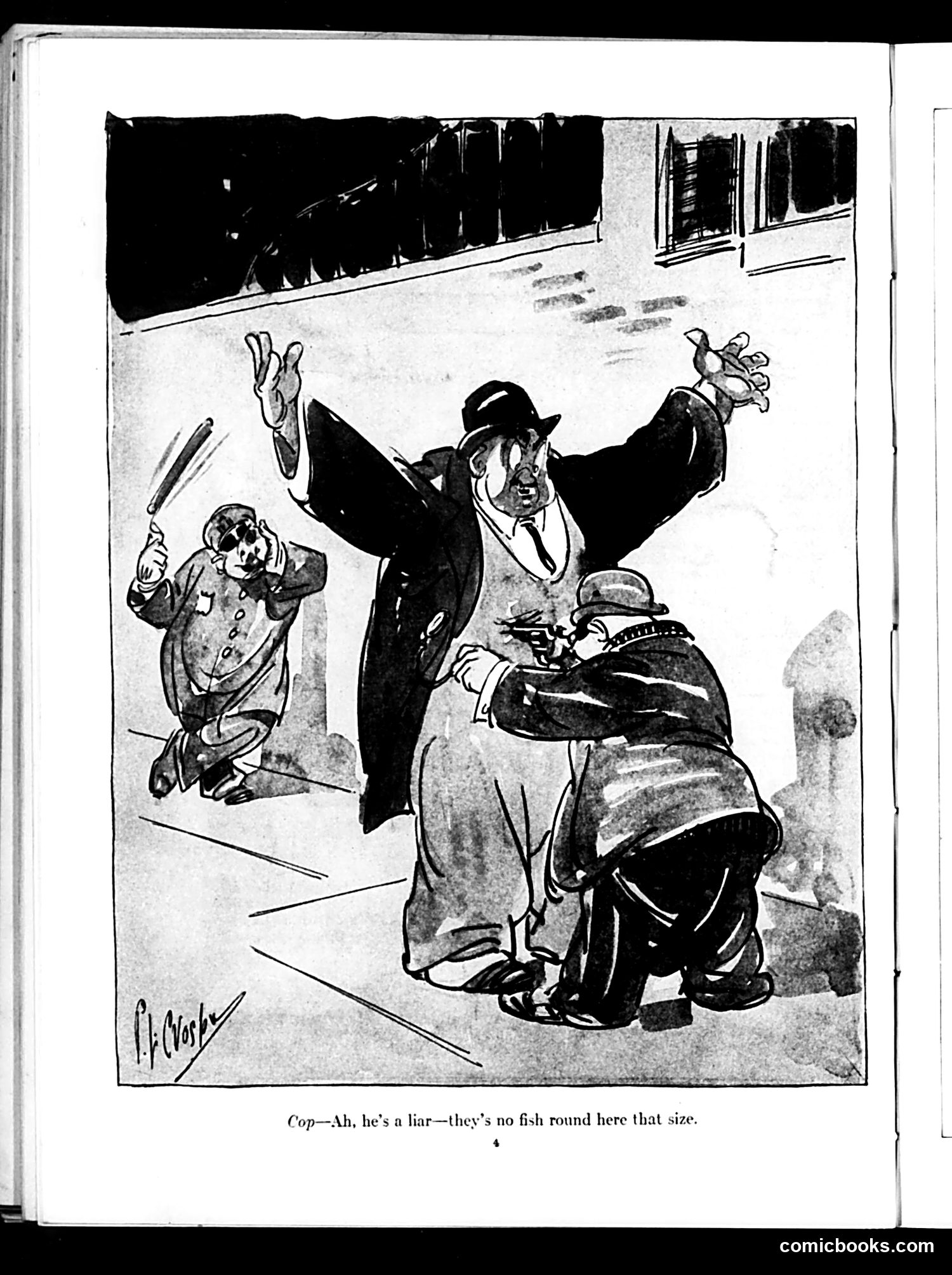
This cartoon depicts a fisherman's tall tale being challenged by a police officer. The central figure—a man in formal dress with exaggerated features—claims to have caught an enormous fish, gesturing wildly with his arms spread wide. A smaller figure on the left holds a baseball bat, appearing skeptical. The caption reads: "Cop—Ah, he's a liar—they's no fish found here that size." The satire mocks the universal human tendency toward exaggeration when recounting fishing exploits. The police officer's intervention adds absurdist humor—law enforcement isn't typically concerned with fishermen's honesty. The caricatured features and theatrical gestures emphasize the storyteller's desperation to appear credible despite obvious fabrication. This is a straightforward joke about lying, not appearing to reference specific political events.
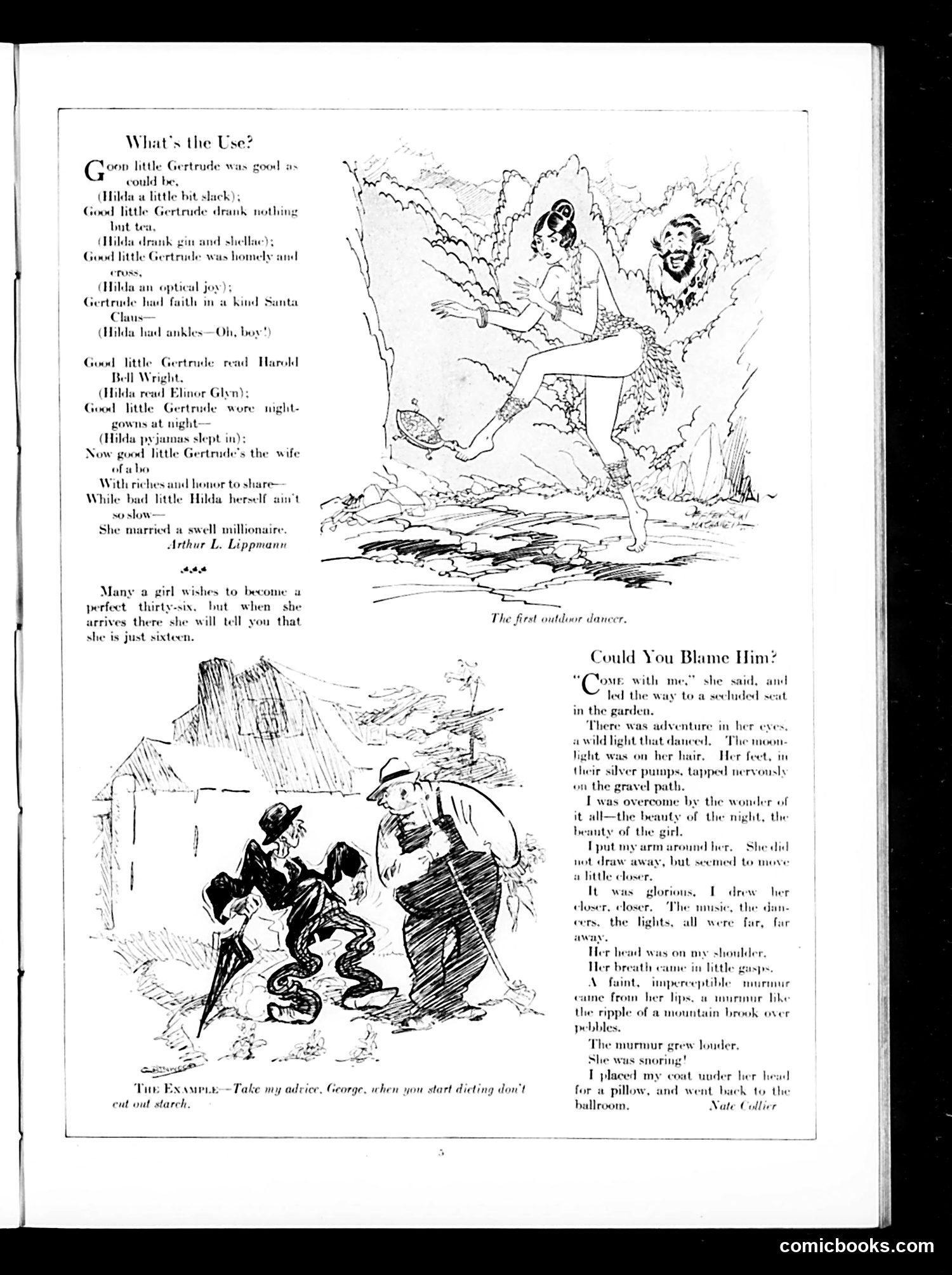
This page contains two separate pieces of humorous fiction rather than political cartoons. **"What's the Use?"** (top) is a poem about "Good little Gertrude," a well-behaved girl who grows up to marry a wealthy millionaire—satirizing the era's messaging that feminine virtue guarantees advantageous marriage. **"Could You Blame Him?"** (bottom) is a romantic narrative about a man overwhelmed by moonlit attraction to a woman in a garden, leading him to steal a kiss. The story's sympathetic framing of his impulsive behavior reflects early 20th-century attitudes normalizing male romantic assertiveness. The accompanying sketches depict leisure scenes and courtship moments. Neither piece appears to reference specific political events or figures—they're social satire targeting gender norms and romantic conventions of their time.
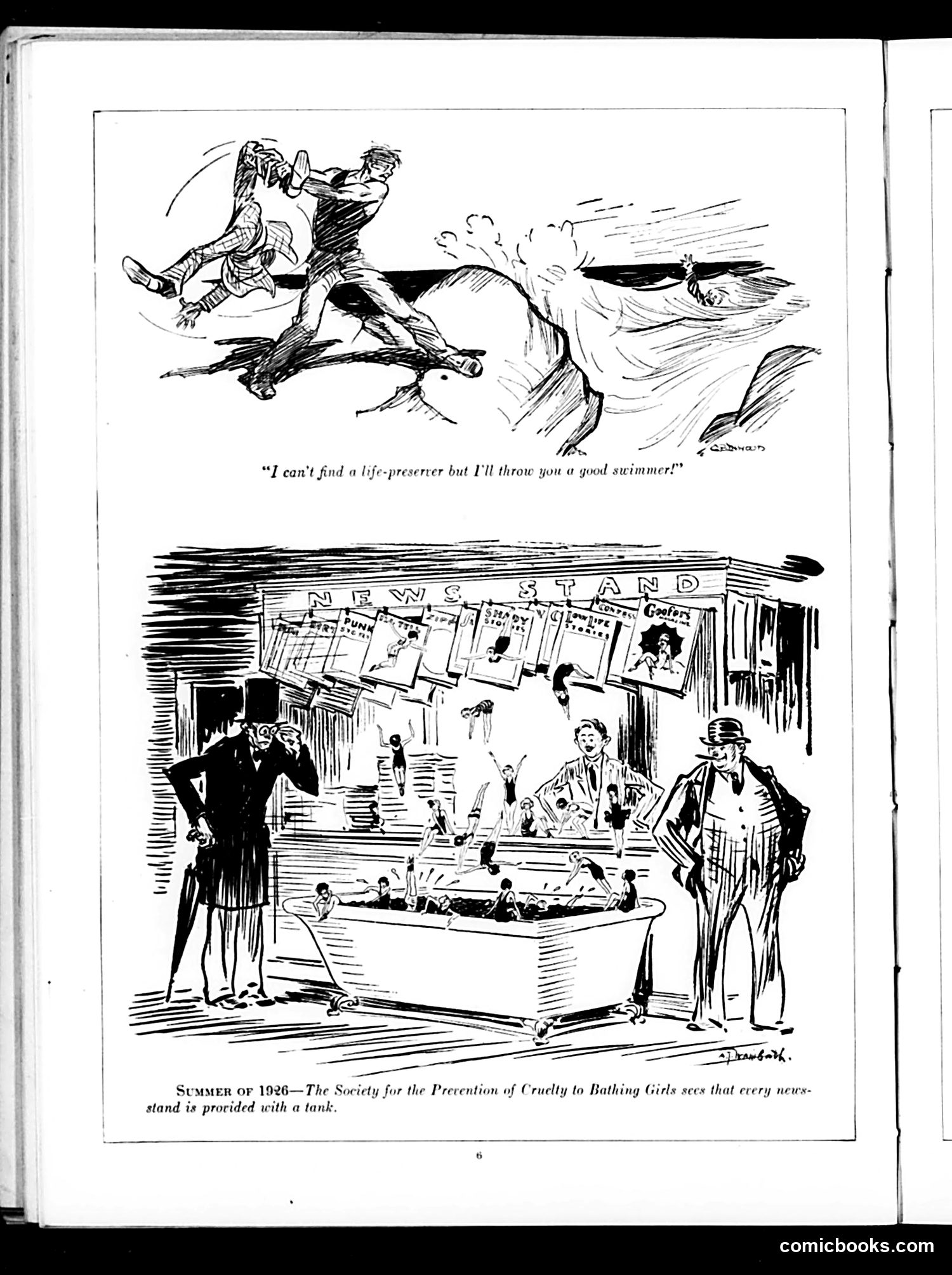
This page contains two cartoons satirizing 1926 social attitudes. **Top cartoon:** A man thrown into water by what appears to be a winged figure, with the caption "I can't find a life-preserver but I'll throw you a good swimmer!" — a joke about unhelpful rescue attempts. **Bottom cartoon:** The main satire depicts a fictional "Society for the Prevention of Cruelty to Bathing Girls" that provides large water tanks at newsstands. The joke targets moral panic about women's bathing suits: the society humorously suggests that displaying images of girls in swimwear at newsstands is so offensive it requires providing tanks of water for shocked passersby to recover in. This mocks the era's conservative attitudes toward women's bodies and the emerging shorter, more revealing bathing suits of the 1920s.
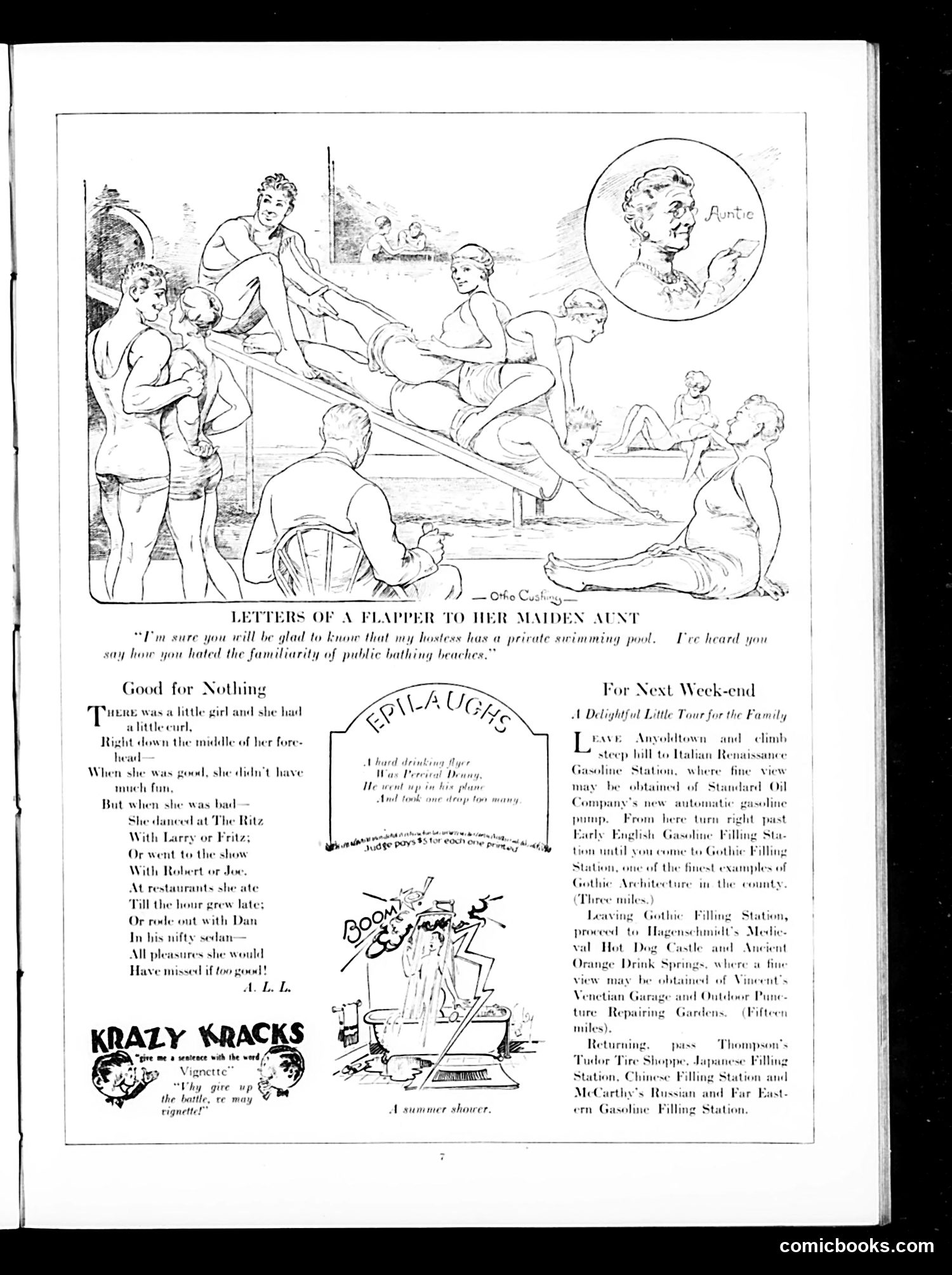
The top cartoon satirizes social pretension about "public bathing beaches." A hostess boasts to her guest about having a private swimming pool, implying that public beaches are undignified due to their "familiarity"—meaning the mixing of different social classes. The joke mocks wealthy people's snobbish avoidance of ordinary people. The "Good for Nothing" poem below satirizes a young woman whose behavior improves only when she misbehaves—dancing at fancy venues (The Ritz) and going out with suitors. It's a light social commentary on how "good girls" had limited fun within propriety's constraints. The "Krazy Kracks" cigarette advertisement is unrelated satirical humor. The right column describes a leisurely weekend tour through rural America, visiting various gas stations and scenic spots—likely mocking the newly popular automobile tourist culture of the era, where even mundane gasoline stops became destinations.
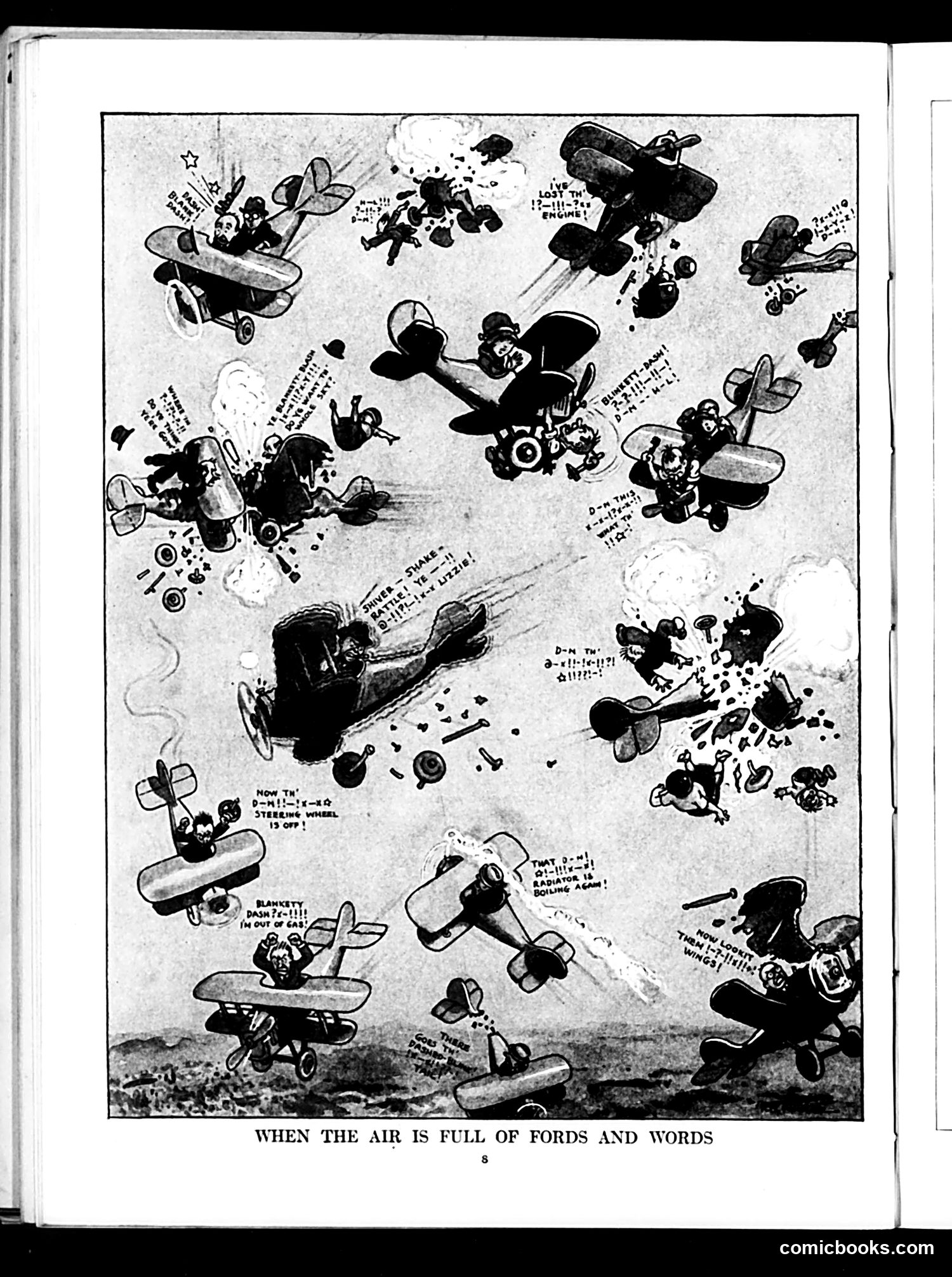
This is a chaotic aerial cartoon showing multiple small airplanes colliding, crashing, and scattering in mid-air. The title satirizes a presumed excess of Ford automobiles and promotional speech/advertising. The planes carry what appear to be businessmen or advertising figures, with various speech bubbles and labels (though illegible in this reproduction) suggesting they're promoting products or making sales pitches. The satire appears to target 1920s commercial excess and advertising culture—the notion that the air is literally "full" of competing commercial messages and Ford vehicles, depicted as a dangerous aerial traffic jam of capitalism and consumer culture run amok. The comedic chaos visualizes market oversaturation and competitive commercial chaos of the era.
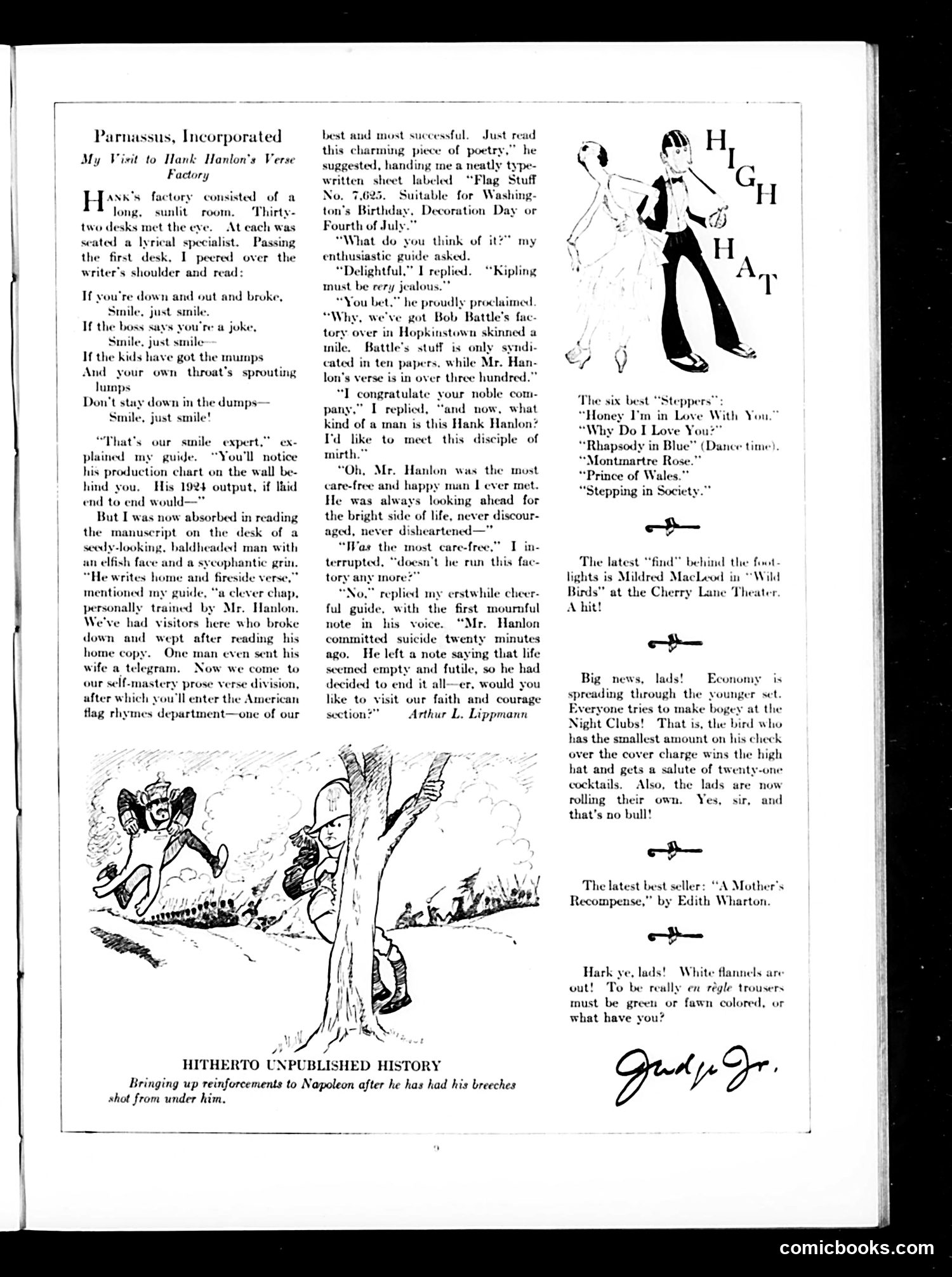
The main article, "Parnassus, Incorporated," satirizes the commercialization of poetry and sentimentality in 1920s America. It depicts "Hank Hanlon's Verse Factory"—a cynical assembly line where specialized writers mass-produce formulaic verse for mass publication: "smile" poems, "home and fireside" material, and "Flag Stuff" for patriotic holidays. The dark joke: Hanlon, despite preaching optimism and the "bright side of life," commits suicide, revealing the hollowness of the mass-produced sentiment his factory churns out. The satire mocks both the commercialization of literature and the gap between advertised cheerfulness and actual despair—a pointed critique of 1920s consumer culture's demand for cheap, uplifting content. The page also contains society gossip (theatrical "finds," fashion notes about trousers colors, references to "night clubs" and rolling cigarettes), indicating this is a humor/lifestyle magazine for a sophisticated urban audience. The small cartoon at bottom appears unrelated—a Napoleonic history joke.
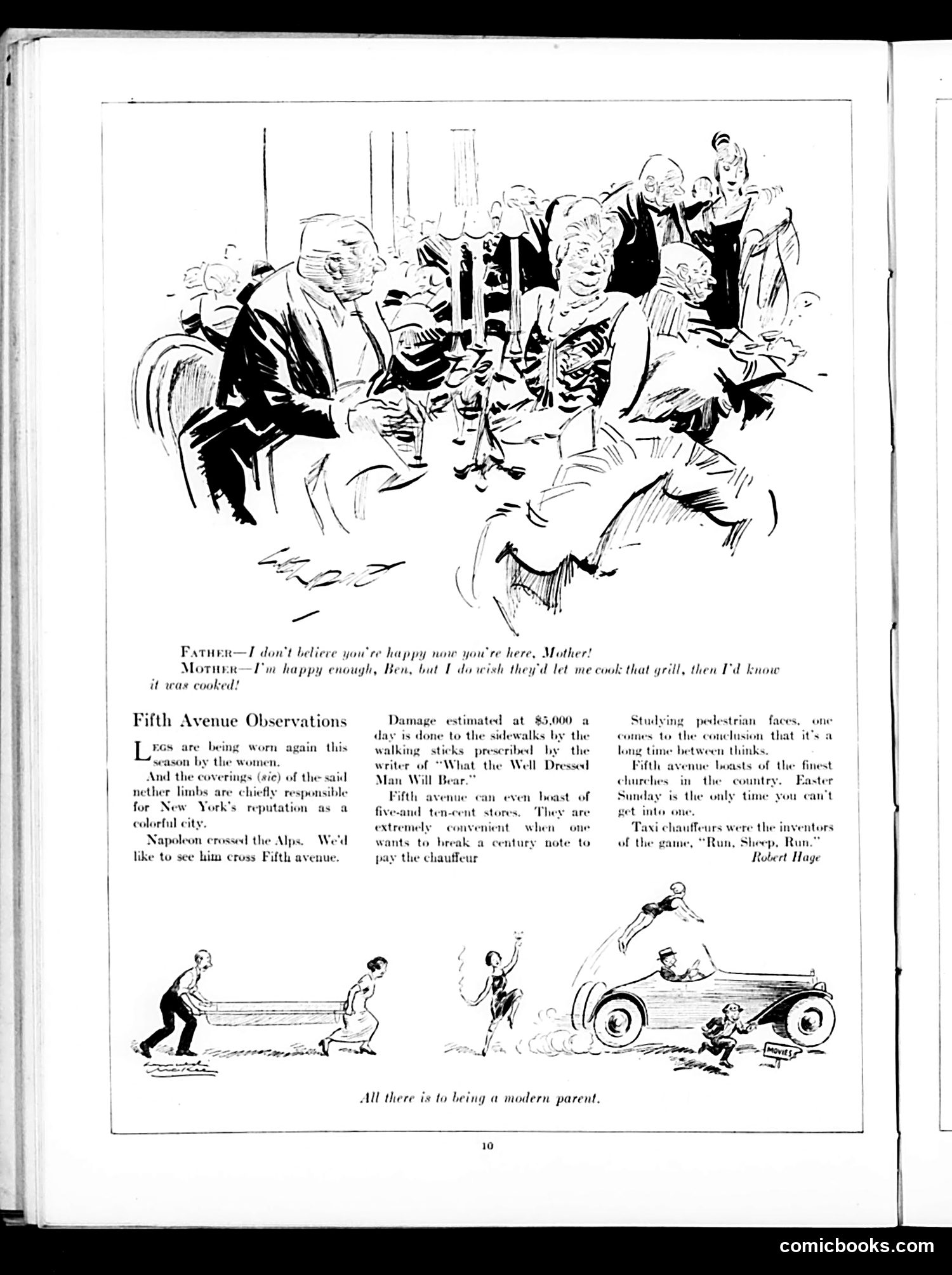
This page satirizes wealthy Fifth Avenue society and modern parenting customs. The main cartoon depicts a formal dinner party where a mother complains she wishes she could cook the meal herself—suggesting wealthy women of the era were increasingly removed from domestic duties, delegating cooking to servants. The caption "All there is to being a modern parent" implies this detachment from household responsibilities reflects broader generational change. The "Fifth Avenue Observations" section mocks high society's pretensions: women wearing expensive ostrich feathers, damage from fashionable walking sticks, overcrowded department stores, and wealthy taxi passengers. The Napoleon reference humorously compares crossing the Alps to navigating crowded Fifth Avenue. The lower cartoons illustrate chaotic modern parenting—children playing dangerously with toys and rope—suggesting contemporary anxiety about looser child supervision and changing social norms among the wealthy classes.
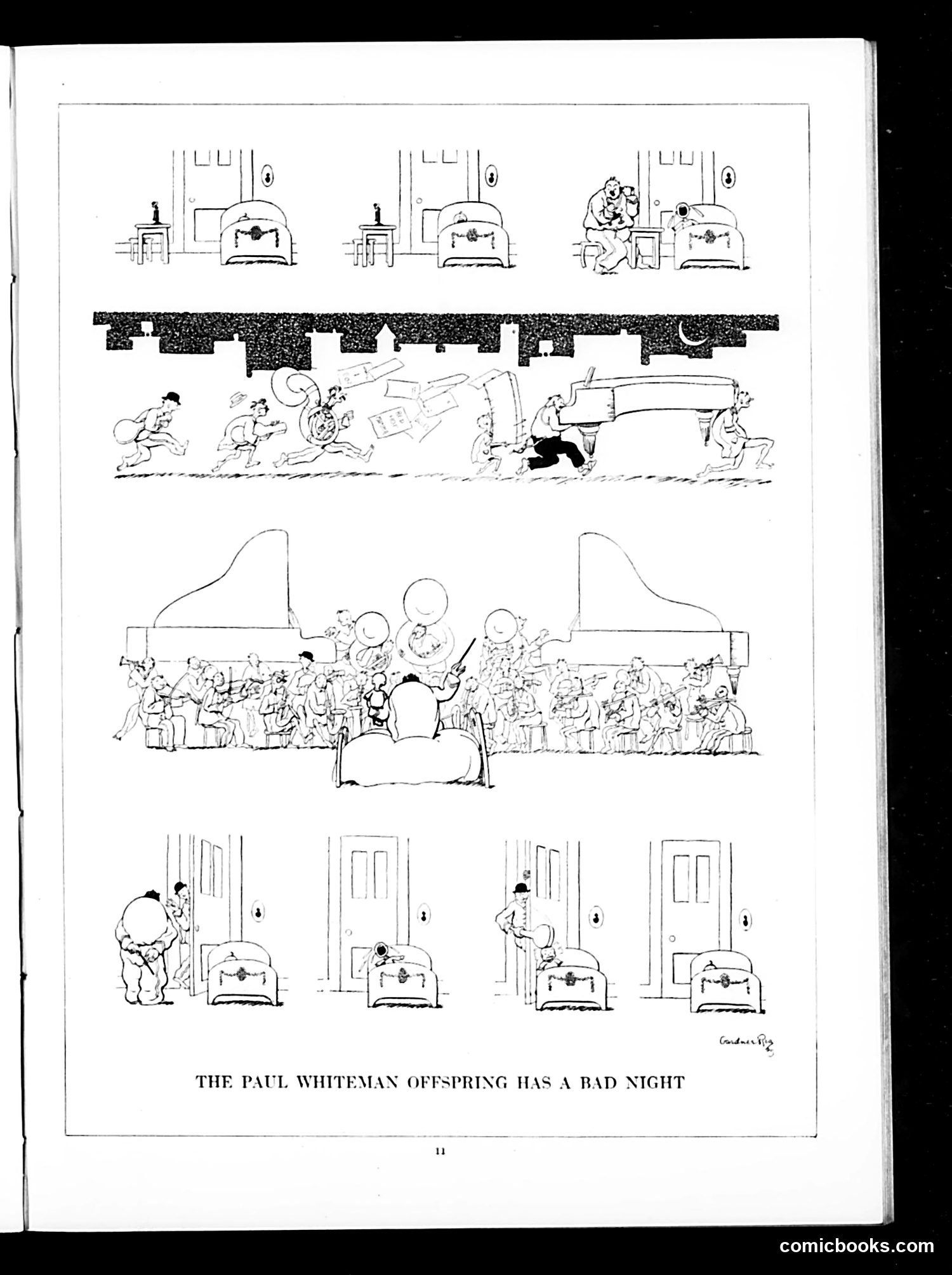
This cartoon satirizes Paul Whiteman, the famous 1920s bandleader known as the "King of Jazz." The multi-panel sequence depicts a chaotic night featuring what appears to be Whiteman's family or musical ensemble experiencing various domestic disturbances—arguments in bedrooms, children misbehaving, and general household mayhem. The humor targets Whiteman's public persona as a respectable, orchestral conductor by contrasting it with undignified home life. The satire likely plays on the gap between his refined professional image and private family disorder. The cartoon's tone suggests gentle mockery of celebrity figures, suggesting even the famous and accomplished face ordinary domestic troubles—a common Judge magazine theme examining the gap between public reputation and private reality.
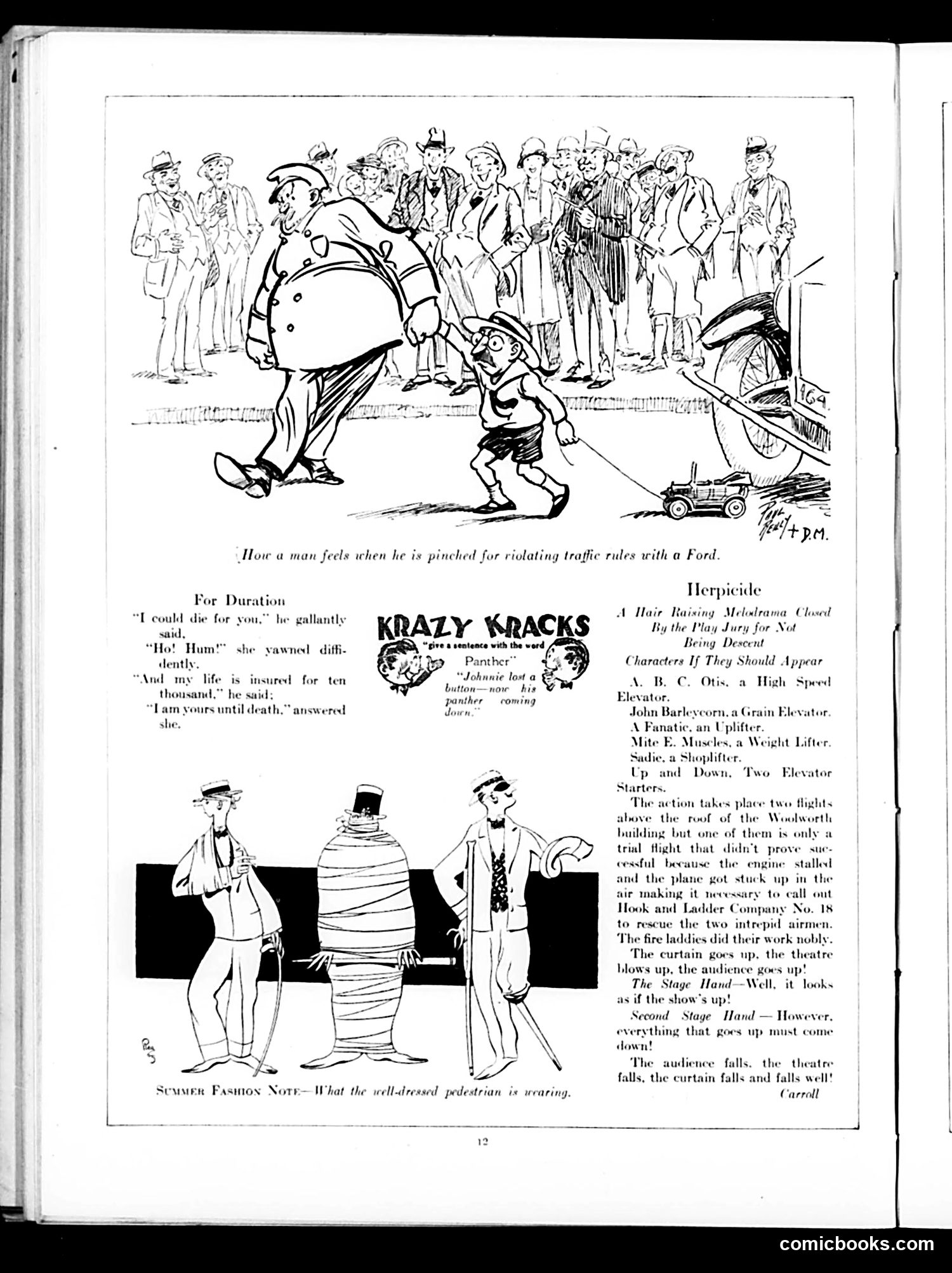
**Top Cartoon:** Shows a large, rotund man being pinched by a police officer for traffic violations in a Ford automobile. The caption "How a man feels when he is pinched for violating traffic rules with a Ford" satirizes the enforcement of early traffic laws. This likely references growing public frustration with traffic police and automobile regulations during the 1920s automobile boom. **"Krazy Kracks":** A joke section playing on the word "panther" in a romantic dialogue—mild wordplay humor typical of the era's magazines. **"Herpicide":** A mock movie synopsis parodying melodramatic silent films. The absurd plot (involving elevators, the Woolworth Building, and a crashed plane requiring fire rescue) and exaggerated theatrical destruction jokes about overwrought early cinema and stage comedies. **Bottom Fashion Note:** A brief illustration comment on contemporary pedestrian fashion. The page is primarily **humorous commentary on modern life**—automobiles, traffic law, and cinema—rather than serious political satire.
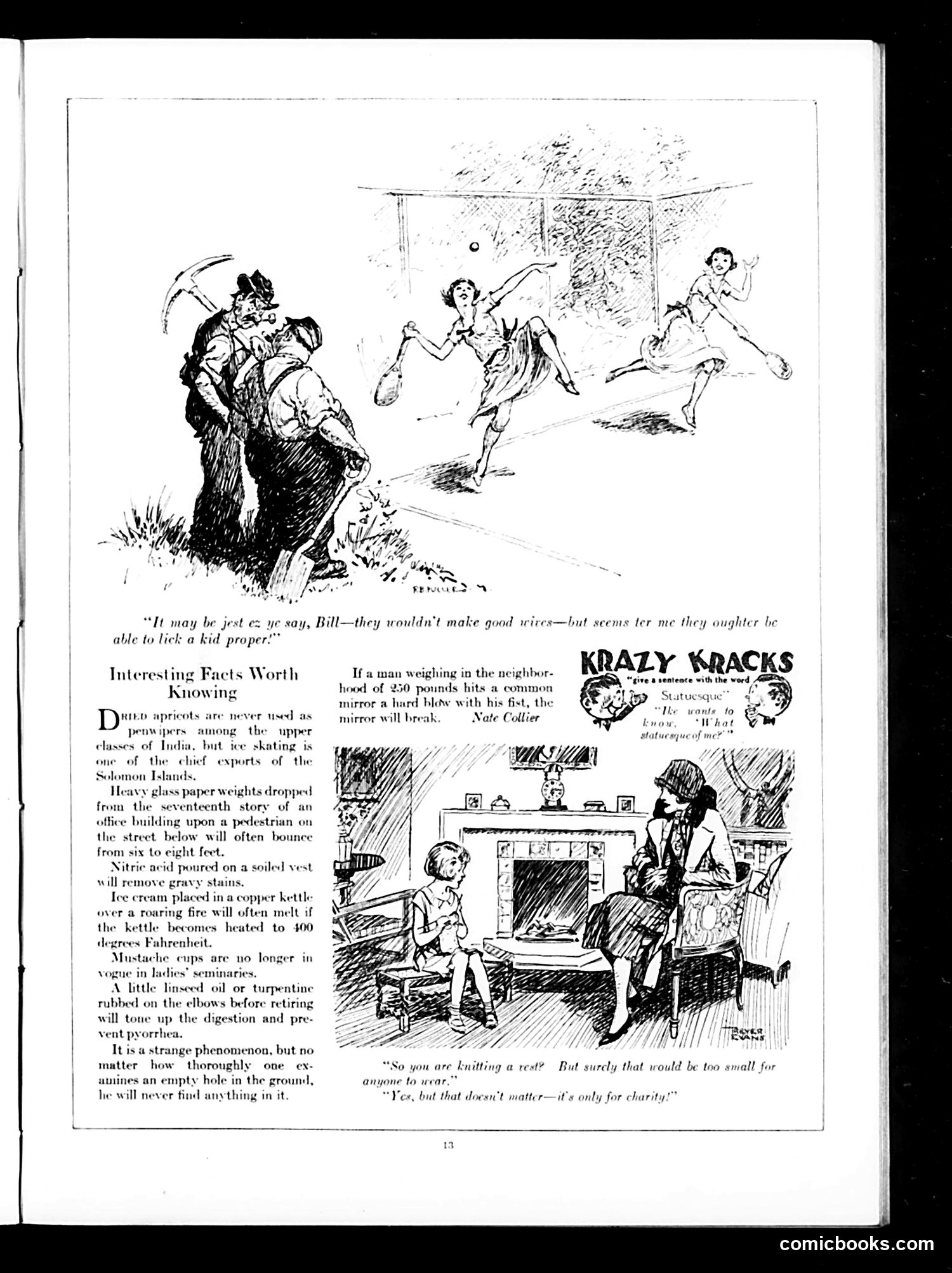
**Top Cartoon**: A man holding a scythe confronts a woman playing ball with children. His quote—"they wouldn't make good wires—but seems ter me they oughter be able to lick a kid proper"—suggests he's criticizing the woman (likely a nanny or caretaker) for failing at basic childcare discipline. The satire targets progressive attitudes about child-rearing; the old-fashioned figure represents traditional corporal punishment while the woman represents modern, gentler approaches he considers inadequate. **"Krazy Kracks" Comic**: A woman knits what appears to be a tiny vest while a child watches. When asked if it's wearable, she replies it's "only for charity"—the joke being the garment is uselessly small, mocking charitable work that's performative rather than practical. **"Interesting Facts Worth Knowing"**: A humorous filler section listing absurd "facts" (like ice skating being exported from tropical islands), typical of period magazines' comedic padding. The page reflects early 20th-century anxieties about modernization and changing social norms.
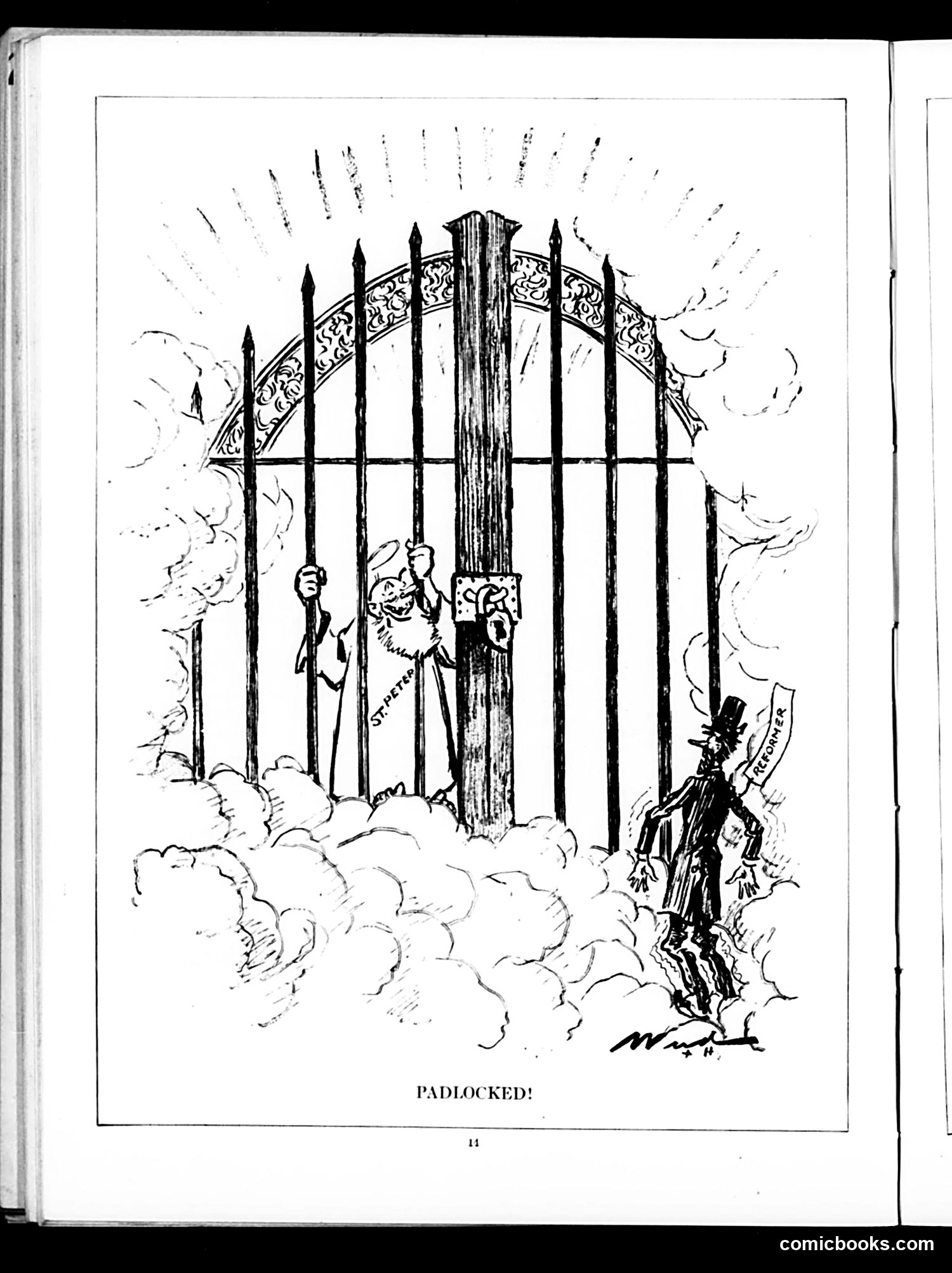
This cartoon depicts a figure (likely a woman, based on the dress and curled hair) chained inside an ornate gate while standing in clouds, suggesting a heavenly or afterlife setting. A well-dressed man labeled "Tammany" stands outside the gate. The satire appears to target **Tammany Hall**, the powerful Democratic political machine that controlled New York City politics. The "padlocked" gate likely represents legal restrictions or criminal charges against Tammany—possibly referring to scandals or corruption convictions that temporarily prevented the organization's operations. The heavenly setting may suggest Tammany Hall's political "death" or temporary demise. Without the specific publication date, the exact scandal referenced remains unclear, though Tammany faced multiple corruption investigations throughout its history.
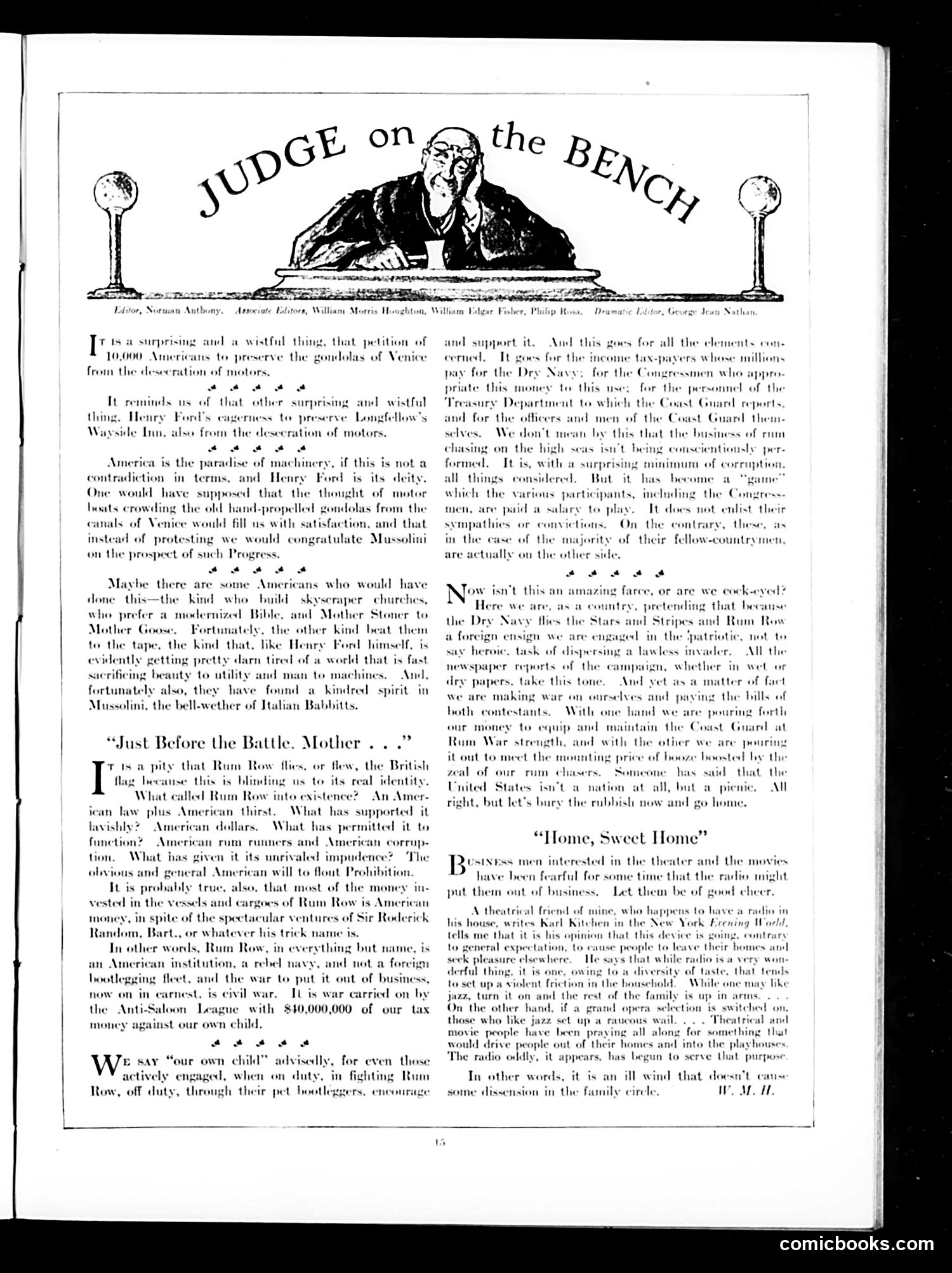
This editorial page satirizes American hypocrisy regarding Prohibition enforcement and cultural preservation. The masthead depicts a judge overseeing multiple satirical commentaries. The main critiques: 1. **Venice Motors vs. Longfellow's Inn**: The piece mocks Americans petitioning to preserve Venice's gondolas from motorization while Henry Ford—America's "deity" of mechanization—destroyed Longfellow's historic Wayside Inn. This exposes selective nostalgia among those who worship industrial progress. 2. **Rum Row Contradiction**: The author argues that "Rum Row" (the notorious bootlegging operation) is fundamentally an American enterprise funded by American money and supported by Americans, yet the government wages "civil war" against it using taxpayer dollars. The satire highlights the absurdity of Americans fighting themselves while financing the very smuggling operation they claim to combat. 3. **Radio vs. Family Life**: A brief section criticizes how radios are disrupting family harmony—a contemporary social anxiety about new technology. The overall message: American society is riddled with contradictions between stated values and actual behavior, particularly regarding technological "progress" and law enforcement.
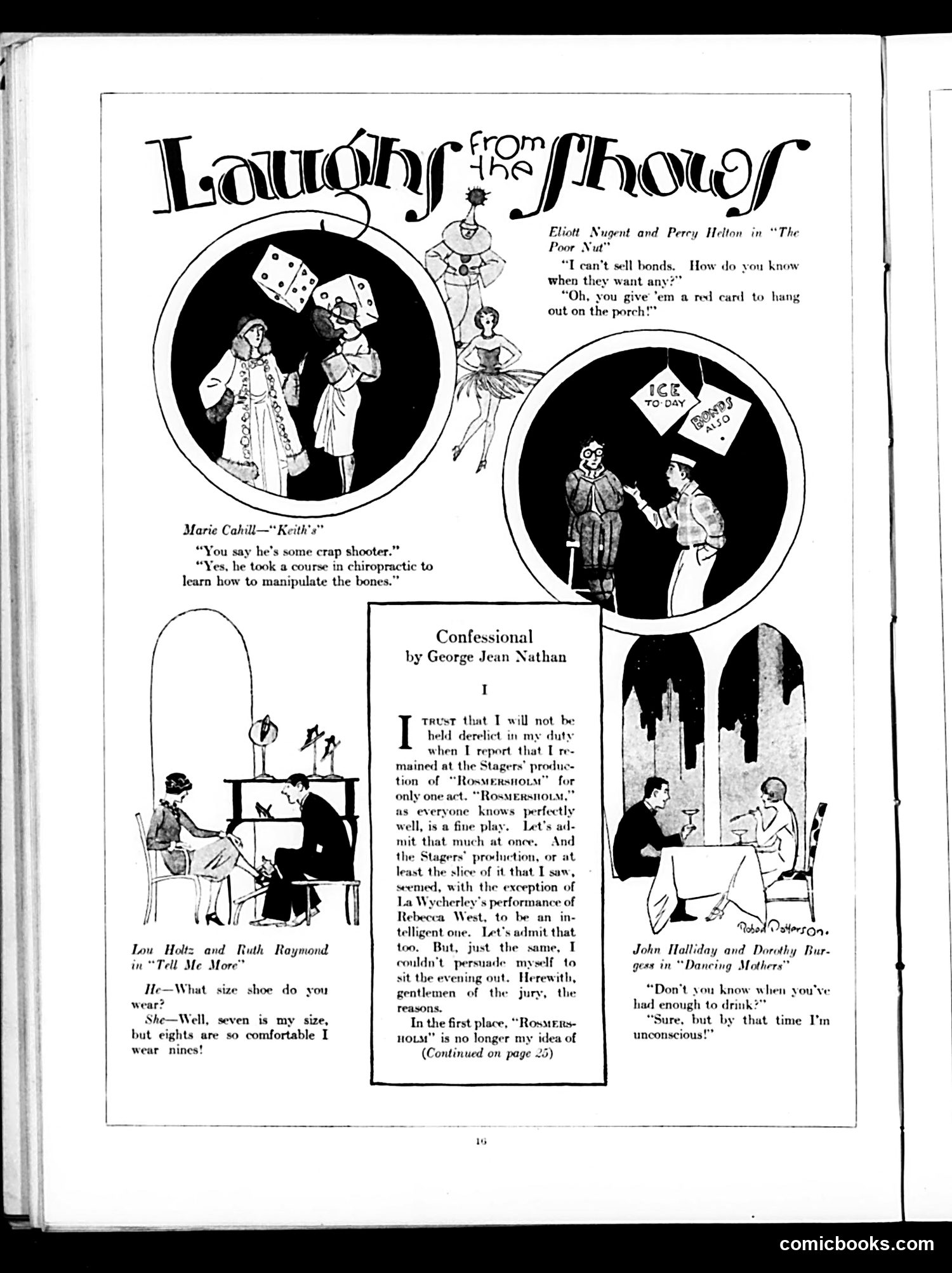
This is a theater-humor page featuring jokes tied to contemporary Broadway productions (circa 1920s based on style). The content includes: **Theater Jokes**: Brief comedic exchanges referencing current shows like "The Poor Nut," "Tell Me More," "Keith's," and "Dancing Mothers"—typical vaudeville-style one-liners about everyday situations (shoe sizes, drinking, selling bonds). **"Confessional" Essay**: Theater critic George Jean Nathan confesses he left early from a Stagers' production of Ibsen's "Rosmersholm," acknowledging it's a "fine play" but admitting he couldn't sit through it. This is Nathan's self-aware critique—a common magazine feature where critics humorously admit their prejudices or impatience. **The Satire**: The page gently mocks both theater-goers (who pretend to appreciate serious drama) and critics (who make excuses for not finishing important works). The contrast between Nathan's intellectual acknowledgment and his actual behavior creates the humor. For modern readers: this resembles contemporary theater reviews or arts criticism that balances respect for canonical works with honest personal reaction.
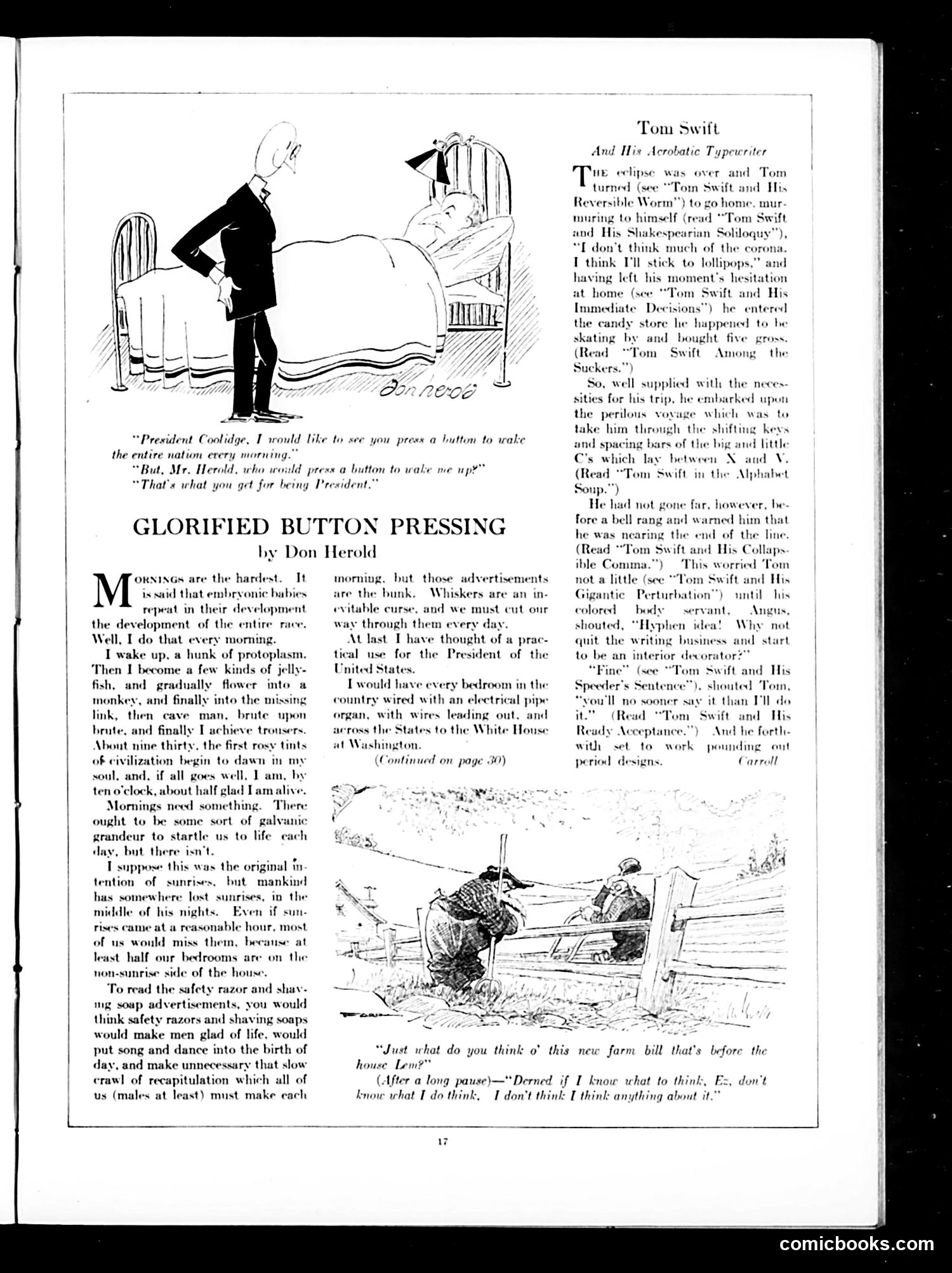
## "Glorified Button Pressing" (Don Herold) This satirizes President **Calvin Coolidge's** legendary laziness and lack of initiative. Herold proposes wiring every bedroom to the White House so Coolidge could press a button to wake the nation—a joke about the President being so inactive that even his sole function should be automated. The punchline plays on Coolidge's reputation: he won't even wake *himself* up. This reflects 1920s frustration with Coolidge's do-nothing presidency during a prosperous but complacent era. ## "Tom Swift and His Acrobatic Typewriter" A parody of the popular **Tom Swift adventure series**, mocking its absurdly overwrought titles. Rather than actual adventure, "Tom Swift" navigates a typewriter's mechanical parts (keys, spacing bars, carriage return) as if they were dangerous terrain. The final panel's farmer character embodies rural indifference to the legislative "farm bill"—satirizing both the pointlessness of Washington politics and rural America's apathy toward it.
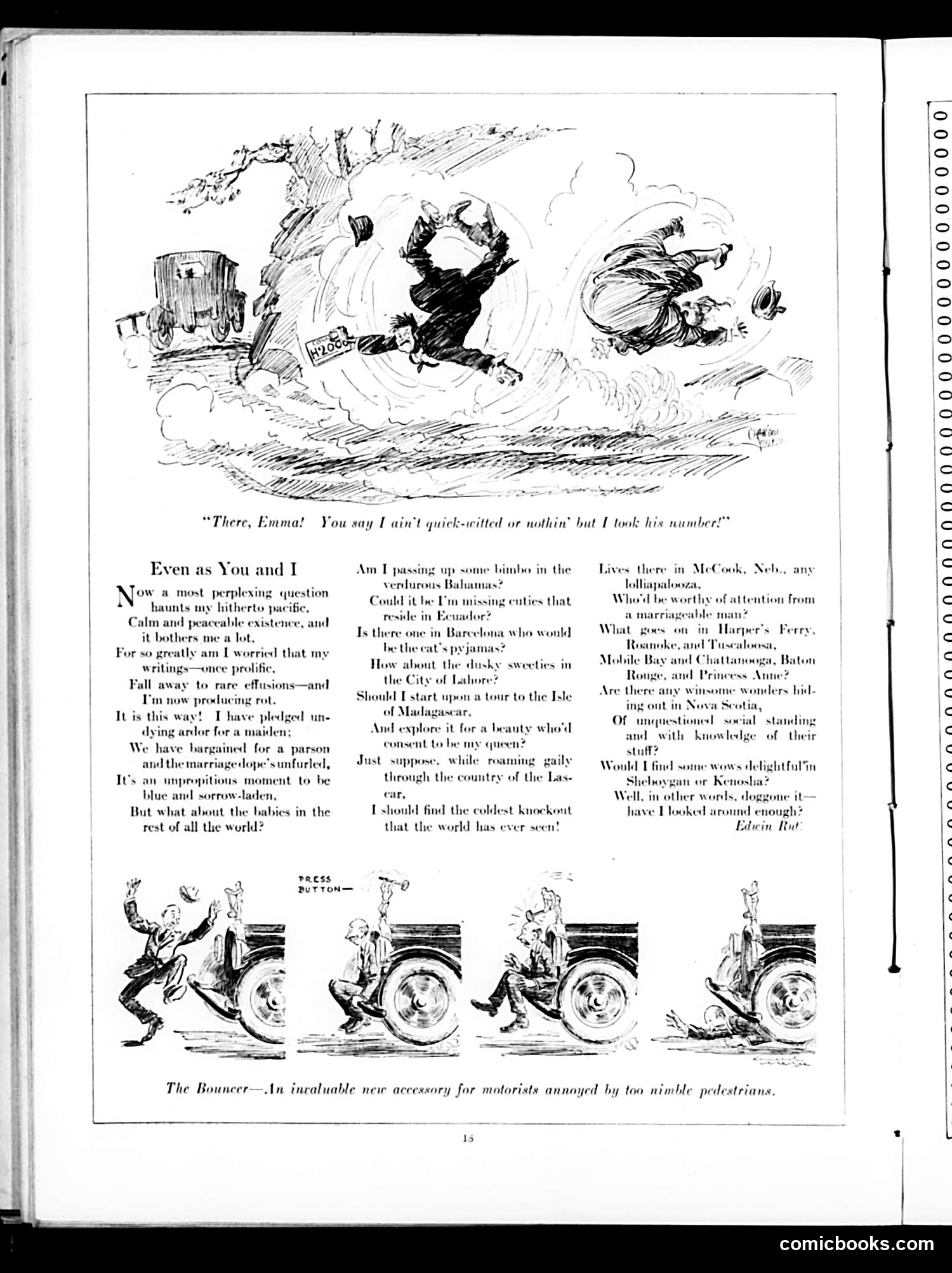
This Judge magazine page combines poetry and cartoons satirizing early 20th-century motorist culture. The top cartoon mocks pedestrians hit by cars—a woman tells "Emma" a driver hit her but at least she got his license number ("took his number"), suggesting pedestrian accidents were so common that documenting them was routine. The accompanying poem, "Even as You and I," humorously presents a man's existential crisis: he's engaged but worries he might be missing his perfect soulmate somewhere in exotic locations (Ecuador, Labrador, etc.). It's a playful critique of romantic anxiety and wanderlust. Below, "The Bouncer" cartoon strip depicts a man being repeatedly ejected from a car by its tire in a four-panel sequence. The caption notes this "bouncer" device is "an invaluable new accessory for motorists annoyed by too nimble pedestrians"—darkly satirizing how motorists viewed pedestrians as nuisances rather than people deserving protection. The humor relies on reversing sympathy: rather than protecting pedestrians, the device launches them away.
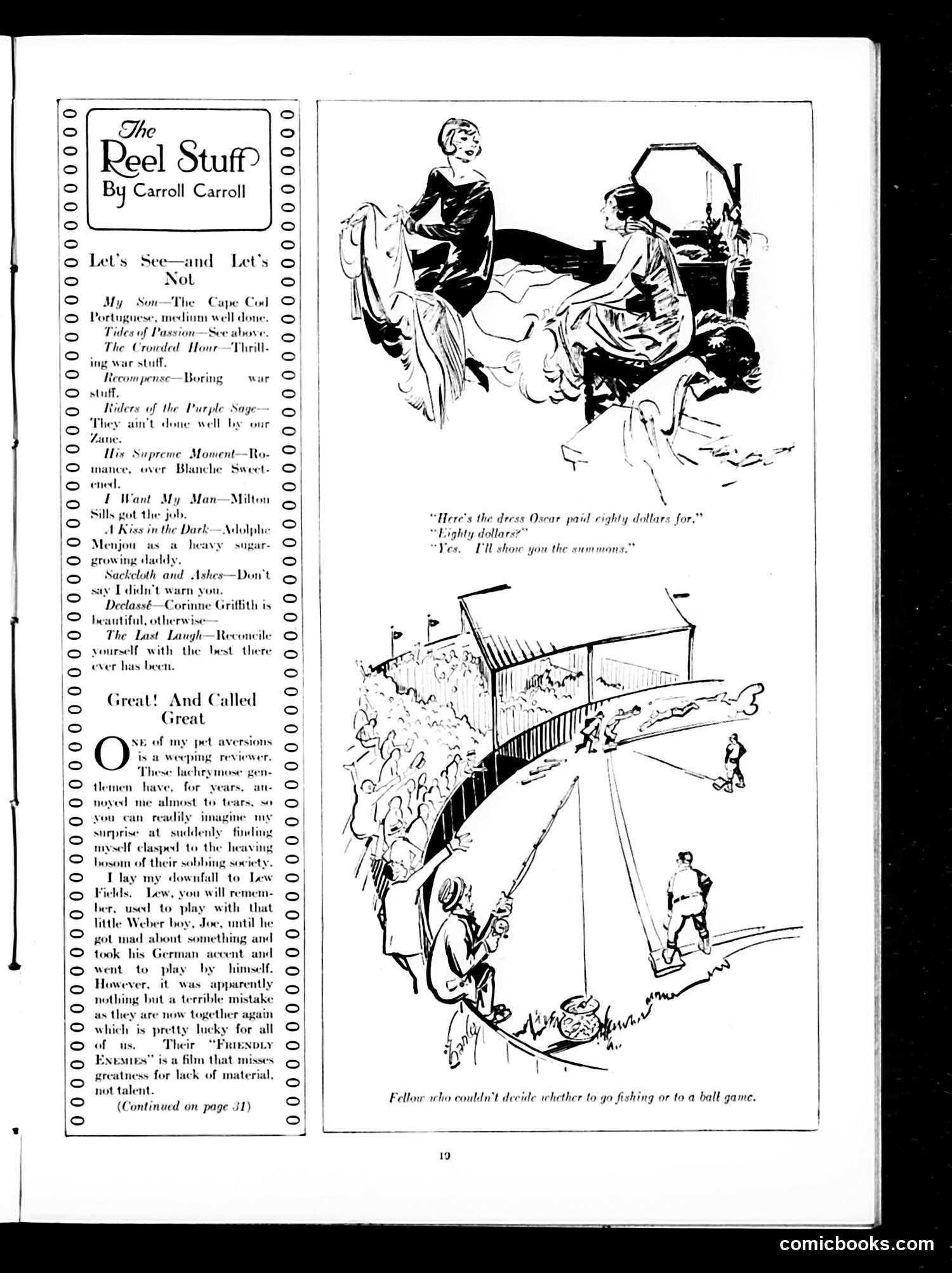
This page contains Carroll Carroll's film column reviewing contemporary movies, accompanied by a cartoon about indecision. The column discusses several films with their stars—*My Son*, *The Cape Cod Portuguese*, *The Crowded Hour*, and others featuring actors like Milton Sills, Adolphe Menjou, and Corinne Griffith (recognizable names to Judge's 1920s audience). The cartoon illustrates a man unable to choose between fishing and attending a ball game—a lighthearted commentary on modern leisure dilemmas. The dialogue joke about a dress costing "eighty dollars" appears to mock either extravagant fashion costs or possibly someone's gullibility in overpaying. The "Reel Stuff" column is essentially entertainment gossip and reviews for a magazine-reading public interested in early cinema and theatrical personalities of the era.
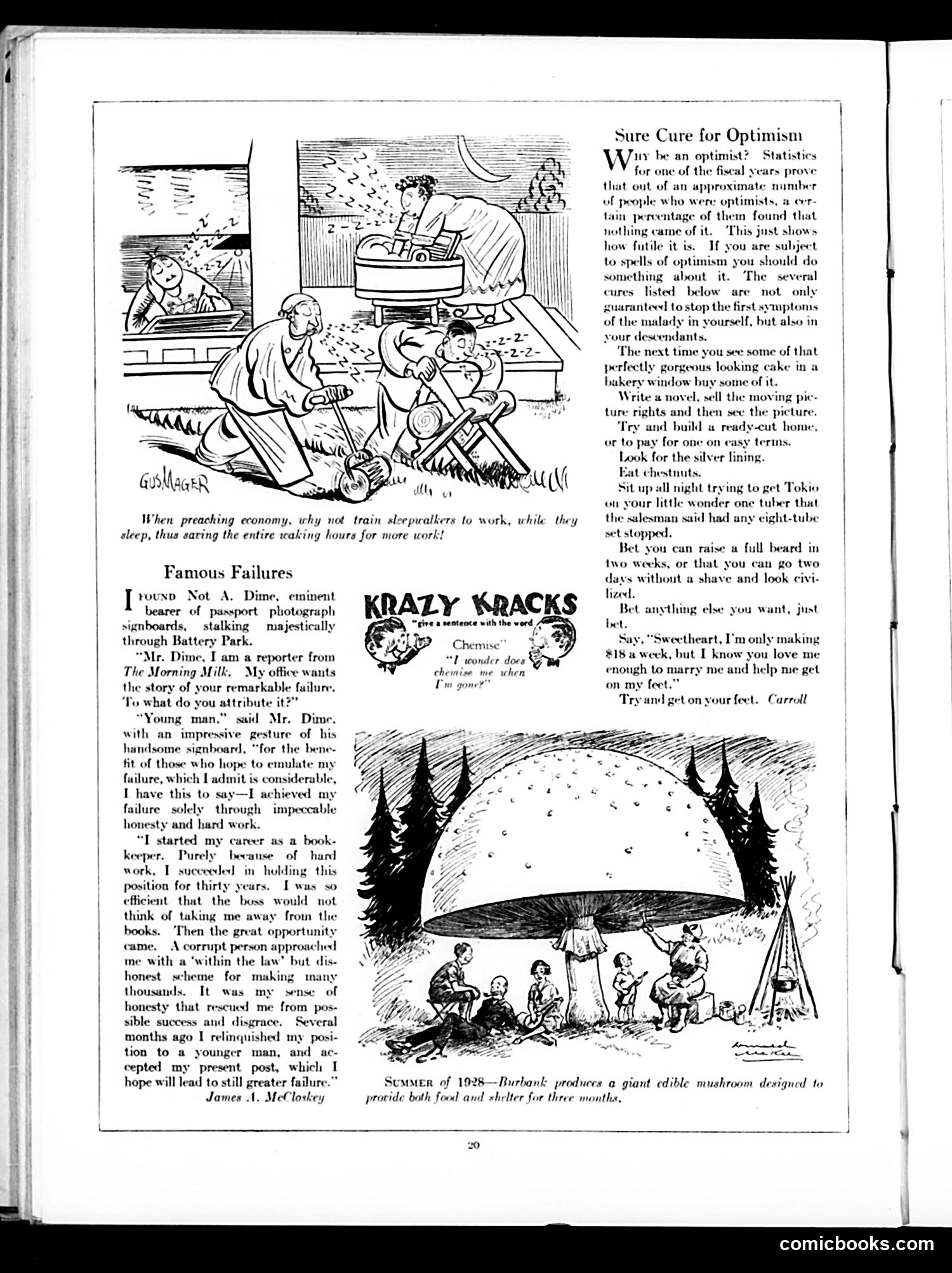
This page contains two satirical pieces mocking American optimism and work culture, likely from the 1930s Depression era. **"Famous Failures"** features an interview with "Not A. Dime," a man wearing a sandwich board (a common Depression-era form of advertising work). The satire is ironic: Dime claims his "failure" resulted from *honesty and hard work*—suggesting that in contemporary society, success actually requires dishonesty. His story (thirty years as a bookkeeper, then accepting a worse job) mocks how diligence and integrity lead nowhere. **"Sure Cure for Optimism"** lists deliberately futile activities to discourage hopefulness: writing unpublished novels, building homes you can't afford, raising beards, and proposing marriage on $18 weekly. The joke targets working-class desperation masked by false optimism. The bottom illustration shows people sheltering under a giant mushroom, captioned as practical food and shelter—a darkly absurd "solution" to Depression hardship. Together, these pieces satirize how economic failure punishes honest workers while mocking the "pull yourself up" mentality as delusional.
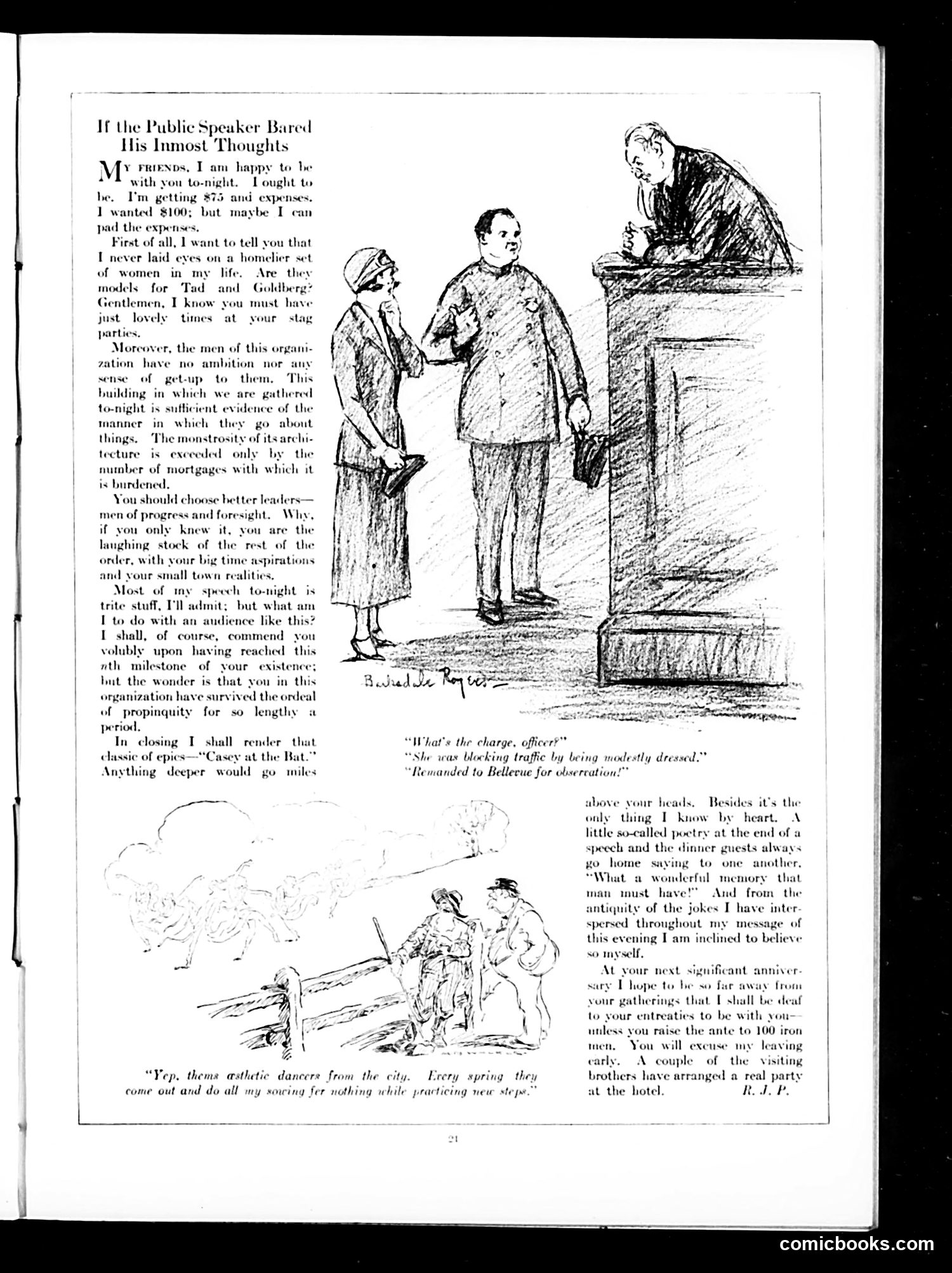
This satirical piece mocks the hypocrisy of after-dinner speakers. The speaker publicly claims honor at attending the event, then "bares" his actual thoughts: he's only there for money ($75 plus expenses, padded if possible), he finds the audience unattractive and culturally unsophisticated, and he'll bore them with recycled material like "Casey at the Bat" because he knows nothing else. The humor lies in exposing the gap between public speeches (flattery, inspiration) and private contempt. The accompanying cartoon showing the speaker at a podium with an uncomfortable audience visualizes this disconnect. A secondary cartoon jokes about a woman arrested for "blocking traffic by being modestly dressed"—likely satirizing either prudish attitudes or changing social standards around women's appearance. The reference to "Tad and Goldberg" (cartoonists) suggests commentary on contemporary humor styles. The piece critiques both self-serving speakers and the organizations that book them despite knowing better.
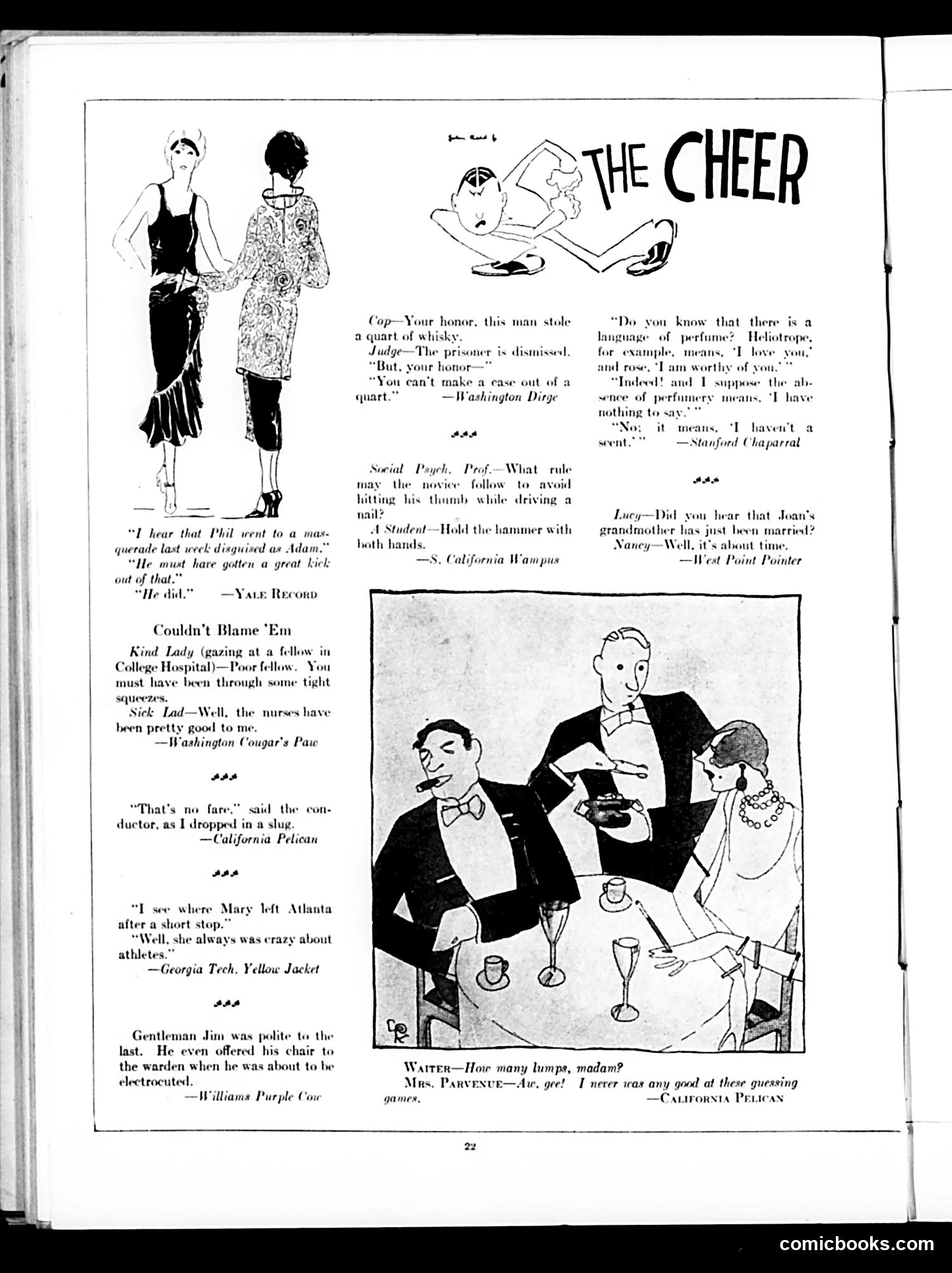
This is a collection of brief jokes and quips from college humor magazines, a common feature in Judge during the early-to-mid 20th century. The content reflects 1920s-era social attitudes: **Key jokes include:** - A masquerade costume joke playing on Adam/nudity implications - Hospital/nurse innuendo humor - A conductor rejecting a counterfeit coin ("slug") - References to athletes and romantic pursuits - A dark reference to an execution ("Gentleman Jim" and electrocution) - Perfume/flirtation banter - A grandmother getting married (surprise at late-life romance) - A waiter/sugar cubes joke with double meaning about "lumps" and guessing games The large illustration shows a formal dinner scene with a waiter serving drinks, likely accompanying the sugar-cubes joke below it. **The satire:** These are gentle, college-oriented comedies poking fun at social conventions, romance, and everyday mishaps—typical of Judge's lighter content aimed at educated, upper-middle-class readers.
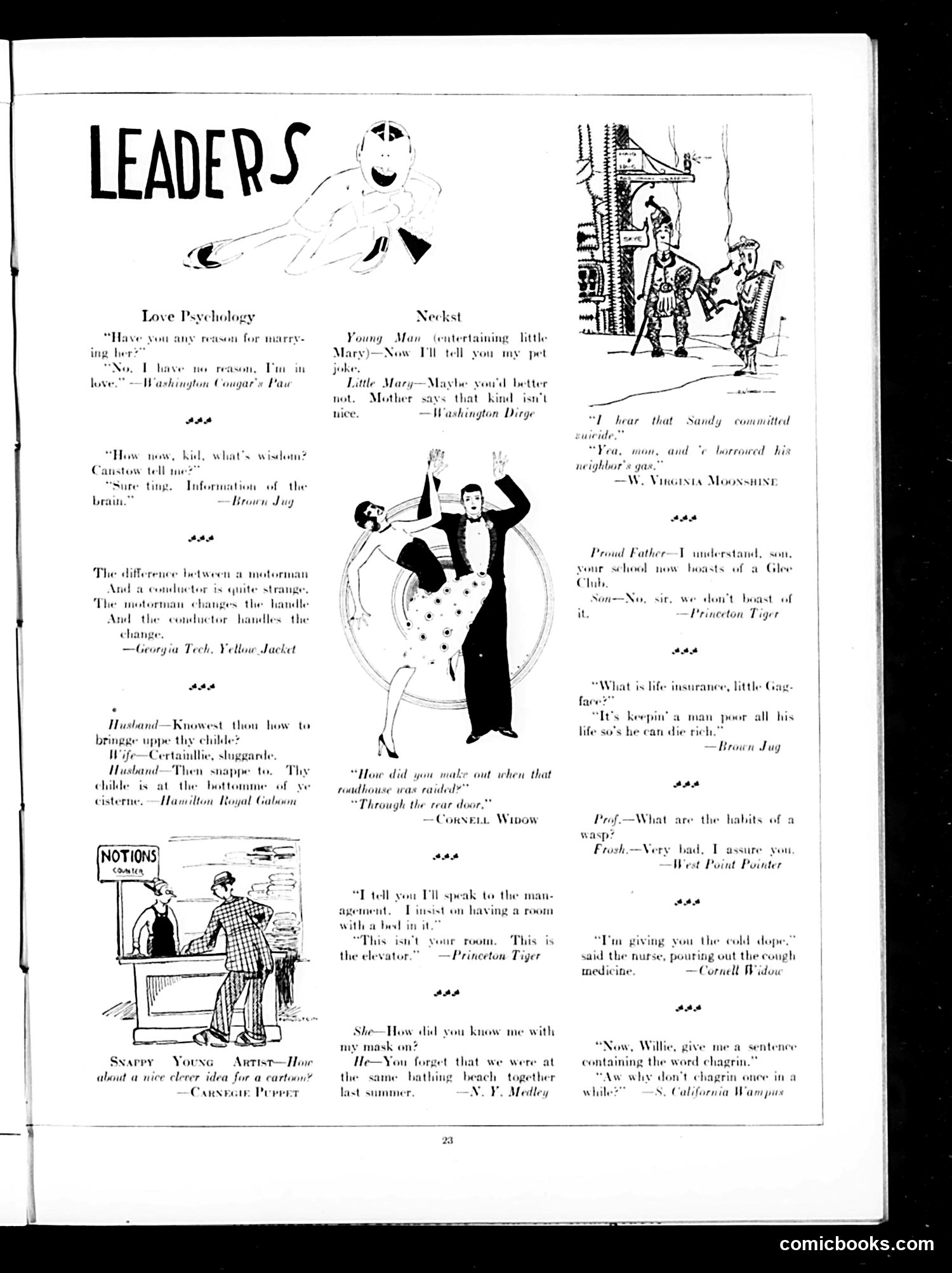
This page collects humorous quotations and brief jokes organized under the heading "Leaders"—likely meaning witty remarks or clever observations worth repeating. The content reflects early 20th-century college and social humor. Notable elements include: - **"Love Psychology"**: A young man jokes about having no reason to marry except being "in love"—satirizing romantic illogic. - **"Neckst"**: A pun playing on "neck" (slang for kissing/flirting), where a boy tells his friend a risqué joke about a girl named Mary. - **College references**: Multiple attributions to Princeton Tiger, Cornell Widow, and other college publications suggest this appeals to educated readers. - **Social satire**: Jokes about elevators, servants, bathing beaches, and motormen reflect urban American life of the era. - **Gender dynamics**: Several jokes center on courtship and wives' behavior toward husbands, typical of period humor. The cartoons accompanying the text appear to illustrate selected jokes visually. The overall tone is lighthearted social commentary rather than political satire.
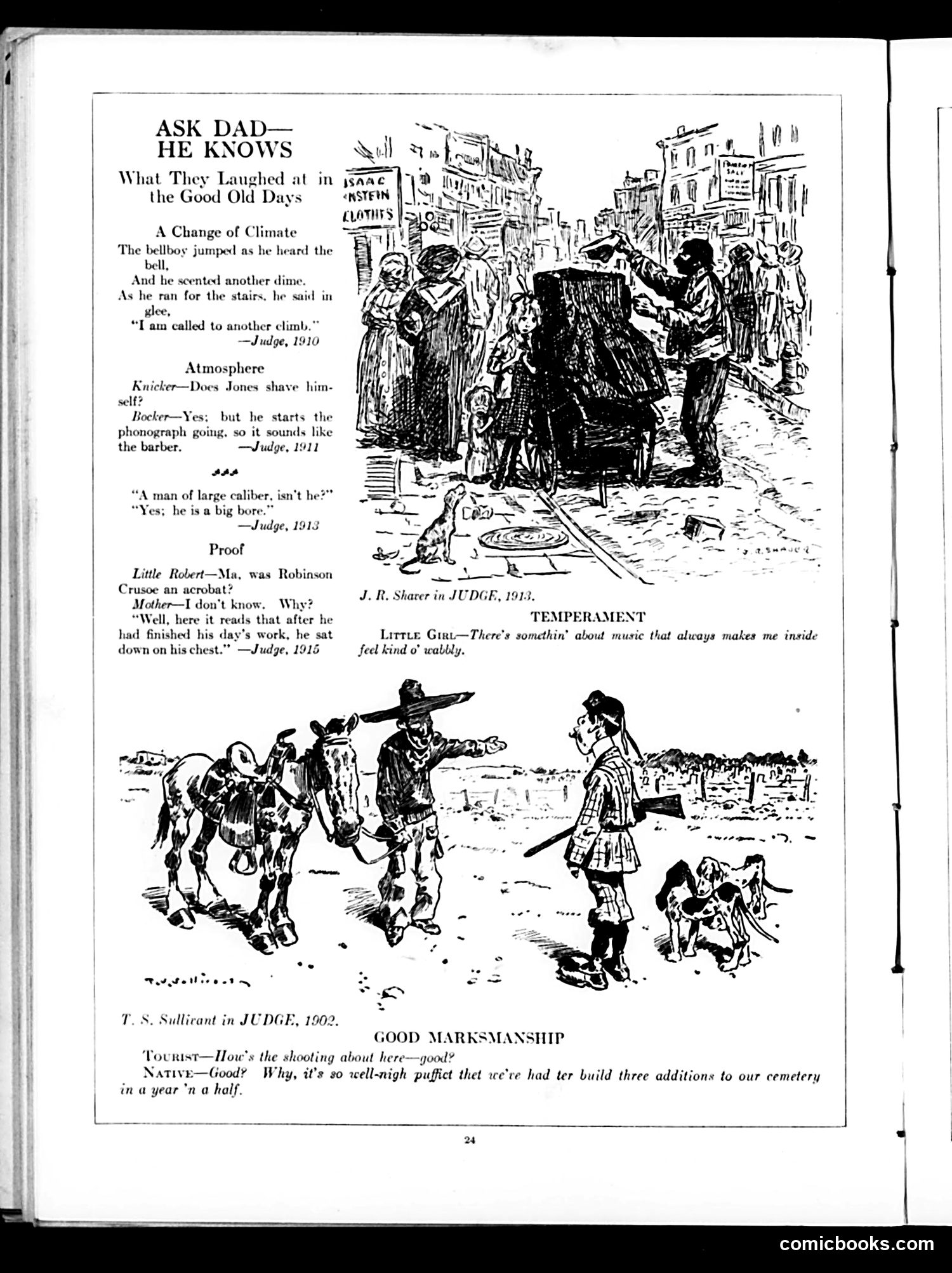
This page collects brief jokes and cartoons from Judge magazine spanning 1902-1915. The content reflects early 20th-century American humor styles: **"Ask Dad—He Knows"** presents nostalgic anecdotes about "the good old days"—simple jokes about bellhops, phonographs, and wordplay that older readers would remember finding amusing. **The illustrated cartoons** include: - A street scene (artist J.R. Shaver) depicting urban life - A Western scene (T.S. Sullivant) where a Native American boasts that their town's shooting is so accurate they've had to expand the cemetery three times in 18 months—dark humor about frontier violence and marksmanship **"Temperament"** shows a young girl claiming music makes her feel "weaky"—likely satirizing sentimental or affected emotional responses. The page exemplifies Judge's formula: mixing dated wordplay, ethnic humor, and satirical observations about contemporary American life. Much relies on period-specific references and sensibilities modern readers would find unfamiliar or uncomfortable.
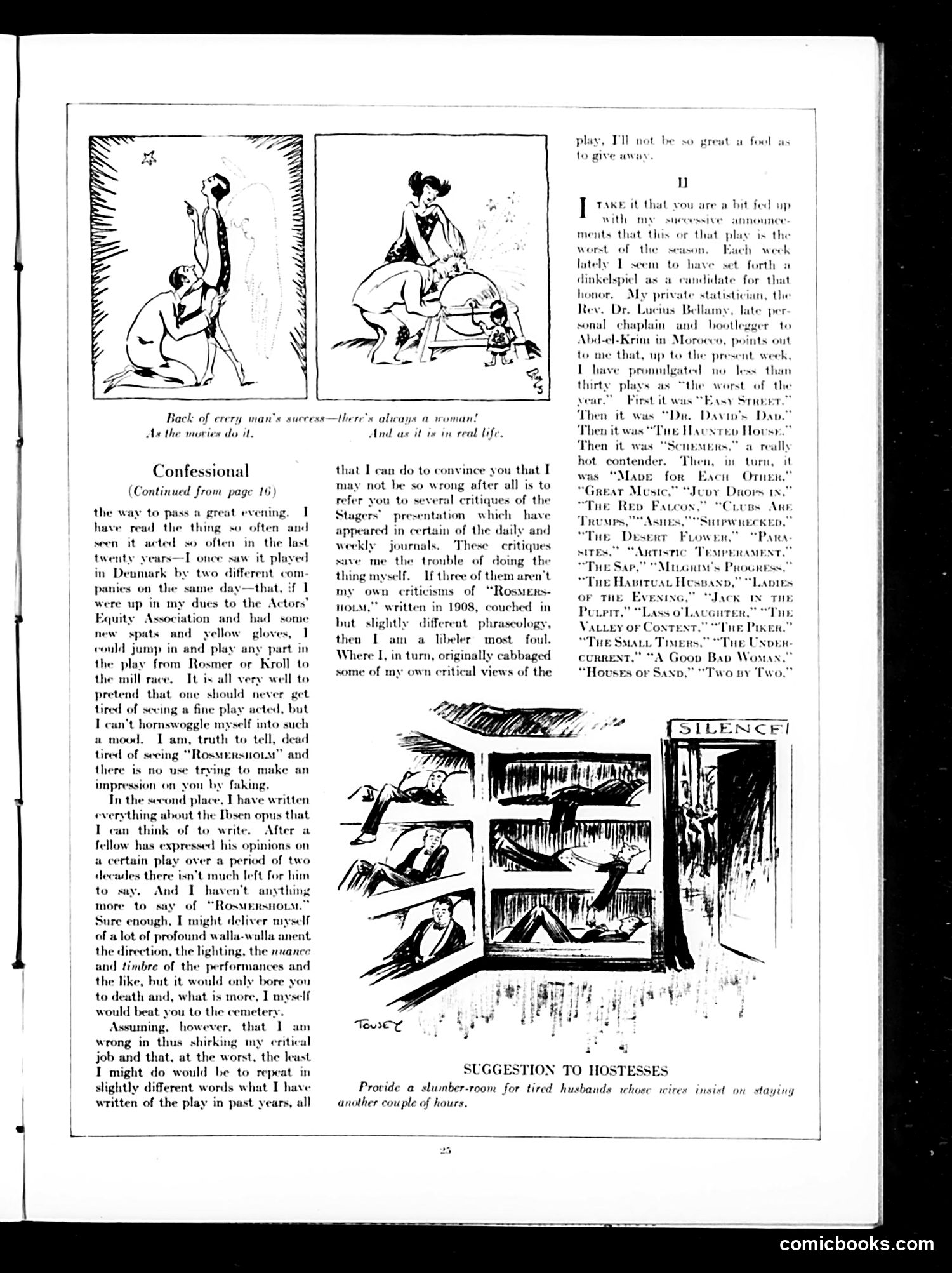
This page contains a theater critic's column defending his decision not to review another production of Ibsen's *Rosmersholm*. The critic argues he's already written exhaustively about the play over decades and that contemporary reviews essentially repeat his 1908 criticism—implying either his original insights were so comprehensive they're now clichéd, or that modern critics lack originality. The top illustrations show a woman behind a man's success, reflecting the column's opening caption about female influence. The main cartoon titled "SUGGESTION TO HOSTESSES" depicts wives forcing husbands to endure lengthy social engagements. It satirizes domestic dynamics of the era: wives' social ambitions versus husbands' exhaustion. The "slumber-room" suggestion is satirical advice—a humorous acknowledgment that men found such gatherings tedious and needed escape. Both elements reflect early 20th-century gender dynamics and social expectations around entertainment and domestic life.
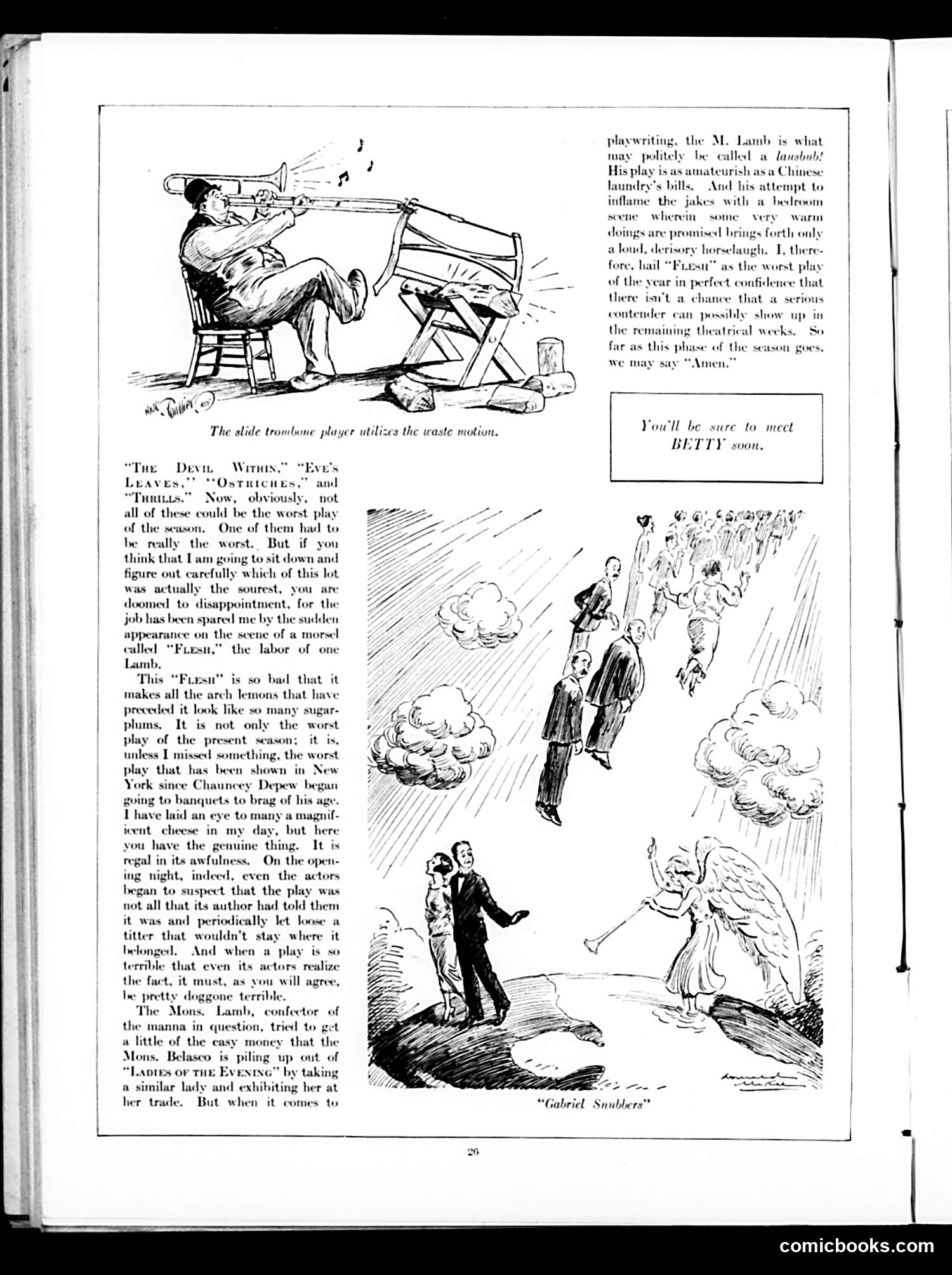
This page discusses theatrical criticism, specifically attacking a play called "Flesh" by M. Lamb. The critic sarcastically compares it to other terrible productions, claiming it's the worst play shown in New York since Chauncey Depew (a real politician known for giving long banquet speeches) started bragging about his age. The cartoon at top shows a slide trombone player seated awkwardly—a visual joke about "waste motion," likely satirizing inefficient stagecraft or acting. The bottom illustration titled "Gabriel Snubbers" depicts what appears to be a theatrical scene with angels and mortals, though its specific satirical meaning isn't clear from this context alone. The critic mocks playwright Lamb's amateurish writing (comparing it to "Chinese laundry bills") and his attempt to copy producer David Belasco's successful formula with "Ladies of the Evening" by using a similar female lead. The satire targets both the play's failure and Lamb's transparent commercial imitation.
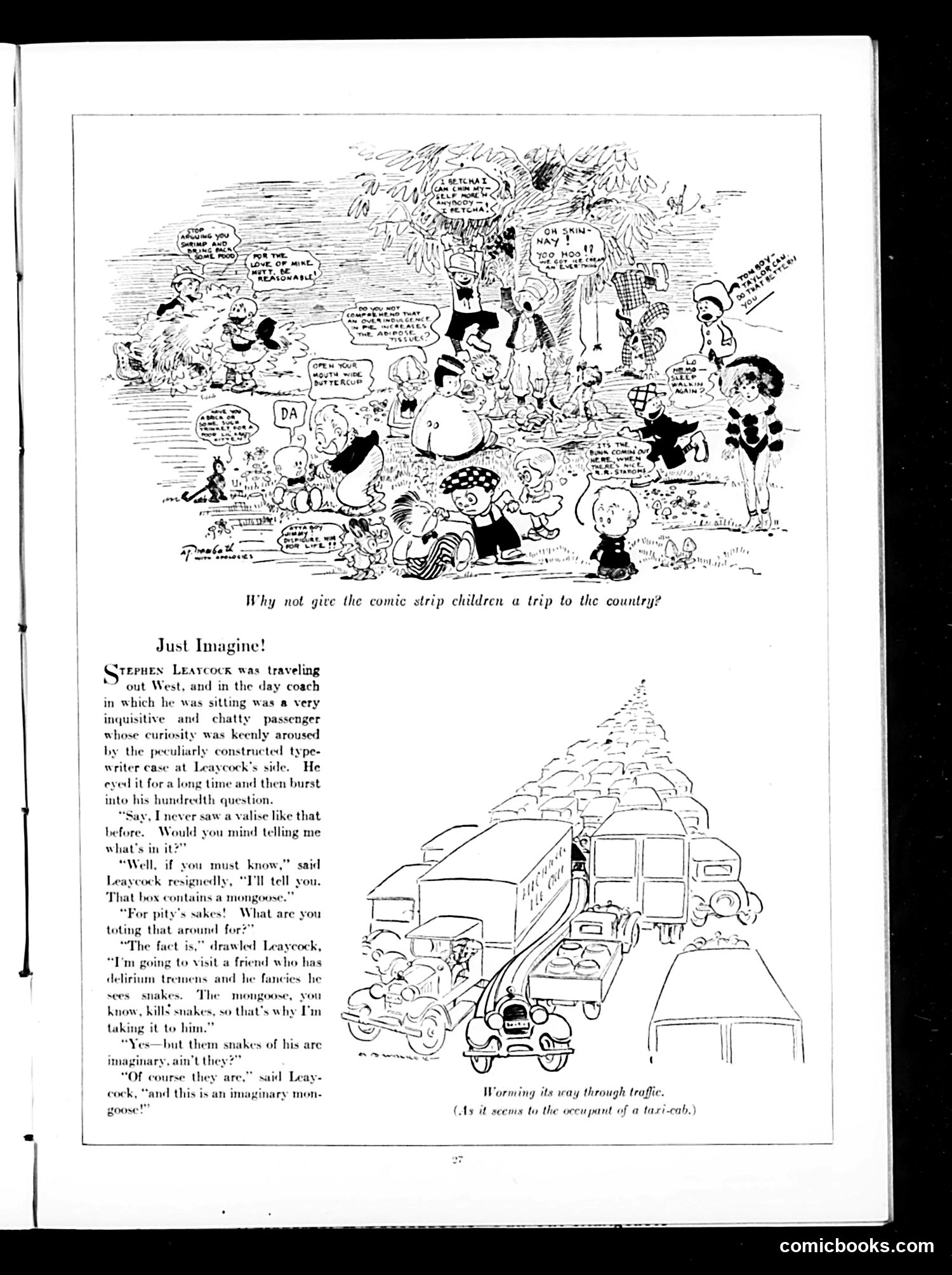
This page satirizes the imaginary world of comic strip children through a framing story featuring Stephen Leacock (a real Canadian humorist/writer). The top cartoon shows idealized comic strip children on a country outing—referencing popular newspaper comics of the era. The narrative below uses Leacock as the vehicle for humor: a nosy passenger on a train notices his typewriter and grows increasingly baffled by his explanations. Leacock claims to visit a friend with "delirium tremens" who imagines snakes, and he's bringing an imaginary mongoose to kill imaginary snakes. The absurdist punchline—"this is an imaginary goose"—plays on the passenger's literal-mindedness versus Leacock's creative imagination. The bottom illustration shows a truck navigating traffic "as it seems to the occupant of a taxi-cab," depicting an exaggerated perspective. **The satire**: Judges at imaginative thinking and the gulf between practical minds and creative ones, suggesting comic strip creators inhabit imaginative worlds ordinary people find bewildering.
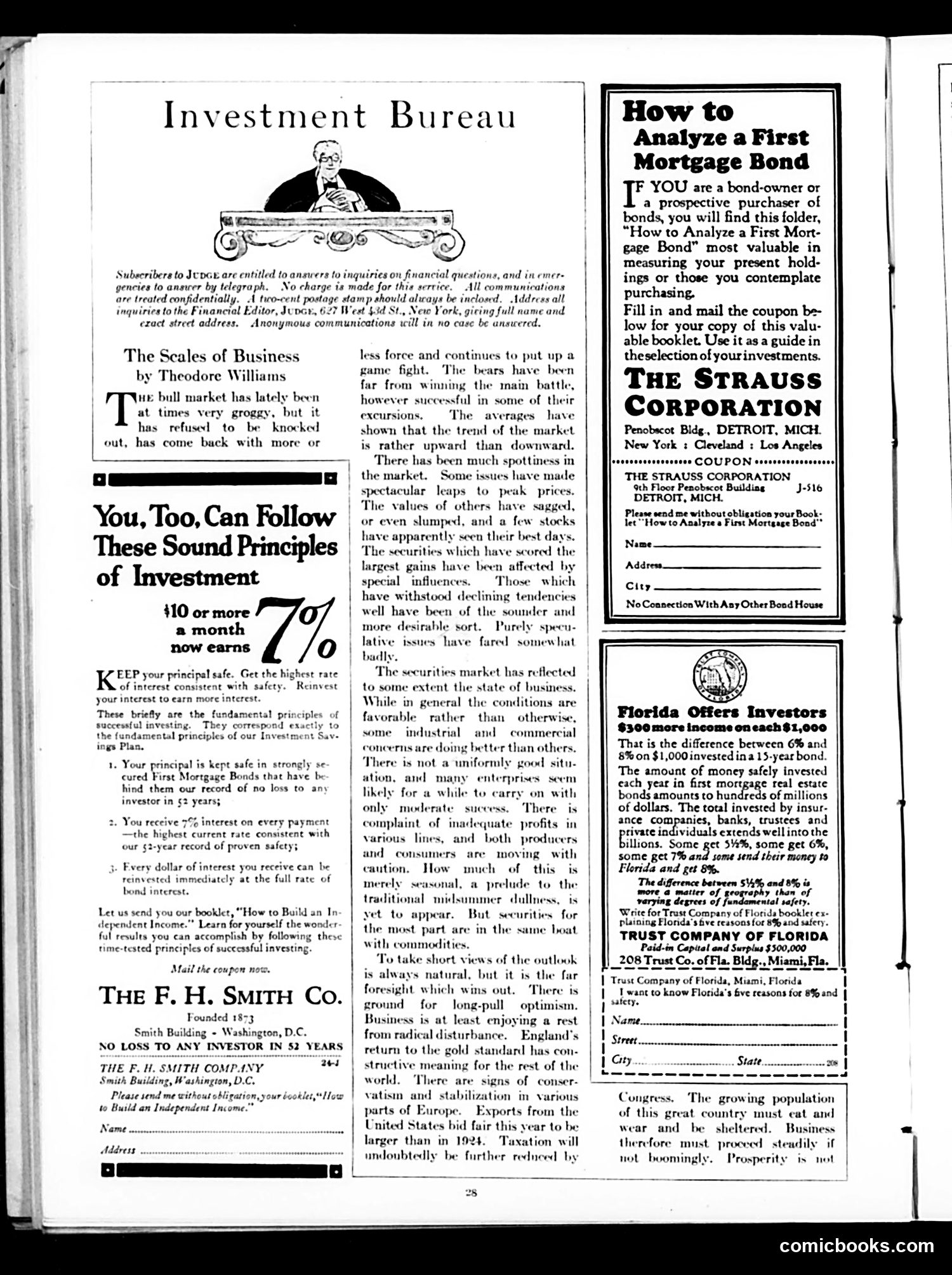
This page is primarily **financial advertising and investment advice**, not political satire. The Judge magazine's "Investment Bureau" section offers guidance on stock market investing and bond purchases. The main article, "The Scales of Business" by Theodore Williams, discusses the recent bull market's resilience despite some volatility. Williams argues that while some stocks have declined, the overall market trend remains upward, and securities are fundamentally sound because they reflect broader business conditions—which he characterizes as stable if not booming. The advertisements below promote investment schemes: F.H. Smith Company (promising "no loss to any investor in 52 years") and the Strauss Corporation (offering mortgage bond analysis). The Trust Company of Florida advertises bonds yielding higher income. **Context for modern readers**: This reflects 1920s optimism about "sound" investing and steady returns—the pre-1929 crash mentality. The repeated emphasis on safety and conservative principles masks speculative fever that would soon collapse.
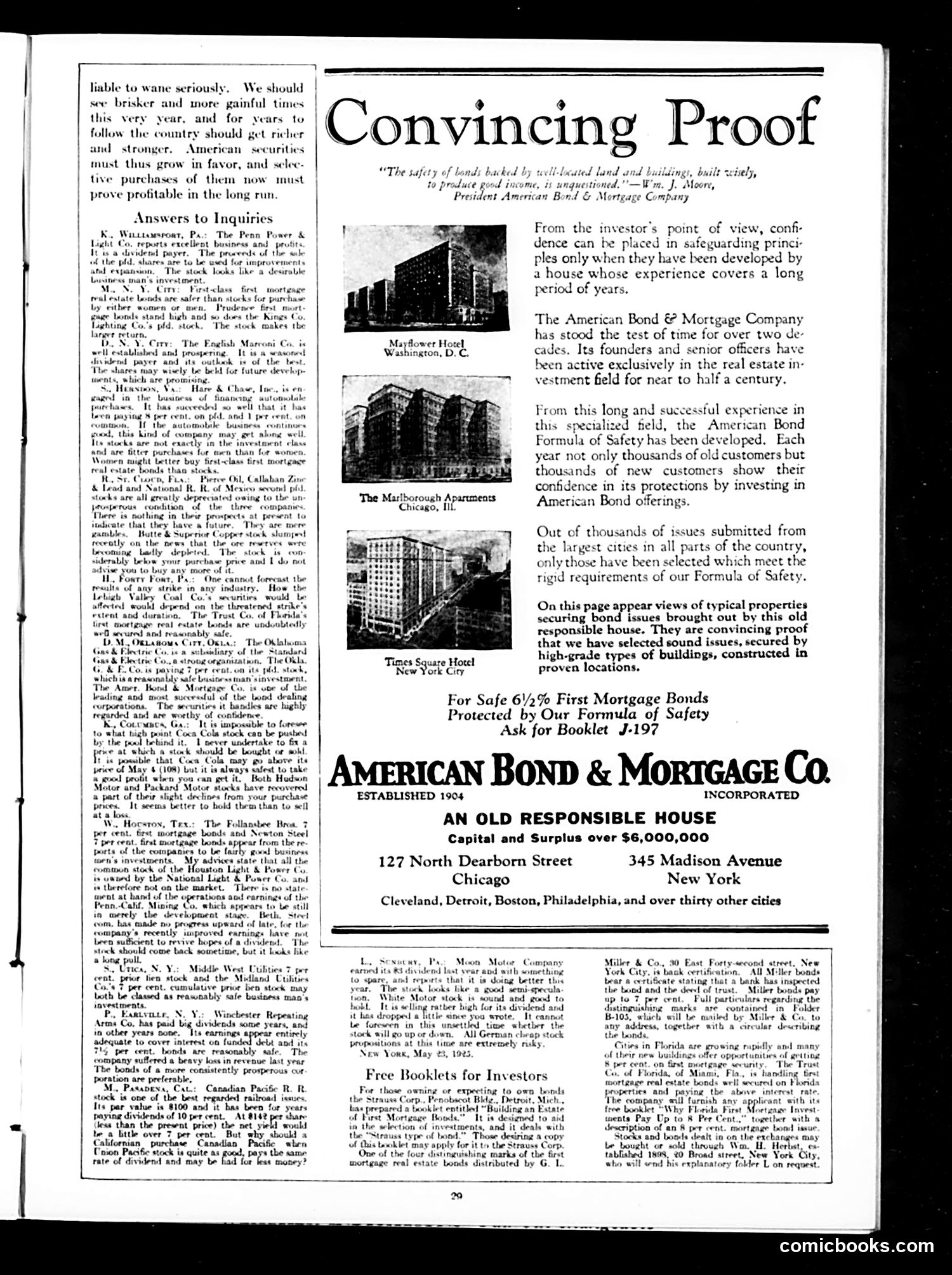
This page is **primarily an advertisement**, not a political cartoon. It features the American Bond & Mortgage Company promoting their mortgage bond offerings, with images of three prominent buildings: the Mayflower Hotel (Washington, D.C.), the Marlborough Apartments (Chicago), and the Times Square Hotel (New York City). The left column contains an "Answers to Inquiries" section—investment advice responding to reader questions about various stocks and bonds, addressing concerns about industries like automobiles, copper mining, and railroads. **No satire or political cartoon is present.** This appears to be a standard Judge magazine page from the early 1900s (the company was established 1904) mixing financial editorial content with corporate advertising. The "convincing proof" is simply the listed successful real-estate projects demonstrating the company's reliability to investors. The page reflects early-20th-century investment culture and confidence in industrial/commercial expansion.
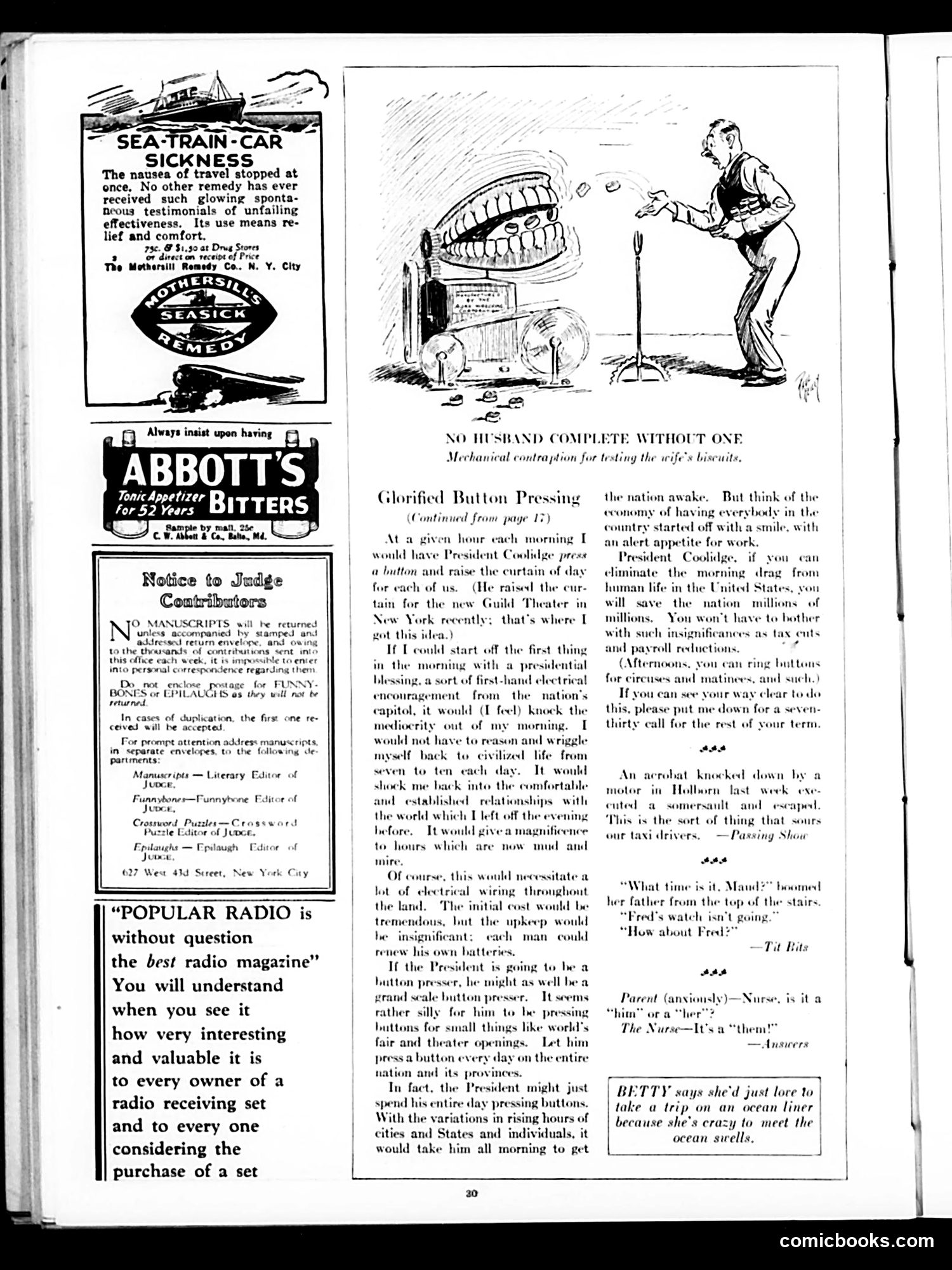
This page contains mixed content: advertisements, editorial notices, and a single cartoon. **The Main Cartoon** ("No Husband Complete Without One") shows a man using a mechanical device to test his wife's biscuits. The caption describes it as a "mechanical contraption for testing the wife's biscuits." This is domestic satire mocking the early 20th-century trend of gadgetry and "labor-saving" devices—here absurdly applied to marriage. The joke targets both the proliferation of unnecessary inventions and traditional gender roles (the wife's cooking being a husband's concern worthy of mechanical intervention). **Surrounding Content:** The page is dominated by period advertisements (Mothersill's seasickness remedy, Abbott's Bitters) and a long article titled "Glorified Button Pressing" discussing President Coolidge pressing buttons to raise curtains and start the day for citizens—a satirical proposal about presidential power and efficiency. The humor assumes readers familiar with 1920s consumer culture, domestic expectations, and contemporary political figures like Coolidge.
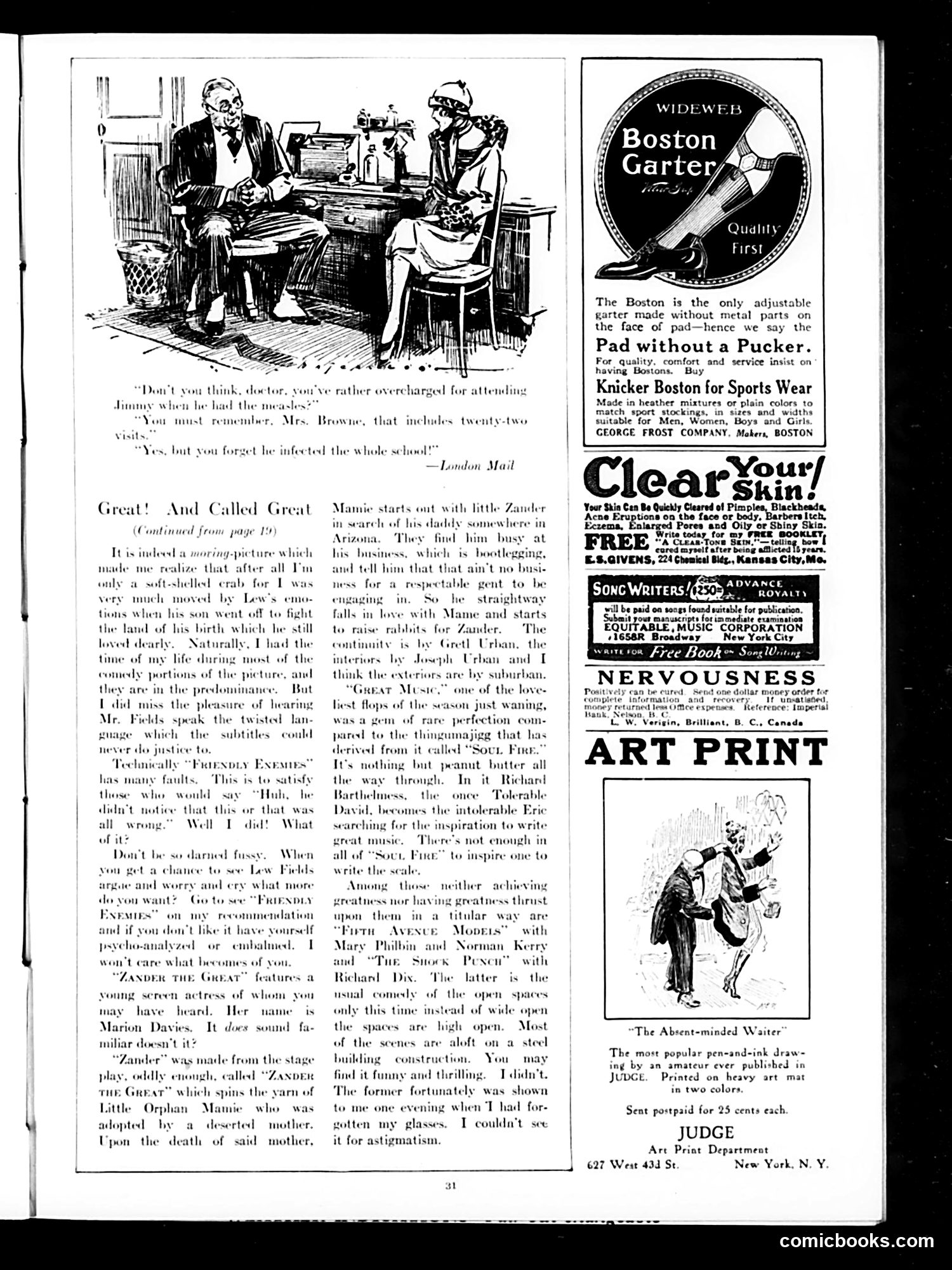
This page is primarily **advertising and serialized fiction**, not political satire. The main illustrated cartoon (top left) shows a doctor-patient interaction: a woman confronts her physician about overcharging for treating her children's measles, sarcastically noting he "infected the whole school"—a dark joke about the doctor's medical incompetence spreading disease. The page continues serialized film criticism ("Great! And Called Great"), reviewing silent movies featuring Lew Fields, Marion Davies, and Richard Barthelmess. The critic discusses 1920s cinema production values and acting styles. The right column contains vintage **advertisements**: Boston Garter (elastic stockings), acne treatments, song-writing royalties, and an art print service. The "Art Print" illustration shows "The Absent-minded Waiter"—a humorous pen-and-ink drawing available from Judge's art department for 25 cents postpaid. This reflects Judge's mixed format: satirical commentary alongside entertainment reviews and commercial advertising.
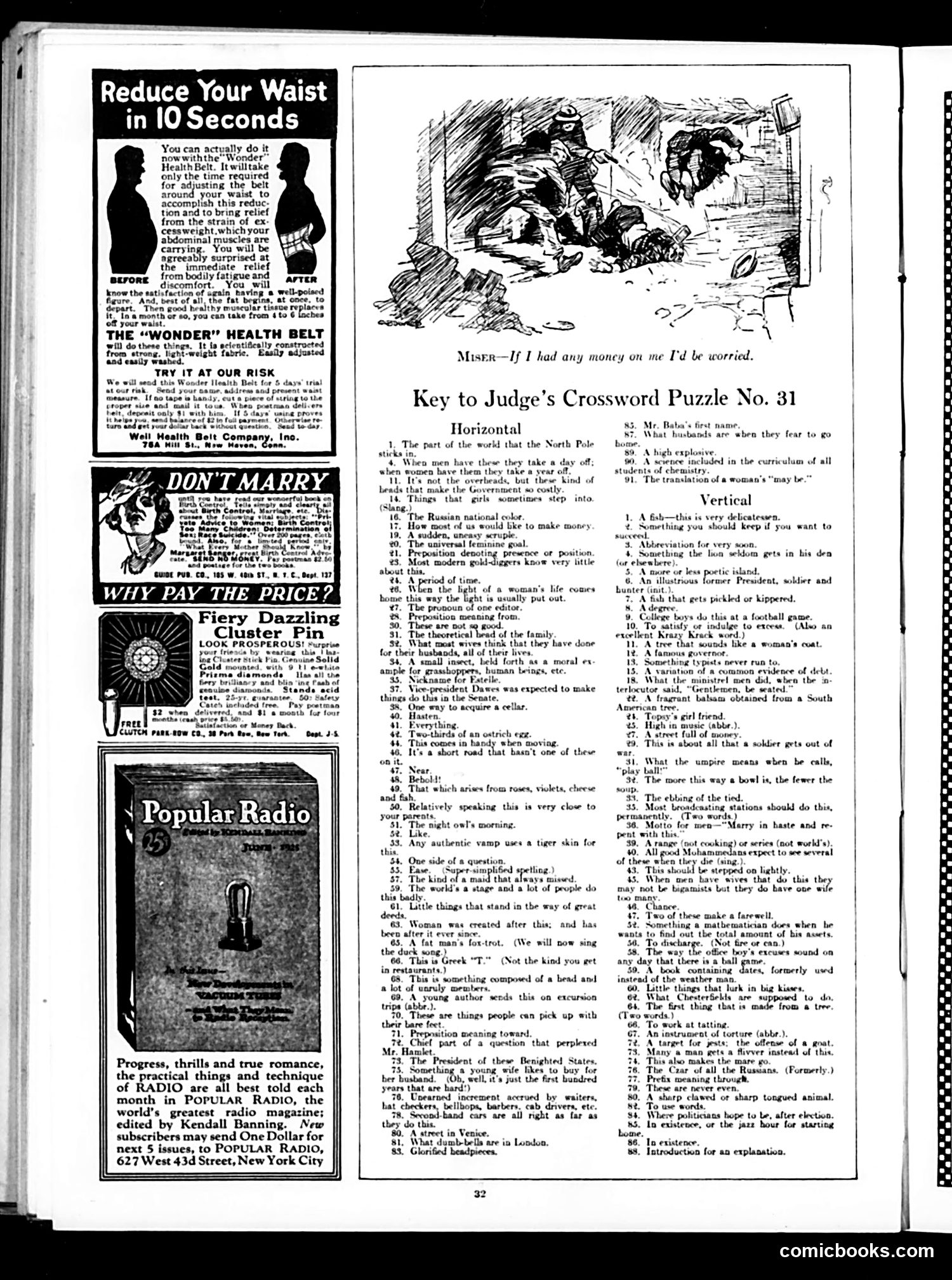
This page is primarily **advertisements and filler content** rather than political satire. The main elements include: **Advertisements:** - "Wonder Health Belt" (waist reduction device) - "Don't Marry" pamphlet (appears to promote birth control) - "Fiery Dazzling Cluster Pin" (jewelry) - Popular Radio magazine subscription **Cartoon:** A small illustration labeled "Miser" depicts what appears to be a poor or homeless person in squalid conditions—satirizing miserliness and poverty. **Crossword Puzzle:** The bulk of the page contains clues for "Judge's Crossword Puzzle No. 31," featuring wordplay typical of 1920s humor (references to flappers, wives, politicians like Vice-President Dawes). The content reflects 1920s concerns: consumer products, emerging birth control discussion, radio's popularity, and domestic humor. The page demonstrates Judge's mixed editorial/commercial format rather than focused political commentary.
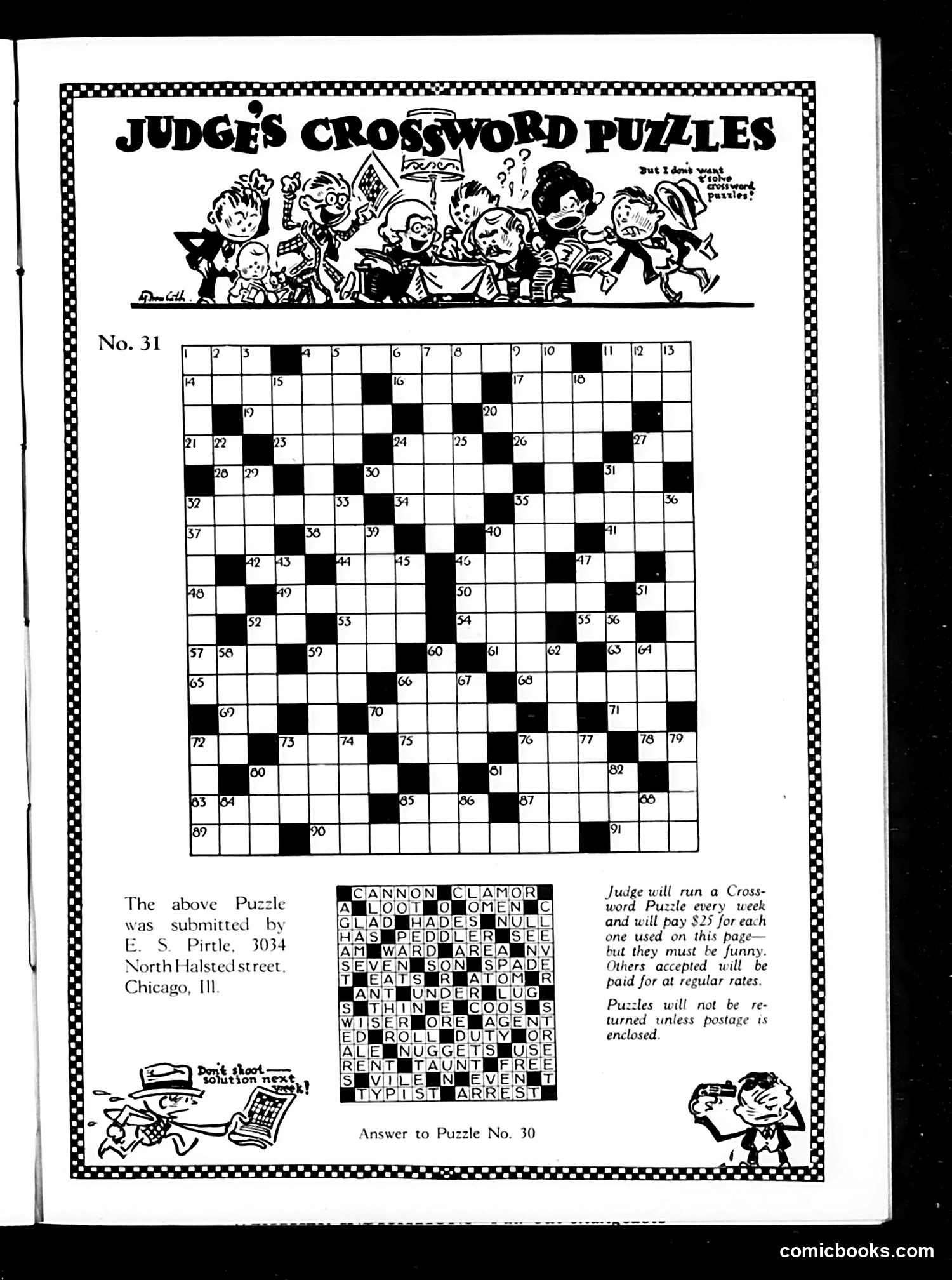
This page is primarily a **crossword puzzle submission feature**, not political satire. The cartoon header shows children excitedly engaged with puzzles, with one asking "But I don't want a crossword puzzle!"—a humorous contradiction. The content announces Judge's weekly crossword puzzle contest, offering $25 payment for funny puzzles published on this page, with regular rates for accepted non-funny submissions. A completed sample puzzle ("Answer to Puzzle No. 30") is displayed as reference. The submission credit goes to E.S. Pirtle of Chicago. Small cartoon illustrations of puzzle-solvers appear in the margins—typical Judge decoration emphasizing the playful nature of the feature. This represents how early 20th-century magazines used crosswords as interactive reader engagement, paying contributors while building audience participation. No specific political or social satire is evident on this page.
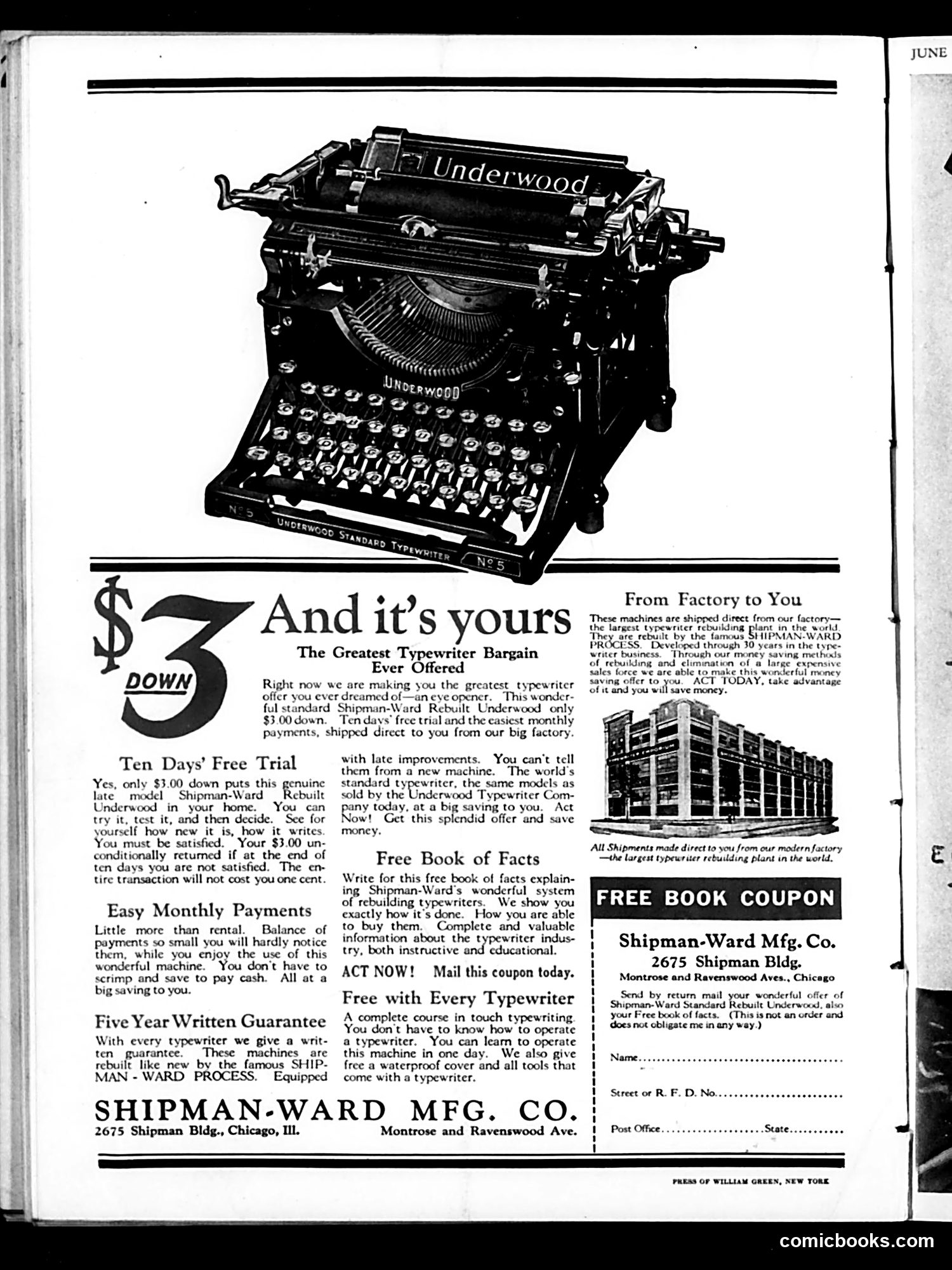
This is a **full-page advertisement**, not political satire or cartoon content. It promotes Shipman-Ward Manufacturing Company's rebuilt Underwood typewriters. **The Pitch:** The company sells refurbished standard Underwood typewriters (the industry standard) at bargain prices—$3 down with easy monthly payments—by eliminating the middleman and shipping "direct from our factory" to consumers. **Key selling points advertised:** - Ten-day free trial - Five-year written guarantee - Machines rebuilt to appear "like new" through their proprietary process - Free typing course and accessories included - "Factory to You" eliminates expensive sales forces **Historical Context:** This reflects early 20th-century consumer capitalism—making formerly expensive equipment accessible through installment buying and direct sales. The emphasis on rebuilt/refurbished goods was common during economically uncertain periods. **For modern readers:** This is essentially the Depression-era equivalent of today's discount direct-to-consumer sales pitches, emphasizing affordability and eliminating retailer markups.