
Judge, 1925-05-30 · page 22 of 36
Judge — May 30, 1925 — page 22: what you’re looking at
What you’re looking at
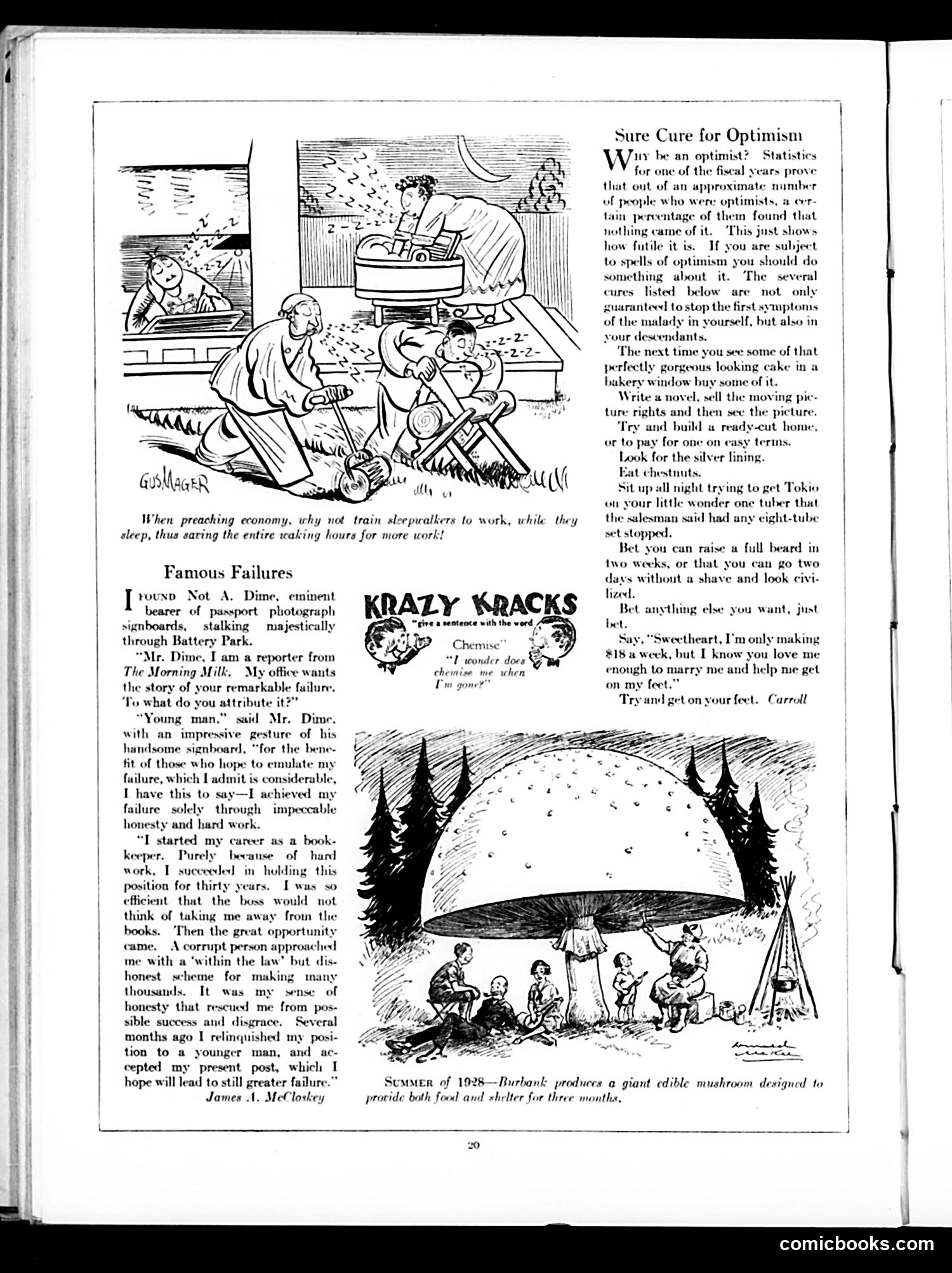
This page contains two satirical pieces mocking American optimism and work culture, likely from the 1930s Depression era. **"Famous Failures"** features an interview with "Not A. Dime," a man wearing a sandwich board (a common Depression-era form of advertising work). The satire is ironic: Dime claims his "failure" resulted from *honesty and hard work*—suggesting that in contemporary society, success actually requires dishonesty. His story (thirty years as a bookkeeper, then accepting a worse job) mocks how diligence and integrity lead nowhere. **"Sure Cure for Optimism"** lists deliberately futile activities to discourage hopefulness: writing unpublished novels, building homes you can't afford, raising beards, and proposing marriage on $18 weekly. The joke targets working-class desperation masked by false optimism. The bottom illustration shows people sheltering under a giant mushroom, captioned as practical food and shelter—a darkly absurd "solution" to Depression hardship. Together, these pieces satirize how economic failure punishes honest workers while mocking the "pull yourself up" mentality as delusional.
📄 Transcribed text from this page (OCR, searchable)
Machine-transcribed from the original scan — historical spelling and the odd misread are preserved.
When preaching economy, why not train sleepwalkers to work, while they sleep, thus saving the entire waking hours for more work! Famous Failures rounp Not A. Dime, eminent bearer of passport photograph signboards, stalking majestically through Battery Park. “Mr. Dime, I am a reporter from The Morning Milk. My office wants the story of your remarkable failure. ‘To what do you attribute it?” “Young man,” said Mr. Dime, with an impressive gesture of his handsome signboard, “for the bene- fit of those who hope to emulate my failure, which I admit is considerable, I have this to say—I achieved my failure solely through impeccable honesty and hard work. “I started my career as a book- keeper. Purely because of hand work, T succeeded in holding this ition for thirty years. I was so ent that the bess would not think of taking me away from the books. ‘Then the great opportunity came. A corrupt person approached me with a ‘within the law’ but dis- honest scheme for making many thousands. It was my sense of honesty that rescucd me from pos- sible success and disgrace. Several months ago I relinquished my posi- tion to a younger man, and ac- cepted my present post, which I hope will lead to still greater failure.” James A. McCloskey KRAZLY KRACKS “give a sentence with the w Summer of 192 Sure Cure for Optimism Ww he an optimist? Statistics for one of the fiscal years prove that out of an approximate number of people who were optimists, a cer- fain percentage of t! found that nothing came of it. ‘This just shows how futile it is. If you are subject to spells of optimism you should do something about it. The several cures listed below are not’ only guarantee] to stop the first symptoms of the malady in yourself, but also in your descendants. ‘The next time you see some of that perfectly gorgeous looking cake in a bakery window buy some of Write a novel, sell the mo ture rights and then see the picture. Try and build a ready-cut home, or to pay for o1 a Look for the t chestnuts. Sit up all night trying to get Tokio on your little wonder one tuber that th Jesman said had any eight-tube set stopped. Bet you can raise a full beard in two weeks, or that you can go two days without a shave and look civi- lized. Bet anything else you want, just bet. Say Sweetheart, I'm only making 818 a week, but I know you love me enough to marry me and help me get on my fect.” Try and geton your feet. Carroll —Burbank produces a giant edible mushroom designed to provide both food and shelice for three months, comicbooks.com