
A complete issue · 36 pages · 1925
Judge — May 2, 1925
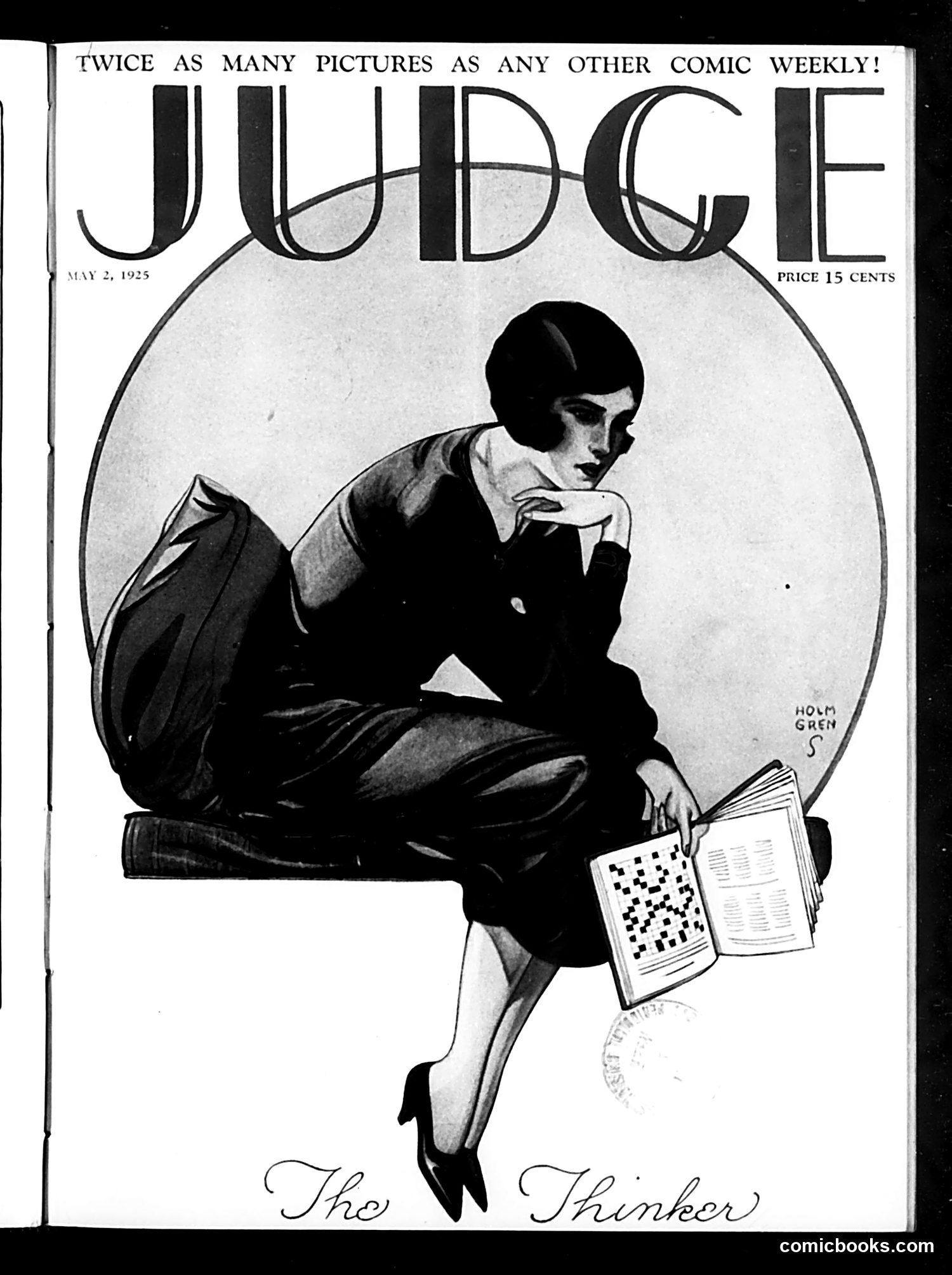
This cover illustrates "The Thinker"—a woman in 1920s attire absorbed in solving a crossword puzzle. The illustration satirizes the era's craze for crossword puzzles, which had become a widespread popular pastime among the American public. The woman's contemplative pose mirrors Rodin's famous sculpture, elevating a trivial activity to mock-heroic status. Her accessories—a newspaper and crossword magazine—emphasize her complete absorption in this leisure activity rather than serious intellectual pursuits. The satire targets how crossword puzzles captivated the nation during the mid-1920s, often to the exclusion of more substantive concerns. Judge uses the ironic comparison to Rodin's philosophical "Thinker" to humorously critique this cultural obsession, suggesting Americans were devoting serious mental energy to what the magazine considers frivolous entertainment.
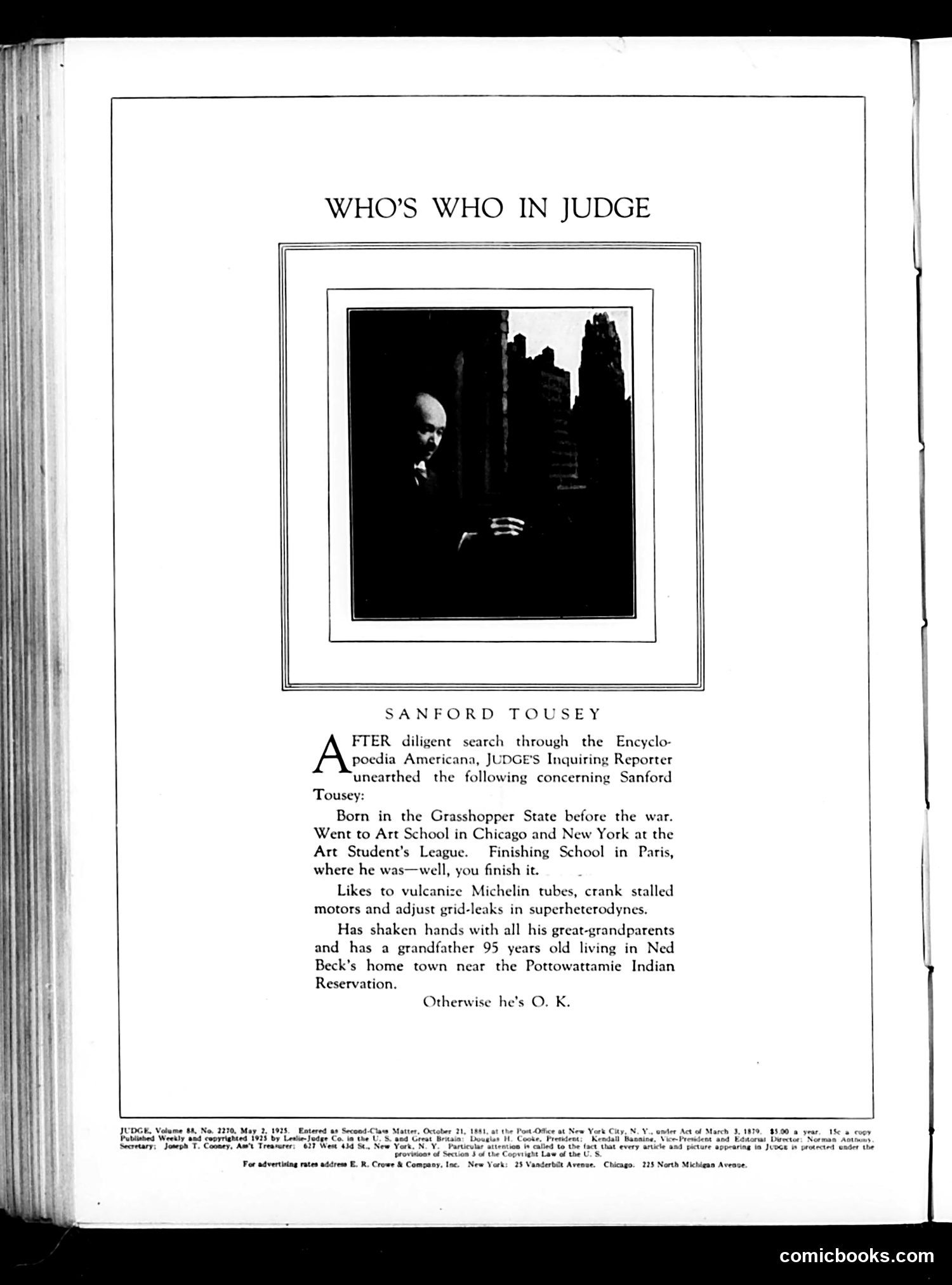
This page features a satirical biography of **Sanford Tousey** in Judge magazine's "Who's Who in Judge" section. The text humorously describes Tousey as someone born in Kansas, educated in art schools in Chicago, New York, and Paris, with peculiar hobbies like "vulcanizing Michelin tubes" and adjusting "grid-leaks in superheterodynes"—technical jargon that appears deliberately nonsensical for comedic effect. The joke culminates in the claim that he shook hands with a 95-year-old great-grandfather living on a Native American reservation, ending with "Otherwise he's O.K."—suggesting Tousey is unremarkable except for these absurd fabrications. The dark photograph shows a man in profile against a city skyline. This is typical Judge humor: mock-earnest biographical satire of magazine contributors or contemporary figures, mixing real and invented details for comedic absurdity.
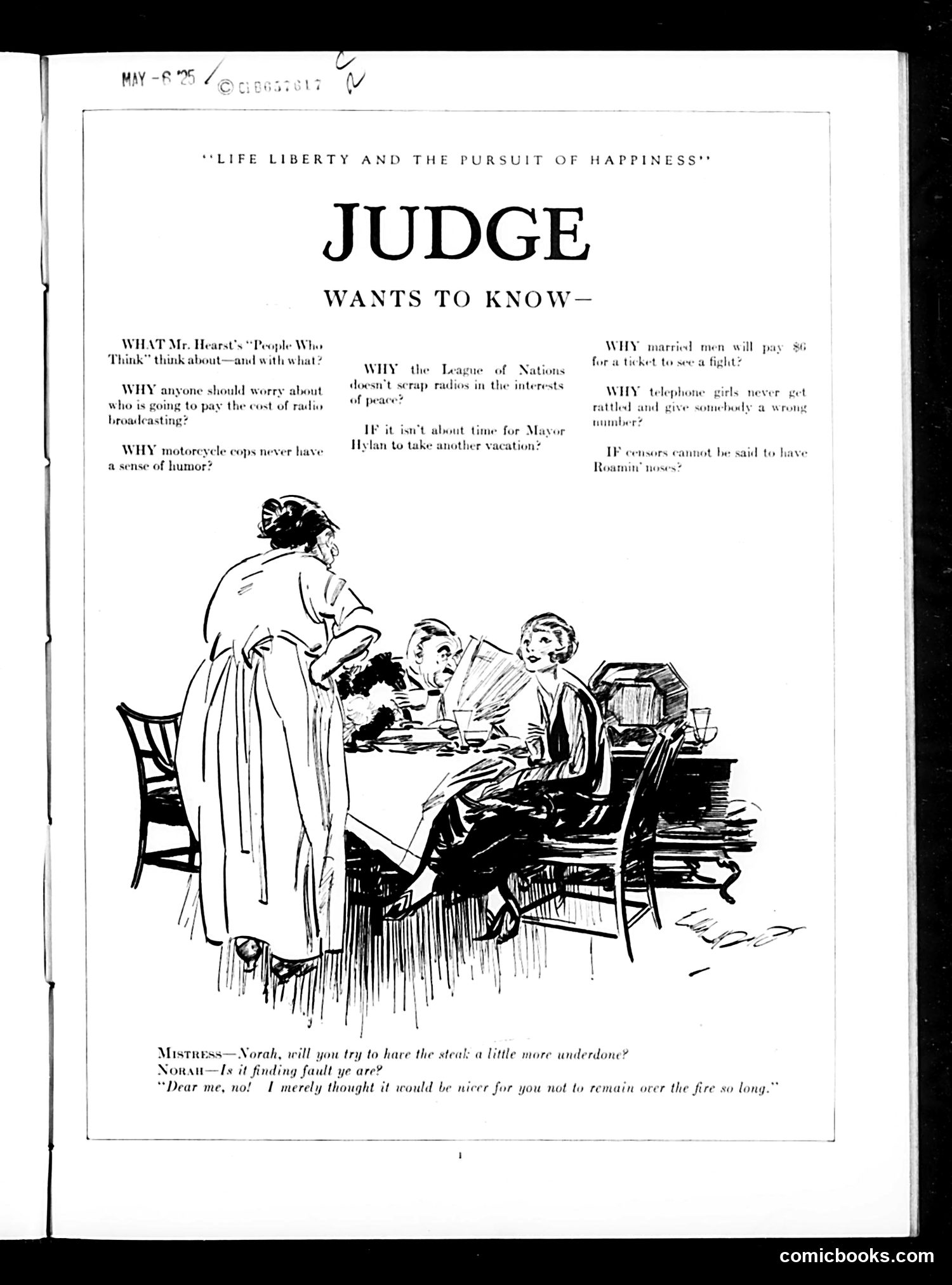
This Judge magazine page satirizes contemporary social absurdities through rhetorical questions ("Judge Wants to Know"). The topics—radio broadcasting costs, the League of Nations, Mayor Hylan's vacations, motorcycle cops, fight tickets, telephone operators, and censorship—reflect 1920s concerns. The illustration shows a domestic scene where a mistress (labeled "Norah") confronts a man about a stolen steak, while a woman reads nearby. The dialogue jokes about marital infidelity and household management. The caption's tone—the man deflecting blame while the mistress suggests she remain by the fire—mocks both class dynamics and moral hypocrisy of the era. The page uses humor to critique contemporary politics, consumer culture, and social conventions rather than endorsing any particular viewpoint. It's characteristic Judge satire targeting middle-class readers.
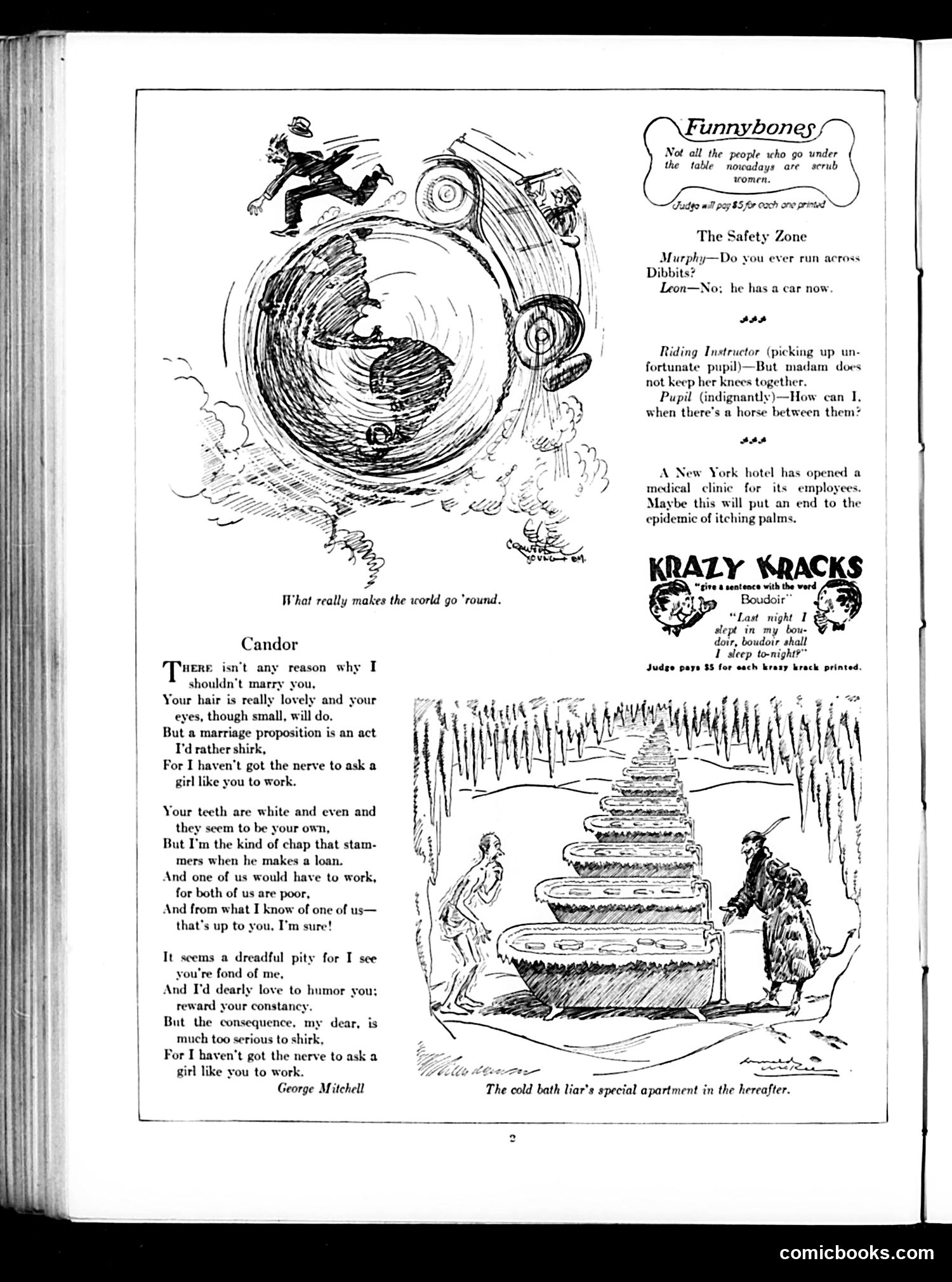
This page contains several humorous pieces typical of early 20th-century satirical magazines: **"What really makes the world go 'round"** shows a large globe with people clinging to its surface as it spins—a visual gag about how ordinary people are caught up in the chaos of modern life. **"Candor"** is a poem by George Mitchell rejecting a marriage proposal. The speaker acknowledges the woman's attractive qualities but refuses because he lacks the nerve to ask a woman to work, given their mutual poverty. **"The Safety Zone"** and **"Krazy Kracks"** are brief joke sections poking fun at modern inconveniences—cars replacing old hazards, riding instructors, and workplace injuries. The cartoons appear designed for middle-class readers finding humor in contemporary social anxieties about work, courtship, and modern technology.
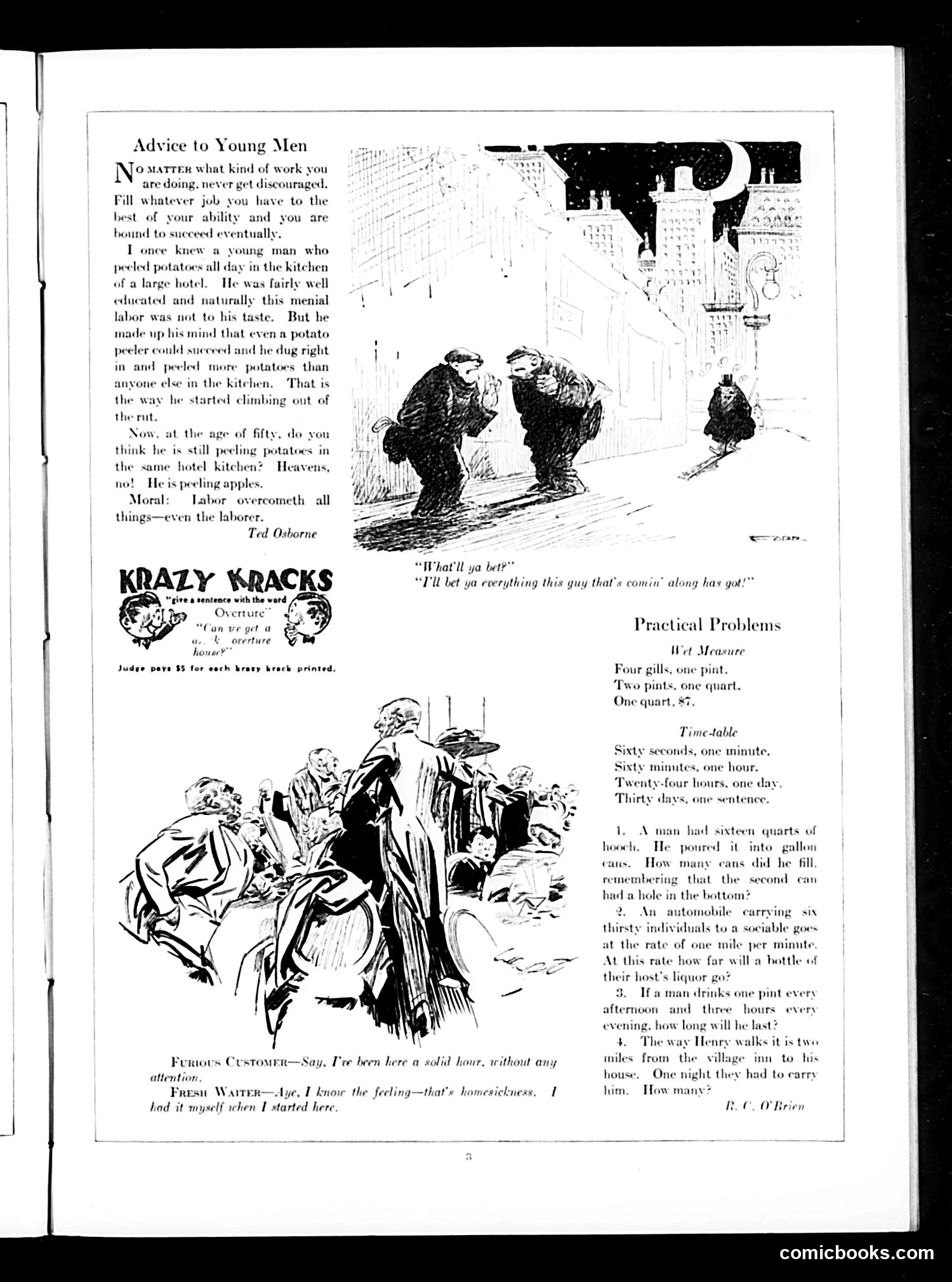
The page contains several distinct elements: **"Advice to Young Men"** (top left): Ted Osborne's column argues that accepting humble work—even jobs beneath one's education—builds character and leads to advancement. The example of a hotel potato-peeler who rose to success illustrates the era's belief in bootstrapping and meritocracy. **"Krazy Kracks"** (center left): A wordplay game awarding judges $5 for printed entries, typical of Judge's reader-participation features. **Main cartoon** (center): Depicts what appears to be a waiter and customer interaction, with accompanying dialogue suggesting social discomfort or class awkwardness—likely satirizing workplace hierarchies or service-industry pretension common in early 20th-century America. **"Practical Problems"** (right): Math word problems covering measurements and time, possibly educational or humorous puzzles for readers. The overall tone reflects Progressive-era values emphasizing work ethic and social mobility.
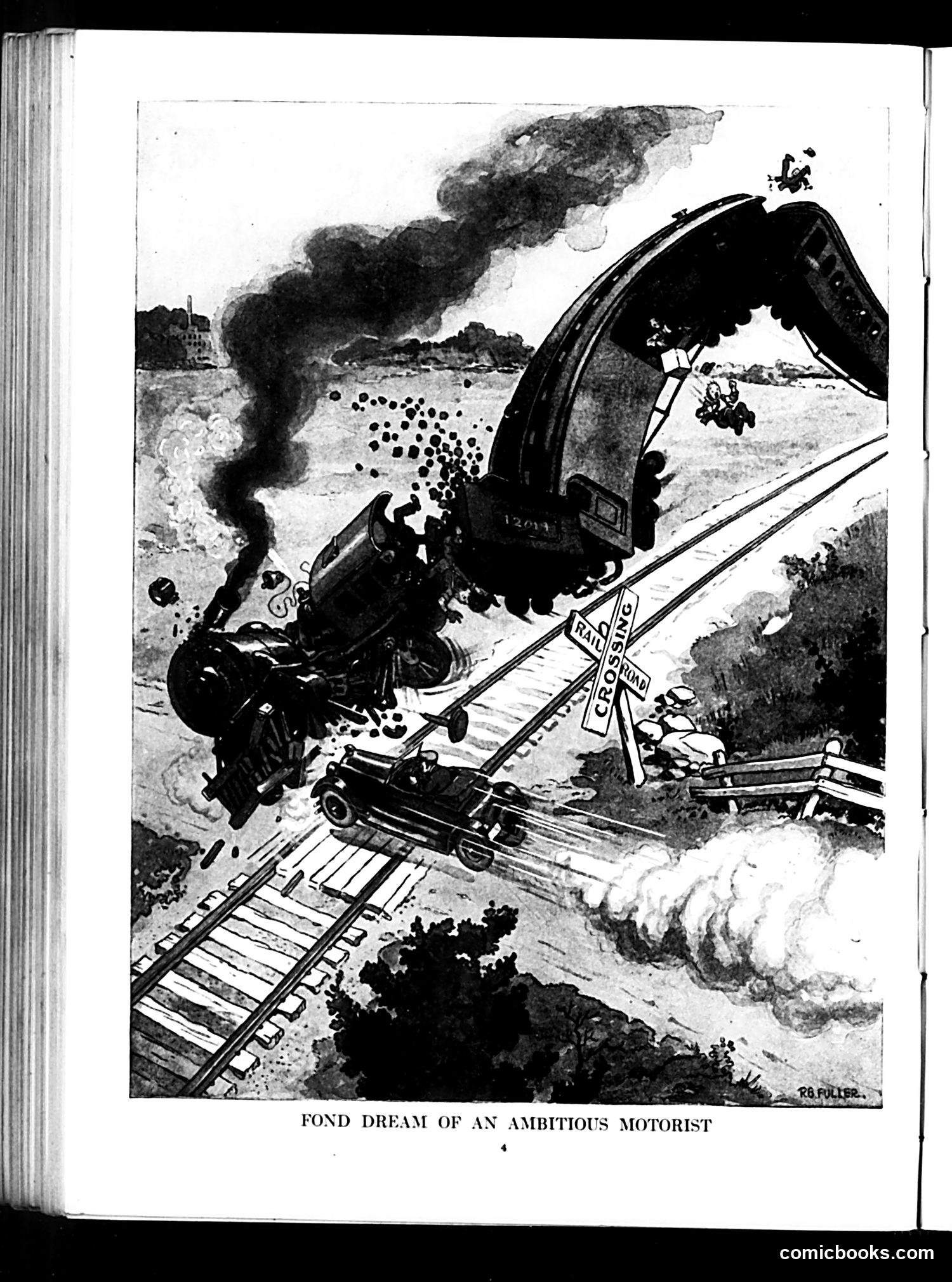
This cartoon satirizes the dangerous fantasies of early automobile enthusiasts. The image depicts a catastrophic collision at a railroad crossing where a speeding car has struck a train, with both vehicles exploding in dramatic fashion. Bodies and debris scatter across the landscape while smoke billows skyward. The caption's irony suggests that some motorists harbored reckless, destructive ambitions—perhaps dreaming of automotive supremacy or disregarding safety entirely. The cartoon likely critiques the arrogance of early motorists who ignored railroad crossing warnings, treated trains with contempt, or drove recklessly. It represents broader anxieties about automobiles as dangerous new technologies competing with established transportation infrastructure, mocking drivers' overconfidence in their vehicles' capabilities and their disregard for public safety.
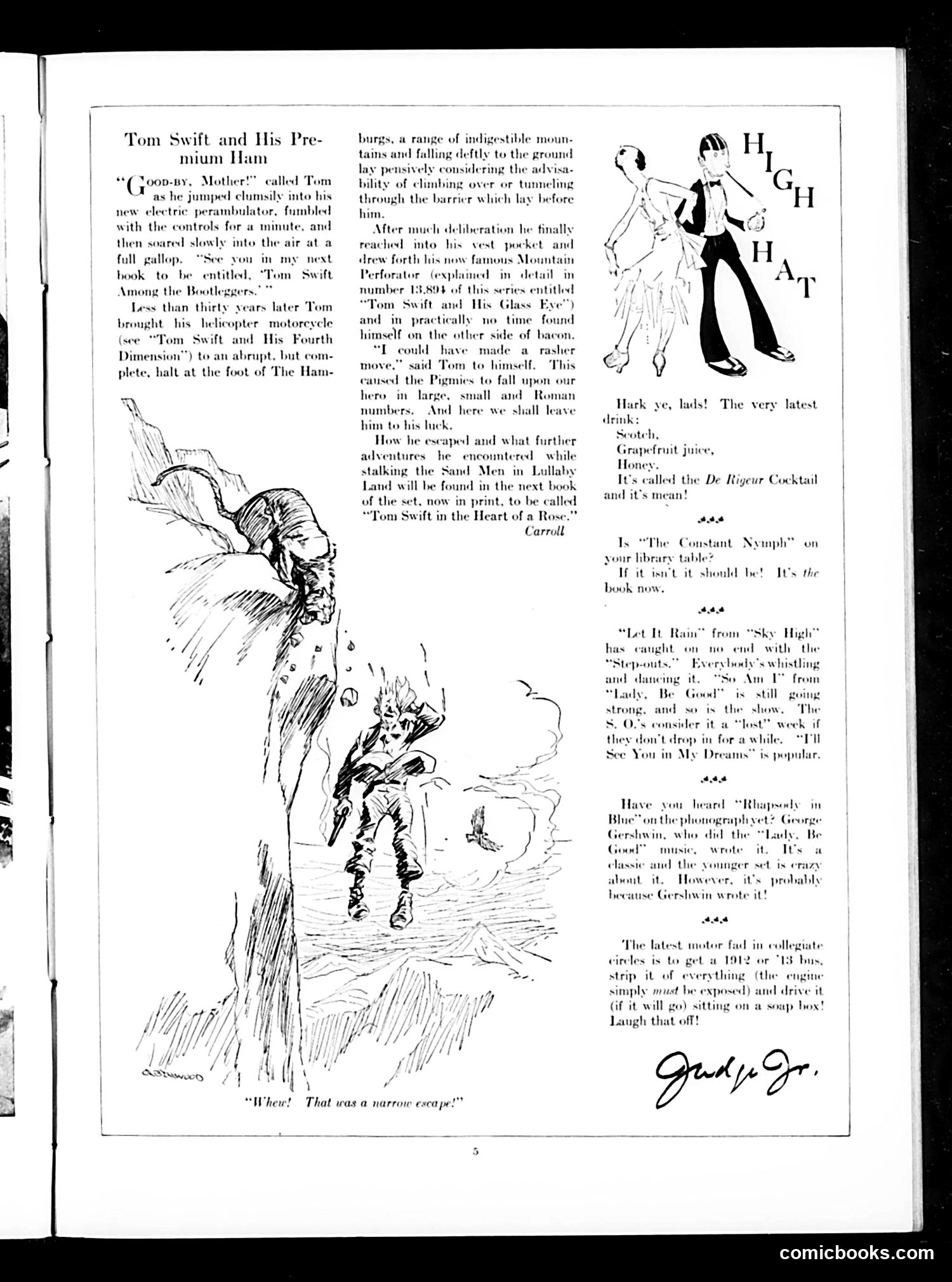
This page primarily contains **editorial content rather than political satire**. The main feature is "Tom Swift and His Preliminary Ham," referencing the popular Tom Swift adventure book series. The large illustration depicts a dramatic mountaineering scene—a figure scaling a cliff face—accompanying a narrative about Tom Swift's adventures. The right column contains **entertainment gossip and recommendations**: cocktail recipes ("De Rigeur Cocktail"), song recommendations ("Let It Rain," "So Am I"), and commentary on popular music (mentioning Gershwin's "Rhapsody in Blue"). The **bottom illustration** and caption "Whew! That was a narrow escape!" appears to relate to the Tom Swift narrative above it. Overall, this is **lifestyle and entertainment content** rather than political commentary, typical of Judge's editorial mix during this period.
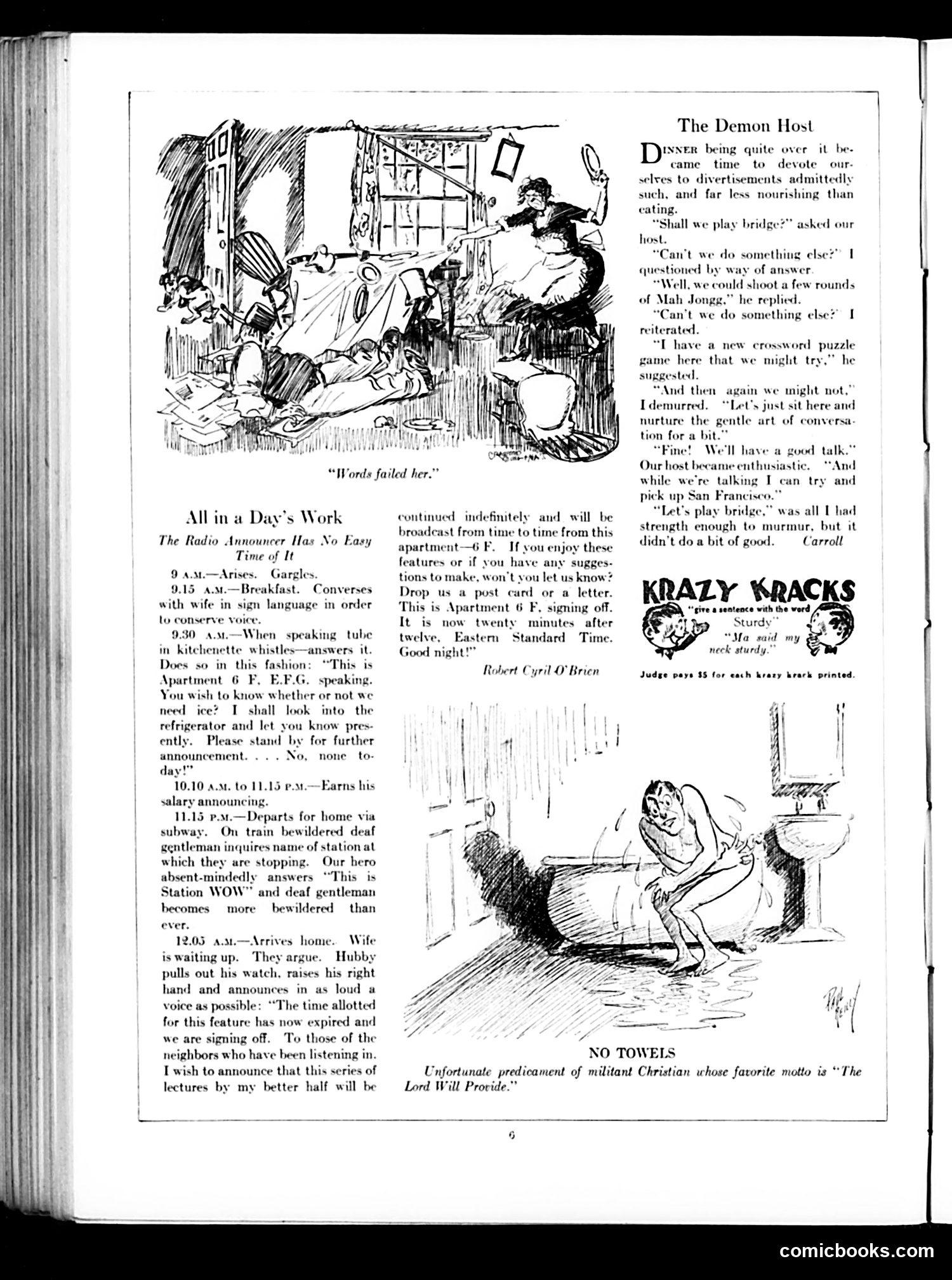
**"All in a Day's Work"** satirizes radio announcers' exhausting schedules and occupational hazards. The humor stems from the announcer's inability to "switch off"—he speaks in formal broadcast voice throughout his entire day, from answering neighbors' questions about ice delivery to announcing his wife's nagging to a bewildered deaf passenger. The joke culminates when he formally "signs off" his domestic argument as if it were a radio program, treating his marriage as another broadcast segment. **"The Demon Host"** depicts a frustrated dinner guest trapped in an endless cycle of tedious parlor games (bridge, Mah Jongg, crossword puzzles) suggested by an overzealous host. The satire mocks upper-class entertainment conventions of the era—the guest's exhausted resistance contrasts with the host's relentless enthusiasm for predictable diversions. **"No Towels"** is a brief gag cartoon mocking a Christian's literal interpretation of "The Lord Will Provide"—he apparently relies on divine intervention rather than practical provisions like towels.
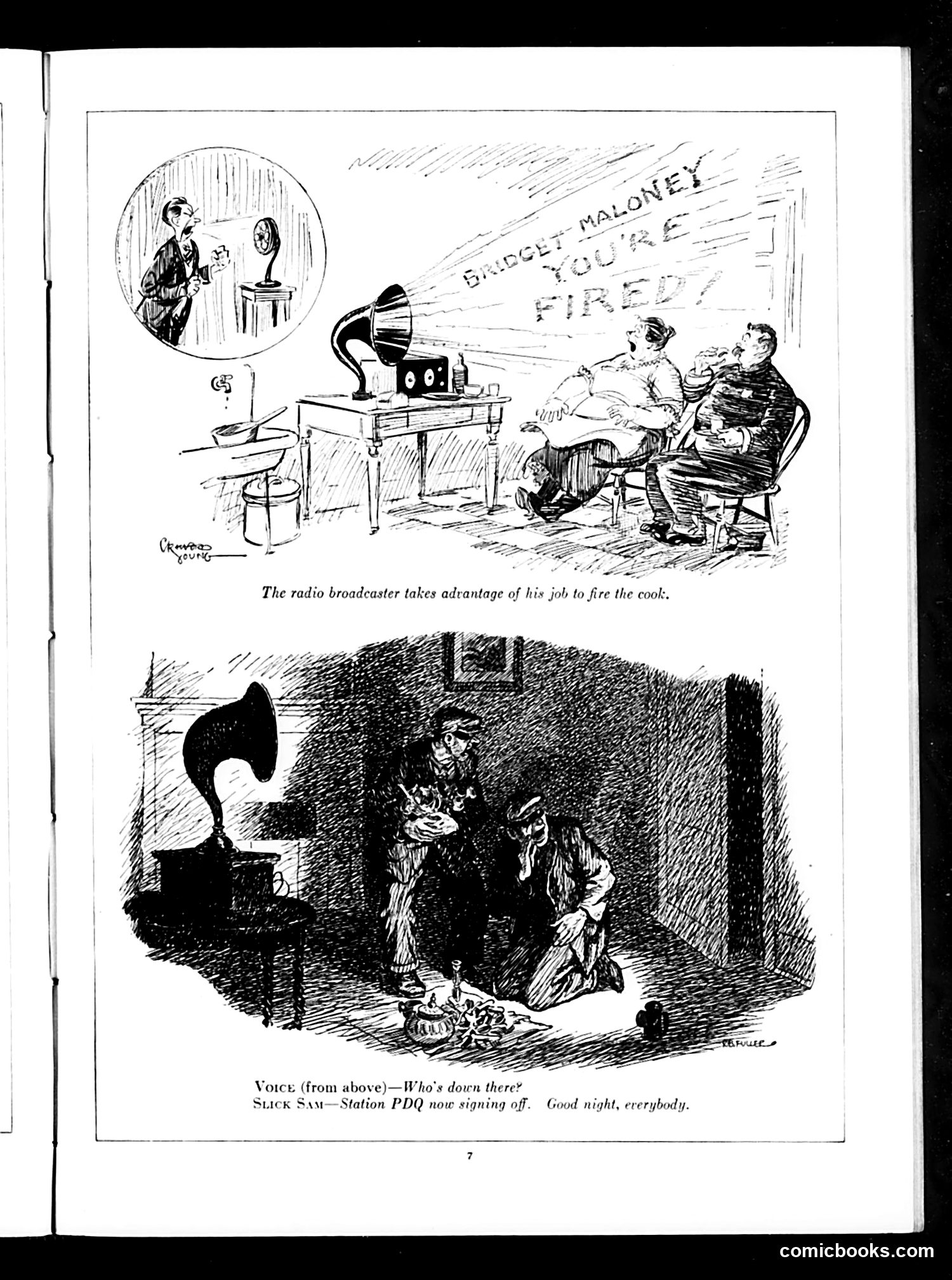
**Top cartoon:** "The radio broadcaster takes advantage of his job to fire the cook." A man at a microphone broadcasts "Bruget Maloney, you're fired" through a horn-speaker, while two men listen. The joke plays on radio's new power as a mass medium—using public airwaves to deliver a personal firing message. **Bottom cartoon:** A darker scene in a basement or cellar shows two figures listening to a gramophone/speaker. The caption indicates "Slick Sam" from "Station PDQ" is signing off. This appears to satirize either a disreputable radio station or the somewhat crude, unregulated nature of early broadcasting. Both cartoons mock early radio as an emerging medium—showing how its public reach could be comically misused for private purposes or how amateur/dubious broadcasters operated.
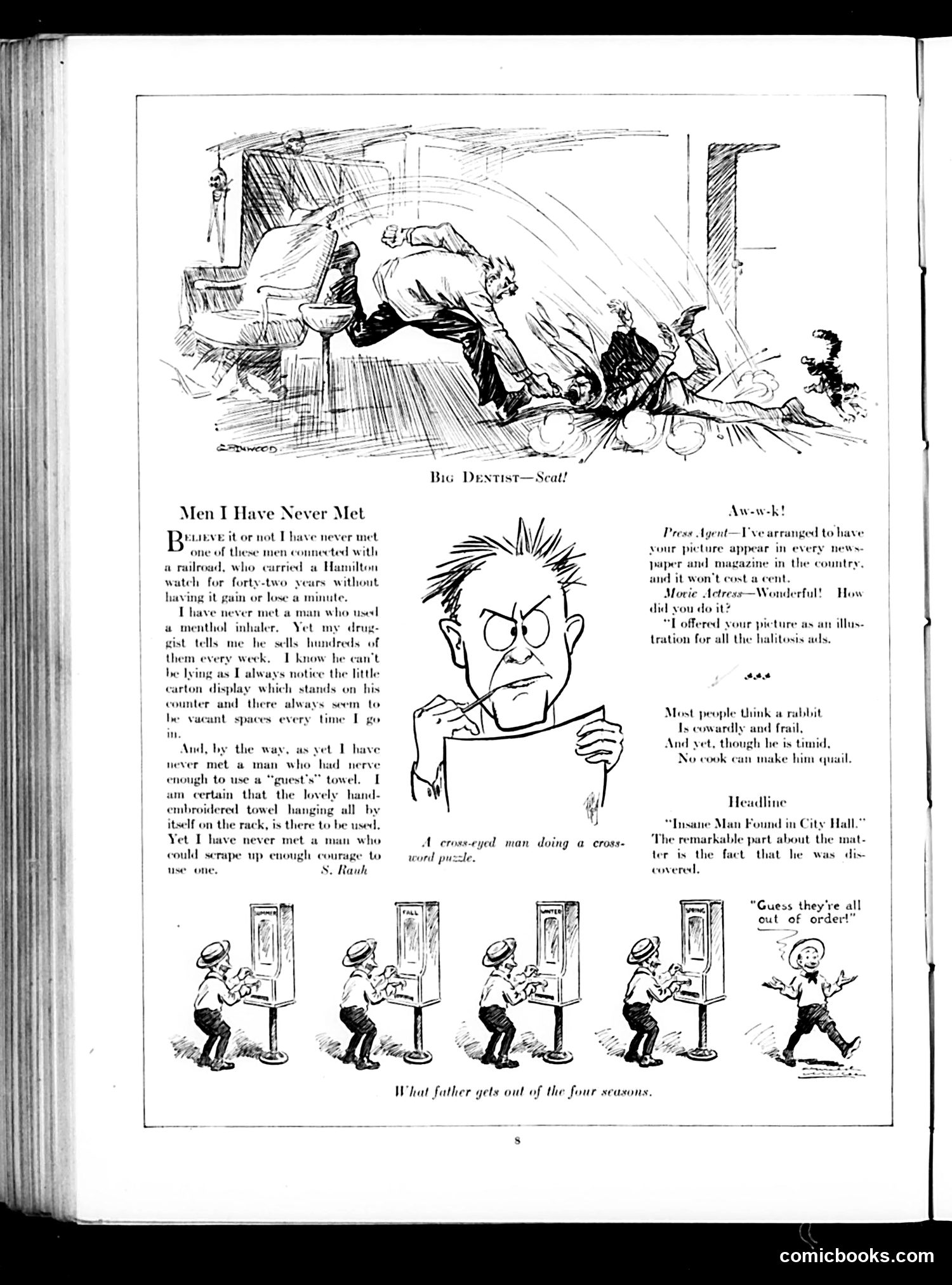
This page from the satirical magazine **Judge** contains several distinct humor pieces: **"Men I Have Never Met"** (top left): A humorous essay by S. Rank listing paradoxes—products he knows sell (Hamilton watches, menthol inhalers) yet claims never meeting actual users. The joke satirizes consumer culture and mass marketing: goods are ubiquitous despite never encountering real purchasers. It also mocks social etiquette (the unused "guest towel"), suggesting people lack courage for normal behavior. **"Big Dentist—Seat!"** (top): A slapstick cartoon showing someone being launched from a dentist's chair, satirizing dental anxiety. **The crossword/movie agent exchanges** (center-right): Quick gags—one about a cross-eyed man's puzzle-solving difficulties, another about a press agent using an actress's photo for halitosis advertisements (period advertising commonly featured "bad breath" as a social disgrace). **Bottom comic strip**: A four-panel sequence showing a man repeatedly operating something, with the caption "What father gets out of the four seasons"—likely about seasonal household maintenance or chores. The overall tone is light, topical satire typical of early-to-mid 20th-century American humor magazines.
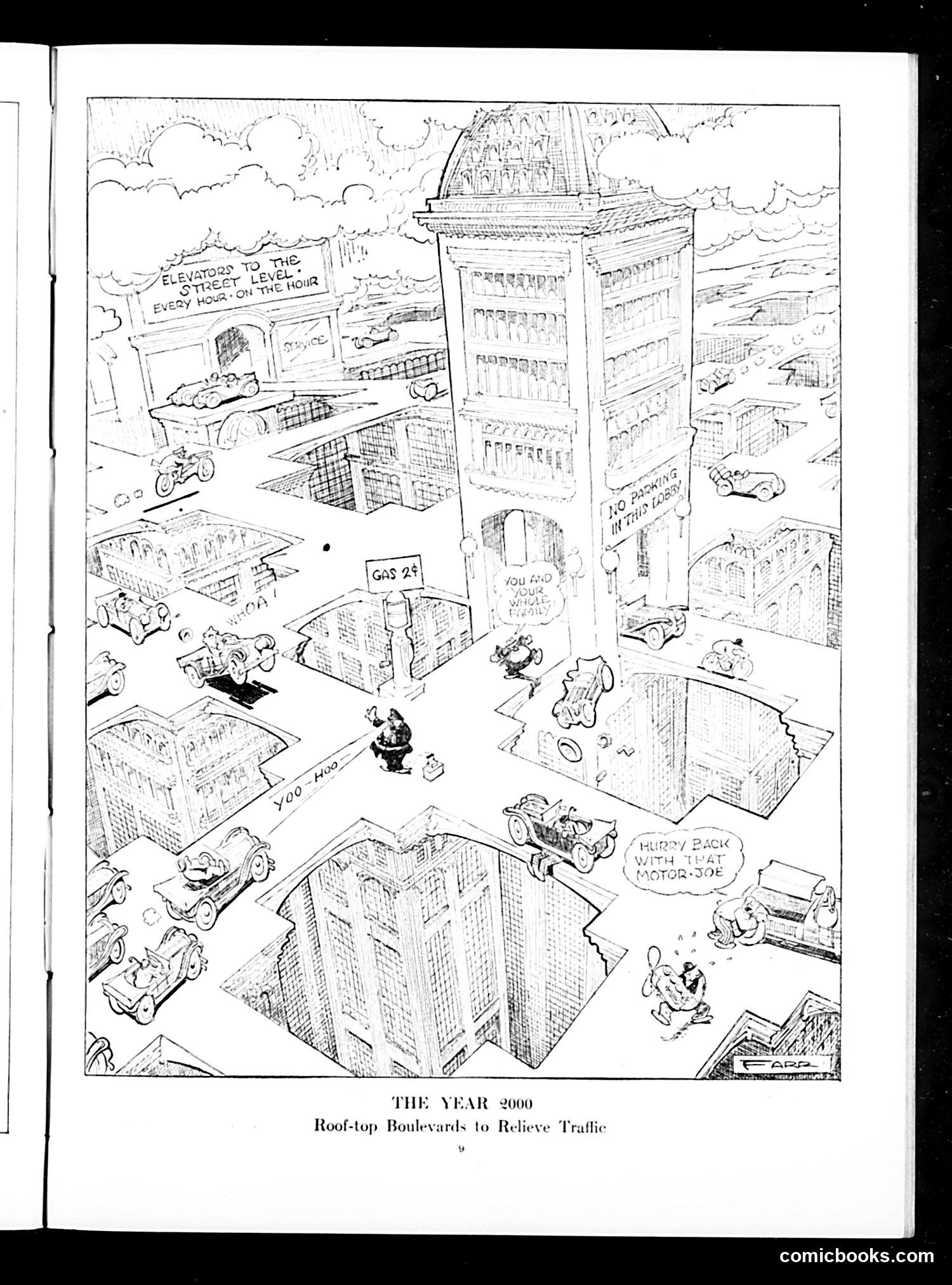
This is a futuristic satire imagining urban traffic solutions in the year 2000. The cartoon depicts a towering multi-story building surrounded by multilevel parking structures and elevated roadways on rooftops. Small cars navigate various levels, with vehicles and pedestrians shown at street level, mid-level, and rooftop heights. The satire mocks speculative urban planning: as traffic congestion worsens, the proposed solution is building upward rather than addressing root causes. An elevator sign reads "ELEVATOR TO THE STREET EVERY HOUR OF THE HOUR," humorously suggesting the street itself has become inaccessible. The joke targets early-20th-century optimism about technological fixes for metropolitan problems. Rather than reducing vehicles, planners imagine literally stacking traffic vertically—a solution both absurd and revealing about how cities might continue prioritizing cars over comprehensive transit reform.
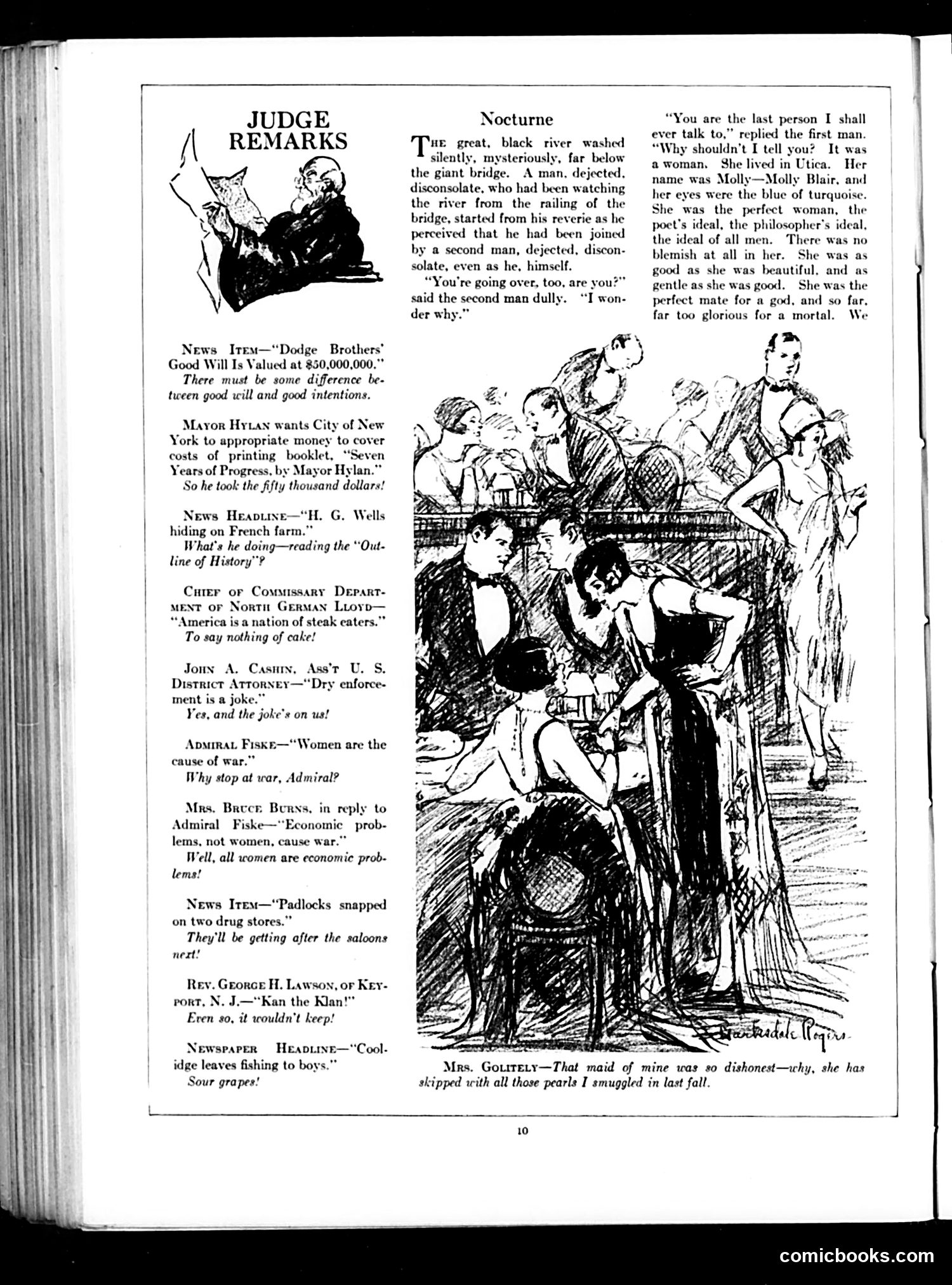
This page from Judge combines satirical news commentary with a short story. **The "Judge Remarks" section** consists of brief, sardonic jabs at contemporary figures and events (likely 1920s based on references to Prohibition enforcement and Mayor Hylan). Examples include mockery of Mayor Hylan's self-promotional spending and Admiral Fiske's claim that women cause war—quickly countered by a female respondent arguing economic problems are the real cause. **"Nocturne,"** the illustrated story, depicts two suicidal men meeting on a bridge. One explains his despair over an impossibly perfect woman named Molly Blair from Utica—so flawless she's "too glorious for a mortal." **The cartoon's satirical point** is unclear from the image alone, though the accompanying caption about Mrs. Golitely's maid stealing smuggled pearls suggests ironic commentary on hypocrisy or moral pretense among the wealthy. The overall page exemplifies Judge's characteristic blend of topical political humor and literary satire aimed at educated, urban readers.
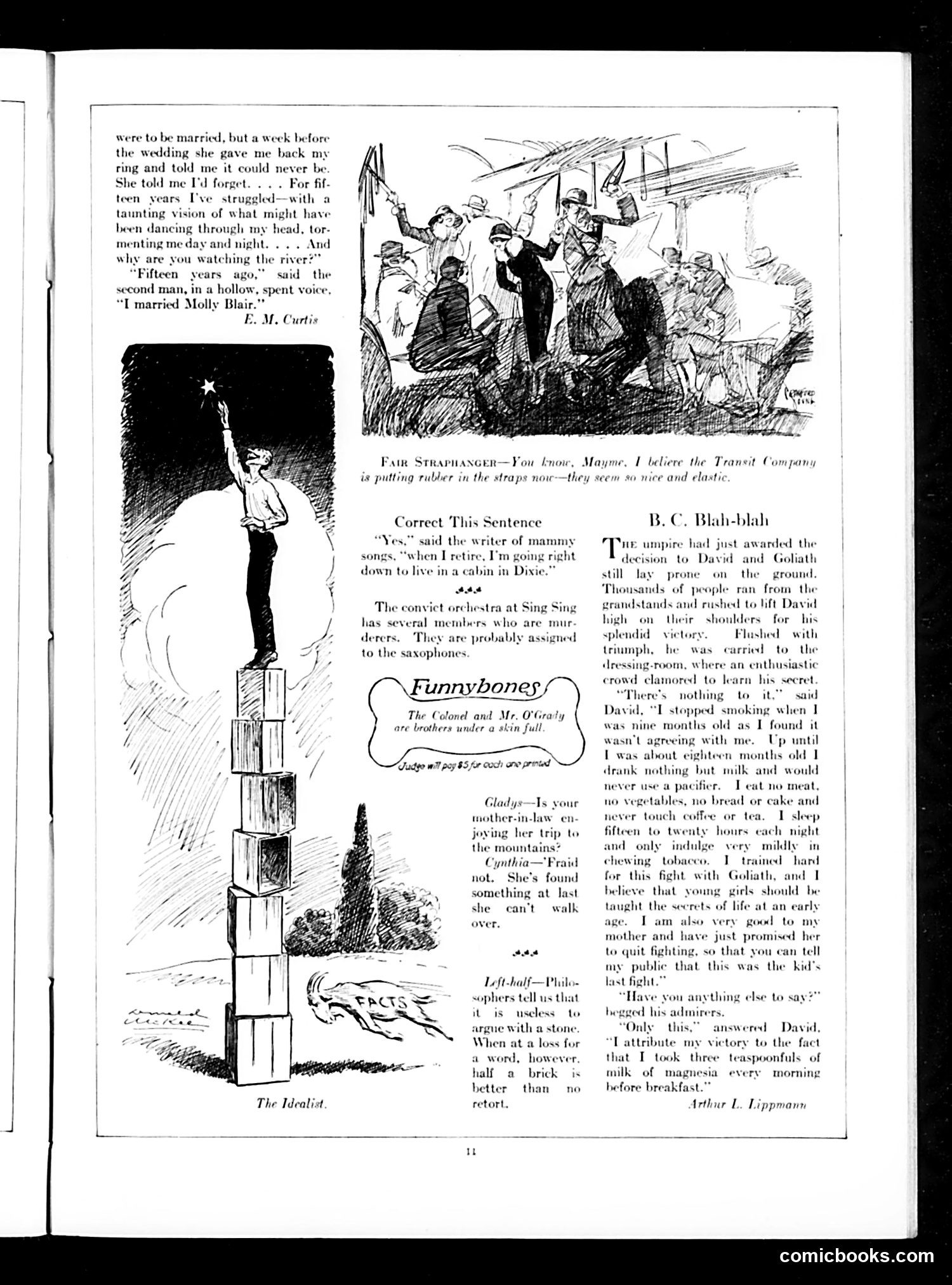
This page contains several satirical humor pieces typical of early 20th-century Judge magazine: **"The Idealist"** (left cartoon): A man stands on a precarious stack of boxes reaching for a star—visual metaphor for pursuing an impossible dream. The accompanying text describes unrequited love, suggesting the cartoon mocks idealistic romanticism as impractical and self-destructive. **"Fair Straphanger"** (top right): Mocks the Transit Company for using rubber in subway straps, presented as if this were a luxury innovation rather than practical improvement. **"B.C. Blah-blah"**: A humorous rewrite of the David and Goliath story where David credits his victory to health practices (no smoking, no meat, milk of magnesia)—satirizing contemporary fad diets and health crazes. The page also includes "Funnybones" (short jokes about philosophers and verbal comebacks) and grammar corrections. The overall tone ridicules contemporary social pretensions, health fads, and romantic melodrama through absurdist humor.
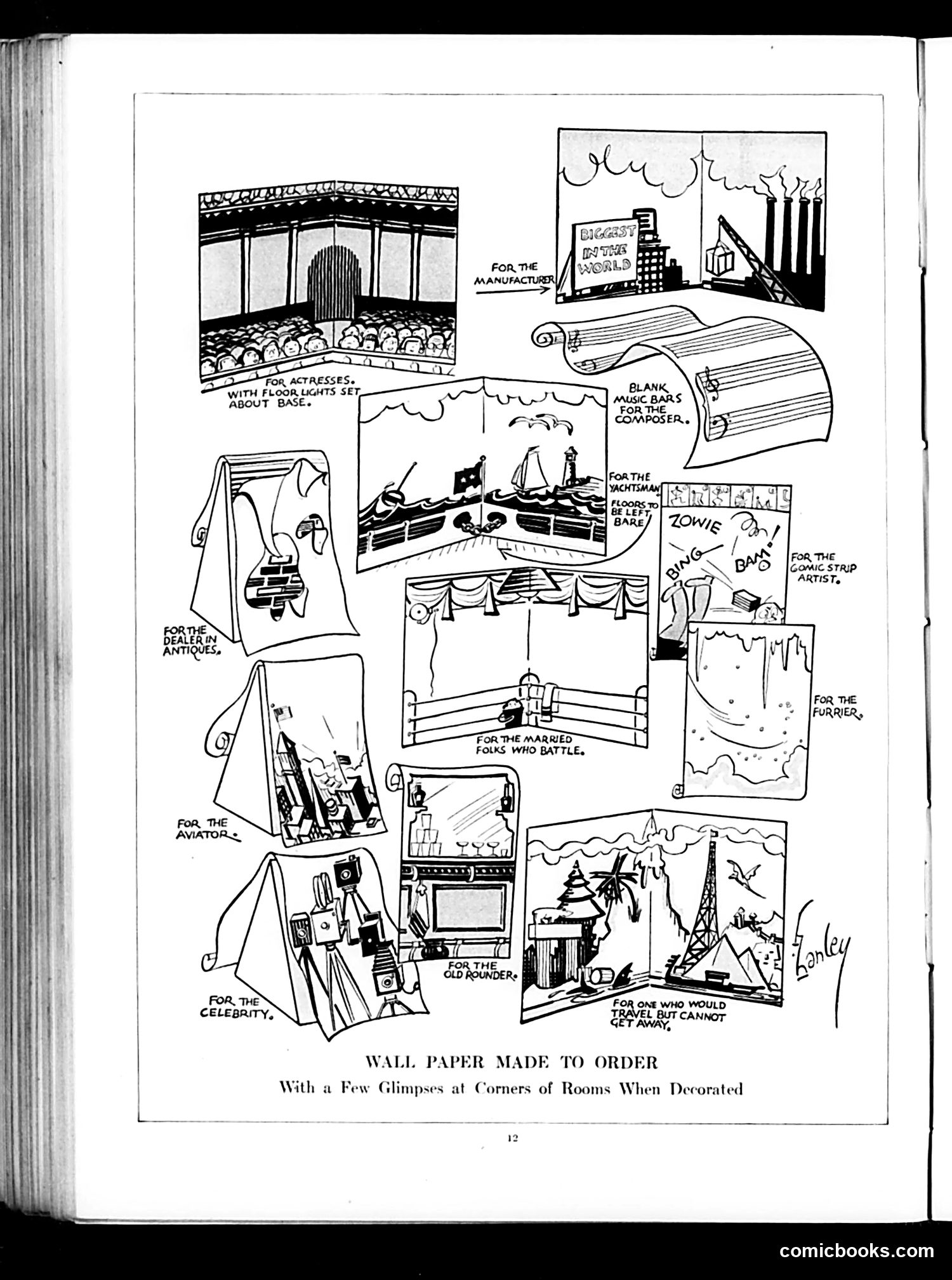
This page satirizes custom wallpaper designs catering to different professions and interests. Rather than traditional patterns, each wallpaper sample features themed imagery matched to its intended user: actresses get theatrical stage sets with footlights; manufacturers get factory smokestacks; composers get musical notation; aviators get aircraft; celebrities get paparazzi scenes; comic strip artists get cartoon characters; travelers get exotic locales; and boxers/fighters get boxing rings. The satire mocks both consumer vanity and early-20th-century marketing's attempt to sell personalized status symbols. By reducing people's identities to their professions or hobbies—wallpapering one's home entirely in such imagery—Judge ridicules self-aggrandizing decoration and the commercial impulse to monetize every aspect of self-expression. The humor lies in the absurdity of surrounding oneself with such literal, occupation-specific décor.
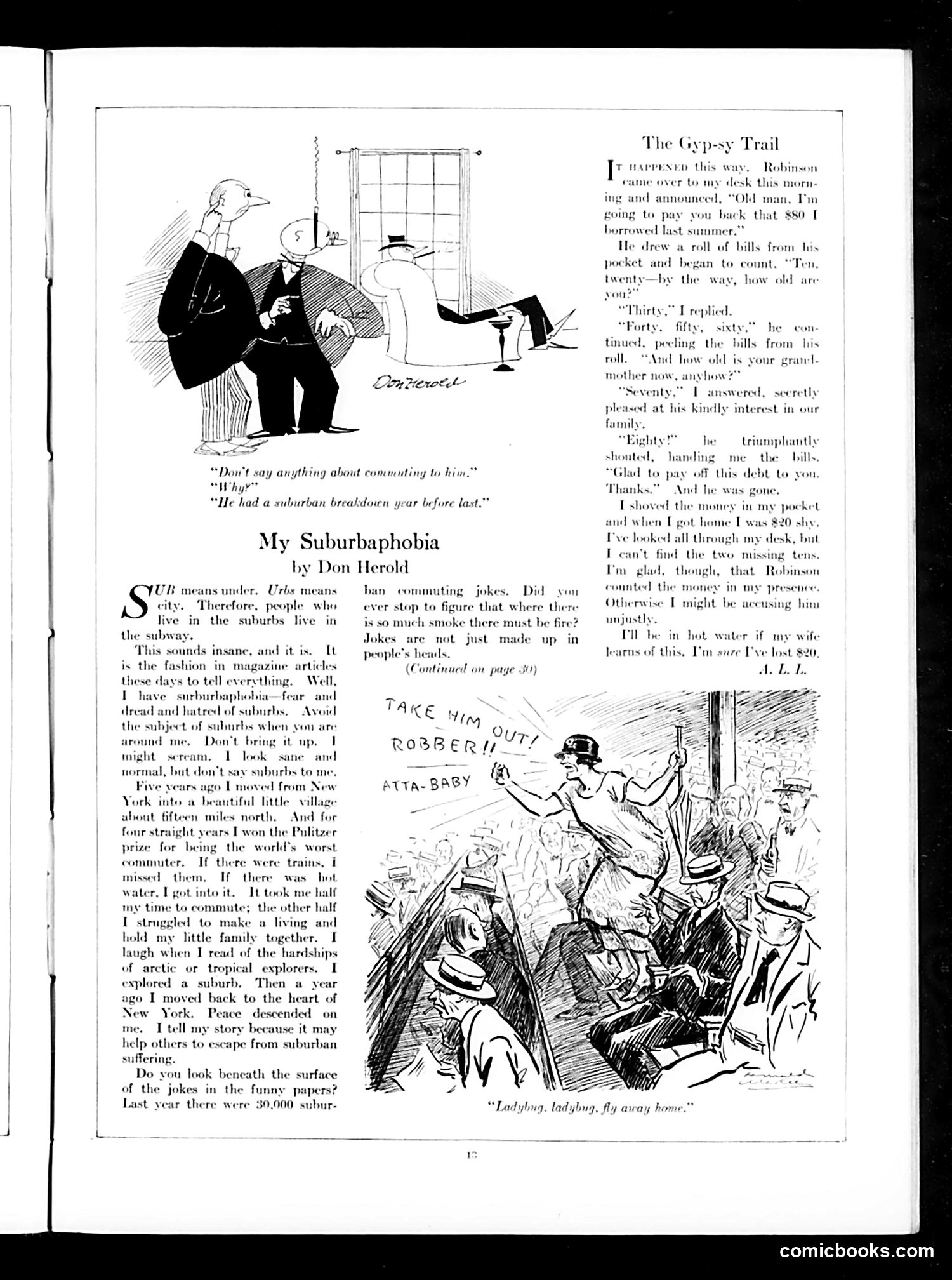
**"My Suburbaphobia" by Don Herold** satirizes the growing suburban commuter experience of 1920s America. The opening cartoon depicts a man having suffered a "suburban breakdown" — depicting suburban commuting as mentally damaging. Herold's essay mocks both suburbs themselves and the fashionable magazine trend of confessional personal stories. He describes his failed five-year experiment living fifteen miles north of New York, where he became "the world's worst commuter," experiencing floods, fires, and other disasters while trying to maintain family life. The satire targets the romantic idealization of suburban living that magazines promoted, contrasting it with actual commuter misery. **"The Gypsy Trail"** (continued from page 30) appears to be a separate short story about a man who borrows money from Robinson, forgets about it, then loses the repayment cash. The lower cartoon labeled "Take Out! Robbery! Atta-Baby" is unclear without full context. The page reflects early 20th-century anxieties about suburban expansion and the grueling new commuter lifestyle.
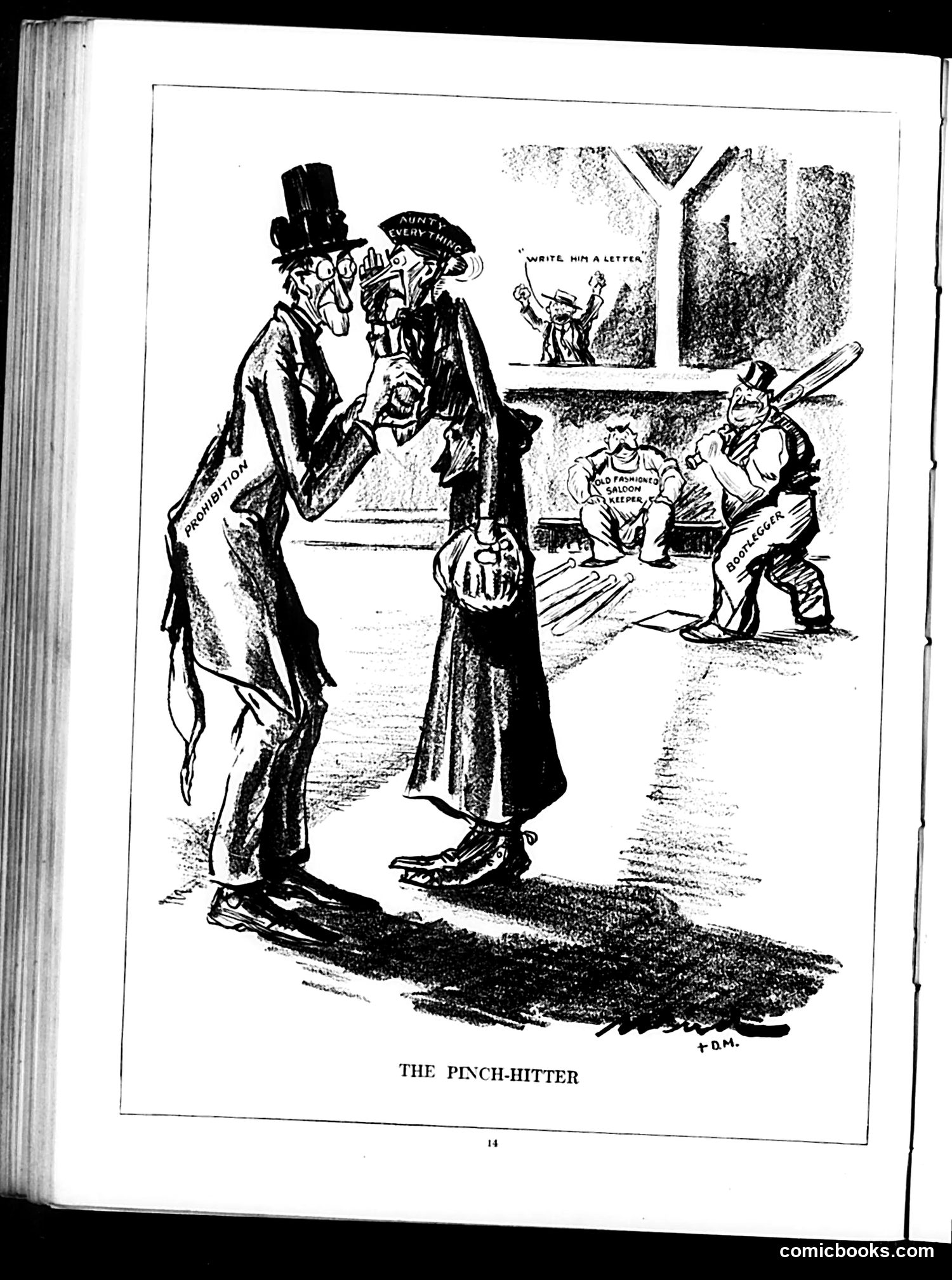
This political cartoon depicts two well-dressed figures in conversation. The figure on the left wears a coat labeled "PROHIBITION" and a top hat labeled "MINT EVERYTHING," suggesting he represents temperance or prohibitionist interests. The second figure appears to represent an alternative or substitute approach to the same issue. In the background, children play baseball while a sign reads "WRITE HIM A LETTER," likely referencing public appeals or petitions related to alcohol policy. The title "The Pinch-Hitter" uses baseball terminology (a substitute batter) to satirize political maneuvering around Prohibition—suggesting that one faction is being replaced by another in advocating for or against alcohol regulation. The cartoon likely comments on shifting political strategies or power plays during America's Prohibition era (1920-1933).
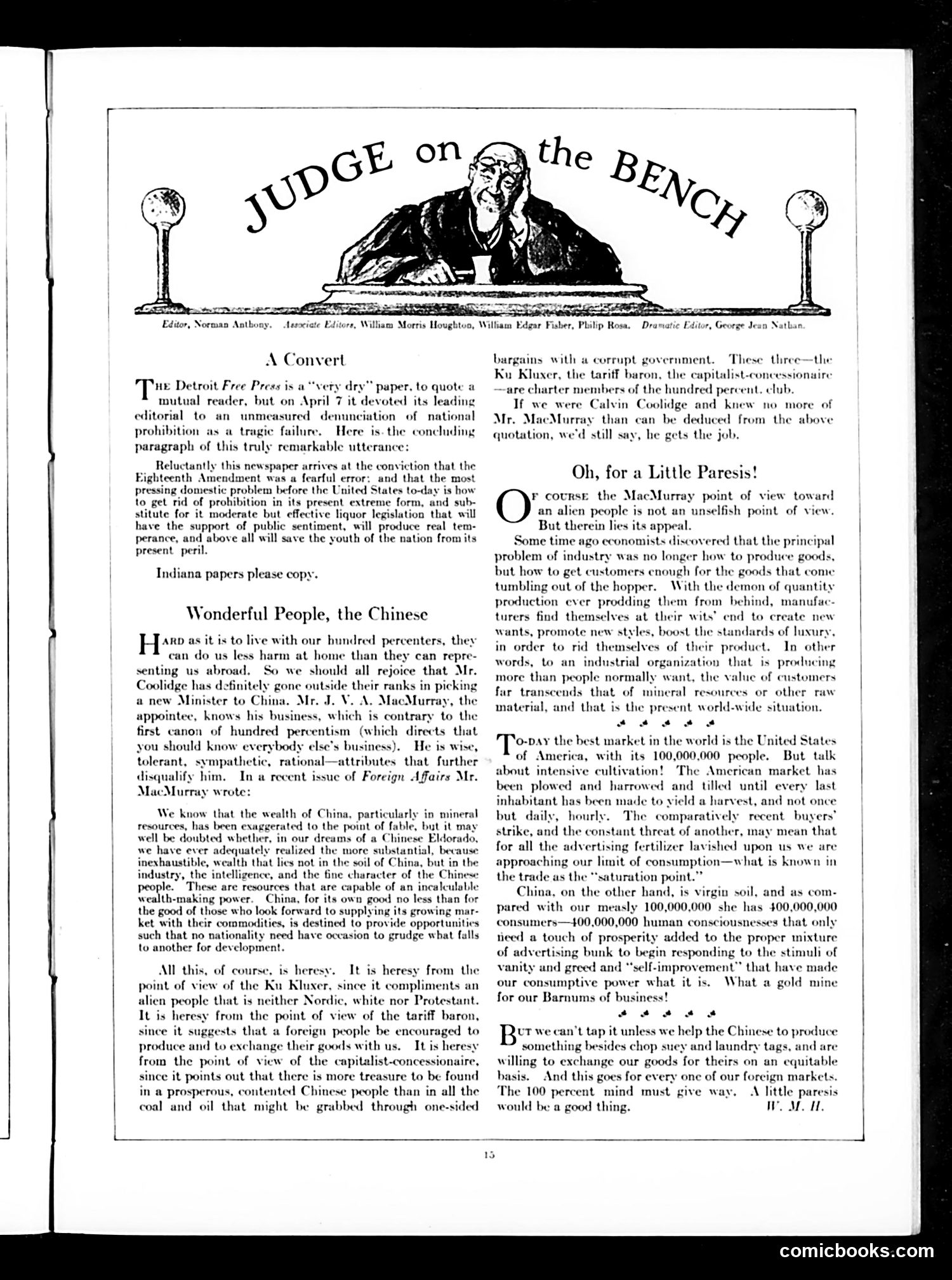
This page satirizes American isolationism and xenophobia in the 1920s. The main article praises diplomat J.V.A. MacMurray's appointment as Minister to China, attacking three groups the magazine calls "hundred percenters": 1. **The Ku Kluxer** — opposing MacMurray's respectful view of non-Nordic, non-Protestant peoples 2. **The tariff baron** — opposing free trade with foreign nations 3. **The capitalist-concessionaire** — preferring exploitative deals with corrupt governments over fair Chinese prosperity The satire's point: these "hundred percent" American nationalists prioritize racial/religious purity, protectionism, and imperial exploitation over practical diplomacy and mutually beneficial commerce. MacMurray's heretical idea—that prosperous, contented Chinese partners benefit America more than colonized subjects—challenges prevailing 1920s attitudes. The opening editorial about Prohibition's failure illustrates the magazine's broader critique of rigid ideological absolutism.
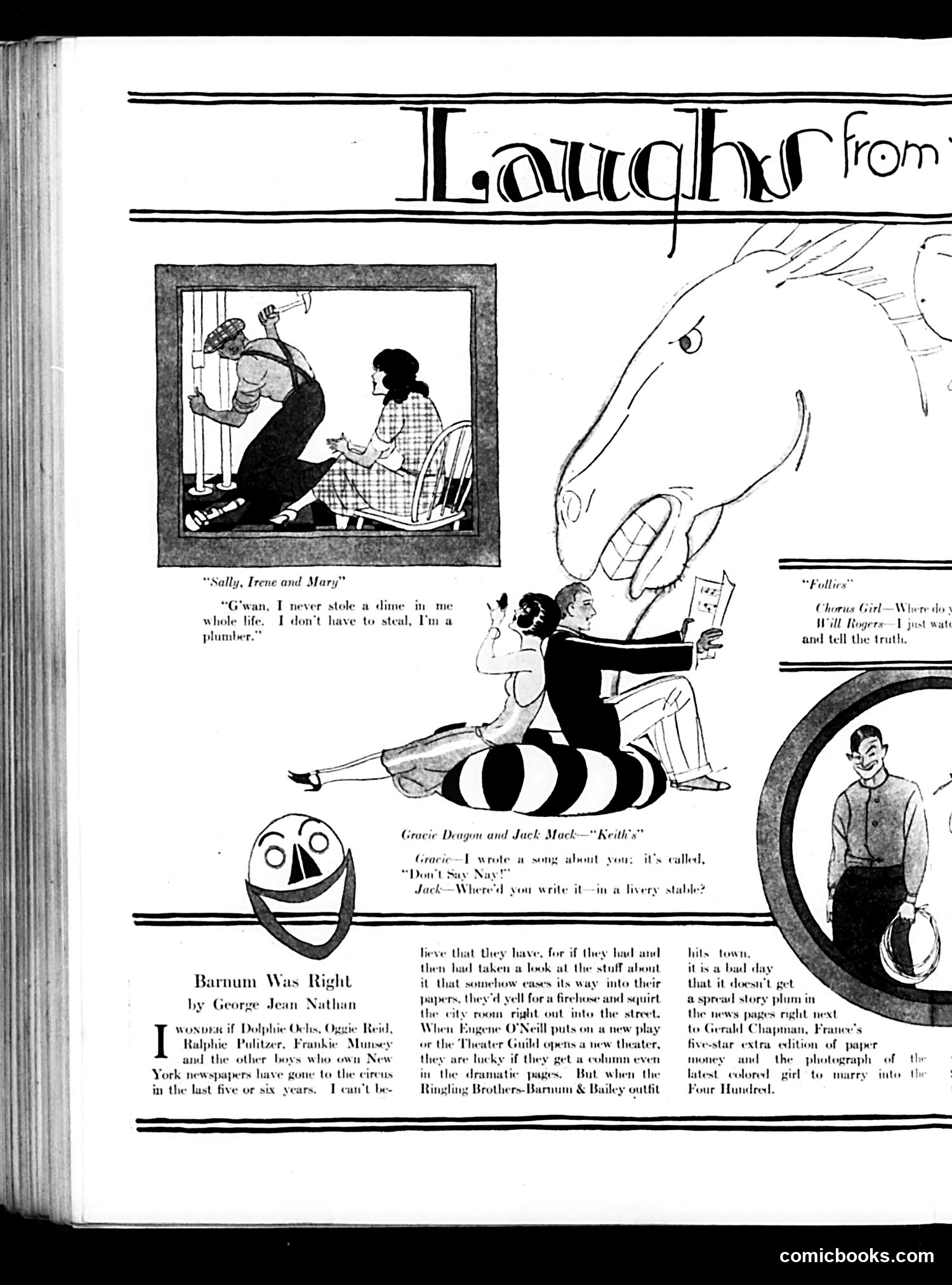
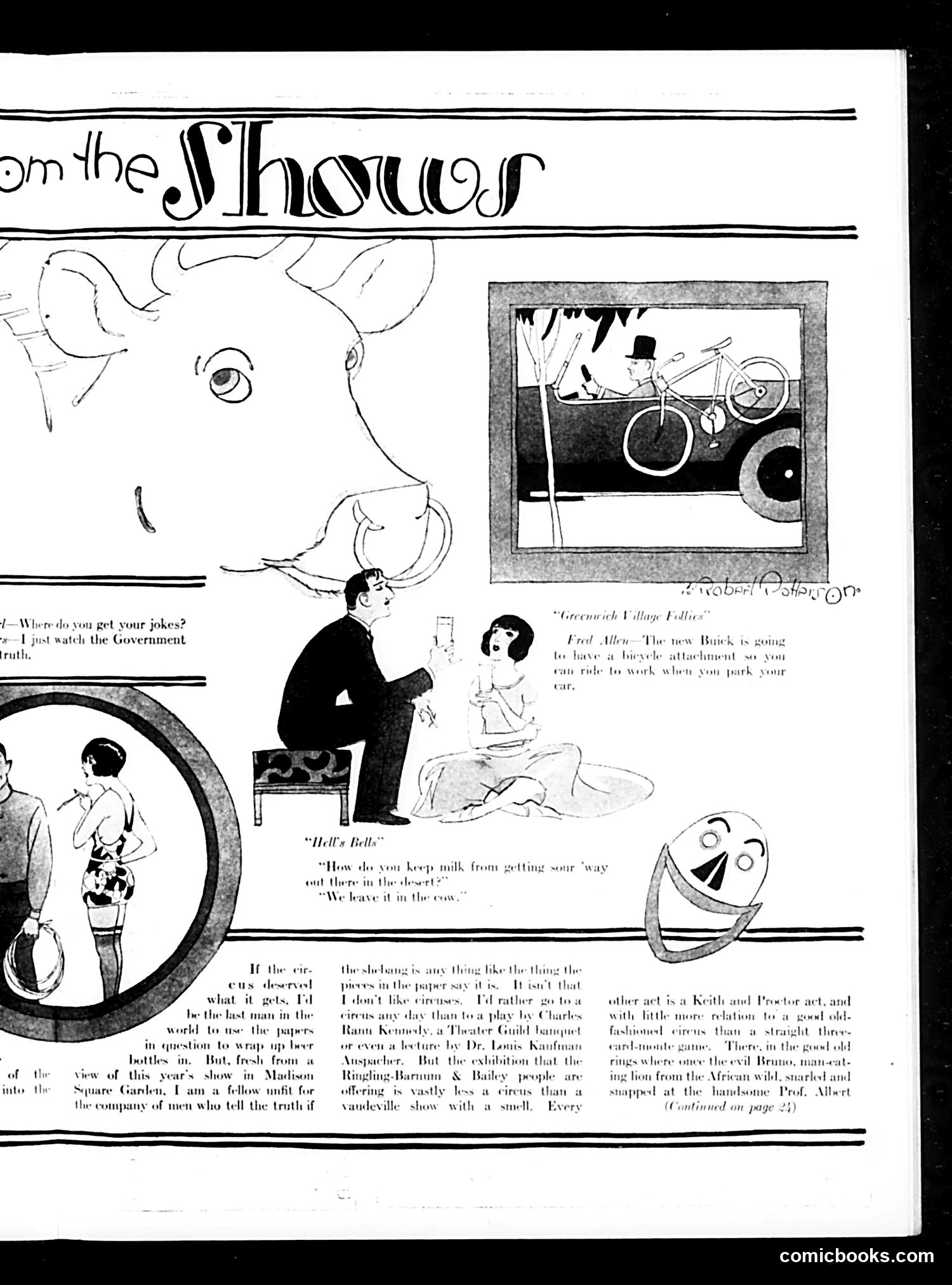
This page from *Judge* contains three separate humor items satirizing 1920s American entertainment and consumer culture: 1. **"Greenwich Village Follies"**: A photograph of a man with a bicycle attachment, likely mocking the absurdity of impractical automobile accessories or trendy consumer gadgets marketed to urban sophisticates. 2. **"Hell's Bells"**: A classic joke format—a man asks how to keep milk fresh in the desert; the answer "We leave it in the cow" ridicules overly literal or obvious solutions. 3. **The main article** critiques the decline of circus entertainment. The author argues that modern circuses (specifically Ringling-Barnum & Bailey) have become less entertaining than vaudeville shows. He suggests theatrical alternatives like Keith and Proctor acts or lectures by Dr. Louis Kaufman are superior to traditional circus performances, indicating anxiety among intellectuals about mass entertainment's quality during this era. The satirical tone targets both consumer culture excess and nostalgic debate over which entertainment forms deserve cultural status.
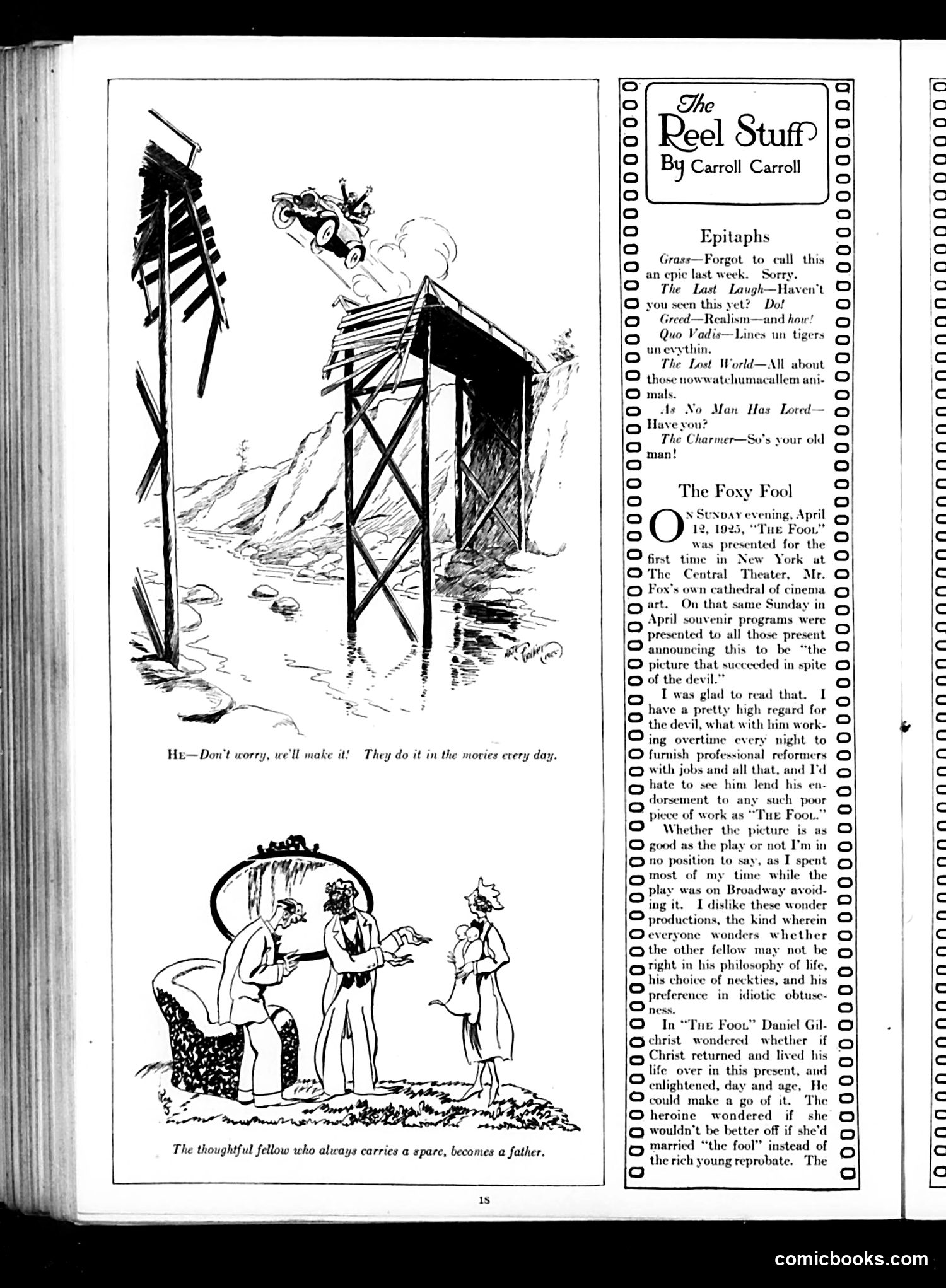
This page contains two unrelated cartoon sections by Carroll Carroll from *Judge*, a satirical magazine. **Top cartoons:** Generic humor about movie stunts and fatherhood. The first shows a man reassuring his companion about a dangerous construction stunt by noting movies do this "every day"—satirizing Hollywood's casual attitude toward safety. The second is a caption joke about preparedness and parenthood with no specific political content. **"The Reel Stuff" column:** A theater review critiquing "The Foxy Fool," a 1923 film presentation. The author expresses disdain for William Fox's "wonder productions"—elaborate, philosophical films that question faith and materialism. The reviewer mocks films where characters debate whether Christ could succeed in modern times or whether marrying "the fool" beats marrying wealth. It's satire of pretentious cinema attempting profound social commentary while avoiding genuine engagement with such questions. No specific political figures are caricatured here; the satire targets Hollywood's self-important pseudo-intellectual productions of the early 1920s.
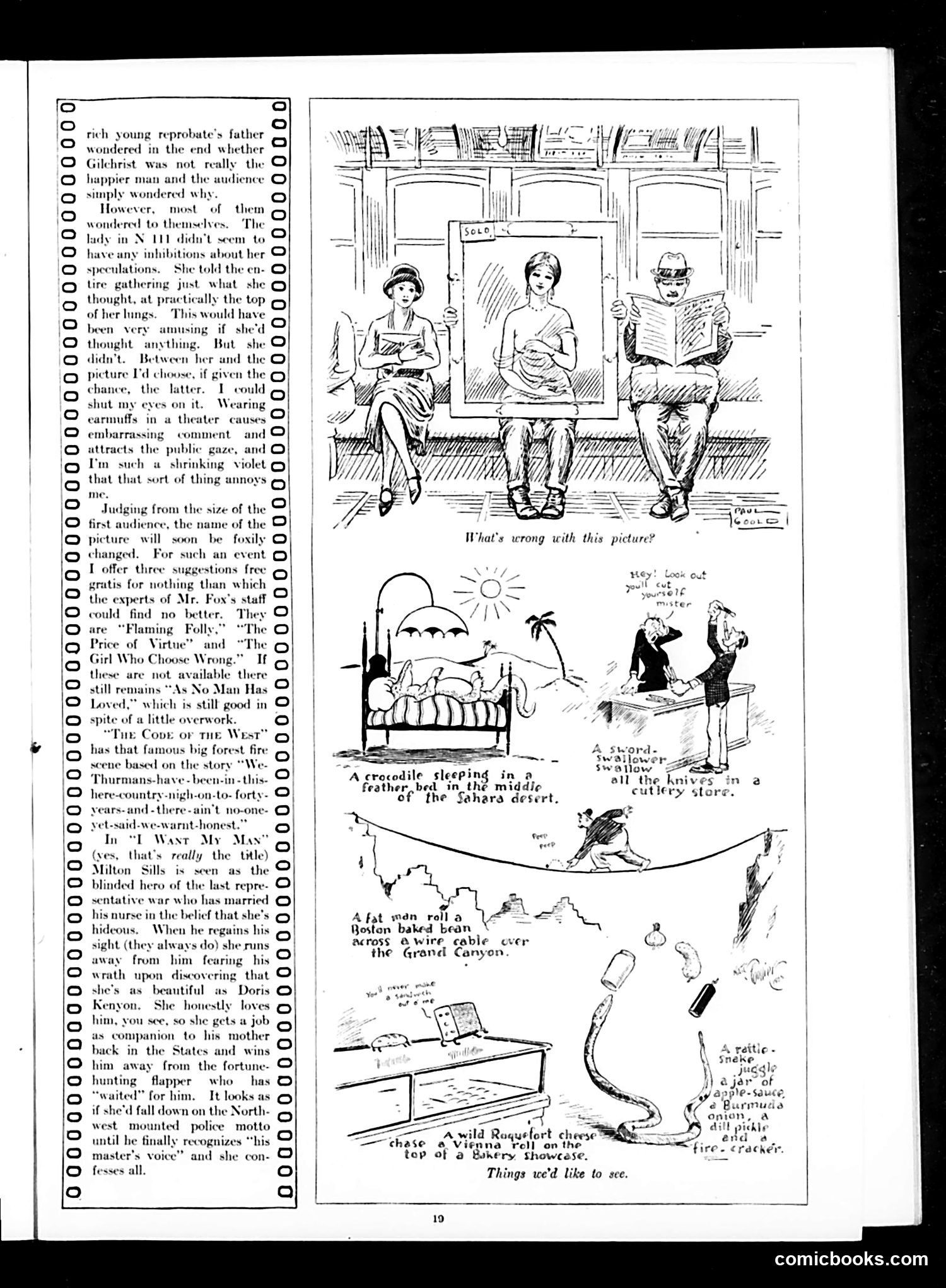
This is a Judge magazine page mixing film reviews with visual humor puzzles. **Top section:** A theater critic reviews recent films, complaining about a loud female moviegoer. He discusses several movies: one about a "rich young reprobate," *The Court of the West* (featuring a famous horse scene), and *I Want My Man* (starring Milton Sills as a blinded war hero who marries his nurse, then fears her beauty will make her leave). **Bottom section:** "What's wrong with this picture?" and "Things we'd like to see"—absurdist visual gags asking readers to spot logical impossibilities or imagine surreal scenarios: a crocodile sleeping in a feather bed in the Sahara, a fat man rolling a Boston baked bean across the Grand Canyon on a wire cable, a sword-swallower consuming all cutlery store knives, etc. The humor relies on readers' familiarity with 1920s film titles and their tolerance for gentle absurdism—amusement derived from impossible premises rather than sophisticated satire.
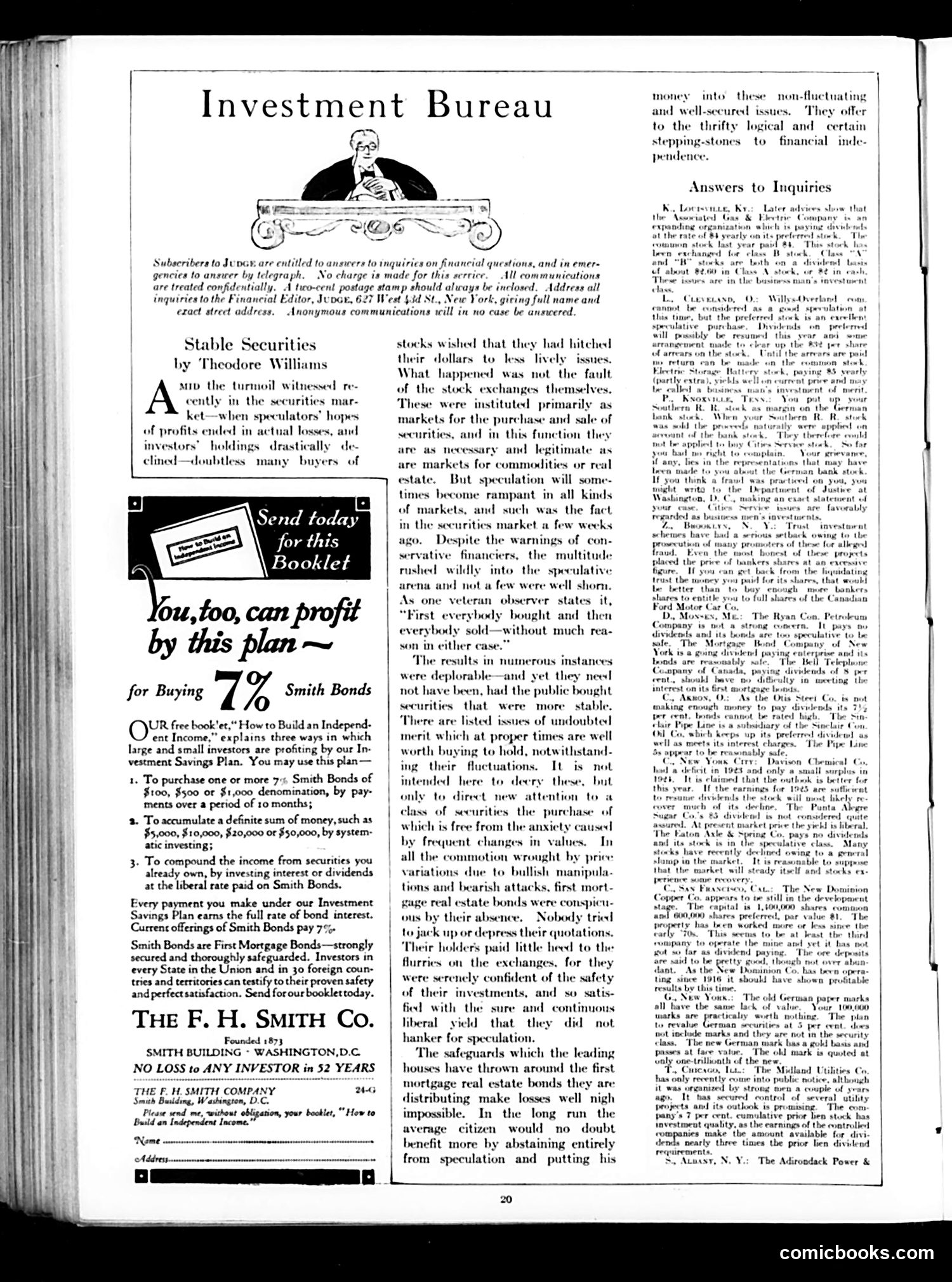
This page combines financial advice with period advertising. The main content is Theodore Williams's article "Stable Securities," written during what appears to be a market downturn (likely the 1920s based on context clues). **The satire's point**: Williams argues that everyday investors rushed recklessly into stock speculation, lost money, then blamed the market itself rather than their own poor judgment. He contrasts this with "stable securities"—bonds and established issues—which provide steadier, if less glamorous, returns. The article mocks the speculative fever that gripped ordinary people ("everybody bought and then everybody sold—without much reason"). **The illustration** shows a figure at an "Investment Bureau" desk, apparently offering guidance—satirizing how financial "experts" positioned themselves during this period. **The F.H. Smith Company advertisement** below peddles 7% bonds as a safer alternative to stock speculation, claiming "NO LOSS to ANY INVESTOR in 52 YEARS"—ironically promoting stability while the page discusses recent market chaos. The page reflects early-20th-century anxiety about ordinary citizens gambling with their savings in securities markets.
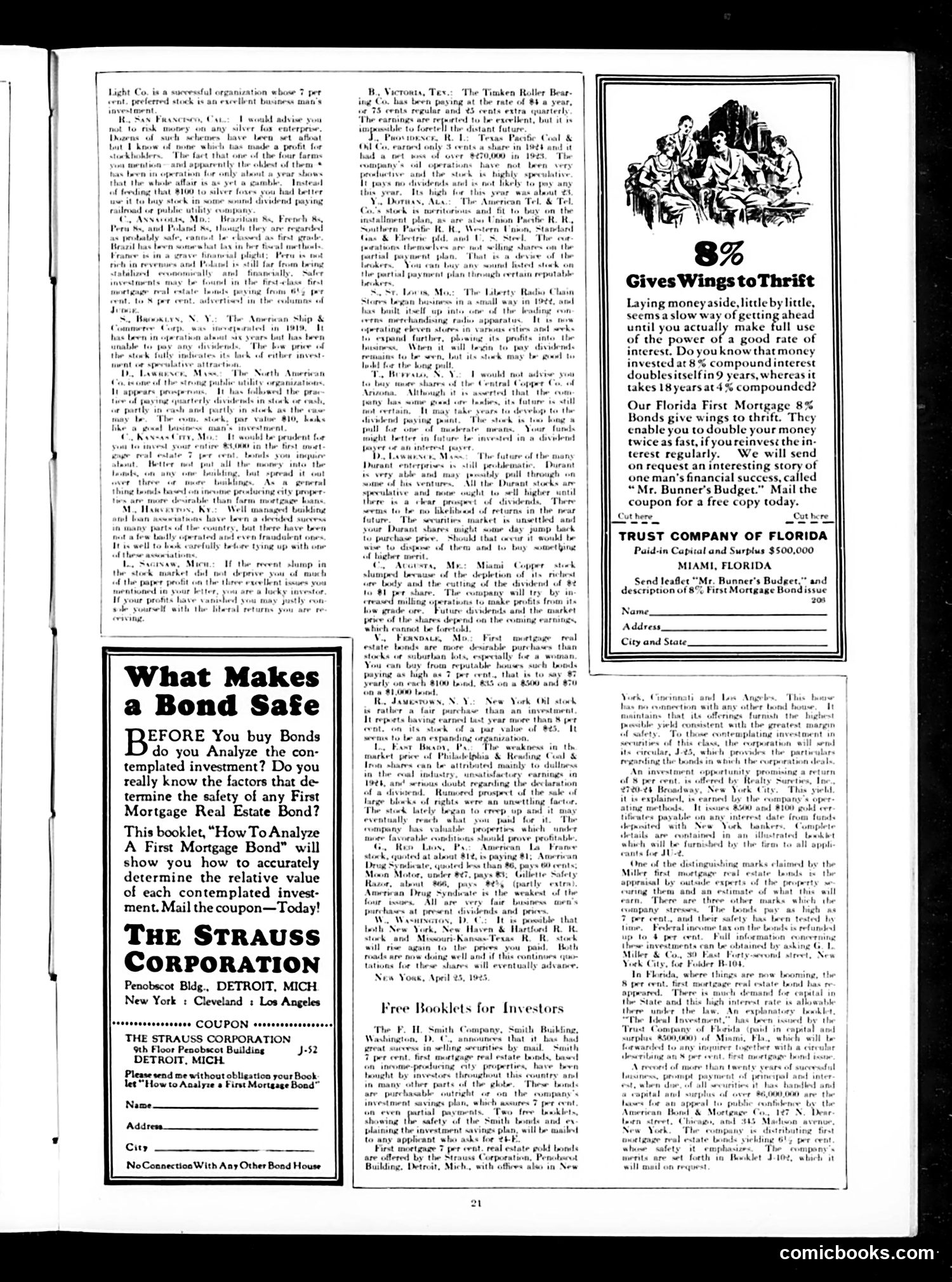
This is primarily a **financial advertising page** from Judge magazine, likely from the 1920s. It contains two major bond-investment advertisements (The Strauss Corporation and Trust Company of Florida) promoting "safe" investment vehicles, alongside reader investment-advice columns. The key irony for modern readers: these ads emphasize bond safety and careful analysis while promoting relatively high returns (8% interest). This page appears published during the speculative bubble of the 1920s, before the 1929 stock market crash. The advice columns warn against risky schemes—yet they're surrounded by aggressive bond marketing claiming exceptional safety *and* superior returns. The "8% Gives Wings to Thrift" ad uses compound-interest mathematics to make slow savings seem dramatic, a common persuasion tactic. The overall message promises ordinary people they can safely build wealth through conservative bond investment—a narrative that would prove dangerously misleading within years. The cartoonish illustration appears decorative rather than satirical commentary on the financial content.
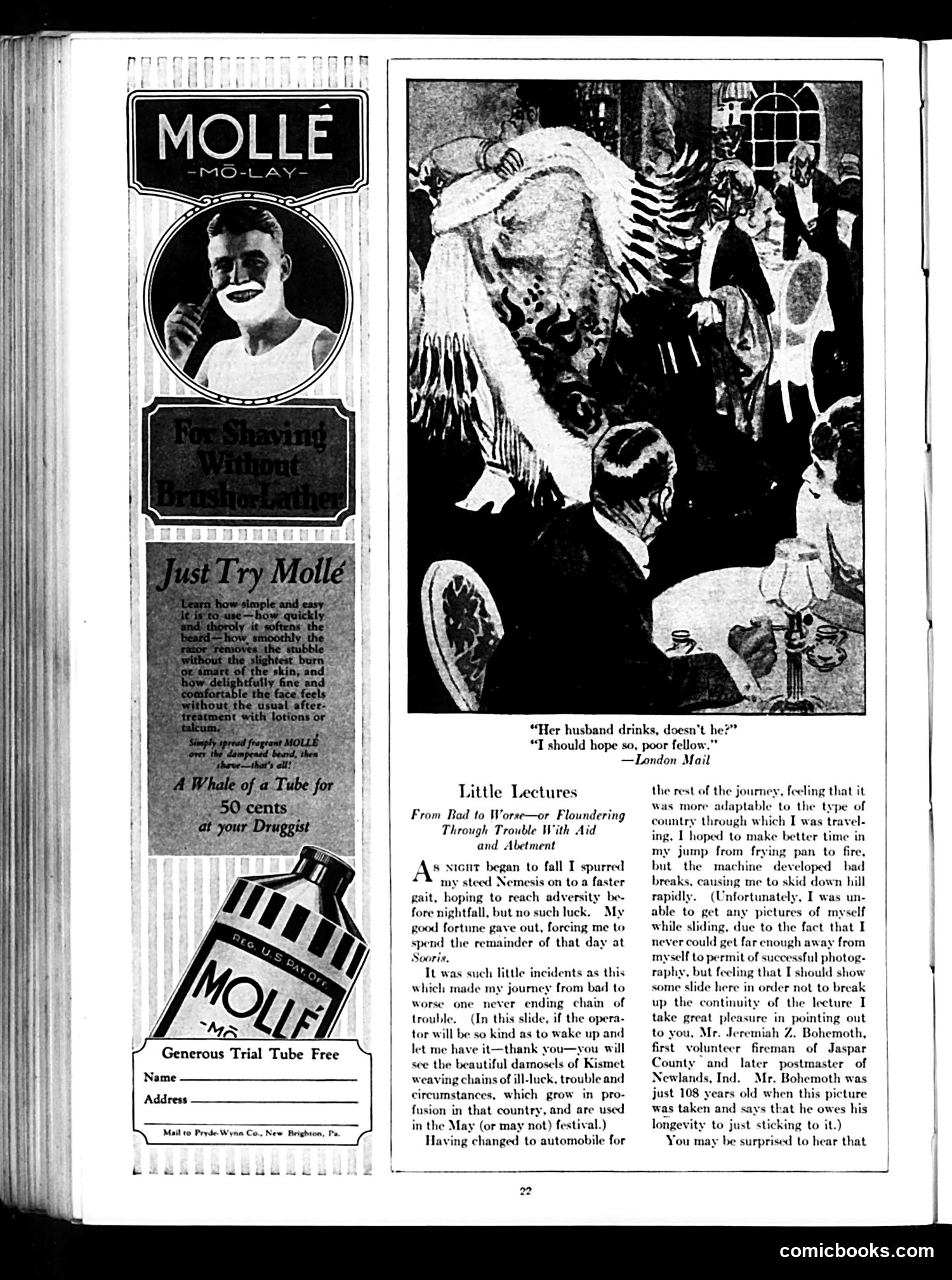
This page combines advertising with a humorous essay. The **Mollé shaving cream ad** (left) uses standard early 20th-century marketing—promising smooth shaving without aftereffects like irritation or talcum powder residue. The main content is a comedic essay titled "Little Lectures: From Bad to Worse," narrated as a traveler's misadventure. The author describes a journey plagued by escalating disasters—a horse fails, forcing an overnight stay; switching to an automobile causes brake failure and a dangerous skid. The humor is deadpan and absurdist: the narrator mentions taking photographs of himself sliding downhill but notes he "never could get far enough away from myself" to succeed. The illustration shows a period dinner scene with the caption quoting a London Mail exchange: one character asks if another's husband drinks; the response "I should hope so, poor fellow" implies drinking is preferable to the husband's actual character—mild social satire on unhappy marriages. The essay's self-aware digressions and footnotes (addressing a "Mr. Bohemoth" in the audience) mock conventional lecture formats while celebrating failure and absurdity as entertainment.
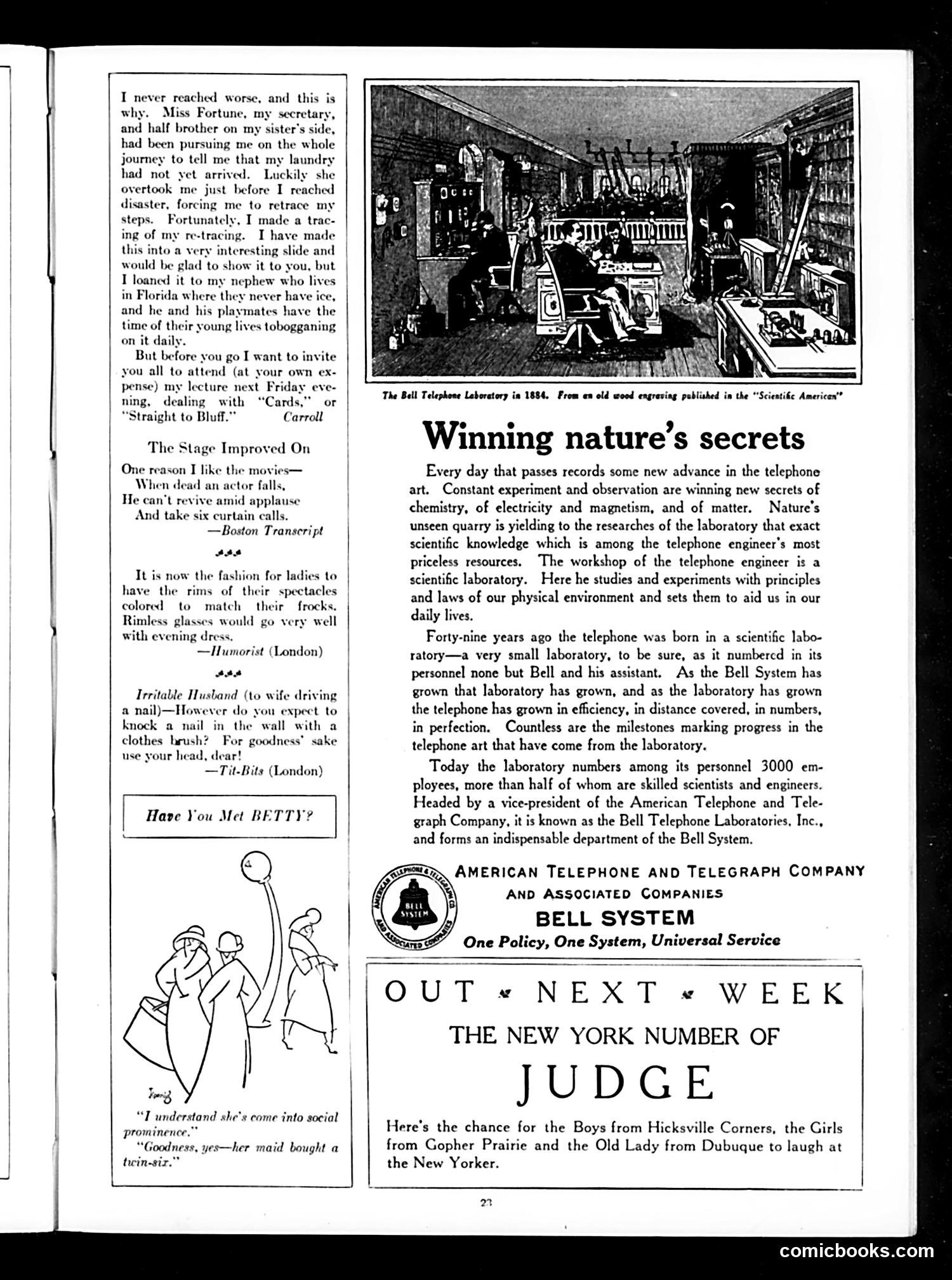
This page mixes humor content with corporate advertising. The left side contains three brief satirical pieces typical of Judge's style: jokes about theater, fashion eyeglass rims, and domestic absurdity (a husband mocking his wife for using a clothes brush as a hammer). These represent the magazine's light social commentary. The dominant right-side content is a substantial advertisement for the Bell Telephone System, celebrating its research laboratory. The ad uses the language of scientific progress, claiming telephone engineers are "winning nature's secrets" through constant experimentation. It traces the telephone's origins to Bell's small laboratory and emphasizes the system's growth to 3,000 employees, "more than half" being scientists and engineers. This reflects early-20th-century corporate propaganda positioning business innovation as heroic scientific achievement. The ad concludes by promoting an upcoming "New York Number" of Judge, inviting rural Americans to laugh at sophisticated urban culture—revealing the magazine's actual audience demographics.
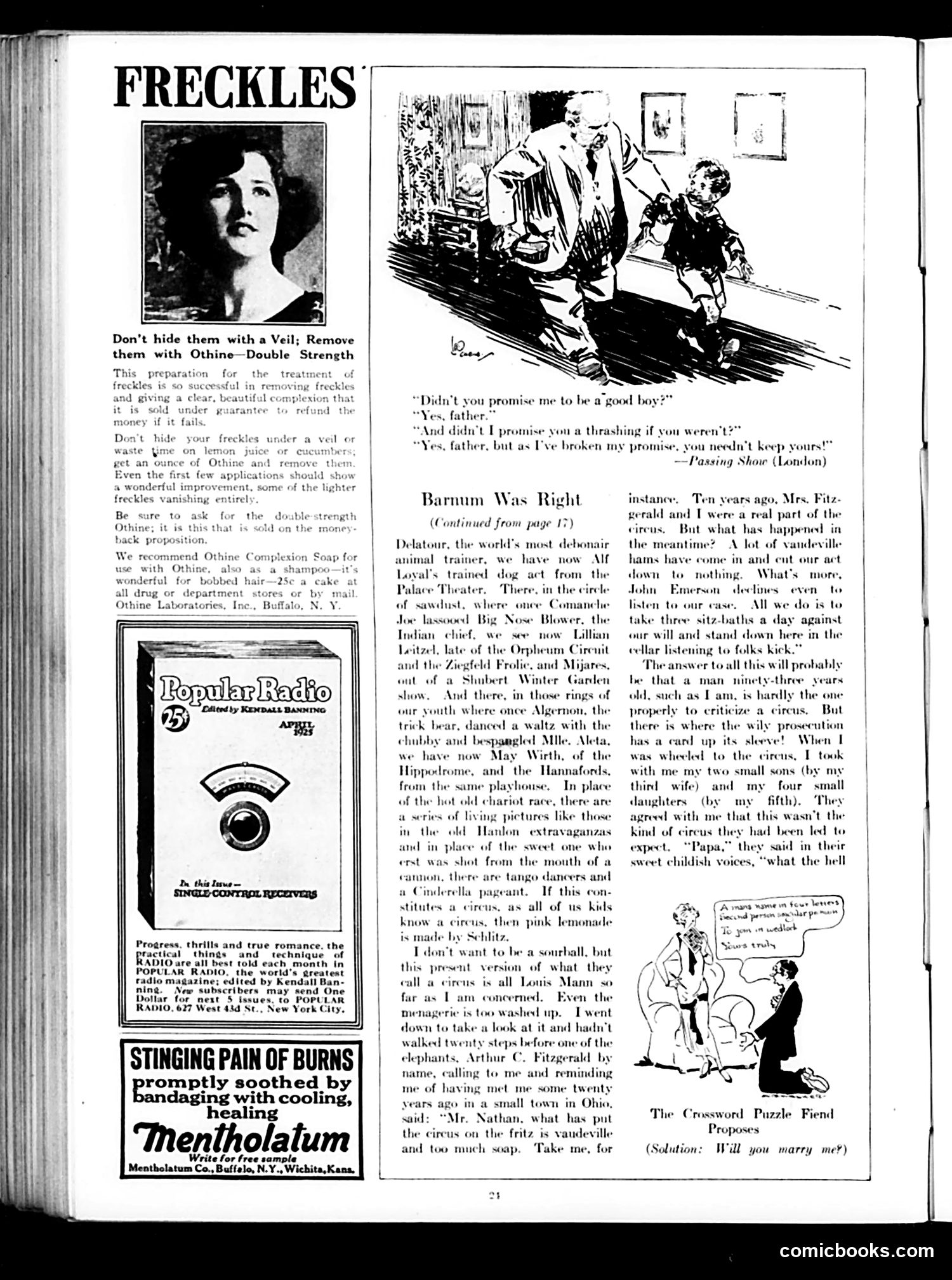
This page mixes advertisements with humor pieces typical of 1920s *Judge* magazine. The main cartoon shows a father and son in a domestic dispute. The boy cleverly argues that since *he's* broken his promise to behave, his father shouldn't keep *his* promise to give him a thrashing—using twisted logic to escape punishment. The satire targets childhood mischief and parental discipline. The longer article "Barnum Was Right" discusses circus decline. Writer George Nathan argues that vaudeville performers have infiltrated the circus, replacing traditional acts with lower-quality entertainment. He satirizes how modern circuses have become commercialized and diluted, contrasting them with earlier, purer circus traditions. The title references P.T. Barnum's famous circus, implying even he couldn't save it from this degradation. Supporting this is an advertisement for *Popular Radio* magazine and one for Mentholatum burn ointment—typical period advertisements unrelated to the editorial content. The page reflects 1920s nostalgia for "authentic" entertainment versus commercialized mass culture.
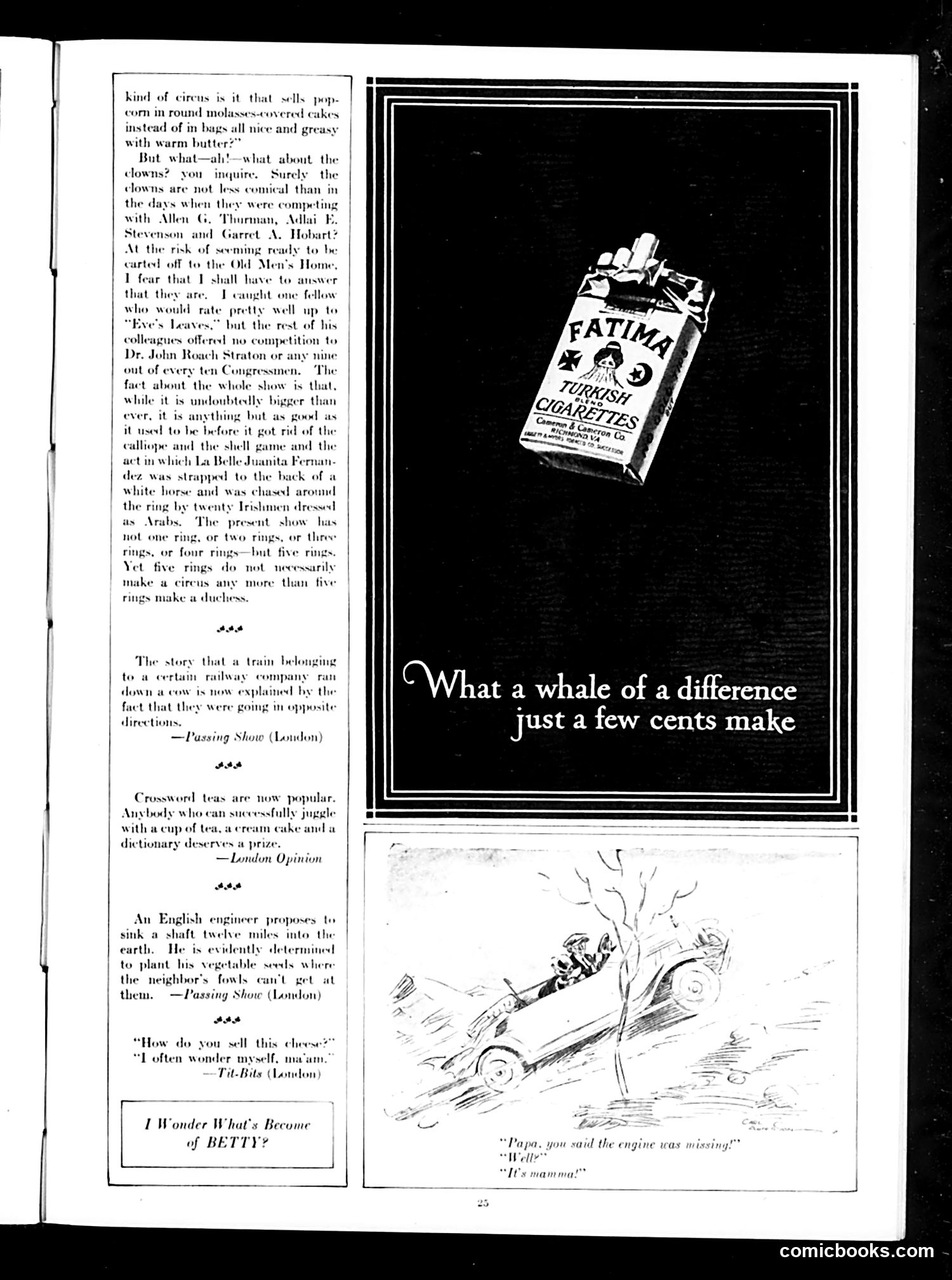
This page from *Judge* magazine contains mostly short humor items and an advertisement rather than political cartoons. The main advertisement (center-right) promotes **Fatima Turkish Cigarettes**, showing a pack with the slogan "What a whale of a difference just a few cents make"—a vintage tobacco ad emphasizing value. The left column contains brief anecdotes and jokes sourced from other publications (*Passing Show*, *London Opinion*, *Tit-Bits*). These reference: - **Circus clowns** compared unfavorably to performers like Allen G. Thurman, Adlai E. Stevenson, and Garret A. Hobart (likely political figures being mocked) - A joke about a train accident caused by opposite directions - Crossword puzzles and an engineer's vegetable garden scheme The bottom illustration shows a car accident with the caption "Papa, you said the engine was missing! / Well? / It's mammal!"—a pun on "engine missing" versus "mama missing." These are light domestic humor items and advertisements typical of early 20th-century satirical magazines, with no significant political commentary visible on this particular page.
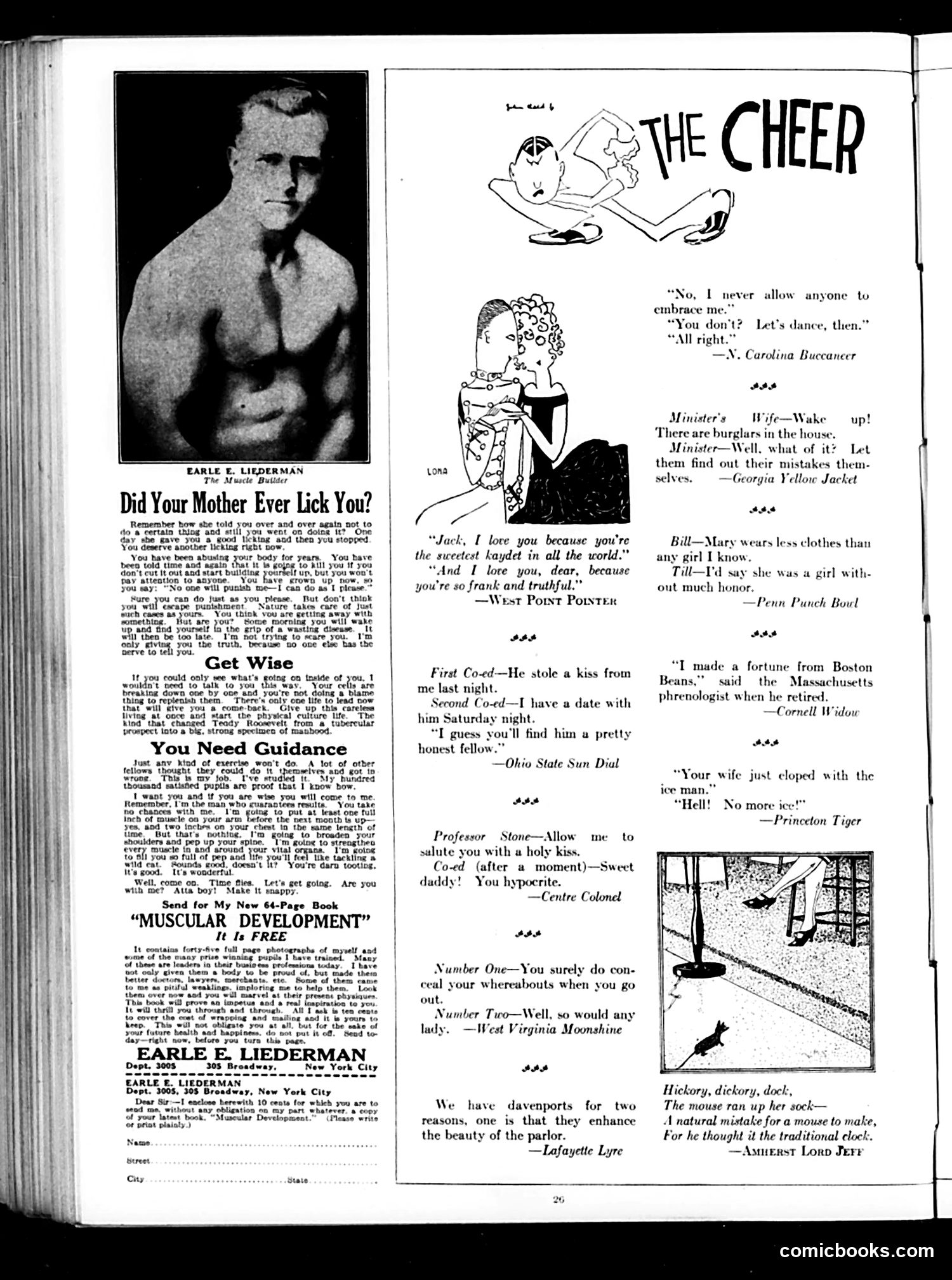
This page combines advertisements with humorous quotations—a common Judge format. The main content is **"The Cheer,"** a collection of brief jokes and witty remarks submitted by readers from various college publications and newspapers. **Key elements:** The left side features **Earle E. Liederman**, a real physical-culture entrepreneur advertising his "Muscular Development" course—typical of early 20th-century bodybuilding promotions promising strength and manhood. **The jokes themselves** mock various social situations: a minister too passive to stop burglars, a cadet praised for being "frank and truthful," wives as property (the ice-man elopement joke), and small romantic misunderstandings between college men and women. **The humor reflects 1920s attitudes**: gender dynamics, marital infidelity as comedy, and courtship conventions. The cartoon of the running mouse with the couplet about "hickory dickory dock" is a traditional nursery rhyme joke. This page is primarily **filler content**—lighthearted, inoffensive humor designed to amuse readers between more substantial satirical pieces.
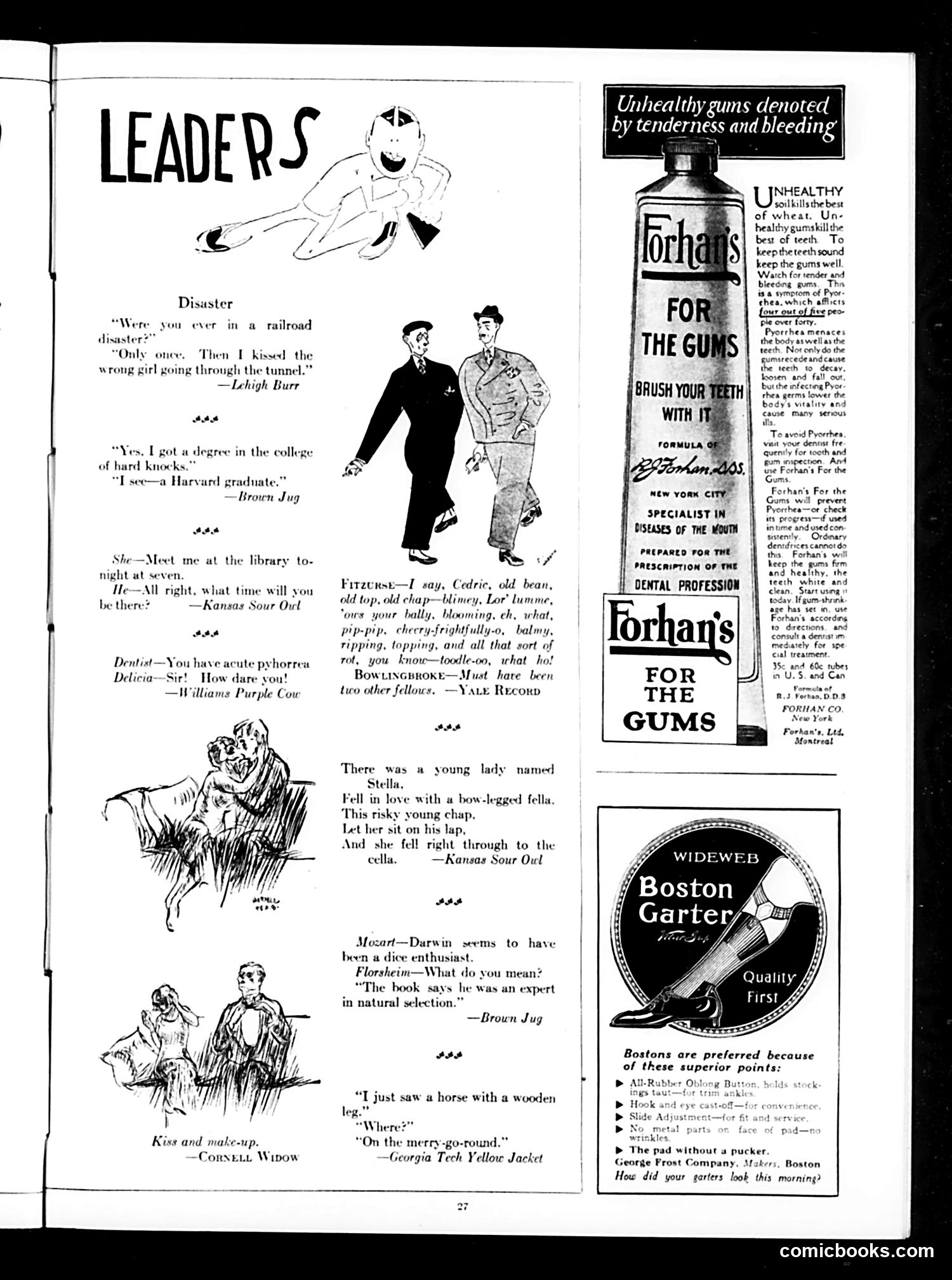
This page combines humor pieces ("Leaders") with period advertisements. The jokes are largely obscure without historical context—references to college "hard knocks," railroad disasters, and literary allusions that were apparently recognizable to Judge's early 20th-century audience but lack clarity now. The page's substantial real estate goes to **advertisements for Forhan's toothpaste and Boston Garter products**. The Forhan's ad emphasizes treating pyorrhea (gum disease), presenting it as a serious health threat affecting "four out of five people over forty"—positioning the product as preventative medicine. The Boston Garter ad similarly uses health/quality claims to market garters. The humor pieces appear largely **non-political**—mostly dating mishaps and wordplay. The "Darwin/natural selection" joke plays on double meanings, while British-accented dialogue ("old bean," "pip-pip") mocks affected speech patterns. This is primarily **a commercial publication disguised as satire**, where advertisements dominate and humor serves as filler between product pitches.
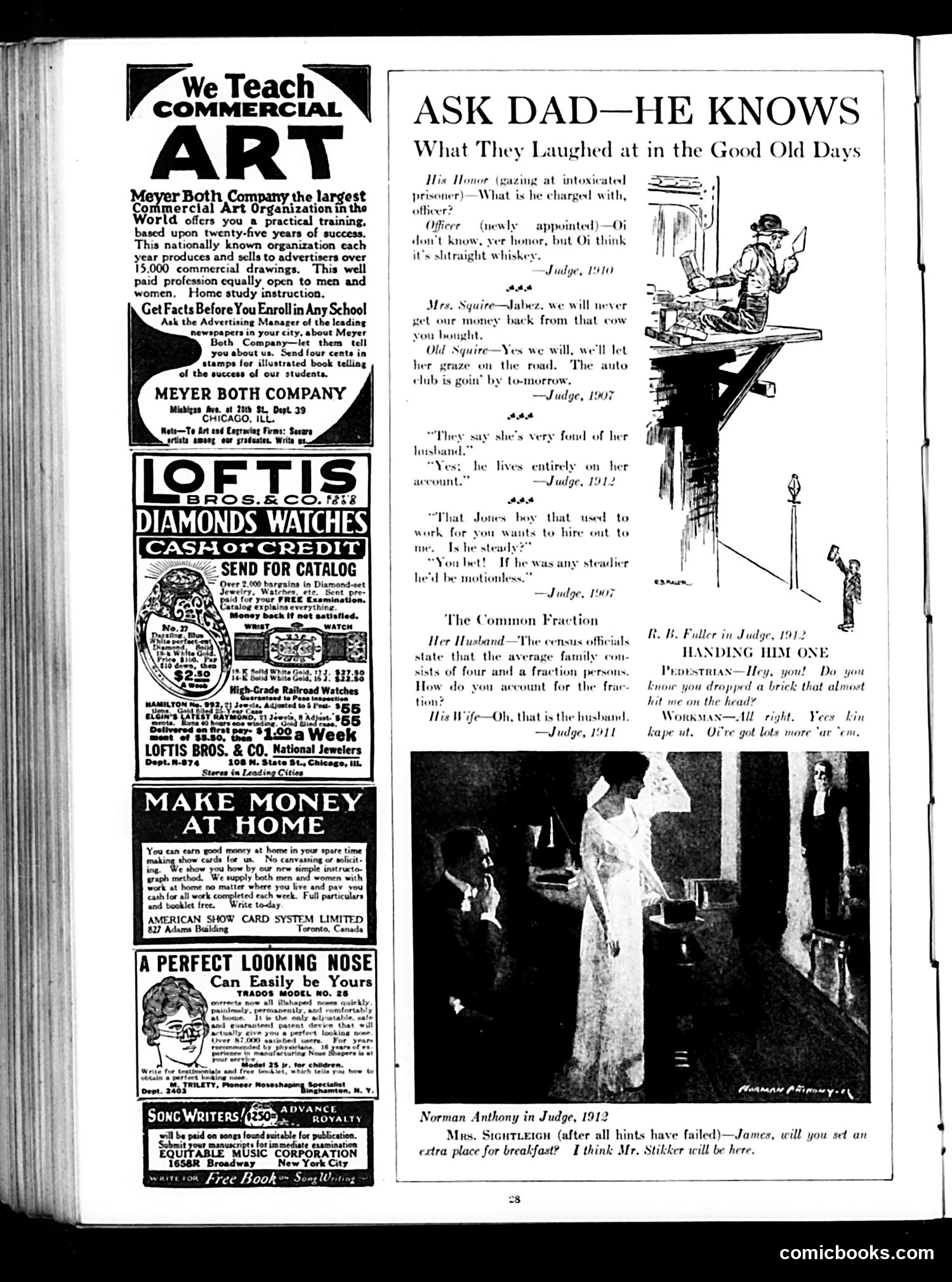
This page collects short joke strips and gags from Judge magazine, primarily featuring domestic and social humor of the early 1910s. The cartoons satirize common scenarios: **Key jokes include:** - An Irish police officer's malapropism ("shtraight whiskey" for "straight whiskey") - Rural husband-and-wife banter about recovering money from a bad cow purchase via auto club collision - A census official's explanation that the "fraction" in average family size is the husband (suggesting husbands are disposable/worthless) - A worker carelessly dropping bricks on pedestrians The humor relies on class stereotypes (Irish accent), gender roles (incompetent husbands), and slapstick scenarios typical of the era. The illustrations accompany brief dialogue, a common Judge format. The page is dominated by advertisements (art schools, jewelry, nose-shaping devices), reflecting the magazine's commercial nature alongside its satirical content.
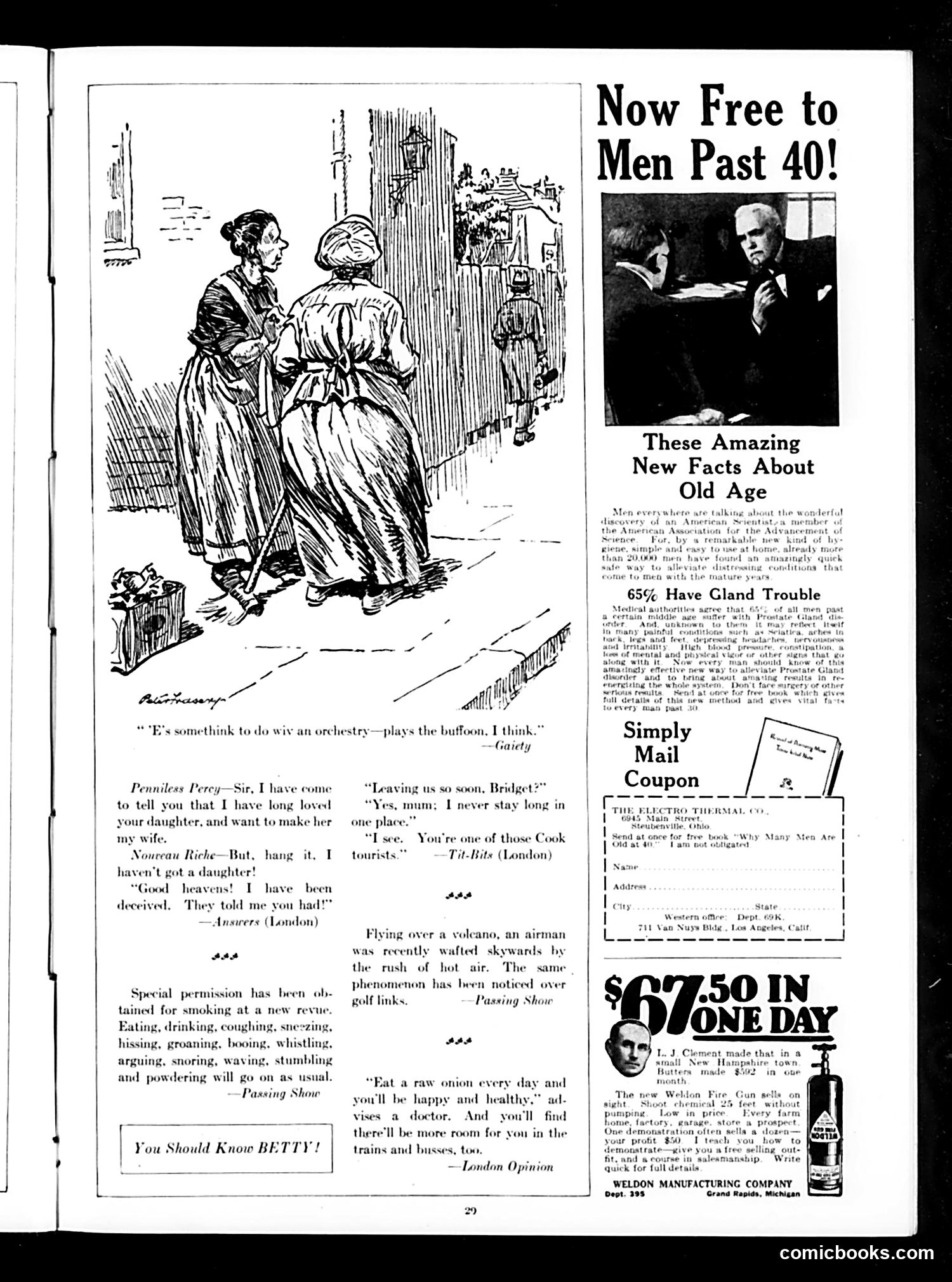
This page mixes humor with advertising. The main cartoon depicts a comedic misunderstanding: a poor suitor ("Penniless Percy") approaches a wealthy man ("Nouveau Riche") seeking permission to marry his daughter, only to learn the man has no daughter—implying the suitor was misled or confused. Below are brief jokes satirizing British social conventions: a reveue permits smoking but allows other disruptive behaviors anyway; a domestic servant ("Bridget") characterizes tourists as transient; a doctor's raw onion health advice is mocked. The dominant content is an advertisement for the "Weldon Fire Gun," a dubious health device marketed to men over 40, promising earnings of $67.50 daily. This reflects era-typical medical quackery targeting aging men with vague wellness claims. The overall tone mixes genteel British social satire with exploitative advertising—typical of Judge's mixed editorial-commercial format.
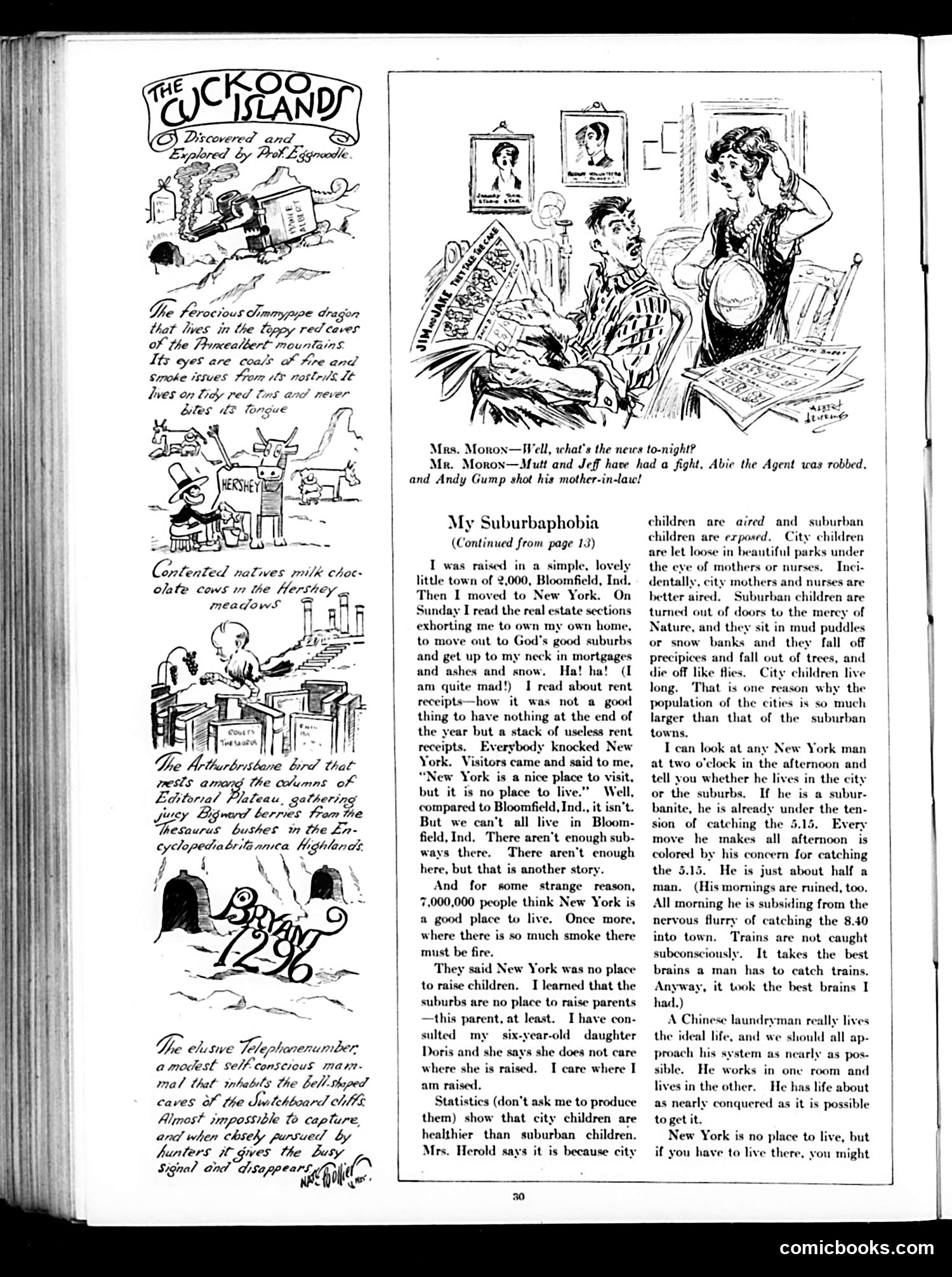
This page from *Judge* magazine contains satirical content about urban versus suburban life. The left side features absurdist "fantasy creatures" (the "Cuckoo Island" section)—whimsical invented animals that parody nature writing, likely mocking pseudo-scientific or fantastical magazine features popular at the time. The main content is "My Suburbaphobia," a humorous essay by someone (likely Arthur Brisbane, given the magazine's style) defending city living against prevailing suburban enthusiasm. The author sarcastically rebuts the era's common real estate advertising pitch that suburbs were ideal for families. He contrasts his small Indiana hometown (2,000 people) with New York City, arguing that suburban life creates anxiety (commuters obsessing over train schedules) while city parks provide superior child-rearing. The opening cartoon shows a domestic dispute—"Mrs. Moron" and "Mr. Moron" gossip about scandals involving comic strip characters (Mutt and Jeff, Abie the Agent, Andy Gump), satirizing lowbrow entertainment consumption. The satire targets both suburban boosters and urban complacency during the 1920s real estate boom.
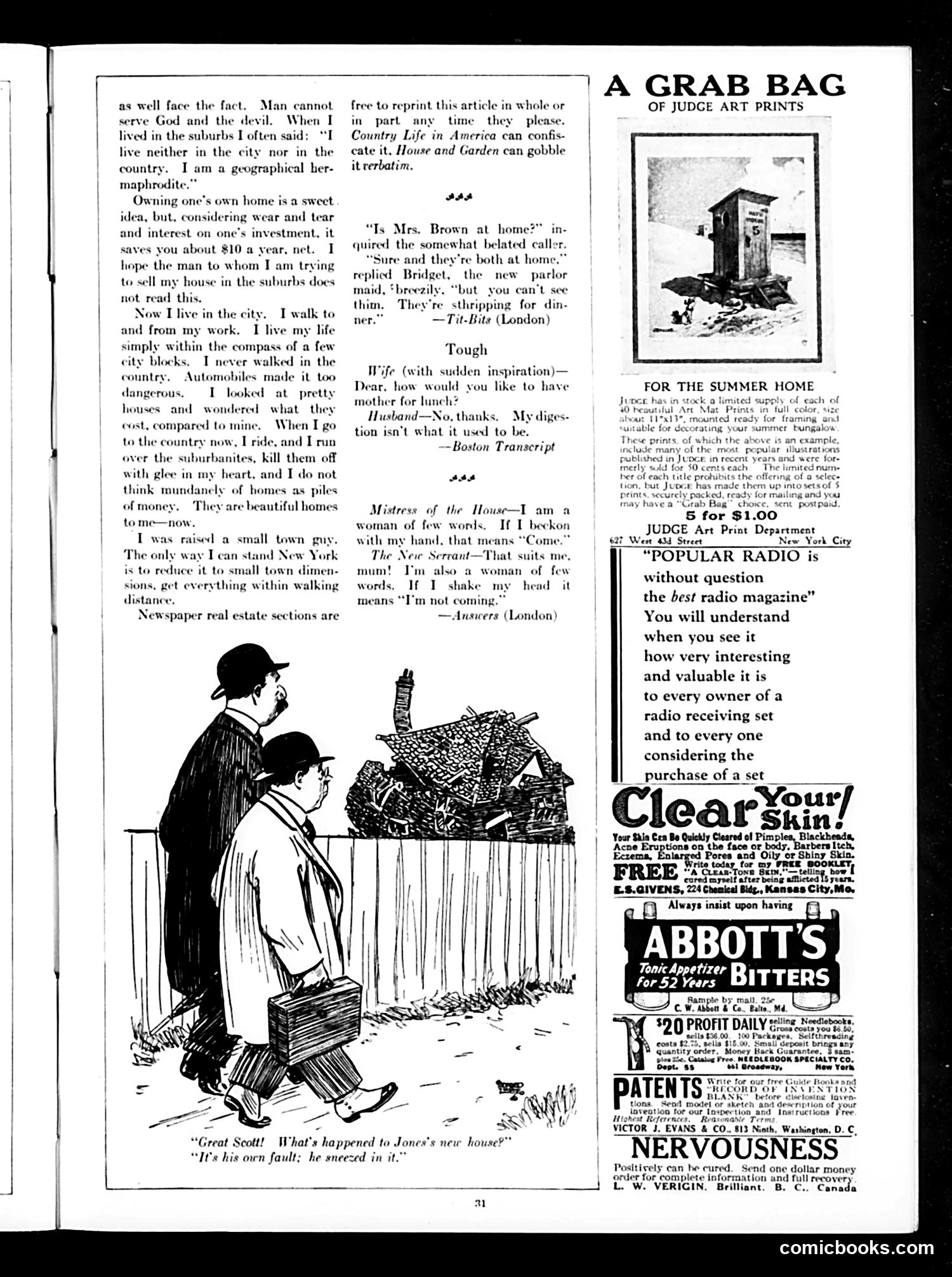
## Main Cartoon The illustrated cartoon shows two men in bowler hats looking over a fence at a dilapidated, ramshackle house. The caption reads: "Great Scout! What's happened to Jones's new house?" / "It's his own fault; he sneezed in it." **Meaning**: This is a visual pun satirizing suburban home ownership. The joke suggests that even a sneeze can damage a poorly-built suburban house—implying these mass-produced homes are flimsy and constructed from cheap materials. It mocks the popular aspirational trend of suburban home-buying. ## Context The accompanying article text discusses the author's disillusionment with suburban living. He criticizes the financial reality (homes save only "$10 a year, net"), the geographic isolation, and the dangers of automobiles. The author now prefers city living and views suburban homes cynically—not as investments but as overpriced vulnerabilities. **The satire targets**: 1920s-era suburban expansion, real estate marketing, and middle-class aspirations to homeownership, exposing the gap between the suburban dream and financial/practical reality.
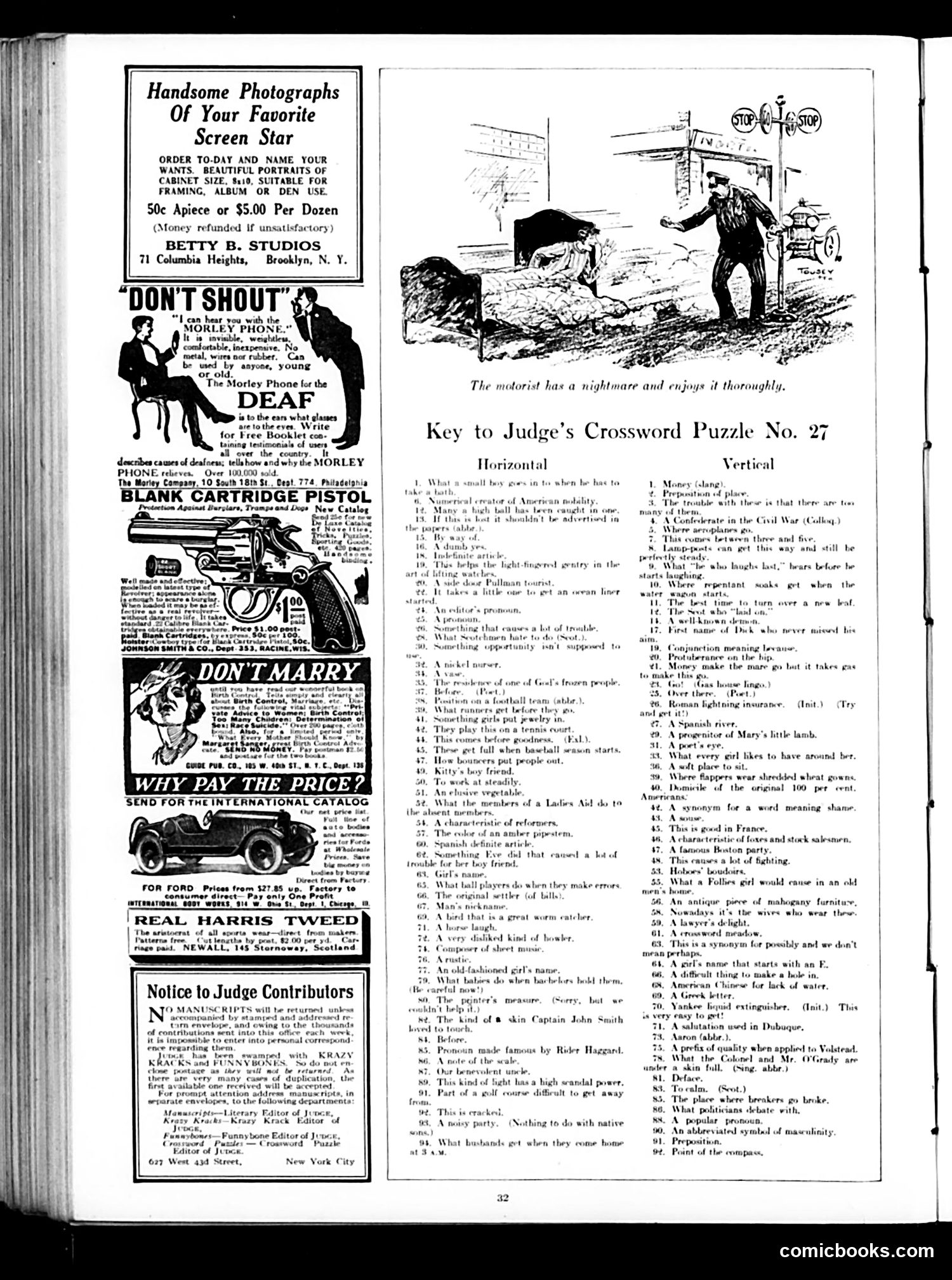
This page is primarily **advertising and puzzle content** rather than political satire. It contains: **Advertisements:** Screen star photographs, the "Morley Phone" (a hearing device for deaf users), a blank cartridge pistol, and Ford automobiles—typical early 20th-century classified ads. **Main Content:** A crossword puzzle solution ("Key to Judge's Crossword Puzzle No. 27") with horizontal and vertical clues. The puzzle itself appears to be a standard word game with generic clues referencing everyday topics (sports, romance, fashion, animals). **Cartoon:** A small illustration shows a motorist experiencing a nightmare while driving—likely satirizing the growing automobile culture and its dangers, presented as comedic rather than serious social commentary. The page reflects Judge's mixed format: combining satirical humor with commercial advertising and entertainment features typical of early 1900s magazines. There are no identifiable political figures or specific contemporary events referenced.
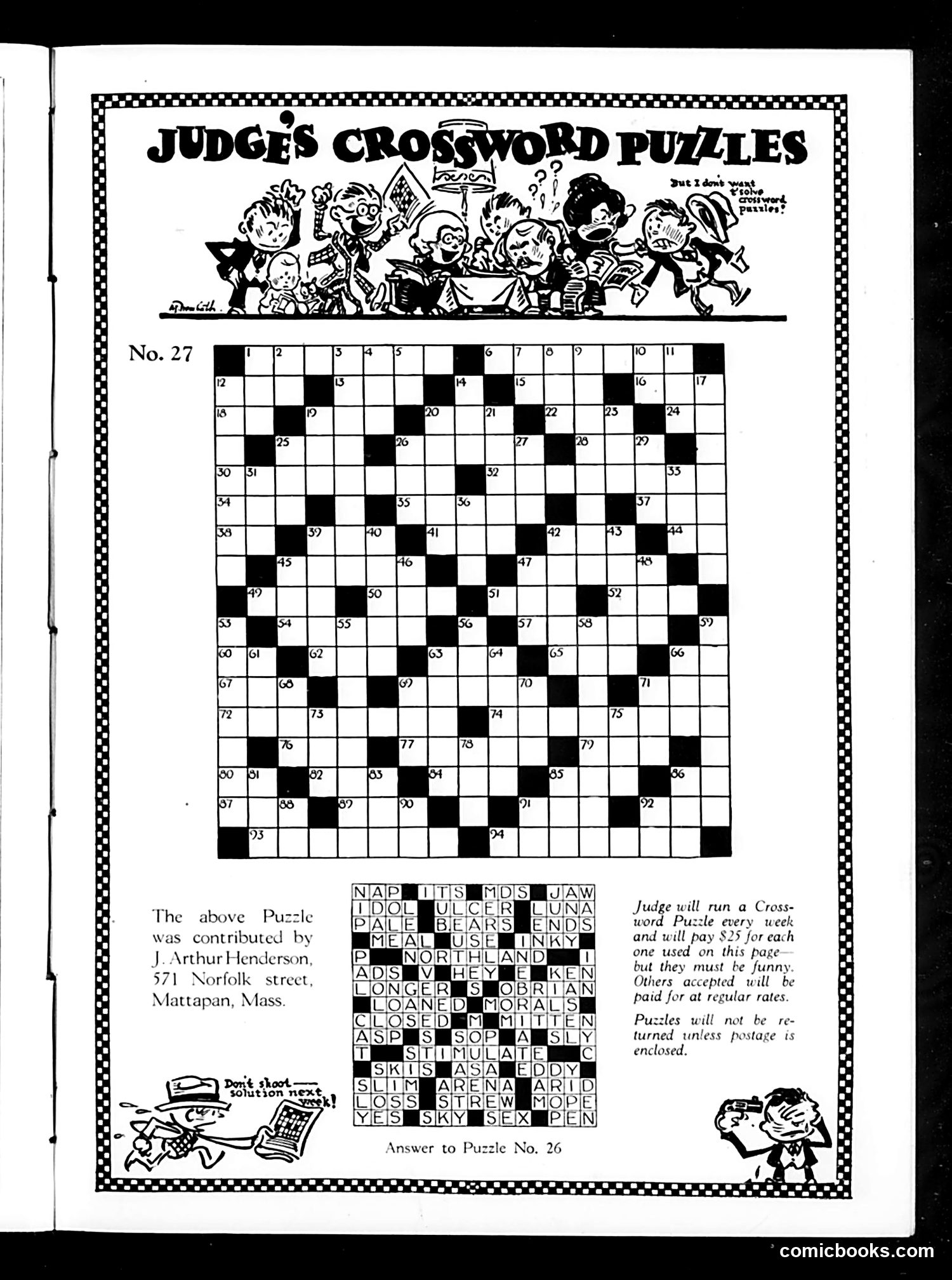
This page presents a **crossword puzzle contest** rather than satirical cartoons. Judge magazine offered $25 payment for funny crossword puzzles submitted by readers, with this example contributed by J. Arthur Henderson of Mattapan, Massachusetts. The page includes the solution to the previous week's puzzle (No. 26), displaying answers in a grid format with words like "NAPS," "ULCER," "LUNA," "BEARS," "ENDS," and others visible. The cartoon illustrations are generic decorative elements—a character reviewing puzzle solutions and another character at bottom right—rather than specific political or social satire. This was a popular magazine feature during the crossword puzzle craze of the early-to-mid 20th century, functioning as both entertainment and reader engagement strategy through the financial incentive for submissions.
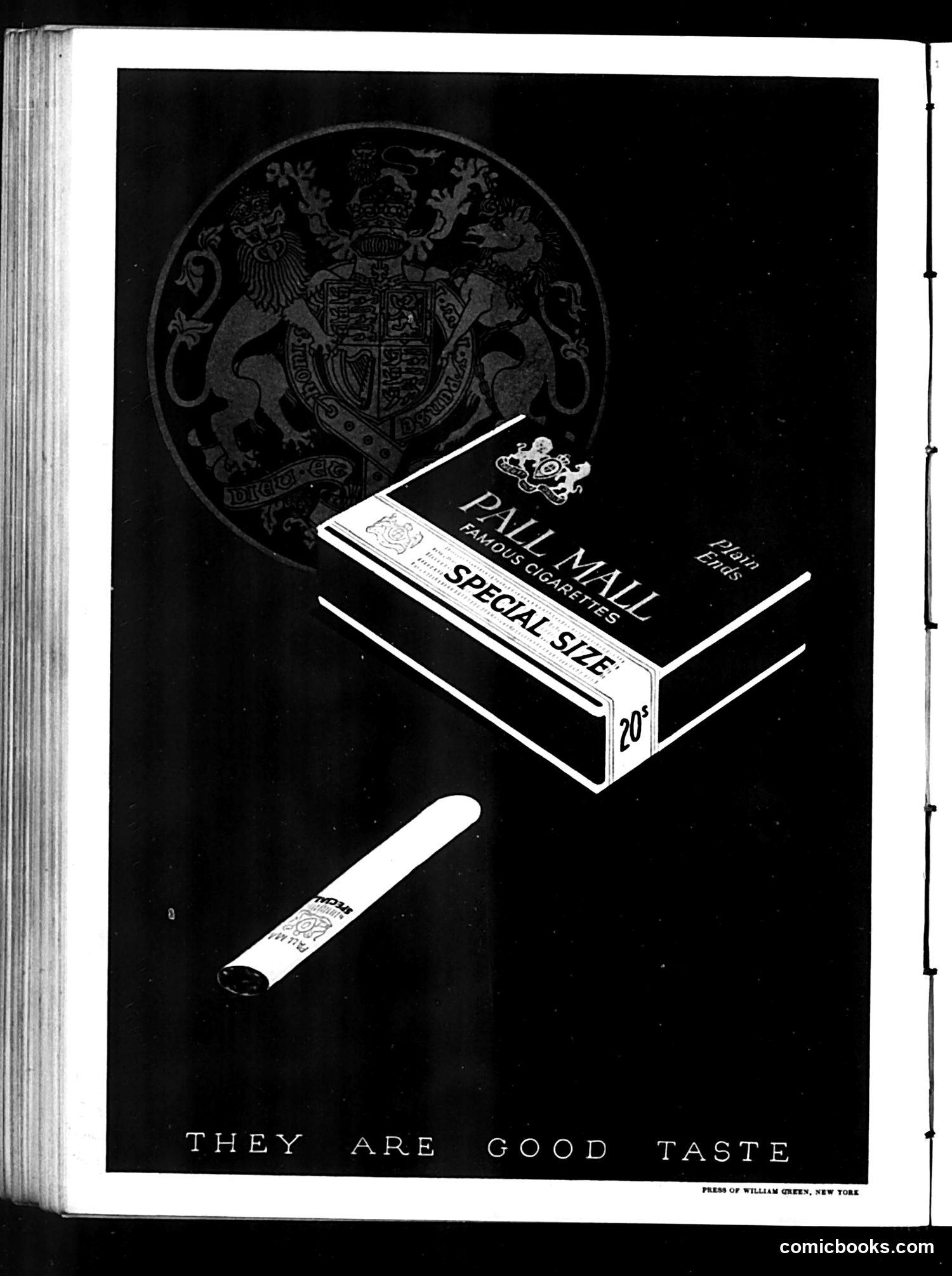
This is a **cigarette advertisement**, not political satire. The image shows a Pall Mall cigarette pack and individual cigarette against a heraldic royal coat of arms, emphasizing prestige and sophistication. The advertisement's appeal relies on **class association**—pairing cigarettes with British royal imagery and formal heraldry to suggest that smoking Pall Malls is a refined, upper-class activity. The tagline "THEY ARE GOOD TASTE" directly connects the product to social status and elegance. For modern readers, this represents **vintage advertising's frank use of class signaling** to sell products, before widespread health warnings. The royal symbolism was meant to convey luxury and exclusivity to mid-20th century consumers.