
Judge, 1925-05-02 · page 17 of 36
Judge — May 2, 1925 — page 17: what you’re looking at
What you’re looking at
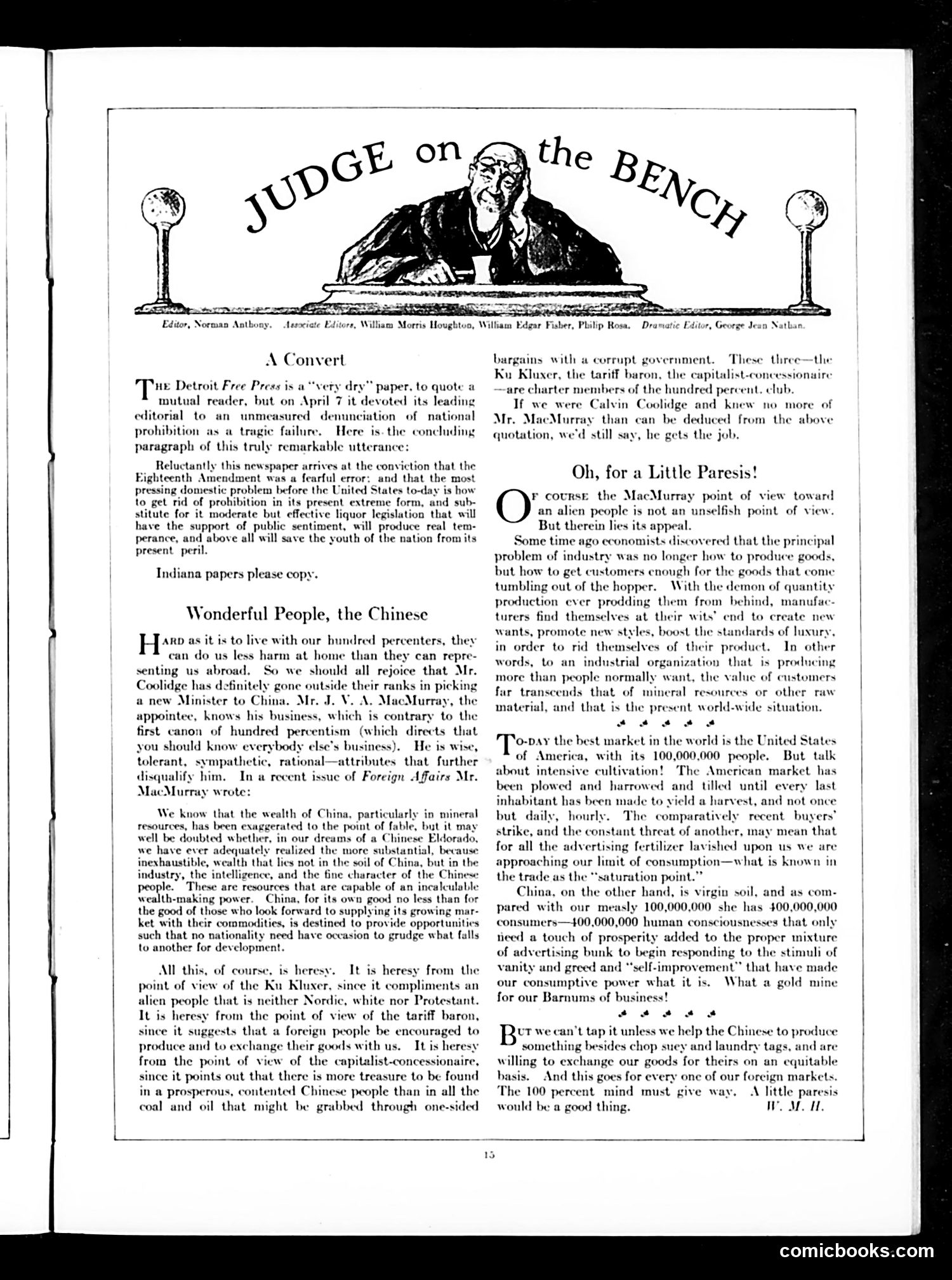
This page satirizes American isolationism and xenophobia in the 1920s. The main article praises diplomat J.V.A. MacMurray's appointment as Minister to China, attacking three groups the magazine calls "hundred percenters": 1. **The Ku Kluxer** — opposing MacMurray's respectful view of non-Nordic, non-Protestant peoples 2. **The tariff baron** — opposing free trade with foreign nations 3. **The capitalist-concessionaire** — preferring exploitative deals with corrupt governments over fair Chinese prosperity The satire's point: these "hundred percent" American nationalists prioritize racial/religious purity, protectionism, and imperial exploitation over practical diplomacy and mutually beneficial commerce. MacMurray's heretical idea—that prosperous, contented Chinese partners benefit America more than colonized subjects—challenges prevailing 1920s attitudes. The opening editorial about Prohibition's failure illustrates the magazine's broader critique of rigid ideological absolutism.
📄 Transcribed text from this page (OCR, searchable)
Machine-transcribed from the original scan — historical spelling and the odd misread are preserved.
Editor, Norman Anthony, Associate A Convert HE Detroit Free Press is a “very dry” paper, to quote a mutual reader, but on April 7 it devoted its leading editorial to an unmeasured denunciation of national prohibition as a tragic failure, Here is. the concluding paragraph of this truly remarkable utterance: Reluctantly this newspaper arrives at the conviction that the Eighteenth Amendment was a fearful error; and that the most pressing domestic problem before the United States to-day is how to get rid of prohibition in its present extreme form, and sub- stitute for it moderate but effective liquor legislation that will have the support of public sentiment, will produce real tem- perance, and above all will save the youth of the nation from its present peril. Indiana papers please copy. Wonderful People, the Chinese RD as it is to live with our hundred percenters, they can do us less harm at home than they can repre- So we should all rejoice that Mr. Coolidge has definitely gone outside their ranks in picking a new Minister to China. Mr. J. V. A. MacMurray, the appointee, knows his business, which is contrary to the first canon of hundred percentism (which directs that you should know everybody else’s business). He is wise, tolerant, sympathetic, rational—attributes that further disqualify him. In a recent issue of Foreign Afairs Mr. MacMurray wrote: H senting us abroad We know that the wealth of China, particularly in mineral resources, has been exaggerated to the point of fable, but it ma well be doubted whether, in our dreams of a Chinese Eldor: we have ever adequately realized the more substantial, because inexhaustible, Ith that lics not in the soil of China, but in the industry, the in| nee, and the fine character of the Chinese people. “These are resources that are capable of an incalculable wealth-making power. China, for its own good no less than for the good of those who look forward to supplying its growing mar- ket with their commodities, is destined to provide opportunities such that no nationality need have occasion to grudge what falls to another for development. All this, of course, is heresy. It is heresy from the point of view of the Ku Kluxer, since it compliments an alien people that is neither Nordic, white nor Protestant. It is heresy from the point of view of the tariff baron, since it suggests that a foreign people be encouraged to produce and to exchange their goods with us. It is heresy from the point of view of the capitalist-concessionaire, since it points out that there is more treasure to be found in a prosperous, contented Chinese people than in all the coal and oil that might be grabbed through one-sided William Edgar Fisher, Philip Rosa, Dramatic Editor, G Jean Nathan bargains with a corrupt government. These three—the Ku Kluxer, the tariff baron, the capitalist-concessionaire ~are charter members of the hundred percent. club. If we were Calvin Coolidge and knew no more of Mr. MacMurray than can be deduced from the above quotation, we'd still say, he gets the job. Oh, for a Little Paresis! O' covrse the MacMurray point of view toward an alien people is not an unselfish point of view. But therein lies its appeal. Some time ago economists discovered that the principal problem of industry was no longer how to produce goods, but how to get customers cnough for the goods that come tumbling out of the hopper. With the demon of quantity production ever prodding them from behind, manufac- turers find themselves at their wits’ end to create new wants, promote new styles, boost the standards of luxury, in order to rid themselves of their product. In other words, to an industrial organization that is producing more than people normally want, the value of customers fur transcends that of mineral resources or other raw material, and that is the present world-wide situation. ee a ee? 'o-pay the best market in the world is the United States of America, with its 100,000,000 people. But talk about intensive cultivation! The American market has been plowed and harrowed and tilled until every la inhabitant has been made to yield a harvest, and not c but daily, hourly. The comparatively recent’ buyers’ strike, and the constant threat of another, may mean that for all the advertising fertilizer lavished upon us we ure approaching our limit of consumption—what is known in the trade as the “saturation point.” China, on the other hand, is virgin soil, and as com- pared with our measly 100,000,000 she has 400,000,000 consumers—400,000,000 human consciousnesses that only tieed a touch of prosperity added to the proper mixture of advertising bunk to begin responding to the stimuli of vanity and greed and “self-improvement” that have made our consumptive power what it is. What a gold mine for our Barnums of business! as UT we can’t tap it unless we help the Chinese to produce something besides chop suey and laundry tags, and are willing to exchange our goods for theirs on an equitable basis. And this goes for every one of our foreign markets. The 100 percent mind must give way. A little paresis would be a good thing. WMH. rary ey comicbooks:com