
A complete issue · 36 pages · 1925
Judge — March 14, 1925
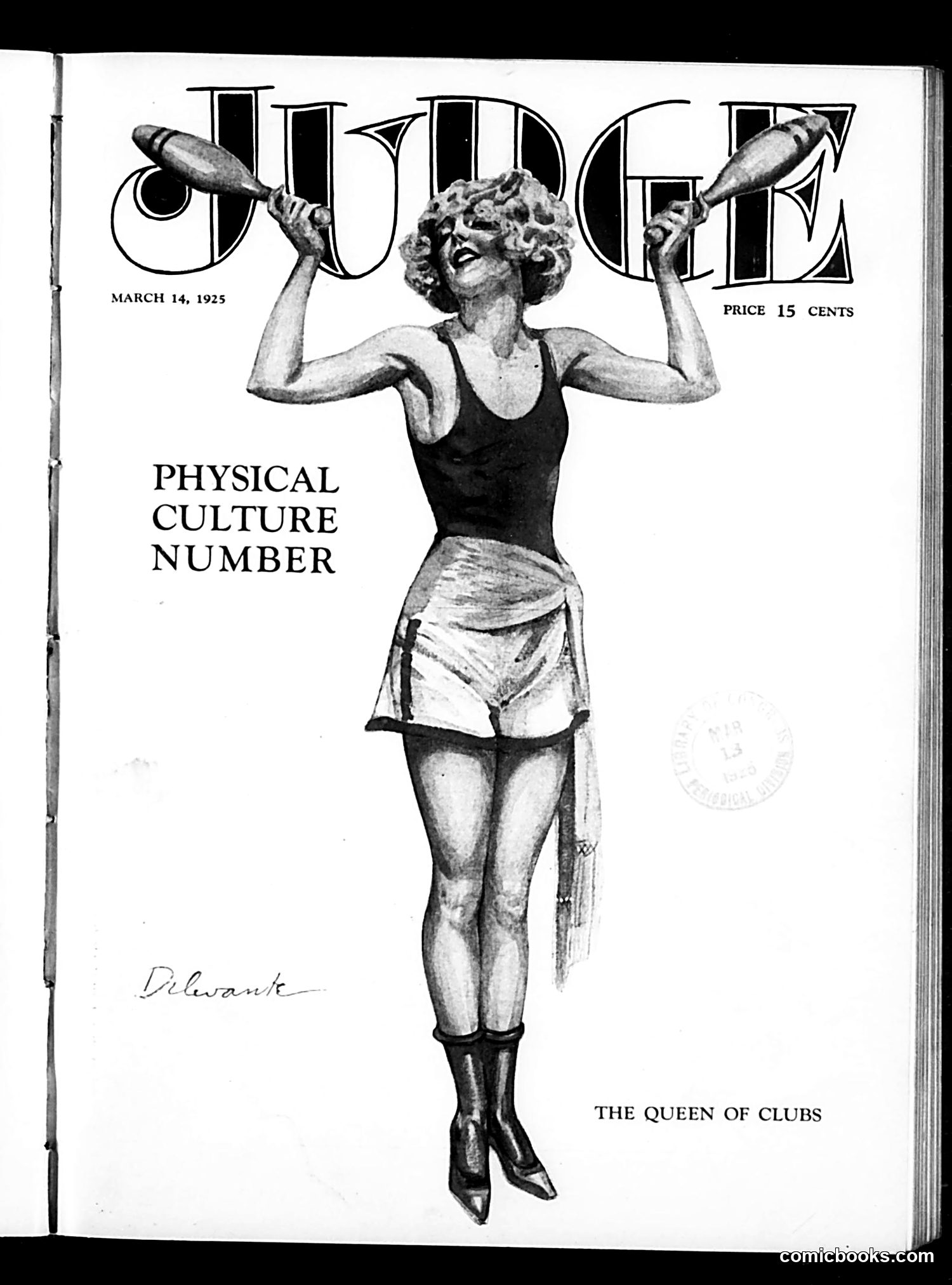
This is a "Physical Culture Number" issue of Judge magazine, featuring a woman in athletic wear wielding Indian clubs (a popular 1920s exercise equipment). The cover is titled "The Queen of Clubs," a pun playing on the suit from playing cards. The illustration reflects the 1920s "New Woman" — the flapper era's embrace of female athleticism and physical fitness as modern and progressive. Women's participation in sports and physical culture was controversial then, challenging Victorian ideas about femininity. The lighthearted tone and decorative Art Deco typography suggest Judge treated this as humorous rather than serious social commentary. The 15-cent price and artist signature ("Delevante") indicate this was a mainstream satirical magazine offering.
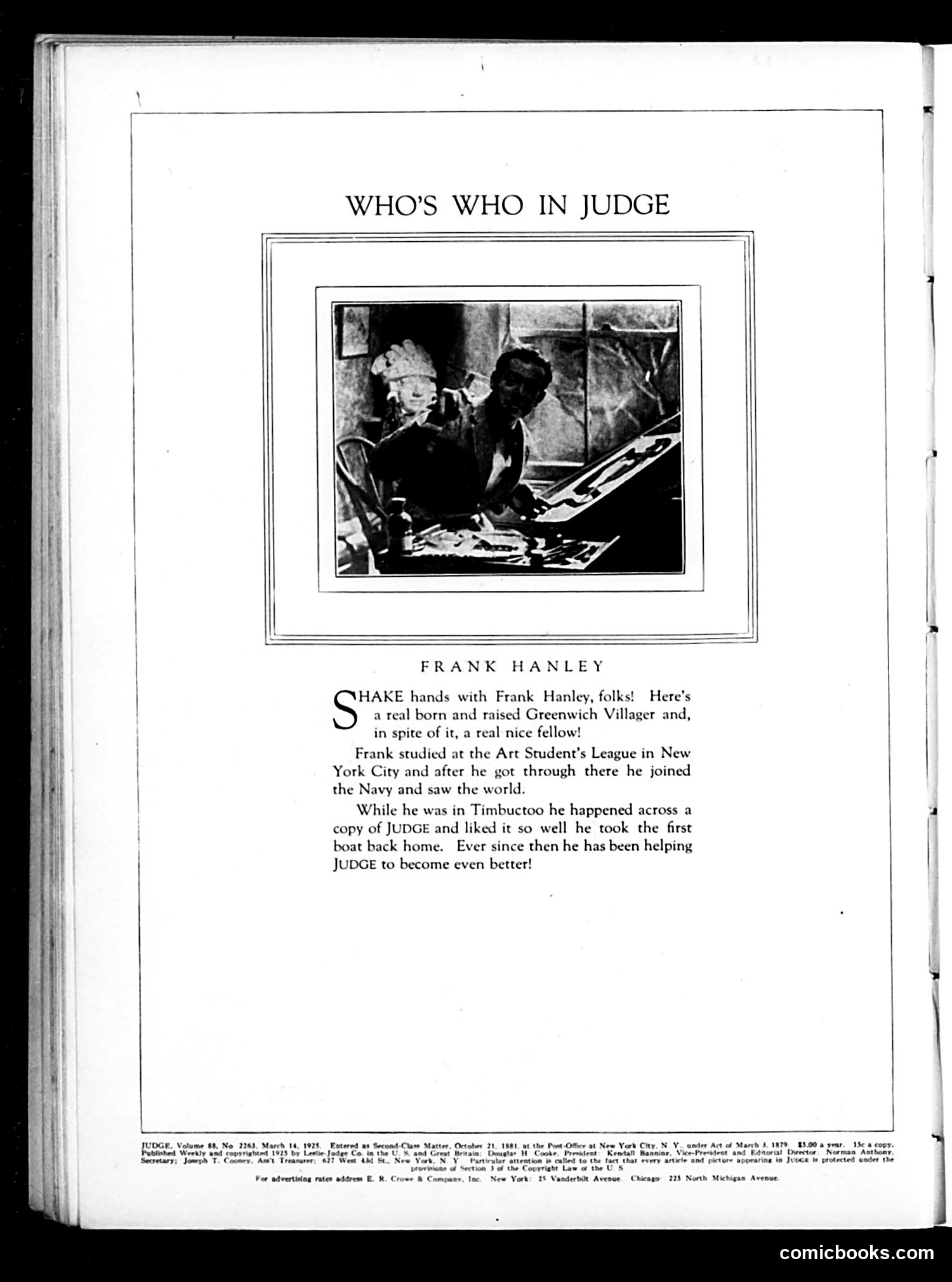
This is a biographical profile page from Judge magazine introducing Frank Hanley, described as "a real born and raised Greenwich Villager." The text explains that Hanley studied at the Art Student's League in New York City, served in the Navy, and discovered Judge magazine while in Timbuctoo. He became so enthusiastic about the publication that he brought a copy home and has since been contributing to it. The photograph shows two figures examining what appears to be artwork or designs at a table. This is essentially a staff introduction or advertisement for the magazine itself, celebrating Hanley's connection to Judge and positioning him as a contributor helping improve the publication. It reflects Judge's practice of promoting its own staff members and creative team.
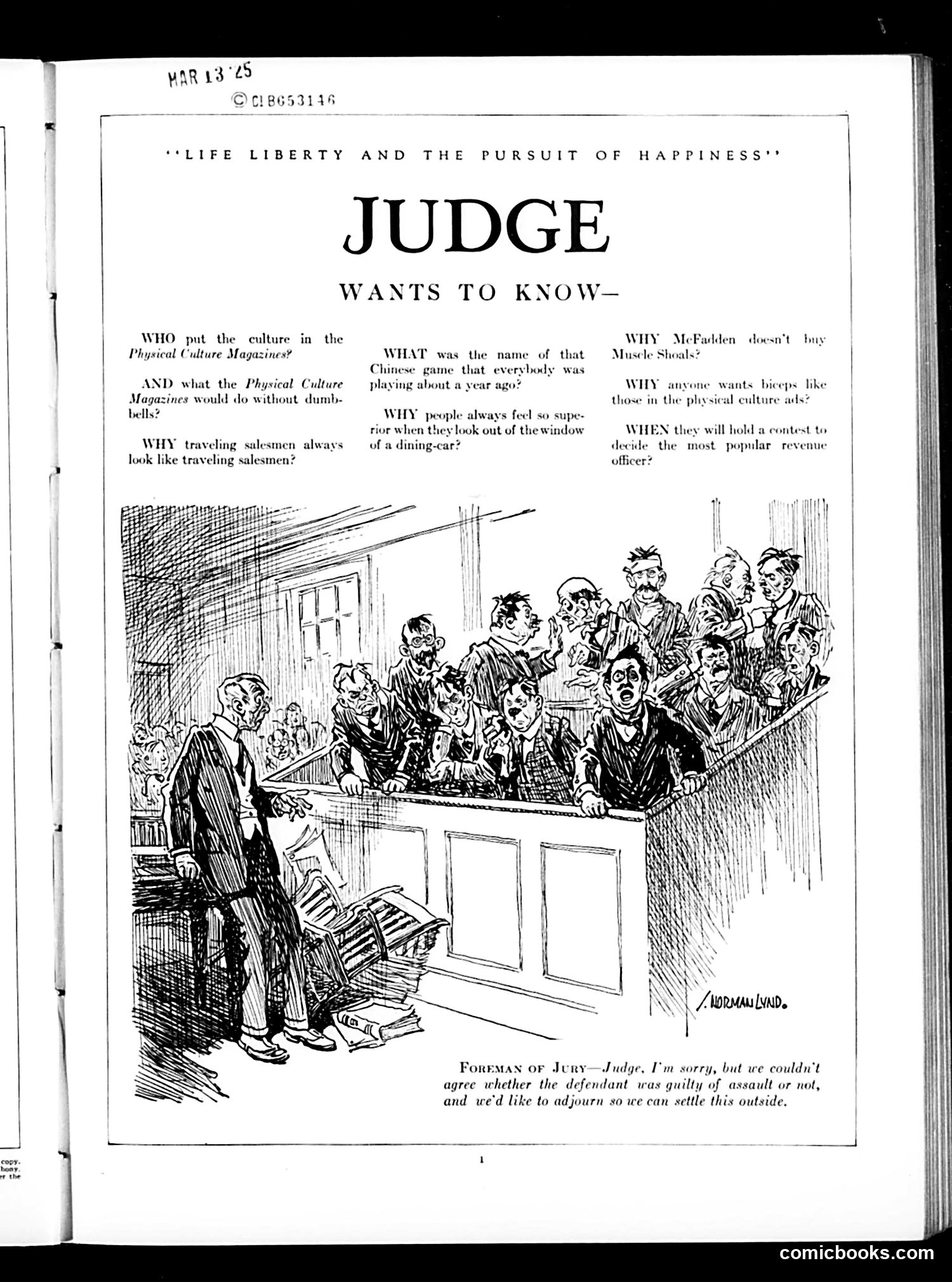
This page satirizes American obsessions with trivial matters and cultural pursuits. The title "Judge Wants to Know" presents rhetorical questions mocking popular preoccupations: who created "Physical Culture" magazines, why traveling salesmen look like traveling salesmen, and why people feel superior in dining cars. The central cartoon depicts a courtroom scene where a judge addresses a jury foreman. The satire targets judicial inefficiency: the jury cannot agree on a defendant's guilt and wants to adjourn to settle the matter "outside"—suggesting they'd resolve it through violence rather than legal process. The humor criticizes both frivolous public curiosities and the breakdown of proper legal procedures, reflecting early 20th-century anxieties about American institutions and culture.
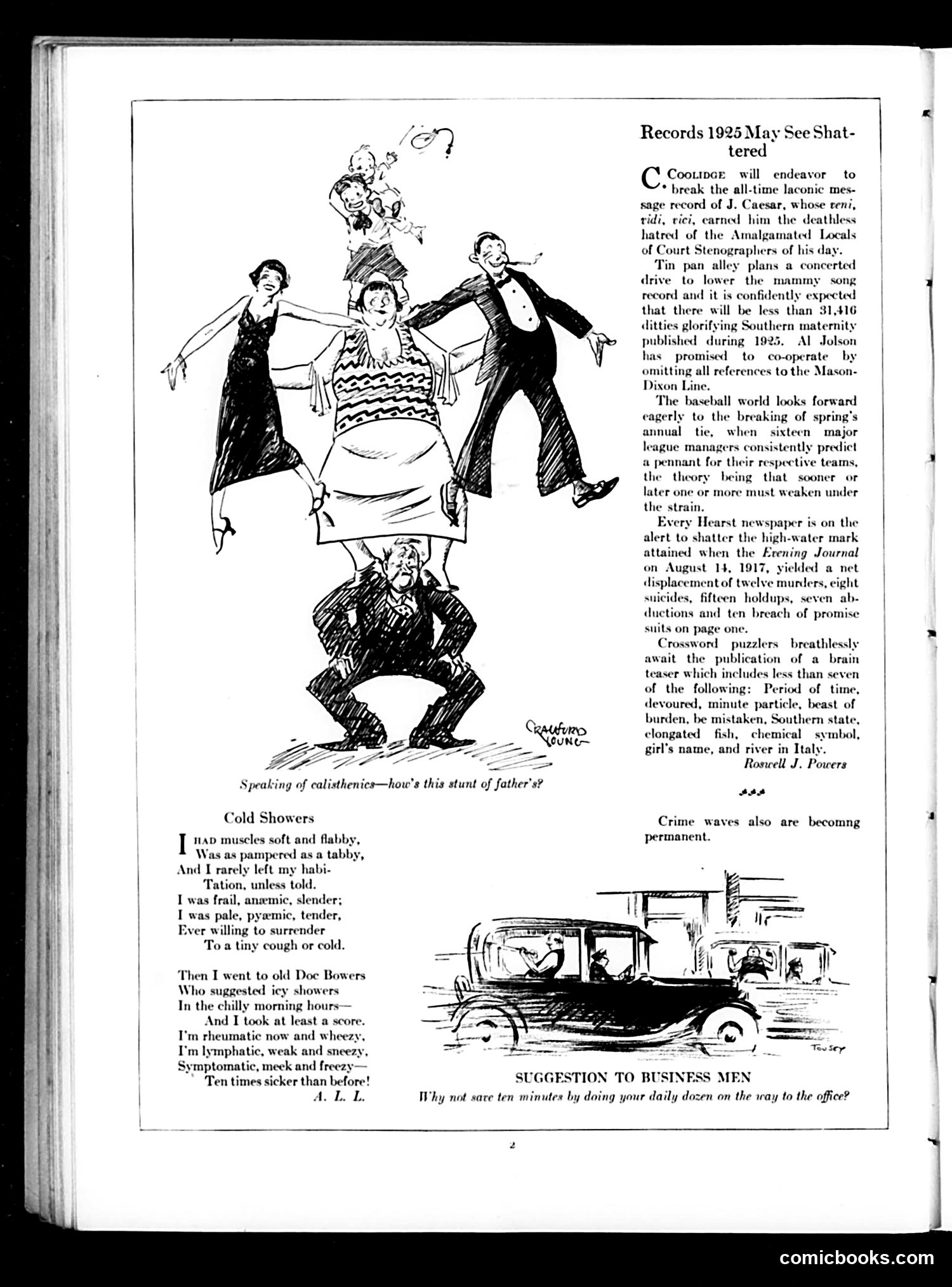
**Top Cartoon:** "Speaking of calisthenics—how's this stunt of father's?" A man (representing "father") balances children on his body in an acrobatic pose. This satirizes the physical fitness/calisthenics craze popular in the 1920s, mocking fathers attempting gymnastic exercises—likely with comedic results and strain on their bodies. **"Cold Showers" Poem:** A humorous verse about someone pampered in youth who later discovers cold showers' supposed health benefits, becoming "ten times sicker than before." This ridicules health fads and their ineffective or counterproductive outcomes. **Bottom Cartoon:** "Suggestion to Business Men" depicts a car robbery/crime scene, humorously suggesting businessmen "sure ten minutes by doing your daily dozen on the way to the office"—combining fitness trends with crime prevention humor. The page satirizes 1920s health crazes and their dubious benefits.
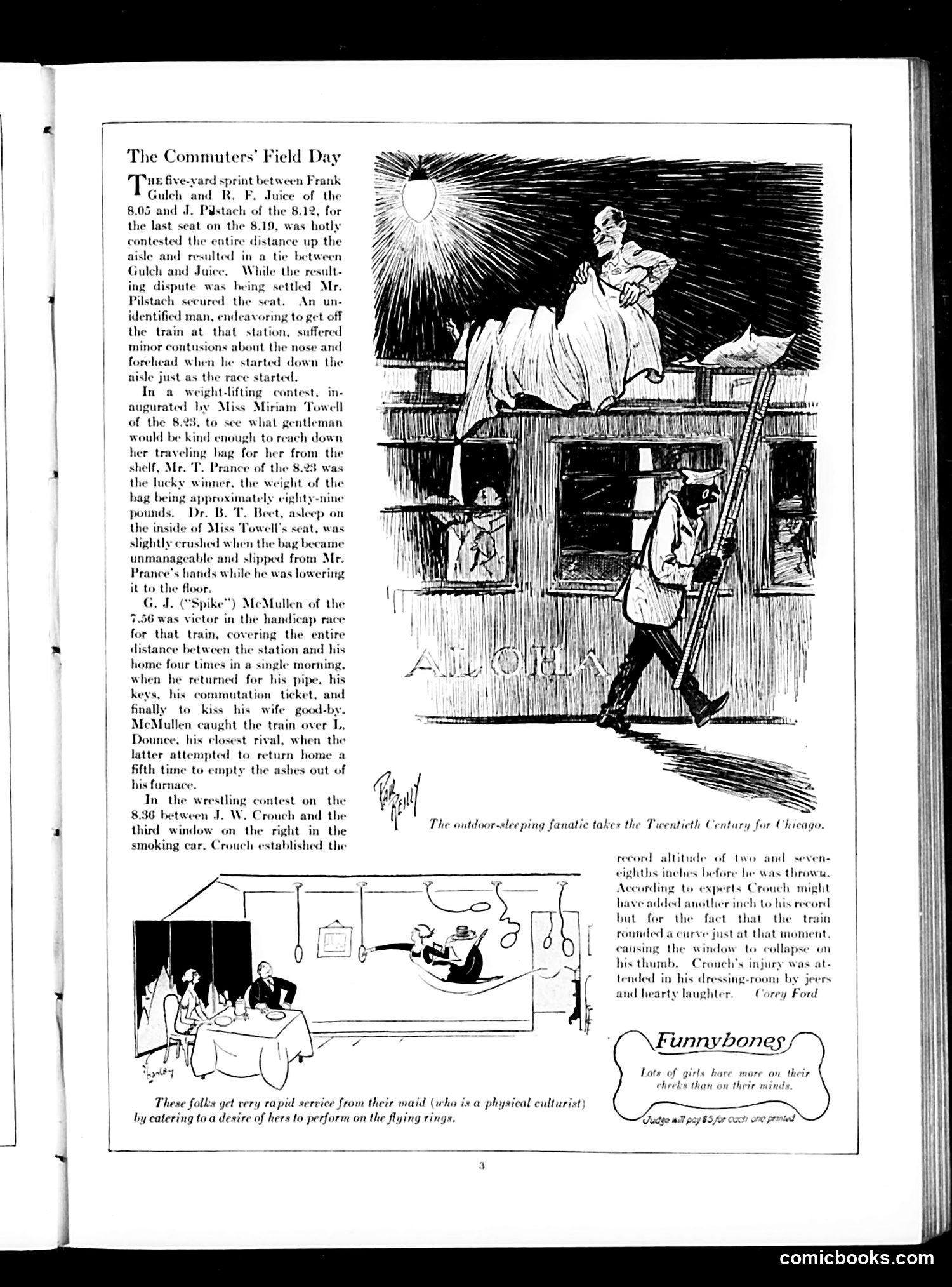
This page satirizes the absurdities of commuter life on trains around Chicago circa early 1900s. The main cartoon shows an exhausted man carrying an enormous traveling bag onto a train—"The outdoor-sleeping fanatic takes the Twentieth Century for Chicago"—mocking the impractical luggage some travelers brought aboard. Other vignettes mock commuter behavior: a race between Frank Gulch and R.F. Juice over train seating; a weightlifting contest where someone's bag becomes so heavy it's unmovable; a wrestling match in a smoking car; and a man repeatedly returning home to retrieve forgotten items. The humor targets commuter incompetence, obsessive behavior, and the general chaos of early rail travel. The "Funnybones" section at bottom makes a casual observation about women's vanity.
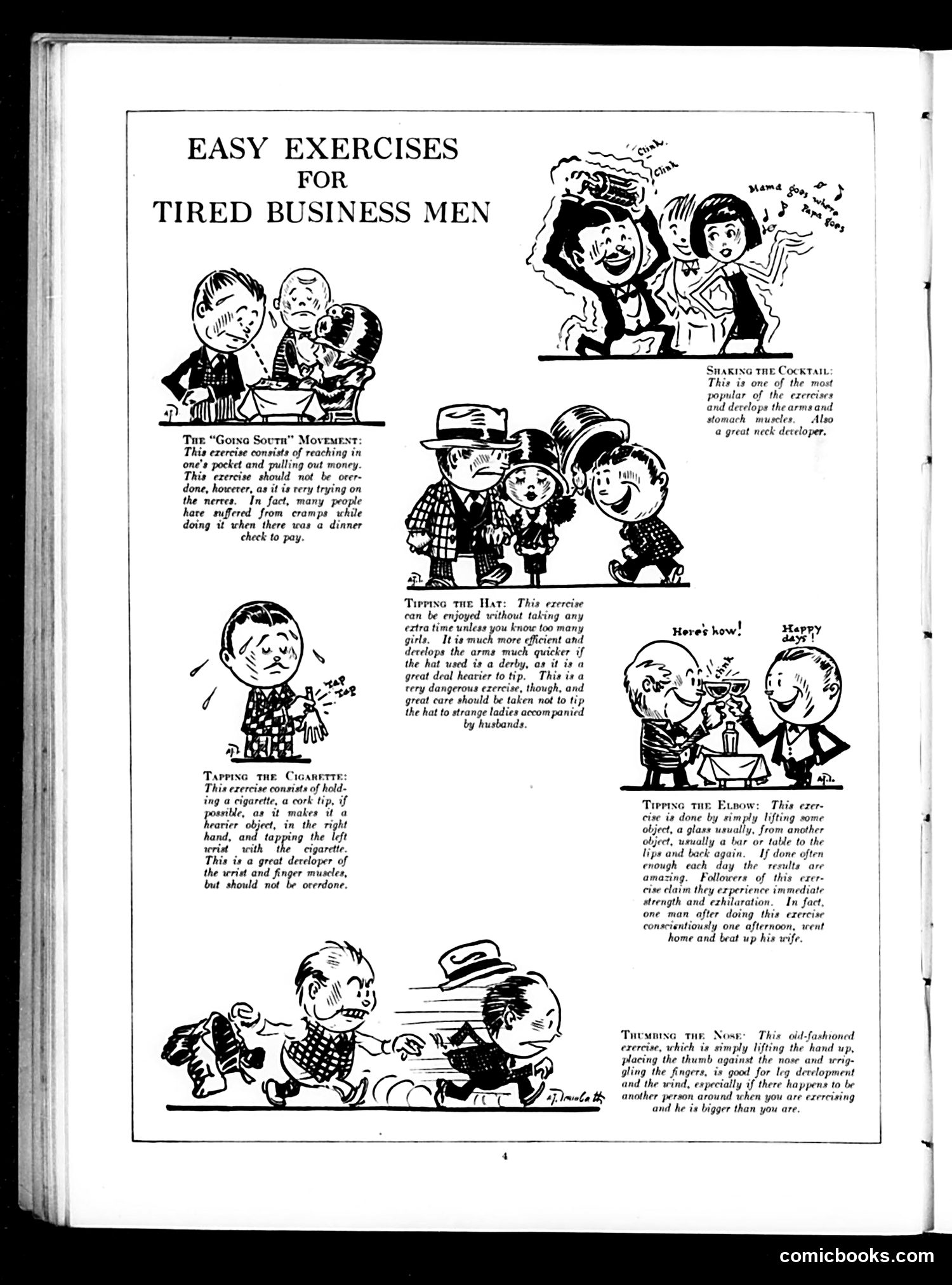
This is a humorous instructional page satirizing the exercise fads popular among early 20th-century businessmen. Rather than prescribing conventional fitness, the "exercises" are comedic pantomimes disguised as physical activity: - **"Going South"**: Reaching into one's pocket—implying financial strain - **"Tapping the Cigarette"**: Holding a cigarette - **"Shaking the Cocktail"**: Mixing drinks - **"Tipping the Hat"**: Removing one's hat - **"Tipping the Elbow"**: Lifting a glass to drink - **"Throwing the Old-Fashioned"**: Another drinking motion The satire mocks sedentary businessmen who seek easy fitness while actually engaging in vices—smoking, drinking, and spending money. The cartoon suggests these men get their "exercise" through indulgence rather than genuine physical activity, a commentary on leisure-class behavior and urban sophistication of the era.
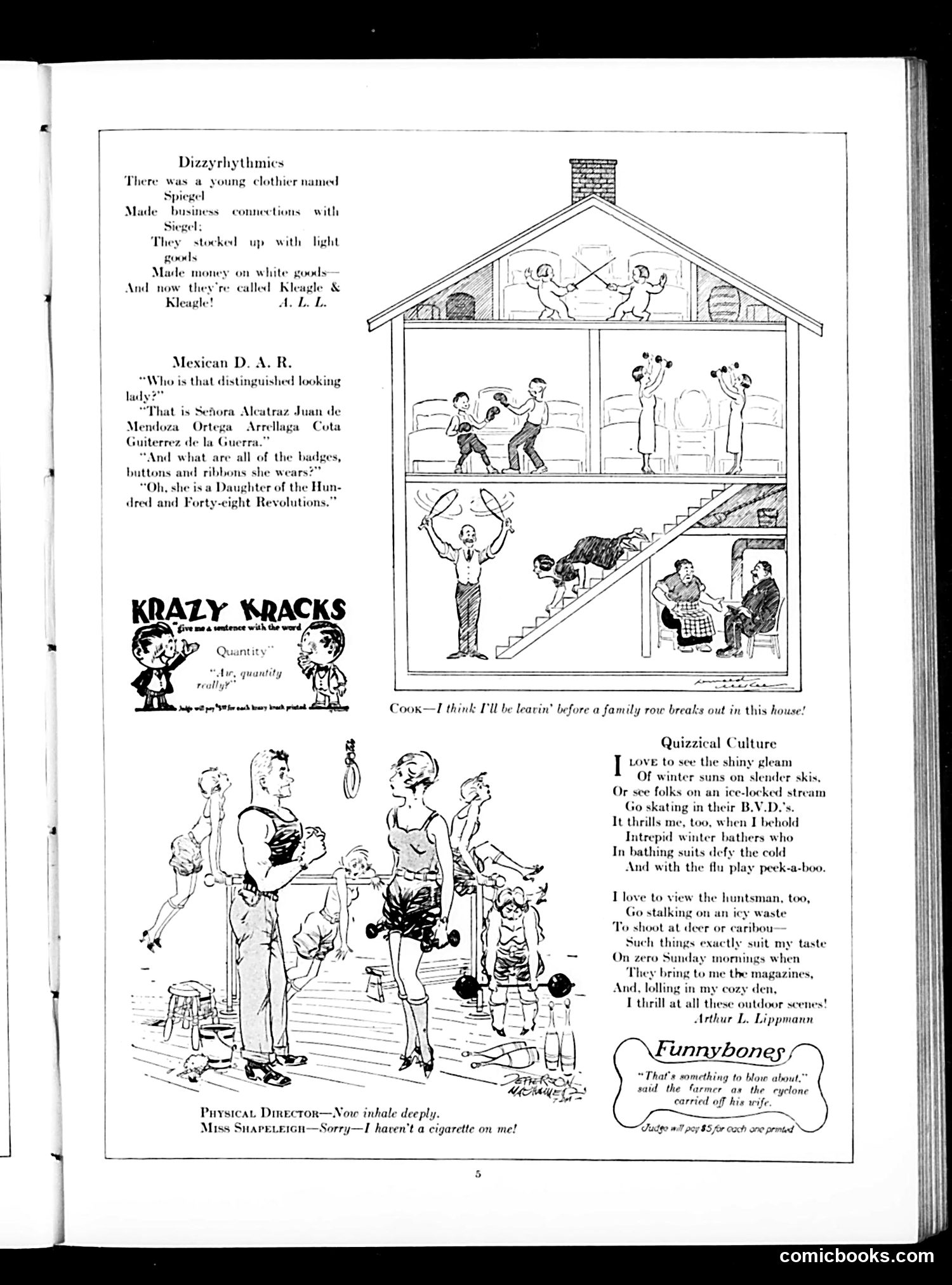
This page contains several unrelated humorous items rather than political cartoons: **"Dizzyrrhythmics"** satirizes a clothier named Spiegel who stocks light goods and white merchandise, now calling themselves "Kleagle & Kleagle"—likely a joke referencing the KKK's organizational titles (Kleagle was a KKK rank), though the exact satirical point is unclear. **"Mexican D.A.R."** jokes about a woman with an extremely long Mexican name claiming membership in the Daughters of the American Revolution based on distant revolutionary ancestry—mocking the DAR's snobbish exclusivity. The other items are advertisements ("Krazy Knacks"), a poem about winter activities, and a gym class illustration with the caption "Physical Director—Now inhale deeply. Miss Shapeleigh—Sorry! I haven't a cigarette on me!"—light social humor without clear political content.
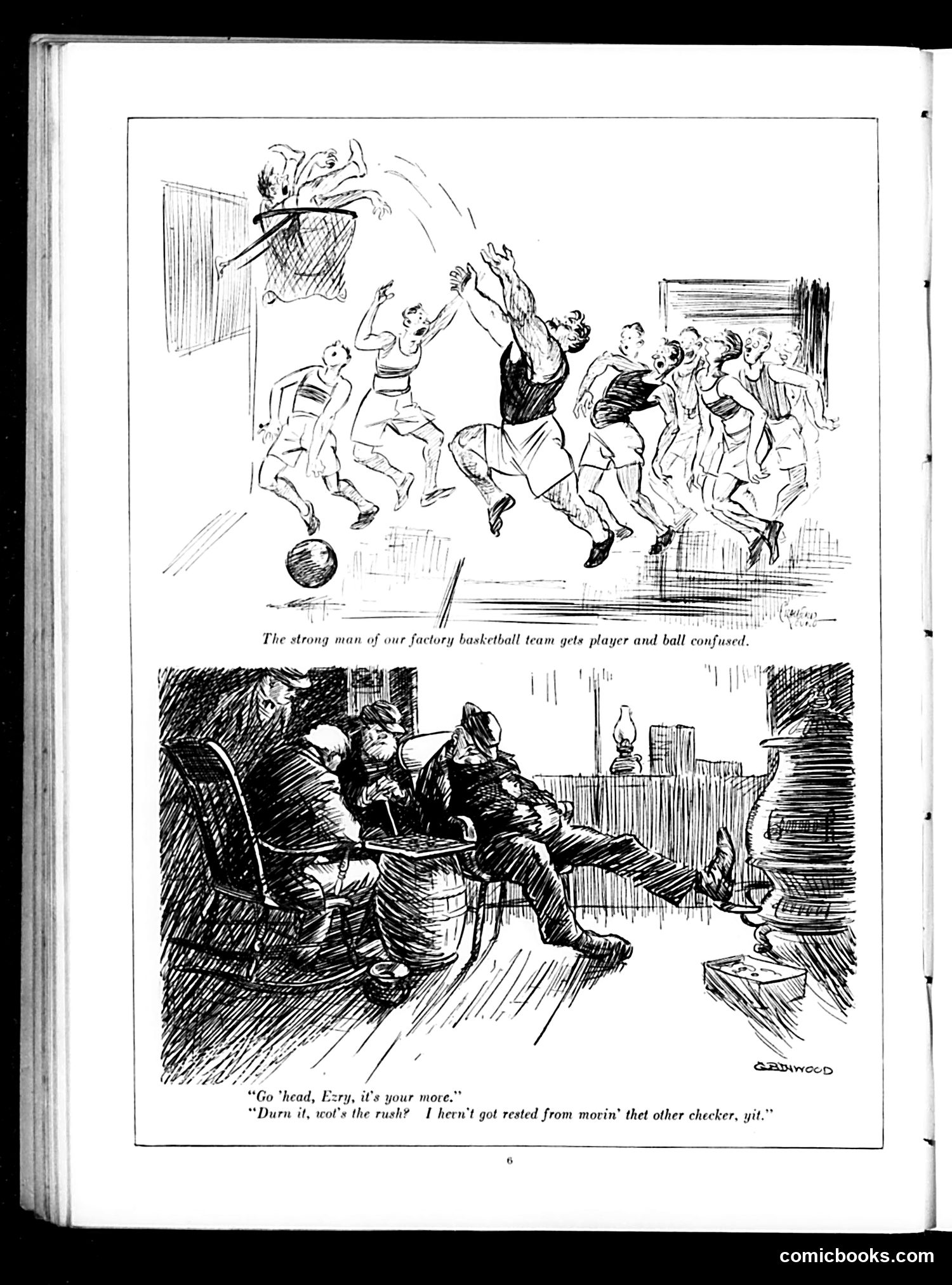
This page contains two unrelated comic vignettes satirizing working-class behavior: **Top cartoon:** Depicts a factory basketball game where the team's "strong man" has become so physically overpowered that he's launched both the ball and a player into the air simultaneously—literally confusing which is which during play. The joke mocks his brute strength as comically counterproductive to actual athletics. **Bottom cartoon:** Shows two men playing checkers, with the rural-accented character "Ezry" complaining about being rushed between moves. The dialect humor ("Durn it," "wot's," "hevn't") stereotypes rural or working-class speech patterns. The joke is that he's too slow and lazy even for checkers, needing extended rest between simple moves. Both cartoons use physical comedy and dialect humor typical of early 20th-century American satire, mocking working-class incompetence and laziness.
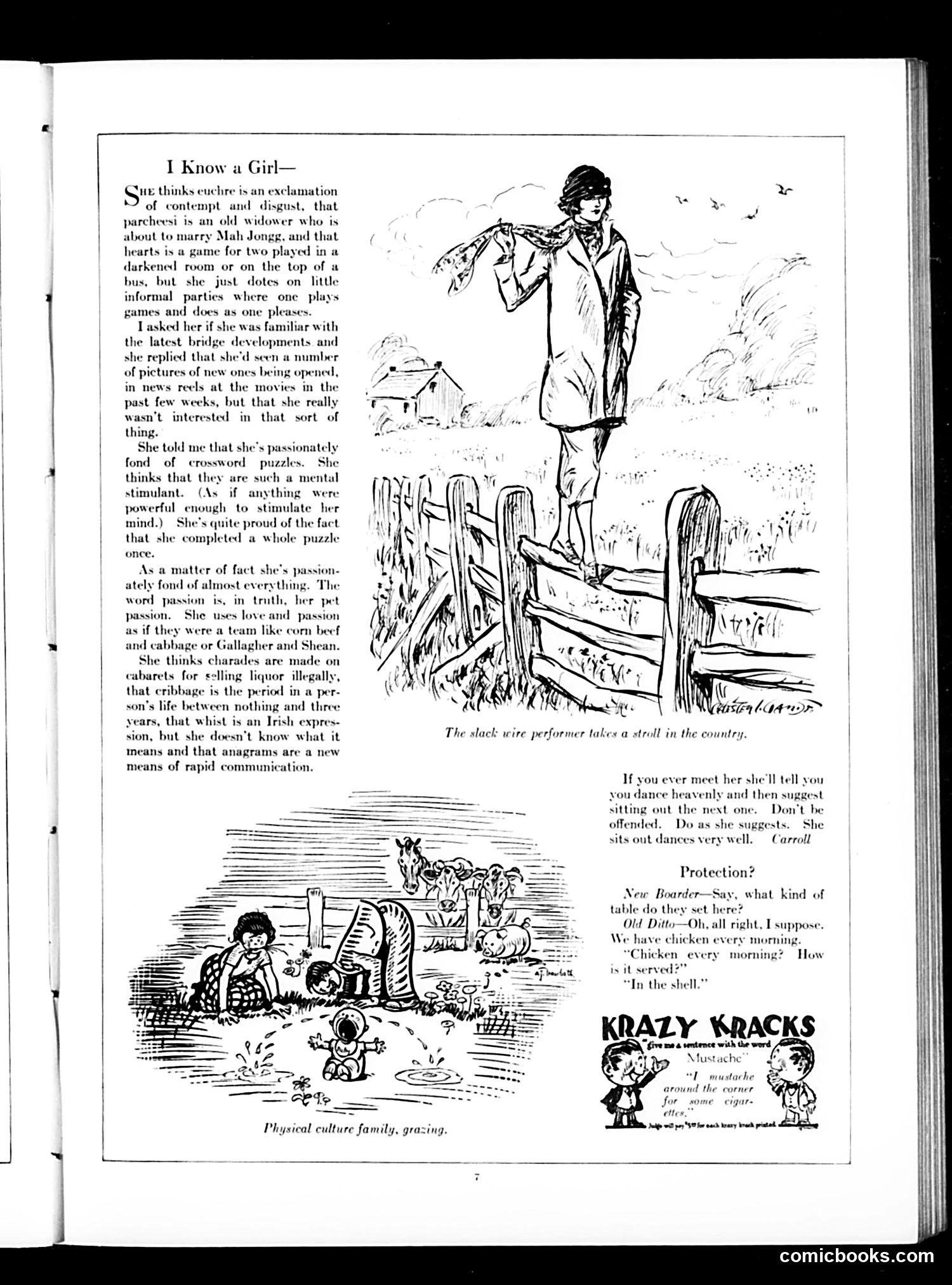
This page contains **humorous character sketches and advertisements** rather than political cartoons. **"I Know a Girl"** is a satirical portrait of a young woman who misunderstands games, activities, and words through either willful ignorance or deliberate pretense. The joke: she confuses "euchre" with an exclamation, "parcheesi" with a widower, and "cribbage" with infancy. She loves using words like "passion" and "love" indiscriminately. The illustrations show period leisure activities—a woman in fashionable dress by a fence, and "physical culture family, grazing" (satirizing outdoor recreation trends). The closing line mocks her social manipulation: she'll flatter male dance partners then suggest sitting out dances. **"Protection?"** is a brief joke about boarding house food: new boarders assume "chicken every morning" means fresh chicken, but it's served "in the shell"—a cynical reference to cheap, sparse meals. **"Krazy Kracks"** is a word-puzzle advertisement asking readers to use "mustache" in a sentence. The page reflects 1920s concerns about women's social behavior, leisure culture, and dining conditions.
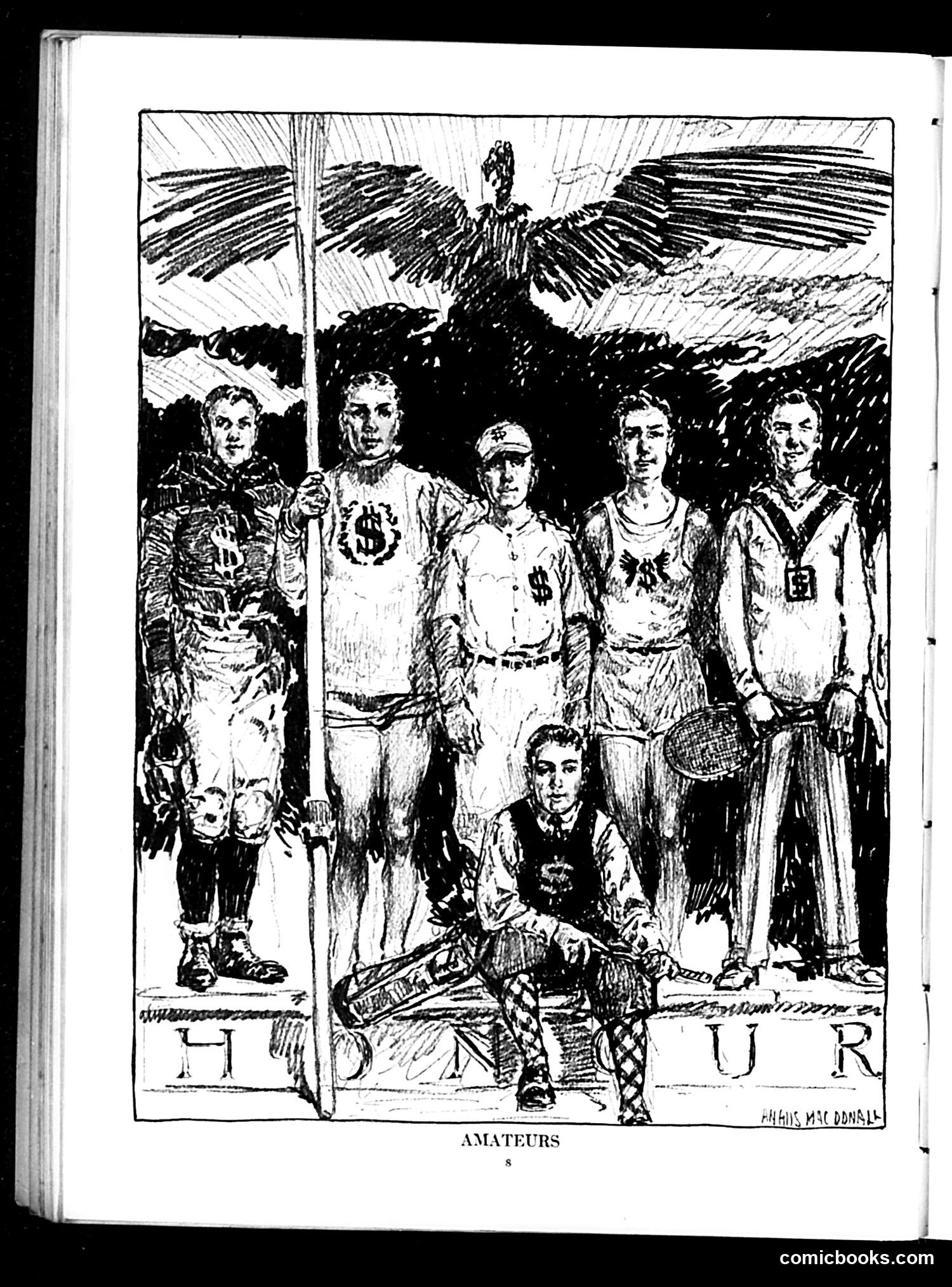
This cartoon depicts six young male athletes in various sports attire (baseball, basketball, tennis uniforms visible) standing on a platform, with a winged angel figure looming above them. Two younger boys sit below. The title "AMATEURS" suggests satire about amateur athletics. The "$" symbols visible on some uniforms indicate the cartoon's likely point: **mocking the hypocrisy of "amateur" athletes who are secretly paid**. This references the early-20th-century tension between officially amateur sports (Olympic standards, college athletics) and athletes receiving under-the-table compensation. The angelic figure may represent ideals of athletic purity being corrupted by commercialism. The artist is credited as "Mac Donale" (possibly misspelled).
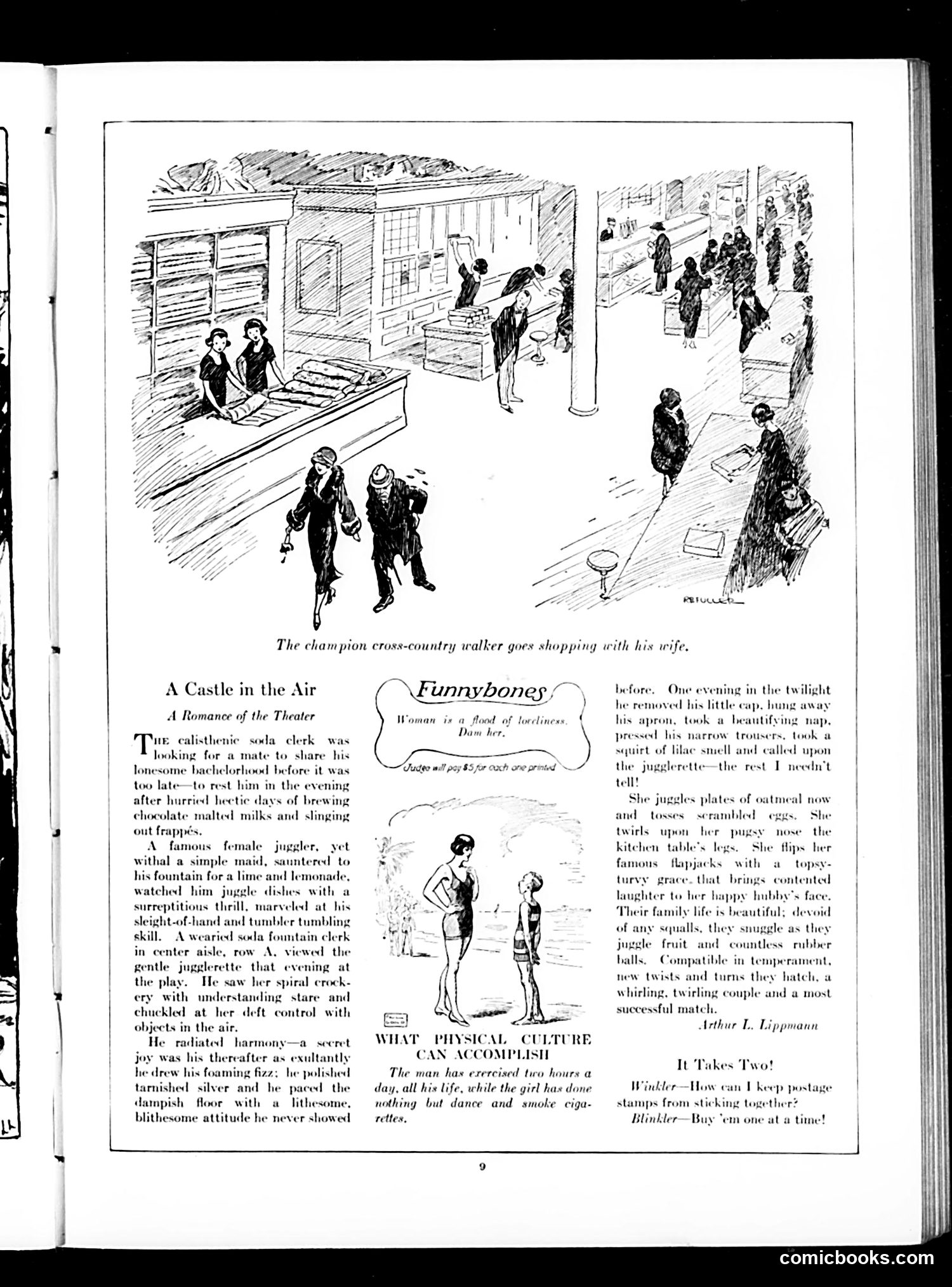
This page contains three separate satirical pieces typical of 1920s humor: 1. **"The Champion Cross-Country Walker Goes Shopping"** (top cartoon): Mocks the fad of extreme "cross-country walking" by showing an athletic enthusiast reduced to mundane domestic shopping with his wife—deflating the romance of athletic pursuits through ordinary reality. 2. **"A Castle in the Air"** (left column): A romantic comedy about a soda fountain clerk and a female juggler who fall in love. The satire gently mocks theatrical romanticism—their "meet-cute" over her juggling skills in his soda shop leads to marriage. It's sentimental but playful social commentary on working-class courtship. 3. **"What Physical Culture Can Accomplish"** (center): Compares a man who exercised for years versus a girl who only dances and smokes, with an illustration showing they appear equally physically capable. This satirizes the obsessive "physical culture" fitness movement popular in the era, suggesting dedication doesn't necessarily outperform natural ability or lifestyle. 4. **"It Takes Two!"** (bottom): A simple joke exchange about postage stamps sticking together—light wordplay rather than satire. The page reflects 1920s concerns with fitness fads, courtship rituals, and modern leisure culture.
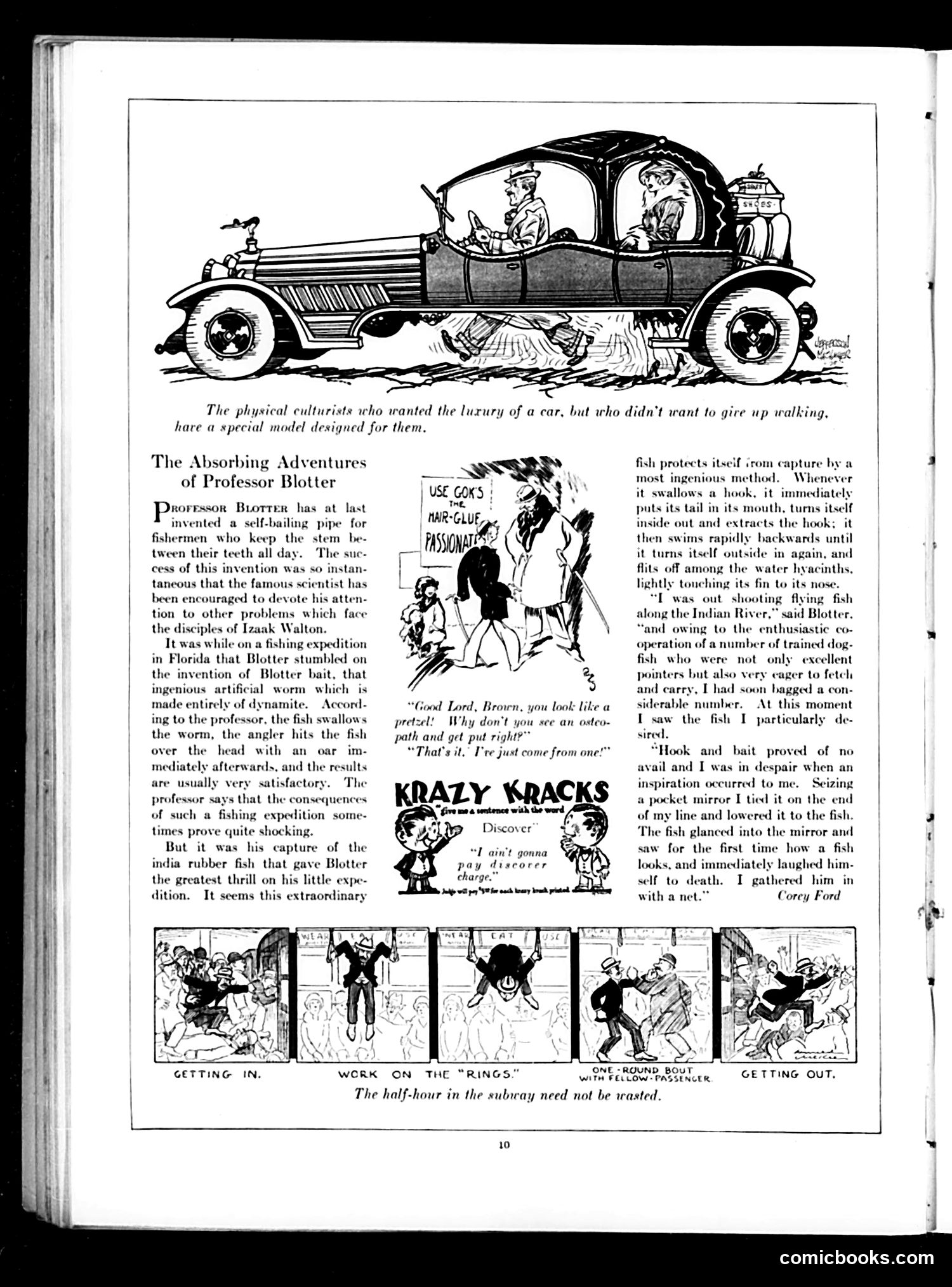
This page contains two satirical pieces mocking pseudoscientific inventions and fitness trends: **Top cartoon:** Ridicules "physical culturists" (early 20th-century fitness enthusiasts obsessed with bodybuilding) who want cars but refuse to abandon walking. The joke is a absurdist car design where passengers must walk continuously while riding—combining contradictory desires. **"Professor Blotter" comic:** A fictional scientist invents increasingly ridiculous fishing devices: a self-bailing pipe, dynamite-filled artificial worms, and captures an "india rubber fish" that escapes by turning itself inside-out. The humor is pure nonsense—fish that laugh at mirrors, dynamite bait that requires beating fish with oars. **"Krazy Kracks":** A simple children's joke about the word "discover." **Bottom strip:** Shows subway passengers doing calisthenics during commutes—satirizing the obsession with fitness and maximizing every moment, presented as undignified wrestling matches. The satire targets the era's craze for physical culture and invented gadgets solving non-existent problems through absurd logic.
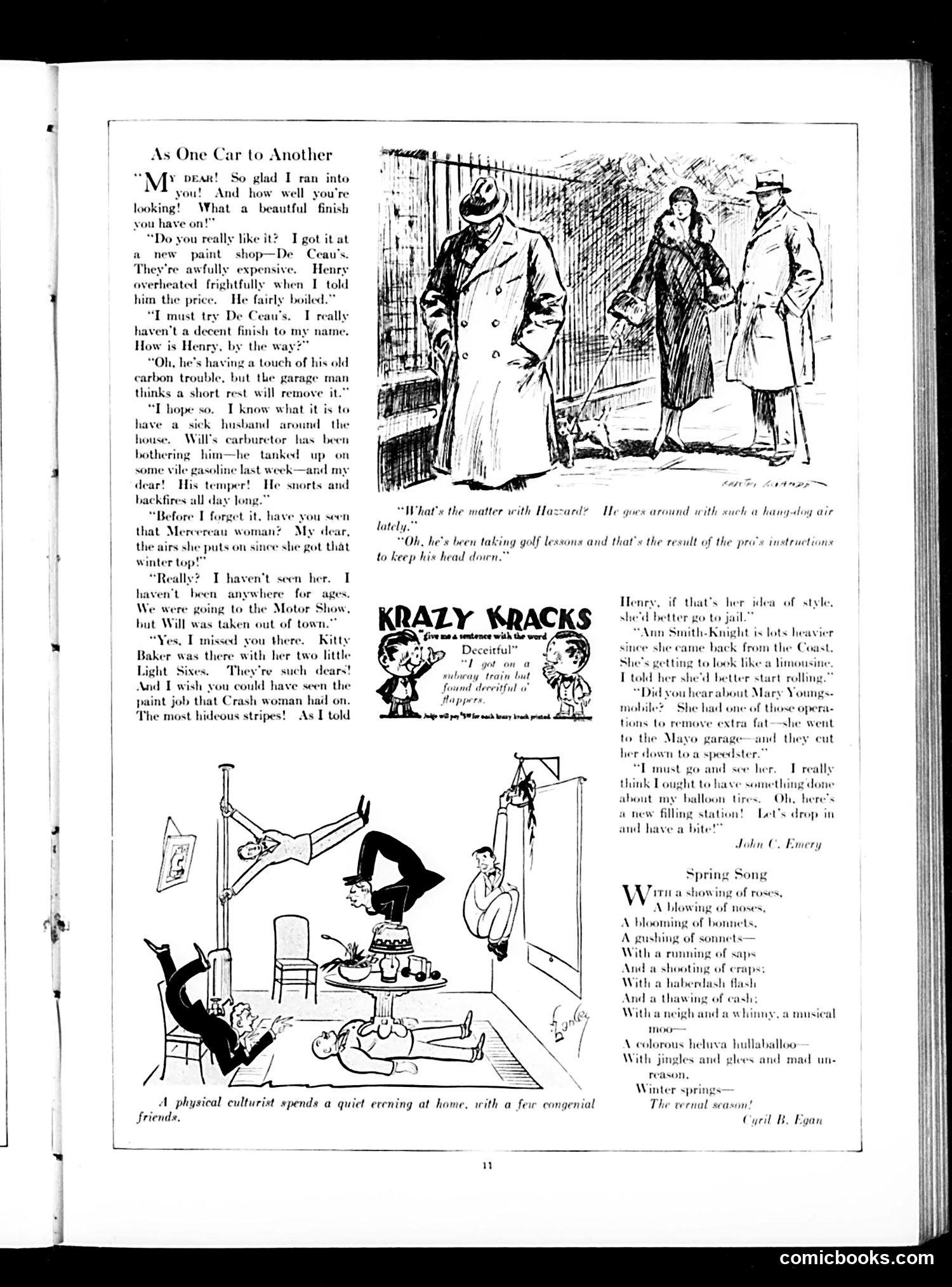
This page satirizes the emerging car culture and conspicuous consumption of the early 20th century. The main cartoon depicts two wealthy women discussing their automobiles as if they were human companions—comparing paint finishes, discussing "sick husbands" (engines), and sharing gossip about neighbors' vehicles and modifications. The satire targets the absurdity of automobile obsession among the affluent: women fret over paint jobs at expensive shops, discuss carburetor troubles with the anxiety of actual illness, and measure social status through vehicle upgrades (winter tops, balloon tires, speedster conversions). The joke hinges on treating cars with the emotional investment and social consciousness previously reserved for human relationships—gossiping about "the Mercereau woman" and her new winter top mirrors shallow social climbing. The accompanying illustrations mock physical culture enthusiasts and golf-obsessed socialites, reinforcing Judge's critique of wealthy leisure-class preoccupations during the automobile's rapid integration into American life.
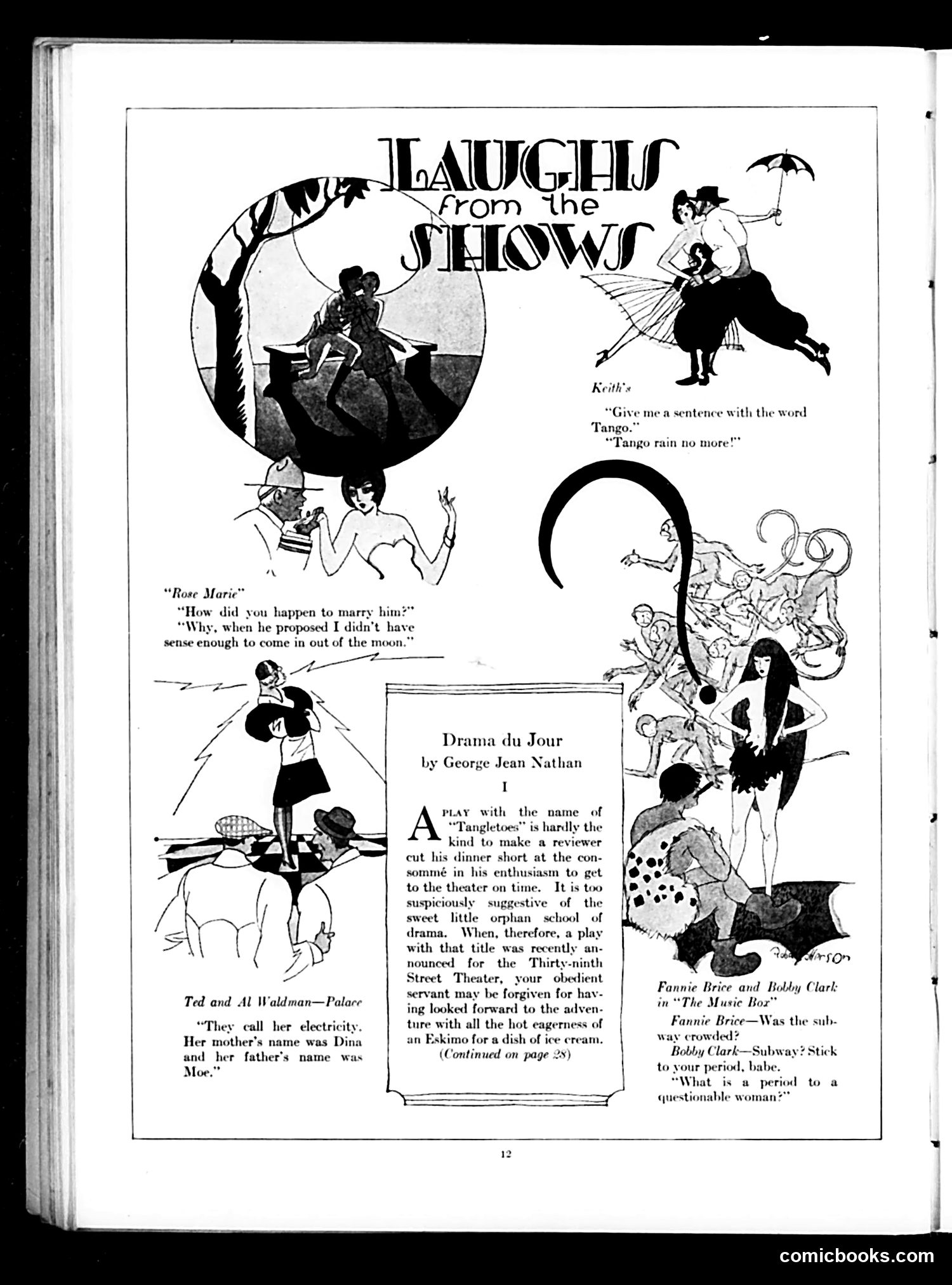
This is a theater humor page featuring jokes about Broadway shows and performers. The "Rose Marie" and "Tango" jokes mock romantic comedies of the era through absurdist punchlines. The "Electricity" joke about Ted and Al Waldman (Palace Theater performers) makes a pun on the father's name "Moe" sounding like "more." The central article by drama critic George Jean Nathan satirizes a play called "Tanglefoot" (likely a real production) that he assumes will be sentimental melodrama based on its suggestive title. He expresses mock-skeptical anticipation, comparing his reluctance to an Eskimo's enthusiasm for ice cream—a period-typical racial stereotype used for comedic contrast. The final joke features vaudeville stars Fannie Brice and Bobby Clark, punning on "subway" versus period-appropriate language, suggesting Clark's character should speak in costume-consistent dialogue. The cartoons illustrate these theatrical humor bits with Jazz Age style illustrations.
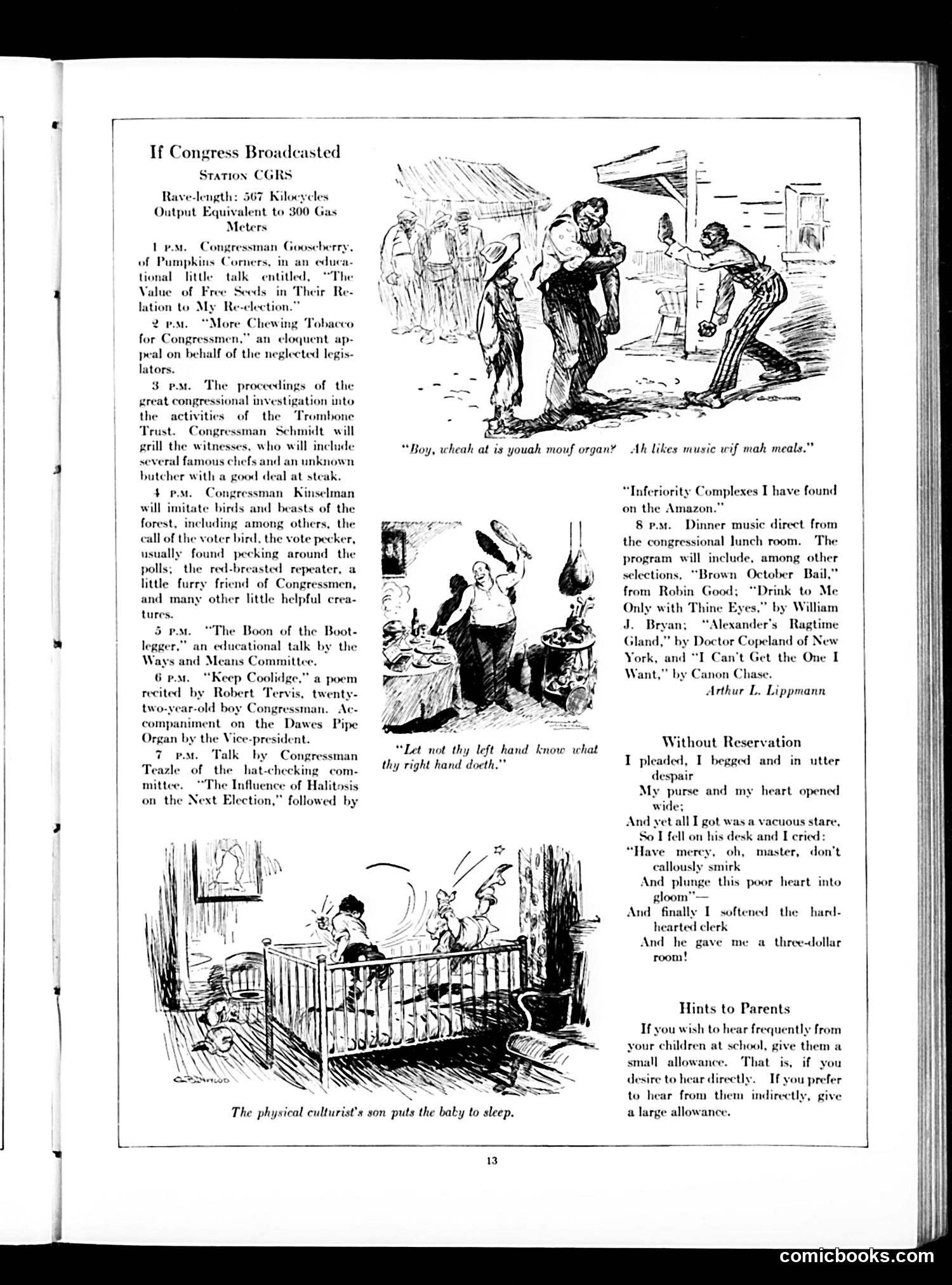
This 1920s Judge magazine page satirizes Congress through a fake radio schedule (Station CGRS). The humor mocks legislators as self-serving and incompetent: **The Satire:** Proposed congressional broadcasts feature absurd topics—politicians discussing free seeds for "re-election," a "Trombone Trust" investigation with celebrity chefs as witnesses, and congressmen imitating animal calls. The "Voter Bird" and "Red-Breasted Repeater" are puns on electoral corruption. **Political Context:** The references to Coolidge and Dawes (Vice President) date this to the mid-1920s. The satire suggests Congress wastes time on frivolous matters while individual politicians grandstand. **The Cartoons:** Accompanying sketches show absurd scenarios—a physical culturist's son putting a baby to sleep—illustrating the disconnect between congressional dignity and actual competence. The overall message: Congress is self-interested, ridiculous, and unworthy of serious attention—a common Progressive-era critique of legislative gridlock and corruption.
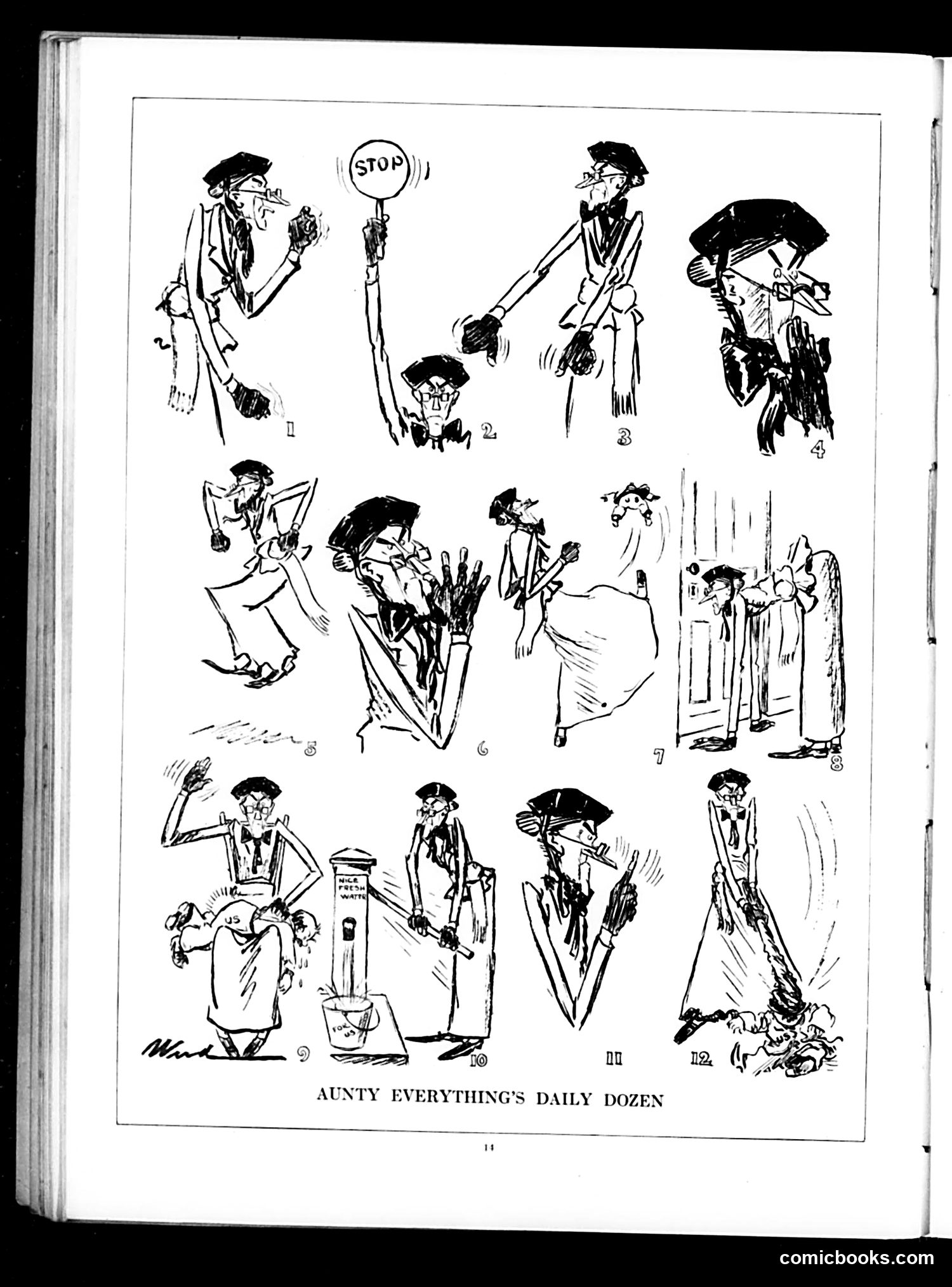
This is a humorous instructional cartoon titled "Aunty Everything's Daily Dozen," depicting twelve exercise poses performed by an elderly woman character. The sketches show various calisthenics and stretching movements—bending, reaching, swinging arms, touching toes, and other physical activities. The satire targets the early 20th-century fitness craze and the popular "Daily Dozen" exercise routine promoted by physical culture advocates. "Aunty" appears to be an older, somewhat out-of-shape woman attempting these exercises with exaggerated awkwardness and strain, poking fun at both the fitness movement's enthusiasm and the difficulty of maintaining such regimens, particularly for older adults. The joke rests on the contrast between the exercise program's intended vigor and an elderly person's humorous struggle to execute the movements.
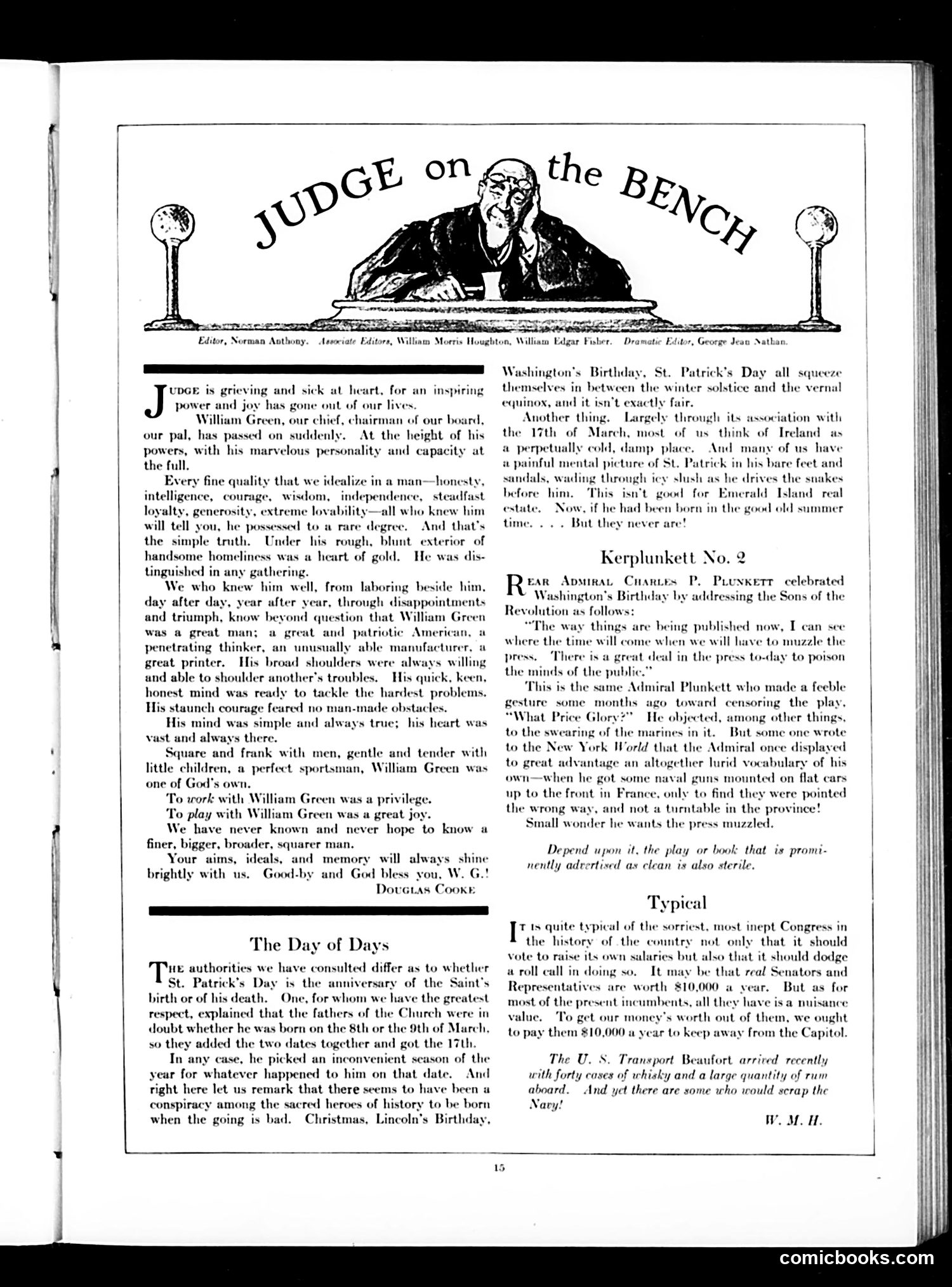
This page contains an **obituary tribute to William Green**, Judge magazine's editor-in-chief who died suddenly. The ornamental header shows a judge at his bench, framing the memorial. The main article praises Green as an honest, courageous leader possessing integrity, intelligence, and generosity. It's a sincere eulogy emphasizing his character and contributions to the publication—not satirical, which is unusual for Judge. Below this is commentary on **St. Patrick's Day's inconvenient March timing**, joking that sacred historical figures seem conspiratorially born during harsh seasons rather than pleasant ones. The final section, "Kerplunkett No. 2," mocks **Admiral Charles P. Plunkett**, who recently advocated censoring the play "What Price Glory?" The satire highlights hypocrisy: Plunkett previously used colorful military profanity himself. The piece ridicules calls for press censorship and suggests such restrictions would suppress legitimate public discourse. The page reflects early 1920s concerns about free speech and theatrical content regulation.
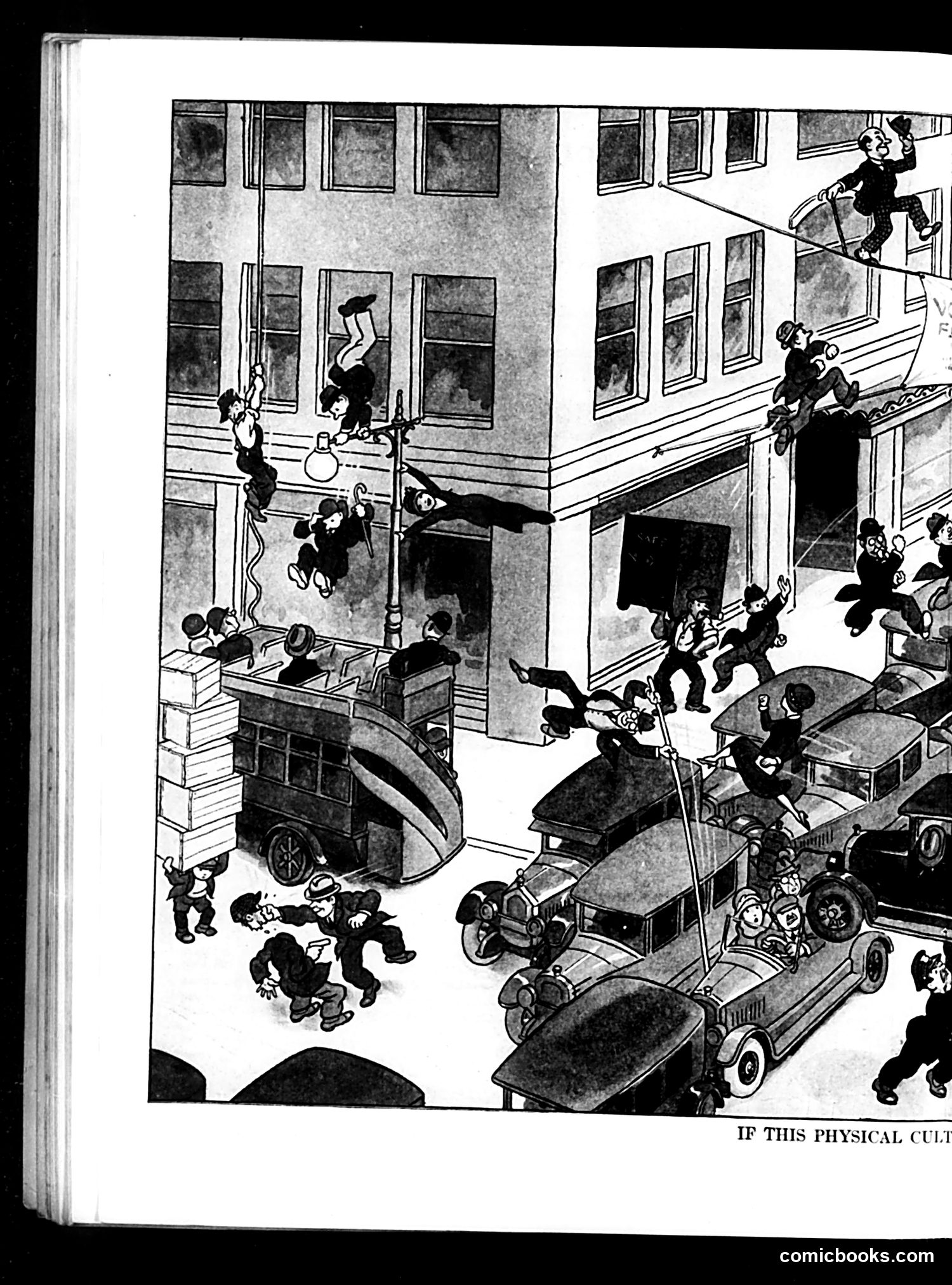
This appears to be a satirical cartoon from *Judge* magazine depicting an urban street scene with numerous people engaging in acrobatic stunts, swinging from lamp posts, and performing physical feats on buildings and vehicles. The title fragment "IF THIS PHYSICAL CUL[TURE]" suggests the cartoon is mocking the "physical culture" movement—a late 19th/early 20th-century fitness craze emphasizing athletic training and bodily development. The satire likely critiques the movement's excessive enthusiasm or impracticality by showing average people attempting dangerous acrobatic stunts in public spaces, creating urban chaos. The exaggerated, comedic depictions suggest the cartoonist views the physical culture obsession as absurd and potentially dangerous when taken to extremes. The crowded street scene emphasizes how pervasive this fitness fad had become in popular culture.
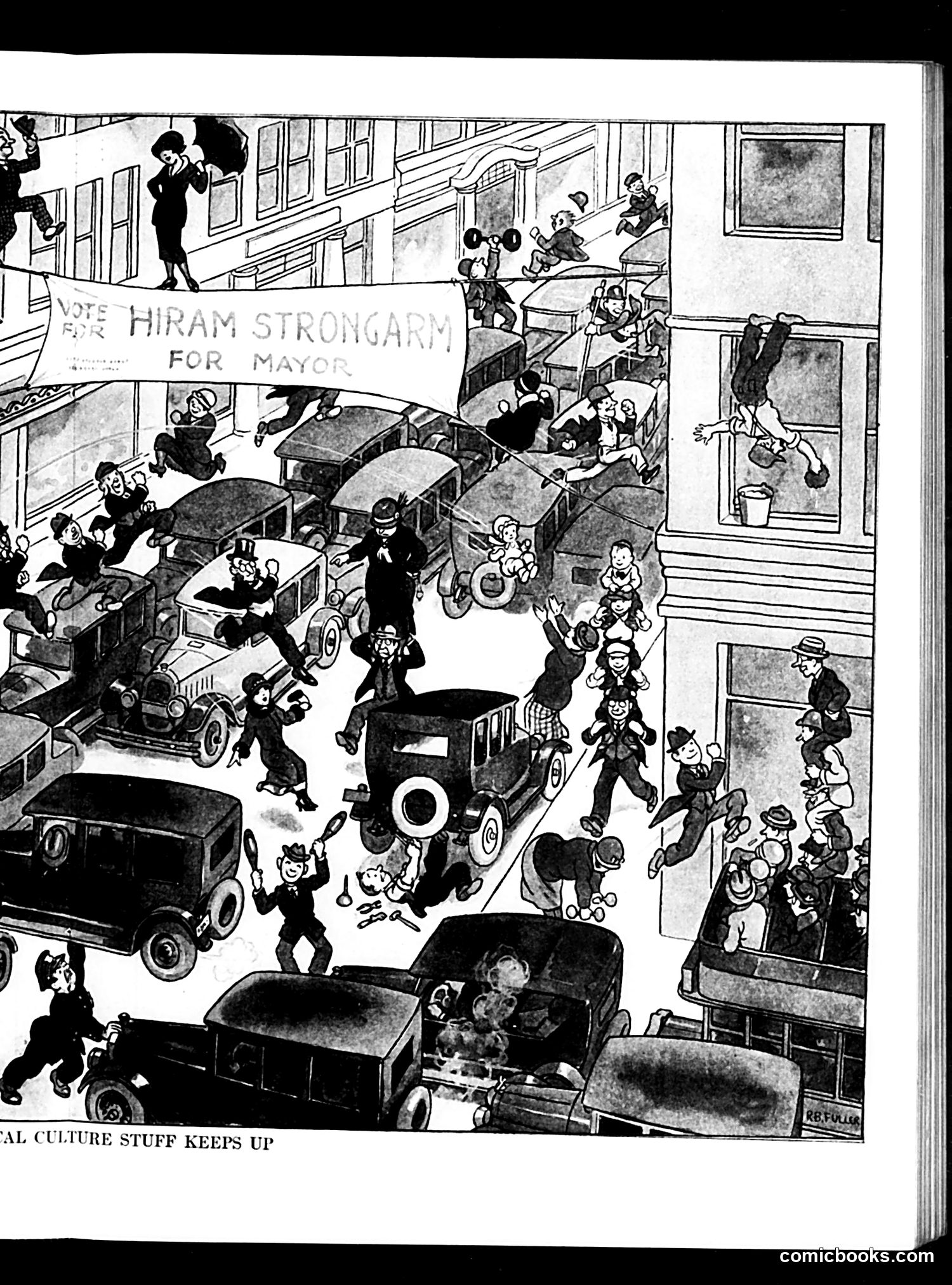
This Judge magazine cartoon depicts a chaotic street scene with a banner reading "VOTE FOR HIRAM STRONGARM FOR MAYOR." The illustration shows numerous figures in early 20th-century dress engaged in what appears to be rowdy campaign activity—people riding in cars, climbing buildings, and creating general commotion in an urban setting. The satire appears to mock a mayoral campaign, likely suggesting that Hiram Strongarm's candidacy is associated with disorder, chaos, and aggressive tactics rather than reasoned civic engagement. The "strongarm" name itself is a pun implying forceful or corrupt political methods. The wild street scene suggests the candidate's supporters—or the candidate himself—operate through intimidation and disruption rather than legitimate democratic processes. The cartoon critiques both the candidate and the broader culture of political roughhousing in urban American politics of this era.
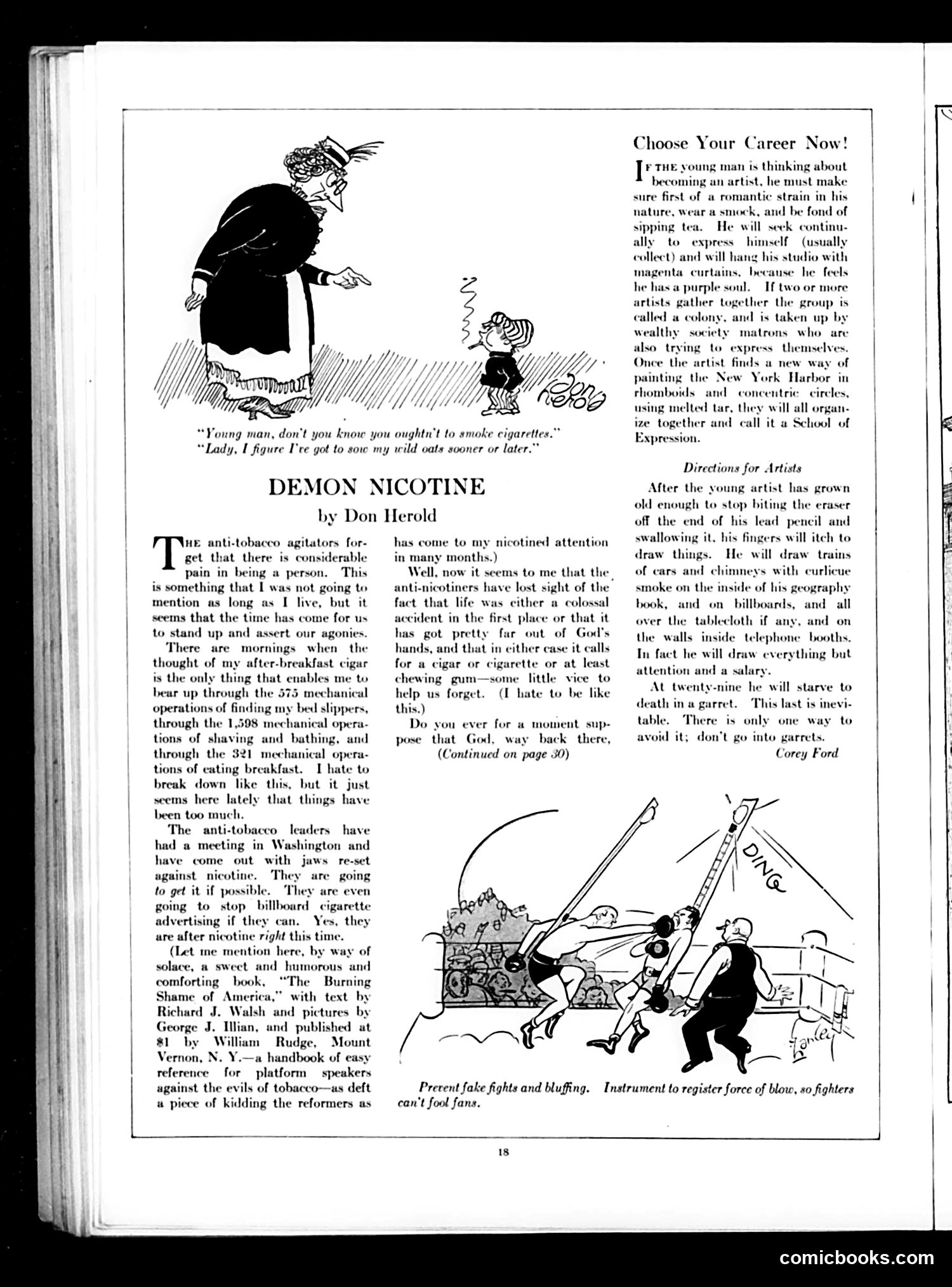
This Judge page contains two distinct pieces of satire: **"Demon Nicotine"** (by Don Herold) is a humorous defense of smoking against anti-tobacco reformers who were actively campaigning in the 1920s. The cartoon shows an older woman scolding a young man for smoking; he replies he needs to "sow wild oats." Herold's essay sarcastically argues that cigarettes help people endure life's tedious daily tasks, and mocks anti-smoking activists for meeting in Washington to ban cigarette advertising—presenting their reform efforts as overwrought and unrealistic. **"Choose Your Career Now!"** (by Corey Ford) satirizes young artists and bohemian culture. It mockingly describes stereotypical "artistic" behavior: wearing smocks, sipping tea, forming colonies, creating pretentious schools of art. The piece concludes with dark humor: artists starve in garrets, and the only way to avoid this fate is—don't become an artist. Both pieces exemplify Judge's satirical house style: attacking moral reformers and satirizing cultural affectations through exaggeration and cynicism.
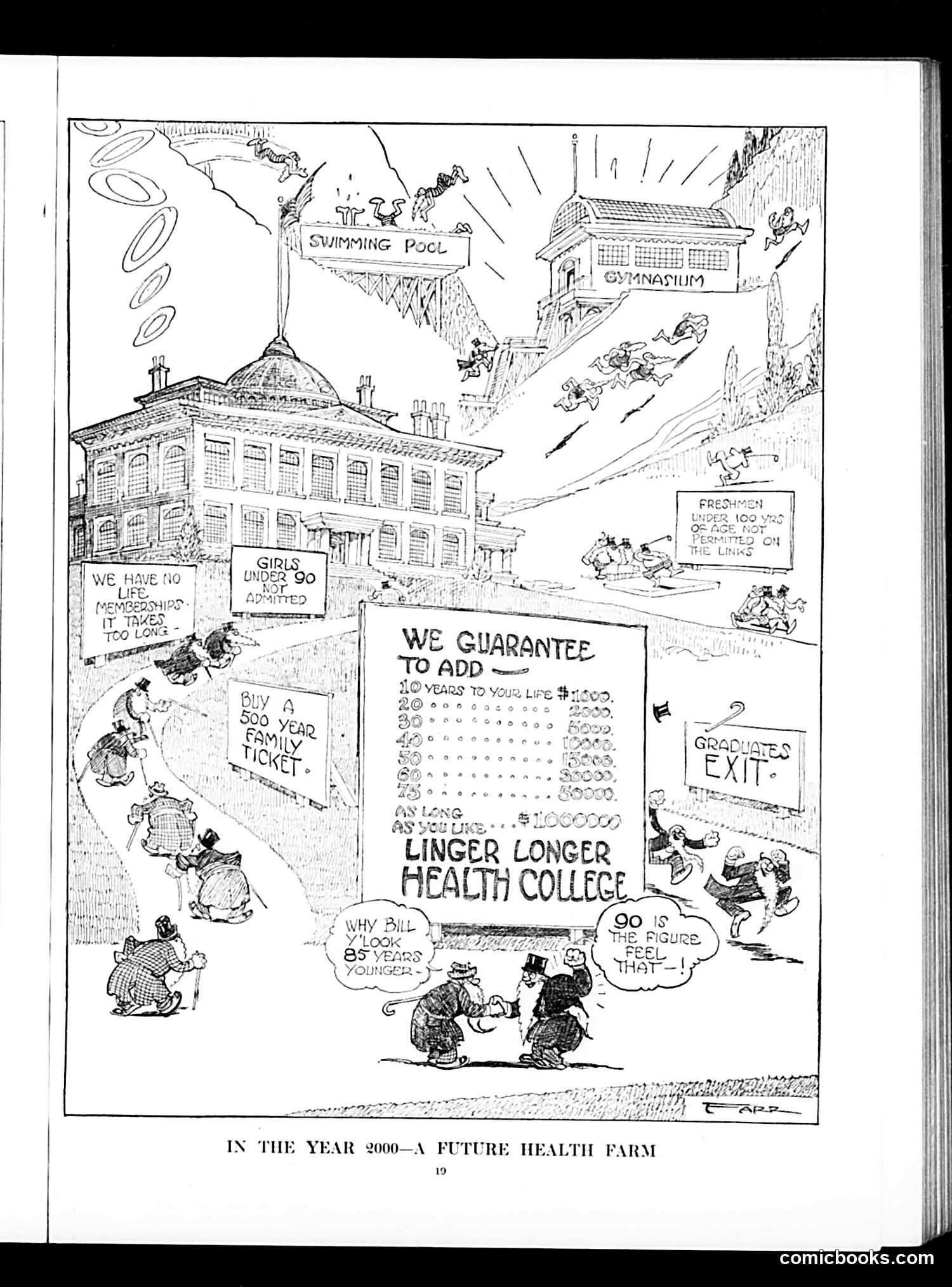
This satirical cartoon imagines a commercialized health institution in the distant future. The main building advertises "Linger Longer Health College," promising to add years to your life through memberships and treatments—a jab at the era's booming health-farm industry and longevity claims. The satire targets: - **Health-farm commercialism**: Expensive "family tickets" and dubious life-extension guarantees - **Institutional restrictions**: Signs reading "Girls Undoo Not Admitted" and "No Life Membership" mock exclusionary practices - **Unrealistic promises**: The guarantee to add decades appears as a numbered, cost-based list—suggesting these claims were mere marketing hokum The cartoon critiques how health institutions of the early 1900s exploited public anxieties about aging and mortality through overpriced memberships and inflated testimonials. The futuristic setting emphasizes the absurdity of such claims.
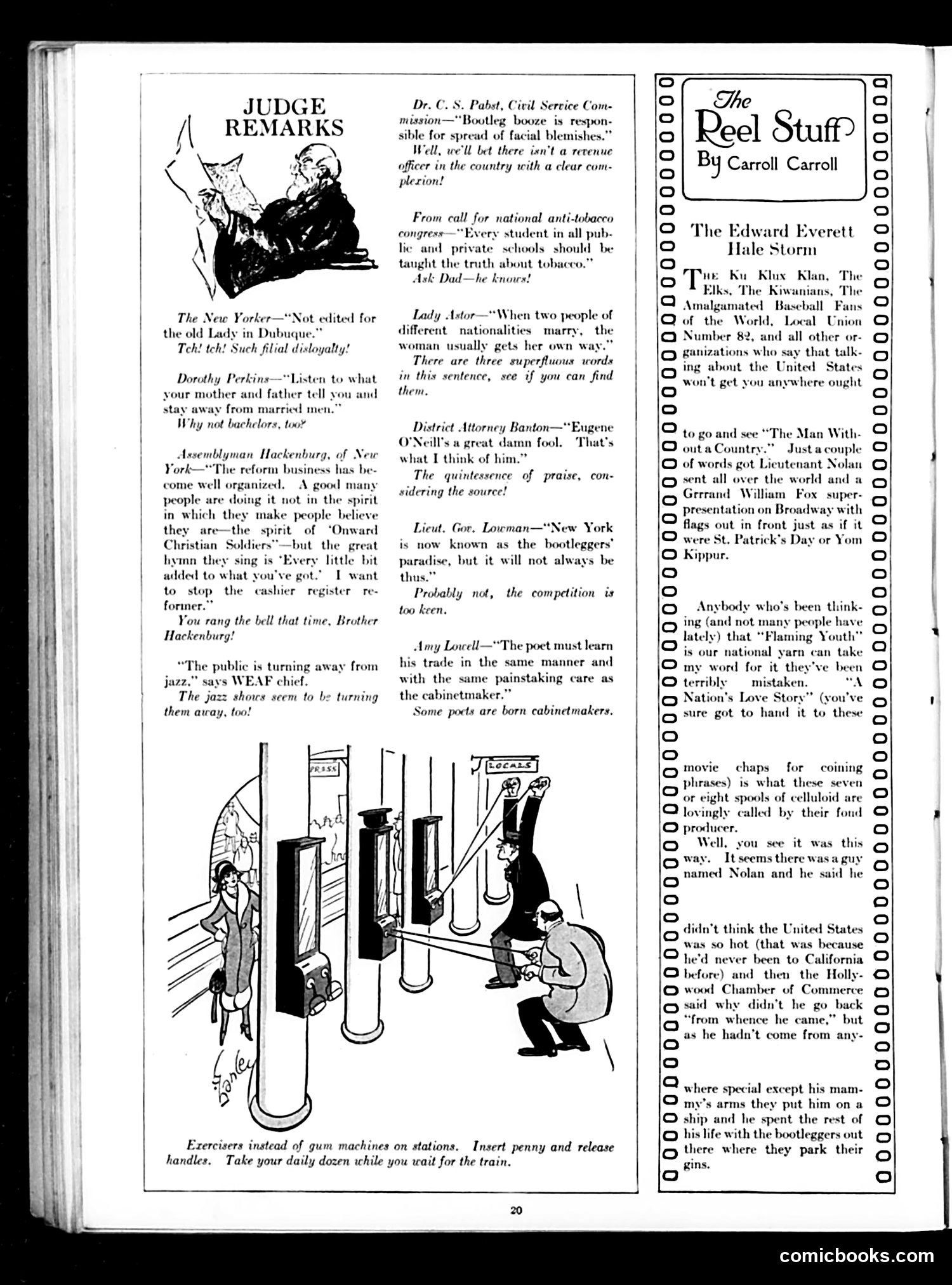
This page from Judge magazine contains satirical commentary on contemporary public figures and social issues, likely from the 1920s. **"Judge Remarks"** (left) offers brief critiques of various statements: - Attacks on moral reformers (Dorothy Perkins, anti-tobacco Congress advocates) - Criticism of Assemblyman Hackenburg for opposing "cashier register reformers" - A dig at radio station WEAF's claim the public is abandoning jazz - Mockery of Lady Astor's remarks on cross-national marriages and District Attorney Banton's harsh description of Eugene O'Neill **The cartoon** depicts exercise machines replacing gum dispensers at train stations—satirizing the era's enthusiasm for physical fitness fads and mechanical solutions to modern life. **"The Reel Stuff"** (right) is a film column reviewing movies, mentioning "Flaming Youth," "A Nation's Love Story," and "The Man Without a Country." It mocks Hollywood's patriotic productions and includes anecdote about a character named Nolan who criticized America. The page reflects 1920s concerns: Prohibition enforcement, social reform movements, mass entertainment, and changing cultural values.
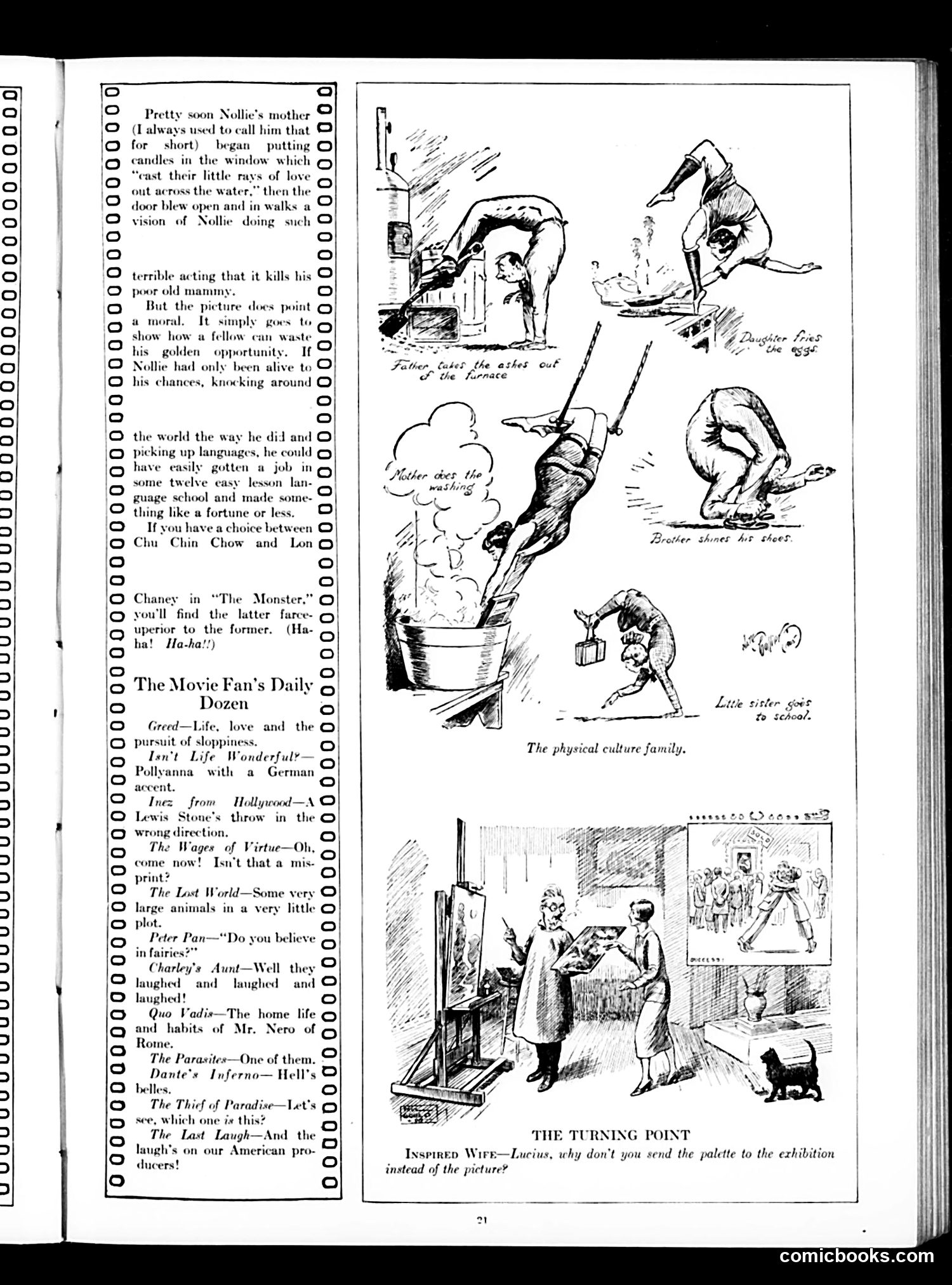
This page contains two distinct satirical pieces: **"The Movie Fan's Daily Dozen"** (left column) is a movie review section mocking 1920s films. It ridicules specific movies and actors—naming Lewis Stone, Lon Chaney, and referencing popular films like *Peter Pan* and *Quo Vadis*—by offering absurdist one-line critiques. The humor targets both the films themselves and contemporary cinema audiences' questionable taste. **"The Turning Point"** (right) is a multi-panel cartoon satirizing "physical culture"—the bodybuilding/fitness movement popular in the 1920s. The family performs increasingly absurd gymnastic exercises (standing on hands, contorted poses). The final panel's caption mocks an aspiring artist-husband whose wife pressures him to prioritize his wife's fitness activities over his painting, suggesting the physical culture craze's intrusion into domestic life and serious pursuits. Both pieces reflect Jazz Age anxieties about entertainment excess and fad culture overtaking more refined or productive endeavors.
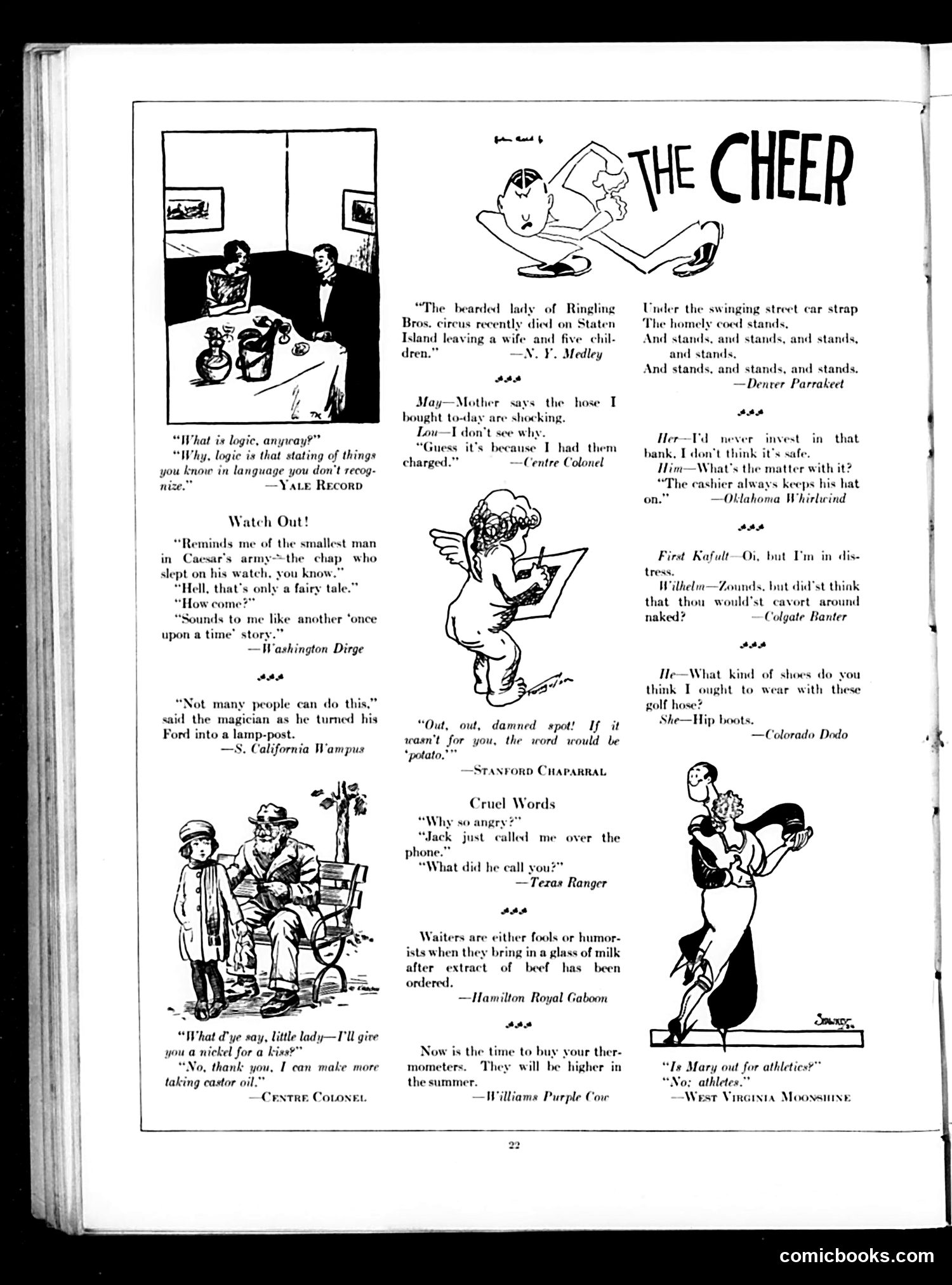
This is a collection of brief jokes and witty observations from various sources, typical of Judge's satirical humor section. The content reflects early 20th-century American comedic sensibilities: **Notable items:** - A fake news item about a bearded lady from Ringling Bros. circus dying, leaving a family—presumably dark humor about an unusual circumstance - Domestic humor (wives complaining about purchases) - Wordplay and absurdist jokes ("potato" instead of a Shakespearean curse word) - Relationship humor between men and women - Observational comedy about social situations (waiters, bankers, golfers) The accompanying cartoons show typical Judge illustration style—exaggerated figures in comedic situations. The humor is largely innocent by modern standards: puns, relationship jokes, and social observation rather than political satire. The varied attributions (fake newspaper names like "Yale Record," "Denver Parrakeet") add to the satirical tone, mocking the pretense of journalistic sourcing.
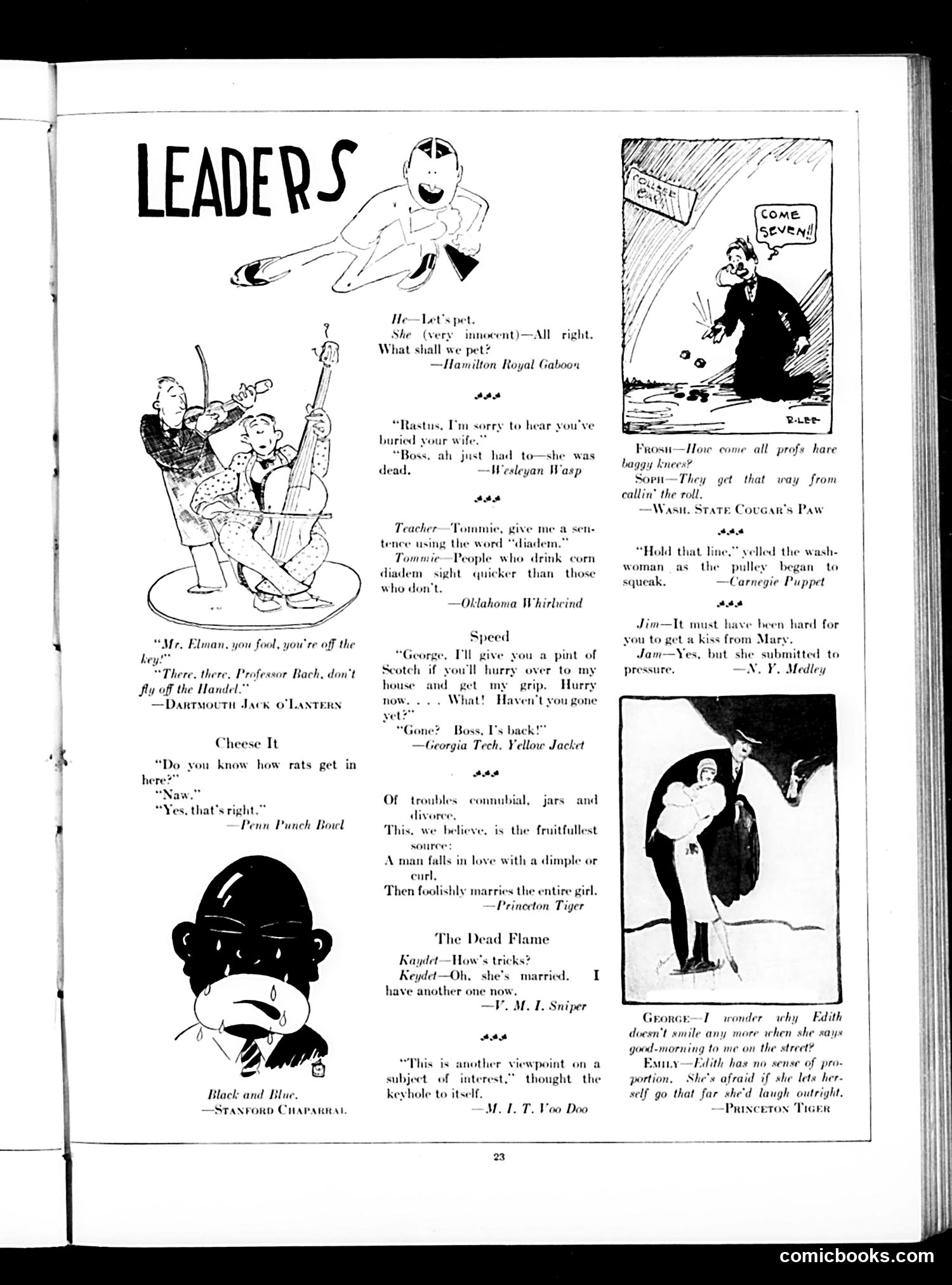
This page collects humorous shorts from various college humor magazines (Penn Punch Bowl, Stanford Chaparral, etc.), typical of Judge's format. The jokes reflect early-to-mid 20th century college and social attitudes. The content includes: **Musical humor**: References to Mischa Elman (violinist) and Bach suggest educated audiences. **Racial stereotypes**: A "Rastus" joke using offensive dialect represents the casual racism common in period humor. **College life satire**: Jokes about professors, drinking (Prohibition-era), and romantic pursuits reflect campus culture. **Gender commentary**: Several jokes mock women's emotional restraint and vanity (the "Edith" joke suggests women suppress laughter to maintain composure). **Social observations**: The "Dead Flame" and marriage jokes cynically comment on romantic disillusionment. The illustrations show generic college types and domestic scenes. This page exemplifies how Judge mixed sophisticated satire with crude stereotyping—attitudes considered acceptable entertainment for educated readers at the time but now recognized as offensive.
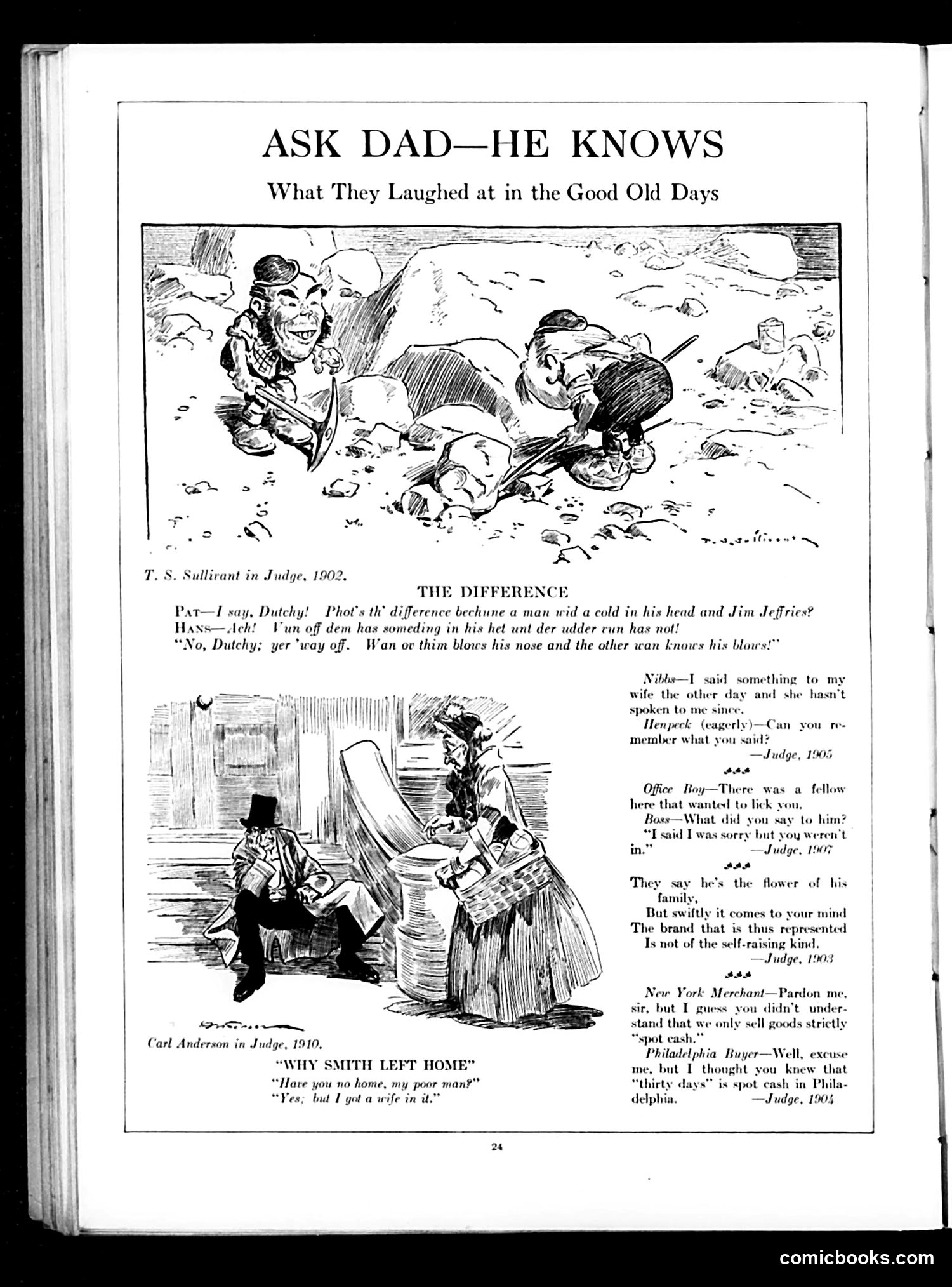
This page collects brief humorous anecdotes from *Judge* magazine (1902-1910), presented as examples of "good old days" humor for modern readers. **The cartoons depict:** 1. **"The Difference"** (1902): A joke with ethnic dialect humor, featuring "Pat" (Irish) and "Hans" (German) characters punning about colds and boxer Jim Jeffries—likely referencing Jeffries' famous boxing matches. 2. **"Why Smith Left Home"** (1910): A domestic joke playing on the trope of nagging wives and unhappy marriage—the man prefers homelessness to married life. 3. **Additional anecdotes** about henpecked husbands, office boys, and regional commercial practices. **The satire targets:** Stereotyped immigrant characters (via dialect), traditional gender dynamics (wives as domestic torment), and regional business culture (Philadelphia's liberal credit terms). The page itself is nostalgic framing, inviting readers to laugh at period humor they presumably found entertaining decades prior—while modern readers would likely find the ethnic caricatures and misogynistic marriage jokes dated.
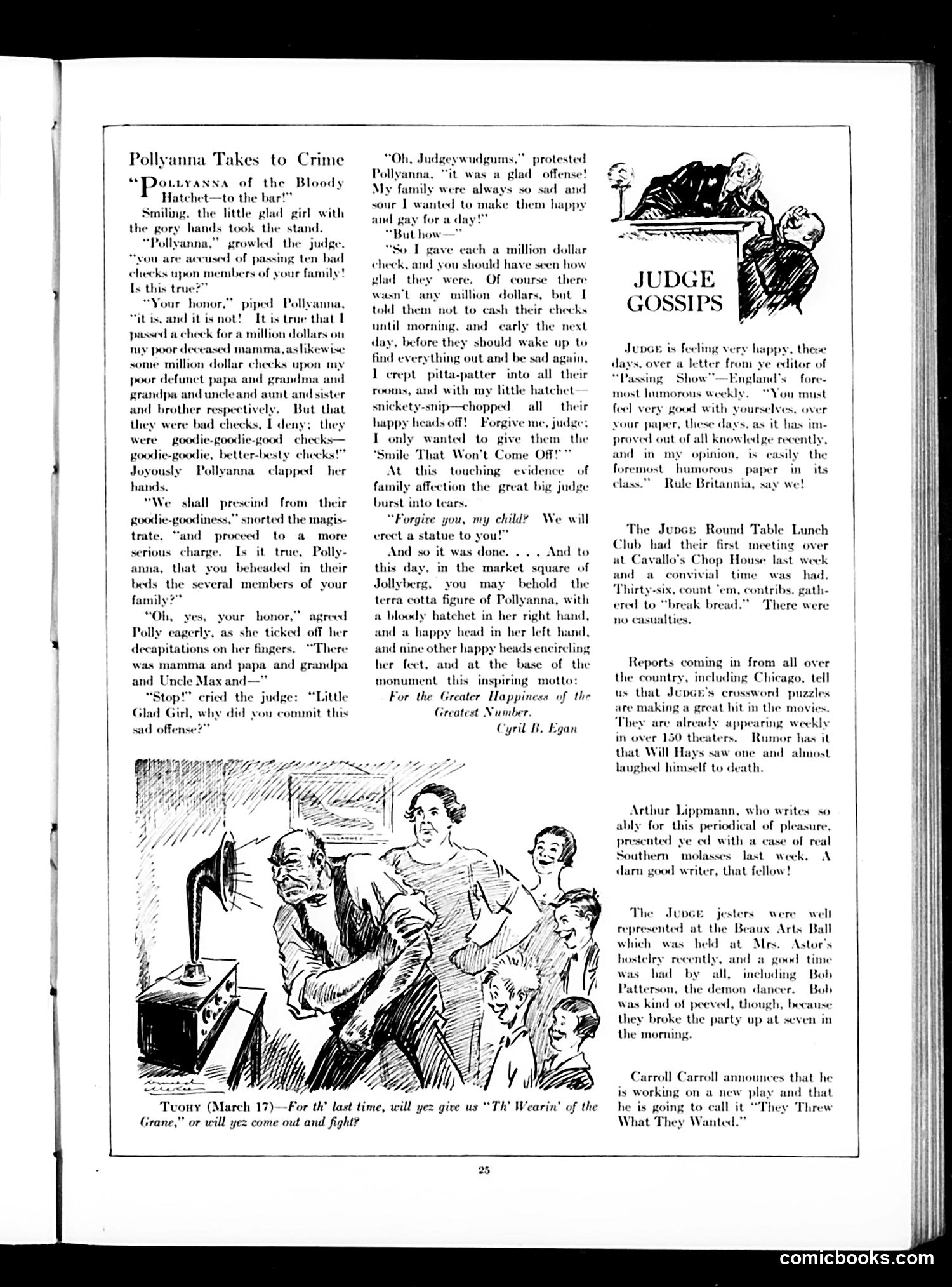
This is a dark satire on Eleanor Porter's beloved 1913 novel *Pollyanna*, about an irrepressibly optimistic girl. The story parodies her famous "Glad Game"—finding something good in every situation—by pushing it to absurd extremity: Pollyanna murders her entire family with a hatchet, then convinces a weeping judge she deserves a statue because she was trying to make them "happy." The joke targets both saccharine optimism and the book's enormous cultural impact. By having the judge erect a monument celebrating her murders, the cartoon mocks the idea that relentless cheerfulness can justify anything—or that society will excuse crimes if presented with sufficiently earnest motivation. The accompanying *Judge* gossip column shows this was standard magazine fare: celebrity mentions, inside jokes about the publication, and social events. The page reflects 1920s American humor at a nationally distributed satirical weekly.
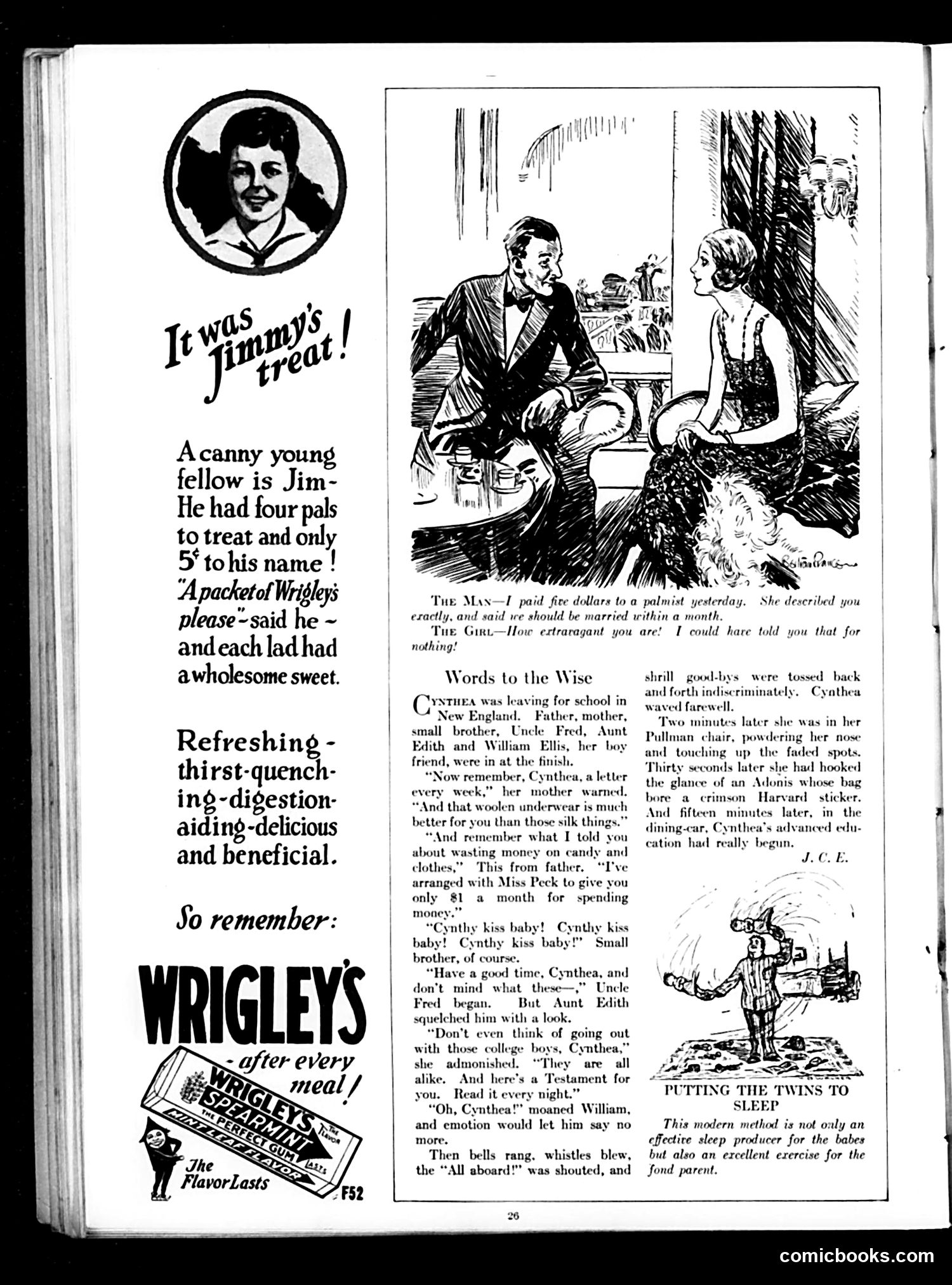
This page contains **advertisements and two unrelated stories** rather than unified satire. **Left side:** A Wrigley's gum advertisement presenting "Jimmy's treat"—a joke about a young man named Jim who had four friends to treat but only enough money for a packet of Wrigley's gum (5 cents). The ad positions gum as an economical, wholesome alternative to other treats, emphasizing its digestive benefits. **Right side:** Two pieces of fiction: 1. **"The Man and the Girl"** (top): A brief comedy about a man who paid a palmist $5 for a prediction that he'd marry a woman within a month. The woman jokes she could have told him that for nothing—suggesting he's obviously interested or that the prediction was obvious. 2. **"Words to the Wise" (bottom):** A sentimental story about a girl named Cynthea leaving for boarding school in New England, surrounded by protective family members dispensing advice about underwear, spending money, and avoiding college boys. The final illustration shows parents exercising infants as a "sleep producer." The page reflects **early 20th-century attitudes** about propriety, parental concern, and consumer goods.
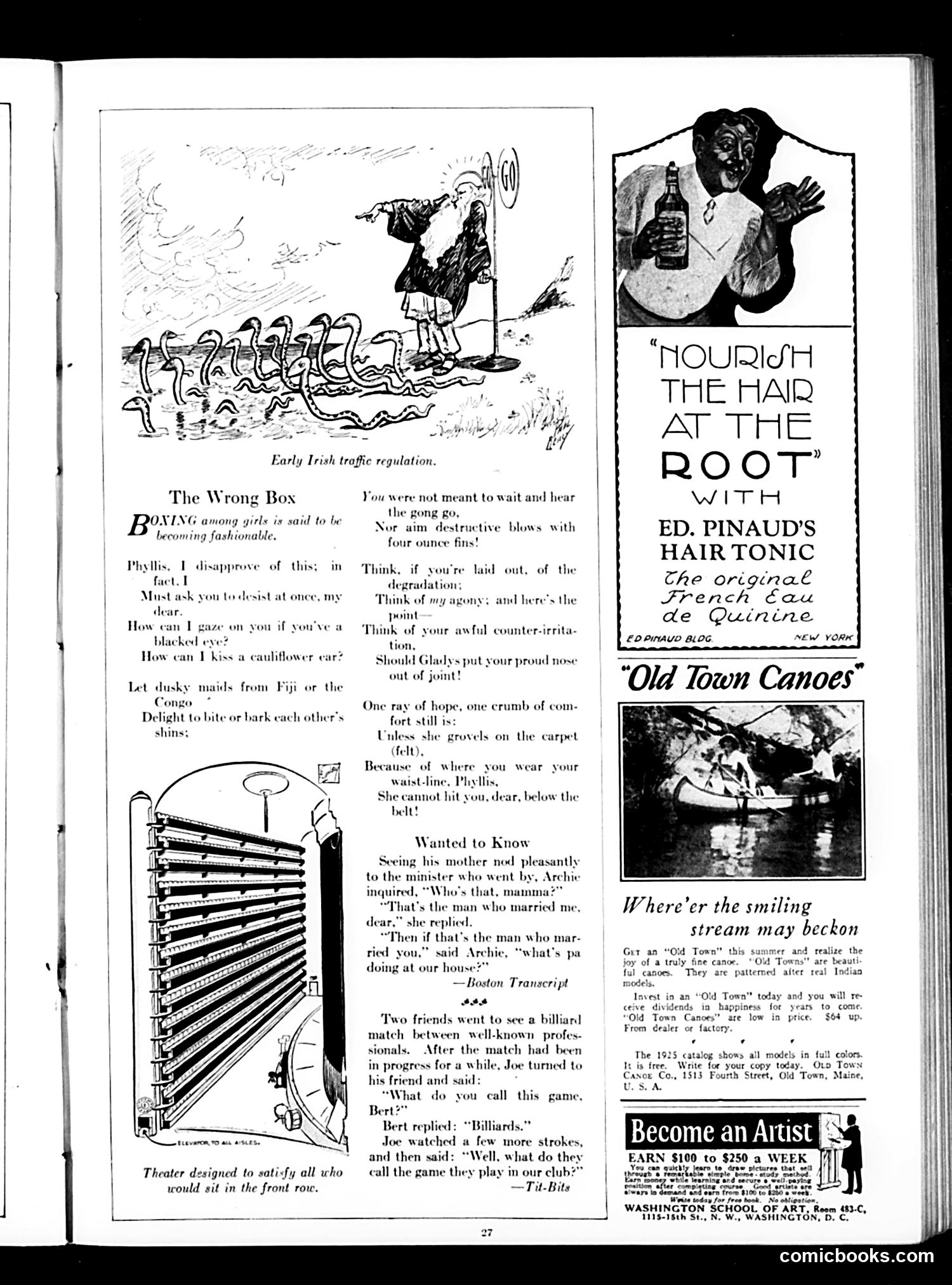
This page combines humor pieces mocking early 1920s social conventions with period advertisements. **"The Wrong Box"** satirizes the emerging trend of women boxing. A character named Phyllis criticizes her friend for taking up the sport, arguing that boxing damages a woman's appearance (blackened eyes, cauliflower ears) and is thus unfeminine and unmarriageable. The humor depends on readers accepting that physical attractiveness for marriage prospects should outweigh women's athletic interests—a position the satire gently ridicules by taking it to absurd extremes. **The theater cartoon** jokes about theater design accommodating rowdy front-row patrons. **"Wanted to Know"** and the billiards anecdotes are light domestic humor about misunderstandings. **The advertisements**—hair tonic, canoes, and art school—represent typical Judge revenue sources. The art school ad promises substantial weekly earnings, reflecting post-WWI economic optimism. The "Early Irish traffic regulation" caption accompanying geese suggests ethnic humor typical of the era.
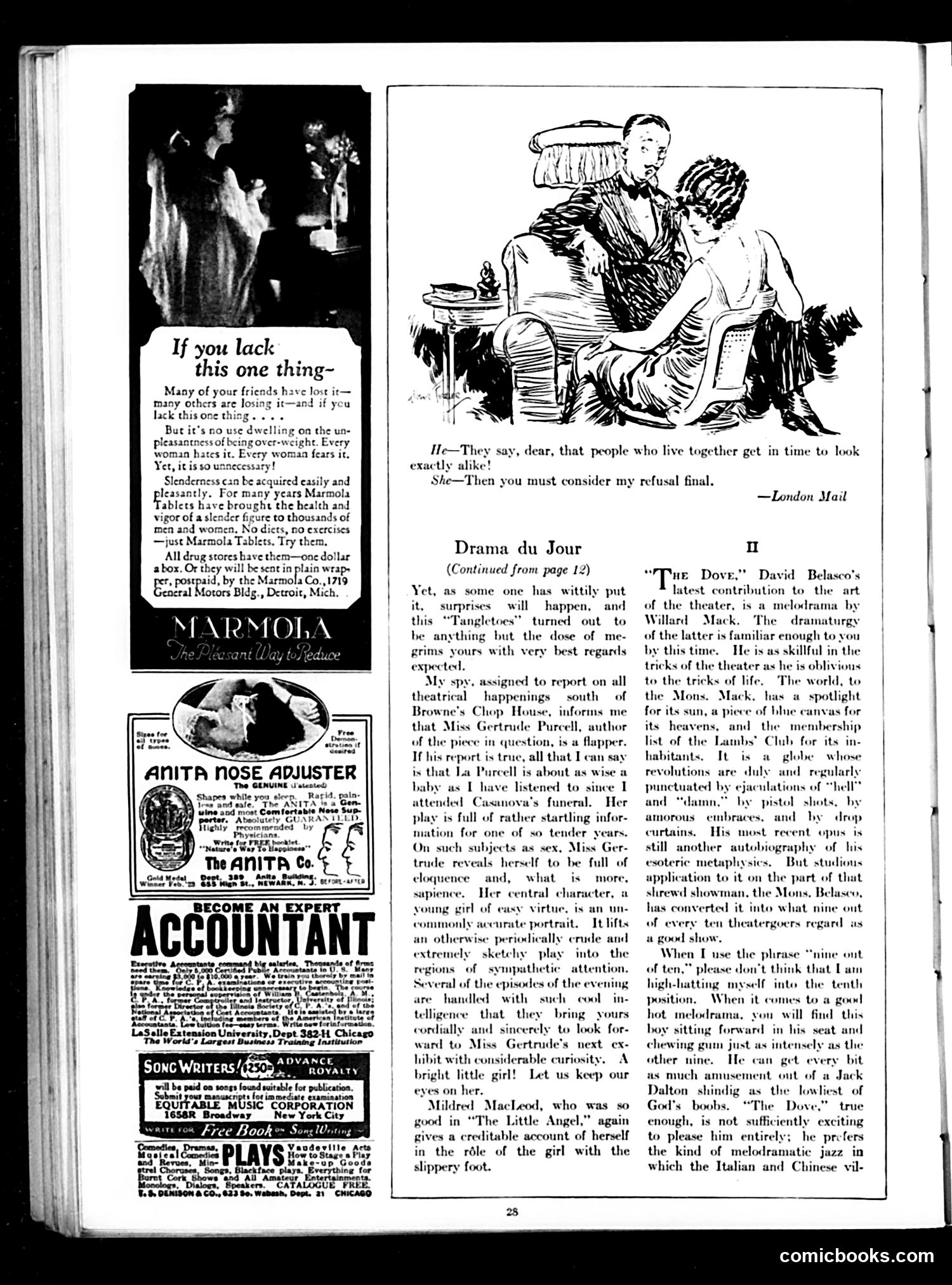
This page is primarily **advertisements and theatrical criticism**, not political satire. The top half contains vintage ads for weight-loss tablets (Marmola), a nose adjuster device, and accountancy training—typical early 20th-century dubious medical products marketed to women concerned about appearance. The bottom half features "Drama du Jour," a theater review discussing new plays: Gertrude Purcell's "Tangletoes" (criticized as a flapper's naive work dealing with sex) and David Belasco's "The Dove" (praised as skillful melodrama, though the reviewer notes Belasco relies on theatrical tricks rather than genuine insight into life). The small cartoon between sections shows a domestic exchange where a woman refuses a man's marriage proposal by claiming that people who live together eventually resemble each other—implying she won't marry him because she'd look like him. **No political satire or caricature appears on this page.** It's entertainment-focused content typical of Judge's theater and consumer coverage.
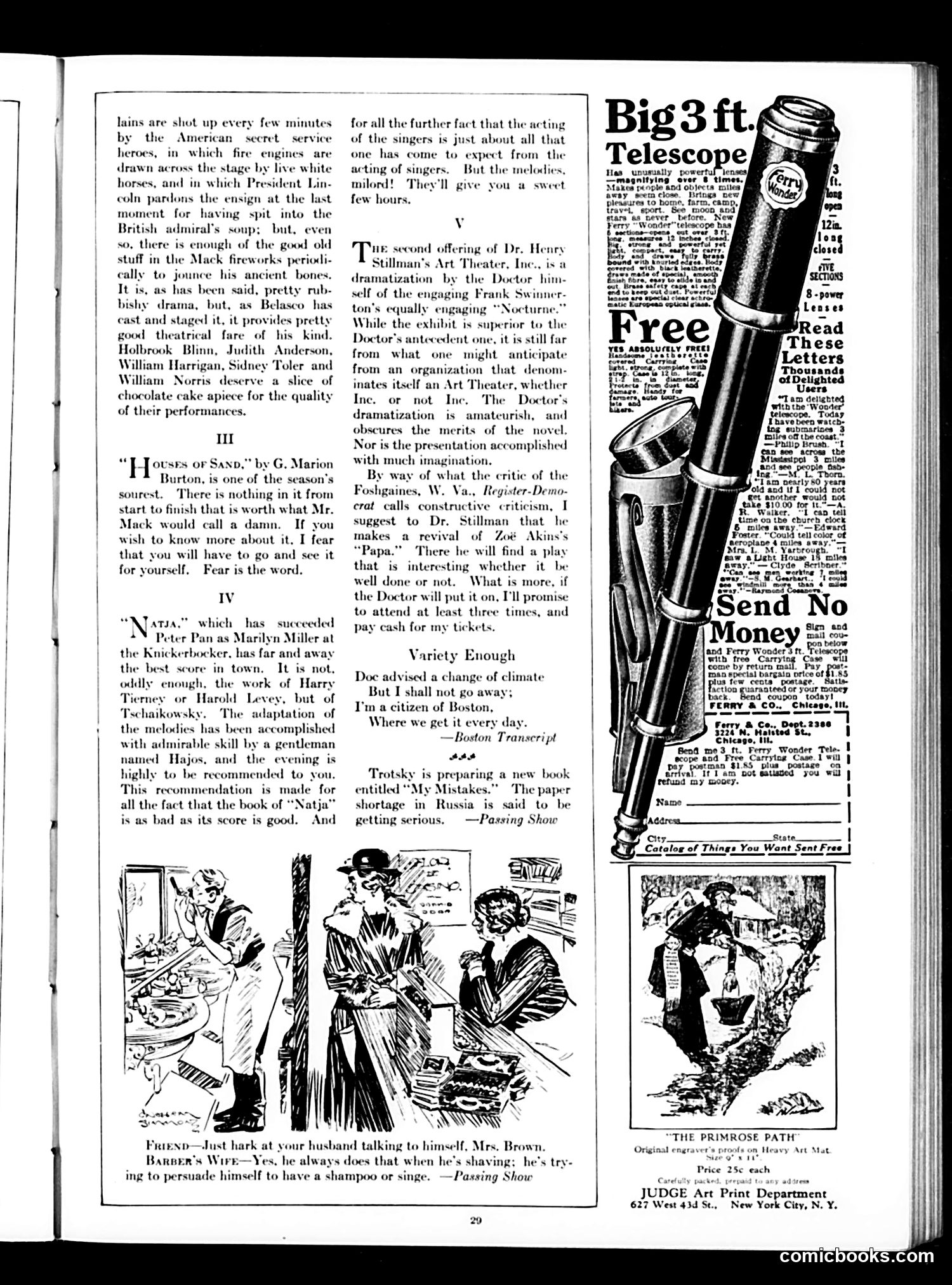
This page from Judge contains theater reviews and advertisements. The main content discusses Broadway productions: "Houses of Sand" (criticized as worthless), "Natja" (praised for Tschaikowsky's music despite poor dialogue), and Dr. Stillman's Art Theater production of "Nocturne" (deemed amateurish). Two small cartoons appear at bottom left, appearing to be from "Passing Show," depicting domestic humor—one showing a husband talking to himself while shaving, with his wife commenting he's trying to persuade himself to have a shampoo. The right side features a large advertisement for a "Big 3 ft. Telescope" offered free with letters sent in, typical of early 20th-century mail-order promotions promising optical instruments. Below is an illustration titled "The Primrose Path" from the Judge Art Print Department. The page reflects 1920s entertainment culture and common advertising tactics of offering premiums to encourage reader correspondence.
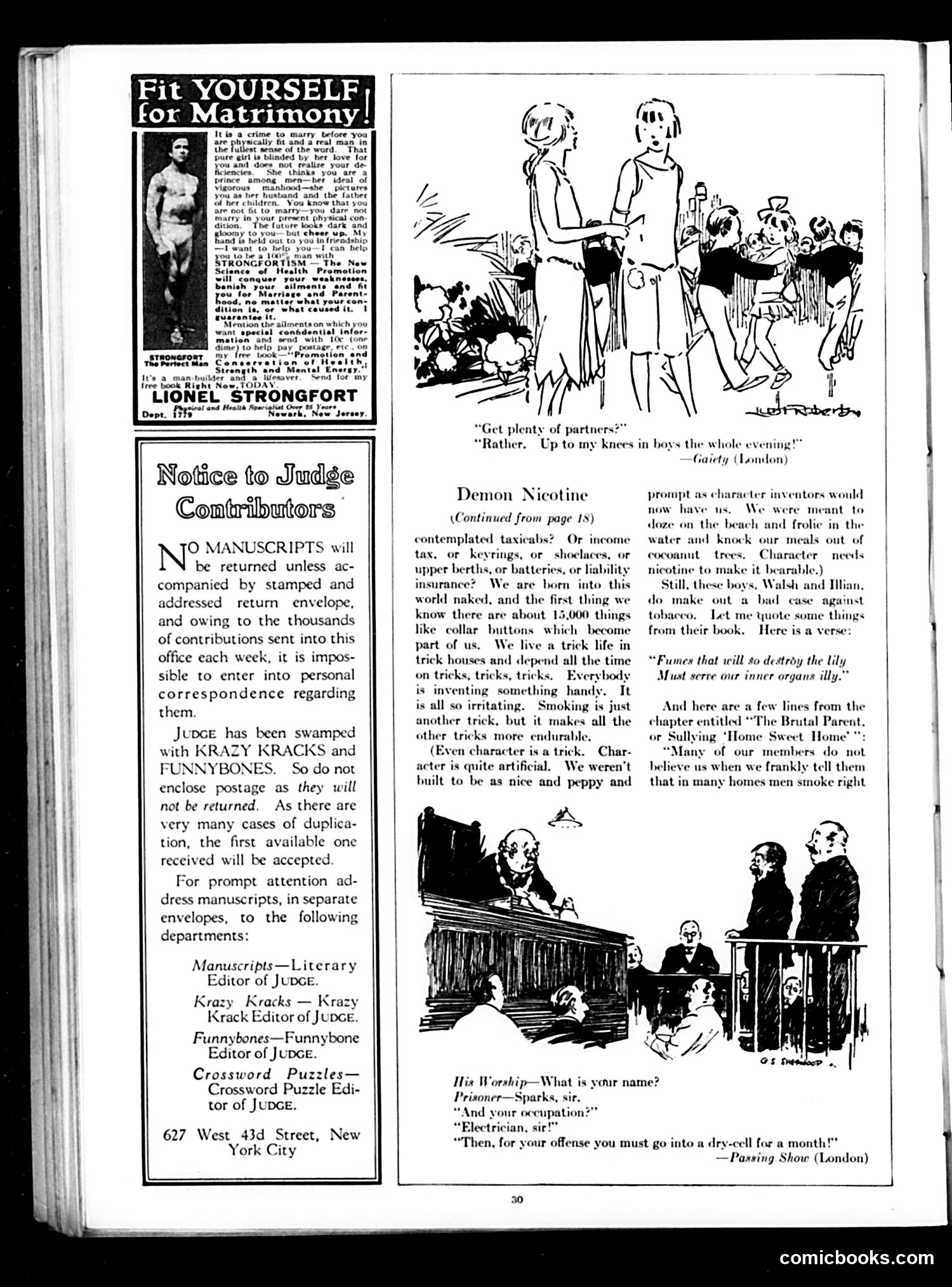
This page contains **advertisements and editorial notices** rather than political cartoons requiring historical context. The main visual content shows two unrelated cartoon jokes: 1. **Top cartoon** depicts children at play with the caption about "plenty of partners" and "up to my knees in boys"—a mild double-entendre joke about a children's game. 2. **Bottom cartoon** illustrates a courtroom scene with a judge questioning a prisoner named Sparks, an electrician—a simple pun setup (electrician/electrical current). The dominant text is a **"Notice to Judge Contributors"** explaining the magazine's submission policies and their need to screen the overwhelming volume of reader contributions ("Krazy Kracks" and "Funnybones"). There's also **an advertisement for Lionel Strongfort's physical fitness course** promoting marriage readiness through bodybuilding—reflecting early 20th-century wellness marketing to men. The **"Demon Nicotine" article** discusses smoking's role in modern life's irritations, neither particularly satirical nor political. This page is primarily **administrative and commercial** rather than editorially significant.
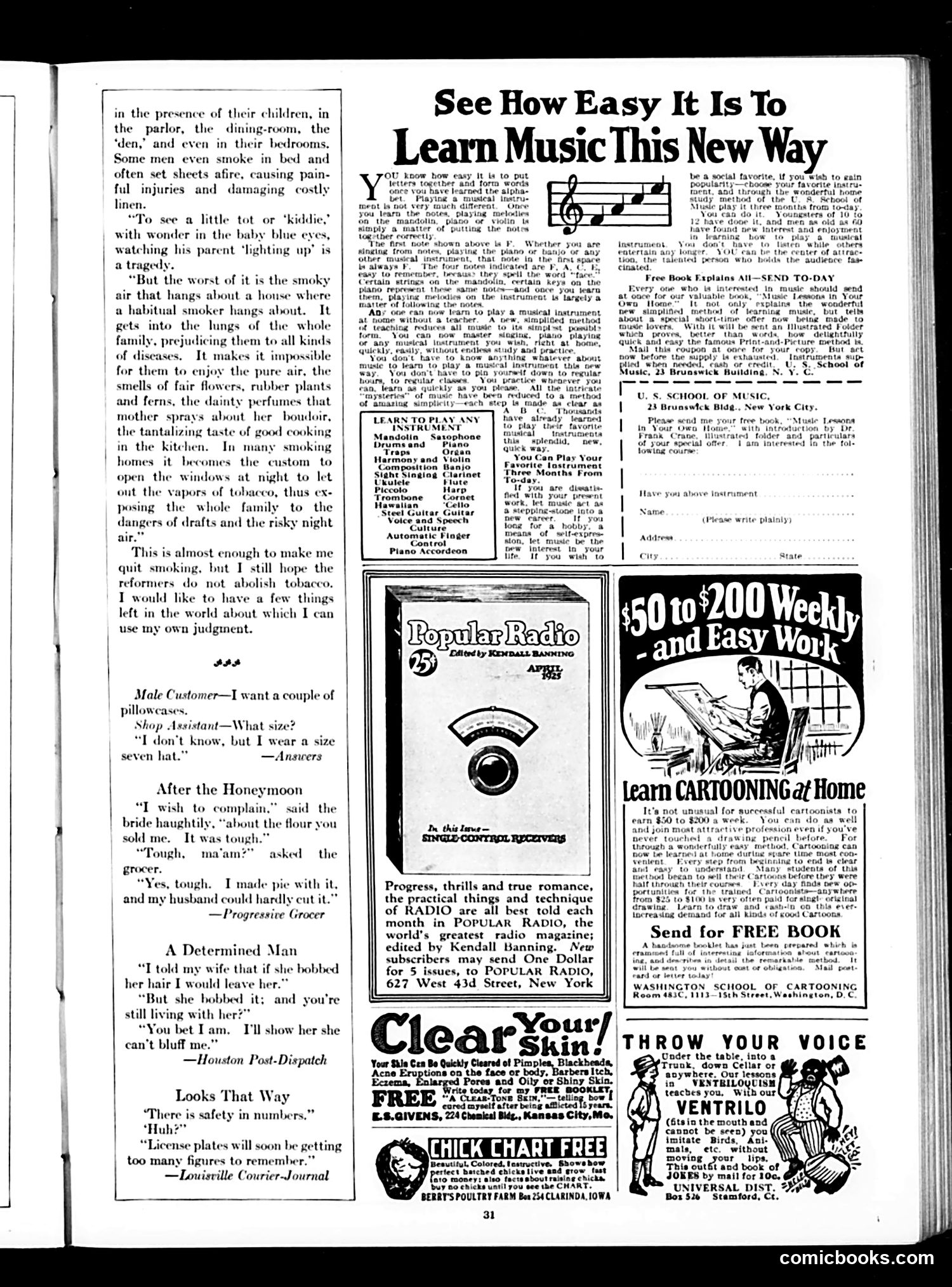
This page is primarily **advertising and light humor**, not political satire. The main content is an advertisement for music lessons, promising readers can easily learn any instrument ("as easy as A-B-C") through a new home-study method. The ad lists various instruments and claims rapid mastery within three months. The humor pieces are brief, domestic jokes: a confused customer asking about pillow sizes, a bride complaining about tough flour from the shop, and a husband maintaining a standoff with his wife after her bobbed haircut (a 1920s reference to modern women's fashion). The only semi-serious content is a long anti-smoking essay criticizing smokers for polluting family homes and endangering children—a health-reform argument popular in early 20th-century publications. The essay mocks smokers while admitting the author hopes tobacco isn't abolished, wanting to "use my own judgment." The page reflects typical 1920s-era Judge magazine content: consumer advertising mixed with gentle domestic humor and occasional advocacy for reform causes.
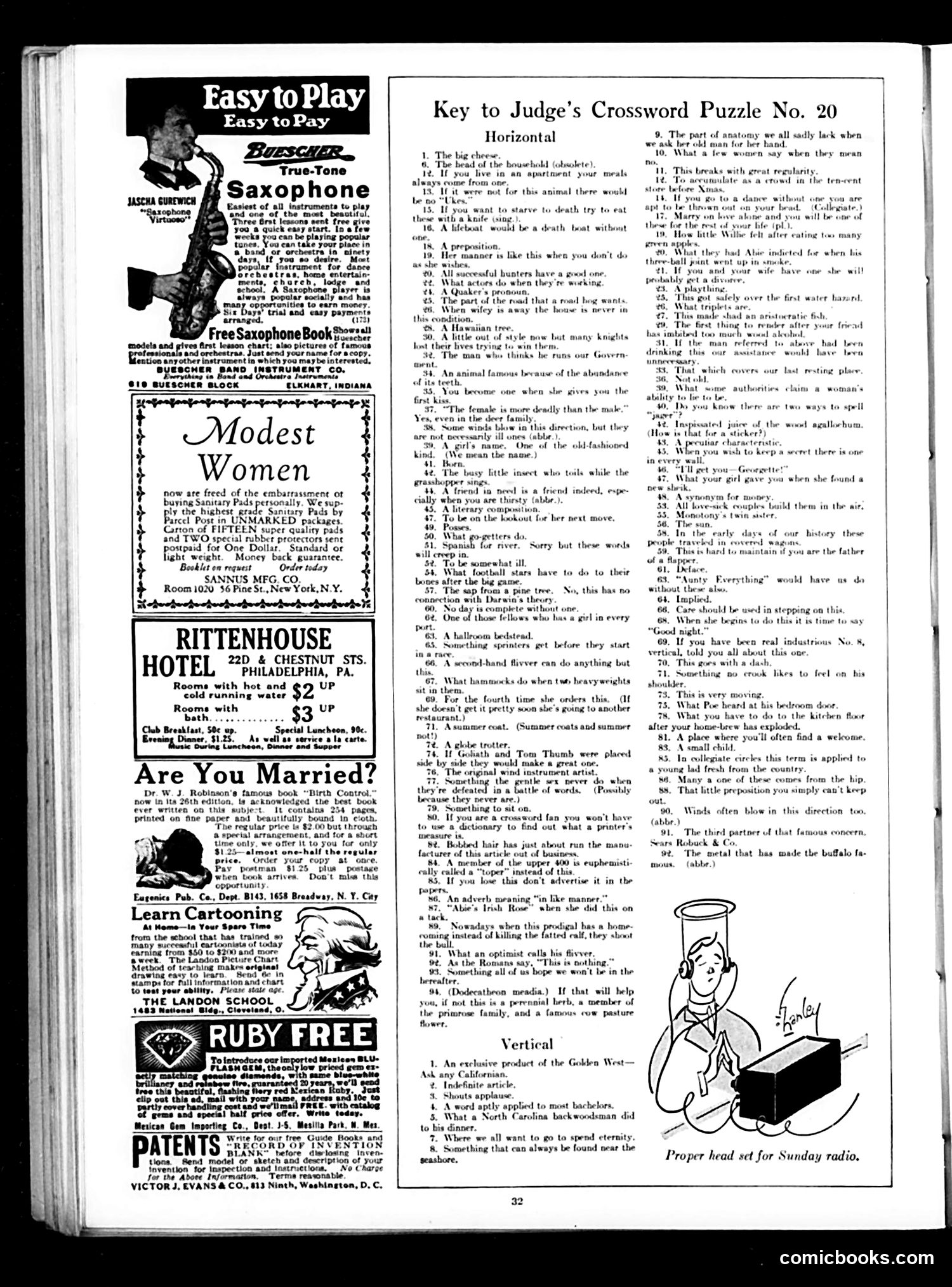
This page is primarily **advertisements and a crossword puzzle answer key**, not satirical content requiring historical context. The visible advertisements target early 1920s consumers: a Buegher saxophone ("easy to play, easy to pay"), sanitary pads sold discreetly by mail (addressing female embarrassment about purchasing), a Philadelphia hotel, Dr. Robinson's "Birth Control" book, and cartooning correspondence courses. The single cartoon shows a man at a radio with caption "Proper head set for Sunday radio"—a mild visual pun suggesting domestic/marital control rather than political satire. The crossword puzzle answers reference everyday 1920s life: household items, animals, social customs, and period slang. There are no identifiable political figures or events being satirized on this page. It's a standard magazine interior page mixing instructional content with commercial advertising typical of the era.
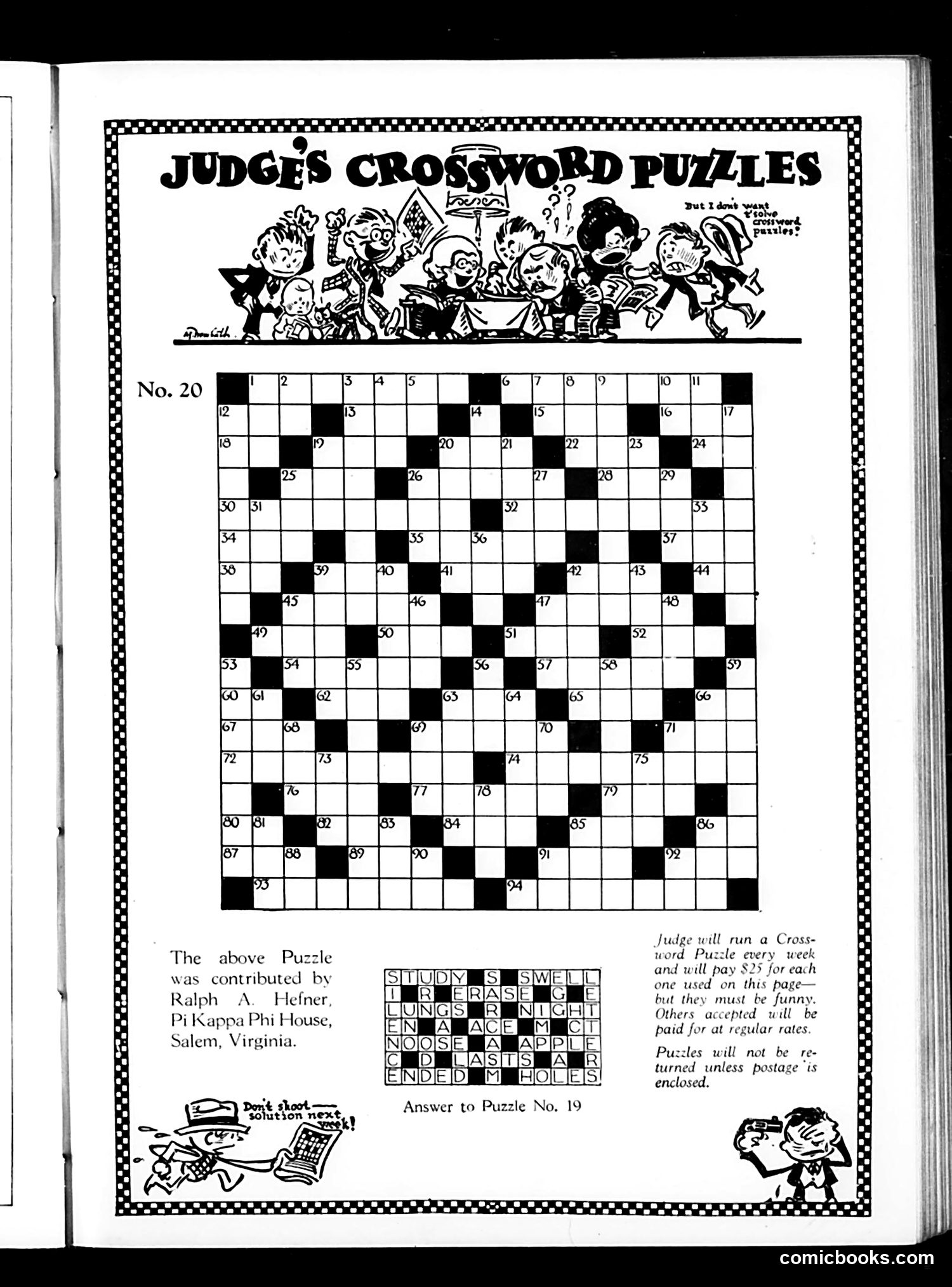
This page features "Judge's Crossword Puzzles," No. 20, a standard puzzle competition section common to early-to-mid 20th century magazines. The page itself is not satirical—it's a functional puzzle offering with the solution to the previous week's puzzle (No. 19) displayed in a grid showing answers like "STUDY," "ERASE," "SMELL," and "NOOSE." The key content is the announcement that Judge will pay $25 for each puzzle accepted for publication, contributing to a long tradition of reader-submitted content in the magazine. The small cartoon illustrations are generic decorative elements showing characters working on puzzles—not political commentary. This represents Judge's shift toward entertainment and puzzle content rather than purely satirical cartooning, reflecting the magazine's broadening appeal during this period.
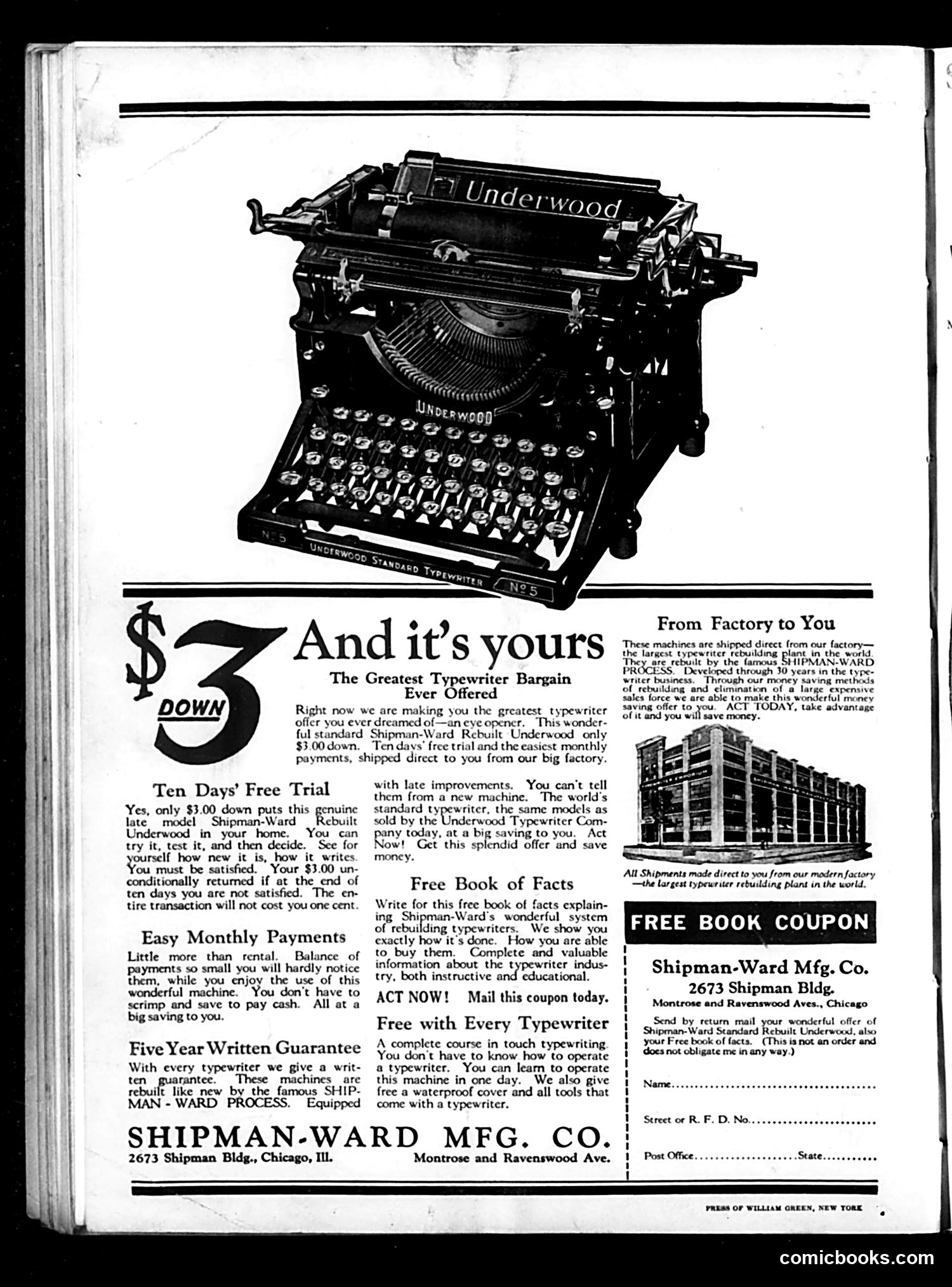
This page is **not a cartoon or satire**—it's a straightforward advertisement for Shipman-Ward Manufacturing Company's rebuilt typewriters, disguised as a Judge magazine page. The ad promotes a Underwood typewriter rebuilt through their "Shipman-Ward Process" for $3 down with ten days' free trial and easy monthly payments. Key selling points include a five-year guarantee, free typing lessons, and factory-direct shipping claimed to eliminate middleman costs. The only "Judge" element is the page's placement in the satirical magazine itself, which during this period (likely 1920s-30s) regularly published advertisements alongside humorous content. There are no identifiable figures, political references, or satirical commentary—just a commercial pitch emphasizing affordability and reliability to appeal to cost-conscious buyers during an era when typewriters were becoming standard office equipment.