
A complete issue · 36 pages · 1925
Judge — January 3, 1925
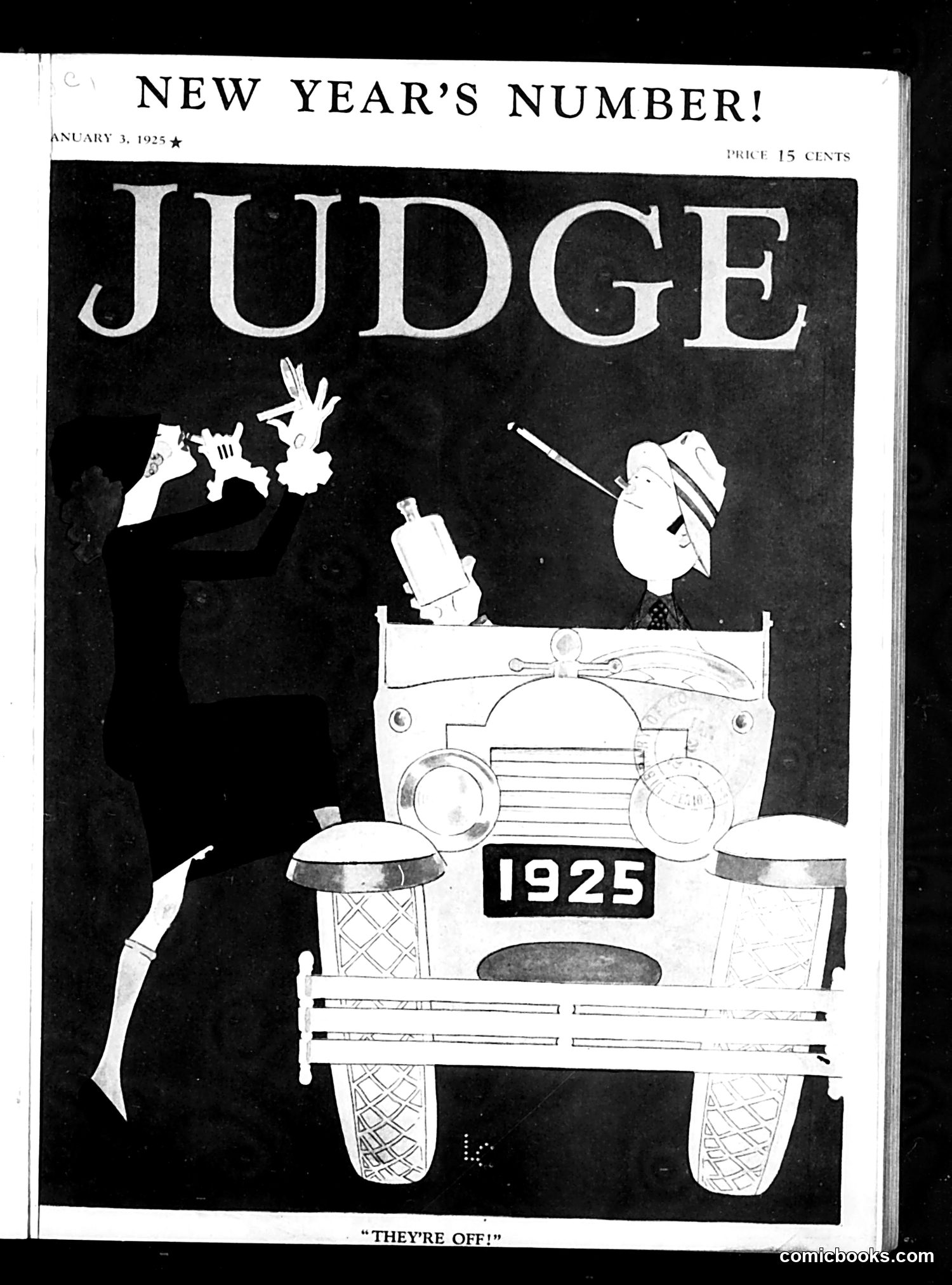
This is Judge's "New Year's Number" cover cartoon titled "They're Off!" The image depicts a caricatured figure in a car labeled 1925, about to speed forward into the new year. On the left, another figure appears to be watching or sending them off, possibly representing 1924 or the past year departing. The cartoon uses the metaphor of a race or sporting event—"they're off" being a racing phrase—to represent the year 1925 beginning. The automobile imagery was topical for the 1920s, when cars were still relatively new and symbolized modernity and progress. The satirical point appears celebratory rather than critical, marking the literal start of a new year with characteristic Judge humor and contemporary visual references.
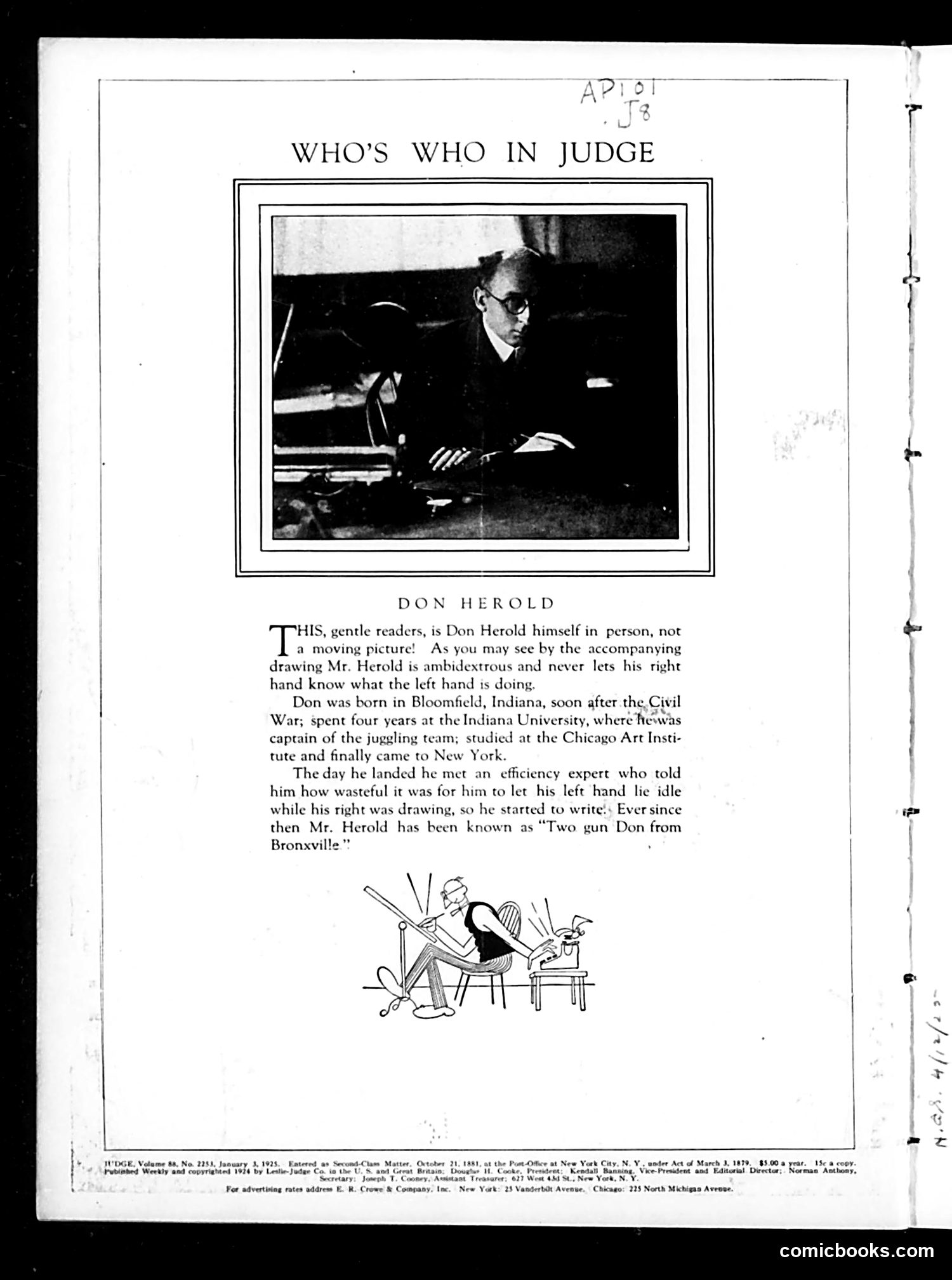
This page profiles cartoonist and writer Don Herold for Judge magazine's "Who's Who" feature. The photograph shows Herold at his desk, wearing glasses and formal attire. The biographical text explains Herold's background (born in Bloomfield, Indiana; Indiana University graduate; studied at Chicago Art Institute) and humorously notes his ambidexterity: an efficiency expert told him his idle left hand was wasteful, so he began writing while drawing with his right hand simultaneously. This earned him the nickname "Two gun Don from Bronxville." The small cartoon below illustrates this dual-handed technique humorously, depicting a figure juggling multiple artistic tasks at once—the central joke being Herold's unusual productivity method that made him notable among Judge's contributors.
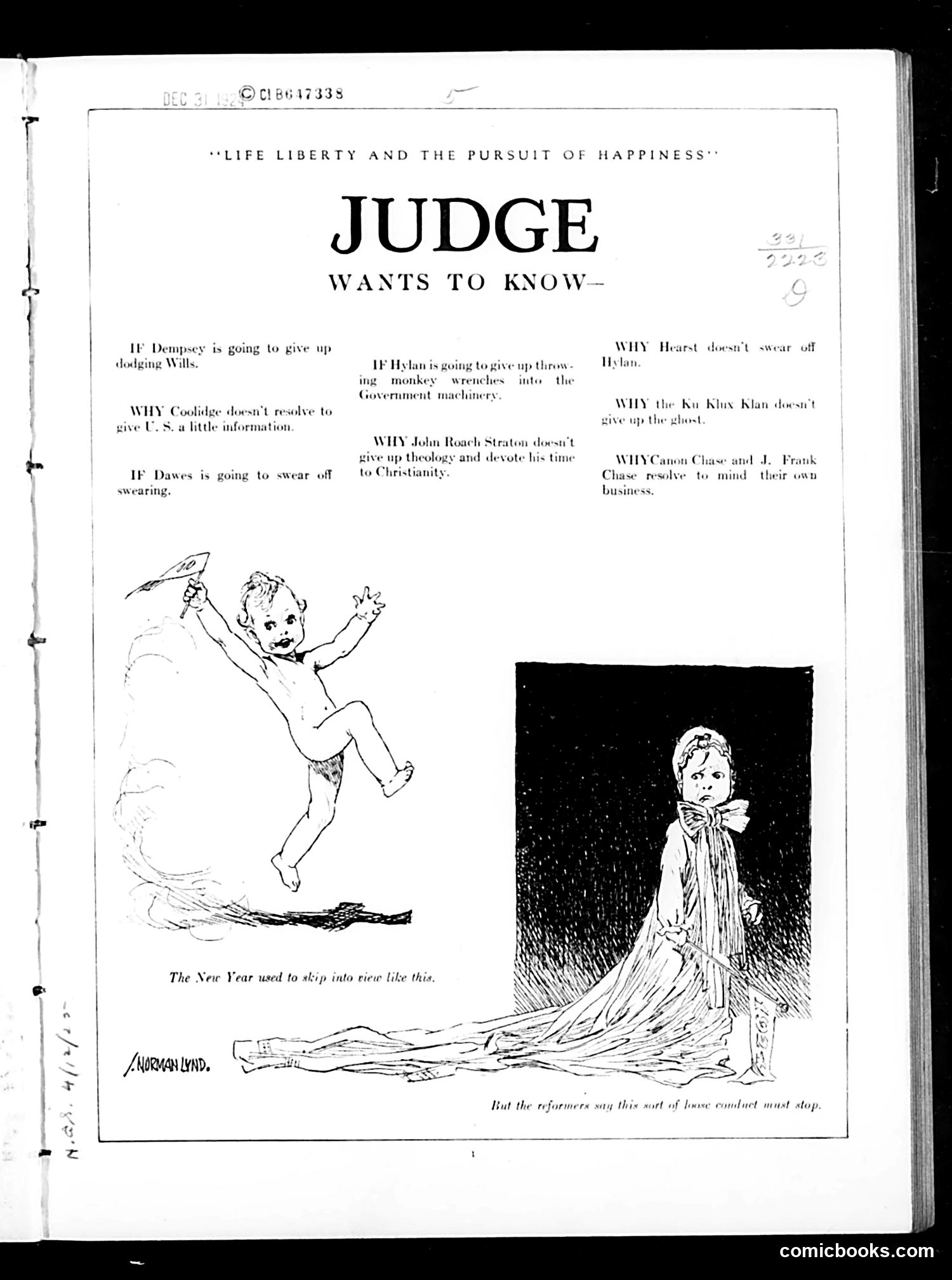
This page satirizes prominent figures' refusal to reform or change their public behavior, framed around "Life, Liberty and the Pursuit of Happiness." The header "Judge Wants to Know" lists rhetorical questions about why various people won't abandon questionable practices: - Dempsey won't stop boxing - Coolidge won't provide transparency - Hylan won't stop corrupting government machinery - Davies won't stop swearing - Hearst won't stop sensationalism - The KKK won't abandon its organization - Religious figures won't devote themselves to Christianity - Wealthy businessmen won't mind their own affairs The illustrations show a cherub from the old year being replaced by a child wrapped in tattered cloth, suggesting reformers' disappointment that bad behavior persists into the new year. The satire critiques public figures' resistance to moral or civic improvement.
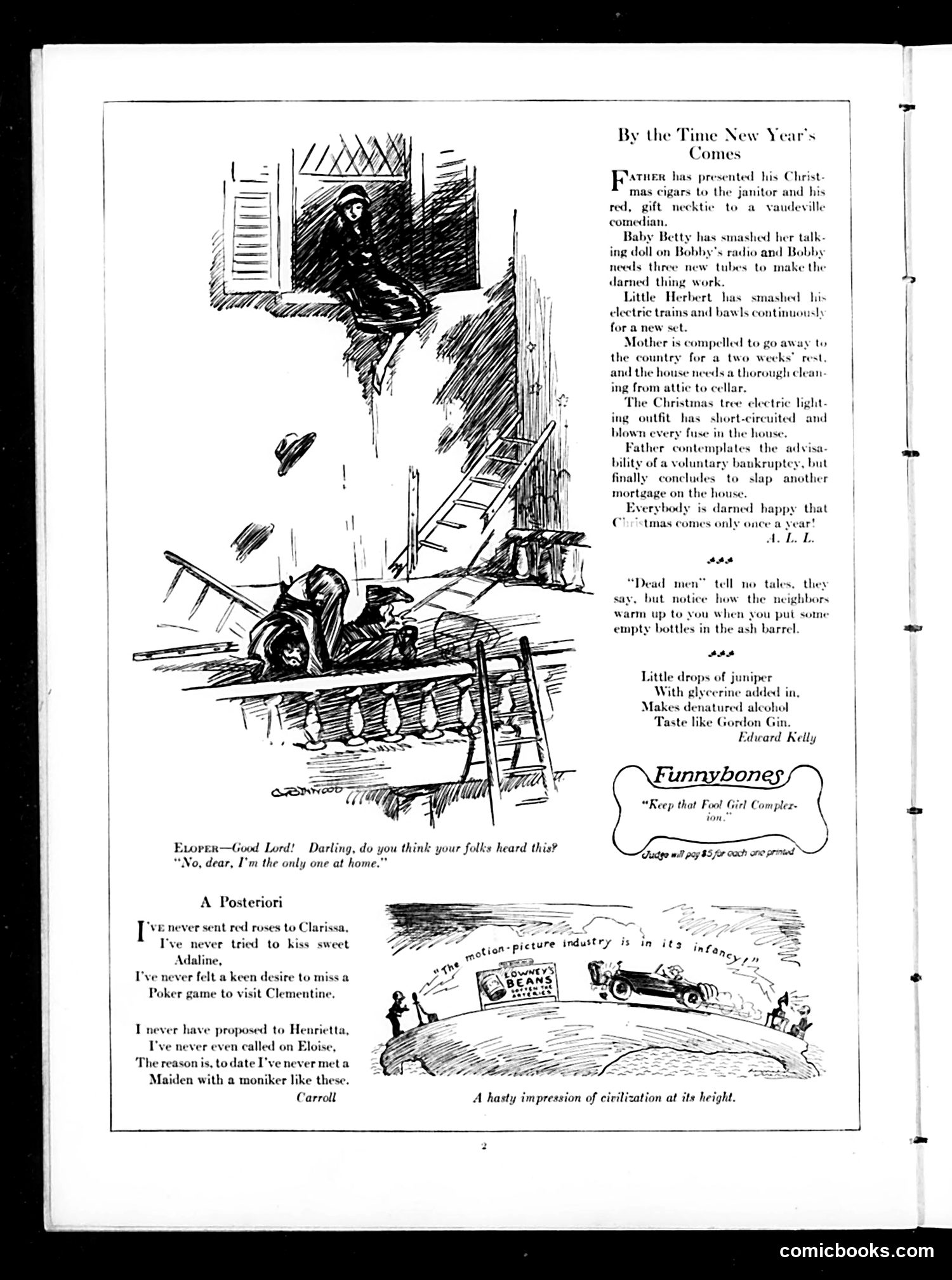
This page satirizes post-Christmas household chaos. The main cartoon depicts a father surveying destruction—broken toys, overturned furniture, a damaged Christmas tree with blown electrical fuses—alongside children's gifts that have failed or caused damage (smashed talking doll, broken electric trains, ruined radio). The satire targets both consumer excess and the era's unreliable electrical technology. The accompanying text humorously catalogs holiday disasters: the family must vacate for cleaning, the father contemplates bankruptcy and another mortgage, and everyone agrees "Christmas comes only once a year!" The accompanying short pieces ("Dead men tell no tales," Kelly's gin joke) and "A Posteriori" poem provide additional comic relief, while the bottom cartoon mocks early motion-picture industry pretensions.
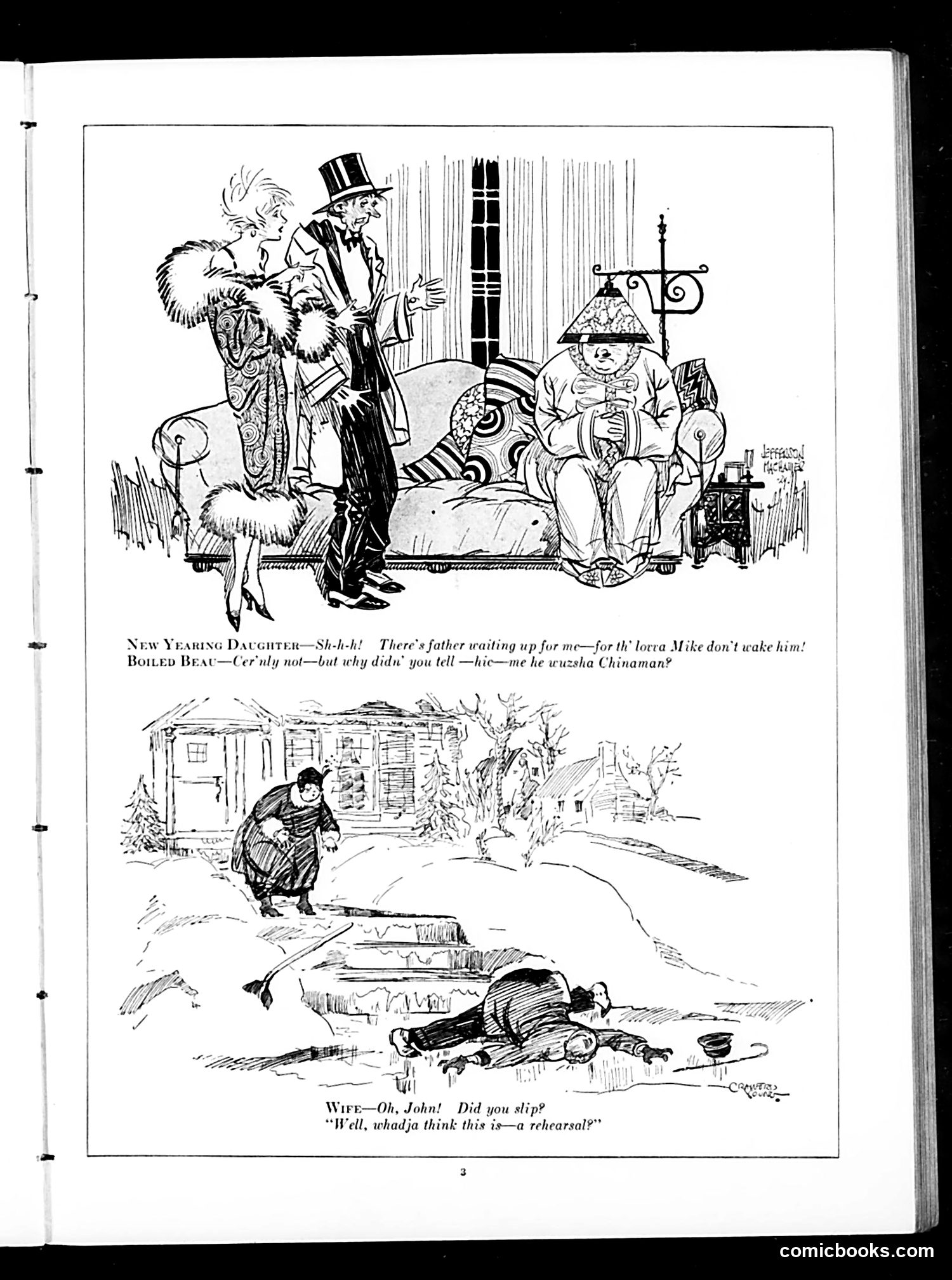
**Top Cartoon - "New Yearing Daughter":** This depicts a wealthy young woman in fashionable attire confronting her father (in top hat) about a suitor named "Mike." She references "Boiled Beau" and "Cer'nly not," then asks why he didn't take a "Czarsha Chinaman"—likely satirizing contemporary anxieties about interracial dating and foreign suitors among the wealthy elite. The joke appears to mock both the daughter's romantic expectations and period prejudices about acceptable courtship. **Bottom Cartoon - "Wife":** Shows a man who has apparently fallen into a ditch or hole. His wife's response—"Well, whadja think this is, a rehearsal?"—suggests he's an actor or performer practicing a comedic fall, making light of his mishap through theatrical reference. Both employ slapstick and social satire typical of Judge's humor.
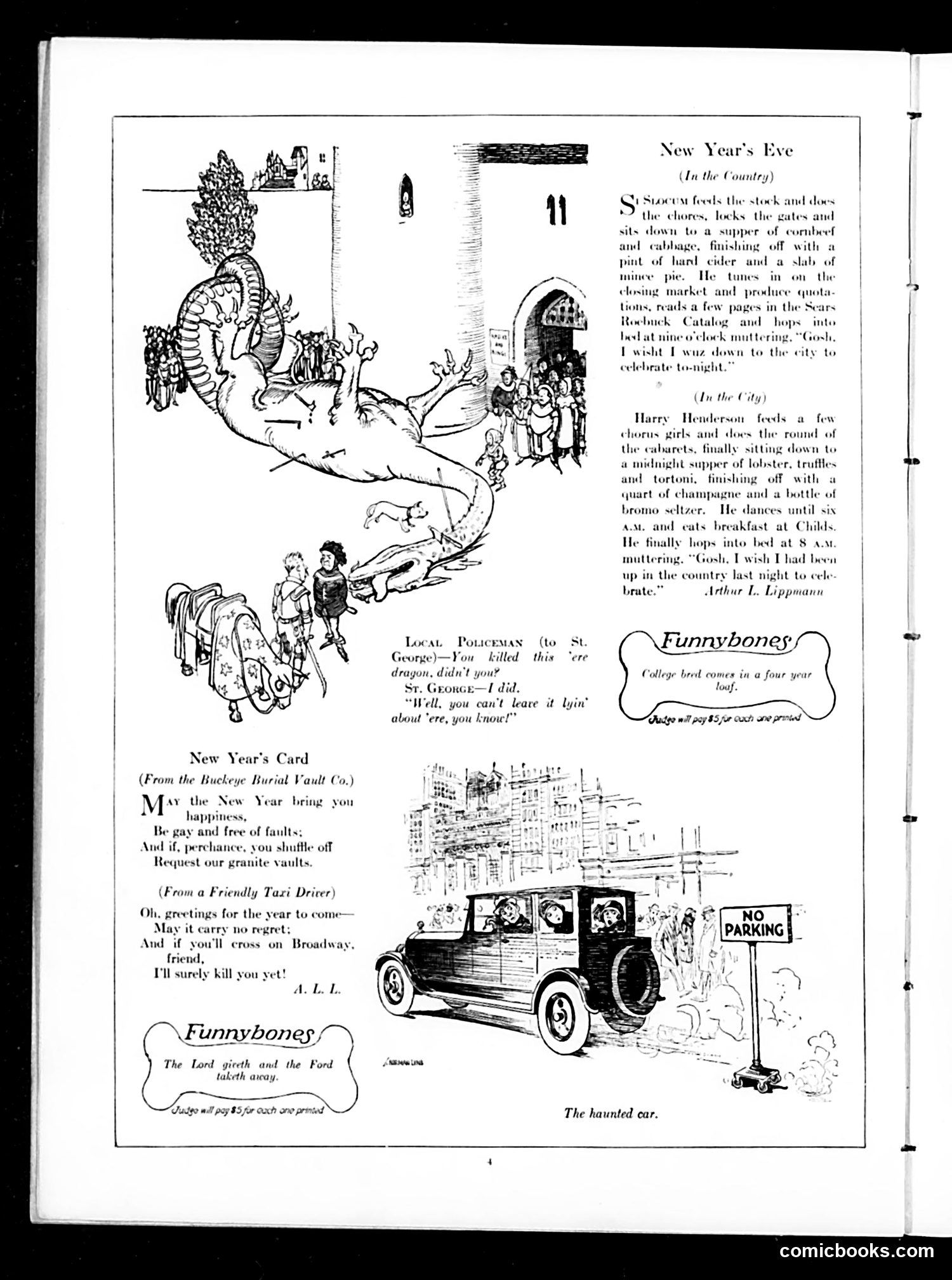
This page contains New Year's Eve satirical sketches from an early 20th-century American magazine. The main cartoon depicts a large dragon labeled "1922" (or similar year) terrorizing rural and urban figures, symbolizing the year's challenges and misfortunes. **Content includes:** - **"New Year's Eve (In the Country)"** and **(In the City)**: Contrasting how rural versus urban Americans celebrated, with country folk doing simpler activities versus city dweller Harry Henderson's elaborate nightclub revelry. - **"New Year's Card"** and **"Funnybones"**: Humorous greetings and puns. - **"The Haunted Car"** cartoon: A parked vehicle with "NO PARKING" sign, likely satirizing urban parking enforcement or automobile culture anxieties. The humor relies on class contrasts and everyday frustrations recognizable to 1920s readers.
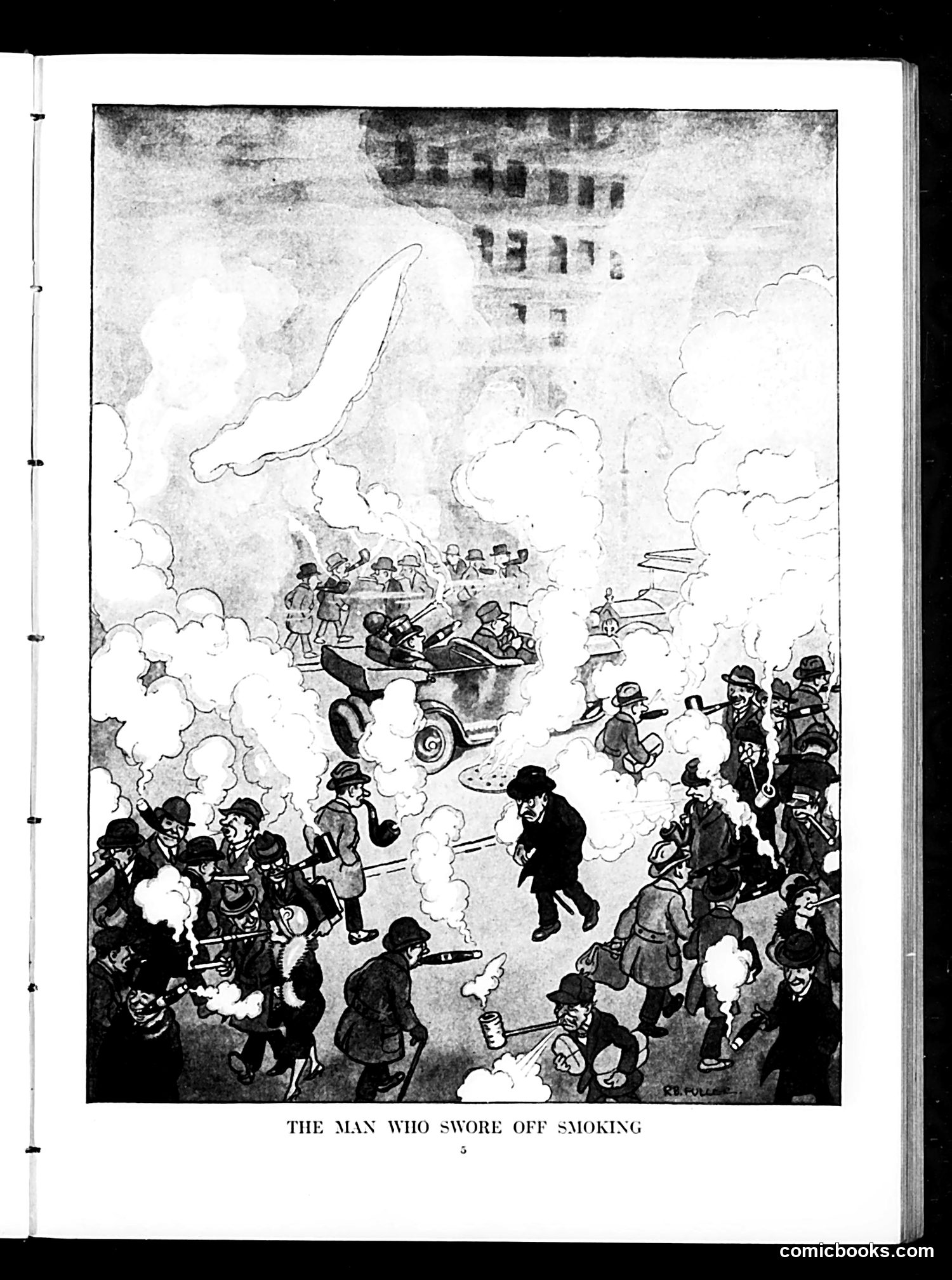
This satirical cartoon depicts a man (center, in dark coat) who has apparently pledged to quit smoking, surrounded by crowds of people actively smoking—clouds of smoke billow everywhere. The cartoon's humor lies in the ironic contrast: despite his vow of abstinence, he's completely surrounded by smoking temptation. The piece satirizes the difficulty of maintaining a personal resolution when social pressure and widespread practice work against it. The crowded scene suggests smoking's ubiquity in early 20th-century American society, making individual abstinence nearly impossible or ridiculous to attempt. The isolated figure struggling against the smoking masses represents the futility of willpower against ingrained social norms.
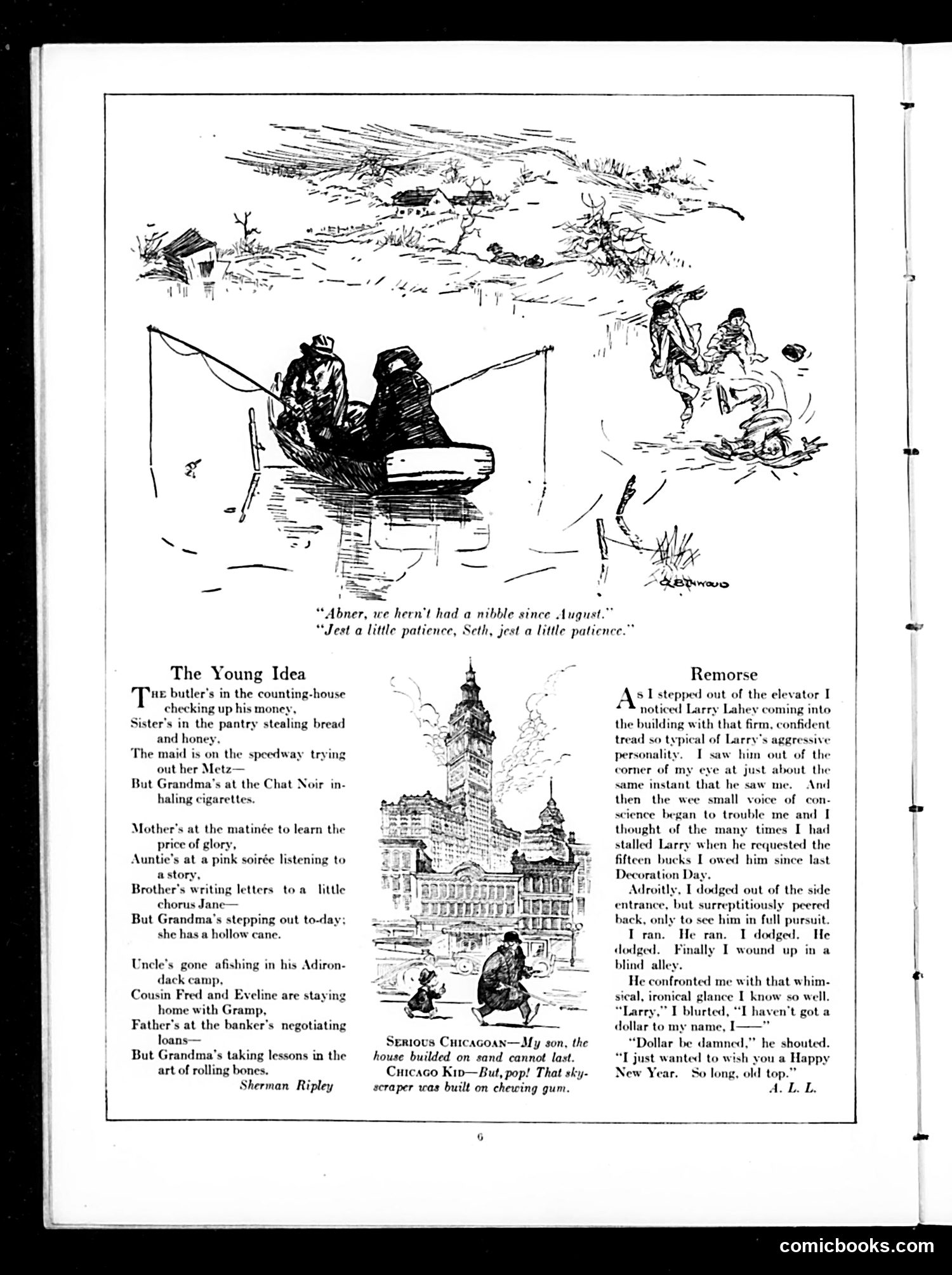
This page contains three pieces of satirical humor typical of early 20th-century American life: **"The Young Idea"** (Sherman Ripley): A poem mocking modern youth and changing social values. It catalogs family members engaged in frivolous activities—butlers checking money, maids driving fast cars, grandmothers smoking at nightclubs and gambling ("rolling bones"). The satire targets society's preoccupation with wealth, speed, and vice replacing traditional family values. **"Serious Chicagoan"**: A brief joke contrasting old wisdom about foundations with modern commercial shortcuts—the skyscraper "built on chewing gum" likely refers to Chicago's rapidly constructed, cheaply-made buildings prioritizing profit over quality. **"Remorse"**: A humorous anecdote about a man who owes a friend fifteen dollars (since Decoration Day) and tries avoiding him. When cornered, Larry dismisses the debt with good humor, wanting only to wish him Happy New Year—satirizing both debt avoidance and masculine honor codes. All reflect turn-of-the-century anxieties about modern morality and commercialism.
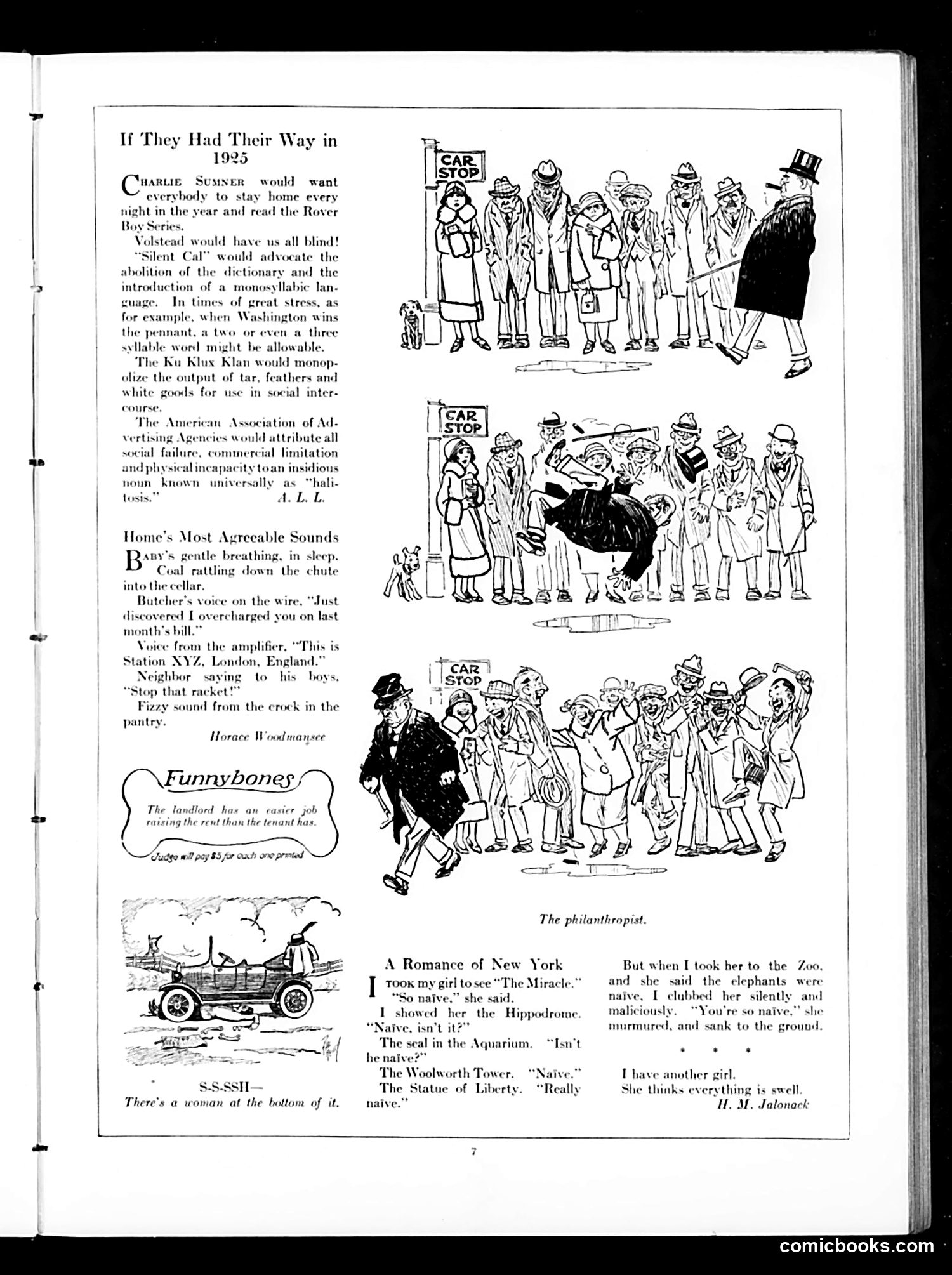
This satirical cartoon mocks various 1920s figures and groups by imagining what society would be like if they had complete control. The targets include: - **Charlie Sumner**: Would restrict people to reading only Rover Boy adventure stories - **"Silent Cal"** (Calvin Coolidge, U.S. President): Would eliminate the dictionary and reduce English to one-syllable words - **The Ku Klux Klan**: Would monopolize tar, feathers, and white goods—referencing their use of these materials for lynching and intimidation - **Advertising agencies**: Would blame all social problems on "halitosis" (bad breath) The three "CAR STOP" panels show increasingly chaotic street scenes illustrating societal breakdown under these scenarios. The page also includes unrelated humor sections: anecdotes about naive girlfriends taken to New York landmarks, and observations about everyday sounds and landlord-tenant relations. These are typical filler content for the magazine.
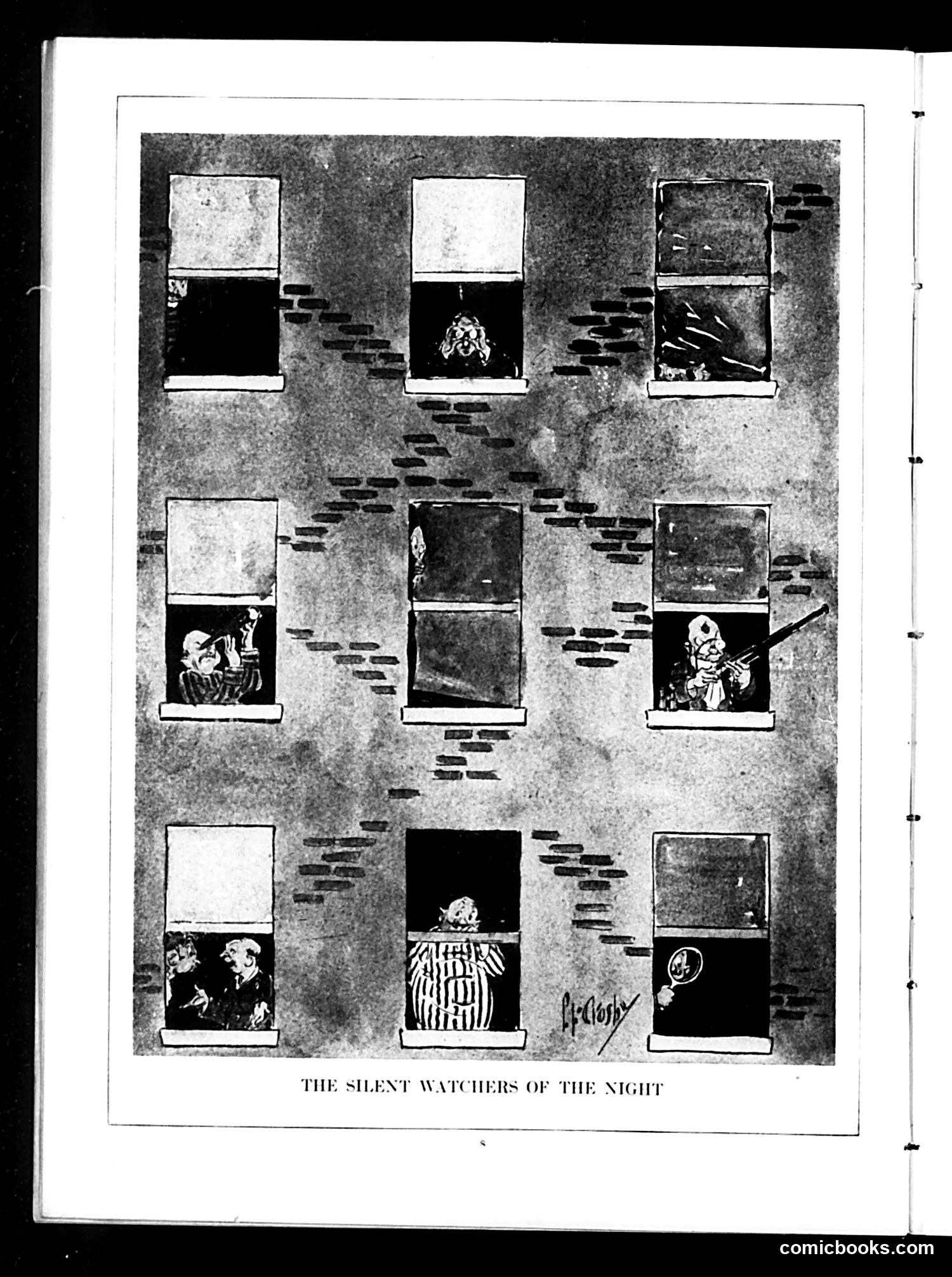
This appears to be a satirical illustration showing multiple apartment windows at night, with various figures visible inside. The title suggests commentary on urban voyeurism or surveillance—people observing each other across the city at night. The windows contain silhouettes and figures engaged in various activities, some appearing suspicious or dramatic in nature. The "silent watchers" likely refers to neighbors observing each other's private lives, or possibly police/authorities monitoring citizens. Without clearer visibility of specific figures or accompanying article text, the exact political/social target remains unclear. However, the composition suggests commentary on either invasion of privacy, urban isolation, or surveillance culture in American city life—themes Judge magazine regularly satirized during the early-to-mid 20th century.
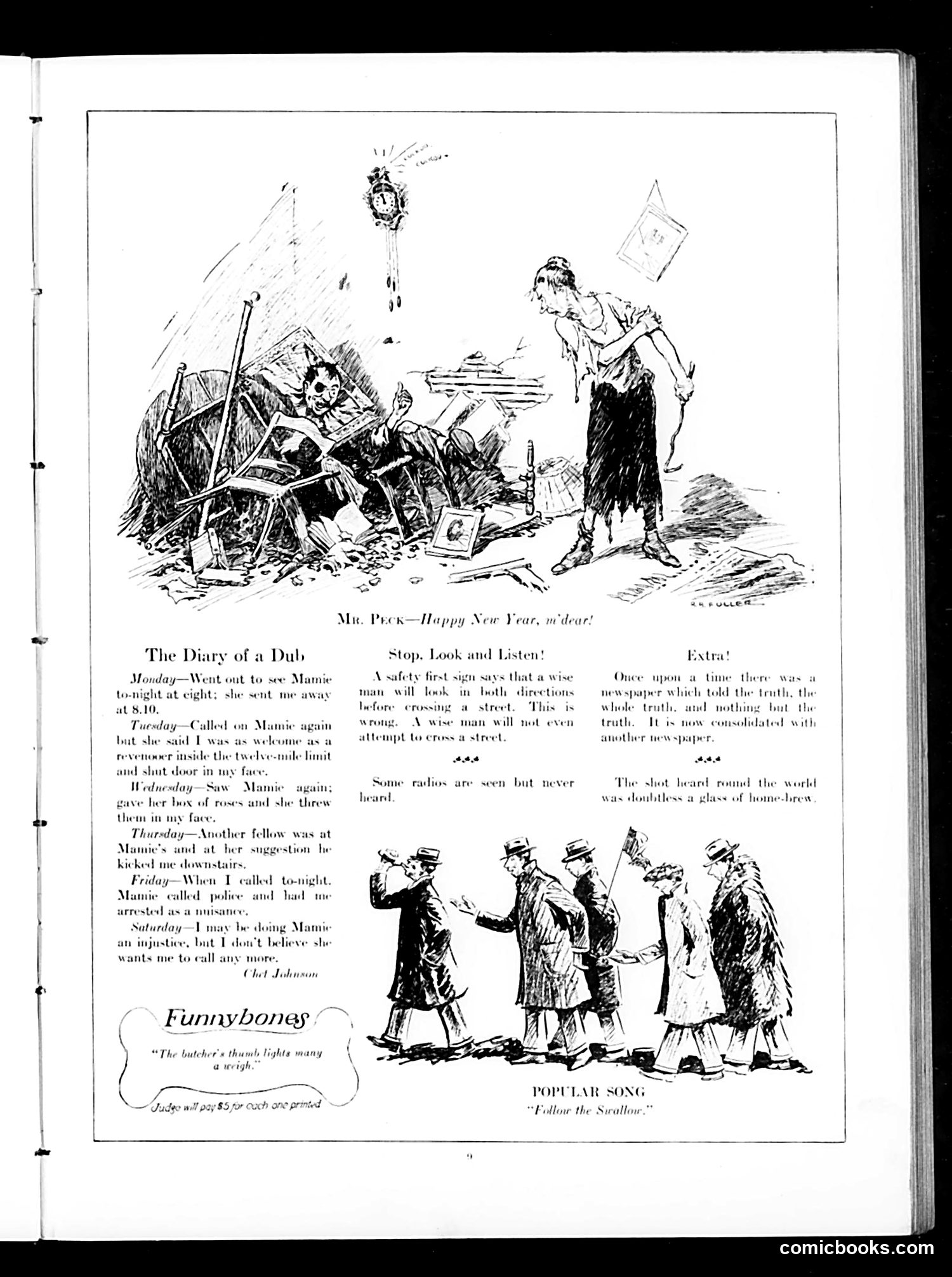
This page from *Judge* magazine contains three separate satirical pieces: **"The Diary of a Dub"** mocks an unsuccessful suitor named Chat Johnson who pursues a woman named Mamie throughout the week, only to be repeatedly rejected—sent away early, shut out, having flowers thrown at him, and kicked downstairs. The joke is that he's a "dub" (a foolish person) who can't take obvious hints to stop. **"Stop, Look and Listen"** offers deadpan observations: a safety warning about street-crossing, a quip that radios exist but produce nothing worth hearing, and a joke about "home-brew" (illegal alcohol during Prohibition) being so potent it could cause global incidents. **"Funnybones"** is a brief pun about a butcher's thumb in the weighing scale—a common joke about dishonest butchers. The top cartoon shows a hobo or poor man amid debris; its caption "Happy New Year, m'dear!" appears to mock desperation. The "Popular Song" reference to "Follow the Swallow" likely alludes to a period song, unclear without more context. Overall, the page emphasizes romantic failure, Prohibition-era humor, and petty urban complaints.
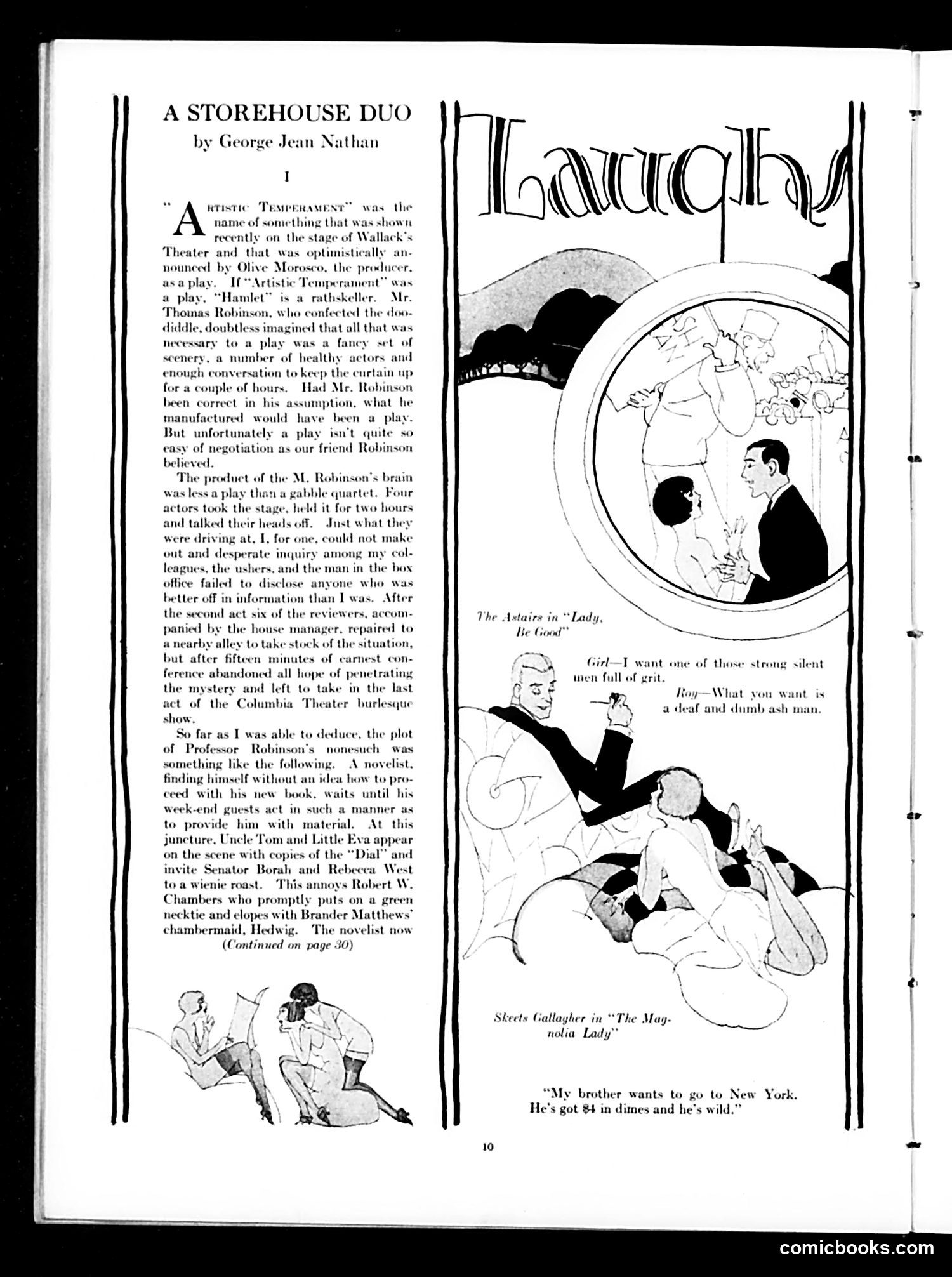
This page contains theater criticism by George Jean Nathan satirizing a play called "Artistic Temperament" at Wallack's Theater, produced by Olive Moroseo. Nathan's target is the play's incoherent plot and dialogue—he describes it as a "gabble quartet" where four actors talk for two hours without clear purpose. He mocks producer Thomas Robinson's assumption that scenery, actors, and conversation alone constitute a play. Nathan ridicules the plot's absurd premise: a novelist gathers weekend guests (including historical/literary figures like Uncle Tom, Senator Borah, and author Robert W. Chambers) to mine material from their behavior, leading to nonsensical outcomes. The accompanying cartoons appear to be separate theatrical humor, including a joke about a woman seeking a "strong silent man" receiving the response that she wants "a deaf and dumb ash man"—crude physical-humor comedy typical of the era. The satire targets pretentious theater production lacking substance.
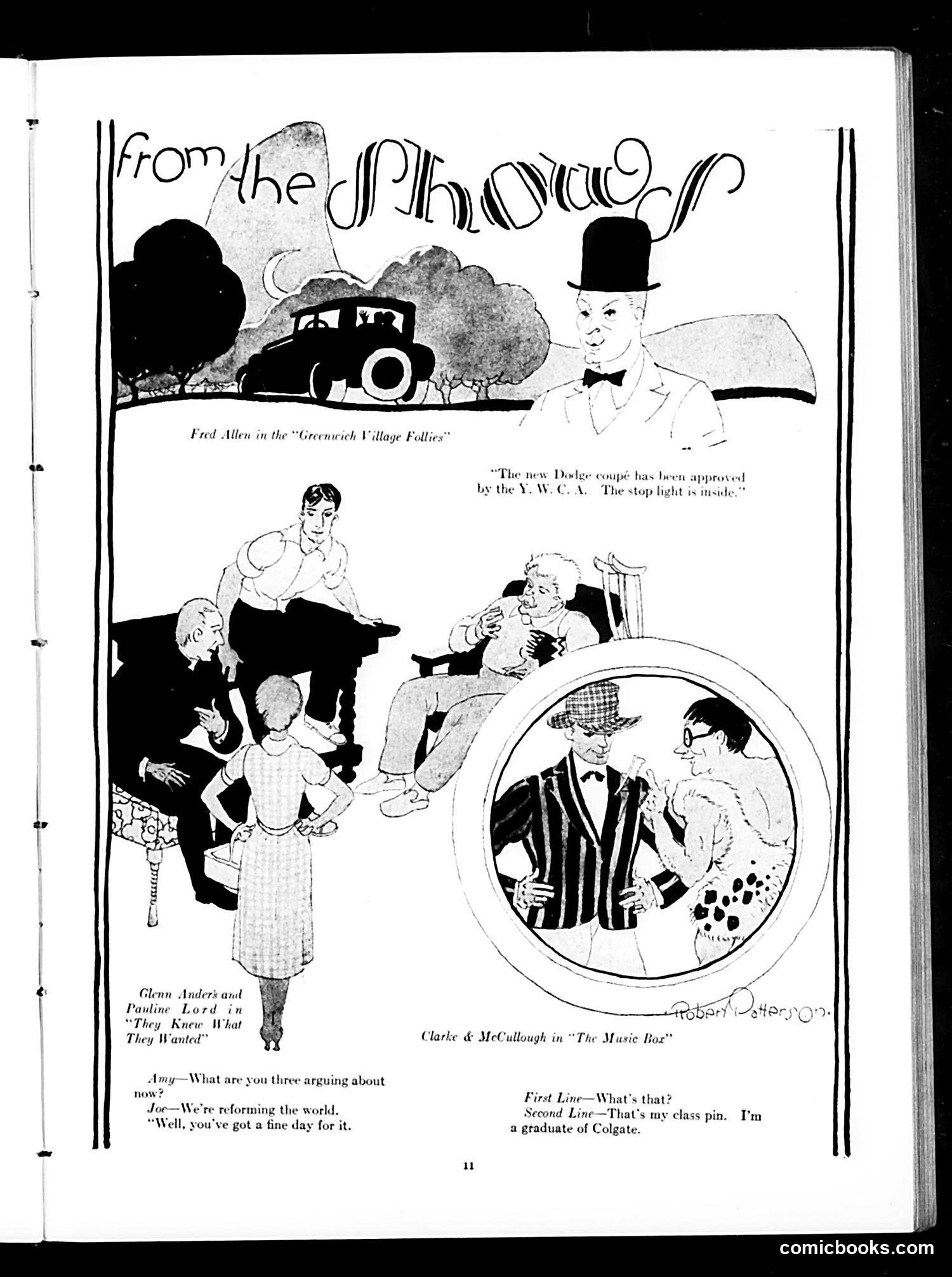
This page from *Judge* magazine features theatrical advertisements and a brief comic sketch. The top showcases Fred Allen in "Greenwich Village Follies" alongside a Dodge automobile advertisement. Below are scenes from two Broadway productions: "They Knew What They Wanted" (starring Glenn Anders and Pauline Lord) and "The Music Box" (with Clarke & McCullough). The main joke concerns three men debating world reform. When asked what they're arguing about, one reveals his argument is merely about a college class pin—specifically that he graduated from Colgate. The humor lies in the deflation of their grandiose claims about "reforming the world" when their actual dispute is petty college rivalry or pride. This satirizes inflated idealism and pretension, likely reflecting post-WWI American social commentary about ambitious rhetoric masking trivial concerns. The Colgate reference suggests collegiate culture was relevant to *Judge*'s readership.
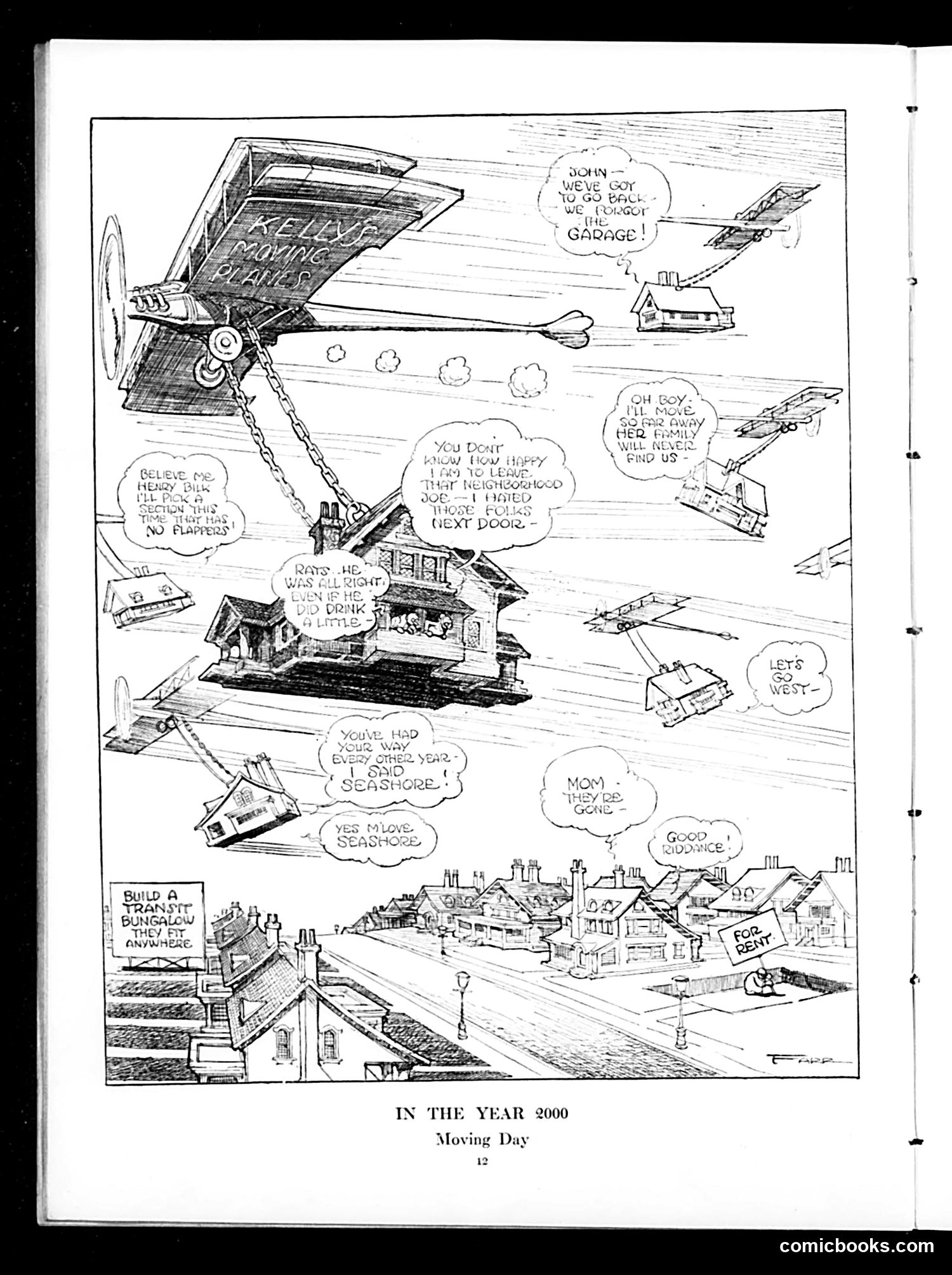
This satirical cartoon depicts a futuristic "Moving Day" in the year 2000, imagining suburban homes as portable structures transported by aircraft. The humor stems from several social anxieties: families are depicted relocating so frequently they've become nomadic, with aircraft hauling entire houses; conversation bubbles reference forgotten items (garage), transient neighborhoods, and rental housing ("For Rent" sign visible). The satire critiques mid-20th century American suburban sprawl, speculative real estate development, and the era's increasing residential mobility and transience. The chaotic scene—with multiple flying houses, disconnected belongings, and uprooted families—mocks contemporary concerns about American rootlessness and the standardized, interchangeable nature of suburban development. The exaggerated futuristic premise amplifies fears about loss of community stability and permanent homes.
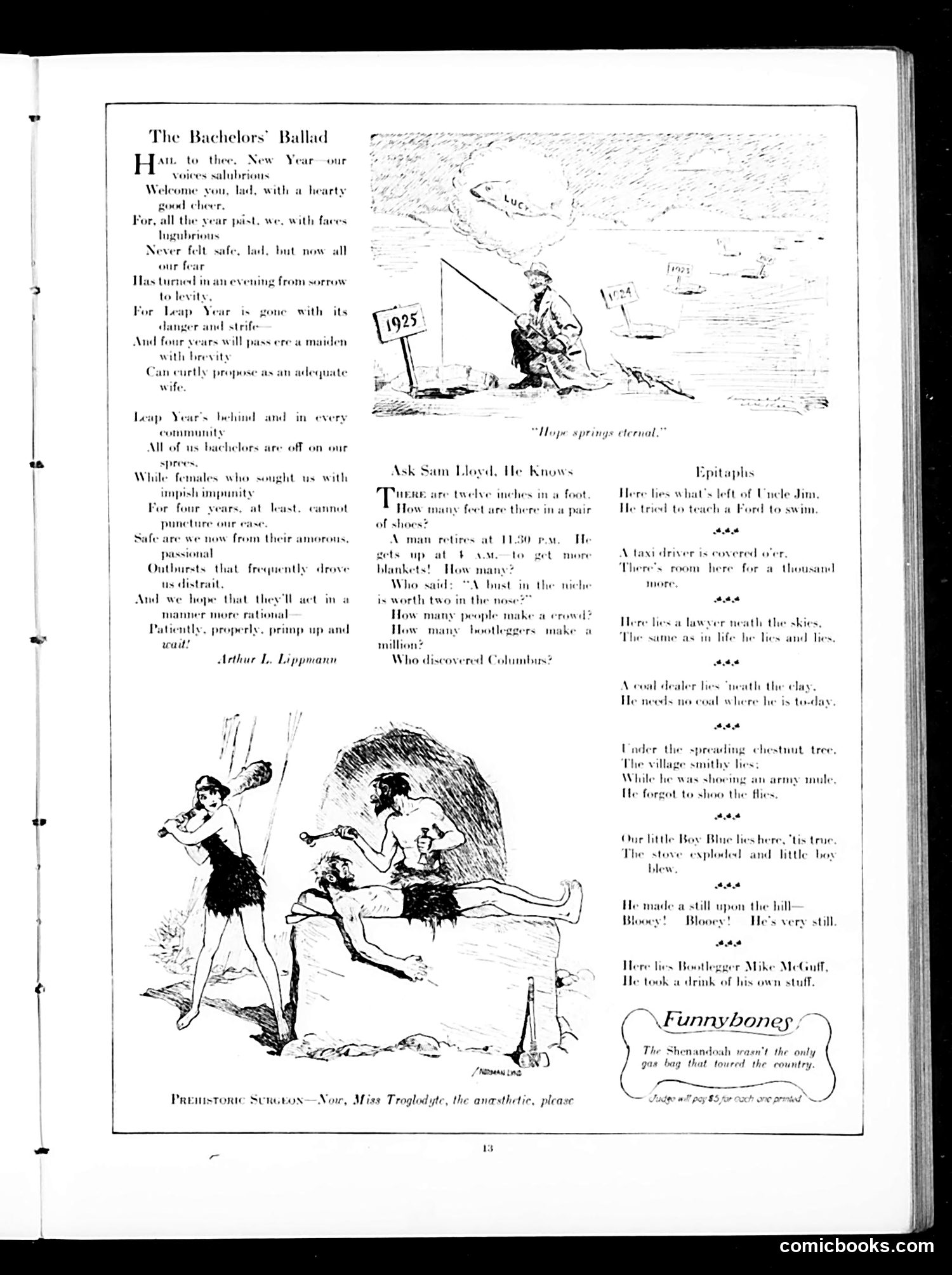
This 1925 page contains New Year's humor centered on **Leap Year** ending. "The Bachelors' Ballad" (by Arthur L. Lippmann) celebrates men's relief that the tradition allowing women to propose has passed—they're "safe" from female romantic pursuit for another four years. The satire mocks both bachelor anxiety about matrimony and the era's gender courtship conventions. The lower section includes puzzle riddles ("Ask Sam Lloyd") and humorous epitaphs—mock tombstones with dark comic twists (a Ford-swimming enthusiast, a bootlegger's still, etc.). The cartoon "Prehistoric Surgeon" depicts cavemen attempting dentistry ("the anaesthetic, please"), a common Judge trope using primitive settings for physical comedy. The "Funnybones" quip references the Shenandoah (an airship that crashed in 1925), a contemporary disaster treated as material for casual jokes—reflecting the magazine's irreverent approach to current events.
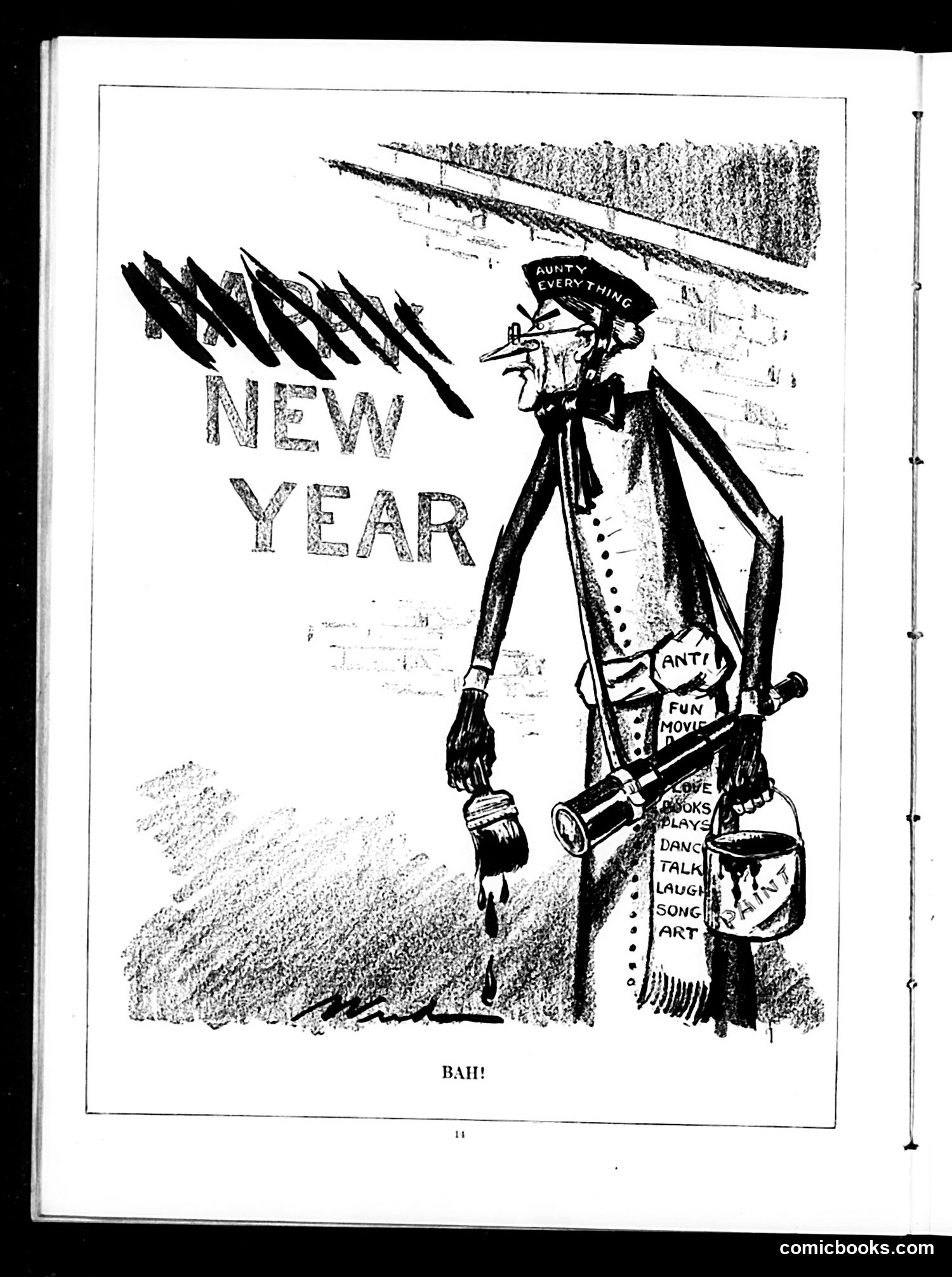
This is a New Year's greeting cartoon featuring an exaggerated character labeled "Aunty Everything" carrying a large bag of entertainment options. The figure represents the coming year's offerings to the public, depicted as an elderly woman with theatrical flair. The bag contains labels for various entertainments: "Anti-Fun Movie," "Love Plays," "Dance," "Talk," "Laugh," "Song," and "Art"—suggesting satirical commentary on what popular culture and entertainment will inflict on audiences in the new year. The phrase "BAH!" at the bottom reinforces cynicism about these offerings. This appears to be Judge magazine's irreverent, dismissive take on theatrical and cultural entertainment trends anticipated for the upcoming year, presented as unwanted gifts forced upon an unwilling public.
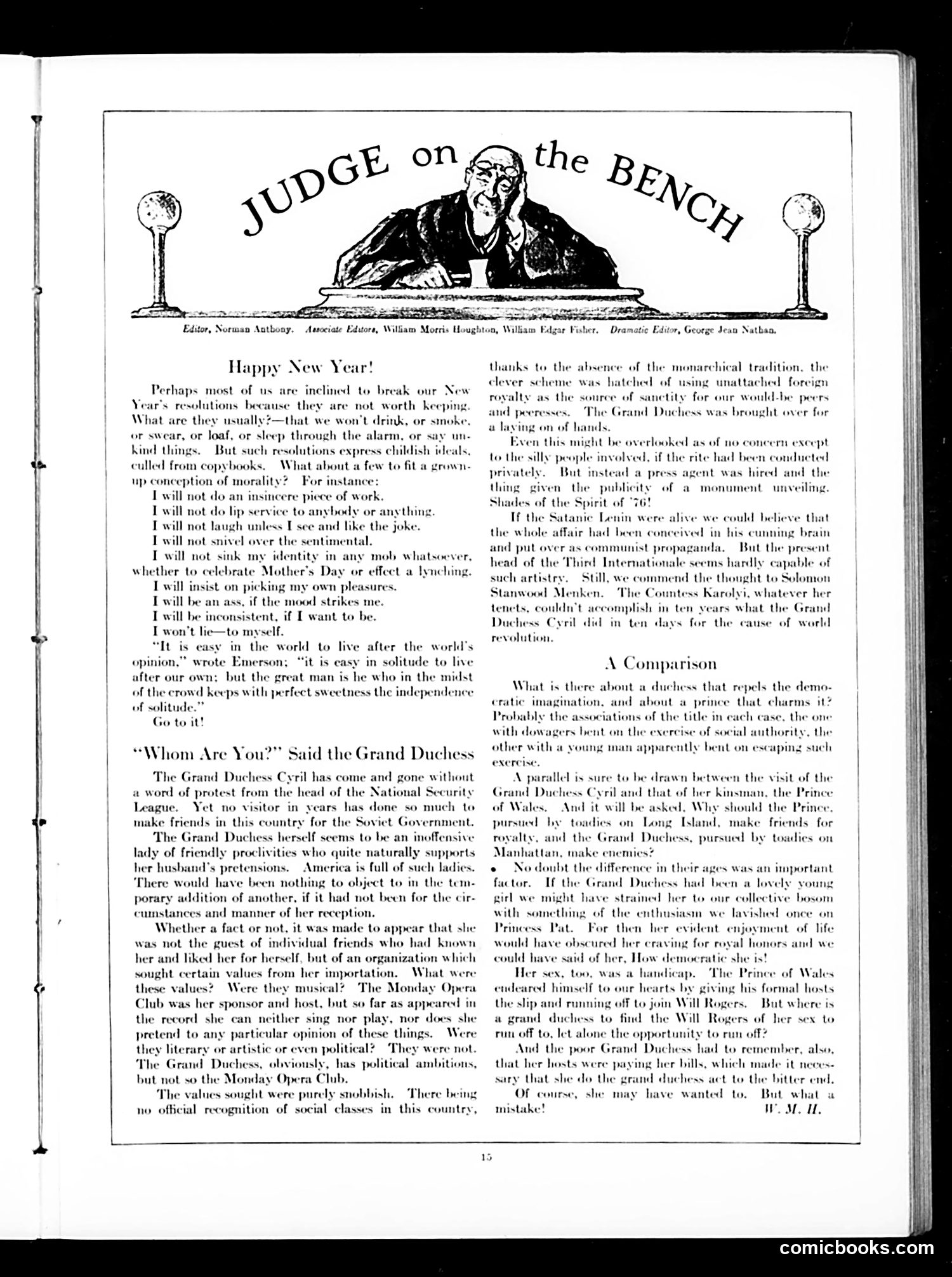
This page satirizes the 1924 American reception of Grand Duchess Cyril, a Russian royal fleeing the Soviet revolution. The cartoon's "Judge" critiques how an elite organization (likely the Monday Opera Club, mentioned in text) orchestrated her visit to enhance their social prestige by associating with Russian nobility. The satire's core: wealthy American "dowagers" sought legitimacy through the Duchess, while she represented outdated aristocratic values incompatible with American democracy. The text mocks this as snobbish—ironic in a country without official class recognition. The piece also jokes darkly that the Duchess inadvertently aided Soviet propaganda better than communist agents could, by dramatizing capitalist elites' desperation to legitimize themselves through foreign titles. A parallel comparison follows: contrasting her visit with the more charming Prince of Wales—suggesting Americans find young, progressive royals appealing, but older women defending aristocratic pretense ridiculous.
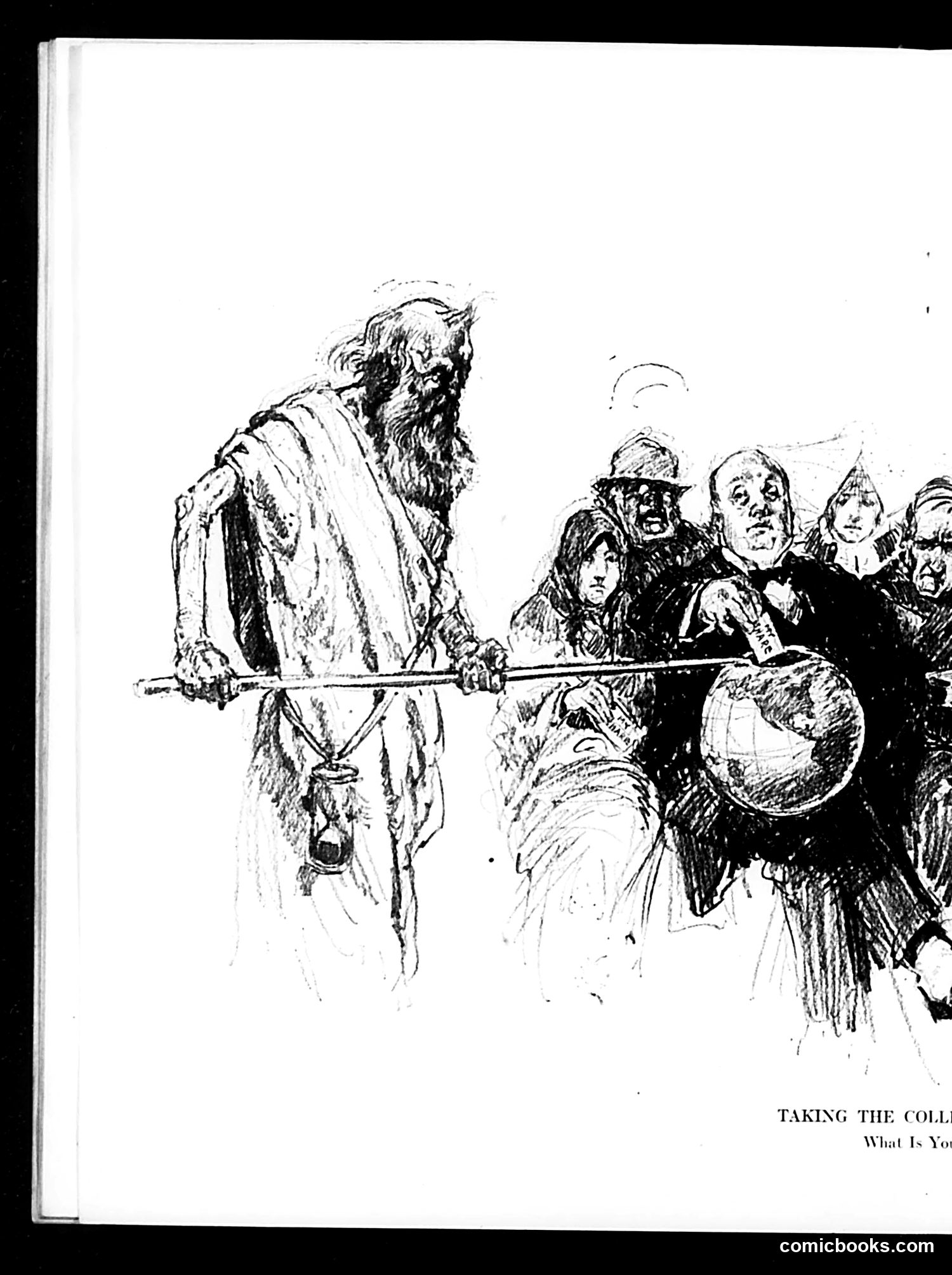
This satirical cartoon depicts a ragged, bearded man (likely representing a beggar, vagrant, or working-class figure) holding a long pole or stick, confronting a group of well-dressed middle and upper-class citizens who appear apprehensive or defensive. The partially visible title "TAKING THE COLL[ECTION]" suggests this illustrates social commentary about wealth redistribution, charitable collections, or class conflict. The contrast between the disheveled figure and the anxious bourgeois group implies satire about either charity demands, wealth inequality, or social unrest. The composition suggests the working-class figure is making some kind of demand or challenge to the established order. Without the complete caption, the specific historical or political reference remains unclear, though it evidently critiques class relations.
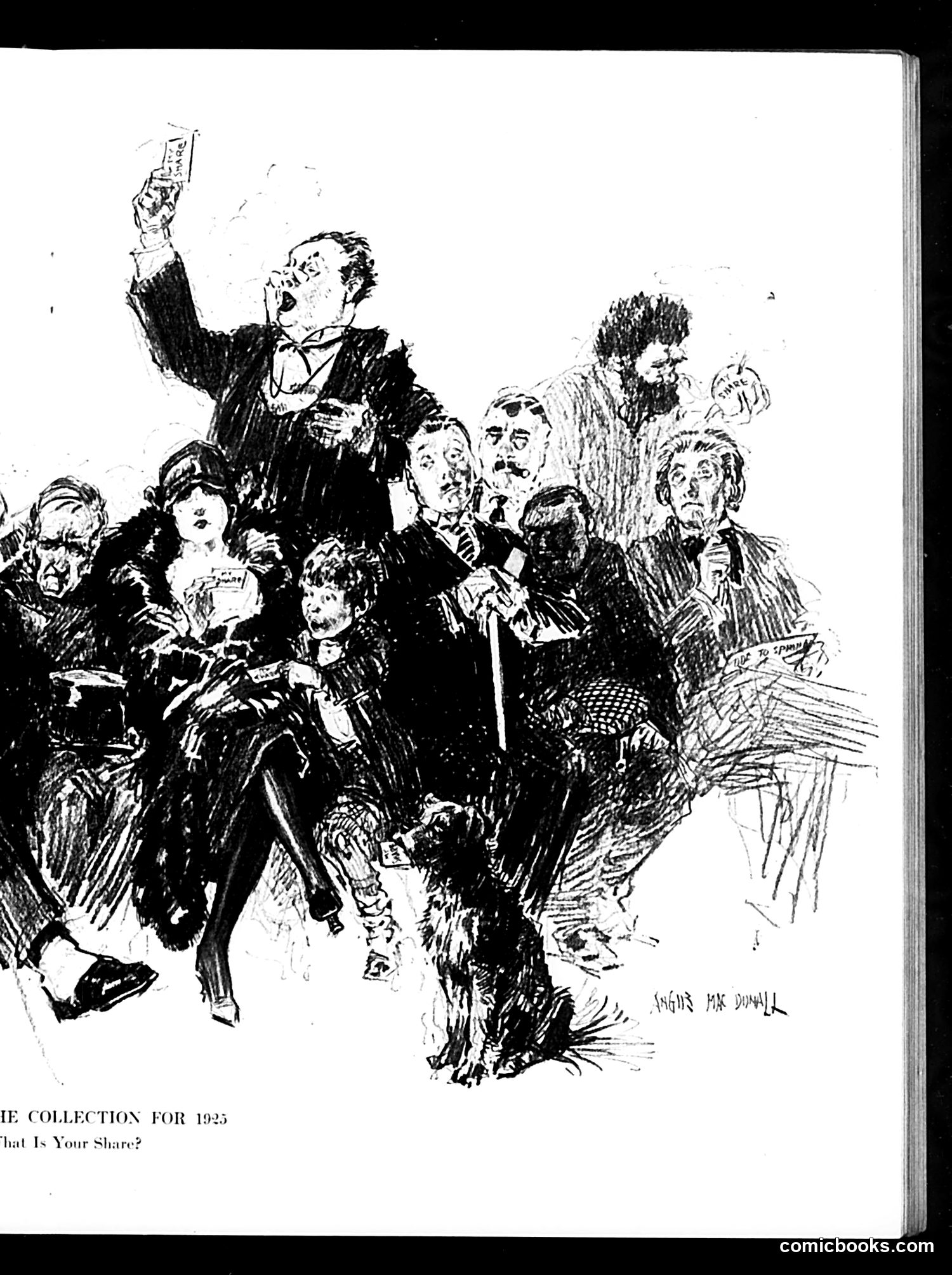
This satirical cartoon depicts a group of wealthy and powerful figures—including what appears to be politicians, industrialists, and military officers (identifiable by uniforms and formal dress)—gathered around a collection plate or fund-raising effort. A man elevated above the crowd holds up money triumphantly. The cartoon critiques wealth inequality and exploitative fund-raising practices of the 1920s, sarcastically asking viewers "What Is Your Share?" The composition suggests ordinary people are being pressured to contribute to collections benefiting the already-wealthy elite. The dog in the foreground may represent the common person, adding to the satirical commentary. This reflects post-WWI American anxieties about economic disparity and who truly benefited from national prosperity during the Jazz Age.
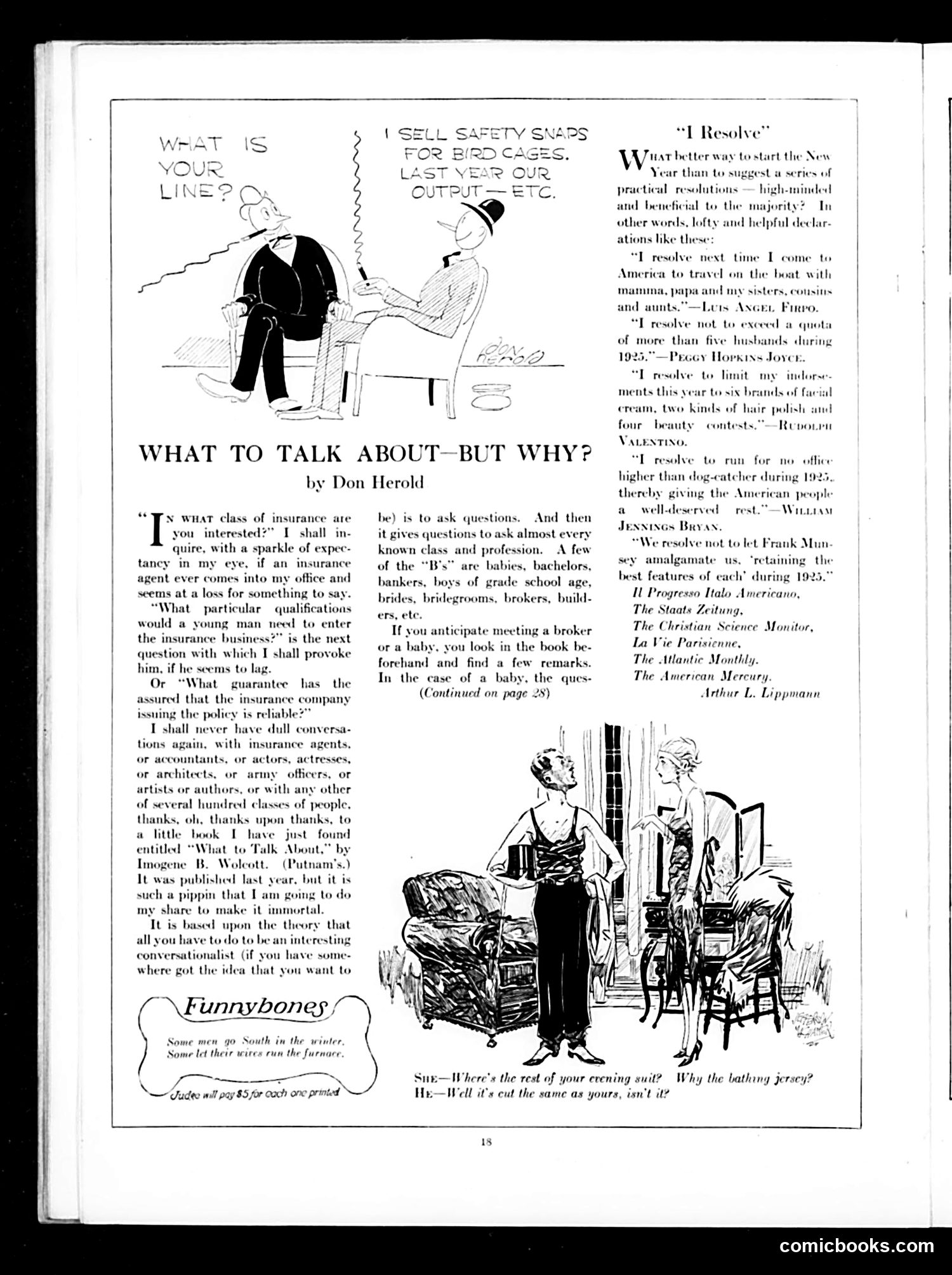
This is a 1925 *Judge* magazine page featuring social satire about conversation and New Year's resolutions. **Main Article**: Don Herold satirizes the book "What to Talk About" by suggesting it enables boring people to artificially generate conversations with professionals (insurance agents, architects, etc.) by asking canned questions—mocking both the book's premise and conversationalists who lack genuine social skills. **"I Resolve" Section**: Humorous fake resolutions attributed to celebrities and public figures of the era (Luis Angel Firpo, William Jennings Bryan, Rudolph Valentino). These mock their real or perceived behaviors—Valentino's endorsement deals, Bryan's political relevance fading, etc. The satire suggests these figures' actual conduct makes earnest resolutions absurd. **Bottom Cartoon**: A couple discusses evening wear; the husband's incomplete suit mirrors the wife's, suggesting they're wearing matching abbreviated clothing—likely a dig at 1920s fashion liberalization and changing gender norms in dress. The page's overall tone satirizes modern American social pretense and celebrity culture.
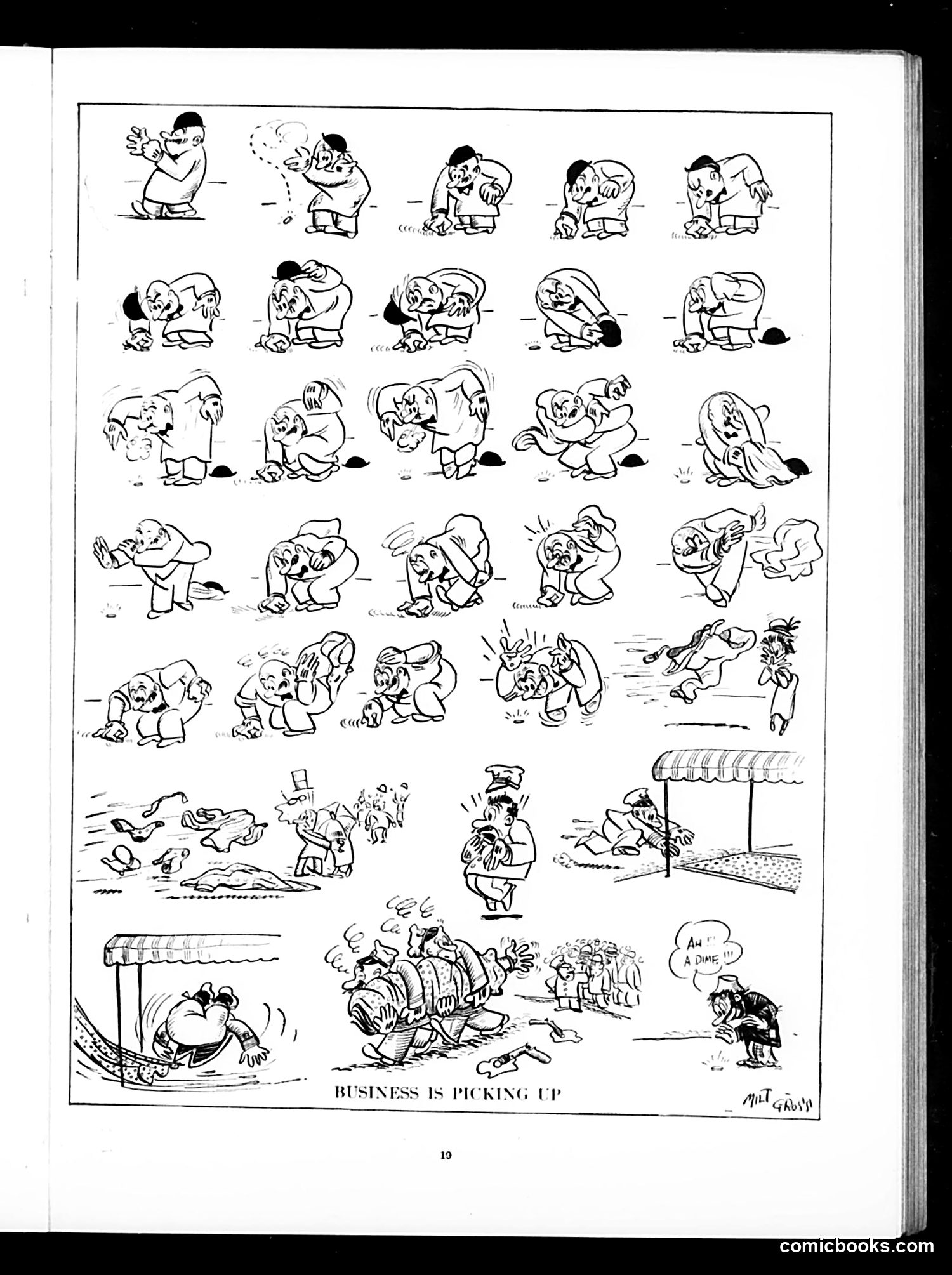
This satirical cartoon by Art Graff depicts economic recovery or increased activity through sequential panels showing a figure gradually becoming more energetic and successful. The title "Business Is Picking Up" is the explicit joke. The narrative progresses from the figure appearing dejected or struggling (top panels) to increasingly active, eventually shown hauling goods, managing workers, and operating a profitable enterprise (bottom panels). The final scenes show bustling commercial activity with crowds and what appears to be successful trade. The cartoon likely comments on American economic conditions, possibly referencing post-recession recovery or improved business conditions during the period Judge published. Without a visible date, the specific economic moment is unclear, but the visual metaphor—"picking up" literally and figuratively—conveys optimism about commercial revival.
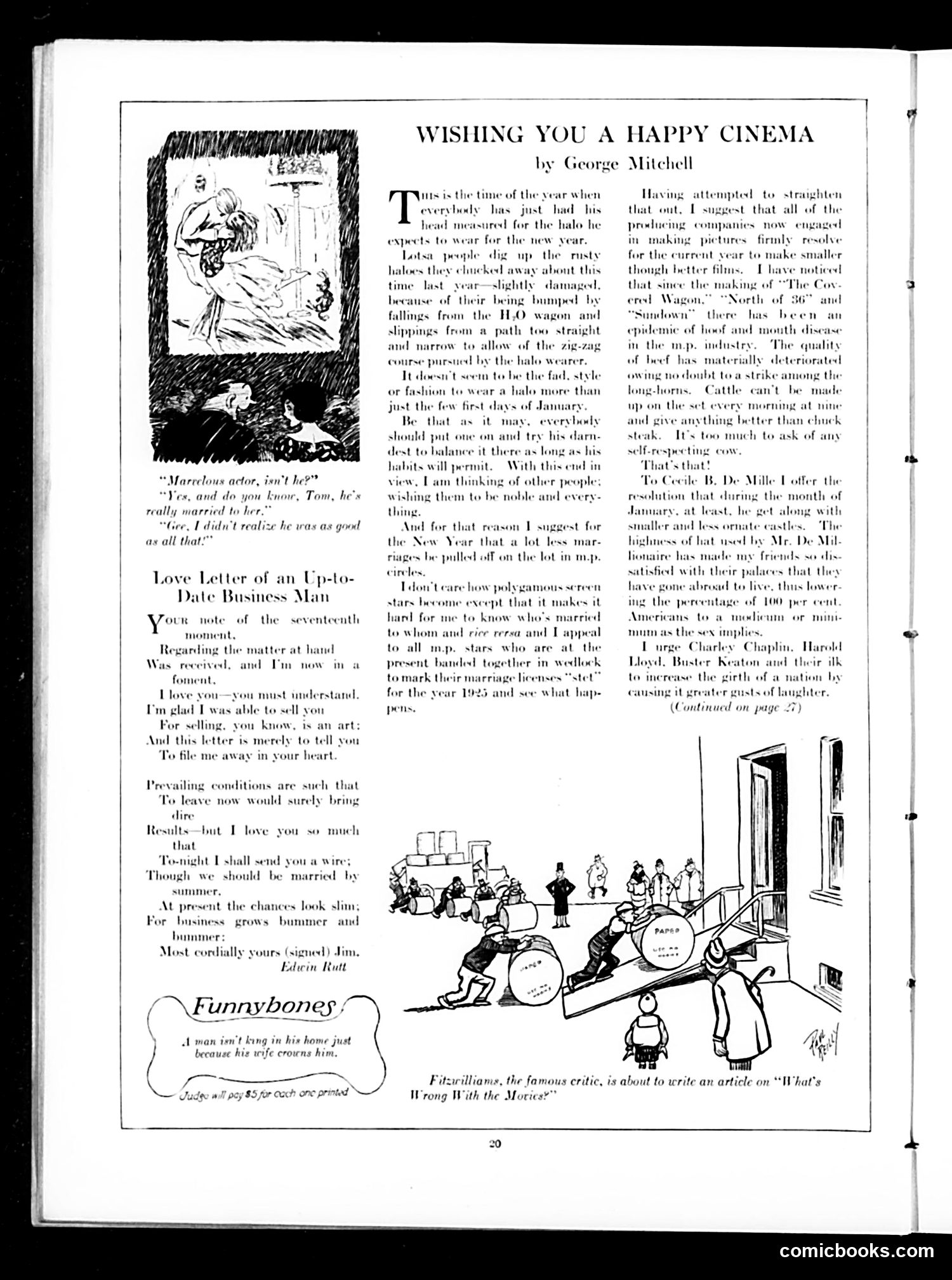
This page from Judge magazine (appears to be 1920s) contains satirical commentary on the film industry by George Mitchell, titled "Wishing You a Happy Cinema." **Main Content:** The article mocks Hollywood trends and personalities: - **Cattle/livestock imagery**: Mitchell criticizes the overuse of livestock in films (referencing "Covered Wagon," "North of 36," "Sundown"), joking that the quality of beef has deteriorated due to a "strike among the long-horns"—satire on both the repetitive Western genre and labor disputes. - **Specific Hollywood figures**: He targets Cecil B. DeMille for excessive castle sets and extravagance, and urges Chaplin, Harold Lloyd, and Buster Keaton to moderate their comedic pratfalls. - **Marriage scandal**: The piece references polygamous relationships among screen stars, suggesting they "set" their marriage licenses for 1925 to clarify who's actually married to whom—likely alluding to Hollywood's notorious marital chaos and multiple divorces/remarriages. **Side Content:** A "love letter" parodies corporate jargon applied romantically; "Funnybones" offers a one-liner joke about wives and authority. The satire targets Hollywood excess, genre fatigue, and moral scandal.
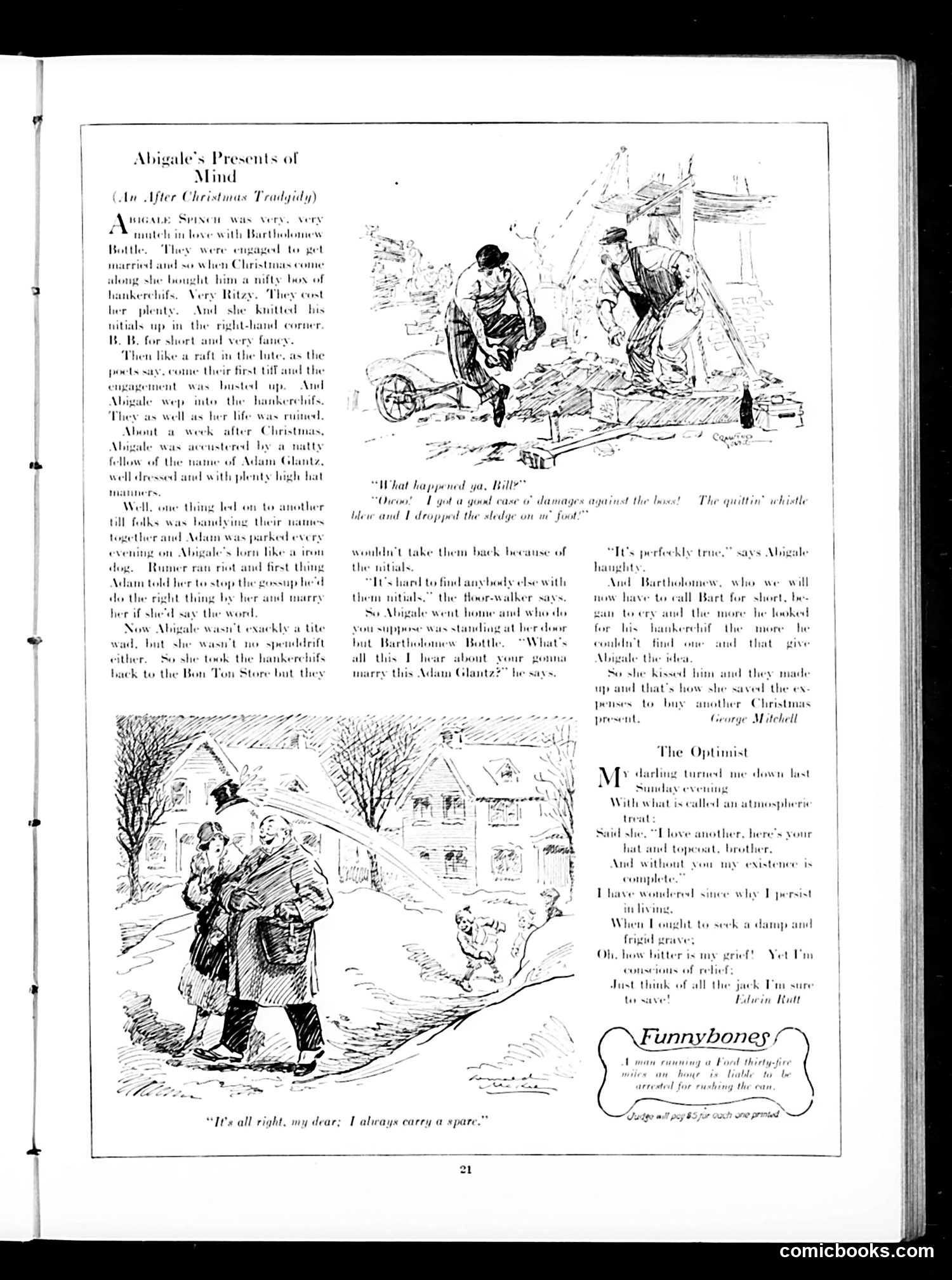
This page contains two humorous stories typical of Judge's satirical approach to everyday life. **"Abigale's Presents of Mind"** is a romantic comedy about a young woman named Abigale Spencer engaged to Bartholomew Bottle. After Christmas, she buys him monogrammed handkerchiefs as a gift. When their engagement breaks off, she attempts to return them—but the store refuses because of the initials. She subsequently begins dating another man (Adam Glantz), which causes Bartholomew to realize his mistake and win her back. The satire targets both romantic fickleness and the impracticality of personalized gifts. **"The Optimist"** is a brief joke about a man rejected by his girlfriend, yet finding silver linings: he won't need to buy her presents, rent a house, or support her existence. Both pieces employ common Judge tropes: sentimental romance undercut by practical cynicism, and wordplay ("Abigale's Presents of Mind" puns on "presence of mind"). The illustrations show period-appropriate clothing and domestic settings. The humor relies on recognizable middle-class courtship conventions of the era.
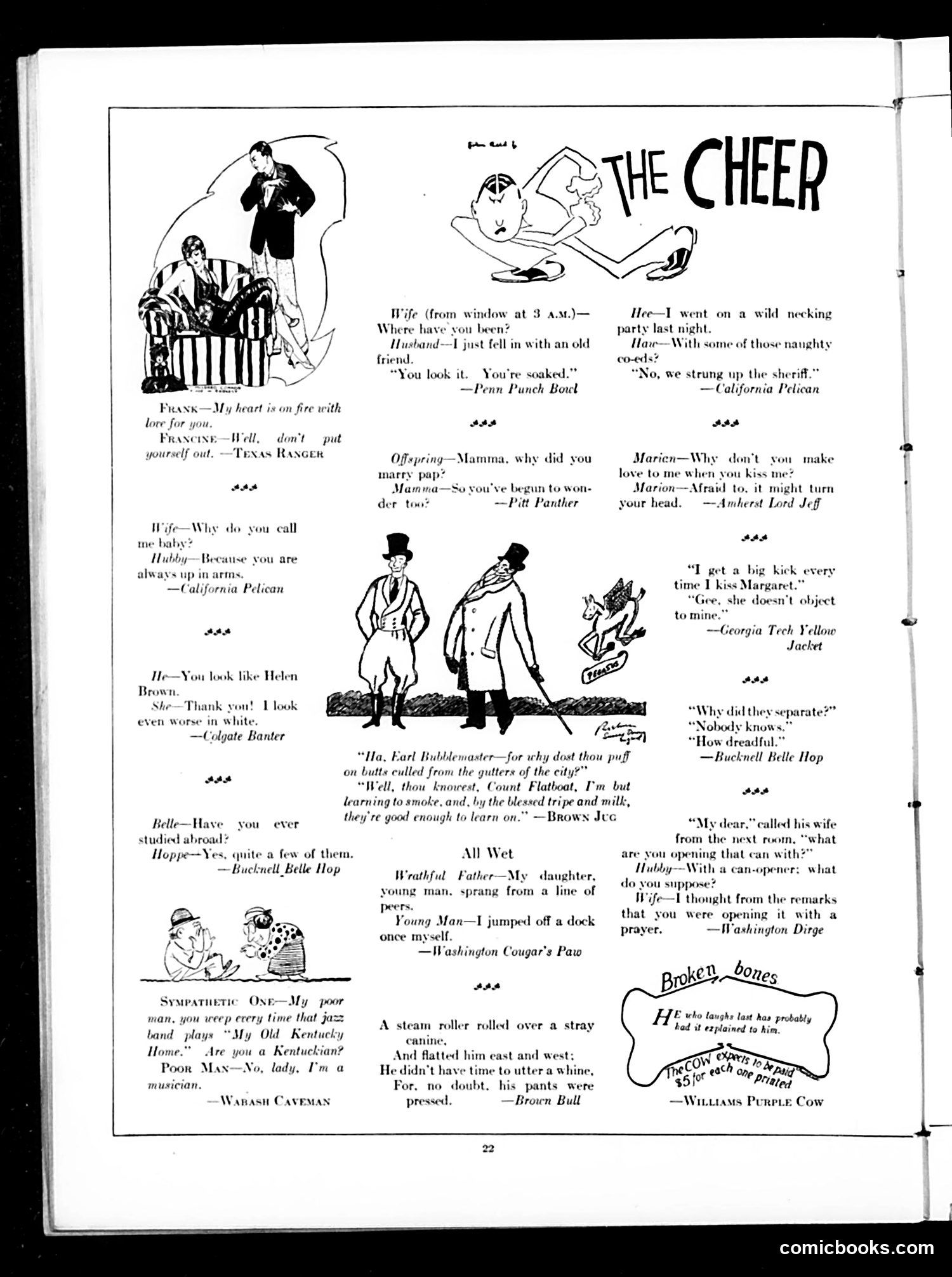
This page collects short jokes and quips from various college humor magazines (Penn Punch Bowl, Texas Ranger, Colgate Banter, etc.), arranged around cartoon illustrations. The humor reflects early 20th-century collegiate and domestic comedy: - **Dating/romance jokes** mock courtship conventions ("Why don't you make love to me when you kiss me?") - **Gender dynamics** play on traditional marriage stereotypes (wives "always up in arms," husbands coming home drunk) - **Class humor** appears in the "Wrathful Father" joke about ancestry - **Prohibition-era references** emerge obliquely (men "strung up the sheriff," smoking butts from gutters) - **"All Wet"** section uses archaic slang The cartoons show gentlemen in top hats and casual domestic scenes. Most jokes rely on puns, double meanings, and mild risqué innuendo acceptable for 1920s-era college publications. The overall tone is lighthearted, non-political satire aimed at young, educated audiences.
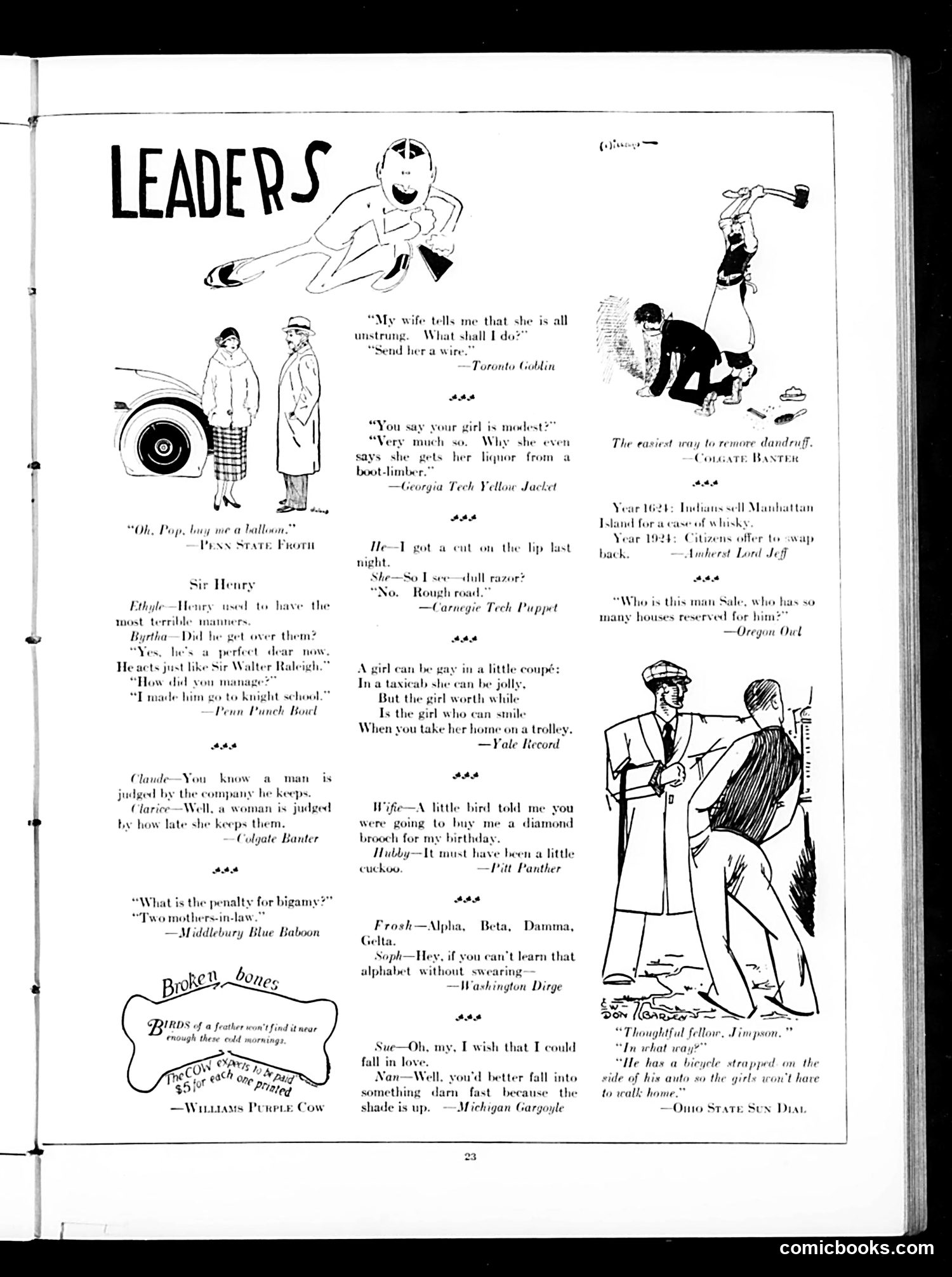
This page collects humorous quotes and jokes from college newspapers and other sources, organized under the heading "Leaders." The content reflects early 20th-century social humor. The satire targets contemporary attitudes about gender and courtship: jokes mock women's drinking habits ("gets her liquor from a boot-legger"), their modesty as deceptive, and dating dynamics (the trolley joke implies modest girls are valuable). One cartoon depicts a barber removing dandruff, captioned as "the easiest way"—a crude visual joke about shaving a bald man's head. Historical references include a 1624 note about Native Americans selling Manhattan Island for whisky, positioning Native Americans as foolish, and a 1924 reference to citizens wanting to "swap back" the island (Amherst Lord Jeff), suggesting buyer's remorse about urban development. The "Broken Bones" section quotes a cow, adding absurdist humor. Overall, the page reflects period attitudes about class, gender, and Native Americans that would be considered offensive today.
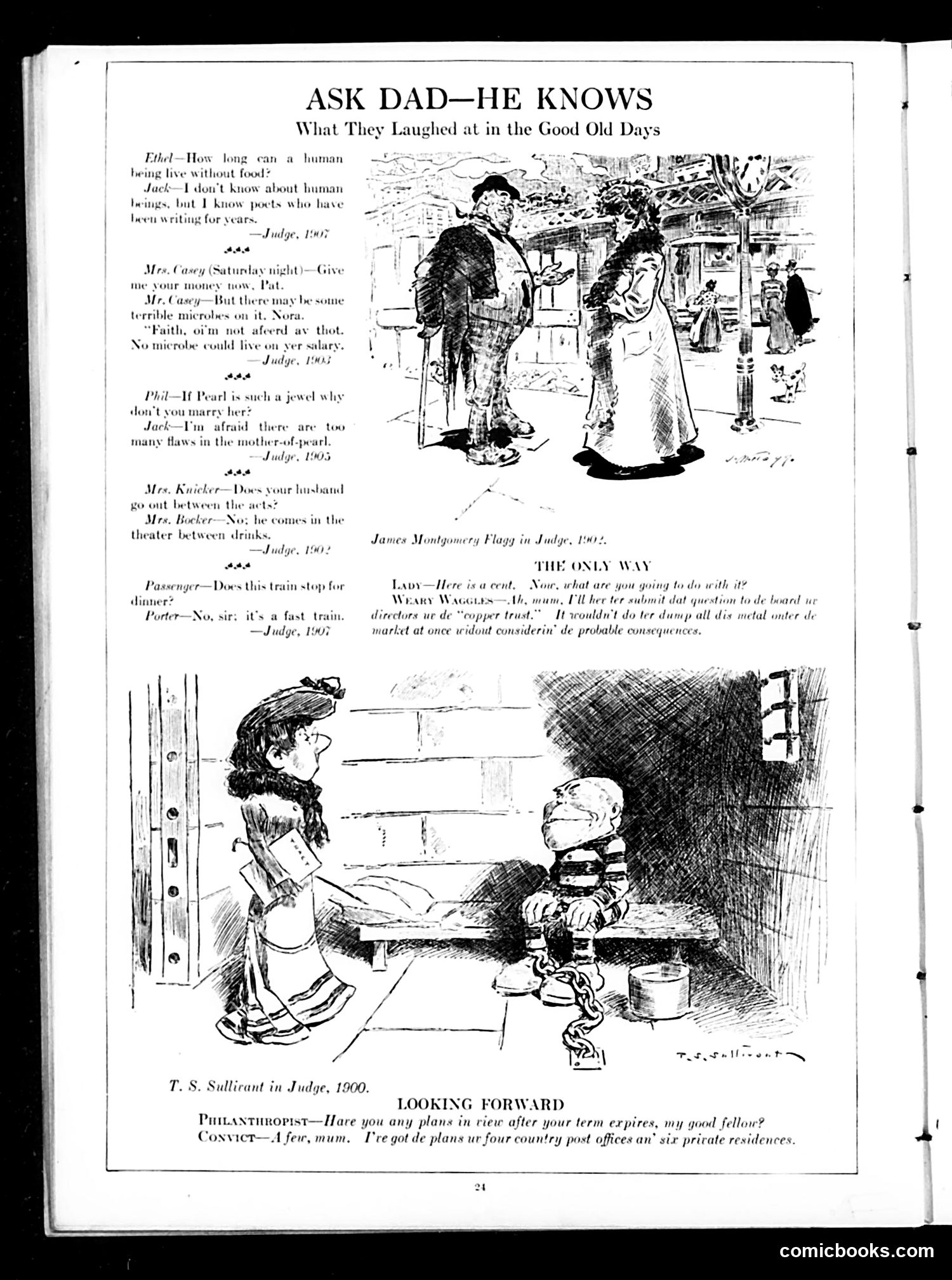
This page collects humorous one-liners and cartoons from Judge's archives, labeled "What They Laughed at in the Good Old Days." The jokes target early 1900s social anxieties: **The text jokes** mock poets' poverty, Irish immigrant stereotypes (Mrs. Casey's salary joke), romantic flaws, and drinking habits. One involves the "copper trust"—a reference to monopolistic business practices—where a vagrant humorously invokes corporate caution about market dumping. **The cartoons** include a T.S. Sullivant illustration showing domestic conflict, and a Flagg drawing satirizing the wealthy ("The Only Way"). The final "Looking Forward" joke darkly suggests a convict plans to commit burglaries and robberies after release. The overall tone reflects Progressive-era concerns: corporate monopolies, class disparities, immigration, and crime. The satire assumes readers recognize these contemporary issues while enjoying period humor that often relies on ethnic caricature and gender dynamics now considered offensive.
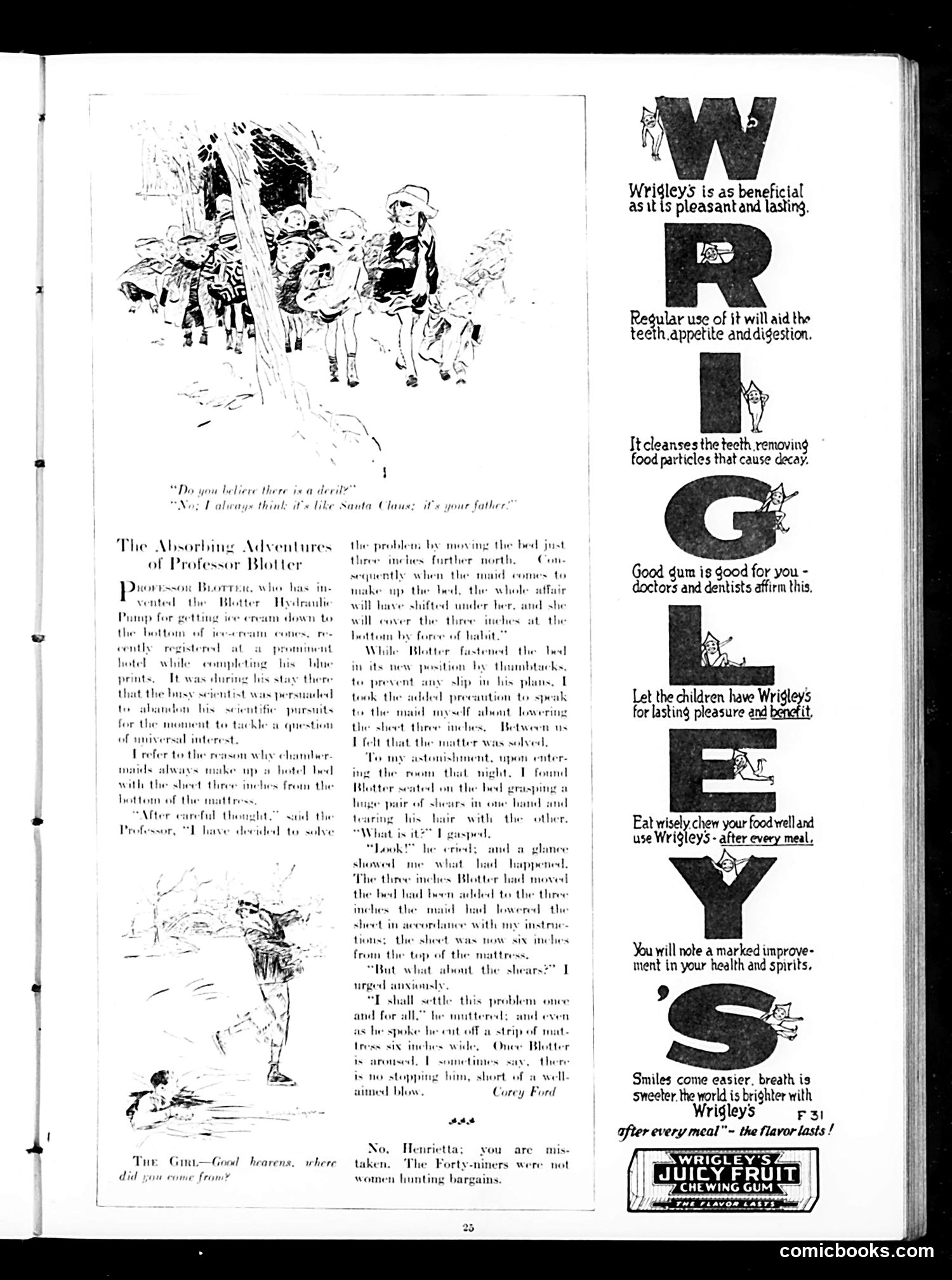
This page contains two distinct elements: **Left side:** "The Absorbing Adventures of Professor Blotter," a humorous story illustrated by Corey Ford. Professor Blotter is a scientist attempting to solve a trivial household mystery: why hotel chambermaid sheets are always three inches short at the bed's bottom. Through absurd experimentation (moving the bed, measuring obsessively), he creates an increasingly ridiculous situation, eventually cutting strips of mattress in frustration. The joke mocks academic over-complication of simple, meaningless problems—a satire on pedantic intellectualism. **Right side:** A Wrigley's Juicy Fruit chewing gum advertisement disguised as health advice, using large decorative letters spelling "WRIGLEY'S." It claims gum aids teeth, appetite, digestion, and overall health—typical early-20th-century advertising that made dubious medical claims before such regulation existed. The cheerful illustrations reinforce marketing messaging to children and families. The contrast between satire (left) and earnest advertising (right) is typical of *Judge* magazine's mixed editorial/commercial format.
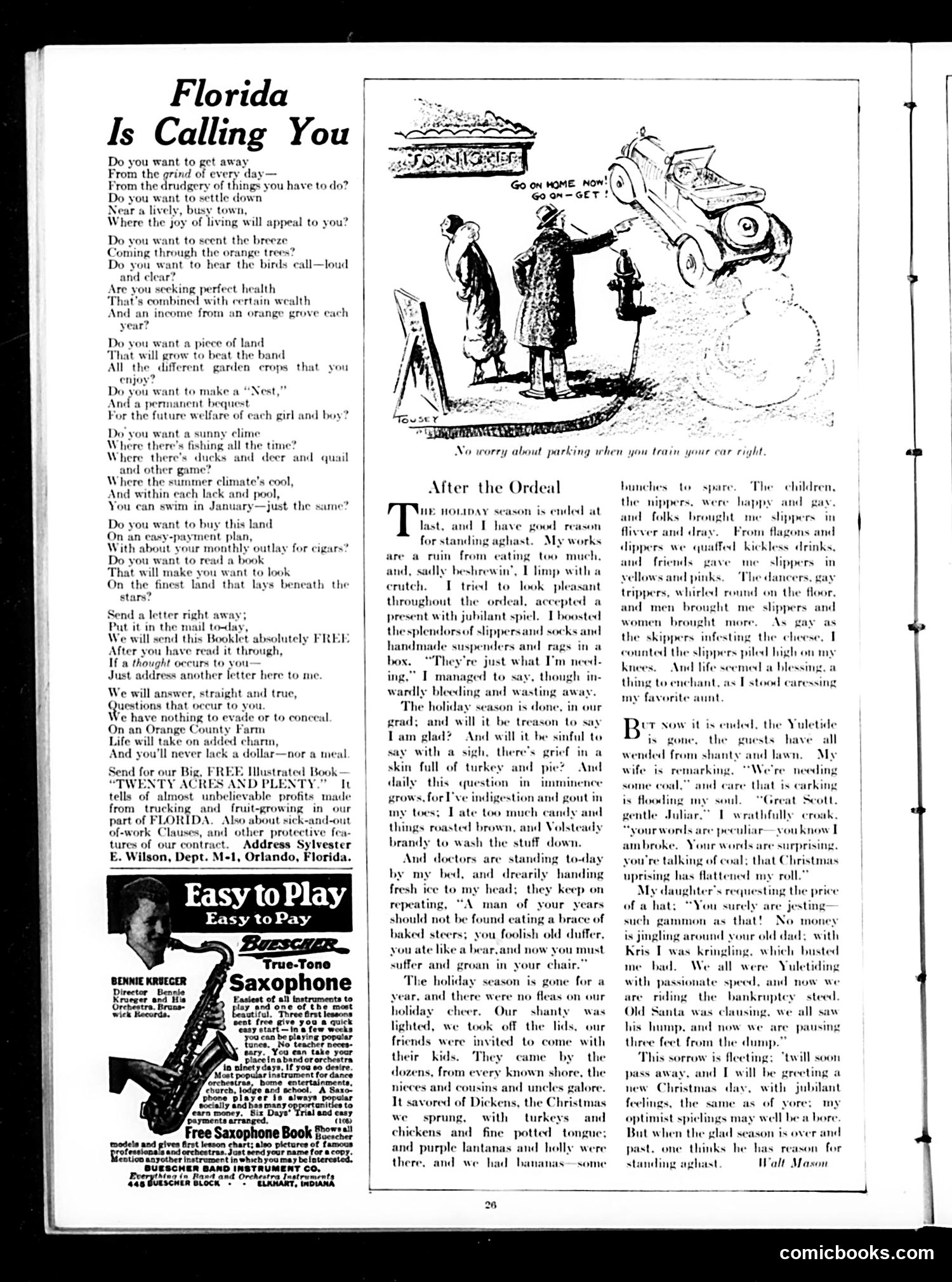
This page contains **two distinct elements**: a prominent Florida real-estate advertisement and two unrelated articles/cartoons. **The "Florida Is Calling You" ad** is a classic early-20th-century land-promotion scheme targeting weary northerners. It uses rhetorical questions to paint an idealized vision—orange groves, hunting, perfect health, easy payment plans—promising prosperity and leisure. The satirical cartoon above it ("No worry about parking when you train your car right") gently mocks automobile enthusiasts, suggesting they need training to park properly. **"After the Ordeal"** is a humorous essay about post-holiday exhaustion. The narrator, worn out from Christmas festivities and overeating (turkey, candy, brandy), receives mountains of unwanted slippers as gifts. Doctors warn him about his gluttony and gout. The joke depends on the reader recognizing Victorian-era Christmas excess and the absurdity of receiving identical impractical gifts. The **saxophone advertisement** promotes musical instruction as a leisure pursuit. Together, these pieces represent Judge's mixture of satirical advertising critique, domestic humor, and lifestyle promotions typical of early American magazines.
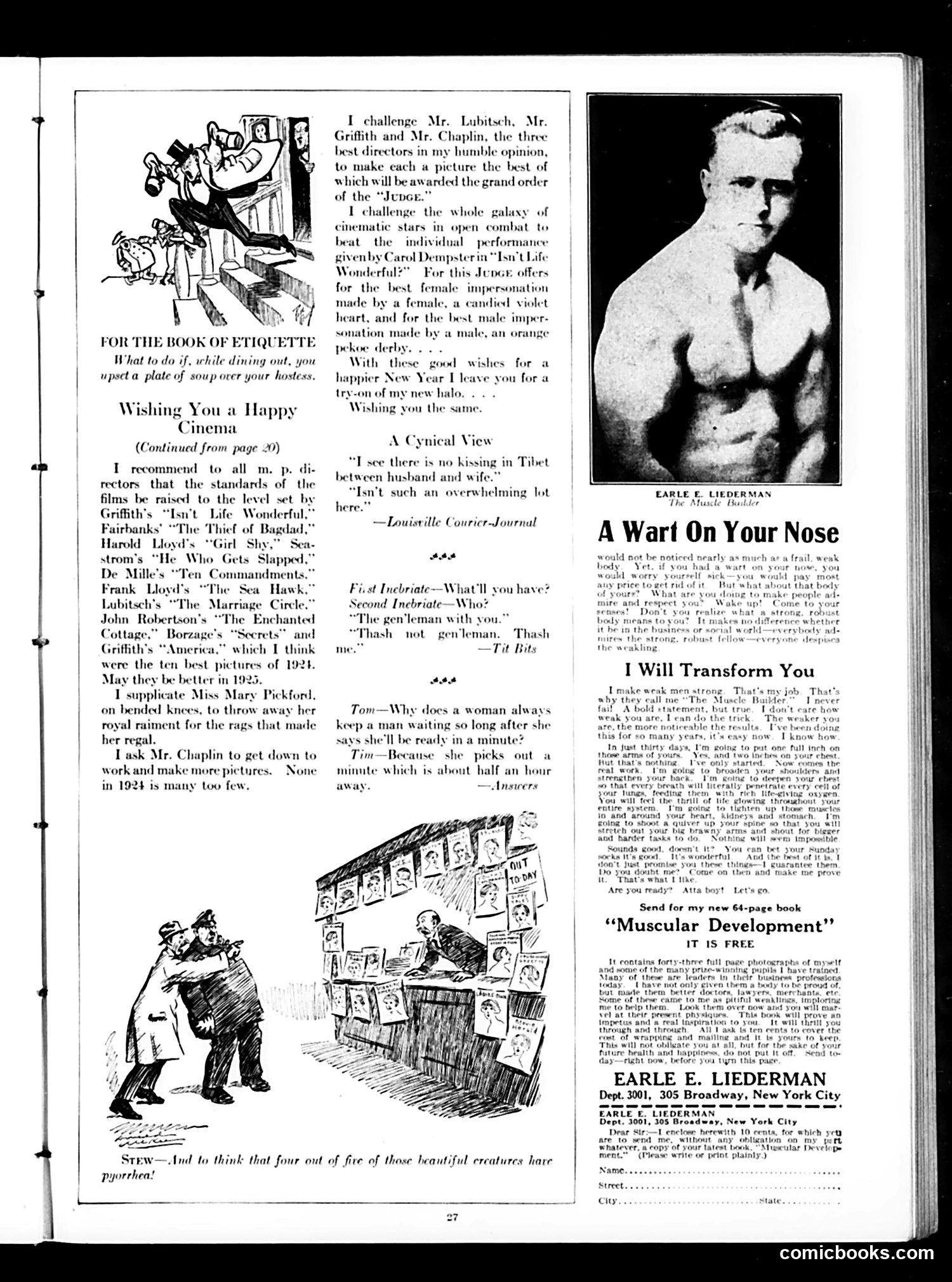
This page contains multiple distinct sections rather than a unified cartoon: **Main Content:** The left side features a film criticism column recommending 1924 cinema, praising directors Lubitsch, Griffith, and Chaplin, and urging Mary Pickford and Chaplin to make more pictures. It includes humorous "etiquette" advice about spilling soup on a hostess. **Cartoons:** Two small comic vignettes appear: 1. A drunk dialogue about a "gentleman" (the drunk himself) 2. A joke about women's timekeeping **Advertisements:** The right side is dominated by ads for Earle E. Liederman's "Muscular Development" book and wart removal treatment—typical early-20th-century self-improvement marketing, featuring a shirtless physique photo. **Historical Context:** This reflects 1920s consumer culture blending entertainment criticism with mail-order body-building and medical product advertisements. The film references indicate this is likely from late 1924 or early 1925.
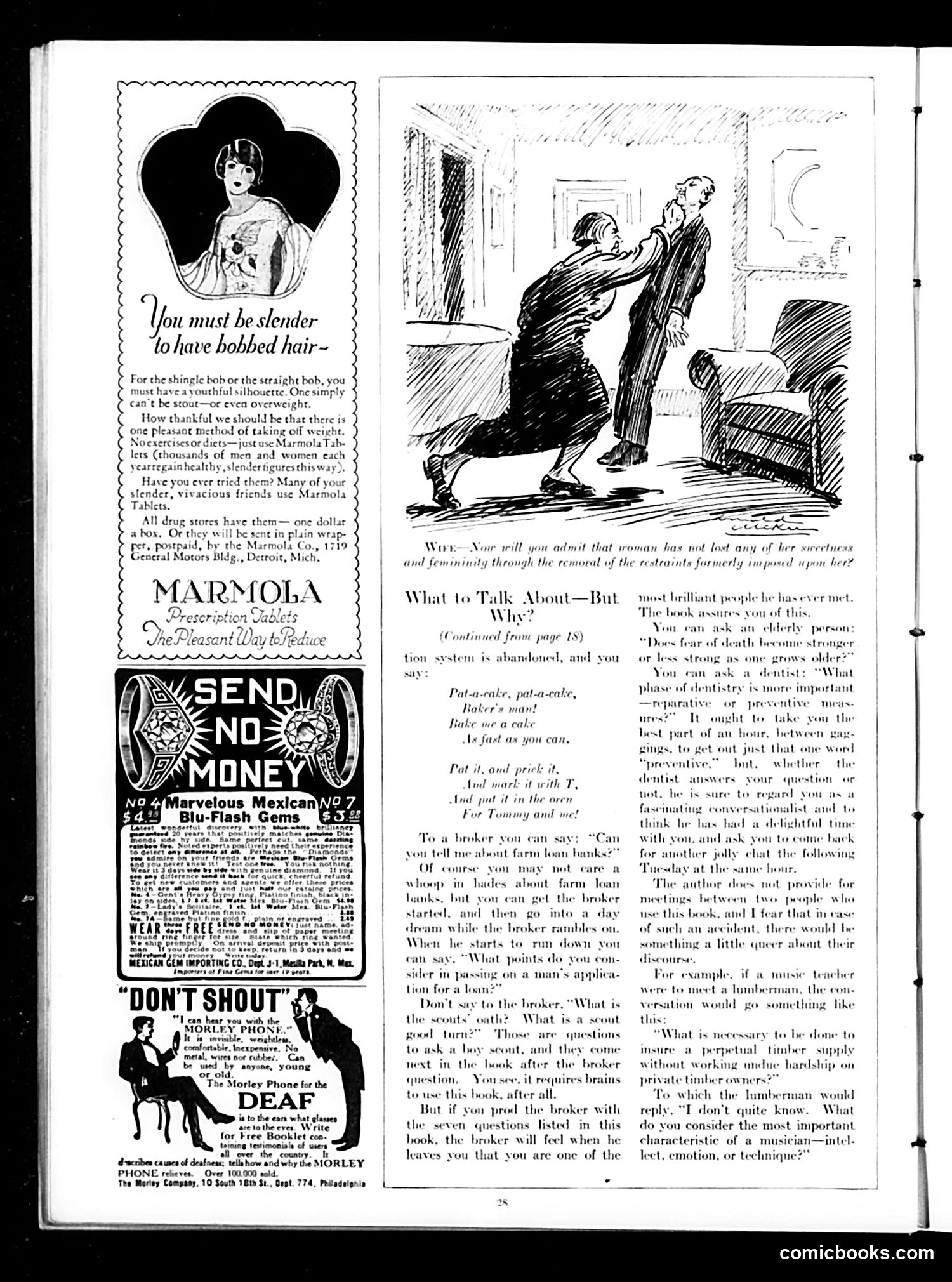
This page mixes advertising with satirical content typical of 1920s Judge magazine. **The Main Cartoon** (right side): Depicts a woman aggressively flirting with a man, with the caption about women retaining "sweetness and femininity" despite removed social restraints. This satirizes the "New Woman" of the 1920s—the flapper era—mocking anxieties about women's increased freedom (voting rights, bobbed hair, looser clothing) and whether they'd abandoned traditional femininity. The exaggerated physical comedy suggests male anxiety about shifting gender roles. **The Advertisements** reflect period obsessions: Marmola diet pills (connecting the "bobbed hair" trend to being slender), the Morley hearing device, and gems—targeting readers' insecurities. **"What to Talk About" Article**: Offers conversational tips, somewhat facetiously, suggesting awkward middle-class social anxiety about appropriate discussion topics with various professions. The overall effect lampoons both modern women's liberation and male discomfort with social change.
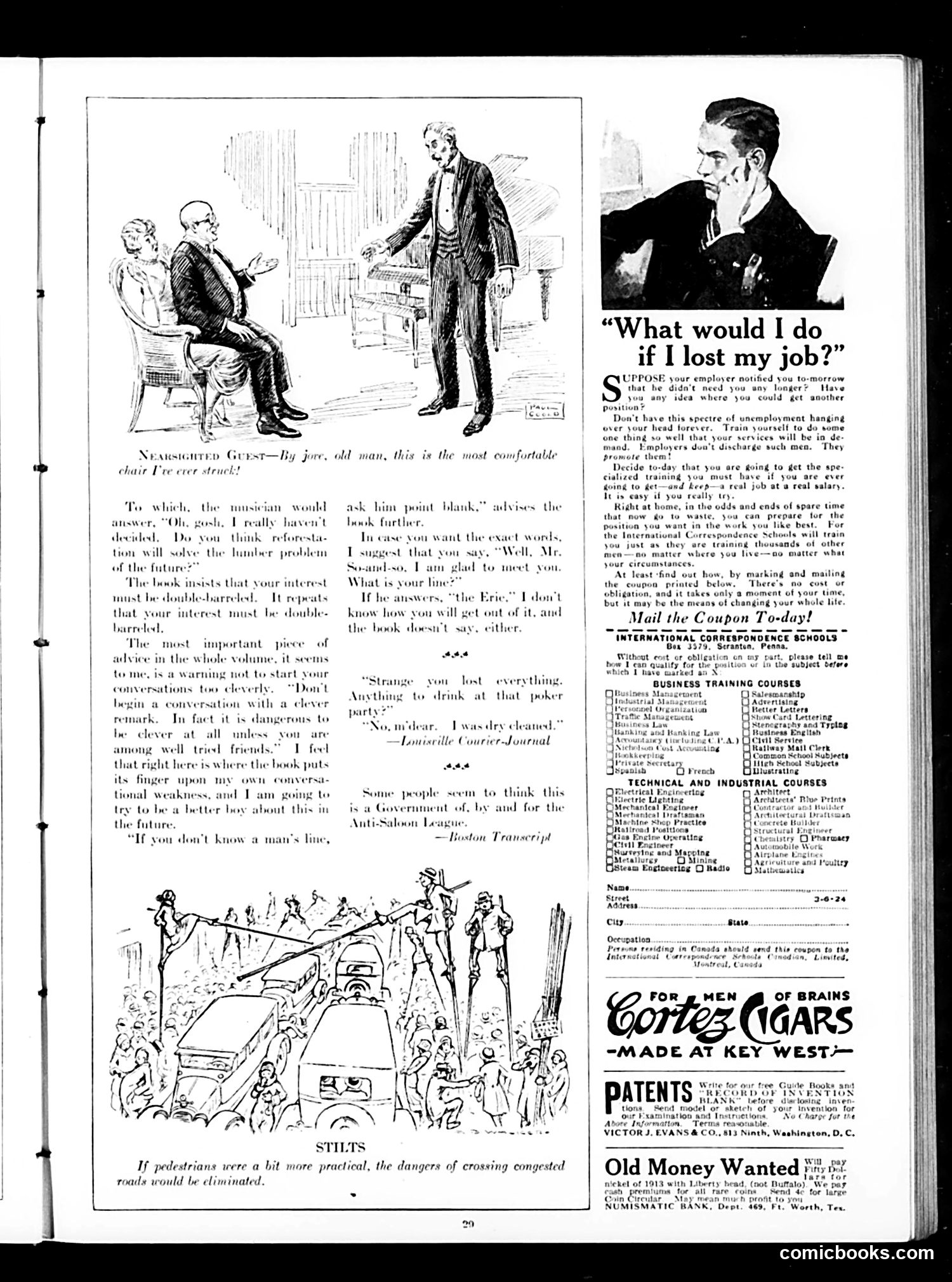
This page contains three distinct cartoons and advertisements from an American satirical magazine. **Top cartoon** depicts a social etiquette lesson: a musician advises two men on conversation skills, warning against being too clever or discussing one's own interests. The satire mocks overly-formal social rules and the pretentiousness of advice literature popular in the early 20th century. **Middle cartoon** labeled "Stilts" uses an illustration of pedestrians precariously balanced on stilts amid traffic to satirize poor pedestrian safety practices. It's a visual pun suggesting that if people were more cautious crossing congested roads, accidents would decrease. **Right side** contains a substantial advertisement for International Correspondence Schools, promoting vocational training with the tagline "What would I do if I lost my job?" This reflects Depression-era anxieties about employment security. The page also advertises Cortez cigars ("for men of brains"), patent services, and a numismatic bank seeking old currency—typical period advertising alongside the editorial content.
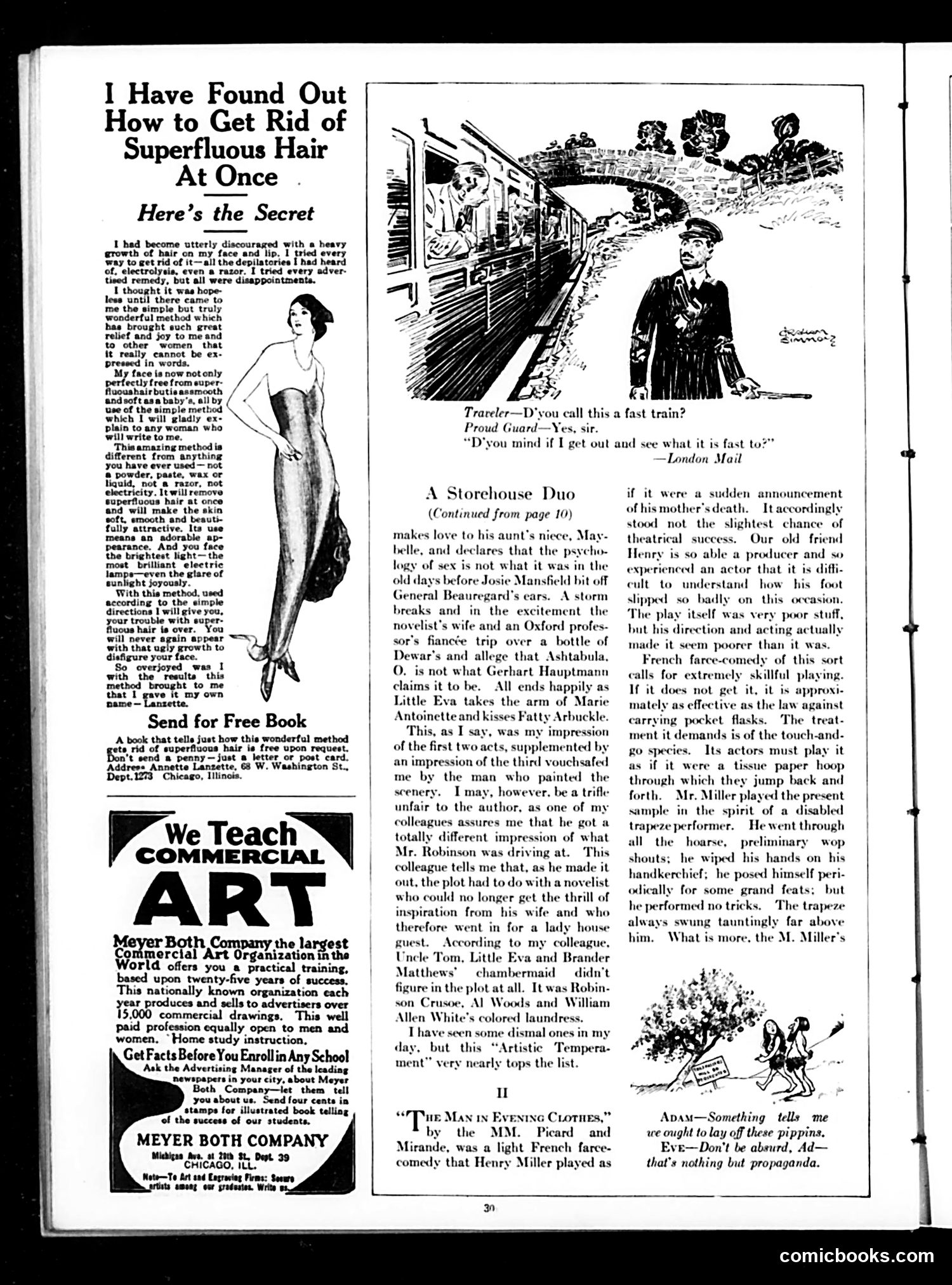
This page contains **advertising and theater criticism**, not political satire. The main content includes: 1. **"Superfluous Hair" Advertisement**: A testimonial ad for "Lanzette," a hair-removal product, featuring a woman claiming it removes unwanted facial hair without razors, electricity, or chemicals. This reflects early-20th-century beauty standards and anxieties about women's appearance. 2. **Small Cartoon**: A brief comic exchange between a train passenger and conductor, joking about train speed—unremarkable satire. 3. **Theater Review**: A negative critique of a play called "A Storehouse Duo" (or similar), with the reviewer mocking its convoluted plot involving novelists, society figures, and absurd character combinations. The reviewer suggests the plot made little sense. 4. **Commercial Art School Advertisement**: Meyer Both Company advertising art education. The page reflects 1920s-era concerns: beauty standards for women, theatrical entertainment criticism, and vocational training marketing. No specific political figures or events are referenced.
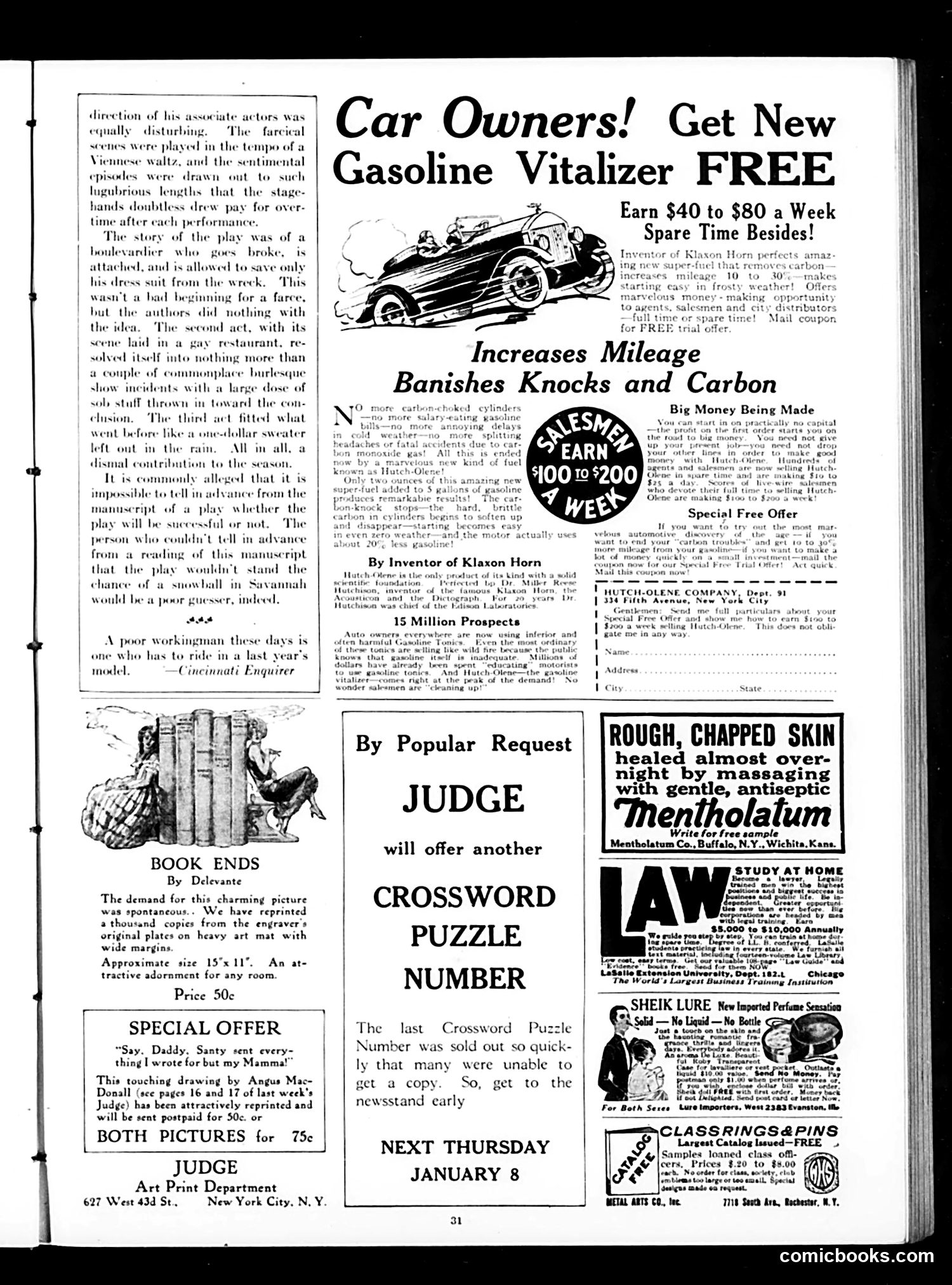
This page is primarily **advertising and announcements**, not satirical content. The dominant feature is a large advertisement for a "Gasoline Vitalizer" device—a fuel additive promising to increase mileage and eliminate engine knocks. The inventor is identified as the creator of the Klaxon Horn, a then-popular automobile horn. The ads reflect early 1920s concerns: car owners seeking fuel economy improvements and side-income opportunities (the "$40 to $80 a week" pitch). Other advertisements include correspondence courses, skin treatments, and class rings. The page also announces Judge magazine's reprint of a sentimental drawing titled "Say, Daddy, Santy sent everything I wrote for but my Mamma!" and previews an upcoming crossword puzzle number—indicating these were popular features readers would buy separately. **Context for modern readers**: This shows Judge functioning as both humor magazine and marketplace, with advertisements reflecting period anxieties about automobile maintenance and economic supplementation during uncertain economic times.
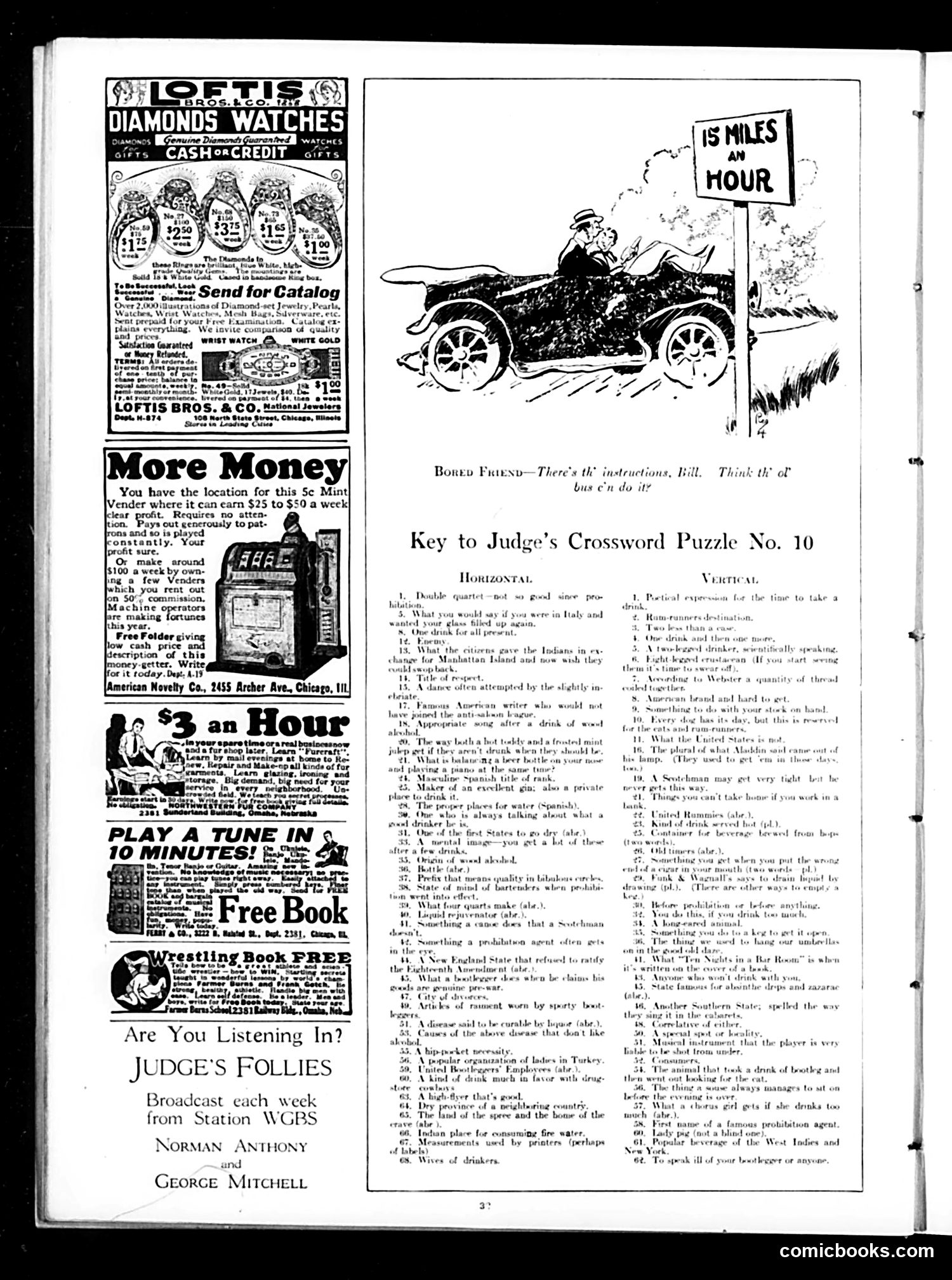
This page is primarily **advertising and puzzle content** rather than editorial satire. The main cartoon shows a man in a speeding car passing a "15 miles an hour" speed limit sign, with the caption "Bored Friend—There's th' instructions, Bill. Think th' of bus e'n do it?" The joke appears to reference **traffic safety concerns and speed limits** of the era—the "bored friend" sarcastically mocks the absurdity of following such restrictions, suggesting reckless driving was treated casually. The page is dominated by advertisements for **Loftis Bros. diamonds and watches** (offering "cash or credit"), a "$3 an hour" work-from-home opportunity, a free wrestling book, and Judge's Follies radio broadcast. The crossword puzzle answers fill the right column. The overall context reflects **1920s-30s American consumer culture**: easy credit for luxury goods, dubious get-rich-quick schemes, and broadcasting entertainment. The speed-limit cartoon mildly satirizes disregard for safety regulations.
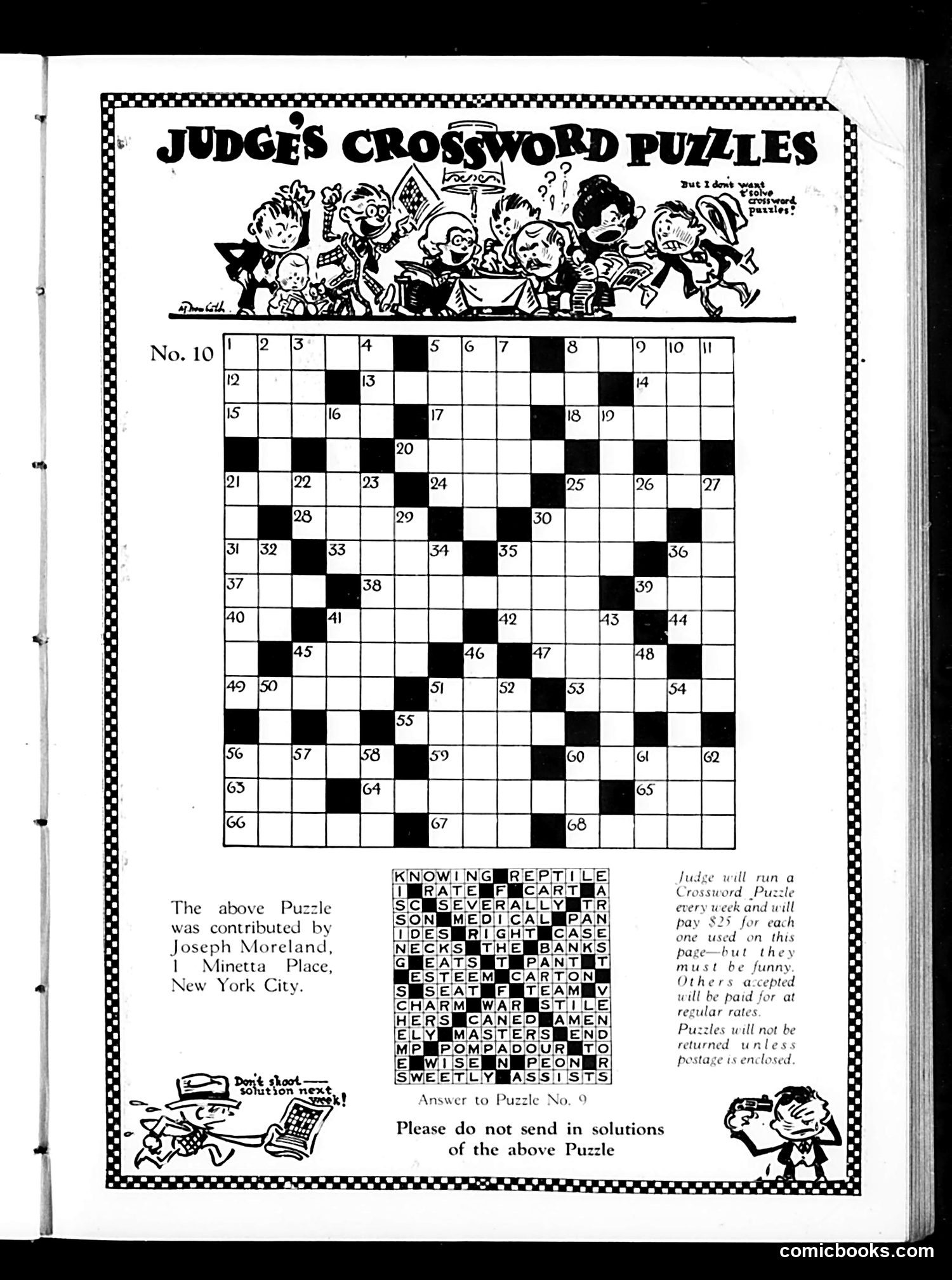
This page from *Judge* magazine presents **Puzzle No. 10**, a crossword puzzle contributed by reader Joseph Moreland of New York City. The page is primarily functional rather than satirical—it's a puzzle submission feature. The cartoon elements are minimal: whimsical illustrated characters appear in the header and margins (typical of *Judge*'s visual style), but they're decorative rather than making specific political or social commentary. The real content is the puzzle itself and the editorial note explaining *Judge*'s contest: they paid $25 per puzzle published (substantial money in this era) and accepted additional submissions at regular rates. The note emphasizes puzzles "must be funny"—indicating *Judge* sought humor-based wordplay rather than straightforward crosswords. The "Answer to Puzzle No. 9" grid shown demonstrates the solution format. This represents *Judge*'s reader-engagement strategy during the crossword puzzle craze of the 1920s-1930s.
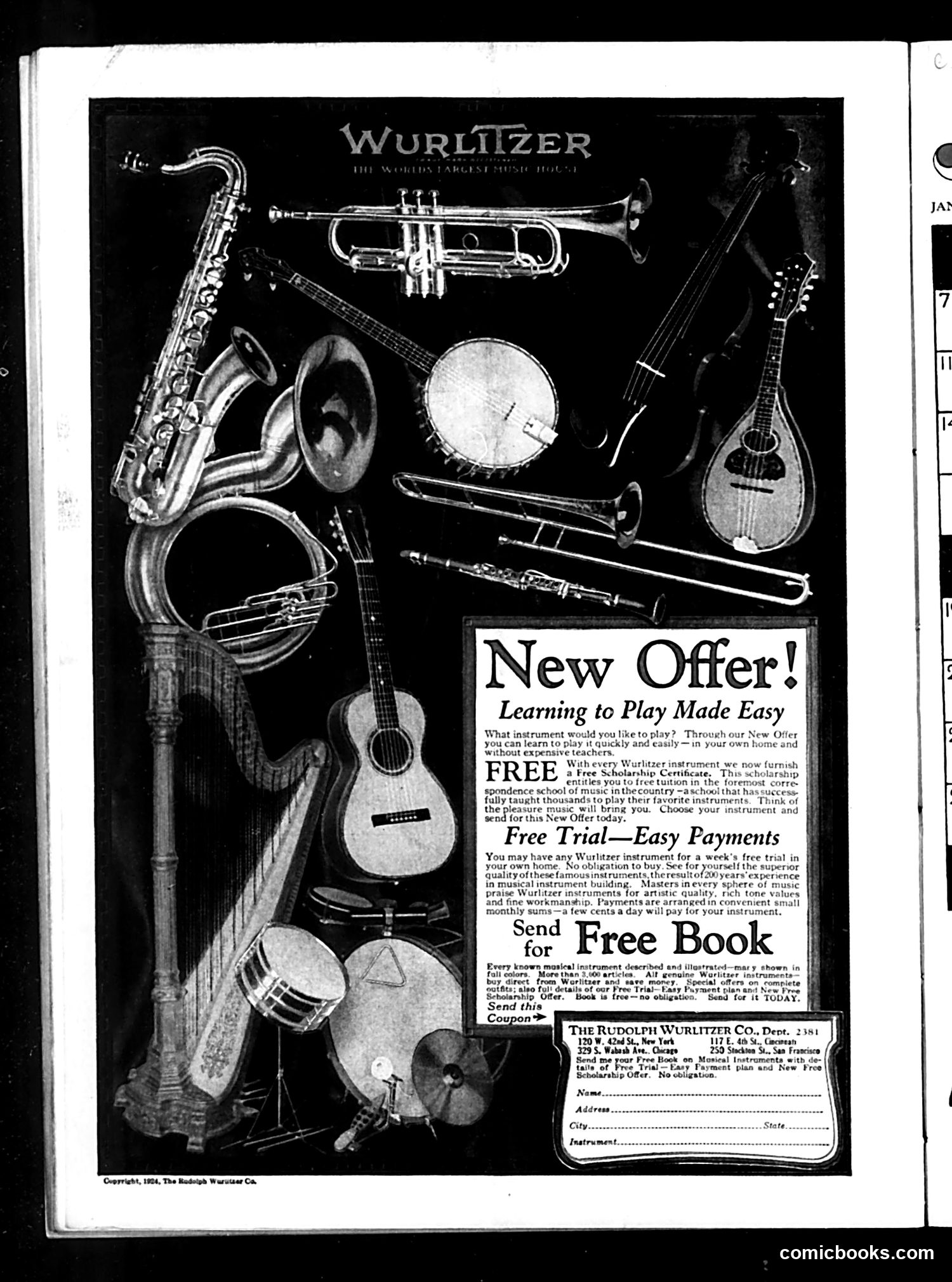
This is a **full-page advertisement, not satire or political commentary**. It's a Wurlitzer musical instrument company ad promoting their mail-order sales model. The image displays various instruments—saxophones, trumpets, guitars, mandolins, drums, banjo, and trombone—arranged around the Wurlitzer company name at top. The accompanying text pitches a "New Offer" for learning music easily through mail correspondence combined with a free trial period and installment payment plans ("a few cents a day"). The appeal targets aspiring musicians who want instruments but lack immediate funds. The "Free Book" and "Free Scholarship Certificate" promise access to a correspondence school of music—a popular early-20th-century educational model. This represents standard period advertising targeting middle-class consumers, not satire. The page simply showcases Judge magazine's commercial content alongside editorial material.