
Judge, 1925-01-03 · page 12 of 36
Judge — January 3, 1925 — page 12: what you’re looking at
What you’re looking at
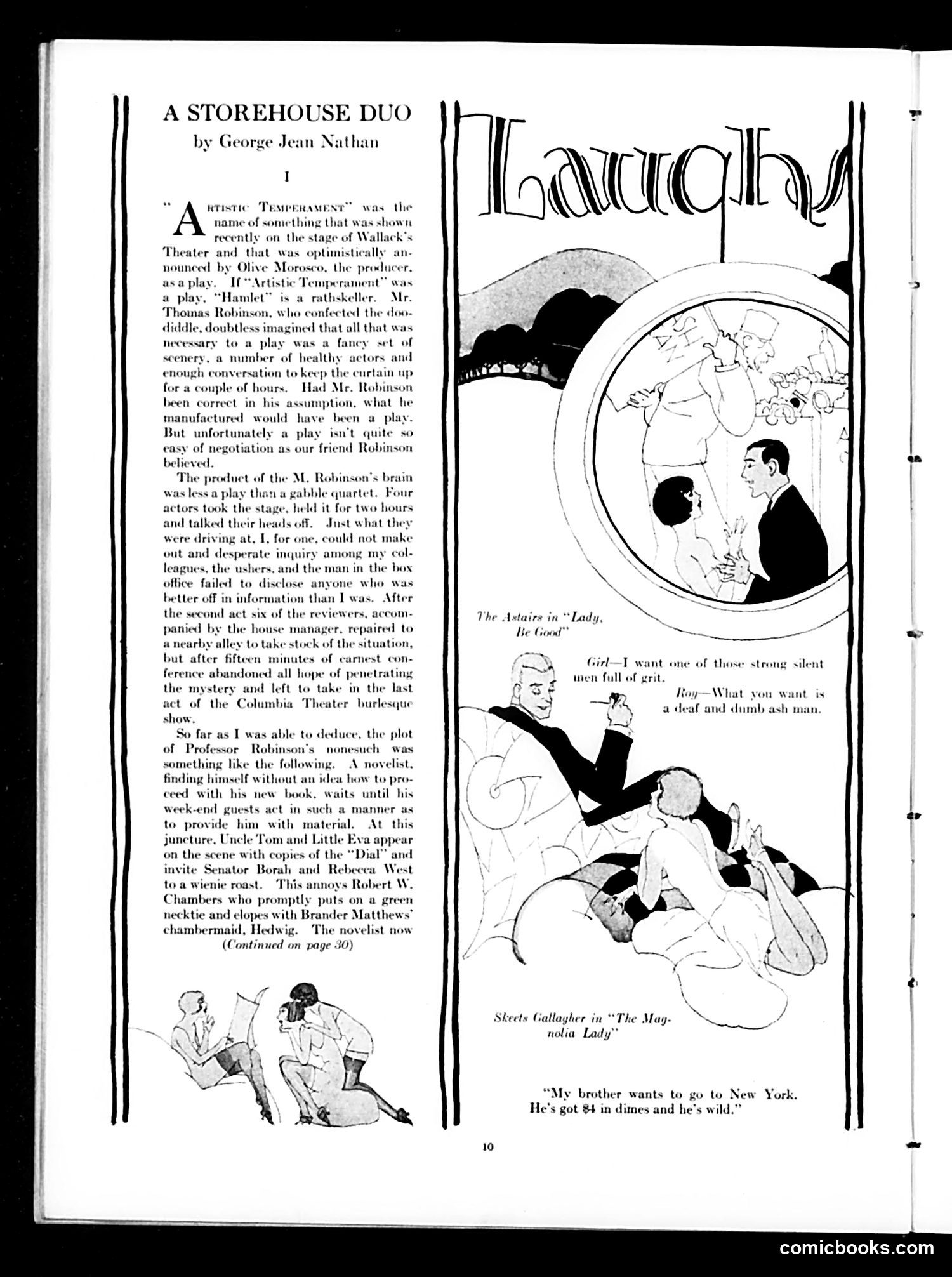
This page contains theater criticism by George Jean Nathan satirizing a play called "Artistic Temperament" at Wallack's Theater, produced by Olive Moroseo. Nathan's target is the play's incoherent plot and dialogue—he describes it as a "gabble quartet" where four actors talk for two hours without clear purpose. He mocks producer Thomas Robinson's assumption that scenery, actors, and conversation alone constitute a play. Nathan ridicules the plot's absurd premise: a novelist gathers weekend guests (including historical/literary figures like Uncle Tom, Senator Borah, and author Robert W. Chambers) to mine material from their behavior, leading to nonsensical outcomes. The accompanying cartoons appear to be separate theatrical humor, including a joke about a woman seeking a "strong silent man" receiving the response that she wants "a deaf and dumb ash man"—crude physical-humor comedy typical of the era. The satire targets pretentious theater production lacking substance.
📄 Transcribed text from this page (OCR, searchable)
Machine-transcribed from the original scan — historical spelling and the odd misread are preserved.
A STOREHOUSE DUO by George Jean Nathan I nTistiC TEMPERAMENT was the name of something that was shown recently on the stage of Wallack’s rand that was optimistically an- 1 by Olive Moroseo, the producer, If “Artistic Temperament” was mlet™ is a rath ve. Mr. Thomas Robinson, who confected the doo- diddle, doubtless imagined that all that was necessary to a play was a fancy set of scenery, a number of healthy actors and enough conversation to keep the curtain up for a couple of hours, Had Mr. Robinson been correct in his assumption, what he manufactured would | But unfortunately a play isn’t quite easy of negotiation as our friend Robinson believed. The product of the M. Robinson's brain was less a play than a gabble quartet. F actors took the stage, held it for two hi and talked their heads off. Just what they were driving at, I, for one, could not make out and desperate inquiry among my col- leagues, the ushers, and the man in the box failed to disclose anyone who was better off in information than I was. After the second act six of the reviewers, accom- panied by the house manager, repaired to a nearby alley to take stock of the situation, but after fifteen minutes of « est con- ference abandoned all hope of penetrating the mystery and left to ein the last act of the Columbia Theater burlesque show. So far as I was able to deduce, the plot of Professor Robinson's vesuch was something like the followin, A novelist, finding himself without an ideu to pro- ceed with his new book, waits until his week-end guests act in such a manner as to provide him with material. At this juncture, Uncle Tom and Little Eva appear on the scene with copies of the “Dial” and invite Senator Borah and Rebecca West to a wienie roast. This annoys Robert W. Chambers who promptly puts on a green necktie and elopes with Brander Matthews’ chambermaid, Hedwig. The novelist now (Continued on page 30) The Astaire in “Lady, TS, Ke Good” Girl—T want one of those strong silent ten full of grit. p My Roy—What you want is a deaf and dumb ash man Skeets Gallagher in “The May- nolia Lady” “My brother wants to go to New York. He's got $4 in dimes and he’s wild.” comicbooks.com