
A complete issue · 35 pages · 1924
Judge — December 27, 1924
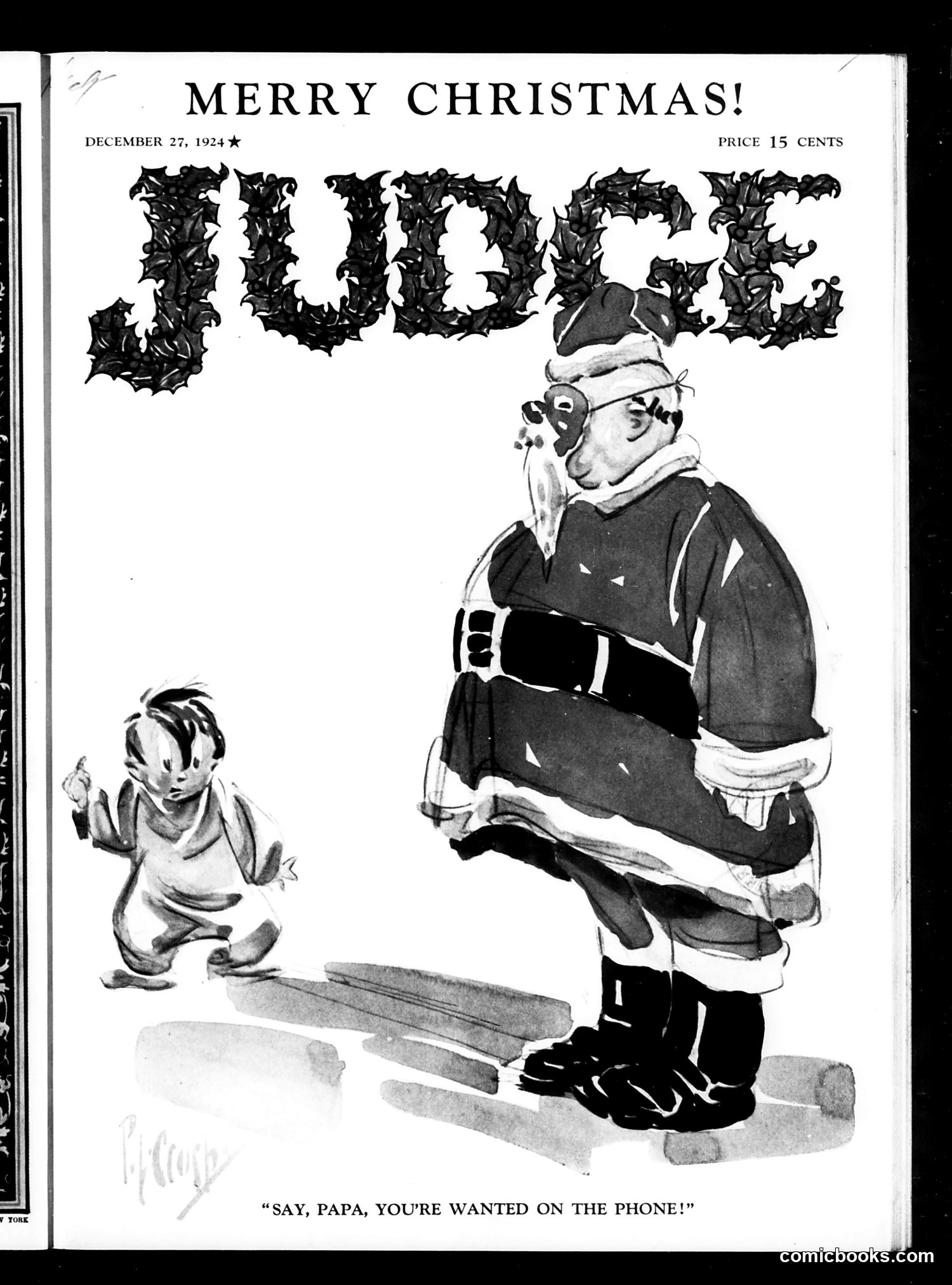
This is a Christmas-themed cover for *Judge* magazine. The main cartoon shows Santa Claus on what appears to be a snowy rooftop, with a small child tugging at his coat saying "Say, Papa, You're Wanted on the Phone!" The joke plays on the domestic reality of 1920s life: even Santa—traditionally a figure of uninterrupted Christmas magic—cannot escape the demands of modern telephone communication. The humor reflects contemporary anxieties about technology intruding on private/family moments. The child's innocent revelation that "Papa" (the father dressed as Santa) is being called away undermines the Christmas fantasy, suggesting that even holiday traditions were being disrupted by the increasing demands of modern life and communication technology in the Jazz Age.
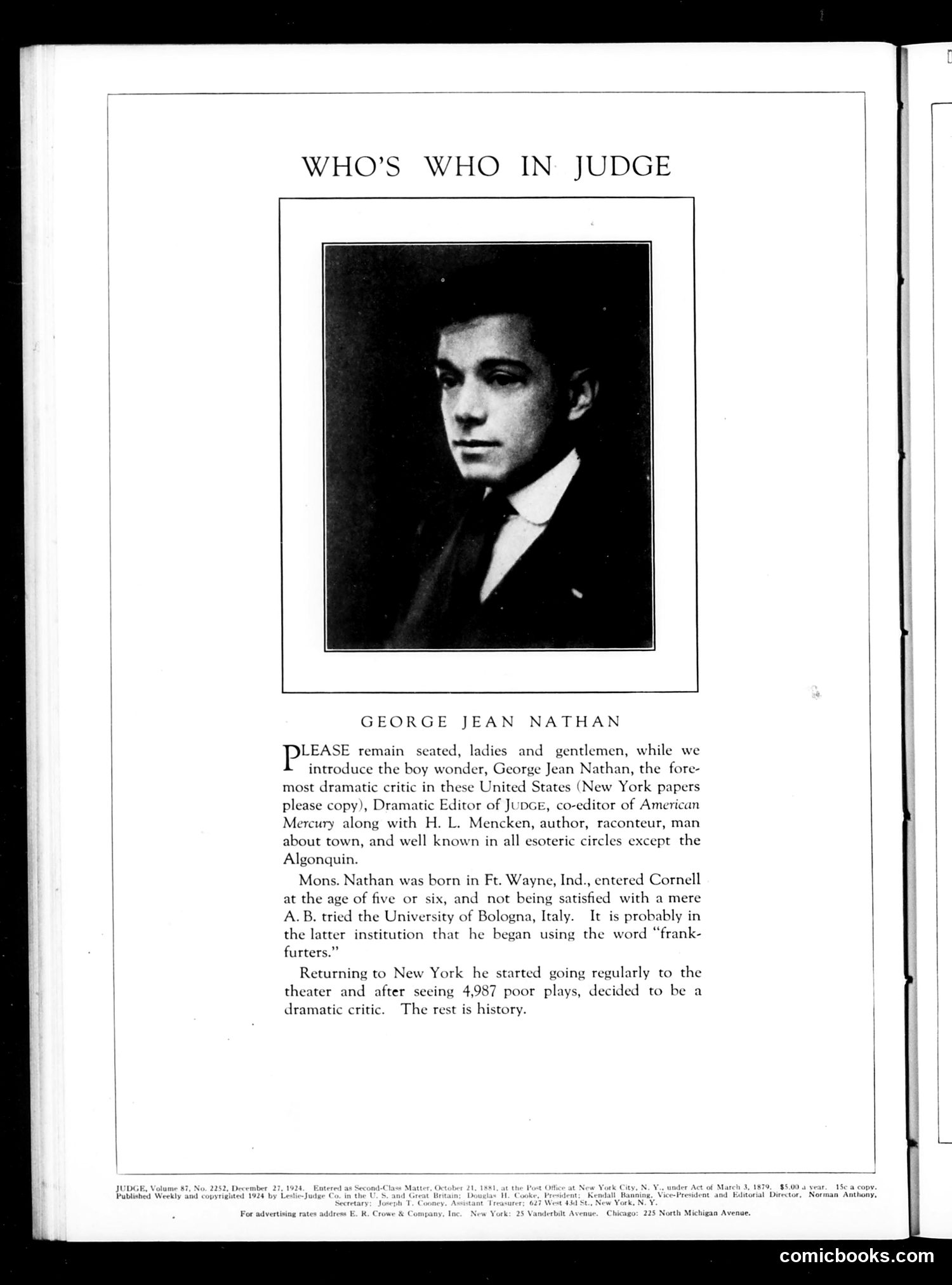
This is a biographical profile of George Jean Nathan, a prominent dramatic critic. The text describes him as "the foremost dramatic critic in these United States," noting his roles at *Judge* magazine and *American Mercury*, and his association with H.L. Mencken. The profile is humorous rather than satirical—it uses jokes about Nathan's background (born in Fort Wayne, Indiana; attended Cornell and University of Bologna) and his career (he saw 4,987 poor plays before becoming a critic). The phrase about inventing the word "frankfurters" at Bologna appears to be playful exaggeration. This is essentially a comedic introduction of Nathan to *Judge*'s readership, celebrating his credentials as a theater critic through witty anecdotes rather than political satire.
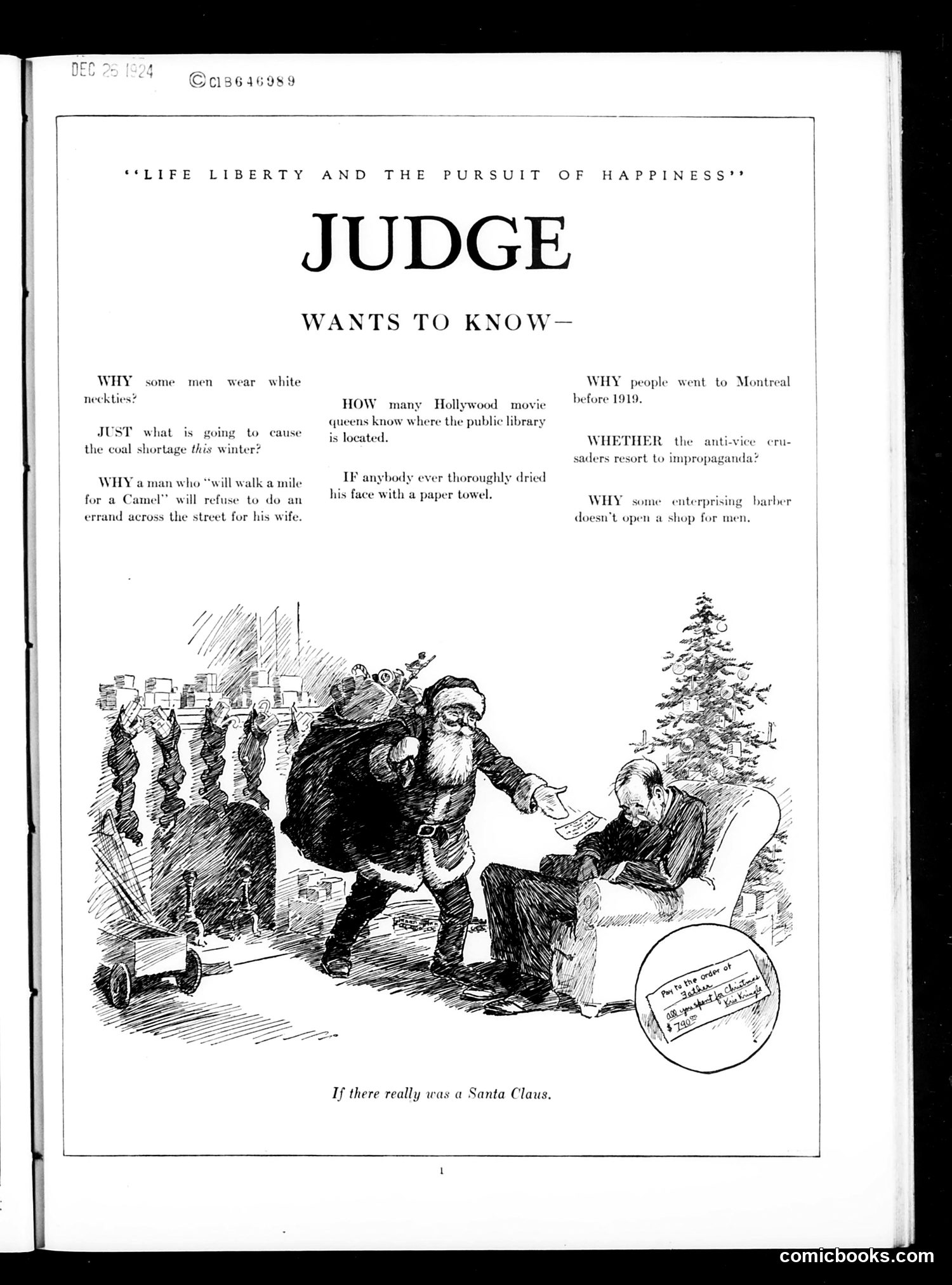
This page presents a satirical cartoon titled "If there really was a Santa Claus," appearing to critique economic inequality and hardship during what the date stamp suggests is 1924. The central figure—a bearded man resembling Santa Claus—distributes gifts to impoverished people in winter conditions. The surrounding "questions Judge wants to know" address contemporary social issues: coal shortages, Hollywood excess, paper towels, barber shops, and anti-vice crusades. The satire's point is clear: if Santa truly existed to help the poor, many of these societal problems wouldn't persist. The cartoon criticizes the gap between charitable ideals and harsh economic realities facing working-class Americans during the 1920s. The circular inset contains text too small to read clearly but likely reinforces this ironic commentary on wealth distribution.
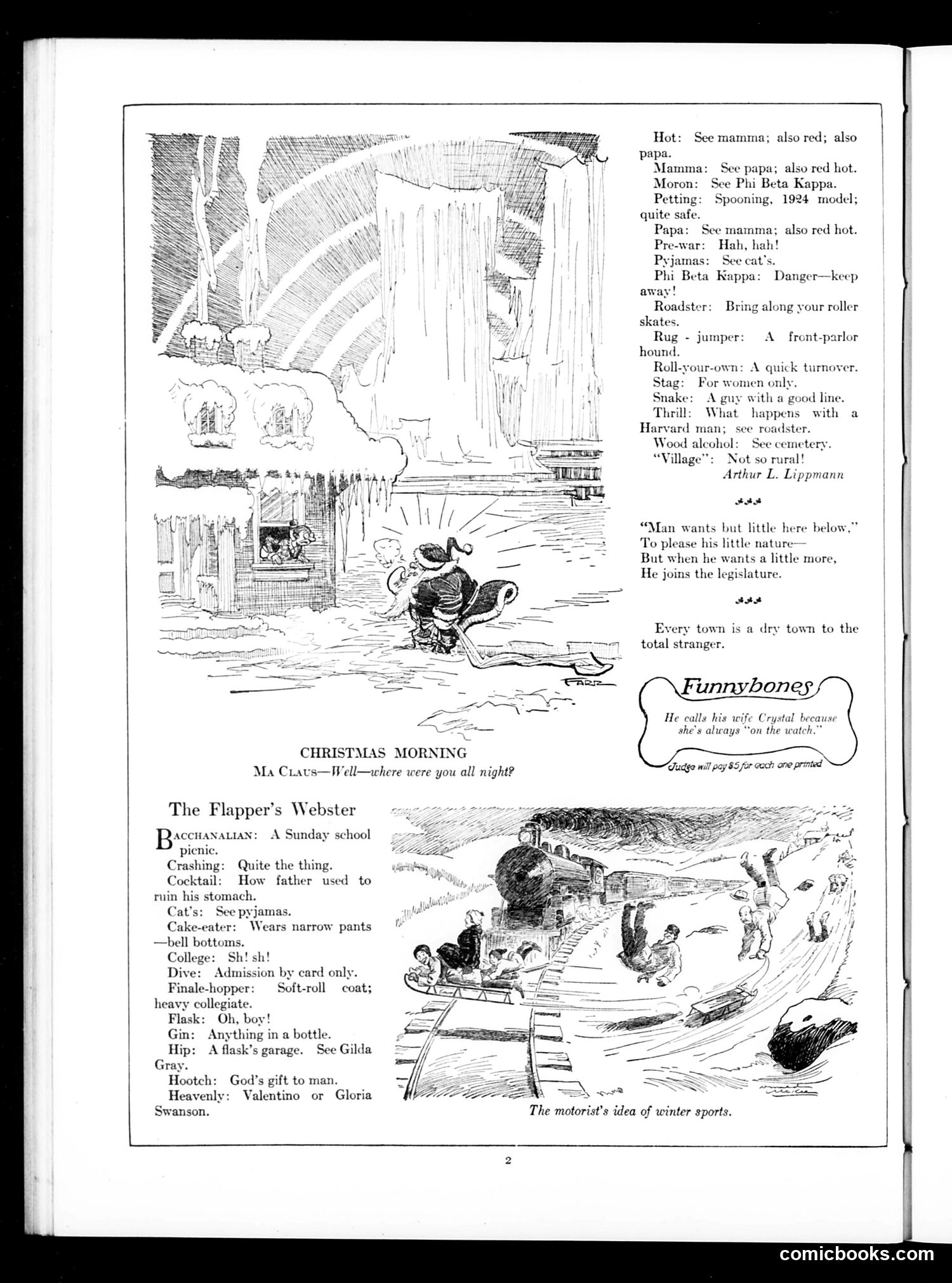
This page contains two main sections: a glossary of slang terms ("The Flapper's Webster") and illustrations with humorous commentary. **The Flapper's Webster** satirizes 1920s youth slang associated with young women (flappers) and their social culture. Terms like "Bacchanalia" (Sunday school picnic), "Crushing" (attraction), and "Cake-eater" (narrow-pants wearer) mock the era's emerging modern youth vocabulary and behavior that older generations found bewildering and scandalous. The illustrations above show domestic scenes and winter activities. The "Christmas Morning" cartoon and the motorist's winter sports scene appear to be genteel, if somewhat idealized, depictions of middle-class leisure activities—suggesting satire of contemporary lifestyle aspirations rather than pointed political commentary. The page primarily mocks generational and cultural tensions of the Jazz Age.
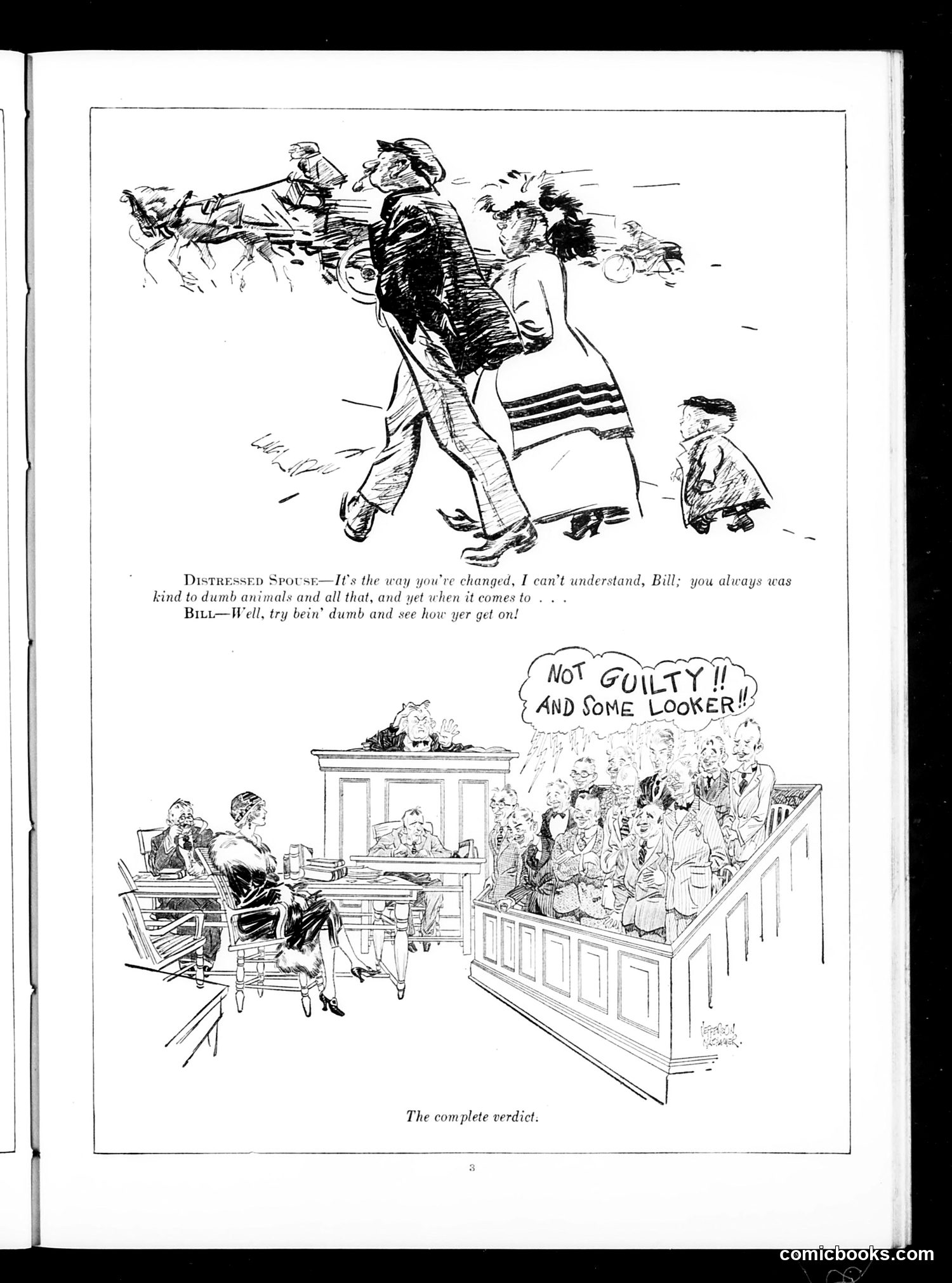
This is a two-panel satirical cartoon about marriage and divorce. The top panel shows a husband literally dragging his wife away while she protests his changed behavior—he's now cruel to animals and treats her poorly. The wife sarcastically notes this contradicts his former kindness. The bottom panel depicts a courtroom verdict: "NOT GUILTY!! AND SOME LOOKER!!" The judge or jury apparently acquitted the husband on charges (likely divorce-related), and someone comments approvingly on the wife's appearance rather than addressing the serious marital misconduct described above. The satire targets how courts and society often dismissed women's complaints about mistreatment while judges and observers reduced women to their physical appearance—a commentary on both judicial bias and the superficiality with which women's grievances were treated in early 20th-century America.
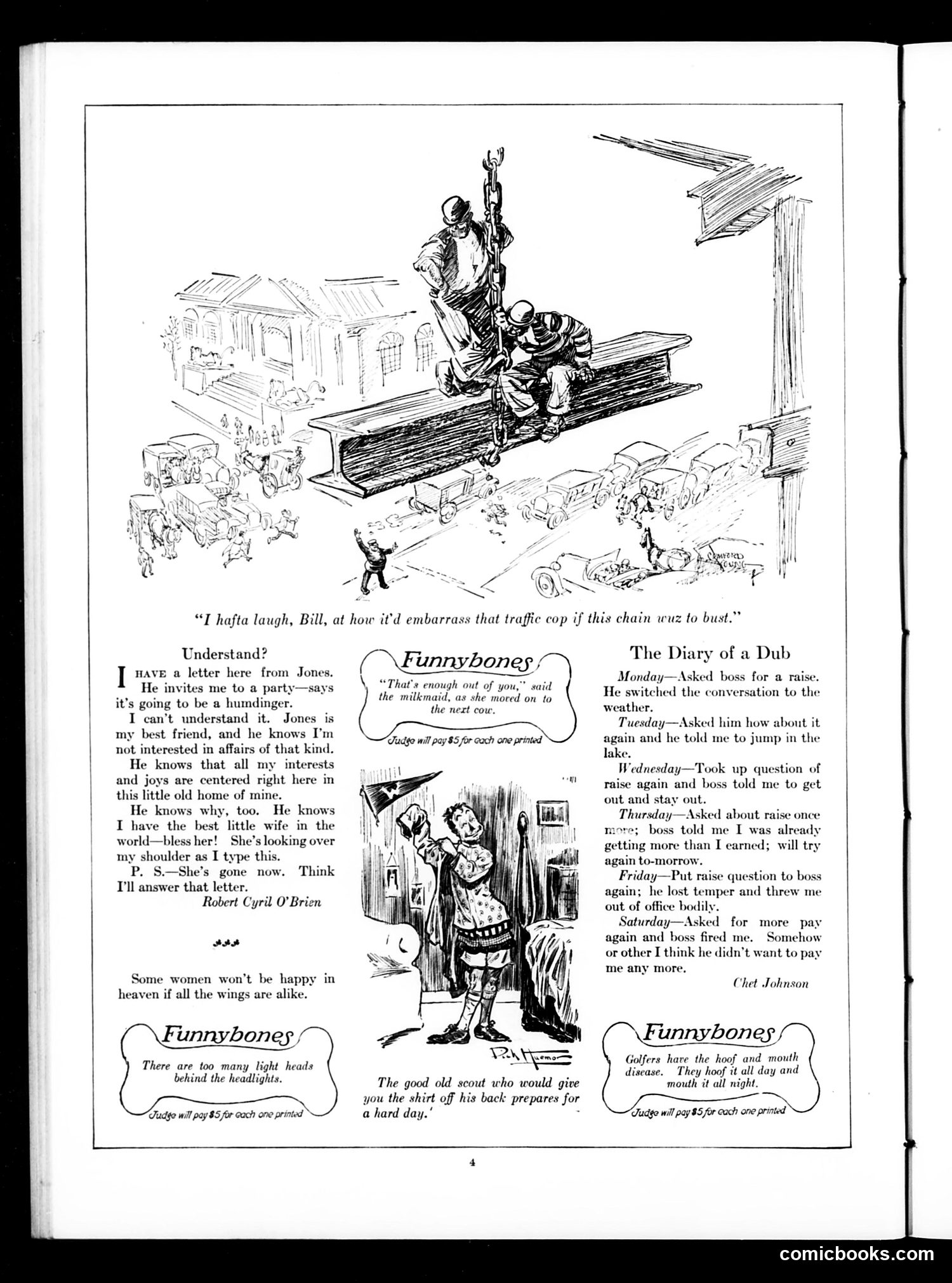
This page contains humor pieces and illustrations rather than political cartoons. The main content includes: **"Funnybones"** sections: Brief, captioned jokes with illustrations, typical of Judge's humor format. **"The Diary of a Dub"** by Chet Johnson: A week-long satirical diary entry depicting an office worker repeatedly asking his boss for a raise, getting rejected, fired, and eventually rehired—satirizing workplace dynamics and employee desperation during (unclear which era, but likely early 20th century based on style). **Upper cartoon**: Shows men on an oversized log with "traffic cop" reference, likely satirizing Prohibition-era law enforcement or labor disputes. The page demonstrates Judge's mix of workplace satire, social observation, and slapstick humor targeting middle-class readers' everyday frustrations with employment and authority figures.
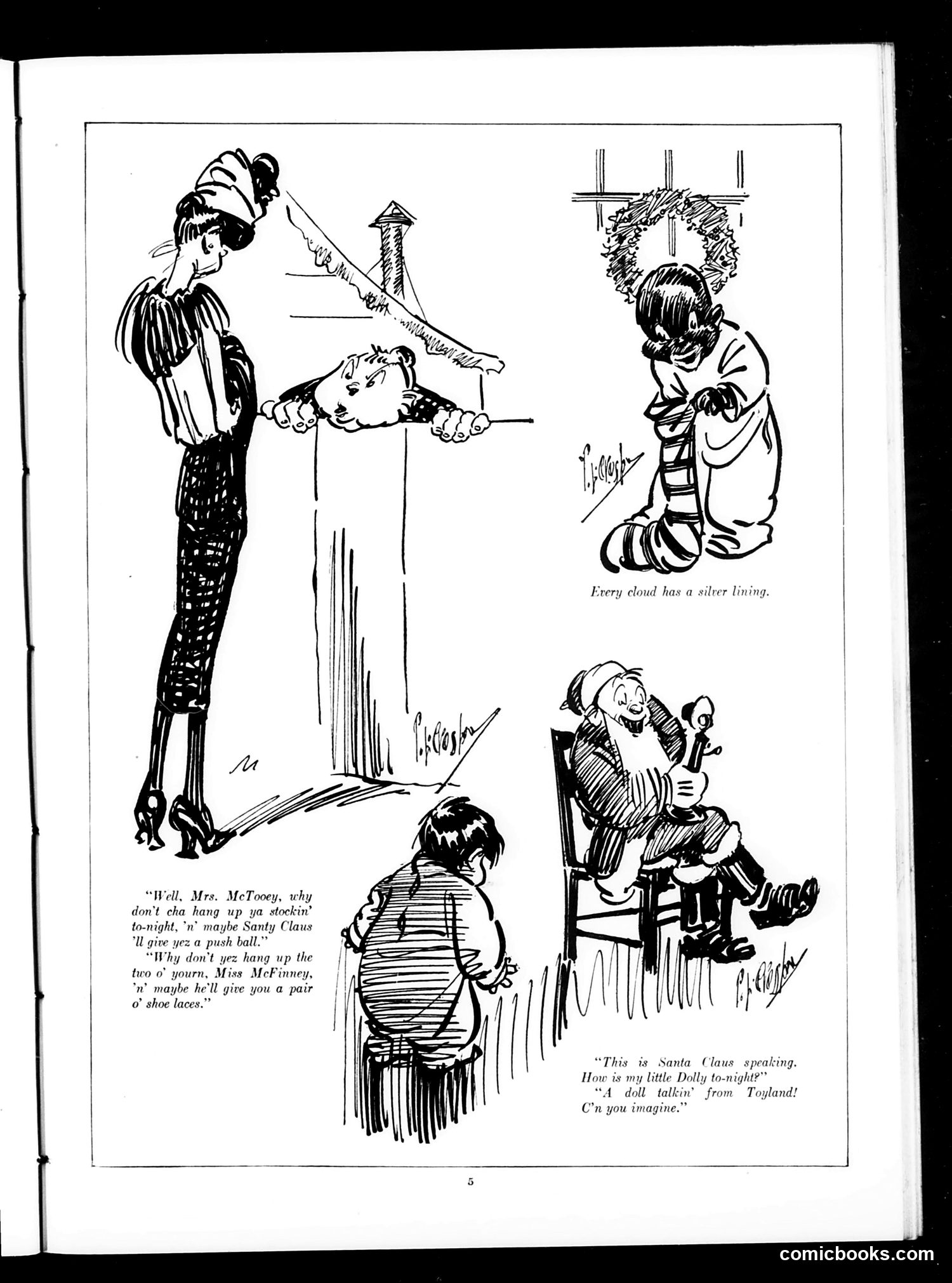
This page contains three comic vignettes depicting Christmas morning scenes, likely from the early 20th century. The humor relies on class-based contrasts and period-specific references: **Top left**: A fashionably dressed woman (indicated by elaborate dress and hat) discusses hanging stockings with a maid, using dialect humor typical of the era. **Top right**: A child prays before a Christmas wreath, captioned "Every cloud has a silver lining"—suggesting financial hardship masked by optimism. **Bottom**: An older woman (possibly immigrant, suggested by dialect) receives a doll from "Santa Claus," marveling at a "talking" toy from Toyland—satirizing both immigrant unfamiliarity with modern toys and wealth disparities in Christmas gift-giving. The satire contrasts wealthy households with working-class or immigrant families, using dialect and caricature—common Judge magazine conventions.
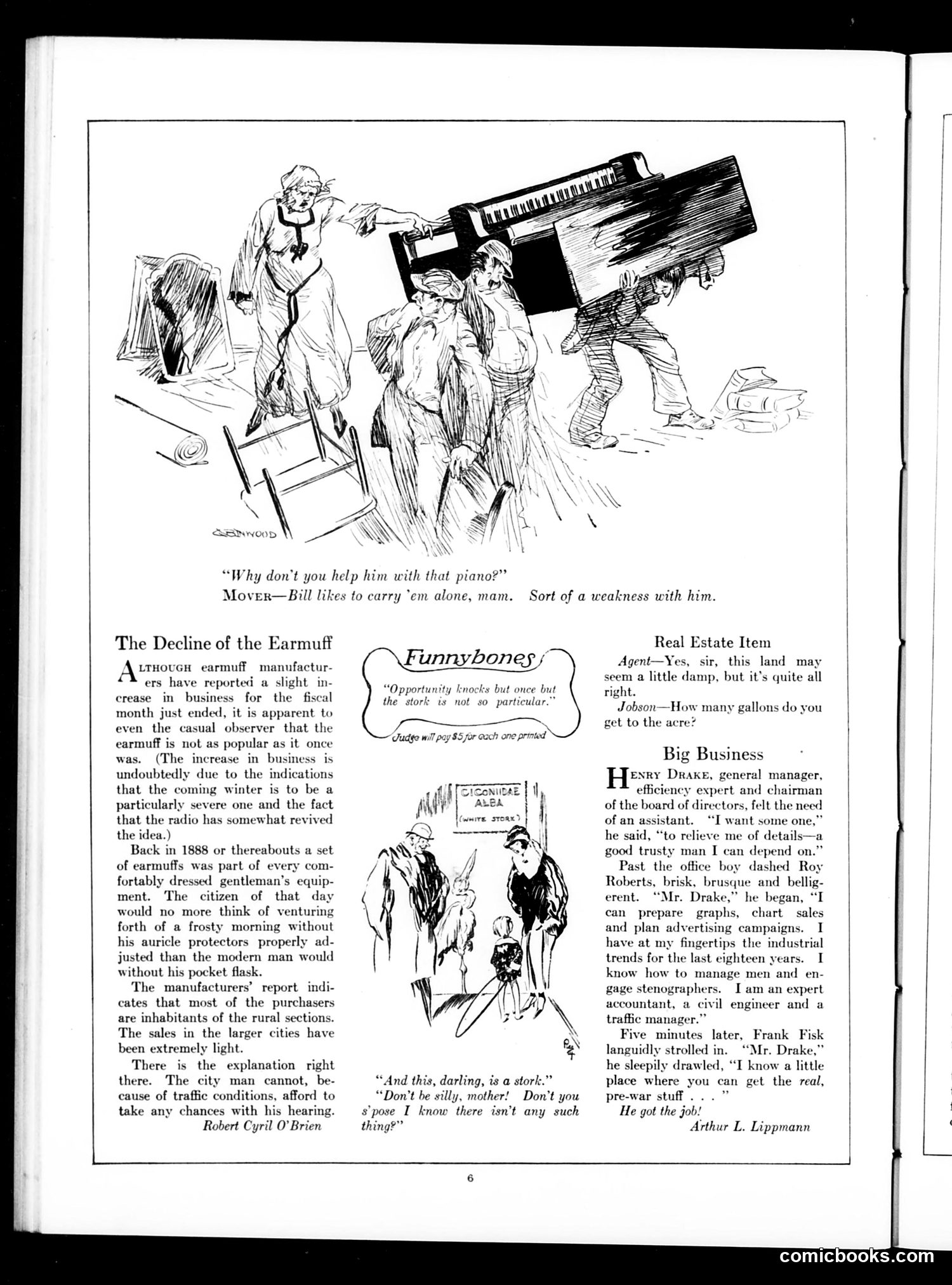
This page contains multiple satirical pieces targeting early 20th-century American life: **Top Cartoon**: A moving company worker refuses help carrying a piano, insisting on doing it alone—portrayed as a character flaw. The satire mocks excessive self-reliance or stubbornness. **"The Decline of the Earmuff"**: An essay lamenting that earmuffs, once essential winter wear for gentlemen (1888), are now obsolete in cities. The joke: city men can't wear them because they need to hear traffic warnings—radio has only slightly revived the fashion. Rural people still buy them. This satirizes technological and social change. **"Big Business"**: A hiring vignette where an overqualified candidate with impressive credentials loses the job to an applicant who casually mentions knowing "a place where you can get the real, pre-war stuff"—likely bootleg liquor during Prohibition. The satire mocks how personal connections and access to illegal goods trumped actual competence in business. The page combines light humor with social commentary on class, technology, and corruption of the era.
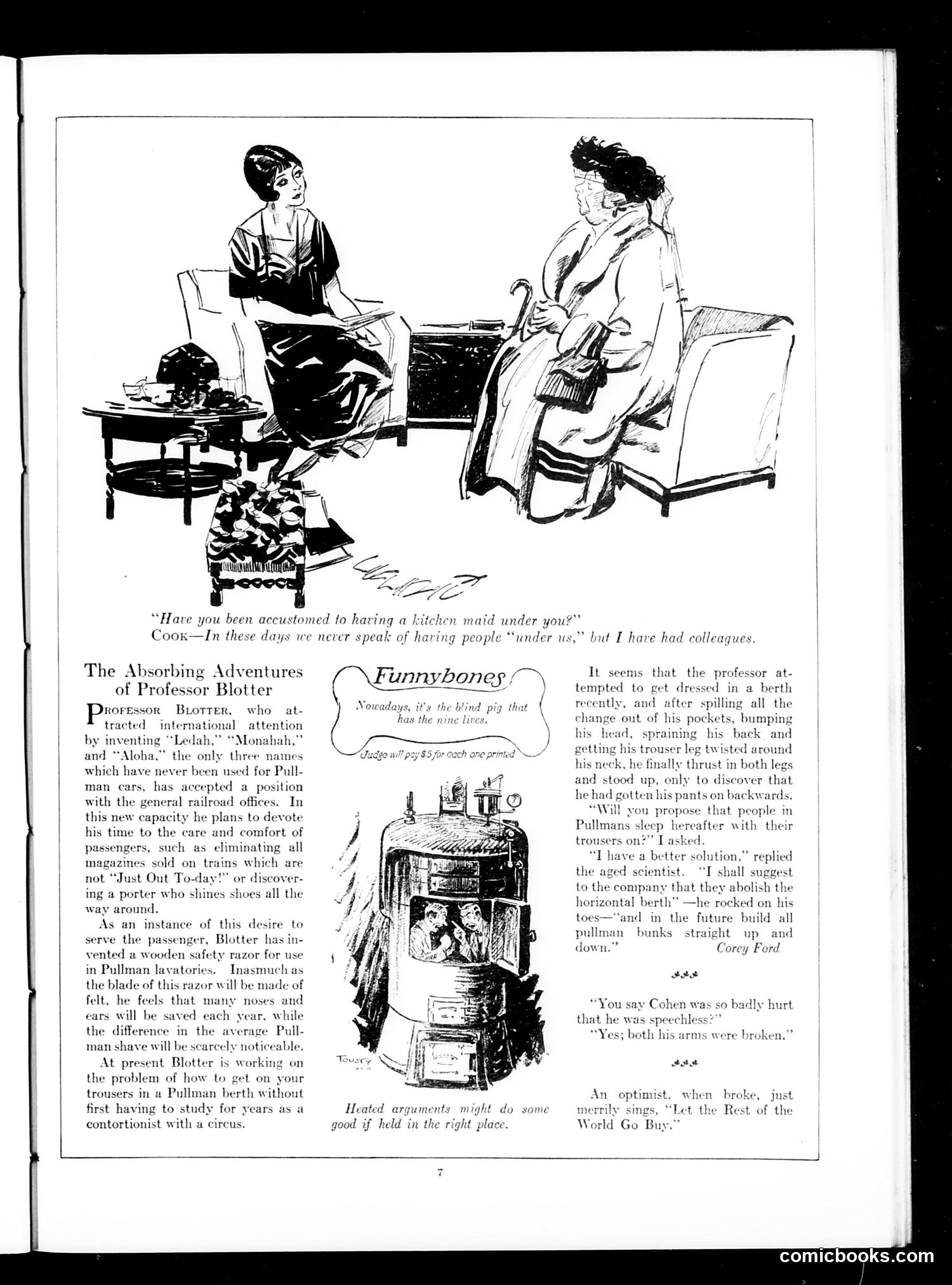
This page satirizes **Professor Blotter**, a fictional inventor of useless railroad innovations. The humor targets early 20th-century Pullman car culture and pretentious "scientific progress." The main joke: Blotter invents absurd solutions to minor passenger complaints—a felt safety razor (which won't shave), a wooden safety device for getting dressed in cramped berths. The cartoon mocks inventors who overcomplicate simple problems and railroad companies that might adopt such impractical ideas. The opening dialogue jokes about class language: a cook dismisses euphemistic phrases like having people "under you," reflecting changing attitudes about servant hierarchies in this era. The "Funnybones" sidebar offers additional one-liners about modern inconveniences, typical of Judge's satirical format. The overall target: the gap between technological ambition and practical usefulness in the industrial age, and corporate obsession with "innovation" regardless of actual value.
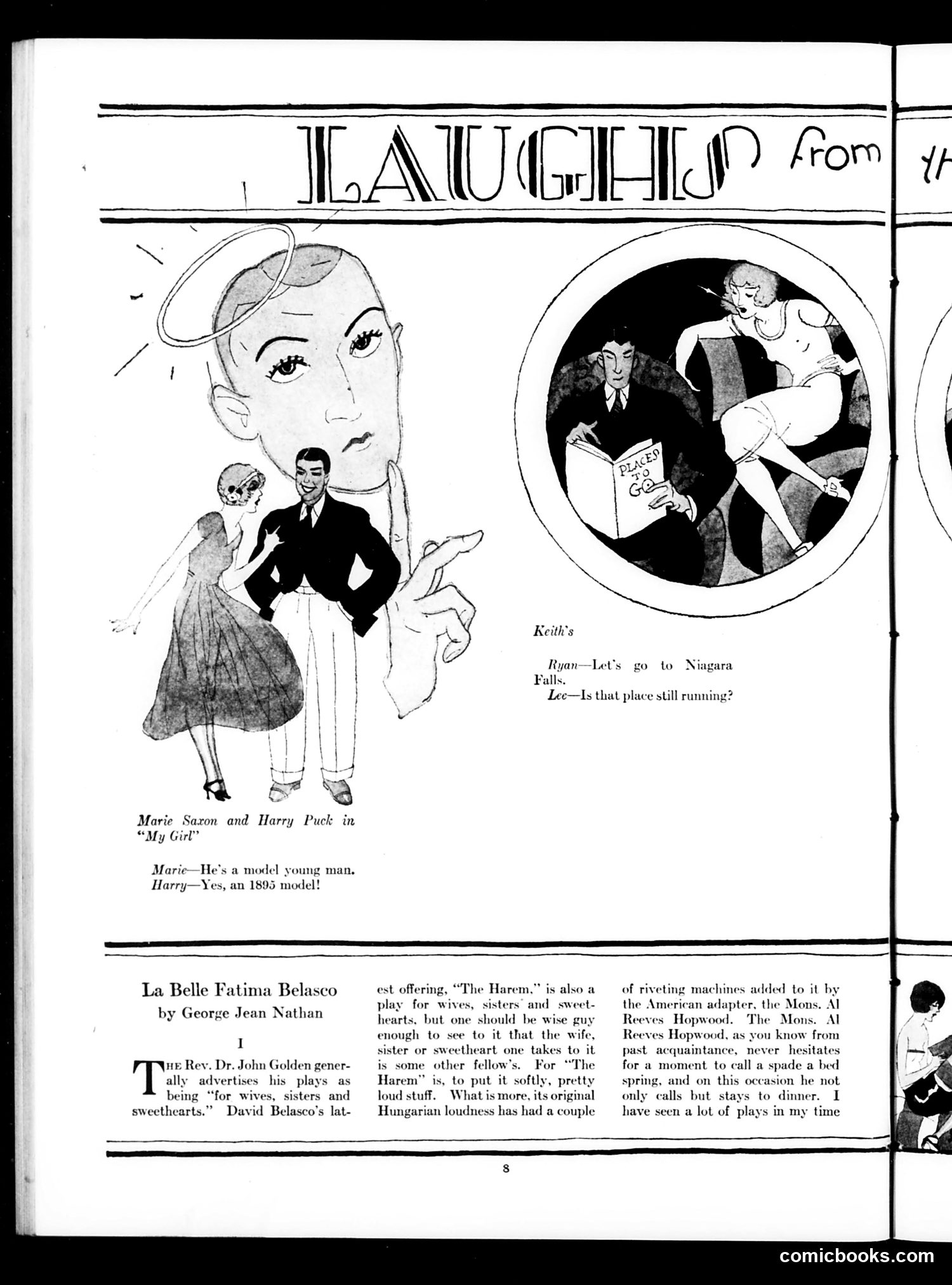
This is a *Judge* magazine page featuring theatrical humor and reviews from around 1912. **Top Section:** Two cartoon jokes about plays: 1. "My Girl" stars Marie Saxon and Harry Puck. The joke: Marie calls her leading man "a model young man"; Harry quips he's "an 1895 model"—meaning outdated or old-fashioned. 2. A vaudeville exchange where characters suggest going to Niagara Falls, then joke "Is that place still running?"—implying the tourist attraction is so old it might have closed. **Bottom Section:** Theater critic George Jean Nathan reviews "La Belle Fatima Belasco," adapted by Al Reeves Hopwood. Nathan sarcastically warns that while producer John Golden markets plays as family-friendly entertainment for "wives, sisters and sweethearts," Belasco's risqué "Harem" play is explicitly sexual ("loud stuff"). He mocks adapter Hopwood for adding crude American flourishes, saying Hopwood never minces words—he "calls a spade a bed spring" and stays for the consequences. The satire targets theatrical hypocrisy about morality while critiquing both dated entertainment and scandalous adaptations.
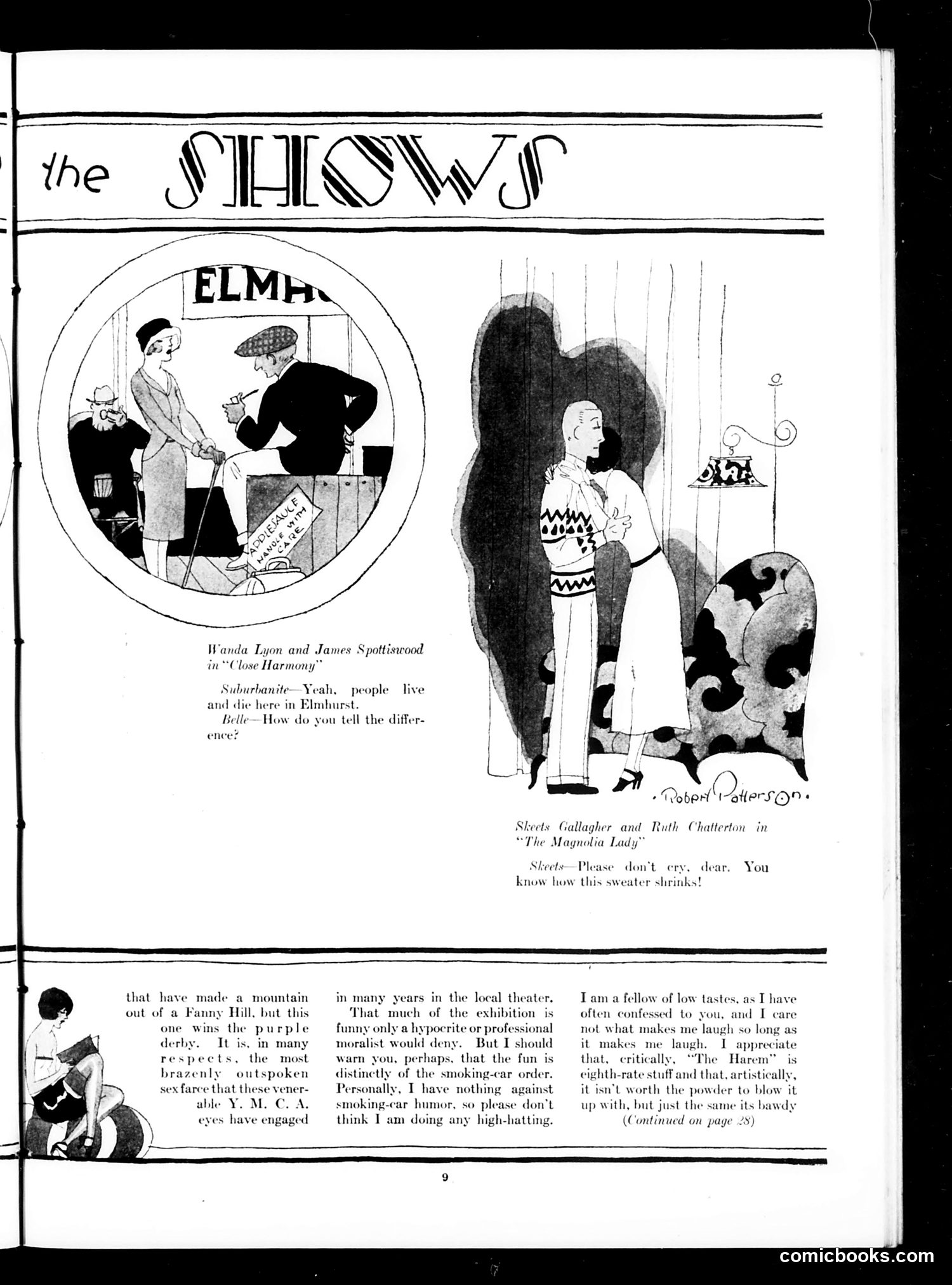
This page from *Judge* magazine reviews contemporary theatrical productions with satirical commentary. The top two illustrations show scenes from "Close Harmony" and "The Magnolia Lady"—films or stage productions of the era. The humor operates on multiple levels: The "Close Harmony" joke plays on suburban monotony (people in Elmhurst live and die identically). "The Magnolia Lady" caption makes a mild double entendre about a sweater shrinking. The larger text below critiques a production called "The Harem" (likely a burlesque or sexually suggestive show). The reviewer—writing with mock self-deprecation—defends low-brow entertainment against moral censorship. He's ironically addressing the "Y.M.C.A. eyes" (conservative audiences), arguing that bawdy humor needn't pretend to artistic merit. The satire targets both prudish moralism and pretentious critics who dismiss popular entertainment. This reflects 1920s tensions between emerging permissiveness and lingering Victorian propriety.
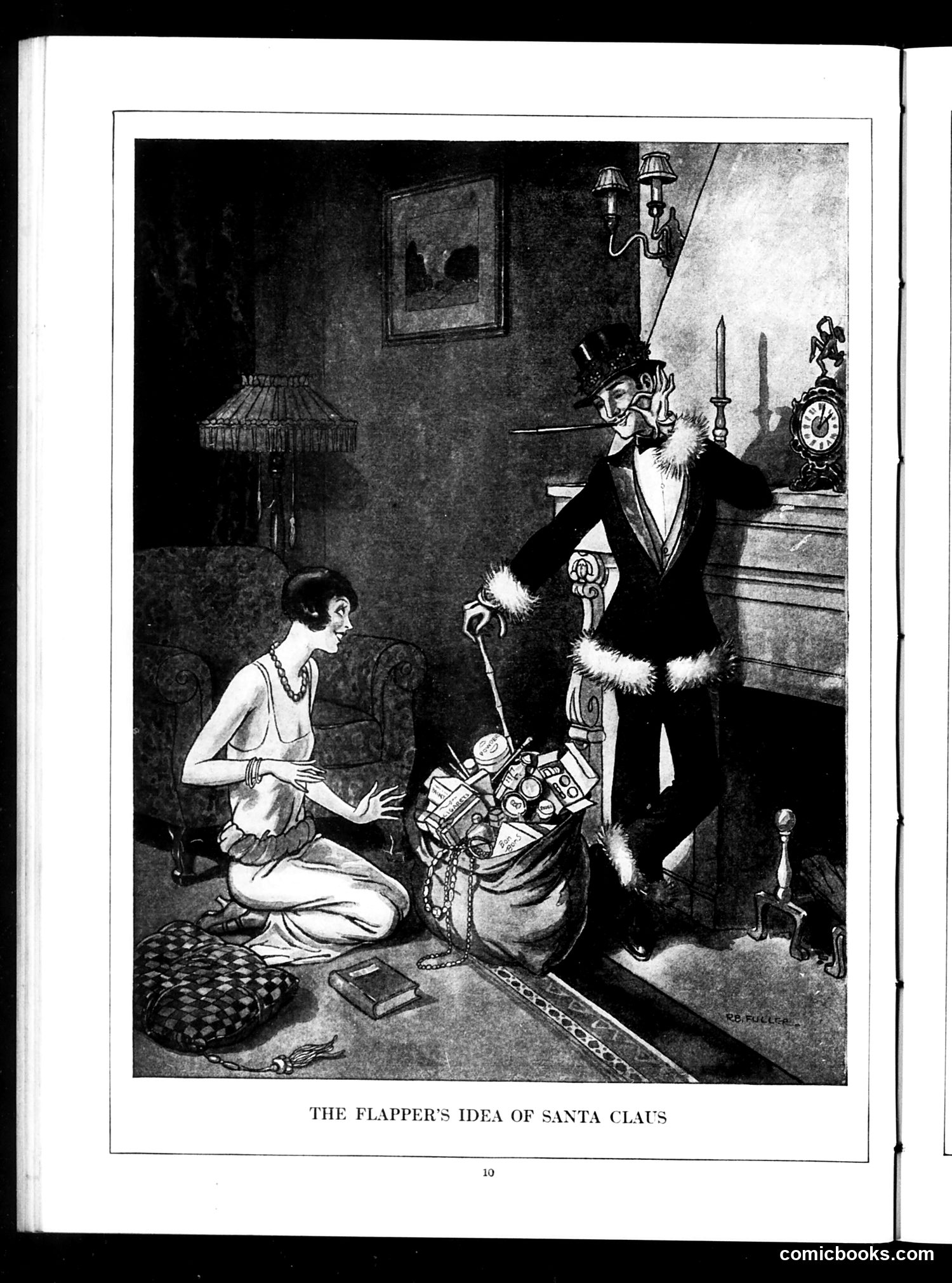
This cartoon satirizes 1920s "flapper" culture—young women known for rejecting Victorian conventions, bobbed hair, and modern fashion. The illustration shows a woman in casual dress gazing at an extravagantly dressed man in top hat and fur-trimmed coat, surrounded by luxury goods (jewelry, perfume bottles, an ornate clock). The joke equates the flapper's ideal romantic partner with an indulgent, wealthy sugar daddy or wealthy suitor—essentially treating a generous man as her version of Santa Claus. The satire mocks both the materialism stereotypically attributed to flappers and their apparent preference for luxury and leisure over traditional domestic values. This reflects conservative anxieties about 1920s youth culture and changing gender dynamics.
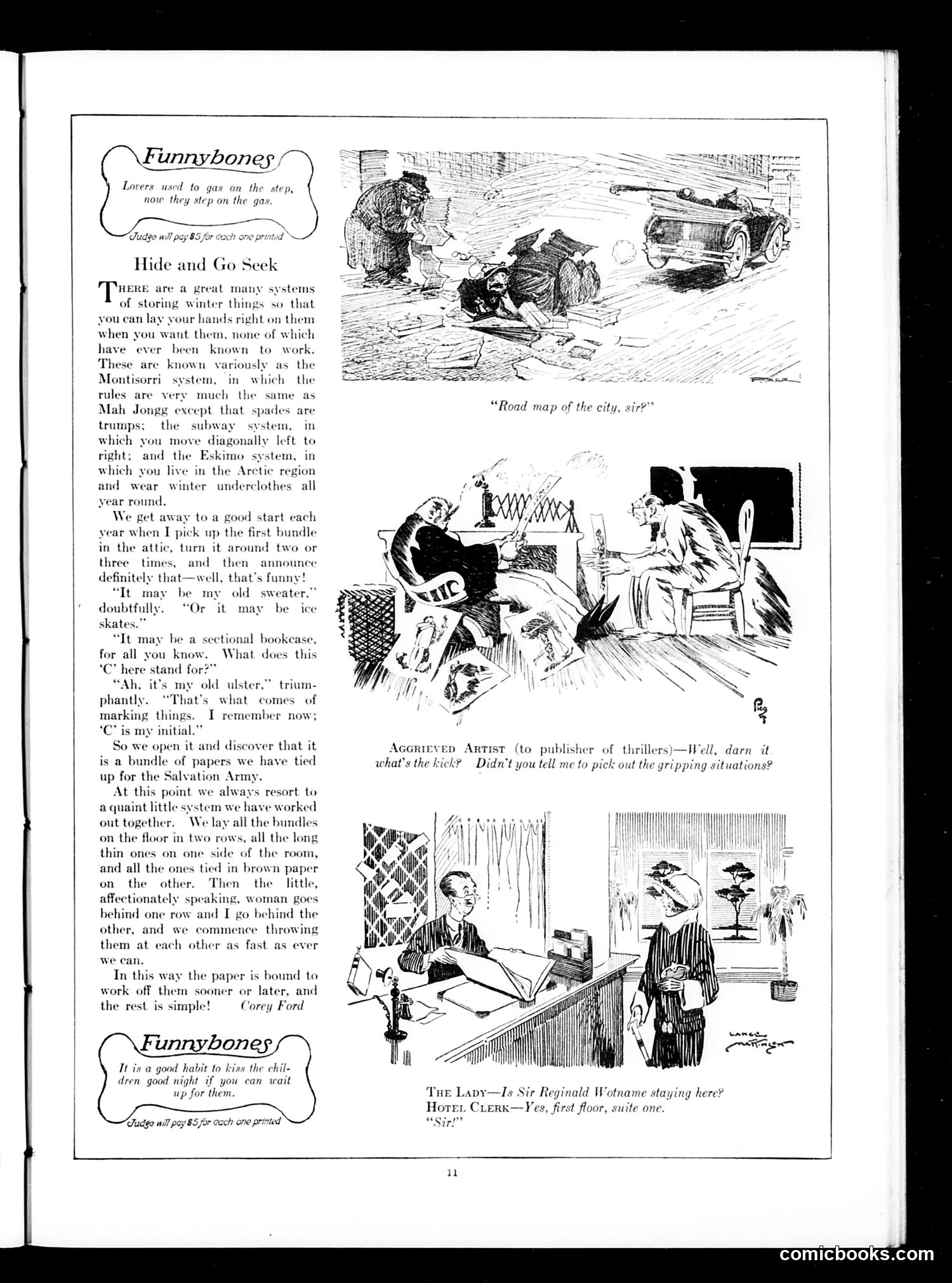
This page from *Judge* magazine contains three separate humor pieces: **"Hide and Go Seek"** (main article by Corey Ford): A humorous essay about storing winter items with no system that actually works. The joke satirizes pretentious organizational methods (Montessori, Mah Jongg references) that fail in practice. The punchline: a couple simply throws bundles at each other across a room—chaos masquerading as a system. **"Road map of the city, sir"** (top cartoon): Shows vagrants or homeless men examining a street map, captioning urban poverty during what appears to be the post-WWI era when such homelessness was visible. **"Aggrieved Artist" (middle cartoon): An artist complains to a thriller publisher about being asked to illustrate "gripping situations"—satirizing the disconnect between editorial requests and artistic execution in commercial publishing. **"The Lady and Hotel Clerk"** (bottom cartoon): A woman inquires about a male guest; the clerk's brief "Sir?" response suggests innuendo about impropriety—typical early 20th-century humor about adultery or moral scandal. The "Funnybones" taglines are brief witticisms unrelated to main content.
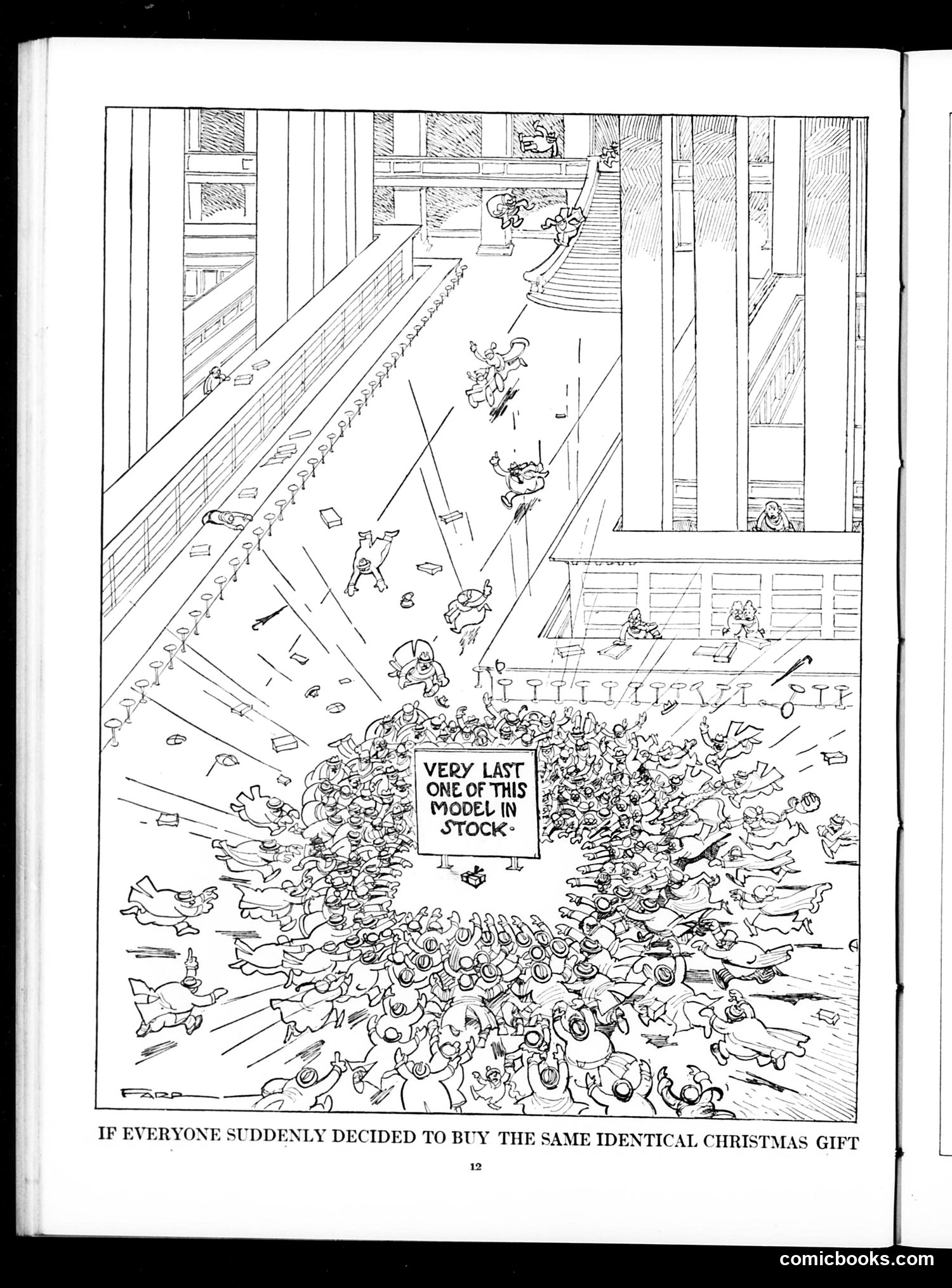
This is a satirical illustration from *Judge* magazine showing a massive crowd of people packed into what appears to be a department store or shopping mall, all clamoring to buy identical Christmas gifts. The caption reads: "If Everyone Suddenly Decided to Buy the Same Identical Christmas Gift." The joke satirizes the herd mentality of holiday shopping and consumer culture. The cartoon depicts the chaos, crowding, and competitive frenzy that would result if everyone pursued the exact same purchase simultaneously. A sign in the crowd reads "Very Last One of This Model in Stock," emphasizing scarcity and the resulting panic buying. The illustration mocks both consumer behavior and retail merchandising tactics that exploit seasonal gift-buying pressures. The chaotic, densely-packed scene visualizes the absurdity of mass commercialism during Christmas.
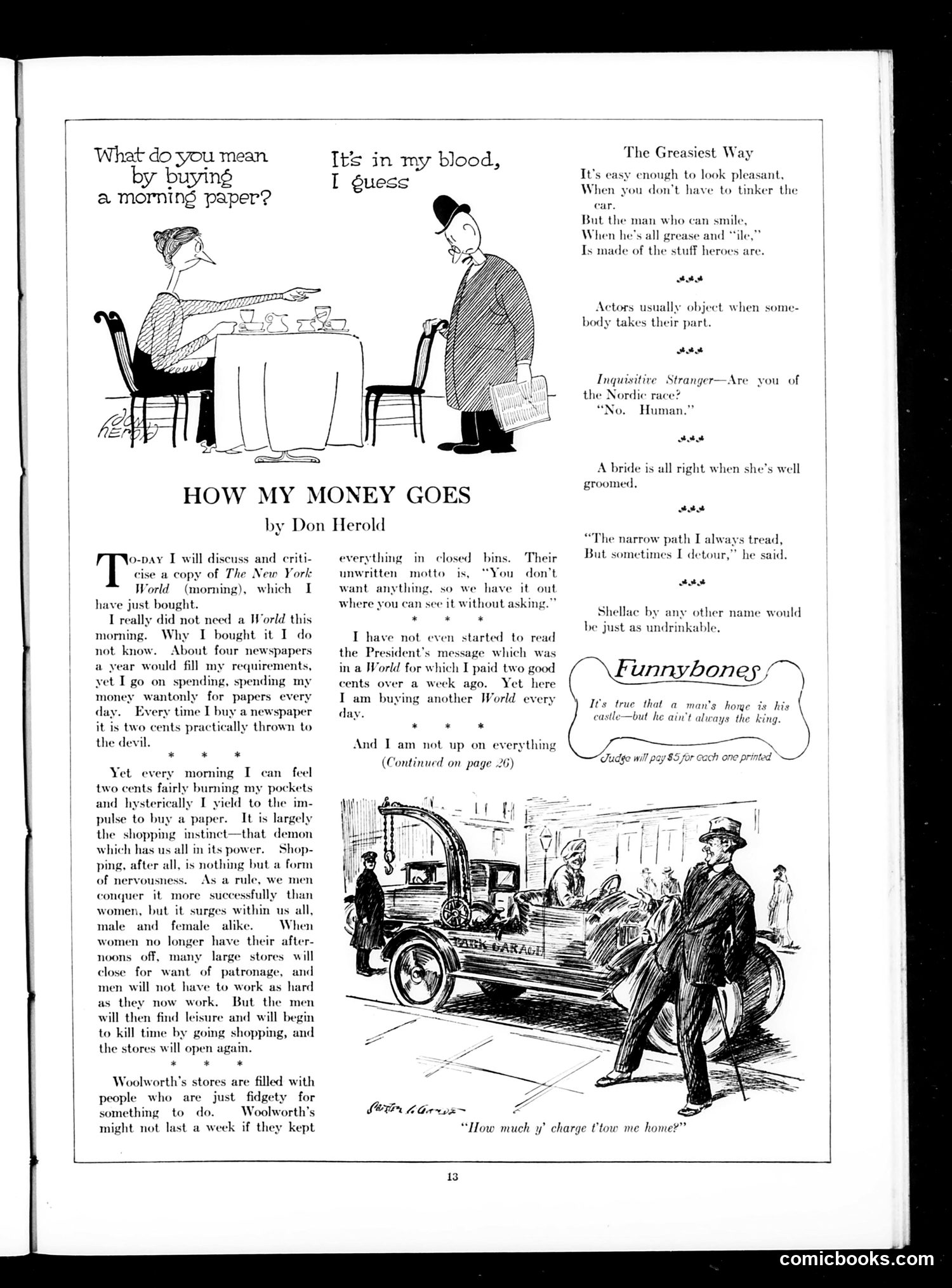
This page from *Judge* contains satirical commentary on American consumer habits and social observations, circa early 20th century. The main article, "How My Money Goes" by Don Herold, humorously critiques the compulsive newspaper-buying habit. Herold argues that despite rarely reading papers thoroughly, he reflexively purchases them daily—a two-cent waste driven by the shopping instinct rather than genuine need. He blames this on the same nervousness that fills Woolworth's stores with fidgety browsers. The satire targets both consumer psychology and the wasteful spending habits of ordinary Americans. The cartoon accompanying the article depicts a morning conversation where one man questions another's newspaper purchase, suggesting it reflects an ingrained, almost biological compulsion ("it's in my blood"). The page also includes various unrelated comic observations about automobiles, marriage, and social etiquette, typical of *Judge*'s format of brief satirical quips and illustrations.
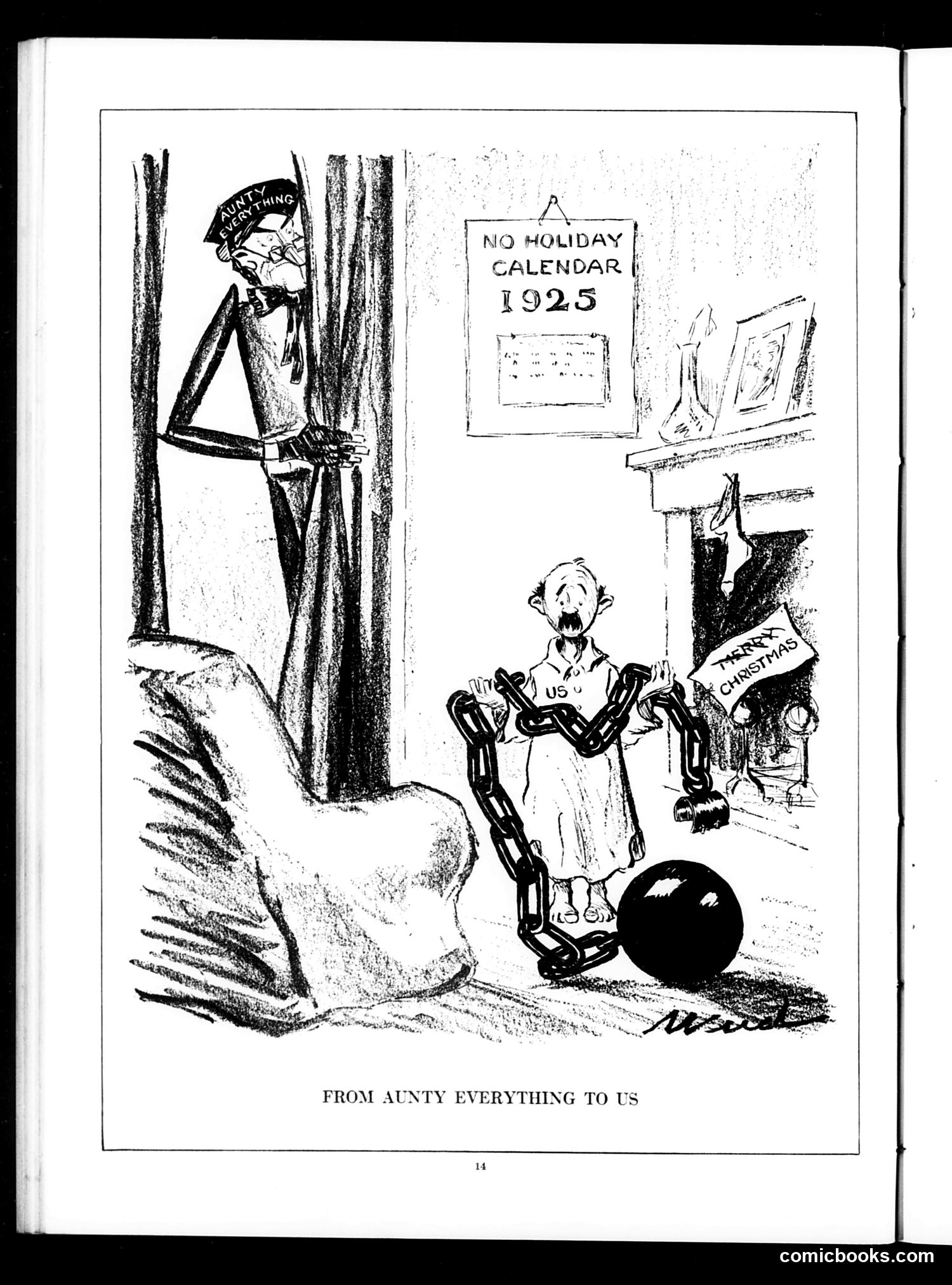
This 1925 *Judge* cartoon satirizes labor conditions and Christmas hardship. On the left, a skeletal figure labeled "EVERYTHING" (representing deprivation or hardship) lurks menacingly. On the right, a distressed woman is chained and bound, surrounded by Christmas imagery—a calendar marked "NO HOLIDAY," a wreath saying "MERRY CHRISTMAS," and a ball and chain. The caption "FROM AUNTY EVERYTHING TO US" suggests grim irony: "Aunty" (a term suggesting false comfort) offers nothing but continued suffering. The satire criticizes how working-class Americans, particularly women, received no respite from labor during the holiday season, while the calendar mockingly proclaims celebrations they couldn't afford or enjoy. It comments on economic inequality and exploitation persisting despite seasonal goodwill rhetoric.
This editorial essay, titled "Things," satirizes modern consumer culture through a judge's commentary. The piece argues that industrial mass production has fundamentally altered Christmas gift-giving from meaningful exchanges to obligatory consumption. The satire contrasts pre-industrial gift-giving—when handmade presents held genuine value and were remembered—with modern abundance where people forget gifts almost immediately. The author cites Samuel Strauss's *Atlantic* article "Things Are in the Saddle," suggesting that capitalism has inverted priorities: production now drives consumption rather than need driving production. The central joke targets economic absurdity: we've created such surplus that society must manufacture artificial demand ("produce the customers") to keep factories running. Americans now possess more comforts than historical kings, yet feel perpetually unsatisfied. The editorial mocks how Christmas has become less about meaningful giving than about society's desperate need for citizens to keep buying things they don't want or need.
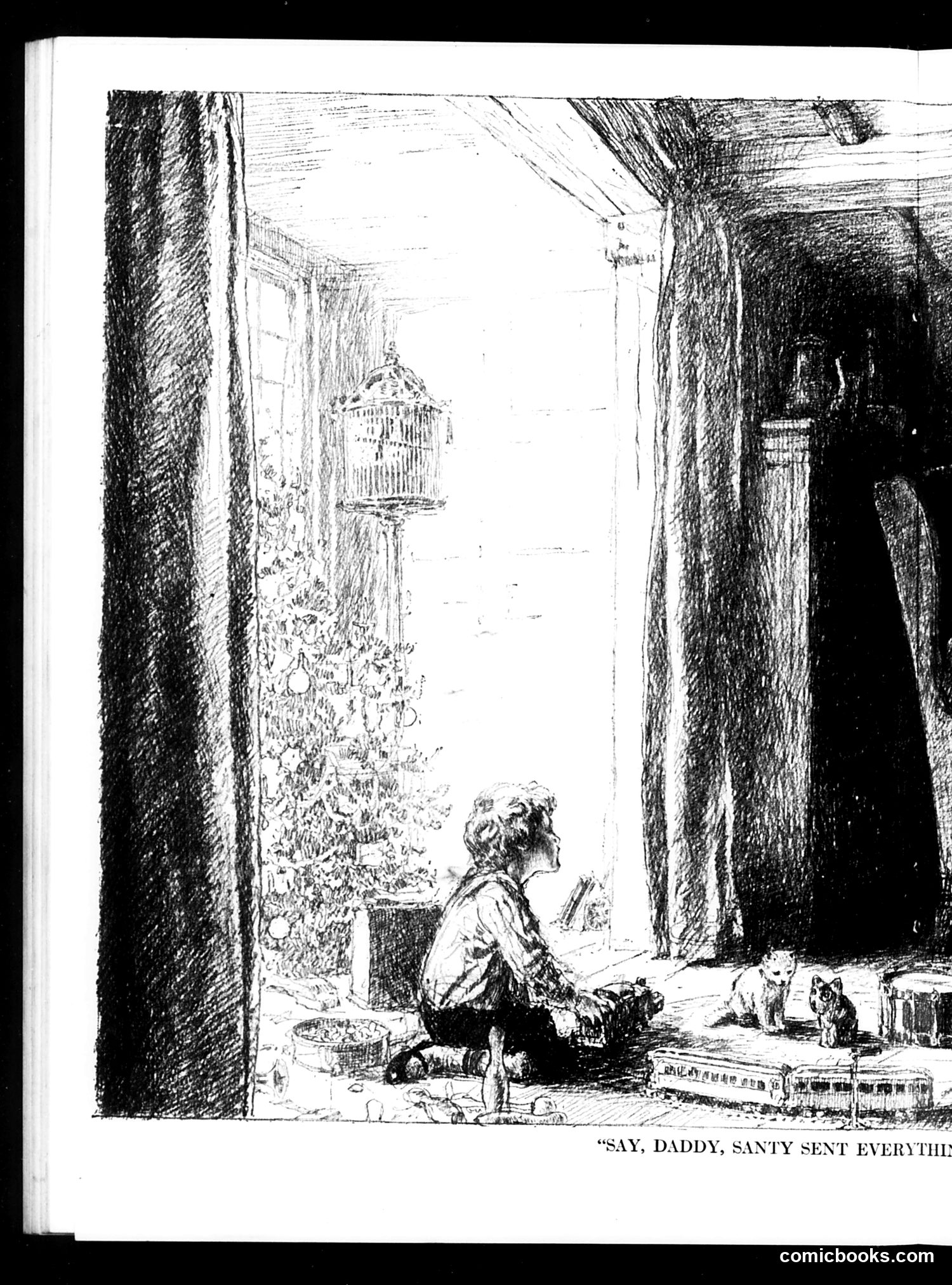
This appears to be a domestic scene rather than political satire. The sketch shows a young child sitting in what looks like a modest, cluttered alleyway or tenement setting, speaking to an adult (presumably the father). The child's incomplete dialogue—"Say, Daddy, Santy sent everythi[ng]"—suggests the caption continues beyond the visible text. The cartoon likely satirizes economic inequality or poverty during the Depression era, contrasting what Santa supposedly delivered with the family's actual circumstances. The detailed rendering of dilapidated surroundings—brick walls, scattered objects, cramped space—emphasizes hardship. The child's innocent optimism about Santa's generosity forms an ironic commentary on the gap between American promises of plenty and working-class reality. The exact intended message remains unclear without the complete caption.
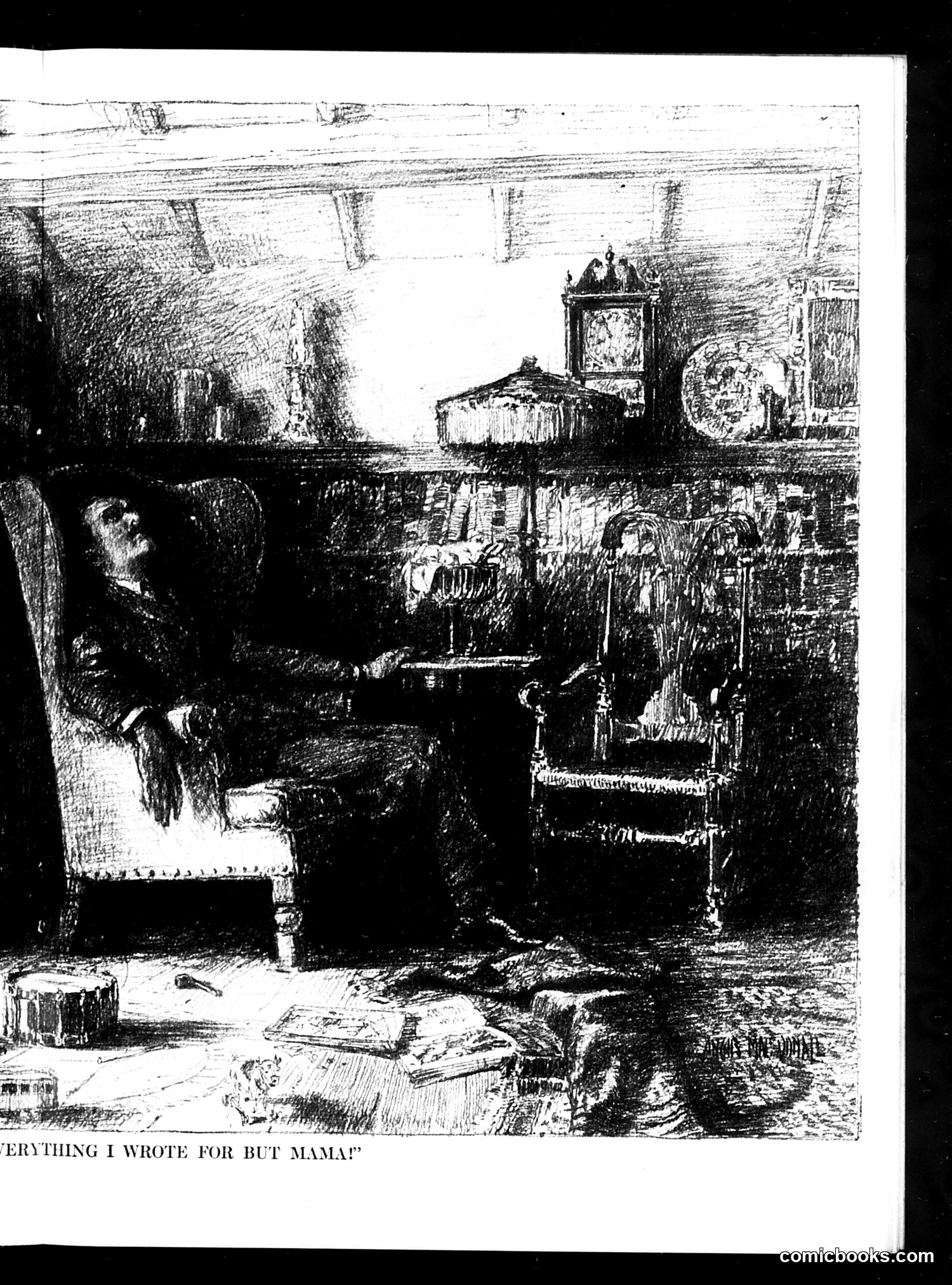
This appears to be a sketch from *Judge* magazine showing an interior domestic scene. A figure sits in a chair on the left side of what looks a Victorian-era room, with furniture, a fireplace, and decorative items visible. The caption reads "EVERYTHING I WROTE FOR BUT MAMA?" - suggesting the speaker is lamenting that despite their literary or written efforts, their mother remains unimpressed or unmoved by their work. The satire likely mocks either: aspiring writers seeking maternal approval, or the disconnect between an artist's ambitions and a parent's priorities/understanding. The sketch's heavy, dramatic style emphasizes the melancholy of this domestic disappointment. Without additional context about when this was published, it's unclear what specific literary figure or contemporary writer this might reference.
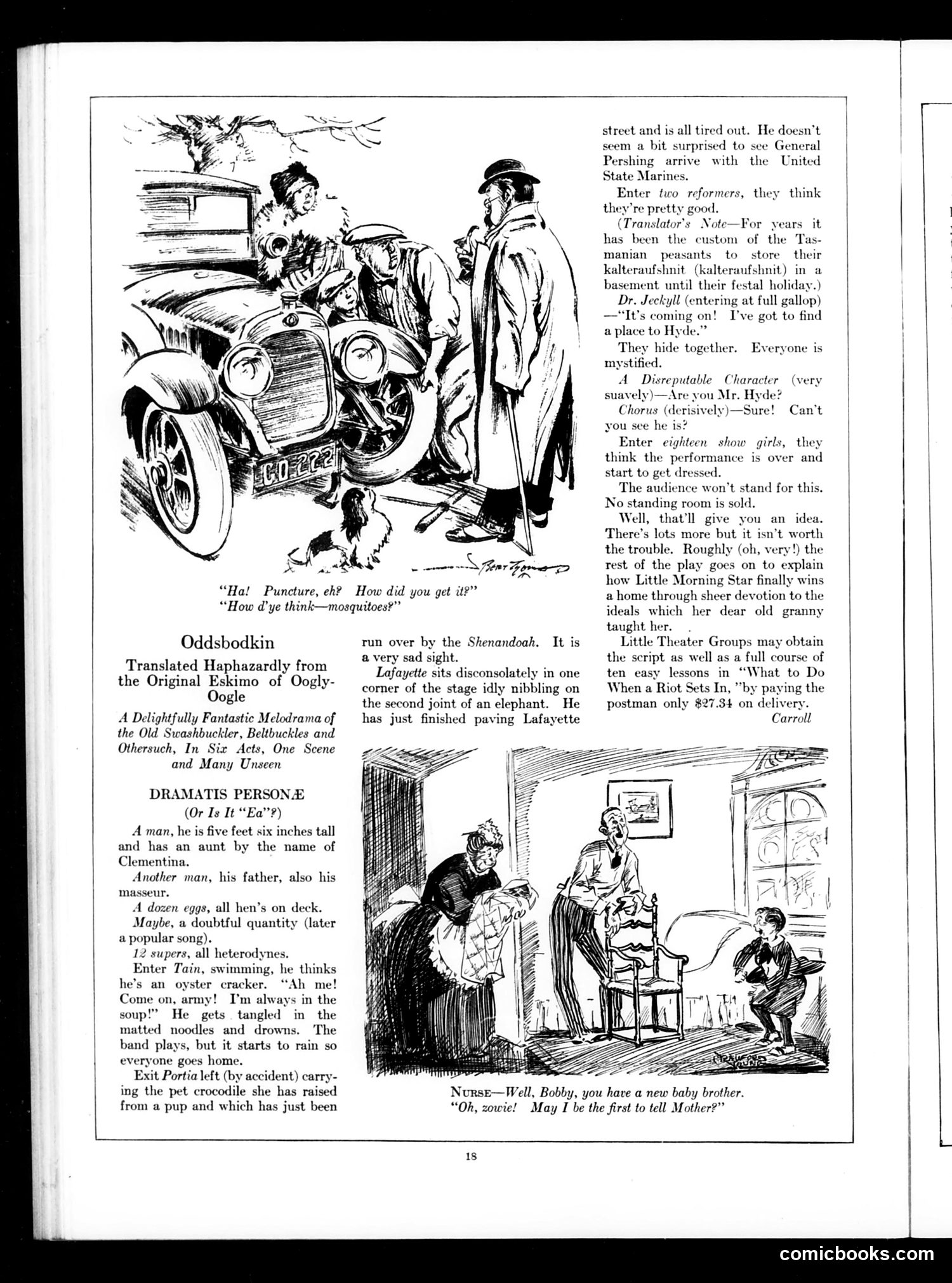
This page satirizes pretentious avant-garde theater of the 1920s. The mock play "Oddsbodkin" is deliberately absurd—characters swim thinking they're oyster crackers, drown in noodles, Lafayette nibbles elephant joints, and Dr. Jekyll appears for no reason. The satire escalates when eighteen showgirls undress mid-performance, the audience riots, and the author admits the rest of the plot is incomprehensible filler about "Little Morning Star." The joke targets experimental theater groups who presented confusing, self-important work. Judge mocks both the incomprehensible scripts themselves and the pretense surrounding them. The fake "script available for $27.34" parodies Little Theater Groups' actual educational offerings, suggesting their productions were equally nonsensical yet sold as meaningful art. The cartoons above show unrelated domestic scenes, emphasizing the magazine's eclectic, comedic approach to satirizing contemporary culture.
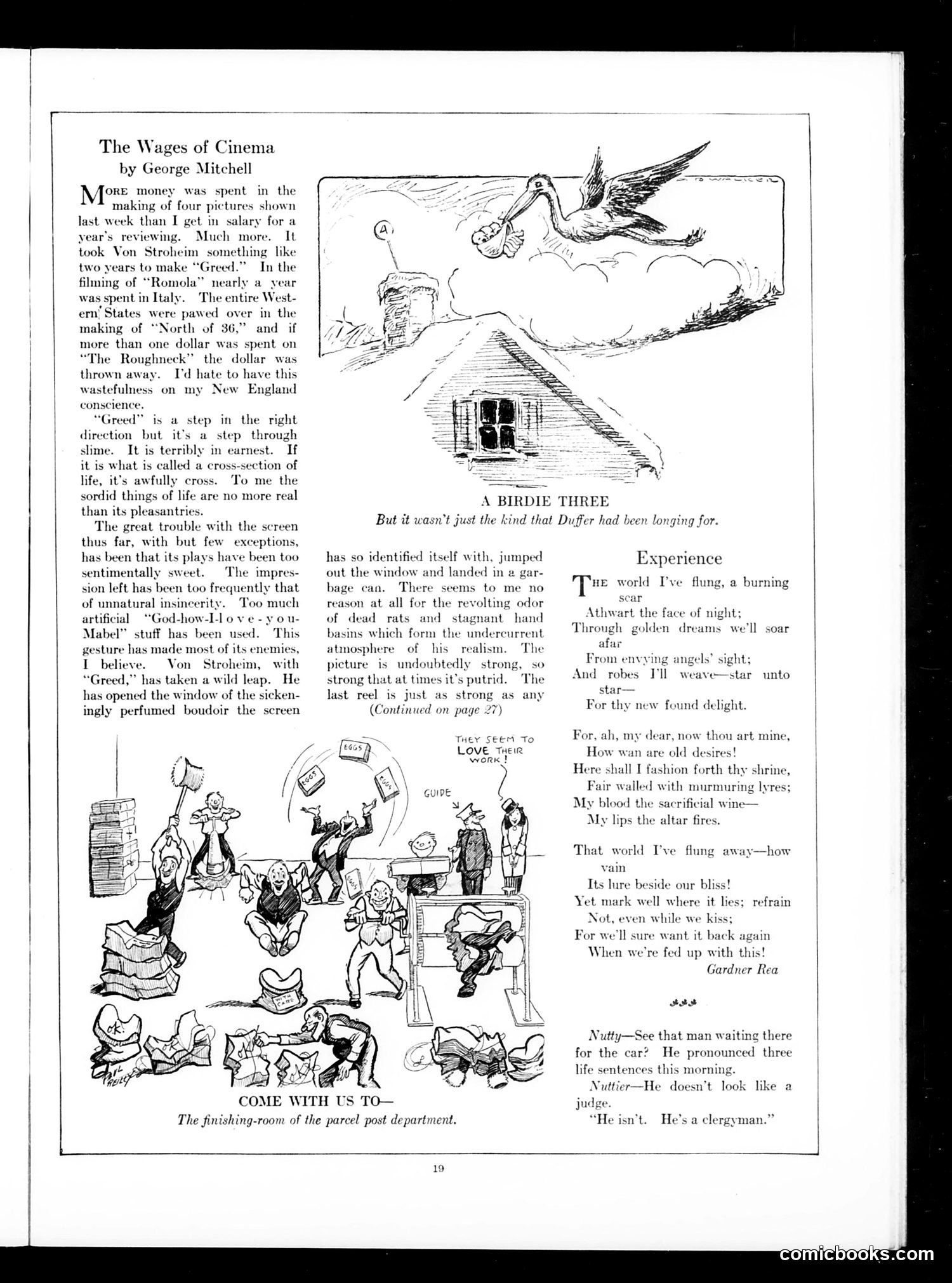
This page satirizes Hollywood's extravagant film production budgets circa the 1920s. Critic George Mitchell complains that single films (like Von Stroheim's "Greed," "Romola," and "North of 36") consumed budgets exceeding his annual salary, representing wasteful spending he finds troubling. Mitchell critiques the cinema's historical sentimentality and artificial "God-how-I-love-you-Mabel" theatrics. While praising Stroheim's "Greed" for boldly departing toward harsh realism, Mitchell argues the director overcorrected—making the film's atmosphere gratuitously sordid with "dead rats and stagnant hand basins." The cartoon below satirizes film industry chaos: workers in the "parcel post department" juggle endless projects labeled "love their work," depicting the frantic, disorganized nature of movie production. The accompanying poem and jokes are unrelated filler content typical of Judge's mixed editorial format.
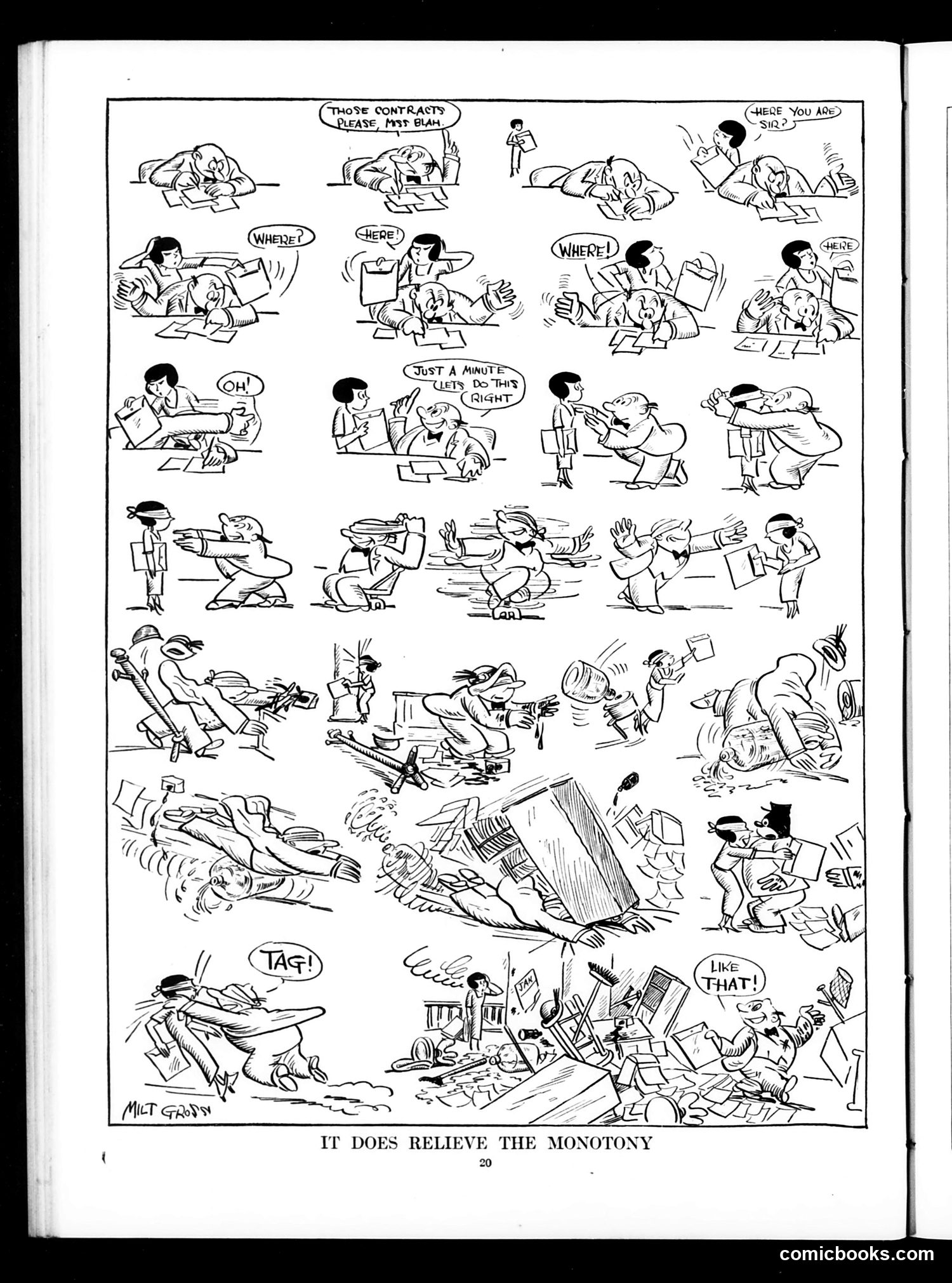
This single-panel cartoon by Milt Gross depicts office workers engaged in increasingly chaotic and physical play—chasing, wrestling, tumbling, and throwing papers and furniture around their workplace. The caption "It Does Relieve the Monotony" suggests this mayhem serves as comic relief from tedious office work. The opening dialogue references boring contracts, establishing that routine paperwork prompts this anarchic behavior as an escape. The satire mocks the soul-deadening nature of clerical labor in corporate America, where workers become so desperate for stimulation that violent horseplay becomes preferable to their actual duties. Gross's exaggerated, dynamic drawing style emphasizes the workers' manic energy compared to their earlier slumped postures. This reflects early-20th-century anxieties about industrialization, bureaucracy, and worker alienation.
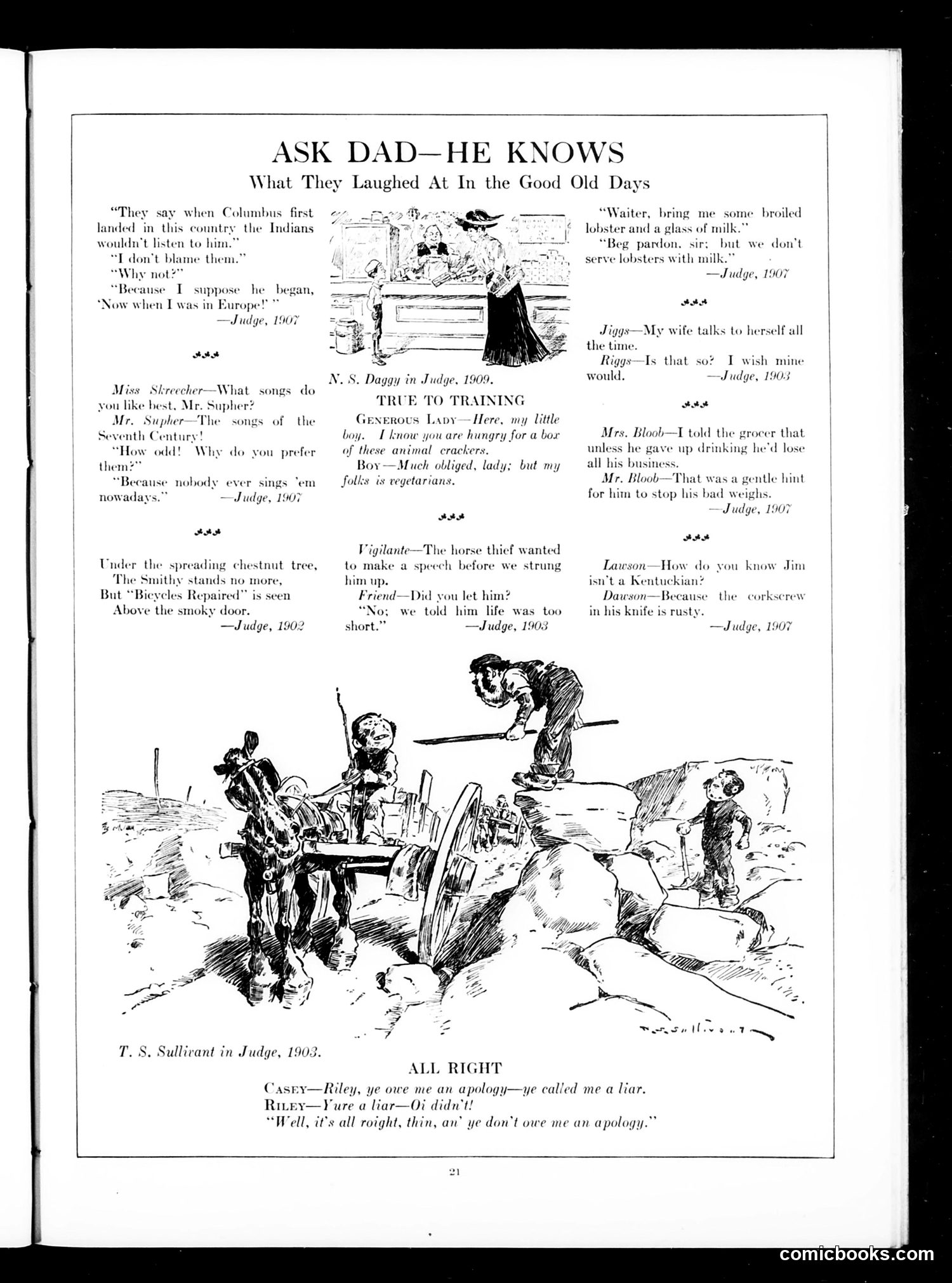
This is a humor column featuring jokes attributed to *Judge* magazine (1902-1909) reflecting early 20th-century American attitudes. The page mixes various comedy types: **Social commentary**: The bicycle repair shop replacing a blacksmith's forge laments modernization. A vegetarian child refuses animal crackers—reflecting emerging dietary movements. Wives' nagging and marital discord appear as recurring targets. **Ethnic humor**: The final dialogue between "Casey" and "Riley" uses exaggerated Irish brogue and dialect spelling ("roight," "Oi"), typical of period stereotyping of Irish immigrants. **Class/comportment jokes**: A diner ordering lobster with milk is mocked for poor taste; a grocer's drinking problem is addressed through hints rather than directness. **Frontier violence**: A lynching joke treats vigilante justice casually. The cartoon illustration (by T.S. Sullivant) depicts frontier prospectors or miners, adding visual comedy. The humor relies on period anxieties about social change, immigrant stereotypes, and domestic friction—reflecting *Judge's* satirical but often conservative readership.
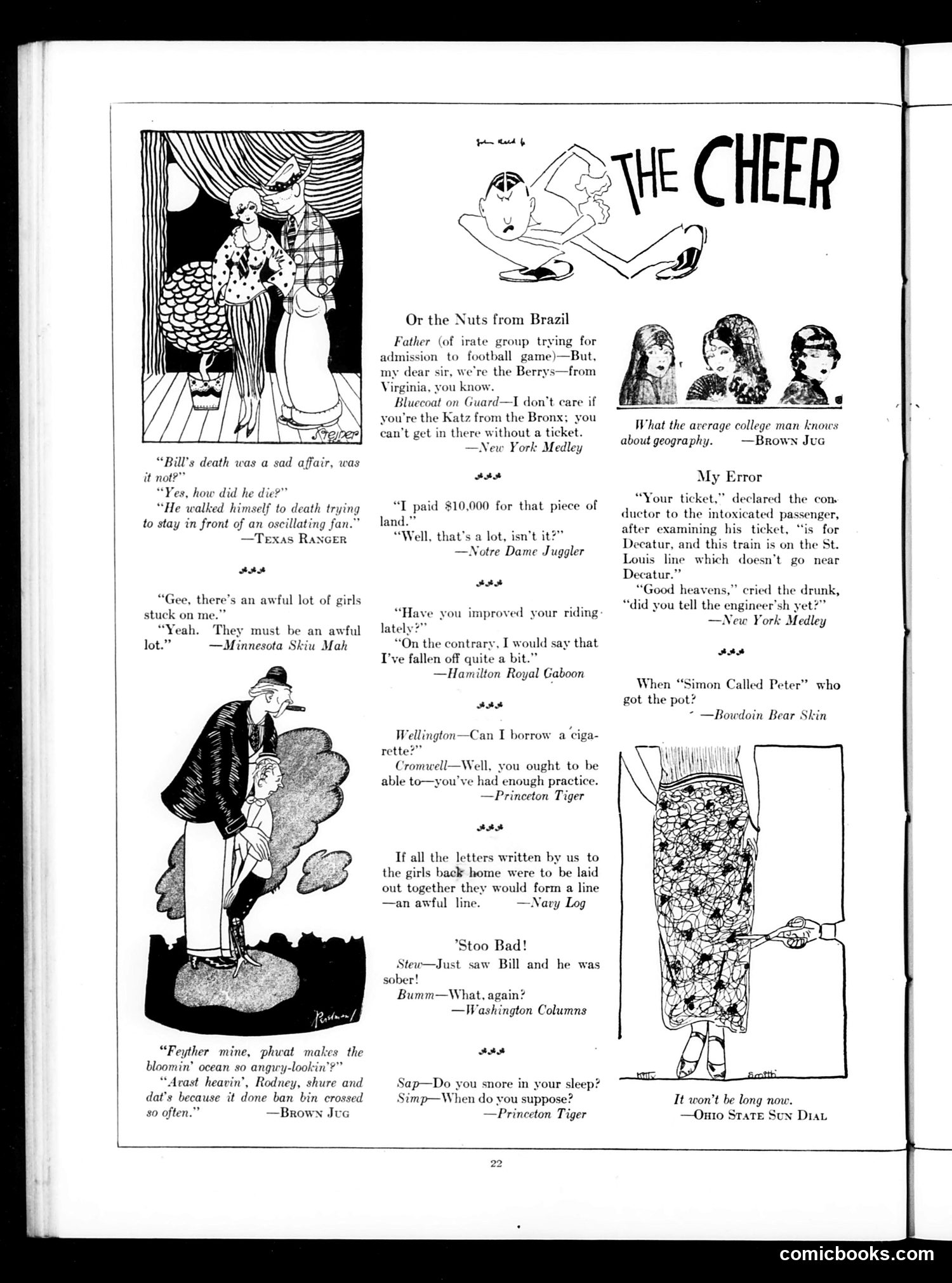
This page from **Judge** magazine collects brief humorous anecdotes and jokes typical of early 20th-century college and social humor. The cartoons and quips satirize: **Social observations**: The jokes mock college students' ignorance (the "average college man" knowing nothing about geography), romantic entanglements ("awful lot of girls stuck on me"), and drinking culture (the intoxicated passenger, Bill's sobriety being noteworthy). **The main cartoon** ("The Cheer") depicts a rotund man cheering at what appears to be a football game—satirizing enthusiastic but physically unfit fans. The subtitle references "nuts from Brazil," suggesting either imported goods or foreign spectators. **Period details**: References to oscillating fans, train lines, and letters home from military/naval service date this to the WWI era. The college publication attributions (Princeton Tiger, Brown Jug, Notre Dame Juggler) show this represents Ivy League and college humor traditions. The humor is light, domestic, and focused on everyday absurdities rather than political commentary.
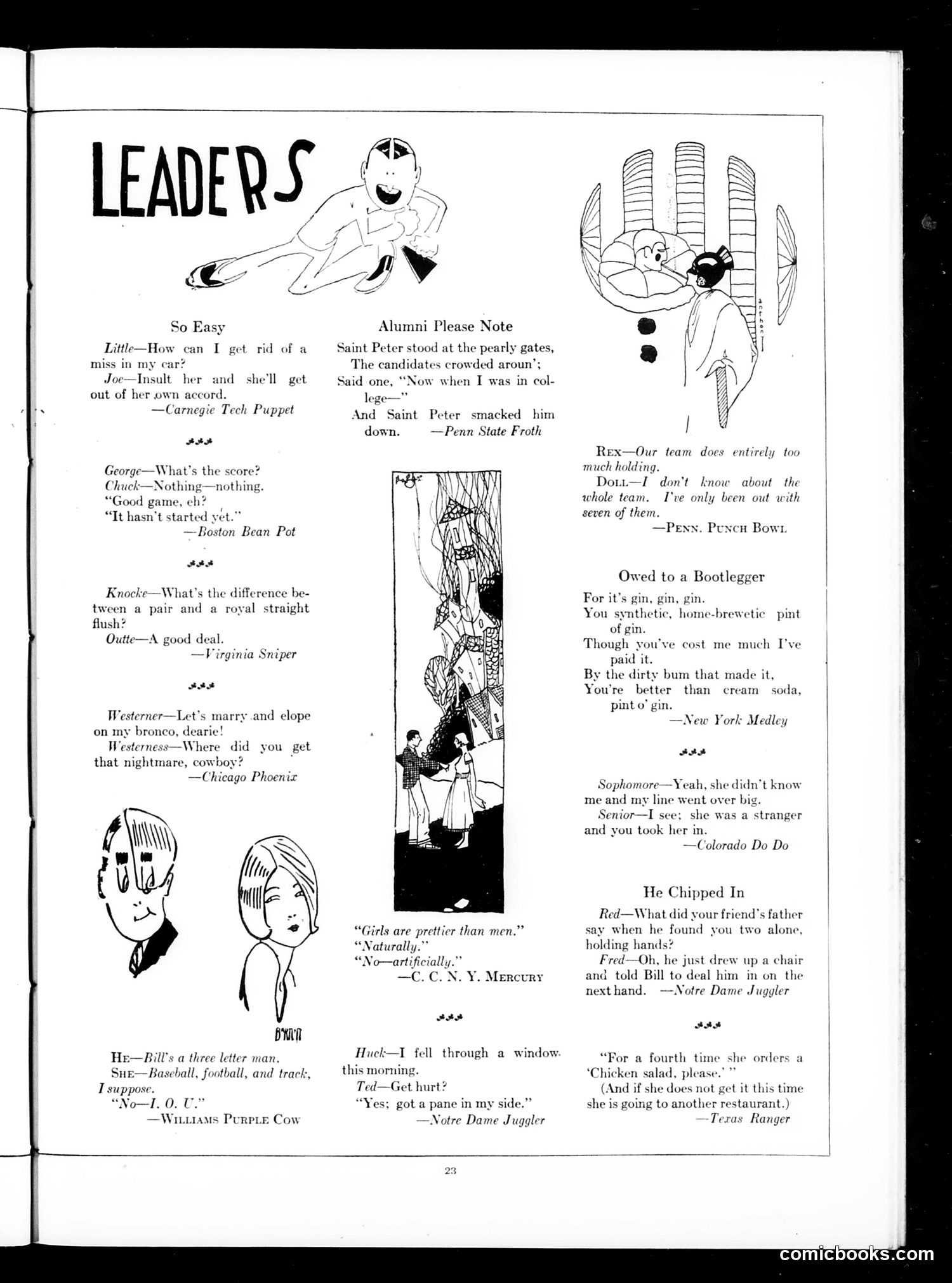
This page from *Judge* magazine contains brief humorous exchanges ("leaders") rather than political cartoons. The humor relies on wordplay and period-specific references: **Key jokes:** - A woman insulting a man to end a relationship ("out of her own accord") - A zero sports score dismissed as "not started yet" - "I.O.U." (debt) as a "three letter man" at college - Prohibition-era bootleg gin ("synthetic, home-brewetic") - A pane of glass pun ("pane in my side") - College dating deceptions **Historical context:** These are college and dating humor pieces, many sourced from university publications (*Carnegie Tech Puppet*, *Penn State Froth*, *Notre Dame Juggler*). They reflect 1920s-30s social attitudes about courtship, athletics, and Prohibition. The "bootlegger" joke references illegal alcohol production during Prohibition. The cartoons show stylized flappers and young men—typical *Judge* illustration style. Nothing here targets specific political figures; instead, it's lighthearted social satire aimed at educated readers and college audiences.
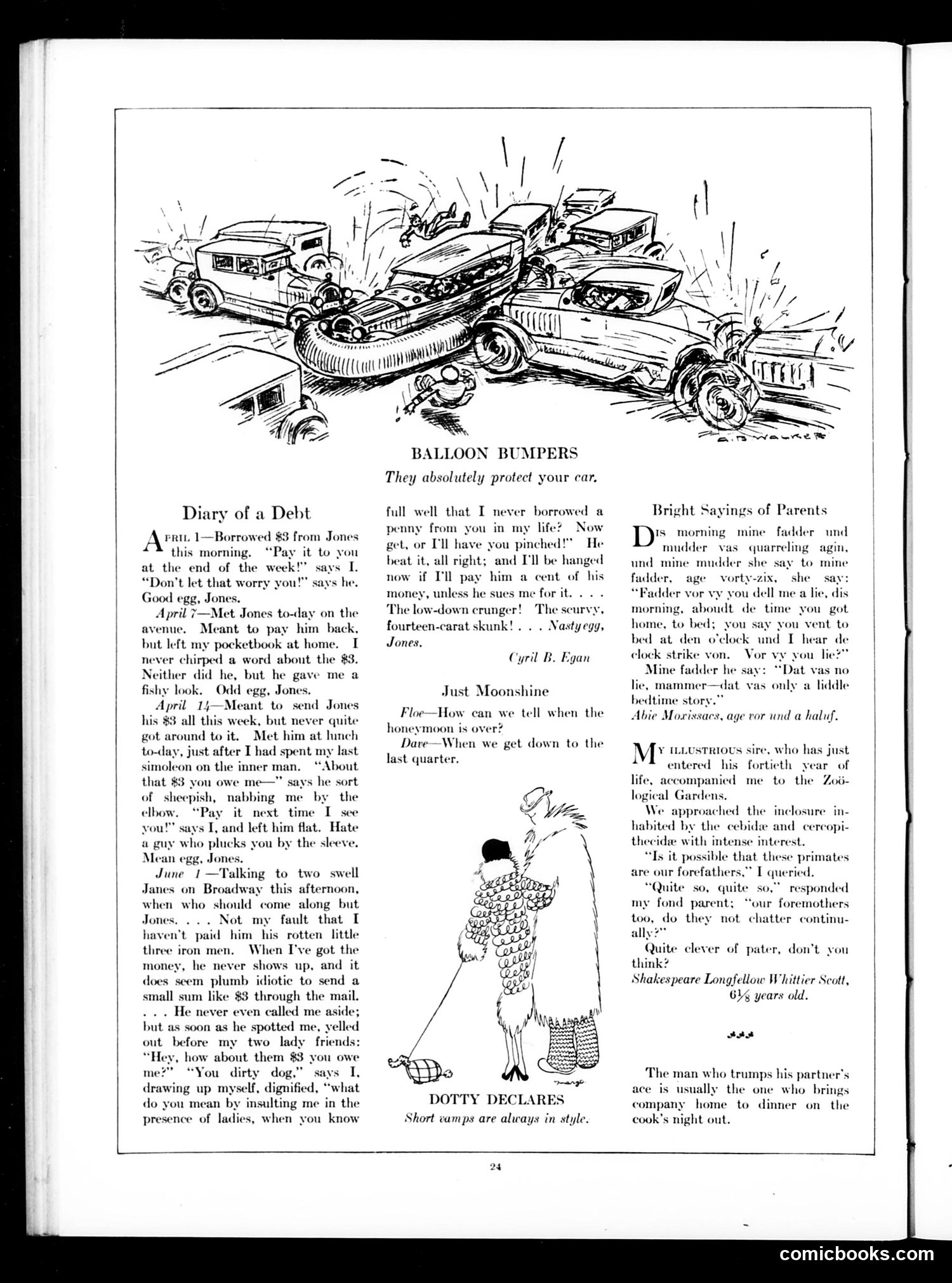
This page from *Judge* magazine contains three satirical pieces mocking common social situations: **"Diary of a Debt"** ridicules a debtor's hypocrisy. A man borrows $3 from Jones and repeatedly avoids repayment. When Jones finally publicly asks for the money (embarrassing the narrator in front of women), the debtor responds with outrage and swears never to pay—blaming Jones for being tactless rather than acknowledging his own dishonesty. The satire targets how people rationalize their failures and turn victim when confronted. **"Just Moonshine"** is a brief joke about honeymoons ending when finances dwindle. **"Balloon Bumpers"** advertises car safety equipment with an illustration of a collision. The remaining items—"Dotty Declares," "Bright Sayings of Parents," and closing quips—are brief humor pieces using stereotypical immigrant dialect and observations about human behavior. The overall page exemplifies *Judge*'s format: social satire paired with advertisements and miscellaneous comic commentary on contemporary American life.
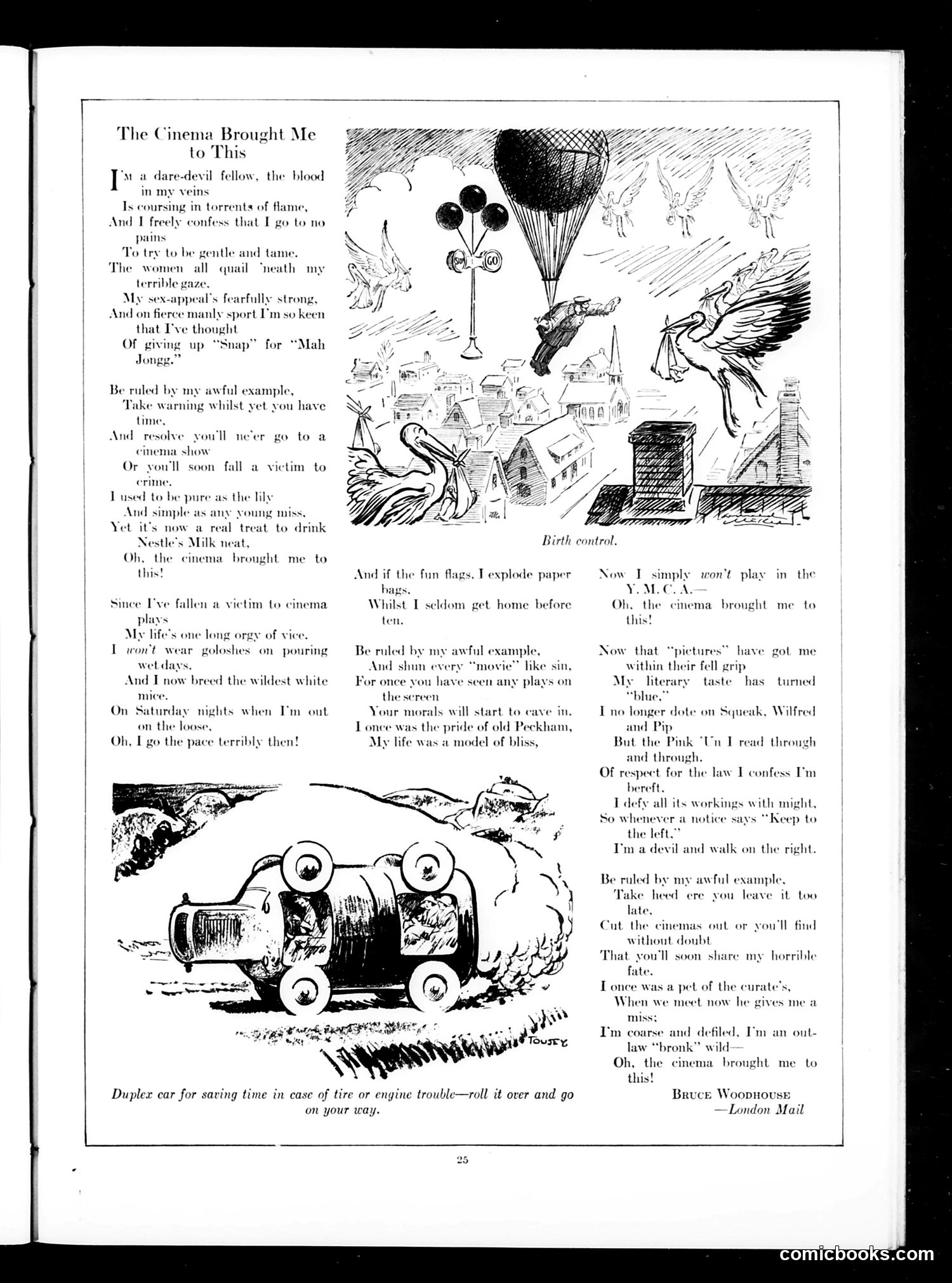
This satirical poem and cartoons mock the moral panic over cinema's corrupting influence—a genuine concern among early 20th-century British conservatives. The speaker, a formerly pure and respectable person (from Peckham), catalogs increasingly trivial "vices" supposedly caused by moviegoing: staying out late, exploding paper bags, refusing to wear galoshes, breeding white mice, reading lowbrow publications instead of classics, and jaywalking. The humor lies in the absurdity of equating cinema attendance with moral collapse. The "crimes" listed are petty rather than serious, satirizing how middle-class moralists exaggerated cinema's dangers. The accompanying illustrations (including one labeled "Birth control" and a "Duplex car") add visual comedy to the social commentary. By attributing minor behavioral changes to movies, the piece ridicules conservative anxieties about modern entertainment and leisure, suggesting such fears were overwrought and disconnected from real consequences.
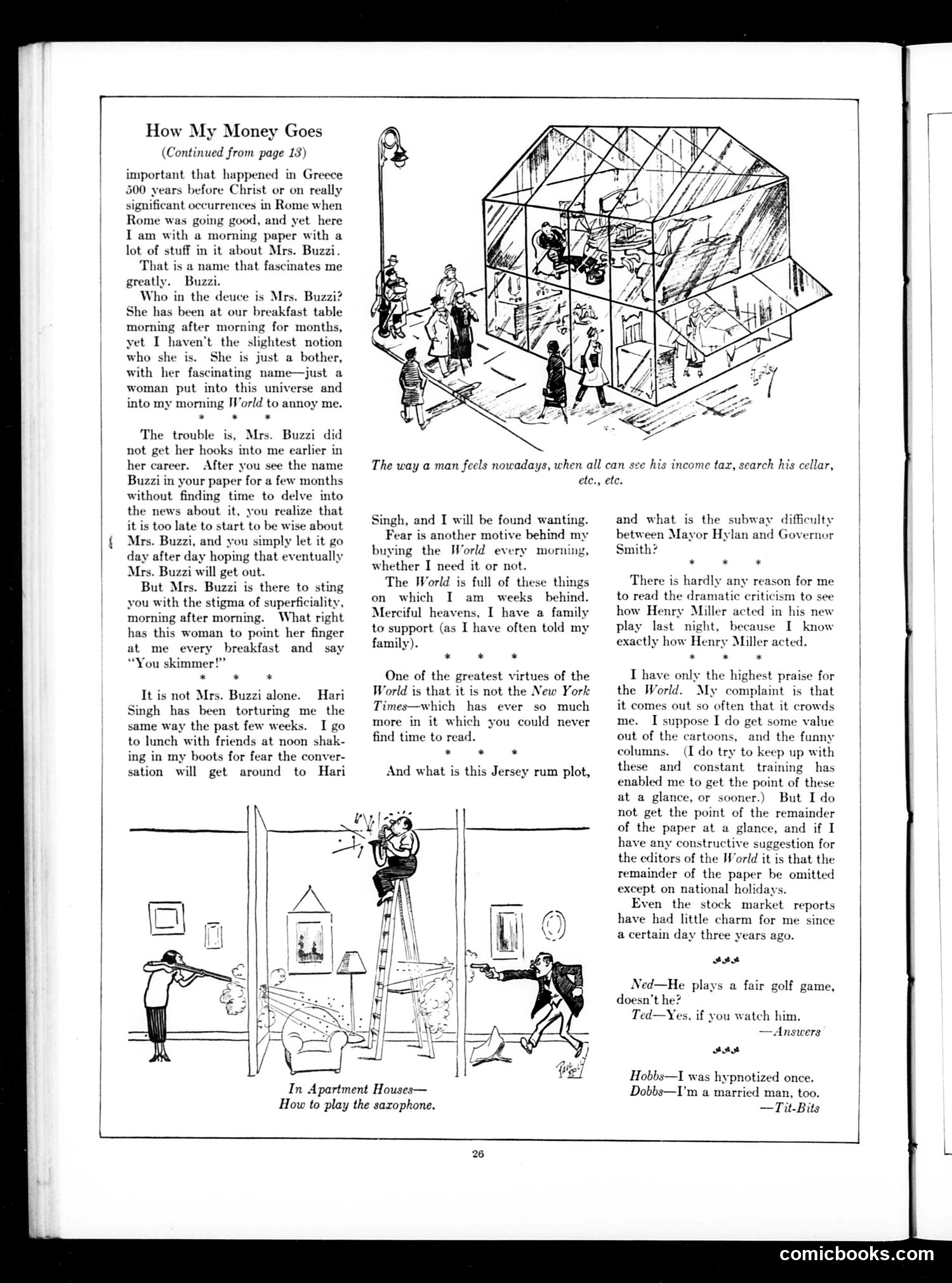
This humorous essay satirizes modern newspaper anxiety and information overload. The author complains about being tormented by newspaper stories he encounters but never investigates — Mrs. Buzzi and Hari Singh appear repeatedly in the *World* (a New York daily), creating social embarrassment when these names arise in conversation. He buys the paper daily from fear of being uninformed, yet admits he can't keep up with the volume of news. The satire targets: - **Information anxiety**: Modern readers feel obligated to know everything newspapers print - **The World newspaper's relentless daily publication** (contrasted favorably with the *Times*, which contains even more unreadable content) - **Urban sophistication performance**: Breakfast table and lunch conversations demand current knowledge The accompanying cartoons mock suburban apartment life and social pretension. The joke reflects a distinctly early-20th-century anxiety about mass media's expectations on readers' time and attention.
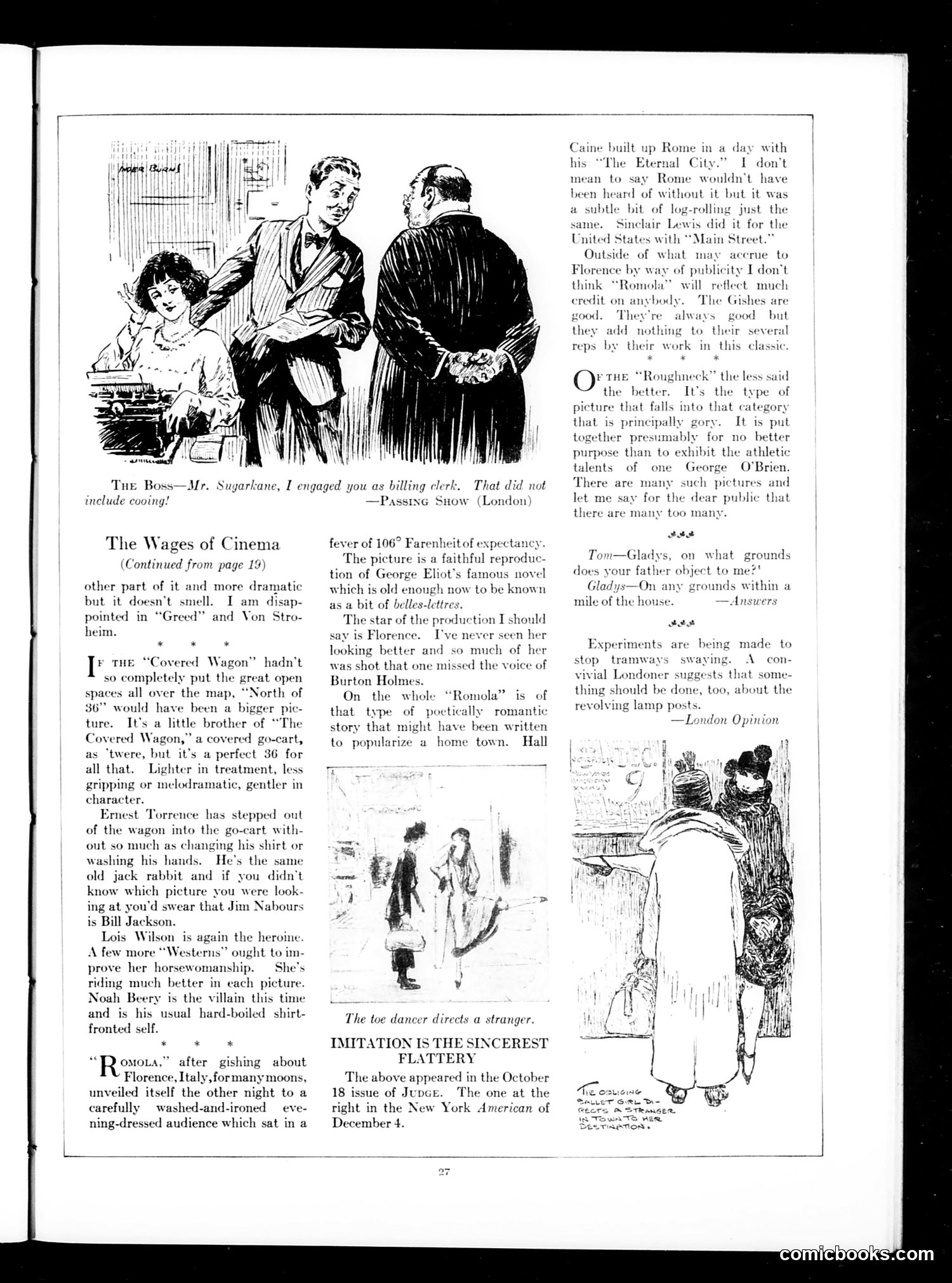
This page from Judge magazine contains film reviews and a small comic joke. The main cartoon at top shows an office scene where a boss confronts an employee (billing clerk "Mr. Sugarlane") about unprofessional behavior—the caption's humor comes from the employee apparently engaging in romantic "cooing" at work rather than performing duties. The bulk of the page reviews recent films: "North of 36" (a Western sequel), "Romola" (adapted from George Eliot's novel), and "The Roughneck" (an action picture). The critic praises the Gish sisters and actress Florence but dismisses "The Roughneck" as merely showcasing athletic stunts with no artistic merit. At bottom, a section titled "Imitation Is the Sincerest Flattery" shows two nearly identical cartoons—one from Judge's October 18 issue and one from the New York American's December 4 issue—depicting a "toe dancer" directing a stranger. Judge is calling out the American for copying their cartoon design.
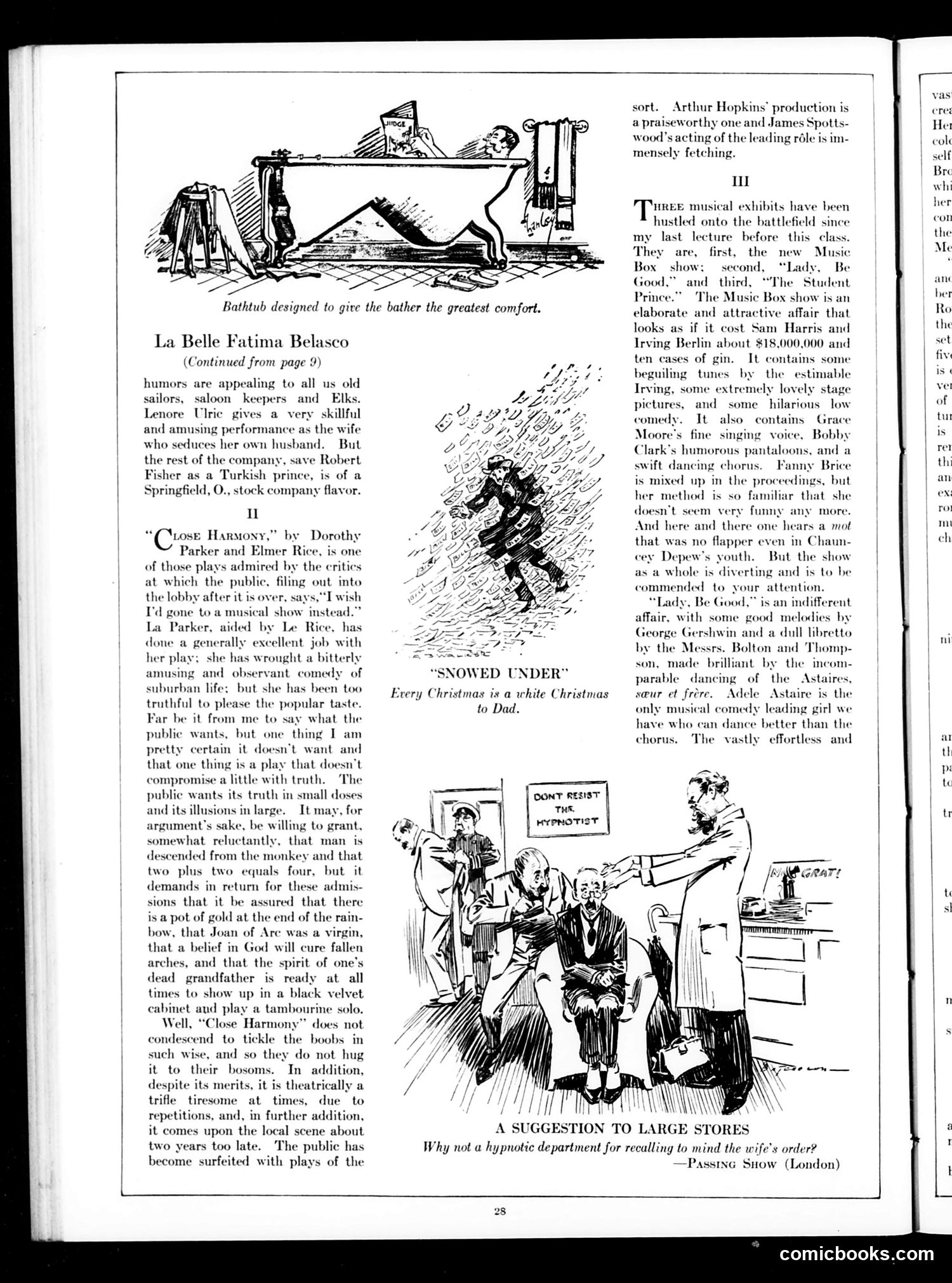
This page reviews three Broadway productions: "La Belle Fatima Belasco," "Close Harmony," and three Music Box shows including "Lady, Be Good" and "The Student Prince." The cartoons illustrate theater-related humor: 1. **"Bathtub" sketch**: A visual gag about comfort during performances—audiences want leisure, not challenge. 2. **"Snowed Under"**: Depicts a father receiving Christmas gifts, suggesting domestic contentment. 3. **"Suggestion to Large Stores"**: A satirical proposal for a "hypnotic department" to help wives remember shopping orders—mocking both retail practices and marital dynamics of the era. The text critiques how audiences prefer comforting illusions over uncomfortable truths. The reviewer notes "Close Harmony" fails commercially because it honestly depicts suburban life rather than flattering audiences with pleasing falsehoods. The Music Box productions succeed because they offer spectacle and entertainment without demanding intellectual engagement—exactly what the public wants.
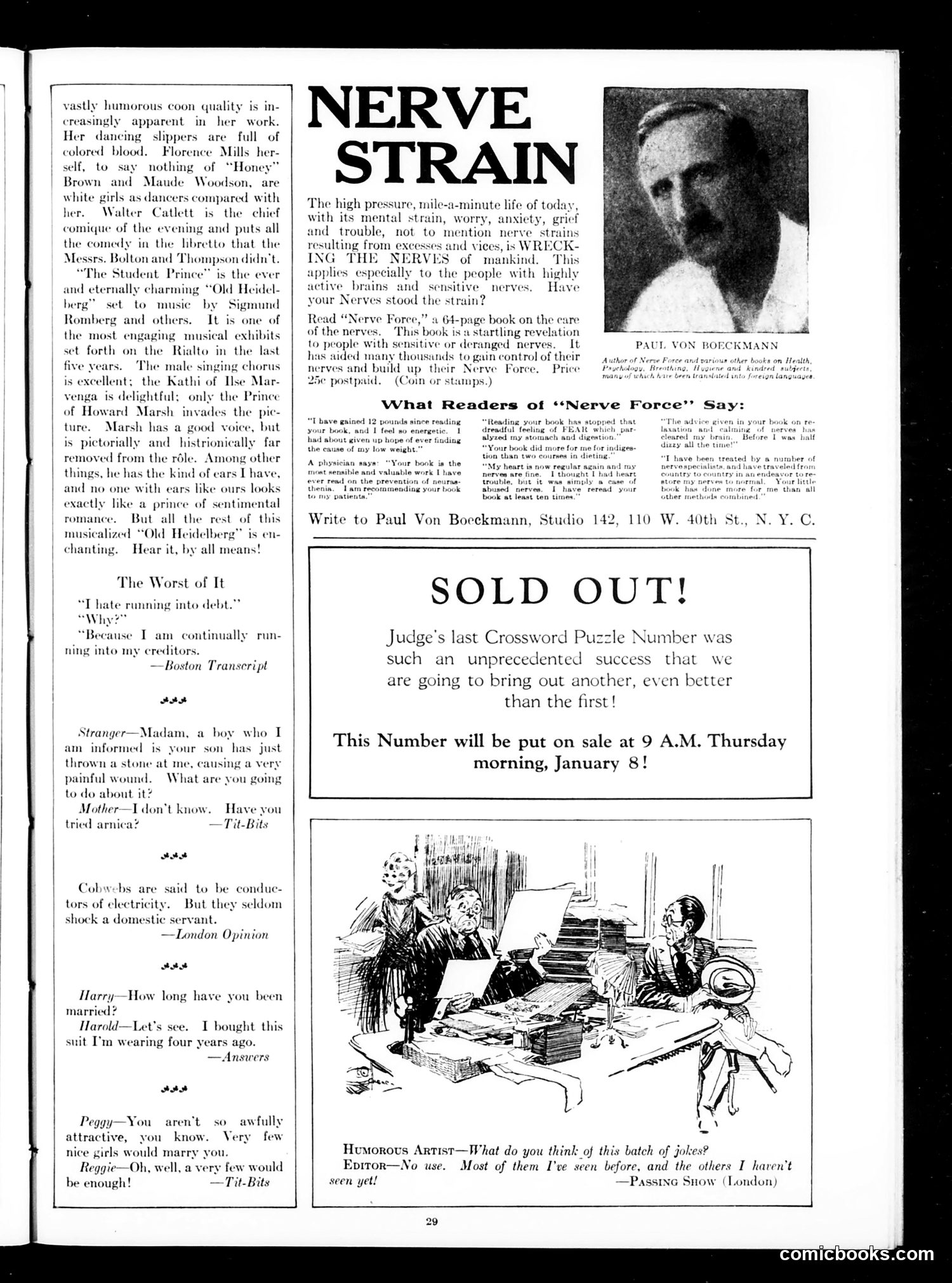
This page is primarily **advertising and filler content** rather than political satire. The main elements: **"Nerve Strain" Advertisement**: A commercial for Paul Von Boeckmann's "Nerve Force" book (64 pages, addressing nervous conditions). This reflects early 20th-century anxiety about modern life's psychological toll—the "high pressure, mile-a-minute life" resonated with contemporaries worried about industrialization and stress. **"Sold Out!" Announcement**: Judge magazine is promoting a forthcoming crossword puzzle issue, capitalizing on an earlier successful crossword number. **Scattered Jokes**: Brief humor snippets typical of Judge's format—mild domestic comedy ("How long married?" answered by suit wear duration) and observational humor about creditors and household servants. **Notable Language**: The theatrical review uses period-appropriate but now-offensive racial terminology when discussing performer Florence Mills, reflecting the era's problematic attitudes. The page lacks sustained political or social satire; it's mostly commercial promotion and light comedy filler.
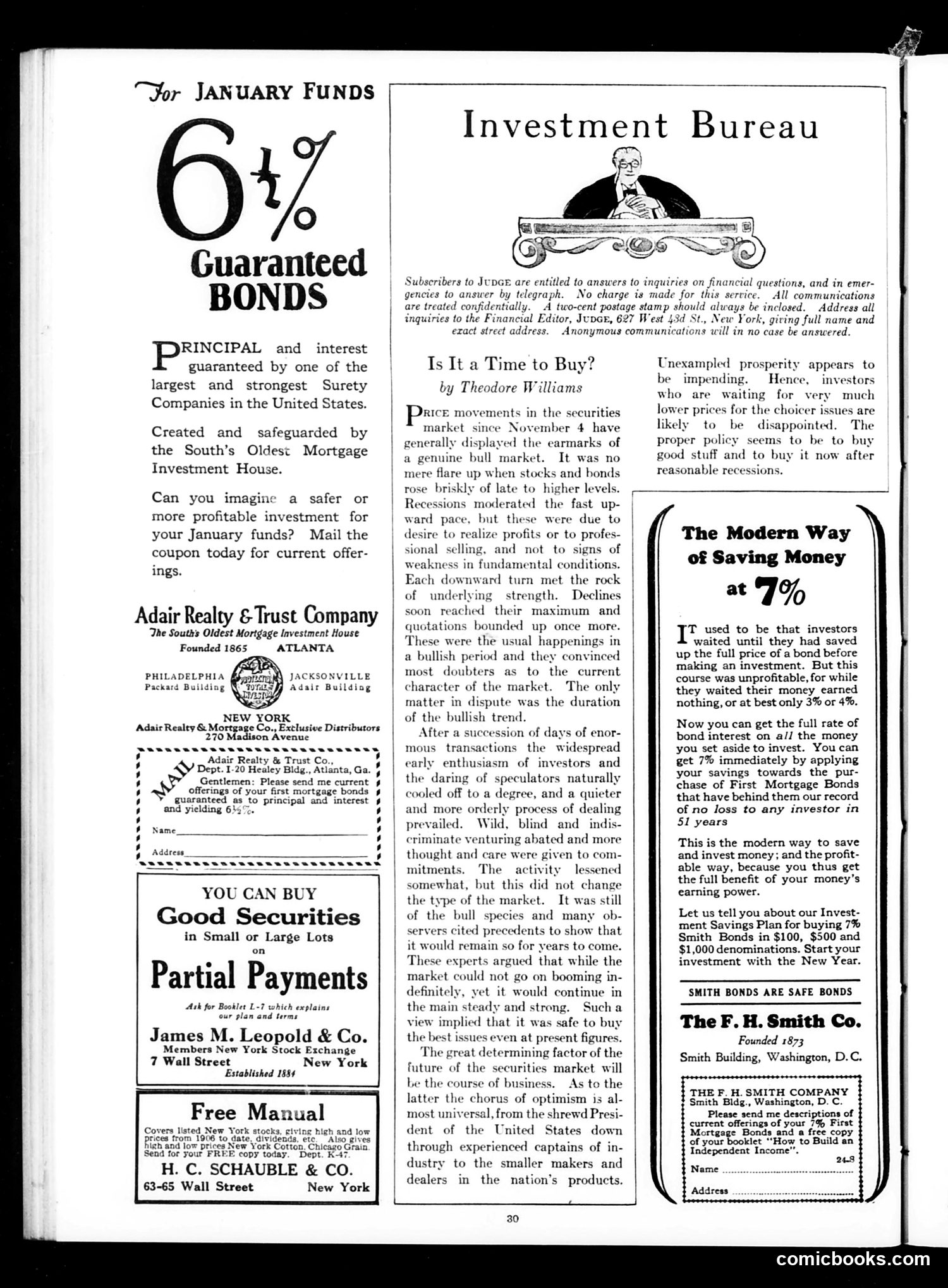
This page is primarily **financial advertising**, not political satire. It features multiple investment firms promoting bonds and securities to readers, capitalizing on post-election market optimism (referenced as "since November 4"). The central article, "Is It a Time to Buy?" by Theodore Williams, discusses the 1920s bull market. Williams argues that recent stock and bond price increases reflect genuine economic strength—not mere speculation—and that business fundamentals support continued market gains. He cites widespread optimism from President [Calvin] Coolidge through industry leaders. The advertisements (Adair Realty, James M. Leopold & Co., F.H. Smith Co.) emphasize safety and guaranteed returns, offering bonds yielding 6.5-7%. This reflects pre-Great Depression confidence in financial stability. The page also includes Judge's "Investment Bureau," offering free financial advice to subscribers. **Historical context**: This represents 1920s investment culture before the 1929 crash, when such promotional optimism was standard and largely unchallenged.
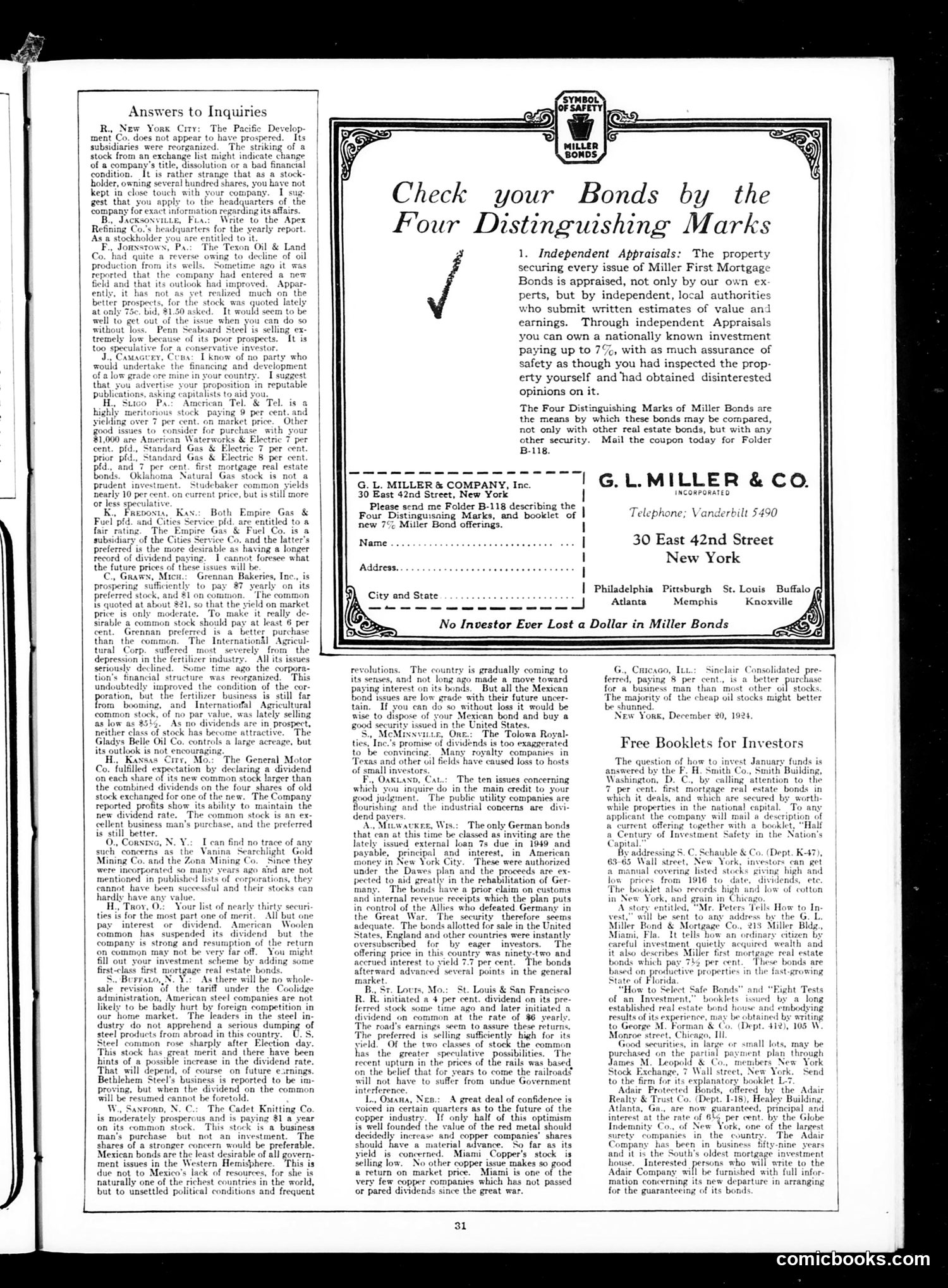
This page is primarily **financial advice, not satire or political content**. It's a legitimate "Answers to Inquiries" column where readers ask about investment recommendations—stocks, bonds, and mining companies. The **G.L. Miller & Company advertisement** dominates the right side, promoting Miller Bonds with "Four Distinguishing Marks" including independent appraisals and investor protections. This reflects early 20th-century financial marketing. The column itself addresses genuine investor concerns about company dividends, stock valuations, and reorganizations (Pacific Development Co., Texon Oil, American Telephone & Telegraph, etc.). Readers seek guidance on whether to hold or sell struggling investments or buy promising securities. **No cartoon content is visible**—this appears to be a business/finance page rather than satirical material, despite appearing in Judge magazine. It represents the era's investment culture before modern regulatory protections like the SEC existed.
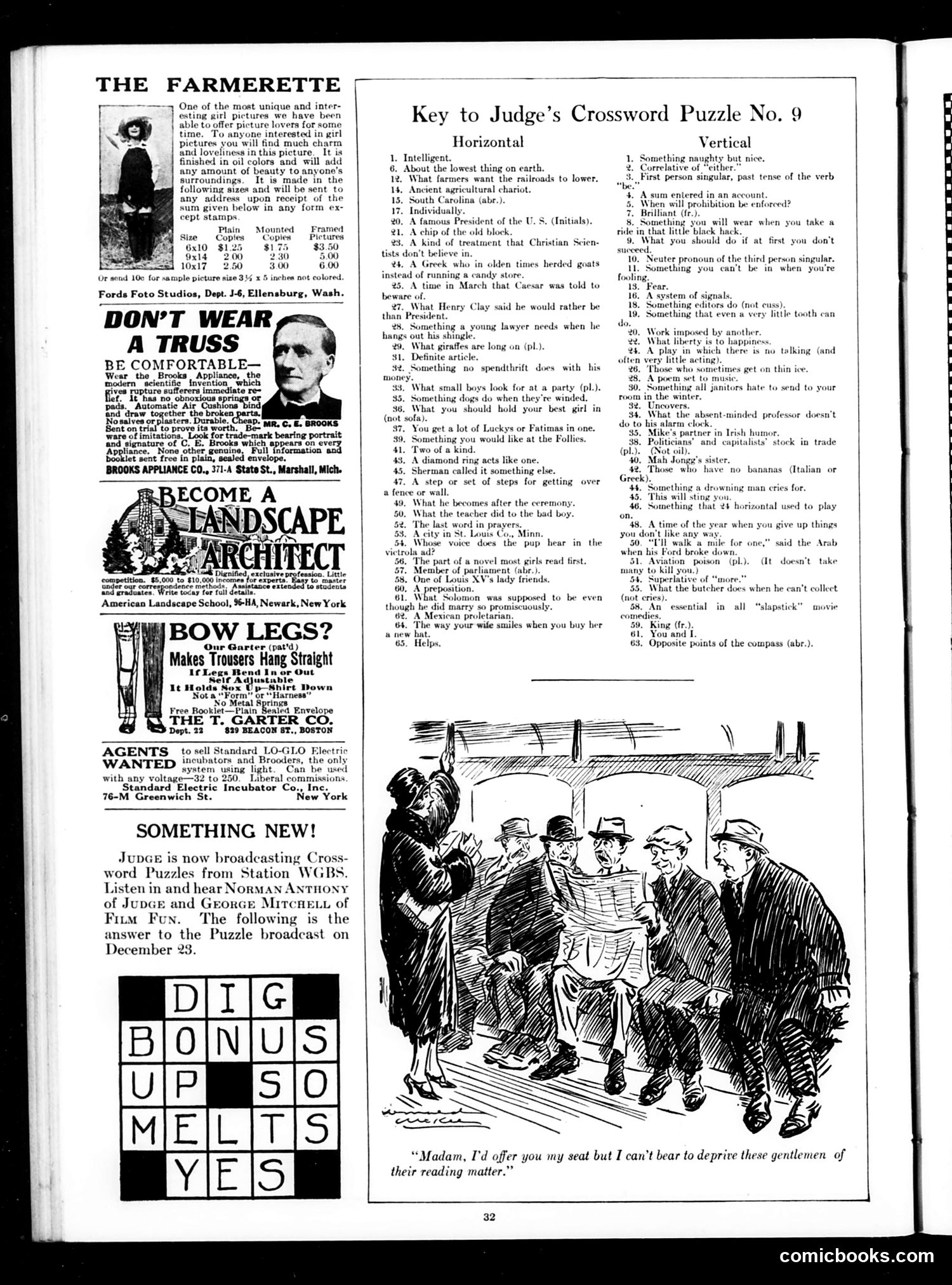
This page primarily features **advertisements and a crossword puzzle**, not political satire in the traditional sense. The main illustrated cartoon shows a woman offering her streetcar seat to several men reading newspapers, with the caption: "Madam, I offer you my seat but I can't bear to deprive these gentlemen of their reading matter." This is **social satire about newspaper addiction**—mocking men's obsession with reading the papers, even at the expense of basic civility toward women. The crossword puzzle itself contains **oblique social commentary** through its clues, referencing contemporary topics like Henry Clay, prohibition enforcement ("When will prohibition be enforced?"), and Christian Science treatments. These hint at the magazine's satirical interests without explicit political cartooning on this particular page. The advertisements (truss devices, landscape architecture schools, bow-leg correctors) are typical early 20th-century magazine filler, reflecting the era's medical quackery and self-improvement culture that Judge often lampooned.
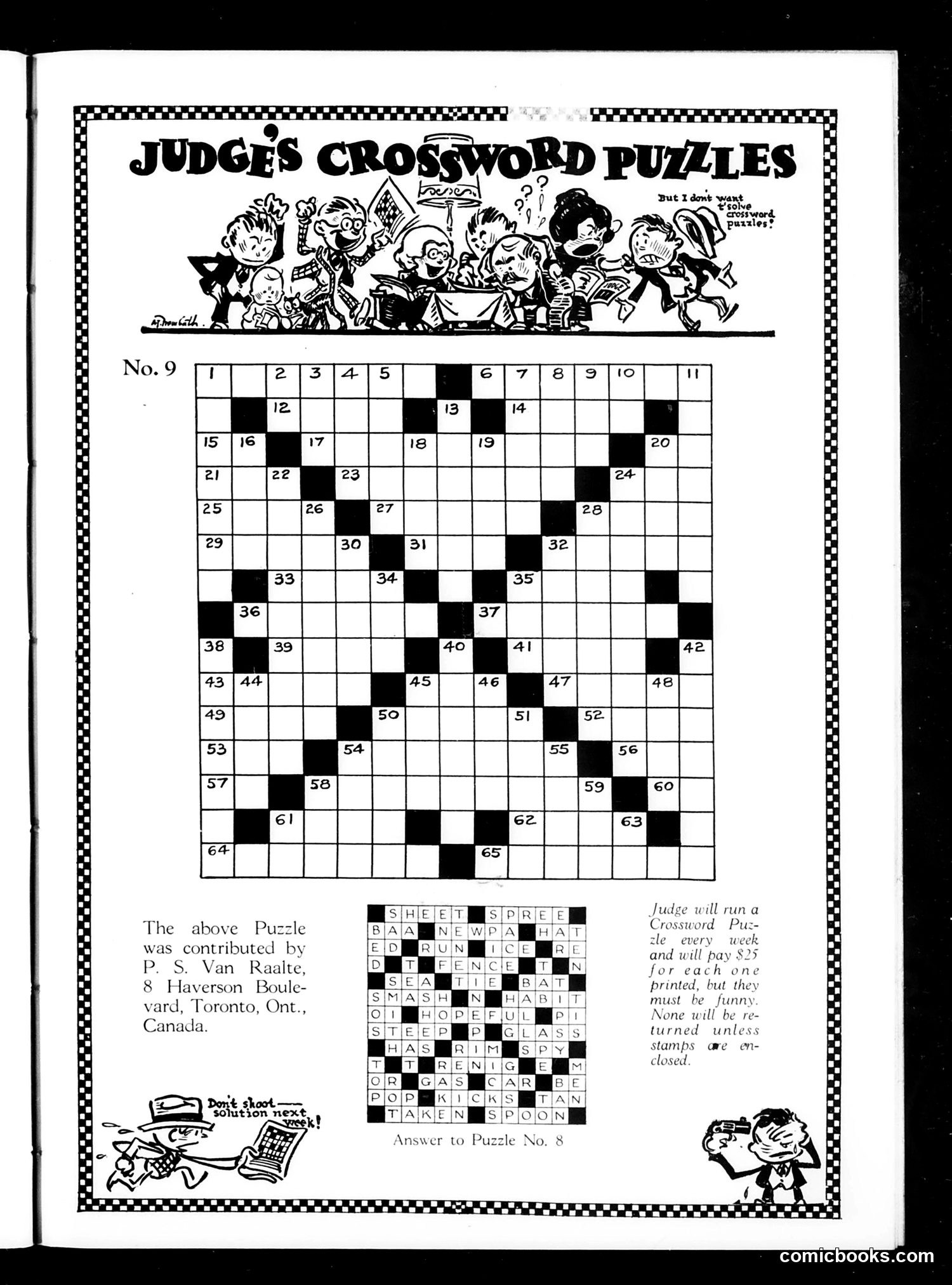
This page contains **Judge's Crossword Puzzle No. 9**, a recreational puzzle feature rather than political satire. The page shows a blank crossword grid with numbered clues and an answer key to the previous week's puzzle (No. 8). The decorative header features cartoon characters celebrating puzzle-solving, establishing a lighthearted tone. The credited contributor is P. S. Van Raalte of Toronto, Ontario, Canada. **The key content**: Judge offered monetary incentives ($25 per published puzzle) to encourage reader submissions. The note clarifies that puzzles must be humorous or original to be returned—establishing editorial standards for this recurring feature. The cartoons flanking the text (a figure with a calculator and another character) humorously reinforce the puzzle theme but carry no deeper political meaning. This represents Judge's mix of satirical content with entertainment features to engage its audience.