
Judge, 1924-12-27 · page 8 of 35
Judge — December 27, 1924 — page 8: what you’re looking at
What you’re looking at
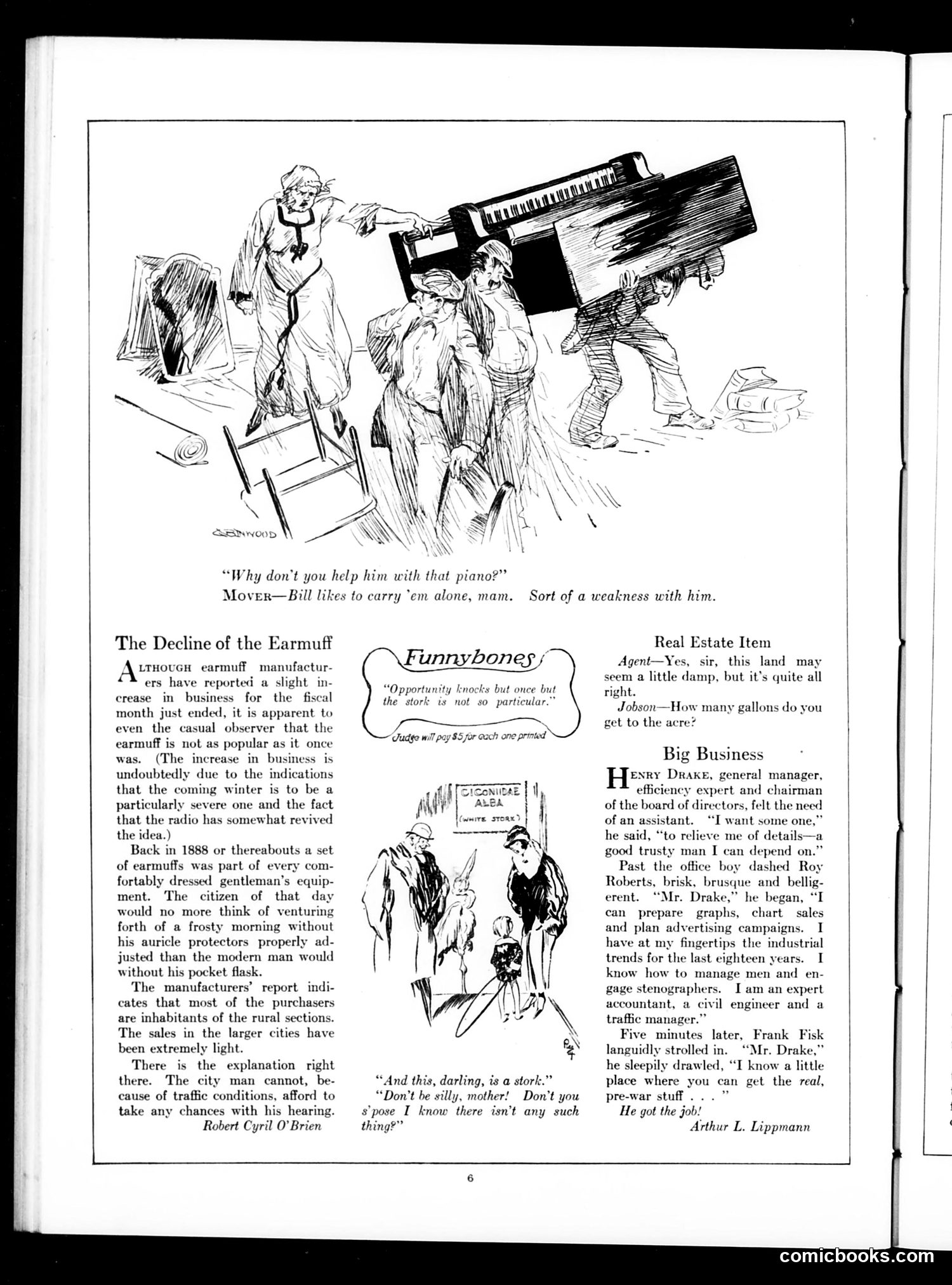
This page contains multiple satirical pieces targeting early 20th-century American life: **Top Cartoon**: A moving company worker refuses help carrying a piano, insisting on doing it alone—portrayed as a character flaw. The satire mocks excessive self-reliance or stubbornness. **"The Decline of the Earmuff"**: An essay lamenting that earmuffs, once essential winter wear for gentlemen (1888), are now obsolete in cities. The joke: city men can't wear them because they need to hear traffic warnings—radio has only slightly revived the fashion. Rural people still buy them. This satirizes technological and social change. **"Big Business"**: A hiring vignette where an overqualified candidate with impressive credentials loses the job to an applicant who casually mentions knowing "a place where you can get the real, pre-war stuff"—likely bootleg liquor during Prohibition. The satire mocks how personal connections and access to illegal goods trumped actual competence in business. The page combines light humor with social commentary on class, technology, and corruption of the era.
📄 Transcribed text from this page (OCR, searchable)
Machine-transcribed from the original scan — historical spelling and the odd misread are preserved.
SSnwoop The Decline of the Earmuff A ttHoven earmuff manufactur- ers have reported a slight in- crease in business for the fiscal month just ended, it is apparent to even the casual observer that the earmuff is not as popular as it once was. (The increase in business is undoubtedly due to the indications that the coming winter is to be a particularly severe one and the fact that the radio has somewhat revived the idea.) Back in 1888 or thereabouts a set of earmuffs was part of e fortably dressed gentleman’s equip- ment. The citizen of that day would no more think of venturing forth of a frosty morning without his auricle protectors properly ad- justed than the modern man would without his pocket flask. The manufacturers’ report indi- cates that most of the purchasers are inhabitants of the rural sections. The sales in the larger cities have been extremely light. There is the explanation right there. The city man cannot, be- cause of traffic conditions, afford to take any chances with his hearing. Robert Cyril O’Brien com- —— “Why don’t you help him with that piano?” Mover—Bill lik: s to carry ‘em alone, mam. Funnybones / “Opportunity knocks but once but the stork is not so particular.” _——. ‘Cuadge will pay $5 ar each one printed And this, darling, is a stork.” “Don’t be silly, mother! Don’t you s'pose I know there isn't any such thing?” Sort of a weakness with him. Real Estate Item Agent—Yes, sir, this land may seem a little damp, but it’s quite all right. Jobson—How many gallons do you get to the acre? Big Business enry Drak efficie general manager, vert and chairman of the board of directors, felt the need of an assistant. “I want some one,” he said, “to relieve me of details—a good trusty man I can depend on.” Past the office boy dashed Roy Roberts, brisk, brusque and bellig- erent. “Mr. Drake,” he began, “I can prepare graphs, chart sales and plan advertising campaigns. I have at my fingertips the industrial trends for the last eighteen years. I know how to manage men and en- gage stenographers. I am an expert accountant, a civil engineer and a traffic manager.’ Five minutes later, Frank Fisk languidly strolled in. “Mr. Drake,” he sleepily drawled, “I know a little place where you can get the real, pre-war stuff...” He got the job! Arthur L. Lippmann comicbooks.com