
Judge, 1924-12-27 · page 17 of 35
Judge — December 27, 1924 — page 17: what you’re looking at
What you’re looking at
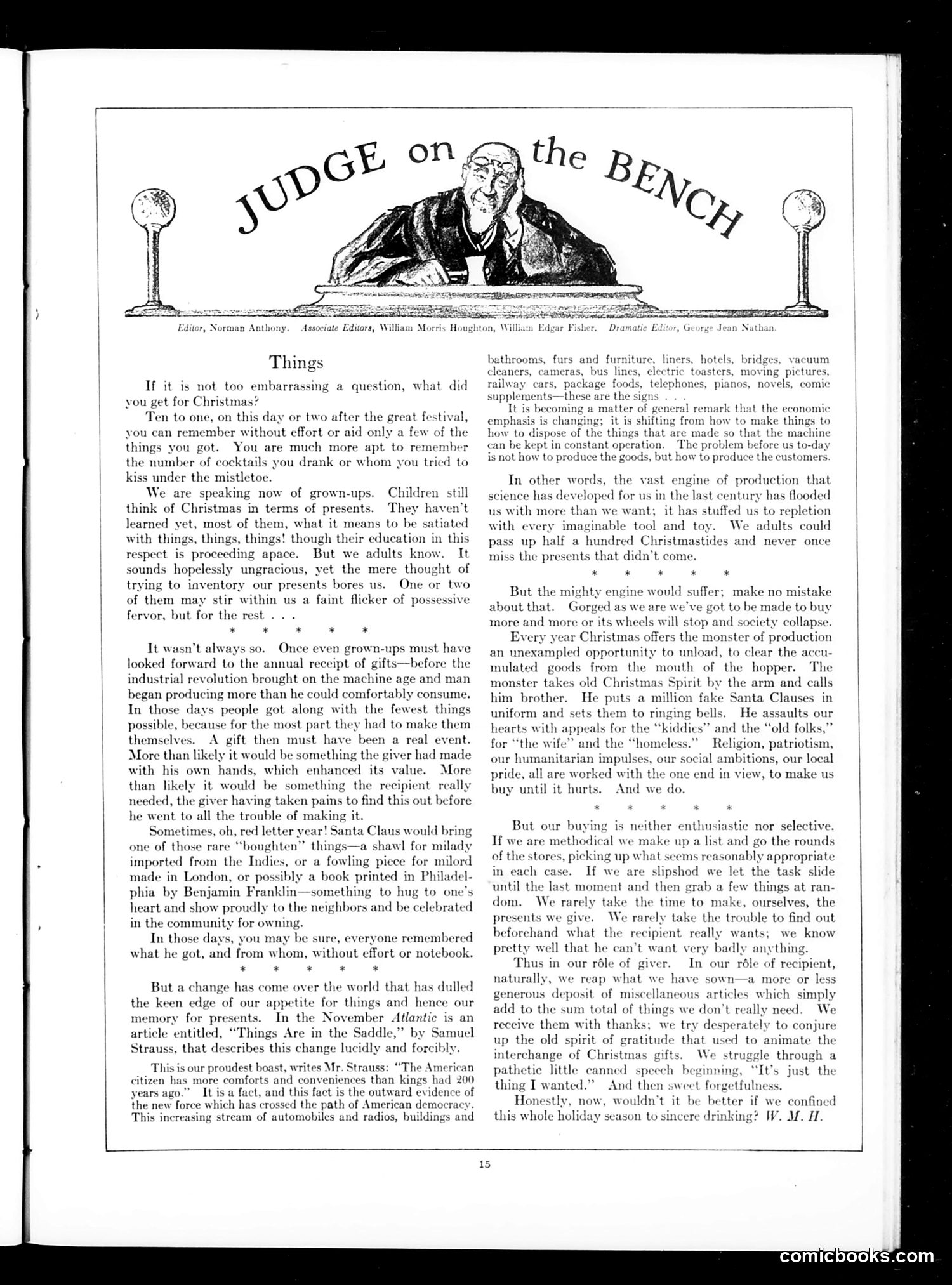
This editorial essay, titled "Things," satirizes modern consumer culture through a judge's commentary. The piece argues that industrial mass production has fundamentally altered Christmas gift-giving from meaningful exchanges to obligatory consumption. The satire contrasts pre-industrial gift-giving—when handmade presents held genuine value and were remembered—with modern abundance where people forget gifts almost immediately. The author cites Samuel Strauss's *Atlantic* article "Things Are in the Saddle," suggesting that capitalism has inverted priorities: production now drives consumption rather than need driving production. The central joke targets economic absurdity: we've created such surplus that society must manufacture artificial demand ("produce the customers") to keep factories running. Americans now possess more comforts than historical kings, yet feel perpetually unsatisfied. The editorial mocks how Christmas has become less about meaningful giving than about society's desperate need for citizens to keep buying things they don't want or need.
📄 Transcribed text from this page (OCR, searchable)
Machine-transcribed from the original scan — historical spelling and the odd misread are preserved.
Things If it is not too embarrassing a question, what did you get for Christmas? Ten to one, on this day or two after the great festival, you can remember without effort or aid only a few of the things you got. You are much more apt to remember the number of cocktails you drank or whom you tried to kiss under the mistletoe. We are speaking now of grown-ups. Children still think of Christmas in terms of presents. They haven't learned yet, most of them, what it means to be satiated with things, things, things! though their education in this respect is proceeding apace. But we adults know. It sounds hopelessly ungracious, yet the mere thought of trying to inventory our presents bores us. One or two of them may stir within us a faint flicker of possessive fervor, but for the rest . . . * *£ & & It wasn’t always so. Once even grown-ups must have looked forward to the annual receipt of gifts—before the industrial revolution brought on the machine age and man began producing more than he could comfortably consume. In those days people got along with the fewest things possible, because for the most part they had to make them themselves. More than likely it would be something the giver had made A gift then must have been a real event. with his own hands, which enhanced its value. More than likely it would be something the recipient really needed, the giver having taken pains to find this out before he went to all the trouble of making it. Sometimes, oh, red letter one of those rare “boughter sar! Santa Claus would bring things—a shawl for milady imported from the Indies, or a fowling piece for milord made in London, or possibly a book printed in Philadel- phia by Benjamin Franklin—something to hug to one’s heart and show proudly to the neighbors and be celebrated in the community for owning. In those days, you may be sure, everyone remembered what he got, and from whom, without effort or notebook. * * * * * But a change has come over the world that has dulled the keen edge of our appetite for things and hence our memory for presents. In the November Atlantic is an article entitled, “Things Are in the Saddle,” by Samuel Strauss, that describes this change lucidly and forcibly. This is our proudest boast, writes Mr. citizen has more comforts and conveniences than kings had 200 years ago.” It is a fact, and this fact is the outward evidence of the new force which has crossed the path of American democracy. This increasing stream of automobiles and radios, buildin rauss: “The American bathrooms, furs and furniture, liners, hotels, bridges, , cameras, bus lines, electric toaste y cars, package foods, telephones, pia supplements—these t It is becomin, vacuum , moving pictures, » novels, comic igns a matter of general remark that the economic emphasis is changing; it is shifting from how to make things to how to dispose of the th that are made so that the machine can be kept in constant operation. The problem before us to-day is not how to produce the goods, but how to produce the customers. In other words, the vast engine of production that science has developed for us in the last century has flooded us with more than we want; it has stuffed us to repletion with every imaginable tool and toy. We adults could pass up half a hundred Christmastides and never once miss the presents that didn’t come. * * * * * But the mighty engine would suffer; make no mistake about that. Gorged as we are we've got to be made to buy more and more or its wheels will stop and society collapse. Ever, Christmas offers the monster of production an unexampled opportunity to unload, to clear the aceu- mulated goods from the mouth of the hopper. The monster takes old Christmas Spirit by the arm and calls him brother. He puts a million fake Santa Clauses in uniform and sets them to ringing bells. He assaults our hearts with appeals for the “kiddies” and the “‘old folks,” for “the wife” and the Religion, patriotism, our humanitarian impulses, our social ambitions, our local pride, all are worked with the one end in view, to make us buy until it hurts. And we do. homeless.” But our buying is neither enthusiastic nor selective. If we are methodical we make up a list and go the rounds of the stores, picking up what seems rez in each case. until the dom. nably appropriate If we are slipshod we let the task slide ast moment and then grab a few things at ran- We rarely take the time to make presents we give. before , ourselves, the We rarely take the trouble to find out nd what the recipient really wants; we know pretty well that he can’t want very badly anything. Thus in our réle of giver. In our réle of recipient, naturally, we reap what ave sown—a more or less generous deposit of miscellaneous articles which simply add to the sum total of things we don’t really need. We receive them with thanks: we try des to conjure up the old spirit of gratitude that used to animate the interchange of Christmas gifts. We stre pathetic little canned spe It’s just the thing I wanted.” And then stfulness. Honestly, now, wouldn't it be better if we confined this whole holiday season to sincere drinking? W. M. H. le through a weet for