
A complete issue · 37 pages · 1924
Judge — October 4, 1924
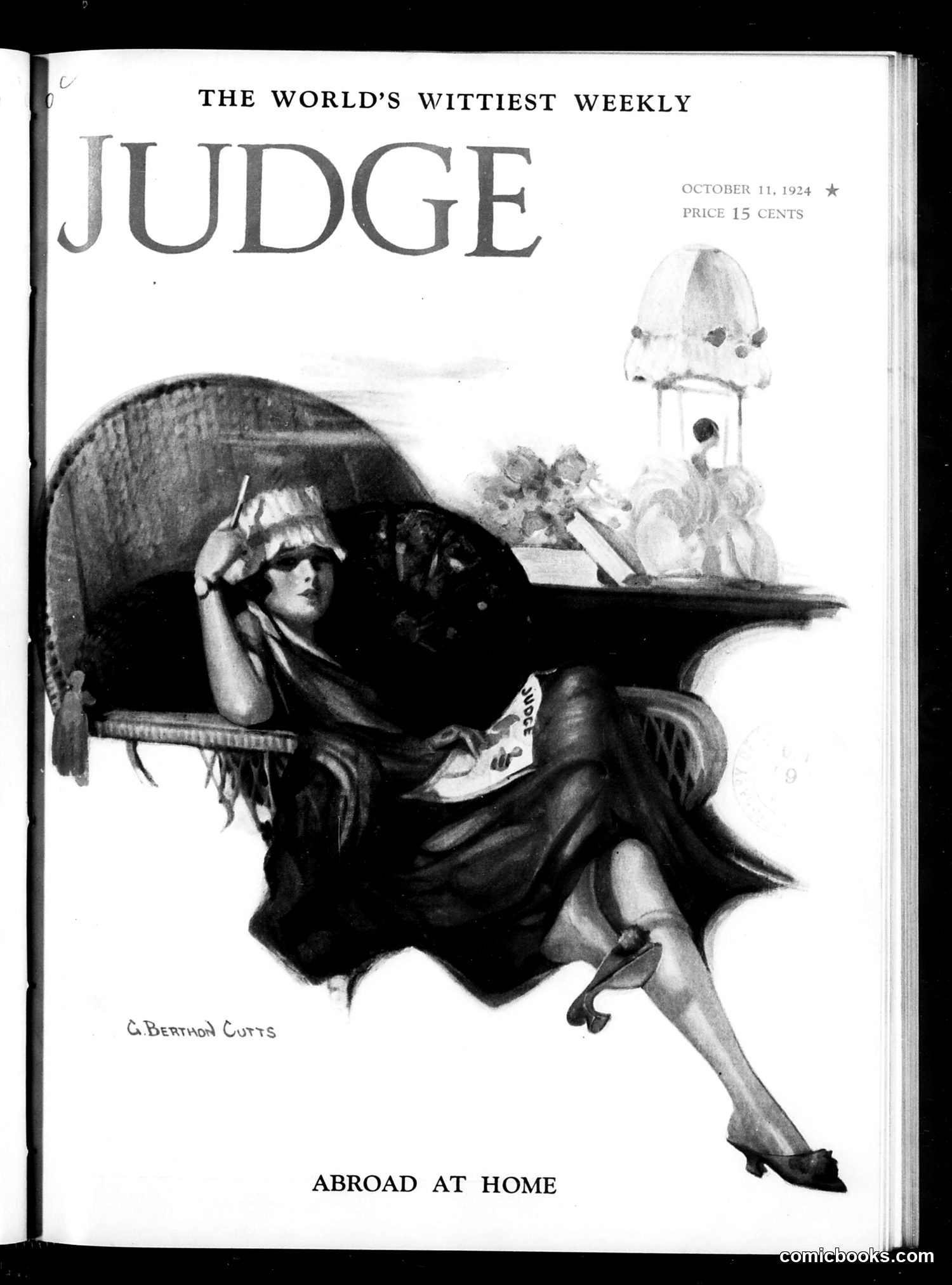
This illustration by C. Berthon Cutts depicts a fashionable woman reclining in a chair, reading what appears to be a travel magazine or brochure. The caption "Abroad at Home" suggests satire about domestic leisure activities mimicking foreign travel. The joke likely mocks 1920s middle-class aspirations: people could experience "abroad" (exotic foreign cultures) while remaining at home through reading, imagination, or perhaps newly available travel literature and entertainment. The woman's relaxed posture and focused attention on the publication emphasize armchair tourism as a substitute for actual travel—a commentary on either economic constraints or the growing consumer culture of leisure fantasies during the prosperous 1920s.
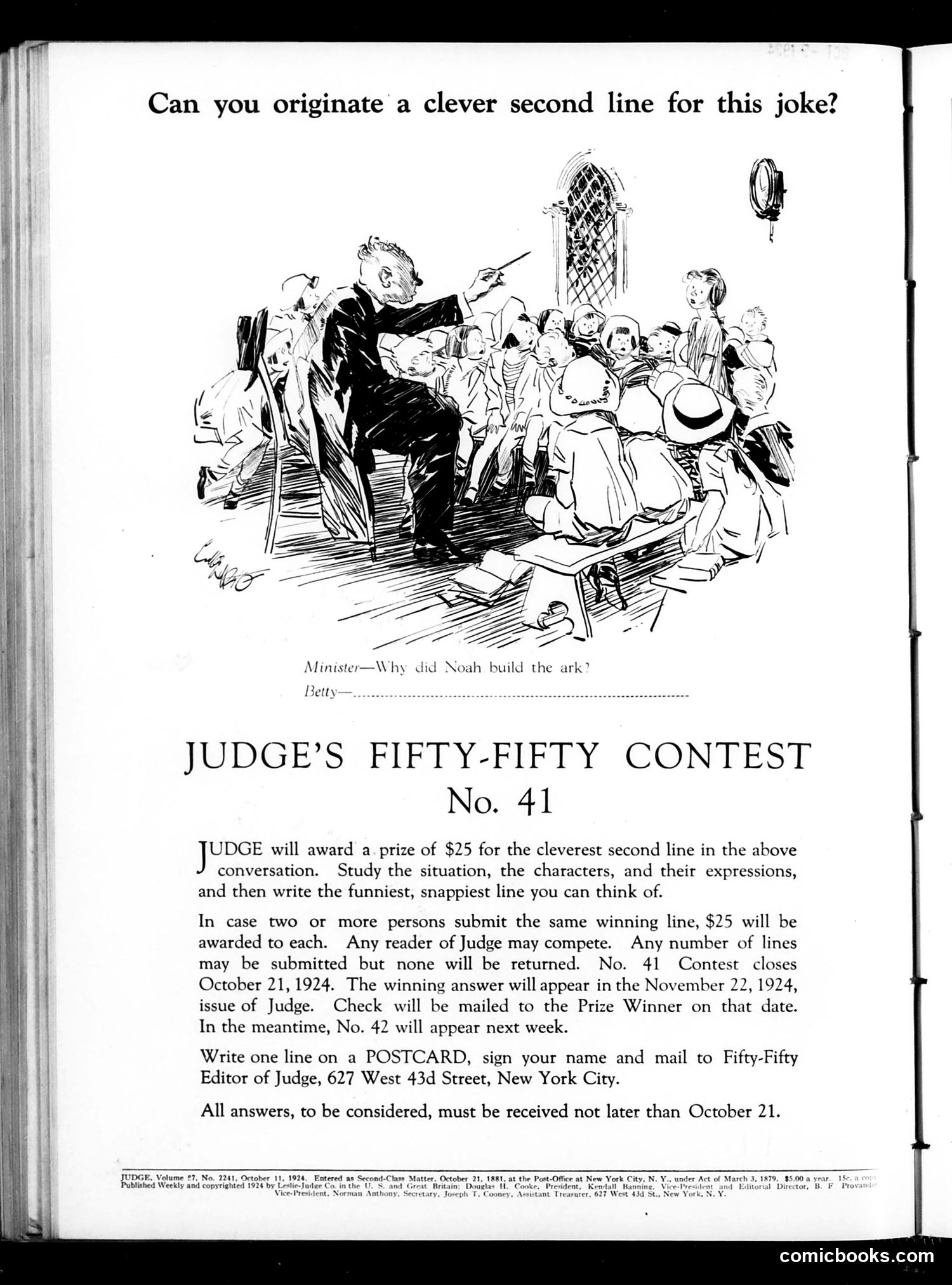
This page presents a "Fifty-Fifty Contest" where readers submit clever punchlines. The cartoon shows a minister addressing children in what appears to be a Sunday school setting, with the setup: "Minister—Why did Noah build the ark?" and a blank line for readers to complete with Betty's answer. The joke likely plays on children's biblical knowledge or common misconceptions about Noah's ark. The contest offered $25 for the cleverest response, with submissions due October 21, 1924. This reflects Judge magazine's interactive format—inviting reader participation in humor creation was a common feature of early 20th-century magazines, combining editorial content with audience engagement and modest monetary prizes to boost circulation and reader involvement.
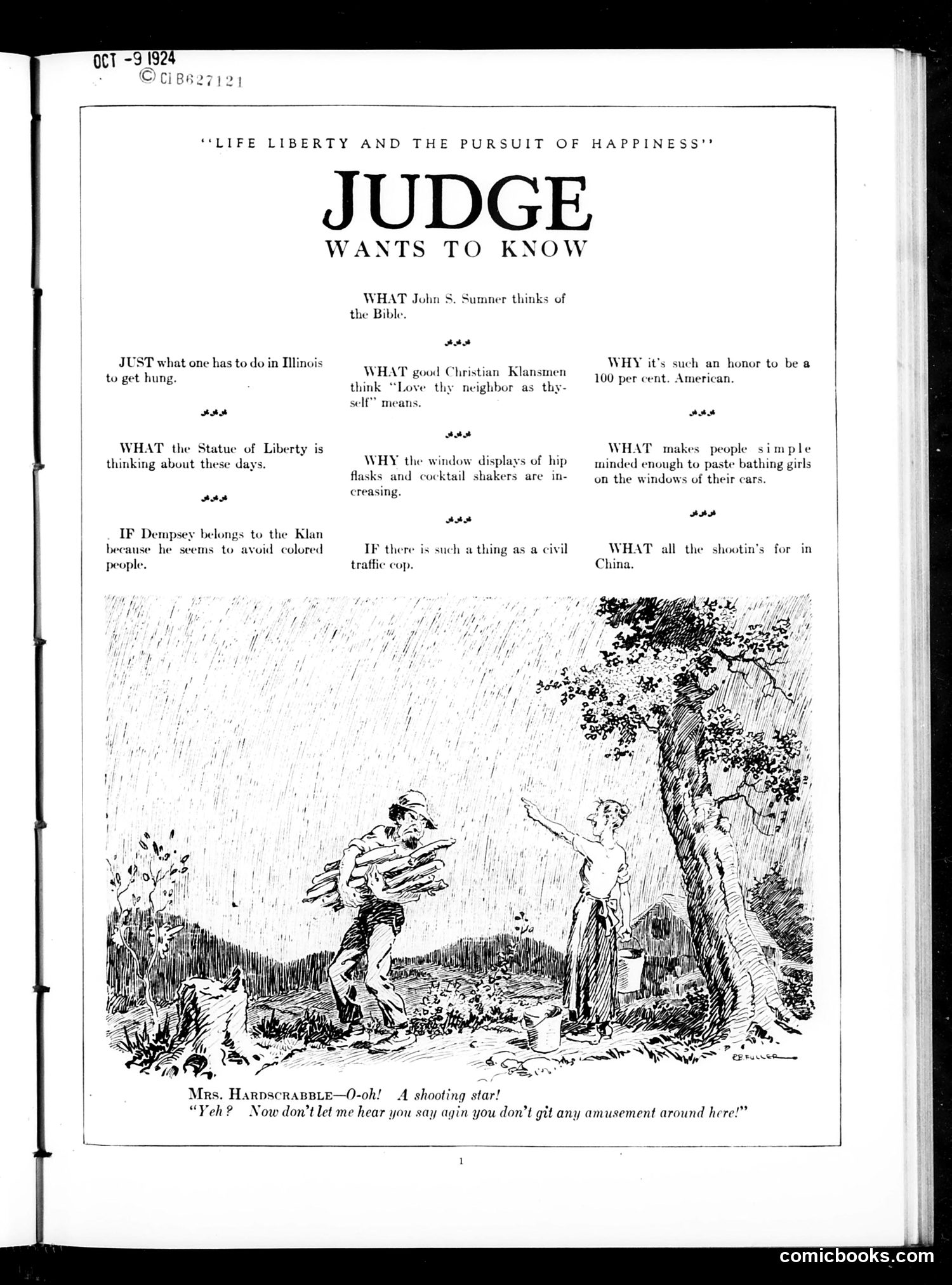
This October 1924 *Judge* page satirizes contemporary American social concerns through a series of rhetorical questions posed to an unnamed judge. The topics reflect 1920s anxieties: prohibition enforcement in Illinois, Christian attitudes toward neighbors, the Ku Klux Klan's activities, window displays of alcohol ("hip flasks and cocktail shakers"), and racial attitudes toward Chinese immigrants. The cartoon below depicts a domestic scene where Mrs. Hardscrabble interrupts her husband's hunting with complaints about shooting and noise—a domestic comedy rather than political commentary. The page's overall structure mocks the disconnect between judges' authority and their inability to address society's actual problems, from crime to hypocrisy around alcohol consumption during the Prohibition era.
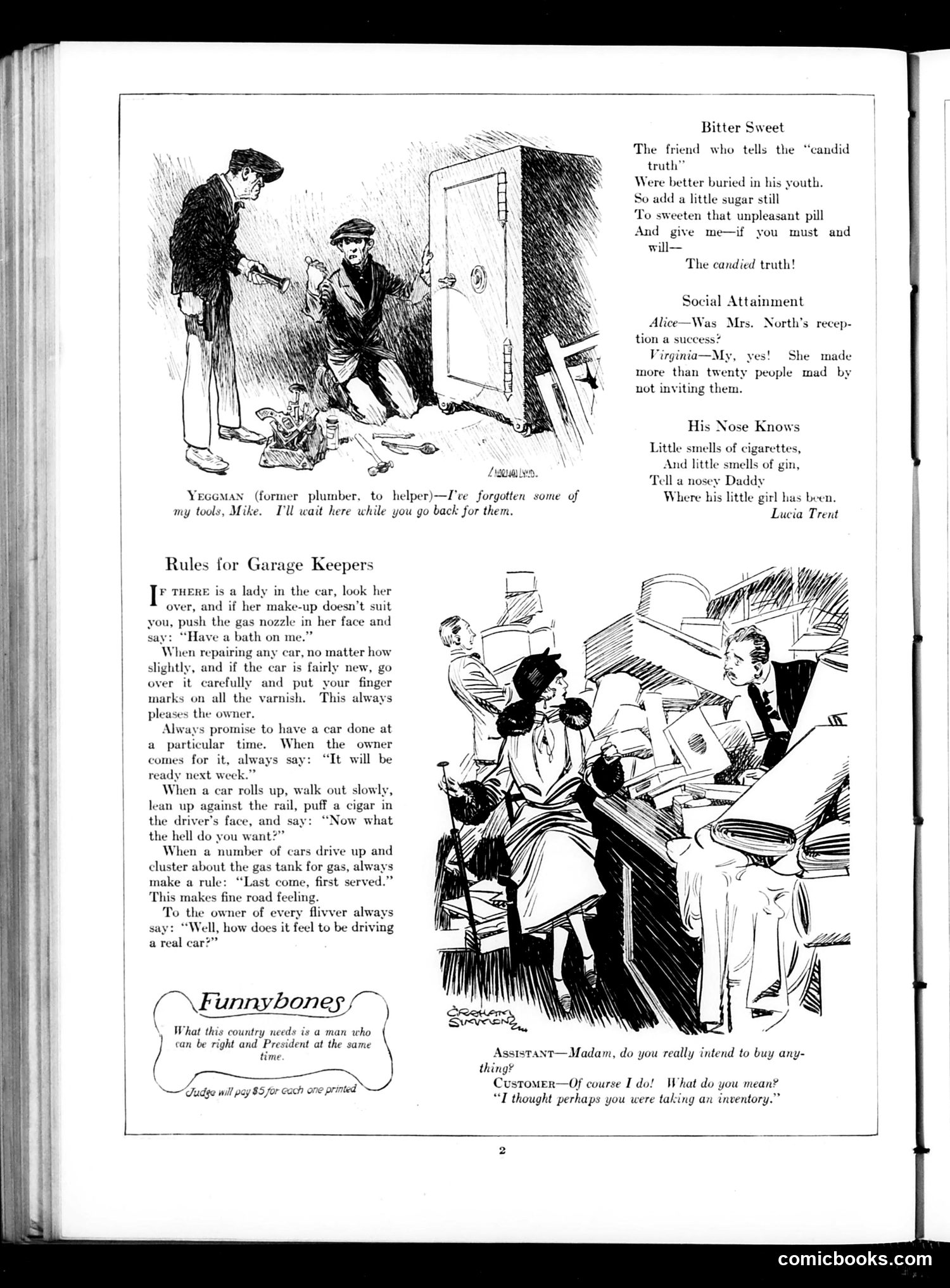
This page contains several unrelated satirical pieces typical of Judge magazine's format. **Top cartoon**: Shows a plumber (labeled "Yeggman") telling a customer he's forgotten his tools and will wait while the customer retrieves them—an ironic commentary on unreliable tradesmen making excuses. **"Rules for Garage Keepers"**: A humorous etiquette guide satirizing auto repair shops' poor customer service—advising mechanics to ignore lady customers, make vague promises about completion times, overcharge, and be dismissive of complaints. It's satire exposing actual garage industry practices. **Bottom right cartoon**: Shows a store assistant awkwardly confronting a customer about purchasing intentions, apparently misinterpreting browsing as inventory-taking—mocking retail sales tactics. **"Funnybones"**: A riddle section offering small prizes. The page satirizes early 20th-century service industry incompetence and rudeness toward customers.
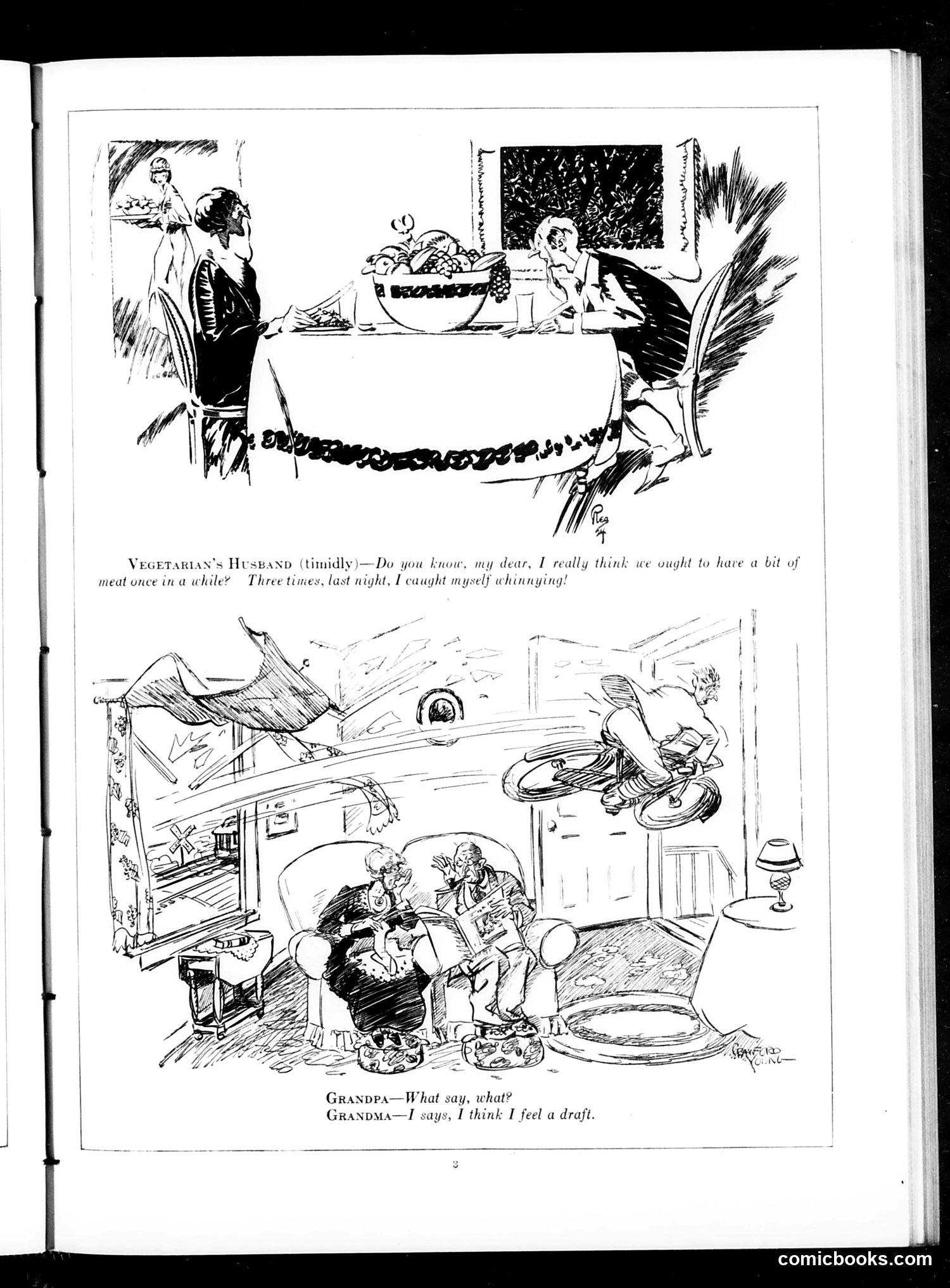
**Top Cartoon:** Shows a dinner party where a vegetarian husband tentatively suggests to his wife that they should eat meat occasionally, claiming he's been "shrimping" three times. The satire mocks the vegetarian movement (likely early 20th century) by portraying the husband as secretly indulging in meat while maintaining vegetarian principles—a commentary on hypocrisy within dietary reform movements. **Bottom Cartoon:** Depicts grandparents with grandchildren in a living room. One grandfather complains of feeling a draft while the other responds, "I say, I think I feel a draft." This appears to be gentle domestic humor about aging and sensitivity to cold rather than political satire. Both cartoons reflect middle-class domestic life and social trends of the era through humorous observation.
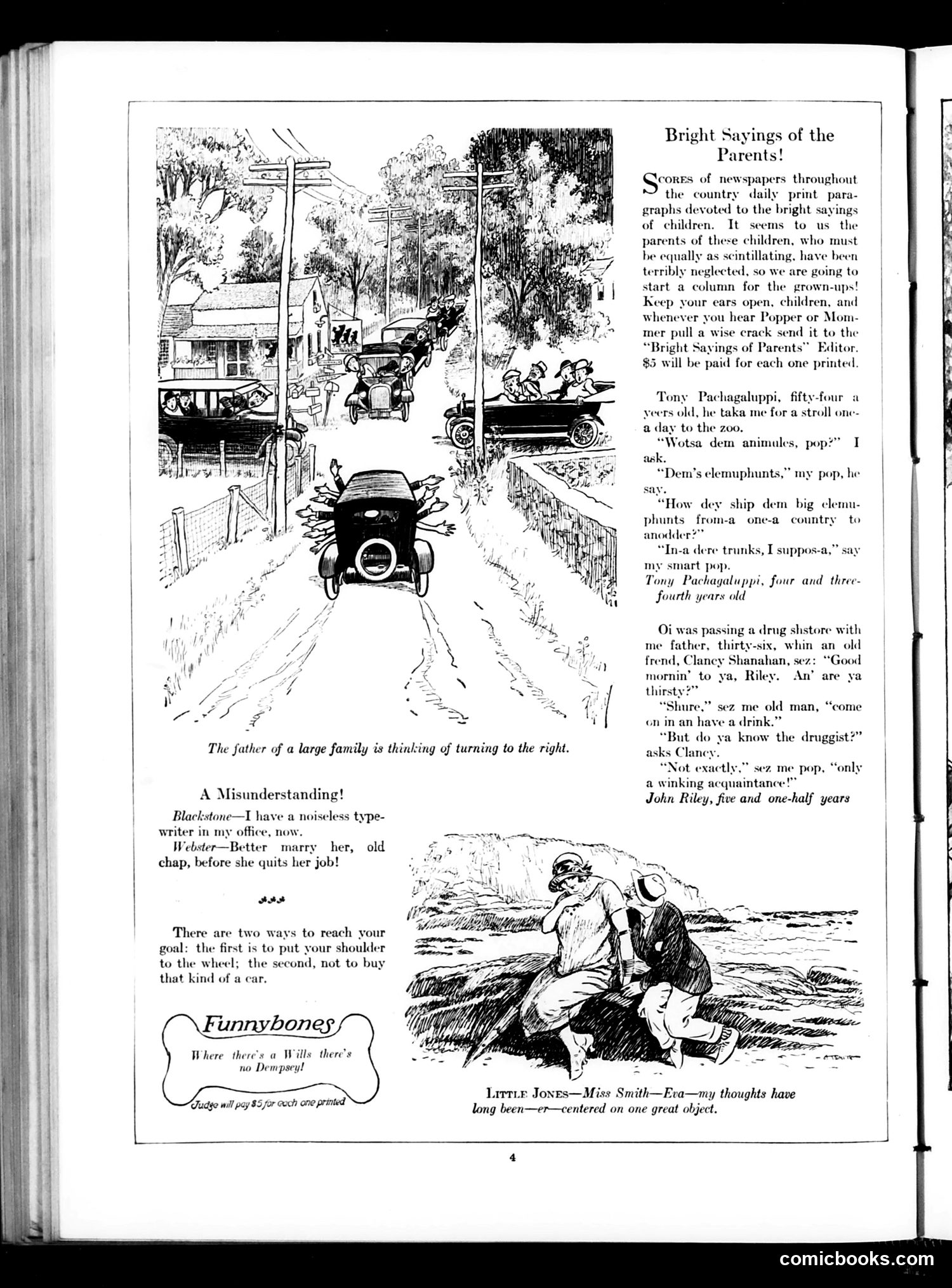
This page contains humorous content aimed at parents and children rather than political satire. **"Bright Sayings of the Parents!"** solicits submissions of children's witty quotes, paying $5 per published entry. Two examples follow: 1. **Tony Pachagaluppe** (age 5-6) makes a joke about elephants at the zoo—asking how they shipped "dem big elephants from a one-a country to another," with his father's deadpan response about store trunks. 2. **Little Jones** (age 5.5) has centered her thoughts on "one great object"—likely a romantic crush, per Miss Smith/Eva's observation. The main cartoon depicts a family car turning right, with the caption explaining the father's driving decision. A separate "Misunderstanding" joke and "Funnybones" section round out the page's light humor content.
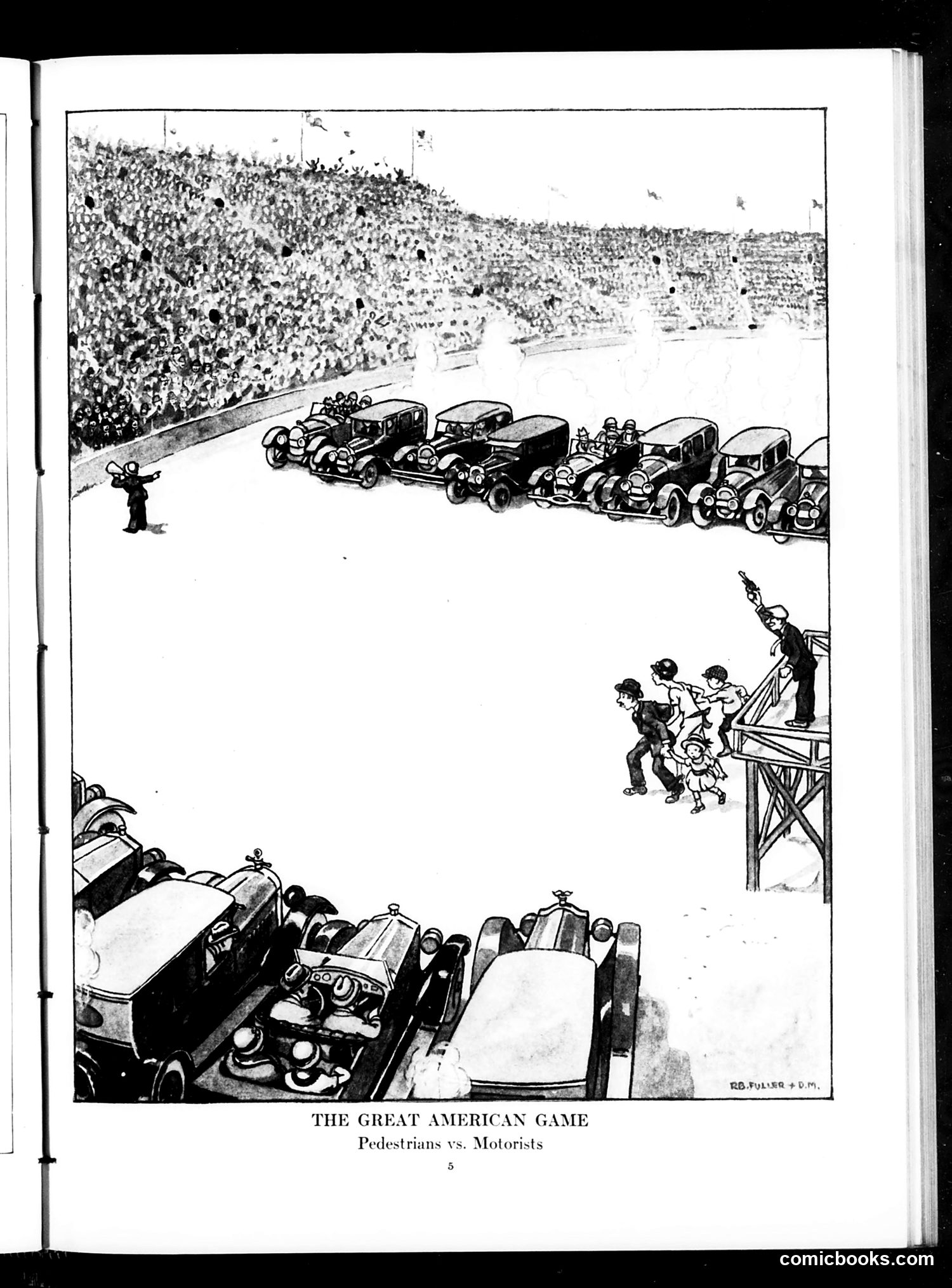
This cartoon satirizes the dangerous conflict between pedestrians and early automobiles in early 20th-century America. The title frames this as "The Great American Game"—suggesting the conflict was as central to American life as baseball. The image shows a stadium-like setting with spectators watching what appears to be a collision or near-miss between cars and pedestrians. Racing cars line up on the track while people (including what appear to be children) scramble on the field. A police officer on an elevated platform oversees the scene. The satire critiques how automobile accidents involving pedestrians were treated as entertainment or spectacle rather than serious public safety concerns. The "game" framing mocks society's apparent indifference to the dangers posed by rapidly increasing motorized traffic to vulnerable pedestrians and children.
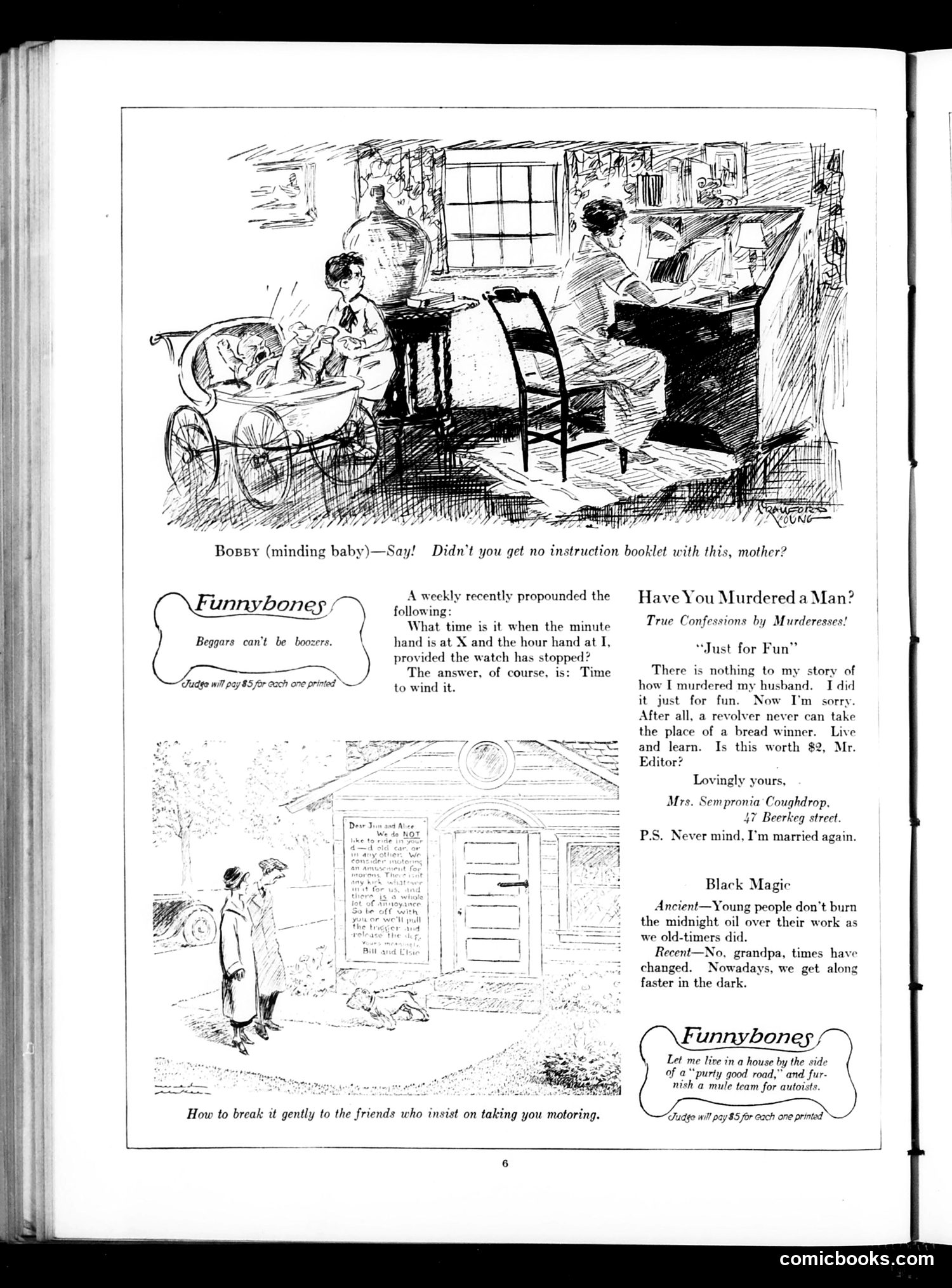
This page contains several unrelated humorous pieces typical of early 20th-century satirical magazines: **Top cartoon**: A domestic scene where a young mother ("Bossy") tends a baby carriage while others work nearby. Bobby complains about lacking an instruction booklet—satirizing how new parents receive no formal guidance for childcare. **"Funnybones" sections**: Short joke submissions. One mocks beggars; another plays on a riddle about a stopped watch ("time to wind it"). **"Have You Murdered a Man?"**: A darkly comedic fake "confession" where a woman admits murdering her husband "just for fun," then regrets it because he was a breadwinner. The satire targets sensationalist true-crime publications popular at the time. **"Black Magic"**: Contrasts old and young generations—elderly people worked by candlelight; modern youth work in darkness (unclear reference, possibly about efficiency or laziness). **Bottom cartoon**: About tactfully telling friends their car-driving invitation must be declined. The page is largely **filler humor content** rather than pointed political satire, reflecting Judge's mix of domestic comedy and absurdist jokes.
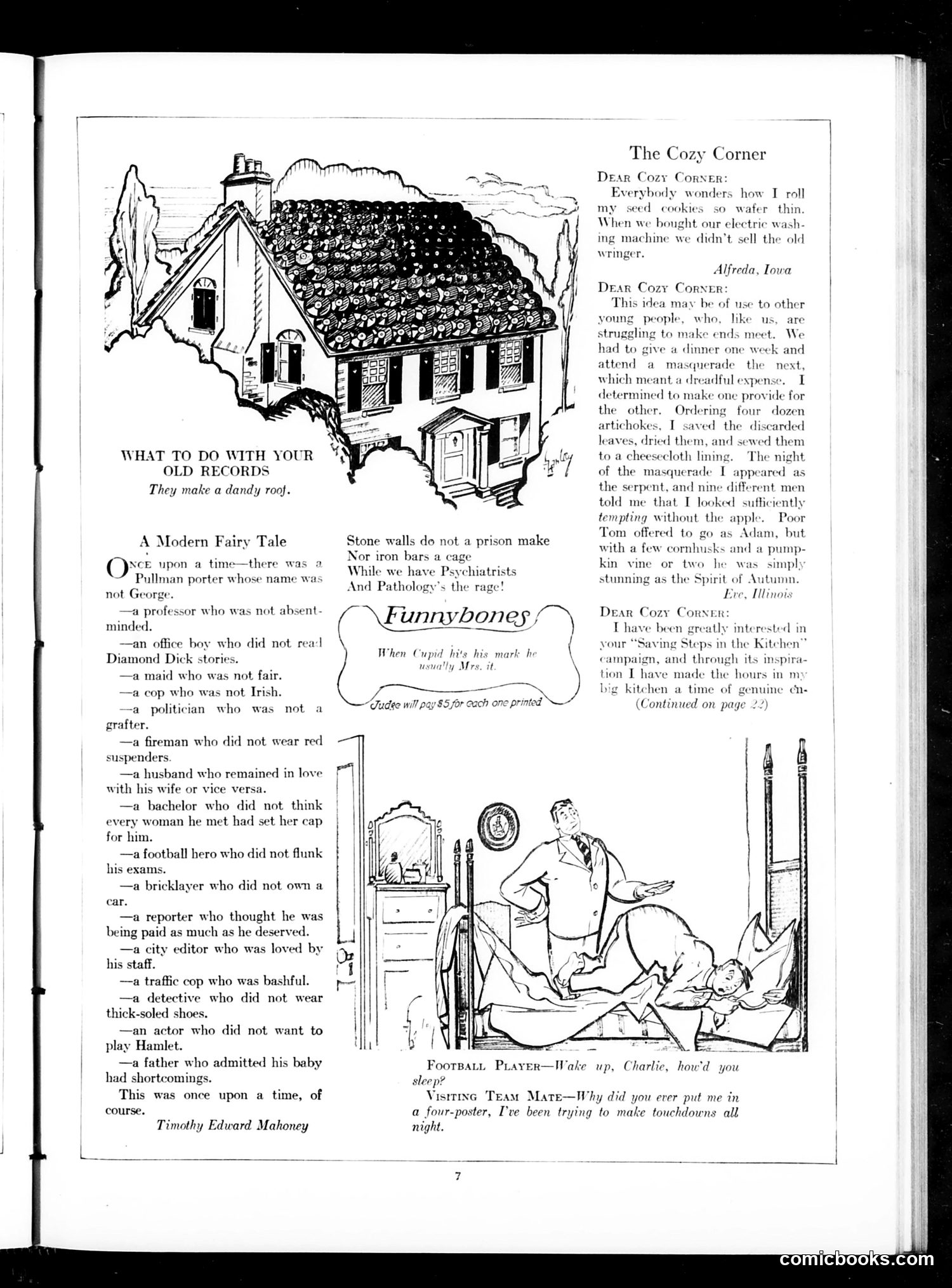
This page contains satirical humor typical of early-to-mid 20th century Judge magazine: **"A Modern Fairy Tale"** is a cynical list by Timothy Edward Mahoney cataloging fictional "exceptions" to common stereotypes—a Pullman porter not named George, a professor who's attentive, a politician who isn't corrupt, etc. The punchline: "This was once upon a time, of course," implying none of these people actually exist. It's social satire mocking predictable character types in American society. **"Funnybones"** contains brief domestic humor jokes. **The cartoon illustrations** show two comic scenarios: one depicting a football player and teammate (the bottom caption jokes about a player trying to score touchdowns from a four-poster bed), and another showing people in various domestic situations. **"The Cozy Corner"** is an advice column featuring humorous reader tips—cookie-rolling techniques and Depression-era money-saving tricks (repurposing artichokes as costume elements for masquerades). The page reflects Judge's focus on satirizing everyday American life, class anxieties, and social pretensions through gentle, accessible humor.
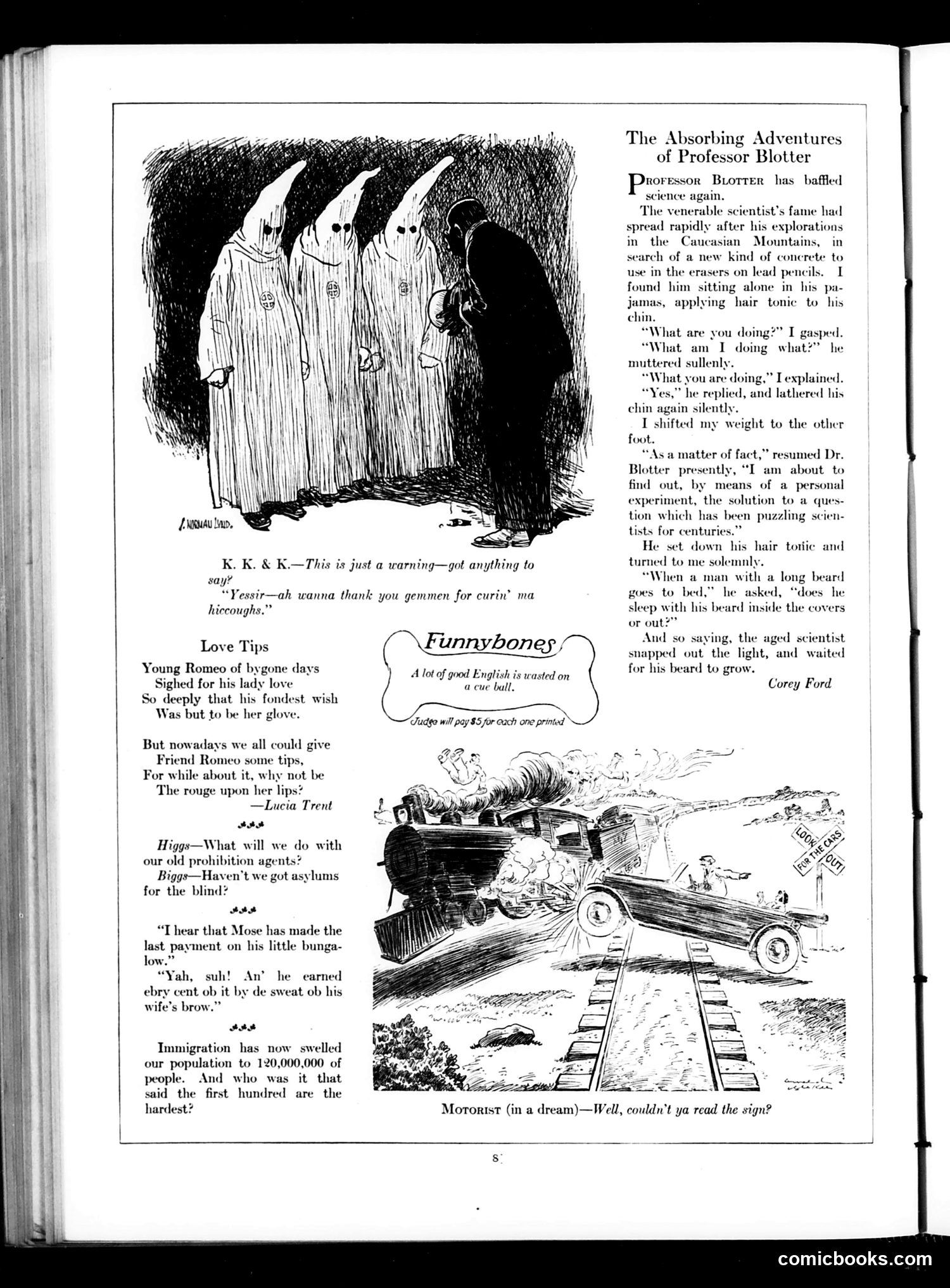
This page contains three satirical pieces typical of Judge magazine's humor: **"The Absorbing Adventures of Professor Blotter"** mocks pseudo-intellectual scientists. Professor Blotter—supposedly famous for exploring the Caucasus seeking new concrete for pencil erasers—is found applying hair tonic to his chin. The joke centers on his ridiculous "scientific" experiment: whether a bearded man sleeps with his beard inside or outside the covers. This parodies how trivial "research" could masquerade as serious science. **"Love Tips"** is lighthearted verse contrasting old romantic ideals with modern cynicism about relationships. **"Funnybones"** collects brief gags, including one mocking Prohibition-era unemployment (what to do with now-useless prohibition agents?) and one using racist dialect humor about a Black man's financial success being credited to his wife's labor. The motorist cartoon at bottom depicts an accident victim sarcastically asking the driver if they could read warning signs—commenting on reckless driving. The overall tone reflects 1920s American satire: anti-intellectual, cynical about social progress, and reliant on now-offensive racial stereotypes.
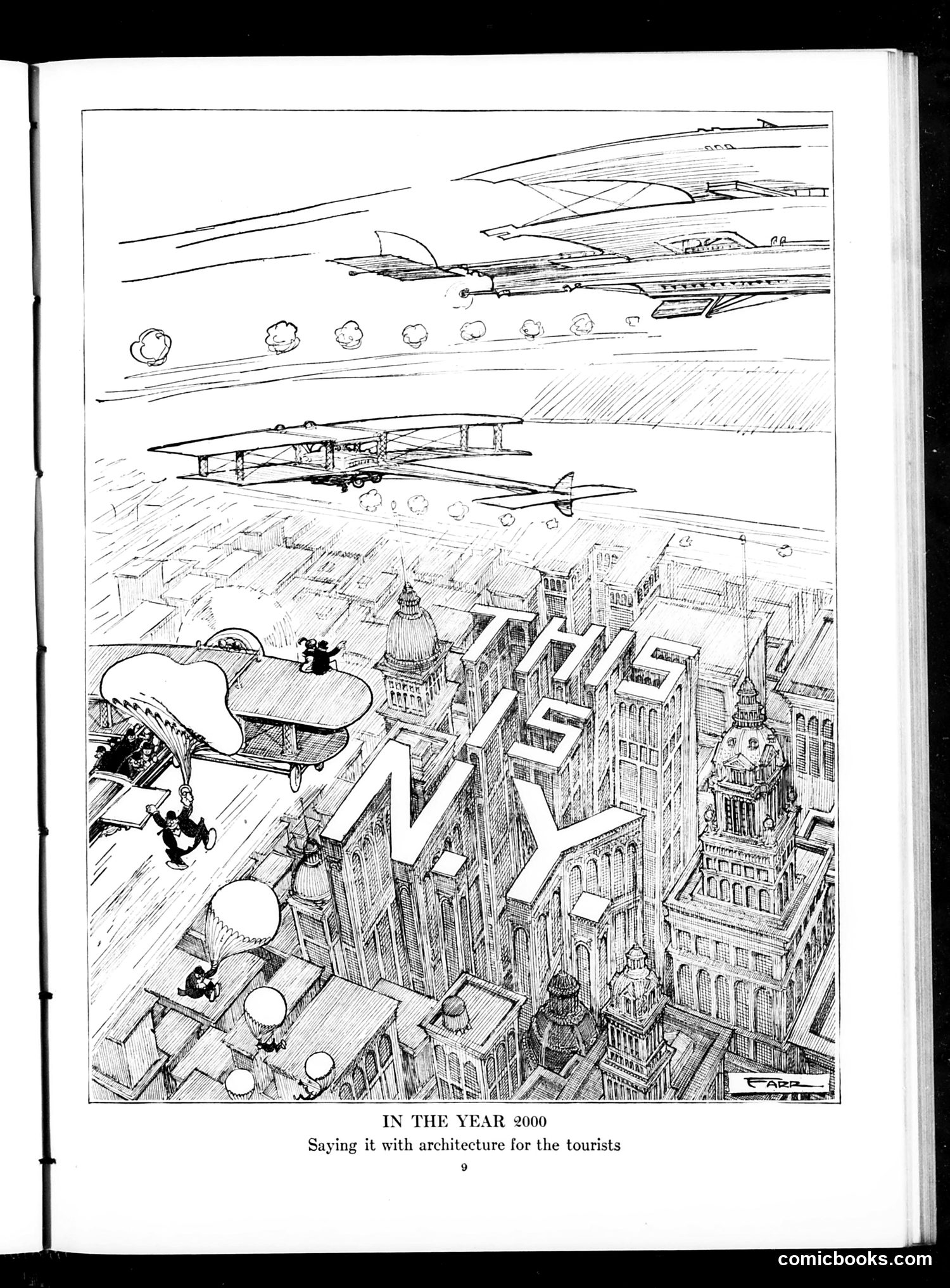
This is a futuristic satire imagining the year 2000. The cartoon depicts early aircraft (biplanes and dirigibles) flying over a cityscape where architectural landmarks have been enlarged or repurposed as tourist attractions. The satire targets commercialization and tourism: instead of preserving historic buildings authentically, the future vision shows them grotesquely scaled up or transformed into novelty attractions for visitors. The massive balloon structures and oversized monuments suggest monuments have become mere spectacle rather than cultural artifacts. The title's phrase "saying it with architecture" sarcastically comments on using grand buildings to impress tourists rather than for genuine civic purposes. This reflects early-20th-century anxieties about American commercialism overwhelming authentic culture and history—turning sacred architecture into billboard advertisements for consumption.
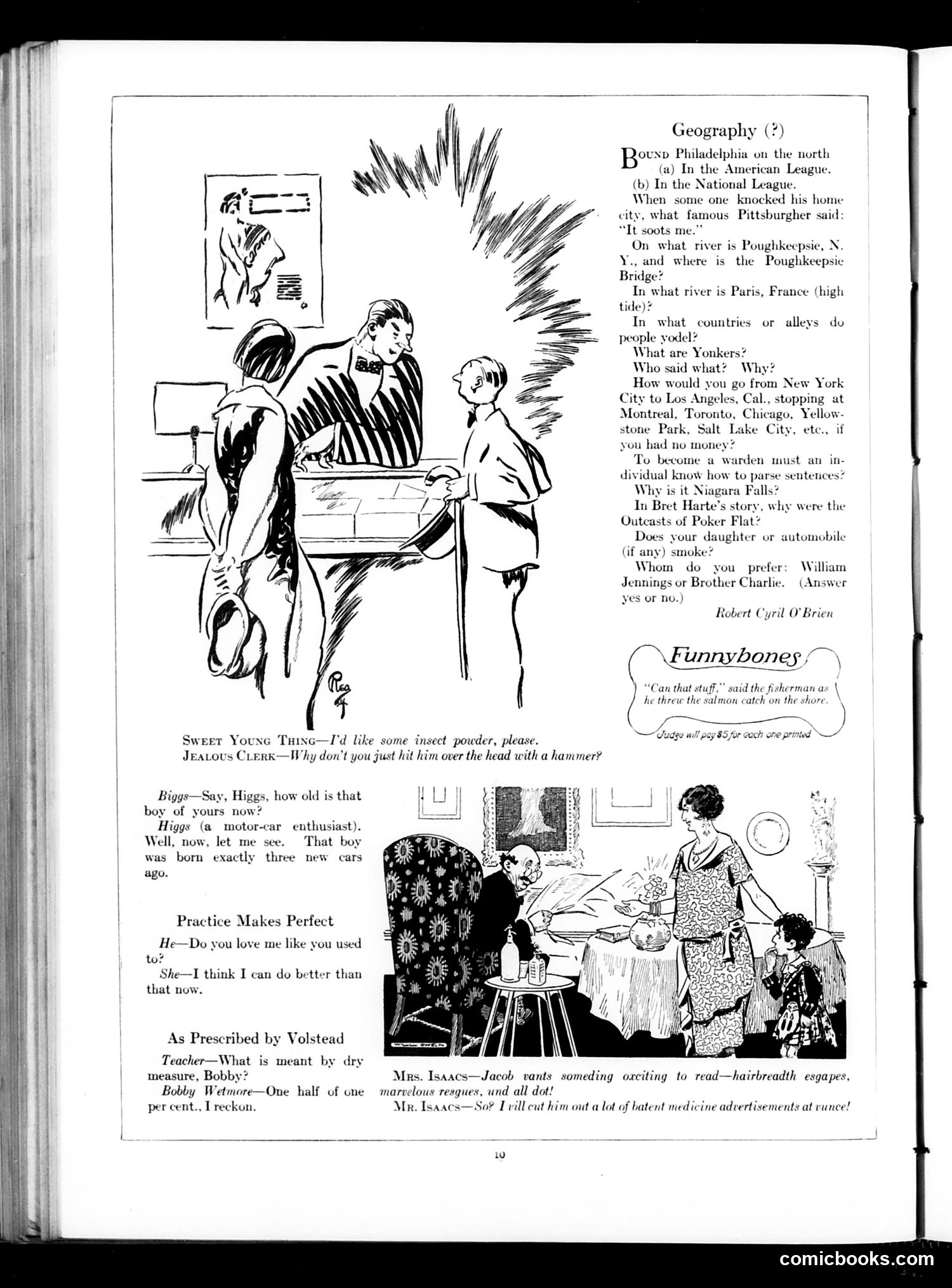
This page contains several unrelated humor pieces typical of Judge magazine's format. The main "Geography (?)" section is a satirical quiz mocking trivial knowledge and American cultural references—including sports (Philadelphia baseball leagues), geography (Poughkeepsie, Paris rivers), and contemporary figures (a Pittsburgh personality, William Jennings Bryan vs. "Brother Charlie"). The cartoons below present domestic comedy scenarios: - **"Sweet Young Thing/Jealous Clerk"**: A flirtation joke where a clerk suggests violence as a solution to romantic jealousy. - **"Biggs/Higgs"**: A motor-car enthusiast measures his child's age in "new cars" rather than years—satirizing the automobile industry's rapid growth and consumer obsession in the 1920s. - **"Practice Makes Perfect"**: A couple's relationship has improved through practice. - **"As Prescribed by Volstead"**: References the Volstead Act (Prohibition). A teacher's dry measure quiz answer becomes a temperance joke; separately, Mrs. Isaacs wants exciting reading but gets patent medicine ads instead—mocking both advertising saturation and Prohibition-era substitute entertainments.
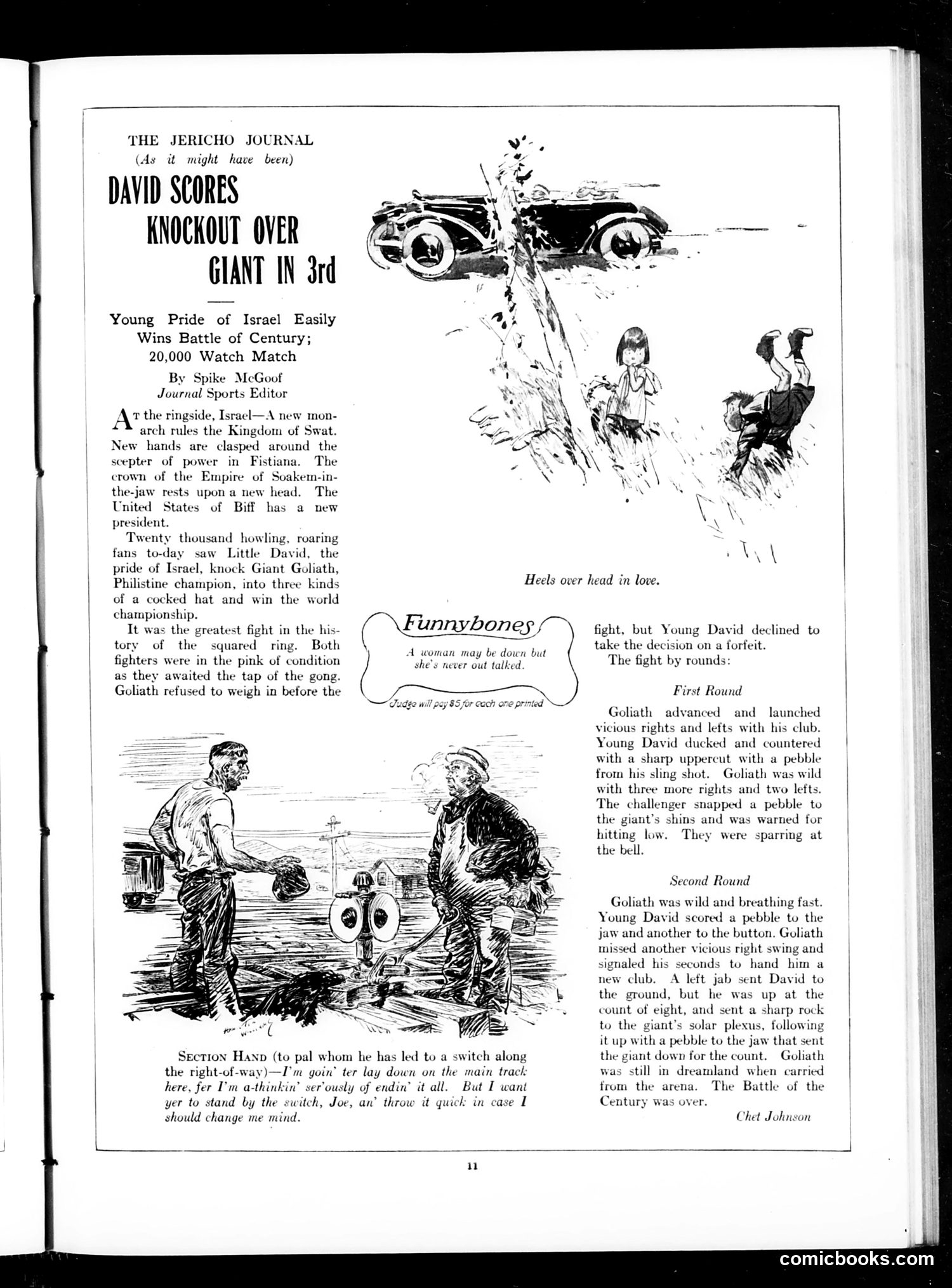
This page satirizes the Biblical story of David and Goliath by reimagining it as a modern boxing match. The satire works by applying 1920s sports journalism conventions—"Battle of the Century," ringside commentary, round-by-round descriptions, official counts—to ancient scripture. The joke is treating a religious narrative as contemporary sports spectacle. David's slingshot becomes boxing equipment; Goliath's defeat is narrated like a knockout. The byline "Spike McGoof" and dramatic headlines ("Young Pride of Israel") parody sensationalist sports reporting of the era. The "Funnybones" panel and automobile illustration appear unrelated filler content. The bottom "Section Hand" cartoon about railroad suicide appears to be separate satirical content about labor/despair. The overall effect mocks both grandiose sports coverage and the casual trivialization of serious (biblical) subjects through modern mass media frameworks.
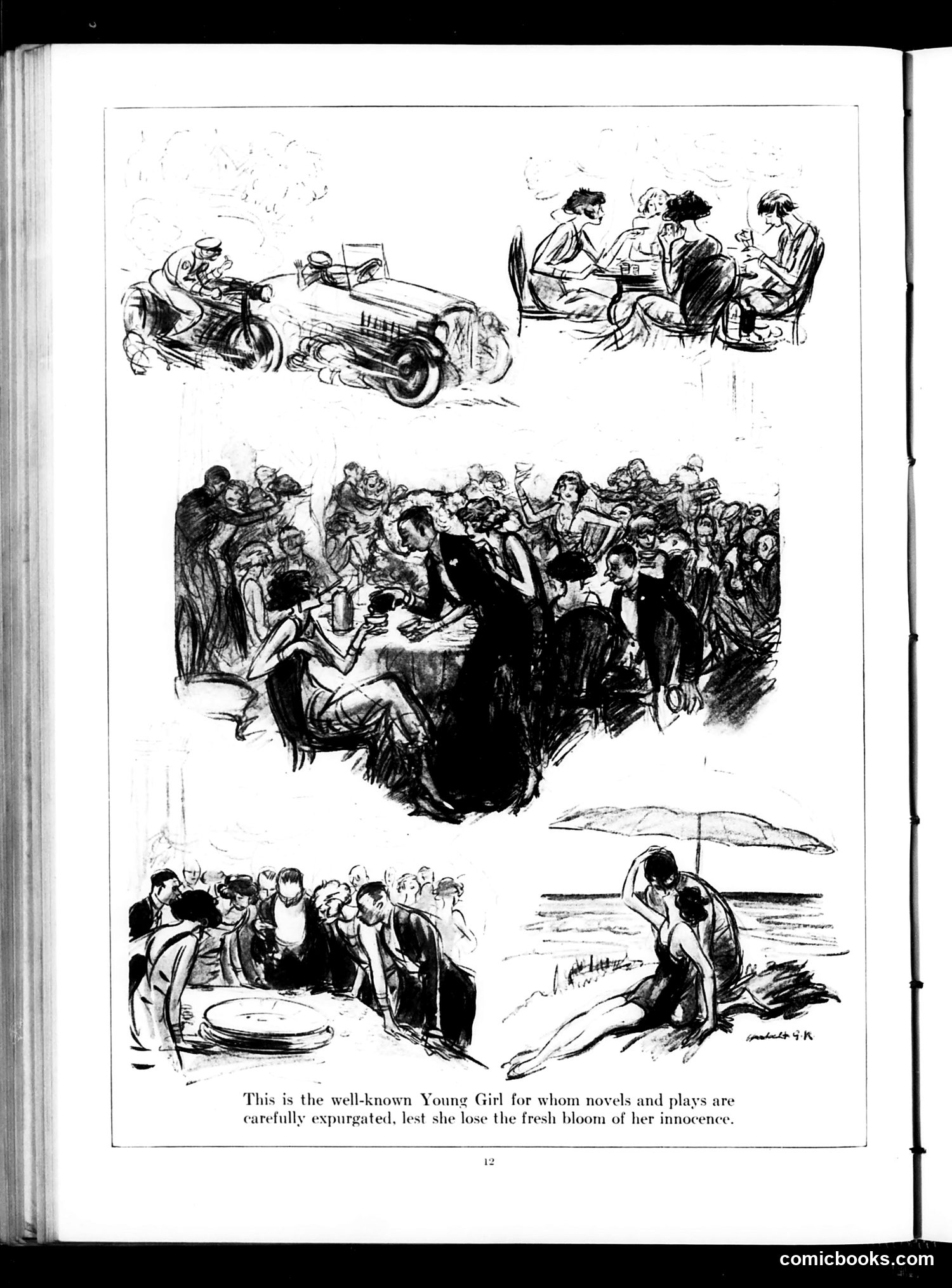
This page satirizes Victorian-era censorship and protective attitudes toward young women's morality. The caption identifies "the well-known Young Girl"—a stock literary figure treated as so fragile and innocent that publishers and playwrights heavily edited content to shield her from corruption. The four sketches ironically contradict this protective myth, depicting this supposedly innocent girl engaging in worldly activities: racing in cars with men, attending crowded social gatherings, dining out, and lounging on beaches in revealing attire. The satire's point: society claims to protect young women's "innocence" through censorship while simultaneously allowing them freedoms and social exposure that contradict that claimed innocence. The gap between the protected ideal and actual behavior is the joke—the expurgation is performative theater rather than genuine protection.
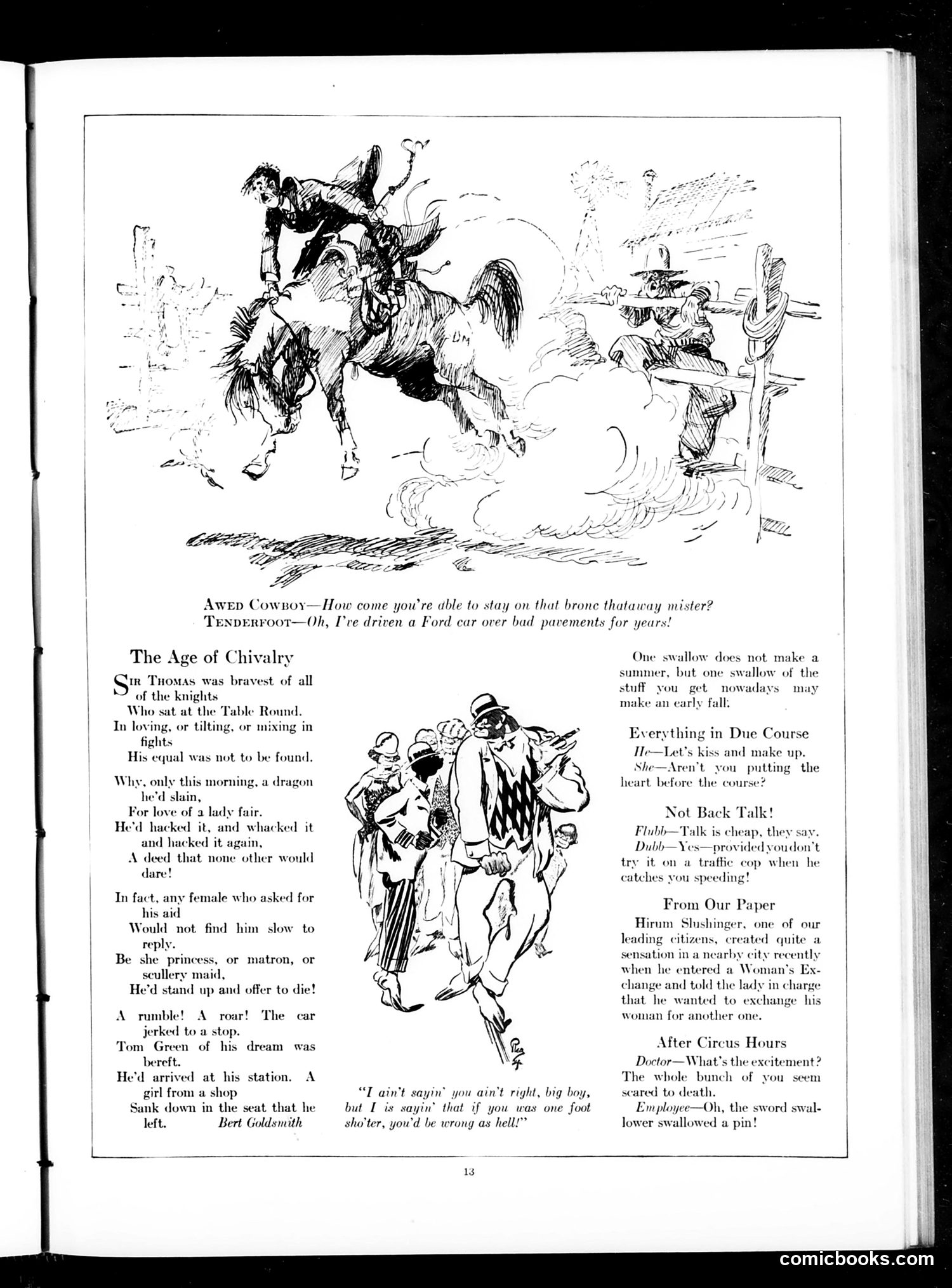
This page contains multiple humorous sketches satirizing early 20th-century American life and attitudes. **Top Cartoon**: An "Awed Cowboy" marvels at a "Tenderfoot's" bronco-riding ability. The joke: the tenderfoot claims his skill comes from driving a Ford automobile over bad roads—suggesting Ford cars were so poorly made or rough-riding that they provided equivalent training to wild horse riding. **"The Age of Chivalry"**: A poem and illustration mock the decline of romantic masculine ideals. A man named Tom Green daydreams about being a noble knight, but is abruptly jolted back to reality when arriving at his train station. The satire suggests modern life has replaced medieval chivalry with mundane routine. **Miscellaneous Jokes**: Several brief satirical quips follow, including commentary on Prohibition-era drinking ("one swallow...may make an early fall"), courtship customs, traffic enforcement, and a domestic-exchange joke about a man wanting to "exchange his woman." The overall tone criticizes modern American life as having stripped away romantic notions and replaced them with commercialism and petty concerns.
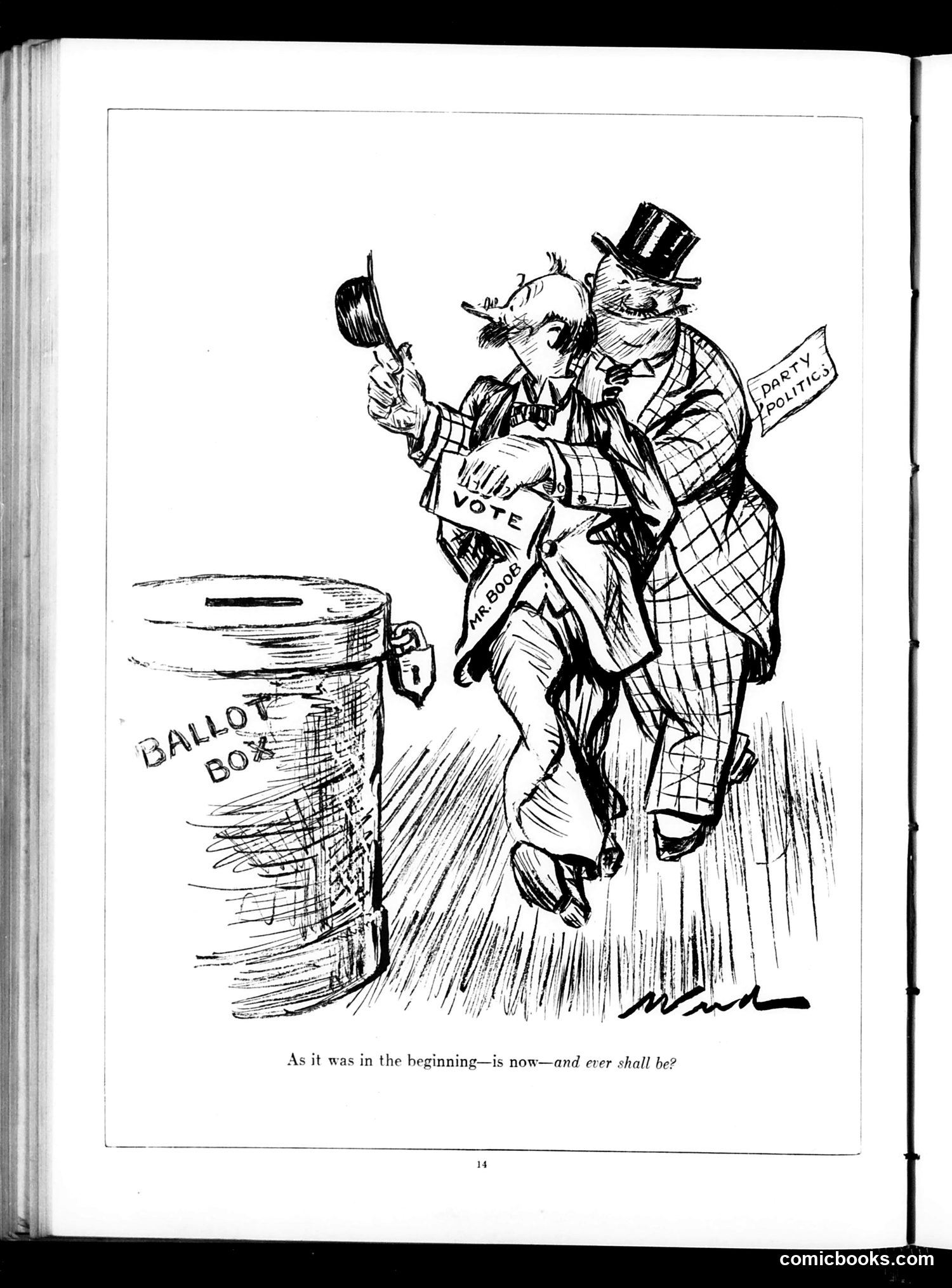
This Judge magazine cartoon depicts two caricatured figures—one wearing a top hat labeled "Party Politics"—manipulating a third figure at a ballot box. The central character holds a "Mrs. Bob Vote" document while being directed by the politicians. The satire critiques the corrupting influence of partisan politics on the voting process. The phrase "As it was in the beginning—is now—and ever shall be?" (echoing religious liturgy) suggests this is a cyclical, perpetual problem in American democracy. The cartoon likely comments on voter manipulation or the compromised nature of elections through party control. The "Party Politics" label indicates criticism of partisan machinery overriding genuine democratic choice. Without a visible date, the specific historical context remains unclear, though the theme reflects recurring concerns about electoral integrity.
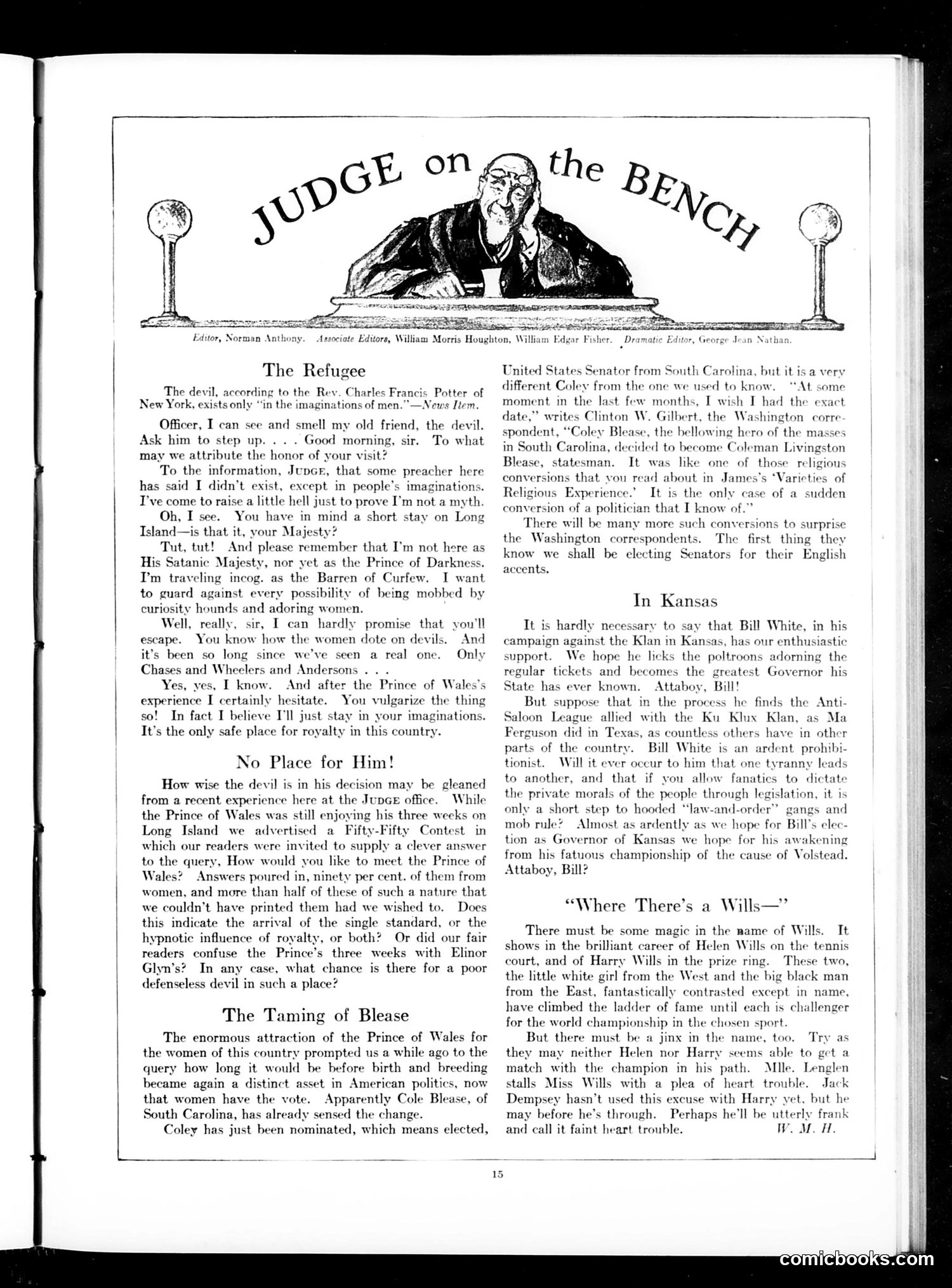
This page contains three political satirical pieces: **"The Refugee"**: A dialogue between a police officer and the Devil, mocking Rev. Charles Francis Potter's claim that evil exists only in imagination. The joke: the Devil threatens to "raise a little hell" to prove he's real, then ironically decides to stay in people's imaginations because it's "the only safe place for royalty"—a reference to the Prince of Wales's recent visit generating excessive female admiration. The satire criticizes both Potter's naive theology and American women's perceived obsession with royalty. **"The Taming of Blease"**: Mocks Cole Blease, South Carolina politician nominated for Senator, who has suddenly adopted refined behavior ("Coleman Livingston Blease, statesman") to appeal to newly enfranchised female voters. Judge satirizes how politicians reshape their personas for women's votes. **"In Kansas"**: Supports Bill White's campaign against the Ku Klux Klan, while warning he may unexpectedly find anti-Saloon League allies—suggesting unlikely political bedfellows emerge during reform campaigns.
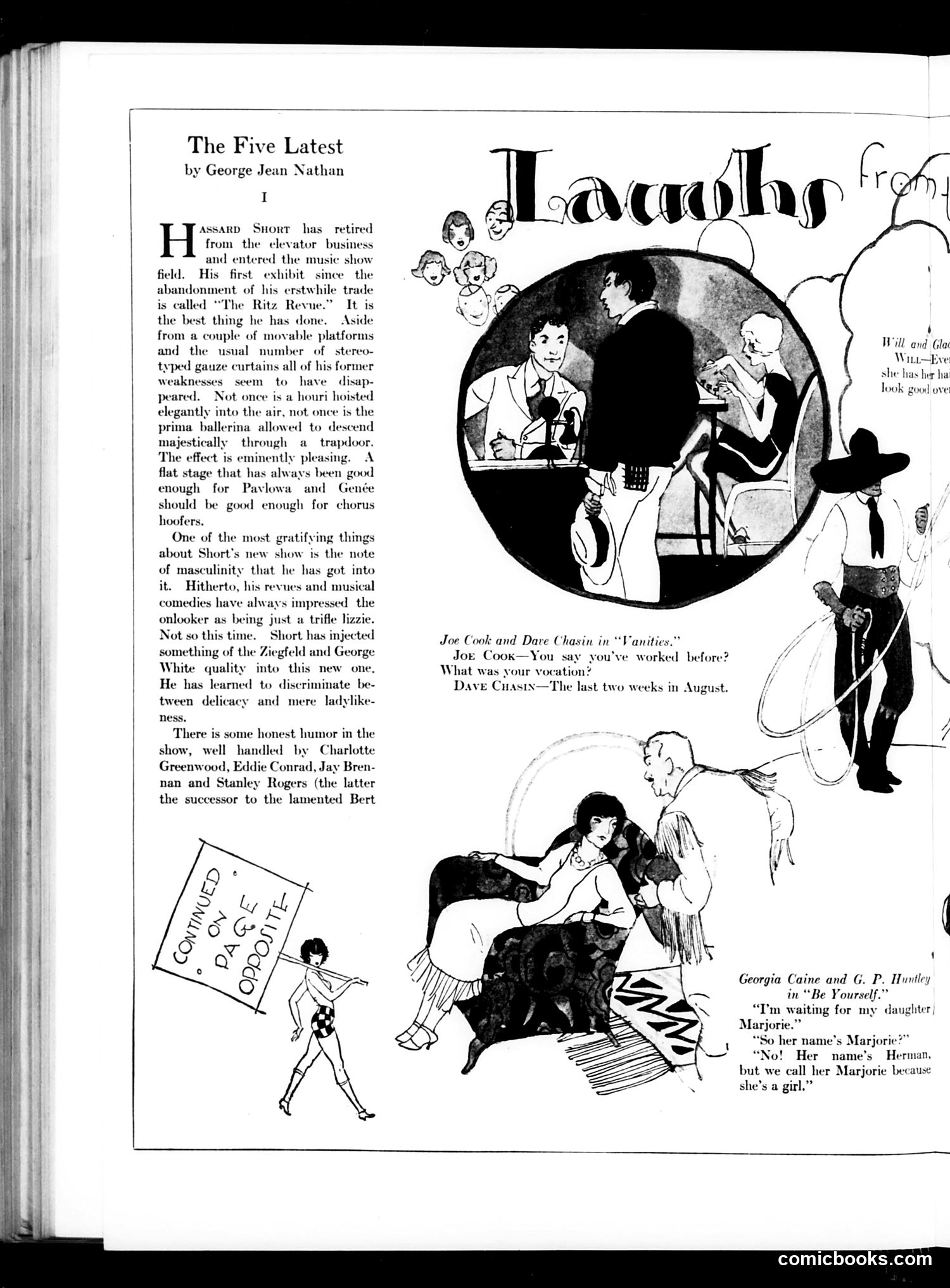
This is critic George Jean Nathan's review of recent Broadway shows. The main subject is **Hassard Short**, a theatrical producer who abandoned the "elevator business" (likely referring to his signature use of elaborate mechanical stage platforms in earlier revues) to produce "The Ritz Revue." Nathan praises Short's new show for abandoning gimmicky stagecraft—no more prima ballerinas descending through trapdoors. The review celebrates that Short has injected "masculinity" into his typically effete musical comedies, comparing his improved style to producers Ziegfeld and George White. The illustrated vignettes mock performers in other current shows: Joe Cook and Dave Chasin's exchange about vocation is a joke about August theater work; Georgia Caine and G.P. Huntley's scene jokes about naming a daughter "Marjorie" despite her birth name being "Herman"—likely satirizing period gender conventions or theatrical absurdity. The cartoons and text together form typical Broadway gossip and satire for the magazine's audience.
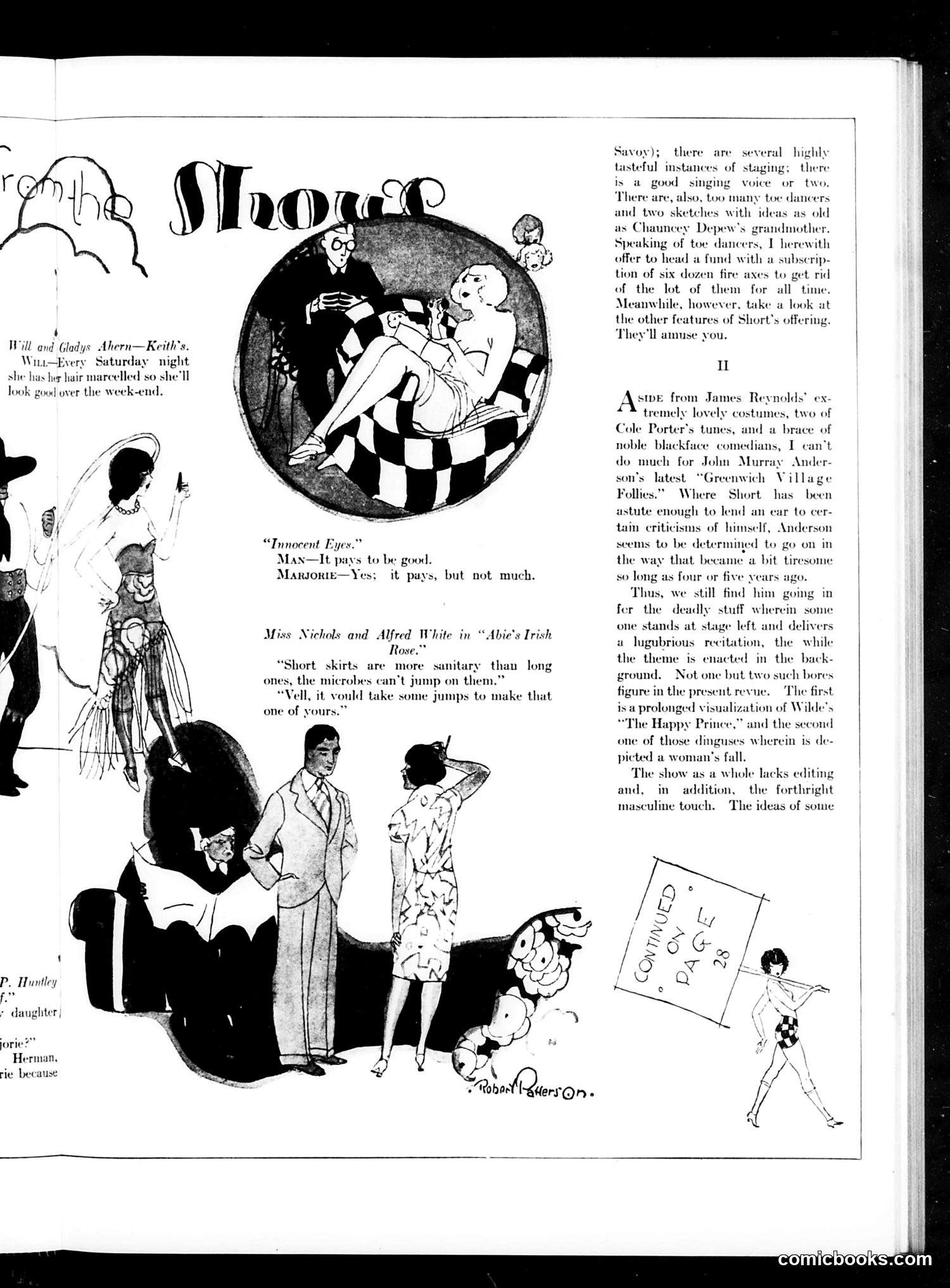
This Judge magazine page contains theater reviews and satirical commentary on 1920s Broadway shows. The main content mocks contemporary stage productions: **"Abie's Irish Rose"** — A popular play about interfaith romance; the reviewer quips that short skirts are "more sanitary" because microbes can't jump on them, then jokes that one actress's legs are so substantial they'd need actual jumps. **Greenwich Village Follies and other revues** — The critic complains about excessive toe-dancing, blackface comedy acts, and pretentious dramatic recitations (like Wilde adaptations) that have become tiresome. He sarcastically offers to fund "six dozen fire axes" to eliminate all the dancers permanently. The cartoons feature vaudeville and Broadway personalities, with social commentary on 1920s entertainment trends and theatrical excess. The satire targets producers' reliance on spectacle over substance—concerns surprisingly modern in nature.
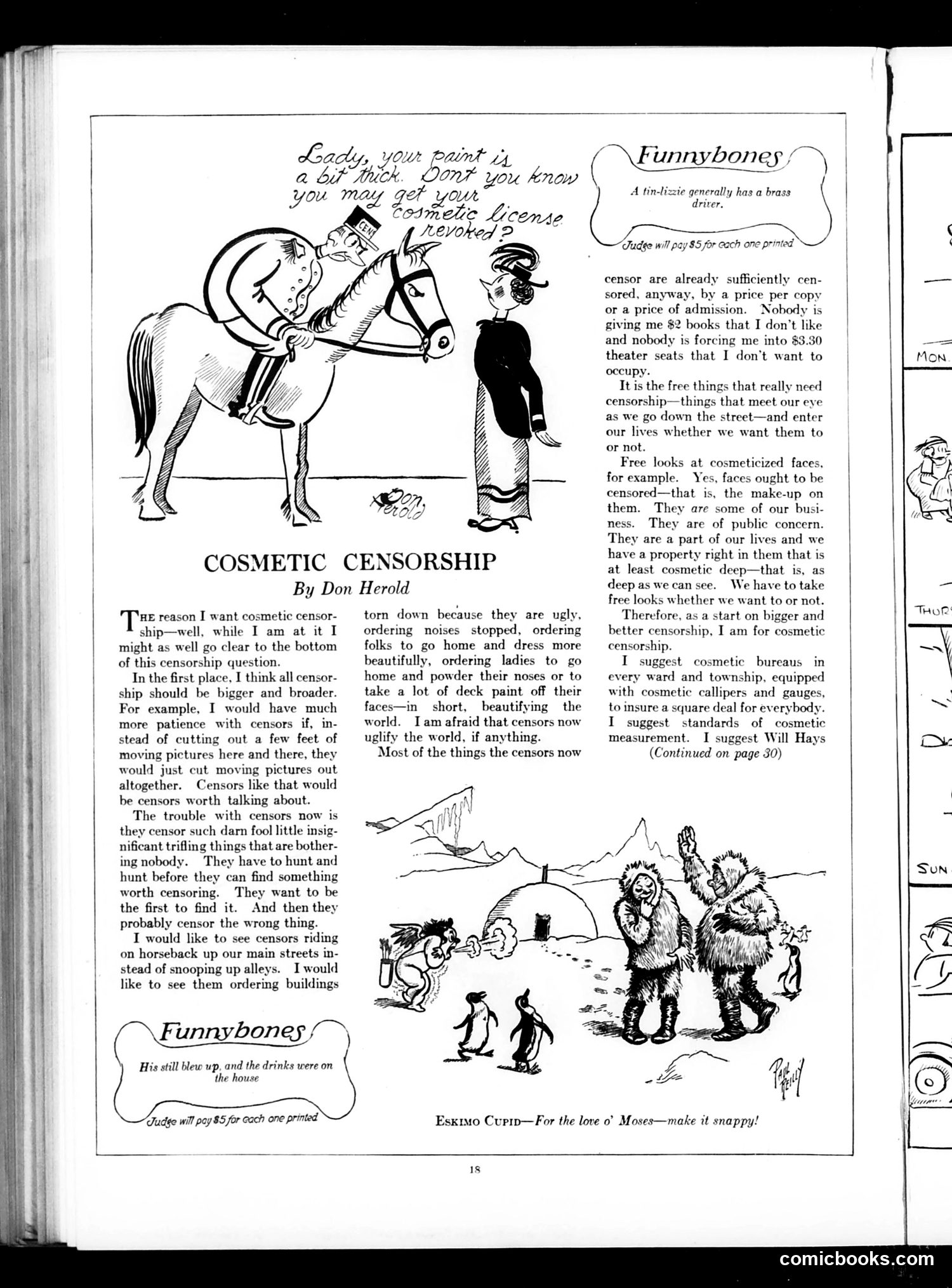
This satirical essay attacks film censorship by proposing absurd "cosmetic censorship" instead. The top cartoon shows a mounted censor confronting a woman about her makeup, threatening to revoke her "cosmetic license"—a visual joke on the licensing concept. Herold's argument is ironic: if censors insist on removing "offensive" content from paid entertainment (movies, theater), they should instead censor the "free" visual assaults—ugly buildings, noise, and women's heavy makeup seen on public streets. He sarcastically suggests cosmetic bureaus with measuring standards (likely referencing Will Hays, the real film censor). The satire critiques censorship's hypocrisy: censors regulate purchased media while ignoring actual public nuisances. The "Eskimo Cupid" cartoon below is unrelated advertising humor. The piece reflects 1920s-30s debates over film censorship and women's cosmetics as moral/social concerns.
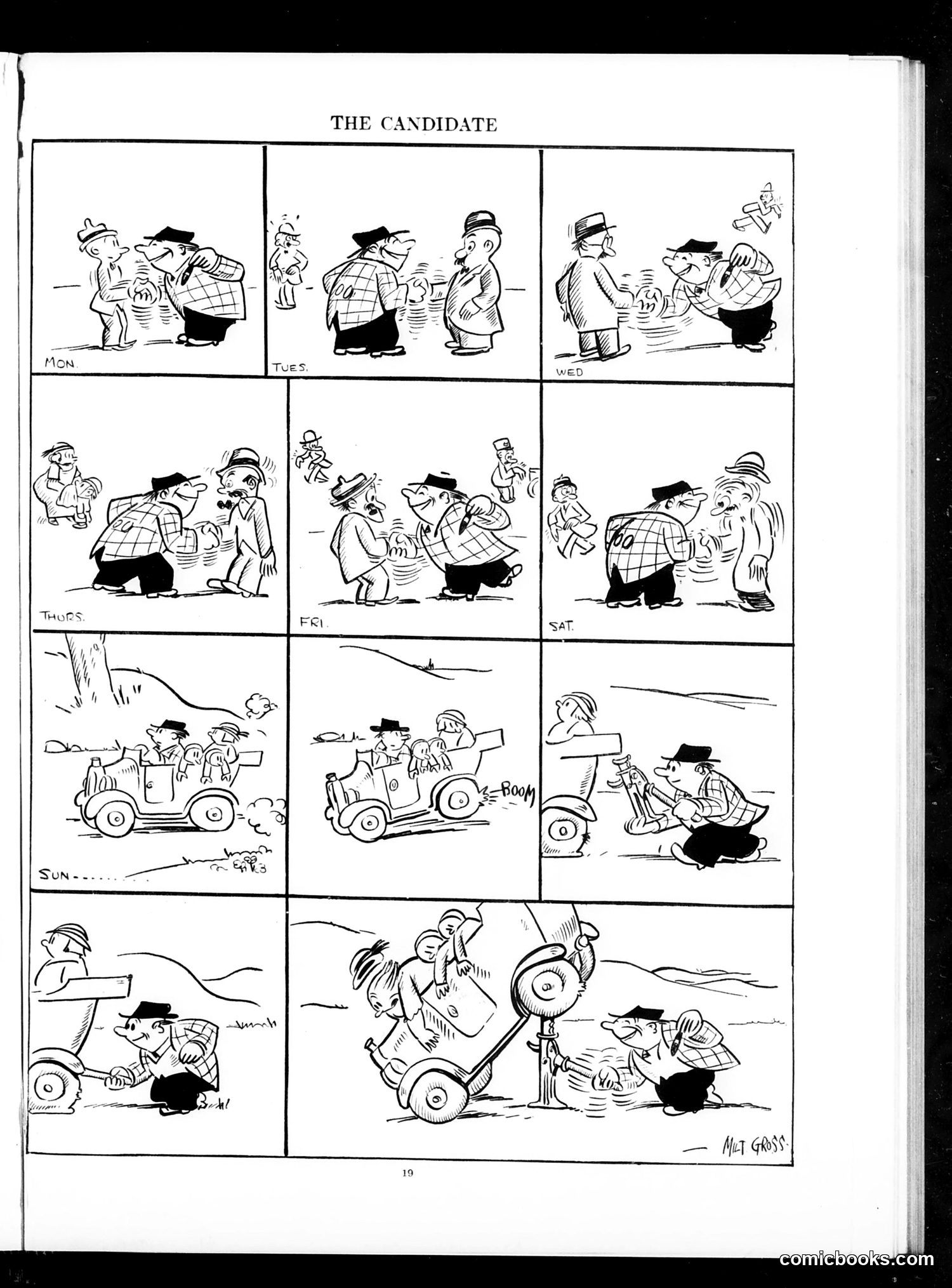
This is a seven-panel satirical comic strip showing a political candidate's week-long campaign schedule. The strip depicts the candidate (recognizable by his checkered suit and hat) engaging in various public activities: **Mon-Sat**: The candidate meets voters, shakes hands, and performs public appearances—typical campaign activities. **Sun onwards**: The narrative shifts absurdly. The candidate appears to suffer increasingly chaotic mishaps involving a car: crashes, explosions, and physical comedy escalate throughout the remaining panels. The satire likely mocks how politicians exhaust themselves through relentless campaigning, or how candidates maintain composed public personas while experiencing personal disasters. The shift from civilized handshakes to vehicular chaos suggests the strain of campaigning or the gap between campaign rhetoric and reality. The artist is Mal Grass (signed lower right).
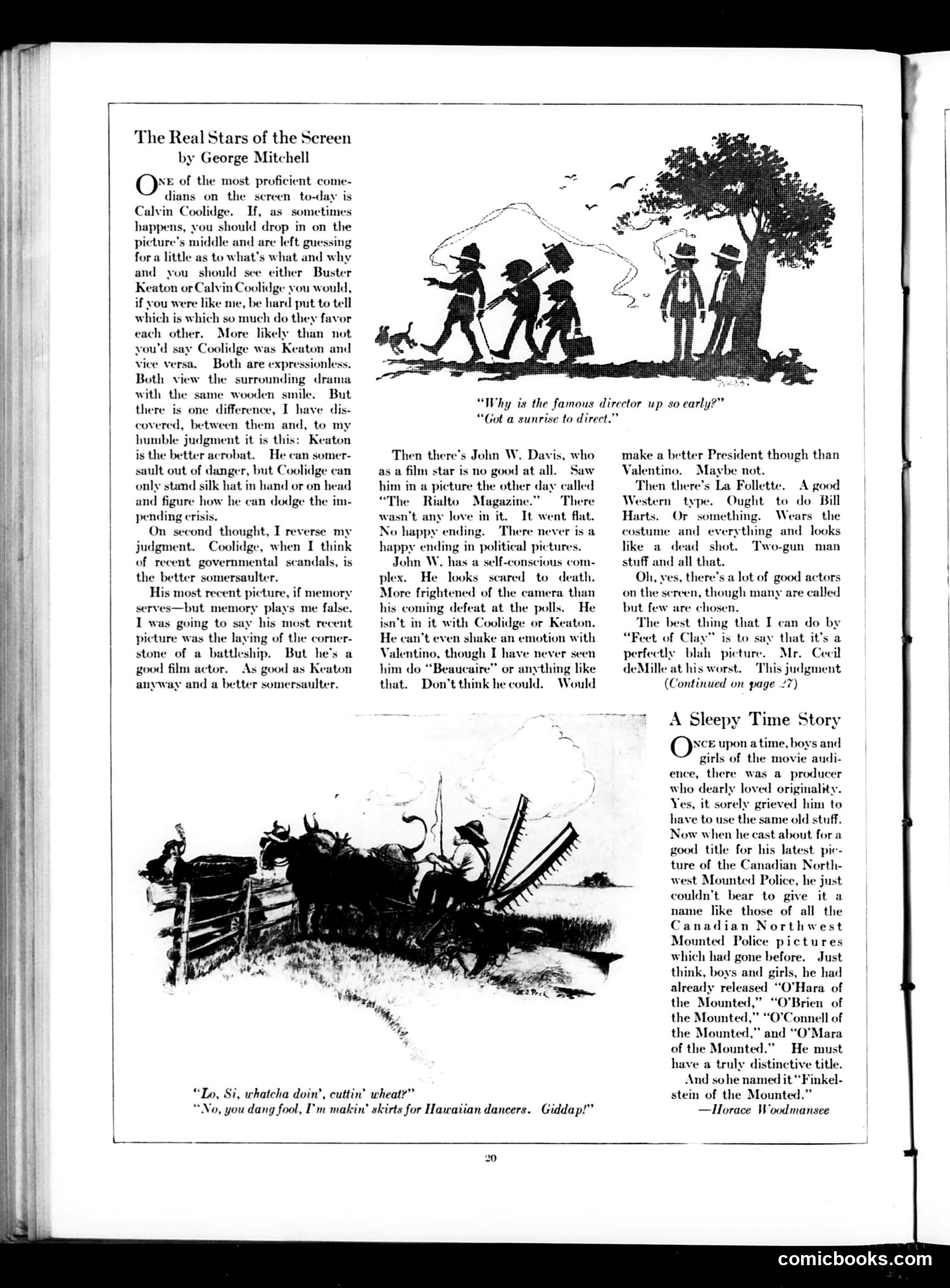
This page contains two separate articles by George Mitchell about early cinema. **"The Real Stars of the Screen"** compares comedians Calvin Coolidge and Buster Keaton, suggesting both have similar expressionless faces and acrobatic talent. The article critiques several film stars: John W. Davis (called bad at acting), La Follette (described as "Western type"), and mentions Cecil deMille positively. The piece appears to be satirizing contemporary actors' limited range. **"A Sleepy Time Story"** mocks a film producer's creative desperation—he's recycled Canadian Northwest Mounted Police titles repeatedly ("O'Hara of the Mounted," "O'Brien of the Mounted," etc.), now proposing "Finkelstein of the Mounted." The satire targets Hollywood's formula filmmaking and lack of originality. Both articles use humor to criticize the entertainment industry's predictability and mediocrity during the silent film era.
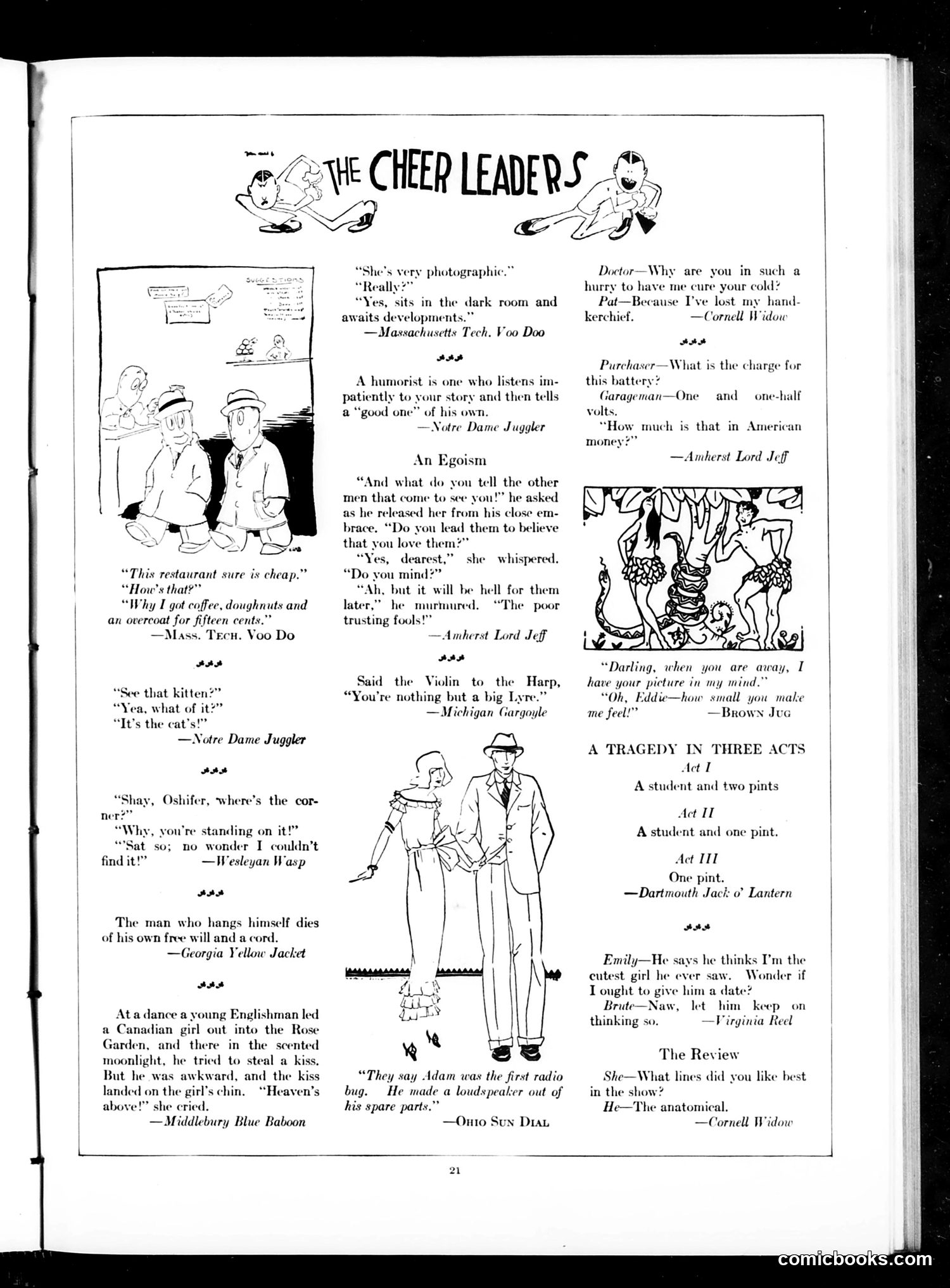
This is a college humor compilation from Judge magazine, featuring jokes submitted by various university publications (Notre Dame Juggler, Massachusetts Tech, Amherst Lord Jeff, etc.). The cartoons and quips satirize early 20th-century college life and social customs. The humor targets: - **Dating/courtship absurdities** (the awkward English suitor, the egoistic man with multiple girlfriends) - **College drinking culture** ("A Tragedy in Three Acts" depicts declining sobriety through acts) - **Gender dynamics** (women as photographers, superficial compliments about appearance) - **Modern technology** (the "radio bug" joke about Adam; the "photographic" woman developing in darkness—a darkroom reference) - **Economic confusion** (the garage man's voltage explanation to an American customer) The page demonstrates how Judge used college humor to gently mock student behavior, romantic fumbling, and generational attitudes toward new technologies and social conventions of the era.
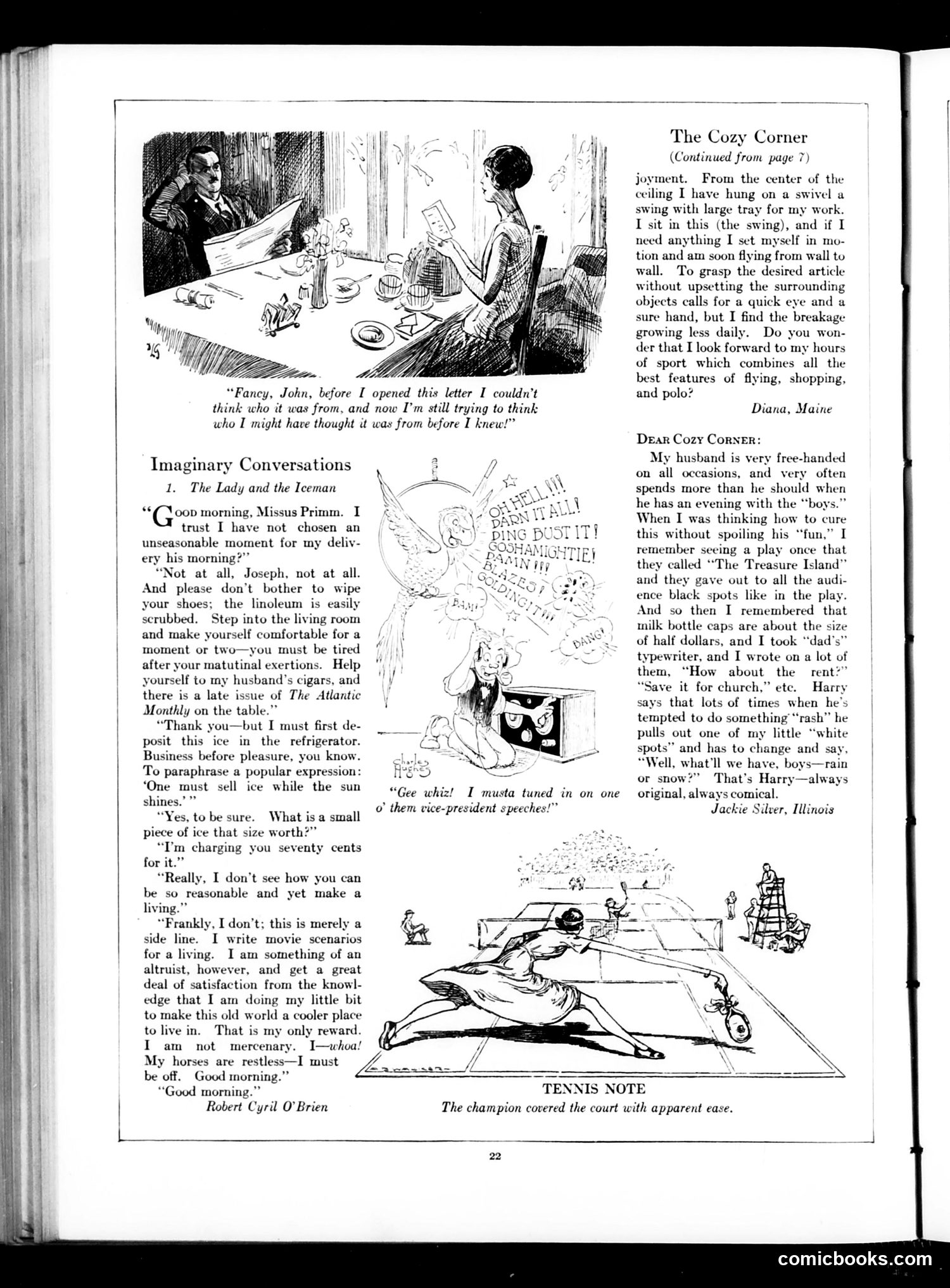
This page from *Judge* magazine contains three humorous pieces satirizing early 20th-century American life: **"Imaginary Conversations: The Lady and the Iceman"** mocks class pretense. A wealthy woman (Mrs. Primm) treats her ice deliveryman with exaggerated politeness—offering cigars and *The Atlantic Monthly*—while he reveals he's actually a struggling screenwriter moonlighting as an ice seller. The satire targets both her condescension disguised as generosity and his implausible story about writing movie scenarios while delivering ice. **"The Cozy Corner"** section contains domestic humor: letters from readers describing inventive home solutions. One woman describes a swing-based filing system; another describes using typed milk-bottle caps with financial reminders to curb her husband's spending on nights out with friends. The cartoons and jokes reflect 1920s concerns: class anxiety, the novelty of refrigeration, movie industry aspirations, marital finance management, and women's domestic creativity during an era of limited economic power.
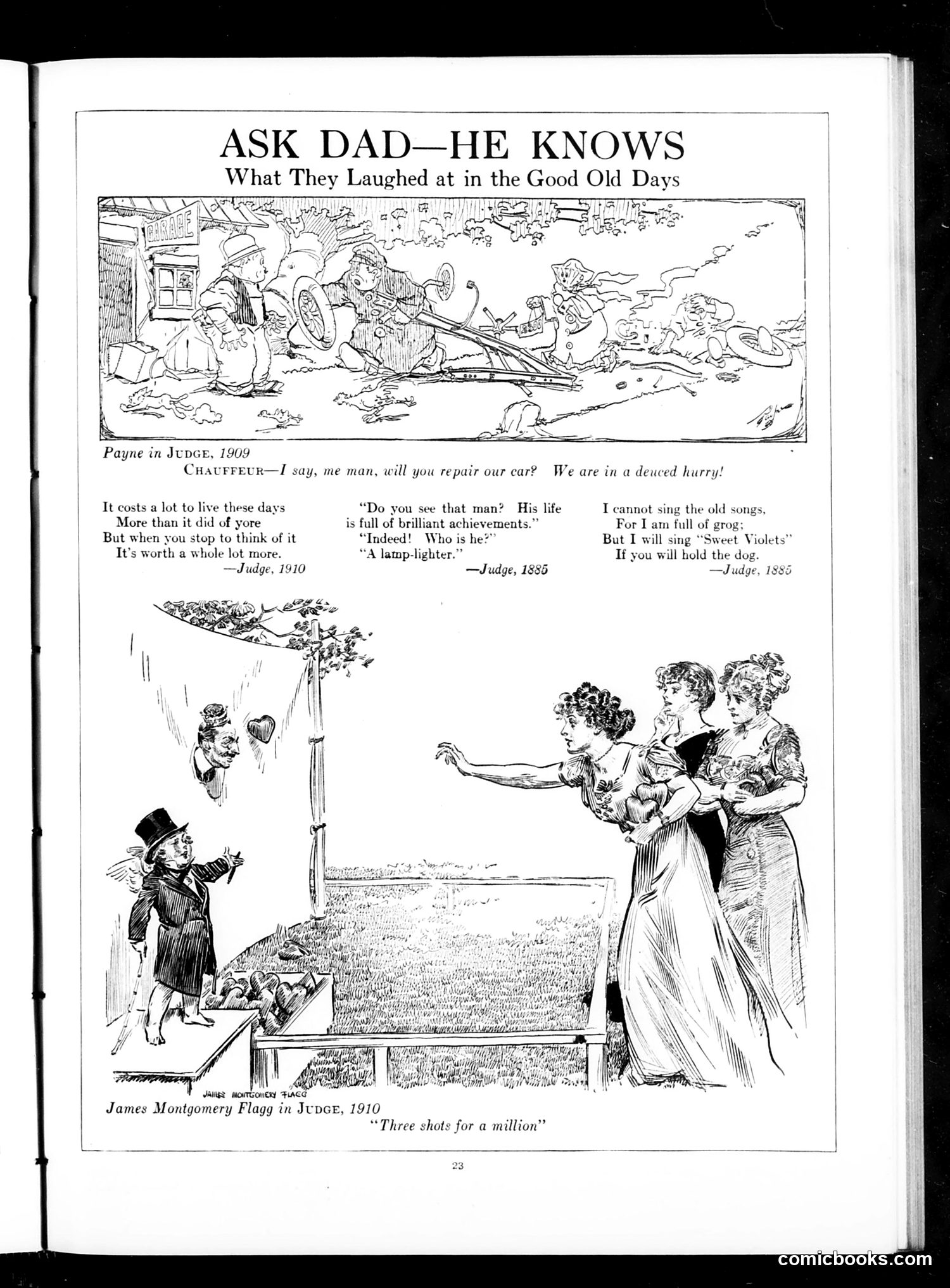
This page presents humorous contrasts between "the good old days" and present times (circa 1910). The top cartoon shows children with a broken-down automobile, asking a chauffeur for repairs—suggesting modern inconveniences and expenses. Below are three joke quotations from earlier Judge issues (1855, 1885, 1910), each reflecting period concerns: rising living costs, social ambition, and changing entertainment (from old songs to new popular music). The bottom cartoon by James Montgomery Flagg shows "Three shots for a million"—likely referencing either golf (a wealthy pastime gaining popularity) or gambling, mocking upper-class leisure pursuits. Overall, the page uses nostalgia humorously to comment on modernization's costs and how society's values and entertainments have shifted, inviting readers to remember simpler or different times through "dad's" perspective.
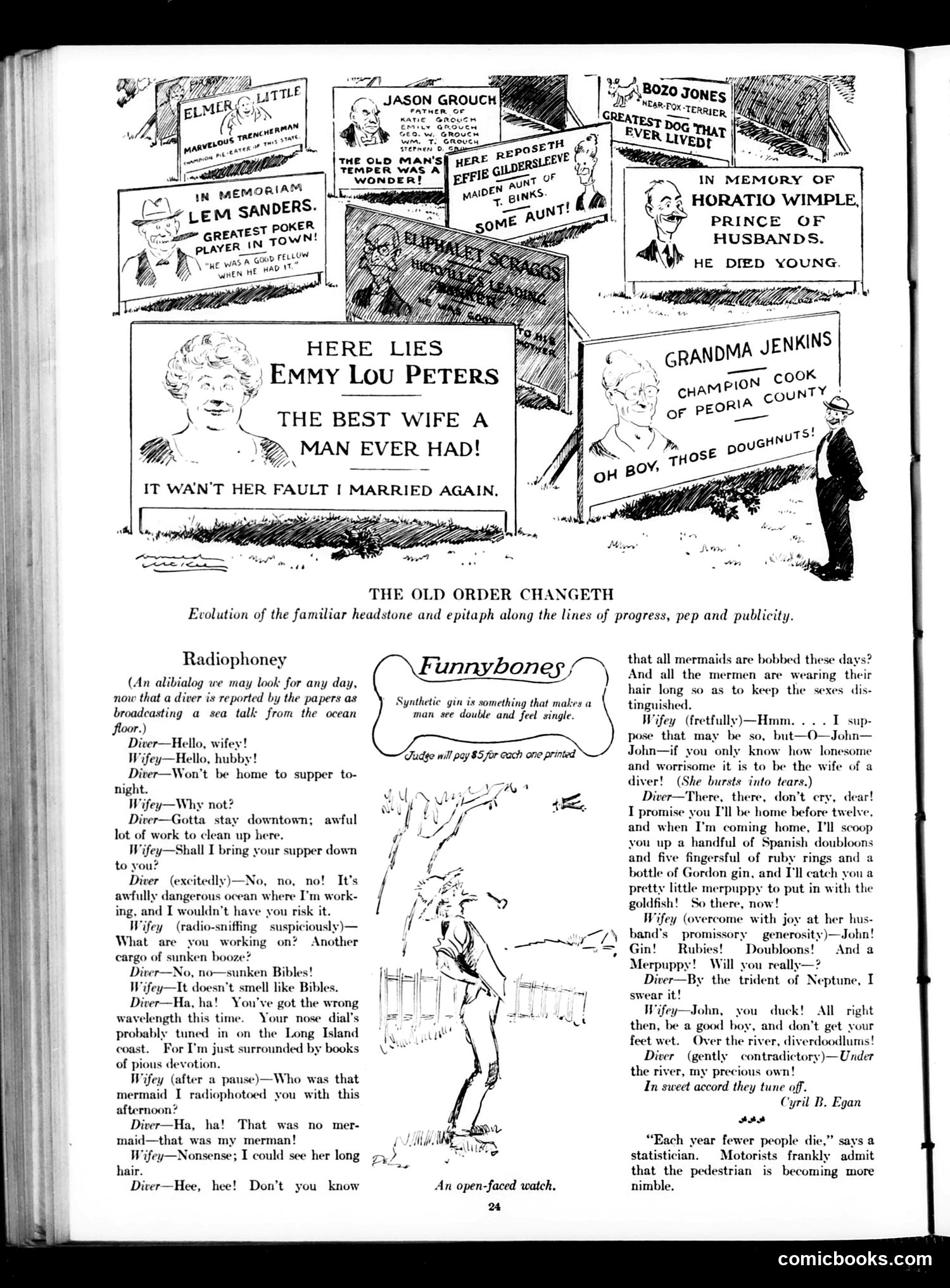
This page satirizes evolving American funeral customs and modern technology's intrusion into traditional practices. The top section shows cemetery headstones becoming increasingly sensationalized and publicity-driven—from solemn memorials to bombastic tributes (Bozo Jones as "Greatest Dog That Ever Lived!"). The caption notes this represents "progress, pep and publicity." The main cartoon depicts a "radiophoney" conversation between a diver husband and anxious wife. The satire targets radio broadcasting (a novelty at this time) and the absurdity of deep-sea workers transmitting domestic conversations. The wife worries about her husband's infidelity with a "mermaid," playing on the romantic mythology of mermaids while the husband dismisses her concerns. The humor derives from the clash between modern technology enabling surveillance of private life and traditional gender anxieties about faithfulness. The bottom note about pedestrians becoming "more nimble" likely references increasing automobile accidents—darkly suggesting fewer deaths because people are learning to jump out of the way faster.
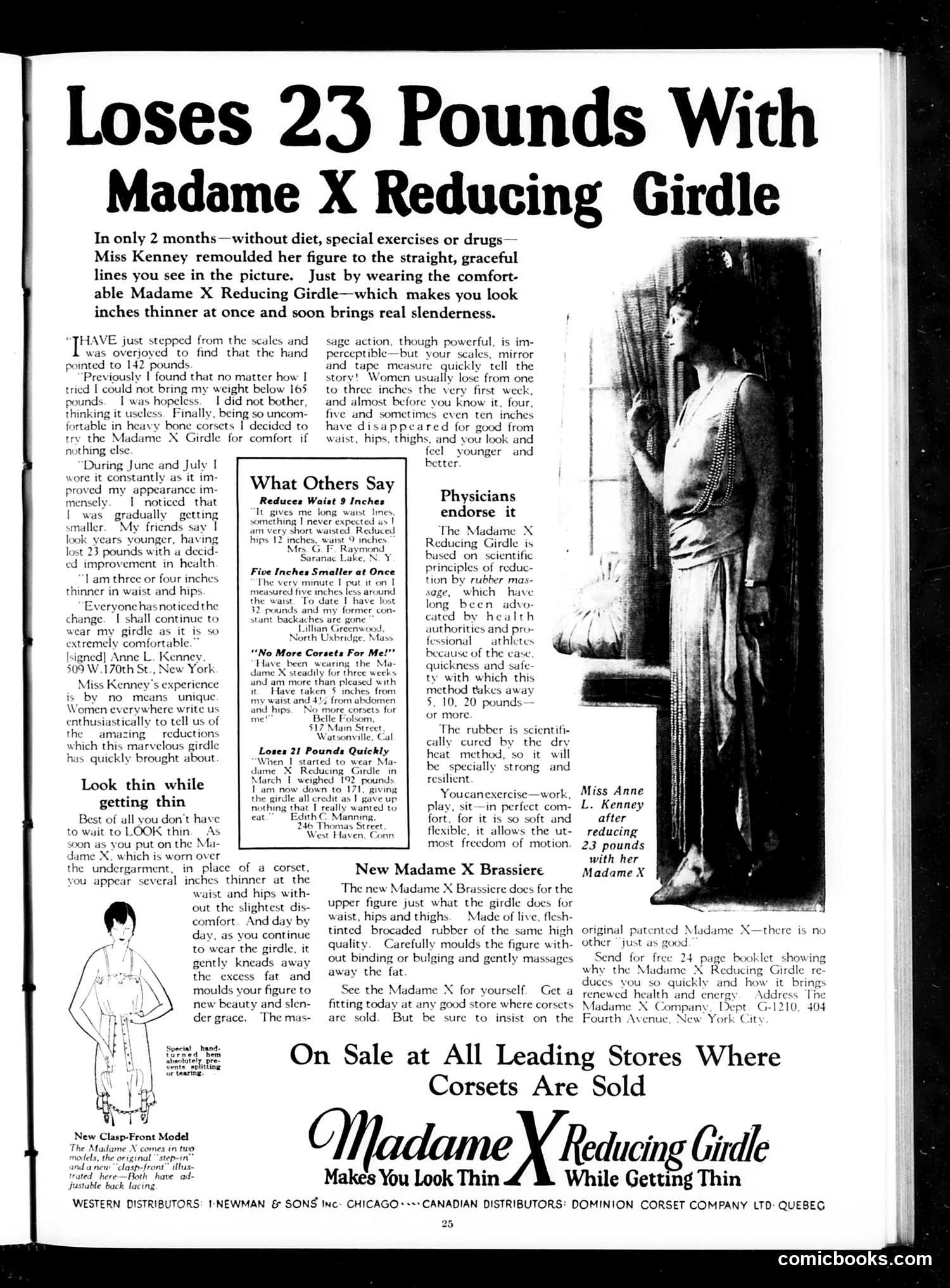
This is a **full-page advertisement** for the "Madame X Reducing Girdle," not a satirical cartoon. Judge magazine, while primarily known for political satire, also carried advertisements. The ad promotes a rubber corset-girdle claiming to reduce weight without diet or exercise—a promise that appears absurd by modern standards. A testimonial from "Miss Kenney" claims 23-pound weight loss in two months simply from wearing the garment. The page includes customer testimonials and physician endorsements emphasizing the girdle's "scientific" rubber massage action. A diagram shows the garment's construction. **Historical context**: This represents early 20th-century weight-loss marketing, when rubber compression garments were genuinely marketed as weight-reduction tools. The ad exploits women's body image anxieties and offers a "quick fix" with minimal effort—a sales strategy that remains common today, though modern advertising standards are stricter.
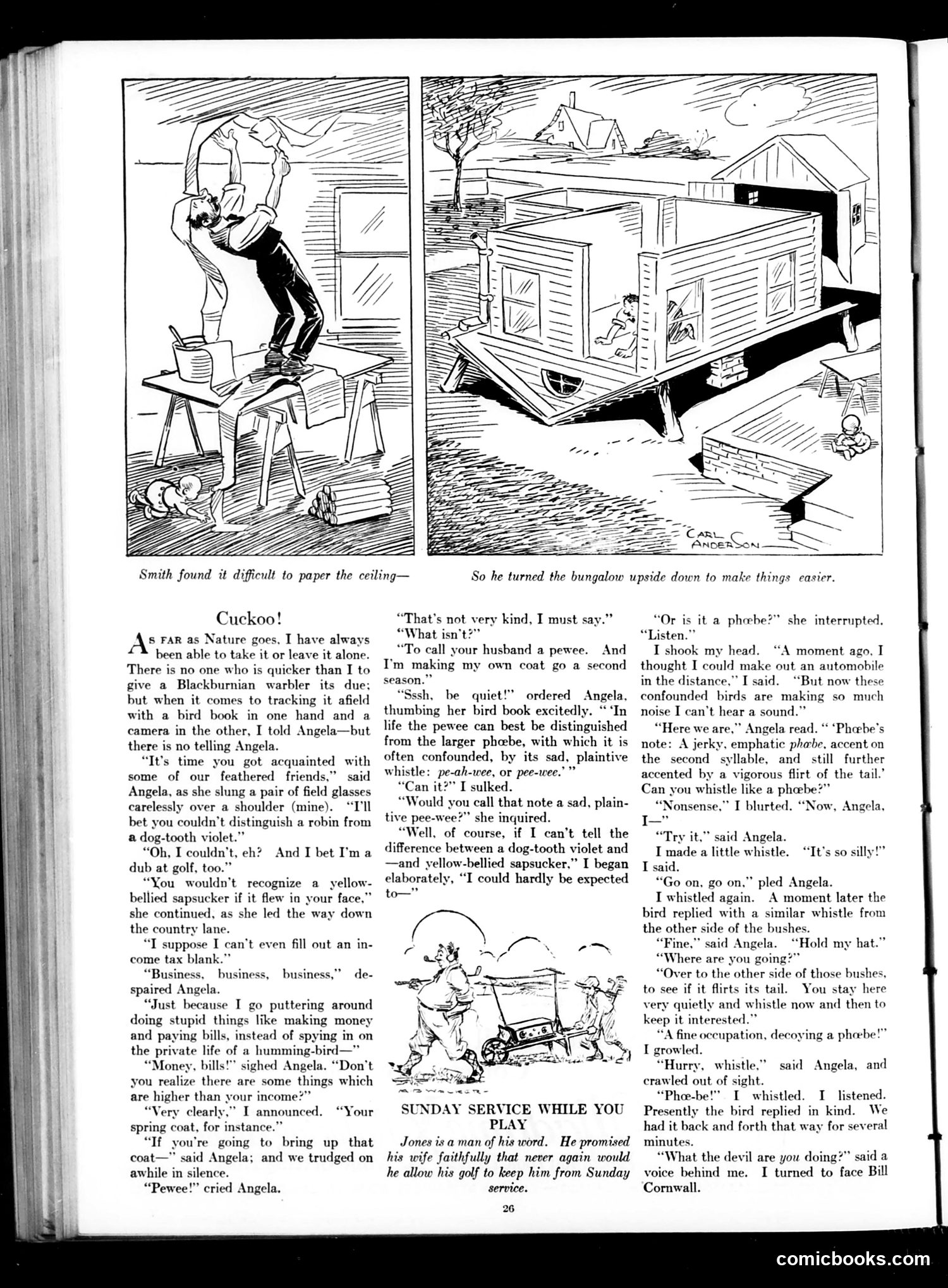
This page from *Judge* magazine contains a humorous domestic story illustrated with two cartoons about a husband reluctant to bird-watch with his wife Angela. **The Setup:** The narrator dismisses bird-watching as trivial compared to "important" work like making money and paying bills. Angela insists on educating him about nature. **The Satire:** The joke mocks masculine priorities and marital dynamics of the era. The husband's dismissive attitude toward his wife's interests—and his sarcastic deflections about his own golf and income taxes—represents the typical husband who considers his pursuits important while belittling his wife's hobbies. **The Punchline:** While dutifully bird-watching and whistling to attract a phoebe, a friend (Bill Cornwall) discovers him alone, whistling repeatedly into the bushes—creating an absurd, compromising scene the friend cannot understand. **The Cartoons:** The top panels show domestic incompetence: Smith struggles with home repairs while Angela forces him outdoors; the bungalow is literally upside-down to accommodate golf-playing. The satire ultimately ridicules both the husband's resistance to his wife's interests and the embarrassing situations his compliance creates.
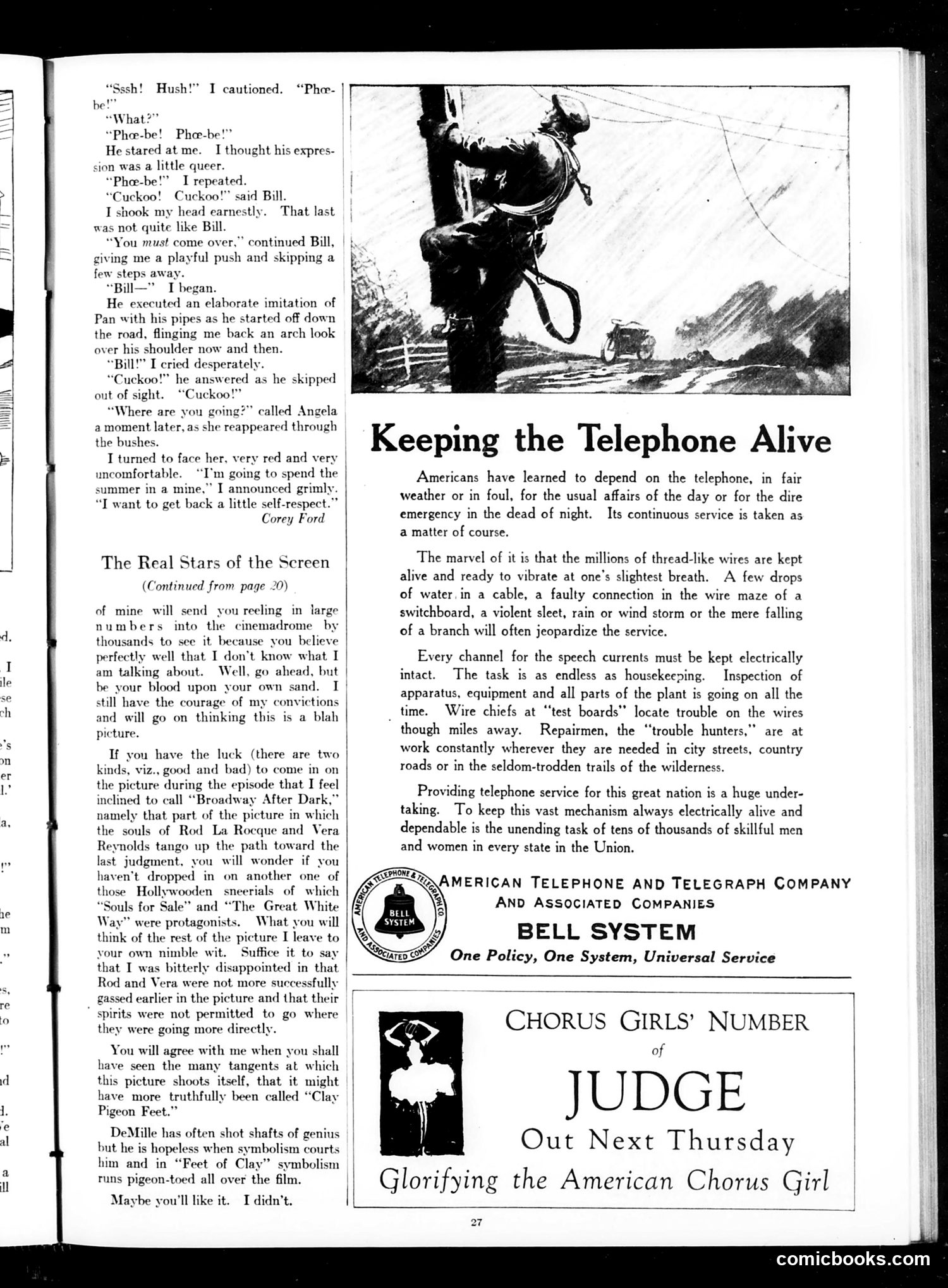
This page contains two distinct sections: **Left side:** A humorous short story excerpt (attributed to Corey Ford) about romantic misunderstanding. A narrator attempts to imitate a bird call ("Phee-be!") to attract a woman named Angela, but his friend Bill mockingly imitates a cuckoo bird and Pan's pipes instead, suggesting the narrator is foolish or "cuckoo" for his romantic efforts. The satire targets social awkwardness and failed courtship attempts among the era's young men. **Right side:** A full-page advertisement for Bell System telephone service. Rather than traditional advertising copy, it reads as promotional journalism, celebrating telephone infrastructure maintenance as noble work. It emphasizes the reliability and nationwide network required to keep phones operational. The ad features the Bell System logo and promotes their "One Policy, One System, Universal Service" messaging. **Bottom:** An advertisement for the film "Judge," featuring chorus girls. The page mixes editorial content with advertising typical of Judge magazine's format.
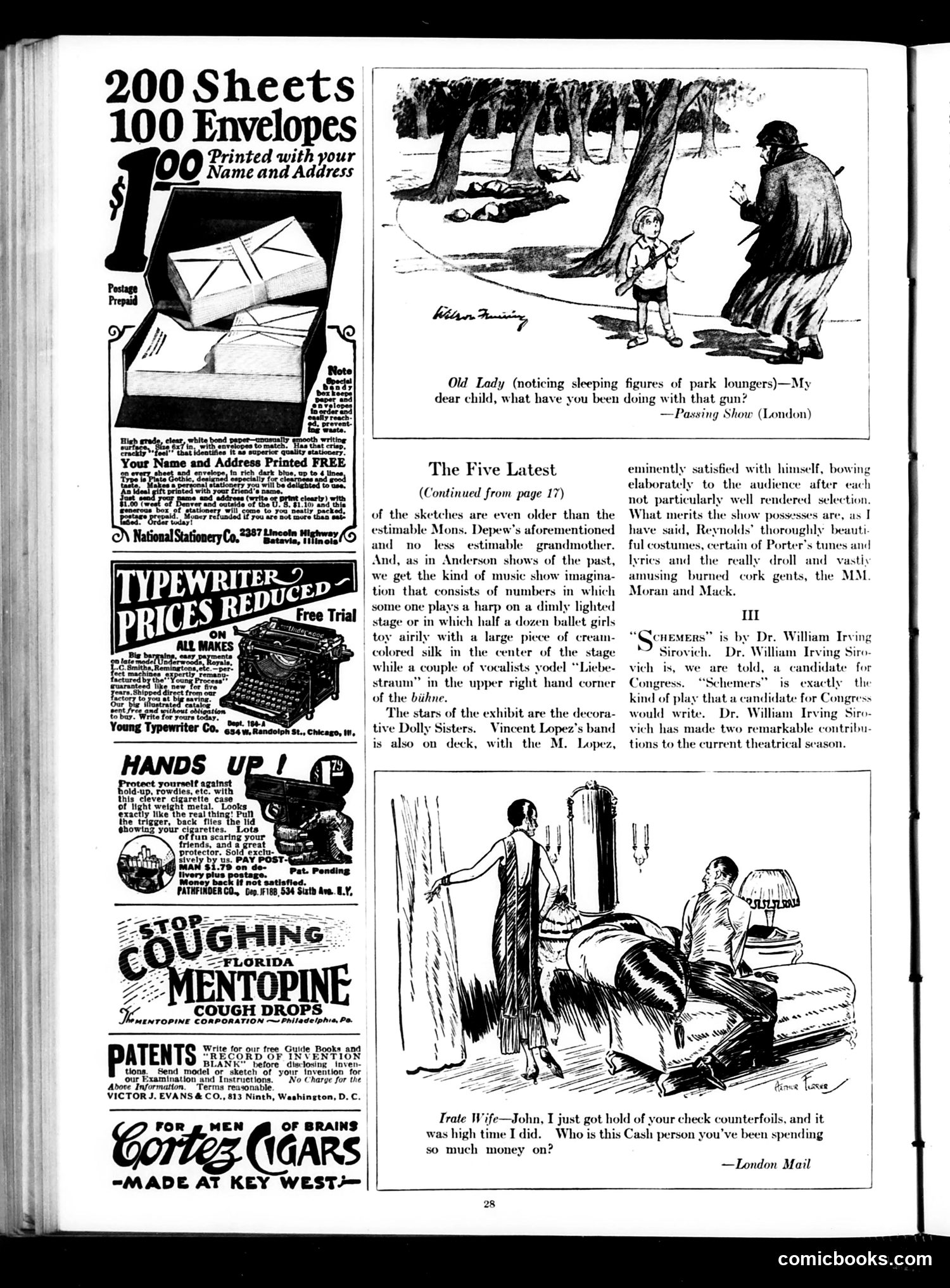
This page contains two distinct cartoons: **Top cartoon** (credited to Passing Show, London): Shows an elderly woman confronting a child holding a toy gun near park loungers sleeping under trees. The joke plays on the woman's alarm at the child's "weapon"—she doesn't realize it's a toy, creating humor from her overwrought concern about what appears to be innocent play. **Bottom cartoon** (from London Mail): Depicts a wife confronting her husband after discovering his checkbook stubs. She's found evidence he's been giving money to someone named "Cash," creating a double entendre—she suspects infidelity or financial impropriety, not realizing "Cash" is simply a person's name. The husband's defensive posture suggests marital tension over undisclosed spending. Both cartoons rely on misunderstanding or mistaken identity for comedic effect, typical of early 20th-century domestic humor targeting middle-class anxieties about money and propriety. The page is primarily filled with period advertisements (typewriters, stationery, patent services, cigars) rather than editorial content.
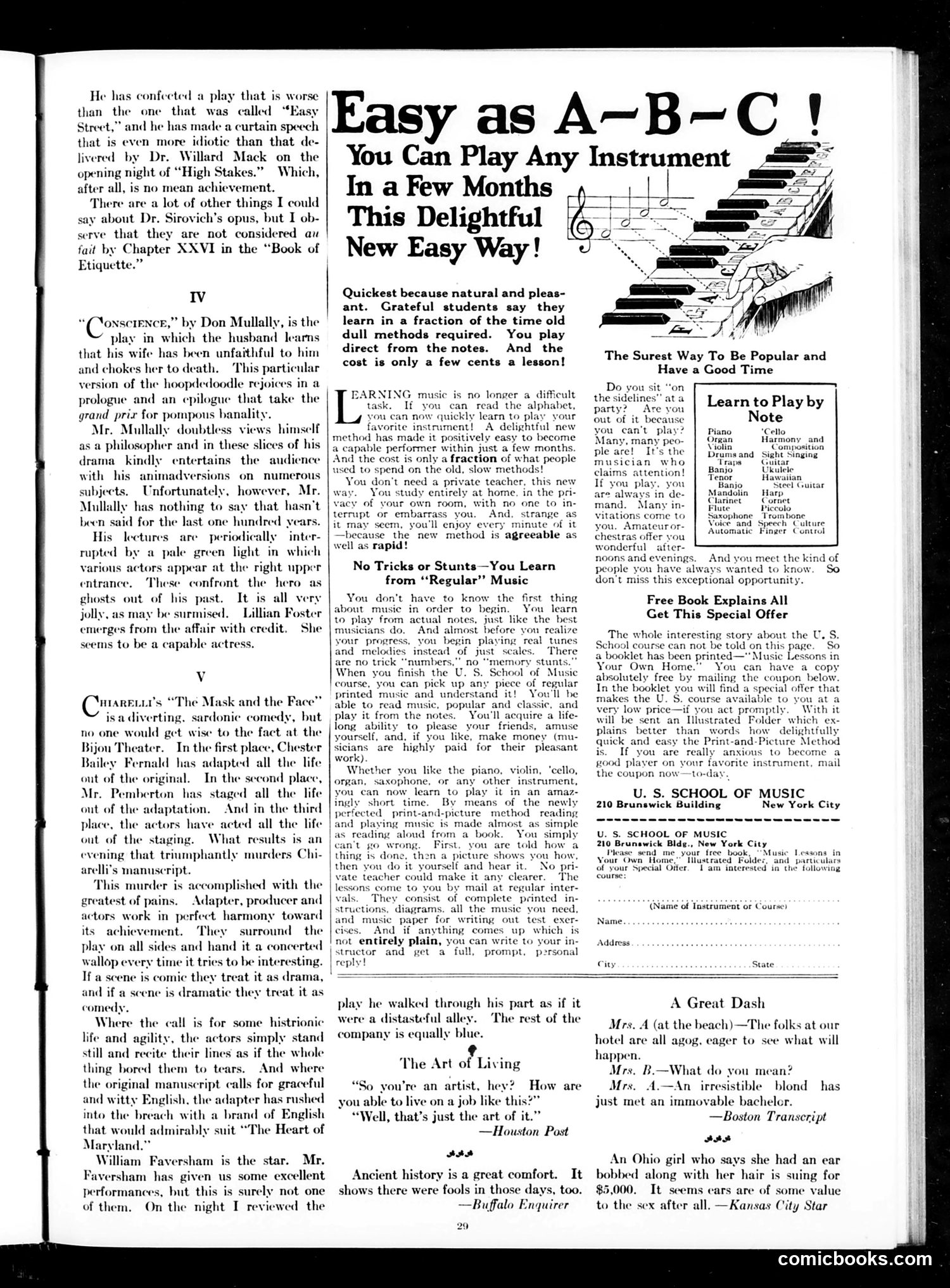
This page contains primarily **advertising content** rather than political satire or commentary. The dominant feature is a large advertisement for the "U.S. School of Music," promoting a mail-order music instruction method claiming students can learn any instrument in "a few months" through an "Easy as A-B-C" approach. The ad emphasizes affordability ("only a few cents a lesson"), home study without private teachers, and speed compared to "old, dull methods." The upper portion includes brief theatrical reviews of plays including works by Don Mullally ("Conscience") and others, with critics commenting on their poor quality and overwrought staging—typical Judge satirical commentary on Broadway productions. **For modern readers:** This represents early-20th-century mail-order education marketing, a precursor to correspondence schools. The claims about rapid, affordable learning mirror contemporary online education advertising. The theatrical reviews reflect Judge's focus on lampooning cultural pretension and poor artistic execution.
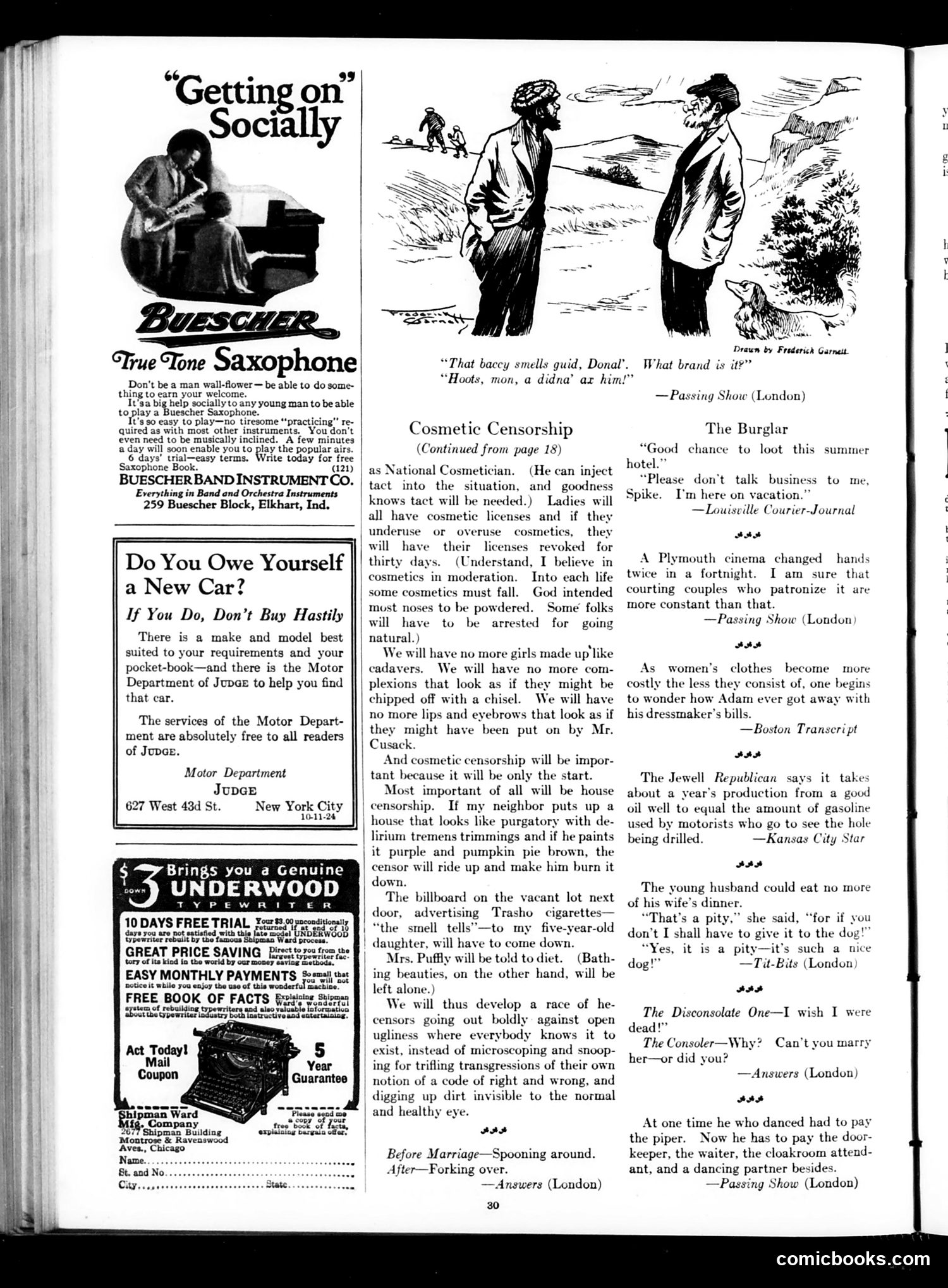
This page from Judge (dated 10-11-24) contains advertisements and satirical humor pieces typical of the era. **Main Cartoons:** The top cartoon, credited to Frederich Garnett, shows two Scottish men discussing tobacco, with one asking "What brand is it?" The humor relies on Scottish dialect ("guid," "didna' ax him") and appears to be a setup for a Buescher Saxophone advertisement—suggesting that playing saxophone helps with social acceptance. **Satirical Pieces:** The "Cosmetic Censorship" essay proposes a fictional government censor who would regulate cosmetics use, preventing both over- and under-application. It's social satire critiquing excess vanity while humorously suggesting authoritarian solutions. Other brief jokes mock modern life: couples in cinemas being unfaithful, a burglar's poor timing, and the expense of dating ("Before Marriage—Spooning around. After—Forking over"). **Context:** This reflects 1920s concerns about consumerism, gender appearance standards, and social propriety, delivered through Judge's characteristic blend of advertising and lighthearted social commentary.
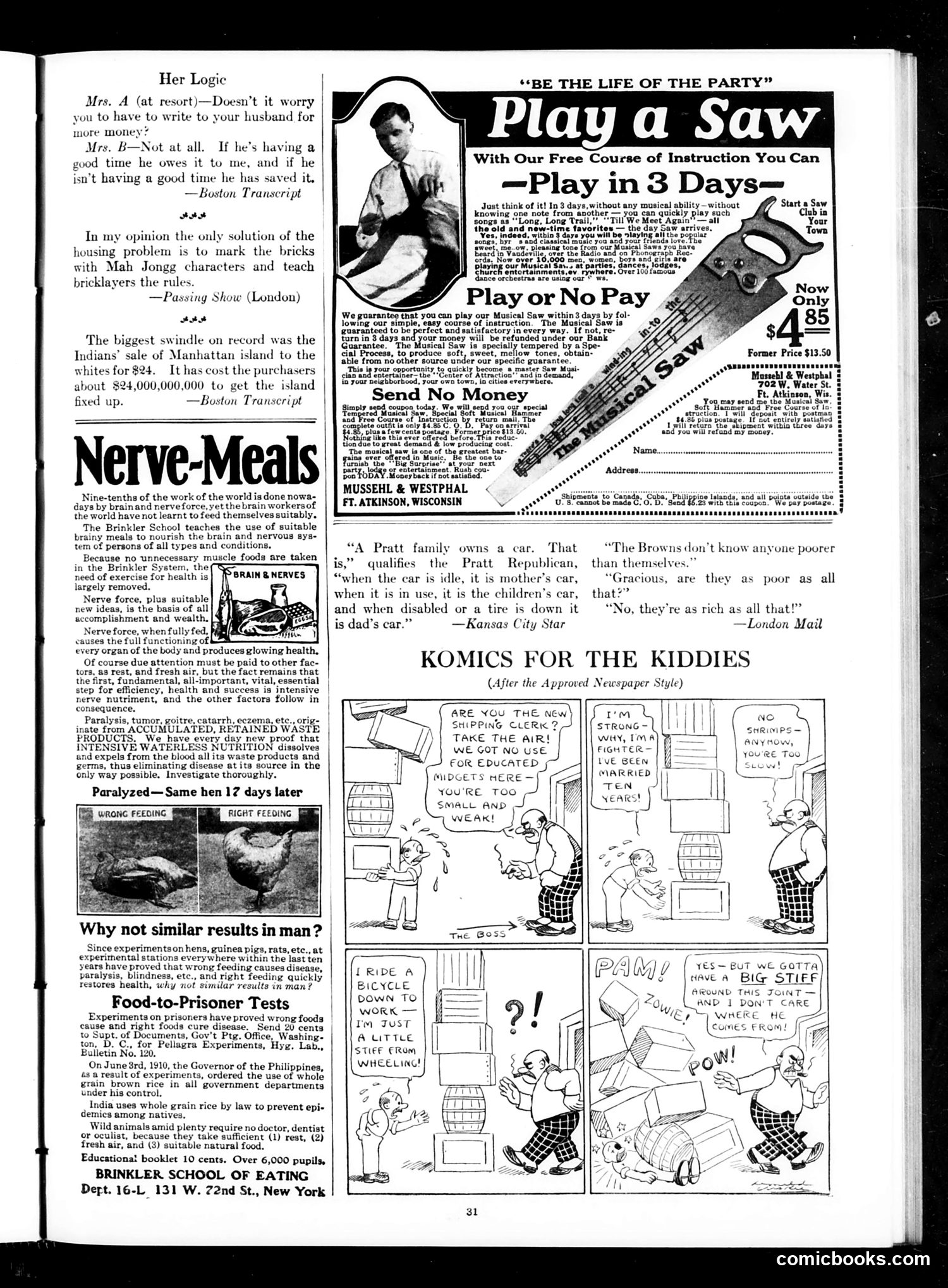
This page from *Judge* magazine contains primarily **advertising and filler content** rather than political satire. The main items are: **"Nerve-Meals" advertisement**: Promotes the Brinkler School's dietary system, claiming specialized "brainy meals" nourish the nervous system and eliminate disease through "intensive waterless nutrition." This reflects 1920s pseudo-scientific wellness trends. **"Play a Saw" advertisement**: Offers a musical saw with a guarantee to teach playing in three days—classic mail-order hucksterism. **Brief comedic quotes**: Including one mocking Manhattan's $24 purchase price (now costing $24 billion to maintain) and observations about married couples' financial dynamics. **"Komics for the Kiddies"**: A children's comic strip in newspaper style featuring working-class characters and slapstick humor. The page represents typical *Judge* magazine filler: light domestic humor, dubious mail-order products, and entertainment—rather than focused political commentary. It reflects 1920s consumer culture and middlebrow humor sensibilities.
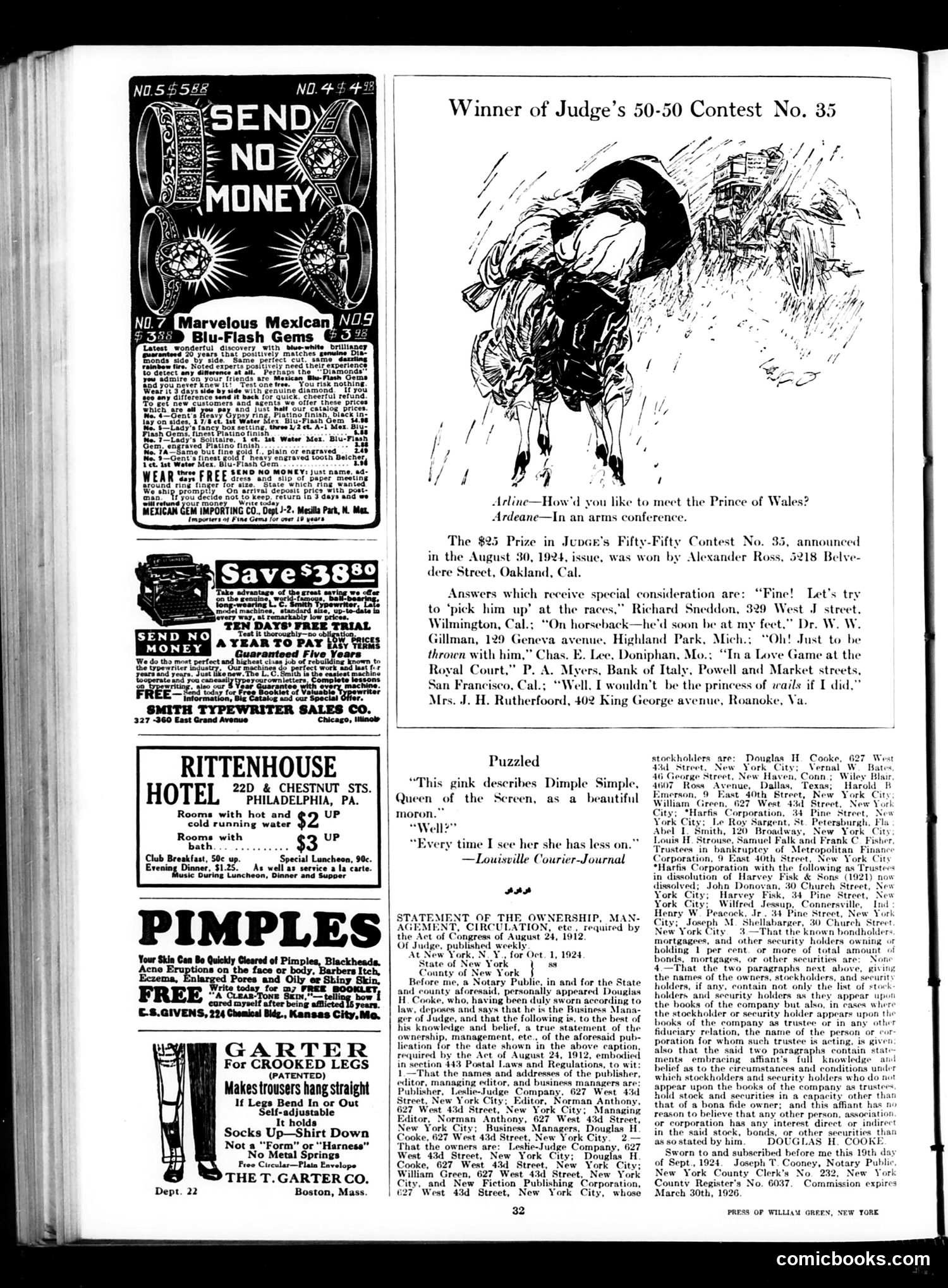
This page primarily features **advertisements and contest results** rather than political cartoons. The main content is the "Winner of Judge's 50-50 Contest No. 35" — a humorous illustration showing someone being thrown from a horse. The accompanying joke plays on a social situation: one character (Arlene) asks another if they'd like to meet the Prince of Wales, and the response depicts an awkward "arm's conference" — a visual pun on meeting someone in an embarrassing position. The $25 prize-winning entry (by Alexander Ross) included witty reader responses about meeting the Prince of Wales, suggesting this was a popular 1924 humor contest among Judge's audience. The rest of the page consists of vintage advertisements: hotel accommodations, typewriter sales, gem sellers, and medical treatments for skin conditions — typical commercial content padding a magazine of this era. These ads are historically interesting but not satirical in intent.
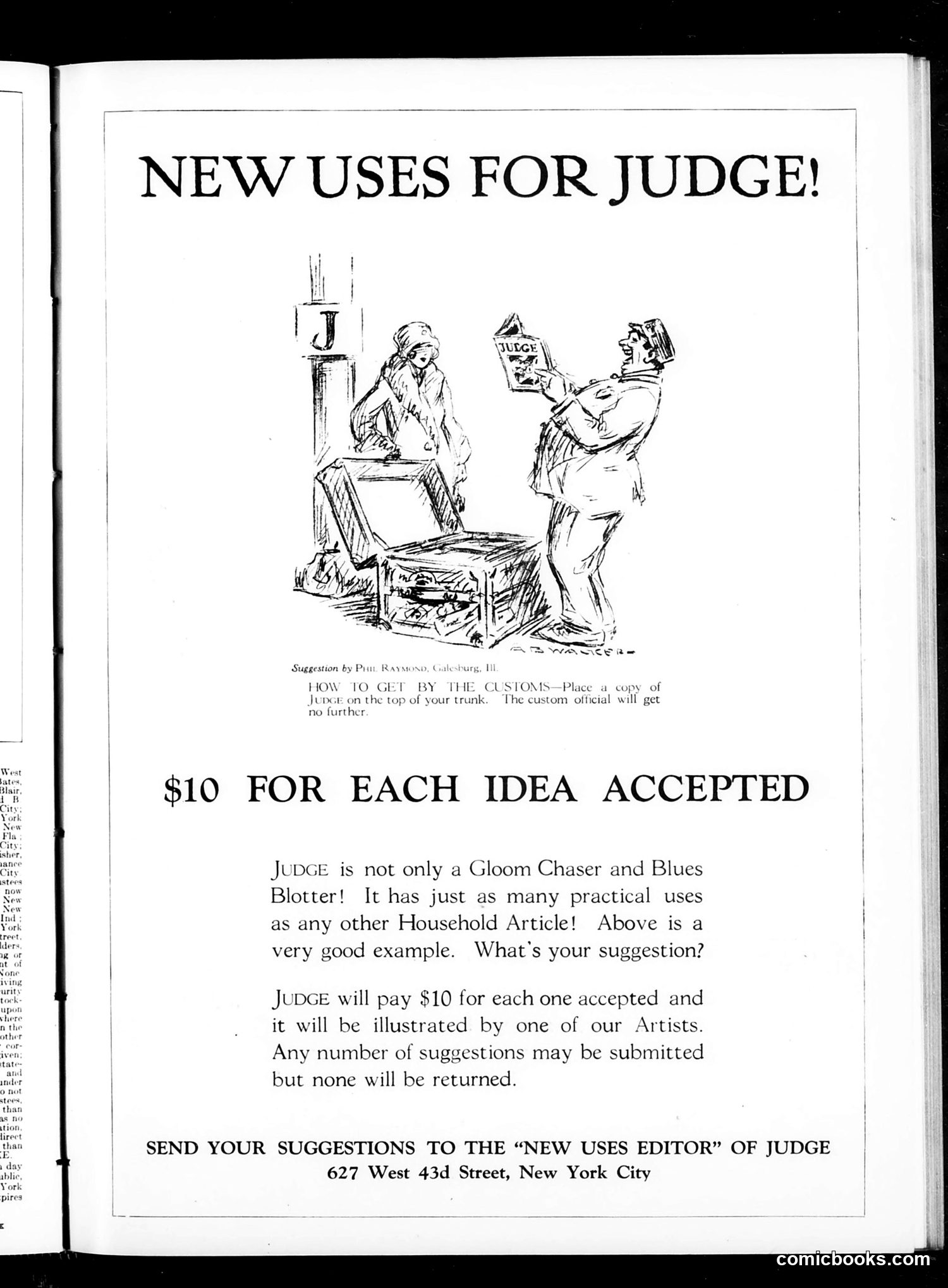
This page is primarily an **advertisement/contest**, not political satire. Judge magazine is soliciting reader submissions for "new uses" of Judge magazine itself. The cartoon illustrates one suggested use: placing a copy of Judge atop a steamer trunk to deter customs inspectors from searching luggage. The humor relies on the implication that customs officials find Judge so tedious or authoritative that they won't bother looking further. The contest offers $10 per accepted idea—a substantial sum for the era—with professional illustration. The framing text presents this as practical household innovation, treating the magazine almost as a multipurpose product like any other "Household Article." This is **self-promotional satire**: Judge humorously advertises itself by joking about its own usefulness, inviting readers to participate in elaborating on the gag. The tone is lighthearted, poking fun at both the magazine and readers' ingenuity.
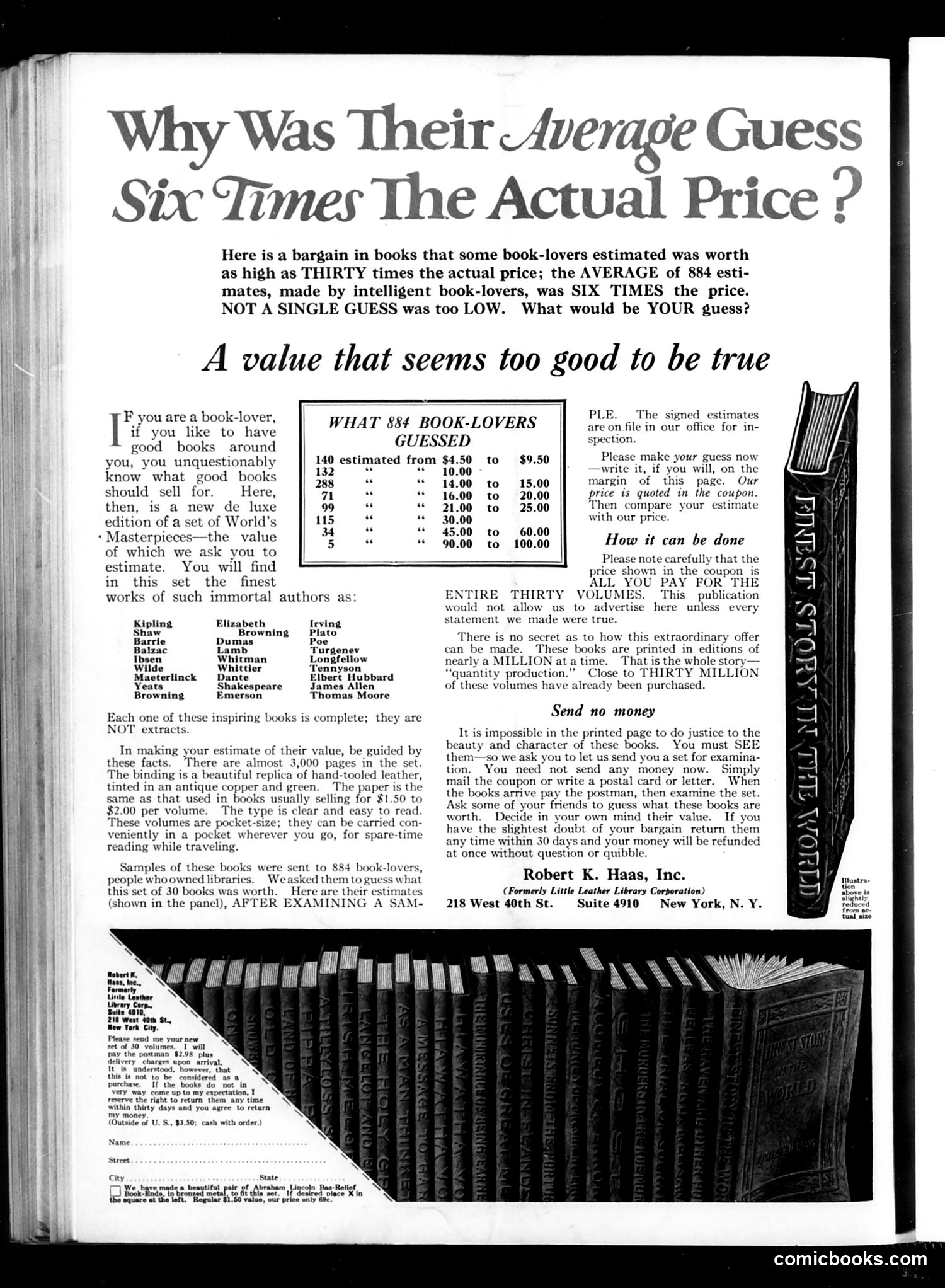
This is primarily **advertising copy**, not a cartoon or satirical piece. It's a mail-order book advertisement from Robert K. Haas, Inc., promoting a 30-volume "World's Masterpieces" collection. **The "Trick":** The company claims 884 book-lovers estimated this set's value at an average of **six times** the actual selling price—with no one guessing *too low*. This psychological marketing tactic exploits cognitive bias: if intelligent people massively overvalue it, readers assume it must be exceptional. **The Satire (implicit):** Judge magazine likely ran this to mock aggressive sales techniques and consumer gullibility. The absurdity that nearly 900 estimates never undershot the price suggests the premise itself is suspect—yet the ad weaponizes this implausibility as proof of quality. **Classical appeal:** The set features canonical authors (Shakespeare, Dickens, Tolstoy, Poe), targeting educated readers who'd recognize these names as markers of refinement and value. **The pitch:** "Send no money"—examine free for 30 days. This removes purchase friction, a modern sales tactic presented as bold novelty.

I can see this is a page from Judge magazine, but the image appears to be almost entirely blank or blank white space with only a dark binding edge visible on the left side. There is no discernible cartoon, illustration, text content, or satirical material visible that I can analyze. Without being able to see actual cartoon imagery, figures, captions, or readable text on this page, I cannot identify any political figures, social references, or explain any satirical points. This may be a blank page, a scanning error, or a page that has faded significantly over time. To provide accurate historical analysis as requested, I would need a clearer image showing the actual cartoon content and accompanying text from this Judge magazine page.