
Judge, 1924-10-04 · page 19 of 37
Judge — October 4, 1924 — page 19: what you’re looking at
What you’re looking at
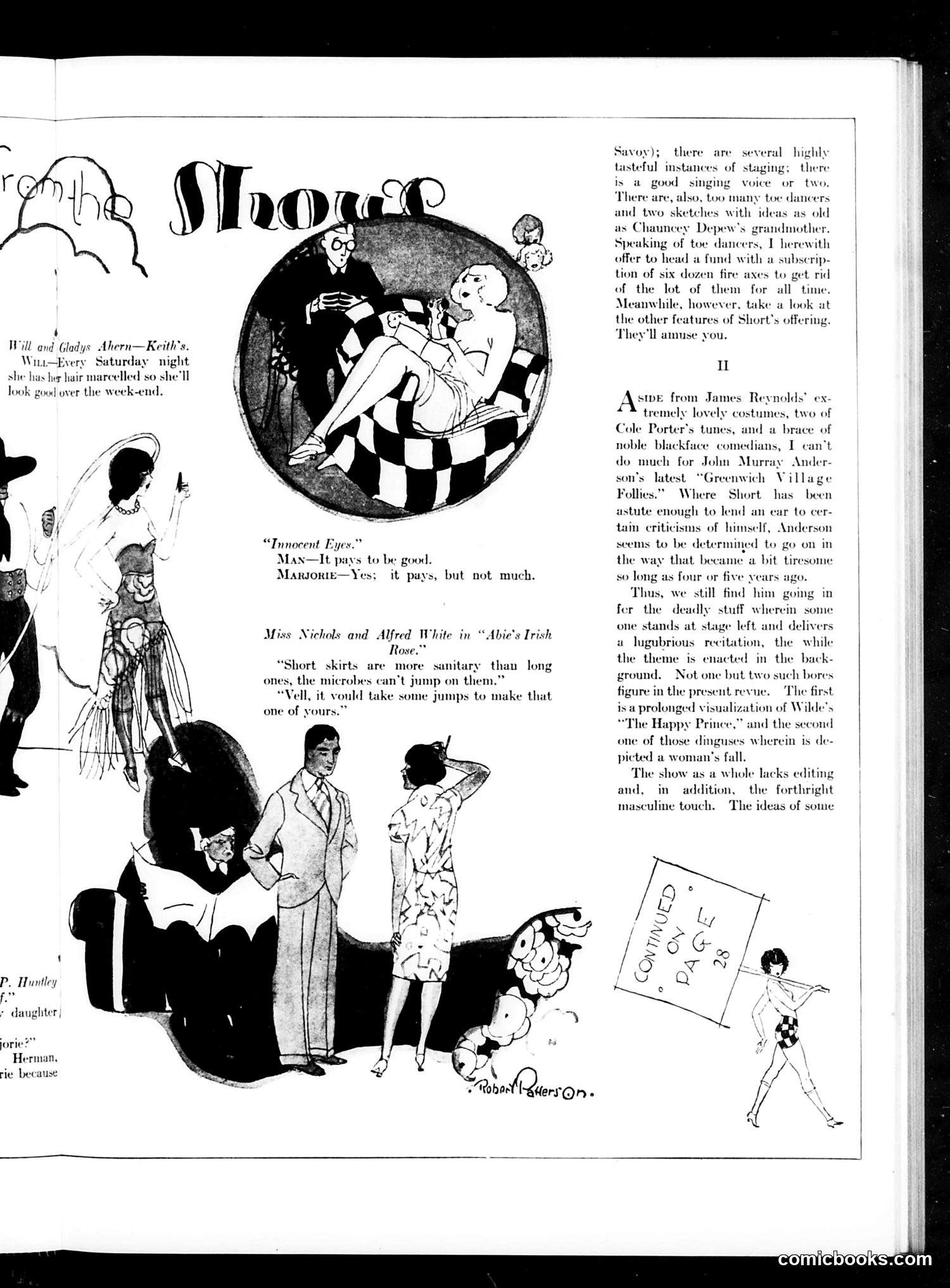
This Judge magazine page contains theater reviews and satirical commentary on 1920s Broadway shows. The main content mocks contemporary stage productions: **"Abie's Irish Rose"** — A popular play about interfaith romance; the reviewer quips that short skirts are "more sanitary" because microbes can't jump on them, then jokes that one actress's legs are so substantial they'd need actual jumps. **Greenwich Village Follies and other revues** — The critic complains about excessive toe-dancing, blackface comedy acts, and pretentious dramatic recitations (like Wilde adaptations) that have become tiresome. He sarcastically offers to fund "six dozen fire axes" to eliminate all the dancers permanently. The cartoons feature vaudeville and Broadway personalities, with social commentary on 1920s entertainment trends and theatrical excess. The satire targets producers' reliance on spectacle over substance—concerns surprisingly modern in nature.
📄 Transcribed text from this page (OCR, searchable)
Machine-transcribed from the original scan — historical spelling and the odd misread are preserved.
‘ Will and Gladys Ahern—Keith's. Win—Every urday night she has her hair marcelled so she'll look good over the wel end. to be good. Marsorie—Yes; it pays, but not much. Miss Nichols and Alfred White in “Abie’s Irish Rose.” Short skirts are more sanitary than long the microbes can’t jump on them.” ‘Vell, it vould take some jumps to make that one of yours.” P. Huntley ra » daughter | jorie?” Herman, rie because Savoy); there are. several highly tasteful instances of staging; there is a good singing voice or two. There are, also, too many toc dancers and two sketches with ide: as Chauncey Depew's grandmother. Speaking of toe dancers, I herewith offer to head a fund with a subserip- tion of six dozen fire axes to get rid of the lot of them for all time. Meanwhile, however, at the other features of Short’s offering. They'll amuse you. as old a loo Il Aste from James Reynolds’ ex- * * tremely lovely costumes, two of Cole Porter's tunes, noble blackface comedians, I can’t and a brace of do much for John Murray Ander- son’s latest. “Greenwich Village Follie: Where Short) has been astute enough to lend an ear to cer- tain criticisms of himself, Anderson seems to be determined to go on in the way that became a bit tiresome so long as four or five years ago. Thus, we still find him going in for the deadly stuff wherein some one stands at stage left and delivers a lugubrious recitation, the while the theme is enacted in the back- ground. Not one but two such bores figure in the present revue. The first isa prolonged visualization of Wilde's “The Happy Prince,” and the second one of those dinguses wherein is de- picted a woman's fall. The show as a whole lacks editing and, in addition, the forthright masculine touch. The ideas of some