
A complete issue · 36 pages · 1924
Judge — March 15, 1924
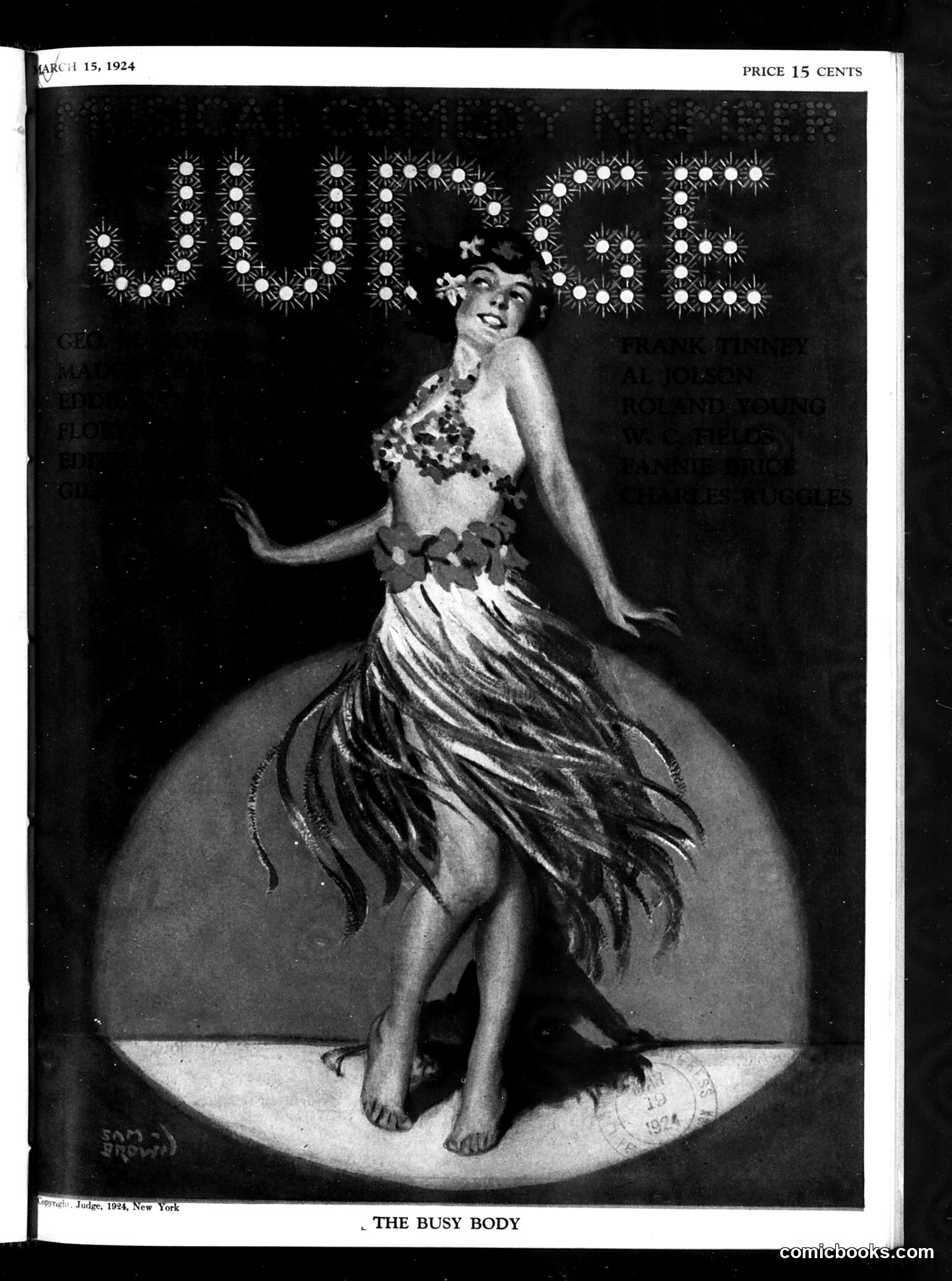
This magazine cover features a woman in a hula skirt performing a Hawaiian dance pose, with the title "The Busy Body" below. The decorative text above reads "JUDGE" in a stylized font made of ornamental circles. The satirical point appears to reference the 1920s fascination with Hawaiian culture and exotic entertainment that was sweeping American popular culture during this era. The term "busy body" typically refers to someone who is overly active or meddles in others' affairs, suggesting this may be satirizing the modern woman of the 1920s—active, energetic, and pursuing leisure and entertainment. The image reflects Jazz Age attitudes toward sexuality and cultural exoticism that characterized the period.
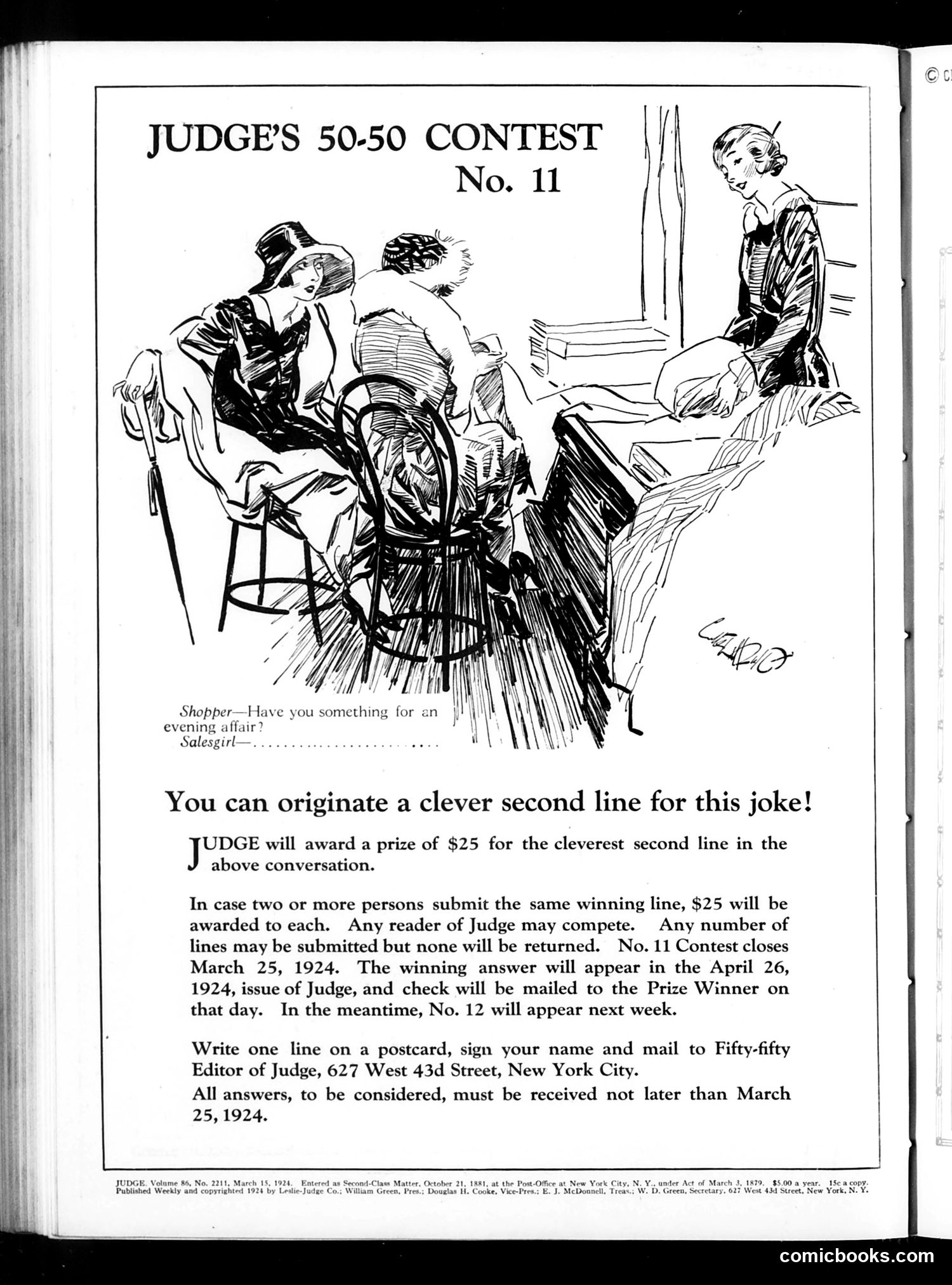
This page features a "50-50 Contest" inviting readers to complete a joke. The cartoon shows three women in 1920s attire in what appears to be a boutique or dressing room setting. The setup line reads: **"Shopper—Have you something for an evening affair? Salesgirl—..."** The joke's humor likely plays on double entendre—"evening affair" could mean either formal clothing or a romantic encounter. Readers were challenged to supply a clever second line, with the winner receiving $25. The cartoon reflects 1920s fashion concerns and the era's interest in sophisticated, flirtatious humor aimed at urban audiences. The page is dated March 13, 1924, with contest deadline March 25, 1924.
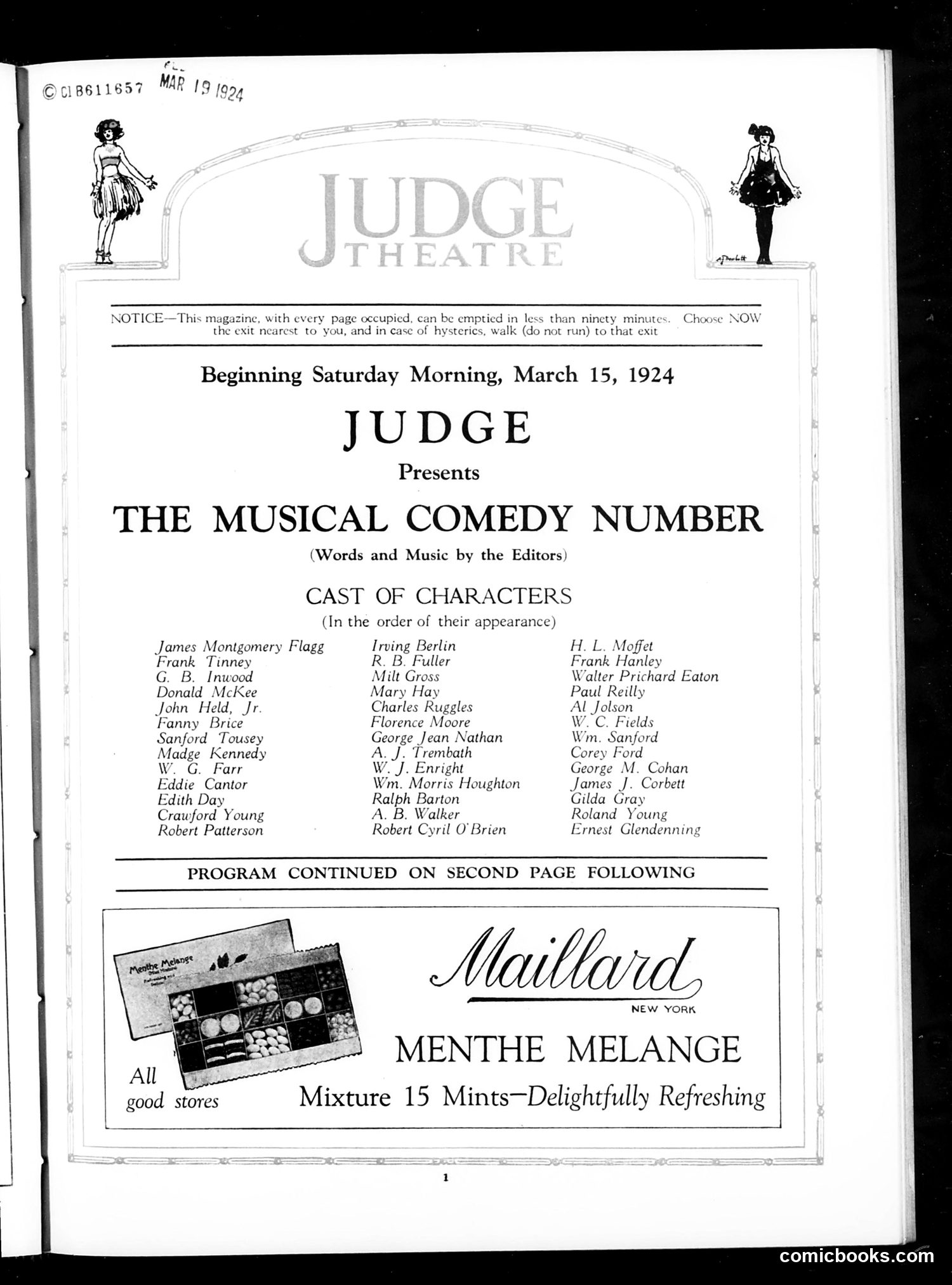
This page is primarily a **theater program** rather than satirical content. It announces Judge magazine's presentation of "The Musical Comedy Number" at the Judge Theatre, beginning Saturday, March 15, 1924. The page lists the cast of characters in order of appearance, featuring performers like James Montgomery Flagg and Frank Tinney. Two decorative illustrations frame the title—stylized figures of women in 1920s fashion, typical of the era's theatrical aesthetics. The bottom third contains an advertisement for Maillard's "Menthe Melange" candy mixture, marketed as "Delightfully Refreshing." This appears to be a standard program page mixing theatrical promotion with period advertising rather than political or social satire. The content reflects 1924 entertainment and commercial culture.
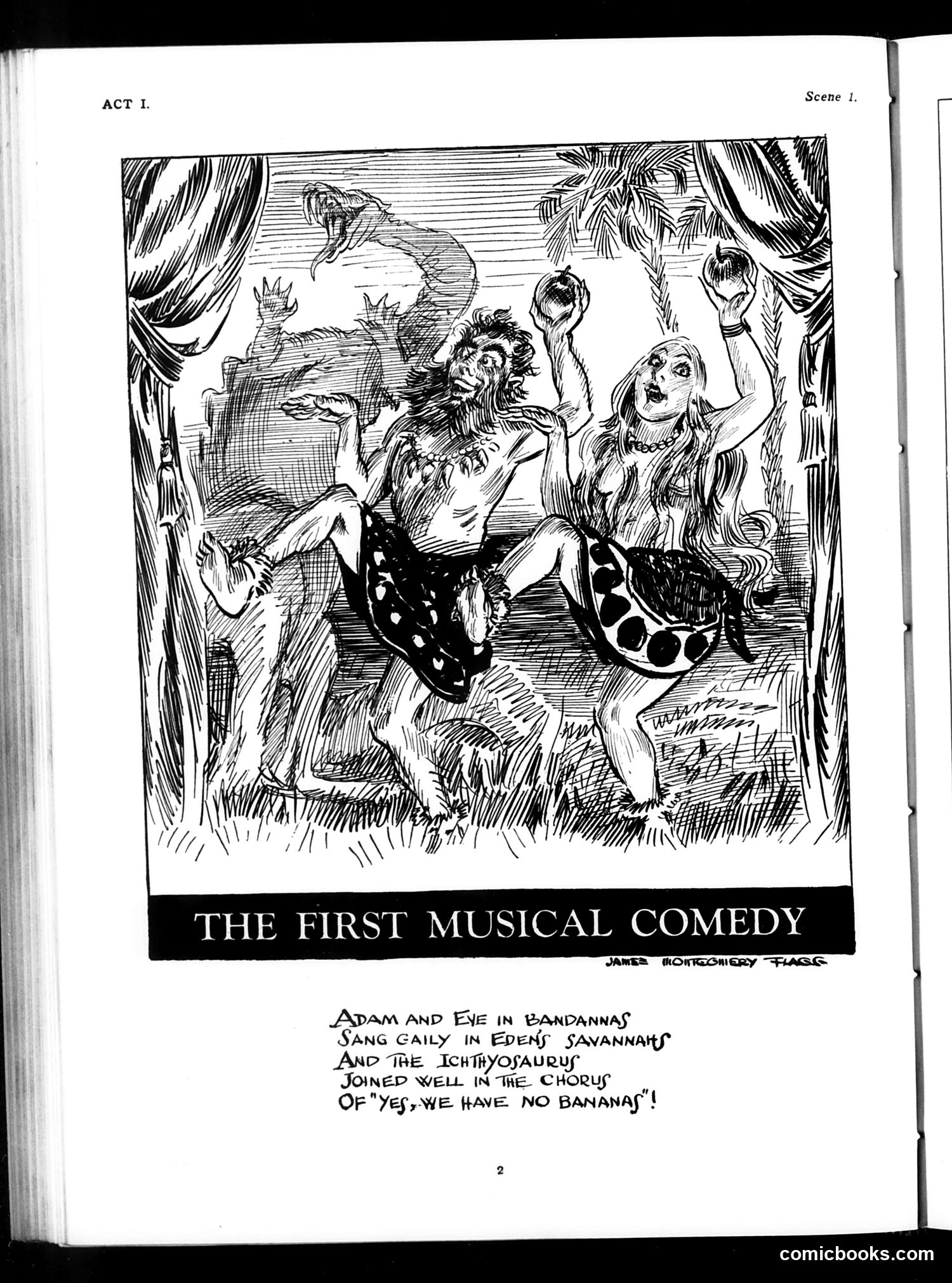
This illustration satirizes early musical theater by depicting characters from Genesis in a vaudeville-style scene. The caption identifies "Adam and Eve in Bananas," "Eden's Savannahs," and "The Ichthyosauru" performing together, with the absurdist chorus "Yes, we have no bananas!" The satire targets the low quality and nonsensical plots of contemporary musical comedies—mixing biblical characters, prehistoric creatures, and fruit peddlers in one incoherent spectacle. The deliberately ridiculous premise (Adam, Eve, and dinosaurs singing about bananas) mocks how musical comedies prioritized spectacle and novelty songs over logical storytelling. This appears to critique Judge magazine's contemporary theater scene, suggesting that early 1920s musical comedies were absurdist entertainments more concerned with catchy tunes than coherent narratives.
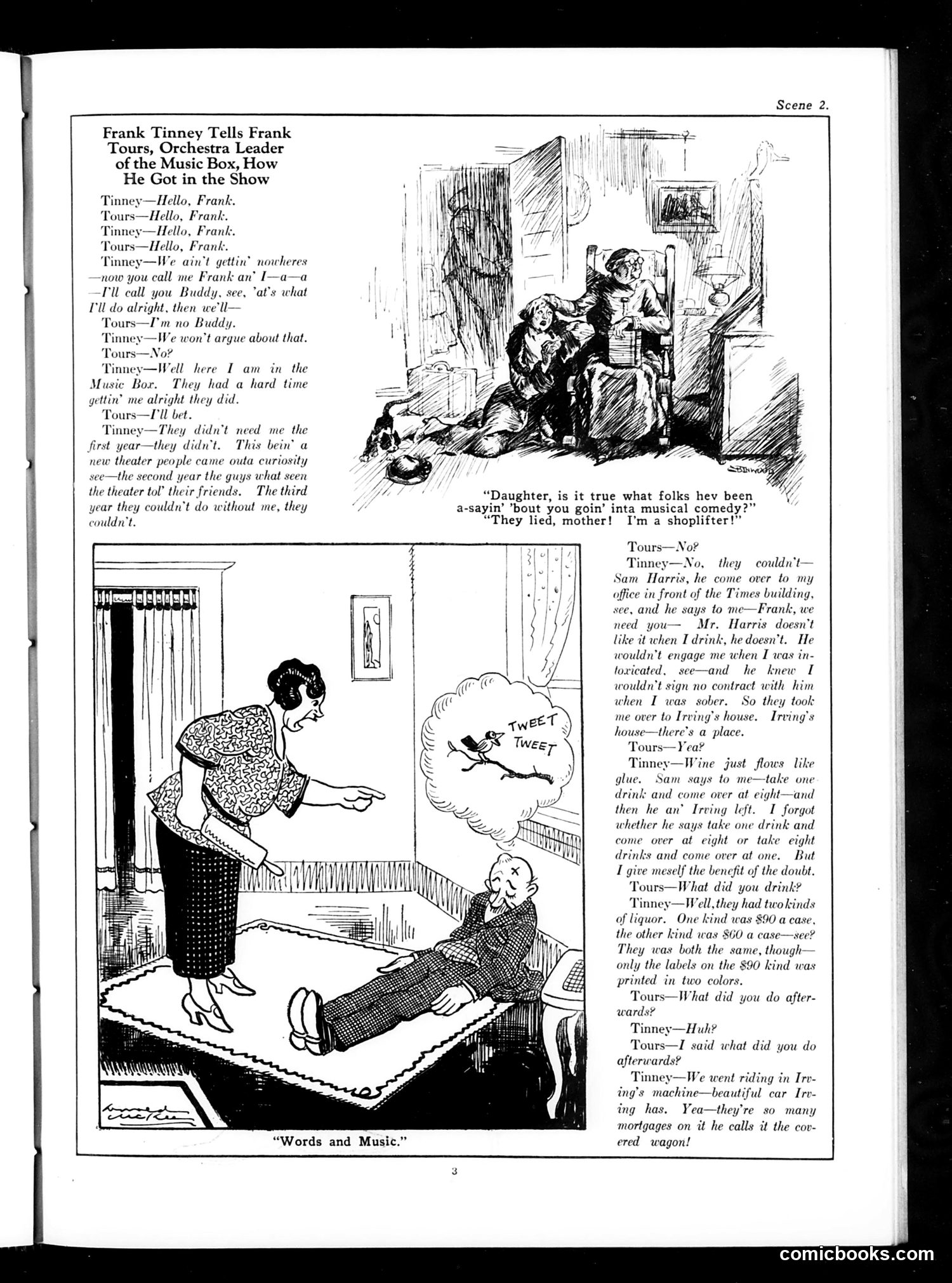
This page satirizes Frank Tinney (a vaudeville comedian) and Frank Tours (orchestra leader). The dialogue reveals Tours helped Tinney get into show business despite resistance from Sam Harris, a theater producer who wouldn't hire Tinney when intoxicated. The humor centers on Tinney's drinking problem. Tours claims Tinney consumed two types of liquor costing $90 and $60 respectively before a visit, supposedly identical except for labels. The punchline mocks Tinney's excuse that he "forgot" which drink Irving wanted—implying his drunkenness made him unreliable. The cartoons illustrate this conversation. The satire targets Tinney's alcoholism as a professional liability, presenting it as both comedic material and a genuine obstacle to his theatrical career. This reflects 1920s attitudes toward substance abuse as both entertainment fodder and character flaw.
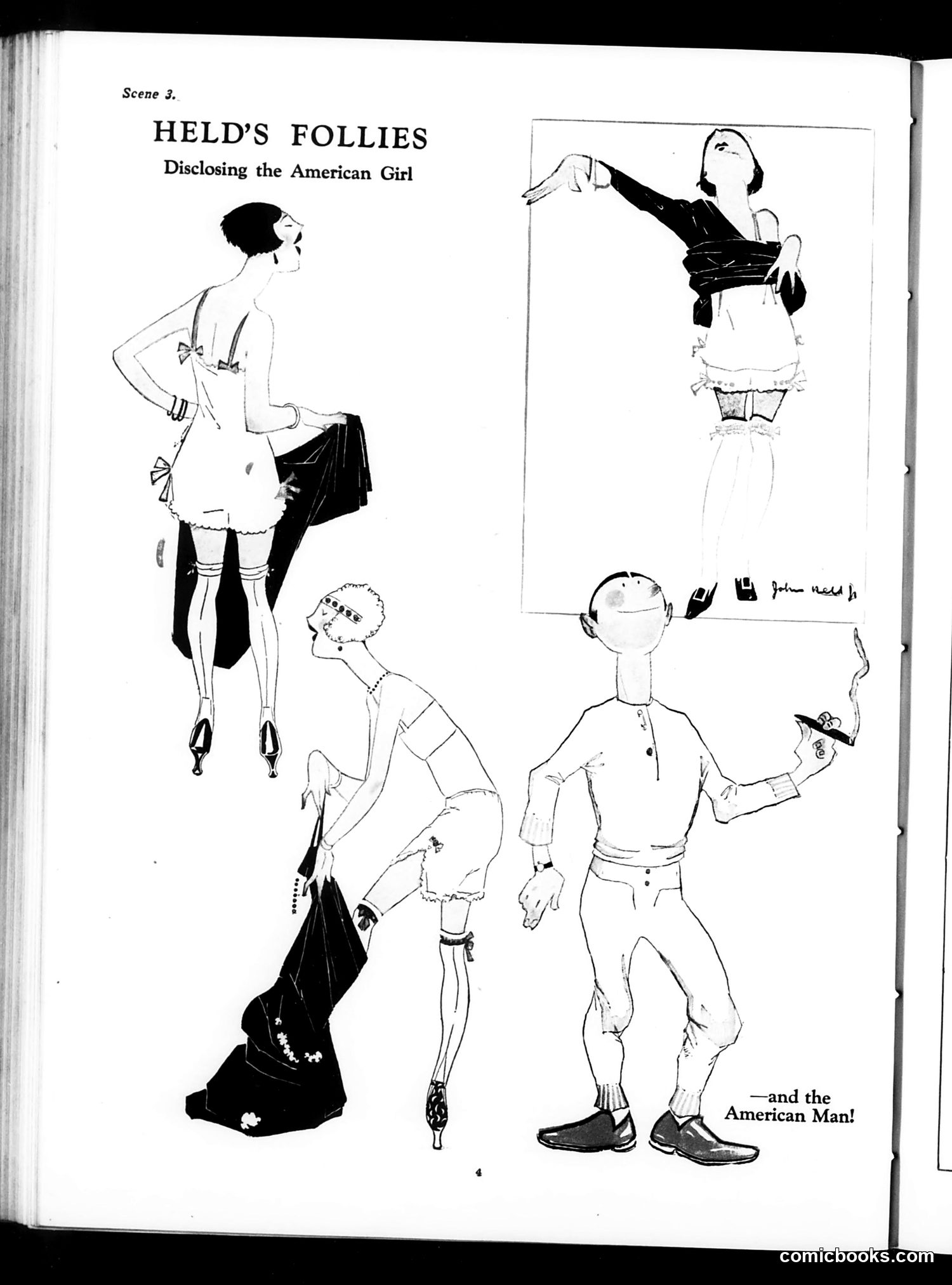
This page from *Judge* magazine satirizes 1920s fashion and social mores through caricatures attributed to artist John Held Jr., a prominent chronicler of the Jazz Age. The cartoons mock the "modern American girl" by depicting her in various states of undress and athletic poses—flapper fashion including shortened skirts, rolled stockings, and revealing undergarments. The subtitle "and the American Man!" suggests the satire targets both genders' changing social behavior. The humor relies on exaggeration: the elongated figures, prominent undergarments, and exposed limbs were shocking to conservative audiences but represented actual 1920s fashion liberalization. Held satirizes society's anxiety about women's increased freedom, shorter hemlines, and participation in previously male-dominated activities like sports, playing on generational tensions of the era.
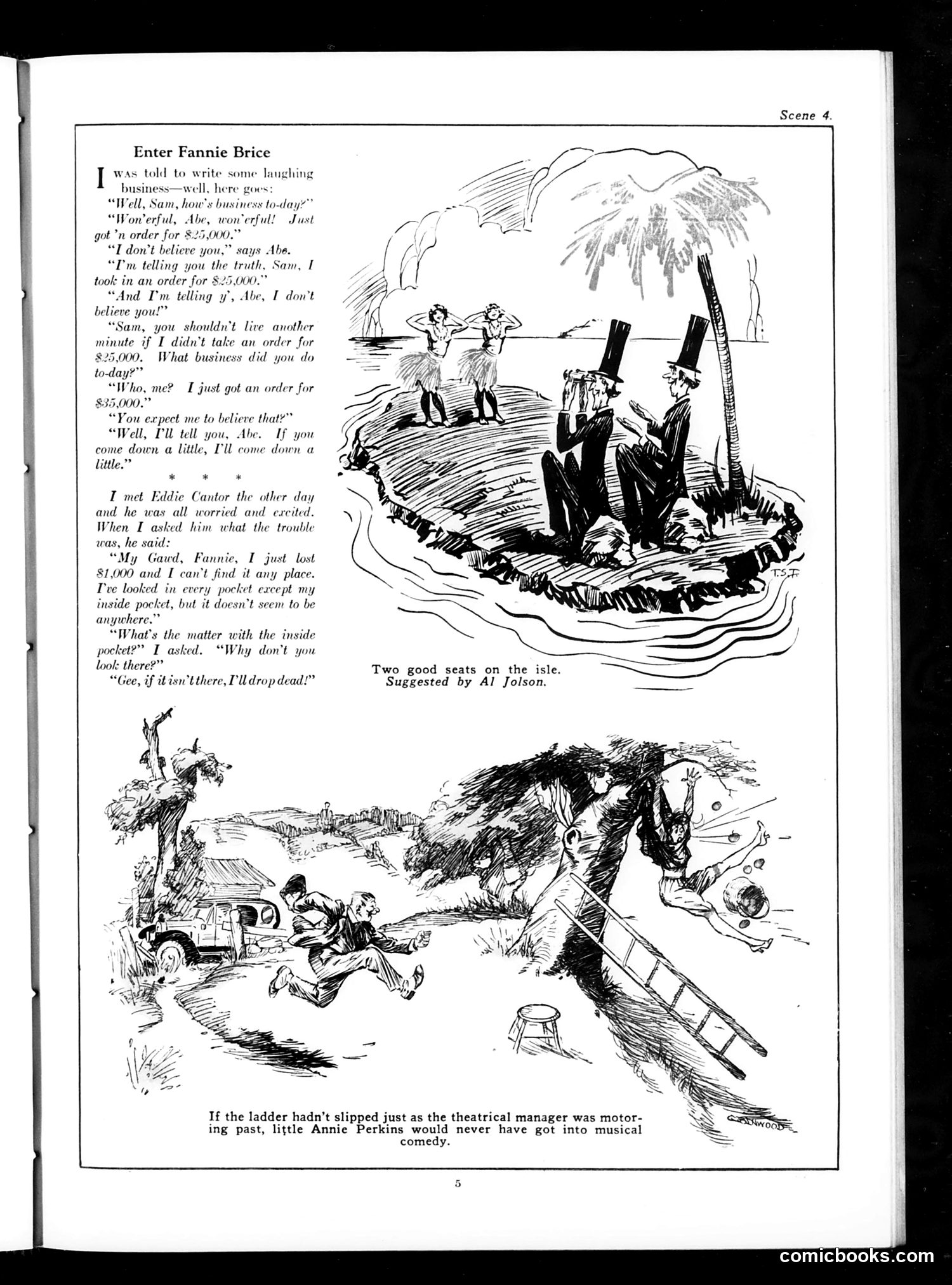
This page features humor centered on **Fannie Brice**, a famous Jewish-American vaudeville and Broadway performer of the early 20th century. The content consists of three separate jokes: 1. **Opening dialogue**: A conversation between characters with Jewish names (Sam, Abe) joking about exaggerated business orders—satirizing boastful salesmanship and the unreliability of verbal claims. 2. **Eddie Cantor anecdote**: A joke about losing $1,000 and searching everywhere except the logical place (inside pocket). Cantor was a contemporary entertainer and comedian. The humor plays on obvious obliviousness. 3. **Annie Perkins cartoon**: A slapstick illustration suggesting an accident (a fallen ladder) launched someone into show business—poking fun at luck and chance in theatrical careers. The page uses gentle ethnic humor typical of early 20th-century American comedy, featuring recognizable Jewish entertainers and stereotypical character names to appeal to audiences familiar with vaudeville culture.
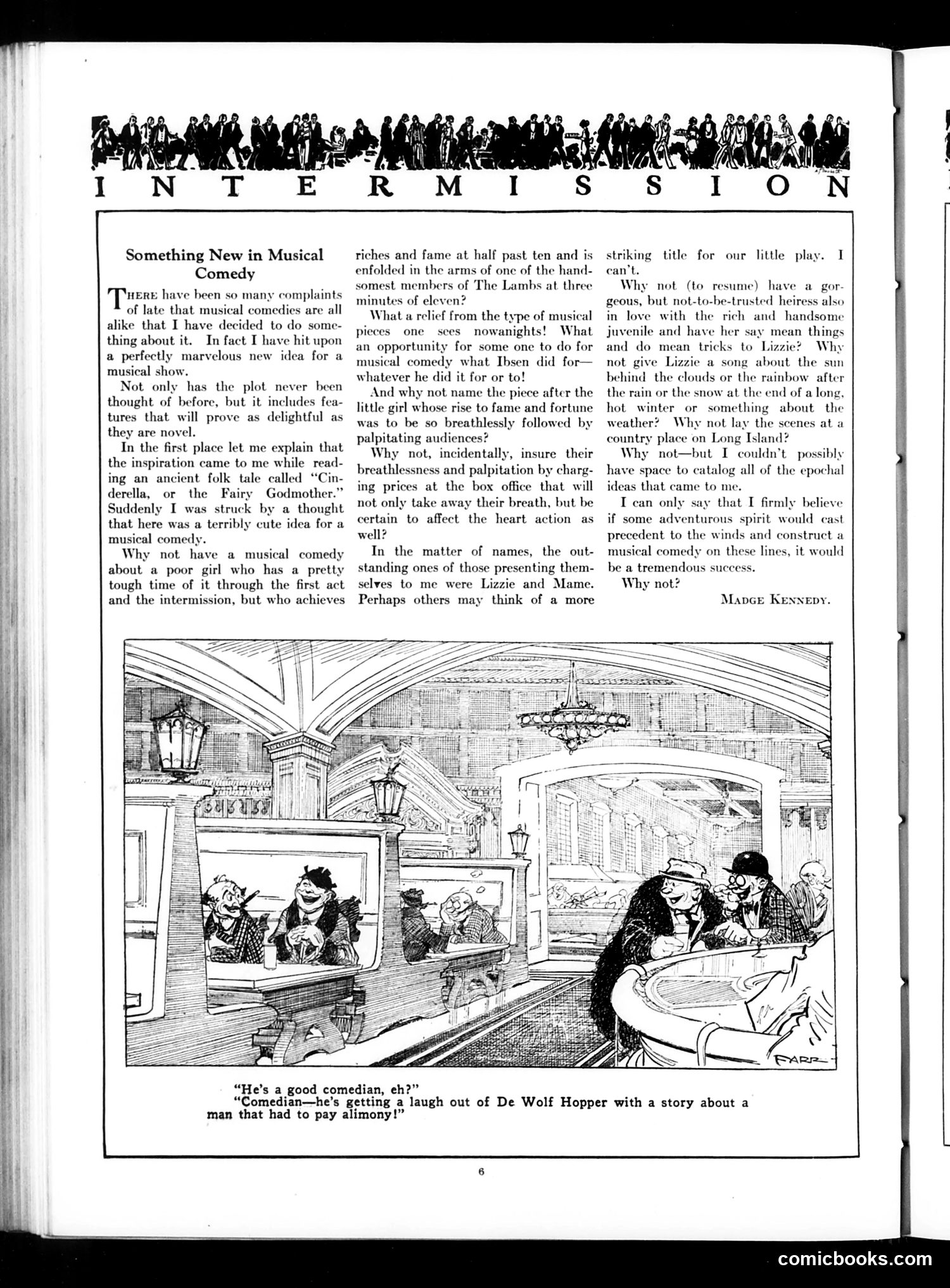
This is a satirical essay by Madge Kennedy mocking the formulaic nature of musical comedies. Kennedy proposes a "new" idea: adapting Cinderella—a poor girl suffering through Act One, then achieving wealth and romance by 10:30 PM, marrying a handsome member of The Lambs (a theatrical club). The satire is that this isn't novel at all; it describes the standard musical comedy plot of the era. Kennedy further mocks the genre by suggesting inflated ticket prices, love triangles with mean heiresses, predictable songs about weather, and country-estate settings—all clichéd tropes presented as if revolutionary. The accompanying cartoon shows a scene in what appears to be a ship or restaurant, with the caption joking about De Wolf Hopper (a famous comedian of the period) being so skilled he can extract laughs even from terrible material—specifically "a story about a man that had to pay alimony," suggesting comedians recycled tired domestic-humor subjects just as musical comedies recycled tired plots.
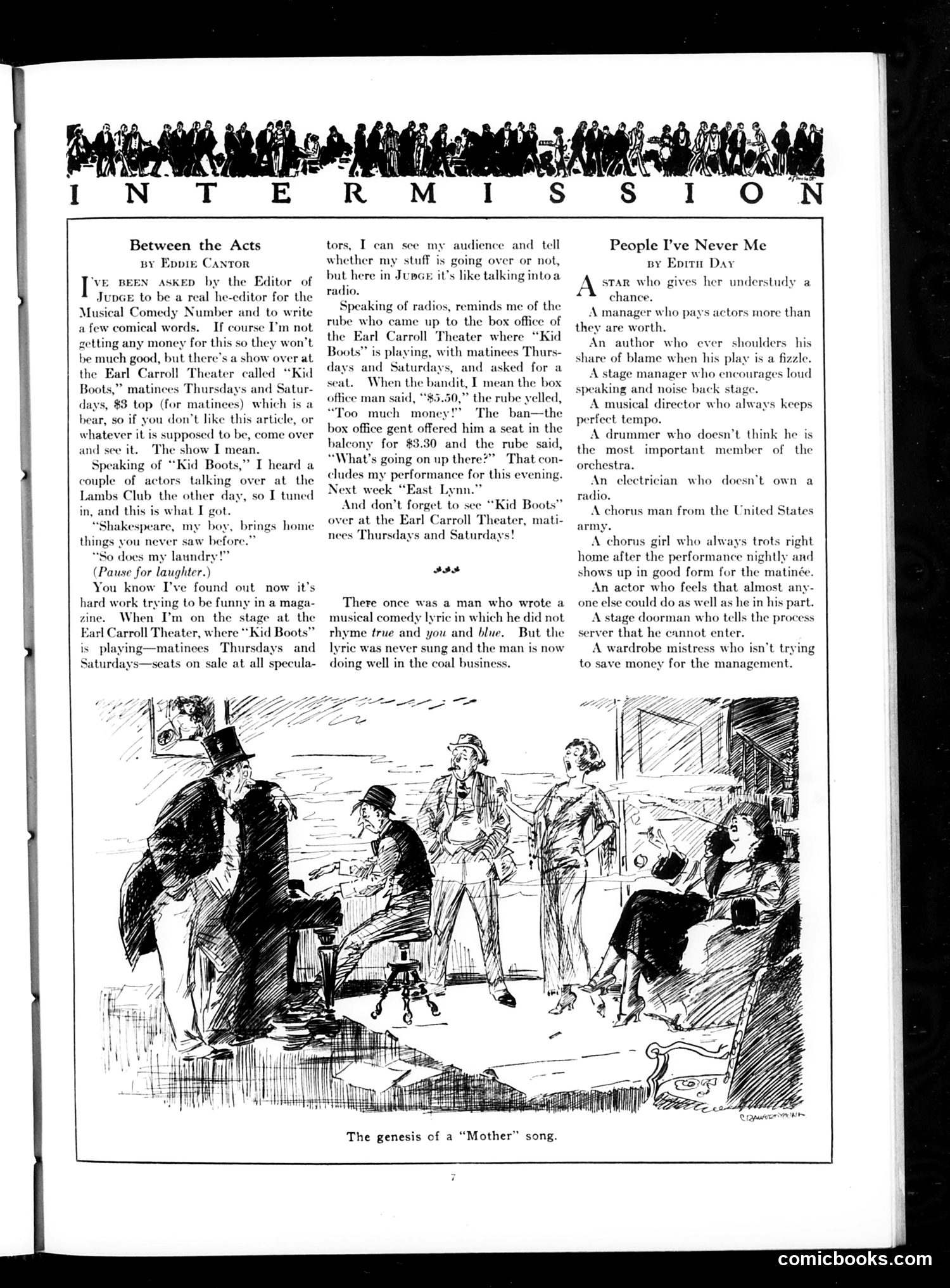
This page from *Judge* magazine features theatrical humor from the 1920s (the Earl Carroll Theater's "Kid Boots" production is referenced repeatedly). **"Between the Acts" by Eddie Cantor:** This is meta-comedy—Cantor, a famous vaudeville/theater performer, complains about writing humor for a magazine versus performing live onstage, where he can gauge audience reaction. He repeatedly promotes "Kid Boots" (this appears to be advertising disguised as editorial content). The jokes are mild: a Shakespeare/laundry comparison, a rube confused by theater balcony pricing. The cartoon depicts theatrical professionals workshopping a "Mother" song—a common sentimental musical-comedy number. **"People I've Never Met" by Edith Day:** This is satirical list-humor, describing impossibly virtuous theater professionals who don't actually exist: a star who helps her understudy, a manager who overpays actors, a stage manager who discourages noise. The satire suggests these professions were actually characterized by selfishness and corner-cutting. The humor relies on insider theater knowledge and 1920s entertainment industry cynicism.
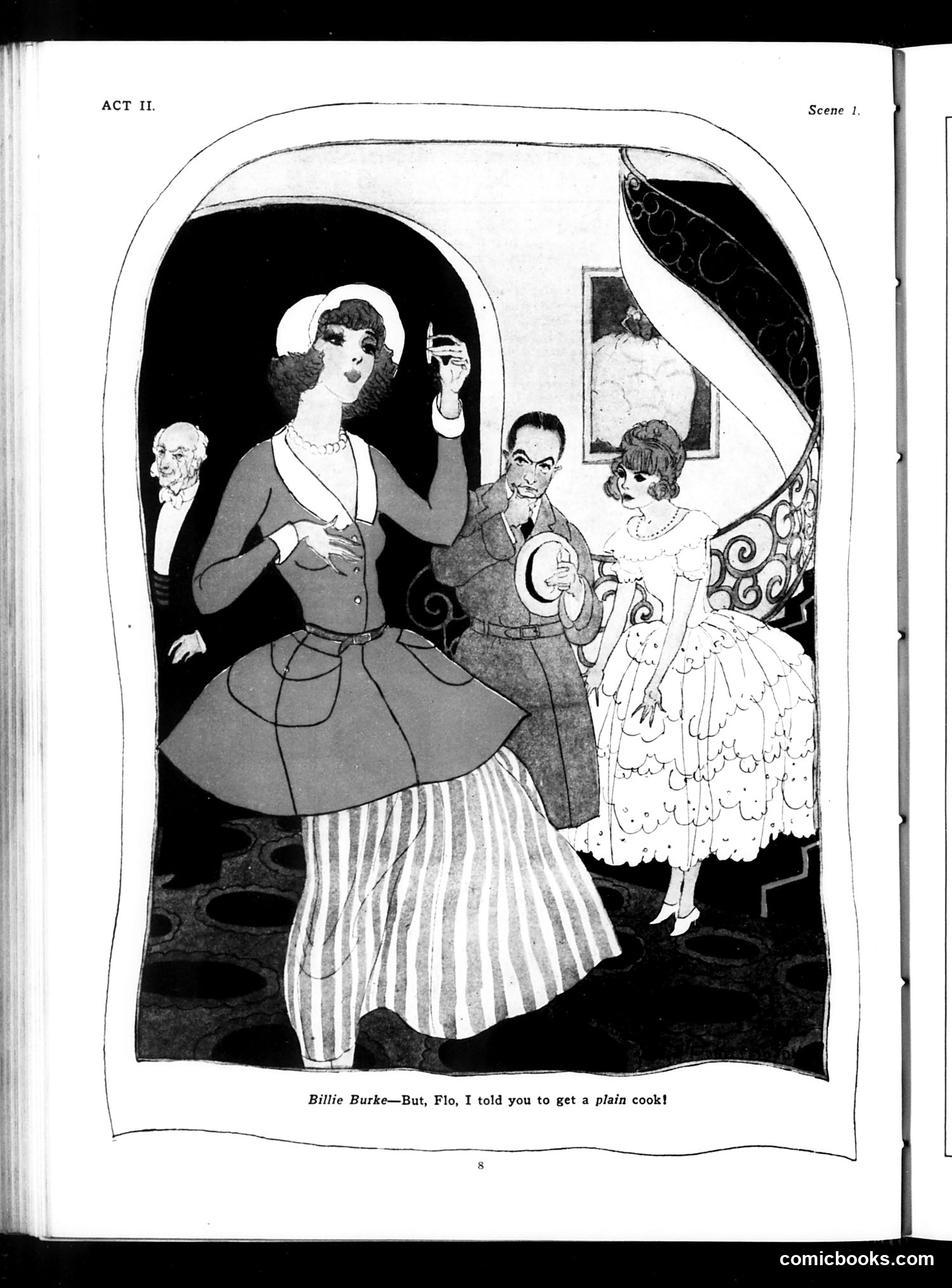
This is a social comedy cartoon from Act II, Scene 1, featuring two women in 1920s attire at what appears to be a fancy dinner party. The caption references "Billie Burke," a famous American actress of that era known for comedic roles. The joke centers on a domestic servant problem: one woman (likely the hostess, Billie Burke) complains to "Flo" that she specifically requested hiring a "plain cook"—meaning an unattractive or ordinary-looking servant. The implication is that the cook hired is too attractive, presumably causing problems (likely flirtation or distraction among male guests or household members). This reflects early 20th-century class anxieties and servant-hiring concerns among wealthy households, treating the situation as comedic fodder for Judge's satirical audience.
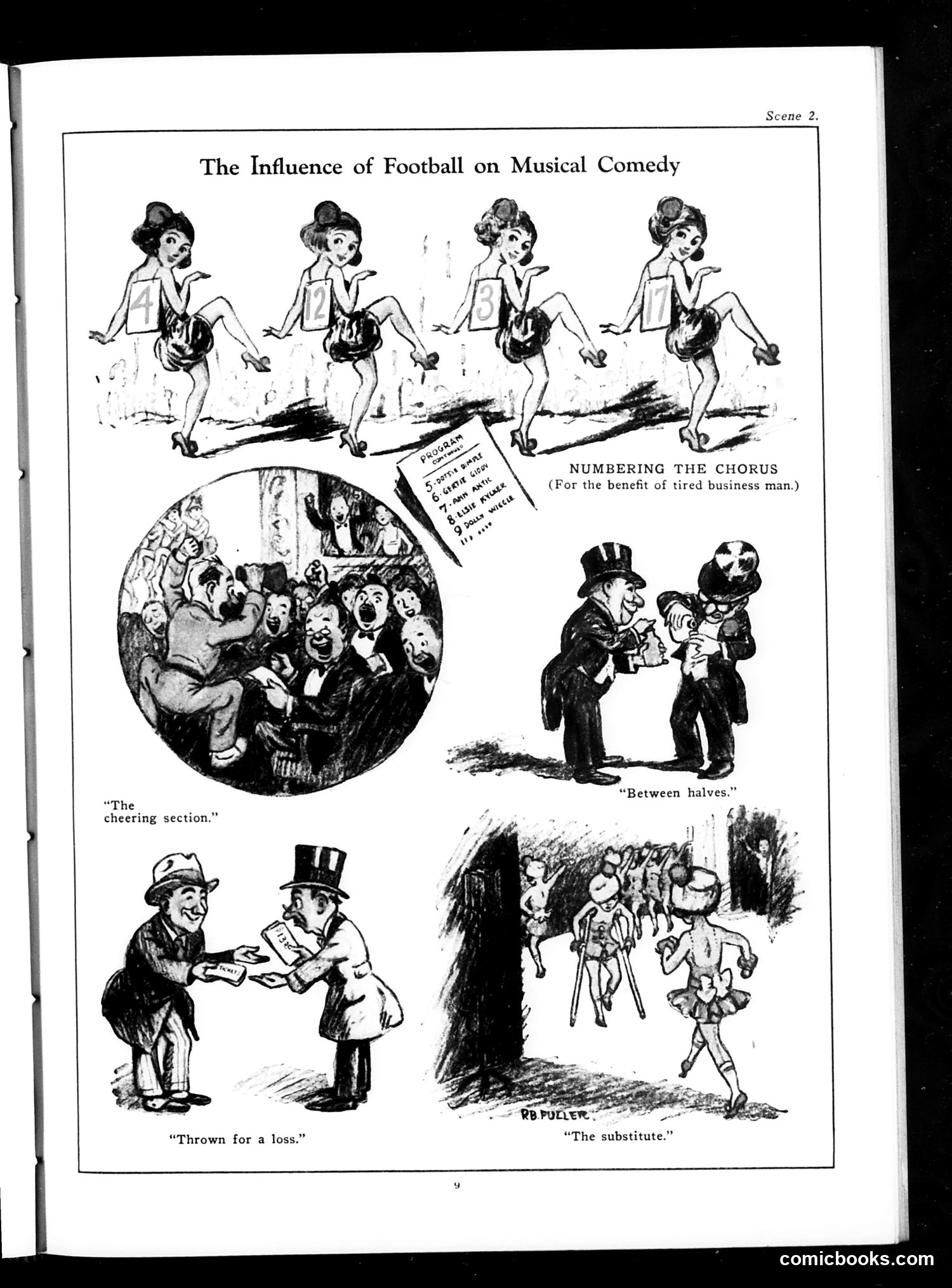
This Judge magazine satire compares football terminology and spectacle to musical comedy productions. The page mocks how football has infiltrated entertainment culture: **"Numbering the Chorus"** shows chorus girls lined up like football players, numbered for identification—a joke about treating performers as interchangeable units, similar to sports rosters. Other panels apply football language to theater: "The cheering section" depicts an enthusiastic audience; "Between halves" shows intermission activity; "Thrown for a loss" and "The substitute" use sports jargon metaphorically for theatrical mishaps and cast replacements. The subtitle's reference to the "tired business man" suggests this was popular entertainment for working men who'd become obsessed with football. The satire critiques how this sports culture has invaded and degraded musical theater—reducing performers to numbered commodities and replacing artistic merit with spectacle and enthusiasm.
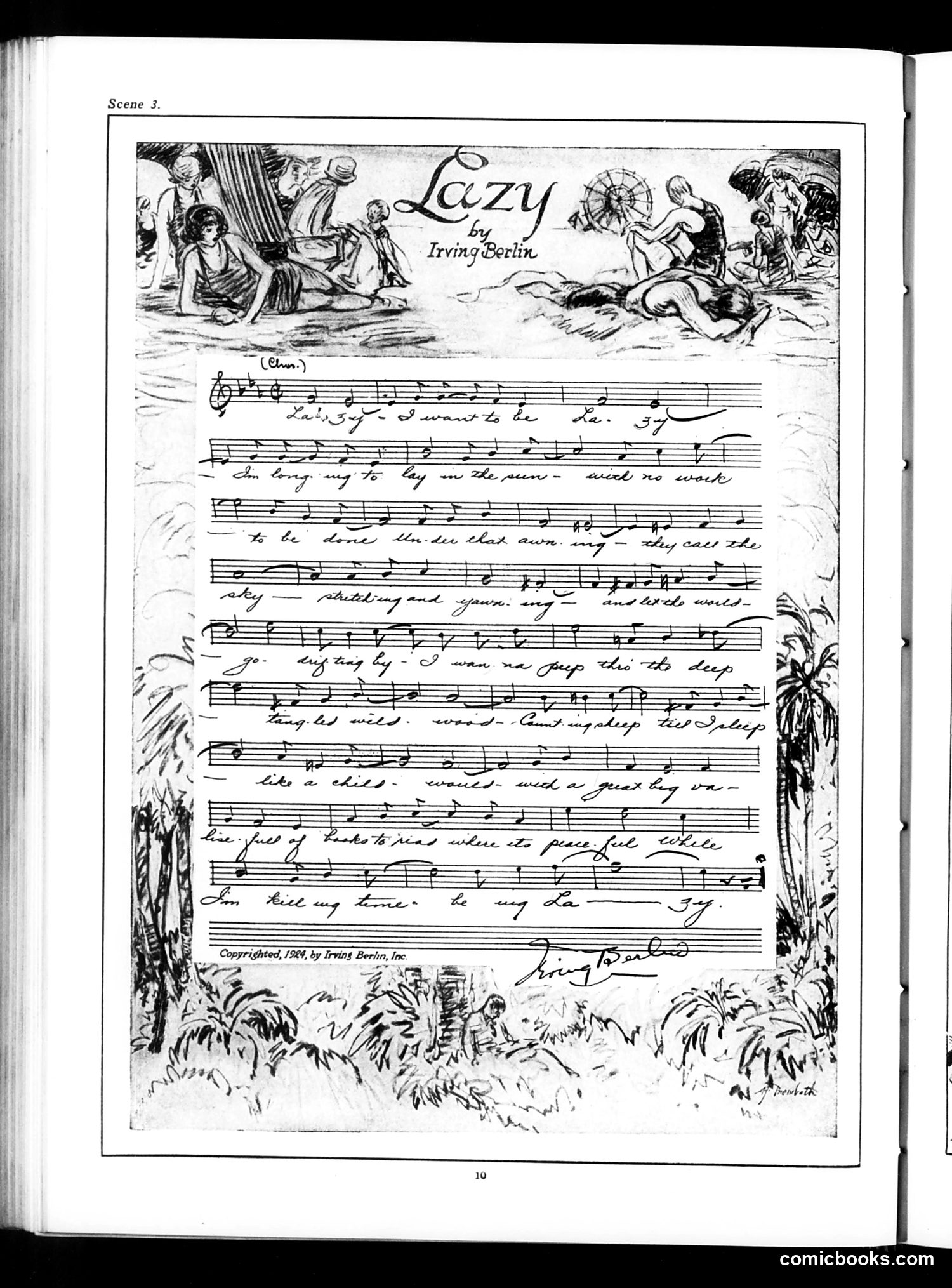
This page reproduces sheet music for Irving Berlin's song "Lazy," copyrighted 1924. The image shows the musical score with handwritten lyrics beneath the staff notation. The decorative border features illustrated scenes of leisure—people lounging, relaxing on beaches, and idling in tropical settings with palm trees. The satire appears to mock laziness as a cultural theme during the Jazz Age. Berlin's composition uses everyday language ("I don't want to be, he sigh...I'm long way to lay in the sun") to humorously celebrate indolence and avoidance of work. The tropical imagery reinforces the fantasy of carefree escape. This reflects 1920s social anxieties about changing work ethics and leisure culture during post-WWI America's more permissive era.
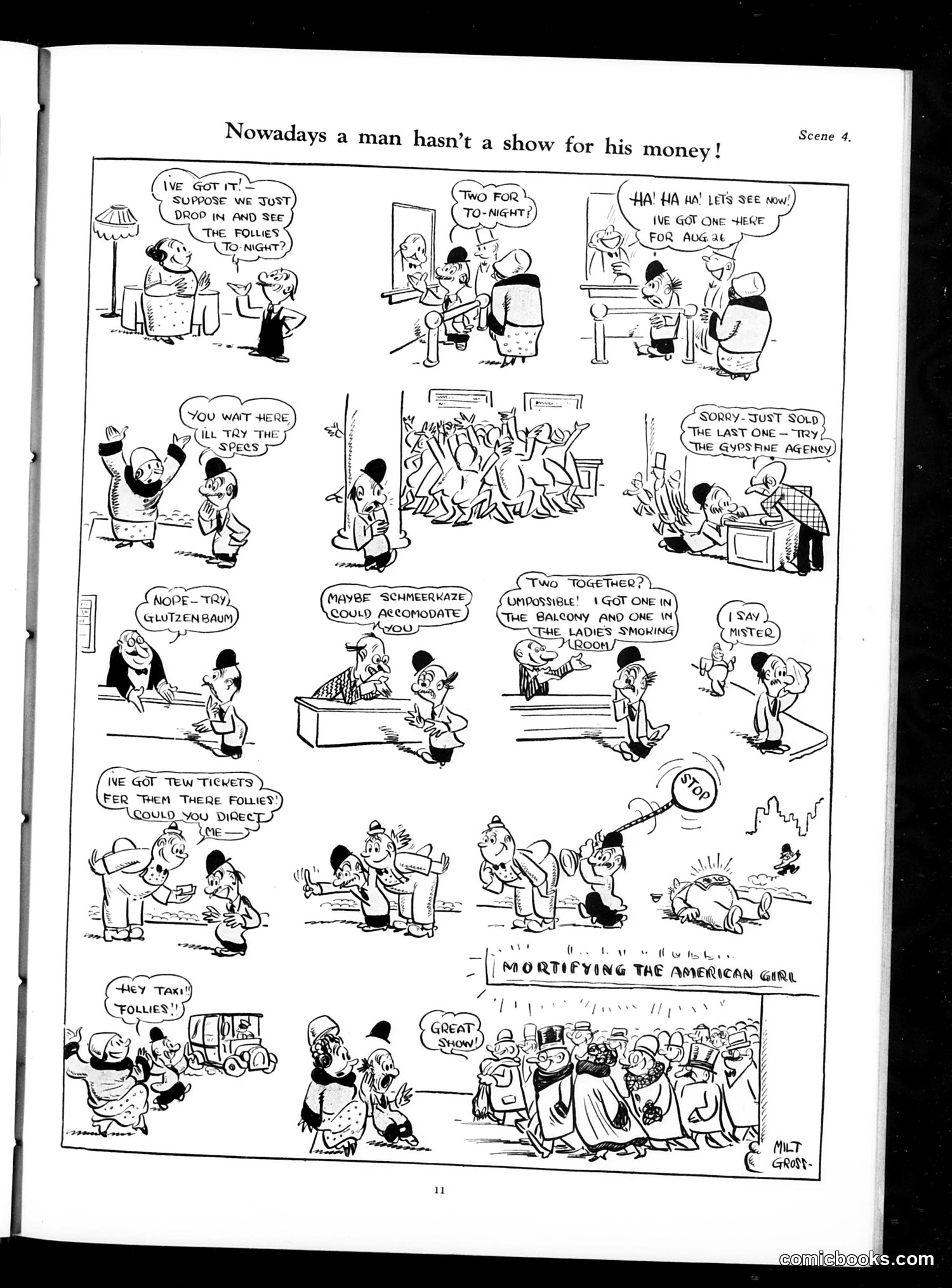
This cartoon satirizes the difficulty of securing theater tickets for Broadway shows, likely from the 1910s-1920s Judge era. The narrative follows a man attempting to buy tickets for "the Follies" (the famous Ziegfeld Follies revue), only to encounter repeated obstacles: sold-out shows, unavailable seating combinations, tickets held by agencies, and eventually resorting to black-market "taxi follies." The humor targets both theater scarcity and the emerging scalping/resale market. References to locations like "the balcony" and "ladies smoking room" reflect period theater layouts. The final panel, showing the man settling for inferior entertainment, suggests theatrical ticket prices and availability had become so frustrating that audiences accepted lesser alternatives. The satire criticizes both Broadway's inability to meet demand and the exploitation this created for eager patrons.
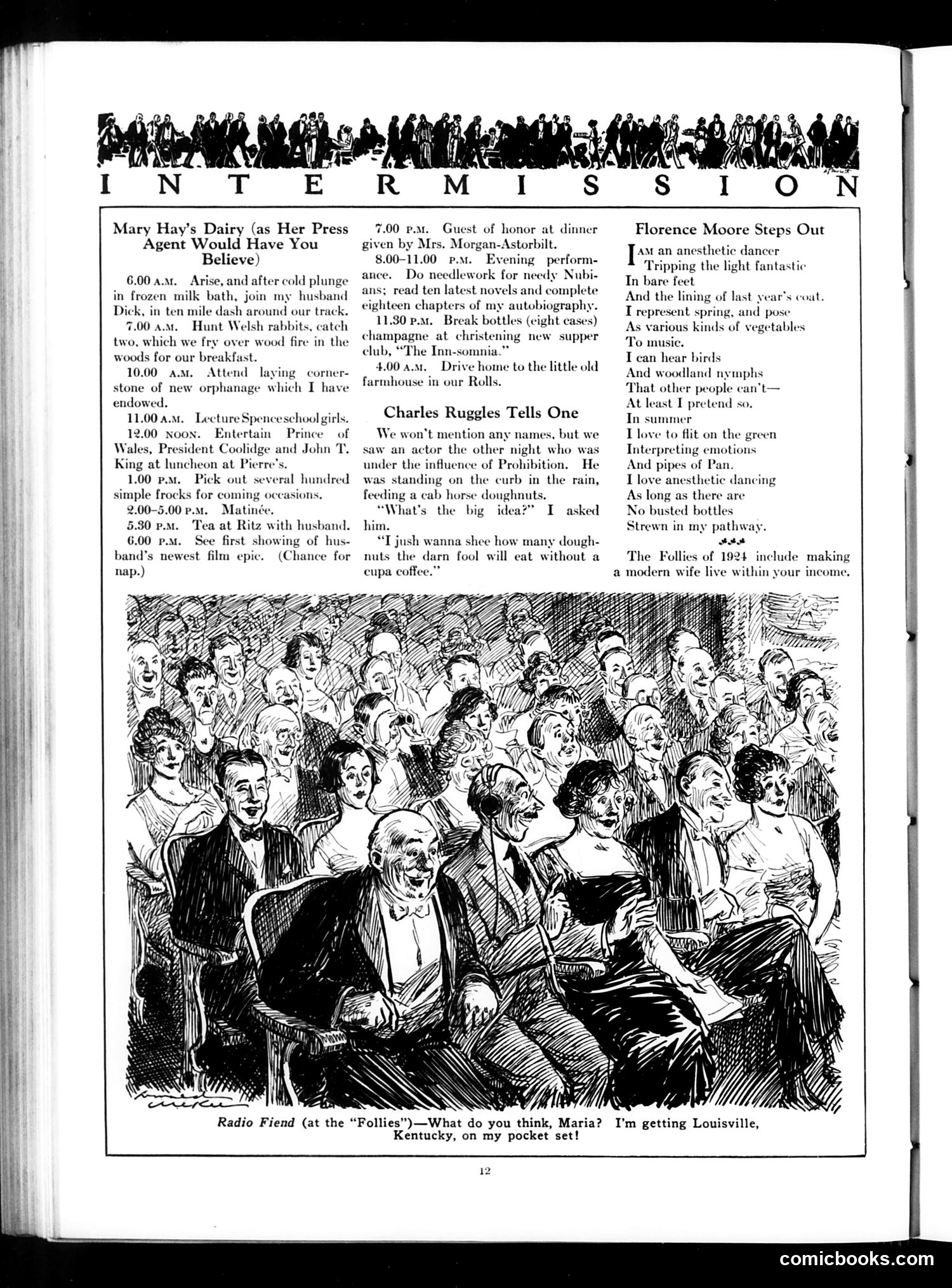
This page satirizes celebrity culture and Prohibition-era excess. **"Mary Hay's Dairy"** mocks the unrealistic press narratives around actress Mary Hay, listing an absurdly packed day (6 a.m. frozen milk bath, hunting rabbits, entertaining the Prince of Wales at lunch, attending galas at night). It's satirizing the gap between celebrity image-making and reality—her publicist's invented superhuman schedule. **"Charles Ruggles Tells One"** is a short joke about a drunk actor during Prohibition (when alcohol was illegal). The humor relies on the actor being intoxicated despite the law, feeding doughnuts to a horse—absurdist humor about prohibition's failure to stop drinking. **"Florence Moore Steps Out"** describes an avant-garde dancer's pretentious artistic philosophy, concluding with a jab at modern marriage: wives should live within husbands' incomes (a period social commentary on female spending). The large **cartoon below** shows a crowded theater audience, captioned about "Radio Fiend" at the Follies—likely mocking the novelty of radio technology and people's obsession with it, even at live entertainment venues.
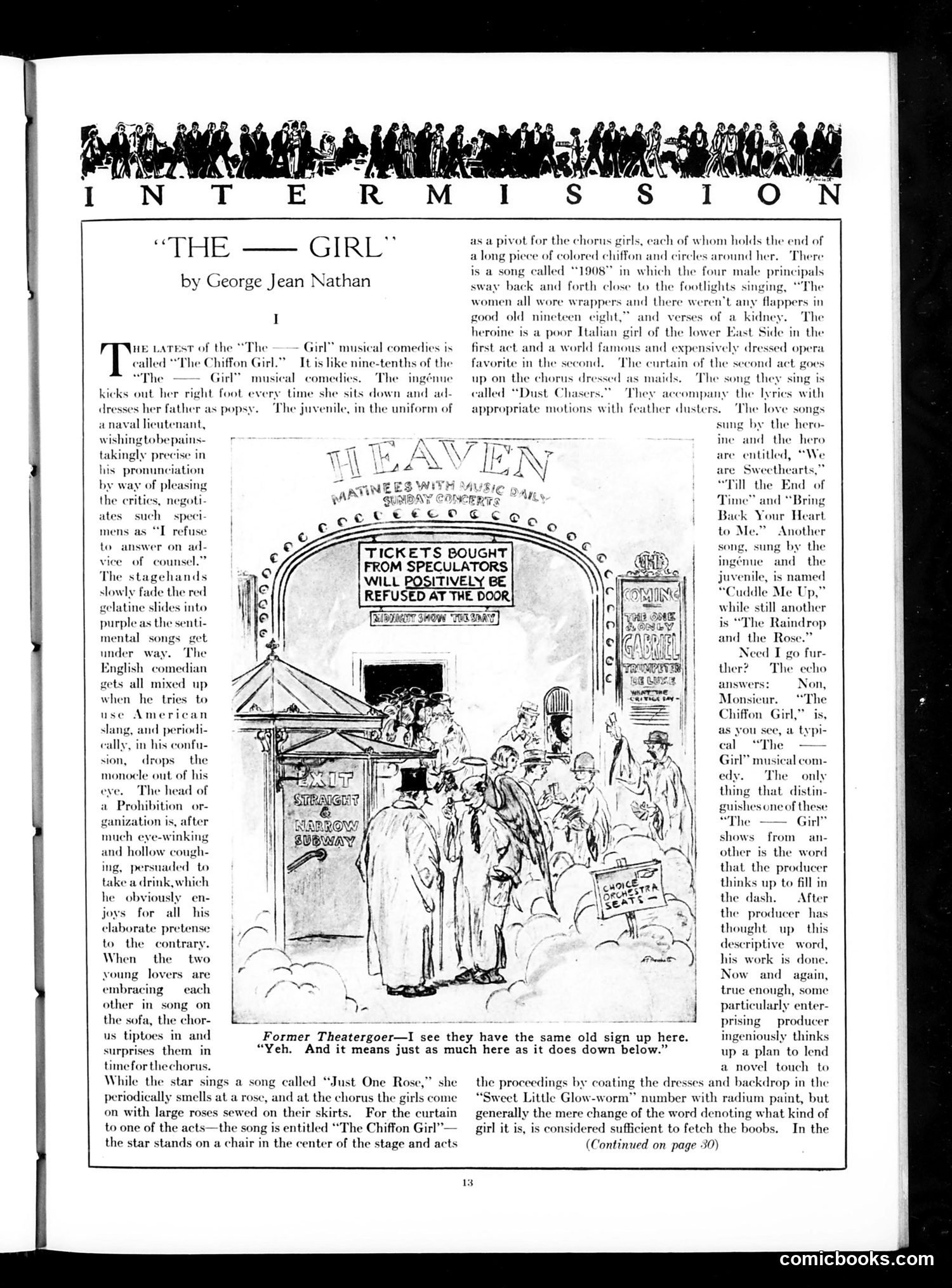
This is a theater review by George Jean Nathan critiquing a popular musical comedy. The accompanying cartoon satirizes theatrical advertising practices. **The Review's Point:** Nathan mockingly catalogs the formulaic, derivative nature of "The — Girl" musicals—a series where producers simply swap one descriptor (Chiffon, Powder Puff, etc.) into an identical template. The ingénue kicks her leg, the juvenile wears a naval uniform, sentimental songs fade to colored gelatin slides, and the plot barely varies. **The Cartoon's Satire:** The sketch shows a theater box office with a prominent sign warning "TICKETS BOUGHT FROM SPECULATORS WILL POSITIVELY BE REFUSED AT THE DOOR." A "Former Theatergoer" observes the identical sign exists both upstairs and downstairs, remarking it "means just as much here as it does down below"—implying the warning is equally meaningless everywhere, mocking theatrical management's hollow gestures. Together, they satirize Broadway's cynical mass-production approach: repackaged plots, interchangeable stars, and empty promises to the paying public.
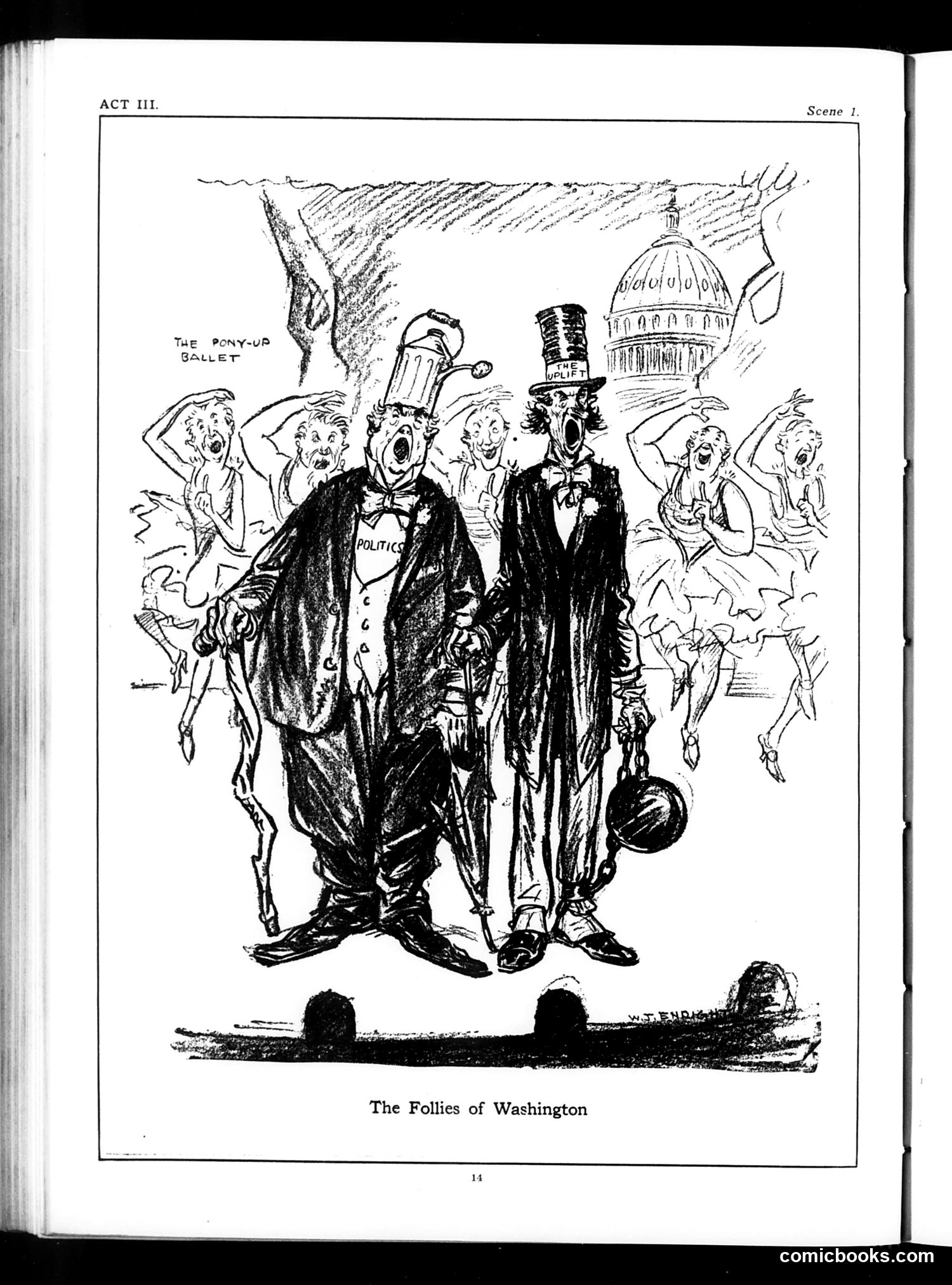
This is Act III, Scene 1 of a theatrical satire titled "The Follies of Washington." The cartoon depicts two formally-dressed men—one labeled "POLITICS"—surrounded by dancing chorus girls ("The Pony-Up Ballet") and framed by the U.S. Capitol dome. The setting parodies Broadway musical revues popular at the time. The satire mocks Washington politicians as entertainers engaged in frivolous spectacle rather than serious governance. The "pony-up" reference likely alludes to politicians extracting money or favors. The theatrical framing suggests political processes are performative show business. The chorus girls and elaborate staging ridicule the carnival-like nature of political activity, while the Capitol dome anchors the critique to governmental institutions themselves.
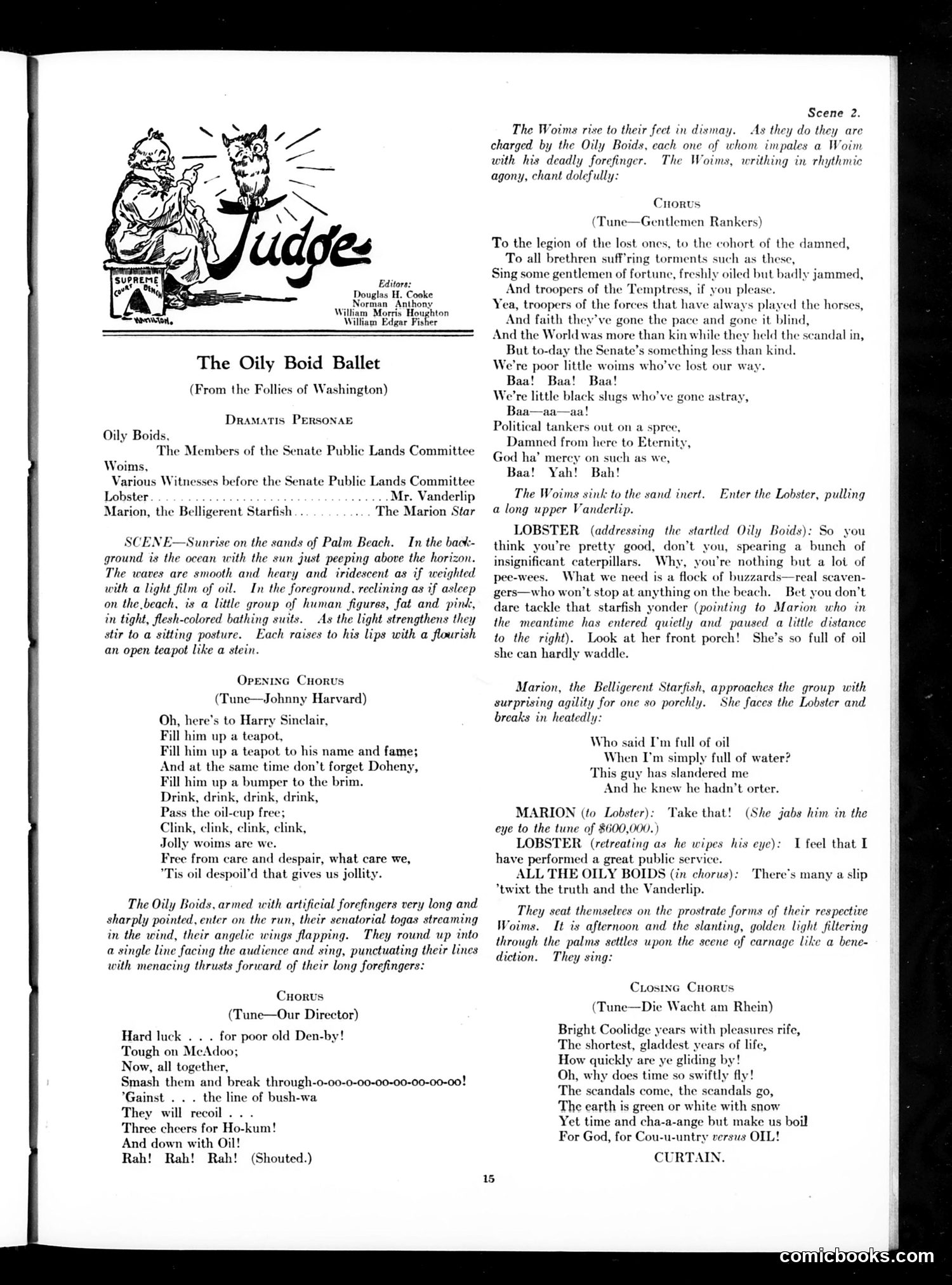
This is a theatrical satire of the Teapot Dome scandal, a major corruption case involving the Harding administration's Senate Public Lands Committee (circa 1921-1924). **The figures:** - "Oily Boids" = corrupt senators on the Public Lands Committee - "Woims" = witnesses testifying before the committee - "Harry Sinclair" and "Doheny" = oil executives at the scandal's center - "Marion" (the starfish) = likely refers to the *Marion Star* newspaper, possibly representing Senator Warren Harding's Ohio publication - The "Lobster" = appears to represent a political operator or witness **The satire's point:** The sketch mocks how senators allegedly accepted bribes (oil) to protect oil magnates' interests. The theatrical format—with singing "oily boids" attacking "woims"—ridicules the committee's supposed failure to seriously investigate corruption. The oil imagery throughout emphasizes the scandal's centrality to the absurd proceedings.
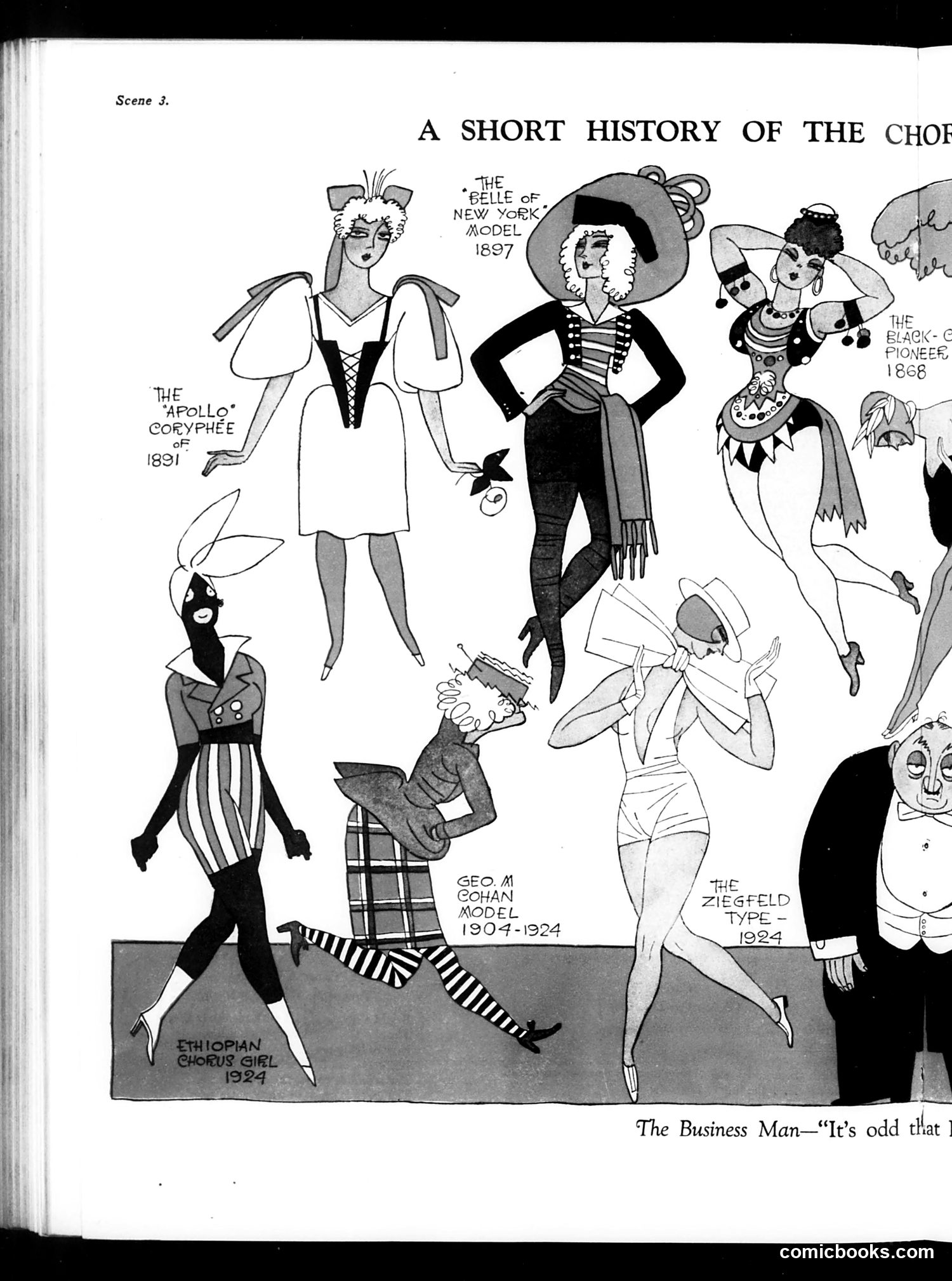
This page satirizes the evolution of chorus girl fashion and presentation in theatrical productions from 1831 to 1924. It shows six different "types" spanning roughly a century: - The "Apollo Coryphée" (1831) features exaggerated classical styling - "The Belle of New York Model" (1897) displays the Gibson Girl aesthetic - "The Black Crook Pioneer" (1868) represents early theatrical chorus work - "Ethiopian Chorus Girl" (1924) and "Geo. M. Cohan Model" (1907-1924) show contemporary styles - "The Ziegfeld Type" (1924) depicts the glamorous Ziegfeld Follies aesthetic The incomplete caption suggests the joke concerns how chorus girls' appearances and costumes have shifted dramatically over time—likely mocking changing fashion standards or theatrical trends. The comic appears to be commenting on theatrical history and evolving performance styles.
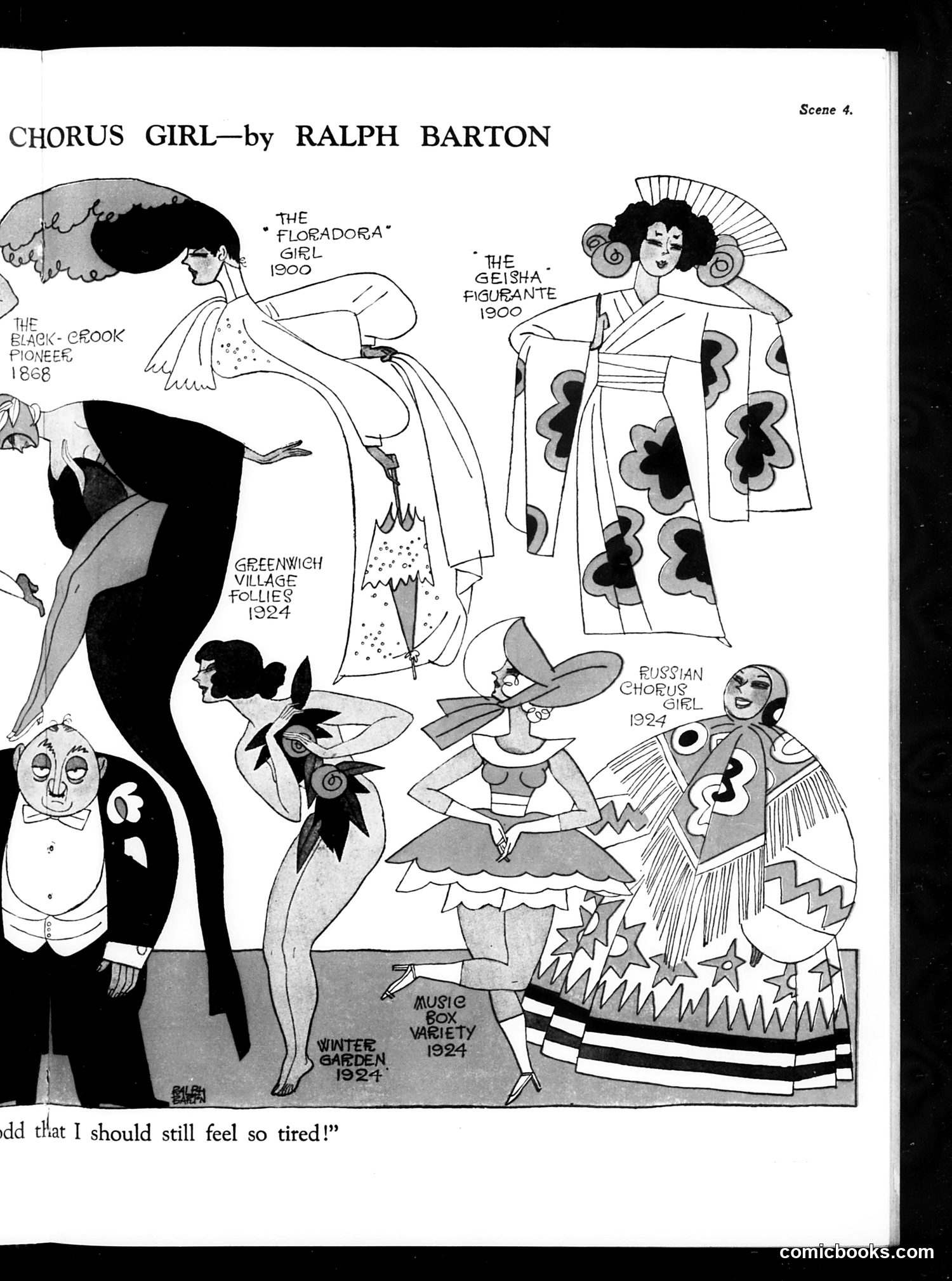
This illustration traces the evolution of chorus girl costumes and aesthetics across theatrical productions from 1868 to 1924. Barton labels each figure with show titles—"The Black Crook Pioneer" (1868), "Floradora Girl" (1900), "The Geisha Figurante" (1900), "Greenwich Village Follies" (1924), "Winter Garden" (1924), "Music Box Variety" (1924), and "Russian Chorus Girl" (1924). The cartoon satirizes how chorus girl costumes and body presentations changed dramatically over roughly five decades, shifting from Victorian modesty through Edwardian exoticism to 1920s modernism with shorter skirts, geometric patterns, and stylized features. The final quote—"dd that I should still feel so tired!"—jokes that despite evolving fashions, the grueling work of chorus girls remained constant. This is social commentary on entertainment industry labor and changing beauty standards.
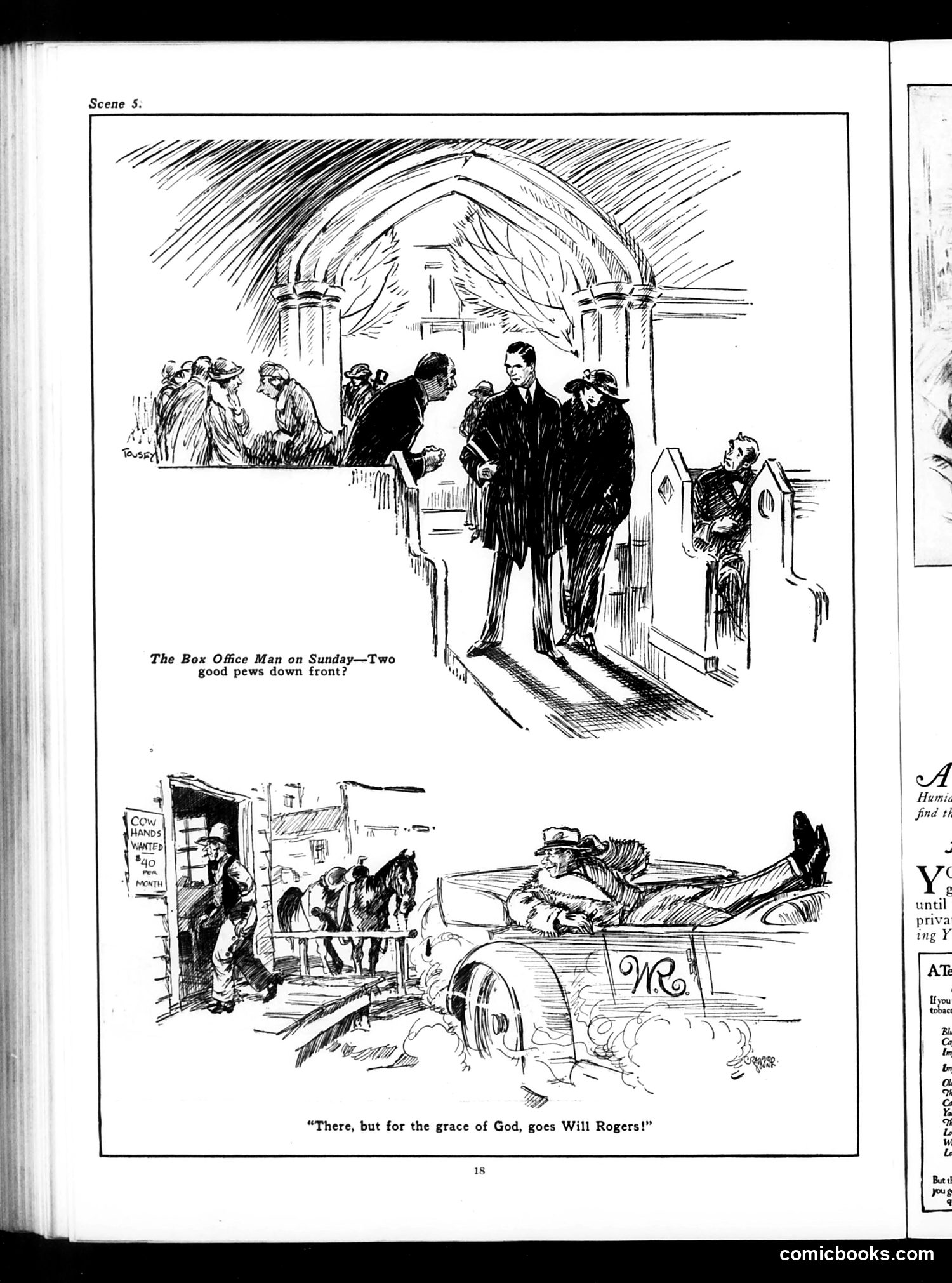
**Top cartoon:** A church box office attendant sells "good pews" to parishioners like theater seats. The satire mocks the commodification of religion—treating church attendance as a commercial transaction where the best seating positions require payment, reducing spiritual worship to entertainment venue economics. **Bottom cartoon:** Titled "There, but for the grace of God, goes Will Rogers!" shows a man in a vehicle marked "WR" in apparent distress or danger. This appears to reference Will Rogers, the famous humorist and social commentator of the early 20th century, likely satirizing his reputation or public persona, though the specific incident referenced is unclear without additional context. Both cartoons reflect *Judge* magazine's satirical approach to American social and religious hypocrisy.
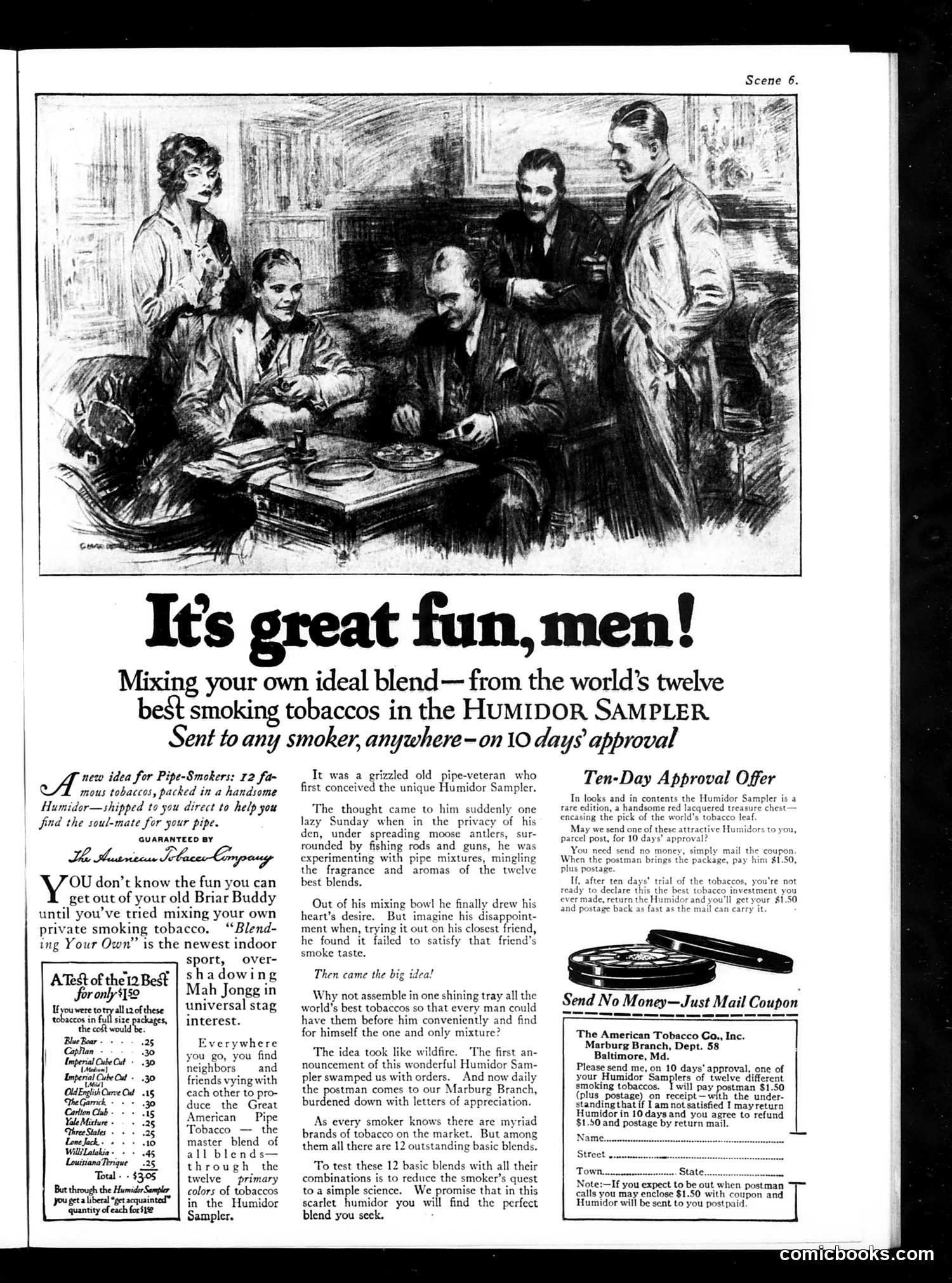
This is primarily a **full-page advertisement** for the Humidor Sampler tobacco product, not satire. The small illustration labeled "Scene 6" depicts men in what appears to be a den or study, examining tobacco blends—a straightforward product visualization. The advertisement's framing as "great fun" reflects **1920s-era marketing language** that treated tobacco blending as a fashionable hobby for men, comparing it to other contemporary leisure activities like Mahjong. The narrative device—the "grizzled old pipe-veteran" who invented the sampler—is typical period advertising storytelling meant to create product authenticity and appeal. The "$1.50 plus postage" and "10 days' approval" language represents direct-mail marketing common to this era, when mail-order was a novel convenience. There is **no apparent political satire or social criticism** on this page. It's a commercial product advertisement designed to appeal to male pipe-smokers through narratives of customization and leisure.
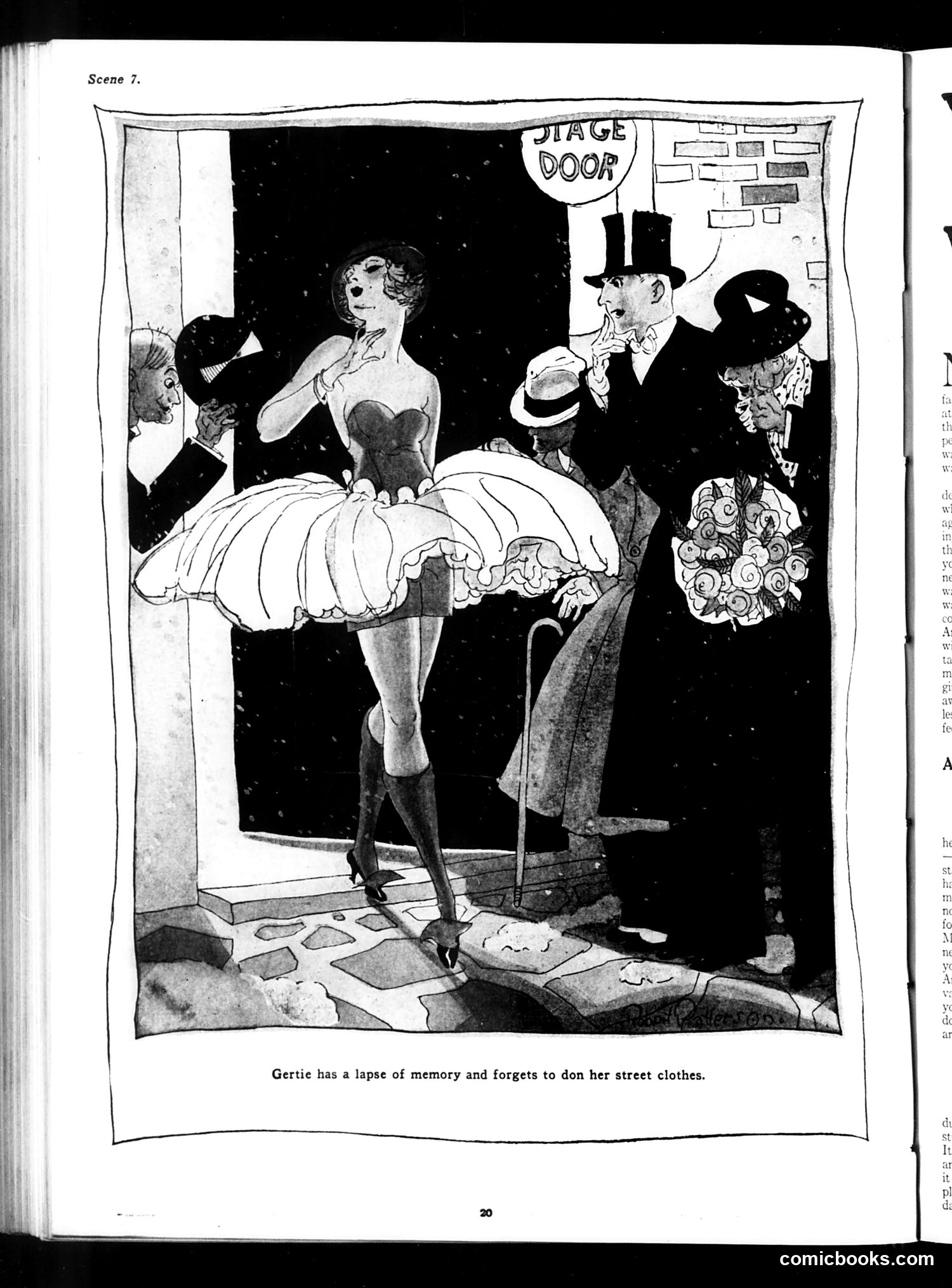
This cartoon depicts a theatrical backstage scene where a performer named Gertie has forgotten to change out of her stage costume—a voluminous, revealing tulle skirt—before exiting through the stage door into public view. Well-dressed gentlemen in top hats react with surprise and amusement at her wardrobe malfunction. The satire targets early 20th-century theatrical conventions and gender norms. The joke plays on the contrast between stage persona (where such revealing costumes were acceptable) and proper street attire expected of women in public. Gertie's "lapse of memory" humorously illustrates either her professional absent-mindedness or suggests commentary on the blurred lines between theatrical performers' public propriety and their on-stage personas—a source of social anxiety and satirical fodder in the period.
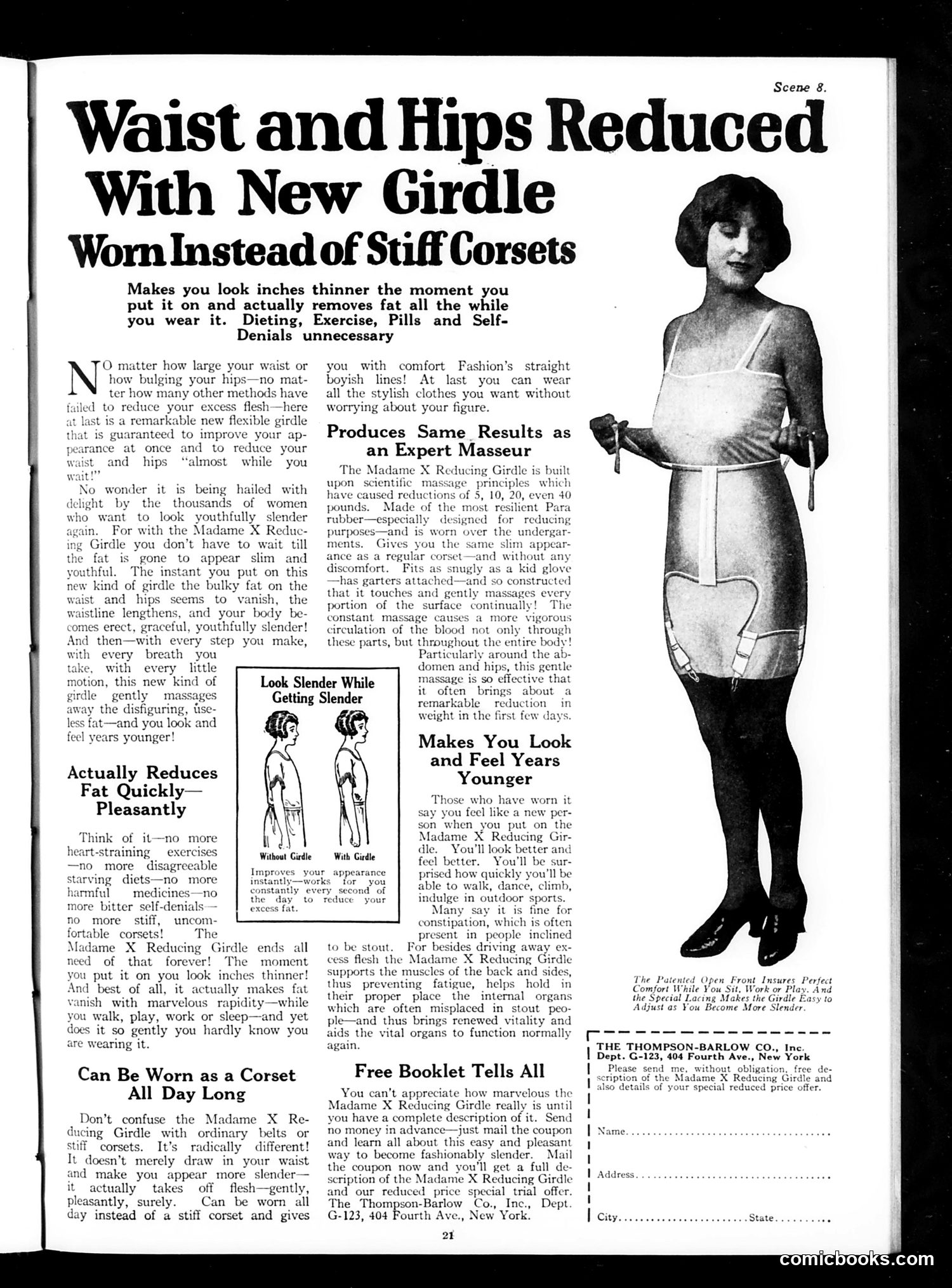
This page is primarily a **vintage advertisement**, not political satire. It promotes the "Madame X Reducing Girdle," a flexible undergarment marketed as an alternative to rigid corsets. **Key Claims Made:** - The girdle allegedly reduces fat through constant gentle massage while worn - Promises weight loss without dieting, exercise, or pills - Claims to slim appearance instantly while actually removing fat over time - Advertises scientific basis (massage principles) and medical benefits (improved organ placement, circulation) **Historical Context:** This reflects early 20th-century attitudes toward women's bodies and fashion—promoting an ideal of slenderness achievable through undergarments rather than lifestyle changes. The advertisement exemplifies how consumer products were marketed with exaggerated health claims before modern FDA regulations. The accompanying illustration shows before/after silhouettes emphasizing the girdle's shaping effect. This is typical commercial content for *Judge* magazine rather than satirical commentary, though modern readers might find the health claims themselves absurdly false.
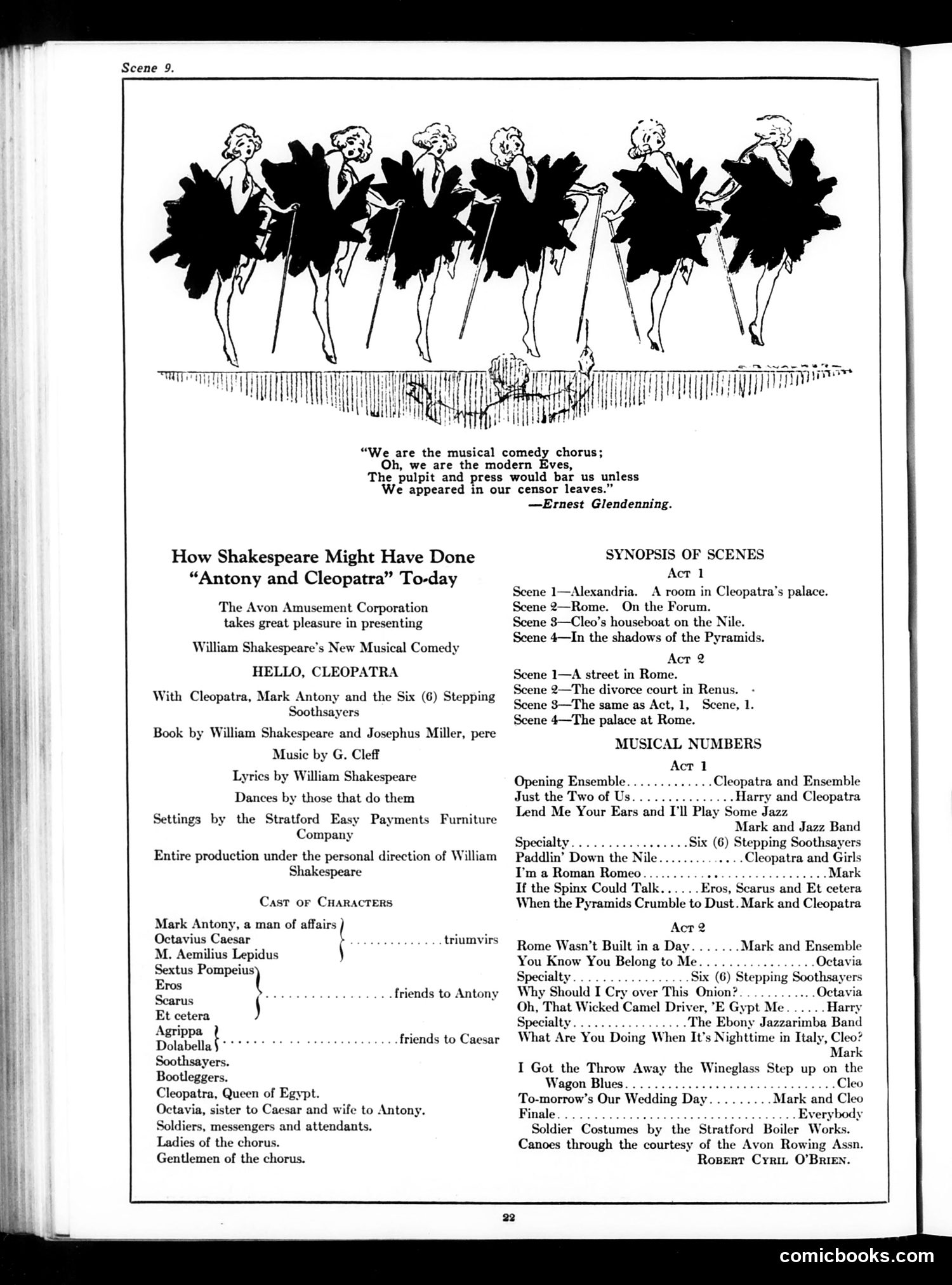
This page satirizes 1920s Broadway musical comedy trends by imagining Shakespeare's "Antony and Cleopatra" reimagined as a modern musical revue. The joke targets several contemporary preoccupations: **The epigraph** criticizes chorus girls' scanty costumes, with the quote suggesting they wear only "censor leaves" (minimal coverings) to evade censorship—a real concern in the Jazz Age. **The "musical numbers"** parody modern Broadway's frivolous song titles ("Paddlin' Down the Nile," "I'm a Roman Romeo," "The Ebony Jazzarimba Band"), treating Shakespeare's tragedy as mere vehicle for dance spectacle and jazz. **The casting** includes "Six (6) Stepping Soothsayers," "Bootleggers," and a "jazz band"—anachronistic additions mocking how 1920s producers updated classics with contemporary references and entertainment gimmicks. **The illustration** shows six stylized chorus girls in minimal costumes with large feathered fans, embodying the "modern Eves" referenced in the epigraph—embodying both the era's sexual liberation and its perceived moral decline. The satire critiques how commercial theater prioritized spectacle and sexuality over artistic substance.
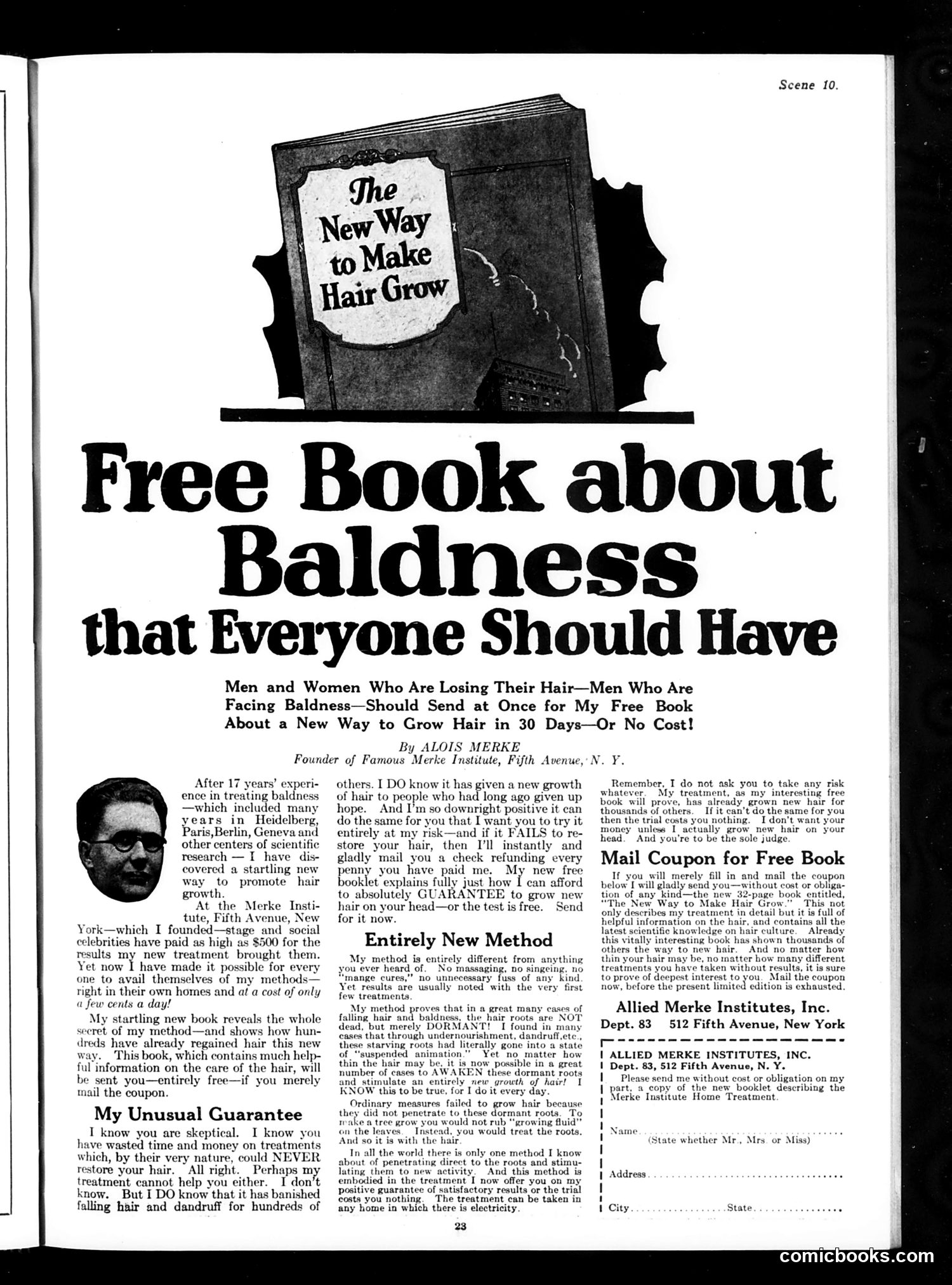
This page is **primarily an advertisement**, not a satirical cartoon. It contains a full-page promotional ad for Alois Merke's baldness treatment and hair-growth method, appearing in *Judge* magazine. The ad targets men and women experiencing hair loss, promising results within 30 days through an "entirely new method" involving electrical stimulation of dormant hair roots. Merke, claiming 17 years of experience at his Fifth Avenue institute, offers a free instructional book and an unusual "guarantee"—customers pay only if treatment succeeds, with refunds promised if it fails. The ad employs typical early-20th-century advertising rhetoric: appeals to skepticism, testimonials from wealthy clients who paid $500, scientific-sounding terminology, and risk-free trial language. The coupon at bottom allows readers to request the free book. There is **no identifiable satire or political commentary** on this page—it appears to be straightforward advertising, though modern readers might find the pseudoscientific claims and guarantees amusing or dubious.
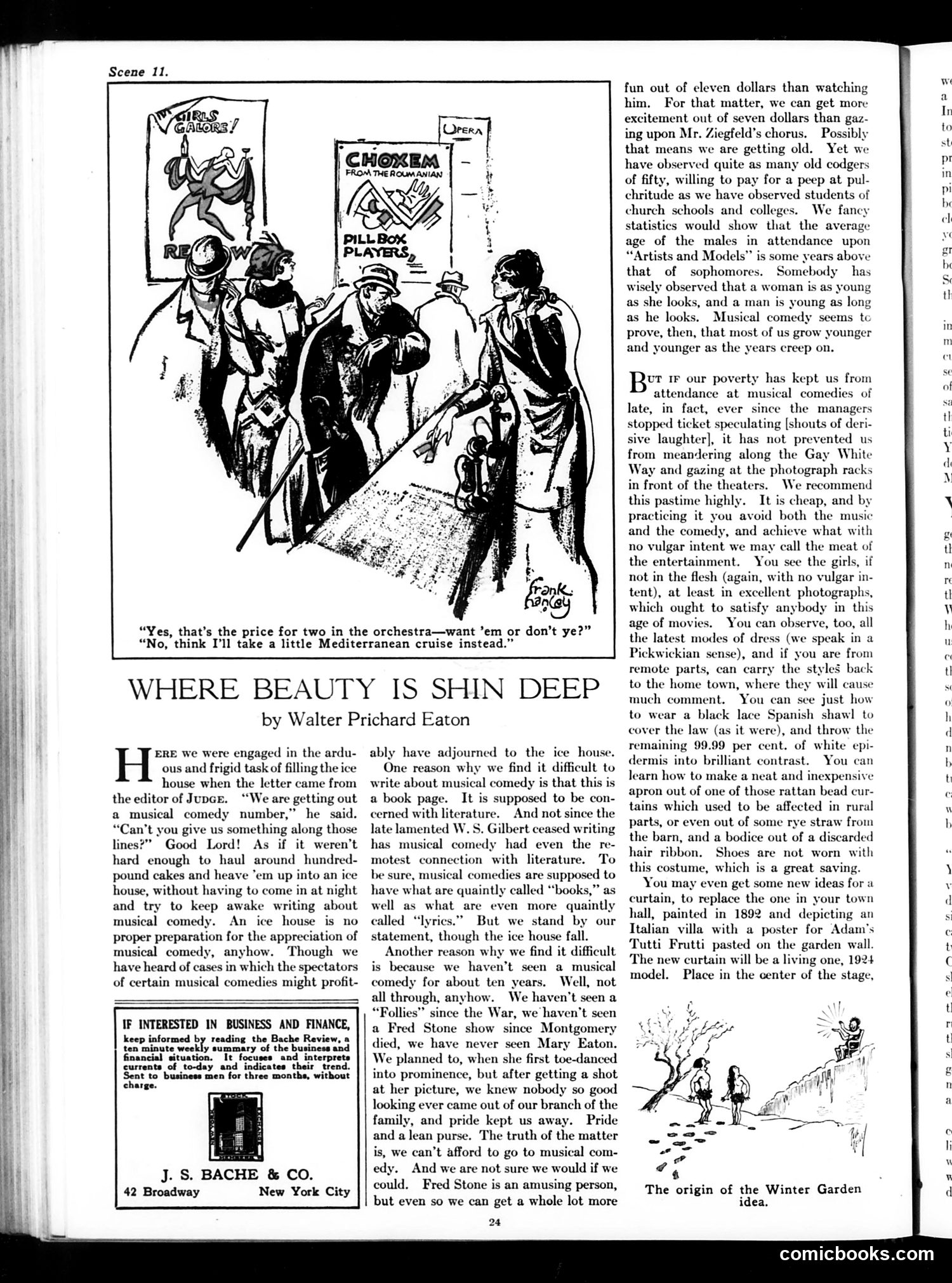
The cartoon depicts theater patrons outside a Broadway venue, with posters advertising musicals like "Follies" and "Chicken from the Boondanians." The joke: when told orchestra seats cost a certain price for two, one patron opts for a Mediterranean cruise instead—satirizing how prohibitively expensive Broadway tickets had become. The accompanying article by Walter Prichard Eaton mocks musical comedy as intellectually empty entertainment. He admits he hasn't attended shows in years due to cost and lack of interest, but compensates by viewing promotional photographs of chorus girls outside theaters. The satire is twofold: musical comedies lack literary merit, yet their primary appeal is visual (attractive female performers), which audiences can enjoy for free by simply looking at lobby photographs. Eaton jokes that this explains why theater-goers grow "younger" as they age—they're really just looking at pictures of young women.
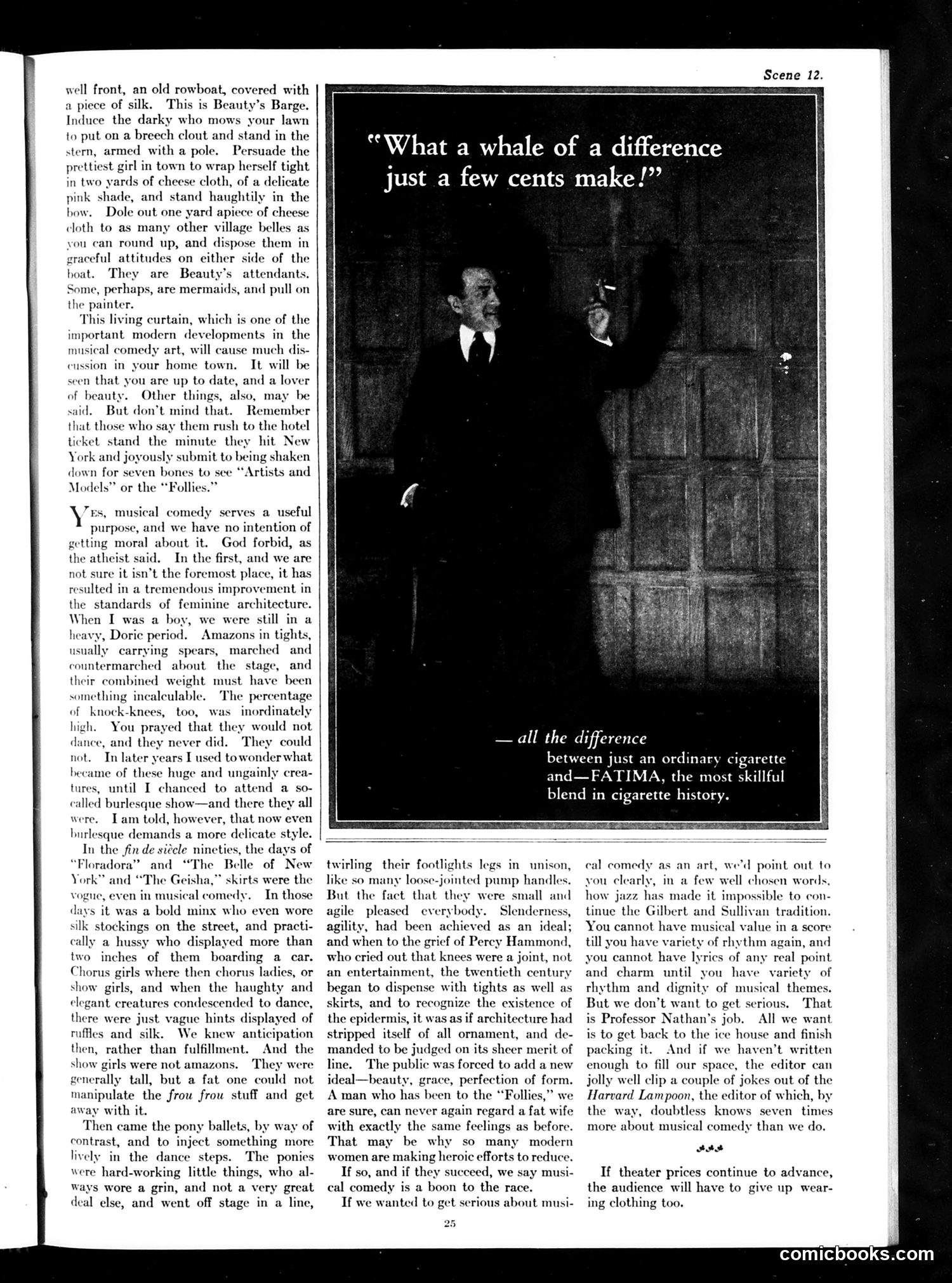
This page contains **advertising disguised as editorial content**—a common Judge practice. The main image is a **cigarette advertisement for Fatima**, featuring two men in formal dress with the tagline "What a whale of a difference just a few cents make!" The lengthy text column is **satirical advice** about staging amateur theatrical productions, mocking small-town aspirations to cosmopolitan sophistication. The author patronizingly instructs readers on how to recreate "Beauty's Barge" (a theatrical scene) using lawn workers and local girls in cheesecloth, while claiming this demonstrates cultural refinement. The satire targets: - **Small-town pretension** and desire to seem "up to date" - **Musical comedy's evolution** toward revealing women's bodies (the author traces the shift from heavy Doric "Amazons" to slender "pony ballets") - **Moral hypocrisy**—the author notes critics rush to condemn such shows while buying tickets The cigarette ad exploits this same appeal to affordable sophistication: Fatima costs slightly more but offers superior quality, positioning consumers as discerning without being extravagant.
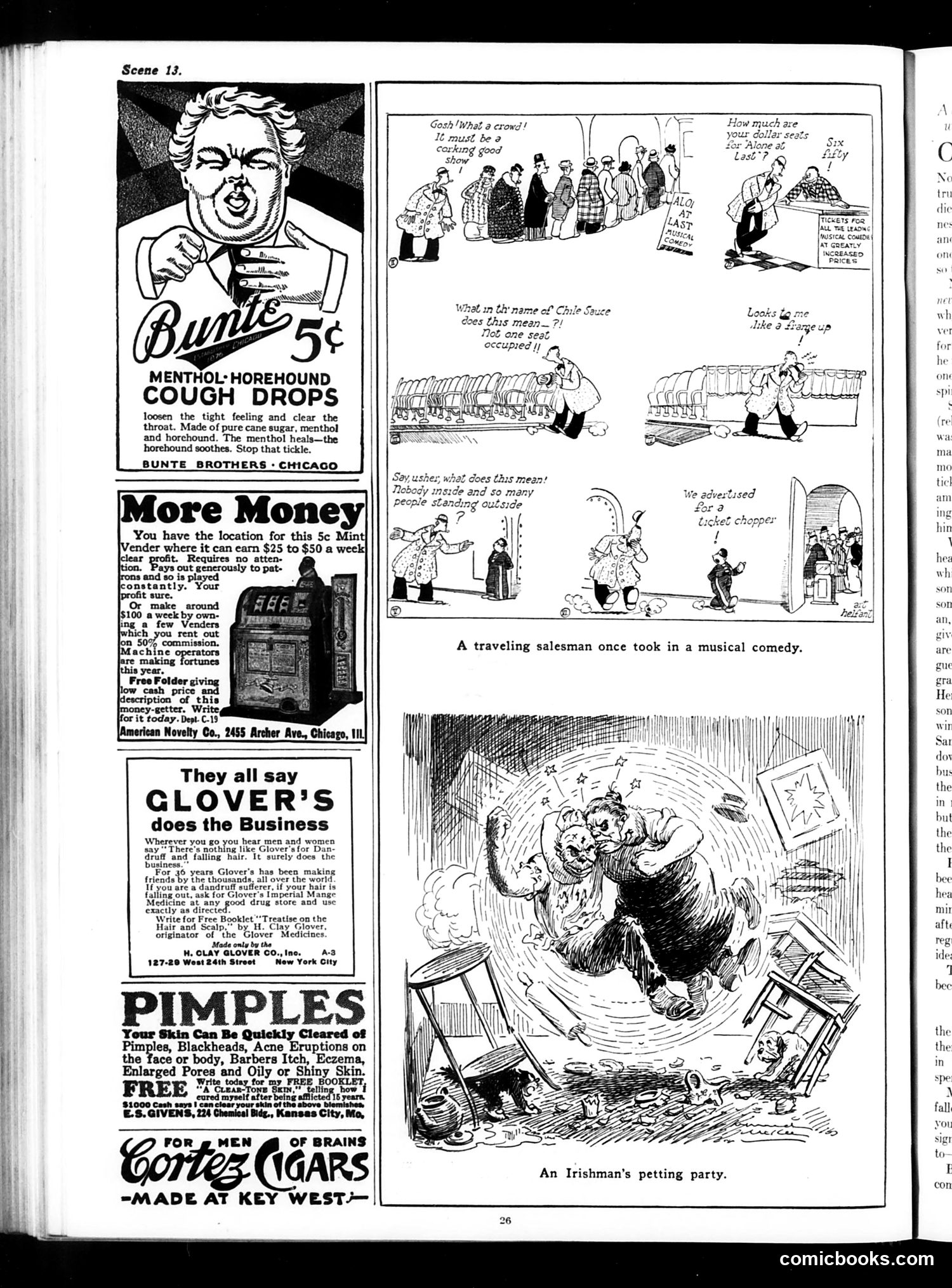
This page is primarily **advertising**, containing six product advertisements (cough drops, vending machines, hair tonic, pimples treatment, and cigars) occupying the left and bottom margins. The main content is a **multi-panel comic strip** titled "A traveling salesman once took in a musical comedy" and "An Irishman's petting party." The strip depicts crowded theater scenes with working-class characters. The humor relies on: 1. **Ethnic stereotype**: "Irishman's petting party" labels the chaotic scene, playing on period Irish-American caricatures 2. **Class satire**: Contrast between refined theater-going and rowdy, disorderly working-class behavior 3. **Physical comedy**: The final panel shows violent chaos—furniture flying, people fighting—suggesting the "petting party" (courting) escalated into brawling The satire mocks working-class entertainment and social customs through exaggerated caricature, typical of Judge's satirical approach targeting urban immigrant populations of the era.
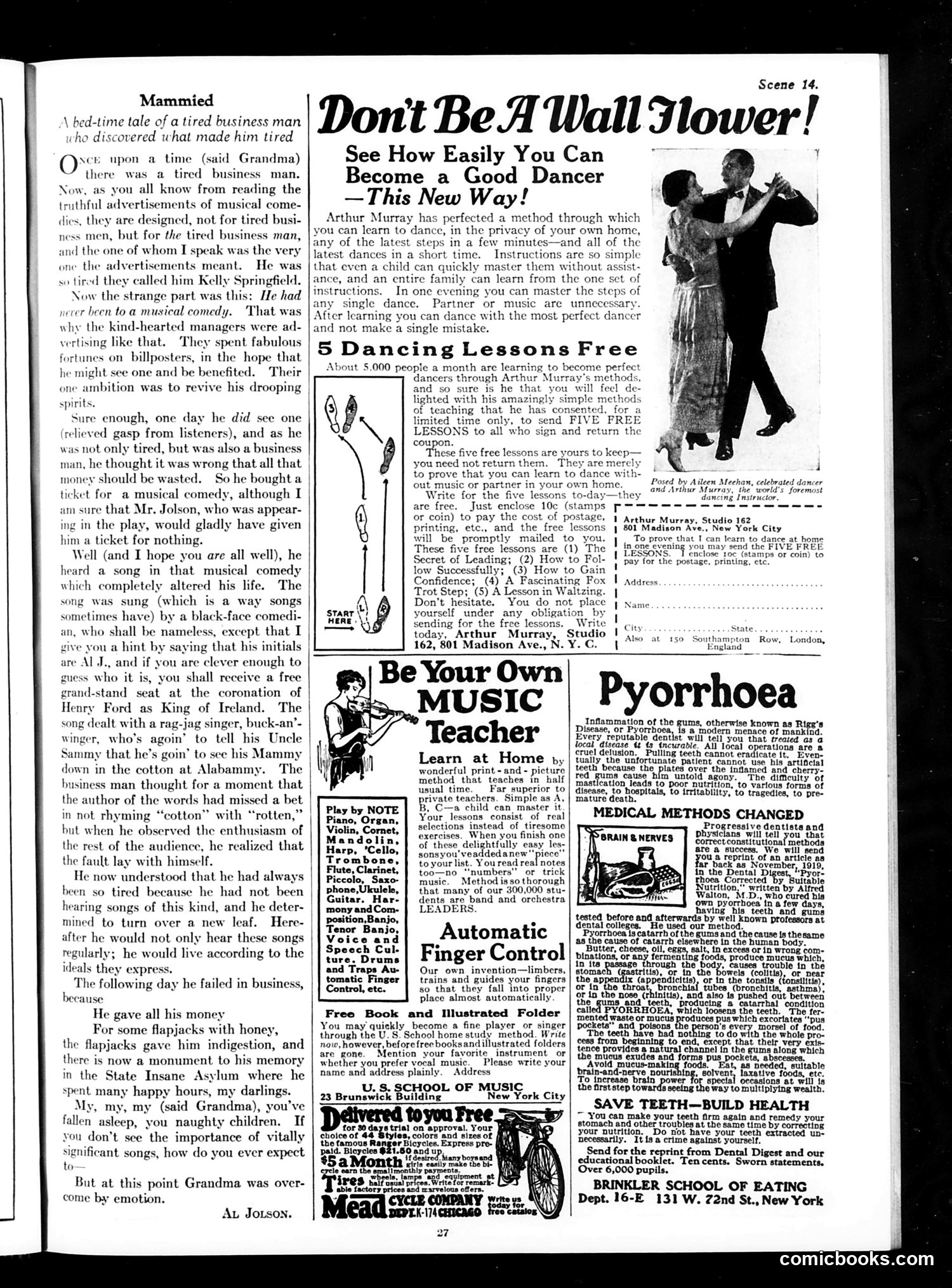
This story satirizes how advertising and popular entertainment exploit tired businessmen's emotions. The protagonist, nicknamed "Kelly Springfield" (a tire brand), is a perpetually exhausted businessman who never attended musical comedies despite their advertisements targeting him specifically. When he finally sees a blackface performer (the text hints this is Al Jolson, using the initials "ALJ") sing a sentimental song about missing his "Mammy" in the South, it emotionally transforms him. He becomes so enchanted with the song's idealized sentimentality that he abandons financial responsibility, spends all his money on frivolous purchases, suffers indigestion, and ends up institutionalized. The satire targets: (1) how advertising manipulates tired consumers, (2) the emotional manipulation of popular entertainment and blackface minstrelsy, and (3) how escapist nostalgia (the "mammy" mythology) can destroy rational judgment. The bedtime tale frame suggests this cautionary tale warns against being seduced by commercial entertainment's false promises of rejuvenation.
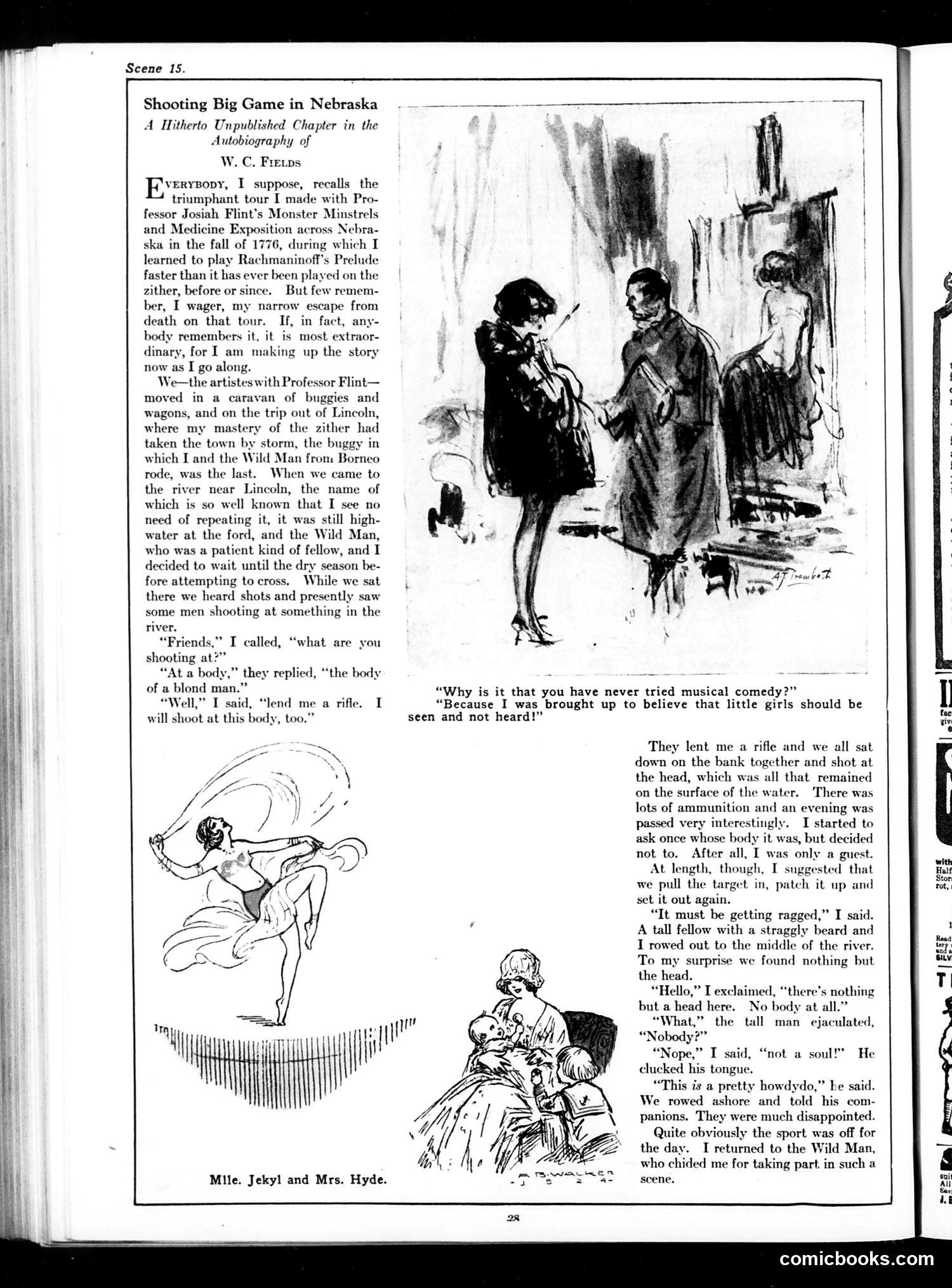
This page from *Judge* magazine presents a humorous tall tale attributed to W.C. Fields, a famous vaudeville performer and comedian of the era. The piece is satirical autobiography—Fields fabricates an absurd 1776 Nebraska adventure with a traveling medicine show. The central joke is the increasingly ridiculous shooting scenario: men casually shooting at a floating corpse for entertainment, then discovering only the head remains. Fields's deadpan narration ("not a soul!") creates dark humor through his failure to question the ethical implications. The accompanying illustrations of "Mile. Jekyll and Mrs. Hyde" and the musical comedy dialogue provide separate satirical content about female performers. The satire targets period attitudes—casual frontier violence, the era's dubious traveling exhibitions, and entertainment's often morally questionable nature. Fields's invented memoir pokes fun at both celebrity autobiography and Nebraska's perceived cultural remoteness.
This page is primarily **advertising**, not political satire. The main content is a humorous fictional anecdote featuring **W.C. Fields**, the famous vaudeville comedian and actor. The story is a tall tale: Fields overhears two men discussing how they once attempted to assassinate him—but killed someone else by mistake (revealed to be the pianist Rachmaninoff). Fields confronts them, discovers they were obsessed zither players angry at his musical performance, and the three become friends despite the murder mix-up. The humor relies on absurdist exaggeration typical of Fields's comedic persona—the implausible eavesdropping method, the casual revelation of mistaken identity assassination, and the reconciliation. It's entertainment, not satire. The surrounding content consists of period advertisements for weight-loss pills, ventriloquism lessons, batteries, and patent services—typical early-1920s magazine advertising with dubious health claims.
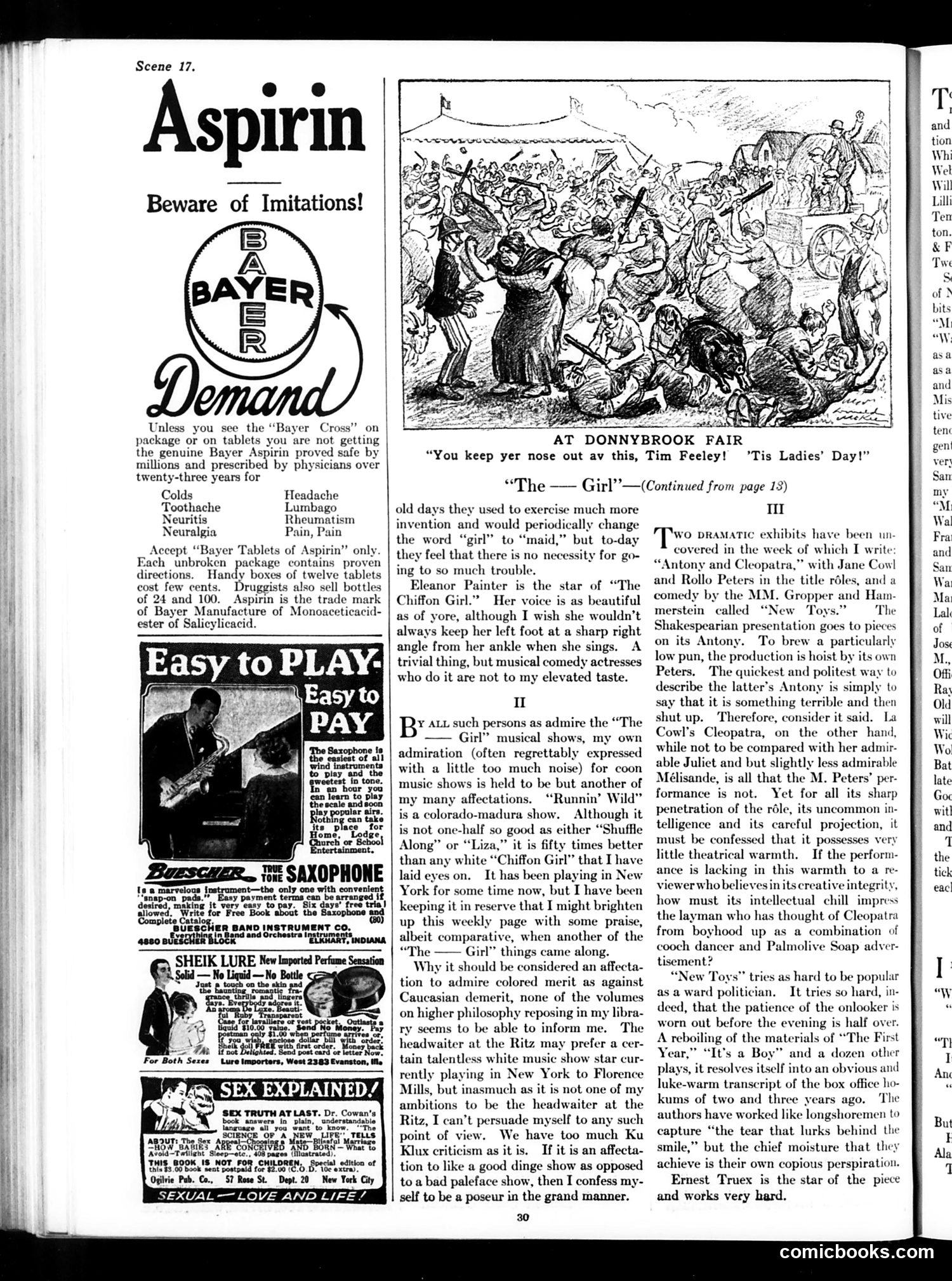
This page primarily contains **advertisements and theatrical reviews**, not political satire. The top section features a **Bayer Aspirin advertisement** warning against counterfeit products—a practical consumer message emphasizing the importance of the "Bayer Cross" trademark on genuine aspirin tablets. Below that is an illustration titled "At Donnybrook Fair" showing an Irish street scene (identifiable by the dialect in the caption: "You keep yer nose out av this, Tim Feeley! 'Tis Ladies' Day!"). This appears to be a generic humorous illustration rather than political commentary. The bulk of the page consists of **theater criticism** discussing "The Girl" musical and related performances, including commentary on Eleanor Painter's performance and comparative praise for African-American theatrical productions like "Runnin' Wild" versus white productions. The remaining space contains various product advertisements for saxophones, perfume, and other goods typical of 1920s publications. There is **no significant political cartoon or satire** on this particular page.
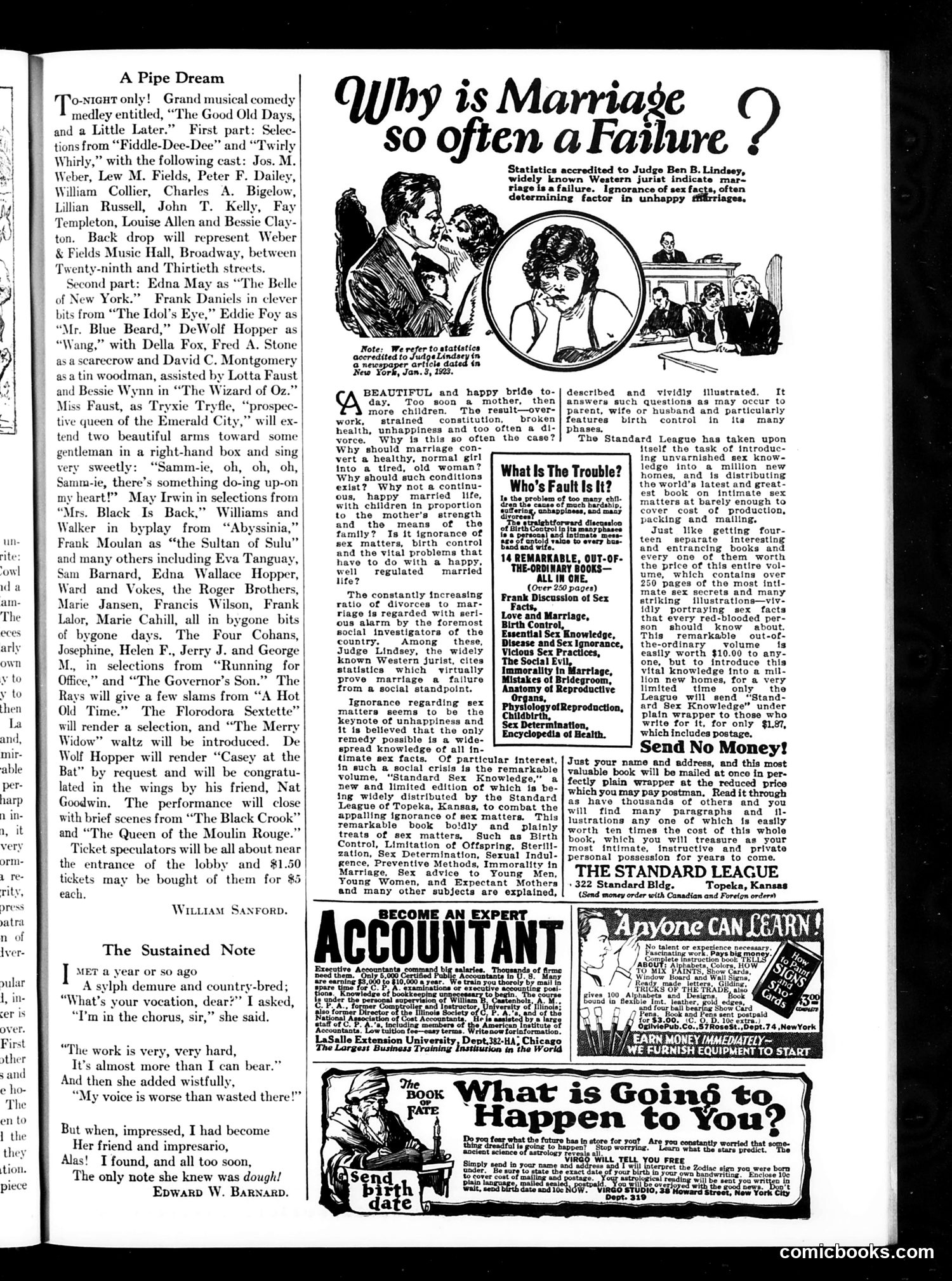
This page from *Judge* magazine (a satirical publication) contains several distinct elements: **Main Feature: "Why is Marriage so often a Failure?"** A serious editorial illustrated with a courtroom scene, citing Judge Ben B. Lindsey's statistics on divorce. The article argues that ignorance about sex and birth control causes marital breakdown—wives become exhausted from repeated pregnancies, leading to health collapse and divorce. This reflects early 20th-century progressive concerns about women's wellbeing and reproductive autonomy. **Left Column: Theater Review** "A Pipe Dream" advertises a musical comedy medley featuring famous vaudeville performers (Weber & Fields, Lillian Russell, DeWolf Hopper, etc.), typical entertainment advertising of the era. **Poem: "The Sustained Note"** A humorous anecdote about a chorus girl who complains her talent is wasted—until the narrator discovers her only real "note" is wanting money. Light satire on theatrical ambition. **Advertisements** Including "Become an Accountant" and "What is Going to Happen to You?" (astrology/fortune-telling), typical of period magazine ads. The tone mixes serious social critique with entertainment and advertising—characteristic of *Judge's* format.
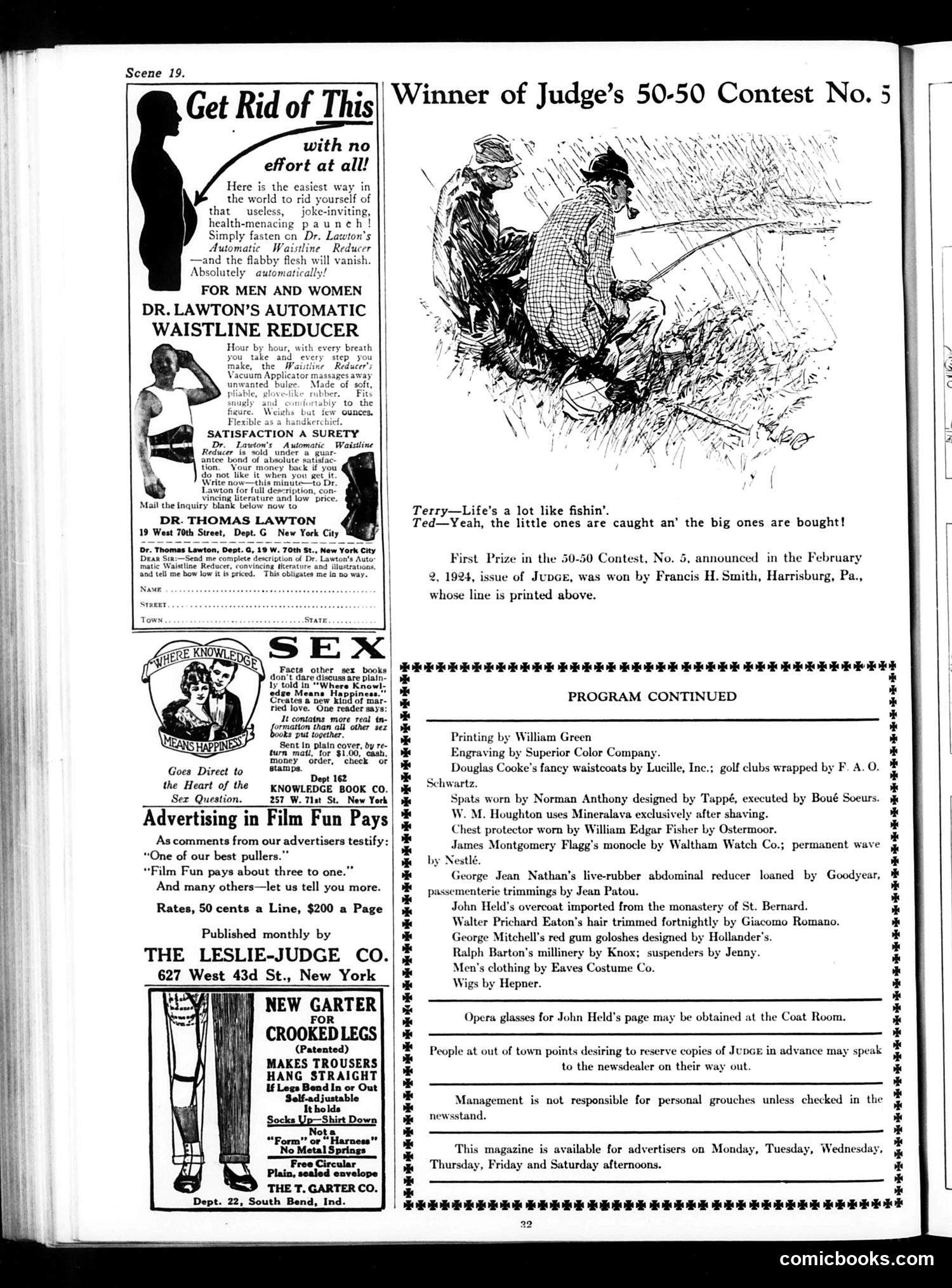
This page contains **primarily advertising and production credits**, not political satire. The main content is a winning cartoon from Judge's "50-50 Contest No. 5" (a reader humor contest). The joke contrasts fishing with romance: one character says life resembles fishing because "the little ones are caught an' the big ones are bought"—a cynical quip suggesting that while ordinary people marry for love, wealthy men are pursued for money. The page is dominated by **period product advertisements** (waistline reducers, garters, sex education books) typical of 1920s magazines, plus extensive **production credits** listing which luxury brands provided clothing and accessories to the magazine's photo shoot or production. The "Where Knowledge Speaks" advertisement selling a sex education book reflects early-20th-century attitudes toward frank discussion of sexual topics as novel and marketable. This is fundamentally a **behind-the-scenes production page**, not editorial content requiring historical context beyond basic 1920s consumer culture.
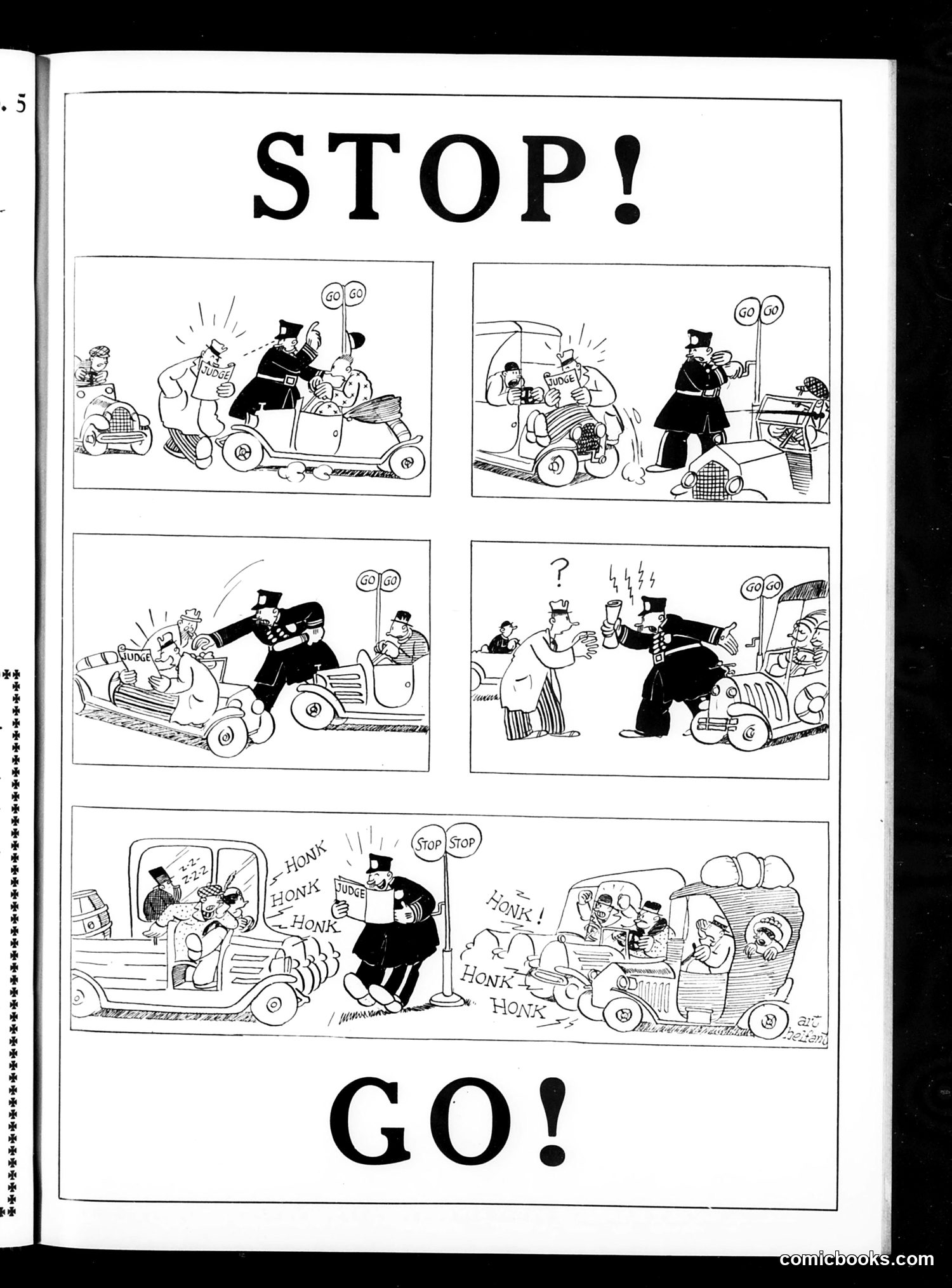
This satirical comic depicts traffic chaos, likely from the early-to-mid 20th century when traffic signals and automobile congestion were novel concerns. The sequence shows: **The scenario:** A traffic policeman alternates between holding "STOP" and "GO" signs at an intersection crowded with small vehicles and passengers. **The satire:** The joke appears to mock the absurdity of early traffic control—the policeman's commands create confusion rather than order. In the final panel, his frantic "HONK HONK" signals produce a chaotic jam of cars, suggesting that well-intentioned regulation can backfire spectacularly. **The point:** This reflects contemporary frustration with emerging urban traffic problems and the limitations of early traffic management systems. The cartoon humorously demonstrates how authorities' attempts to impose order on modern transportation often produce the opposite effect.
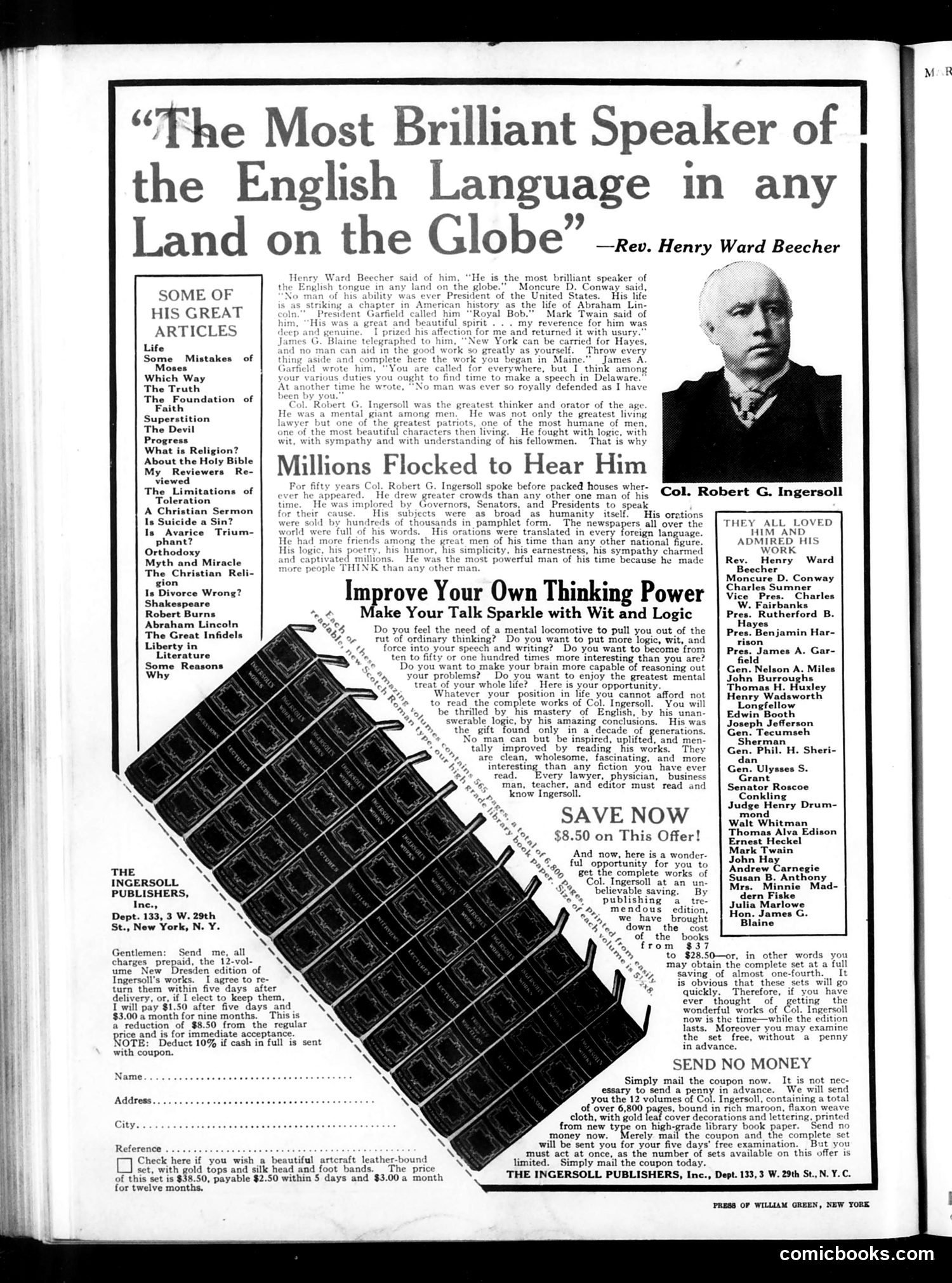
This is primarily an **advertisement for Col. Robert G. Ingersoll's complete works**, not political satire. The page features a portrait of Ingersoll, a famous 19th-century orator and freethinker known for his skepticism toward organized religion. The layout juxtaposes Ingersoll's image with endorsements from prominent figures (Mark Twain, Abraham Lincoln's associates, Thomas Edison, Walt Whitman, etc.), presenting him as intellectually superior. The "Improve Your Own Thinking Power" section promises readers they'll become "more interesting" by studying his work. The irony—subtle for modern readers—lies in the **contrast between the advertisement's reverent tone and Ingersoll's actual reputation as a controversial agnostic critic of Christianity**. Judge magazine, typically satirical, appears here to be running a straightforward commercial. The list of admirers may constitute gentle irony, as some figures (like Lincoln) couldn't have actually endorsed him post-mortem, suggesting the ad's promotional excess was itself somewhat tongue-in-cheek.