
Judge, 1924-03-15 · page 27 of 36
Judge — March 15, 1924 — page 27: what you’re looking at
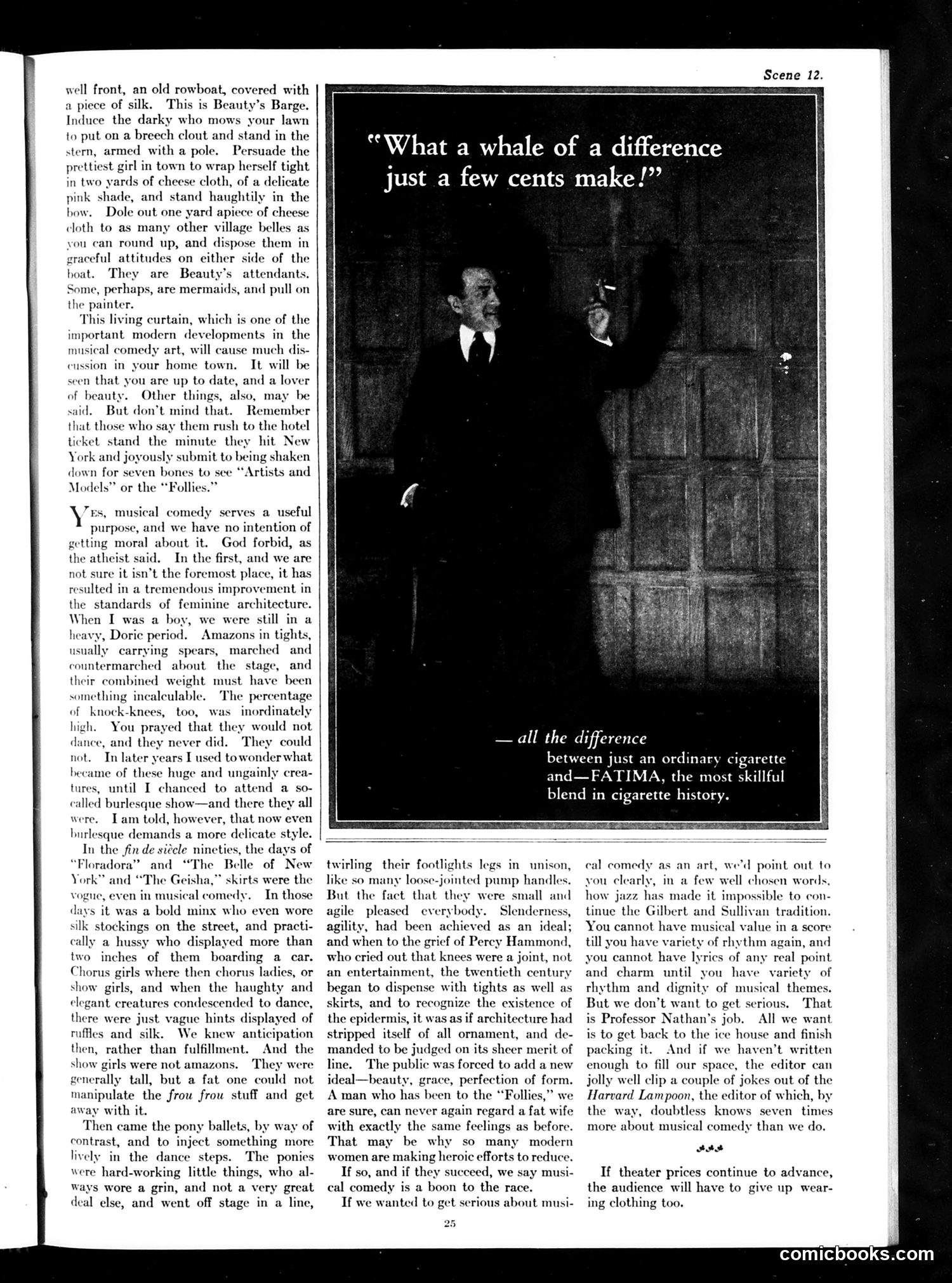
What you’re looking at
This page contains **advertising disguised as editorial content**—a common Judge practice. The main image is a **cigarette advertisement for Fatima**, featuring two men in formal dress with the tagline "What a whale of a difference just a few cents make!" The lengthy text column is **satirical advice** about staging amateur theatrical productions, mocking small-town aspirations to cosmopolitan sophistication. The author patronizingly instructs readers on how to recreate "Beauty's Barge" (a theatrical scene) using lawn workers and local girls in cheesecloth, while claiming this demonstrates cultural refinement. The satire targets: - **Small-town pretension** and desire to seem "up to date" - **Musical comedy's evolution** toward revealing women's bodies (the author traces the shift from heavy Doric "Amazons" to slender "pony ballets") - **Moral hypocrisy**—the author notes critics rush to condemn such shows while buying tickets The cigarette ad exploits this same appeal to affordable sophistication: Fatima costs slightly more but offers superior quality, positioning consumers as discerning without being extravagant.
📄 Transcribed text from this page (OCR, searchable)
Machine-transcribed from the original scan — historical spelling and the odd misread are preserved.
well front, an old rowboat, covered with a piece of silk. This is Beauty’s Barge. Induce the darky who mows your lawn to put on a breech clout and stand in the stern, armed with a pole. Persuade the prettiest girl in town to wrap herself tight in two yards of cheese cloth, of a delicate pink shad d haughtily in the how. Dole out one yard apiece of cheese cloth to as many other village belles as you can round up, and dispose them in aceful attitudes on either side of the They are Beauty’s attendants. Some, perhaps, are mermaids, and pull on the painter. This living curtain, which is one of the important modern developments in the musical comedy art, will cause much dis- cussion in your home town. It will be seen that you are up to date, and a lover of beauty. Other things, also, may be But don’t mind that. Remember that those who say them rush to the hotel ticket stand the minute they hit New York and joyously submit to being shaken to see “Artists and and s\ said. down for seven bon Models” or the **Foll Y=. musical comedy serves a useful purpose, and we have no intention of getting moral about it. God forbid, as the atheist said. In the first, and we are not sure it isn’t the foremost place, it has resulted in a tremendous improvement in the standards of feminine architecture. When I was a boy, we were still in a heavy, Doric period. Amazons in tights, usually carrying spears, marched and countermarched about the stage, and their combined weight must have been The percentage of knock-knees, too, was inordinately high. You prayed that they would not ance, and they never did. They could not. In later years I used towonder what became of these huge and ungainly crea- tures, until I chanced to attend a so- called burlesque show—and there they all were. Lam told, however, that now even burlesque demands a more delicate style. In the finde siécle nineties, the days of “Floradora” and “The Belle of New York” and “The Geisha,” skirts were the vogue, even in musical comedy. In those days it was a bold minx who even wore silk stockings on the street, and practi- cally a hussy who displayed more than two inches of them boarding a car. Chorus girls where then chorus ladies, or show girls, and when the haughty and elegant creatures condescended to dance, there were just vague hints displayed of ruffles and silk. We knew anticipation then, rather than fulfillment. And the show girls were not amazons. ‘They were generally tall, but a fat one could not manipulate the frou frou stuff and get y with it. hen came the pony ballets, by way of contrast, and to inject something more lively in the dance steps. The ponies were hard-working little things, who al- wore a grin, and not a very great deal else, and went off stage in a line, something incalculable. awa Scene 12. “What a whale of a difference just a few cents make!” — all the difference between ju t an ordinary cigarette and—FATIMA, the most skillful blend in cigarette history. twirling their footlights legs in unison, like so many loose-jointed pump handles. But the fact that they were small and agile pleased everybody. Slenderness, agility, had been achieved as an ideal; and when to the grief of Perey Hammond, who cried out that knees were a joint, not an entertainment, the twentieth century began to dispense with tights as well as skirts, and to recognize the existence of the epidermis, it was as if architecture had stripped itself of all ornament, and de- manded to be judged on its sheer merit of line. The public was forced to add a new ideal—beauty, grace, perfection of form. A man who has been to the “Foll are sure, can never again regard a fat wife with exactly the same feelings as before. That may be why so many modern women are making heroic efforts to reduce. If so, and if they succeed, we say musi- cal comedy is a boon to the race. If we wanted to get serious about musi- cal comedy as an art, we'd point out to you clearly, in a few well chosen words, how jazz has made it impossible to con- tinue the Gilbert and Sullivan tradition. You cannot have musical value in a score till you have variety of rhythm again, and you cannot have lyrics of any real point and charm until you have variety of rhythm and dignity of musical themes. But we don’t want to get serious. That is Professor Nathan’s job. All we want is to get back to the ice house and finish packing it. And if we haven't written enough to fill our space, the editor can jolly well clip a couple of jokes out of the Harvard Lampoon, the editor of which, by the way, doubtless knows seven times more about musical comedy than we do. Rnd If theater prices continue to advance, the audience will have to give up wear- ing clothing too. comicbooks.com