
Judge, 1924-03-15 · page 8 of 36
Judge — March 15, 1924 — page 8: what you’re looking at
What you’re looking at
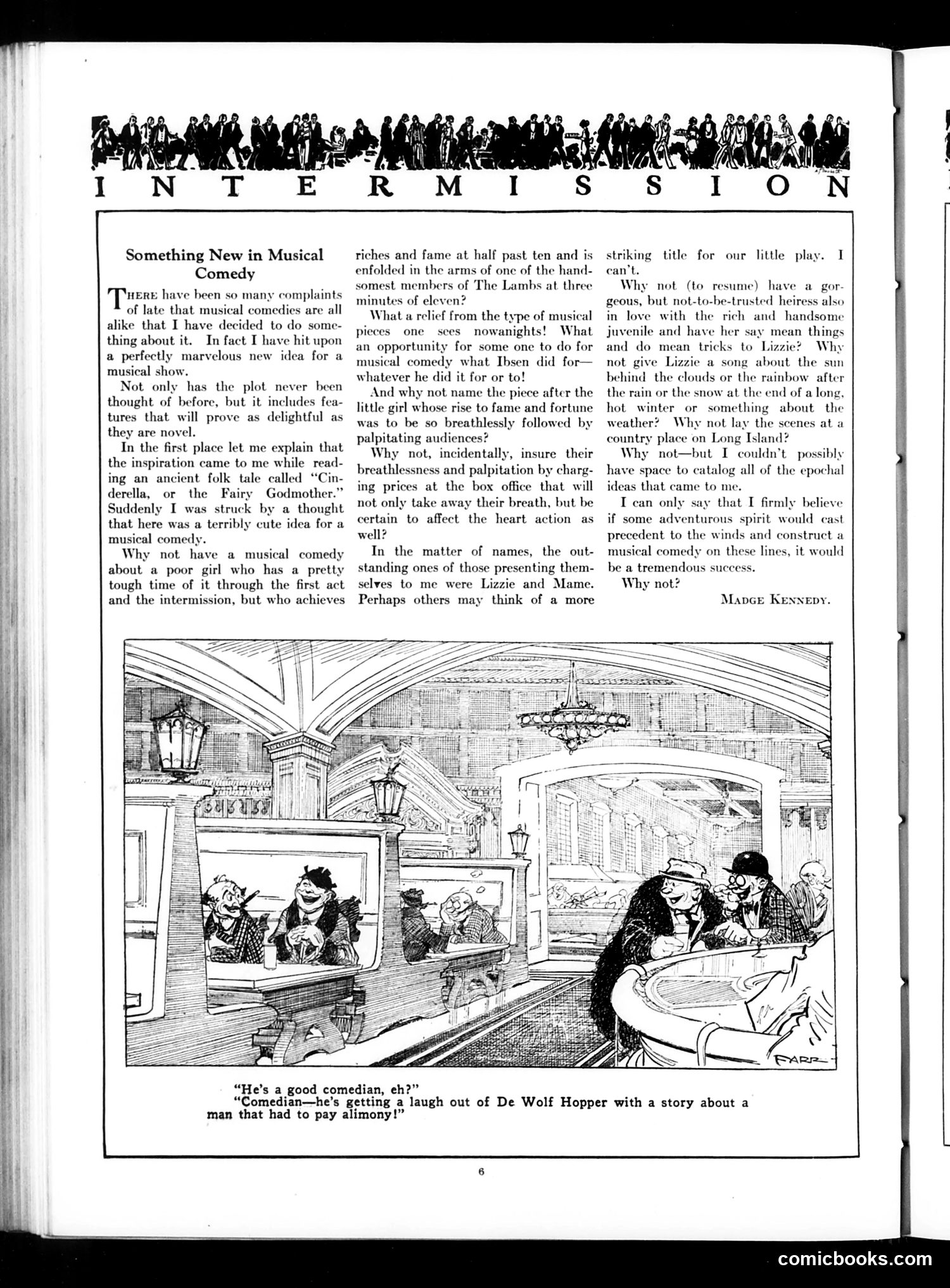
This is a satirical essay by Madge Kennedy mocking the formulaic nature of musical comedies. Kennedy proposes a "new" idea: adapting Cinderella—a poor girl suffering through Act One, then achieving wealth and romance by 10:30 PM, marrying a handsome member of The Lambs (a theatrical club). The satire is that this isn't novel at all; it describes the standard musical comedy plot of the era. Kennedy further mocks the genre by suggesting inflated ticket prices, love triangles with mean heiresses, predictable songs about weather, and country-estate settings—all clichéd tropes presented as if revolutionary. The accompanying cartoon shows a scene in what appears to be a ship or restaurant, with the caption joking about De Wolf Hopper (a famous comedian of the period) being so skilled he can extract laughs even from terrible material—specifically "a story about a man that had to pay alimony," suggesting comedians recycled tired domestic-humor subjects just as musical comedies recycled tired plots.
📄 Transcribed text from this page (OCR, searchable)
Machine-transcribed from the original scan — historical spelling and the odd misread are preserved.
Something New in Musical Comedy HERE have been so many complaints of late that musical comedies are all alike that I have decided to do some- thing about it. In fact I have hit upon a perfectly marvelous new idea for a musical show. Not only has the plot never been thought of before, but it includes fea- tures that will prove as delightful as they are novel. In the first place let me explain that the inspiration came to me while read- ing an ancient folk tale called ‘“Cin- derella, or the Fairy Godmother.” Suddenly I was struck by a thought that here was a terribly cute idea for a musical comedy. Why not have a musical comedy about a poor girl who has a pretty tough time of it through the first act and the intermission, but who achieves riches and fame at half past ten and is enfolded in the arms of one of the hand- somest members of The Lambs at three minutes of eleven? What a relief from the type of musical pieces one nowanights! What an opportunity for some one to do for musical comedy what Ibsen did for— whatever he did it for or to! And why not name the piece after the little girl whose rise to fame and fortune was to be so breathlessly followed by palpitating audiences? Why not, incidentally, insure their breathlessness and palpitation by charg- ing prices at the box office that will not only take away their breath, but be certain to affect the heart action as well? In the matter of names, the out- standing ones of those presenting them- selves to me were L sees ie and Mame. Perhaps others may think of a more striking title for our little play. I can’t. Why not (to resume) have a gor- geous, but not-to-be-trusted heiress also in love with the rich and handsome juvenile and have her say mean things and do mean tricks to Lizzie? Why not give Lizzie a song about the sun behind the clouds or the rainbow after the rain or the snow at the end of a long, hot winter or something about the weathe Why not lay the scenes at a country place on Long Island? Why not—but I couldn't possibly have space to catalog all of the epochal ideas that came to me. T can only say that I firmly believe if some adventurous spirit would cast precedent to the winds and construct a musical comedy on these lines, it would be a tremendous success. Why not? Mapce Kennepy. “He’s a good comedian, eh?” “Comedian—he’s getting a laugh out of De Wolf Hopper with a story about a man that had to pay alimony!” comicbooks.com