
A complete issue · 36 pages · 1923
Judge — December 8, 1923
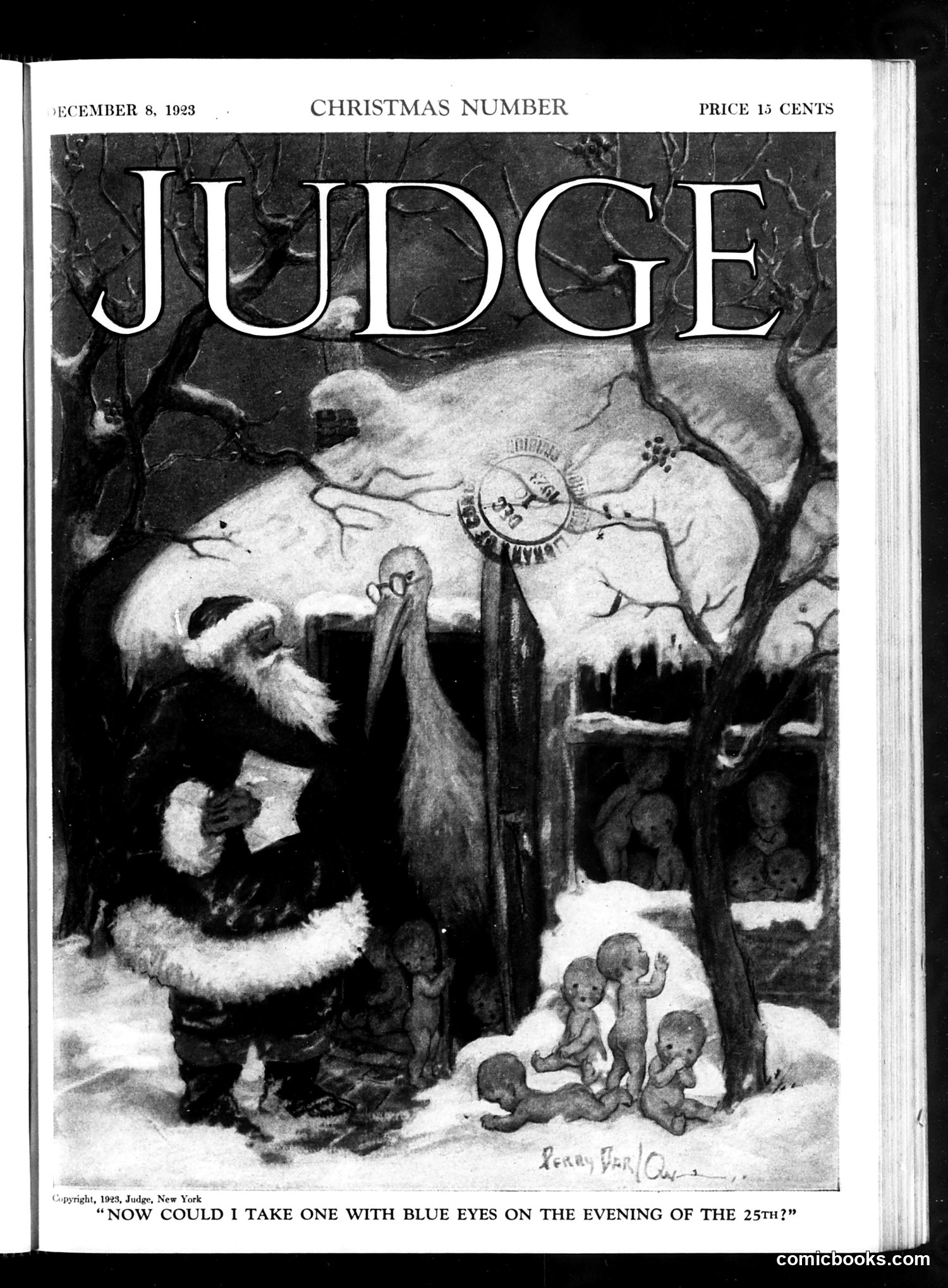
This is the cover of Judge magazine's Christmas special issue. The illustration depicts Santa Claus in a snowy winter scene with cherubs or baby angels at his feet, gazing upward at a large clock face showing midnight or near-midnight. The caption reads: "NOW COULD I TAKE ONE WITH BLUE EYES ON THE EVENING OF THE 25TH?" This appears to be a humorous commentary on gift-giving—specifically, Santa expressing a wish to deliver a child with blue eyes on Christmas Eve. The joke likely plays on contemporary racial or ethnic stereotypes common to 1920s American humor, though the exact satirical target remains unclear without additional historical context about Judge's typical editorial concerns of that era.
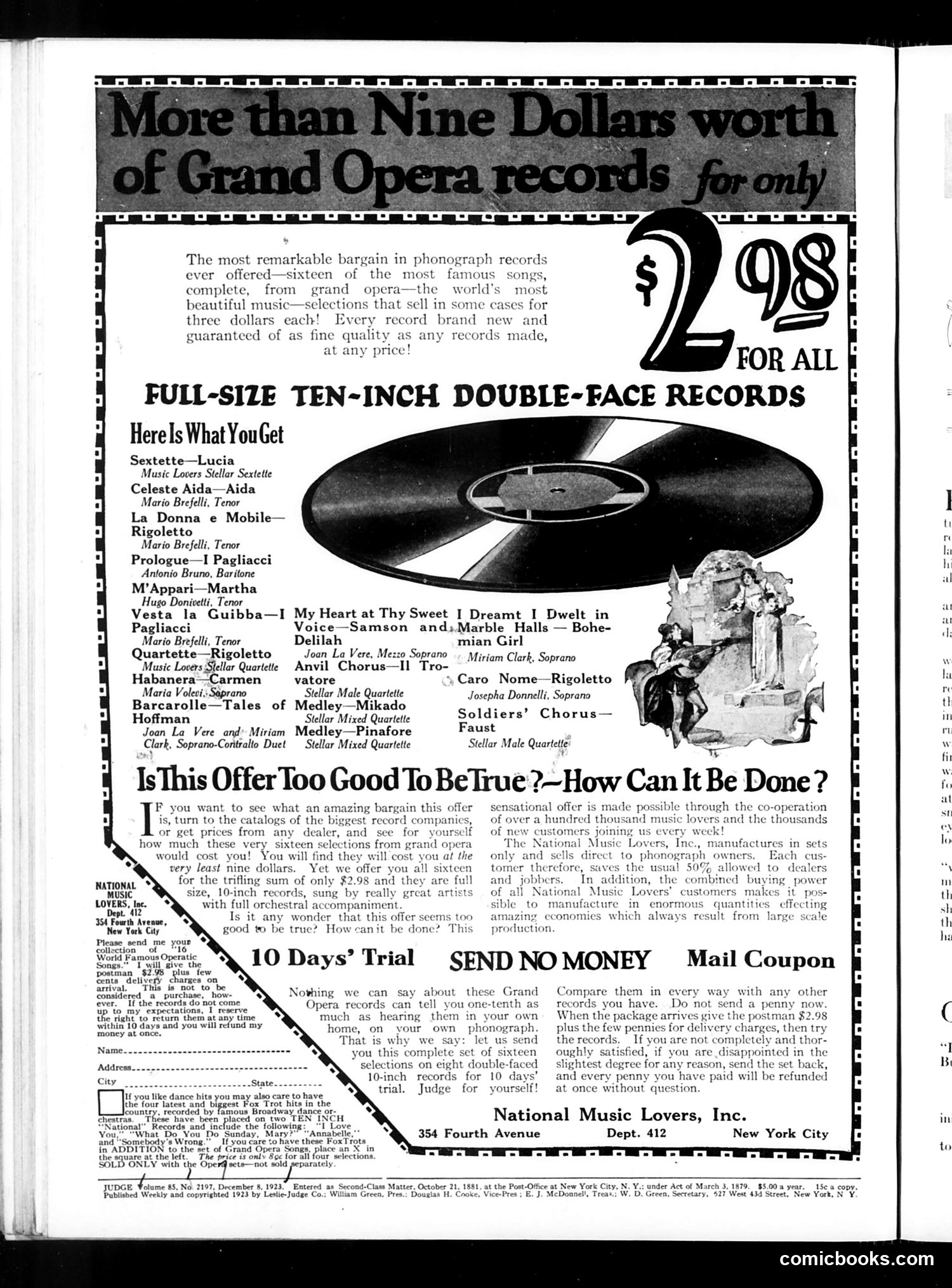
This page is **primarily an advertisement**, not a political cartoon. It promotes Grand Opera records sold by National Music Lovers, Inc. for $2.98 per set—marketed as an extraordinary bargain ("More than Nine Dollars worth...for only $2.98"). The ad lists sixteen opera selections featuring famous singers and includes a mail-order coupon offering a "10 Days' Trial" with "SEND NO MONEY." The rhetorical question "Is this Offer Too Good To Be True?" addresses consumer skepticism about the deal's legitimacy. The only humorous element is explanatory copy justifying the low price through economies of scale and direct manufacturing—not satire. There are no political figures or social commentary visible. This represents typical 1920s magazine advertising targeting middle-class consumers interested in classical music.
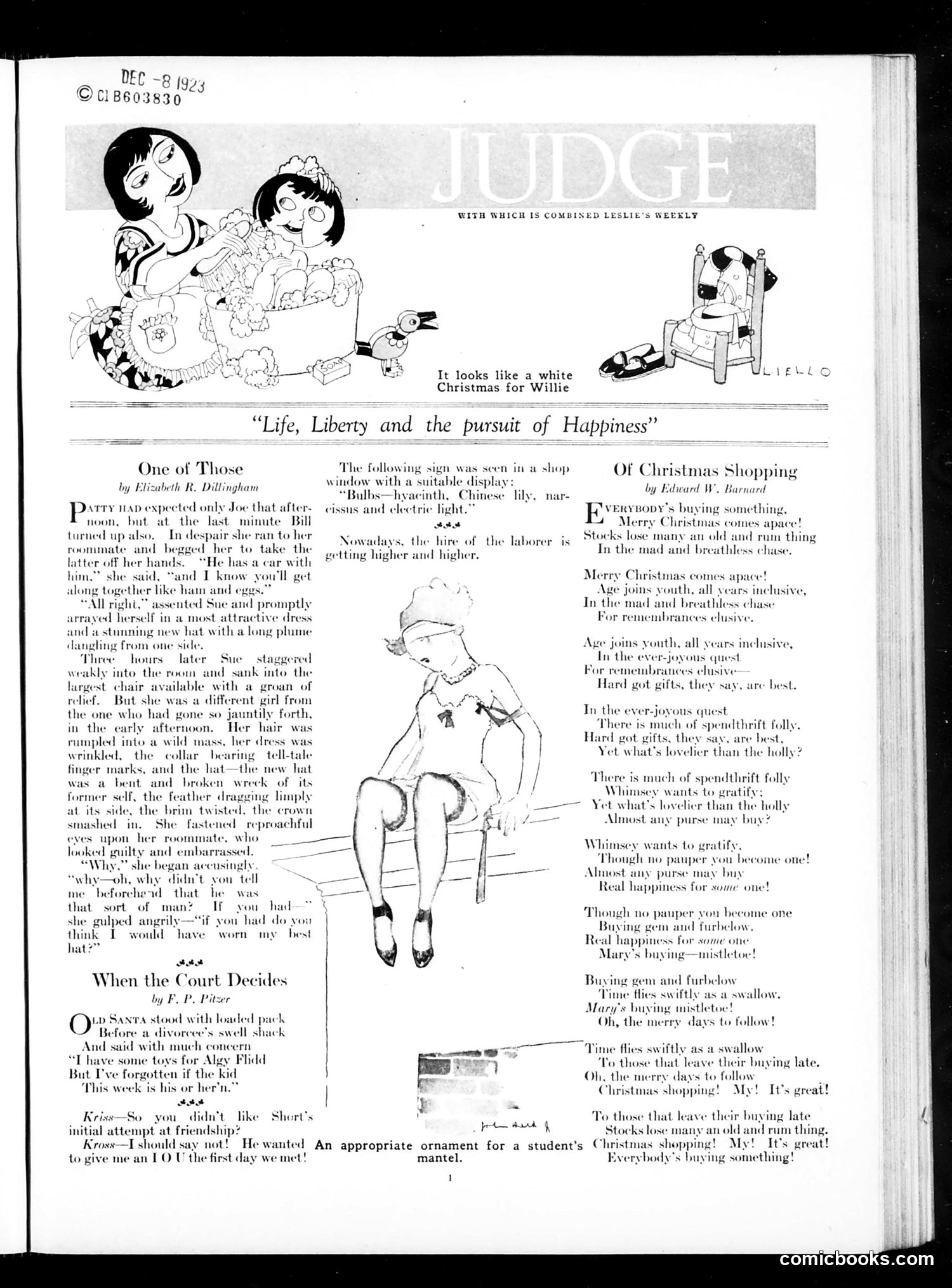
This page contains three fictional pieces with accompanying illustrations: **"One of Those"** depicts a domestic dispute where a wife, angry at her husband's late arrival, refuses to forgive him despite his explanations. The satire mocks conventional marital arguments of the era. **"When the Court Decides"** appears to be a humorous poem about Santa Claus dealing with forgotten Christmas gifts and legal consequences—likely satirizing both holiday commercialism and court proceedings. **"Of Christmas Shopping"** is a poem celebrating Christmas consumer spending, emphasizing that buying material goods brings happiness. This reflects 1920s consumer culture promotion. The illustrations are simple line drawings showing domestic scenes. The overall page celebrates shopping and consumption as paths to happiness—typical 1920s magazine content mixing social commentary with commercial messaging.
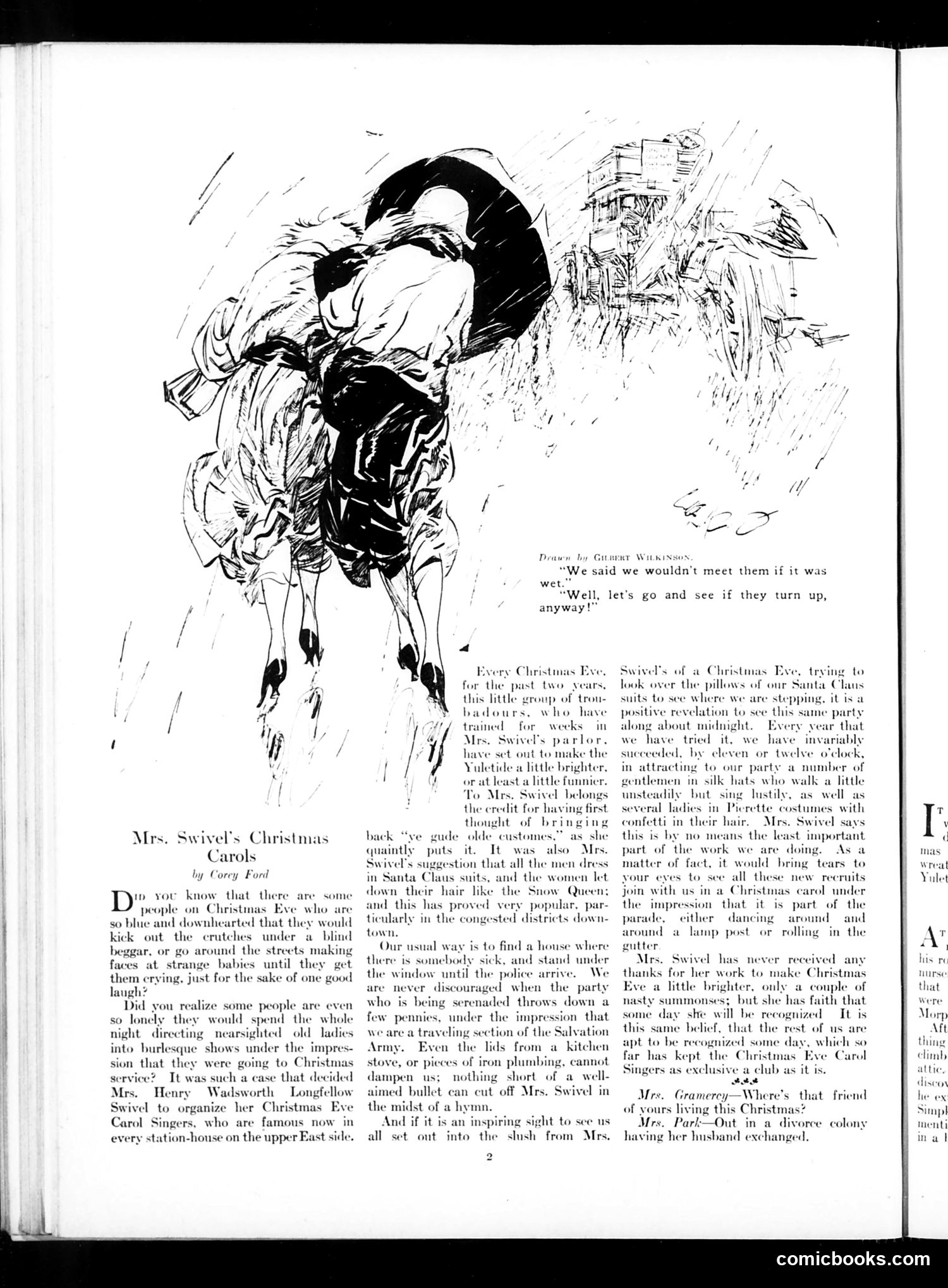
This is a humorous short story illustrated by Gilbert Wilkinson, not a political cartoon. The narrative describes Mrs. Swivel organizing a Christmas Eve caroling group despite discouraging weather ("We said we wouldn't meet them if it was wet"). The story satirizes upper-class Christmas traditions and charitable activities. It mocks the pretension of wealthy women like Mrs. Swivel who organize elaborate holiday performances—complete with costume coordination (Santa suits, Snow Queen outfits) and choreographed caroling—as displays of gentility. The humor derives from the contrast between the groups' aspirations and the mundane reality of trudging through slush singing carols to already-indifferent audiences, including divorced women like "Mrs. Park."
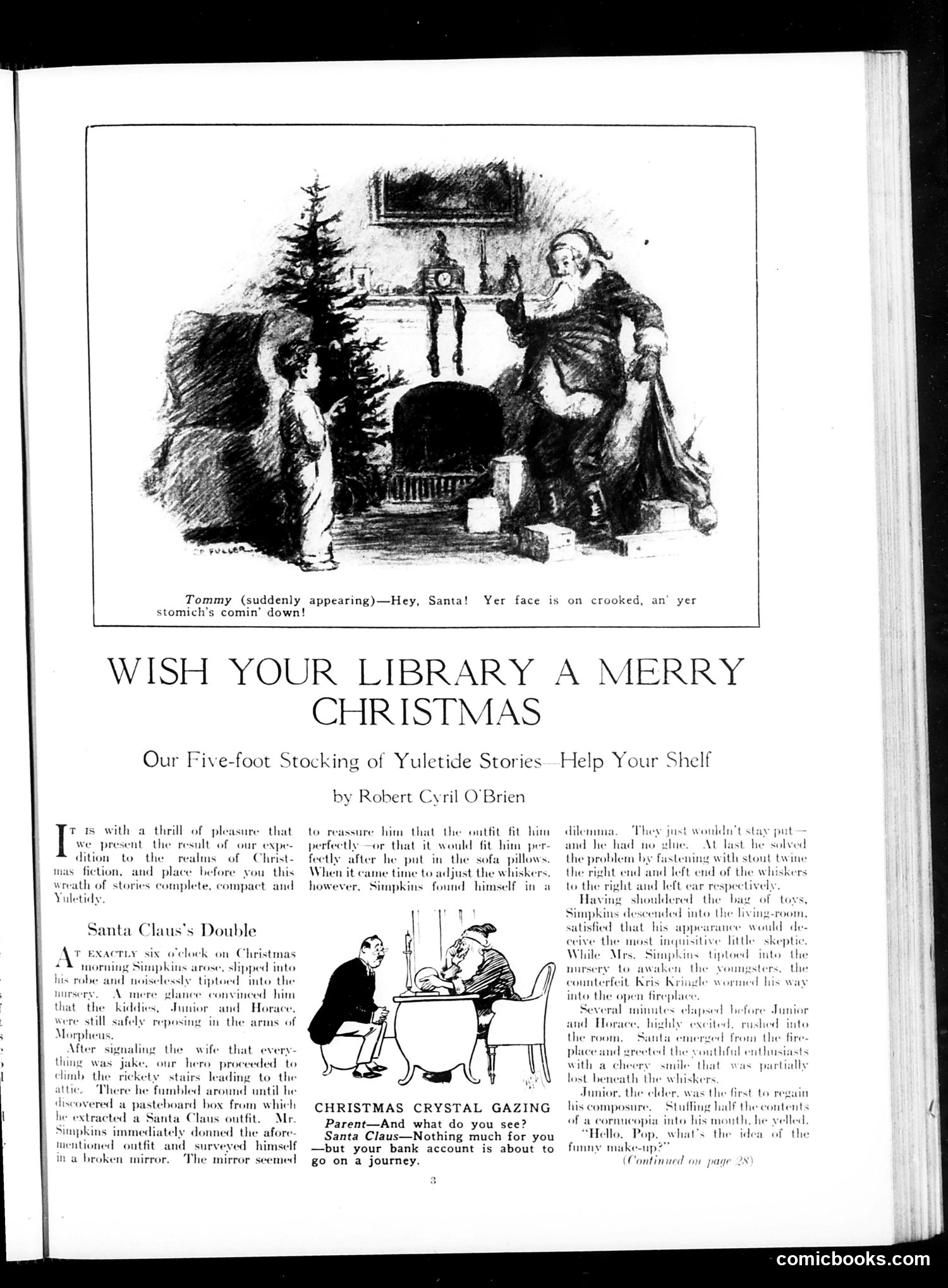
This page from *Judge* magazine presents Christmas-themed fiction rather than political satire. The main illustration shows a domestic scene with Santa Claus and family members around a fireplace, captioned with dialogue from a child (Tommy) commenting on Santa's appearance: "Hey, Santa! Yer face is on crooked, an' yer stomach's comin' down!" The joke is straightforward slapstick humor: a father dressed as Santa has a poorly-fitted costume, with his real face visible through crooked makeup and his stomach protruding awkwardly beneath the padding. Below, an article titled "Santa Claus's Double" begins a serialized Christmas story by Robert Cyril O'Brien about Christmas morning adventures. The secondary illustration labeled "Christmas Crystal Gazing" shows adults in conversation. This is entertainment content for holiday reading rather than political commentary.
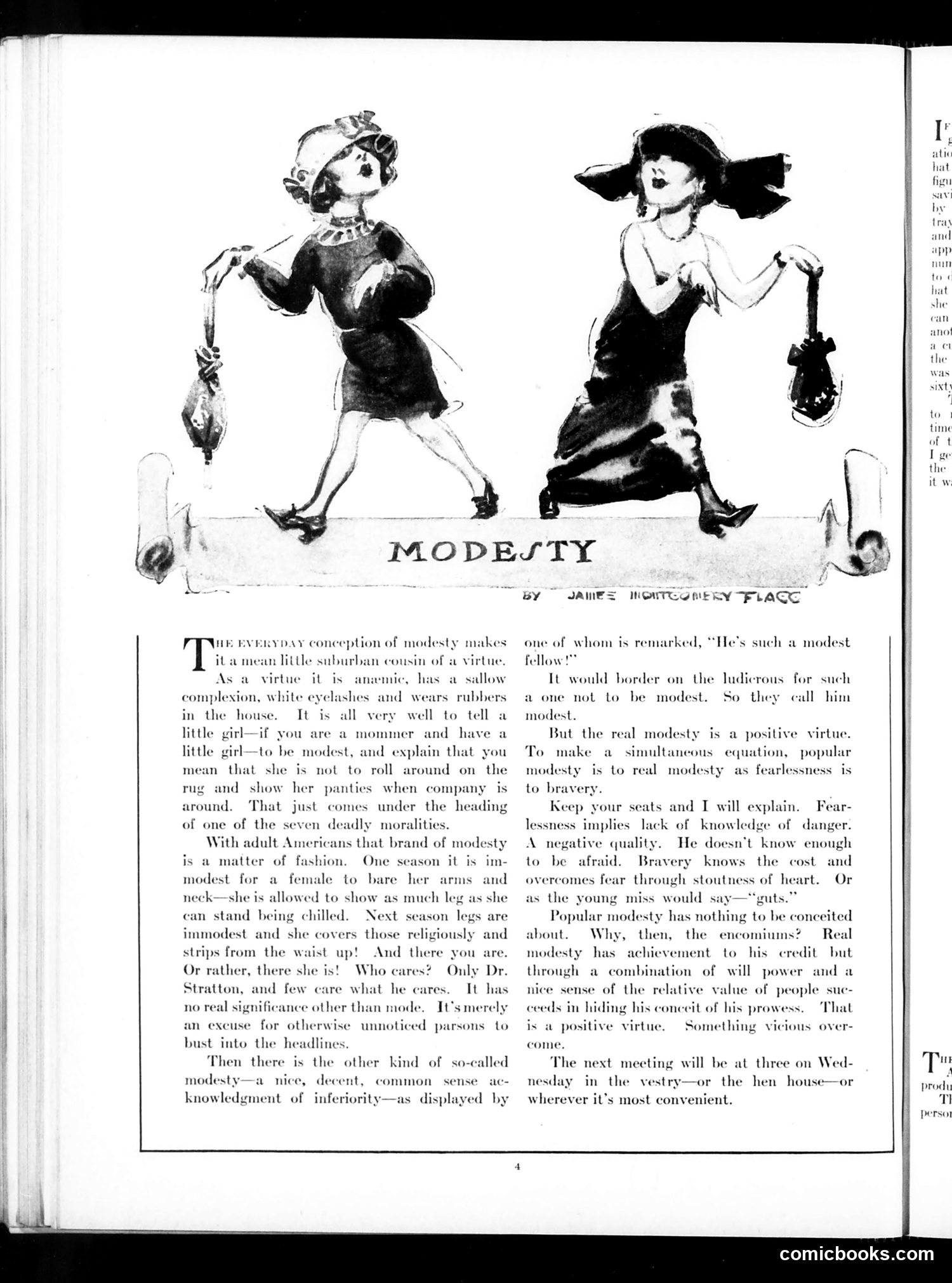
This satirical piece critiques shifting standards of female modesty in early 20th-century America. The cartoon shows two women displaying what the text calls false "modesty"—one holding a dead animal (likely fur), the other a fashionable purse—while dressed in revealing contemporary clothing. Flagg's satire targets the hypocrisy of women who claim modesty while openly displaying legs, bare arms, and necks—fashion changes the text notes society had recently deemed immodest. The real point: *true* modesty, according to the author, involves moral courage and self-respect, not merely adhering to arbitrary dress codes. The piece mocks both the fashion industry's shifting "modesty" rules and women who uncritically follow them while claiming virtue.
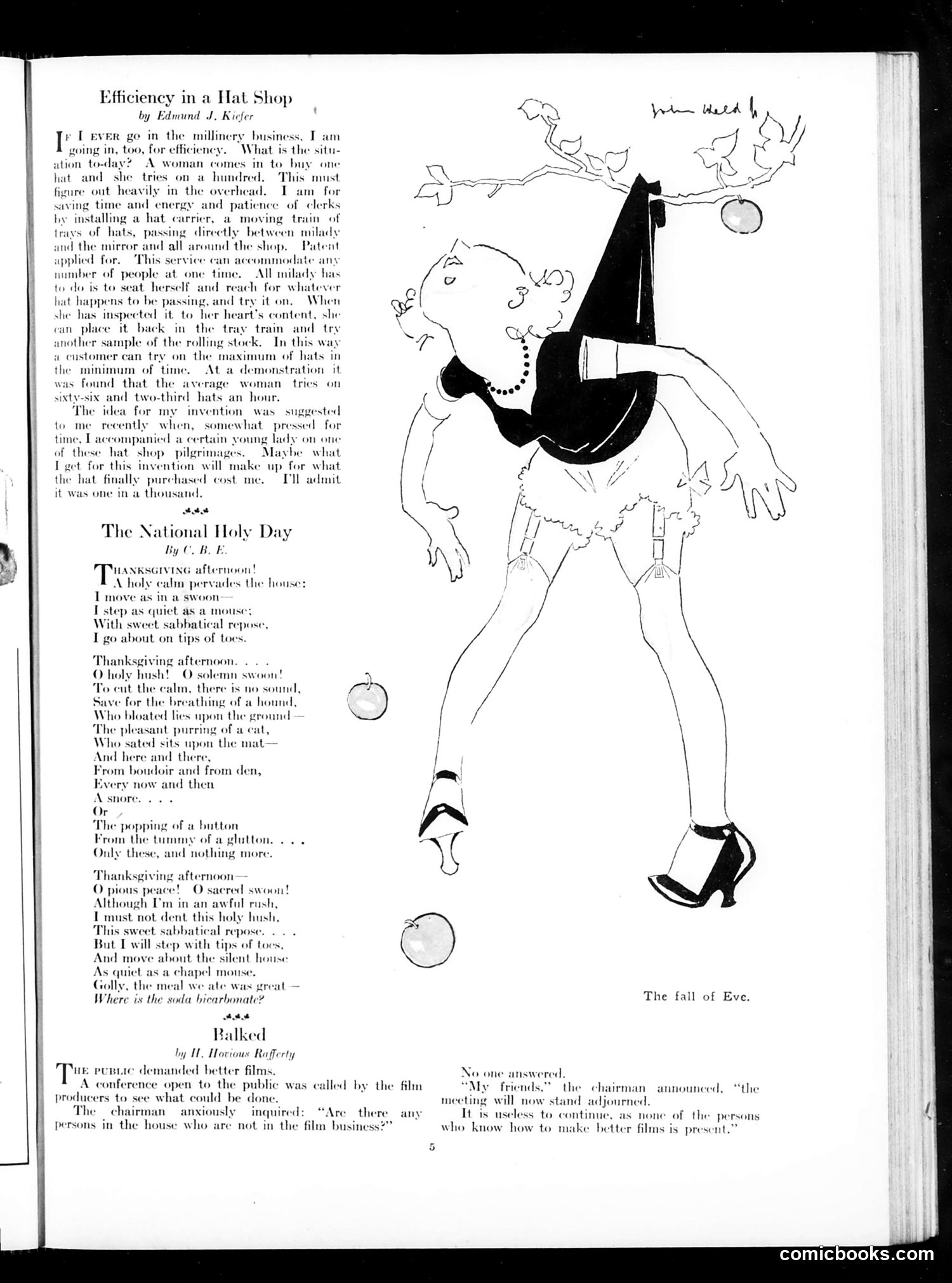
This page contains three separate pieces. The main cartoon, titled "The Fall of Eve," depicts a woman in a large black hat and dress surrounded by falling apples—a visual pun on the Biblical Fall of Adam and Eve. The joke appears to satirize women's fashion, specifically the oversized hats popular in the early 20th century, by literalizing the phrase "fall of Eve" through both the woman's precarious posture and the tumbling fruit. The accompanying text pieces are humorous essays: one about hat shop efficiency (proposing a conveyor system for trying on hats), another about the post-Thanksgiving food coma, and one mocking a film industry conference where producers admit they can't improve their films because nobody in attendance knows how. Together, these pieces represent Judge magazine's typical satirical approach: combining visual wordplay with gentle social commentary on contemporary consumer culture and industrial practices.
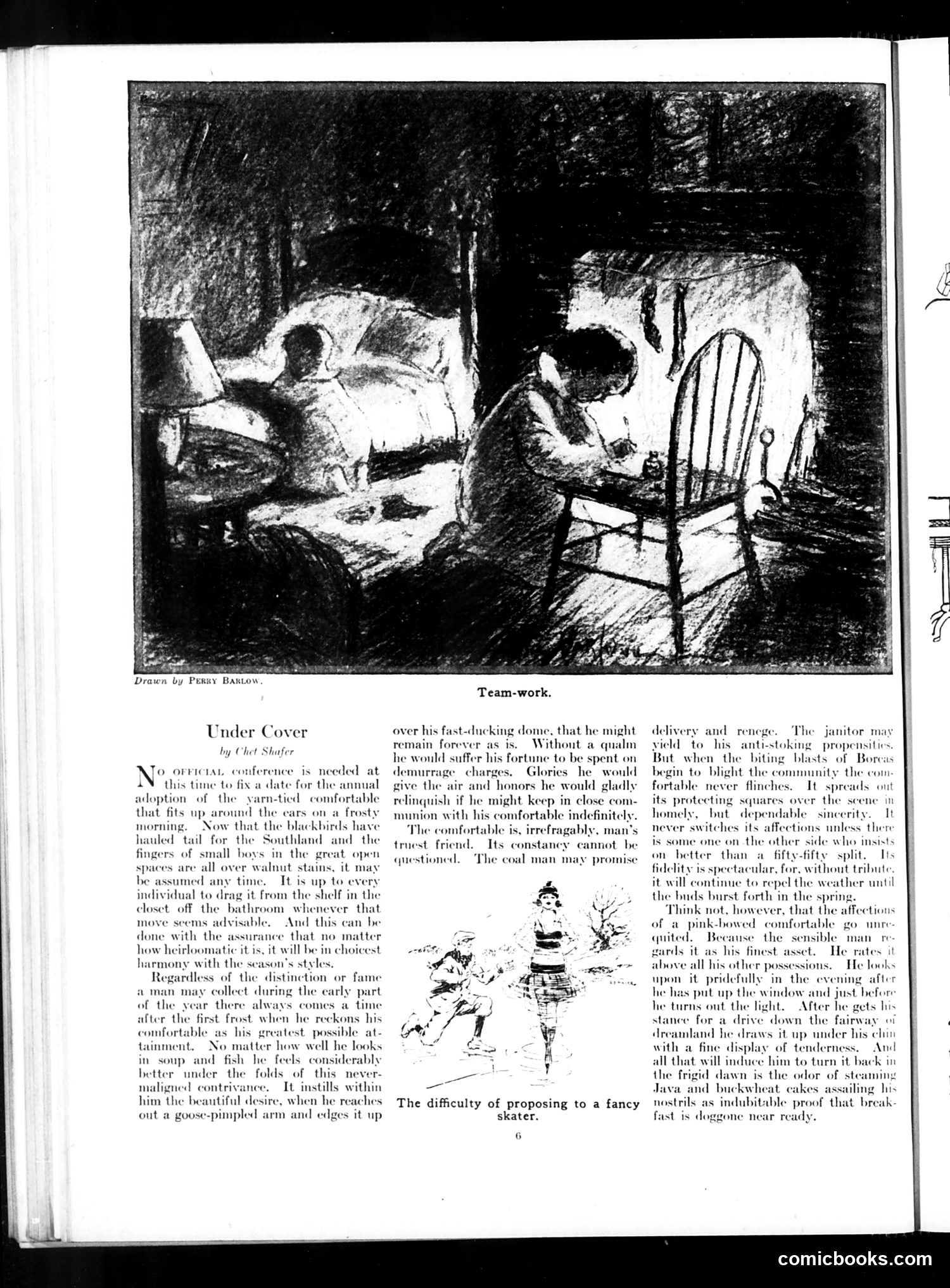
This page contains a humorous essay by Chet Shafer (illustrated by Perry Barlow) celebrating the "comfortable"—a yarn-tied quilted blanket or comforter worn around the shoulders during winter. The piece is nostalgic, comparing the blanket to a faithful friend that never disappoints, unlike unreliable tradespeople like coal deliverymen or janitors. The satire gently mocks masculine sentimentality: a man would sacrifice wealth and honor for his beloved blanket's warmth. The essay humorously portrays grown men's emotional attachment to this humble object—how they regard it "pridefully" at evening and draw it up "with a fine display of tenderness." Below the essay is an unrelated cartoon captioned "The difficulty of proposing to a fancy skater," showing a young man attempting to propose to a skating woman, likely satirizing the awkwardness of romantic overtures during active recreation. This reflects Gilded Age domestic humor and seasonal rituals.
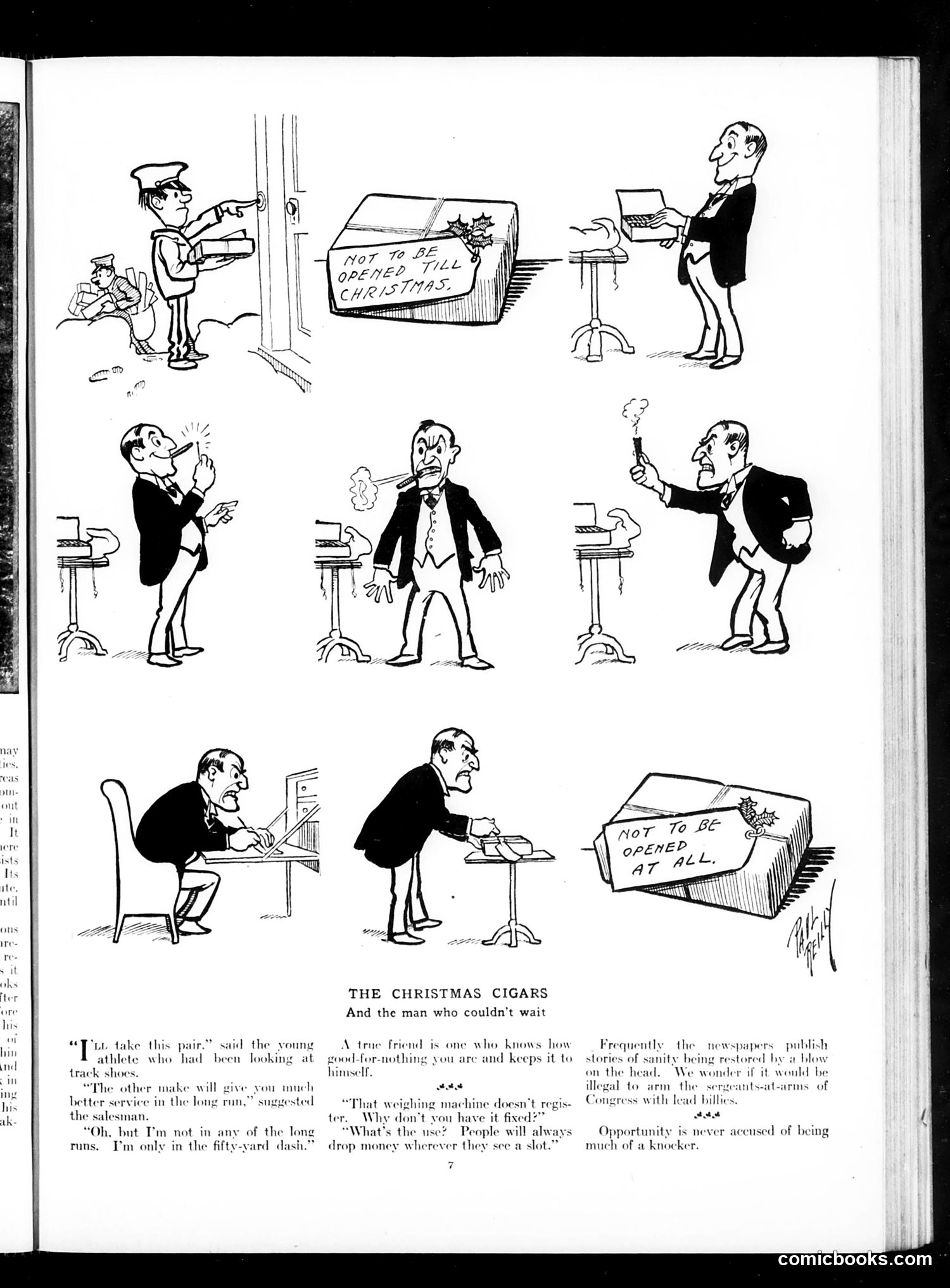
This satirical comic strip depicts a man's impatience with a gift-wrapped package labeled "Not to be opened till Christmas." The sequence shows his escalating attempts to open it—first asking permission, then becoming increasingly agitated and frustrated, eventually resorting to tools and force. The accompanying text aphorisms mock human nature: a "true friend" keeps quiet about your faults; broken weighing machines are profitable because people drop money in slots regardless; and "opportunity" doesn't announce itself loudly. The central satire targets impatience and lack of self-control—specifically, the inability to wait for gratification. It's a commentary on human weakness and instant-gratification impulses, likely resonating with contemporary readers about holiday gift-giving customs and personal discipline.
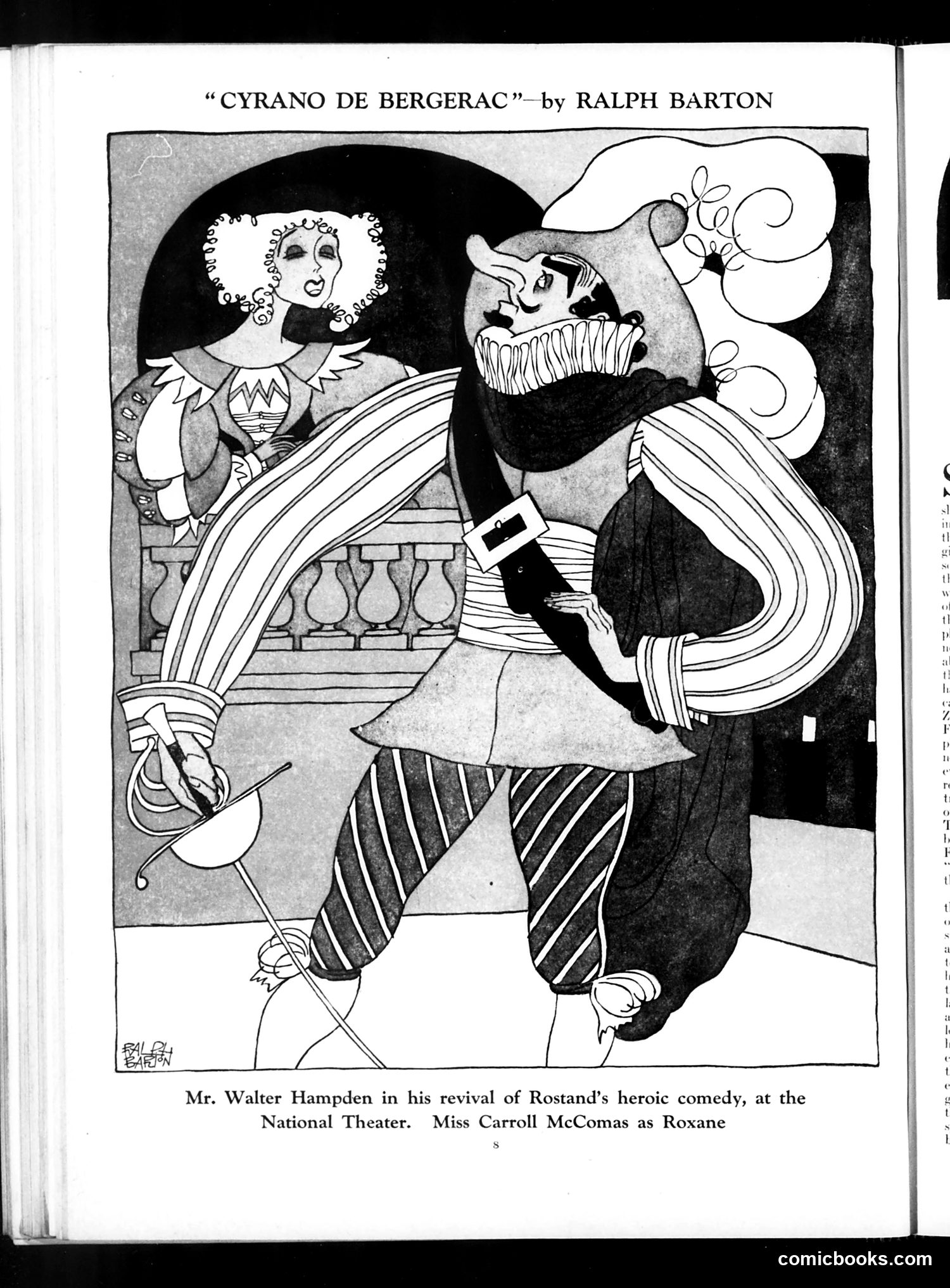
This is Ralph Barton's illustration for a theatrical production of Rostand's *Cyrano de Bergerac*. The text identifies it as Mr. Walter Hampden's revival at the National Theater, with Miss Carroll McComas playing Roxane. The cartoon depicts two characters: a man in period costume with an enormously long nose (Cyrano) gesticulating dramatically, and a woman (Roxane) in elaborate dress with a prominent ruffled collar. Cyrano's exaggerated nose is the play's central motif—his self-consciousness about it drives the plot. Barton's style emphasizes theatrical caricature, with elongated proportions and decorative linework typical of Art Deco-influenced magazine illustration. This appears to be theatrical coverage rather than political satire, celebrating the performance through exaggerated character portrayal.
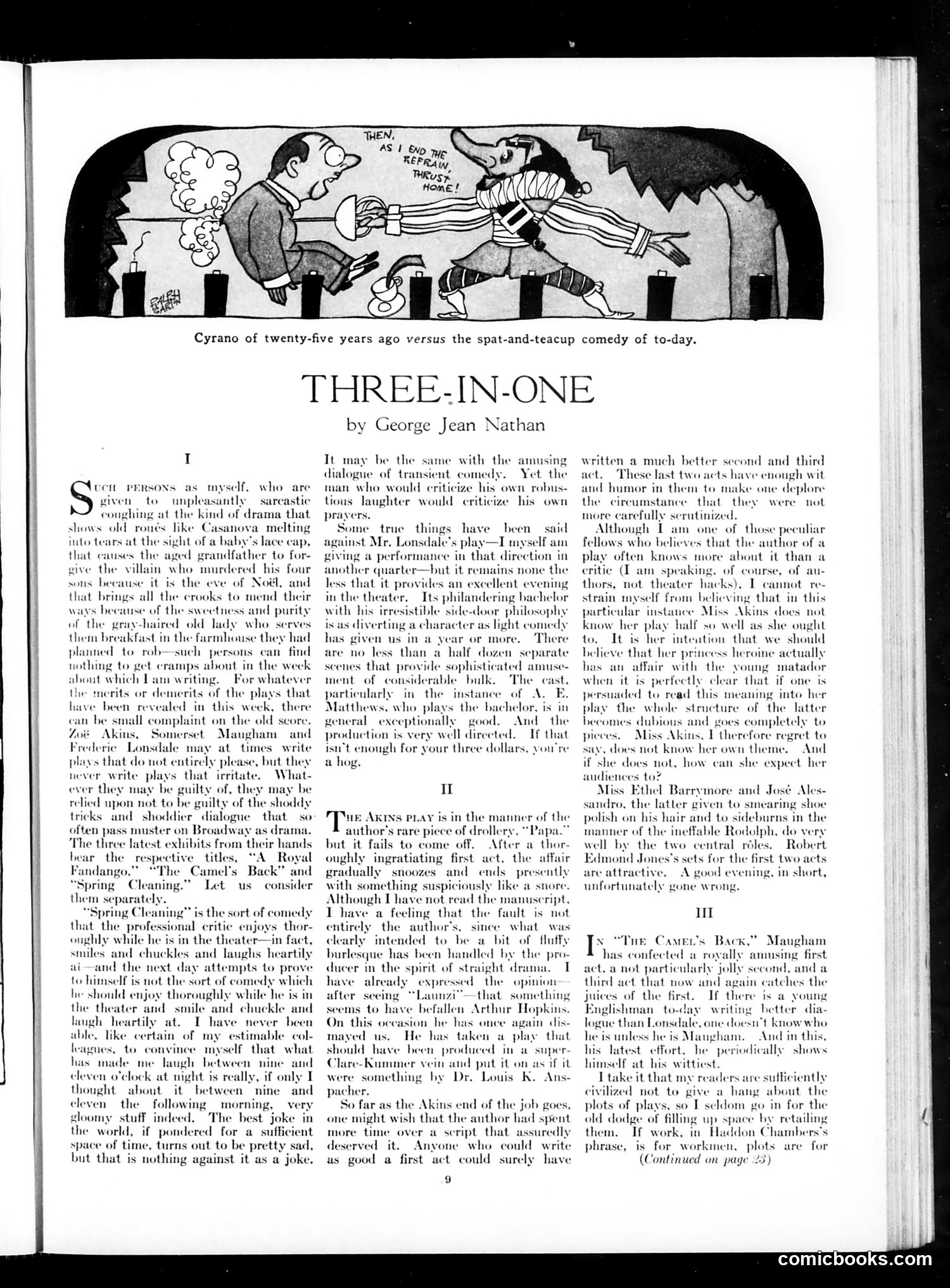
The cartoon compares theatrical styles across twenty-five years. The left figure represents "Cyrano" (referencing Edmond Rostand's 1897 romantic drama), depicted as a passionate swordsman. The right figure shows modern comedy—a woman spraying a man with what appears to be a teapot or similar domestic object, labeled "spat-and-teacup comedy of to-day." The satire critiques the shift from grand, romantic drama to lightweight domestic comedy. The accompanying article by George Jean Nathan reviews three contemporary plays (by Akins, Somerset Maugham, and Frederic Lonsdale), defending them against critics who dismiss transient comedy as intellectually trivial. Nathan argues that plays providing genuine entertainment and laughter have merit, even if they lack serious dramatic weight—a defense of commercial theater against snobbish critical dismissal of "shoddy" modern comedies.
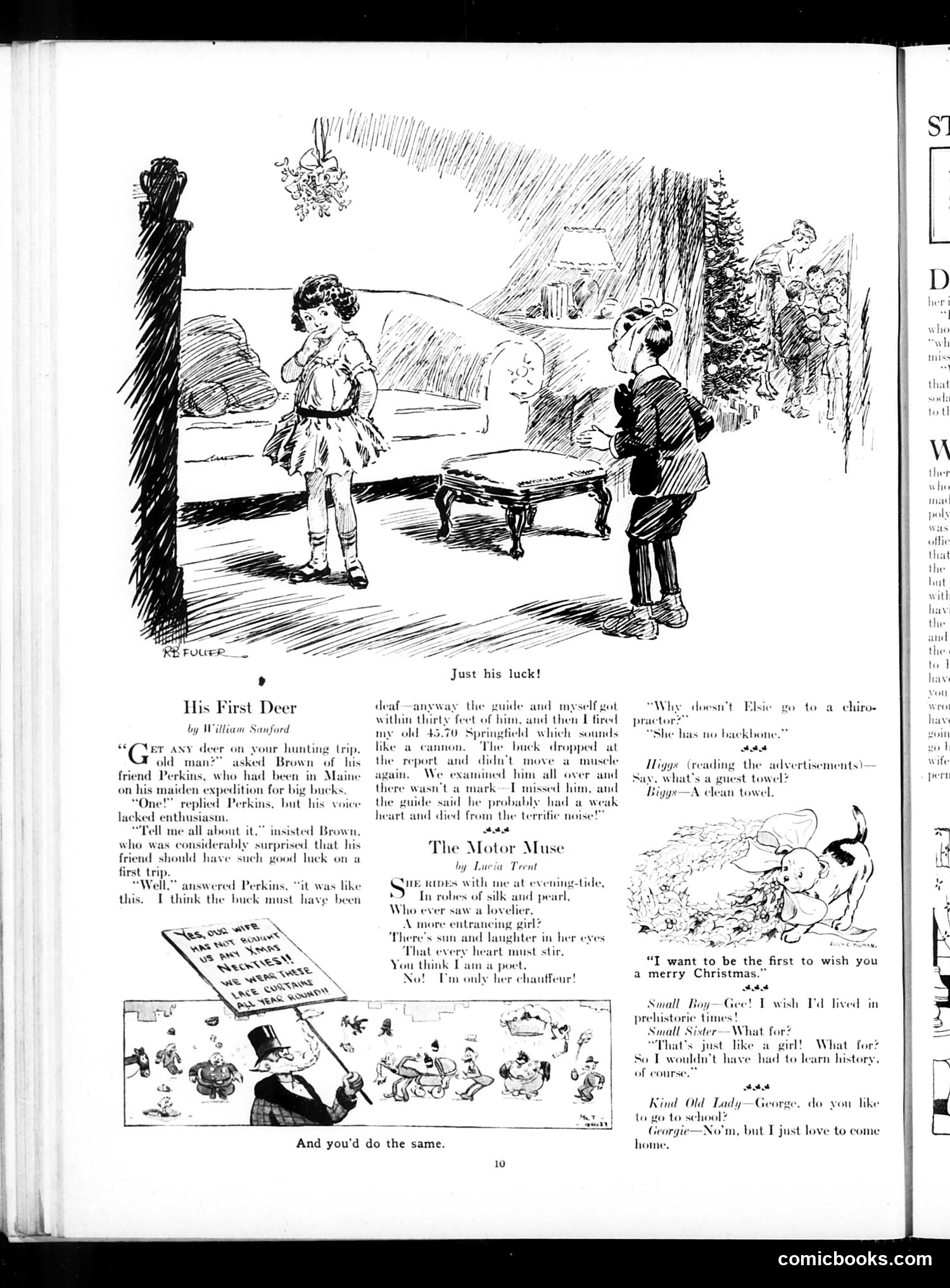
This page contains three separate satirical pieces: **"His First Deer"** presents a hunting story where a novice hunter claims to have killed a deer—but admits he *missed* it. The joke: the buck supposedly died from fright at the loud noise of his rifle shot rather than from being hit. The satire mocks incompetent hunters who make excuses, and the absurdity of attributing an animal's death to acoustic shock rather than marksmanship. **"The Motor Muse"** is a light poem about a chauffeur infatuated with his passenger, who sarcastically notes that despite believing himself a poet, he's "only her chauffeur." The satire gently mocks working-class men who romanticize above their station. **The bottom section** contains brief humorous dialogues about trivial domestic matters—guest towels, school attendance, and prehistoric times—typical of Judge's lighthearted filler content poking fun at ordinary people's simple misunderstandings and perspectives.
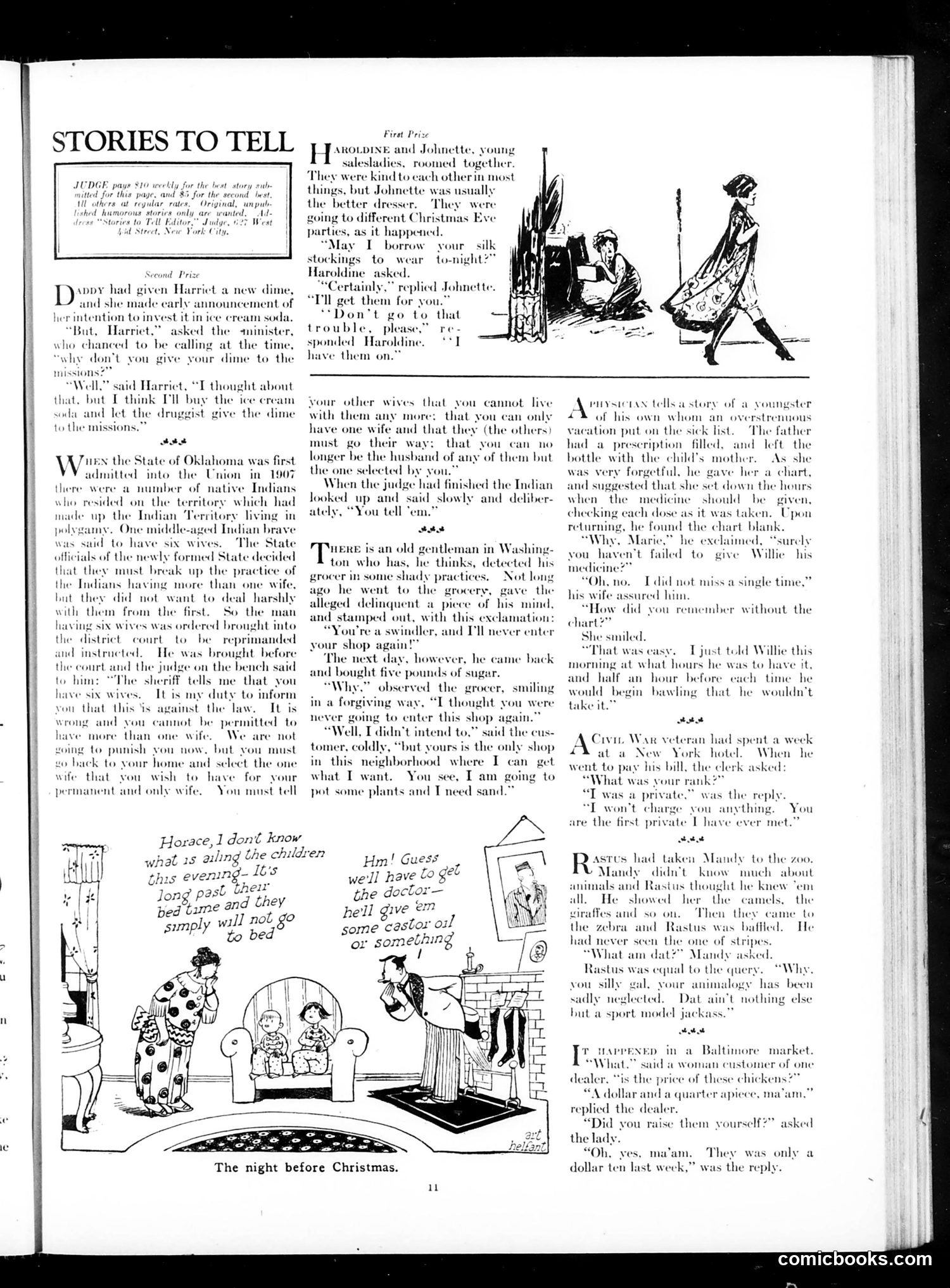
This page contains multiple humorous anecdotes satirizing everyday American life. The cartoons and stories mock: **Social hypocrisy**: A minister's daughter chooses ice cream over charity; a grocer-insulter returns to the same shop; a woman customer pretends ignorance about raising cheap ducks. **Marital conflict**: An Oklahoma Indian with six wives is ordered by a judge to keep only one—he replies "You tell 'em," suggesting the judge should enforce his own monogamy rules. **Child-rearing incompetence**: A mother forgets to give her sick child medicine despite a written chart, then falsely claims she didn't miss a dose. **Christmas domesticity**: The illustrated cartoon "The night before Christmas" shows parents managing children's bedtime before the holiday. The satire targets moral inconsistency, domestic disorder, and the gap between stated values and actual behavior—common Judge magazine themes for middle-class readers of the early 20th century.
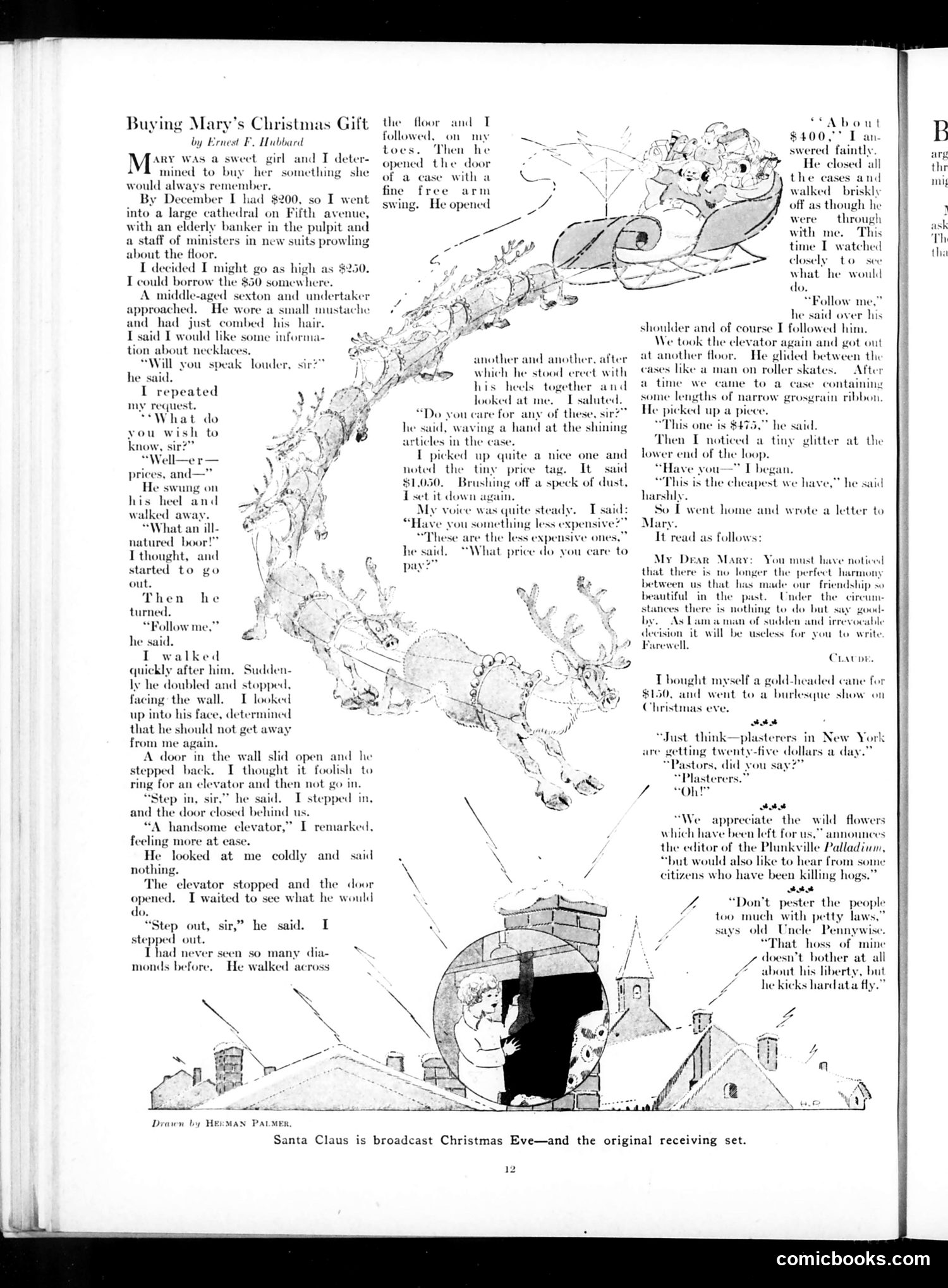
This is a satirical short story with accompanying illustrations by Herman Palmer, not primarily a political cartoon. The satire targets **excessive consumerism and pretentious retail culture**. The narrator attempts to buy an expensive Christmas gift for Mary with $200-250 (substantial money in this era). He encounters a deliberately unhelpful, snobbish jeweler/salesman who shows him increasingly expensive items while remaining coldly indifferent to the customer's budget constraints. The cheapest item shown costs $1,050—far beyond what the narrator can afford. The punchline: humiliated and embittered, the narrator breaks off his relationship with Mary via letter, then spends the money on himself (a cane and burlesque show). The story mocks both the **pretentiousness of high-end retailers** who treat ordinary customers with contempt, and the **shallow materialism** of Christmas gift-giving culture. The sidebars contain unrelated jokes typical of Judge magazine's miscellaneous humor format.
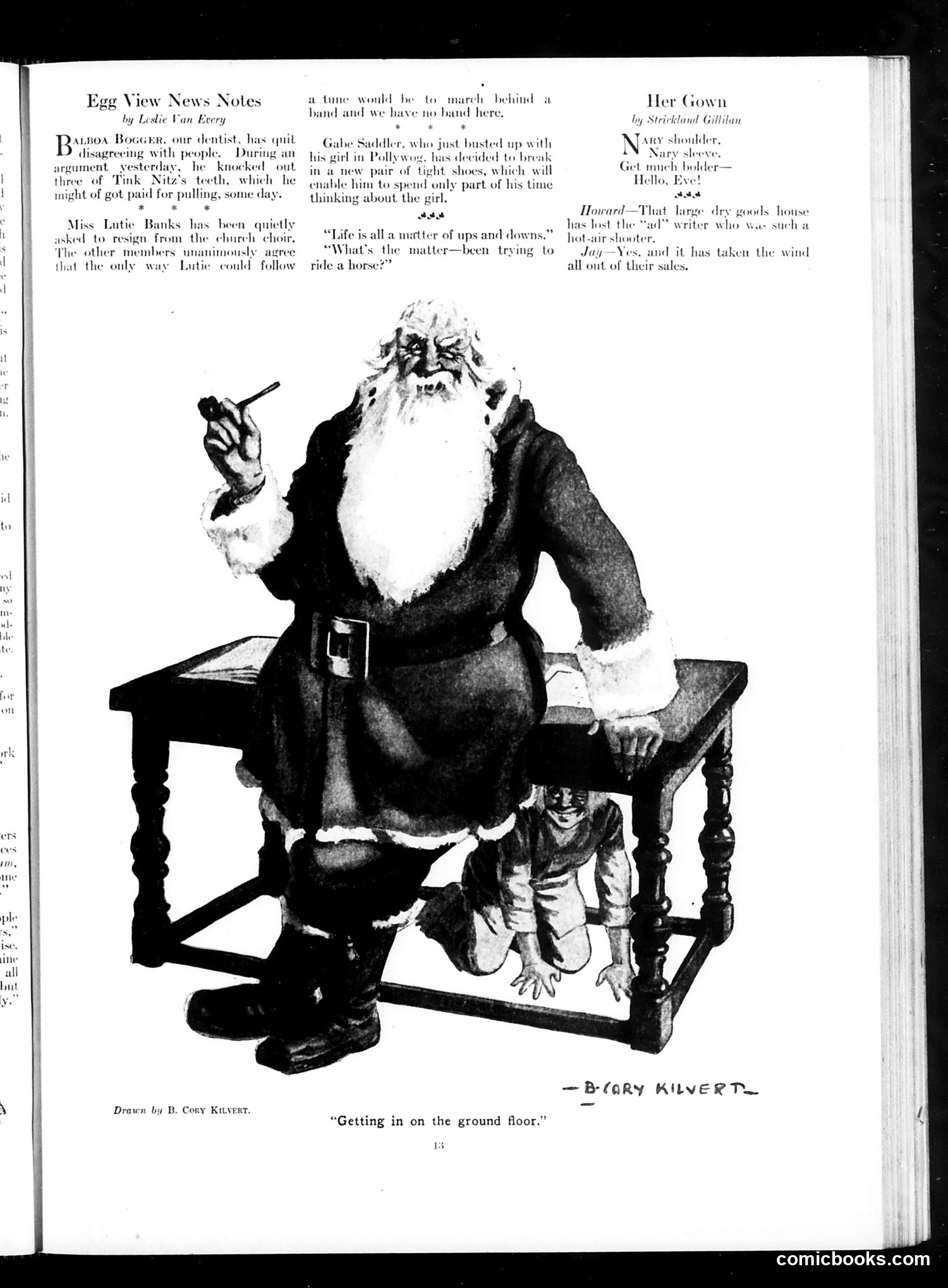
This page contains humor pieces and a single cartoon from *Judge* magazine's "Egg View News Notes" section—brief, gossipy anecdotes about small-town characters. **The main cartoon** (credited to B. Cory Kilvert, captioned "Getting in on the ground floor") depicts a bearded, heavyset man sitting at a desk with two small figures crawling beneath it. This is a visual pun: the phrase "getting in on the ground floor" typically means joining a business venture early for profit. Here, it's illustrated literally—people are physically on the ground floor, beneath the desk. The joke relies on this double meaning. **The text snippets** are lighthearted local gossip: a dentist who fights with patients, a lovestruck man buying tight shoes, a church choir member asked to resign. The dialogue about "ups and downs" and horse-riding appears unrelated wordplay. The overall tone is gentle small-town satire, typical of *Judge*'s era—mocking minor social drama and playing with common expressions rather than addressing serious political issues.
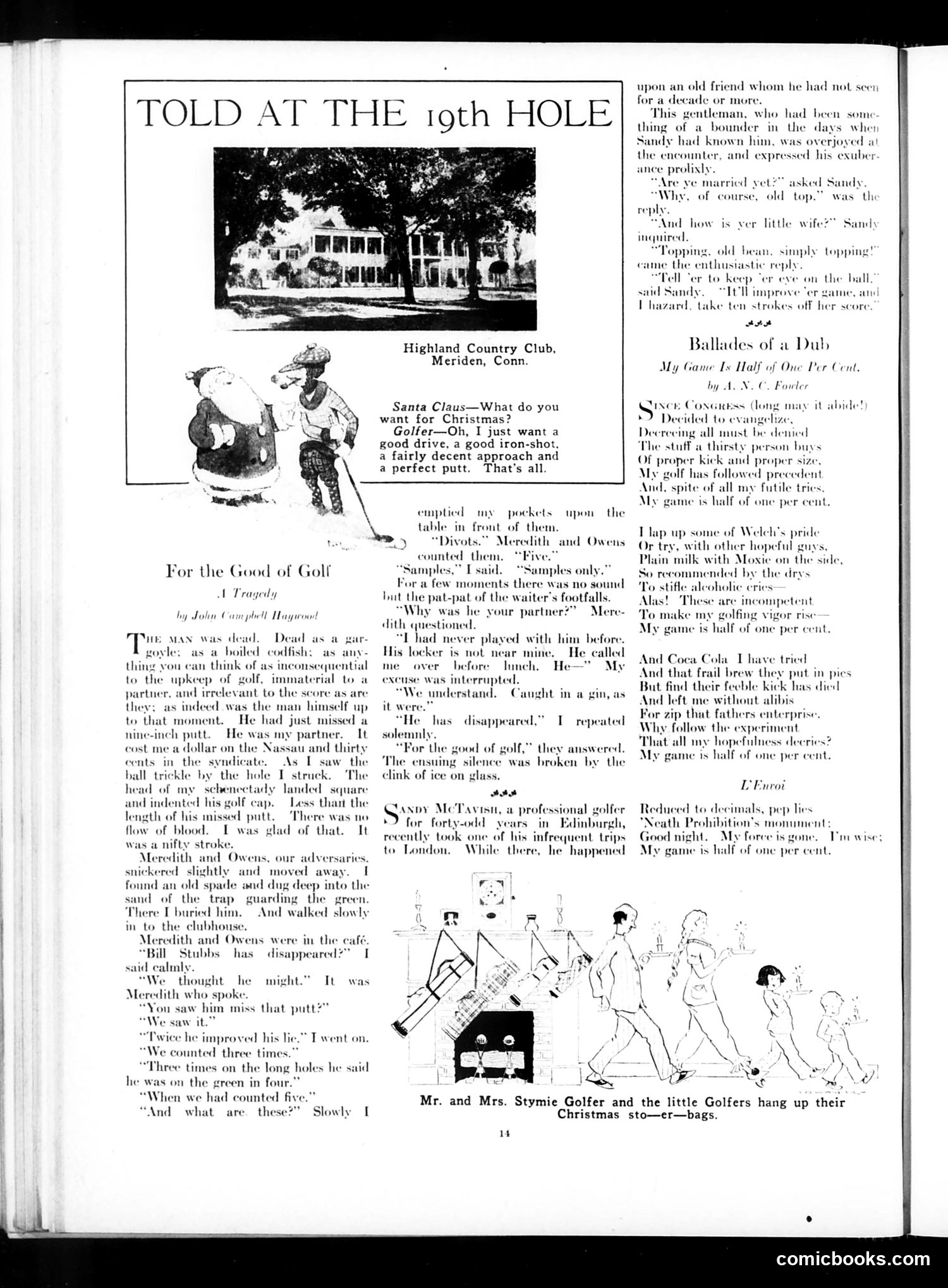
This page contains golf-themed satirical humor typical of early 20th-century Judge magazine. The main story, "For the Good of Golf," is a darkly comic tragedy where a golfer murders his partner for poor play (missing a nine-inch putt), then calmly buries him. When questioned by witnesses, he justifies the killing as necessary "for the good of golf"—satirizing golfers' obsessive competitiveness and the sport's importance to its devotees. The accompanying pieces mock golf culture: a Santa joke about modest Christmas wishes (just wanting decent shots), an anecdote about a Scottish pro dismissing his friend's wife as needing ten strokes off her score, and a poem lamenting Prohibition's effects on golfing ability. The cartoon shows a family with golf bags as Christmas stockings. The satire targets golf's near-religious status among players and the absurd priorities it creates in their lives.
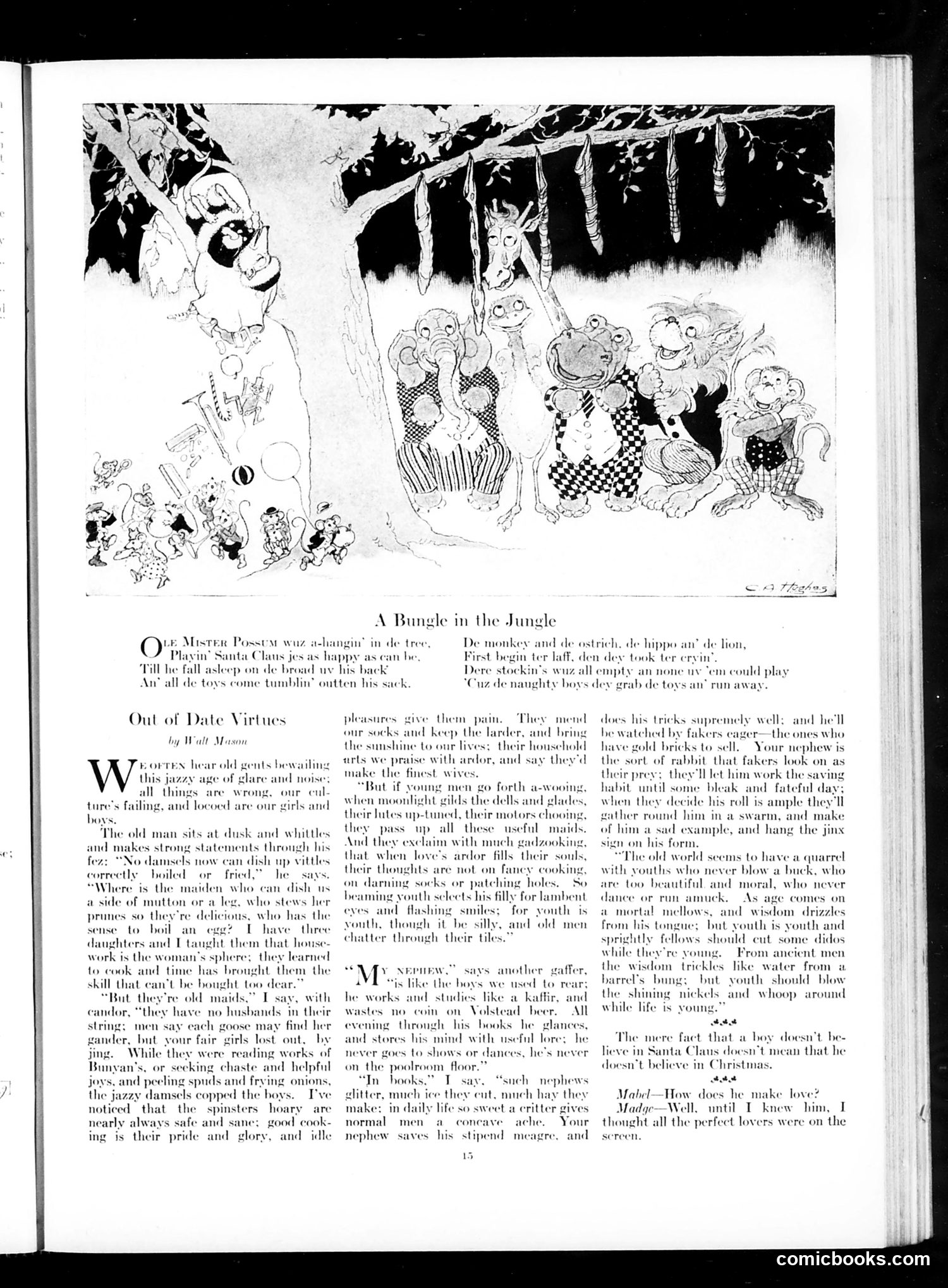
This Judge page contains two pieces satirizing contemporary attitudes. **"A Bungle in the Jungle"** (top illustration): A humorous dialect poem showing animals discovering an empty Christmas stocking—the "naughty boys" have stolen the toys. It's lighthearted holiday satire with no clear political target. **"Out of Date Virtues"** (main article by Walt Mason): A commentary on generational conflict. An elderly man laments that modern young women lack domestic skills (cooking, mending) that previous generations possessed. However, Mason's satire cuts both ways: he notes that young men pursuing romance deliberately *avoid* these "useful maids," preferring girls with "lambent eyes and flashing smiles." The piece also warns that overly virtuous savers (like the "nephew") become easy marks for con artists. The satire suggests both old and young bear responsibility for changing values—neither generation's priorities are entirely rational or sustainable. This reflects 1920s-era anxiety about modernity, youth culture, and shifting gender roles during the Jazz Age.
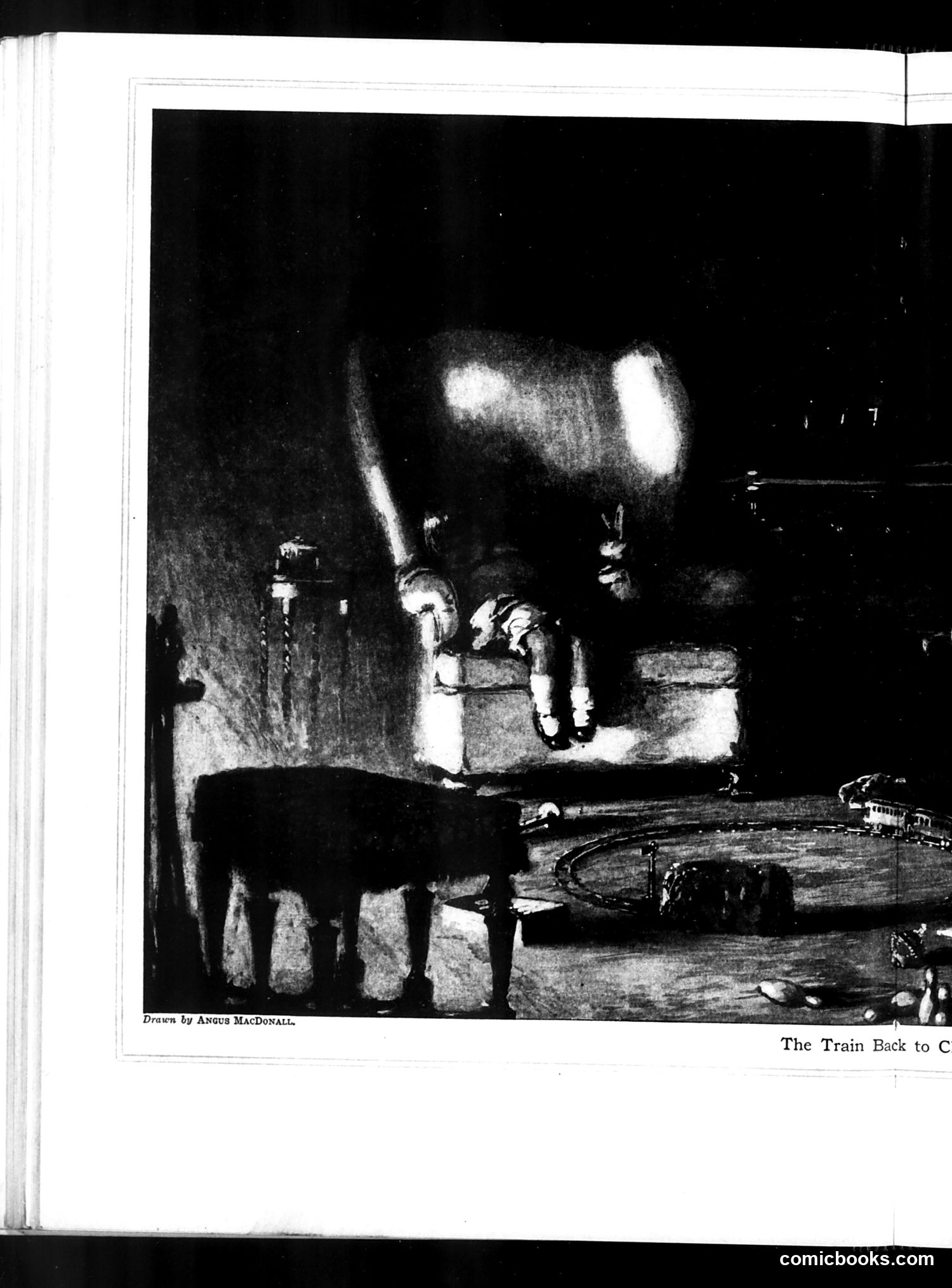
This appears to be an illustration by Angus MacDonald titled "The Train Back to C" (text cut off). The black and white image shows a dramatic theatrical or cinematic scene: a figure in light-colored clothing stands on what appears to be a train platform or stage, illuminated by spotlights, with other shadowy figures nearby. Train cars and track are visible in the lower foreground. Without the complete title and full page context, the specific political or social satire is unclear. The theatrical lighting and composition suggest this may comment on performance, publicity, or the spectacle of a particular public figure or event, but **I cannot identify the specific reference or figures depicted with certainty** from the image alone. The fragmented text prevents determining Judge magazine's satirical intent here.
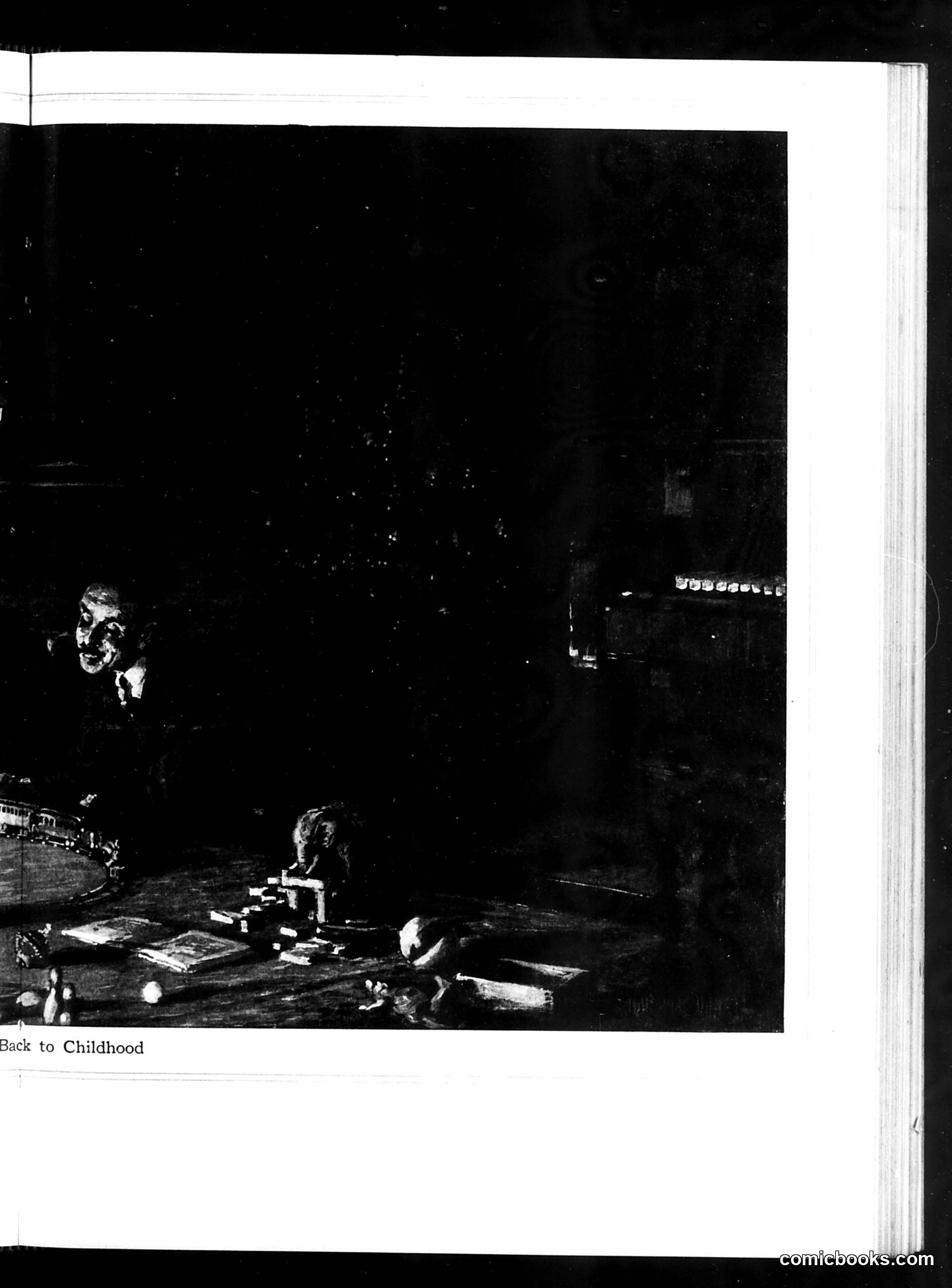
This appears to be a satirical illustration titled "Back to Childhood" from *Judge* magazine. The black-and-white image shows an adult figure in formal attire observing children engaged in play with blocks and toys on the floor. The composition suggests social commentary about adults regressing to childish behavior or abandoning mature responsibilities. Without clearer visibility of specific facial features or additional context clues, I cannot definitively identify which historical figure or political situation this cartoon targets. The satire likely comments on either a specific public figure's perceived immaturity or a broader social phenomenon of adults avoiding adult duties—a common theme in *Judge's* satirical repertoire during the early-to-mid 20th century. The exact political or social reference remains unclear from the image alone.
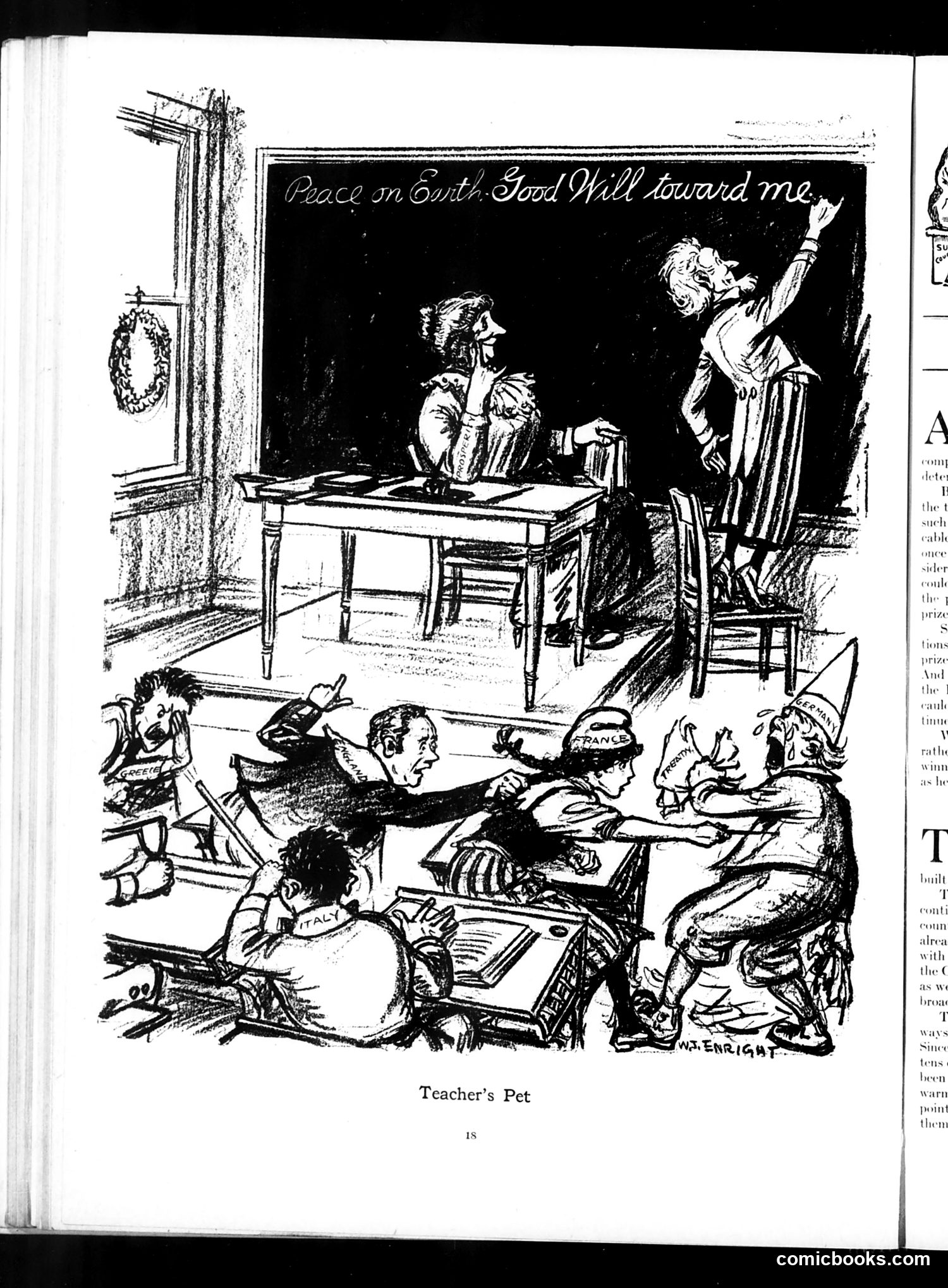
This political cartoon depicts a classroom scene with a telling contrast. In the upper portion, two well-dressed figures sit peacefully at a table beneath the inscription "Peace on Earth, Good Will toward me"—suggesting self-interested hypocrisy. Below, several caricatured national figures (identifiable by labels including "France," "Italy," and others) appear to be fighting or struggling, depicted as childish or animalistic. The cartoon satirizes how world leaders publicly espouse peace and goodwill while their nations engage in conflict—they are "teacher's pets" who behave differently in public versus private conduct. The artist appears to be critiquing international diplomacy as performative, with leaders presenting civilized facades while their countries' actual conduct remains aggressive or chaotic.
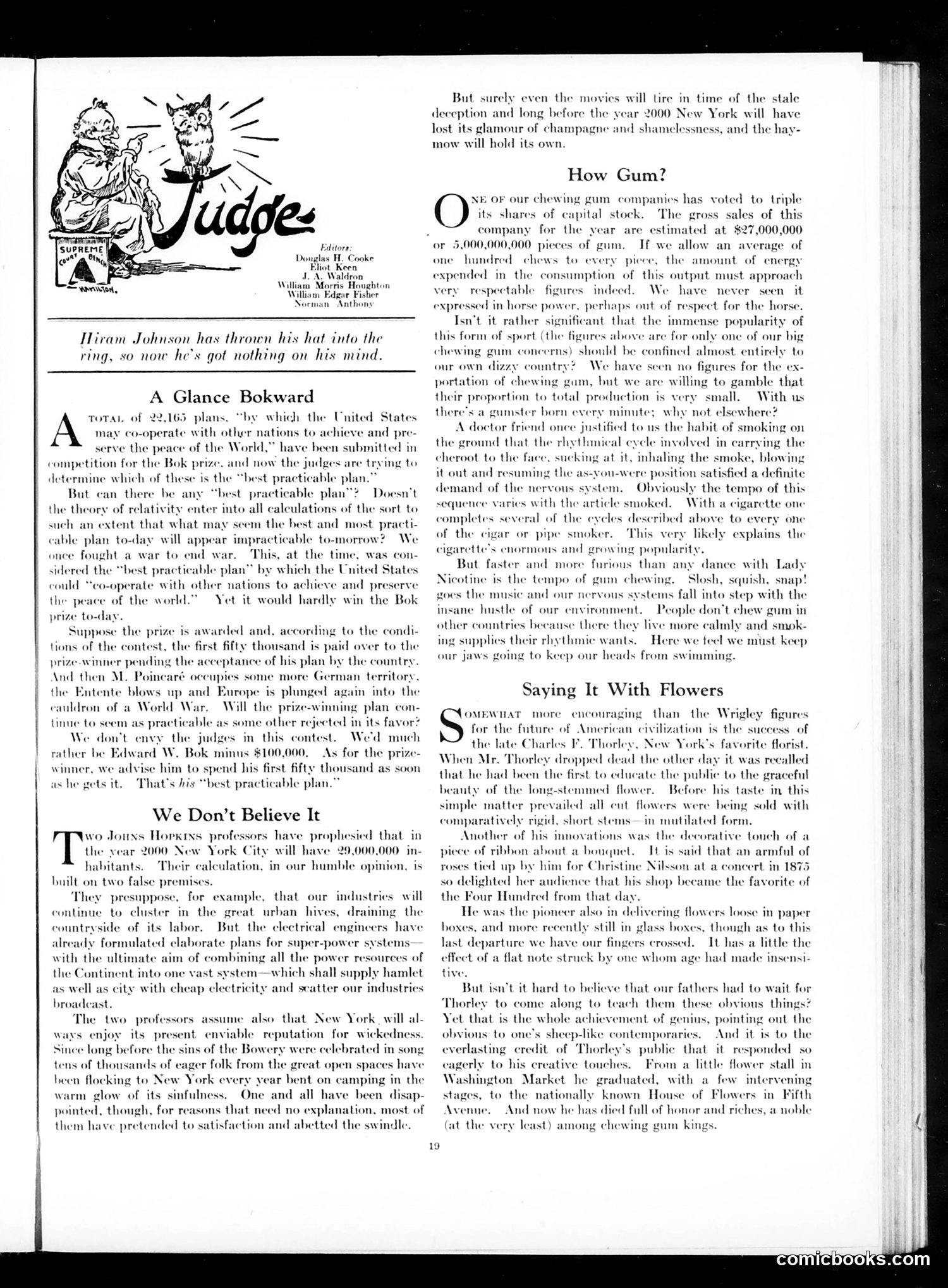
The page contains three separate satirical pieces: **"A Glance Bokward"** mocks the Edward Bok peace prize competition, which solicited plans for international cooperation to preserve world peace. The cartoon jokes that judge Hiram Johnson "has thrown his hat into the ring, so now he's got nothing on his mind"—a pun on empty-headedness. The satire argues that any "best practicable plan" today becomes obsolete tomorrow due to unforeseen circumstances (referencing Einstein's theory of relativity). It's cynical commentary on idealistic peace-building efforts, particularly given Europe's ongoing turmoil (likely post-WWI). **"We Don't Believe It"** ridicules academic predictions that New York City will reach 29 million inhabitants by 2000. The piece sarcastically claims the prediction ignores how electrification will decentralize industry and how New York's moral decay will eventually repel residents seeking authentic "sin." **"How Gum?"** expresses bewilderment at chewing gum's popularity, noting one company's massive production (5 billion pieces yearly) and questioning why this "sport" remains uniquely American rather than spreading globally. All three pieces exemplify Judge's acerbic skepticism toward contemporary optimism and predictions.
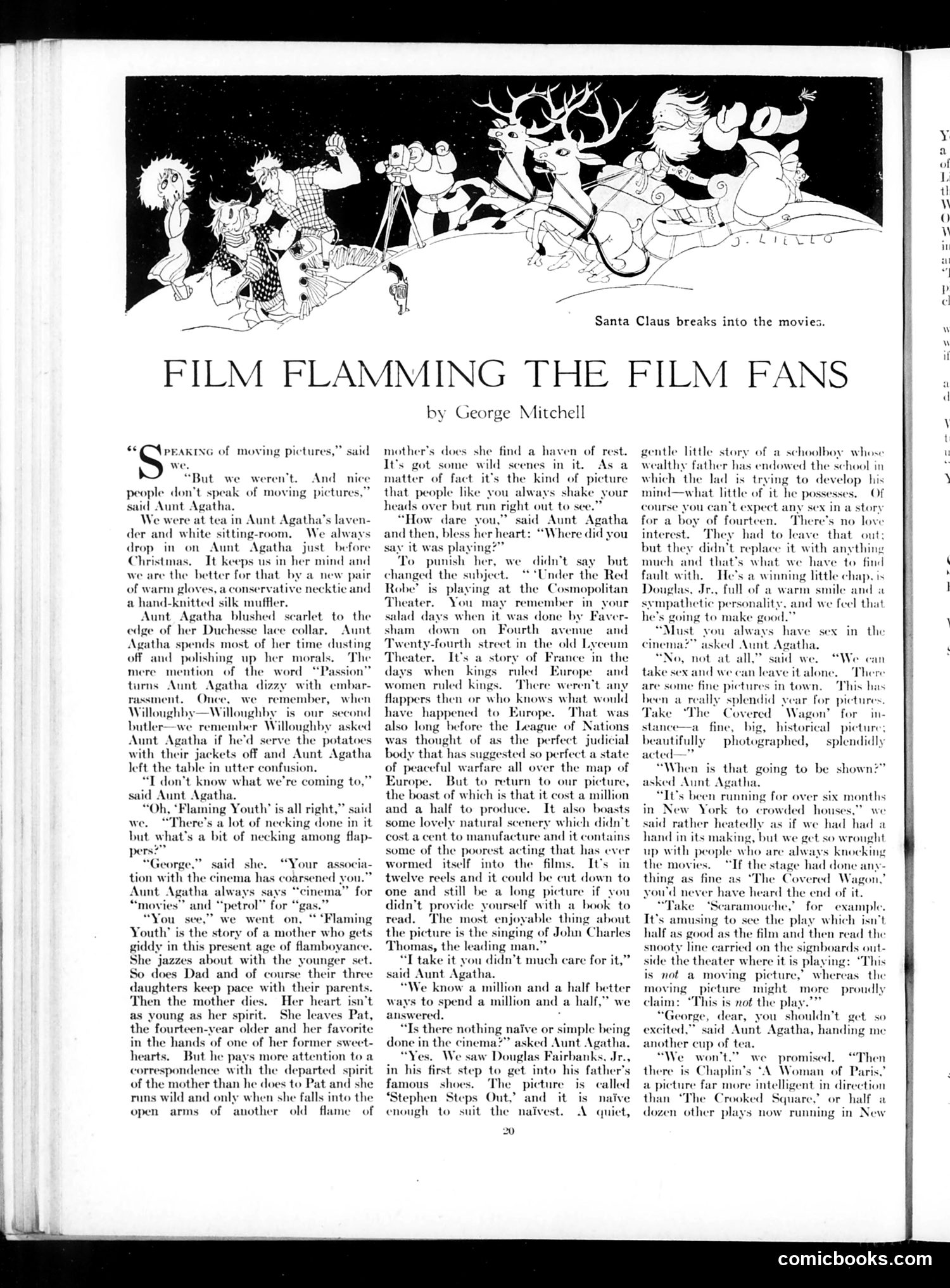
This is a humorous article by George Mitchell satirizing the cultural divide between older, conservative Americans (represented by "Aunt Agatha") and younger generations embracing cinema in the 1920s. **The Setup:** A proper, prudish aunt is shocked that her relatives discuss "moving pictures"—considered lowbrow entertainment by respectable society. She views cinema as morally corrupting, particularly films featuring "flappers" (young women with modern, loose morals). **The Satire:** The narrator deliberately lists contemporary films to scandalize Aunt Agatha while simultaneously mocking them—praising "Flaming Youth" while admitting it's mediocre, criticizing the expensive "Under the Red Robe" as having poor acting despite its budget, and noting even Douglas Fairbanks Jr.'s film is "naive." **The Point:** This mocks both the uptight moral gatekeepers who condemn cinema outright AND the actual quality of 1920s films themselves. The humor lies in the generational clash: Aunt Agatha's outdated prudishness versus the entertainment industry's questionable artistic merit.
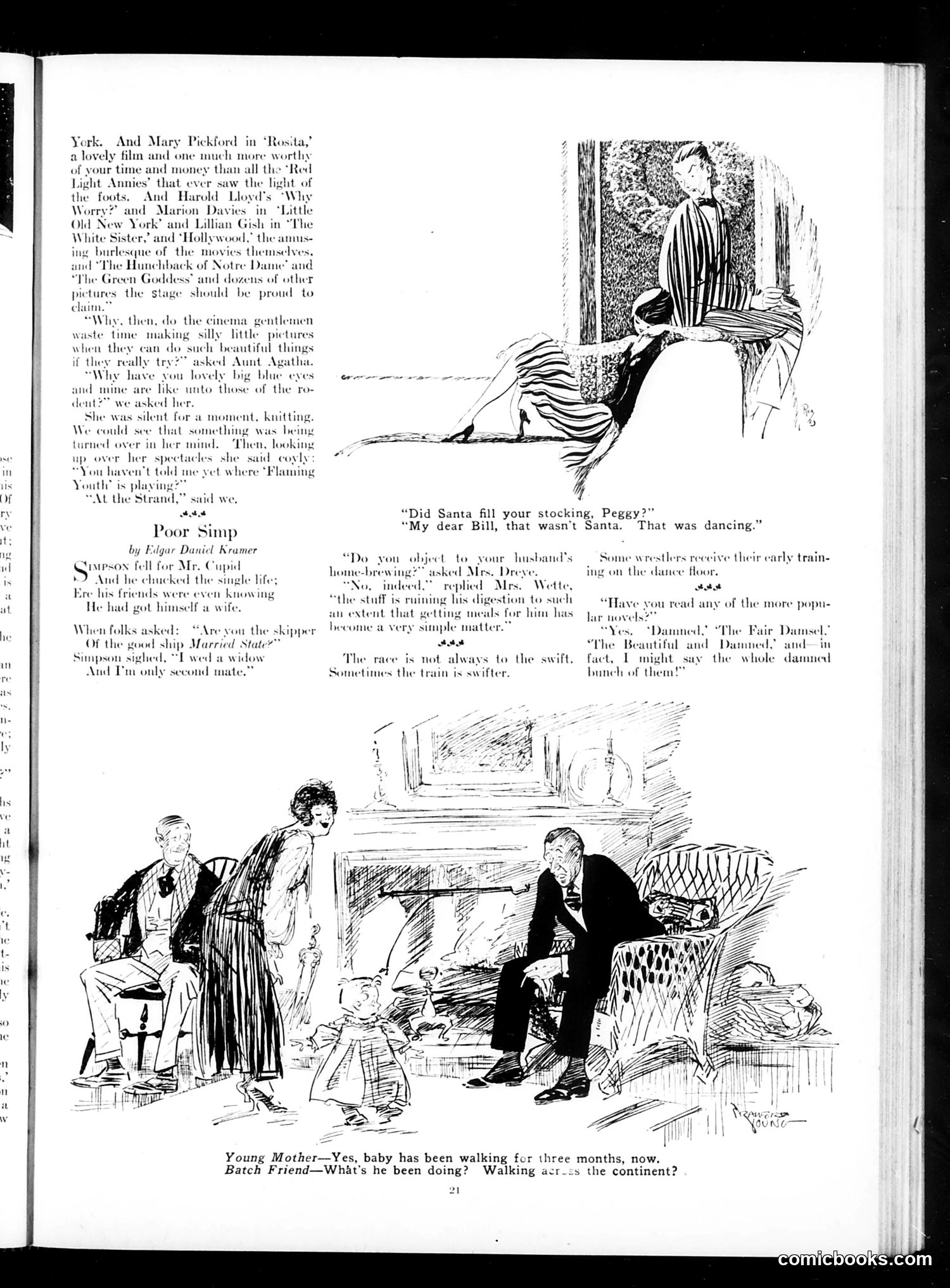
This page contains three distinct pieces of humor typical of Judge's satirical style: **Top Section**: A film criticism discussing popular movies and stars (Mary Pickford, Harold Lloyd, Marion Davies, Lillian Gish). The joke critiques Hollywood's waste of talented actors on mediocre pictures when better films exist. **"Poor Simp"**: A light verse about Simpson, who impulsively married a widow and now ranks second to her late husband in his own household—a common domestic comedy trope of the era. **Bottom Cartoons**: Two brief jokes. One references a husband's home-brewing (Prohibition-era humor), another makes a sarcastic comment about a baby walking across the continent—exaggerating the child's three months of walking ability for comic effect. The page reflects 1920s concerns: film industry criticism, sudden marriages, Prohibition bootlegging, and domestic absurdism. All humor targets middle-class situations with gentle satire rather than sharp political commentary.
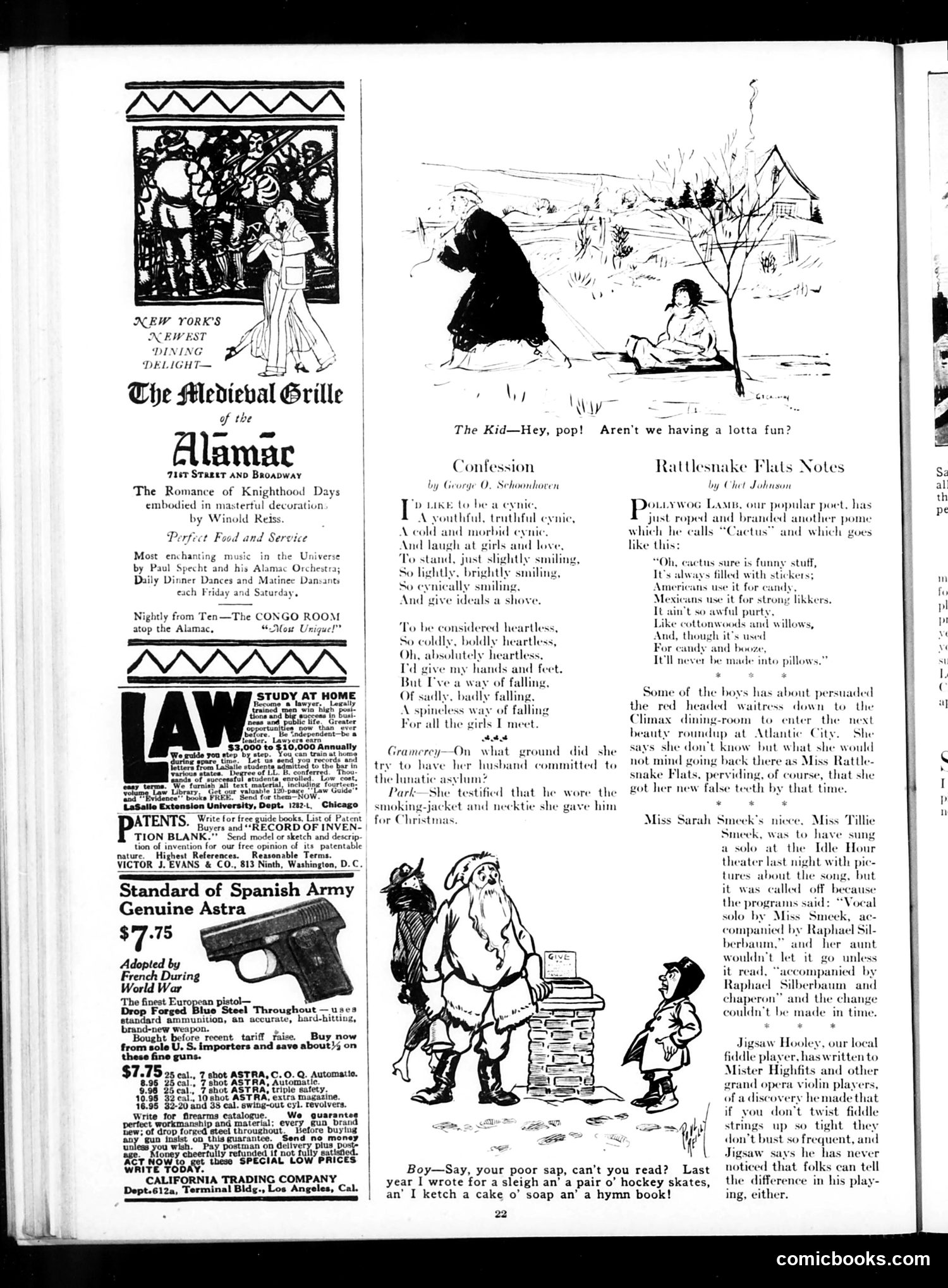
This page is primarily **advertisements and light social humor**, not political satire. **Main Content:** The cartoons and text are social/lifestyle pieces targeting upper-middle-class readers: 1. **Top left**: Restaurant ad for "The Medieval Grille" at the Alamac hotel—a trendy New York dining establishment appealing to sophisticates. 2. **Top right cartoon**: A simple domestic scene of a father and child, with the child asking "Hey, pop! Aren't we having a lotta fun?" — gentle, relatable humor about parenting. 3. **Poetry section**: "Confession" by George O. Schoonhoren is a humorous poem about wanting to be a cynic but falling for girls—typical light verse. 4. **"Rattlesnake Flats Notes"**: Rural/small-town gossip column with folksy humor about local characters and their mishaps—contrast to sophisticated urban content. **Advertisements** dominate: The Alamac restaurant, a Spanish pistol (Astra), patent services, and a correspondence school. This reflects Judge's **general-interest appeal** to American middle and upper-class readers seeking entertainment, not hard-hitting political commentary.
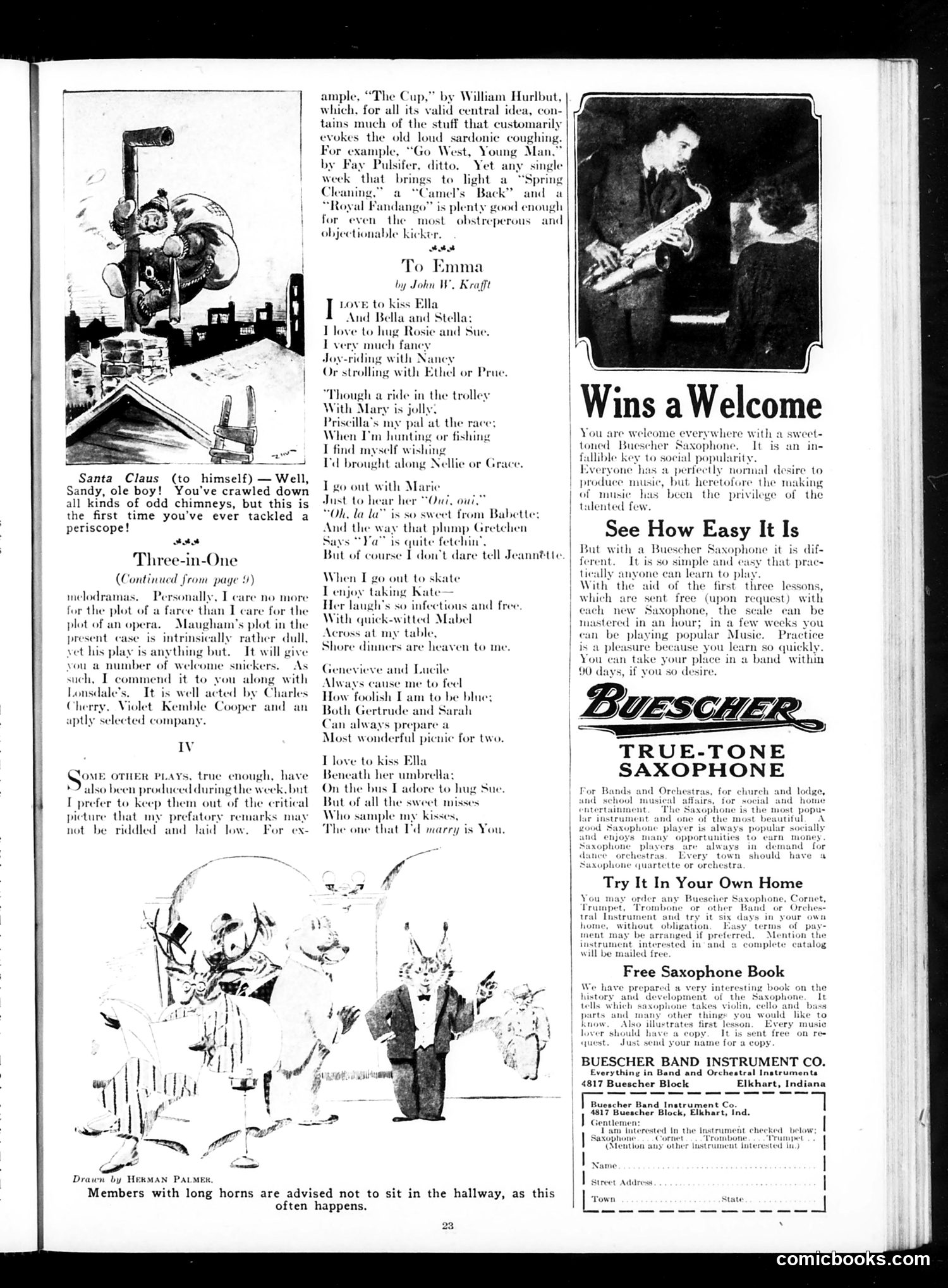
The page contains mixed content: theater reviews and advertisements rather than political cartoons. The primary cartoon shows **Santa Claus descending a periscope instead of a chimney**, with the joke being Santa's confused self-commentary about tackling this unusual "chimney." This references **WWI-era submarine warfare**—periscopes were prominent in public consciousness due to German U-boat attacks on ships. The humor lies in the anachronistic incongruity of Santa encountering modern military technology. A second cartoon by Herman Palmer depicts **orchestra members with long horns**, humorously showing one member's horn getting stuck, with a caption warning such musicians not to sit in hallways. The page also includes a poem "To Emma" about romantic entanglements, and extensive advertising for **Buescher saxophones**, emphasizing how easy it is to learn and become socially popular playing one. The overall tone reflects early 20th-century American popular culture mixing wartime references with entertainment and consumer aspirations.
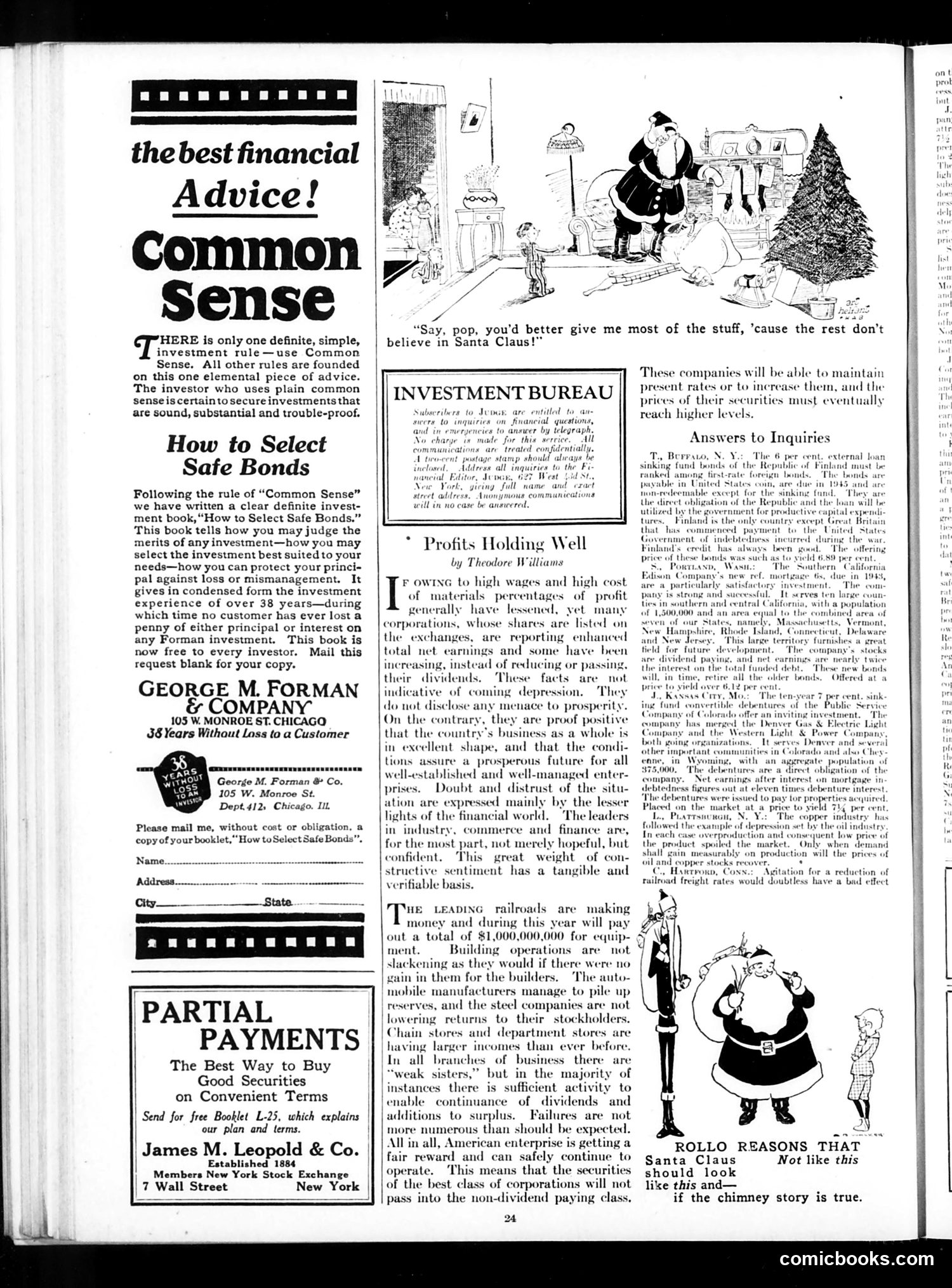
This page is primarily **financial advertising** with one cartoon joke. The **main cartoon** (upper right) depicts Santa Claus being confronted by a child who demands he give over "most of the stuff, 'cause the rest don't believe in Santa Claus!" The joke satirizes American skepticism about prosperity during what appears to be the post-WWI era—suggesting people doubt good economic news, much like doubting Santa's existence. This cartoon **complements the page's central message**: multiple articles and ads argue that American business fundamentals remain sound despite public doubt. The text emphasizes that corporate profits, railroad investments, and industrial output are strong, contradicting pessimistic sentiment from "lesser lights of the financial world." The surrounding **advertisements** (George M. Forman & Company, James M. Leopold & Co., Investment Bureau) sell bonds and investment guides using "common sense" as their pitch—ironically echoing the cartoon's theme that investors should believe in America's economic health despite widespread skepticism.
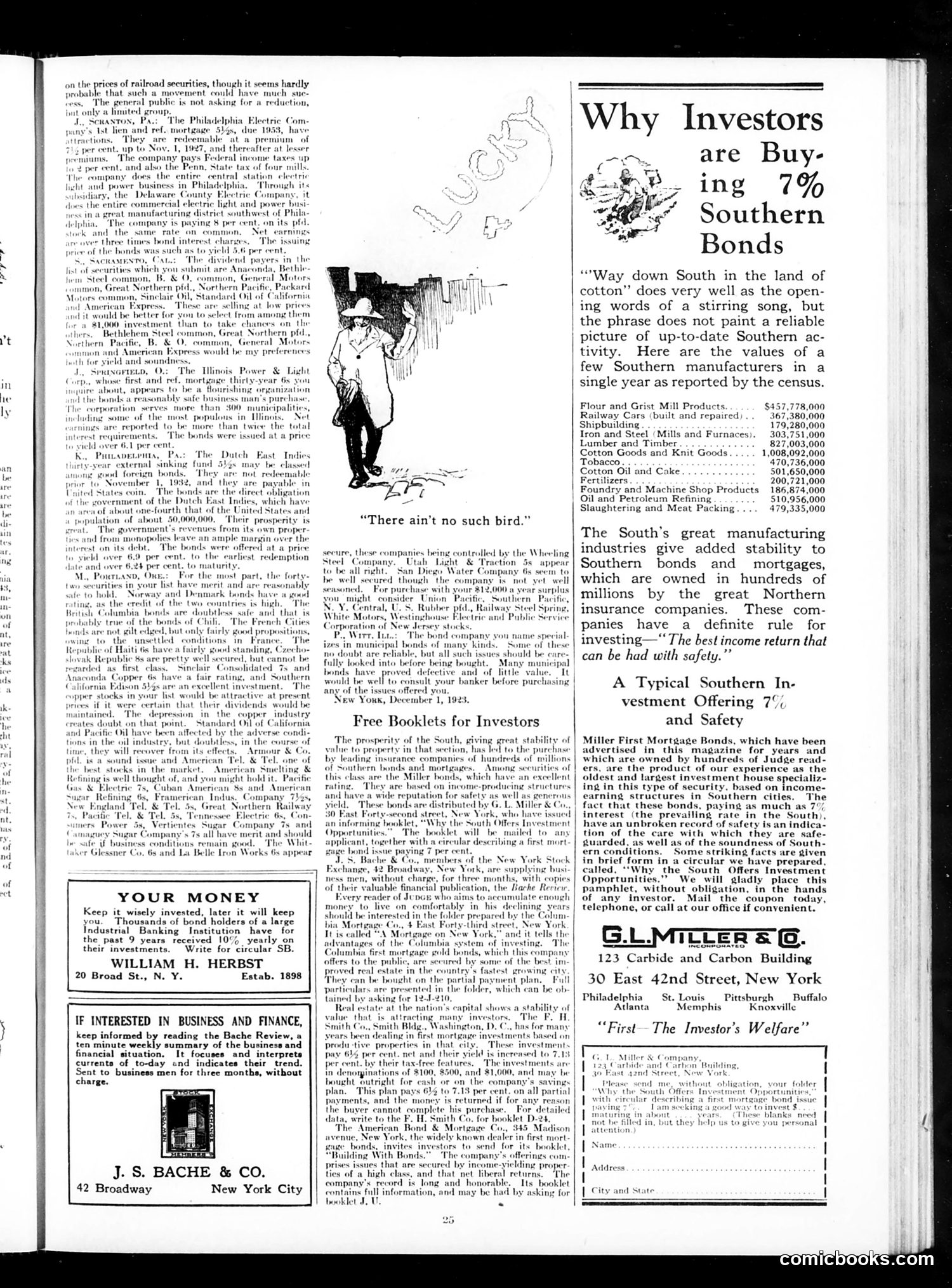
This page primarily contains **financial advertising** rather than political satire. The main cartoon depicts a man in formal dress pointing at a map of the United States, with the caption "There ain't no such bird"—a humorous reference to the saying "way down South in the land of cotton." The joke plays on the contrast between romanticized imagery of the South (evoked by the popular song lyric) and the reality of modern Southern industrial production. The cartoon introduces a substantial article advertising 7% Southern bonds as secure investments, supported by census data showing significant manufacturing output in the region (cotton goods, iron and steel, lumber, etc.). The "bird" metaphor suggests that nostalgic, agrarian visions of the South are outdated—the region is now industrialized and economically robust. This serves the advertisers' purpose: portraying Southern industrial bonds as reliable, modern investments rather than risky ventures in a backward region. The page is fundamentally a promotional publication masquerading as editorial content.
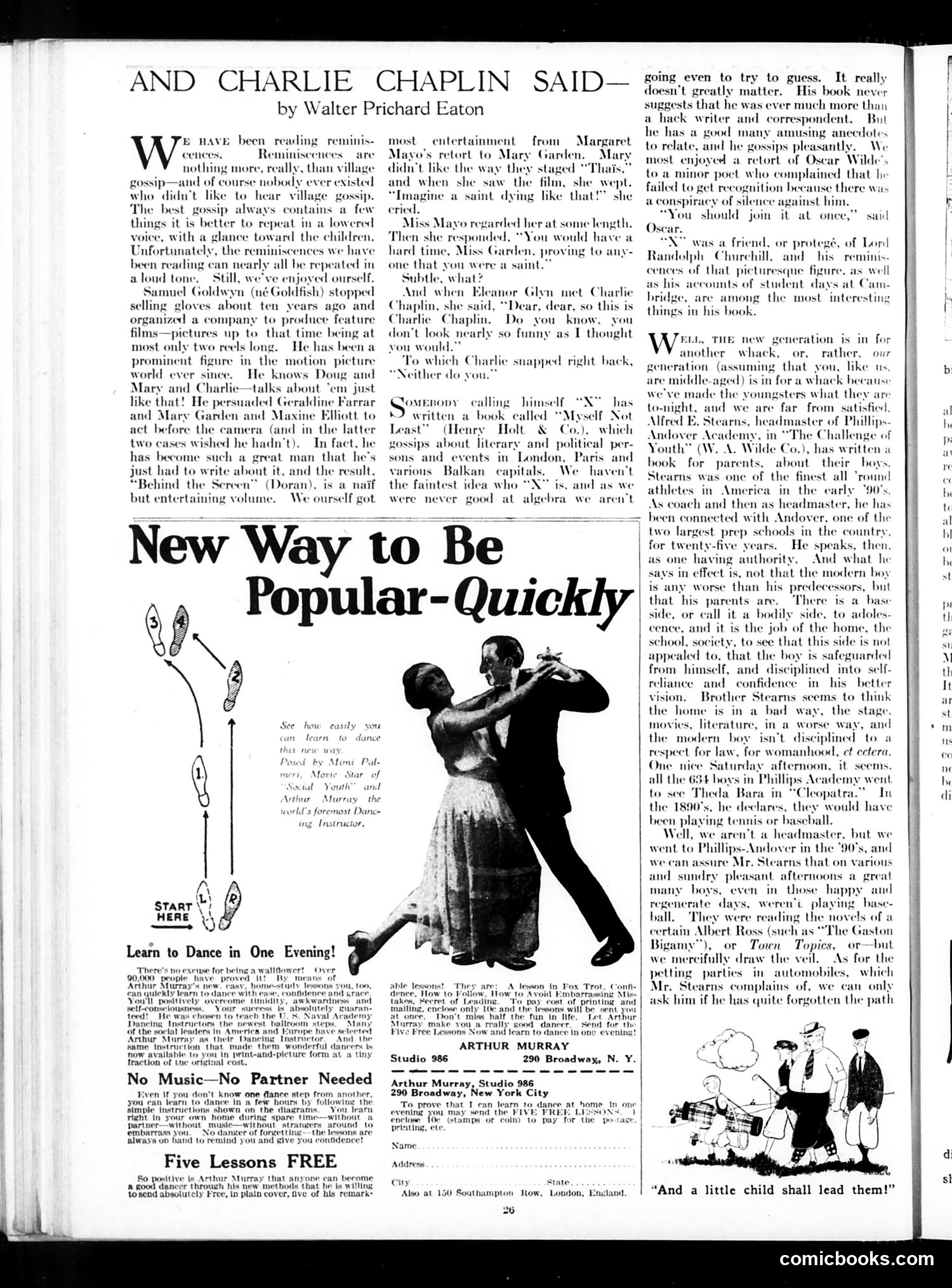
This page mixes editorial content with advertising. The main article by Walter Prichard Eaton discusses anecdotes from Samuel Goldwyn's memoir "Behind the Screen," featuring witty exchanges among early cinema figures. Key moments include Eleanor Glyn's backhanded compliment to Charlie Chaplin ("you don't look nearly so funny as I thought you would"), and Chaplin's sharp retort ("Neither do you"). The piece also includes Oscar Wilde's quip to an unsuccessful poet, advising him to join a "conspiracy of silence" against him—suggesting Wilde found the poet insignificant. The large advertisement features Arthur Murray's dancing instruction service, promising people can "Learn to Dance in One Evening" with "Five Lessons FREE." It's a typical 1920s self-improvement ad. The right-side column discusses modern prep school discipline and education philosophy, contrasting older strict methods with newer approaches. The satirical content is minimal; this page is primarily entertainment and advertising journalism.
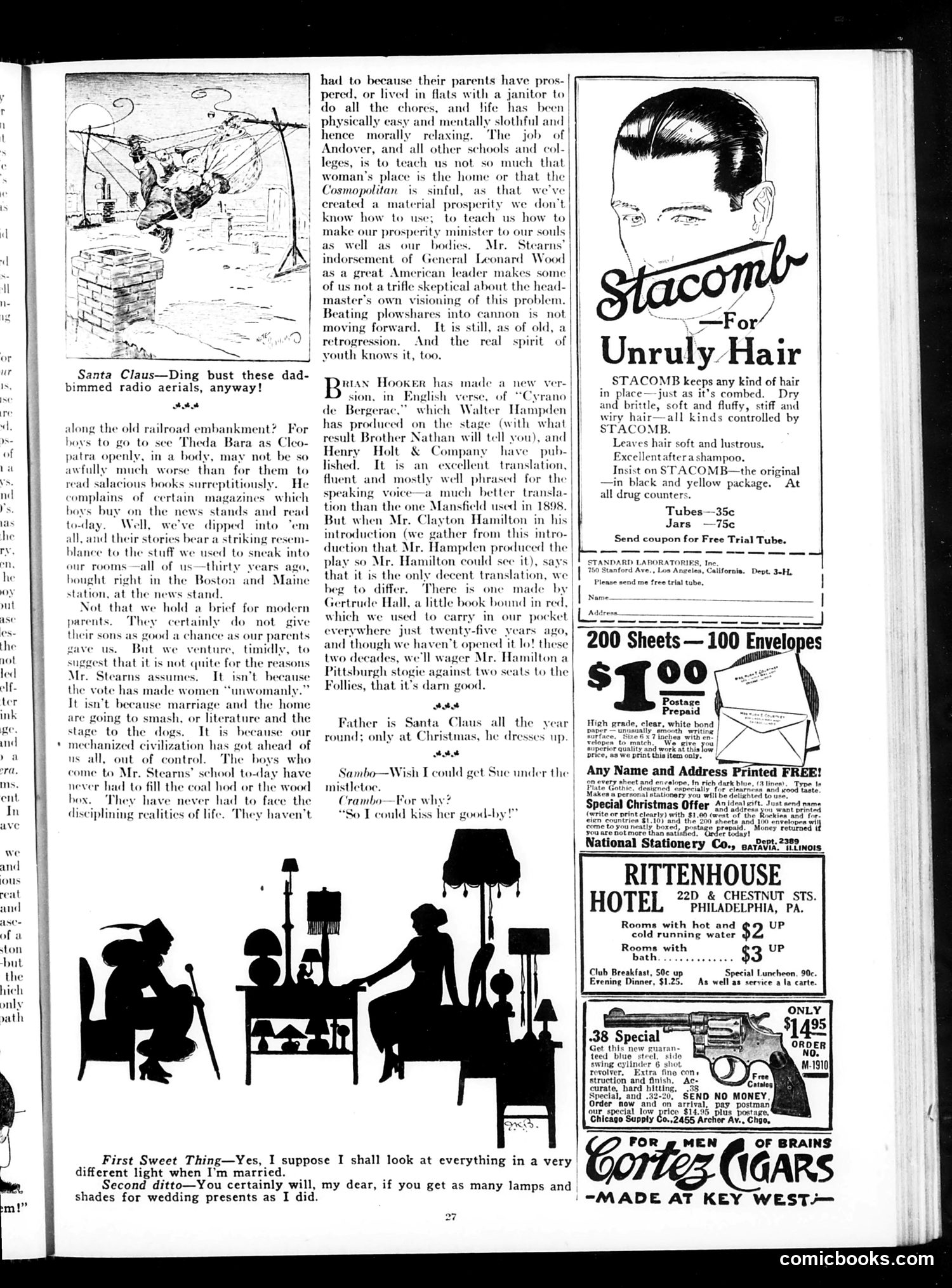
This page mixes editorial commentary with advertisements and humor typical of *Judge* magazine's satirical format. The main editorial discusses **modernity's effect on youth discipline**. It references headmaster **Mr. Stearns** (likely of Andover Academy) and critiques how mechanized civilization has removed character-building hardships from boys—they no longer fill coal hods or face "disciplining realities of life." The piece argues this explains youth moral decline, not "unwomanly" women or immoral literature. The editorial also **skewers General Leonard Wood's endorsement** of Stearns, questioning the headmaster's judgment when he supports "beating plowshares into cannon"—a Biblical peace metaphor inverted to mean military buildup rather than progress. The cartoons are lighter: one jokes about **radio aerials** blocking Santa Claus (early 1920s technology anxiety), another shows young women discussing marriage and materialism—typical gender-based humor of the era. The page also contains period advertisements (Stacomb hair product, hotel, stationery, cigars, firearms) reflecting contemporary consumer culture *Judge* satirized.
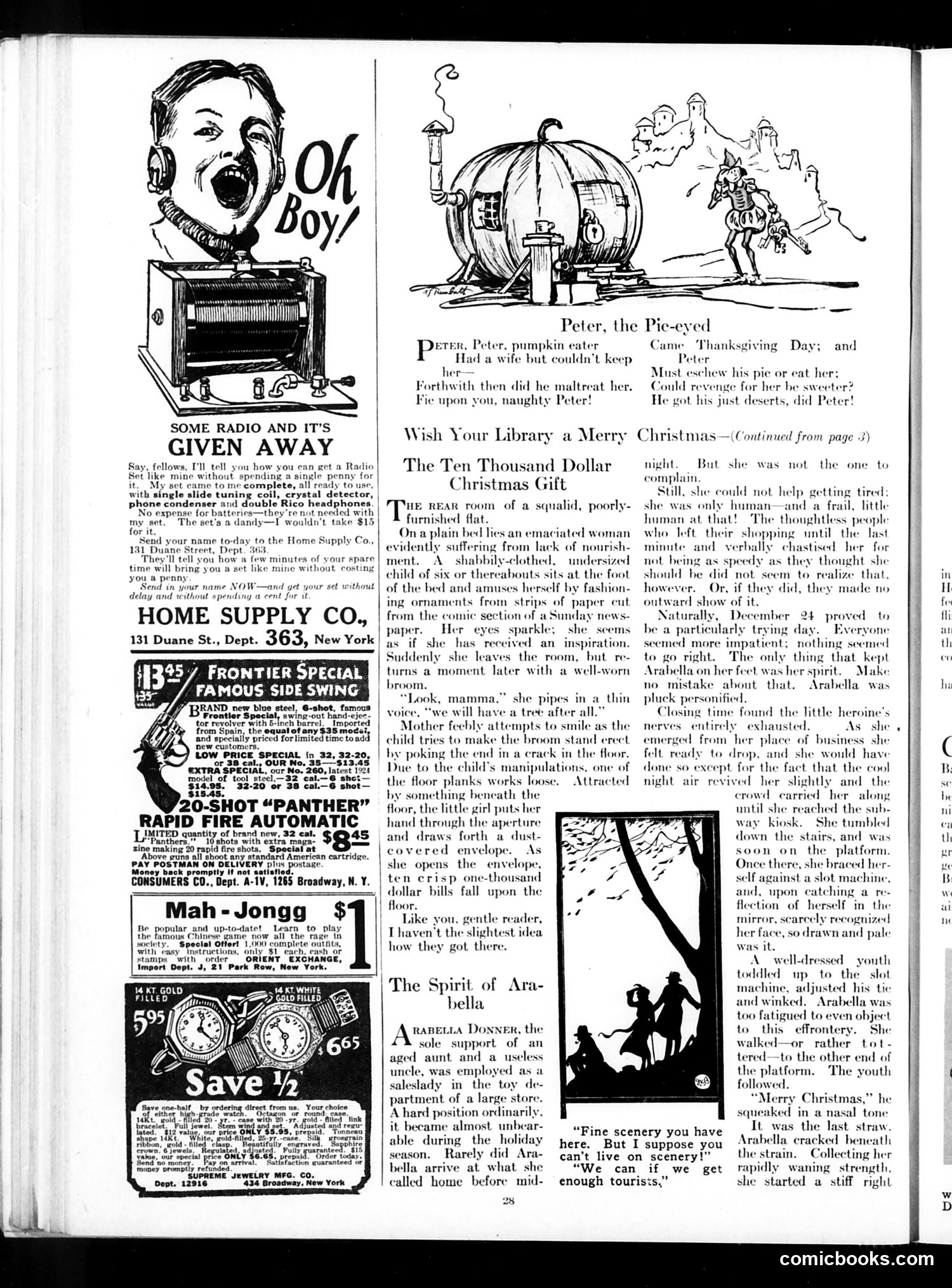
This page contains **advertisements and serialized fiction** rather than political cartoons. The notable content includes: **"Peter, the Pie-eyed"** (top right): A nursery-rhyme adaptation where Peter, a "pumpkin eater," mistreats his wife. She retaliates by sabotaging his pie, and he "got his just deserts." This is light domestic humor rather than satire—a playful morality tale about marital comeuppance. **"The Ten Thousand Dollar Christmas Gift"**: A serialized story about a impoverished child finding ten thousand dollars beneath floorboards. This appears sentimental holiday fiction rather than satirical commentary. **"The Spirit of Arabella"**: Another serialized narrative about an overworked department-store saleswoman during the holiday season. The **dominant page content** consists of mail-order advertisements (radios, revolvers, watches, jewelry). These are genuine commercial offerings, not satirical commentary. There are **no identifiable political figures or social satire** on this page—it's primarily commercial advertising with entertainment fiction filler.
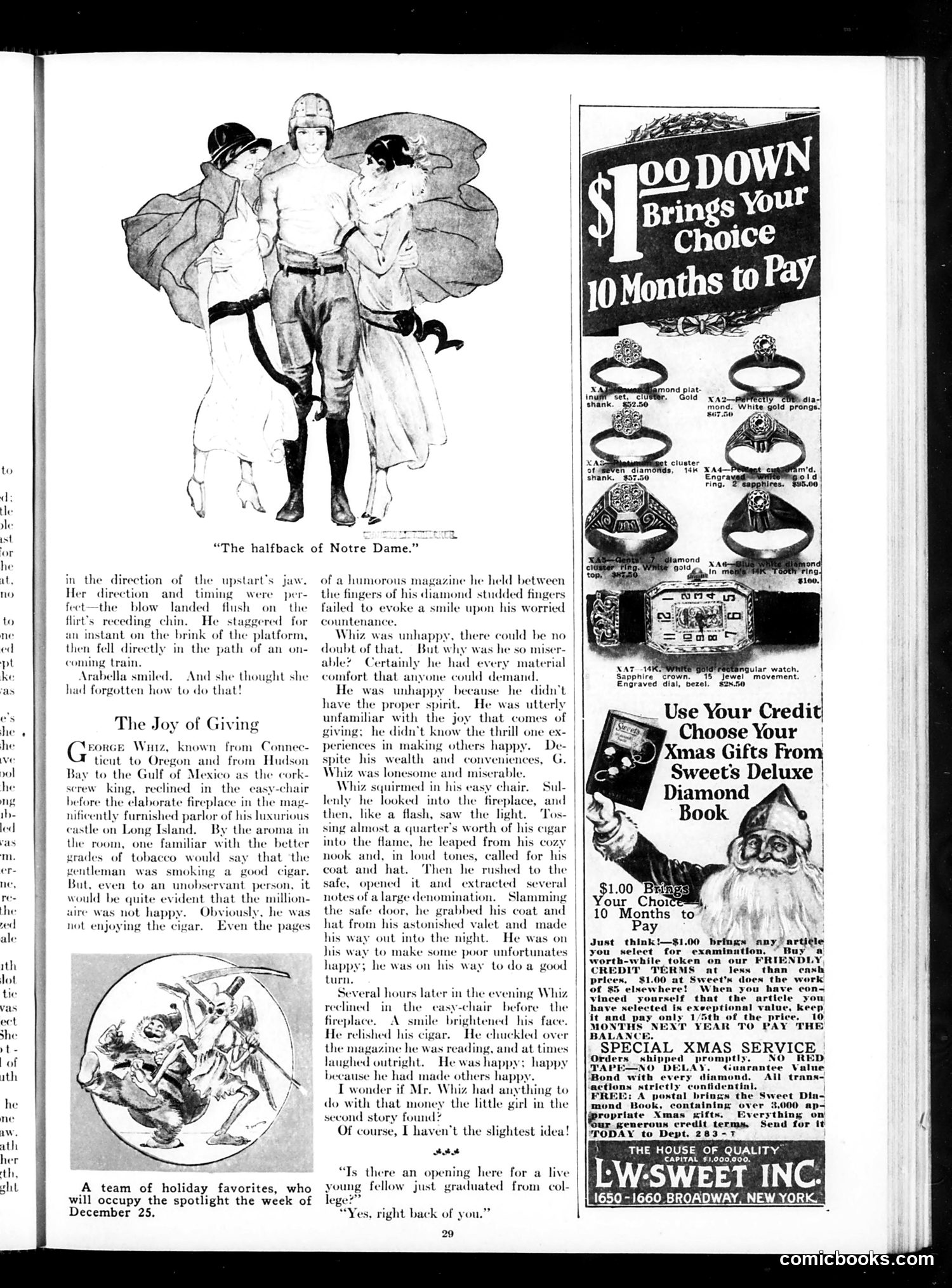
This page contains two distinct elements: **Left side - "The Joy of Giving" story:** A sentimental narrative about George Whiz, a wealthy but miserable millionaire who discovers happiness through anonymous charity. He gives money to poor people at night and returns home fulfilled. The tale includes a subplot suggesting he may have helped a poor girl find money. This represents early 20th-century moralizing about wealth and generosity—a common Judge theme promoting the idea that money alone cannot bring happiness, only charitable acts can. **Right side - Advertisement:** A jewelry company (LW-Sweet Inc.) offering engagement rings and watches on installment credit ("$1 down, 10 months to pay"). The ad promises easy credit terms and includes a gift catalog. **Overall context:** This page reflects 1920s-era values: skepticism toward wealthy industrialists, promotion of charity as moral duty, and emerging consumer credit culture. The juxtaposition suggests even the magazine's own advertisers contradicted its morality tales about excessive consumption.
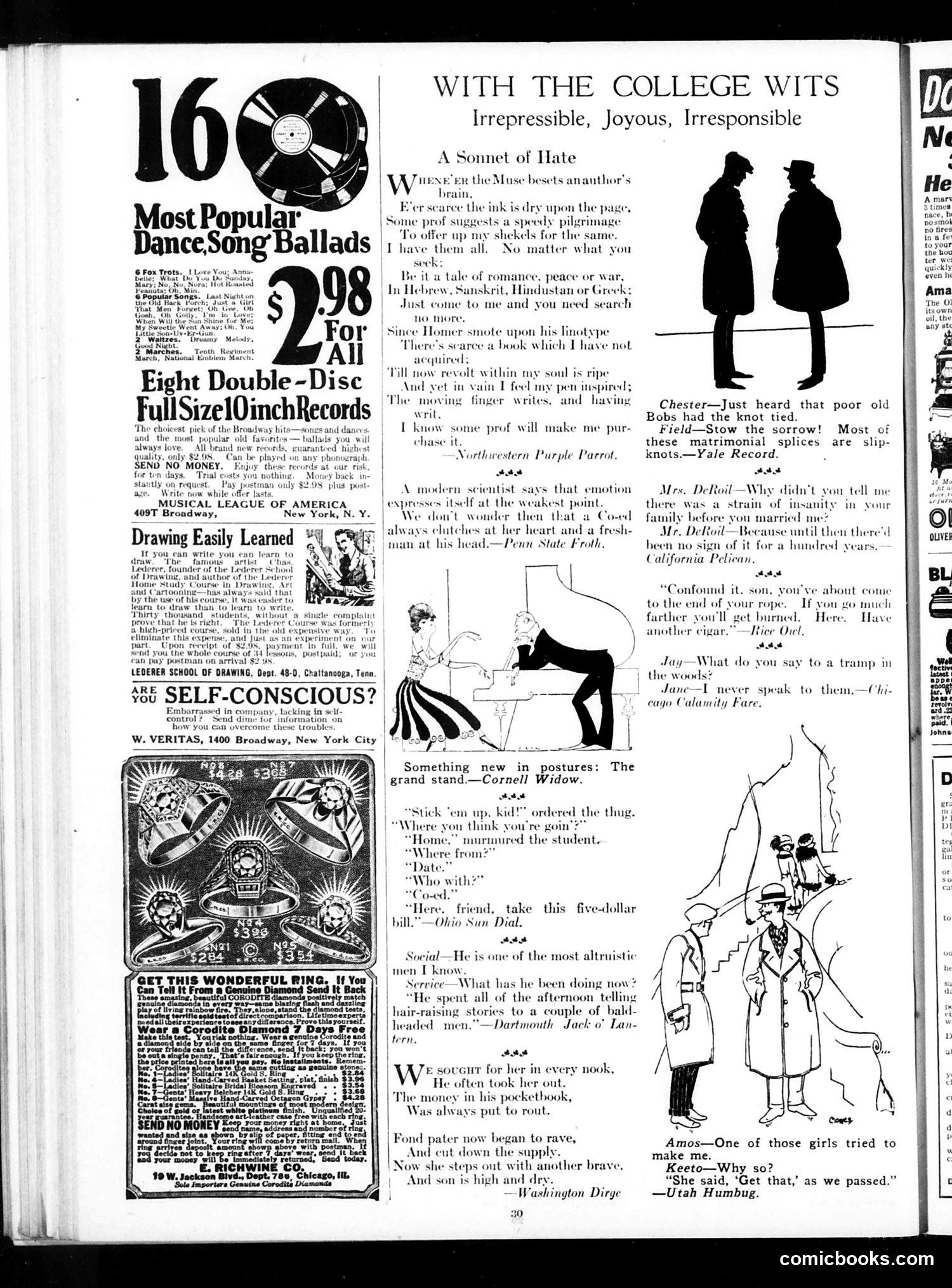
This page from *Judge* magazine features satirical humor about college life, targeting the "college wits"—students characterized as "irrepressible, joyous, irresponsible." **The content includes:** - A mock sonnet mocking pretentious student writers and their professors - Multiple brief jokes from college newspapers (Yale Record, Penn State Froth, Cornell Widow, etc.) poking fun at romantic entanglements, particularly co-eds (female college students) - A cartoon about a mugging where the victim, identified as a student, is robbed - Running jokes about co-eds as romantic interests and objects of humor **The satire targets:** Student pretension, the emerging phenomenon of educated women in colleges ("co-eds"), and romantic mishaps. The humor is typical of 1920s college culture—somewhat condescending toward both ambitious young writers and female students. The repeated co-ed references suggest contemporary anxiety about women's expanding educational access. The page is primarily humorous content with vintage advertisements, not political commentary.
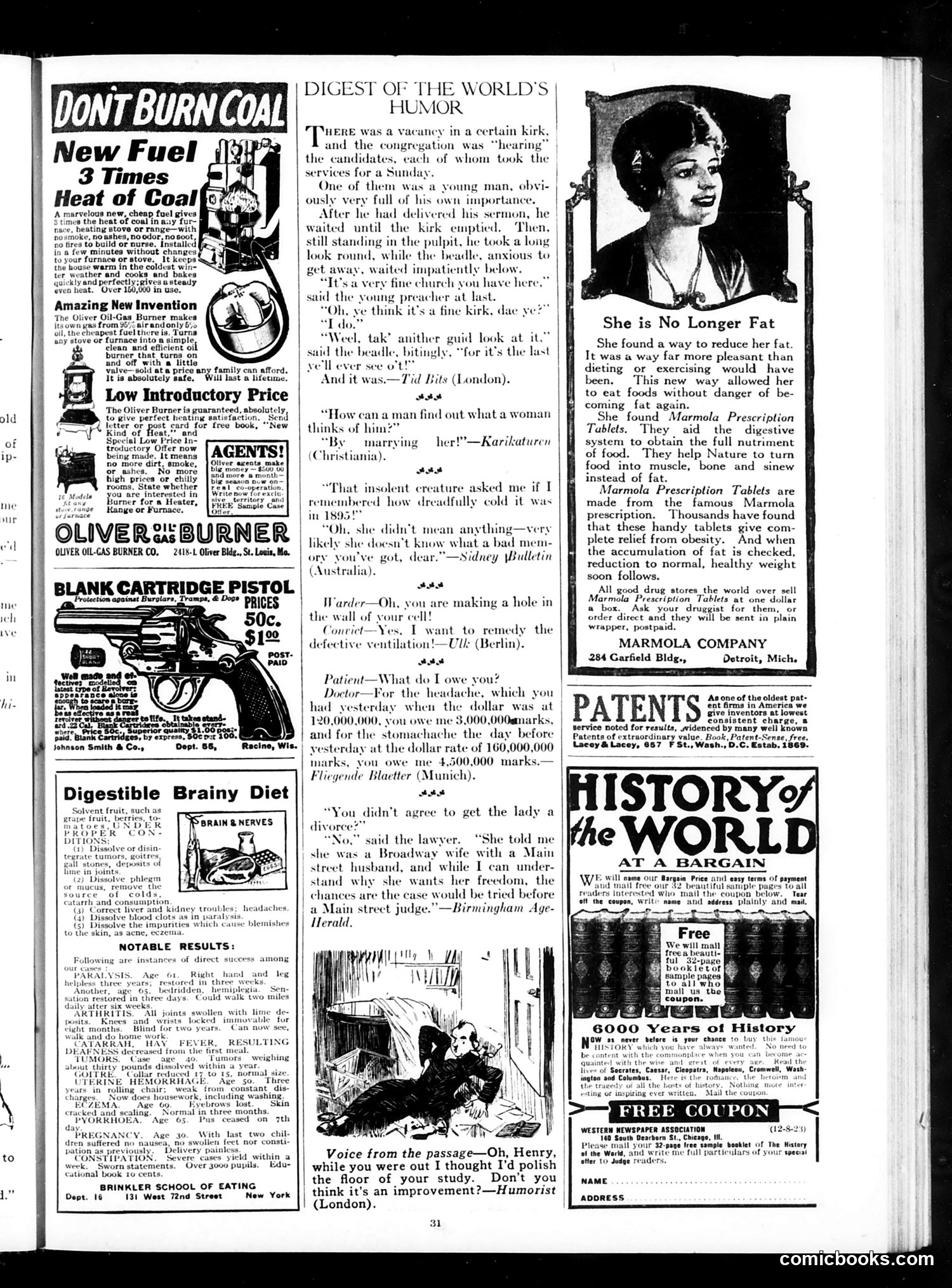
This page from Judge magazine (a satirical publication) is **primarily advertising with humor fillers**, not political cartooning. The main content includes: **Advertisements**: Oil burners, pistols, diet products, and eating schools dominate the page—typical early 20th-century patent medicine and consumer goods ads. **"Digest of the World's Humor"**: A collection of brief jokes reprinted from international sources (London, Berlin, Australia, Munich). These include: - A Scottish minister's vanity being deflated by a beadle - Jokes about memory, inflation (the "dollar rate" references hyperinflation, likely post-WWI), and marital discord - A convict's excuses and a woman wanting to polish floors **"Marmola Prescription Tablets"**: An advertisement for weight-loss pills—reflecting period obsessions with obesity "cures." The satire is gentle, domestic humor rather than political commentary. The page reflects early 1920s consumer culture, inflation concerns, and contemporary anxieties about health and appearance—not editorial cartooning or social criticism.
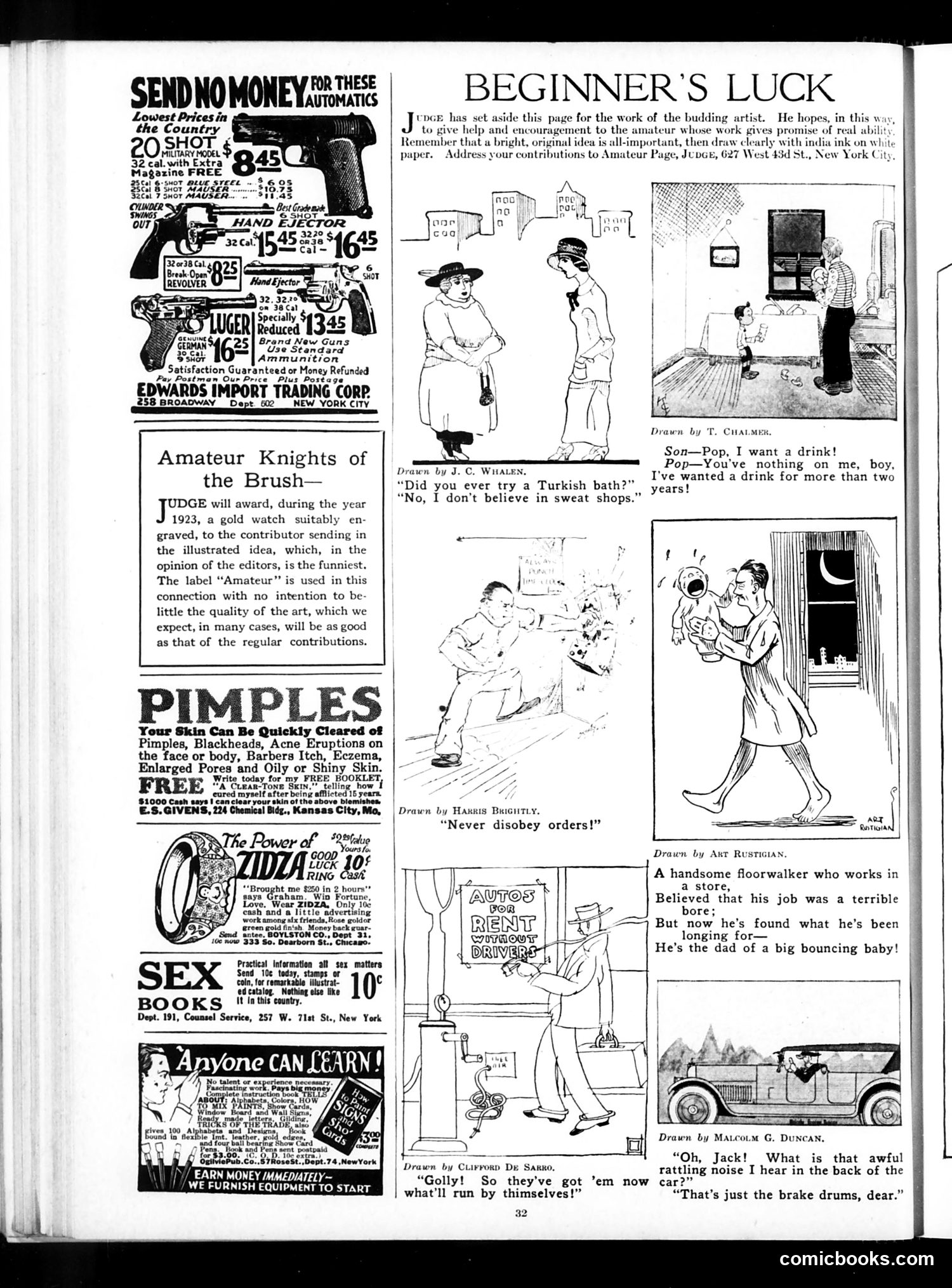
This page showcases amateur cartoonists competing for Judge magazine's 1923 gold watch award. The cartoons reflect post-Prohibition era humor and domestic life observations: **Key cartoons:** - **Whalen's "Turkish bath" joke**: A pun on "sweat shops" (exploitative factories), suggesting the speaker distrusts both Turkish baths and labor practices. - **Brightly's "Never disobey orders"**: A parent threatening a child, typical slapstick humor about obedience. - **Rustgian's floorwalker**: A man who hated retail work but now finds joy as a new father—commentary on male identity shifting from career to fatherhood. - **Duncan's automobile joke**: References early car technology where brake drums made rattling noises, playing on the wife's anxiety about new vehicles. The page also includes period advertisements for firearms, mail-order education, and skin treatments—reflecting 1920s consumer culture. The cartoons generally mock domestic situations, workplace frustrations, and modern conveniences through gentle, family-friendly humor typical of Judge's audience.
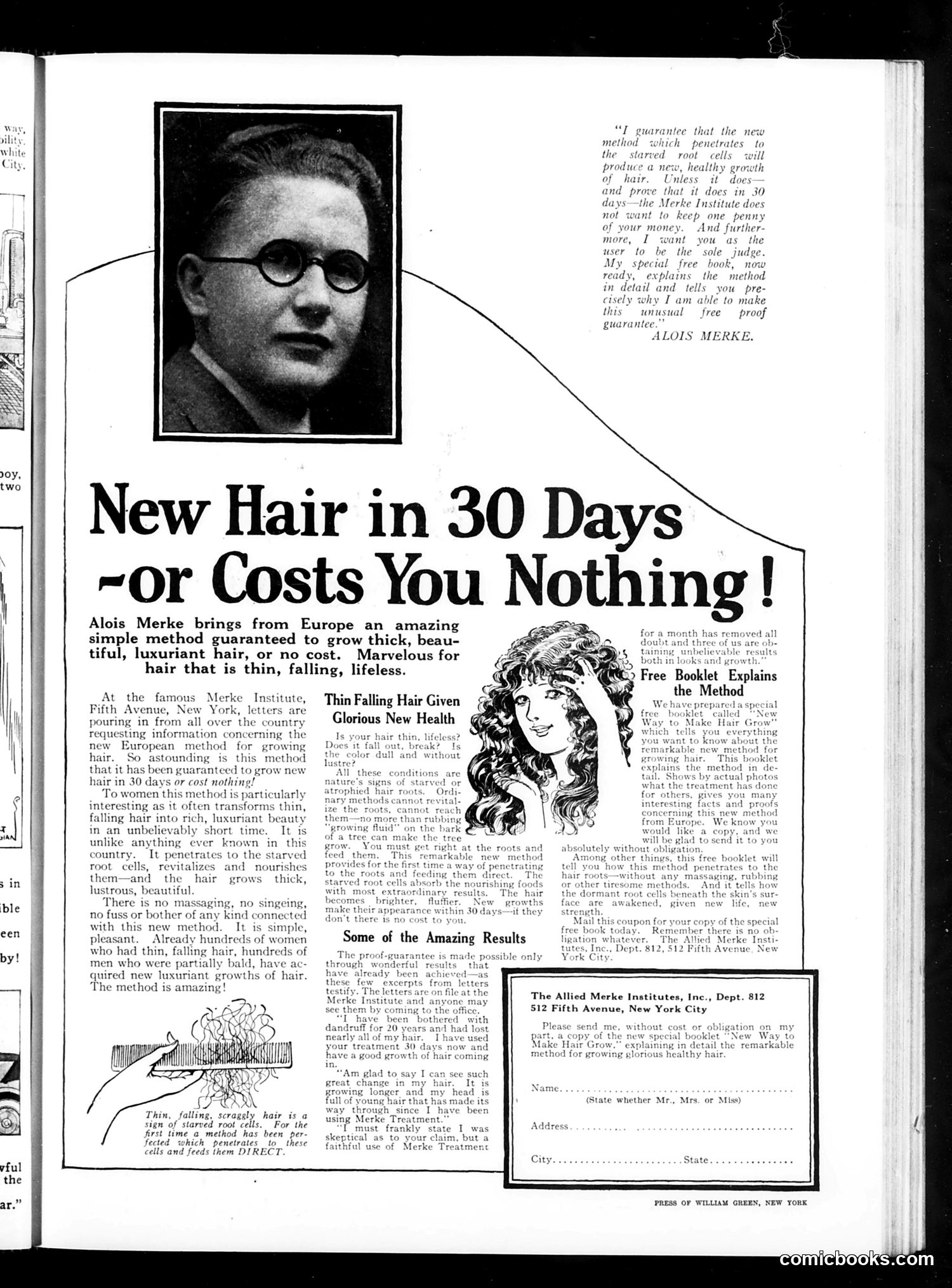
This is **a full-page advertisement**, not political satire. It promotes the "Merke Institute's" European hair-growth treatment, claiming to restore hair in 30 days or money-back. **Key elements:** - The photograph shows Alois Merke, the treatment's promoter - The scientific language ("starved root cells," "penetrates") lends false credibility to what appears to be a dubious product - The guarantee ("costs you nothing") and testimonial letters are classic direct-mail marketing tactics - The illustration of hair roots being "fed" uses pseudoscientific imagery **Why it matters historically:** This exemplifies early 20th-century **patent medicine marketing**—exaggerated claims with pseudoscientific explanations targeting insecure consumers. Judge magazine's inclusion suggests either they accepted such advertising, or possibly satirized consumer gullibility by running it straight-faced. The ornate language and dramatic promises ("luxuriant hair") are characteristic of quack remedies that preceded modern FDA regulations.
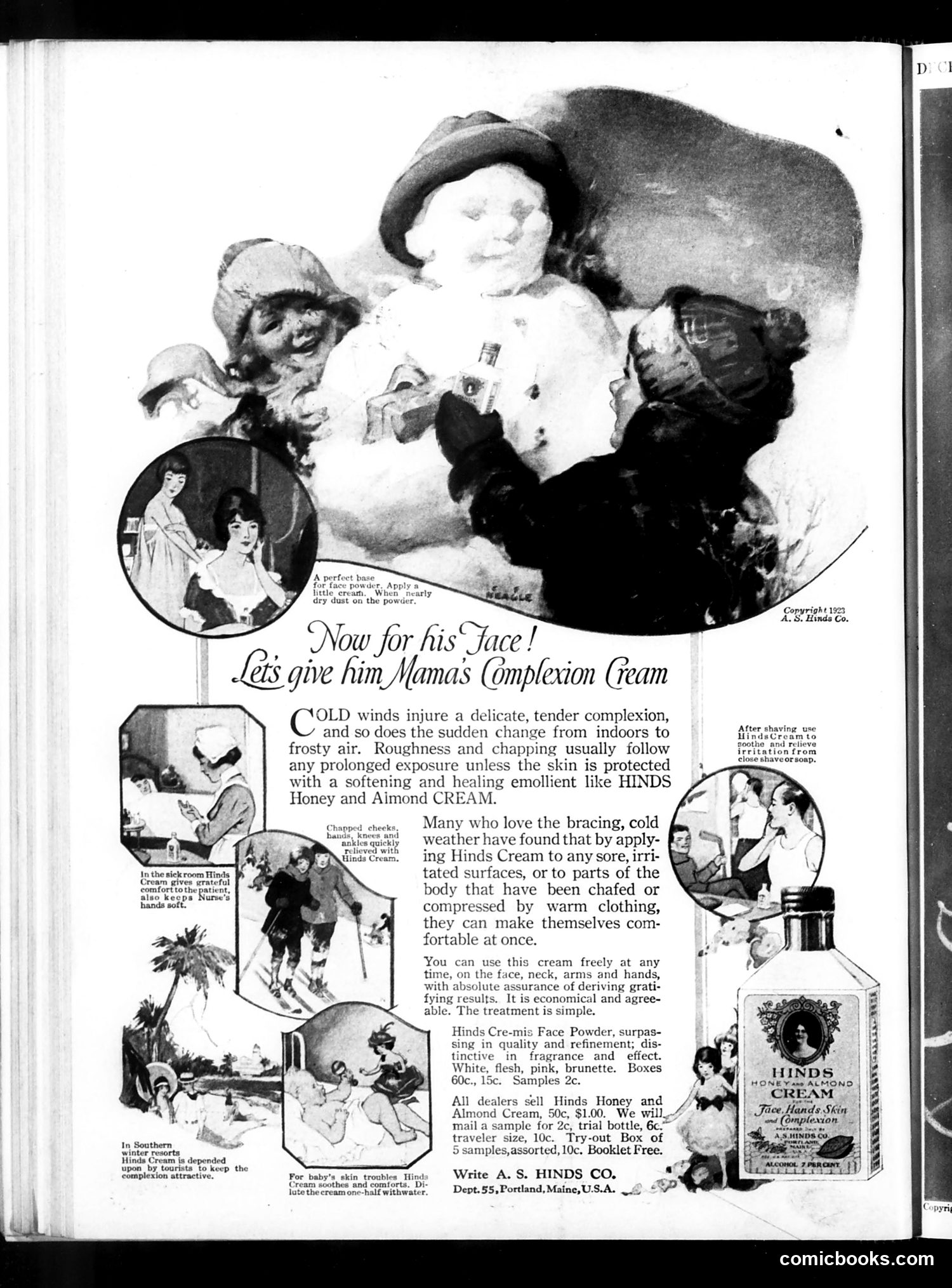
This is primarily a **commercial advertisement**, not political satire. The page promotes Hinds Honey and Almond Cream, a skincare product. The headline "Now for his Face! Let's give him Mama's Complexion Cream" uses sentimental family imagery—showing a mother applying cream to a child's face—to market the product as essential winter skincare. The surrounding vignettes depict common cold-weather skin problems: chapped cheeks, roughness from temperature changes, and irritation from tight winter clothing. The advertisement appeals to vanity and practicality, emphasizing that the cream prevents and treats winter skin damage. References to "Southern winter resorts" suggest marketing toward affluent travelers. The product line includes face powder in multiple shades (white, flesh, pink, brunette), and pricing (50¢-$1.00) indicates a mid-to-premium product. There is **no political or satirical content** visible—this is straightforward early-20th-century beauty advertising aimed at women concerned with maintaining complexions during harsh winter months.