
Judge, 1923-12-08 · page 11 of 36
Judge — December 8, 1923 — page 11: what you’re looking at
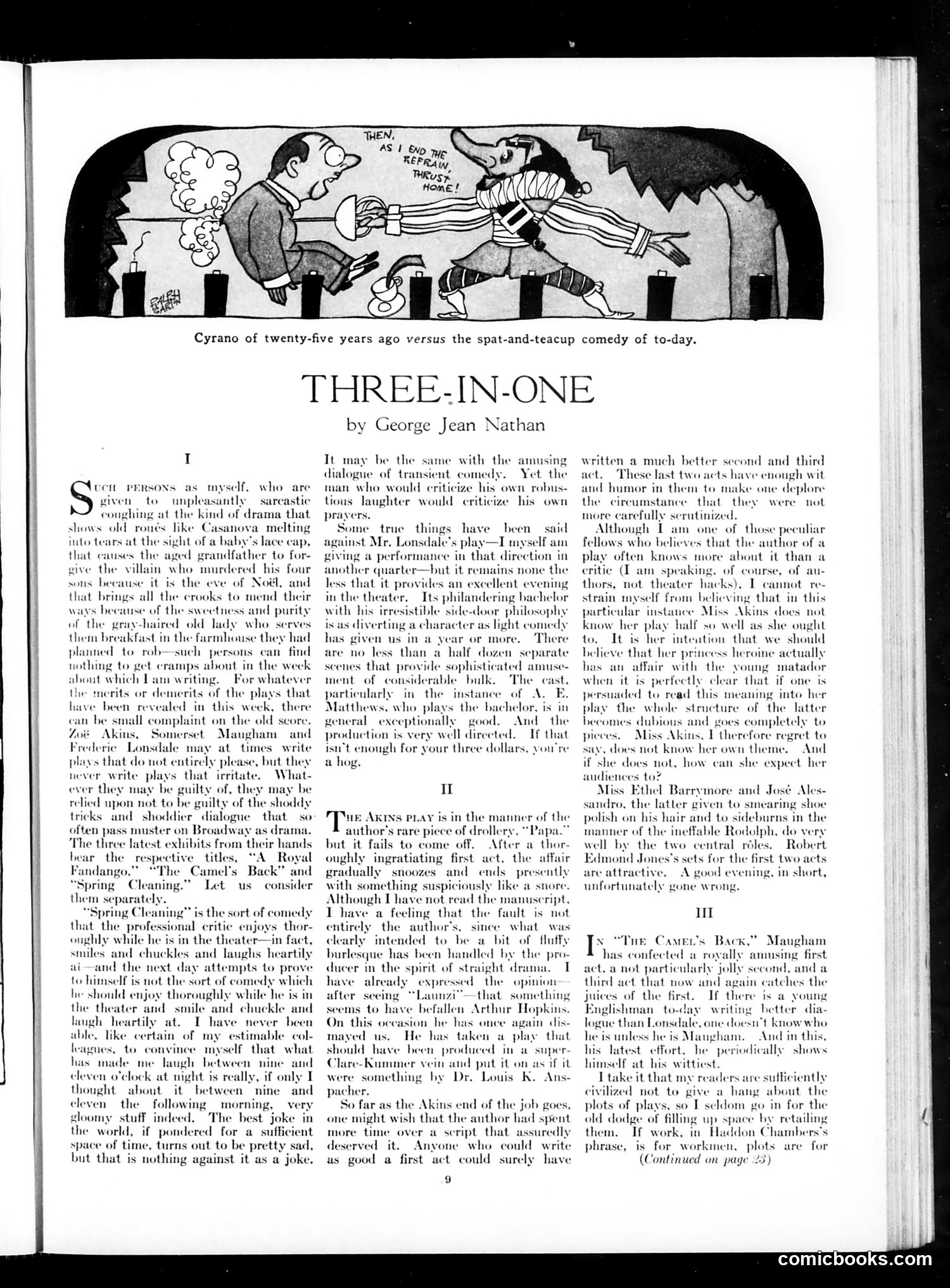
What you’re looking at
The cartoon compares theatrical styles across twenty-five years. The left figure represents "Cyrano" (referencing Edmond Rostand's 1897 romantic drama), depicted as a passionate swordsman. The right figure shows modern comedy—a woman spraying a man with what appears to be a teapot or similar domestic object, labeled "spat-and-teacup comedy of to-day." The satire critiques the shift from grand, romantic drama to lightweight domestic comedy. The accompanying article by George Jean Nathan reviews three contemporary plays (by Akins, Somerset Maugham, and Frederic Lonsdale), defending them against critics who dismiss transient comedy as intellectually trivial. Nathan argues that plays providing genuine entertainment and laughter have merit, even if they lack serious dramatic weight—a defense of commercial theater against snobbish critical dismissal of "shoddy" modern comedies.
📄 Transcribed text from this page (OCR, searchable)
Machine-transcribed from the original scan — historical spelling and the odd misread are preserved.
Cyrano of twenty-five years ago versus the spat-and-teacup comedy of to-day. THREE-IN-ONE I UcH PERSONS as myself, who are given to unpleasantly — sarcastic coughing at the kind of drama that shows old roués like Casanova melting into tears at the sight of a baby’s lace cap, that causes the aged grandfather to for- give the villain who murdered his four it is the eve of Noél, and that brings all the crooks to mend their way's because of the sweetness and purity of the gray-haired old lady who serves them breakfast in the farmhouse they had planned to rob—such persons can find nothing to get cramps about in the week about which Lam writing. For whatever the merits or demerits of the plays that have been revealed in this week, there be small complaint on the old score. Akins, Somerset Maugham and Frederie Lonsdale may at times write plays that do not entirely please, but they never write plays that irritate. What- ever they may be guilty of, they may be relied upon not to be guilty of the shoddy tricks and shoddier dialogue that so often pass muster on Broadway as drama. ‘The three latest exhibits from their hands. hear the respective titles, “A Royal ‘andango.”” “The Camel's Back” and “Spring Cleaning.” Let us consider them separately. “Spring Cleaning” is the sort of comedy that the professional critic enjoys thor- oughly while he is in the theater—in fact, smiles and chuckles and laughs heartily ai—and the next day attempts to prove to himself is not the sort of comedy which he should enjoy thoroughly while he is in the theater and smile and chuckle and laugh heartily at. [ have never been able, like certain of my estimable col- . to convince myself that w ade me laugh between nine and eleven o'clock at night is really, if only I thought about it between nine and eleven the following morning, _ very gloomy stuff indeed. The best joke in the world, if pondered for a_ sufficient space of time, turns out to be pretty sad, but that is nothing against it as a joke. sons because by George Jean Nathan It may be the same with the amusing dialogue of transient comedy. Yet the man who would criticize his own robus- tious laughter would criticize his own prayers. ne true things have been against Mr. Lonsdale’s play—I myself am giving a performance in that direction in another quarter—but it remains none the less that it provides an excellent evening in the theater. Its philandering bachelor with his irresistible side-door philosophy is as diverting a character as light comedy has given us in a year or more. There are no less than a half dozen separate scenes that provide sophisticated amuse- ment of considerable bulk. The cast particularly in the instance of A. tthews. who plays the bachelor, is in general exceptionally good. And the production is very well directed. If that isn’t enough for Your three dollars, you're a hog. said II we AKINs PLAY is in the manner of the author's rare piece of drollery, “Papa.” ils to come off. After a thor- ffair T but it oughly ingratiating first act, the gradually snoozes and cnds_ presently with something suspiciously like a snore. Although I have not read the manuscript, I have a feeling that the fault is not the author's, since what was clearly intended to be a bit of fluffy burlesque has been handled by the pr ducer in the spirit of straight drama. I ty expressed the opinion g inzi”—that something seems to have befallen Arthur Hopkins. On this occasion he has once again dis- mayed us. He has taken a play. that should have been produced ina’ super- Clare-Kummer vein and put it on as if it were something by Dr. Louis K. Ans- pacher. So far as the Akins end of the job goes, one might wish that the author had spent more time over a script. that assuredly deserved it. Anyone who could write as good a first act could surely have after s 9 written a much better second and third act. These last two acts have enough wit and humor in them to make one deplore the circumstance that) they not more carefully scrutinized. Although Tam one of those peculiar fellows who believes that the author of a play often knows more about it than a critic (I am speaking, of course, of au- hacks), I cannot. re- strain myself from believing that in this particular instance Miss Akins know her play half so well as she ought to. It is her inteation that we should believe that her princess heroine actually has an affair with the young matador when it is perfectly clear that if one is persuaded to read this meaning into her play the whole structure of the latter becomes dubious and goes completely to Miss Akins. I therefore regret to say, does not know her own theme. And if she does not, how can she expect her audiences to? Miss Ethel Barrymore and José Ales- sandro, the latter given to smearing shoe polish on his hair and to sideburns in the manner of the ineffable Rodolph, do very well by the two central réles. Robert Edmond Jones’s sets for the first two acts are attractive. A good evening, in short, unfortunately gone wrong. were os not pieces. III x “Tue Camec’s Back,” Maugham has confected a royally amusing first act, a not particularly jolly second, and a third act that now and again catches the juices of the first. If there is a young Englishman to-day writing better dia- logue than Lonsdale, one docsn't know who he is unless he is Maugham. And in this, his latest. effort, he periodically shows himself at his wittiest. I take it that my readers are sufficiently civilized not to give a hang about the plots of plays, so I seldom go in for the old dodge of filling up space by retailing them. If work, in Haddon Chambers’s phrase, is for workmen, plots are for (Continued on page 23) comicbooks.com