
Judge, 1923-12-08 · page 21 of 36
Judge — December 8, 1923 — page 21: what you’re looking at
What you’re looking at
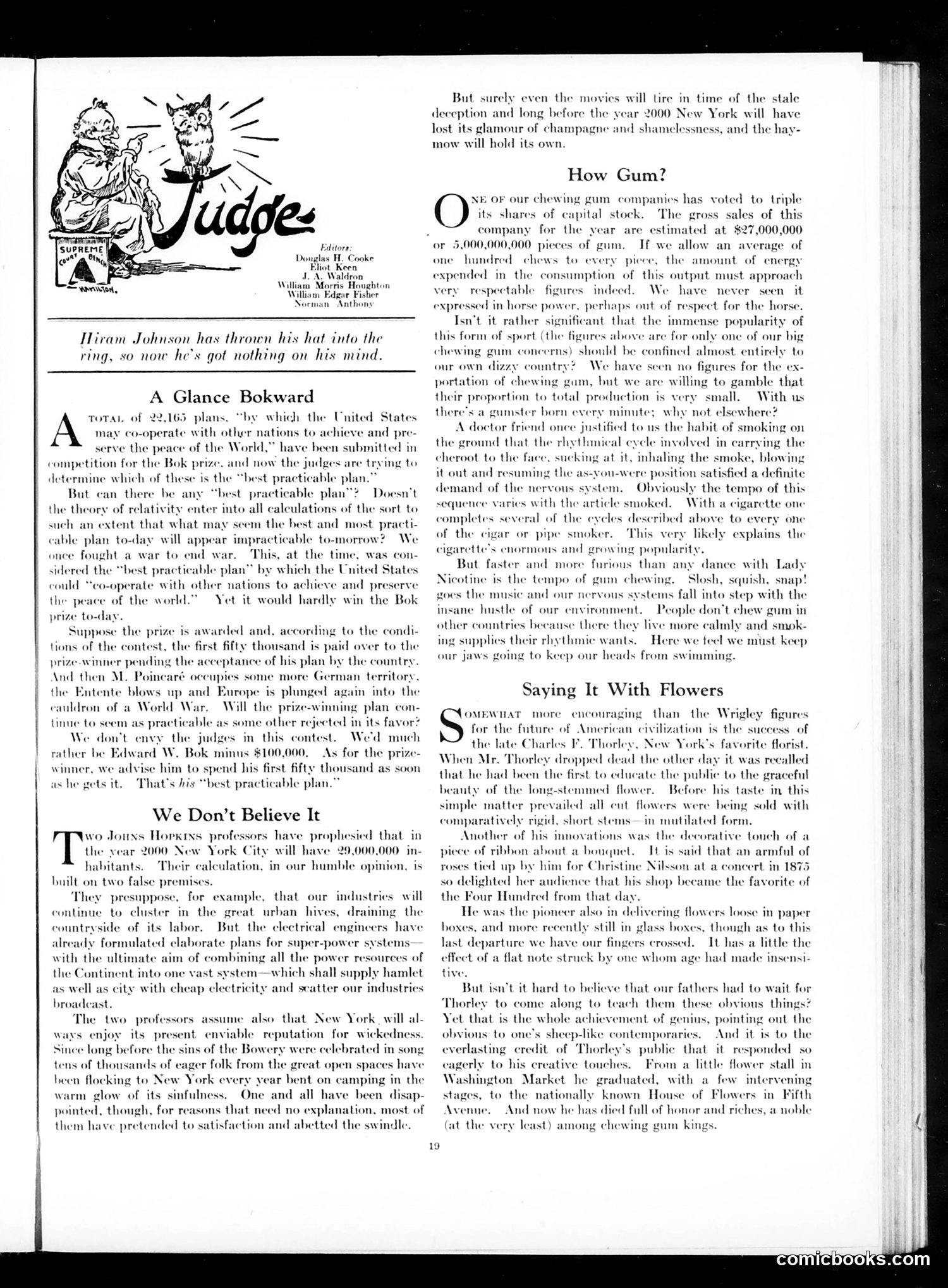
The page contains three separate satirical pieces: **"A Glance Bokward"** mocks the Edward Bok peace prize competition, which solicited plans for international cooperation to preserve world peace. The cartoon jokes that judge Hiram Johnson "has thrown his hat into the ring, so now he's got nothing on his mind"—a pun on empty-headedness. The satire argues that any "best practicable plan" today becomes obsolete tomorrow due to unforeseen circumstances (referencing Einstein's theory of relativity). It's cynical commentary on idealistic peace-building efforts, particularly given Europe's ongoing turmoil (likely post-WWI). **"We Don't Believe It"** ridicules academic predictions that New York City will reach 29 million inhabitants by 2000. The piece sarcastically claims the prediction ignores how electrification will decentralize industry and how New York's moral decay will eventually repel residents seeking authentic "sin." **"How Gum?"** expresses bewilderment at chewing gum's popularity, noting one company's massive production (5 billion pieces yearly) and questioning why this "sport" remains uniquely American rather than spreading globally. All three pieces exemplify Judge's acerbic skepticism toward contemporary optimism and predictions.
📄 Transcribed text from this page (OCR, searchable)
Machine-transcribed from the original scan — historical spelling and the odd misread are preserved.
Editors: Douglas H. Cooke E Hiram Johnson has thrown his hat into the ring, so now he’s got nothing on his mind. A Glance Bokward roTaL of 22,165 plans, “by which the United States may co-operate with other nations to achieve and pre- serve the peace of the World,” have been submitted in competition for the Bok prize. and now the judges are trying to “best practicable plan.” determine which of these is the But can there be ar 1. able plan’? Doesn't rv into all calculations of the sort to such an extent that what may seem the best and most practi- cable plan to-day will appear i We This, at the time, was con- * by which the United States co-operate with other nations to achieve and preserve Yet it would hardly win the Bok the theory of relativity en ble to-morrow? once fought a war to end the “best practicable ple side could th peace of the world.” ¢ to-day. Suppose the prize is a cording to the condi- tions of the contest, the first fifty thousand is paid over to the prize-winner pending the acceptance of his plan by the country And then M. Poincaré oceup’ the Entente blows up and Europe is pling cauldron of a World War. Will the pri tinue to seem as practicable as some other rejected in its favor? | We don’t envy the judges in this contest. We'd much rather be Edward W. Bok minus $100,000, As for the prize- winner, we advise him to spend his first fifty thousand as soon That's his “best practicable plan.” We Don’t Believe It wo Jouns Horxtxs professors have prophesied that in the year 2000 New York City will have 29,000,000. in- habitants. Their calculation, in our humble opinion, is built on two false premises. some more German territory. 1 again into the winning plan con- as he gets it. They presuppose, for example, that our industries will continue to cluster in the great urban hives, draining the But the electrical engineers have already formulated claborate plans for super-power systems with the ultimate aim of combining all the power resources of the Continent into one vast system—which shall supply hamlet as well as city with cheap electricity and scatter our industries broadcast. countryside of its labor. so that New York will al- ways enjoy its present enviable reputation for wickedness Since lor The two professors assume before the sins of the Bowery were celebrated in song tens of thousands of eager folk from the great open spaces have heen flocking to New York ever: ar bent on camping in the One and all have been disap- warm glow of its sinfulness. pointed, though, for reasons that need no explanation, most of them have pretended to satisfaction and abetted the swindle. But surely even the movies will lire in time of the stale deception and long before the year 2000 New York will have lost its glamour of champagne and shamclessness, and the hay- mow will hold its own, How Gum? NE OF our chewing gum companies has voted to triple its shares of capital stock. The gross sales of this company for the year are estimated at or 5,000,000,000 pieces of gum If we allow an average hundred chews to every piece, the amount of energy expended in the consumption of this output must approach We have seen it perhaps out of respect for the horse. ant that the immense popularity of this form of sport (the figures above are for only one of our big very respectable figures. indeed. never expressed in horse power, Isn't it rather signifi chewing gum concerns) should be confined almost entirely to our own dizzy country? We have seen no figures for the ex- gum, but we are willing to gamble that With us there's a gumster born every minute; why not elsewhere? portation of chewit their proportion to total production is very small. A doctor friend once justified to us the habit of smoking on the ground that the rhythmical eycle involved in carrying the cheroot to the face, sucking at it, inhaling the smoke, blowing it out and resuming the as-you-were position satisfied a definite demand of the nervous system. Obviously the tempo of this sequence varies with the article smoked. With a cigarette one “yeles described above to every on This very likely explains the cigarette’s enormous and growing popularity. completes several of the of the cigar or pipe smoker. But faster and more furious than any dance with Lady Nicotine is the tempo of gum chewing. Slosh, squish, snap! goes the music and our nervous systems fall into step with the insane hustle of our environment. ple don’t chew gum in other countries because there they live more calmly and smok- Here we teel we must keep our jaws going to keep our heads from swimming. ing supplies their rhythmic wants. Saying It With Flowers OMEWHAT more encouraging than the Wrigley figures S for the future of American civilization is the success of the late Charles FP. Thorley, New York's favorite florist. When Mr. Thorley dropped dead the othe it was recalled that he had been the first to educate the public to the graceful beauty of the long-stemmed flower. Before his taste in this simple matter prevailed all eut flowers were heing sold with compari in mutilated form. Another of his innovations was the decorative touch of a piece of ribbon about a bouquet. ively rigid, short stems: It is said that an armful of roses tied up by him for Christine Nilsson at a concert. in 1875 so delighted her audience that his shop became the favorite of the Four Hundred from that day, He was the pioncer also in delivering flowers loose in paper and more recently still in glass boxes, though as to this It has a little the effect of a flat note struck by one whom age had made insensi- tive. boxes, last departure we have our fingers crossed. But isn’t it hard to believe that our fathers had to wait for Thorley to come along to teach them these obvious things? Yet that is the whole achievement of genius, pointing out the obvious to one’s sheep-like contempoi And it is to the everlasting credit of Thorley’s public that it responded so cagerly to his creative touches. From a little flower stall in Washington Market he graduated, with a few intervening stages, to the nationally known House of Flowers in Fifth Avenue. And now he has died full of honor and riches, a noble (at the very least) among chewing gum kings. ries. 19