
Judge, 1923-12-08 · page 23 of 36
Judge — December 8, 1923 — page 23: what you’re looking at
What you’re looking at
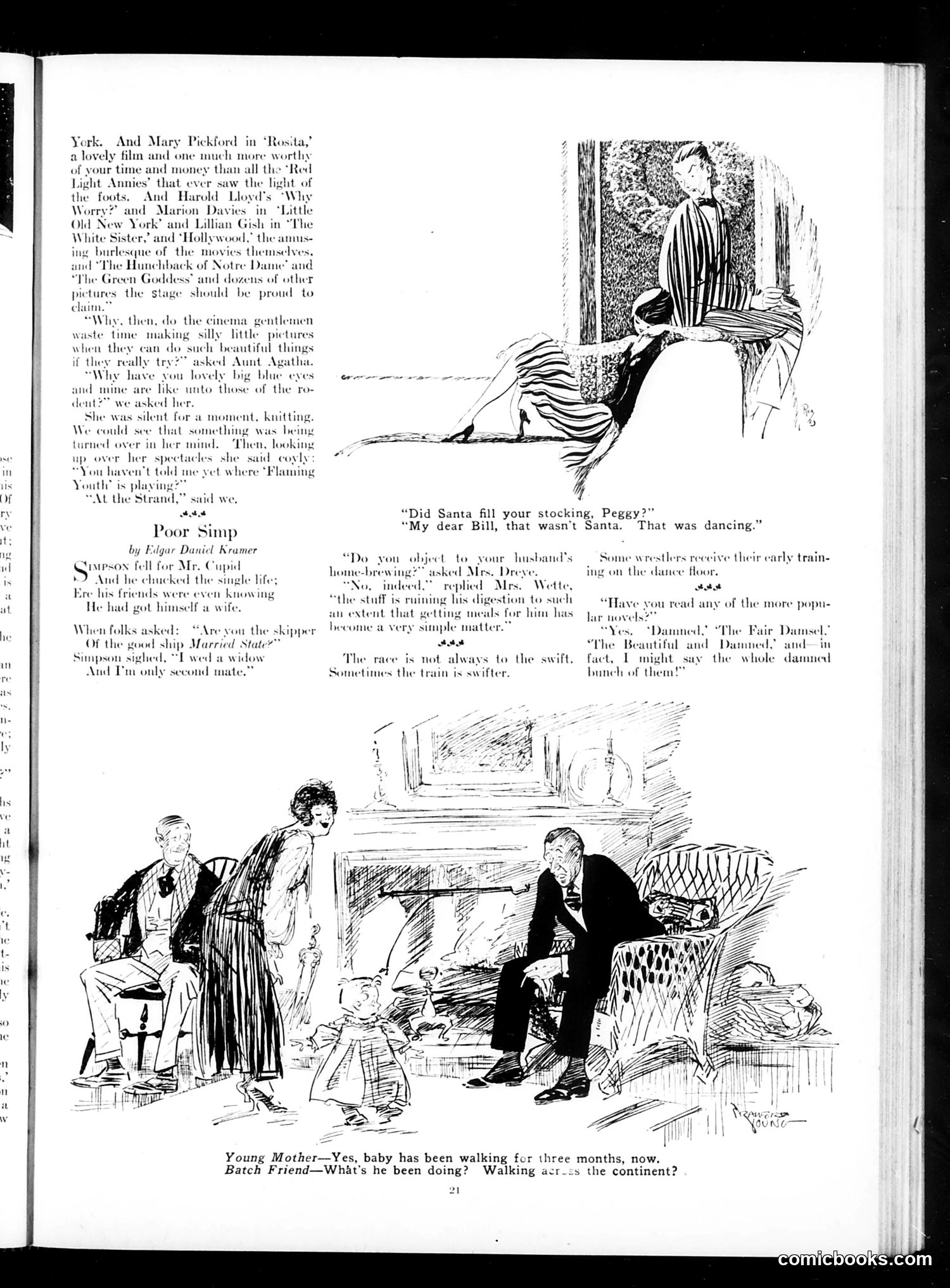
This page contains three distinct pieces of humor typical of Judge's satirical style: **Top Section**: A film criticism discussing popular movies and stars (Mary Pickford, Harold Lloyd, Marion Davies, Lillian Gish). The joke critiques Hollywood's waste of talented actors on mediocre pictures when better films exist. **"Poor Simp"**: A light verse about Simpson, who impulsively married a widow and now ranks second to her late husband in his own household—a common domestic comedy trope of the era. **Bottom Cartoons**: Two brief jokes. One references a husband's home-brewing (Prohibition-era humor), another makes a sarcastic comment about a baby walking across the continent—exaggerating the child's three months of walking ability for comic effect. The page reflects 1920s concerns: film industry criticism, sudden marriages, Prohibition bootlegging, and domestic absurdism. All humor targets middle-class situations with gentle satire rather than sharp political commentary.
📄 Transcribed text from this page (OCR, searchable)
Machine-transcribed from the original scan — historical spelling and the odd misread are preserved.
York. And Mary Pickford in ‘Rosita,’ a lovely film and one much more worthy of your time and money than all the “Red Light Annies’ that ever saw the light of the foots. And Harold Lloyd's "Why Worry? and Marion Davies’ in ‘Little Old New York’ and Lillian Gish in “The White Sister” and *“Hollyw« the amus- ¢ burlesque of the movies themselves. and “The Hunchback of Notre Dame’ and “The Green Goddess’ and dozens of other pictures the sta claim.” “Why, then, do the cinema gentlemen waste time making silly little pictures when they eat uch beautiful things if they really 1 “Why I should be proud to you lovely big. blu and mine like unto those of the ro- dent?” we asked her. She was silent for a moment, knittir We could see that something was bi turned over in her mind. ‘Then, looking up over her spect + said coyly “You haven't tol »*Fhaning Youth’ is play “At the Stranc Poor Simp by Eilgar Daniel Kramer Simpson fell for Mr. Cupid J And he chucked the single life; Ere his friends were even knowing He had got himself'a wife, When folks asked: “Are you the skipper Of the good ship Married State?” Simpson sighed, “T wed a widow And Pai only second mate.” “Did Santa fill your “Do you object to. your husband's home-brewing?” asked Mrs. Drey © inc replied M “the stuff is ruining his digestion to such an extent that getting meals for him has hecome a very simple matter.” ttt The race is not always to the swift. Sometimes the train is swifter, stocking, Peggy?” “My dear Bill, that wasn’t Santa. That was dancing.” Some wrestlers ing on the dance fle e ive their carly train. of the more popu- s. ‘Damned? “The Fair Damsel. > Beautiful and) Damned,” and— in fact, T might say the whole damned bunch of them! Young Mother—Yes, baby has been walking for three months, now. Batch Friend—Whiat's he been doing? Walking acr_zs the continent?