
A complete issue · 36 pages · 1923
Judge — September 15, 1923
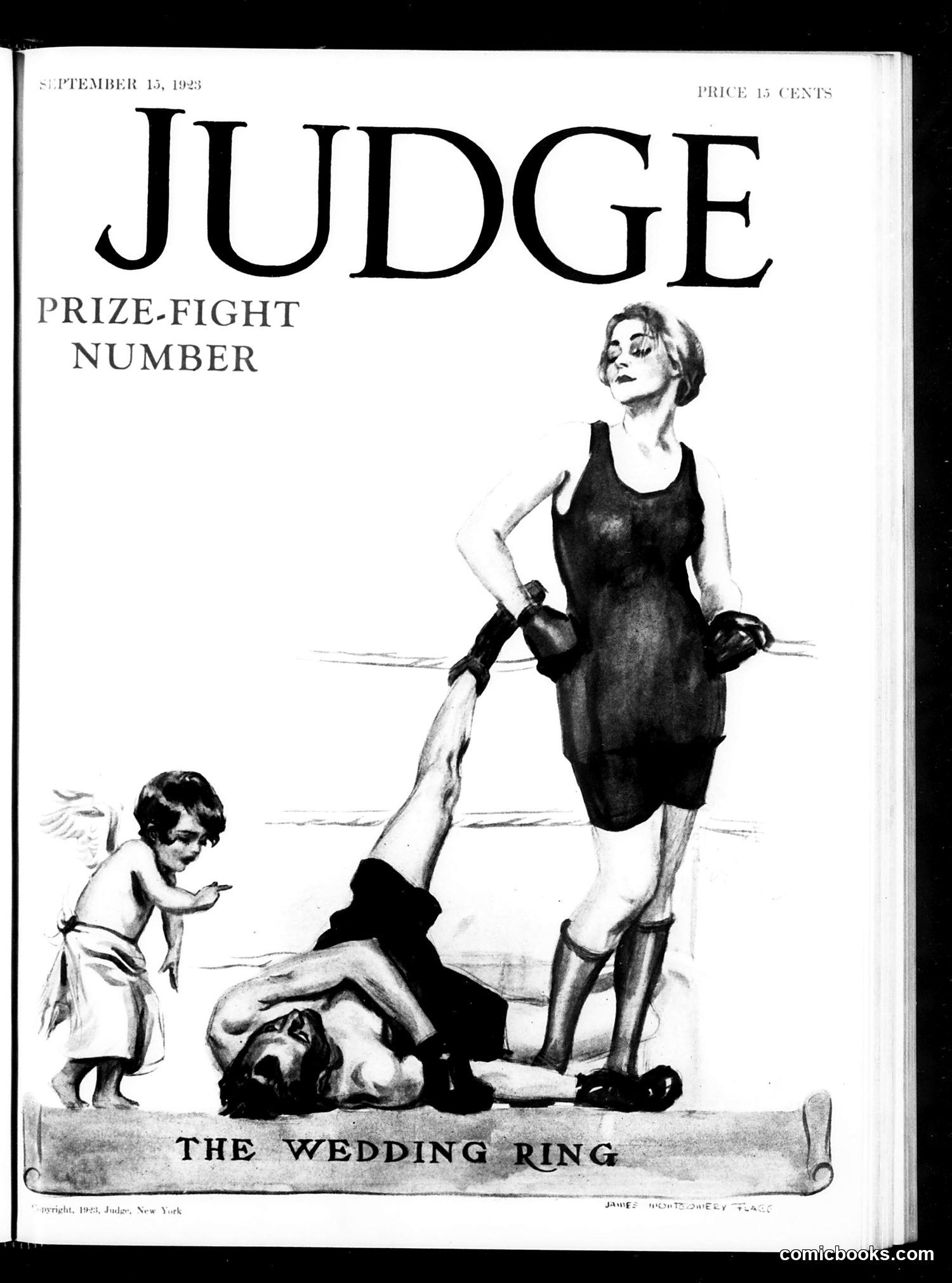
This is the cover illustration for Judge's "Prize-Fight Number." The cartoon depicts a boxing match with three figures: a standing woman in a boxing stance with gloves, a man knocked down on the canvas, and a small winged cupid (Cupid) observing the scene. The satire plays on "The Wedding Ring" as a double meaning—both a literal boxing ring and the marital commitment represented by a wedding ring. The joke appears to comment on the dynamics of marriage as combat, with the woman as the dominant fighter literally defeating her male opponent. This reflects 1920s anxieties about changing gender roles and the "New Woman" of the era, who had gained voting rights (1920) and greater independence, challenging traditional male authority in relationships.
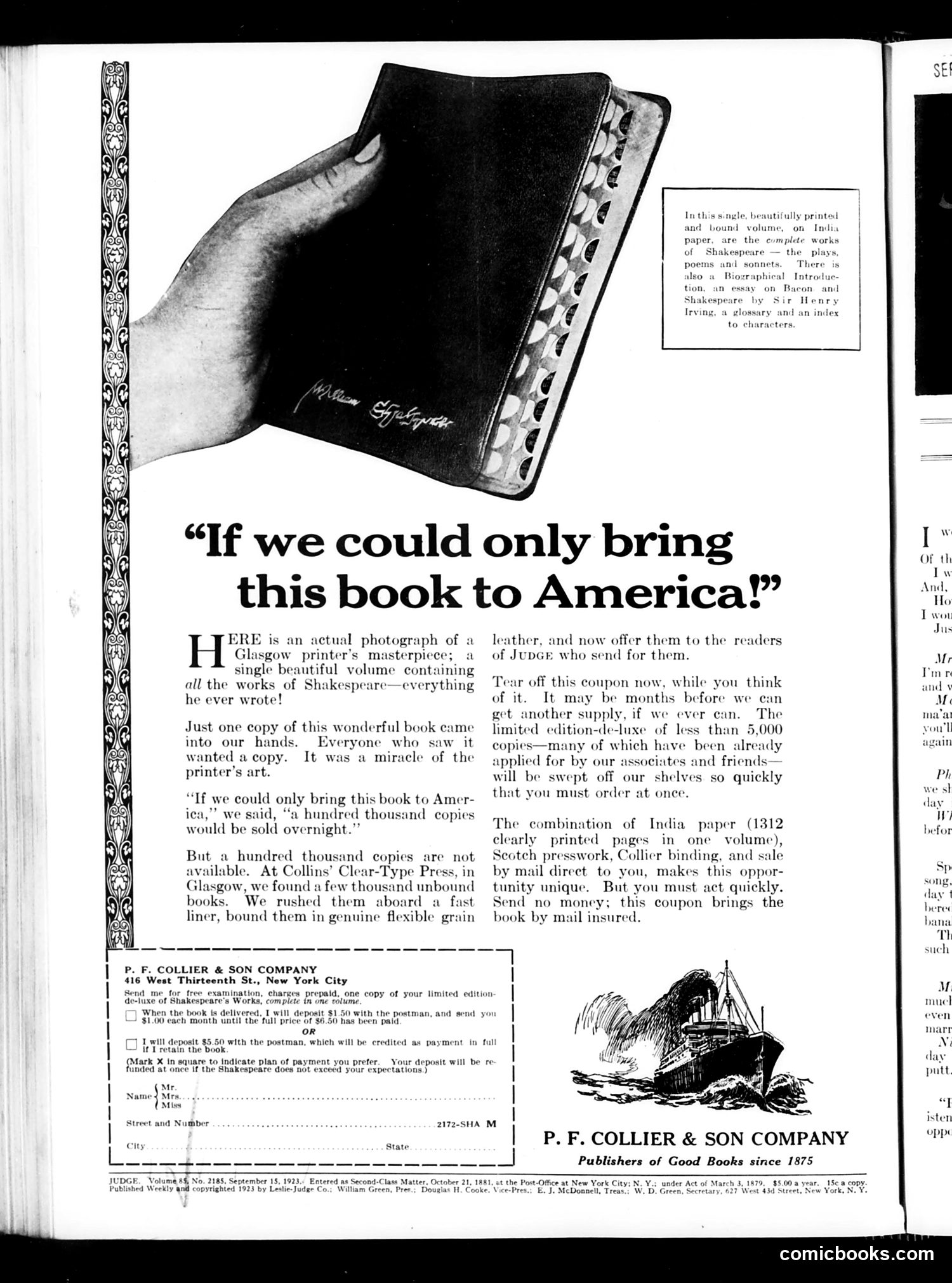
This page is primarily a **book advertisement**, not political satire. P.F. Collier & Son Company advertises a limited-edition complete Shakespeare volume printed in Glasgow. The headline "If we could only bring this book to America!" reflects the actual scarcity—only 100 copies exist, and demand far exceeded supply. The ad emphasizes exclusivity: India paper, Scottish presswork, leather binding, and extremely limited availability (fewer than 5,000 copies total). Readers could order via coupon with payment options ($1.50 deposit or full prepayment). The accompanying illustration shows a hand holding the leather-bound volume, designed to convey luxury and desirability. This represents straightforward aspirational advertising rather than political commentary or satire—typical premium book marketing from the 1920s.
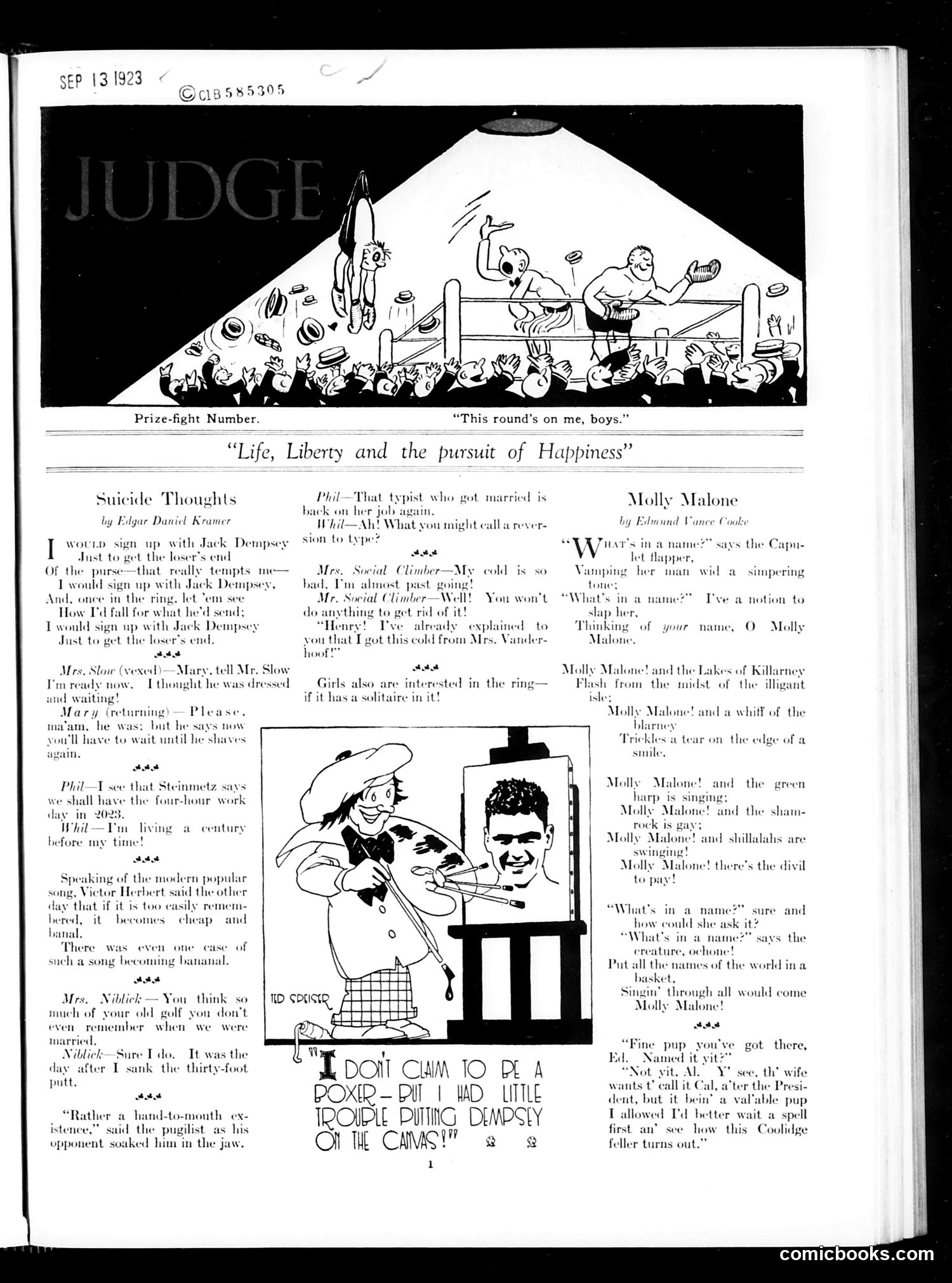
The page contains several humor columns and a central cartoon. The main cartoon depicts a woman artist painting a man's portrait, with the caption "I DON'T CLAIM TO BE A POKER-BUT I HAD LITTLE TROUBLE PUTTING DIMPLES ON THE CANVAS!!!" The joke satirizes amateur artists who flatter their subjects by adding idealized features (dimples) that weren't originally present—a commentary on vanity and dishonest portraiture. The surrounding text includes various humor segments about modern life: marriage anxieties, golf obsessions, and naming conventions. One segment mocks how easily popular songs become "banal." Overall, the page targets middle-class social pretensions and contemporary cultural trends of the 1920s, presented through light satirical commentary typical of Judge magazine's format.
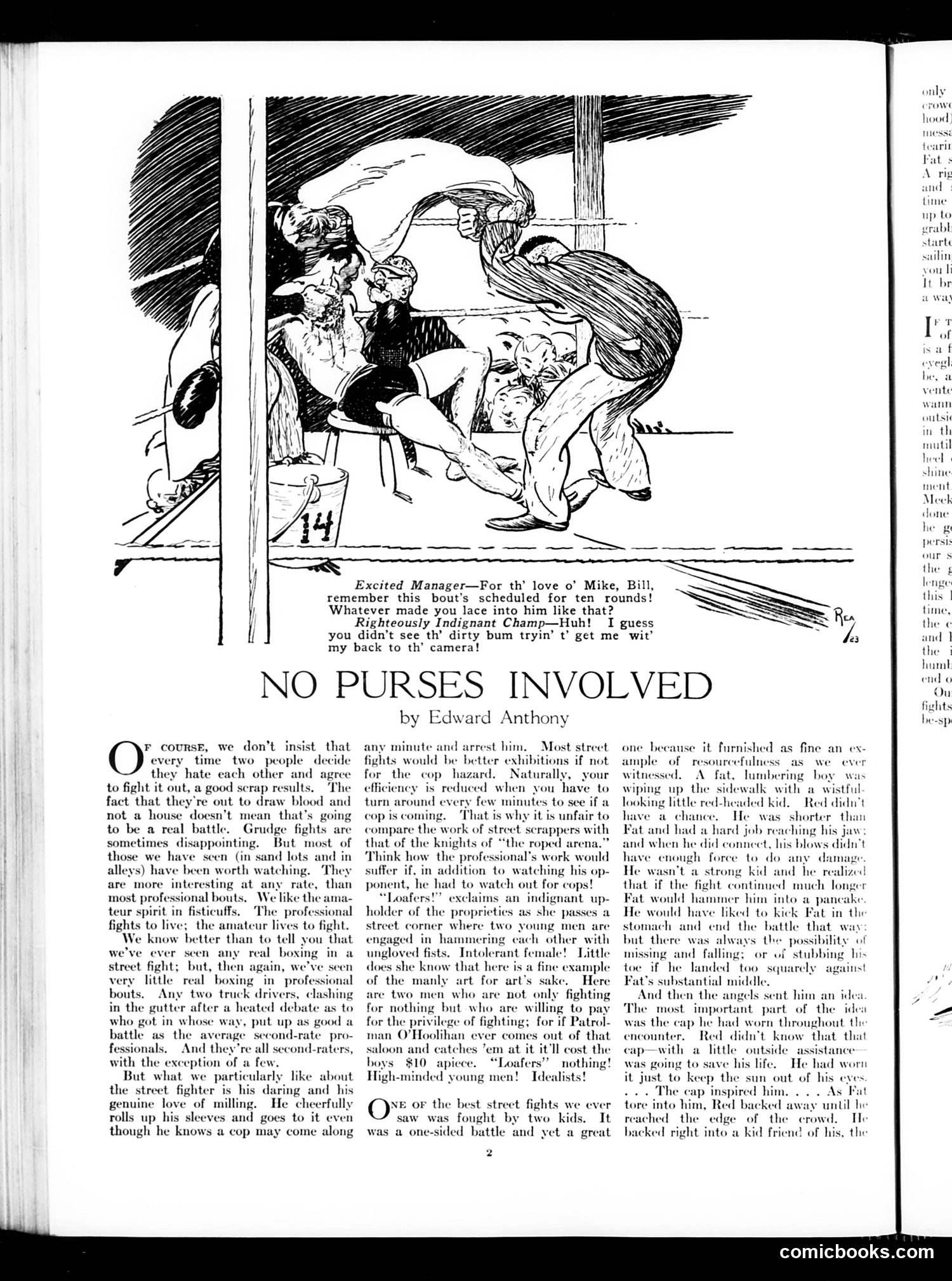
The cartoon and accompanying article satirize street fights among working-class men, contrasting them with professional boxing. The illustration shows a chaotic brawl outside what appears to be a tenement building, with onlookers watching from windows and doorways. Anthony argues that street fights, while unregulated and sometimes brutal, possess an authenticity and genuine spirit that professional boxing—which he suggests is commercialized and controlled—lacks. The title "No Purses Involved" emphasizes this distinction: street fighters compete for honor rather than money. The article celebrates the working-class fighter's genuine love of combat and milling, noting their willingness to fight without financial incentive. The satire critiques how professionalization and commercialization can diminish the authentic passion underlying competitive combat.
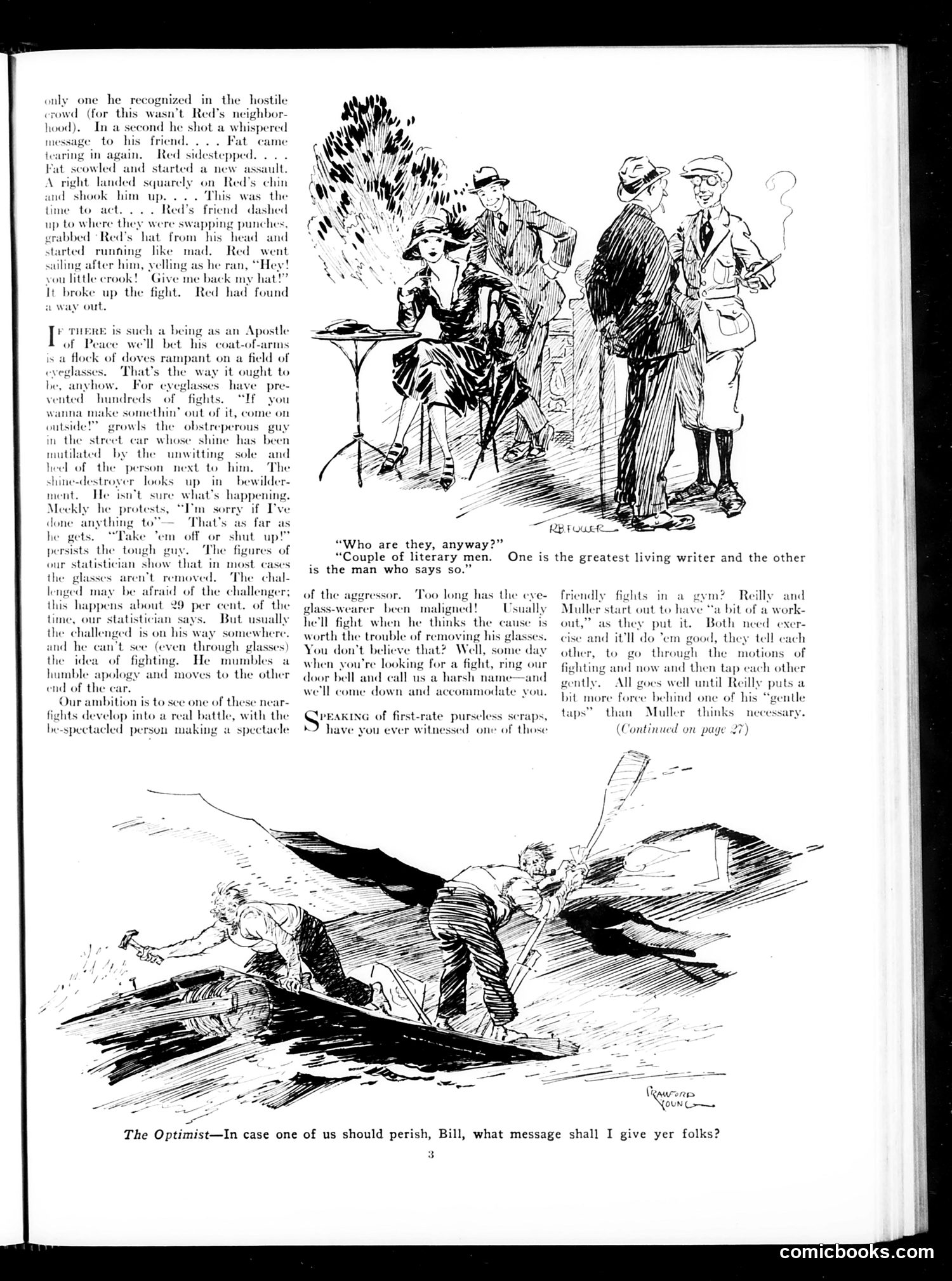
The upper cartoon depicts a street fight between two men, with onlookers gathering. The text indicates this is a dispute between "Red" and "Fat," with references to escalating violence and crowd involvement—a typical urban brawl scenario used for satire. The middle section discusses literary men and eyeglasses, suggesting commentary on intellectuals or writers of the era, though the specific reference is unclear. The lower cartoon, titled "The Optimist," shows figures in what appears to be a dangerous or catastrophic situation. One character asks another to deliver a final message "in case one of us should perish"—dark humor about mortality in a crisis situation. Both cartoons appear to satirize contemporary urban life and human nature through violent or precarious scenarios, typical of Judge's satirical approach.
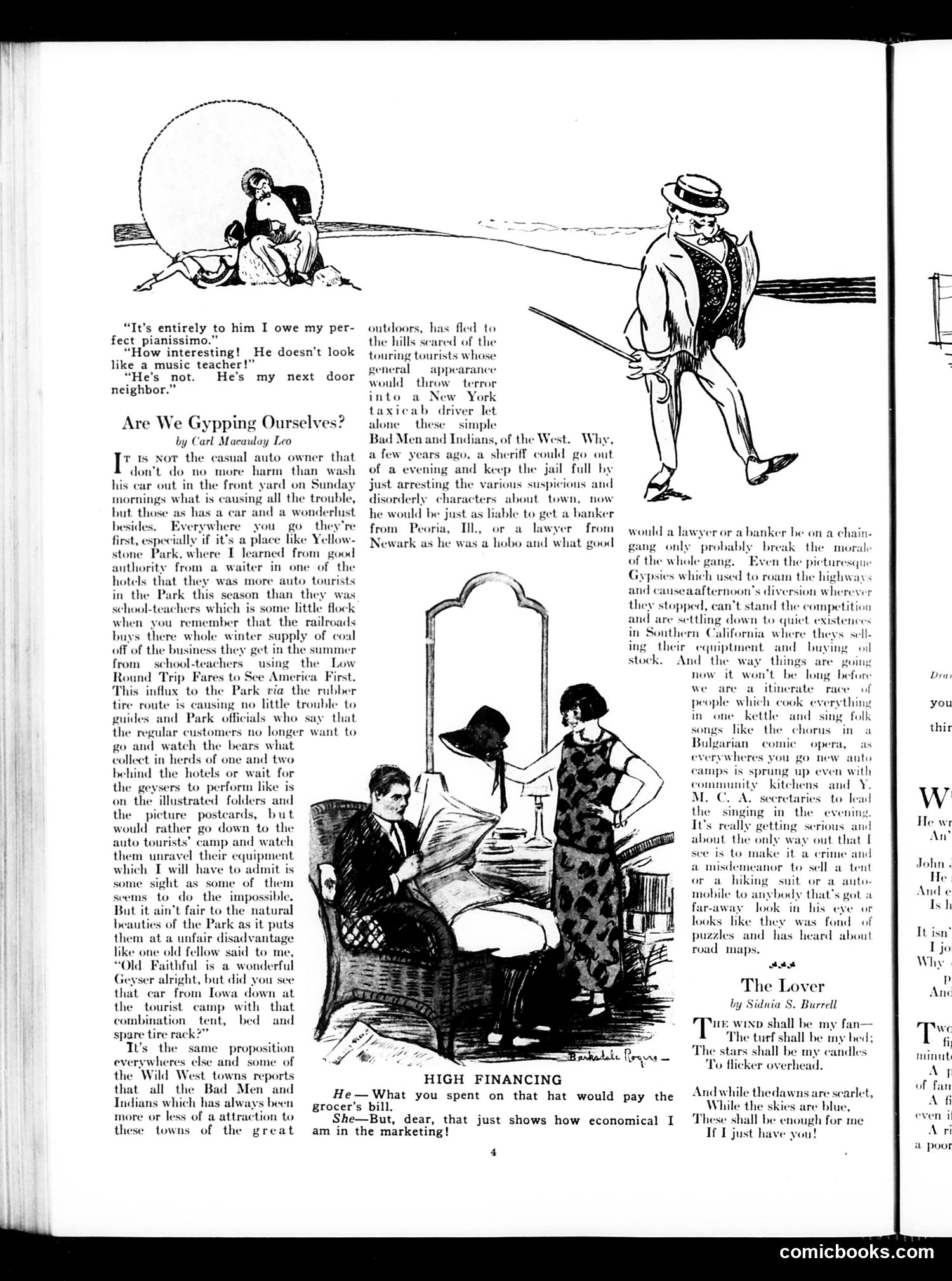
This article satirizes wealthy auto owners who complain about tourist traffic in Yellowstone Park, yet contribute to the very problem they resent. The piece mocks the hypocrisy: these car owners enjoy weekend drives through the park but object when "gypsy" tourists (a period term, often derogatory) do the same. The "High Financing" cartoon below depicts a couple discussing vacation expenses—she spent money he claims would pay a grocer's bill, yet she boasts about her "economical marketing." The satire targets consumer spending habits and domestic financial arguments during the Jazz Age, when automobile ownership and leisure travel were becoming middle-class luxuries, creating tension between aspiration and thrift.
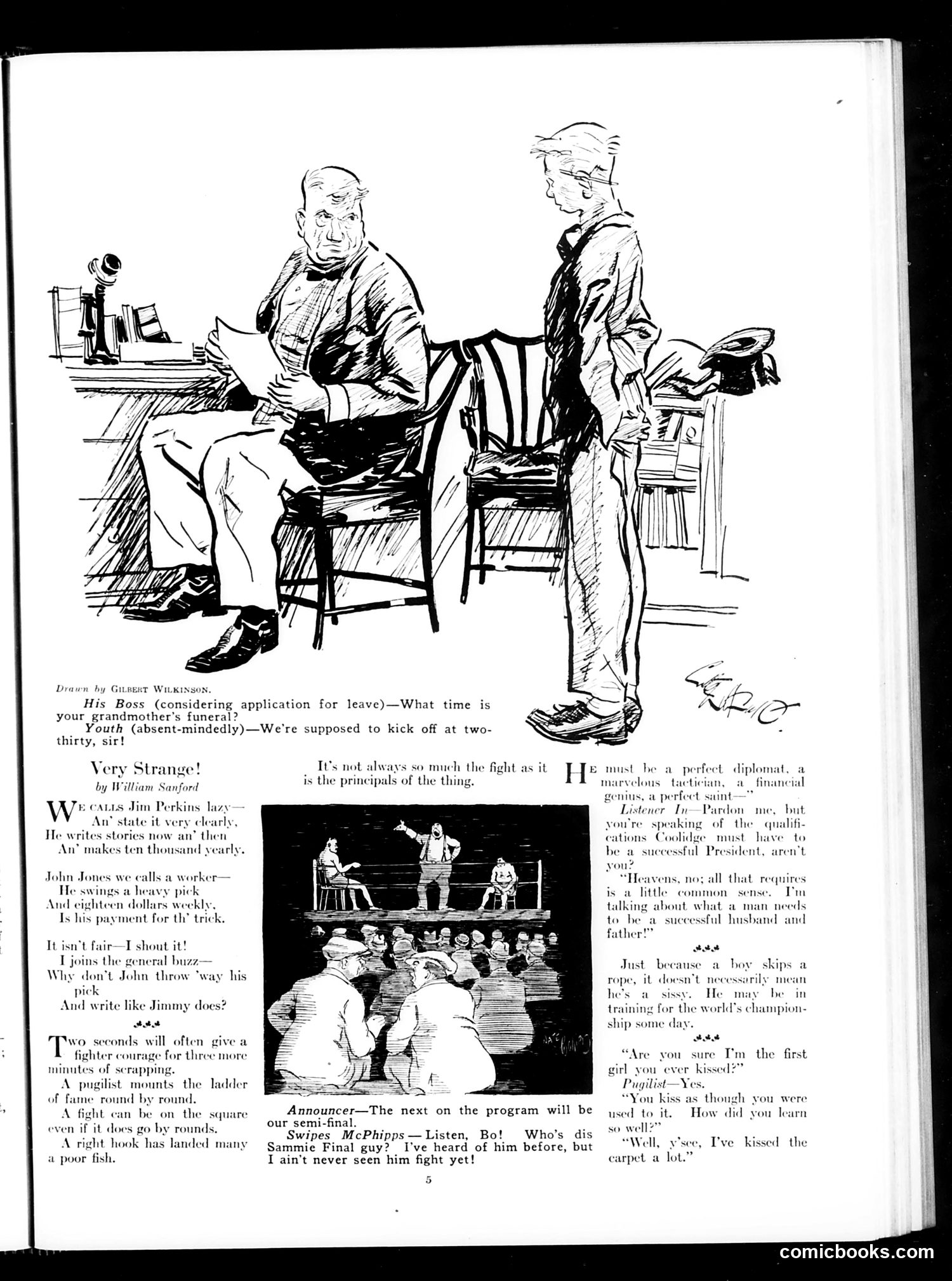
This page contains multiple satirical pieces typical of early 20th-century Judge magazine: **Top Cartoon (by Gilbert Wilkinson):** A boss asks a young employee about his grandmother's funeral time; the distracted youth replies "two-thirty, sir!"—confusing the funeral with a sports kickoff time. The satire mocks youth culture's obsession with athletics over family obligations. **"Very Strange!" (poem by William Sanford):** Satirizes economic inequality. Jim Perkins writes stories casually and earns $10,000 yearly, while John Jones works hard swinging a pick for only $18 weekly. The narrator questions why honest labor goes unrewarded while lazy writers prosper—a commentary on perceived injustice in American wages and opportunity. **Boxing/Sports Section:** Brief satirical observations about boxing and fighting, using sports metaphors. **Coolidge Reference:** A listener corrects someone discussing presidential qualifications—likely Calvin Coolidge, president 1923-1929—suggesting even a perfect diplomat couldn't succeed as president without basic sense. **Bottom Dialogue:** A flirtatious exchange about kissing, with mild sexual innuendo typical of period humor.
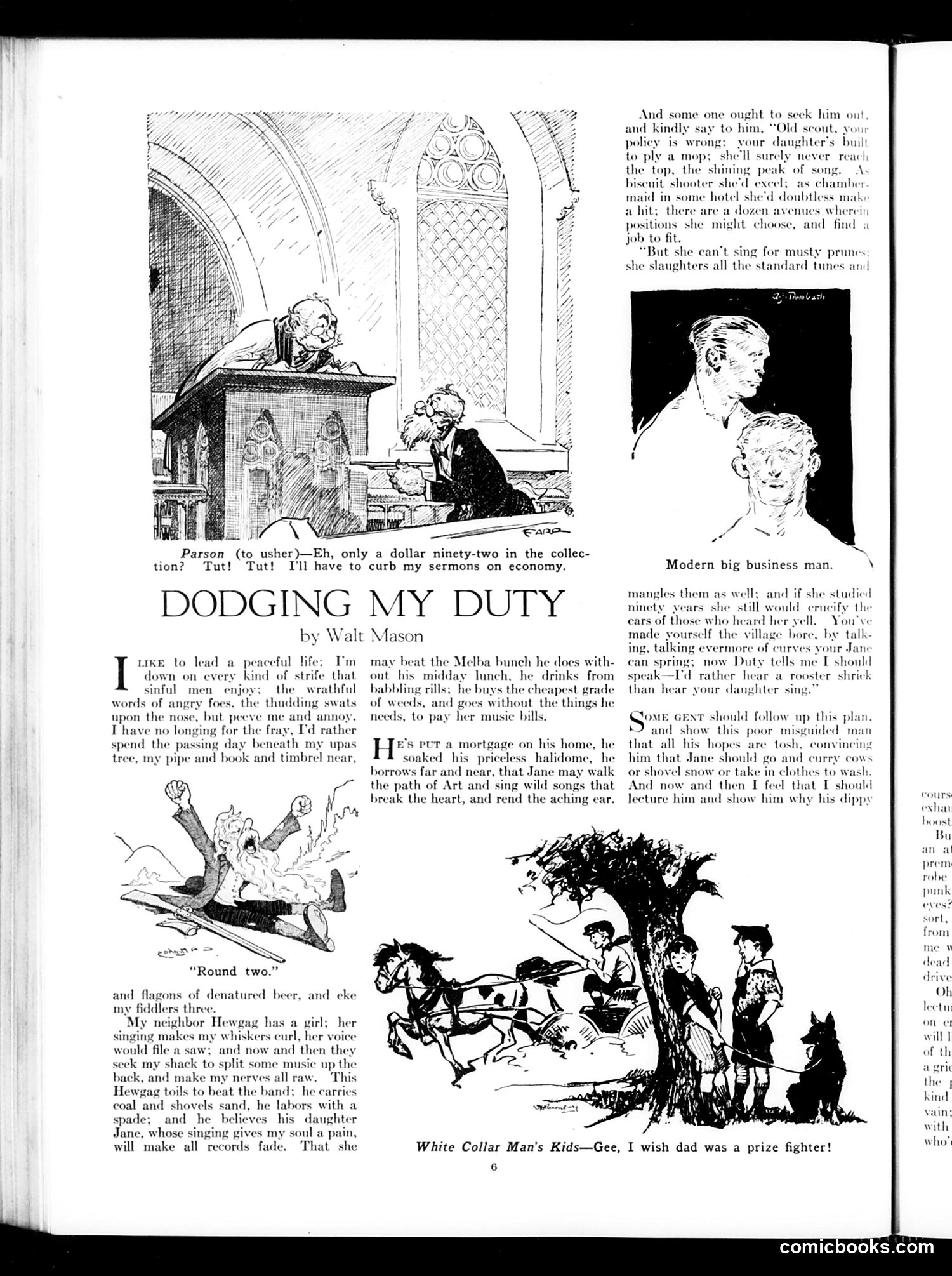
This satirical piece critiques middle-class parents who sacrifice everything for their children's unrealistic ambitions. The main story mocks neighbor Hewgag, who mortgages his home and denies himself basic necessities to fund his daughter's singing lessons—despite her having no genuine talent. The narrator acknowledges he should "lecture" Hewgag about this folly but avoids confrontation, thus "dodging his duty." The opening cartoon shows a parson complaining that donations have dropped to $1.92, forcing him to "curb sermons on economy"—mocking clergy who preach financial restraint while resenting reduced congregant wealth. The final cartoon, "White Collar Man's Kids," depicts children wishing their father were a prize fighter rather than an office worker, suggesting resentment of white-collar respectability and modest means. Together, these pieces satirize early 20th-century anxieties about social aspiration, parental overindulgence, and the gap between ambition and realistic prospects.
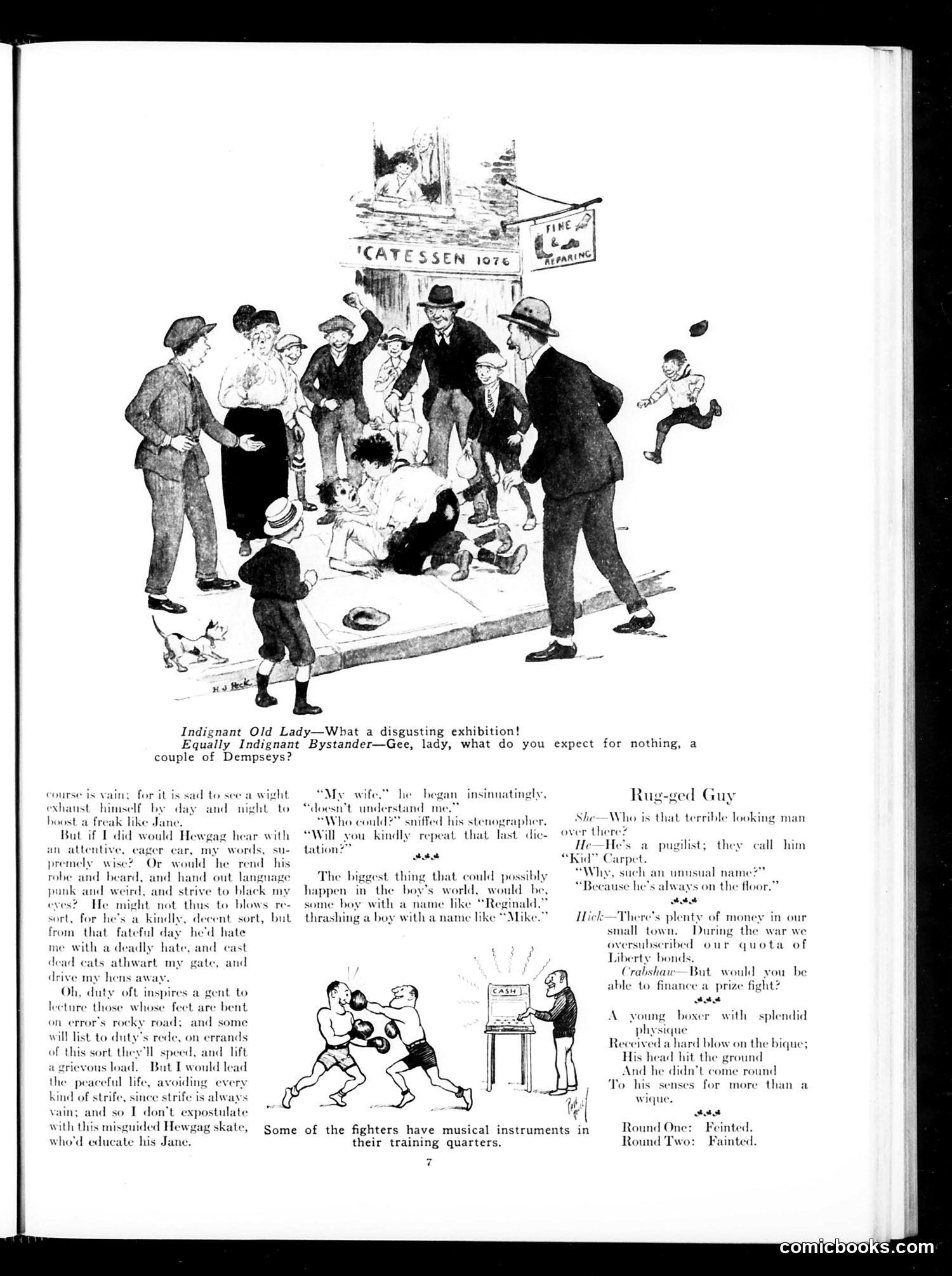
This page from *Judge* magazine contains multiple satirical pieces about boxing and fighting, likely from the 1920s (given the "Dempsey" reference, probably Jack Dempsey, heavyweight champion). **Main cartoon (top):** An "Indignant Old Lady" complains about a "disgusting exhibition"—likely a street fight or boxing match. The bystander's response jokes that she shouldn't expect quality entertainment ("a couple of Dempseys") for free, sarcastically suggesting even famous boxers wouldn't perform without payment. **Sidebar humor pieces** mock boxing culture: - "Rug-ged Guy": A pun on a pugilist nicknamed "Kid Carpet" because he's always knocked down ("on the floor") - "Hick": A small-town boast about war bonds, questioned whether they could afford a prizefight - A limerick mocking a boxer's weak chin **Overall point:** The satire ridicules both the popularity of boxing as public entertainment and the absurdity of amateur street fights being treated seriously by onlookers.
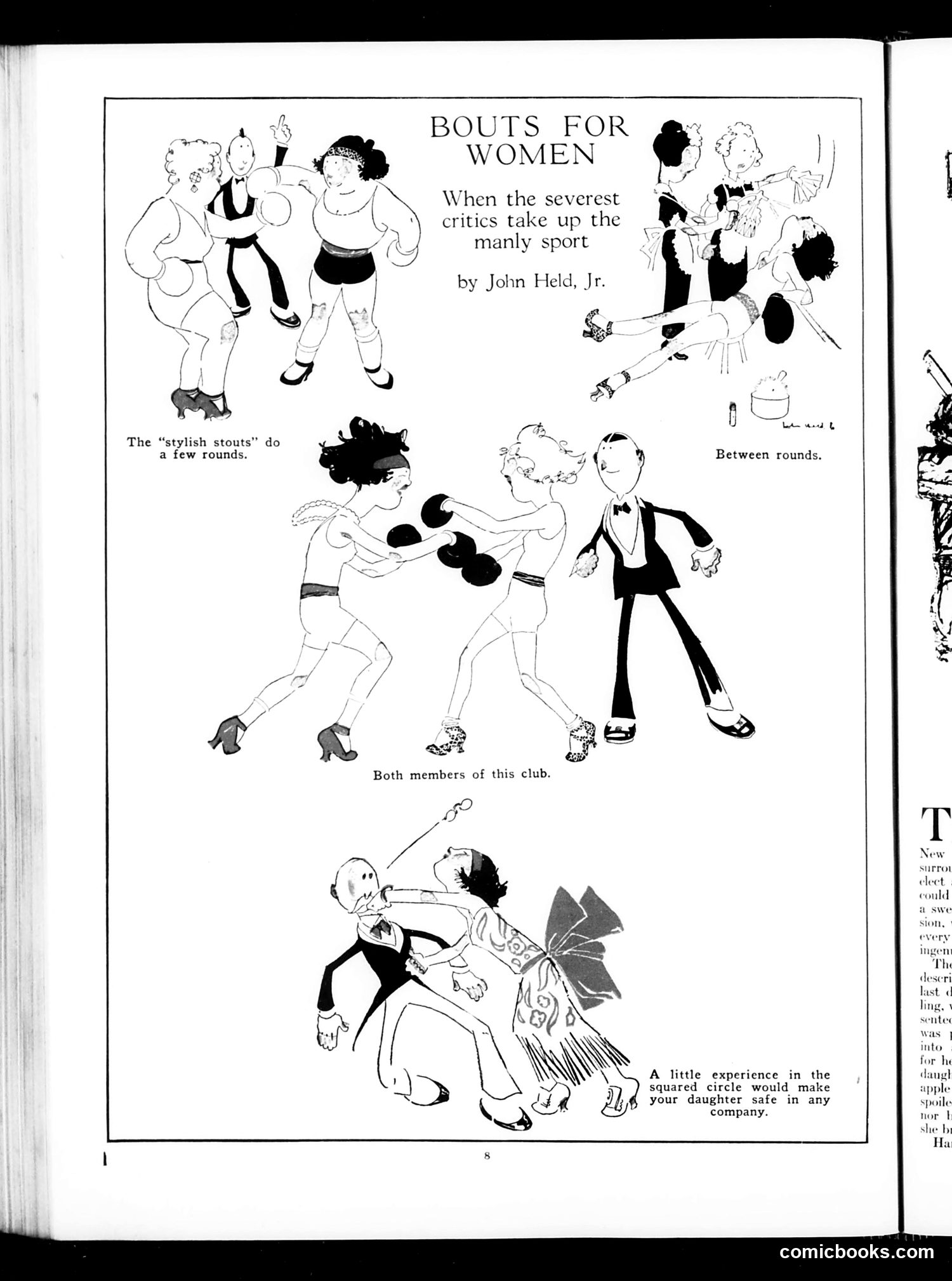
This satirical cartoon mocks the emerging phenomenon of women's boxing in the 1920s-30s. The piece presents exaggerated female boxers—caricatured as overweight, unfashionable "stylish stouts"—participating in what was then considered an exclusively masculine sport. The humor targets both women who boxed and critics who opposed the practice. The caption's ironic framing ("When the severest critics take up the manly sport") suggests the satire cuts both ways: poking fun at women entering boxing while also mocking the hypocrisy of male critics who might secretly participate. The final panel's tongue-in-cheek suggestion that boxing training would make "your daughter safe in any company" plays on contemporary anxieties about women's independence and changing gender roles. The cartoon reflects early 20th-century resistance to women participating in athletic, "unfeminine" activities—presenting female boxers as objects of ridicule rather than serious athletes.
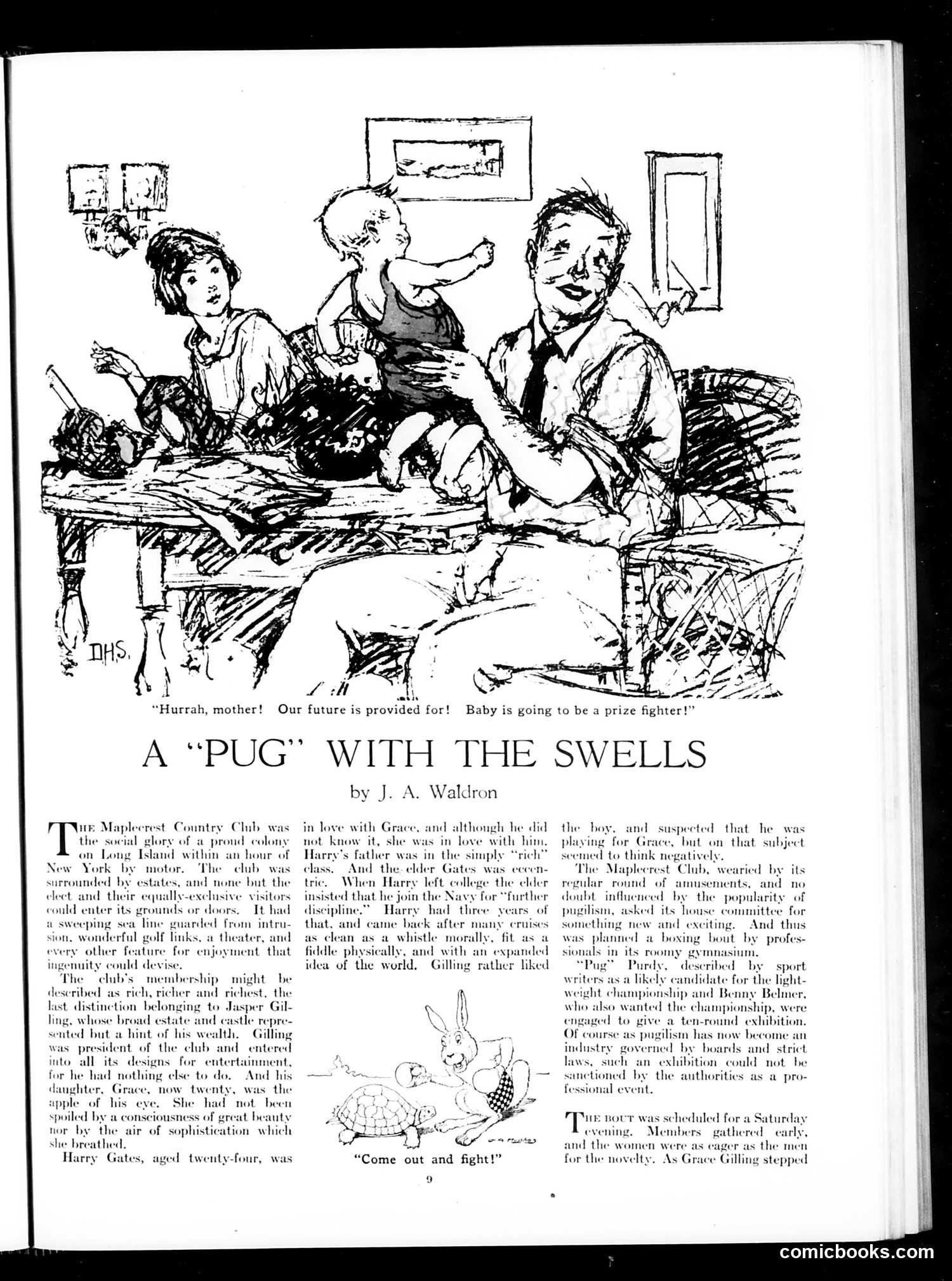
This is a short story (not a political cartoon) satirizing wealthy Long Island society's pretensions and boredom. The "pug" (slang for boxer) refers to "Pug" Purdy, a professional fighter hired to entertain the elite Maplecrest Country Club. The satire targets the idle rich: they're so disconnected from real life that they must import crude entertainment (boxing) to escape ennui. The opening illustration shows the punchline—a child announces the baby will be "a prize fighter," mocking the social climbing and aspirational absurdity of wealthy families. The story involves class tensions: Harry Gates (middle-class naval officer) pursues Grace Gilling (wealthy heiress), while the club seeks novelty through professional pugilism—an activity considered morally questionable for "respectable" society, yet adopted for entertainment. The satire suggests wealth breeds disconnection, superficiality, and the ironic embrace of lowbrow culture as exotic amusement.
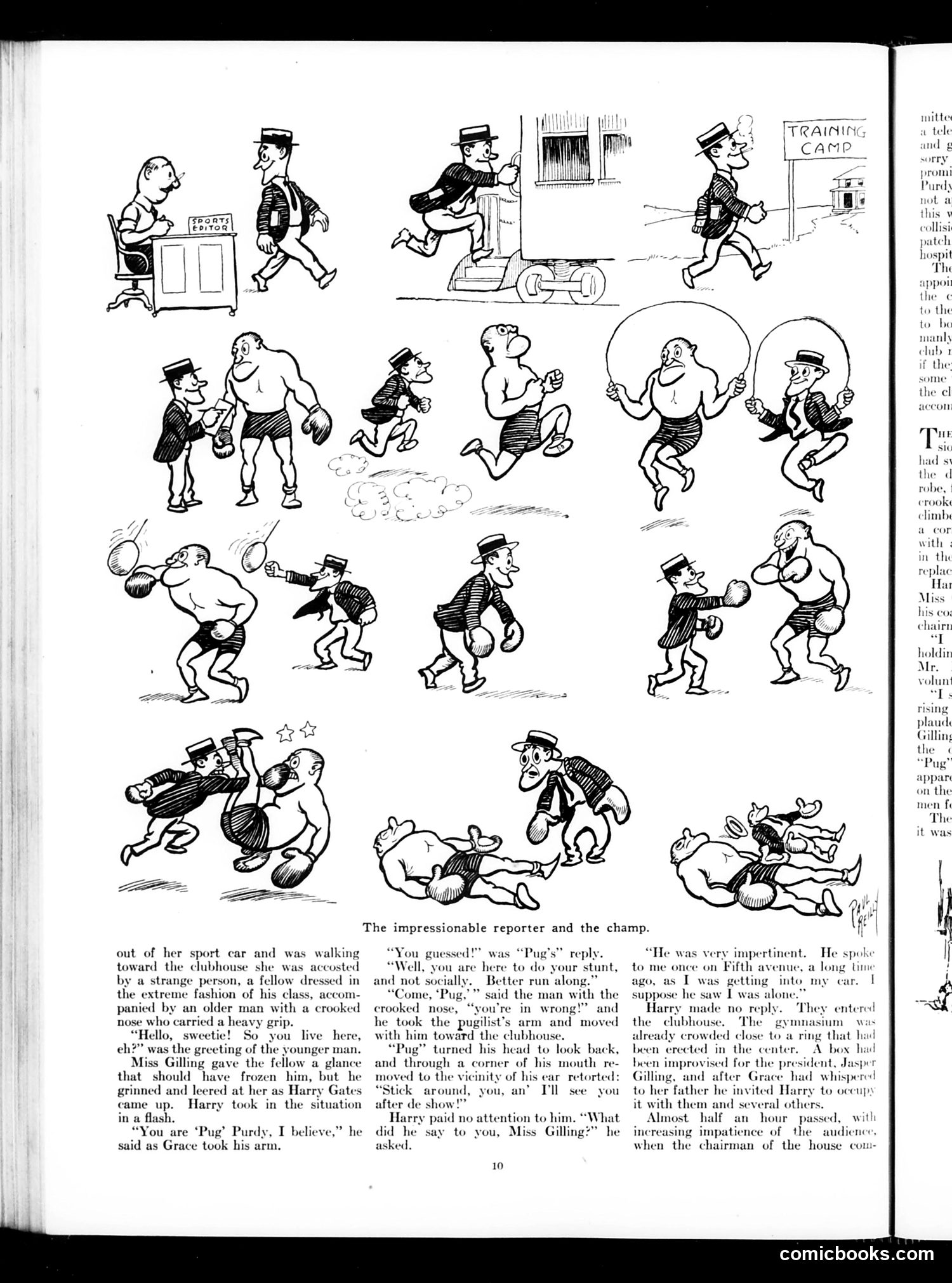
This appears to be a humorous story sequence from an early 20th-century Judge magazine about a boxing match event. The narrative depicts an encounter between "Pug" Purdy (a boxer, indicated by the caricatured physical exaggeration), a sports reporter named Harry Gates, and a young woman, Miss Gilling. The joke centers on Purdy's crude behavior and lower-class manners—he's dressed in exaggerated "extreme fashion of his class" and speaks with poor grammar ("I'll see you after de show"). The satire mocks both the boxer's lack of refinement and the "impressionable reporter's" fascination with athletic celebrities. The cartoons illustrate physical comedy typical of the era: boxing training routines, jumping rope, and physical altercations. The humor derives from class contrast and the period's fascination with prizefighting as entertainment, portraying boxers as uncouth but colorful characters worthy of journalistic attention.
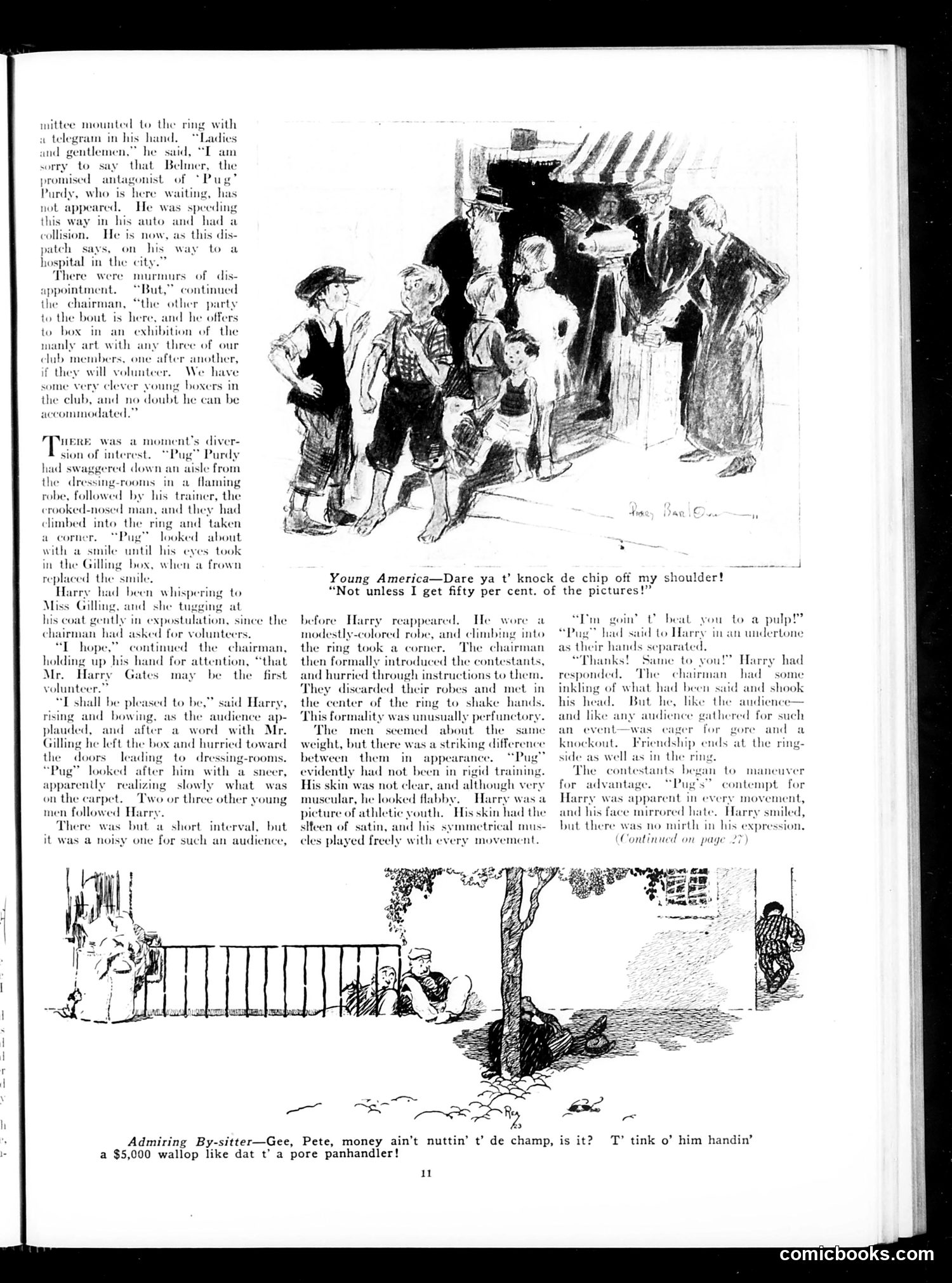
This page depicts a boxing exhibition match at a club. "Pug" Purdy, the advertised fighter, arrives late from an auto accident. When he spots Harry Gates (a club member volunteering as his opponent) sitting with Miss Gilling, Pug becomes visibly angry—apparently Harry is his romantic rival. **The satire:** The cartoons mock the spectacle of amateur boxing exhibitions and class pretensions. The upper illustration shows the contrasting fighters: Pug is out-of-shape and flabby despite his reputation, while Harry is athletically superior. Their animosity is personal, not professional. The lower cartoon comments on wealth disparity: wealthy spectators casually discuss a "$5,000 wallop" (expensive punch) being handed to a "pore panhandler"—satirizing how the rich treat money carelessly while poor people struggle. The satire criticizes both boxing's manufactured drama and the socioeconomic gap in early 20th-century America.
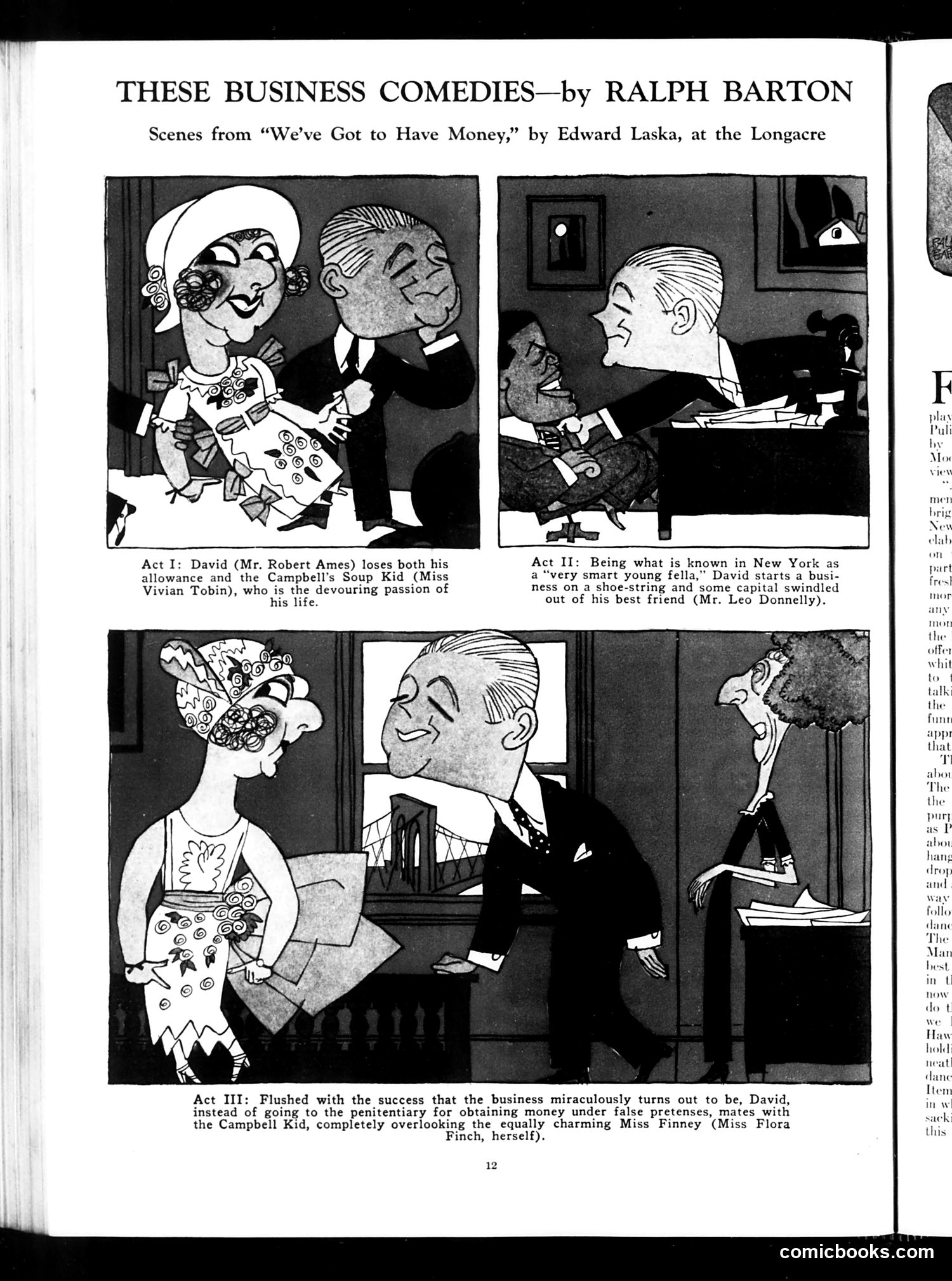
This page illustrates scenes from a 1920s Broadway comedy by Edward Laska, drawn by cartoonist Ralph Barton. The play satirizes American business culture and moral compromise. The plot follows David, a young man who loses his allowance and his girlfriend (nicknamed "the Campbell's Soup Kid"). Desperate, he starts a business by swindling capital from his best friend. Remarkably, the venture succeeds. Rather than face prison for fraud, David marries the Campbell Kid, ignoring another woman (Miss Finney) who apparently deserves better. The satire targets the era's get-rich-quick schemes and the casual ethics of young businessmen—how dishonest ventures could succeed, and how material success could excuse moral failings. The exaggerated caricatures emphasize greed and self-interest. This reflects 1920s anxieties about business culture during the Jazz Age boom.
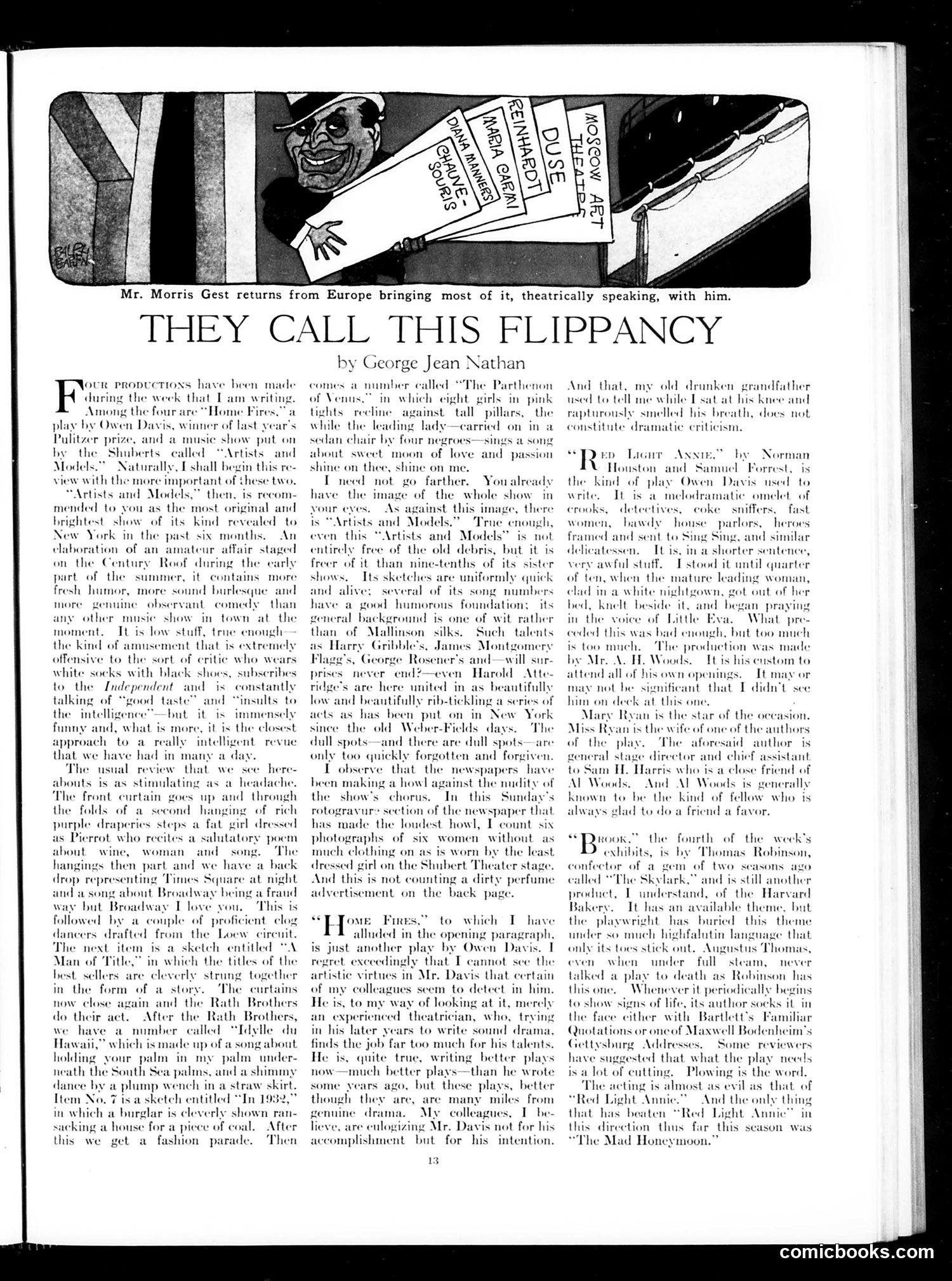
## The Cartoon The top image depicts **Morris Gest**, a prominent theater impresario, returning from Europe with theatrical productions under his arm. The exaggerated caricature suggests Gest is bringing European theatrical pretensions back to America. The satire: he's arriving with grand artistic aspirations, depicted somewhat mockingly. ## The Article Theater critic **George Jean Nathan** reviews recent Broadway productions, particularly praising the musical "Artists and Models" (by the Shuberts) as surprisingly intelligent entertainment, despite being lowbrow comedy. He contrasts it favorably with other shows, including Owen Davis's "Home Fire." Nathan mocks censorious critics ("white socks with black shoes" types) who object to the show's nudity and "vulgarity," while defending the production's genuine humor and wit. The article's title "They Call This Flippancy" suggests contemporary critics dismissed such entertainment as frivolous—a dismissal Nathan disputes. The satire targets both pretentious theatrical gatekeepers and the hypocrisy of newspapers simultaneously condemning chorus nudity while printing photographs of scantily-clad women.
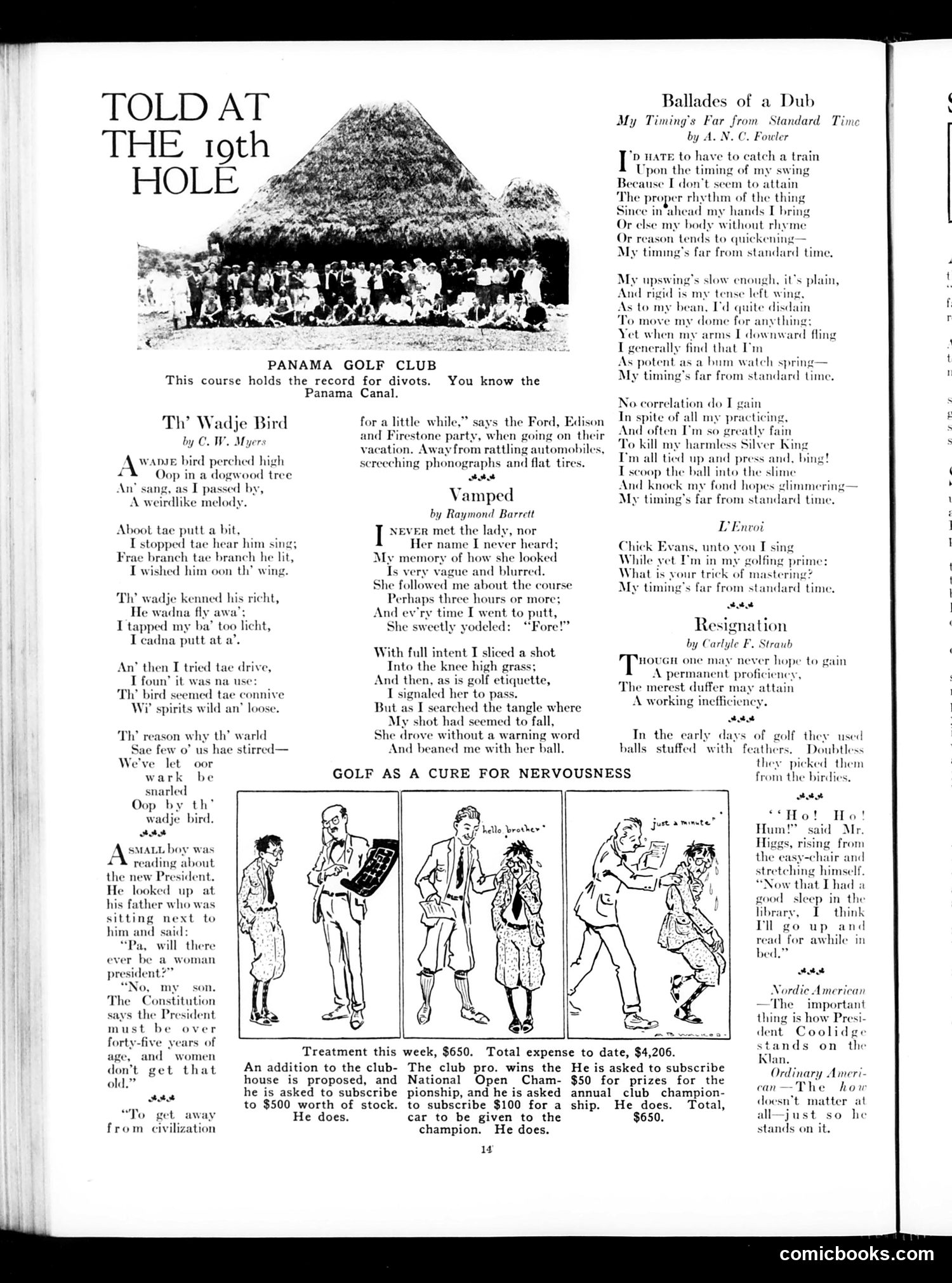
This page from *Judge* magazine contains several golf-themed pieces satirizing early 20th-century American leisure culture. **"Told at the 19th Hole"** features a humorous cartoon about the Panama Golf Club, which apparently holds a record for divots (torn turf). The joke references the Panama Canal—a major contemporary engineering project—implying this golf course is equally destructive. **The poems and stories** mock golfers' obsessions and poor technique. "The Wadge Bird" uses Scottish dialect to describe a bird that interferes with a golfer's game, personifying nature's mockery of human pursuits. Other verses like "Ballades of a Dub" (dub = poor golfer) complain about timing and technique in self-deprecating humor. **"Golf as a Cure for Nervousness"** (the comic strip) satirizes wealthy businessmen using golf as supposed medical treatment—the irony being the expensive "cure" causes more stress than relief. **The small anecdote** about a boy and his father joking about a female president reflects 1920s gender attitudes as throwaway humor. Overall, the page mocks golf culture as an expensive, frustrating obsession among the affluent.
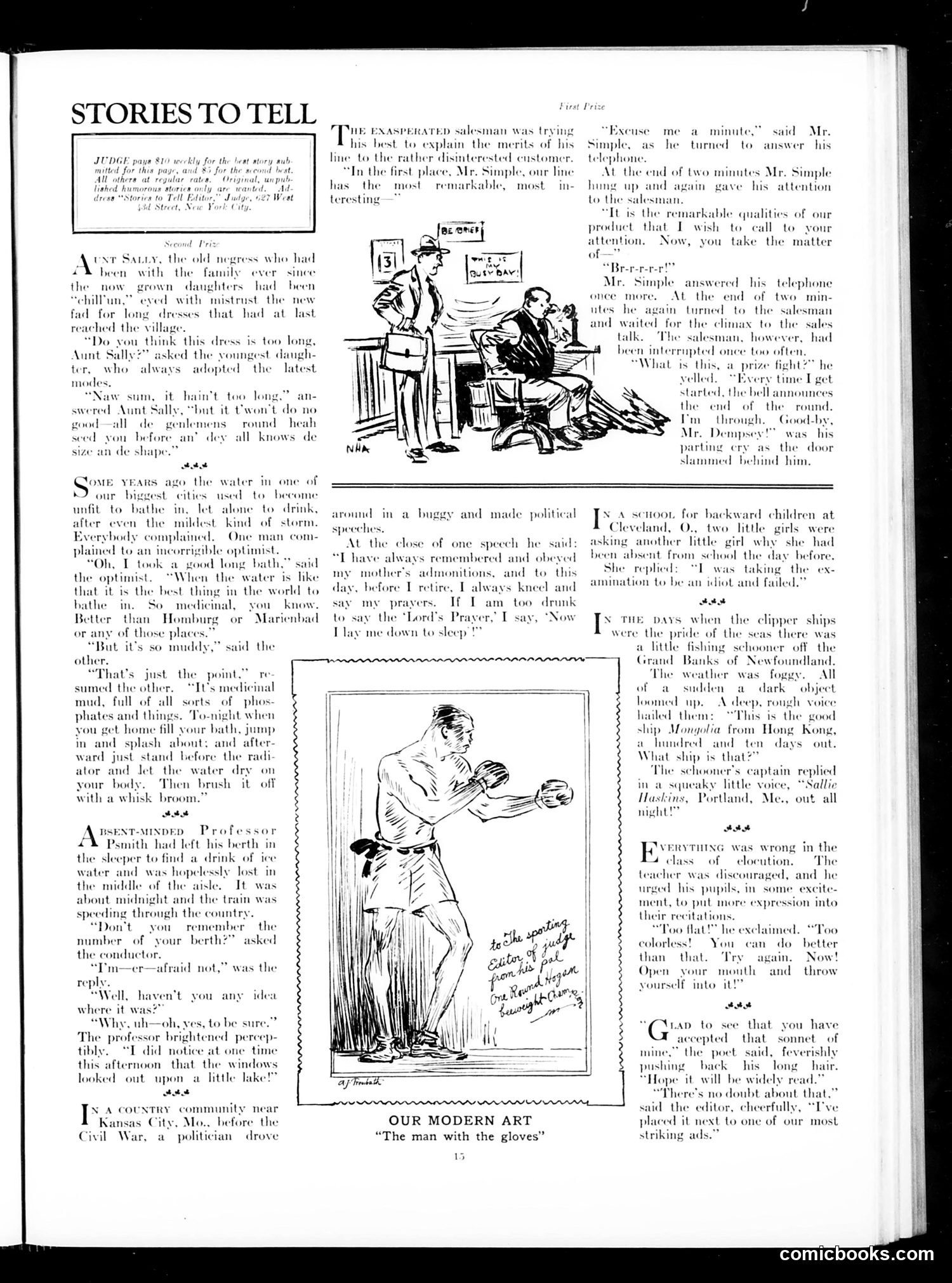
This page collects brief humorous anecdotes typical of Judge's "Stories to Tell" section. The content includes: **Aunt Sally Story**: Uses a Black domestic servant character (common in this era's humor) commenting on fashion—her observation that long dresses are unflattering employs racial dialect humor popular at the time. **The Optimist**: Satirizes toxic positivity through a character finding medicinal benefits in muddy bath water, mocking self-help culture. **Professor Psmith Cartoon**: Illustrates absent-mindedness—a lost train passenger can't remember his berth number but recalls seeing a lake, poking fun at selective memory. **Salesman Story**: Mocks both persistent salesmen and modern interruptions (telephone calls), depicting a frustrated salesman comparing his client to boxer Jack Dempsey for constantly breaking his pitch. **Minor anecdotes**: Include political hypocrisy (a politician's drunken prayer) and children's school humor. The cartoons and stories reflect early 20th-century American humor: racial stereotypes, sarcasm about modern conveniences, and gentle mockery of human foibles.
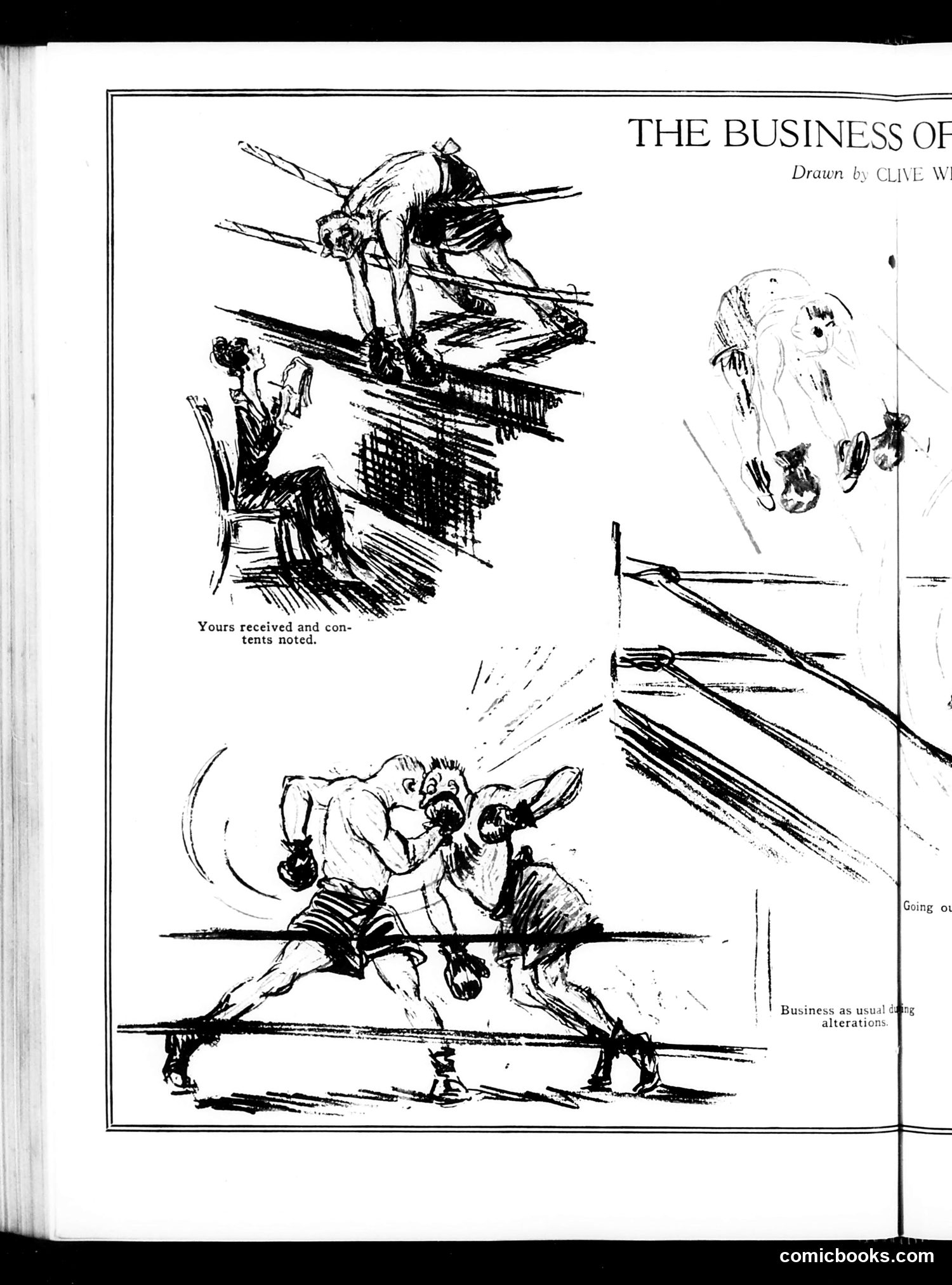
This appears to be a satirical cartoon about business continuity during wartime or crisis. The page shows three sketches: 1. **Top left**: A figure receiving correspondence ("Yours received and contents noted") 2. **Bottom**: Two figures engaged in boxing/fighting, suggesting conflict or struggle 3. **Right side**: References to "Going on" and "Business as usual during alterations" The satire seems to mock the notion that business operations continue normally despite significant disruptions—depicted here through violent conflict imagery. The phrase "alterations" is likely euphemistic understatement for serious upheaval. The boxing match illustrates the contradiction: claiming "business as usual" while literally fighting suggests ironic commentary on how institutions or commerce adapt superficially while chaos unfolds beneath. The artist is credited as "CLIVE W[illiam]" (name cut off).
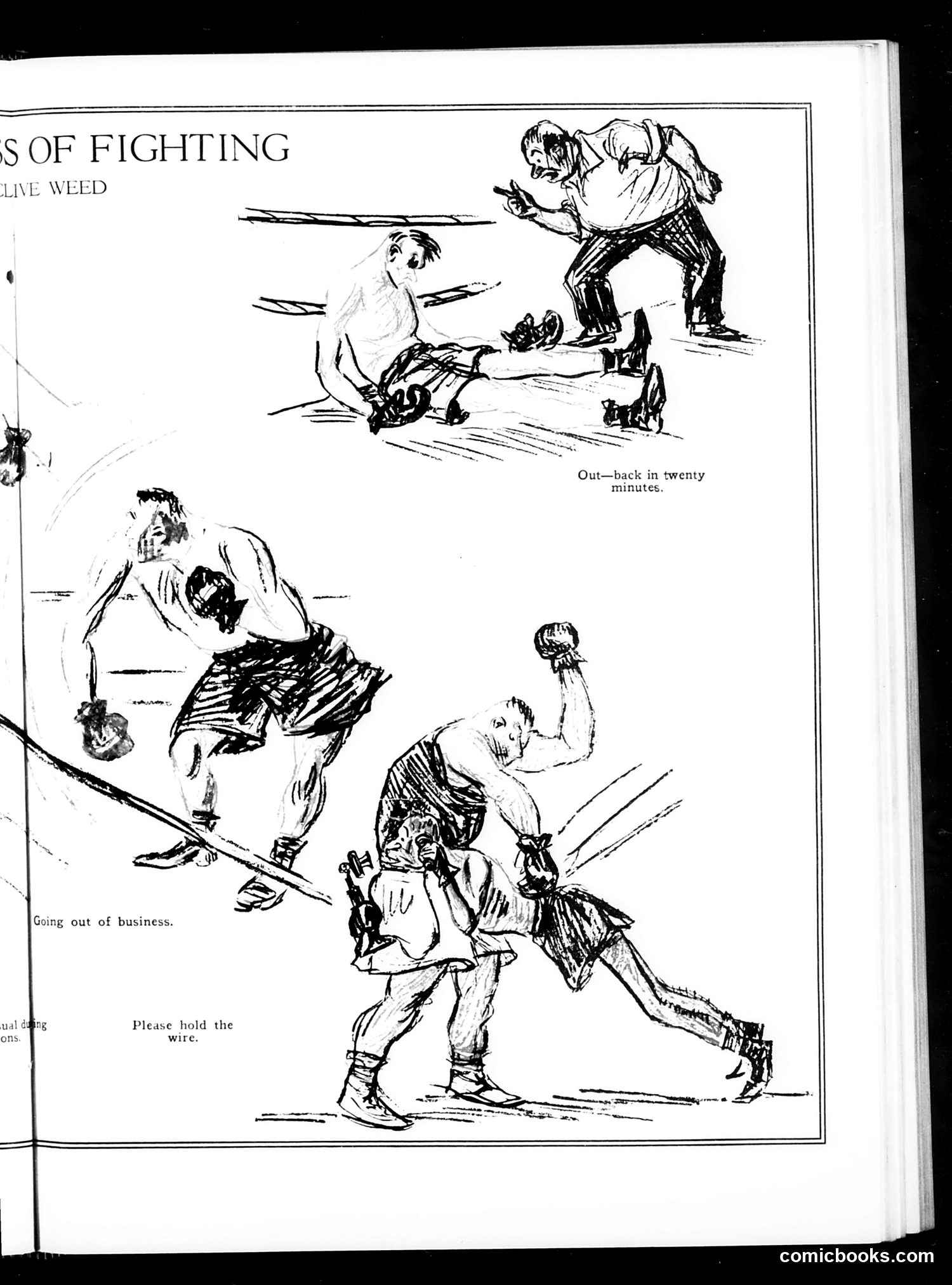
This page from *Judge* presents three cartoon panels depicting fighting techniques, likely instructional or comedic in nature. The sketches show figures engaged in various combat poses with minimal clothing, drawn in a loose, energetic style typical of early satirical magazines. The captions—"Out—back in twenty minutes," "Going out of business," and "Please hold the wire"—appear to be humorous commentary, though their exact satirical targets remain unclear without fuller context. The phrase "Going out of business" suggests possible economic or commercial satire. The page header references "Live Weed," which may indicate a specific article or series topic, but its meaning isn't evident from the image alone. Without additional historical documentation, the specific political or social references this satirizes cannot be determined with certainty.
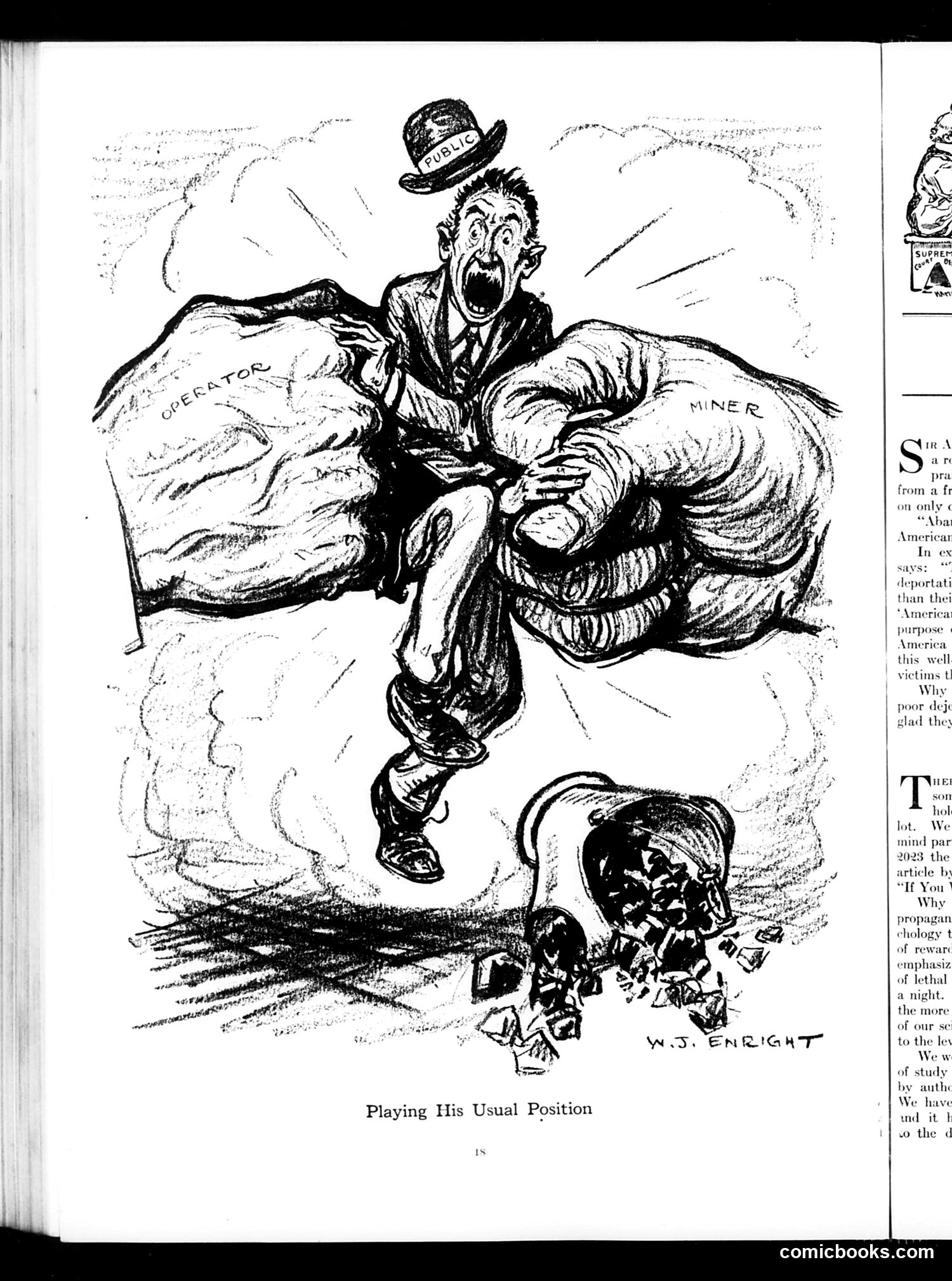
This cartoon by W.J. Enright satirizes a figure labeled "PUBLIC" (visible on the hat) who is being squeezed between two large hands labeled "OPERATOR" and "MINER." The man appears distressed and is being wrung out like a cloth, with money or valuables spilling from below into a bucket. The satire critiques **exploitative labor relations** during America's mining industry era. The "Public" represents ordinary citizens caught between competing interests: mine operators (owners/management) and miners (workers). Both groups are portrayed as literally squeezing profit from the public, who suffer the consequences. The cartoon's title, "Playing His Usual Position," suggests this squeeze is the public's typical, unavoidable role in the economy. This reflects early 20th-century American labor tensions and public anger at how industrial disputes harmed average people.
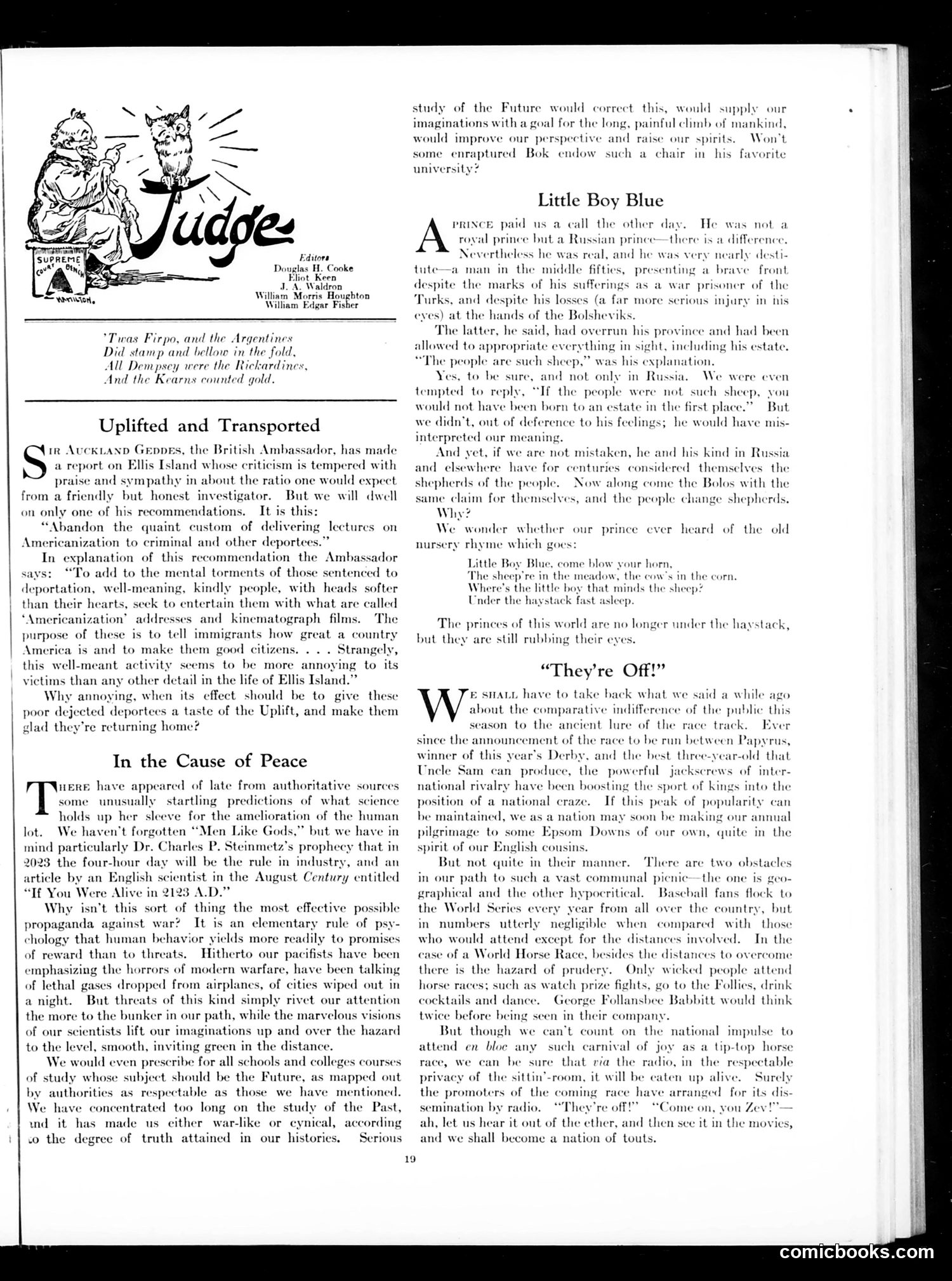
## The "Judge" Masthead Cartoon The small illustration shows a figure pointing at a cat or fox—likely satirizing judicial authority or social criticism with a whimsical tone typical of Judge's approach. ## Key Articles and Their Satire **"Uplifted and Transported"**: Mocks the U.S. practice of lecturing deported immigrants about American greatness while sending them away. The satire is that authorities force "Americanization" propaganda on people being expelled—the irony being this makes deportation *more* insulting, not rehabilitative. **"In the Cause of Peace"**: Argues that teaching optimistic visions of the technological future (four-hour workdays by 2028, flying cars by 2123) would be better anti-war propaganda than showing warfare's horrors. The piece suggests inspiring hope works better than fear. **"Little Boy Blue"**: A sympathetic anecdote about a destitute Russian prince visiting, who lost everything to Bolsheviks. The title echoes the nursery rhyme, suggesting his ruined status as both aristocratic and pitiful. The page reflects 1920s American concerns: immigration policy, post-war pacifism, and Cold War-era skepticism toward communism.
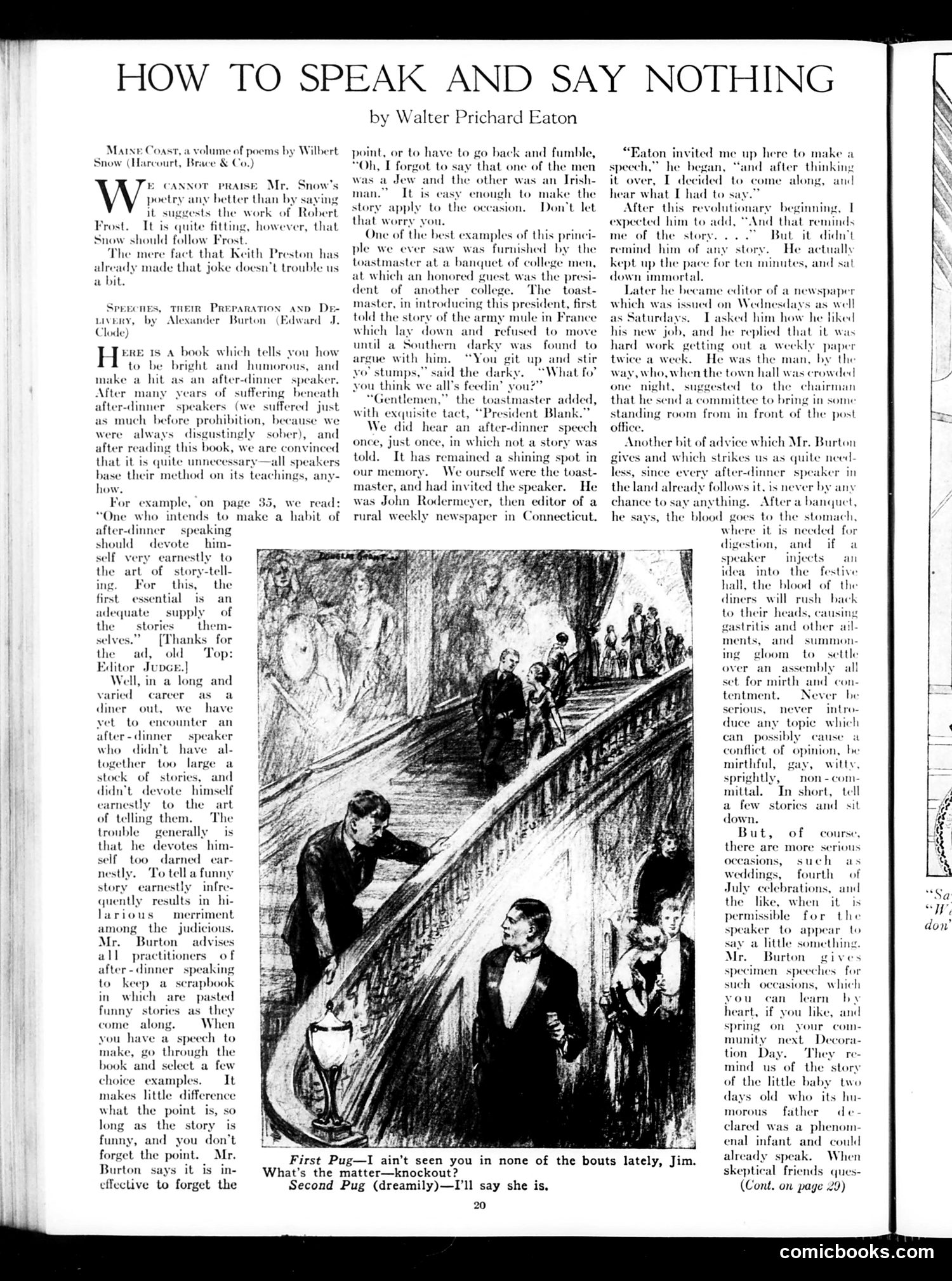
This is a satirical book review by Walter Prichard Eaton critiquing Alexander Burton's guide on after-dinner speaking. The central joke mocks the absurdity of Burton's advice that speakers should memorize funny stories and deploy them regardless of relevance to the occasion or audience. Eaton illustrates this principle with a devastating real example: a college banquet toastmaster introduces the president of another college by first telling a lengthy, pointless story about a mule in France, then simply adds "President Blank" as though the anecdote somehow introduces him. The cartoon depicts this awkward moment. Eaton contrasts this with John Rodermeyer, a Connecticut newspaper editor who gave the only dignified after-dinner speech Eaton ever heard—by pointedly refusing to tell stories at all, simply acknowledging he'd decided to attend and listen instead. The satire targets the mechanical, story-obsessed approach to public speaking that Burton recommends, suggesting it produces exactly the opposite of wit: forced, disconnected rambling that embarrasses both speaker and audience.
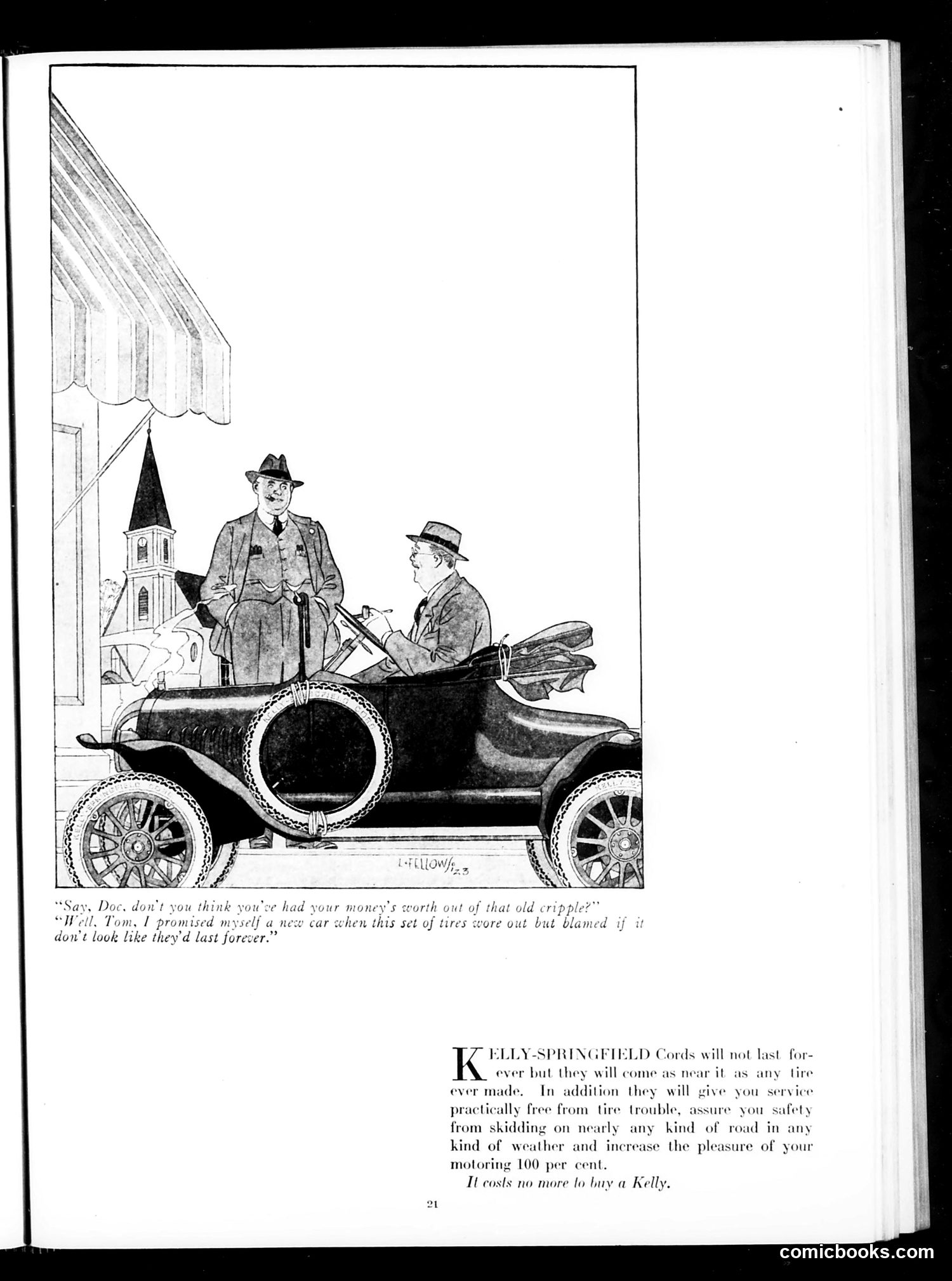
This is primarily a **Kelly-Springfield tire advertisement** disguised as comic content. The cartoon depicts two men in a vintage automobile (appearing to be from the 1910s-1920s era) having a conversation about tire durability. The humor relies on the dialogue: one man suggests his friend got excellent value from his tires, which have lasted so long he can now afford a new car. The friend responds that he'd promised himself a new vehicle when these tires wore out—but they show no signs of failing, so he's stuck keeping his old car. This inverts typical consumer expectations: usually, purchasing new tires means upgrading the vehicle itself. Here, Kelly-Springfield's durability becomes a comedic problem for the owner. The advertisement then pivots to selling the tire's actual benefits: longevity, safety, and value. The tagline "It costs no more to buy a Kelly" promises affordability without sacrificing quality—a common early 20th-century advertising claim.
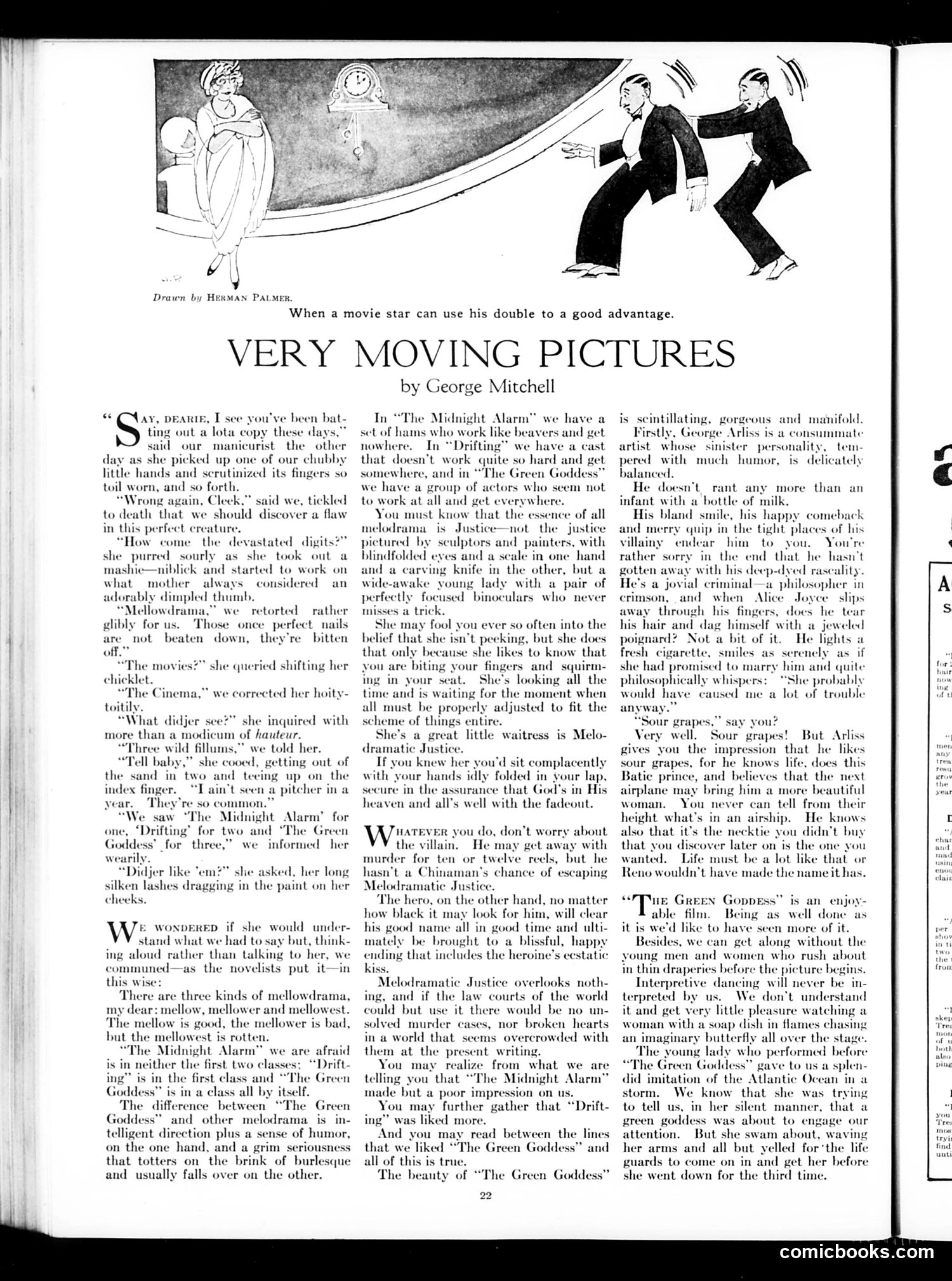
This page reviews three melodramatic films—*The Midnight Alarm*, *Drifting*, and *The Green Goddess*—through a conversational column by George Mitchell. The cartoon at top illustrates the article's opening joke: a movie star using his "double" (a stand-in actor) to advantage, likely depicting stunt work or trickery common in silent films. The main text is a humorous dialogue between the author and his manicurist about cinema. Mitchell classifies melodramas into tiers (mellow, mellower, mellowest) and argues that *The Green Goddess* succeeds because it combines intelligent direction with humor, rather than relying on overwrought acting ("hams") or implausible plots. He personifies "Melodramatic Justice" as a vigilant waitress ensuring villains face consequences and heroes achieve happy endings—a satirical dig at predictable, formulaic silent melodramas popular in the 1920s. The critique targets excessive theatrical acting and threadbare narrative conventions of the era.
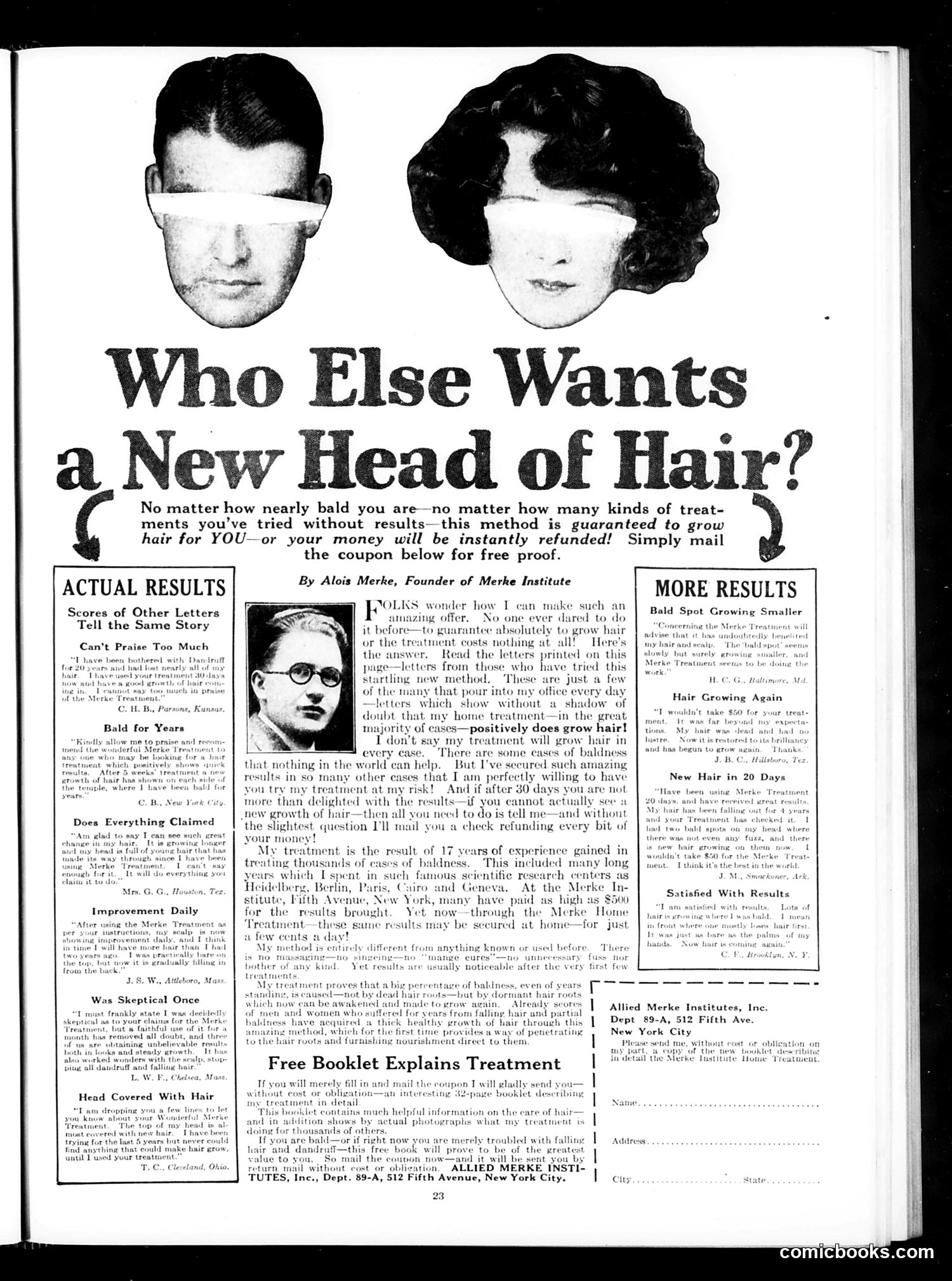
This page is **primarily a mail-order advertisement**, not satirical content. It advertises the Merke hair-growth treatment by Alois Merke, featuring testimonials from satisfied customers claiming hair regrowth after years of baldness. The advertisement uses a common early 20th-century marketing strategy: displaying "before" photos (the two blindfolded heads at top) and publishing customer letters as "proof." The pitch guarantees results or promises full refunds. It emphasizes Merke's credentials—17 years' experience, research at famous European centers—to establish legitimacy. While this appears in *Judge* magazine (known for satire), this particular page functions as **straight advertising copy**, not satire or cartoon commentary. The blindfolded faces may simply serve as anonymized "before" images rather than carrying satirical intent. For modern readers: this exemplifies early mass-media hair-loss marketing that relied on testimonials, pseudo-scientific claims, and money-back guarantees—tactics still common today but now more heavily regulated.
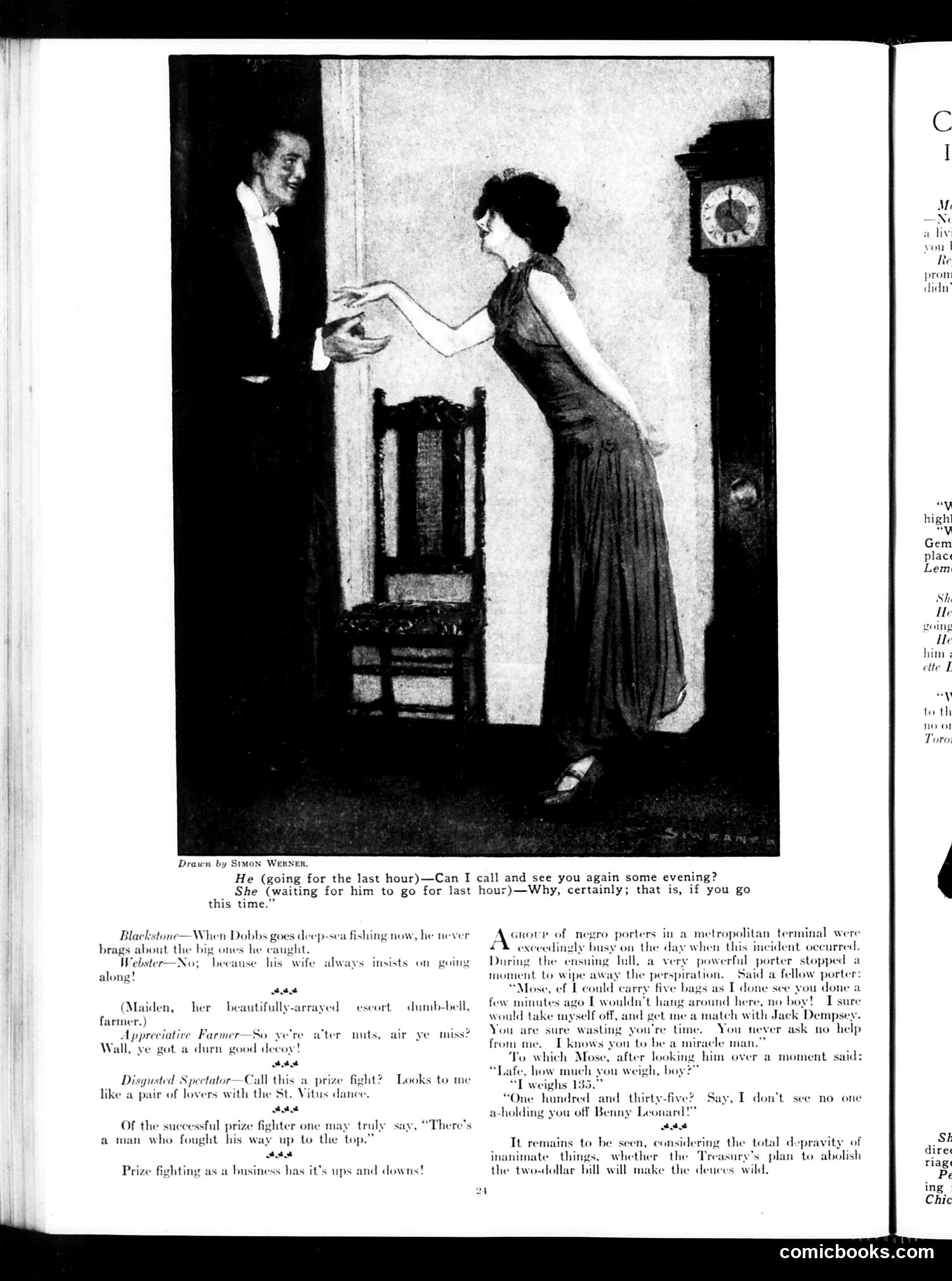
This page contains multiple short comic sketches typical of Judge's satirical humor: **Main illustration (top):** A drawn scene by Simon Werner showing a couple's awkward parting, with dialogue about calling again—a gentle satire on courtship formality. **Blackstone/Webster exchange:** Jokes about fishing and marriage, where a man stops bragging about catches because his wife accompanies him—mocking domestic power dynamics. **"Appreciative Farmer":** Rural dialect humor about a "dumb-bell" (attractive but foolish woman) and "decoy" (likely a hunting reference used as innuendo). **Prize-fighting jokes:** Multiple puns about boxing as a business with "ups and downs," and comparing a clumsy fight to lovers with involuntary muscle spasms (St. Vitus dance). **Porter dialogue:** Appears to feature African American characters discussing work efficiency and strength, with implications about Jack Dempsey (famous boxer). The humor relies on dialect and stereotypes typical of the era. **Final note:** A joke about abolishing the two-dollar bill making "deuces wild"—wordplay on card game terminology. The page is primarily humor/jokes rather than political satire.
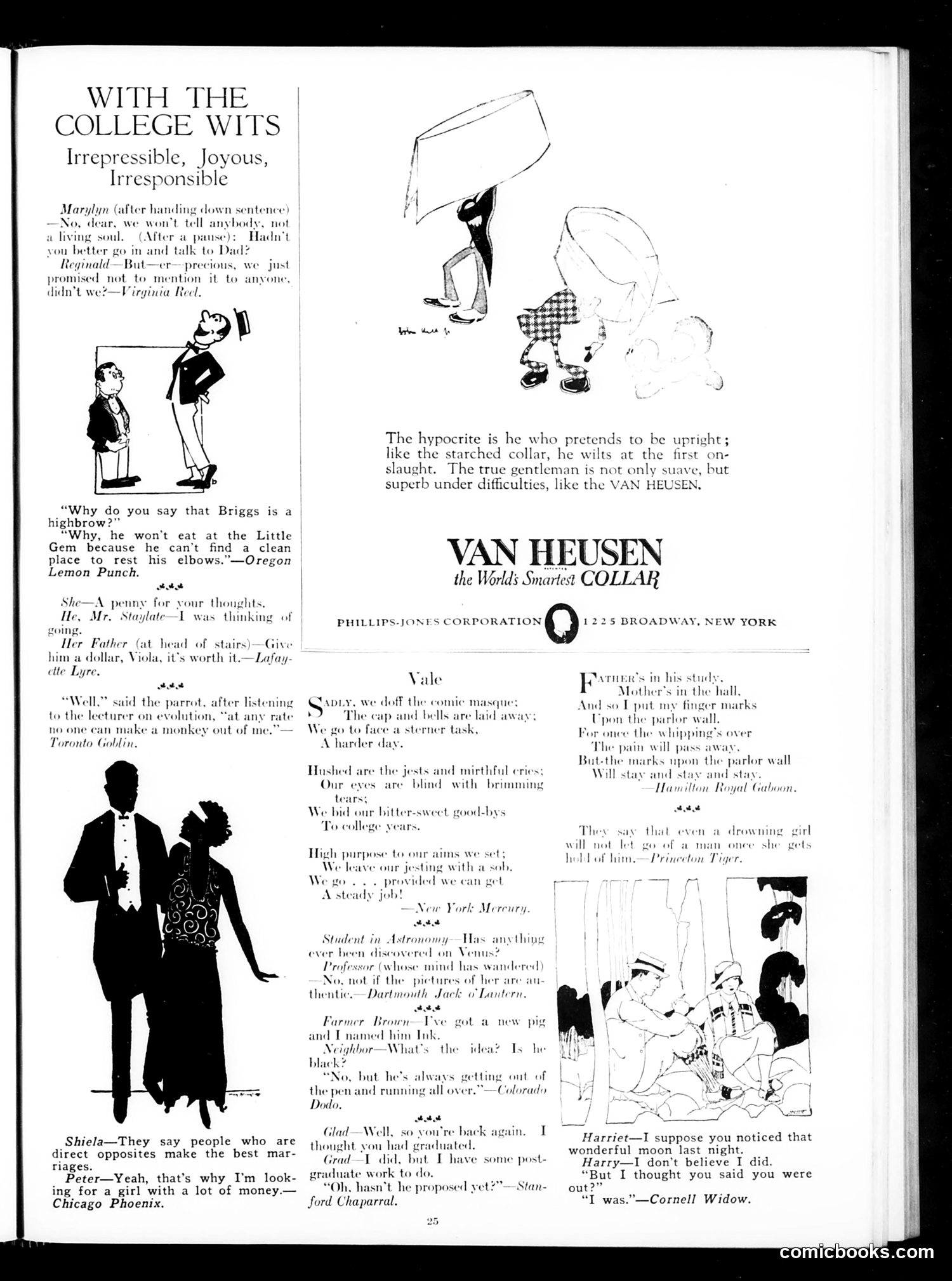
This page collects humor about college students, featuring satirical dialogues and a Van Heusen collar advertisement positioned as editorial content. **The Satirical Content:** The jokes target college life stereotypes: young men delaying serious conversations (Marylyn/Reginald dialogue), pretentious intellectuals (the "highbrow" who avoids casual restaurants), and the anxieties of graduation. Multiple pieces mock the transition from carefree college to adult responsibility—students joking about needing "a steady job" before leaving, or the awkwardness of post-graduate life. **The Advertisement:** Van Heusen uses the page's opening philosophy—that true gentlemen are "superb under difficulties"—to advertise their collar as a symbol of respectability. The collar brand is woven into college humor to suggest sophistication. **For Modern Readers:** This reflects 1920s-30s anxiety about young educated men entering an uncertain job market, and the cultural emphasis on masculine propriety through fashion and comportment. The humor assumes college readers recognize themselves in these types.
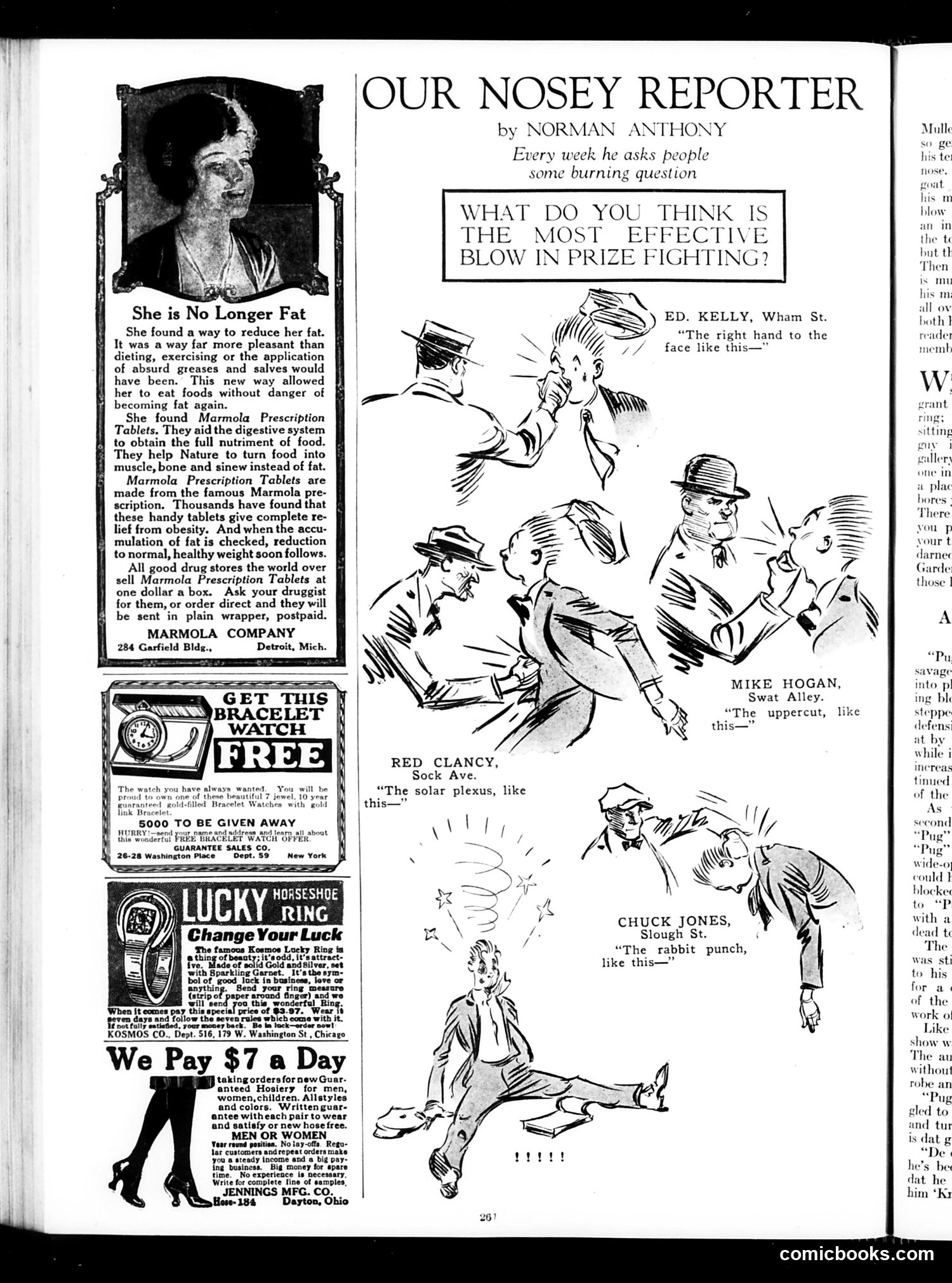
This page features a humor column by Norman Anthony asking street people: "What do you think is the most effective blow in prize fighting?" Four working-class men answer with boxing techniques, each demonstrating their answer through cartoonish illustrations: - **Ed. Kelly** recommends the right hand to the face - **Red Clancy** advocates the solar plexus strike - **Mike Hogan** suggests the uppercut - **Chuck Jones** champions the "rabbit punch" The humor lies in the simple, direct responses from ordinary laborers—these are real boxing enthusiasts sharing practical knowledge about the sport. The exaggerated drawings of men being struck emphasize each technique comedically. The satire gently mocks working-class boxing culture and street-level expertise. This reflects early-20th-century America's fascination with prize fighting, which was popular entertainment among urban working men.
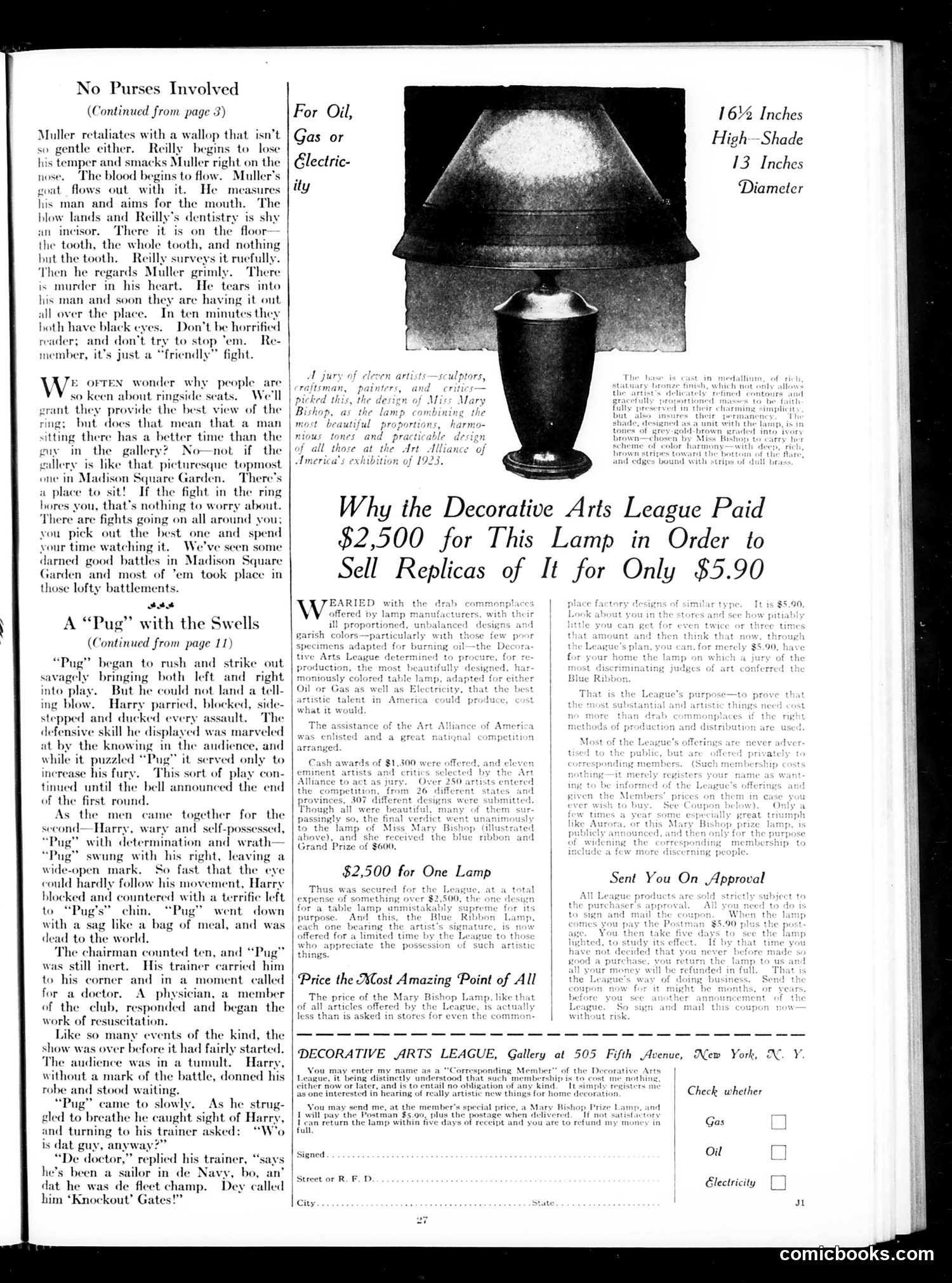
This page contains two distinct pieces: **"A 'Pug' with the Swells"** is a boxing story satirizing class differences. A working-class fighter called "Pug" fights an upper-class boxer named Harry at an exclusive club. Despite Pug's aggressive street-fighting style, Harry's refined technique and discipline prevail—he knocks Pug out in the second round. The humor lies in the contrast: Pug's raw brutality loses to Harry's cultivated skill, and even Pug's trainer (a former Navy boxer) respects Harry's superior training. The implied message mocks the notion that working-class toughness beats genteel education. **The main advertisement** promotes a decorative lamp designed by artist Mary Bishop. The Decorative Arts League paid $2,500 for the original design at a 1923 competition, then sells replicas for $5.90—a stunning markup justified as supporting artistic excellence and fair production methods. This is essentially an appeal to readers' aspirational taste and willingness to fund "art" at premium prices. Both pieces reflect 1920s values: class hierarchy, the appeal of cultural refinement, and commercialized aesthetics.
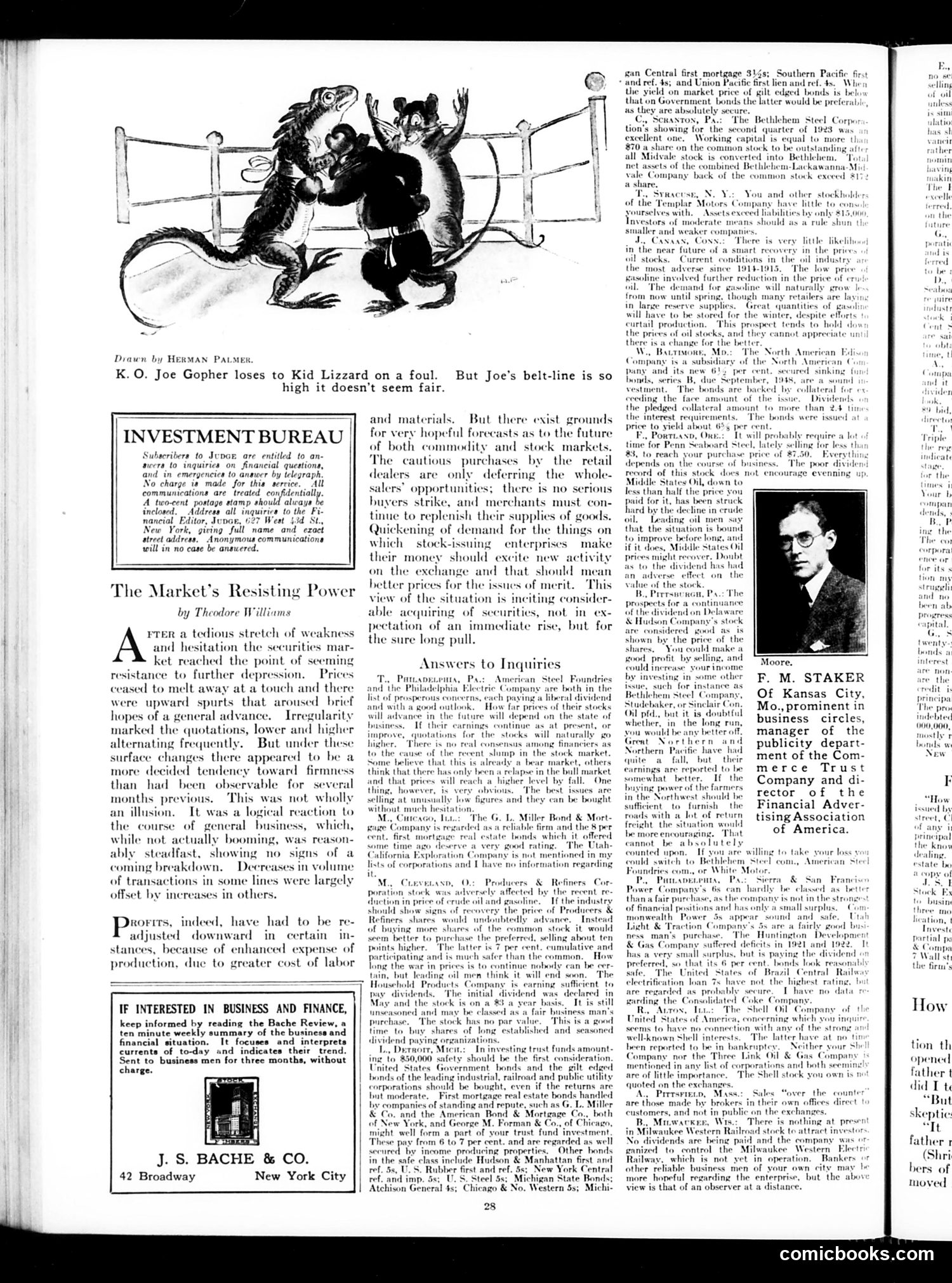
This page contains a comic strip titled "K. O. Joe Gopher loses to Kid Lizzard on a foul" drawn by Herman Palmer. The cartoon depicts two anthropomorphic animals (a gopher and a lizard) engaged in boxing, with the joke being that Joe the gopher's belt-line is positioned so high that it makes the apparent "foul" punch seem unfairly placed—a visual gag about proportions and fairness in boxing. The remainder of the page consists primarily of financial advice and investment discussion, typical of Judge's contemporary content. The "Investment Bureau" section answers reader inquiries about stocks and market conditions, discussing industrial prospects and securities valuations. This reflects Judge's dual purpose as both satirical commentary and practical business guidance for its educated, affluent readership during the early 20th century.
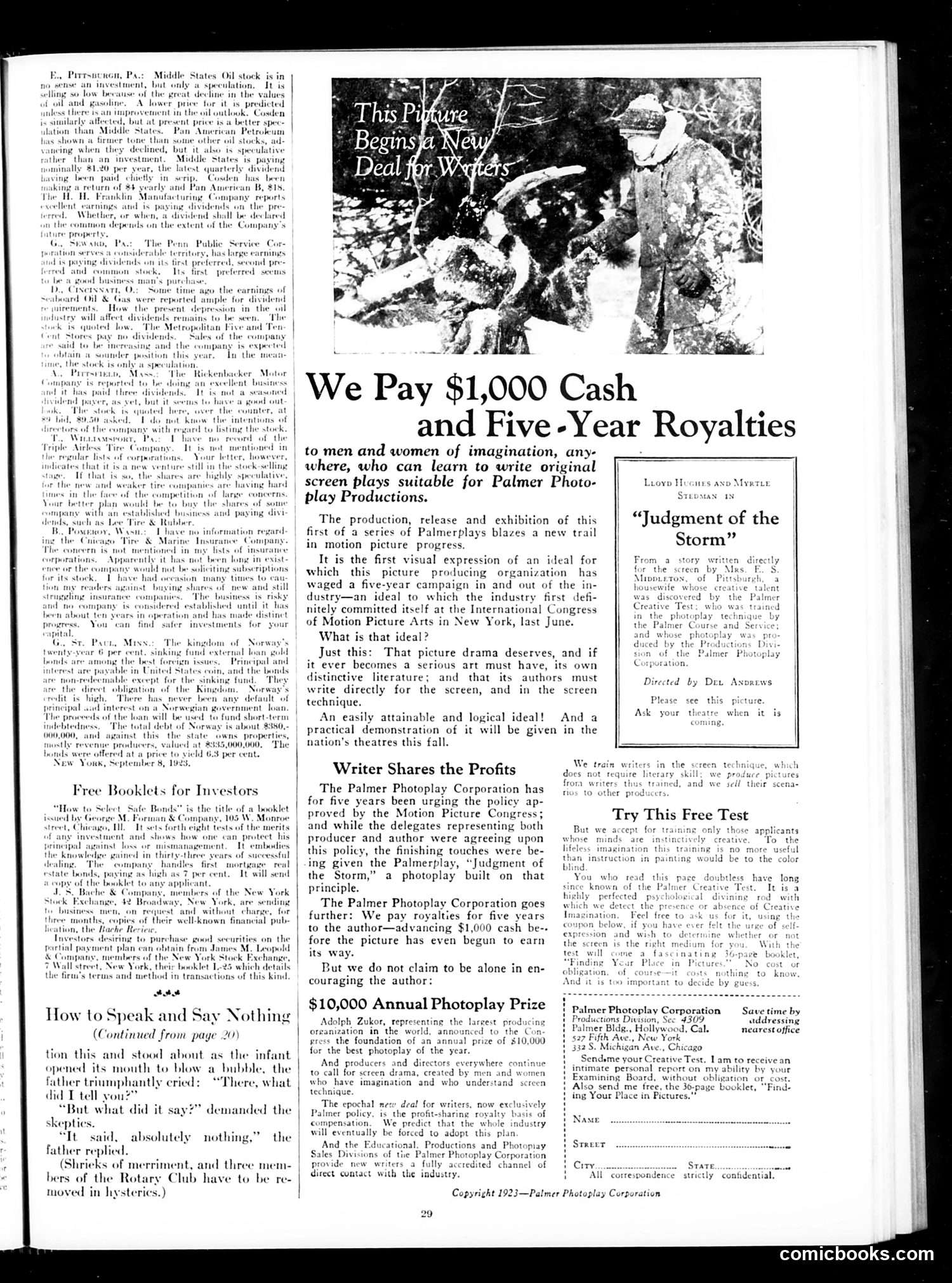
This page is primarily **advertising for the Palmer Photoplay Corporation**, not political satire. The main content promotes a screenwriting competition offering $1,000 cash and five-year royalties. The advertisement announces that Palmer Photoplay is seeking original screenplays, positioning itself as advancing a new artistic ideal: that motion pictures deserve their own distinctive literature, written specifically for film rather than adapted from other media. This was apparently a notable industry position at the time, endorsed at the International Congress of Motion Picture Arts in New York (June 1922). The ad invites "men and women of imagination" to submit scripts and includes a "free test" form. The surrounding text discusses stock investments in various oil and tire companies, typical Judge magazine financial advice content. **There is no discernible political cartoon on this page.** It represents standard 1920s business journalism mixed with entertainment industry advertising.
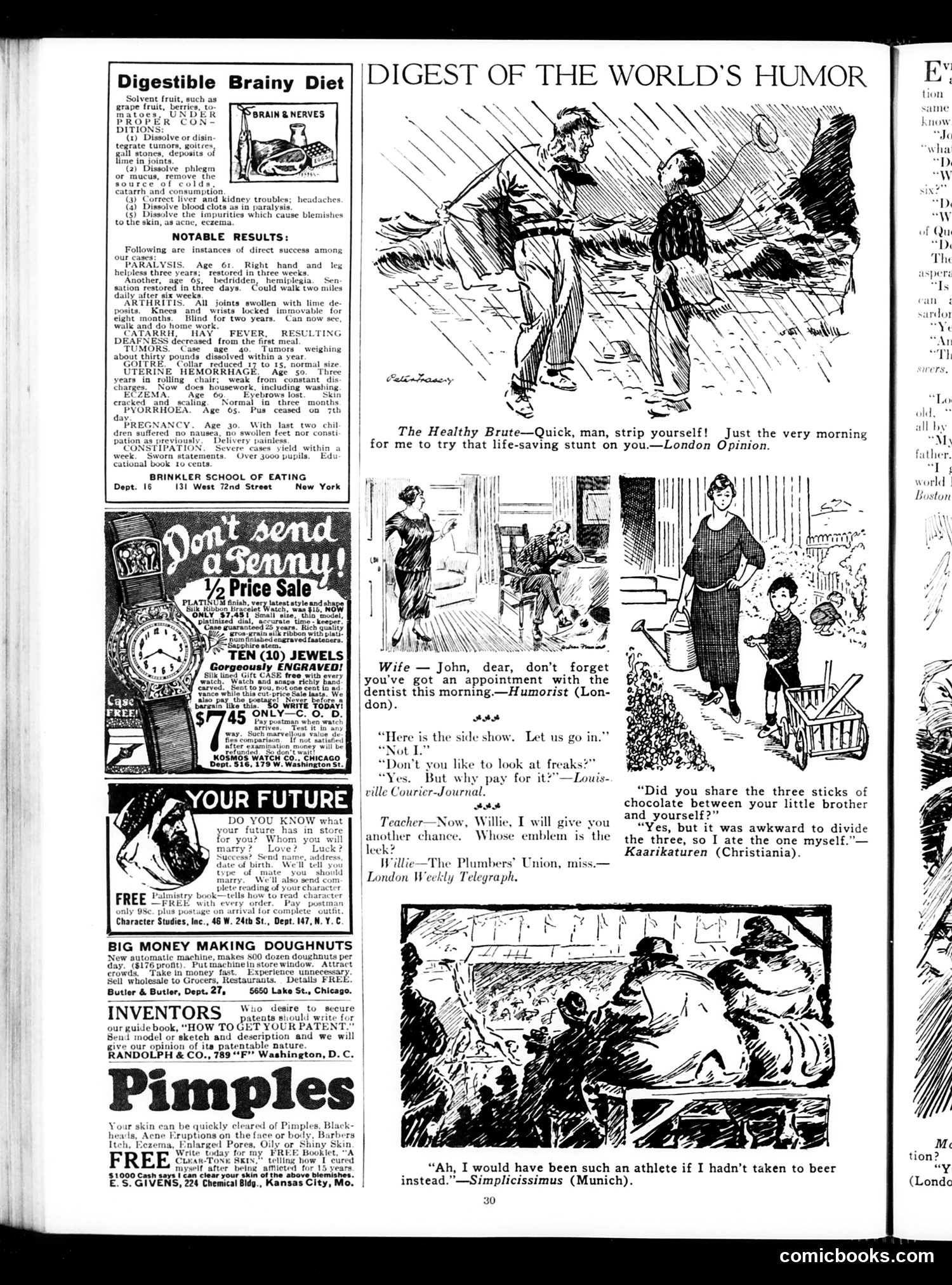
This page collects brief jokes and cartoons from international humor publications, a common Judge feature. The main cartoon shows a man being urged to strip for a dangerous stunt, satirizing health fads and pseudoscience. The reprinted jokes mock everyday domestic and social absurdities: a wife reminding her husband about a dentist appointment; a teacher asking about the Welsh leek (national symbol), to which a student jokes it belongs to the "Plumbers' Union"; a child admitting he ate all three chocolate pieces rather than fairly divide them; and a German cartoon lamenting lost athletic potential due to beer consumption. These represent typical early-20th-century humor: marital dynamics, educational mishaps, childhood mischief, and self-deprecating drinking culture. The "side show" cartoon satirizes curiosity about human oddities. The page also advertises questionable medical treatments and fortune-telling services typical of the era.
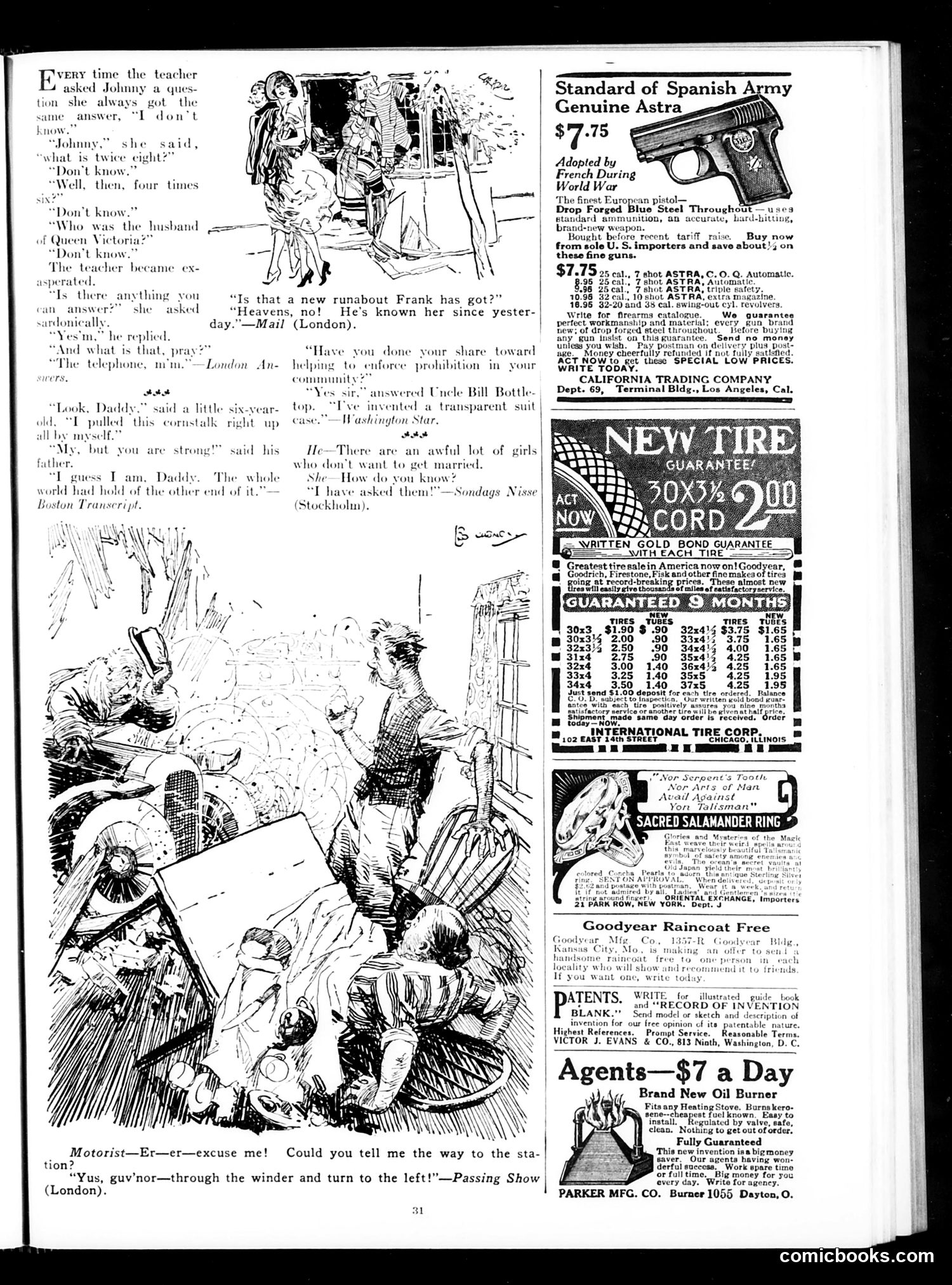
This page contains three distinct humor pieces: **"Johnny" (top left):** A teacher-student joke where a boy answers "I don't know" to every question, regardless of difficulty. The humor lies in his consistent cluelessness and the teacher's escalating frustration—a timeless schoolroom gag about an inattentive student. **"Motorist" (bottom):** A brief comic about a confused driver asking directions. The punchline—"through the winder [window] and turn to the left"—suggests the motorist is so lost or bewildered he should stick his head out the car window. The humor depends on early-20th-century automobile culture and the novelty of cars. **"Daddy" (middle-left):** A small anecdote where a child boasts about pulling up a cornstalk alone, then admits "the whole world had hold of the other end"—revealing he needed help. It's a children's joke about humorous honesty. The page is primarily **advertising** (Spanish Army pistols, tires, rings, patents, oil burners), with these three light comedy pieces interspersed. The satire is gentle and domestic rather than political.
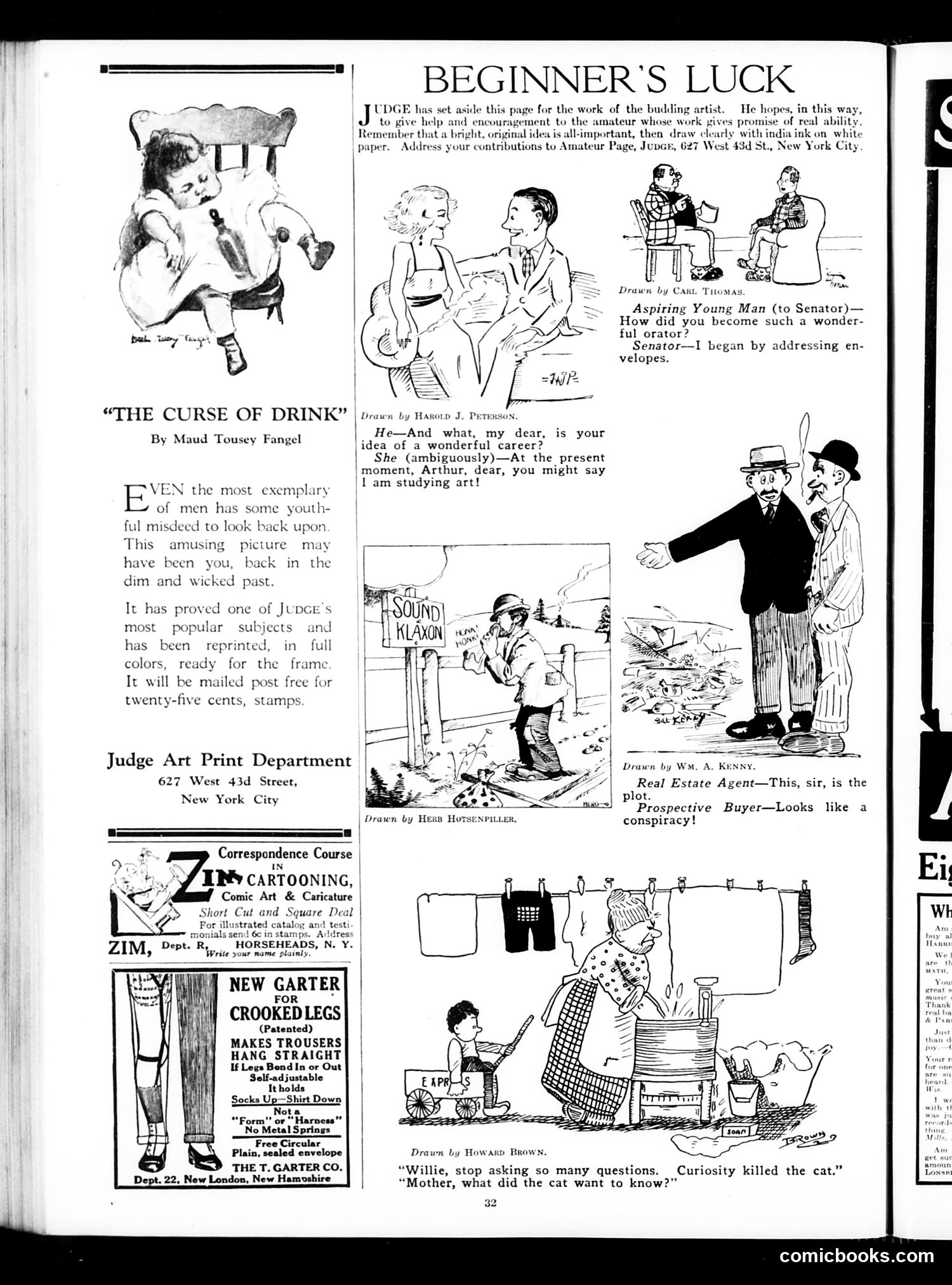
This page contains several brief humor cartoons and advertisements typical of early 20th-century American satirical magazines. **The cartoons satirize:** 1. **"Aspiring Young Man to Senator"** — Jokes about political advancement through mundane work ("addressing envelopes"), suggesting senators gained eloquence through tedious bureaucratic labor rather than genuine ability. 2. **"He and She"** — A man asks his girlfriend about her career aspirations; she ambiguously replies she's "studying art," which the humor suggests is code for avoiding serious work or commitment. 3. **"Real Estate Agent"** — The agent shows a plot of land that visually resembles a conspiracy diagram, implying real estate salesmen use deceptive tactics. 4. **"Mother and Willie"** — A child's innocent question ("what did the cat want to know?") plays on the proverb "curiosity killed the cat." **The advertisements** promote drawing courses, medical devices, and print reproductions—typical period marketing. The overall tone reflects middle-class social humor about ambition, romance, and parenting.
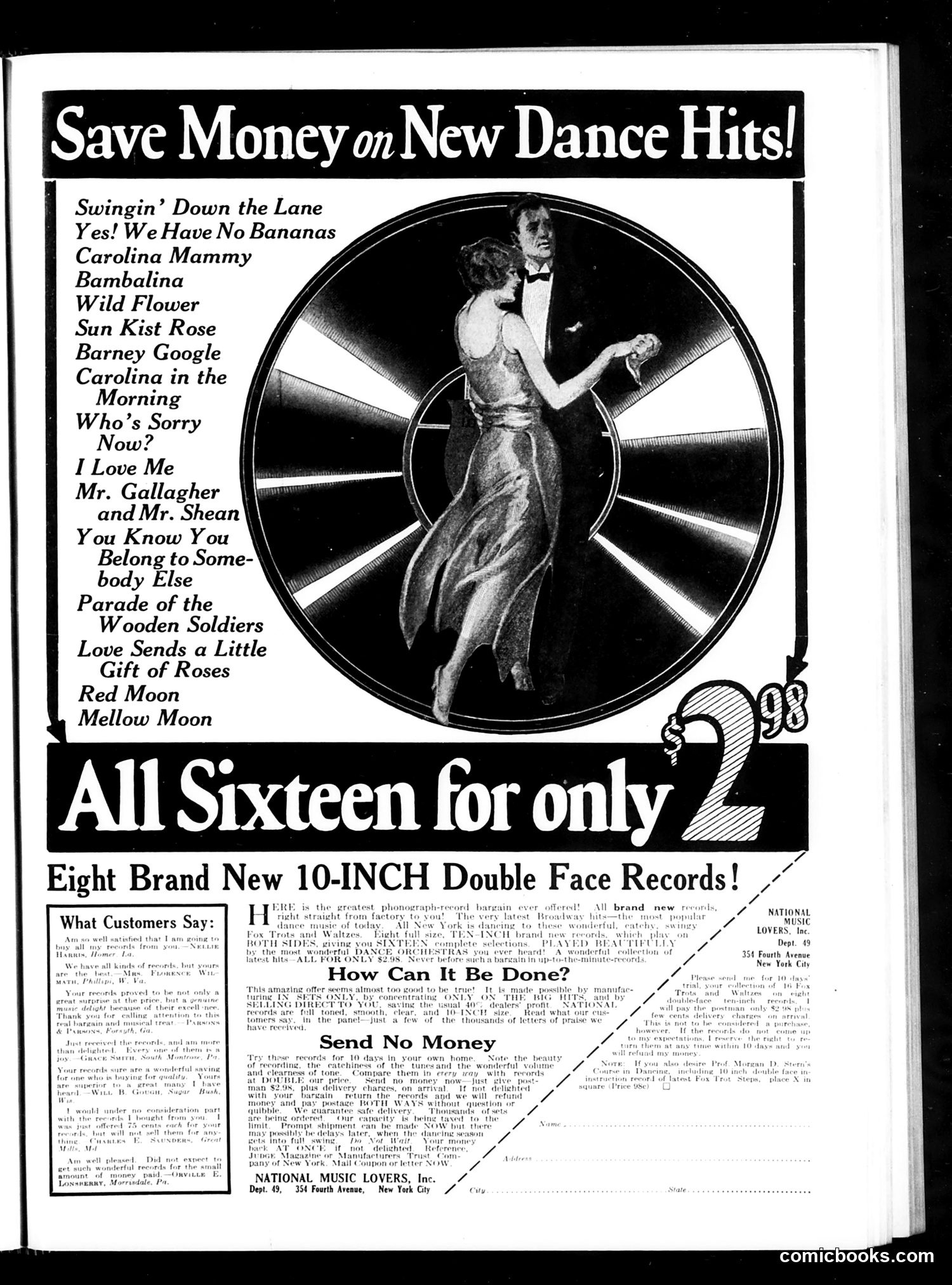
This is primarily a **music record advertisement**, not a political cartoon. It promotes a mail-order offer from National Music Lovers, Inc.: sixteen 10-inch double-sided records for $2.93. The page lists popular **jazz and dance songs from the early 1920s** ("Yes! We Have No Bananas," "Barney Google," "Carolina in the Morning"). The central illustration shows a stylized couple dancing—representing the "dance hits" advertised. The marketing pitch emphasizes value: customers could acquire current popular music cheaply without money upfront. Testimonials from satisfied buyers occupy the lower left. **Historical context:** This reflects the era's booming recorded music industry and mail-order commerce. The song titles and illustration style date this to approximately 1923-1924, during jazz's explosive popularity in American culture. This is commercial advertising rather than satirical commentary, though Judge magazine itself was known for humor and social critique.
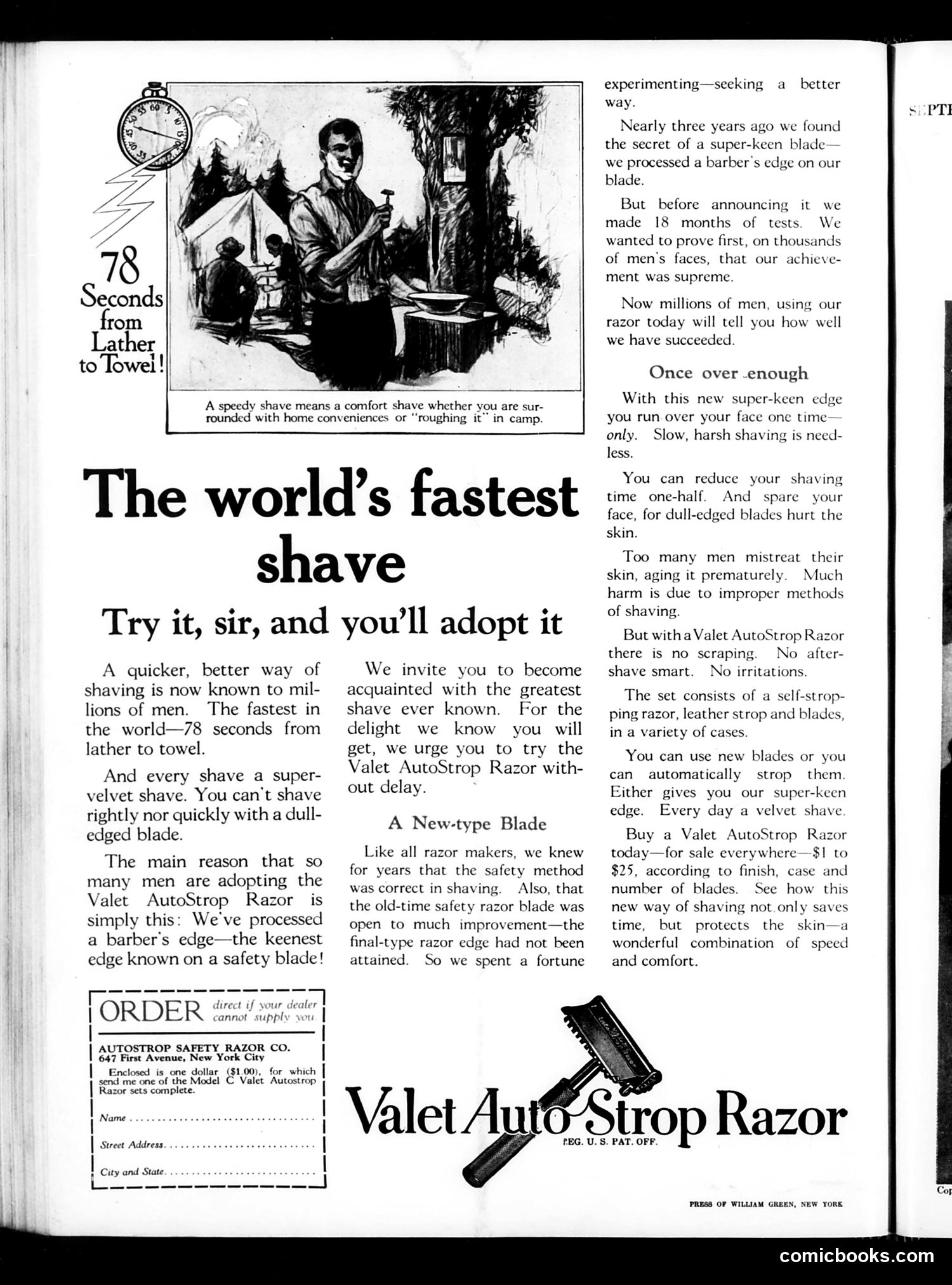
This page is primarily a **product advertisement**, not political satire. It promotes the Valet AutoStrop Razor, emphasizing speed ("78 seconds from lather to towel") and skin protection through a superior blade edge. The illustration shows a barber shaving a customer in what appears to be a camp setting, demonstrating the razor's utility in varied conditions—a marketing appeal to soldiers or outdoor workers during the WWI era (when Judge published this). The satire, if present, is subtle and commercial rather than political: the ad claims superiority through rigorous testing (18 months) and scientific development, positioning the razor as a modern solution to poor shaving methods that "age skin prematurely." This reflects early 20th-century marketing's use of pseudo-scientific claims to drive consumer adoption. The page includes an order coupon for $1, making this primarily advertising copy rather than editorial commentary on contemporary events or figures.