
Judge, 1923-09-15 · page 21 of 36
Judge — September 15, 1923 — page 21: what you’re looking at
What you’re looking at
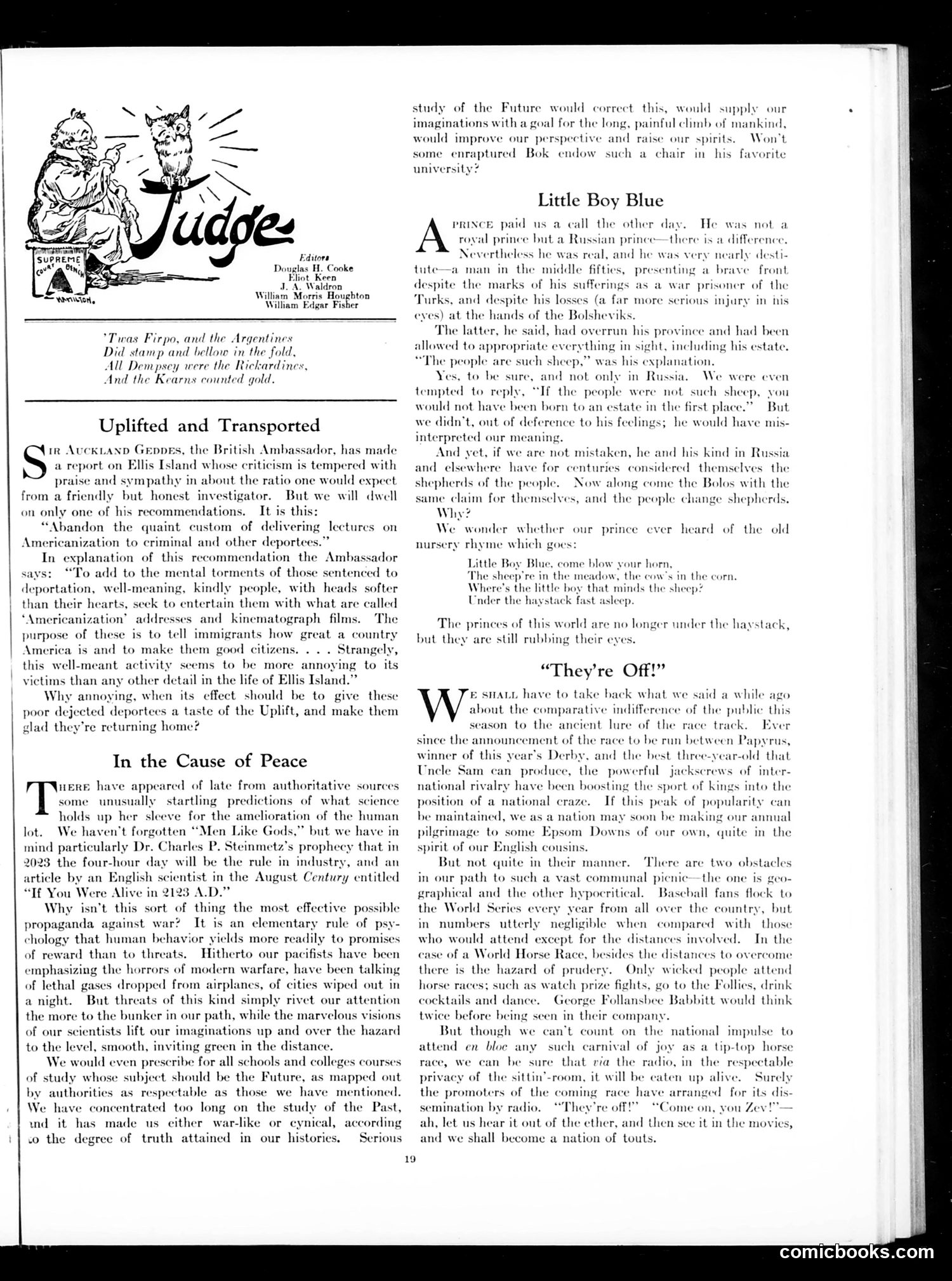
## The "Judge" Masthead Cartoon The small illustration shows a figure pointing at a cat or fox—likely satirizing judicial authority or social criticism with a whimsical tone typical of Judge's approach. ## Key Articles and Their Satire **"Uplifted and Transported"**: Mocks the U.S. practice of lecturing deported immigrants about American greatness while sending them away. The satire is that authorities force "Americanization" propaganda on people being expelled—the irony being this makes deportation *more* insulting, not rehabilitative. **"In the Cause of Peace"**: Argues that teaching optimistic visions of the technological future (four-hour workdays by 2028, flying cars by 2123) would be better anti-war propaganda than showing warfare's horrors. The piece suggests inspiring hope works better than fear. **"Little Boy Blue"**: A sympathetic anecdote about a destitute Russian prince visiting, who lost everything to Bolsheviks. The title echoes the nursery rhyme, suggesting his ruined status as both aristocratic and pitiful. The page reflects 1920s American concerns: immigration policy, post-war pacifism, and Cold War-era skepticism toward communism.
📄 Transcribed text from this page (OCR, searchable)
Machine-transcribed from the original scan — historical spelling and the odd misread are preserved.
Editors Douglas H. Cooke Eliot Keen J. A, Waldron William Morris Houghton William Edgar Fisher 'Twas Firpo, and the Argentines Did stamp and bellow in the fold, All Dempsey were the Rickardines, {nd the Kearns counted gold. Uplifted and Transported ir AucKLAND Geppes, the British Ambassador, has made a report on Ellis Island whose criticism is tempered with praise and sympathy in about the ratio one would expect from a friendly but honest investigator. But we will dwell on only one of his recommendations. It is this: “Abandon the quaint custom of delivering lectures on Americanization to criminal and other deportees.” In explanation of this recommendation the Ambassador “To add to the mental torments of those sentenced to deportation, well-meaning, kindly people, with heads softer than their hearts, seek to entertain them with what are called “Americaniz. addresses and kinematograph films. The purpose of these is to tell immigrants how great a country America is and to make them good citizens. . . . Strangely, this well-meant activity seems to be more annoying to its victims than any other detail in the life of Ellis Island.” Why annoying, when its effect should be to give these poor dejected deportees a taste of the Uplift, and make them glad they're returning home? says: on? In the Cause of Peace nere have appeared of late from authoritative i unusually startling predictions of what science holds up her sleeve for the amelioration of the human lot. We haven't forgotten “Men Like Gods,” but we have in mind particularly Dr. Charles P. Steinmetz’s prophecy that in 2028 the four-hour day will be the rule in industry, and an article by an English scientist in the August Century entitled “If You Were Alive in 2123 A.D.” Why isn’t this sort of thing the most effective possible propaganda against war? It is an elementary rule of psy- chology that human behavior yields more re of reward than to threats. Hitherto our pd emphasizing the horrors of modern warfare of lethal gases dropped from airplanes, of cities wiped out in a night. But threats of this kind simply rivet our attention the more to the bunker in our path, while the marvelous visions of our scientists lift our imaginations up and over the hazard to the level, smooth, inviting green in the distance. We would even prescribe for all schools and colleges courses sources. lily to promises ists have been n talking ave b of study whose subject should be the Future, as mapped out by authorities as respectable as those we have mentioned. We have concentrated too long on the study of the Past, md it has made us cither war-like or cynical, according vo the degree of truth attained in our histories. Serious study of the Future would correct this, would supply our imaginations with a goal for the long, painful climb of mankind, would improve our perspective and raise our spirits. Won't some: enraptured Bolt endow: such » chair ja his favorite university Little Boy Blue PRINCE paid us a call the other day. He was not a royal prince but. a Russian prince—there is a difference. I, and he was very nearly desti- fute—a man in the middle fifties, presenting a brave front despite the marks of his sufferings as a war prisoner of the Nevertheless he was red Turks, and despite his losses (a far more serious injury in his eyes) at the hands of the Bolsheviks. The latter, he said, had overrun his province and had been allowed to appropriate everything in sight, including his estate. The people are such sheep. was his explanation. Yes, to be sure, and not only in Russia. We were even tempted to reply, “If the people were not such sheep, you would not have been born to an estate in the first place.” But we didn't, out of deference to his feelings; he would have mis- interpreted our meaning. And yet, if we are not mistaken, he and elsewhere have for centuries con shepherds of the people. and his kind in Russia lered themselves the Now along come the Bolos with the same claim for themselves, and the people chang hepherds. - wonder whether our prince ever heard of the old nursery rhyme which goes: Little Boy Blue, come blow your horn, ‘The sheep’re in the meadow, the cow's in the corn. W 's the little boy that minds the sheep? Under the haystack fast asleep. The princes of this world are no longer under the haystack, but they are still rubbing their « ative indifference of the public this “They’re Off!” SHALL have to take back what we said a while ago \ V bout the comps season to the ancient lure of the track. Ever since the announcement of the race to be run between Papyrus, winner of this year's Derby, Unele natio race \ best three-year-old. that n can produce, the powerful jackscrews of inter- and the tl rivalry have been boosting the sport of kings into the position of a national erg If this peak of popularity can be maintained, we as a nation may soon be making our annual pilgrimage to some Epsom Downs of our own, quite in the spirit of our English cousins. But not quite in their manner. There are two obstacles in our path to such a vast communal picnic—the one is geo- graphical and the other hypocritical. Baseball fans flock to the World Series eve r from all over the country, but in numbers utterly negligible when compared with’ those who would attend except for the distances involved. In the ase of a World Horse Race, besides the distances to overcome there is the hazard of prudery. horse rac Only wicked people attend ; such as watch prize fights, go to the Follies, drink cocktails and dance. George Follansbee Babbitt would think twice before being seen in their company. But though we can’t count on the national impulse to attend en bloc any such carnival of joy as a tip-top horse ri “e, we can be sure that ria the radio, in the respectable privacy of the sittin’-room, it will be eaten up alive. Surely the promoters of the coming race have arranged for its dis- semination by radio. ‘They're off!" “Come on, you Zey!"— ah, let us hear it out of the ether, and then see it in the movies, and we shall become a nation of touts. comicbooks.com