
Judge, 1923-09-15 · page 15 of 36
Judge — September 15, 1923 — page 15: what you’re looking at
What you’re looking at
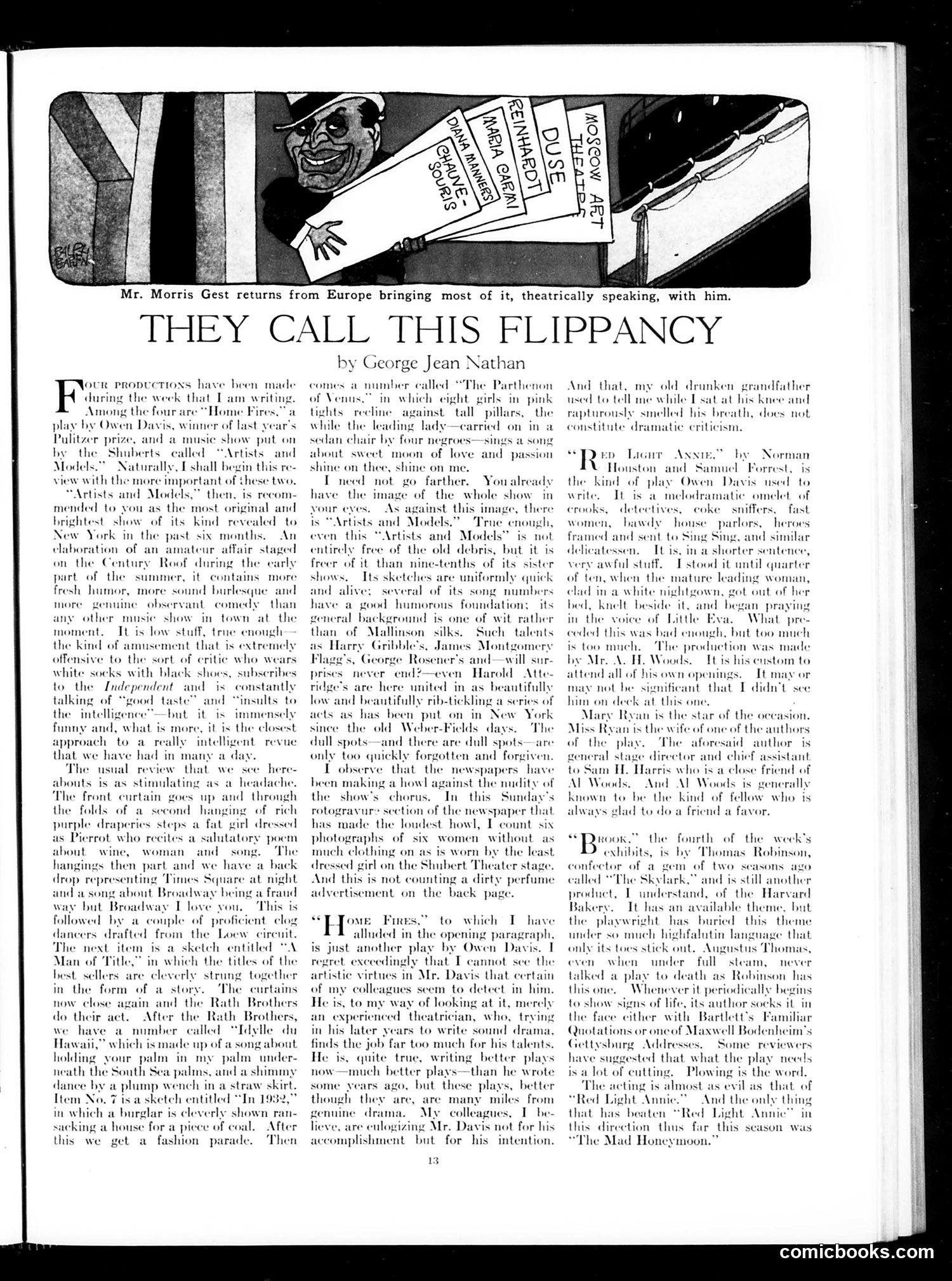
## The Cartoon The top image depicts **Morris Gest**, a prominent theater impresario, returning from Europe with theatrical productions under his arm. The exaggerated caricature suggests Gest is bringing European theatrical pretensions back to America. The satire: he's arriving with grand artistic aspirations, depicted somewhat mockingly. ## The Article Theater critic **George Jean Nathan** reviews recent Broadway productions, particularly praising the musical "Artists and Models" (by the Shuberts) as surprisingly intelligent entertainment, despite being lowbrow comedy. He contrasts it favorably with other shows, including Owen Davis's "Home Fire." Nathan mocks censorious critics ("white socks with black shoes" types) who object to the show's nudity and "vulgarity," while defending the production's genuine humor and wit. The article's title "They Call This Flippancy" suggests contemporary critics dismissed such entertainment as frivolous—a dismissal Nathan disputes. The satire targets both pretentious theatrical gatekeepers and the hypocrisy of newspapers simultaneously condemning chorus nudity while printing photographs of scantily-clad women.
📄 Transcribed text from this page (OCR, searchable)
Machine-transcribed from the original scan — historical spelling and the odd misread are preserved.
Mr. Morris Gest returns from Europe bringing most of it, theatrically speaking, with him. THEY CALL THIS FLIPPANCY by George Jean Nathan joeR PRODUCTIONS have been made during the week that [am writing. Among the four are “Home Fire: play by Owen Davis, winner of last year's Pulitzer prize, and a music show put on by the Shuberts called “Artists and Models.” Naturally, [shall begin this re- view with the more important of these two. “Artists and Models,” then, is recom- mended to you as the most original and brightest: show of its kind revealed to New York in the past six months. An elaboration of an amateur affair staged on the Century Roof during the early part of the summer, it contains more fresh humor, more sound burlesque and more genuine observant comedy than any other musie show in town at the moment. It is low stuff, true enough the kind of amusement that is extremely offensive to the sort of critic who wears white socks with black shoes, subscribes to the Independent and talking of “yg is. constantly 1 taste” and “insults to the intelligence’—but it is immensely funny and, what is more, it is the closest approach to a really intelligent’ revue that we have had in many a day. The usual review that abouts is as stimulating as a he The front curtain goes up and through the folds of a second hanging of rich purple draperies steps a fat girl dressed as Pierrot. who recites a salutatory pocm about wine, woman and The hangings then part and we have a back drop representing ‘Times night and a song about Broadway being a fraud way but Broadway I love you. This is followed by a couple of proficient clog dancers drafted from the Loew cirenit. The next item is a sketch entitled “A Man of Title,” in which the titles of the best sellers are cleverly strung together in the form of a story. ‘The curtains rain and the Rath Brothers: After the Rath Brothers, a number called “Idylle du which is made up of a song about holding your palm in my palm under- neath the South Sea palms, and a shimmy dance by a plump wench in as Item No, 7 is a sketch entitled * in which a burglar is cleverly shown sacking a house for a piece of coal. After this we get a fashion parade. Then we s ca mumber called “The Parthenon of Venus.” in which eight: girls in’ pink tights recline against tall pillars, the while the leading lady—carried on in a Jan chair by four negroes about sweet moon of love and. passion shine on thee, shine on me, I need not go farther. have the im: of the whole show in your eyes. As against this image, there is “Artists and Models.” Trne enough, even this “Artists and Models” is not entirely free of the old debris, but it is freer of it than nine-tenths of its: sister shows. Its sketches are uniformly quick alive; several of its song numbers have a good humorous foundation; its general background is one of wit rather than of Mallinson. silks. Such talents as Harry Gribble’s, James Montgomery Bi: George Rosener’s and—will sur- prises never end?—even Harold Atte- ridge’s are here united in as beautifully low and beautifully rib-tickling a series of acts as has been put on in New York since the old) Weber- The dull spots—and there are dull spots—are only too quickly forgotten and forgiven. I observe that the newspapers have been making a howl against the nudity of the show's chorus. In- this Sunday's rotogravure section of the newspaper that has made the loudest howl, T count: six photographs of six women without as much clothing on as is worn by the dressed girl on the Shubert Theater stage. And this is not counting a dirty perfume advertisement on the back pa sings a song You already and ds days. “Hove Fires.” to which IT have alluded in the opening paragraph, is just another play by Owen Davis. I et exceedingly that T cannot see the artistic virtues in Mr. Davis that certain of my colleagues scem to detect in him. He is, to my way of looking at it, merely an experienced theatrician, who, trying in his later years to write sound drama, finds the job far too much for his tale He is, quite true, writing better plays now—much better plays—than he wrote some years ago, but these plays, better though the: re, are many miles from genuine drama. My colleagues, I ve, are cule ng Mr. Davis not for his accomplishment but. for his. intention. 13 And that, my old drunken grandfather used to tell me while T sat at his knee and rapturously smelled his breath, does not constitute dramatic criticism. “Re Ligue Axsie.”) by Norman Houston and Samuel Forrest, is the kind of play Owen Davis used. to write. It is a melodramatic omelet of crooks, detectives, coke sniffers, fast women, bawdy house parlors, heroes framed and sent to Sing Sing, and similar It is, in a shorter sentence, very awful stuff. [stood it until quarter of ten, when the mature leading woman, clad in a white nightgown, got out of her bed, knelt beside it, and began praying in the voice of Little Ev What. pre- ceded this was bad enough, but too much is too much. ‘The production was made by Mr. A. H. Woods. It is his custom to attend all of his own openings. [Tt may or may not be signifieant that I didn’t sce him on deck at this one, Mary Ryan is the star of the occasion. Miss Ryan is the wife of one of the authors of the play. The aforesa tuthor is general stage director and chief assistant to Sam TH. Harris who is a close friend of Al Woods. And AL Woods is generally known to be the kind of fellow who is always glad to do a friend a favor. delicatessen, “Broo: the fourth of the week's exhibits, is by ‘Thomas Robinson, confector of em of two seasons ago called “The Skylark,” and is still another product, T understand, of the Harvard Bakery. It has an av ble theme, but the playwright has buried this theme under so much highfalutin language that only its toes stick out. Augustus Thomas, even when under full) steam, never talked a play to death as Robinson has this one. Whenever it periodically begins to show signs of life, its author socks it_in the face cither with Bartlett's Familiar Quotations or oncof Maxwell Bodenheim’s Gettysburg Add have suggested that what the play needs is a lot of cuttin Plowing is the word. The acting is almost as evil as that of “Red Light Annie.” And the only thing that has beaten “Red Light Annie” in this direction thus far this season was ~The Mad Honeymoon.” Some reviewers comicbooks.com